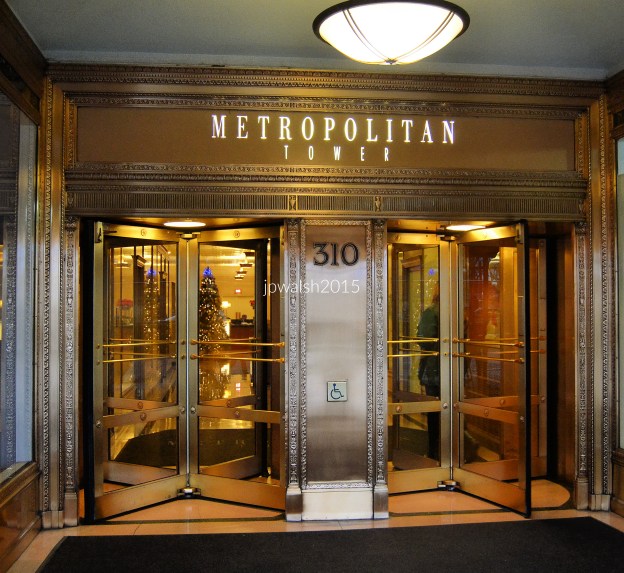
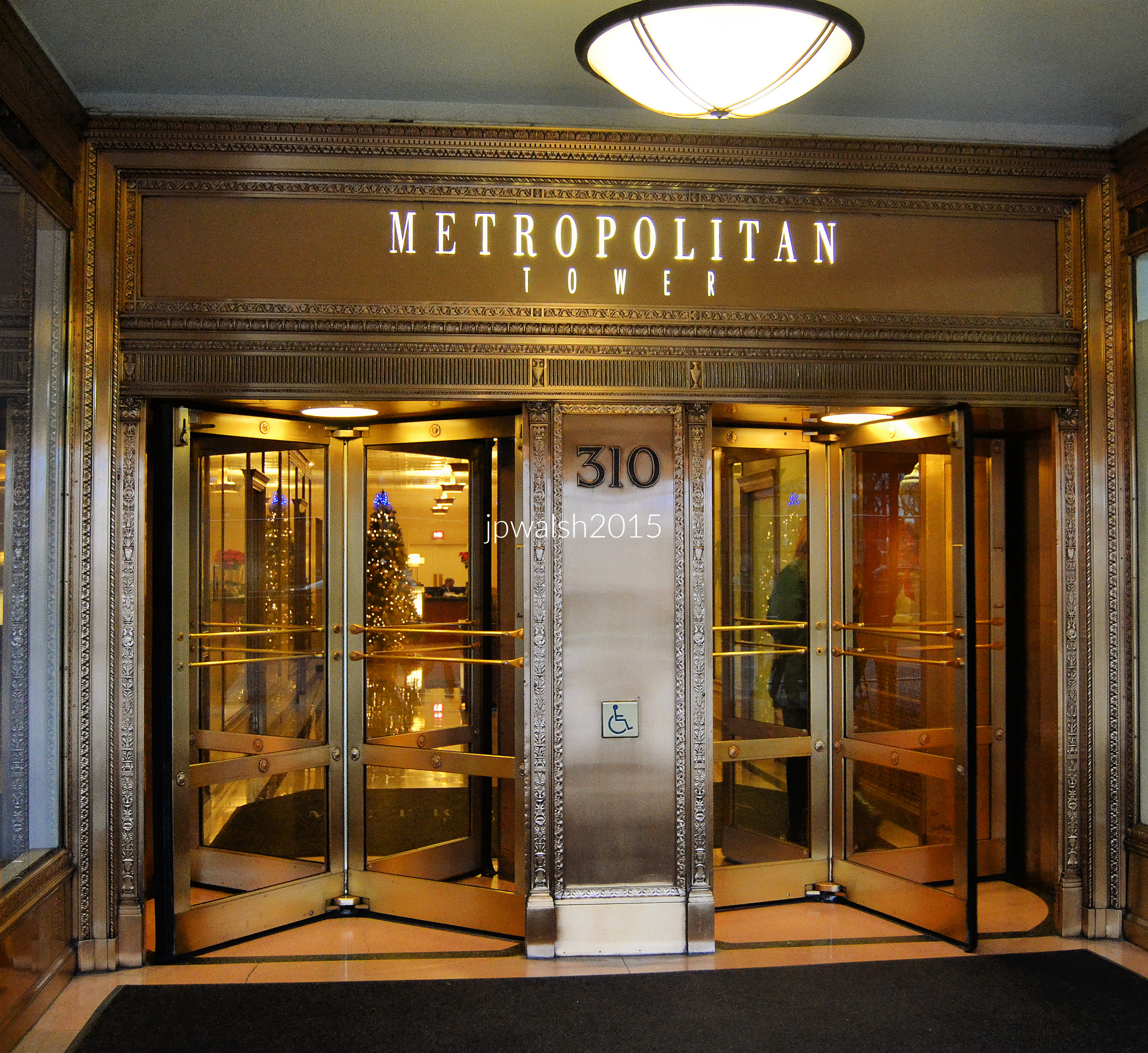
Feature Image: Main Entrance, Metropolitan Tower (1924), 310 South Michigan Avenue, Chicago, was designed by Graham, Anderson, Probst & White. December 2015. 4.89 mb DSC_0963 (1). Author’s photograph.
Metropolitan Tower’s main entrance is more than an architectural detail: it is a surviving gateway to one of Chicago’s most significant early skyscrapers, a building that embodied the ambitions, craftsmanship, and corporate prestige of the 1920s while reflecting the evolution of Michigan Avenue and modern Chicago.
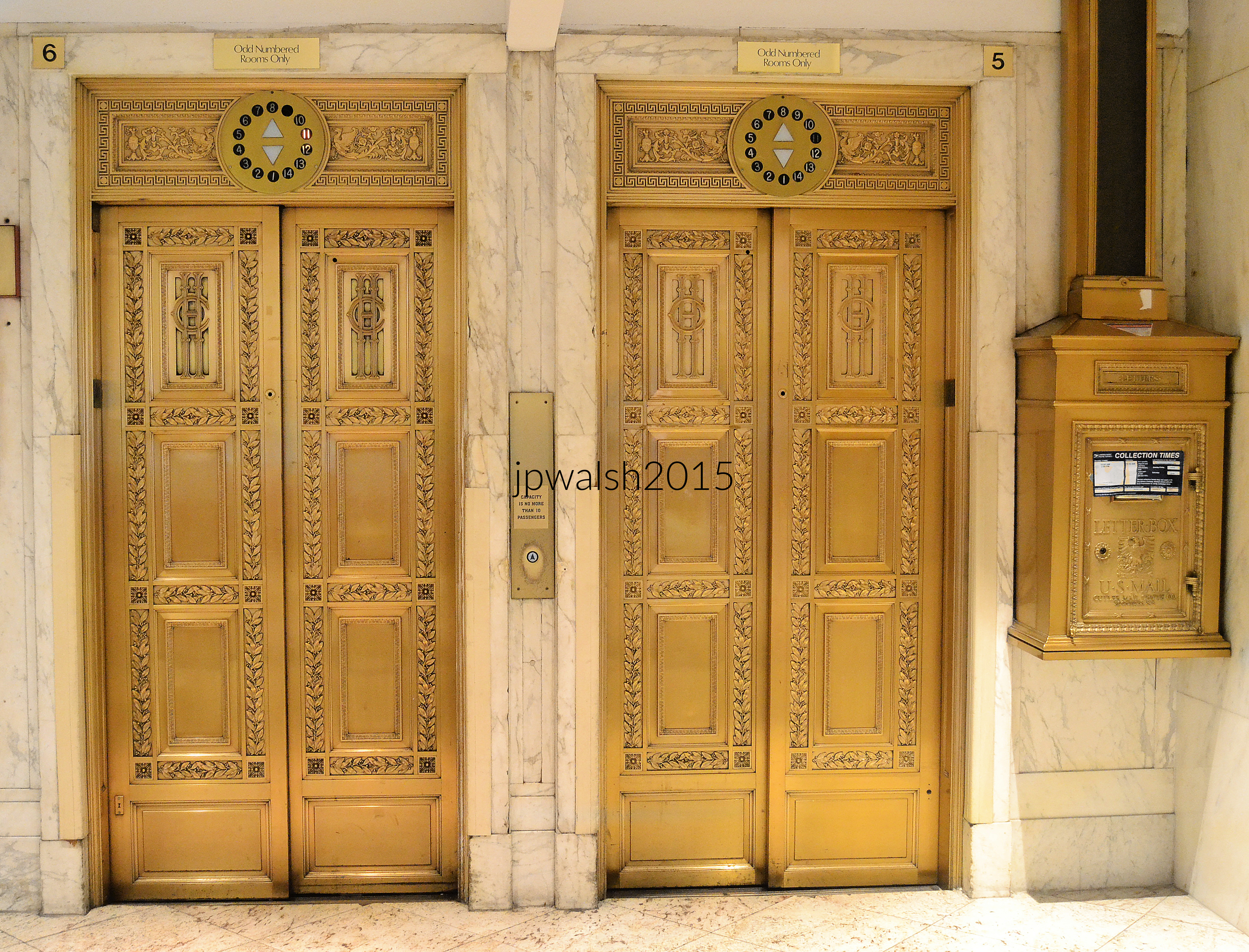
Located at 310 South Michigan Avenue on the southwest corner of Jackson Boulevard, Metropolitan Tower originally served as corporate headquarters for S.W. Straus and Co., a banking and investment firm. The building was erected in 1924 by Graham, Anderson, Probst & White in their signature classical style. The architectural firm was one of the largest in the first half of the twentieth century and went on to build Chicago’s Civic Opera Building in 1929. Founded in 1912, the firm was the successor to D. H. Burnham & Co. by way of partner, Ernest R. Graham (1868-1936), and Burnham’s sons, Hubert and Daniel Jr. Five years later the Burnhams left to form their own firm (Burnham Brothers) and Graham partnered with others of the firm’s members: William Peirce Anderson (1870-1924), Edward Mathias Probst (1870-1942), and Howard Judson White (1870-1936). No expense was spared for the Straus Building’s interior, though of the original lobby’s opulence all that remains are the elaborate bronze elevator doors. The entrance’s coffered bronze doors by Italian sculptor Leo Lentelli (1879-1961) were destroyed. see – Saliga, Pauline A., editor, The Sky’s The Limit A Century of Chicago Skyscrapers, Rizzoli New York, 1990, p. 117.
The Metropolitan Tower was built in 1924 as the headquarters of S.W. Straus & Co. and designed by Graham, Anderson, Probst & White, successors to the Burnham architectural tradition.
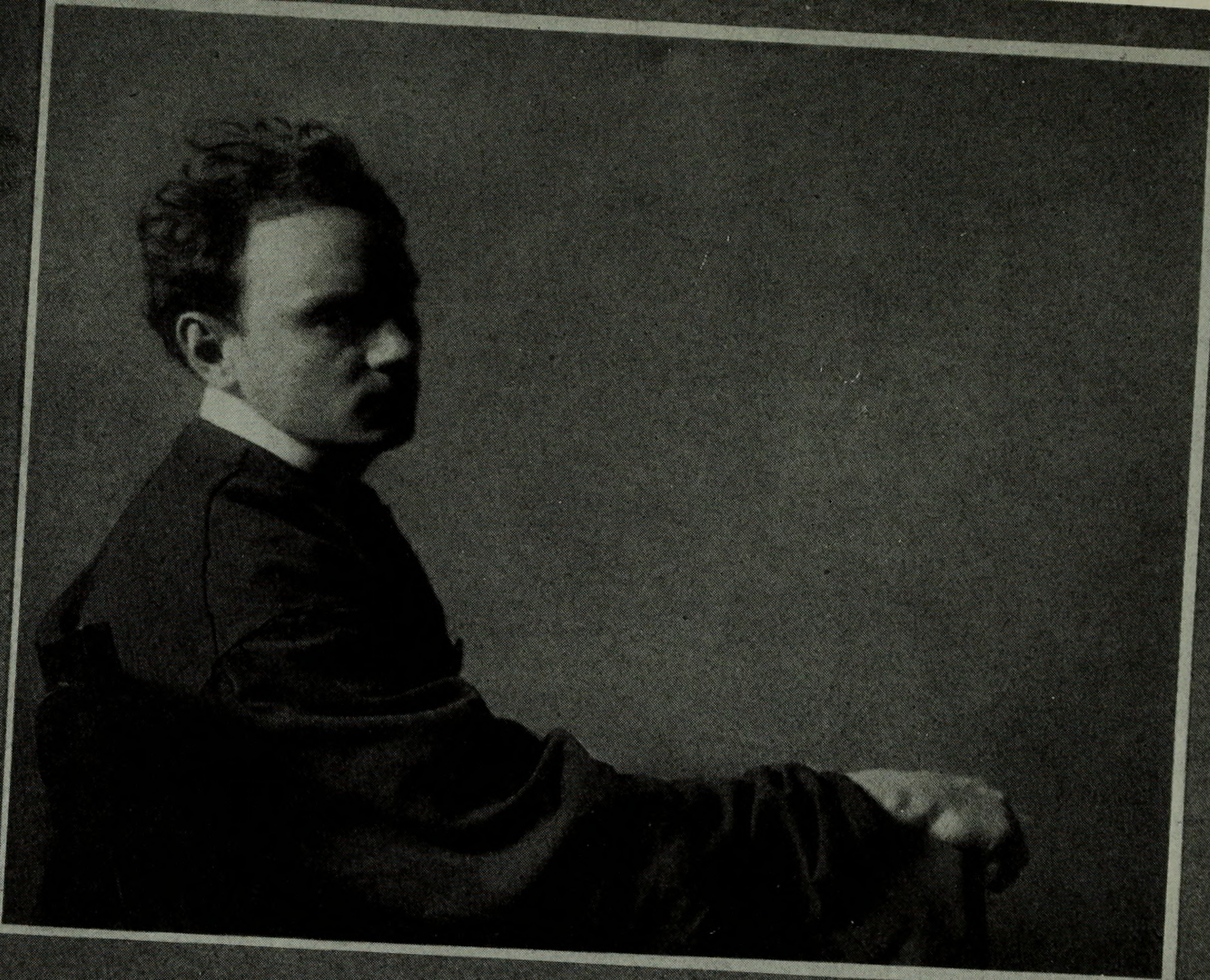
Ernest R. Graham (1868-1936).
William Peirce Anderson (1870-1924).
Edward Mathias Probst (1870-1942).
Howard Judson White (1870-1936).
The elaborate entrance and lobby originally featured exceptional decorative work, including bronze doors created by sculptor Leo Lentelli, although many original elements have been lost.
Leo Lentelli (1879-1961). The Italian sculptor created the original main entrance doors for Metropolitan Tower that were later destroyed. Public Domain.
The 30-floor classical-style Straus Building was renamed over the years for other of its famous inhabitants including Continental National Insurance Co. and Britannica Center for Encyclopedia Britannica. Metropolitan Tower was the first building in Chicago that took advantage of the new 1923 zoning ordinance for skyscrapers that allowed buildings taller than 260 feet (30 or more floors) with the necessary setbacks. Metropolitan Tower’s required setbacks begin at the 21st floor on which sits a nine-story tower until there is a second setback and then the final two stories. Crowned by a stepped pyramid and possessed of a powerful beacon that opened in 1924, the building is Chicago’s first Michigan Avenue skyscraper.
Metropolitan Tower was the first skyscraper on Michigan Avenue and one of the earliest buildings to take advantage of Chicago’s new 1923 zoning regulations permitting greater height through setbacks. Its distinctive stepped crown, beacon, and symbolic ornamentation made it a recognizable feature of the Chicago skyline.
Unused for years, the building’s 1,500-pound carillon bells were restored in 1979 for Pope John Paul II’s visit to Chicago. Just steps from Metropolitan Tower, the papal visit included an outdoor mass in Grant Park on October 5, 1979, which attracted over one million attendees, the largest gathering ever in Grant Park history up to that time. see – CBS Chicago Vault: Pope John Paul II enthralls Chicagoans on 1979 visit – CBS Chicago – retrieved March 18, 2026.
At one time, the thirtieth floor was the Straus Tower Observatory, which was open to the public for viewing the city in all four directions. see – Home | Metropolitan Tower – retrieved February 24, 2026. Home to the Continental National Insurance Company soon after it was built, this iconic skyscraper is located within Chicago’s Landmark Historic Michigan Boulevard District. The glass “beehive” supported by four bison figures at the top of the building held the blue light of a four-direction beacon. The ensemble, symbolizing industry, strength, and thrift, saw its beacon, signifying global reach, permanently shut down in 1934 following the financial failure of the S.W. Straus and Company during the Great Depression. The building was converted to residential condominiums in 2007. see – Metropolitan Tower | Powered by Baird & Warner– retrieved February 24, 2026; AIA Guide to Chicago, 2nd Edition, Alice Sinkevitch, Harcourt, Inc., Orlando, 2004, page 42.
The building was constructed in a classical style and represented the high quality and prestige associated with major Chicago commercial architecture of the 1920s. Over time, the building adapted to changing uses and occupants, including Encyclopedia Britannica and residential condominiums, demonstrating its continued relevance and preservation.
Feature Image: Congress Plaza Hotel in Chicago built in 1893 during the World’s Columbian Exposition features this later ornate Beaux-Arts gold elevator bank and the celebrated Gold Room. December 2015. Author’s photograph. 6.20 mb DSC_0617 (1).
The Congress Plaza Hotel embodies Chicago’s transformation during and after the World’s Columbian Exposition, linking the city’s emergence as a world-class destination with the architectural legacy of Clinton J. Warren and later expansions by Holabird & Roche. Through its strategic location, grand design, continuous operation since 1893, and association with major historical figures, the hotel serves as a living monument to Chicago’s Gilded Age ambitions and early twentieth-century prominence.
A Hotel of the Columbian Exposition Era
The original North Tower was built in 1893 during the World’s Columbian Exposition, held in Chicago from May 1 through October 31 of that year. The project was developed by famed hotel entrepreneur R.H. Southgate and designed by architect Clinton J. Warren (1860-1938), one of Chicago’s most prolific young hotel specialists during the late nineteenth century.
Warren moved from Massachusetts to Chicago in 1879 and joined the firm of Burnham and Root the following year. After establishing his own practice in 1886, he designed an impressive roster of Chicago hotels, including the ten-story Virginia Hotel (1889-1890) at Ohio and Rush Streets; the eight-story Metropole Hotel (1891) at Michigan Avenue and 23rd Street; the Plaza Hotel (1891-1892) at Clark Street and North Avenue; the Lexington Hotel (1892) at 22nd Street and Michigan Avenue; and the Auditorium Annex (1893) at 504 South Michigan Avenue, today known as the Congress Plaza Hotel.
Built in 1893 during the World’s Columbian Exposition and originally opened as the Auditorium Annex, it was designed by architect Clinton J. Warren, one of Chicago’s leading hotel specialists of the era.
By 1900, Warren had returned to Boston. He died in San Diego in 1938, by which time his significant contribution to Chicago architecture had largely faded from public memory. Notably, his New York Times obituary made no mention of his training under Daniel Burnham, his role in shaping Chicago’s hotel architecture over two decades, or the later notoriety of his Lexington Hotel, which served as Al Capone’s headquarters from 1928 to 1931. The obituary read in full:
“Clinton J. Warren SAN DIEGO, Calif., March 17 (AP). Clinton J. Warren, architect, who designed buildings in Europe, Mexico and Eastern United States, died at his home here last night at the age of 80. Mr. Warren formerly lived in Winchester, Mass. His widow and two sons, Clinton Jay Jr. of San Francisco and John of New York, survive.” see – TimesMachine: March 18, 1938 – NYTimes.com and The Chicago Hotels of Architect Clinton J. Warren – Owlcation – retrieved February 22, 2026.
Beaux-Arts elevator banks at 504 S. Michigan Avenue were installed in 1907. December 2015. Author’s photograph. 3.99mb DSC_0958 (2).
The Auditorium Annex and a Strategic Location
Originally known as the Auditorium Annex, the hotel opened in 1893 to accommodate the enormous influx of visitors attending the World’s Columbian Exposition. Remarkably, it has operated continuously as a hotel ever since and has also become well known for its reputed ghost hauntings.
Its location was one of its greatest advantages. The hotel stood only five blocks from both Dearborn Station and Illinois Central Station, making it the closest major hotel to two of Chicago’s principal railroad terminals. It was also the southernmost major hotel in downtown Chicago and sat just a block and a half from the elevated railway line that carried visitors directly to the exposition grounds in Jackson Park.
Expanded with the South Towerbetween 1902 and 1907 designed by Holabird & Roche and featuring the ornate Beaux-Arts gold elevator bank, the hotel grew to more than 1,000 rooms by 1908.
Expansion and the Famous Gold Elevators
The celebrated gold elevator bank is located in the hotel’s South Tower, an addition constructed between 1902 and 1907 and designed by the distinguished architectural firm Holabird & Roche. Executed in an ornate Beaux-Arts style, the elevators remain among the building’s most striking historic features.
The South Tower expansion also included the luxurious Gold Room banquet hall, reinforcing the hotel’s status as one of Chicago’s premier accommodations during the early twentieth century.see – Holabird & Roche. See- Chicago Landmarks – Architect Details – retrieved February 22, 2026.
William Holabird (1854-1923) and Martin Roche (1855-1927) of the architectural firm of Holabird & Roche designed the South Tower of today’s Congress Plaza Hotel between 1902 and 1907. Public Domain.
From Auditorium Annex to Congress Hotel
By 1908, the enlarged complex contained more than 1,000 guest rooms. In 1911, the property adopted the name Congress Hotel, a reference both to nearby Congress Parkway (today Ida B. Wells Drive) and its prominent location facing Grant Park.
Over the years, the hotel welcomed numerous American presidents. Among those who stayed there, and who may well have ridden these gilded elevators, were Theodore Roosevelt, William Howard Taft, Warren G. Harding, and Calvin Coolidge. Today, the elevators stand as elegant reminders of the hotel’s origins in the era of the World’s Columbian Exposition and of its long history as one of Chicago’s most prominent grand hotels. See – Congress Plaza Hotel History | Congress Plaza Hotel – retrieved February 22, 2026.
Renamed the Congress Hotel in 1911, it has hosted numerous U.S. presidents and remains one of Chicago’s longest-operating and most historically significant hotels.
FEATURE Image: February 2018. Village “Art” Theatre, 1548-50 N. Clark Street, Chicago, Illinois 60610. The use of masks had been used in theatre since ancient times. They were usually tied to their dramatic source material and the inherent psychology of the characters. The Landmark Designation Report for the Village Theatre described this polychrome character head with musical instruments as “singing” in honor of the neighboring Germania Club, a German social club with its origins in men’s choral music. The head also wears a Baroque-style “wig” of oak leaves and acorns. In Germany, oak trees are revered, and acorns are a symbol of good luck. A decorative keystone on the theater’s round-arched window also has an acorn ornament. 88% 7.94mb DSC_4799 Author’s photograph.
The Village Art Theatre was more than a neighborhood movie house. It embodied Chicago’s early film culture, immigrant heritage, and evolving urban identity for over a century. Although the building itself was demolished in 2018, the survival of its historic façade highlights both the possibilities and limitations of preserving architectural memory amid redevelopment.
Historical Origins & Opening
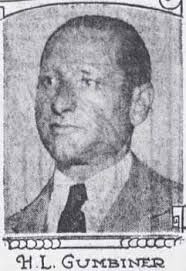
Designed by architect Adolphe Woerner (born Stuttgart, Germany 1851- 1926), the Village (Art) Theatre opened as the Germania Theatre on July 29, 1916 and closed in its 91st year in March 2007. The building was erected by German-born Frank Schoeninger exclusively as a movie theater for $75,000 (about $2.2 million in 2025) and leased for an annual $7,000 rent (about $205,000 today) to Herman L. Gumbiner (Germany, 1879- 1952, Santa Monica, Calif.) in a 10-year contract with his company, The Villas Amusement Company (later Gumbiner Theatrical Enterprises).
The Rise of Neighborhood Movie Houses
By 1910, buildings erected solely for the purpose to showcase motion pictures were becoming increasingly popular as the appetite to consume the latest silent motion pictures out of Hollywood was booming everywhere. These neighborhood movie houses, larger than dingy storefront nickelodeons and yet smaller than flamboyantly ornate vaudeville theatres, had movie “palace” touches while fitted conveniently into Chicago’s many local commercial strips.
Scale, Survival, and Target Audience
Nearly all of these first-generation movie theaters in Chicago have been demolished or remodeled for other purposes including those larger-scale theaters developed by major theater operators such as Balaban and Katz, Lubliner and Trinz, and the Marks Brothers. While those palatial theatres could hold between 2,000 and 4,000 movie-goers the Village Theatre, one of the last and best first generation movie houses to survive for so long, originally held 1,000 spectators. Originally named the Germania Theater because it was next door to the Germania Club, it looked to attract affluent club members to its flicks.
The theater reflected the strong German-American presence in the neighborhood through its decorative symbols and association with the neighboring Germania Club.
The Germania Theatre was built in 1916 on Frank Schoeninger’s open land pictured above between the Germania Club (completed in 1889) and his tavern and hotel on the corner of Clark Street and North Avenue. In 1986 the Germania Club, citing the dwindling numbers of members, finally disbanded. Public Domain.
Herman Gumbinger and Expansion to Los Angeles
Herman Gumbinger was a major film exhibitor who was busy in Chicago building his independent theatre chain in the 1910’s, with several new movie house projects and acquisitions throughout the city’s northside primarily. After building Chicago’s first independent movie house chain in the teens, Gumbinger relocated to Los Angeles, California, in 1921 where he built the famous Los Angeles Theatre in the Broadway Historic Theatre District of Downtown L.A. Erected at a cost of over $1.5 million ($31 million today) and designed by renowned movie theatre architect S. Charles Lee (1899-1990) Gumbinger’s theatre premiered Charlie Chaplin’s City Lights. Gumbinger Theatrical Enterprises finally dissolved in 1943.
Herman Gumbinger (1879-1956), c. 1924, built Chicago’s first independent movie chain, including what became the Village Art Theatre. By the end of the 1920s, Chicago had more than thirty of these movie palace theaters. Among its holdings, Herman Gubinger and his brothers operated the New Blaine which was renamed and is today the Music Box Theatre. Public Domain.
Neighborhood Context and Architectural Design
The Germania was one of the first-generation movie theatres built at the intersection of three Chicago neighborhoods – Gold Coast to the south and east, Old Town to the north and west and Lincoln Park to the north. An architectural mix of styles including Classical Revival (triangle pediments, pilasters and cornice with dentils fashioned in terra cotta) and Renaissance Revival (rusticated exterior and round-arched windows with keystones), the movie house also incorporated Germanic symbolism in its details reflecting the area’s then prominent ethnic group.
WWI Impact and a Century of Name Changes
During World War One, in a wave of anti-German sentiment, The Germania Club renamed itself the Lincoln Club. It changed its name back in 1921. The Germania Theatre changed its name to the Parkside and never looked back. In 1931 until 1962 it was known as the Gold Coast theatre. Meanwhile, prohibition closed down Frank Schoeninger’s tavern and he left for Wisconsin. In the 1960’s the theatre was updated and renamed the Globe Theatre. In 1967 the building was renamed the Village Theatre after it survived being demolished by the nearby Sandburg Village development.
Sandburg Village is a Chicago urban renewal project consisting of eight high-rise buildings, a mid-rise building and 60 townhomes and artists’ lofts. The development was first occupied In 1963 and completed in 1971. In the early 1960’s the Village Theatre was to be incorporated into the project until its landowner refused to sell. PHOTO: “20190323 08 Carl Sandburg Village (49490506022)” by David Wilson from Oak Park, Illinois, USA is licensed under CC BY 2.0.
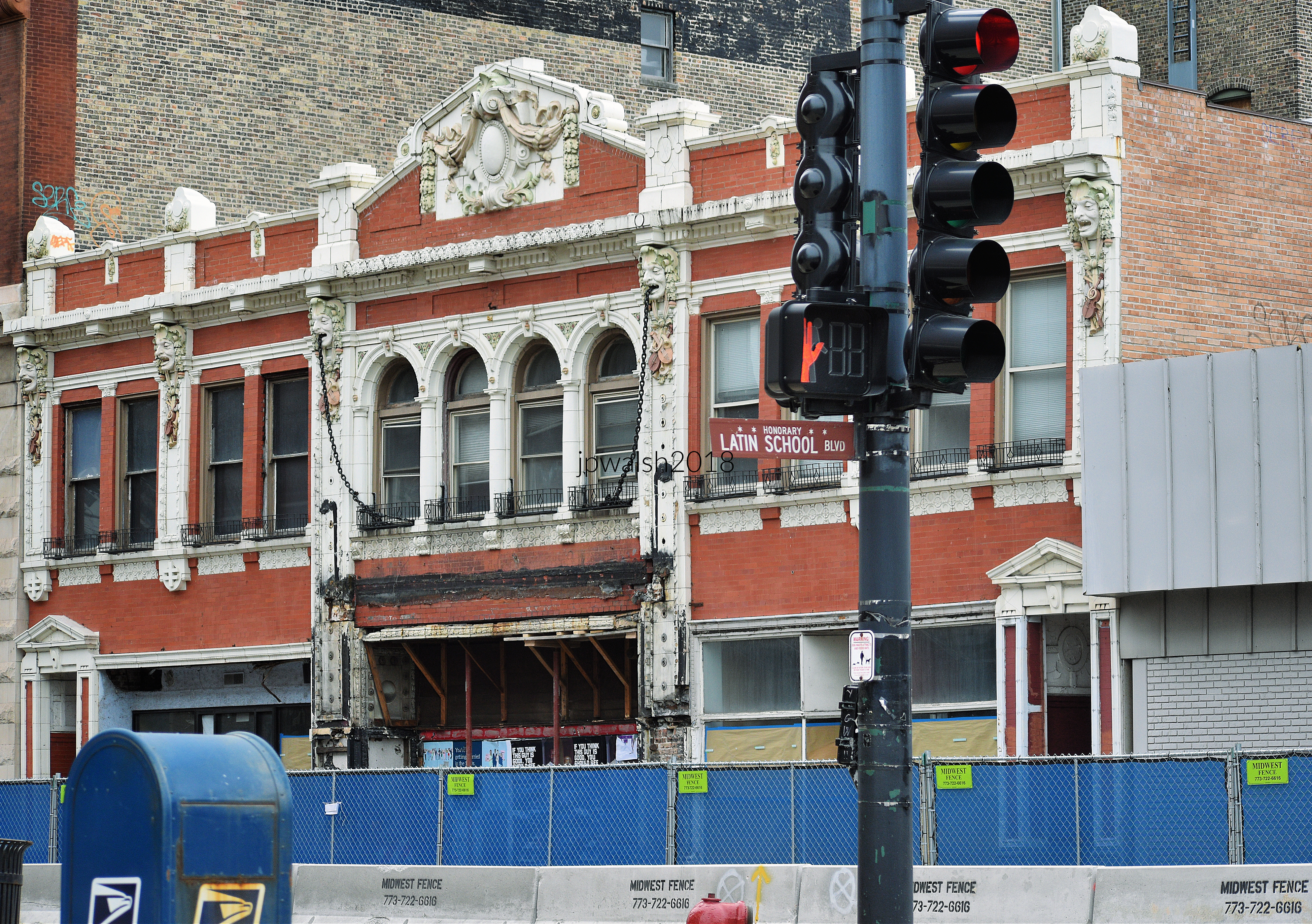
February 2018. The Village Theatre in the last days before its demolition. Its marquee from the 1960’s has been removed. The Village Theatre sat across the street from Latin School of Chicago at North and Clark Streets in Gold Coast/Old Town. In its Landmark Designation Report, the Village Theatre façade is described as having “a symmetrical arrangement, with a central theater entrance and separate entrances to the upstairs offices at opposite ends of the building. Each upper-story entrance has a deeply-recessed alcove lined with brick and white, carved-wood panels. A limestone slab step, inset with hexagonal tiles, is inside each alcove. Each alcove is framed with white terra cotta and brick pilasters on a base of gray terra cotta, made to imitate granite. The pilasters are topped with a triangular, white terra-cotta pediment.” 70% 7.93 mb DSC_4797. Author’s photograph.
Architectural Features and Exterior Appearance
The original two-story façade of red pressed brick and white beige glazed terra cotta decoration competed with a sizeable modern marquee that was removed before its demolition in 2018.
Personal Memories and Moviegoing Experiences
Since after college I was living in Chicago in the 1980s and 1990s, I saw several films at the Village Theatre before it became a multi-plex in 1991 such as House of Games, Fatal Attraction, Wall Street (1987), The Unbearable Lightness of Being (1988), Russia House (1990). In early 1991 the interior of the theater was divided into four screens, and I didn’t stop going to movies there–JFK (1991), Michael Collins (1996), The Red Violin (1999) and more– but not as frequently. Anyway, I moved essentially out of neighborhood in 1995 and sold my condo soon afterwards. The Village Art Theatre in Chicago officially closed as a movie venue in March 2007.
The theater underwent several name changes, including Parkside, Gold Coast, Globe, and finally Village Theatre, adapting to changing audiences and neighborhoods.
Demolition and Modern Condominium Redevelopment
In April 2018, the Village Theatre and neighboring buildings along North Avenue were completely demolished to make way for construction of a condominium building. The ornate Clark Street frontage was stabilized as everything else crumbled to dust around it. The façade was repurposed to serve as the entrance for the new condo development known as Fifteen Fifty on the Park with units priced at opening at $1.625 to $5.85 million.
Beginning in 1969, it became associated with art-house cinema through screenings connected to the Chicago International Film Festival, leading to its “Village Art Theatre” identity. Its run as a core festival venue ended following the October 1989 run.
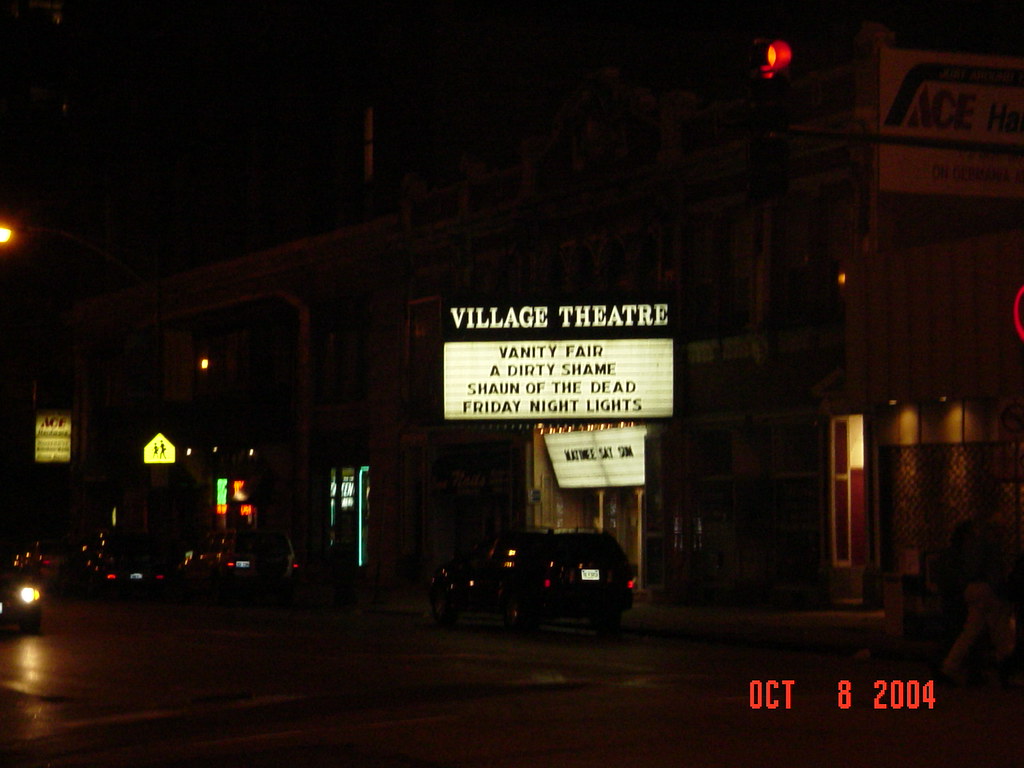
The Village Theatre took the moniker Village Art Theatre after The Chicago International Film Festival used the Village Theatre as a venue to screen “art house” films starting in 1969.In early 1991, the historic 900-seat single auditorium was completely gutted and divided into four smaller screens. This structural partition broke up the grand theater space, ending its era as a primary, large-format host for the main international film festival tracks. October 2004. PHOTO: “Village Art Theatre” by BWChicago is licensed under CC BY-NC 2.0.
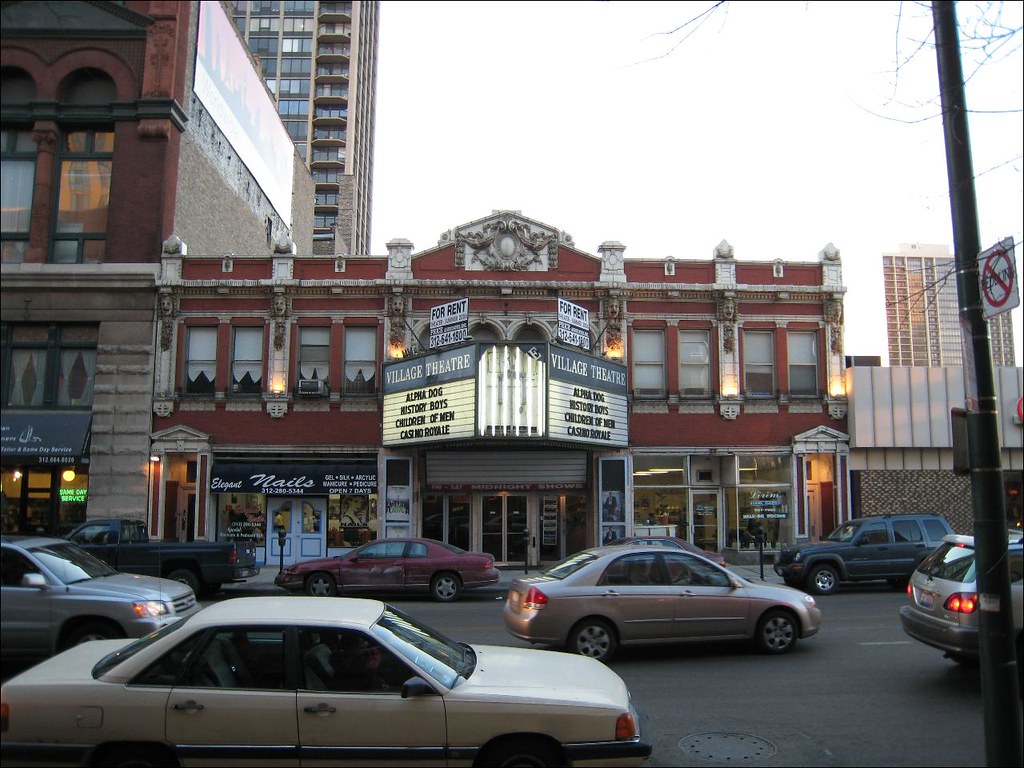
The Village Theatre had at least three distinctive marquees during its history. The first was the original vertical Germania sign, removed almost as soon as it was installed because of anti-German sentiment during World War I. It was followed by a horizontal awning-style marquee, similar to that of Chicago’s Biograph Theater at 2433 N. Lincoln Avenue, installed during the theater’s years as the Gold Coast. The third was the dramatic prow-shaped marquee shown here, paired with steel-and-glass doors and believed to date from the mid-1960s renovations undertaken when the movie house operated as the Globe. PHOTO: “Germania (Parkside, Gold Coast, Globe, Village) Theatre, Chicago, IL” by BWChicago is licensed under CC BY-NC 2.0.
Demolished in 2018 for a luxury condominium development, the building’s ornate façade was retained and incorporated into the new project. October 2018. Author’s collection.
The Village Art Theatre was one of Chicago’s earliest purpose-built neighborhood movie palaces, constructed during the rapid growth of motion-picture exhibition. The building’s history captures its full arc as an architectural, cultural, and neighborhood landmark, ending with the forever tension between preservation and redevelopment.
This explanatory article may be periodically updated.
FEATURE Image: Completed in 1885 at a cost of $500,000 (equivalent to nearly $16 million in 2024), Dearborn Street Station in Chicago’s South Loop stood as a grand Romanesque composition of Italian brick and granite. Its architect, New Yorker Cyrus L. W. Eidlitz, would later design One Times Square (1904), the famed Manhattan tower that has served as the site of the annual New Year’s Eve ball drop since 1908. see – https://www.in2013dollars.com/us/inflation/1885?amount=500000 – retrieved February 27, 2024. November 2017. Author’s photograph. 6.44mb
Dearborn Street Station is one of Chicago’s most significant surviving railroad landmarks, embodying the city’s rise as a national transportation hub while showcasing the architectural achievement of Cyrus L.W. Eidlitz. Despite fire, alteration, and the end of passenger rail service, the station endures as a rare and tangible link to Chicago’s railroad age and urban development.
The Hoosier leaving Dearborn Street Station in Chicago (its clock tower visible at right) for Indianapolis. Public Domain (Pre-1978, no mark).
The Dearborn Street Station in Chicago with its original hipped roofs, including on the tower, c. 1908. Public Domain.
The Dearborn Street Station is Chicago’s oldest existing train station though it has not operated as one since 1971. It is a U-shaped Italian brick three-story Romanesque structure with a granite base that was originally 80 feet tall to the roof line.
The 32-year-old architect of Dearborn Street Station, Cyrus L. W. Eidlitz, came from an illustrious East Coast family of builders and architects.
Cyrus L. W. Eidlitz who built the Dearborn Street Station in Chicago in 1885 was from an influential American family of architects and builders—his father, Leopold Eidlitz (1823-1908), was a founder of the American Institute of Architects (AIA). Cyrus L. W. Eidlitz is best known for designing One Times Square, the former New York Times Building, on Times Square in 1904. He also founded HLW International, one of the oldest architecture firms in the United States. The reconstruction of Dearborn Station in Chicago in 1923 following its devastating fire was done by an unknown architect two years after Cyrus L. W. Eidlitz’s death.
Original facade completed in 1904 of One Times Square in 1919 by Cyrus L. W. Eidlitz who designed and built the Dearborn Station in Chicago in 1885. Public Domain.
Dearborn Street Station (1885) is Chicago’s oldest surviving railroad terminal building. Cyrus L.W. Eidlitz designed the station in a robust Romanesque style using Italian brick and a granite base.
Today’s flat roof is a modification by an unknown architect from its elaborate original hipped roof that was lost in a 1922 fire. The eye-catching Flemish tower, originally 166 feet tall, was also modified after the same conflagration. The station building marks the southern terminus of Dearborn Street which today extends about 4 miles to its northern terminus at the southern boundary of Lincoln Park. Author’s photograph.
Looking south to the Dearborn Street Station which sits at the southern terminus of the 4-mile downtown Dearborn Street corridor. PHOTO: “South Dearborn Street” by Reading Tom is licensed under CC BY 2.0.
The station’s frontage on Polk Street extends 212 feet. Originally the station extended 446 feet south along Plymouth Court with the train sheds 600 feet long with 8 tracks. The station’s train shed was demolished in 1976. In 1986 the station was converted to offices and shops (I had my Bank One branch in the Polk Street Station). Today it is the Dearborn Station Galleria in the South Loop Printing House Historic District.
Following demolition of the train sheds in 1976 the first phase of the Dearborn Park residential development south of the Dearborn Street Station building quickly sprang to life.
The 1885 clock tower of the Dearborn Street Station is visible at the left. Open land which for almost 100 years had been the Dearborn Street Station‘s busy train tracks into a shed equal to two football fields in length were cleared off to make room for Dearborn Park residential development. The photograph is dated from 1977 by William C. Brubaker. PHOTO: “Site for Dearborn Park residential development” by UIC Library Digital Collections is licensed under CC BY-NC-SA 2.0.
Its distinctive clock tower and monumental presence made it a defining feature of Chicago’s South Loop.
The Dearborn Station had 8 tracks that accommodated 12 coaches and engines with 122 trains arriving and departing daily. The station served as a major transportation gateway, accommodating numerous railroads.
Chicago & Eastern Illinois (1877-1976):
C&EI The Danville – Chicago Flyer at Steger, Illinois on November 26, 1965. Public Domain.
Map of the Dixie Route to Florida and connecting lines, published by the C&EI, L&N, and NC&StL railroads, 1926. Public Domain.
Preferred Share of the Chicago and Eastern Illinois Railroad Company, issued 1889. Public Domain.
Chicago and Atlantic Railway, (later the Chicago and Erie Railroad, 1871-1941):
Chicago and Atlantic Railway 1889 ad featuring The New York and Chicago Vestibule Limited. Public Domain.
Atchison, Topeka & Santa Fe (1859-1996):
AT&SF passenger train, c. 1895. Public Domain.
Map of “The Santa Fé Route” and subsidiary lines, as published in an 1891 issue of the Grain Dealers and Shippers Gazetteer. Public Domain.
Louisville, New Albany & Chicago, or Monon (1897-1971):
Chicago, Indianapolis and Louisville Railway, route map, 1903, Unknown author – Poor’s Manual of the Railroads of the United States. Public Domain.
Grand Trunk Western Railroad Company (1859-1991):
A 1976 map of the proposed routes to be turned over by Conrail on the GTW, DT&I and P&LE. Public Domain.
Grand Trunk Western Railroad locomotive shop, Battle Creek, Michigan, 1908. GT Western RR was one of the lines into Dearborn Street Station in Chicago. Public Domain.
The Wabash Railroad (1837-1964):
1886 map of the Wabash, St. Louis and Pacific Railway. Public Domain.
System timetable back and front cover, 1887. Public Domain.
Wabash system map, early 20th century. Public Domain.
The Erie Railroad (1832-1960):
An 1855 map of the New York and Erie Railroad. Public Domain.
Chicago & Western Indiana (1880-present):
The Kansas City Chief at Dearborn Station on February 5, 1968. The glowing face of the station clock in the clocktower is visible upper-left. Photograph by A Roger Puta. Public Domain.
All lines operating into Dearborn Station, except for the Santa Fe (above), travelled over the C&WI.
Colossal damages in December 1922 fire.
On December 21, 1922, fire destroyed the roof of the Dearborn Street Station. The blaze started on the third floor and raged throughout that top floor. Hundreds of passengers and employees were safely evacuated and there was one reported injury. The Chicago Tribune reported that when the fire reached the central tower it roared up the long shaft which became a blazing torch. The crowds watched in amazement as the tower clock stopped and the hands on its three faces crashed into the raging fire below.
The original ornate steeply pitched tiled roofs and dormers were lost in a fire in 1922 and not replaced.
At far left the 1885 clock tower of the Dearborn Street Station can be seen along Dearborn Street in downtown Chicago. June 2022. Author’s photograph.
SOURCES:
AIA Guide to Chicago, 2nd Edition, Alice Sinkevitch, Harcourt, Inc., Orlando, 2004, p. 154.
History of Development of Building Construction in Chicago, Second Edition, Frank A. Randall, Revised and Expanded by John D. Randall, University of Illinois Press, Urbana and Chicago, 1999, pp. 104-105 and 221-223.
Chicago’s Famous Buildings, 5th Edition, Franze Schulze and Kevin Harrington, The University of Chicago Press, 2003, pp. 89-90.
FEATURE image: FISHER BUILDING, 343 S. Dearborn Street, view from the south. Author’s photograph, December 2017.
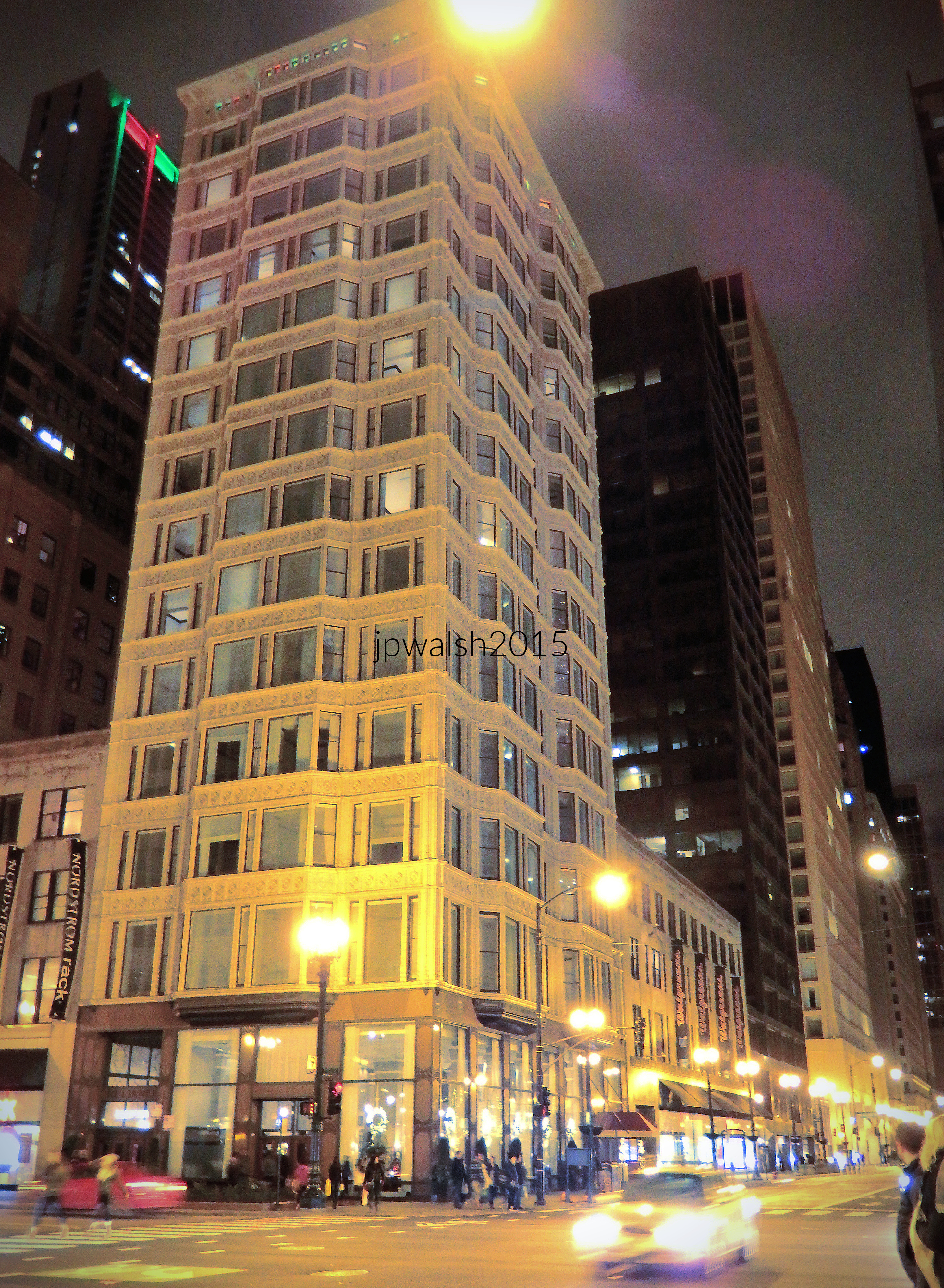
The 1895–96 Fisher Building represents a pivotal triumph in early skyscraper design, demonstrating how Charles B. Atwood’s flamboyant Gothic Revival aesthetics combined with Edward Clapp Shankland’s rapid steel-frame engineering to evolve the glass-and-terra-cotta formulas pioneered by the Reliance Building (1895) into Chicago’s oldest surviving 18-story-plus landmark.
Fisher Building (1895-1896), looking east. To the left is Burnham & Root and Holabird & Roche’s Monadnock Building (1891-1893) and to the right is Holabird and Roche’s Old Colony Building (1893-1894). In the background is Graham, Anderson, Probst & White’s bright red international style CNA Center (1972). September 2015. Author’s photograph,
Structural engineer Edward Clapp Shankland managed the deep-pile foundation design and rapid steel-framing work, allowing the building’s first 13 stories to rise in just two weeks.
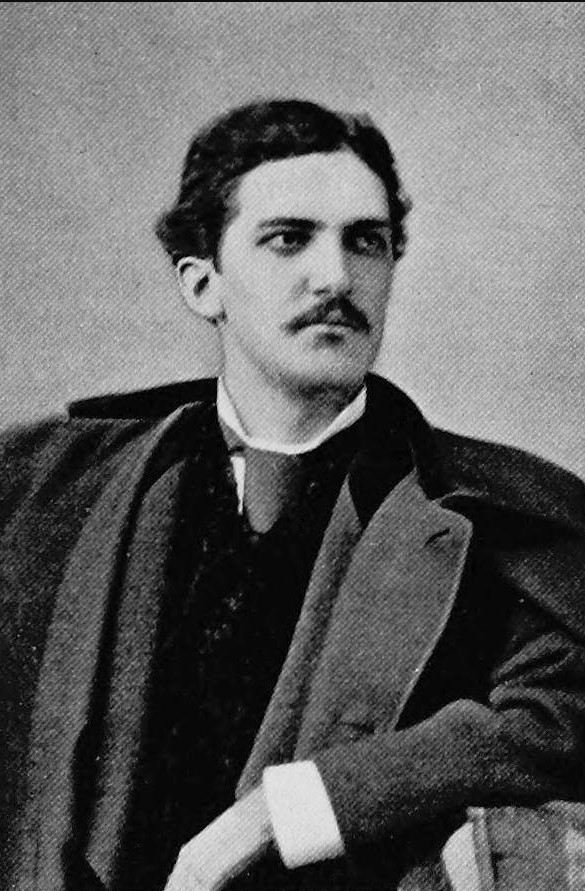
Daniel Hudson Burnham, c. 1890. In 1873 Burnham and Root entered into partnership in Chicago. In 1894 Burnham reorganized his office to include, among other partners, Charles B. Atwood who designed the Fisher Building.
The success of the 14-story Reliance Building at 32 N. State Street built by Daniel H. Burnham (1846-1912) and John Wellborn Root (1850-1891) in 1890-91 and Burnham & Co. in 1894-95 led directly to the construction of the 18-story Fisher Building in 1895. (The final two stories were added over a decade later during its 1907 expansion).
The Fisher Building was also designed for Burnham & Co. by Charles B. Atwood (1849-1895). The Fisher Building was three stories taller than the Reliance Building and possessed even more flamboyant Gothic detailing as it is sheathed in golden terra cotta on its visible façades.
Reliance Building (1890-1895), Chicago. September 2015. Author’s photograph. 87% 7.78mb DSCN1939 (2)
Built directly following the success of the landmark Reliance Building, the Fisher Building was constructed four stories taller (originally standing at 18 stories compared to the Reliance’s 14) and sheathed in a highly decorative golden terra cotta.
Charles B. Atwood c.1880. Public Domain.
The Fisher Building’s façade with its depictions of sea creatures in homage to the building’s namesake, Lucius G. Fisher (1843-1916), an Illinois paper company magnate and architect, was painstakingly restored and adapted for contemporary use in 2001. The rectangular prism with its Gothicized ornamentation sits on 25-foot piles under spread foundations engineered by Edward Clapp Shankland (1854-1924).
Ed Shankland was Daniel Burnham’s structural engineer through 1898 and worked on the Reliance Building and the Fisher Building. Public Domain.
In the mid-1890s, the skyscraper was erected quickly with pride. The steel frame’s first 13 stories were erected in two weeks. The building has oriel windows and engaged colonettes at its corner piers. In 1907, a 2-story vertical addition was built, raising the building to 20 stories, alongside a matching 20-story northern tower expansion by architect Peter J. Weber with Shankland as structural engineer.
Lucius Fisher (1843-1916). Born in Wisconsin, Fisher was an Illinois paper magnate who commissioned Daniel Burnham and Company to build the 18-story, 275-foot-tall Fisher Building in the Chicago Loop in 1895. Completed in 1896, the structure was later expanded in 1907 with a two-story vertical addition and a matching northern tower. Following this expansion, the landmark Fisher Building stands today as the oldest extant 20-story building in Chicago. Public Domain.
In 2002 the main entrances on Dearborn Street and Plymouth Court were recreated. Over 1000 wood-frame windows were replaced or repaired and over 6000 terra-cotta pieces were also replaced. May 2015. Author’s photograph.
Reorganized into Daniel Burnham’s office in 1894, partner Charles B. Atwood designed the Fisher Building with intricate Gothic details and whimsical sea creature motifs as a nod to paper magnate Lucius G. Fisher.
Fisher Building (1895-86) at Plymouth Court and Van Buren Street, looking northwest. October 2017. Author’s photograph,
Completed in 1896, the structure claims the title of the oldest surviving 20-story building in the city of Chicago.
SOURCES:
AIA Guide to Chicago, 2nd Edition, Alice Sinkevitch, Harcourt, Inc., Orlando, 2004, pps. 62-63.
The Sky’s The Limit: A Century of Chicago Skyscrapers, Jane H. Clarke, Pauline A. Saliga, John Zukowsky, New York: Rizzoli, 1990, pps. 33-35.
Chicago’s Famous Buildings, 5th Edition, Franze Schulze and Kevin Harrington, The University of Chicago Press, 2003, pp. 82-83.
Frank A. Randall, History of Development of Building Construction in Chicago, Second Edition, Revised and Expanded by John D. Randall, University of Illinois Press, Urbana and Chicago, 1999, pps. 37 and 164-65.
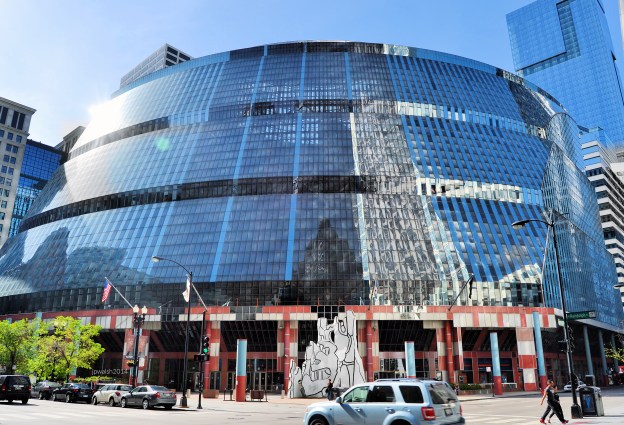
FEATURE image: Helmut Jahn, State of Illinois (Thompson) Center, 100 W. Randolph, Chicago, Illinois, 1979-1985. The Thompson Center was officially bought by Google in 2022 for a reported $105 million. May 2014. Author’s photograph. 4.75 mb
Helmut Jahn was one of the most influential architects in shaping late-20th-century Chicago, blending the legacy of Miesian modernism with bold postmodern experimentation to create buildings that transformed the city’s architectural identity and projected Chicago’s influence onto the world stage.
German-American postmodernist architectHelmut Jahn (1940-2021) is a leading postmodern architect responsible for scores of projects internationally. Retrospective exhibition Helmut Jahn: Life + Architecture held at the Chicago Architecture Center, July 23, 2021, through October 31, 2021. Following his passing in May 2021, the exhibition showcased Jahn’s collaborative engineering process and featured personal items, scaled architectural models, and photography of his work—such as O’Hare International Airport’s Terminal 1. The angled, sail-like canvas banner walls were custom-designed as a subtle nod to Jahn’s passionate love for professional sailboat racing. PHOTO; “Final weekend of the Helmut Jahn exhibit at @chiarchitecture” by reallyboring is licensed under CC BY-NC-ND 2.0.
Helmut Jahn arrived in Chicago in 1966, studied at IIT under the influence of Ludwig Mies van der Rohe, and became a major figure in the city’s architectural development for over five decades.
Helmut Jahn, 1 S. Monroe, 1982. August 2021. 5.56mb DSC_9293 (1)
Introduction.
Helmut Jahn was famous in Chicago and around the world for his prolific postmodern architecture particularly his work in steel and glass.
Born in Germany near Nuremberg, in 1940, Jahn graduated from Technische Hochschule in Munich and moved to Chicago in 1966. Jahn arrived in Chicago just as “downtown development” during the administration of Mayor Richard J. Daley (1902-1976) was finding its greatest momentum. Jahn began to study under Ludwig Mies van der Rohe (1886-1969) at the Illinois Institute of Technology (IIT) and, in 1967, joined Charles (C.F.) Murphy Associates which later became Murphy/Jahn. The younger man would carry on the powerful influence and energy of these Chicago personalities for building big, creatively, and prolifically for the next fifty years into the first quarter of the 21st century. Jahn would add his own significant contribution and footprint in Chicago and around the nation and world in those same long years of his activity.
One of Jahn’s early projects in his first years in Chicago was McCormick Place. The original concrete and steel permanent exposition hall on the lakefront that opened in 1960 was destroyed in a fire in January 1967, just as Jahn was starting to work as a professional architect. Named for Col. McCormick of the Chicago Tribune, the newspaper owner and publisher had boosted the idea of a permanent exposition hall on Chicago’s lakefront for years prior to his death in 1955.
Jahn’s Chicago career coincided with the city’s continued downtown expansion following landmark projects such as the John Hancock Center and Sears Tower.
Jahn had come to Chicago at an exciting time to be building there — during Jahn’s first years in Chicago the John Hancock Building was completed in 1969 and the Sears Tower, the tallest building in the world for the next 24 years, was completed in 1974. In 1971, C.F. Murphy completed the new and massive McCormick Place, a powerful steel and glass structure with enormous cantilever eaves, on the same lakefront site as the old exposition hall. Out of that single successful building project, Helmut Jahn and the rest of the world saw the significant development in Chicago that would blossom around this important and functional modern architecture over ensuing decades — including the North building constructed across Lake Shore Drive in 1986; the South building built in 1996; a hotel built in 1998; the massive West building built in 2007; and, in 2017, the Wintrust Arena.
In the mid 1980’s one of Jahn’s most significant creations was the James R. Thompson Center in Chicago. Aesthetically grandiose and controversial, the “State of Illinois Building” was put up for sale in 2021 by the administration of Governor J.B. Pritzker, citing its historically high operating and maintenance costs.
Jahn designed the 23-story addition to the Chicago Board of Trade in 1980 and Accenture Tower at 500 W. Madison in the West Loop which opened in 1987. Across the nation and world Helmut Jahn’s fresh, grand, and innovative designs have made their way into the annals of postmodern architecture. Any complete list of Helmut Jahn’s active and completed projects extends necessarily into the many scores. A list of notable buildings could include the 1999 K St. NW, a 12-story structure, in Washington D.C. completed in 2009; the twin 37-story Veers Towers in Las Vegas, Nevada opened in 2010; and, in his native Germany, the 63-story Messeturm in Frankfurt opened in 1990 and the Sony Center, a complex of eight buildings, in Potsdamer Platz in Berlin completed in 2000. The hard-driving list goes on…and on.
In Chicago Jahn designed the exposed steel frame United Airlines Terminal 1 at O’Hare International Airport between 1985 and 1988. Air travelers for decades have enjoyably traversed its entertaining walkway connecting concourses that include moving sidewalks, colorful lighting and futuristic sounds.
At the time of his death at 81 years old on May 8, 2021 in a bike road accident in the far western suburbs of Chicago, Helmut Jahn was working on a 74-story residential building in Chicago at 1000 S. Michigan. It was scheduled to be opened in 2022 but its construction was already delayed because of the Covid-19 pandemic that postponed construction. Helmut Jahn taught at IIT, the University of Illinois-Chicago, Harvard University, and Yale University. In 2012 Murphy/Jahn became JAHN and, according to a recent report from Dun & Bradstreet, the firm had a total of 55 employees and generated a little over $6 million in annual sales.
Xerox Center, 55 West Monroe, Chicago, 1977-1980.
In what was one of Helmut Jahn’s first great urban achievements, the 40-story office tower on an important corner in downtown Chicago was built on speculation and soon took the name of its major tenant (Xerox). The sleek and simple curtain wall of enameled off-white fluoropolymer aluminum panels and reflective glass slide over a reinforced concrete structure and around its soft postmodern corners in contrast to the modernist box.
The tower is fitted to its site where the building’s corner is exaggerated at street level with varying glaze percentages, and the white-black-silver palette of the lobby follows a diagonal pattern (also on the roof) in contrast to the exterior curvilinear design.
Silver double-glazed reflective glass pays homage to 1950’s and 1960’s Chicago modernism and the Xerox building’s closest neighbors: the kitty-corner Inland Steel Building (1954-1958, Skidmore, Owings and Merrill) and, directly across to the north, the First National (today, Chase) Bank building (1964-1969, C.F. Murphy Associates with Perkins and Will).
Helmut Jahn (C.F. Murphy Associates)/Murphy Jahn. Xerox Center, 55 West Monroe, Chicago, 1977-1980. December 2014. Author’s photograph. 5.60 mb 99%
Some have observed that Jahn’s curving tower may have been inspired by Louis Sullivan’s 1899 Schlesinger and Mayer department store building on State Street (what became in 1904 Carson, Pirie, Scott and Company Building and today is The Sullivan Center). The 1980 project’s original conception was for two curvilinear towers though obviously only one was constructed obfuscating and negating the original design’s uniquely bold impacts.
The glass and aluminum are arranged to alternate in horizontal bands which have modernist predecessors in Chicago and Europe. Hidden from the street view are more diagonals that cut a pattern across the roof. The building is a major transition for Jahn who, steeped in mid-20th century Modernism, harkened back to earlier 1920s modernist sources for the 55 W. Monroe (Xerox) building. The author’s photograph was taken on December 24, 2014.
SOURCES for 55 W. Monroe: Building Chicago: The Architectural Masterworks, John Zukowsky, New York: Rizzoli with Chicago History Museum, 2016, p. 237.
AIA Guide to Chicago, 2nd Edition, Alice Sinkevitch, Harcourt, Inc., Orlando, 2004, p. 67.
The Sky’s The Limit: A Century of Chicago Skyscrapers, Jane H. Clarke, Pauline A. Saliga, John Zukowsky, New York: Rizzoli, 1990, p. 233.
Chicago Architecture and Design, 3rd Edition, Jay Pridmore and George A. Larson. New York: Abrams, 2018, pp. 210-211.
Helmut Jahn, Nory Miller, New York: Rizzoli, 1986, pp. 76-81.
Thompson Center, 100 W. Randolph, Chicago, 1979-1985.
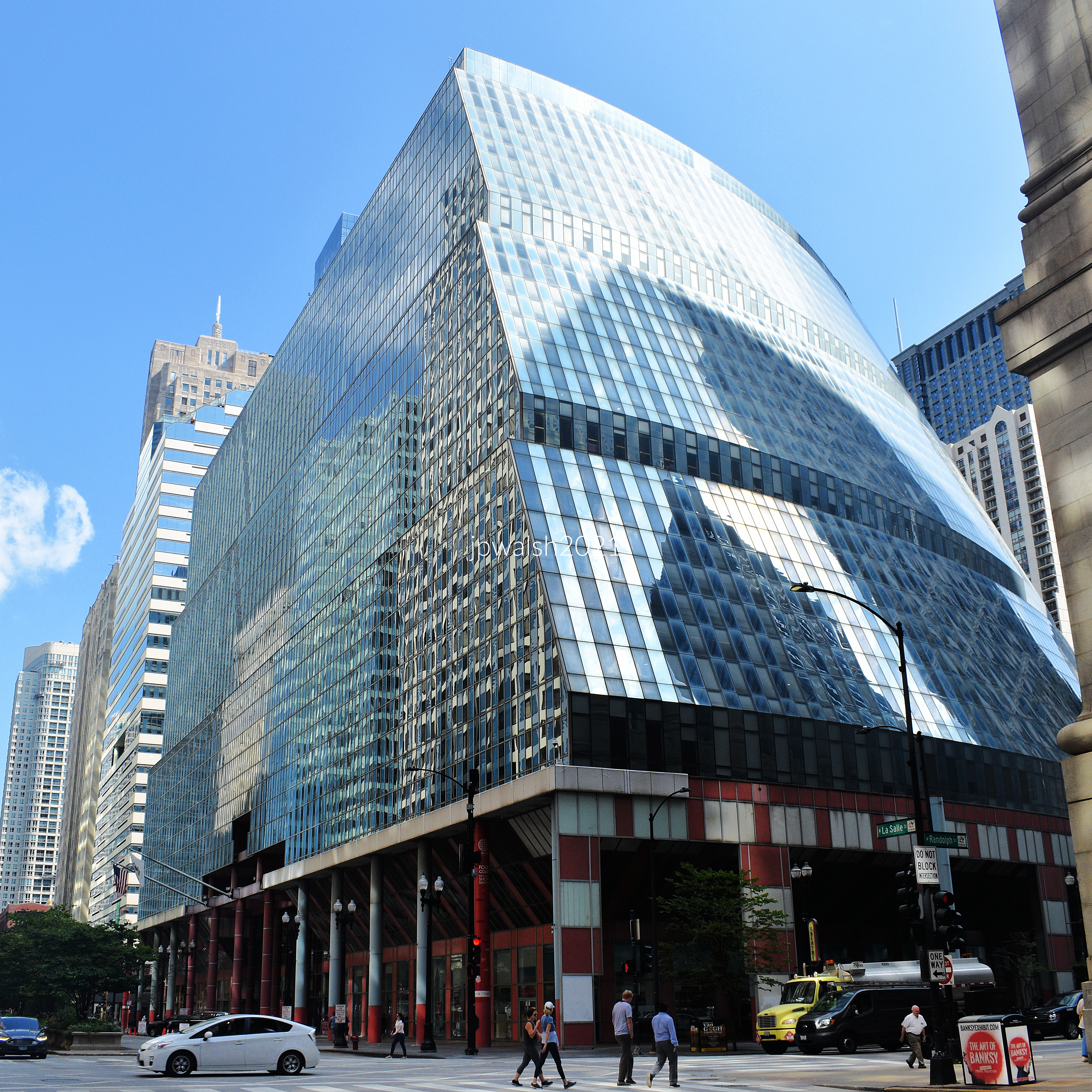
Helmut Jahn, State of Illinois (Thompson) Center, 100 W. Randolph, Chicago, Illinois, 1979-1985. The building is massive at 1.15 million square feet. The rounded facade was intended to embody the traditional architectural history of monumental rotundas and domes. When it was built in the early 1980s it was one of the most exciting projects taking place downtown. Sitting across the street from a classical revival City Hall (1911) and a modernist Daley Center (1965), the postmodern 1980’s monstrosity by Murphy/Jahn was criticized for being out of context in the neighborhood. Yet, over the following decades, negative criticism increasingly faded. May 2014. Author’s photograph. 4.75 mb
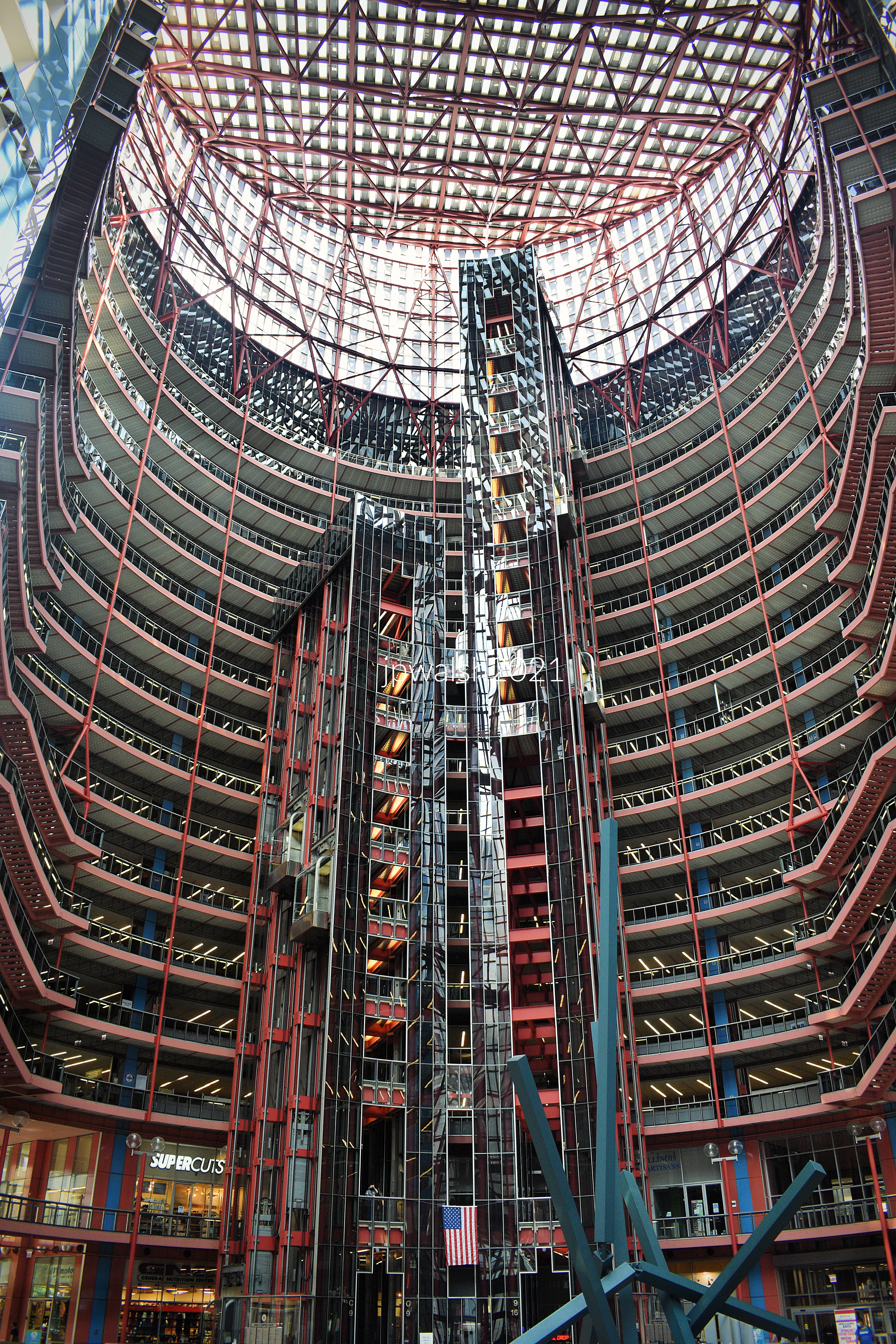
There were mixed reviews for Helmut Jahn’s massive semi-circular Thompson Center at 100 W. Randolph completed in 1985. The criticism begins at its entrance where Jahn saw placed “Outsider” French artist Jean Dubuffet’s fiberglass Monument with Standing Beast. During the building’s planning and construction some of the architect’s dazzling concepts met with resistance from contractors. For example, the contractors prevailed over Jahn’s idea for a completely locked-down outer skin using silicone glazing. In the final construction the appearance of red, white, and blue locked-down skin belies the several places throughout the design where windows are made to be opened. Inside, though its soaring 17-story atrium is airy and impressive exposing floors that hold various state bureaucracy—and signaling the idea of state government’s day-to-day practice towards transparency — the practicalities of the new building’s heating and cooling design proved seriously problematic during Chicago’s summer heat and winter cold though that major issue appeared to be eventually resolved. In 2021 Jahn’s mega-structure has been put up for sale by Illinois Gov. J.B. Pritzker from Chicago citing that the building costs hundreds of millions of dollars to operate and maintain. The photograph was taken by the author on May 25, 2014.
The State of Illinois Center from the southwest Randolph and LaSalle Streets. Setbacks divide the building into three tiers seen here. August 2021. Author’s phtograph 99% 7.65mb _9369
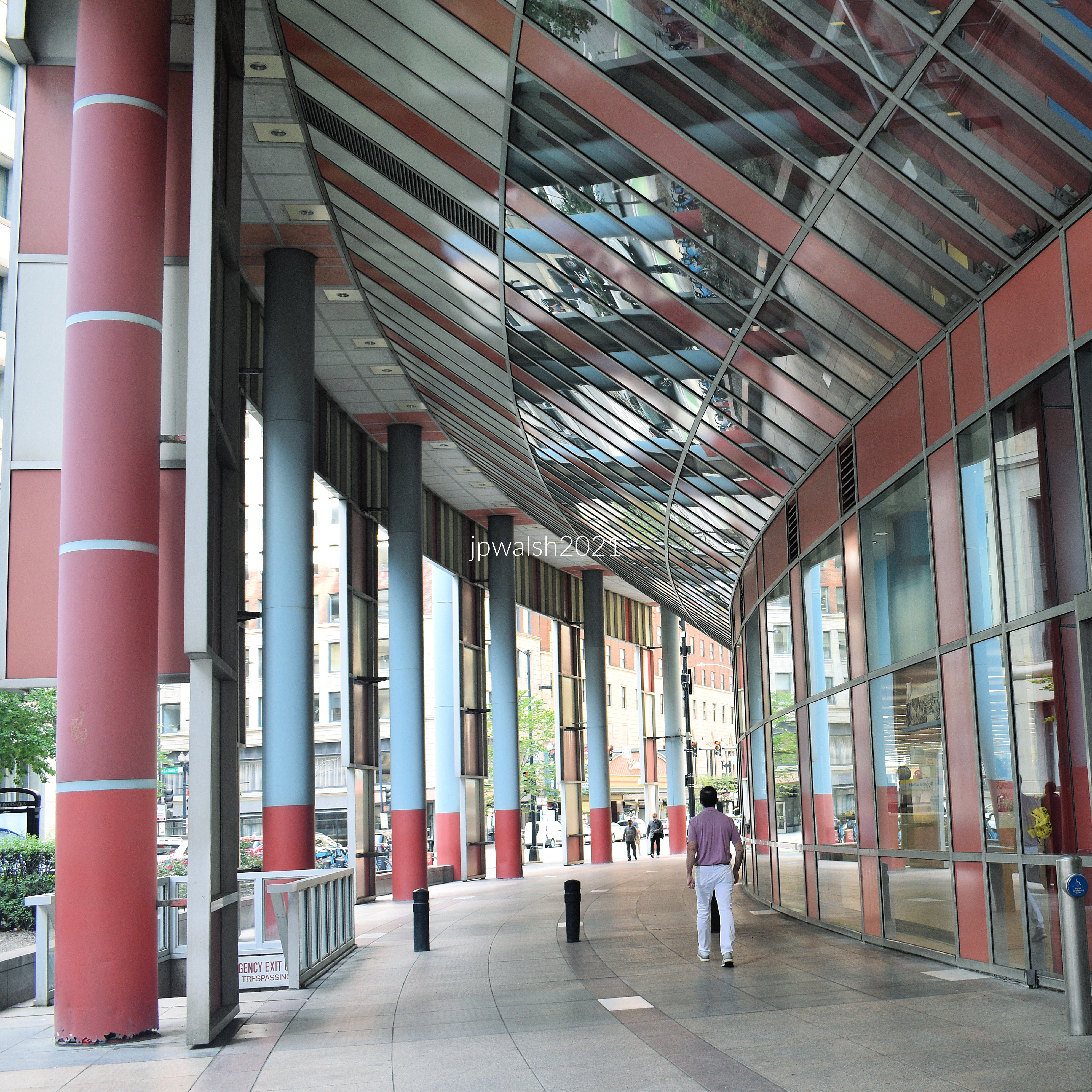
The pink and gray granite arcade provides a covered street-level passageway and is a contrast to the silver and opaque blue ornamental glass. August 2021. Author’s photograph. 99% 7.22mb_9380
The rotunda with its skylit atrium is 160 feet in diameter. The massive airy space is met by circular walkways and freestanding bank of glass elevators. August 2021. Author’s photograph. 70% 7.87 mb_9381
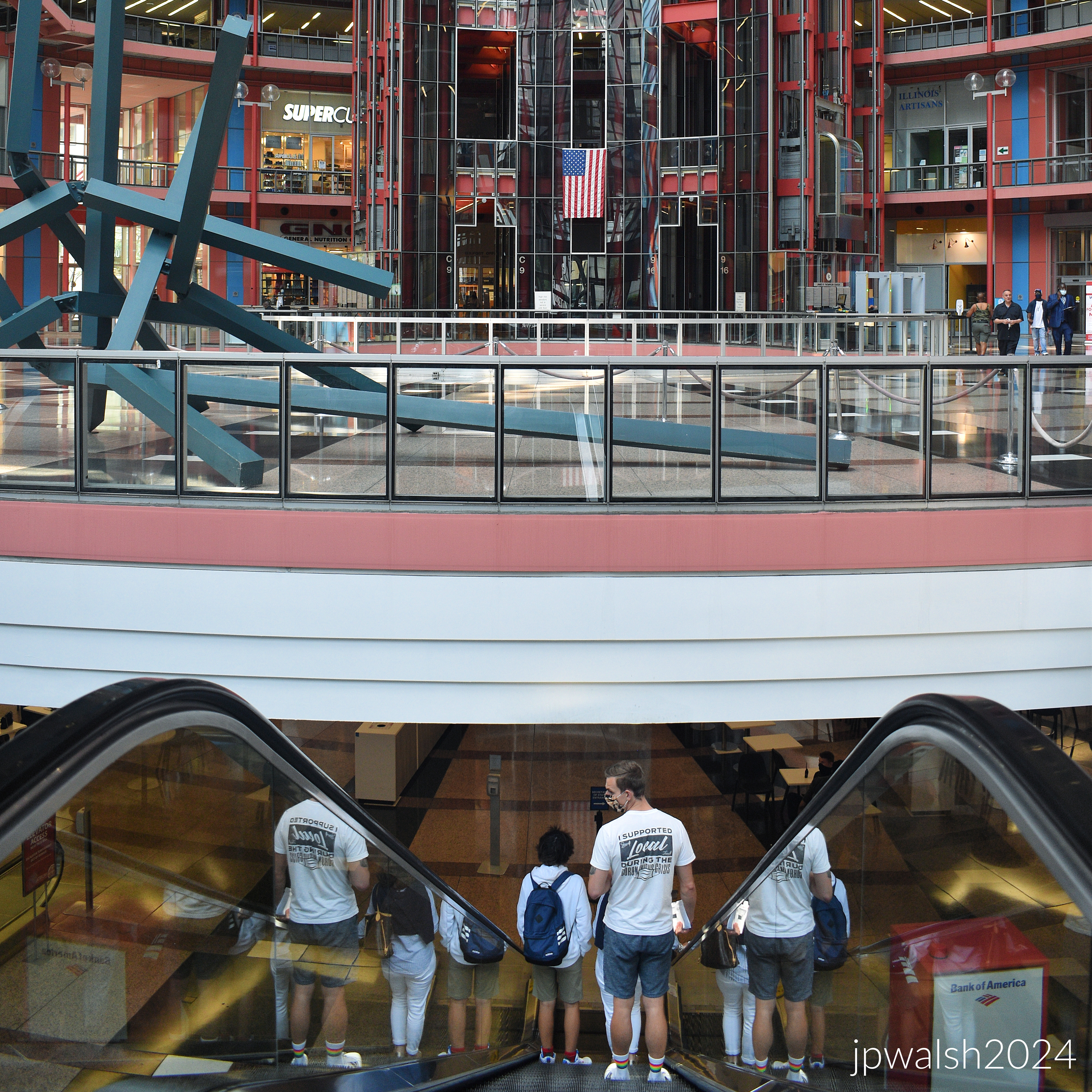
The rotunda has an elaborately paved granite floor with tens of thosand of square feet of retail space. August 2021. Author’s photograph. 99% 6.87 mb_9384
1 S. Wacker Drive, Chicago, 1982.
Helmut Jahn, One South Wacker Drive, Chicago, Illinois, 1979-1982. On a corner site, Jahn’s design is a freely translated interpretation of a 1920s stepped back tower with the building’s skin a stylized exaggeration of vertical windows and stone facades of the same 1920s’ period structures. May 2014. Author’s photograph. 4.45 mb
To the left is UBS Tower (1 N. Wacker) built in 2001 and to the right is Hyatt Center ( 71 S. Wacker) built in 2005. At 42 years old, Jahn spoke of his building at 1 S. Wacker as a synthesis of two major Chicago architectural styles—that of Louis Sullivan (1856-1924) and, Jahn’s mentor and fellow German, Mies van der Rohe (1886-1969). The building is a concrete stepped-back 50-story building with a curtain wall of dark glass defining the vertical bands of windows. Its vision remains fresh and stunning as it sits majestically between two postmodern buildings built in Chicago a generation later. The author’s photograph was taken on May 25, 2014.
Floors in each section of the stepped back tower are of three different sizes, each six thousand square feet less as the building ascends. The setbacks’ atria allow in natural daylight. August 2021. Author’s photograph. 78% 7.77mb _9293
Helmut Jahn, One South Wacker Drive, Chicago, Illinois, 1979-1982. December 2017. Author’s photograph. 6.27mb DSC_0567 (1)
IIT’s Rowe Village, Chicago, 2005.
Helmut Jahn, Jeanne and John Rowe Village at the Illinois Institute of Technology (IIT), Chicago, Illinois, 2003. August 2015. Author’s photograph. 3.67 mb
Jahn’s architecture often drew from Chicago traditions while reinterpreting them through contemporary materials and dramatic forms.
Originally called the State Street Village Dormitories, Jahn’s postmodern structure that anchors the campus to the east, consists of three five-story buildings. Jahn’s design was the first major architectural addition to the IIT campus since the early 1960’s. U.S. News & World Report called it one of the “coolest dorms in the nation.” Stretching one city block along busy State Street from 33rd to 34th Streets, Rowe Village is next to the El tracks whose Green Line zips back and forth to Chicago’s Loop. Each dorm building consists of two wings that flank an interior courtyard. The building is finished at the rear on 34th street by an insulated five-story glass wall. Entry is through the courtyard which leads into a corridor that connects the two wings. It is built of reinforced concrete with the front elevations and roof dressed in custom corrugated stainless steel panels and tinted glass framed in aluminum. The building’s sleek curvature, three compartments and chained block-long length, reflects and evokes the image of a streamlined train making for a building as Art Moderne object in the Miesian tradition. From its rooftop the Rowe Village looks north for views of Chicago’s downtown skyline while the dorm offers suite-style living in a modern setting surrounded by the mind, serious and playful, of Helmut Jahn. The photograph was taken by the author on August 21, 2015.
The Chicago Harbor Lighthouse (1893) stands as a symbol of the city’s rise as the principal commercial gateway between the Great Lakes and the American interior. More than a navigational aid, the lighthouse helped facilitate the maritime commerce, transportation networks, and industrial expansion that transformed Chicago into the economic capital of the Midwest.
Constructed in 1893, the year of the World’s Columbian Exposition, during a period of extraordinary growth for Chicago.
Known as the “Chicago Light,” the Chicago Harbor Lighthouse is an active automated lighthouse dating from 1893.
About one-half mile beyond Navy Pier, the lighthouse stands at the north of the main entrance of the Chicago Harbor in Lake Michigan. The lighthouse has had a significant role in the development of Chicago and the American Midwest and remains an active aid to nautical navigation today.
For more than a century, the U.S. Coast Guard has staffed this lighthouse at the breakwater outside the Chicago Harbor Lock. The lock separates Lake Michigan from the mouth of the Chicago River.
Guided ships on Lake Michigansafely into Chicago Harbor built in 1880, supporting both commercial shipping and passenger traffic.
The lock was built in the mid-1930’s and is operated by the U.S. Army Corps of Engineers. The lock is one of the entrances into the Illinois Waterway system at the Great Lakes. The waterway system is a commercial and recreational shipping connection to the Gulf of Mexico by way of the Illinois and Mississippi rivers.
The “Chicago Light” is at that waterway system’s headwaters as it stands in the outer harbor constructed in 1880. The Chicago Light’s conical tower dates from 1893. Twenty-five years later, in 1918, the tower was reconstructed and the base building which contains a fog-signal room and boathouse was added. The architects are not identified.
Through its breakwaters, the main entrance into Chicago Harbor is 580 feet wide. The Chicago Harbor Lighthouse was designated a Chicago Landmark on April 9, 2003. It is the only surviving lighthouse in Chicago and one of two remaining examples in the state of Illinois.
What a view from the frozen waters of Lake Michigan! CBS 2 photojournalist Alfredo Roman shot this drone video of the Chicago Harbor Lighthouse, which has endured a lot of icy weather since it was built.
About one mile ahead from this photograph’s location is the Chicago Harbor Lock. Built in the 1930’s, it provides the entrance/exit to the Illinois Waterway system at the Great Lakes. The waterway system is a commercial and recreational shipping connection from the Great Lakes to the Gulf of Mexico by way of the Illinois and Mississippi rivers.
As a historic landmark, the Chicago Light represents the often-overlooked maritime foundations of Chicago’s wealth and development as it continues to serve as an active aid to navigation today.
The Park Tower Condominium (1973) exemplifies how Chicago’s late modernist architects adapted the high-rise residential tower to the city’s lakefront, creating a landmark that combines urban density, engineering sophistication, and panoramic engagement with Lake Michigan.
Park Tower Condominium, 5414 N. Sheridan Road, Chicago, SCB, 1973. View from east looking west. August 2015. Author’s photograph. 3.15mb.
Park Tower Condominium is on the lakefront next to north Lake Shore Drive and across from Foster Beach in Lincoln Park. Its address is 5414 N. Sheridan Road, Chicago
Constructed in 1973 by Solomon, Cordwell, Buenz (SCB), a Chicago architectural firm founded in 1931, the tower was planned as the first of three towers in a triangular formation but the others did not materialize.
Tallest building outside Downtown Chicago for 8 miles north to Foster Beach. Located on North Sheridan Road in the Edgewater neighborhood, directly adjacent to Lake Michigan, its height and slender profile make it a prominent visual landmark on Chicago’s northern lakefront.
At 55 stories tall (513 feet high), Park Tower Condominium is the tallest structure between downtown and Foster Beach and one of the tallest structures in Chicago outside the downtown area.
Park Tower Condominiumis one of the largest all-residential buildings in the city.It was originally built as luxury rental apartments, though the building became condos in 1979.
In the Edgewater neighborhood, Park Tower Condominium is one of three residential towers in Chicago with black Miesian windows and three rounded lobes. The others are Lake Point Tower (505 North Lake Shore Drive) and Harbor Point (155 North Harbor Drive).
The tower reflects the modernist emphasis on efficiency, structural clarity, and residential density.
Park Tower Condominium, 5414 N. Sheridan Road, Chicago, SCB, 1973.View from northeast looking southwest. August 2015. Author’s photograph. 3.15mb.
The curtain wall of the Park Tower Condominium is beautifully detailed and proportioned.
Park Tower Condominium Is a lens into late modernist Chicago residential architecture, lakefront urban development, and the emergence of high-rise luxury living along Sheridan Road.
SOURCES:
Architect Magazine. “Solomon Cordwell Buenz.” Accessed October 23, 2026. architectmagazine.com.
Emporis. “Park Tower Condominiums, Chicago, IL, USA.” Building ID 117420. Accessed October 23, 2026. emporis.com.
The links are dropped because the Emporis database was permanently shut down in 2022, and the specific URL you provide for Architect Magazine now leads to an inactive or broken page.
John P. Walsh, 2015. All rights reserved. All text and photos are the property of the author, except for materials explicitly credited as public domain or licensed content. Photographs were taken by the author on August 7, 2015.
FEATURE image: Portion of the open-grate pony-truss bascule Chicago Avenue Bridge and concrete house, erected in 1914, as it was in its last years of operation. Pointing to increased high traffic volume and load-bearing capacity issues, the 104-year-old bridge was demolished and replaced in 2018. Author’s photograph taken in May 2016.
The Chicago Avenue Bridge (1914) embodied the engineering ambition and industrial confidence of early twentieth-century Chicago. As a functional open-grate pony truss bascule bridge spanning the Chicago River, it reflected the city’s commitment to commerce, transportation, and technological innovation. Its demolition in 2018 marked not only the loss of a working piece of infrastructure but also the disappearance of a tangible artifact from Chicago’s era of rapid urban and industrial growth.
The expanse of the Chicago Avenue Bridge over the North Branch of the Chicago River near Goose Island. The steel beam pony trussbridge was built in 1914 and demolished in 2018. It was replaced by a temporary crossing in 2019. PHOTO: “Chicago Avenue Bridge” by swanksalot is licensed under CC BY-NC-SA 2.0
Built in 1914, the bridge was part of Chicago’s extensive system of movable river bridges that enabled both street traffic and river navigation. Designed by the engineering firm Ketler-Elliot, it represented the practical and elegant bridge engineering of the City Beautiful and Progressive Era.
Built in 1914 by Ketler-Elliot Erection Company of Chicago, the original Chicago Avenue Bridge was one of the oldest pony truss bascule bridges in Chicago. Connecting River North and River West, the steel bridge was, after 104 years, demolished in November 2018 and replaced five months later, in 2019, by a temporary fixed bridge. Since this portion of the river is now used mostly for recreational purposes, a new, permanent immovable concrete bridge was expected to open over the Chicago River in this location starting in 2021, delayed by the pandemic, and that will not be a bascule bridge.
Looking west along the old Chicago Avenue Bridge. The pony (steel) truss bridge allows for road and river traffic over and through the truss, but with no cross brace across the top connecting its two sides. PHOTO: “Looking west on Chicago Avenue bridge” by Steven Vance is licensed under CC BY-NC-SA 2.0
The open-grate roadway and pony truss bascule design were characteristic solutions for heavily trafficked urban waterways. The bridge served as a critical link between the Near North Side and the Near West Side for more than a century.
A pony truss bridge is a steel truss bridge that allows traffic over and through the truss, but with no cross brace across the top connecting its two sides. The truss bridge assembly of the Chicago Avenue Bridge was made of riveted steel beams—and a witness to Chicago’s early 20th century industrial manufacturing might.
As well as being “Hog Butcher For The World, Tool Maker, Stacker of Wheat, Player with Railroads and the Nation’s Freight Handler” as Carl Sandberg wrote in his 1914 poem, Chicago, published in the new (1912) Poetry magazine, Chicago was also at that time a world leader in steel production and bridge design.
Looking east at the new Chicago Avenue Bridge in November 1914. Public Domain.
The basic design of any bascule bridge is similar to a medieval castle drawbridge. A leaf or span rises and descends that permits traffic upon it and— for the Chicago Avenue Bridge— also traffic below it on the Chicago River.
Chicago boasts more than 50 movable bridges. Single-leaf (truss) bascule bridges were constructed where the river was not very wide and a single bridge deck goes up and down between abutments. This was often used for train traffic which was convenient since Chicago was and still remains the railroad capital of the United States.
The more common double-leaf (truss) bascule bridge— including the Chicago Avenue Bridge—consists of two leaves or spans which meet in the middle over the river. Counterweights on each side of the bridge beneath it in a river pit (or pits) balances, stabilizes and fortifies the vertical movement of the bridge deck.
If the bridge deck is single leaf, the “Chicago Style” bridge rises in a piece vertically to one side of the river. If the bridge deck is two leaves, each rise to their side of the river and descend to close again by meeting in the middle of the bridge deck.
Its steel construction and mechanical movable span illustrated Chicago’s emergence as a world leader in infrastructure and civil engineering. The structure was closely tied to the industrial, commercial, and maritime history of the Chicago River.
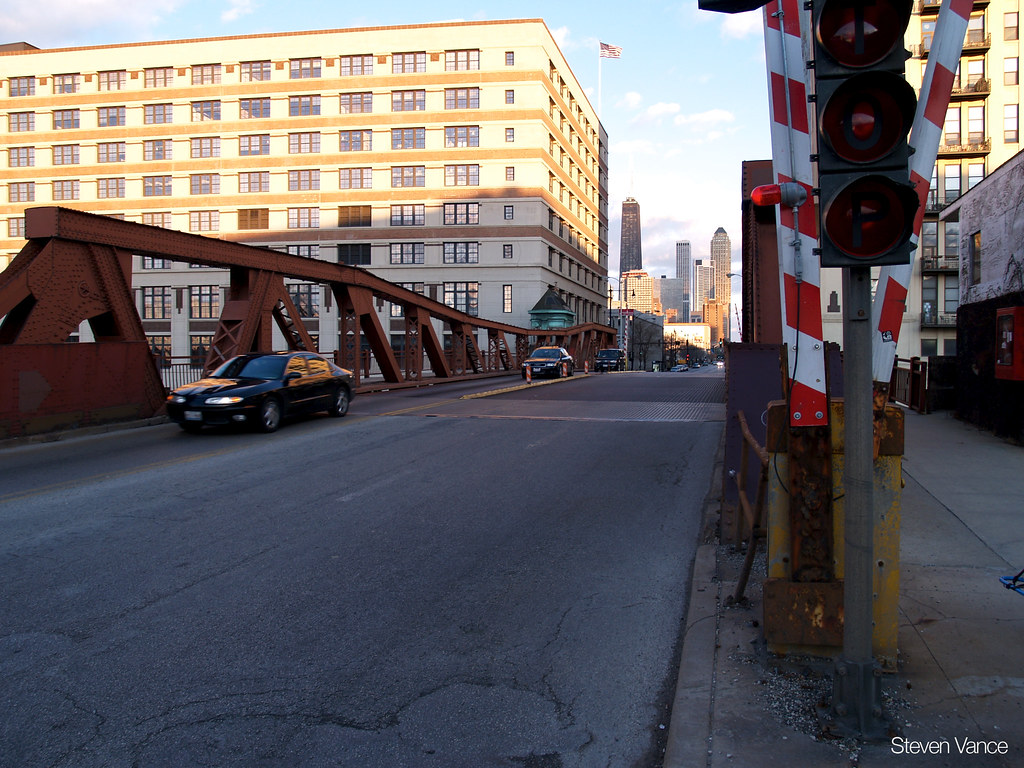
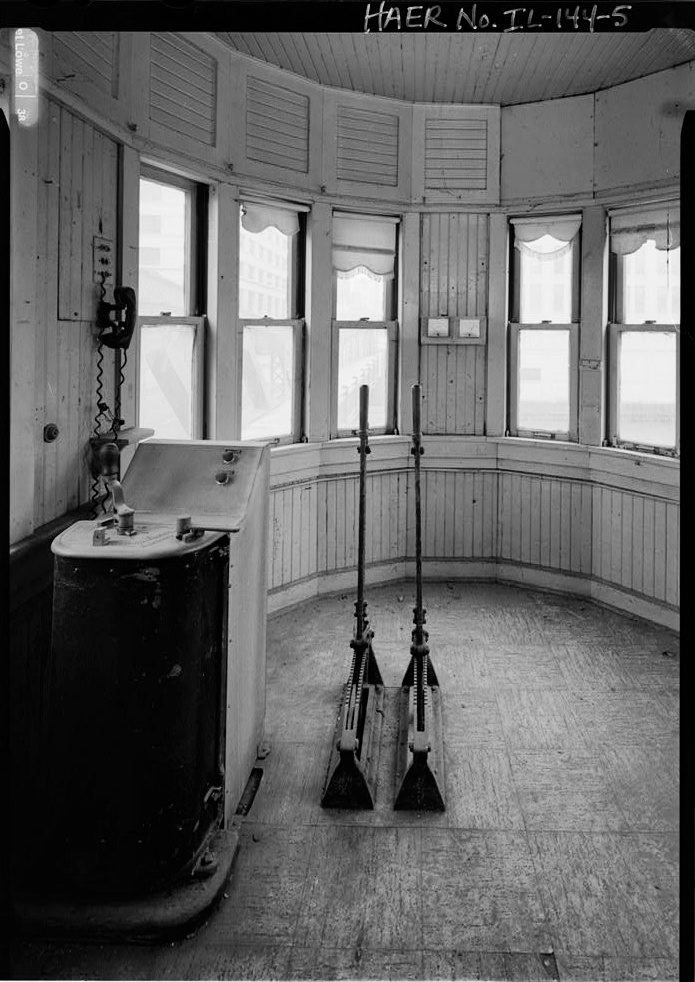
Bascule bridges are the most commonly found moveable bridges in the world because they operate quickly and efficiently. The Chicago Avenue Bridge was operated from a companion pitched-roof bridge house with rounded corners and rows of windows clad in decorative (today oxidized green) copper. The foundational portions of the bridge house were constructed of concrete. Upper portions were made of wood with roofing of vitrified tile. So far, the bridge house portion of the structure has not been demolished.
In 1914, the new Chicago Avenue Bridge across a jag of Chicago River abutting the national headquarters of Montgomery Ward whose complex was first built in 1907, made for a sleek, powerful, modern and elegant statement about industry and urban commerce in early 20th century Middle America.
Historic photographs of the bridge provide a record of a Chicago that was simultaneously industrial, architectural, and intensely urban.
When the Chicago Avenue Bridge opened in 1914, Chicago was the world leader in steel production and bridge design. Chicago Mayor Carter H. Harrison, Jr. (1860-1953) whose name appears on the dedication plaque was a five-term Democrat incumbent from 1897 to 1905 and from 1911 to 1915. PHOTO:“Carter H Harrison Mayor marker – Chicago Avenue Bridge” by swanksalot is licensed under CC BY-NC-SA 2.0
There are numerous variations and designs of the bascule bridge which in Chicago includes the trunnion (“pivot point”) bascule (“seesaw”) bridge. The nation’s first such bridge started operation in Chicago in 1902 over the north branch of the Chicago River at Cortland Street which can still be seen in operation today. The bridge design became known as the “Chicago Style” as its leaf or leaves, suspended on axles (trunnions) with massive concrete counterweights located below the bridge in the riverbank pit, opens and lifts a single or dual bridge deck to clear the river for traffic without blocking the waterway with a central pier.
Chicago’s bascule bridges—and the Chicago Avenue Bridge was one of them—were designed to its specific location. Each was designed to take on heavy loads and the attendant vibration which included the ice and snow pack of Chicago’s typically harsh winters. The design and construction into bedrock took into account wind resistance, whether the bridge leaves were open or closed, and to wind speeds of 100 miles per hour in any and all directions.
By 1920, improvements in bascule bridge design allowed for the construction of a double deck trunnion bascule bridge where car, truck and foot traffic could be carried simultaneously on its upper and lower decks. The first such double deck trunnion bascule bridge in Chicago was near the site of the old Fort Dearborn on the Chicago River at Michigan Avenue—today’s busy DuSable Bridge, formerly Michigan Avenue Bridge which opened in May 1920.
The Chicago Avenue Bridge is also significant as it belonged to a set of Chicago city bridges built between 1910 and 1915 whose designs looked to go beyond their utilitarian function to incorporate artistic and other aesthetic elements. Beginning with the Chicago Avenue Bridge in 1913, the Chicago Planning Commission worked with the city’s Bridge Division at the bascule bridge’s design stage.
Engineer’s blueprint of the Chicago Avenue Bridge, 1914. Public Domain. The blueprint shows the technical plans and cross-sections for the historical bascule drawbridge over the Chicago River at West Chicago Avenue. The detailed architectural drawings outline:
The Top-Down Site Plan (Top): Shows the layout of the river channel, streetcar rails, sidewalks, and neighboring historic properties (like the Montgomery Ward Co. Building, Merchants Lighterage Co., and City Yards).
The Structural Cross-Section (Middle): Details the bridge’s lane width, clearance dimensions, trolley wires, and structural framing.
The Profile Elevation (Bottom): Illustrates the trunnion mechanics, bridge towers, operators’ houses, underwater riverbed depth, and the underground utility tunnels beneath the city datum line.
Demolition in 2018 reflected the ongoing tension between infrastructure modernization and historic preservation.
Following the demolition of the Chicago Avenue Bridge in 2018, an immoveable temporary steel girder bridge was installed in 2019 over this span of the Chicago River. For the moment, bridge design has returned to utilitarian functionality alone with little or no artistic or aesthetic program which had been one of the progressive features of the Chicago Avenue Bridge over a century ago.
Library of Congress. “Chicago Avenue Bascule Bridge, Spanning North Branch of Chicago River at Chicago Avenue, Chicago, Cook County, IL.” Historic American Engineering Record, HAER IL-23. https://loc.gov/pictures/item/IL0823/.
The Brooklyn Bridge stands as the greatest achievement of John Augustus Roebling’s engineering career, uniting innovative design, industrial ambition, and architectural beauty to create an enduring symbol of New York City and America’s rise as a modern nation.
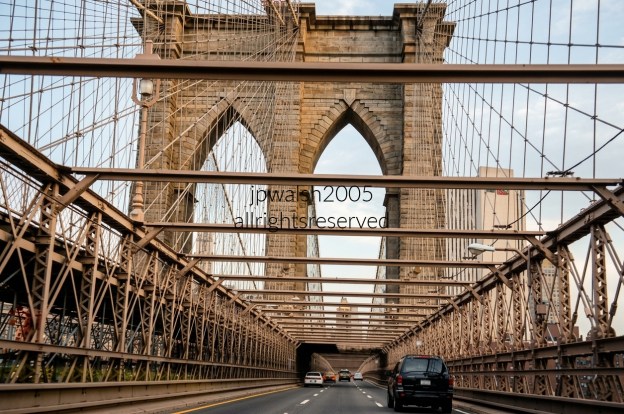
FEATURE image: The Brooklyn Bridge. Centered perfectly is one of the bridge’s massive, Gothic-arched granite suspension towers, while flanking the right side behind the suspension cables are the skyscrapers of Lower Manhattan, including the recognizable Verizon communications building. August 2005. Author’s photograph. All rights reserved.
The Brooklyn Bridge over the East River is the oldest extant bridge in New York City—a city of bridges—and is also the city’s most architecturally famous. The opening of the hybrid cable-stayed and suspension bridge in May 1883 has been called “the Dawn of Modern New York” as it is the world’s first steel-wire suspension bridge.
The Brooklyn Bridge was conceived to connect Manhattan and Brooklyn across the East River, overcoming unprecedented engineering challenges.
Recent photo of the Brooklyn Bridge taken from the Manhattan side of the East River looking across the water toward the DUMBO and Brooklyn Heights neighborhoods. PHOTO: “Brooklyn Bridge New York City” by ugod is licensed under CC BY 2.0.
Spanning the East River between the boroughs of Manhattan and Brooklyn, it was designed and built by a father-son team. Construction began in January 1870 after being approved by Congress in 1869 whose concern was that the bridge project would in no way impede free and open navigation. Over the next over 13 years, an estimated 27 men died during the bridge’s construction. The New York terminus rests on bedrock while the Brooklyn terminus rests on clay. Following its opening in 1883 by the end of that year more than one million passengers crossed the bridge.
Roebling’s innovative use of steel-wire cable technology made longer and stronger suspension spans possible. The bridge’s Gothic-inspired stone towers combine structural necessity with architectural grandeur.
Daily transit on the elevated pedestrian promenade of the Brooklyn Bridge in 1903, looking west toward the lower Manhattan skyline. In the foreground, a New York City policeman in a turn-of-the-century uniform and custodian helmet stands watch as pedestrians in Edwardian dress, men in long overcoats and bowler hats, make their way along the wide wooden boardwalk. The photograph captures the bridge’s intricate lattice of vertical suspenders and radiating steel stay cables. Flanking the promenade on either side are the lower iron trusses that separated pedestrians from the bridge’s busy trolley and cable car lines. Anchoring the composition at the vanishing point is one of the bridge’s immense granite towers, its signature neo-Gothic double arches perfectly framing the horizon and underscoring the monumentality of one of America’s great engineering achievements. Public Domain.
The total length of the bridge is 6,537 feet—nearly one-and-one-quarter miles. From the middle of the span, it is about 135 feet above the river with the span’s weight around 7,000 tons. The railroad on the Brooklyn Bridge opened in 1888. The cables on the bridge are over one foot wide (16 inches) and took almost a year and a half (15 months) to string. Their calibration had to include calculations for variables such as wind and expansion and contraction due to temperature. The height of the Gothic-inspired towers are 159 feet above the roadway.
The Brooklyn Bridge symbolizes the industrial age, urban growth, and American ingenuity. Today it remains one of the world’s most recognizable and photographed structures.
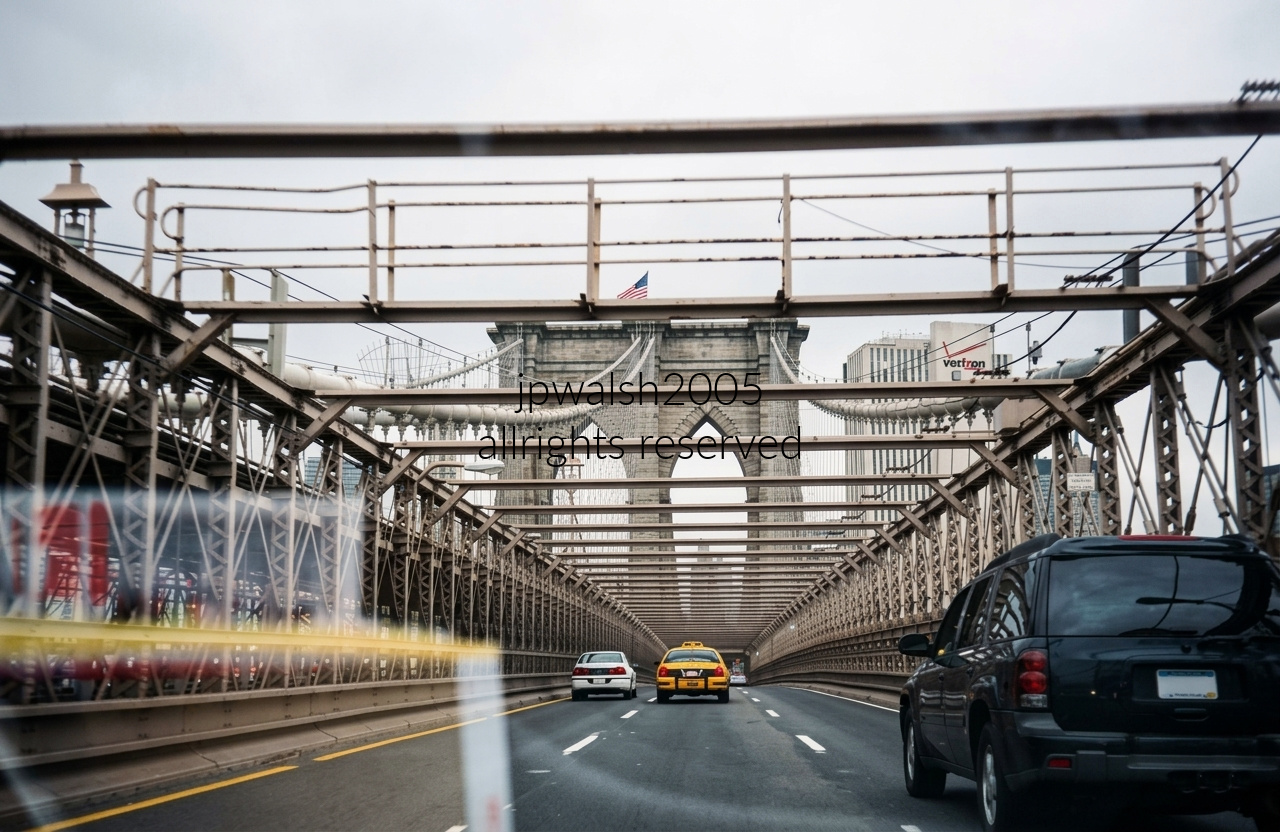
While a classic yellow New York City taxicab and a white sedan drive ahead, the bridge’s intricate, industrial steel trusses, overhead support beams, and complex web of suspension cables that line both sides of the roadway fill out the view heading from Brooklyn into Manhattan. An average of 103,051 vehicles cross the Brooklyn Bridge every single day. August 2005. Author’s photograph. All rights reserved.
SOURCES: The Sun, New York, New York, June 11, 1891. NYC DOT – Brooklyn Bridge – retrieved August 2, 2026.