Tag Archives: #TwentiethCenturyArt

Curves in a City of Grids: How Calder’s Flamingo (1974) Transformed Chicago’s Federal Center.

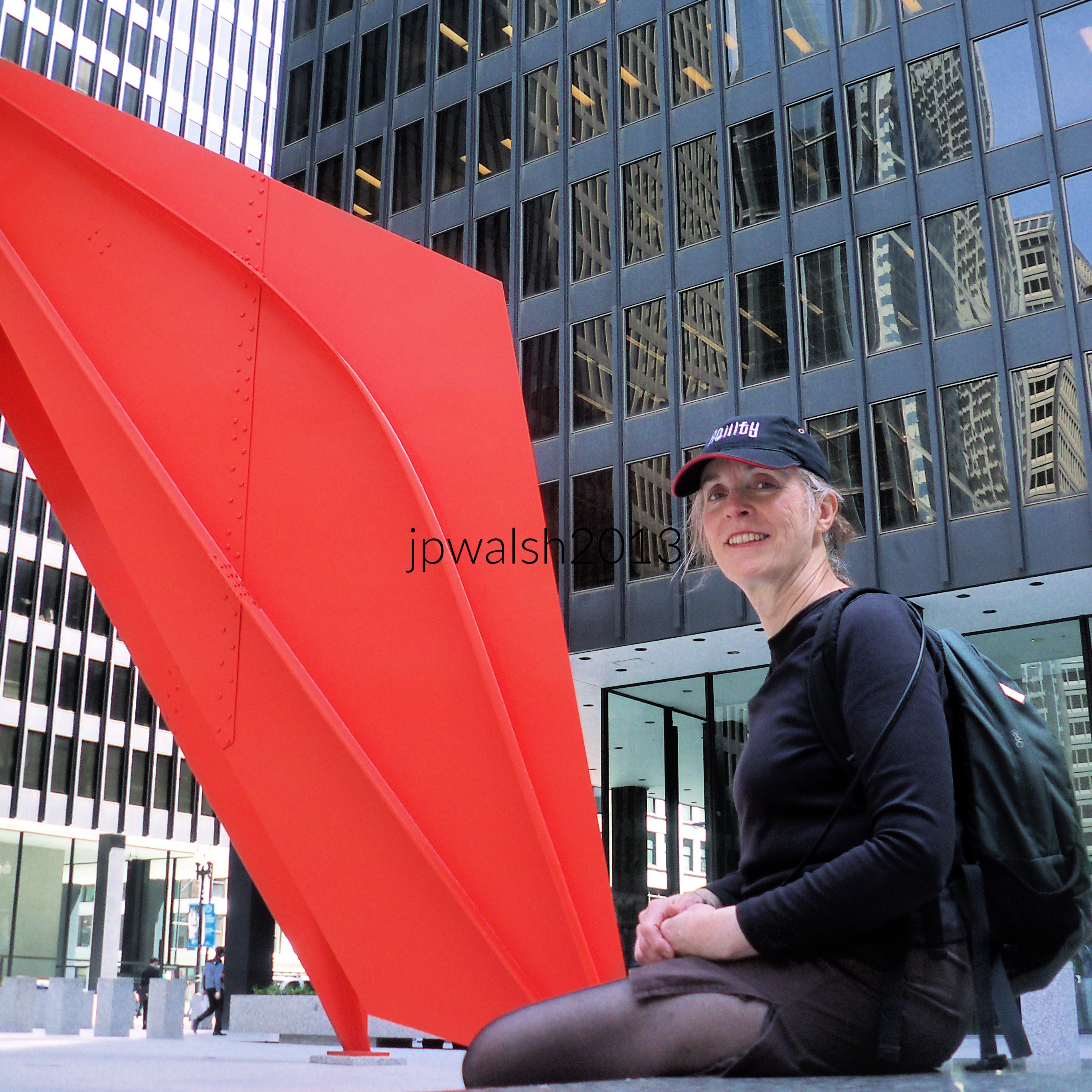
FEATURE Image: Alexander Calder’s Flamingo successfully transforms Chicago’s Federal Center Plaza by humanizing, energizing, and completing Mies van der Rohe’s austere modernist architectural ensemble through color, scale, movement, and sculptural form. Author’s photograph. June 2022. 7.73 mb

Alexander Calder’s Flamingo (1974) transformed Chicago’s Federal Center by introducing movement, whimsy, and human-scaled organic form into one of the city’s most rigorously ordered modernist spaces. Set amid Ludwig Mies van der Rohe’s rectilinear architecture, Calder’s monumental red stabile demonstrates how public art can soften, animate, and humanize the urban environment without diminishing its architectural power. Alexander Calder’s Flamingo was unveiled on October 25, 1974, in a dedication ceremony with the artist. Alongside Picasso and Cloud Gate, it is one of Chicago’s iconic outdoor public artworks.

In downtown Chicago’s Federal Center Plaza on South Dearborn Street between Adams Street and Jackson Boulevard is Alexander Calder’s 53-foot-tall painted steel plate “stabile object” entitled Flamingo. The Chicago Federal Center was completed in 1974 with Calder’s artwork. The design project began in 1958 and included three International-style government buildings by modernist architect Mies van der Rohe (1886-1969) within a public plaza design that was completed in 1974. Flamingo, commissioned after Mies’ death for $250,000 by the Government Services Administration, was unveiled on October 25, 1974 with the 76-year-old Calder present for its dedication ceremonies and festivities. With the commission Calder understood the significant impact of his artwork for the Federal Center Plaza in Chicago.

Calder’s prolific and impressive art career started in the early 1920s. Fifty years later, Flamingo (a.k.a., “the Calder”) in Chicago’s historic Federal Center Plaza is a later work, whose maquette Calder made before it was intended for Chicago.

During his artistic career’s many decades and years, Calder never stopped developing in his art. The 1974 steel sculpture painted red-orange is four stories tall and makes a powerful impact on the streetscape where it is an integral part. Along with Chicago’s Picasso in 1967 and Anish Kapoor’s Cloud Gate (“the Bean”) in 2004, Calder’s Flamingo in 1974 has taken its well-deserved place among Chicago’s most iconic outdoor public artworks.

From the inventor of the mobile, Calder turned later to the development of the stabile of which Flamingo is a masterwork. Starting in the mid1950s and into the 1970’s, Calder produced scores of stabiles in many shapes and sizes for display around the world.

“Most architects and city planners want to put my objects in front of trees or greenery. They make a huge error. My mobiles and stabiles ought to be placed in free spaces, like public squares, or in front of modern buildings, and that is true of all contemporary sculpture” – Alexander Calder. Quoted in Jed Perl, Calder: The Conquest of Space: The Later Years: 1940–1976 (New York: Alfred A. Knopf, 2020).

June 2022. Author’s photograph. 7.24 mb

Above: On the west side of Clark Street between Adams Street and Jackson Boulevard—visible directly behind Alexander Calder’s Flamingo sculpture—the prominent structures are from left to right: The Commercial Office Building located at 118 South Clark Street (directly tucked between the Bankers Building and Jackson Boulevard)—was completed in 1920 and designed by the prolific Chicago architectural firm Holabird & Roche, Willis Tower in the distance, The Bankers Building (105 West Adams Street, completed in 1927 by the Burnham Brothers, a 476-foot Art Deco masterpiece featuring characteristic deep light courts and upper-tier setbacks), and, on the other side of Adams Street, The Field Building at 140 S. Clark. Completed in 1934 by Graham, Anderson, Probst & White, it stands as one of the finest premier masterpieces of Art Deco skyscraper design in the entire United States. A corner slice of the Edison Building is also pictured.

Titled Flamingo, the towering abstracted “Calder red” painted stabile object can evoke reactions to it that are unexpected. Calder’s stabile masterwork was unveiled in October 1974 which was the same year the Sears Tower (in the background) was completed, and which was at that time the world’s tallest building (today it is ranked no. 26). From Federal Center Plaza, Chicago’s 20th century architectural history is readily on display in its downtown buildings in a range of shapes, sizes, textures and design styles.

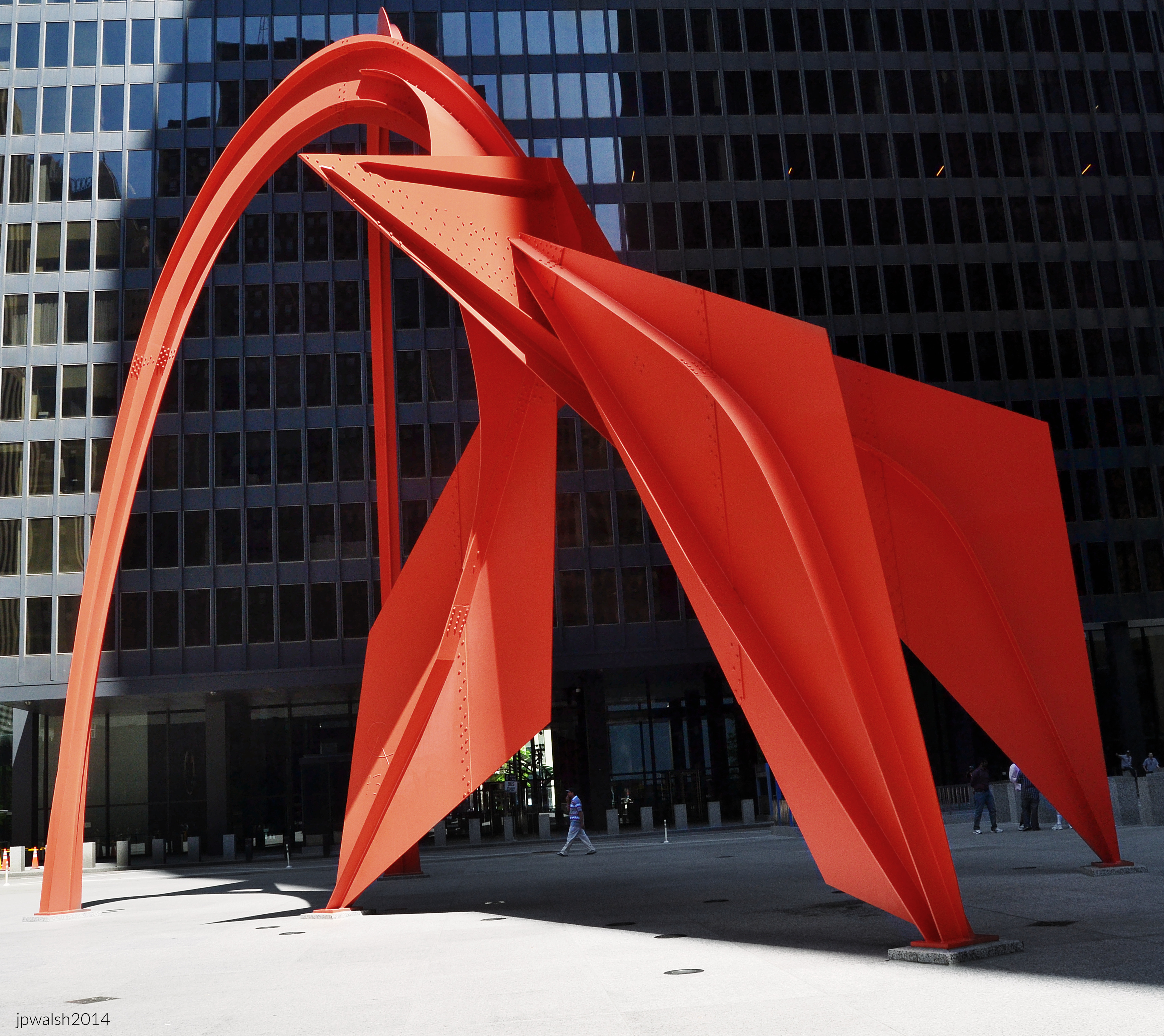
The work’s vivid red color and sweeping curves contrast with Mies van der Rohe’s black steel-and-glass buildings.
May 2014. Author’s photograph. 3.28 mb

Because of its monumental size, Flamingo can be intimidating. Actual flamingo shorebirds vary in size, but none are no more than 3 to 5 feet tall, and weigh about 5 to 7 pounds. At 53 feet tall, Calder’s immense stabile in Chicago is about the size of a giant sauropod dinosaur which would weigh around 60 tons.

“It’s really just for differentiation, but I love red so much that I almost want to paint everything red” – Alexander Calder. Katharine Kuh, The Artist’s Voice: Talks with Seventeen Artists (New York: Harper & Row, 1962).

November 2015. Author’s photograph. 260kb 25%

Alexander Calder trained and worked as a mechanical engineer before he became an artist. The graceful design and construction of Flamingo is expressed by nearly one-inch-thick steel plates buttressed by ribs and gussets joined overhead by lofty arches and resting on three legs as if it is nearly weightless. Even his largest stabiles (of which Flamingo is one) are made so they can be easily unbolted and taken apart to be transported and assembled at the place of destination.

Calder’s Flamingo demonstrates how monumental public sculpture can become an active architectural partner, transforming a formal modernist plaza into a more dynamic, accessible, and memorable civic space.

May 2014. Author’s photograph. 4.82 mb

In Federal Center Plaza is a complex of three buildings of varying scales by Mies van der Rohe: the broad 30-floor Everett McKinley Dirksen Building at 219 S. Dearborn Street completed in 1964 (at right), the lean 45-floor John C. Kluczynski Building at 230 S. Dearborn Street completed in 1974 (not pictured), and the single-story U.S. Post Office building at 219 S. Clark Street (not pictured). Calder’s Flamingo sits on its three pillars like a lunar lander that reflects the arcaded bases of Mies van der Rohe’s buildings that surround it as well as provide a sweeping contrast of curves and bright stand-out color against the surrounding modernist buildings’ monochrome glass-and-steel grid appearance. Calder’s artwork achieved more than the sum of these parts – it transformed Mies’ overall somber architectural trio into a more dramatic and complex quartet that included Calder’s art. The 30-story Dirksen Building is across Dearborn Street.

Flamingo by Alexander Calder is a masterwork stabile in Chicago’s downtown. Its monumental scale remains approachable because pedestrians can walk around, beneath, and through it.

May 2013. Author’s photograph. 3.60 mb 102_0480 (1)
November 2015. Author’s photograph. 484 kb 25%

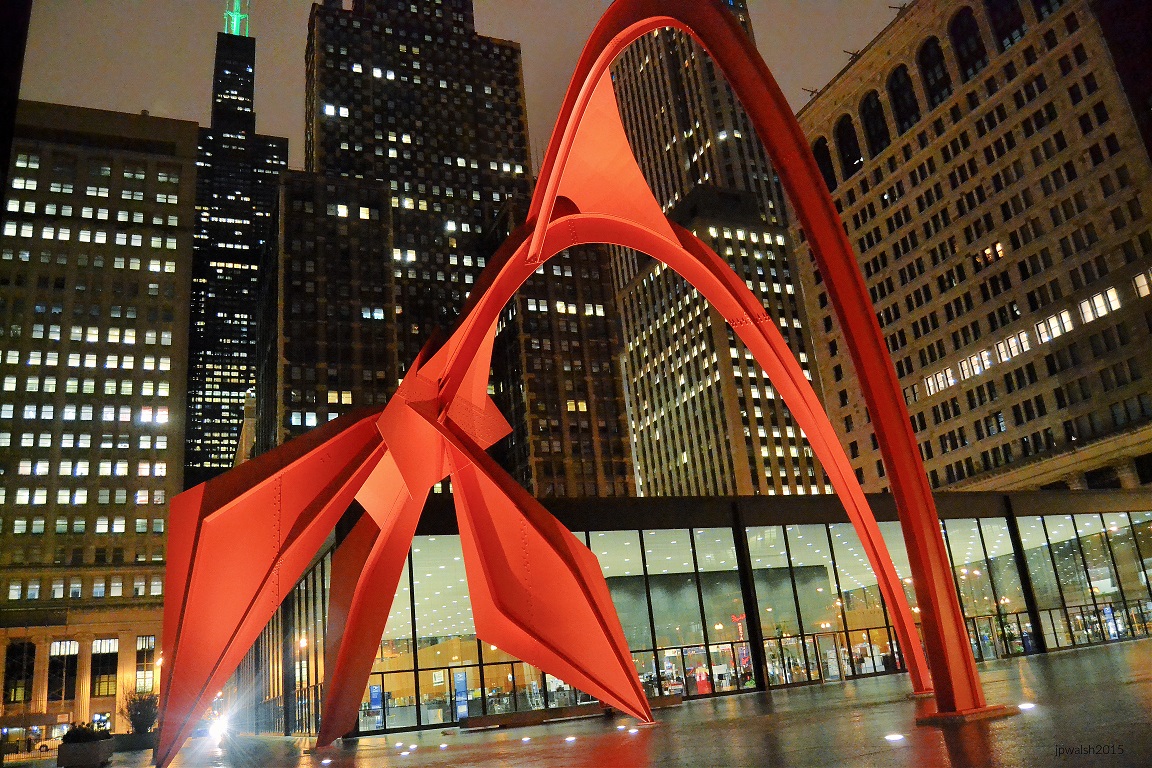
Above: Calder’s Flamingo after dark with the one-story Post Office illumined within behind it (above). Alexander Calder deliberately placed the sculpture in an open urban setting where contemporary sculpture could interact with modern architecture.

June 2022. Author’s photograph. 6.87mb

Above: Calder’s stabile is one of the most monumental public art commissions in Chicago. Flamingo’s height and breadth (it fills a space of about 1440 square feet) achieves a largesse that does not forgo a human scale as it allows pedestrians to freely walk around, under and through it. The 45-story Kluczynski Building is at left.

November 2015. Author’s photograph. 3.77mb

Above: Flamingo lighted at night in late November where there is already a snow pile on the sidewalk in Chicago’s Federal Center Plaza presaging the Chicago winter. In summer months there is a regular farmer’s market on the Federal Center Plaza. It is also the location for a variety of political gatherings year-round. The Kluczynski Building is behind.

Rather than functioning as an isolated object, the sculpture changes how viewers experience the entire Federal Center complex.

October 2015. Author’s photograph. 3.90mb.

Above: Alexander Calder’s Flamingo (1974) sits in Federal Plaza designed by modernist architect Mies Van Der Rohe. Behind it is Mies’ 45-floor John C. Kluczynski Building at 230 S. Dearborn Street and on a sunny east side of South Dearborn his 30-story Dirksen Federal Courthouse. Moving south across Jackson Boulevard is the 5-story 33 West Jackson Boulevard building built in 1910 (with additions/remodels stretching through 1917). Next to it is The Standard Club at 321 South Dearborn Street built in 1926 and designed by Albert Kahn. The Fisher Building (1896) at 343 South Dearborn Street and its annex is next further south. Designed by D.H. Burnham & Company, it was completed in 1896. The Old Colony building on the other side of the L tracks was built between 1893 and 1894, When it officially topped out, the 17-story, 215-foot high-rise briefly held the title of the tallest building in Chicago. It was designed by the legendary architectural firm of Holabird & Roche. The framework was engineered by Corydon T. Purdy who designed it with a highly advanced, pioneering skeletal steel-frame structure that carries the entirety of the building’s massive weight allowing the exterior features absolutely no self-supporting walls.

In October 1974 Alexander Calder was in Chicago for a “Calder Festival” where two of his major works were being dedicated – Flamingo for Federal Center Plaza (depicted above with the Kluczynski Building) and Universe, a motorized mural for the Sears Tower. Reflecting the artist’s lifetime interest in circuses, Calder joined in the city’s circus-themed parade in his honor. In another major cultural event in Chicago, the Museum of Contemporary Art held a large retrospective exhibition of Calder’s art from October to December of 1974.

June 2022. Author’s photograph. 6.20mb

Above: Flamingo sits within a classic Chicago Loop streetscape looking south down South Dearborn Street, framing a beautiful juxtaposition of the city’s architectural evolution. On the left side of the street sits the massive, dark steel-and-glass the Kluczynski Federal Building designed by Mies van der Rohe. On the immediate right foreground is the ornate, reddish-brown stone facade of the Marquette Building (1895). Directly past it rises the colossal, dark brick wall of the Monadnock Building (1891), showcasing its iconic, smooth masonry curves and deep-set bay windows stretching a full block south toward Van Buren Street. In the distant vista is the historic red brick tower of the Old Dearborn Station clock tower (1885) stands out against the sky, acting as a visual anchor at the very end of the street corridor.
May 2024. Author’s photograph. 88% 7.78 mb

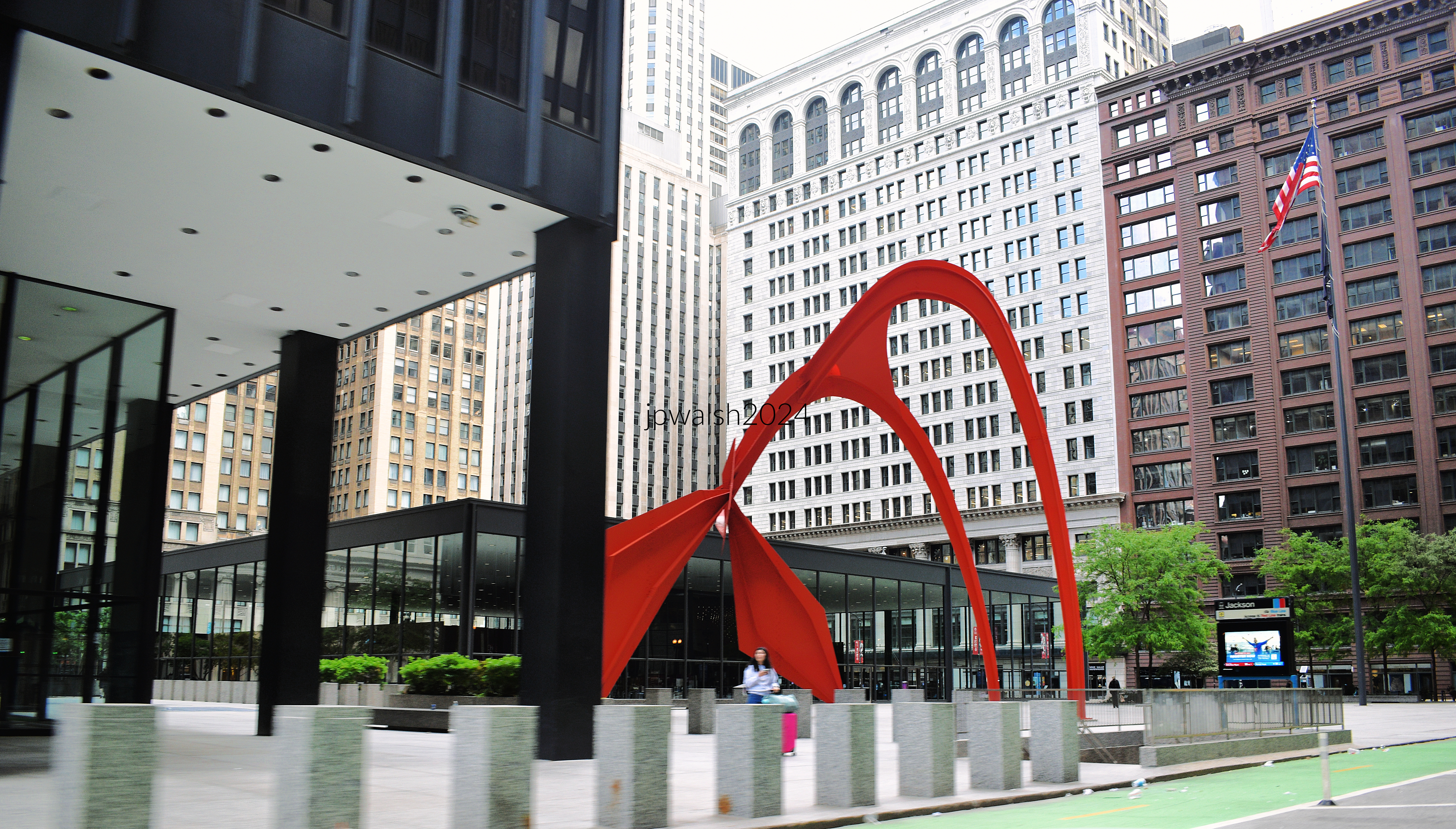
Above: This wide angle of federal Plaza frames several historic and modernist landmarks surrounding Alexander Calder’s Flamingo sculpture. These include a portion of John C. Kluczynski Federal Building, Loop Station Post Office, The Commonwealth Edison Building and The Marquette Building.
May 2013. Author’s photograph. 2.80 mb 102_0488 (1)

August 2021. Author’s photograph. 96% 7.91mb DSC_6798

Above: Looking east along West Quincy Street toward Federal Plaza, this view captures a striking convergence of Chicago’s historic and modernist architecture. Framing the corridor is, on the left, a slice of the Rookery Building, completed in 1888 by the firm Burnham & Root, and the Clark Adams Building originally known as the Bankers Building, completed by the Burnam Brothers in 1927. On the right is the Central Standard Building, originally the Continental Illinois National Bank Building, completed in 1924 by Graham, Anderson, Probst & White. Anchoring the vista is the sweeping red curve of Alexander Calder’s Flamingo. Just in front of it stands the transparent glass entrance to the single-story United States Post Office (1973), an integral element of Ludwig Mies van der Rohe’s original Federal Plaza design. Rising behind the plaza and dominating the upper half of the scene is the John C. Kluczynski Federal Building, Mies’s landmark expression of modernist architecture, creating a dramatic contrast with the richly detailed Art Deco and classical forms that line Quincy Street.

By placing a monumental red sculpture of sweeping organic curves within Mies van der Rohe’s disciplined modernist complex, Alexander Calder transformed Chicago’s Federal Center into a dynamic conversation between art, architecture, and public space.

Sources:

Bach, Ira J., and Mary Lackritz Gray. A Guide to Chicago Public Sculpture. Chicago: The University of Chicago Press, 1983.

Chicago Architecture Center. “Federal Center.” Buildings of Chicago. Accessed September 30, 2022. https://www.architecture.org/learn/resources/buildings-of-chicago/building/federal-center/.

Lipman, Jean. Calder’s Universe. New York: The Viking Press and Whitney Museum of American Art, 1976.

Perl, Jed. Calder: The Conquest of Space: The Later Years: 1940–1976. New York: Alfred A. Knopf, 2020.

The Cultural Landscape Foundation. “Chicago Federal Center Plaza.” Designed Landscapes. Accessed September 30, 2022. https://www.tclf.org/landscapes/federal-plaza.


From Li-Li to Lee Miller: The Making of an Artist Before Paris, 1907-1925.

FEATURE image: The Millers in 1920. Lee, Erik, Theodore, Florence and John. Public Domain.

Lee Miller’s extraordinary artistic career did not emerge suddenly in Paris or the Surrealist movement, but was rooted in the unique environment of her Poughkeepsie upbringing, where family affluence, her father’s intense photographic interests, early exposure to cameras, artistic encouragement, and her rebellious independent personality shaped the creative force she would become.

The Millers, Theodore, Elizabeth Lee, Erik, John and Florence, in 1923. Public Domain.

By John P. Walsh

In the first decades of the twentieth century it became increasingly common practice for established American families to reflect and display their personal lives as well as social status in the timely gathering of photographic portraits. Progressively, the American family unit grew more compact in tandem with its greater personal affluence in an economy increasingly dominated by mechanization and the manufacture of consumer goods, all of which worked relentlessly to replace farming as the engine of American enterprise.

The Millers of Poughkeepsie, New York – a seventeenth century town eighty miles north of New York City which in the eighteenth century had progressed to an early state capital and, by 1910, a significant stop on the railroad line1 – shared that prototypical family form as they gathered for their family portraits between 1914 and 1932.

After 1900, camera availability and quality had markedly improved. Moving into the popular culture, photography allowed the display of a family image that is relaxed and natural as well as a time capsule of its members. In the instance of the Millers their formal and informal photographic portraits capture what appears to be a cohesive family unit expressive of their times. They are within a thoughtfully creative pose and posture likely managed by the head of the household, Theodore Miller (1872-1971), an energetic lifelong amateur photographer.

These portraits are ambitious for an aesthetic which manifests as a controlled vibrancy in the sitters as well as overall composition. The outcome for these portraits which all include Lee Miller as a child and teenager are photographs that combine the qualities of the fine arts with the more delicate workings of a machine. 

The extensive photographs taken by her father, Theodore Miller, unintentionally document the formation of a future artist, providing rare visual evidence of the circumstances that nurtured one of the twentieth century’s most remarkable photographers.

Lee Miller at about eight months old, c. December 1907. Taken by her father Theodore Miller, the amateur photographer would photograph his daughter near incessantly from her childhood into adulthood. Part chronicle, part creative project, their photographer-model relationship could be unusual as he photographed his daughter nude at times over the same time period. Public Domain.

Lee Miller at 8 years in a photograph by her father, Theodore Miller, in 1915. Public Domain.

The Millers, headed by highly credentialed mechanical engineer and amateur photographer Theodore Miller and his wife Florence (1881-1954), saw the couple produce a handsome family: brothers John MacDonald (December 15, 1905-2008) and Erik Theodore (born May 22, 1910-?) and middle daughter, Elizabeth Lee, later Lee Miller, Lady Penrose (April 23, 1907-1977).

In childhood, Lee was curious, had her special interests and likes, especially the newly invented movies, and was encouraged by her parents to be free and active. Rambunctious in youth, Li-Li (Elizabeth Lee’s nickname) expressed herself as a sort of tomboy and later a definite teenage rebel. In school she was often undisciplined and, as the ringleader, provocative.2

When she was ten years old in 1917, her father gave Li-Li an inexpensive and popular Kodak Brownie to take photographs. Kodak used the box camera to sell more products and popularize photography. Almost more like a toy, the Brownie series was first introduced in 1900 and extensively marketed to children,3 although they were taken by soldiers into World War I.

Theodore Miller’s experimentation with photographic technologies exposed Lee to creative and technical aspects of image-making from an early age. She received a Kodak Brownie camera at age ten, introducing her directly to photography.

Kodak Brownie similar to the first camera Lee Miller had when she was 10 years old that was given to her by her father. PHOTO: “Kodak Brownie Target Six-20” by John Kratz is licensed under CC BY-NC-SA 2.0

In the age of American invention, teenage Li-Li Miller, intelligent and creative, was fascinated by her father’s enduring experimentation with new camera gadgets including stereoscopy. That photographic application produced two-dimensional images which, when combined in the brain, gave the perception of three-dimensional depth.4

Traditional stereoscopy. PHOTO: “Stereoscopy” by designrecherche is licensed under CC BY-NC-SA 2.0

The family’s photographs serve as both personal records and carefully composed artistic images.

The Millers in 1914. Florence, Erik, Lee, John, Theodore. Public Domain.

Lee Miller and her mother in 1914. Public Domain.

In an almost desperate search for an academic program to constructively engage their daughter’s interest, the Millers placed Li-Li in and out of several schools around Poughkeepsie. Lee traipsed through Governor Clinton school to Oakwood Quaker to St. Mary’s Catholic to Eastman Business College to Putnam Hall known as the prep school for local Vassar College.

Even with extra-curricular dance and theater activities as well as sojourns into creative writing – along with extended trips to New York City and, accompanying her father on business trips, such as to Puerto Rico on a cruise – by 1920 Li-Li seemed only most uniquely prepared to embrace the intrepid nonchalance of the flapper whose age had arrived thanks to the appearance of This Side of Paradise by F. Scott Fitzgerald.

“The Flapper” as conceived by American illustrator Frank Xavier Leyendecker (1876-1924) for Life magazine in 1922. It seemed by the start of the 1920’s, the teenage rebel and provacateur Lee Miller was ready to embrace the Flapper’s nonchalant image. PHOTO: “‘The Flapper’ (1922)” by Swallowtail Garden Seeds is marked with CC PDM 1.0. This work is in the public domain.

Lee was intelligent, strong-willed, unconventional, and often rebellious in school and social settings. Her interests in movies, dance, theater, travel, and creative expression reflected a broader artistic temperament.

The Millers in 1920. Lee, Erik, Theodore, Florence and John. The teenager bobbed and later permed her golden hair to match a new decade’s fashionable style as she looked for the next exit out of Poughkeepsie. Public Domain.

At the end of a record-cold spring of 1925, Li-Li, called spoiled and well-to-do by many of her neighborhood classmates, took a ship for Paris, France, on May 29 of that year. The Millers’ intention was not to internationalize the shortcomings of their daughter’s educational career, but to assist in the rebellious 18-year-old’s discovery and development of a talent and skill to match her artistic temperament.5

No one could predict in 1925 that after spending this short period of time in Europe as a teenager, Li-Li Miller of Poughkeepsie, New York, will, as Lee Miller, finally return to Europe to spend most of the rest of her life, over 50 years. In those adult years, Miller became a celebrated artist’s and cinema’s muse as well as an important World War II photographer.

By the 1920s, Lee embraced the spirit of the modern flapper, seeking independence beyond her hometown. Her 1925 departure for Paris marked the transition from gifted, restless teenager to the future photographer, model, muse, Surrealist, and war correspondent she would become.

In the cold spring of 1925, Lee Miller is joined by her father as the 18-year-old Lee boards the ship that will take her to Paris to study. The family’s hopes include that in Paris Lee will find and develop some talented skill to express her artistic temperament. Public Domain.

FOOTNOTES:

1. Burke, Carolyn, Lee Miller: A Life, Alfred A. Knopf, New York, 2006, p.6.
2. Haworth-Booth, Mark, The Art of Lee Miller, Yale University Press, 2007, p. 14; provocative-Burke, p. 24.
3. Roberts, Hilary, Lee Miller: A Woman’s War, Thames & Hudson, 2015, p. 190.
4. see Lincoln, Tom, Exercises in Three Dimensions, 2011. http://www.lincolntom.com/pages/Exercises%20in%203D.html- retrieved April 17, 2019
5. Roberts, p.194; https://thestarryeye.typepad.com/weather/april/page/2/

Chicago Discovers Picasso: The Century Behind the Art Institute’s 2013 “Picasso and Chicago.”

FEATURE image: The Art Institute of Chicago hosted the “Picasso and Chicago” exhibition to celebrate the 100-year relationship between the artist and the city. It featured over 250 of Picasso’s works, including paintings, sculptures, and prints, highlighting Chicago’s role as the first American city to showcase his art. PHOTO: “Chicago Art Institute, Picasso and Chicago 01” by Larry Miller is licensed under CC BY-NC 2.0.

Chicago played a uniquely important role in the American reception, collecting, exhibition, and public celebration of Pablo Picasso’s art, while the city’s museums, collectors, and cultural institutions helped build one of the strongest Picasso legacies outside Europe.

Armory Show, Art Institute of Chicago, March 24–April 16, 1913.

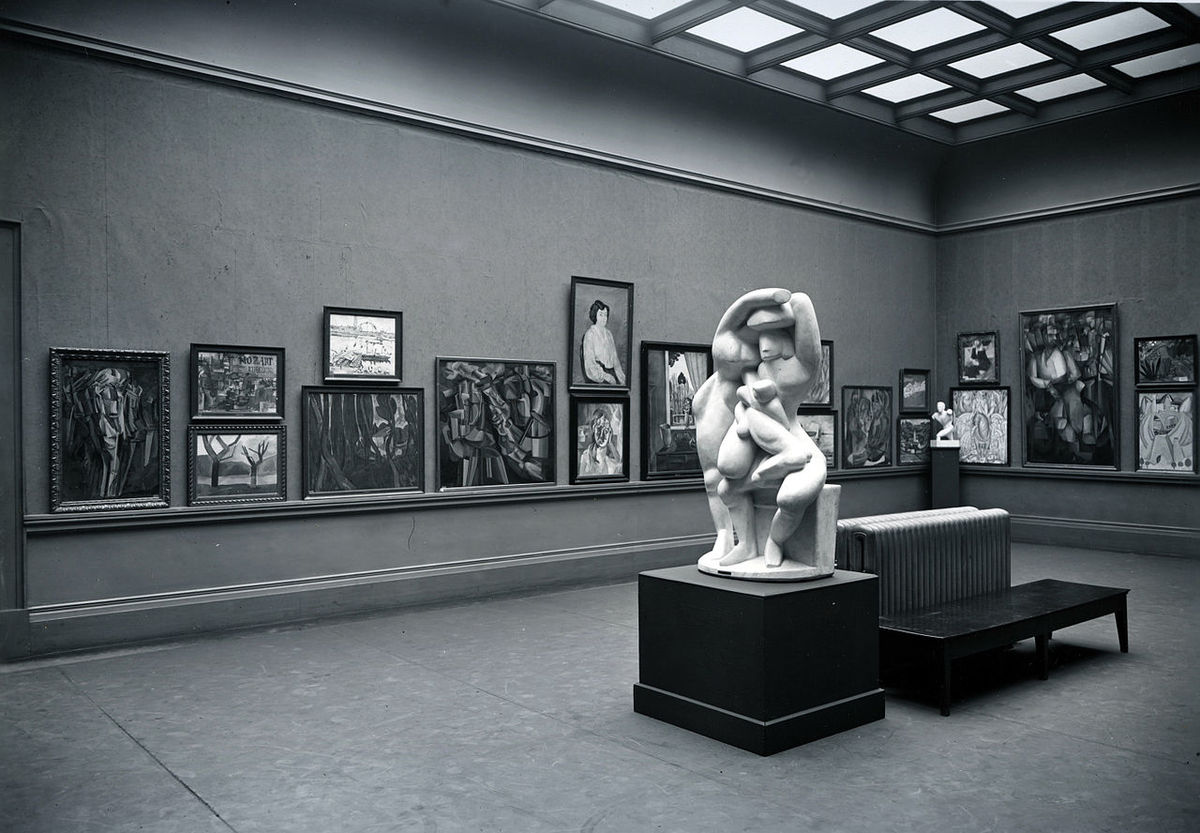
Armory Show, International Exhibition of Modern Art. The Cubist room, Gallery 53 (northeast view), Art Institute of Chicago, March 24–April 16, 1913. On the long wall are three of seven Picasso artworks included in that landmark exhibition. None are in “Picasso and Chicago” in 2013.

The 2013 exhibition reveals that Chicago was not merely a collector of Picasso’s art but an active participant in shaping his American reputation, fostering a century-long relationship that helped establish modern art within the cultural life of the United States.

By John P. Walsh.

Almost as long as Pablo Picasso (1881-1973) was making his art, there have been bragging rights on the Catalan artist that have come from others. Even 40 years after the artist’s death at 91 years old, media talk in 2013 for Picasso and Chicago, a large art exhibition at The Art Institute of Chicago from February 20 to May 12, 2013, revolves around American collector “firsts” associated with Picasso.

Which institution collected Picasso first? The Art Institute of Chicago in 1923.

Which institution collected Picasso most? The Chicago Renaissance Society by 1930.

Which institution had the first Picasso exhibition? The Arts Club of Chicago in 1923.

Which institution had the first Picasso retrospective? The Wadsworth Atheneum in Hartford, Connecticut in 1934.

The Art Institute of Chicago is able to put imagination aside and quote itself in Picasso and Chicago. Nearly all of the same inventory of Picasso artwork in this 2013 show were assembled and displayed in the exact same order in a previous exhibition at the museum called Picasso in Chicago held from February 3 to March 31, 1968. According to the museum director writing at that time, that exhibition had been inspired by the dedication of the Picasso sculpture on August 15, 1967, a five-story Cor-10 steel Chicago icon that still stands enigimatically in Daley Plaza.  If public attention is what Pablo Picasso craves, then he should have no worries.
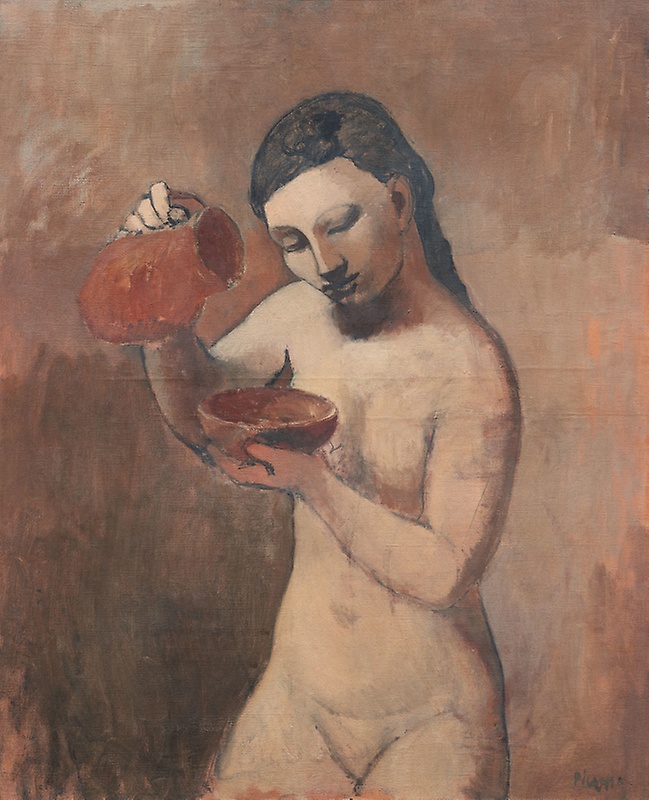
Picasso, Nude with a Pitcher, summer 1906.

Above and two below: Pablo Picasso, Nude with a Pitcher, Gósol, summer 1906, oil on canvas, 39 5/8 x 31 7/8 in. (100.6 x 81 cm), Signed, l.r.: “Picasso.” The Art Institute of Chicago. In the summer of 1906, during a working sojourn to Gósol in the Spanish Pyrenees, Picasso painted his mistress and muse, Fernande Olivier (French, 1881-1966).

Picasso Nude with a pitcher summer 1906 Gosol Spain
nude-with-a-pitcher-detail-summer-1906-gosol-spain-2
fernande-1905

Fernande Olivier and Pablo Picasso in 1905 in Paris. Public Domain.

Pablo Picasso, Fernande Olivier, summer 1906. Charcoal, with stumping, on cream laid paper, 610 x 458 mm. Signed recto, lower right, in graphite: “Picasso” (underlined), The Art Insitute of Chicago.

Pablo Picasso, The Two Saltimbanques, 1905, printed and published 1913. Drypoint on ivory wove paper 120 x 91 mm (image/plate); 193 x 129 mm (sheet) The Art Institute of Chicago.

Picasso, Study for La Coiffure, 1906.

Above: Picasso, Study for “La Coiffure,” 1905-1906. Pen and brown ink, with colored crayons and charcoal applied with stump, over graphite, on blue-gray laid paper 184 x 307 m. Signed recto, upper right, in graphite: “Picasso.” The Art Institute of Chicago.

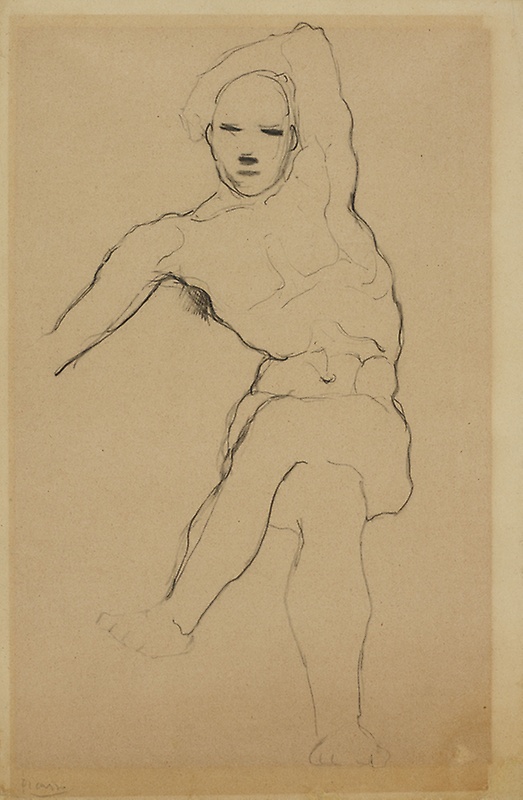
The pairs of figures are related by both being involved in intimate activities but represent different subjects Picasso studied months apart. One dates from 1905 and the other from 1906. The pair on the right is a study for a major painting, La Coiffure, in The Metropolitan Museum of Art in New York.

There are several excellent reasons to see Picasso and Chicago in 2013 and they don’t always revolve around his art. It is a matter for city pride to know that Chicago possesses within its own collections the breadth of art resources to showcase, in chronological order, this Picasso show comprehensive of every major period. In these tight economic times kudos goes out to museum curators who have effectively displayed a vast amount and range of artwork by Pablo Picasso to produce a blockbuster show. The chronological exhibition of Picasso’s art includes works from The Art Institute of Chicago, The Arts Club of Chicago and The Renaissance Society and is front loaded providing for immediate pleasures.

The visitor is greeted nearly at the door by The Old Guitarist painted by Picasso in 1903-1904—a revered Blue Period painting in the Art Institute—and for the viewer to be edified by its presence is worth any exhibition’s admission price though there was no special exhibition fee beyond the price of general admission to the museum.

Picasso, The Old Guitarist, 1903–1904.

Picasso, The Old Guitarist, 1903–1904, oil on panel, 48 3/8 x 32 1/2 in. signed, l.r.: “Picasso.” The Art Institute of Chicago.

If front-loaded, does the rest of the show retain the same high interest? The answer is: yes and no. For all future Picasso shows in Chicago, curators can find several avenues to whittle away at the volume of artwork on display for Picasso and Chicago to present its most interesting parts. That downsizing opportunity intimates this show’s arguable shortcoming: as it displays the Spanish master’s later, increasingly commercial artwork, the Art Institute of Chicago’s 500 Picasso works in all mediums begins to reveal the challenges of building a seamlessly qualitative collection of contemporary art even when the artist is Picasso.

Picasso woman with her hair up 1904

Above: Picasso, Woman with her hair up, 1904, Gouache on tan wood pulp board, 427 x 313 mm, Signed and dated recto, upper left, in blue gouache: “Picasso / 1904.” The Art Institute of Chicago.

Picasso, "Beggar with Crutch," 1904.

Below: Pablo Picasso, Beggar with Crutch, Barcelona 1904, pen, brown ink and colored crayon on paper. The Art Institute of Chicago. 

beggar-with-crutch-barcelona-1904 pen-brown-ink-and-colored-crayon-on-paper-detail

picasso-crazy-woman-with-cats-detail-early-summer-1901-paris-oil-on-cardboard

Above: Crazy Woman with Cats, 1901. Oil on pulp board 17 7/16 x 16 1/16 in. (44.3 x 40.8 cm). Signed. l.r.: “Picasso.” Amy McCormick Memorial Collection, 1942. The Art Institute of Chicago.

In late May 1901 Picasso came to Paris with three weeks to prepare for an exhibition at Vollard’s gallery. The exhibition was arranged by a Catalan dealer who roomed with the 19-year-old Picasso on the Boulevard de Clichy. Crazy Woman with Cats is one of the 64 paintings and several drawings Picasso prepared for the show. 

Above: Picasso, Sketch of a young woman (detail), pen and brush and black ink on paper, Paris 1904, gift of Robert Allerton, 1924, The Art Institute of Chicago.

Robert Allerton, a museum trustee since 1918, began to acquire Picasso drawings in 1923 with the sole purpose of donating them to the museum. Sketch of a young woman was Allerton’s first Picasso drawing purchase and museum donation in 1923 purchased in Chicago from Albert Roullier Galleries.

Above: Pablo Picasso. Salomé from the Saltimbanques series. 1905 102B0518 (1)

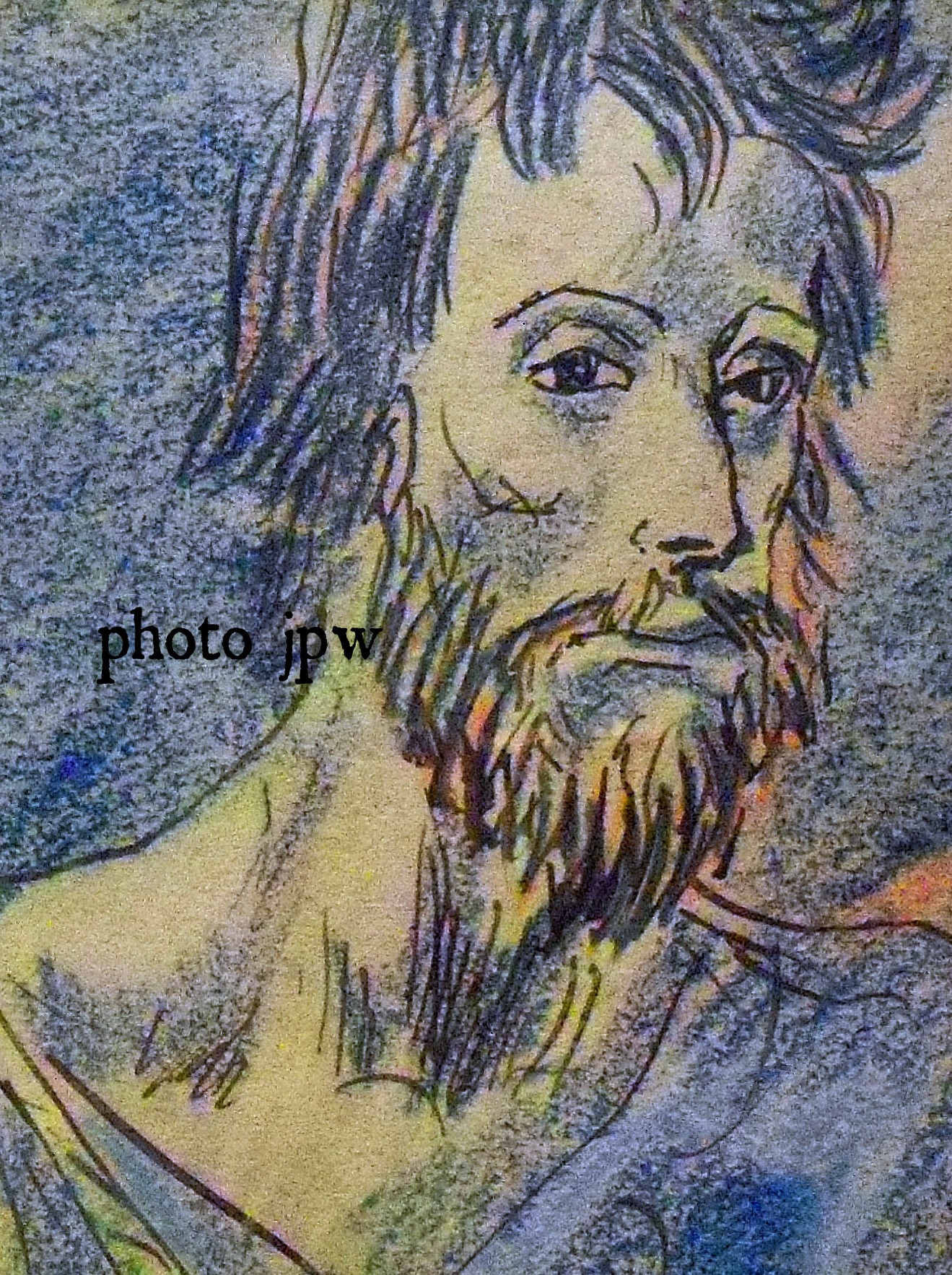
Picasso, Study of a Seated Man, 1905

Above: Picasso, Portrait of a Seated Man, 1905. Black chalk on cream wove paper, laid down on cream Japanese paper, 329 x 216 mm, Signed recto, lower left, in graphite: “Picasso.” Gift of Robert Allerton, 1924. The Art Institute of Chicago.

Picasso, Study of Four Nudes, Paris, 1906-07.

Above: Picasso, Study of Four Nudes, Paris, 1906-07, black crayon paper, Johnson Family collection.

By the end of 1906 Picasso stopped painting and instead started to fill sketchbooks for a new major composition: Les Demoiselles d’Avignon (1907) today in The Metropolitan Museum of Art in New York.

Above: Picasso, Female Nude, 1906. Fabricated Black chalk with graphite and smudging on paper, 31.8 x 23.5 cm. Gray Collection Trust. The Art Institute of Chicago.

Picasso, Two Nudes, Standing, fall 1906 Graphite, with stumping, on cream laid paper 630 x 469 mm Signed verso, upper left, in graphite: “Picasso.” Gift of Mrs. Potter Palmer, 1944. The Art Institute of Chicago .

Picasso, Two Nudes, Standing, fall 1906

In the early 1920’s as Chicago started a buying frenzy of Picasso, another young Spanish painter twelve years younger than Picasso arrived into Paris and was immediately overtly critical of the great Picasso’s work at that time. That younger painter was Joan Miró (1893-1983).

Miró’s criticism of Picasso as well as of Henri Matisse (1869-1954)— it was more a kind of disgust—was basically that the pair, once young avant-gardists, were making all their art for their dealer. In other words, the older artists were making contemporary art mainly for the money. Such may be an inherent risk in making art that meets a market demand in that the artist is tempted to, after a fashion, sell-out. Miró knew at first look—and history has proven him basically correct—that the future of contemporary painting no longer rested in Picasso’s hands after about 1920. This is partly the reason why Miró turned to the “nonsense” art of the Dadaists for the future of his own painting.

Keeping Miro’s judgment in one’s mind at Picasso and Chicago one sees that, notable exceptions made, an earlier Picasso painting—from the Blue Period after 1901 to Picasso’s period of synthetic cubism until around 1920—offers cohesive artwork that contains a germ or seed of progress.  The art collection in Picasso and Chicago, much of it produced following Miró’s critical judgment of Picasso, shares his problematic.

The Red Armchair of 1931 is hung at what is about the show’s halfway point. At this point, I might have exited. Yet where Miró’s critical judgment lags for me is that Picasso’s art is never incompetent or boring. His art is perceptibly linear and, despite its erotic themes, often contains qualities which satisfy and cleanse an art-hungry eye. Picasso’s art is ever ancient and ever new, and distinctly European. For me, seeing a Picasso connotes a stroll in Paris or feeling a sunburn on the face after revelry and reverie along some Mediterranean coast. Quite readily the show produced these kinds of vicarious experiences for me as i soaked up a plethora of Picasso’s later, lesser work in utilitarian Regenstein Hall.

nessus-and-deianira-juan-les-pins-september-22-1920-graphite-on-papere-with-white-ground

Above: Nessus and Deianira, September 22, 1920, Graphite on tan wove paper, prepared with a white ground, signed recto, upper left, in pen and blue ink: “Picasso” (underlined); inscribed upper left, in graphite: “22-9-20.”

Just before leaving Paris in September 1920, Picasso made a series of drawings of the Greek myth of the abduction of Hercules’ bride Deianira by the centaur Nessus. With this, Picasso became fascinated with Greek mythology and continued to make artwork using its themes.

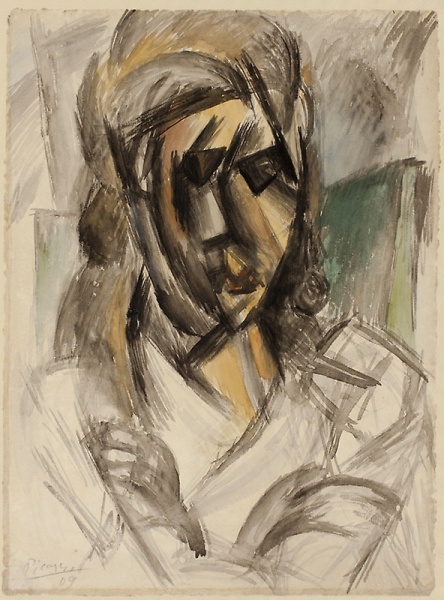
Above: Picasso, Head of A Woman (Fernande), Paris winter 1909-10, brush and gray wash on paper. Private Collection.

Paintings and drawings by Picasso in winter 1909-10 continued to explore Cubism as it related to the human face and figure and its surroundings. 

Picasso studio Horta de Ebro summer 1909.

Above: Picasso’s studio at Horta de Ebro (now Horta de San Juan) in Spain between May and September 1909. The painting (at left) of a Head of a Woman is one of the early Cubist artworks in “Picasso and Chicago.”

Picasso, Head of a Woman, summer 1909, Oil on canvas 23 3/4 x 20 1/8 in. (60.3 x 51.1 cm), Winterbotham Collection, 1940.

The painting above dates to one of the most productive and inventive periods of Pablo Picasso’s career, a summer stay in the town of Horta de Ebro (now Horta de San Juan) in Spain, which lasted, with minor interruptions, from May to September of 1909. In these months, Picasso produced a series of landscapes, heads, and still lifes that are among the most highly acclaimed achievements of early Cubism. Fernande Olivier, Picasso’s mistress, was the model for the series of heads that the artist produced at this time.

Picasso Bust of a Woman, late 1909

Below: Picasso, Bust of a Woman, late 1909, Watercolor and gouache on cream laid paper, laid down on buff laid paper, 363 x 278 mm overall; signed recto, lower left, in graphite: “Picasso (underlined)/ 09” Gift of Mr. and Mrs. Roy J. Friedman, 1964. The Art Institute of Chicago.

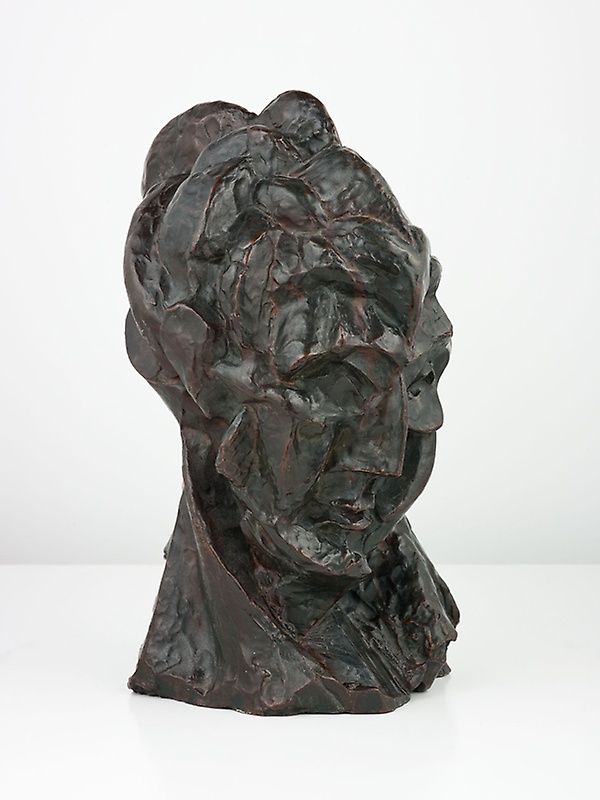
Above: Head of a Woman (Fernande), fall 1909, bronze, 16 1/8 x 9 7/8 x 10 9/16 in. (40.7 x 20.1 x 26.9 cm), cast 1910, Alfred Stieglitz Collection, 1949.

This work is Pablo Picasso’s first large Cubist sculpture and represents the distinctive physiognomy of Fernande Olivier, who was the artist’s model and mistress from 1905 to 1912. Before making the bust, Picasso produced countless drawings and gouaches to explore the specific form and structure of his subject’s facial features. Her hair is in a coil and a topknot; her bulging jaw; her well-defined depression in the center of her upper lip. The Fernande series’ evolved from an agility of facial expression to fixed signs of its individual features.

Picasso, Artist and Model, 1933.

Pablo Picasso (1881-1973), Artist and Model, Cannes, July 24, 1933, watercolor and pen and black ink on paper. Gray Collection trust.

artist-and-model-cannes-july-24-1933-watercolor-and-pen-and-black-ink-on-paper-1
artist-and-model-cannes-july-24-1933-watercolor-and-pen-and-black-ink-on-paper-2
Picasso signature
Portrait_de_Picasso,_1908

Portrait photograph of Pablo Picasso, 1908.

Below: Picasso, Daniel-Henry Kahnweiler, autumn 1910, Oil on canvas, 39 9/16 x 28 9/16 in. (100.4 x 72.4 cm) Gift of Mrs. Gilbert W. Chapman in memory of Charles B. Goodspeed, 1948. The Art Institute of Chicago.

German-born Daniel-Henry Kahnweiler (1884-1979) opened an art gallery in Paris in 1907. In 1908 Kahnweiler began representing Pablo Picasso (1881-1973) and introduced him to Georges Braque (1882-1963). Kahnweiler championed these artists’ revolutionary experiment with Cubism and purchased most of their paintings between 1908 and 1915. Kahnweiler sat for Picasso up to thirty times for this portrait.

Picasso, Head of Harlequin, 1916, The Art Institute of Chicagio. Photograph by author.

Picasso, Harlequin Playing the Guitar, c. 1916, Elden collection.

Picasso Head Arts Club

Above: Picasso, Head of a Woman, 1922, The Arts Club of Chicago, purchased 1926.

Olga_Khokhlova_in_Picasso's_Montrouge_studio,_spring_1918 (1)

Above: Olga Khokhlova (1891-1955) in Picasso’s Montrouge studio, spring 1918.

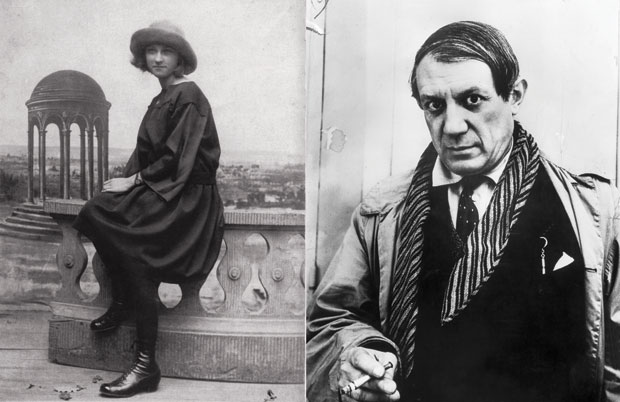
Olga married Picasso on July 12, 1918, at the Russian Orthodox Cathedral in Paris. On February 4, 1921, she gave birth to their son Paulo (1921-1975). After that, Olga and Picasso’s relationship deteriorated though they never divorced. Olga died in Cannes in 1955.

Picasso still life 1922

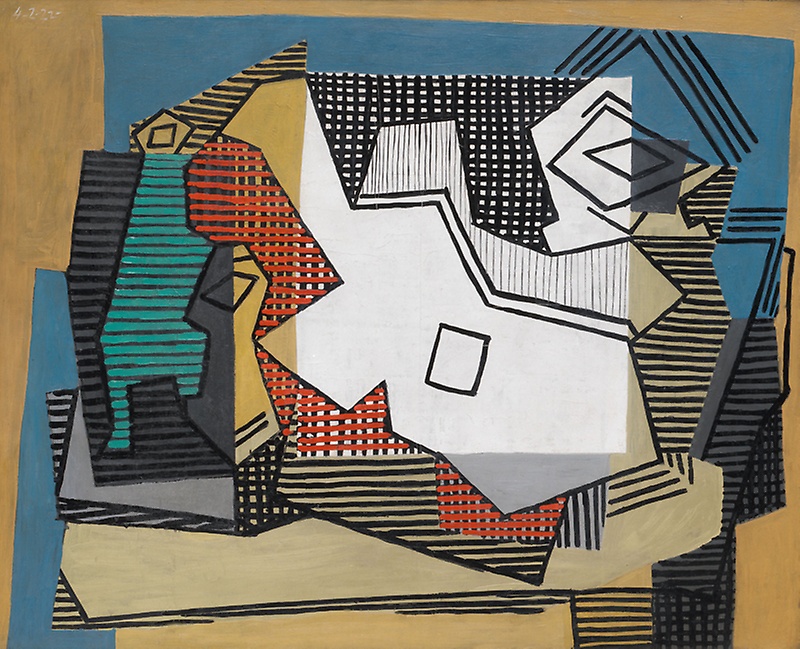
Above: Picasso, Still Life, February 4, 1922, Oil on canvas 32 1/8 x 39 5/8 in. (81.6 x 100.3 cm), Dated, u.l.: “4-2-22-.” Ada Turnbull Hertle Endowment, 1953. Picasso produced a series of Cubist still lifes in 1922 that are simplified to flat planes in a patterned framework. Gertrude Stein (1874-1946) bought this canvas in 1923 to add to her collection of more than 30 Picasso paintings and even more of his drawings and watercolors. This still life was Stein’s last purchase of a painting by Picasso. See article in Architectural Digest by Nick Mafi dated July 28, 2020 on the recent discovery associated with the Picasso painting above.  https://www.architecturaldigest.com/story/famed-pablo-picasso-painting-reveals-abandoned-artwork-beneath

Picasso flute and nude, 1932

Above: Picasso, Double Flute Player and Reclining Nude, October 22, 1932, pen and ink with brush and black wash and scraping on paper, Shapiro collection, 1992. The Art Institute of Chicago.

Picasso_marietherese

Marie-Thérèse Walter and Pablo Picasso. Their relationship began when she was seventeen and Picasso was 45 years old and married to Olga Khokhlova. In late summer and fall of 1932, Picasso and Marie-Thérèse Walter (French, 1909-1977), the artist’s mistress from 1927 to 1935, were together in Boisgeloup. Picasso made three drawings on the same day on a theme of lovers serenading one another.

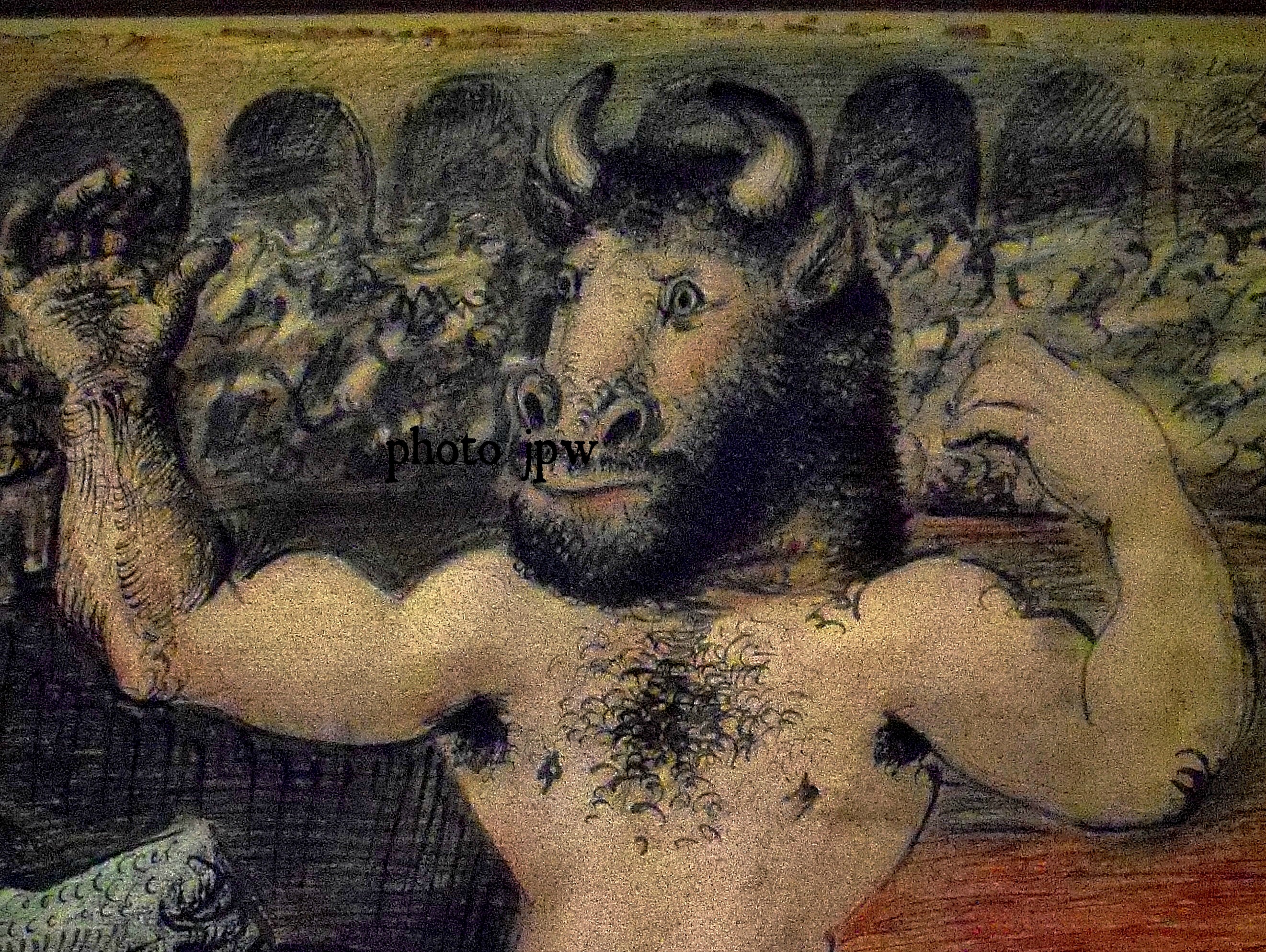
Picasso Minotaur and Wounded Horse 1935

Picasso transforms the bullfighting theme where the half-man and half-bull Minotaur is the aggressor in the ring terrorizing a horse.

Picasso, Minotaur and horse, 1935

Above: Picasso, Minotaur and Wounded Horse, Boisgeloup, April 17, 1935, Pen and brush and black inks, graphite, and colored crayons, with smudging, over incising, on cream laid paper, 343 x 515 mm Signed recto, lower right, in graphite: “Picasso” (underlined); inscribed upper right, in graphite: “Boisgeloup–17 Avril XXXV” The Art Institute of Chicago.

Picasso

Above and below: Picasso, The Red Armchair, oil and ripolin on panel; signed, u.r.: “Picasso,” oil and ripolin on panel, The Art Institute of Chicago.

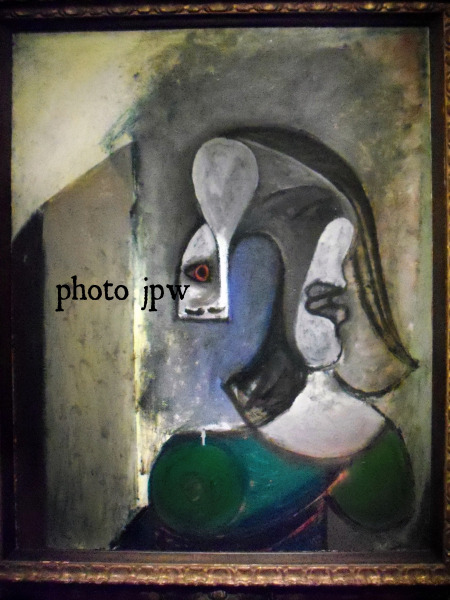
Above: Picasso, Head of Woman (Dora Maar), Paris, April 1, 1939, oil on canvas, 92 x 73 cm. Private collection.

weeping woman dora maar 1937

Above: Weeping Woman I, July 1, 1937. Drypoint, aquatint, and etching, with scraping on copper in black on ivory laid paper, 695 x 497 mm (plate); 774 x 568 mm (sheet). The Art Institute of Chicago.

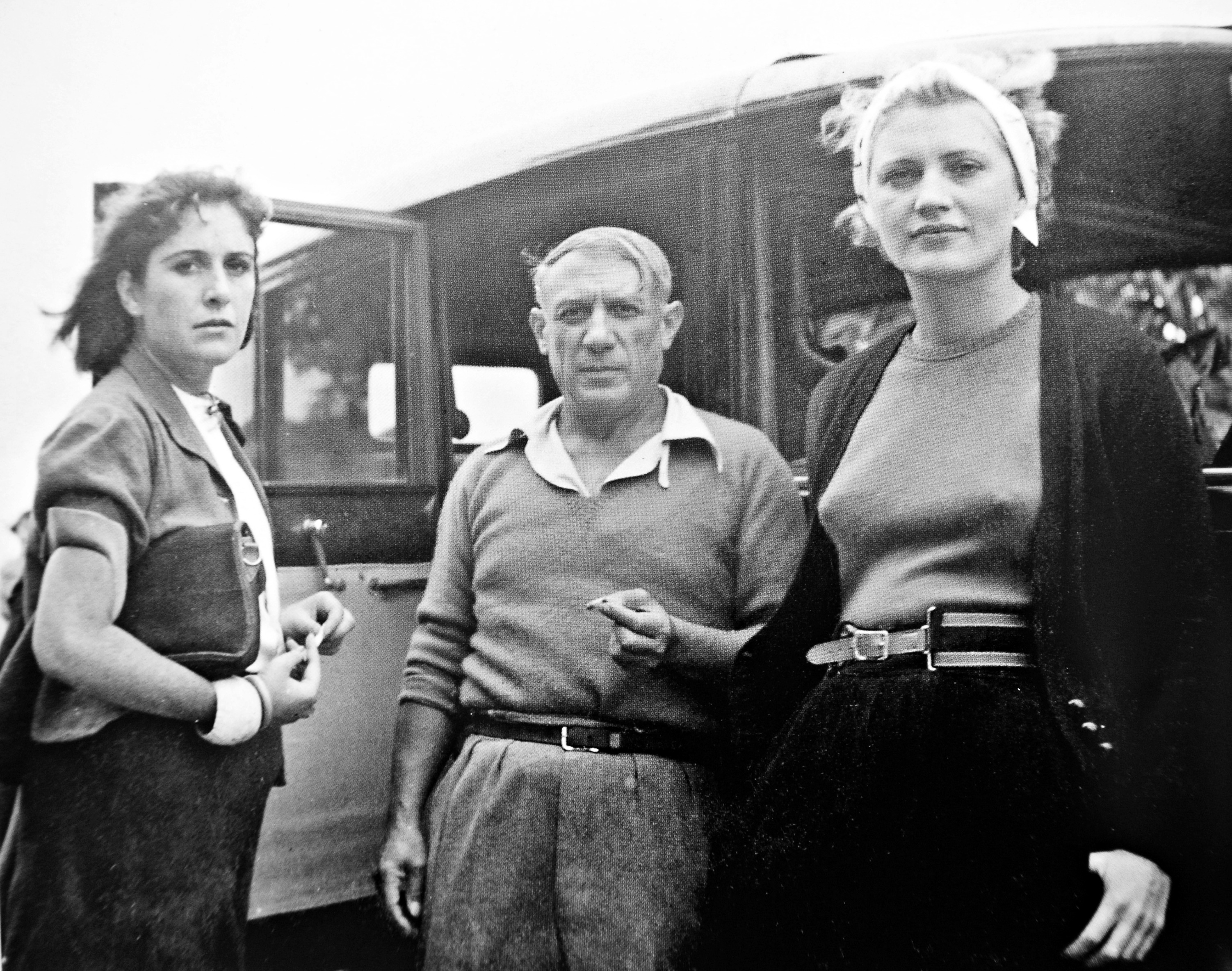
Dora Maar (French, 1907-1997) met Picasso in 1936 at the Café des Deux Magots in Paris. Her liaison with Picasso ended in 1943.

About making portraits of his mistress Dora Maar weeping, Picasso explained: “For years, I’ve painted her in tortured forms, not through sadism and not through pleasure either – just obeying a vision that forced himself on me.” At the end of their relationship Picasso confessed, “I can only see her weeping.”

Dora Maar Picasso Lee Miller 1937

From left: Dora Maar, Picasso, Lee Miller in 1937.

1951 Villa in Vallauris

Picasso, Villa in Vallauris, Vallauris, Feb., 4, 1951, oil on panel. 88.9 x 116.2 cm, The Art Institute of Chicago.

Picasso, large vase with dancers, Vallauris, 1950, red earthenware clay, ground painted in white engobe, 71.2 cm Crown collection.

picasso-gilot-madoura-pottery

Picasso and Françoise Gilot (b. 1921) at Madoura pottery, Vallauris, 1953.

Gilot was lover and muse to Picasso from 1943 to 1953. In the early 1990s I met Françoise Gilot accompanied by her husband, Jonas Sauk (1914-1995), when she spoke at the Alliance Française de Chicago. That evening Gilot made it perfectly clear upfront that she was not going to talk about Picasso.

Picasso Jacqueline 1962

Picasso, Portrait of Jacqueline, Mougins, Dec. 28, 1962, graphite with smudging and black ballpoint pen on paper. 34.9 x 25 cm., Gray Collection Trust.

Picasso Jacqueline 1959

Picasso, Jacqueline, Cannes or Vauvenargues, October 17, 1959, Linocut in colors on paper, 63.8 x 53 cm., Crown collection.

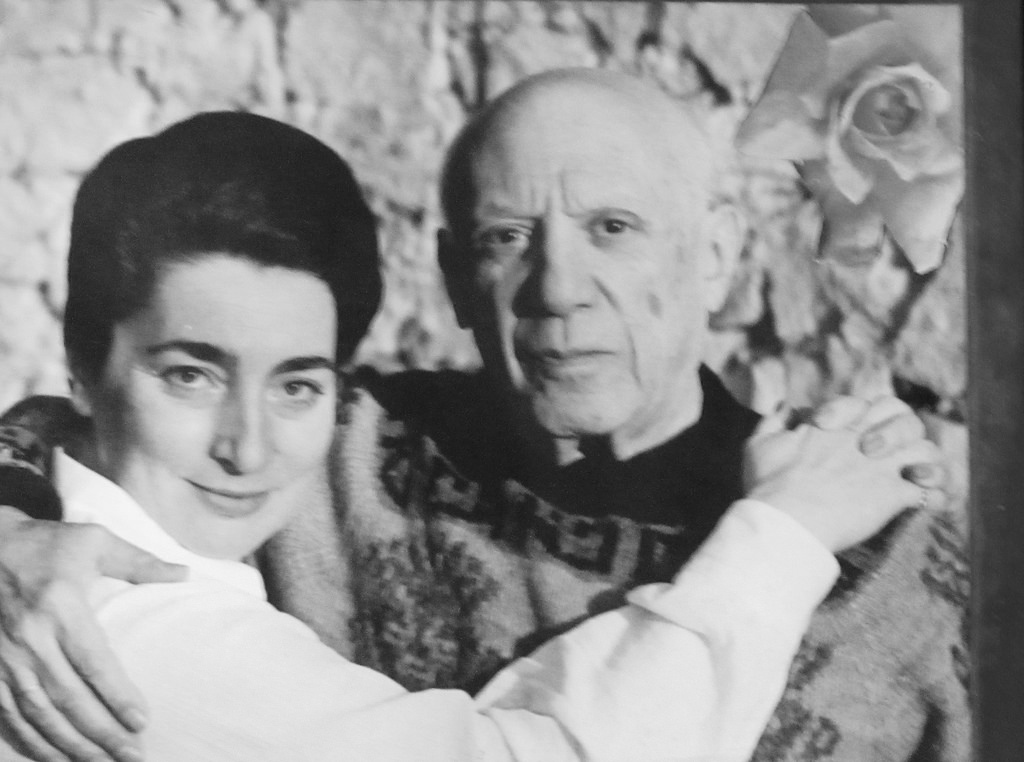
Jacqueline Roque was muse and second wife of Pablo Picasso. Their marriage lasted 11 years until his death, during which time he created over 400 portraits of her, more than any of Picasso’s loves.

Jacqueline and Pablo Picasso.

Picasso and Jacqueline, his second wife. Pablo Picasso met Jacqueline Roque (1927-1986) in 1953 when she was 26 years old and he was 72. He romanced her until she agreed to date him. Only in 1955, when Picasso’s first wife Olga Khokhlova died, did Picasso decide to marry Jacqueline in Vallauris in 1961. They were married until Picasso’s death in 1973.

The Chicago Picasso, 1967. In situ in Daley Plaza in Downtown Chicago, Author’s photograph. July 2015.

There are 250 items on display in Picasso and Chicago—including paintings, prints, drawings, sculptures, and ceramics—and only begins to manifest the prodigious genius of Pablo Picasso.

Picasso and Chicago may have closed, but many, if not most, of these works in Chicago’s cultural institutions and private collections can be savored with the simplicity of a museum visit. A visitor can do no better than visit The Art Institute of Chicago and see Picasso’s The Old Guitarist and The Red Armchair. By that begins one’s own new adventure of absorption of the Spanish master’s artwork whose home is Chicago. The 2013 show is over but more than a few of its best parts are on display right now in these institutions’ permanent collections.

SOURCES:

Art Institute of Chicago. Picasso in Chicago. Chicago: Art Institute of Chicago, 1968.

Chicagoist. “Last Chance to See ‘Picasso and Chicago’ at Art Institute.” May 11, 2013. http://chicagoist.com/2013/05/11/last_chance_to_see_picasso_and_chic.php.

D’Alessandro, Stephanie. Picasso and Chicago 100 years, 100 works. Chicago: Art Institute of Chicago, 2013. Distributed by Yale University Press. http://www.indiebound.org/book/9780300184525.

Mink, Janis. Miró. Cologne: Taschen, 2006.

Michigan Avenue Magazine. “AIC Opens ‘Picasso and Chicago.’” Accessed November 8, 2026. http://michiganavemag.com/living/articles/aic-opens-picasso-and-chicago.

Picasso, Pablo. Je suis le cahier: The Sketchbooks of Picasso. Edited by Arnold B. Glimcher and Marc Glimcher. Boston: Atlantic Monthly Press, 1986. (Note: Originally co-published internationally in cooperation with Arnoldo Mondadori Editore, Verona, Italy).