
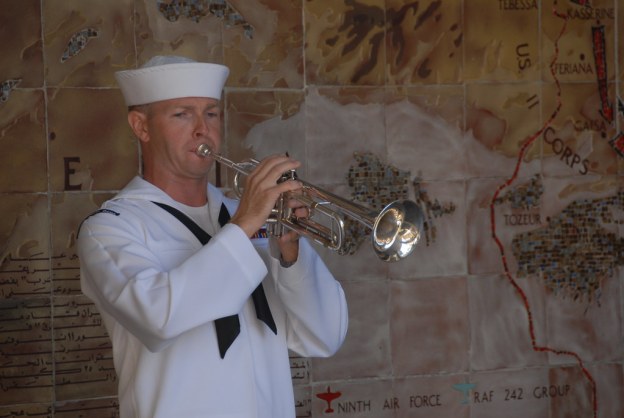
FEATURE Image: Memorial Day Ceremony – North Africa American Cemetery and Memorial – May 31, 2010. PHOTO: “Memorial Day Ceremony – North Africa American Cemetery and Memorial – May 31, 2010” by US Army Africa is licensed under CC BY 2.0.
Introduction
The first national observance of Memorial Day occurred on May 30, 1868, following the U.S. Civil War. Commander in Chief John A. Logan of the Grand Army of the Republic issued General Order Number 11 designating May 30 as a day of memorial “for the purpose of strewing with flowers or otherwise decorating the graves of comrades who died in defense of their country during the late rebellion, and whose bodies now lie in almost every city, village, and hamlet churchyard in the land.” (Source: Library of Congress). It is a day for visiting cemeteries and memorials to mourn the military personnel who died in the line of duty.
Films, music, and literature about the people, places, and events in history where military personnel as individuals and as a unit are asked to pay the ultimate price and make the greatest sacrifice for freedom are among some of the greatest stories ever told.
THE CROSSING (2000). American Revolutionary War (1775-1783).
Bringing Washington’s Gamble to the Screen
Directed by Robert Harmon and adapted by Howard Fast from his novel of the same name, The Crossing stars Jeff Daniels as George Washington.
A Revolution Hanging by a Thread
In December 1776 — barely six months after the Declaration of Independence — Washington’s Continental Army was collapsing. Starved of men, artillery, and supplies, the revolution hung by a thread. So Washington made the most dangerous decision of the war: he would gamble everything on a surprise strike at Trenton, where more than a thousand feared Hessian mercenaries held the town.
Forcing the Ice-Choked Delaware
To reach them, his exhausted army would have to force a night crossing of the ice‑choked Delaware River and march toward what looked like a hopeless fight. Instead, the attack became the stunning, against‑all‑odds victory Washington had scarcely dared imagine.
A Stunning and One-Sided American Victory
Washington’s surprise attack on the Hessian garrison at Trenton on December 26, 1776, produced a stunningly one‑sided American victory. The Continental Army suffered almost no combat losses — none killed in action, two men who froze to death during the night march, and only five wounded, including a young James Monroe, later of Monroe Doctrine fame, who took a musket ball in the shoulder.
The Destruction of the Hessian Force
The Hessians, by contrast, were effectively destroyed as a fighting force: 22 killed (among them their commander, Colonel Johann Rall), 92 wounded, and about 920 captured.

Detail. NYC – Metropolitan Museum of Art: Washington Crossing the Delaware. “NYC – Metropolitan Museum of Art: Washington Crossing the Delaware” by wallyg is licensed under CC BY-NC-ND 2.0.
GETTYSBURG (1993). The U.S. Civil War (1861-1865).
Directed by Ronald F. Maxwell whose screenplay is based on The Killer Angels, a novel by Michael Shaara, Gettysburg starred an ensemble cast including Martin Sheen, Tom Berenger, Jeff Daniels, Stephen Lang and Sam Elliott.
The Convergence of Command at Gettysburg
One of the Union army’s most respected senior commanders during the American Civil War was 42-year-old General John F. Reynolds (John Rothman) who was killed on the first day of the Battle of Gettysburg at the very start of it. Reynolds was in command of the “left wing” of the Army of the Potomac commanded by Gen. George C. Meade and which included the cavalry division of 37-year-old Brig. Gen. John Buford (Sam Elliott).
Buford’s Defensive Stand
Buford had occupied the town of Gettysburg, Pennsylvania, with his “headquarters” atop the cupola of the Lutheran seminary. With light defensive lines he resisted superior numbers of Confederate infantry brigades along the Chambersburg Pike who were blind to the Union Army’s smaller numbers because Major General J. E. B. Stuart had gone missing
The Opening Clash and a Fatal Command
When Reynolds’ I Infantry Corps arrived, he rode out ahead, met with Buford, and then accompanied some of his soldiers into the fighting. As Reynolds was supervising the placement of the 2nd Wisconsin, he shouted: “Forward men! Forward for God’s sake! and drive those fellows out of those woods.” At that moment Reynolds was shot by a sniper and fell off his horse to the ground with a mortal wound to the back of the head.
The Impact of a Leader’s Loss
The death of Reynolds impacted his troops and fellow commanders deeply. At that particular moment, they realized that any one leader (and the Union army had been through several at the top), even if he had the necessary zeal, vision, and sense of purpose, would not be enough to win the fight to save the Union. It must be a coordinated effort. Reynolds, by supporting Buford’s decision to set up defensive resistance as well as engaging his infantry, even in death effectively chose Gettysburg as that hallowed battleground for the next three days.
The Retreat to High Ground
Since Confederate numbers were superior on that first day, Union troops eventually retreated through town and rallied on Cemetery Ridge where General Meade and Maj. Gen. Winfield S. Hancock, with many others, entrenched on the high ground. They faced Confederate Gen. Robert E. Lee (Martin Sheen), and Lieutenant Generals Longstreet, Ewell, and A.P. Hill, among others. In the 1993 film, Confederate Major General Henry Heth is played by Warren Burton who was born and grew up in Chicago and attended The School of the Art Institute of Chicago. Heth was from a coal mining area near Richmond, Virginia.
The Staggering Cost of Hallowed Ground
At the Battle of Gettysburg the two armies suffered between 46,000 and 51,000 casualties. Union casualties amounted to 3,155 killed, 14,531 wounded, and 5,369 captured or missing. Reynolds’ body was immediately transported to his home-town of Lancaster, PA, where he was buried on July 4, 1863. Buford died 5 months later possibly of typhus in Washington, D.C. and was buried at West Point Cemetery in New York. Like Lincoln, Buford was born in Kentucky and grew up in Illinois (Rock Island). His father was a leading politician, but as a Democrat supported Stephen A. Douglas and opposed Abraham Lincoln.

Lutheran Seminary, Gettysburg. PHOTO: “Lutheran Seminary, Gettysburg” by josullivan.59 is licensed under CC BY-NC-SA 2.0.
THE FIGHTING SULLIVANS (1944). World War II (1941-1945).
Hollywood’s Tribute to a Tragic Brotherhood
Directed by Lloyd Bacon based on a story by Edward Doherty, Mary C. McCall Jr., and Jules Schermer, The (Fighting) Sullivans starred Anne Baxter, Thomas Mitchell, Selena Royle, Edward Ryan, John Campbell, James Cardwell, John Alvin, George Offerman, Ward Bond and Trudy Marshall.
The True Story of the Juneau Disaster
Released as The Sullivans in 1944, this 20th-Century-Fox drama film tells the true story of five brothers – George, Frank, Matt, Joe and Al Sullivan – who grew up in Waterloo, Iowa, and who were all killed in World War II when their ship, Juneau, was sunk in combat at Guadalcanal in November 1942.
The Honest Price of a World War
The film is a tearjerker not so much because it is sentimental but that it is honest. The final scene where the naval officer who recruited the five brothers (Ward Bond) comes to the boys’ house to tell the tragic news to their parents (Thomas Mitchell and Selena Royle) and the youngest brother’s widow (Anne Baxter) and mother of his child is one of cinema’s best conveyances of the price paid in a world war that claimed 420,000 American lives.

Memorial Day Ceremony – North Africa American Cemetery and Memorial – May 31, 2010. PHOTO: “Memorial Day Ceremony – North Africa American Cemetery and Memorial – May 31, 2010” by US Army Africa is licensed under CC BY 2.0.
Conclusion
Through the power of cinema and visual art, these Celluloid Chronicles serve as living monuments that permanently capture the profound weight of military sacrifice. From the frozen banks of the Delaware to the bloodied ridges of Gettysburg and the tragic depths of Guadalcanal, artistic expression bridges the gap between historical duty and modern remembrance. This creative preservation ensures that the ultimate price paid by service members in every conflict—from the nation’s founding revolutionary struggles to the modern battlefields of Iraq, Afghanistan, and Iran today—is never forgotten, keeping the sacred meaning of Memorial Day alive across generations.


