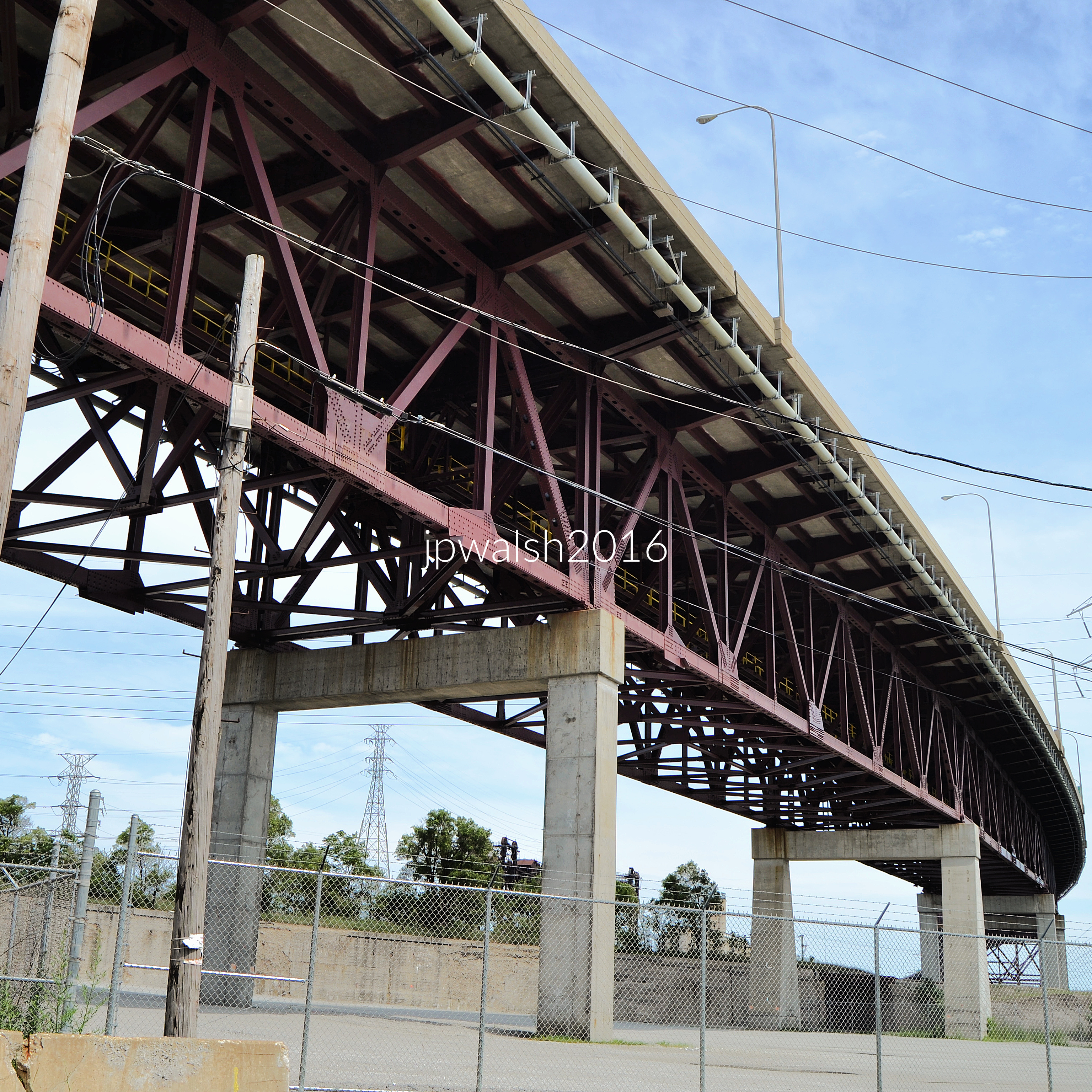
Feature image: Chicago Skyway Toll Bridge, 95th Street & S. Baltimore Avenue, Chicago. July 2016. Author’s photograph. 4.03mb DSC_0774 (1).
The massive steel infrastructure of the Chicago Skyway Toll Bridge (specifically the “High Bridge” at 95th Street and S. Baltimore Avenue) represents a monumental feat of mid-20th-century engineering, combining structural strength, durability, and commercial utility with a striking architectural aesthetic.
This photograph of the Chicago Skyway Toll Bridge (also known as the “Skyway”) is at the exact point where it spans the Calumet River and Calumet Harbor, a major harbor for industrial ships. Built by the City of Chicago in 1958 this massive steel undergirding is part of the 7.8 miles long expressway toll road that connects Chicago’s Dan Ryan freeway on the South Side to the Indiana Toll Road. The main feature of the Skyway is this half-mile long steel truss bridge known as the “High Bridge” whose maximum vertical clearance allowing ships and objects to pass safely underneath is 125 feet or about 10-12 building stories. The Chicago Skyway truss is primarily made of rolled and built-up steel beams for incredible weight-bearing strength, durability and functionality.
Chicago Skyway, 95th Street & Baltimore Avenue, Chicago. July 2016. Author’s photograph. 4.05 mb DSC_0772 (1)
This intersection is located on the city’s Far South Side in the South Chicago neighborhood. The area is heavily industrial, sitting just west of the Calumet River and directly underneath the massive steel framing of the Chicago Skyway High Bridge. The actual boundary of the city limits sits further east and south toward the Illinois-Indiana state line.
The Skyway was operated and maintained by the City of Chicago until January 2005 when Skyway Concession Company, LLC assumed its operations under a 99-year operating lease. The lease agreement between Skyway and the City of Chicago was the first privatization of an existing toll road in the United States. In February 2016, Skyway was purchased by three Canadian Pension Funds (OMERS Infrastructure, CPP Investment Board, and Ontario Teachers’ Pension Plan) and in December 2022 global toll road operator Atlas Arteria Group based in Australia, acquired 66.67% stake in the Skyway with OTPP retaining the rest. see – The Skyway – Chicago Skyway – retrieved December 19, 2025. While exact current figures go up and down, best estimates put daily vehicular traffic on the Chicago Skyway, both cars and trucks, at between 40,000 and 50,000 per day. see – FHWA – Center for Innovative Finance Support – Value Capture – Case Studies: Hays County, Texas Transportation Reinvestment Zones – retrieved December 19, 2025.
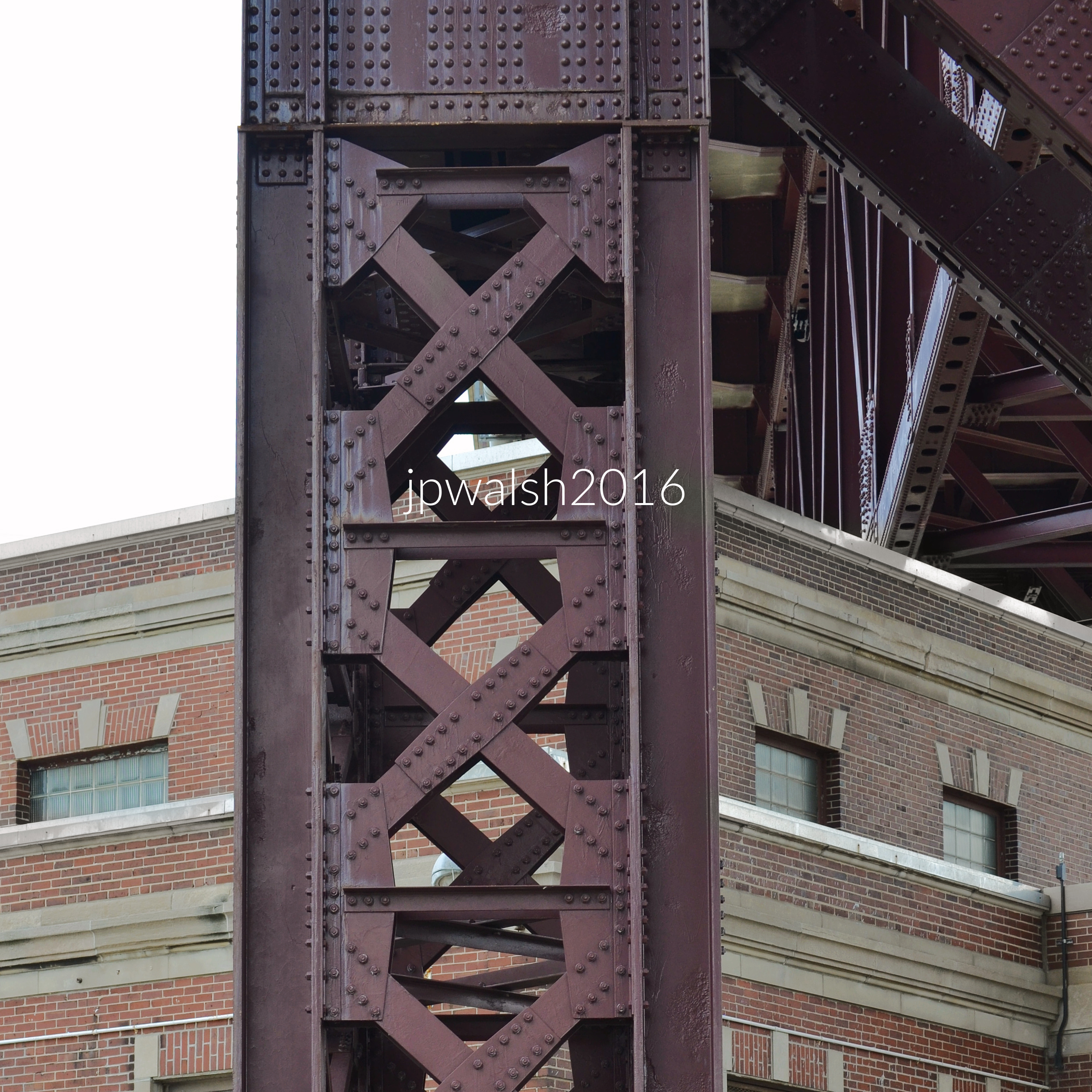
Chicago Skyway. 95th St. & Baltimore Ave. July 2016. Author’s photograph. 4.93mb DSC_0765 (1).
Chicago Skyway. 95th St. & Baltimore Ave. July 2016. Author’s photograph. 2.21mb DSC_0764 (1).
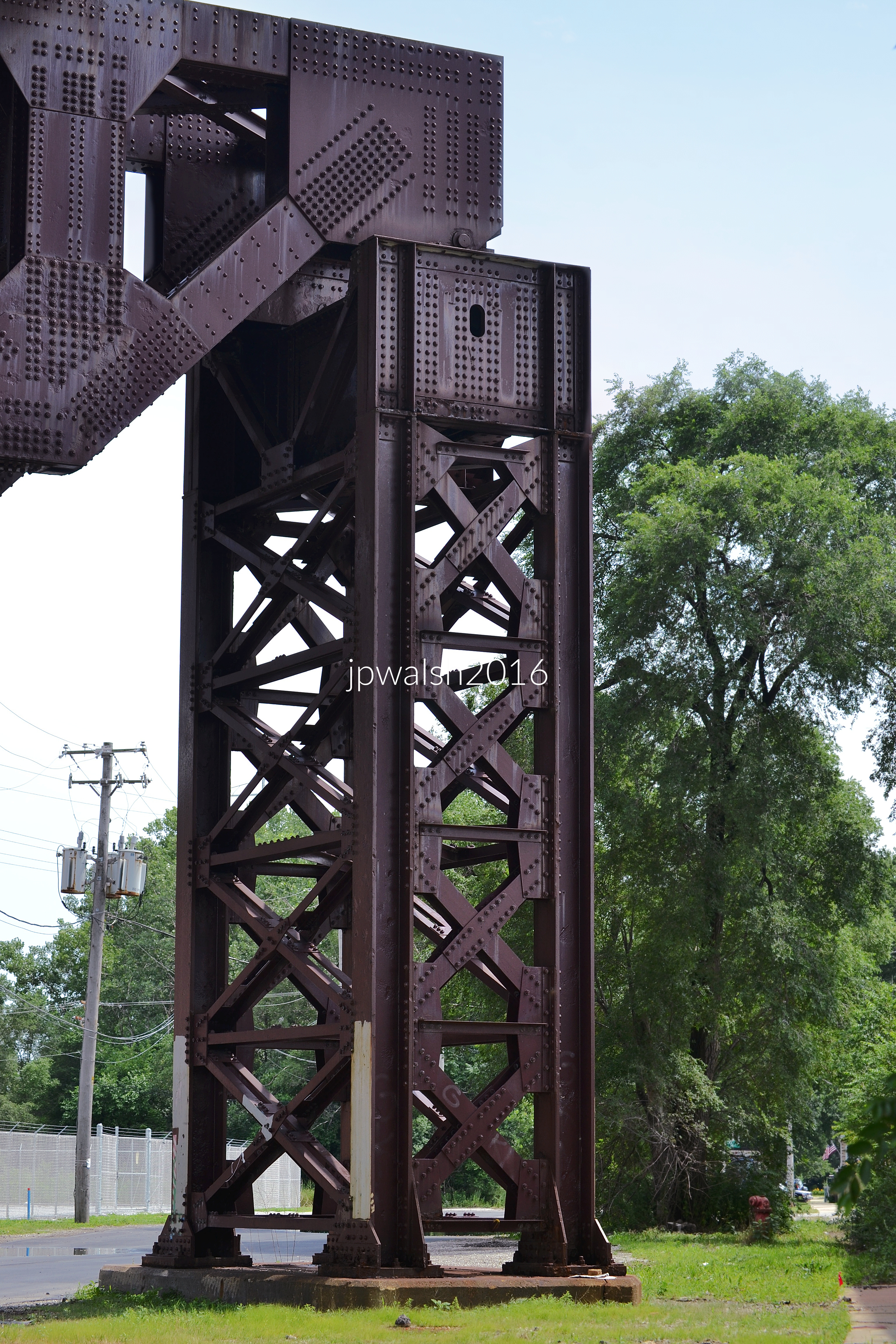
The 1958 steel truss undergirding serves a vital operational purpose—allowing massive industrial shipping to pass underneath into the Calumet River while carrying thousands of daily vehicles above—as it simultaneously serves as a compelling subject for architectural art.
Chicago Skyway. 95th St. & Baltimore Ave. July 2016. Author’s photograph. 5.13mb DSC_0769 (1).
FEATURE image: Portion of the open-grate pony-truss bascule Chicago Avenue Bridge and concrete house, erected in 1914, as it was in its last years of operation. Pointing to increased high traffic volume and load-bearing capacity issues, the 104-year-old bridge was demolished and replaced in 2018. Author’s photograph taken in May 2016.
The Chicago Avenue Bridge (1914) embodied the engineering ambition and industrial confidence of early twentieth-century Chicago. As a functional open-grate pony truss bascule bridge spanning the Chicago River, it reflected the city’s commitment to commerce, transportation, and technological innovation. Its demolition in 2018 marked not only the loss of a working piece of infrastructure but also the disappearance of a tangible artifact from Chicago’s era of rapid urban and industrial growth.
The expanse of the Chicago Avenue Bridge over the North Branch of the Chicago River near Goose Island. The steel beam pony trussbridge was built in 1914 and demolished in 2018. It was replaced by a temporary crossing in 2019. PHOTO: “Chicago Avenue Bridge” by swanksalot is licensed under CC BY-NC-SA 2.0
Built in 1914, the bridge was part of Chicago’s extensive system of movable river bridges that enabled both street traffic and river navigation. Designed by the engineering firm Ketler-Elliot, it represented the practical and elegant bridge engineering of the City Beautiful and Progressive Era.
Built in 1914 by Ketler-Elliot Erection Company of Chicago, the original Chicago Avenue Bridge was one of the oldest pony truss bascule bridges in Chicago. Connecting River North and River West, the steel bridge was, after 104 years, demolished in November 2018 and replaced five months later, in 2019, by a temporary fixed bridge. Since this portion of the river is now used mostly for recreational purposes, a new, permanent immovable concrete bridge was expected to open over the Chicago River in this location starting in 2021, delayed by the pandemic, and that will not be a bascule bridge.
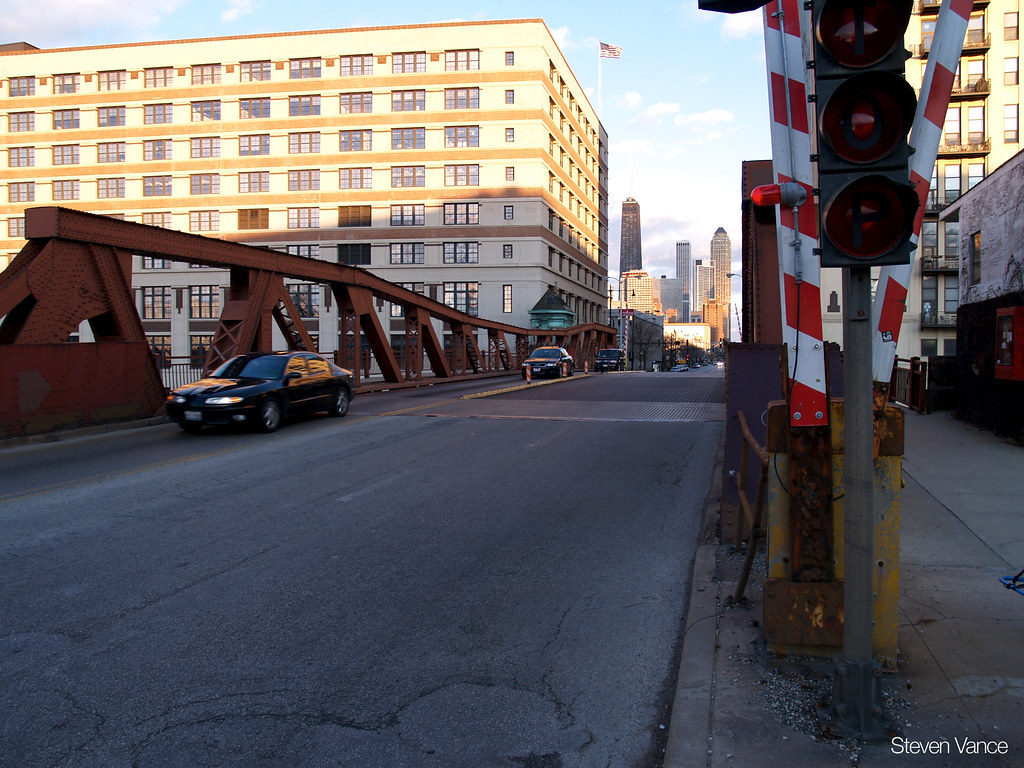
Looking west along the old Chicago Avenue Bridge. The pony (steel) truss bridge allows for road and river traffic over and through the truss, but with no cross brace across the top connecting its two sides. PHOTO: “Looking west on Chicago Avenue bridge” by Steven Vance is licensed under CC BY-NC-SA 2.0
The open-grate roadway and pony truss bascule design were characteristic solutions for heavily trafficked urban waterways. The bridge served as a critical link between the Near North Side and the Near West Side for more than a century.
A pony truss bridge is a steel truss bridge that allows traffic over and through the truss, but with no cross brace across the top connecting its two sides. The truss bridge assembly of the Chicago Avenue Bridge was made of riveted steel beams—and a witness to Chicago’s early 20th century industrial manufacturing might.
As well as being “Hog Butcher For The World, Tool Maker, Stacker of Wheat, Player with Railroads and the Nation’s Freight Handler” as Carl Sandberg wrote in his 1914 poem, Chicago, published in the new (1912) Poetry magazine, Chicago was also at that time a world leader in steel production and bridge design.
Looking east at the new Chicago Avenue Bridge in November 1914. Public Domain.
The basic design of any bascule bridge is similar to a medieval castle drawbridge. A leaf or span rises and descends that permits traffic upon it and— for the Chicago Avenue Bridge— also traffic below it on the Chicago River.
Chicago boasts more than 50 movable bridges. Single-leaf (truss) bascule bridges were constructed where the river was not very wide and a single bridge deck goes up and down between abutments. This was often used for train traffic which was convenient since Chicago was and still remains the railroad capital of the United States.
The more common double-leaf (truss) bascule bridge— including the Chicago Avenue Bridge—consists of two leaves or spans which meet in the middle over the river. Counterweights on each side of the bridge beneath it in a river pit (or pits) balances, stabilizes and fortifies the vertical movement of the bridge deck.
If the bridge deck is single leaf, the “Chicago Style” bridge rises in a piece vertically to one side of the river. If the bridge deck is two leaves, each rise to their side of the river and descend to close again by meeting in the middle of the bridge deck.
Its steel construction and mechanical movable span illustrated Chicago’s emergence as a world leader in infrastructure and civil engineering. The structure was closely tied to the industrial, commercial, and maritime history of the Chicago River.
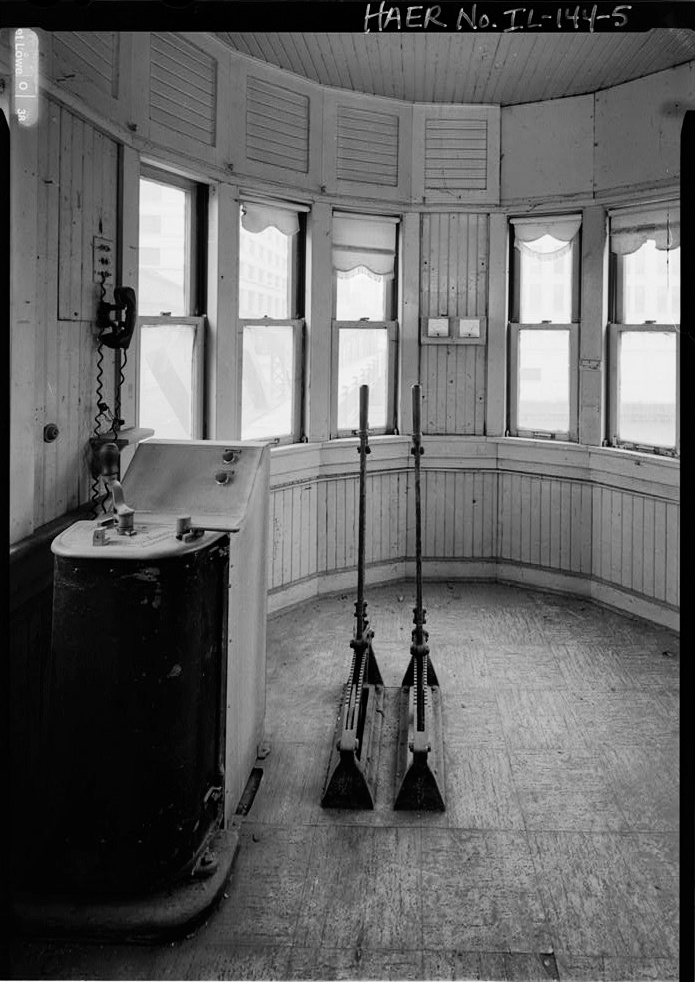
Bascule bridges are the most commonly found moveable bridges in the world because they operate quickly and efficiently. The Chicago Avenue Bridge was operated from a companion pitched-roof bridge house with rounded corners and rows of windows clad in decorative (today oxidized green) copper. The foundational portions of the bridge house were constructed of concrete. Upper portions were made of wood with roofing of vitrified tile. So far, the bridge house portion of the structure has not been demolished.
In 1914, the new Chicago Avenue Bridge across a jag of Chicago River abutting the national headquarters of Montgomery Ward whose complex was first built in 1907, made for a sleek, powerful, modern and elegant statement about industry and urban commerce in early 20th century Middle America.
Historic photographs of the bridge provide a record of a Chicago that was simultaneously industrial, architectural, and intensely urban.
When the Chicago Avenue Bridge opened in 1914, Chicago was the world leader in steel production and bridge design. Chicago Mayor Carter H. Harrison, Jr. (1860-1953) whose name appears on the dedication plaque was a five-term Democrat incumbent from 1897 to 1905 and from 1911 to 1915. PHOTO:“Carter H Harrison Mayor marker – Chicago Avenue Bridge” by swanksalot is licensed under CC BY-NC-SA 2.0
There are numerous variations and designs of the bascule bridge which in Chicago includes the trunnion (“pivot point”) bascule (“seesaw”) bridge. The nation’s first such bridge started operation in Chicago in 1902 over the north branch of the Chicago River at Cortland Street which can still be seen in operation today. The bridge design became known as the “Chicago Style” as its leaf or leaves, suspended on axles (trunnions) with massive concrete counterweights located below the bridge in the riverbank pit, opens and lifts a single or dual bridge deck to clear the river for traffic without blocking the waterway with a central pier.
Chicago’s bascule bridges—and the Chicago Avenue Bridge was one of them—were designed to its specific location. Each was designed to take on heavy loads and the attendant vibration which included the ice and snow pack of Chicago’s typically harsh winters. The design and construction into bedrock took into account wind resistance, whether the bridge leaves were open or closed, and to wind speeds of 100 miles per hour in any and all directions.
By 1920, improvements in bascule bridge design allowed for the construction of a double deck trunnion bascule bridge where car, truck and foot traffic could be carried simultaneously on its upper and lower decks. The first such double deck trunnion bascule bridge in Chicago was near the site of the old Fort Dearborn on the Chicago River at Michigan Avenue—today’s busy DuSable Bridge, formerly Michigan Avenue Bridge which opened in May 1920.
The Chicago Avenue Bridge is also significant as it belonged to a set of Chicago city bridges built between 1910 and 1915 whose designs looked to go beyond their utilitarian function to incorporate artistic and other aesthetic elements. Beginning with the Chicago Avenue Bridge in 1913, the Chicago Planning Commission worked with the city’s Bridge Division at the bascule bridge’s design stage.
Engineer’s blueprint of the Chicago Avenue Bridge, 1914. Public Domain. The blueprint shows the technical plans and cross-sections for the historical bascule drawbridge over the Chicago River at West Chicago Avenue. The detailed architectural drawings outline:
The Top-Down Site Plan (Top): Shows the layout of the river channel, streetcar rails, sidewalks, and neighboring historic properties (like the Montgomery Ward Co. Building, Merchants Lighterage Co., and City Yards).
The Structural Cross-Section (Middle): Details the bridge’s lane width, clearance dimensions, trolley wires, and structural framing.
The Profile Elevation (Bottom): Illustrates the trunnion mechanics, bridge towers, operators’ houses, underwater riverbed depth, and the underground utility tunnels beneath the city datum line.
Demolition in 2018 reflected the ongoing tension between infrastructure modernization and historic preservation.
Following the demolition of the Chicago Avenue Bridge in 2018, an immoveable temporary steel girder bridge was installed in 2019 over this span of the Chicago River. For the moment, bridge design has returned to utilitarian functionality alone with little or no artistic or aesthetic program which had been one of the progressive features of the Chicago Avenue Bridge over a century ago.
Library of Congress. “Chicago Avenue Bascule Bridge, Spanning North Branch of Chicago River at Chicago Avenue, Chicago, Cook County, IL.” Historic American Engineering Record, HAER IL-23. https://loc.gov/pictures/item/IL0823/.
The Brooklyn Bridge stands as the greatest achievement of John Augustus Roebling’s engineering career, uniting innovative design, industrial ambition, and architectural beauty to create an enduring symbol of New York City and America’s rise as a modern nation.
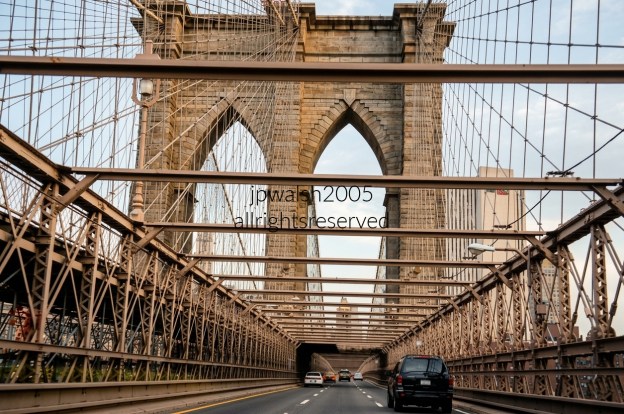
FEATURE image: The Brooklyn Bridge. Centered perfectly is one of the bridge’s massive, Gothic-arched granite suspension towers, while flanking the right side behind the suspension cables are the skyscrapers of Lower Manhattan, including the recognizable Verizon communications building. August 2005. Author’s photograph. All rights reserved.
The Brooklyn Bridge over the East River is the oldest extant bridge in New York City—a city of bridges—and is also the city’s most architecturally famous. The opening of the hybrid cable-stayed and suspension bridge in May 1883 has been called “the Dawn of Modern New York” as it is the world’s first steel-wire suspension bridge.
The Brooklyn Bridge was conceived to connect Manhattan and Brooklyn across the East River, overcoming unprecedented engineering challenges.
Recent photo of the Brooklyn Bridge taken from the Manhattan side of the East River looking across the water toward the DUMBO and Brooklyn Heights neighborhoods. PHOTO: “Brooklyn Bridge New York City” by ugod is licensed under CC BY 2.0.
Spanning the East River between the boroughs of Manhattan and Brooklyn, it was designed and built by a father-son team. Construction began in January 1870 after being approved by Congress in 1869 whose concern was that the bridge project would in no way impede free and open navigation. Over the next over 13 years, an estimated 27 men died during the bridge’s construction. The New York terminus rests on bedrock while the Brooklyn terminus rests on clay. Following its opening in 1883 by the end of that year more than one million passengers crossed the bridge.
Roebling’s innovative use of steel-wire cable technology made longer and stronger suspension spans possible. The bridge’s Gothic-inspired stone towers combine structural necessity with architectural grandeur.
Daily transit on the elevated pedestrian promenade of the Brooklyn Bridge in 1903, looking west toward the lower Manhattan skyline. In the foreground, a New York City policeman in a turn-of-the-century uniform and custodian helmet stands watch as pedestrians in Edwardian dress, men in long overcoats and bowler hats, make their way along the wide wooden boardwalk. The photograph captures the bridge’s intricate lattice of vertical suspenders and radiating steel stay cables. Flanking the promenade on either side are the lower iron trusses that separated pedestrians from the bridge’s busy trolley and cable car lines. Anchoring the composition at the vanishing point is one of the bridge’s immense granite towers, its signature neo-Gothic double arches perfectly framing the horizon and underscoring the monumentality of one of America’s great engineering achievements. Public Domain.
The total length of the bridge is 6,537 feet—nearly one-and-one-quarter miles. From the middle of the span, it is about 135 feet above the river with the span’s weight around 7,000 tons. The railroad on the Brooklyn Bridge opened in 1888. The cables on the bridge are over one foot wide (16 inches) and took almost a year and a half (15 months) to string. Their calibration had to include calculations for variables such as wind and expansion and contraction due to temperature. The height of the Gothic-inspired towers are 159 feet above the roadway.
The Brooklyn Bridge symbolizes the industrial age, urban growth, and American ingenuity. Today it remains one of the world’s most recognizable and photographed structures.
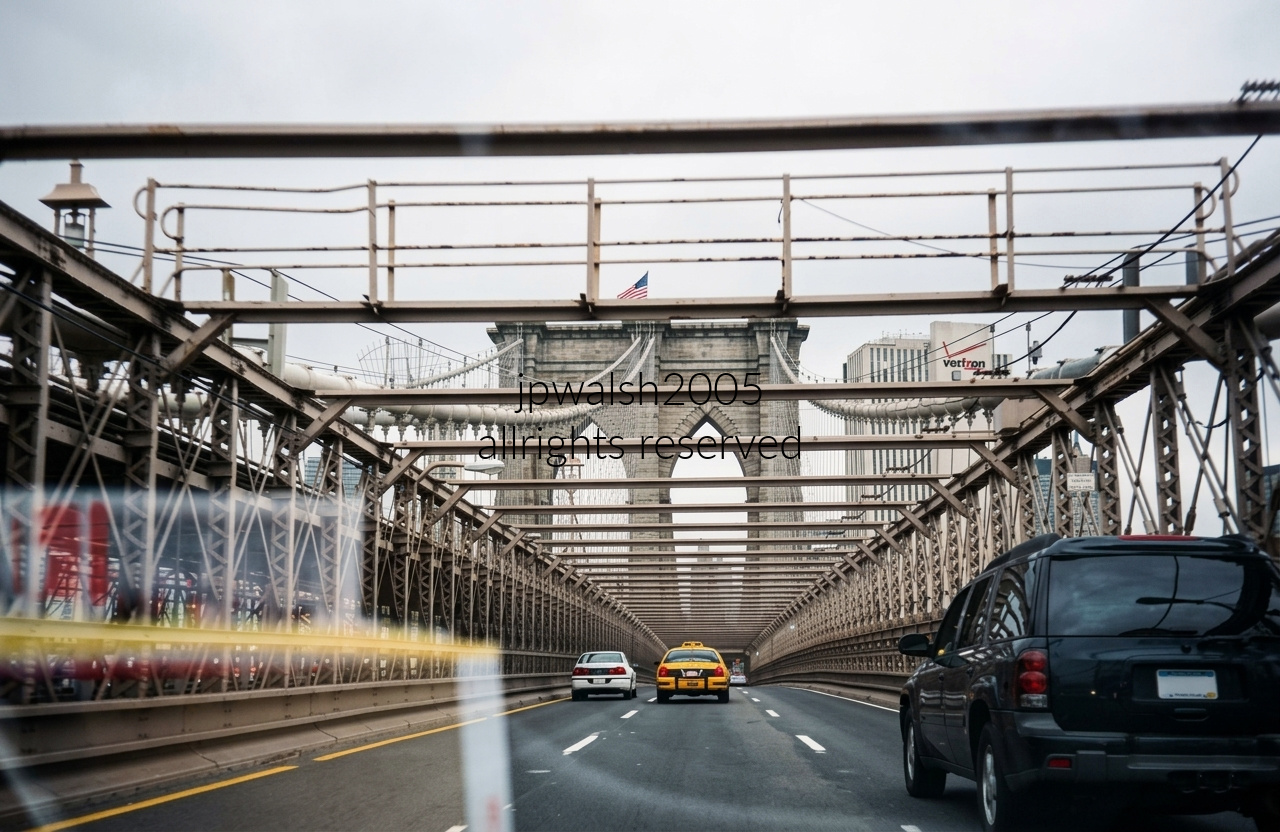
While a classic yellow New York City taxicab and a white sedan drive ahead, the bridge’s intricate, industrial steel trusses, overhead support beams, and complex web of suspension cables that line both sides of the roadway fill out the view heading from Brooklyn into Manhattan. An average of 103,051 vehicles cross the Brooklyn Bridge every single day. August 2005. Author’s photograph. All rights reserved.
SOURCES: The Sun, New York, New York, June 11, 1891. NYC DOT – Brooklyn Bridge – retrieved August 2, 2026.