
Tag Archives: #MilitaryHistory

All Quiet on the Western Front (1930): The Film That Shattered the Myth of the Good War.

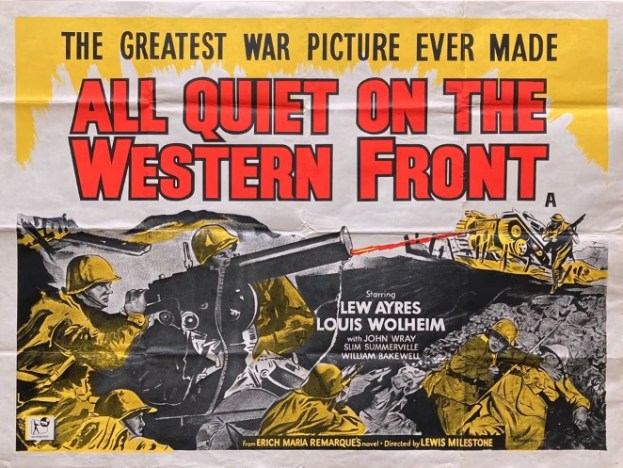
FEATURE Image: A vintage theatrical release poster for All Quiet on the Western Front (1930) captures the bold marketing campaign devised by Universal Pictures and producer Carl Laemmle Jr. to promote a film that challenged Depression-era audiences to view the First World War through the eyes of German soldiers. Across the top, dramatic lettering proclaims it “The Greatest War Picture Ever Made,” while the artwork below immerses viewers in the brutal realities of trench warfare. A striking black-and-white illustration depicts German troops manning a heavy Maxim machine gun amid a shattered, mud-soaked trench system. In the upper right, a tank surges over a trench barrier beneath vivid yellow and red accents as an infantryman takes aim nearby. Elsewhere, a somber scene shows a soldier tending to, or mourning, a fallen comrade amid the devastation of battle. The billing block prominently features stars Lew Ayres and Louis Wolheim, while also emphasizing the film’s prestigious origins with credits to Erich Maria Remarque’s bestselling novel and director Lewis Milestone, underscoring the production’s artistic ambition as well as its emotional power.  In addition to Lew Ayres as Paul Bäumer and Louis Wolheim as Kat, the film features John Wray as Himmelstoss, a postman turned tyrannical drill sergeant who torments the young recruits during training, only to confront his own fears at the front. Slim Summerville appears as Tjaden, the always hungry, resourceful soldier whose humor and resilience help sustain the group through the war’s hardships, while William Bakewell portrays Albert Kropp, one of Paul’s closest schoolmates. Public Domain.

All Quiet on the Western Front (1930) shattered romantic myths of war by portraying combat not as a stage for heroism and glory, but as an industrialized tragedy that destroys youth, friendship, innocence, and human dignity. Through the experiences of Paul Bäumer and his fellow soldiers, the film exposes the profound physical and psychological costs of war while affirming the shared humanity of those forced to fight on opposing sides.

By John P. Walsh
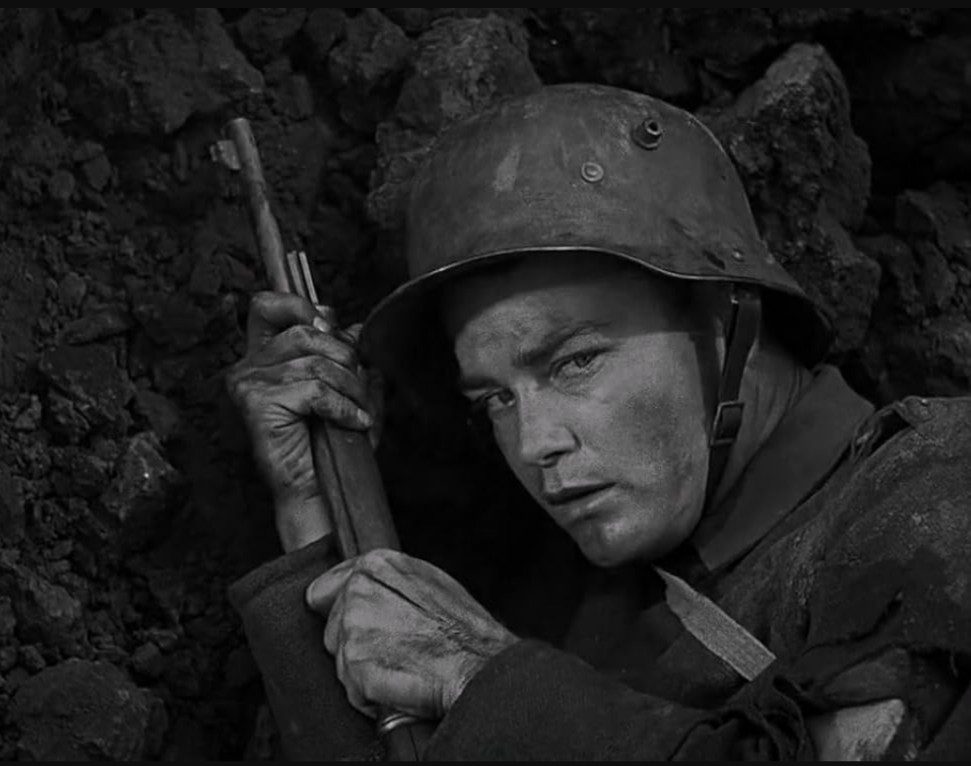
Lew Ayres as Paul Bäumer is the central protagonist; an idealistic German schoolboy who enlists in the army and becomes profoundly disillusioned by the horrific realities of trench warfare. Public Domain.

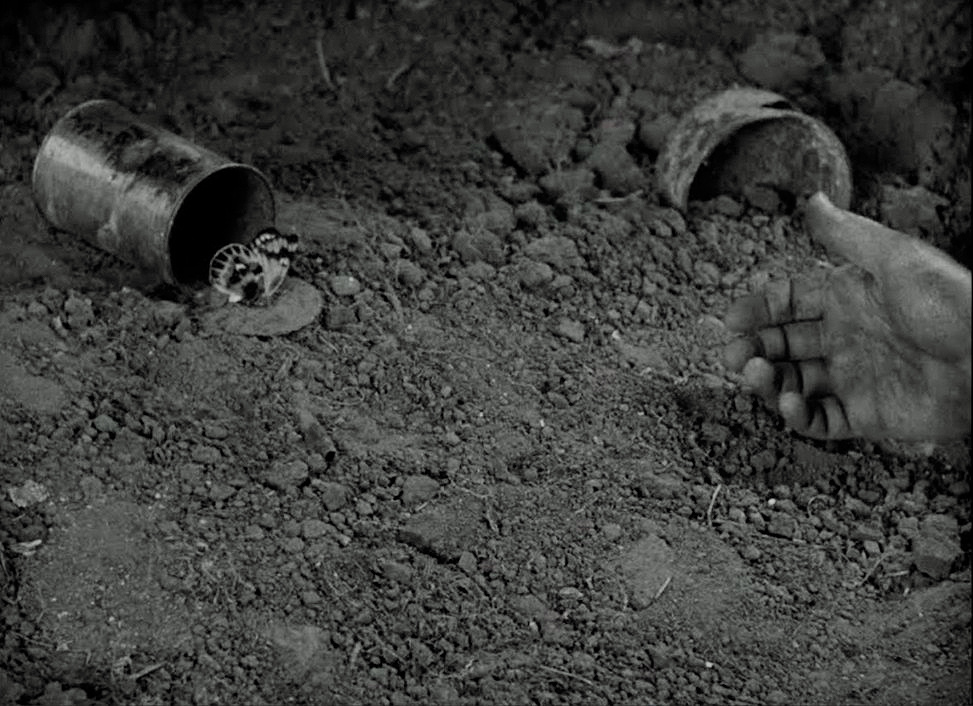
With Kat dead and all of his school friends gone, Paul Bäumer is left utterly alone on the front lines, cut off from the friendships, purpose, and human connections that once sustained him in dire circumstances. Sitting in the uneasy stillness of a trench, he notices a lone butterfly perched just beyond the parapet, a fleeting symbol of beauty and life amid the devastation of war. Drawn to the fragile solo flying creature, Paul reaches out toward it, momentarily forgetting the hard-earned caution that had kept him alive. A sniper’s shot abruptly shatters the silence, and his hand falls limp. In one of cinema’s most haunting endings, Paul’s death underscores the film’s central message: war destroys lives indiscriminately, extinguishing youth, hope, and humanity with tragic indifference.

Origins of a Landmark Film

Based on Erich Maria Remarque’s seminal 1929 novel, the definitive anti-war masterpiece All Quiet on the Western Front was directed by 35-year-old Lewis Milestone and produced by 22-year-old Carl Laemmle Jr., the visionary son of Universal Pictures’ founder.
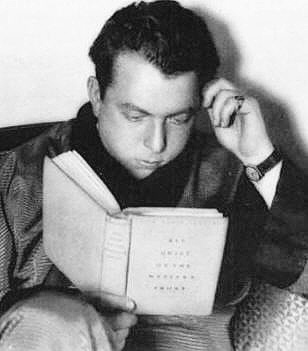
Lewis Milestone, director of All Quiet on the Western Front (1930), is shown deeply absorbed in a copy of Erich Maria Remarque’s landmark anti-war novel, the work that inspired one of cinema’s most influential achievements. Milestone’s adaptation introduced groundbreaking techniques that transformed the depiction of warfare on screen, including pioneering fluid camera movements, rhythmic “symphonic” editing, and a stark, unsentimental realism that conveyed both the physical chaos of battle and its psychological toll. Working at the dawn of the sound era, he also used the new technology of synchronized dialogue and effects to heighten tension and psychological dread, creating an immersive experience that brought audiences closer than ever before to the fear, exhaustion, and trauma endured by ordinary soldiers. The result was a film whose technical innovations and emotional honesty helped redefine the war genre for generations of filmmakers. Public Domain.

From Classroom Patriotism to Boot Camp Reality

On the brink of manhood and fueled by romantic delusions of glory, a class of German schoolboys—led by the sensitive Paul Bäumer (played by Lew Ayres)—is swept up by patriotic fervor and enticed to enlist. Any illusions of grandeur vanish instantly in boot camp, where a ruthless drill instructor barks their new reality: “You will be soldiers—and nothing more.”
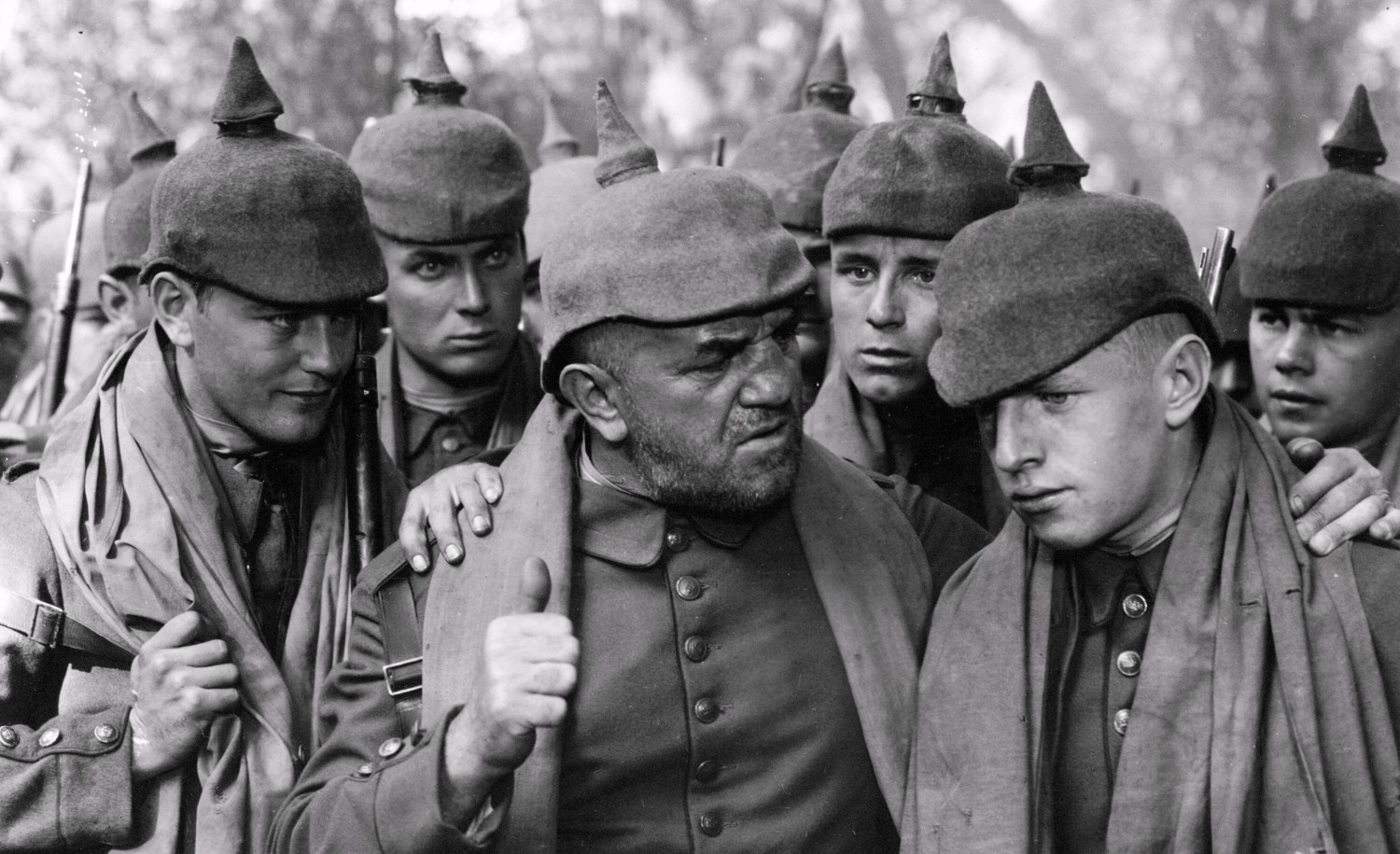
Stanislaus “Kat” Katczinsky (Louis Wolheim), the battle-hardened veteran of All Quiet on the Western Front, gathers with a group of newly arrived schoolboys, including Paul Bäumer (Lew Ayres), standing just to Kat’s left with his eyes cast downward. Acting as mentor and survivor, Kat introduces the young recruits to the harsh realities of life at the front, where practical experience matters far more than patriotic ideals. The image captures one of the film’s central contrasts: Kat’s weathered face, grim expression, and authoritative gesture dominate the scene, while the anxious, smooth-faced boys crowd around him, listening intently as they begin to understand that their romantic notions of war offer little preparation for the brutal world they have entered. Public Domain.

Into the Inferno

When the green recruits arrive at the front lines, they plunge directly into mayhem. The landscape is a claustrophobic nightmare of exploding shells, whizzing bullets, racing horse-drawn ambulances, and relentless rain. The psychological toll begins before they even reach their post when one of the boys is killed, rattling the survivors. On their very first day, the starving recruits are forced to forage for food, bartering with their own cigarettes just to secure a meal.

Life and Death in the Trenches

Life in the trenches is pure horror. In one harrowing sequence, a young soldier is blinded by shrapnel and runs madly into machine-gun fire to his death. The meat-grinder of combat becomes a grim cycle of advances and retreats, where the surviving men hollowly eat the food rations of their slaughtered comrades. In lulls between mortar fire, they debate the absurd geopolitical origins of the war, using dark humor to cope with the pointlessness of their plight. Meanwhile, fresh reinforcements arrive only to be instantly obliterated.
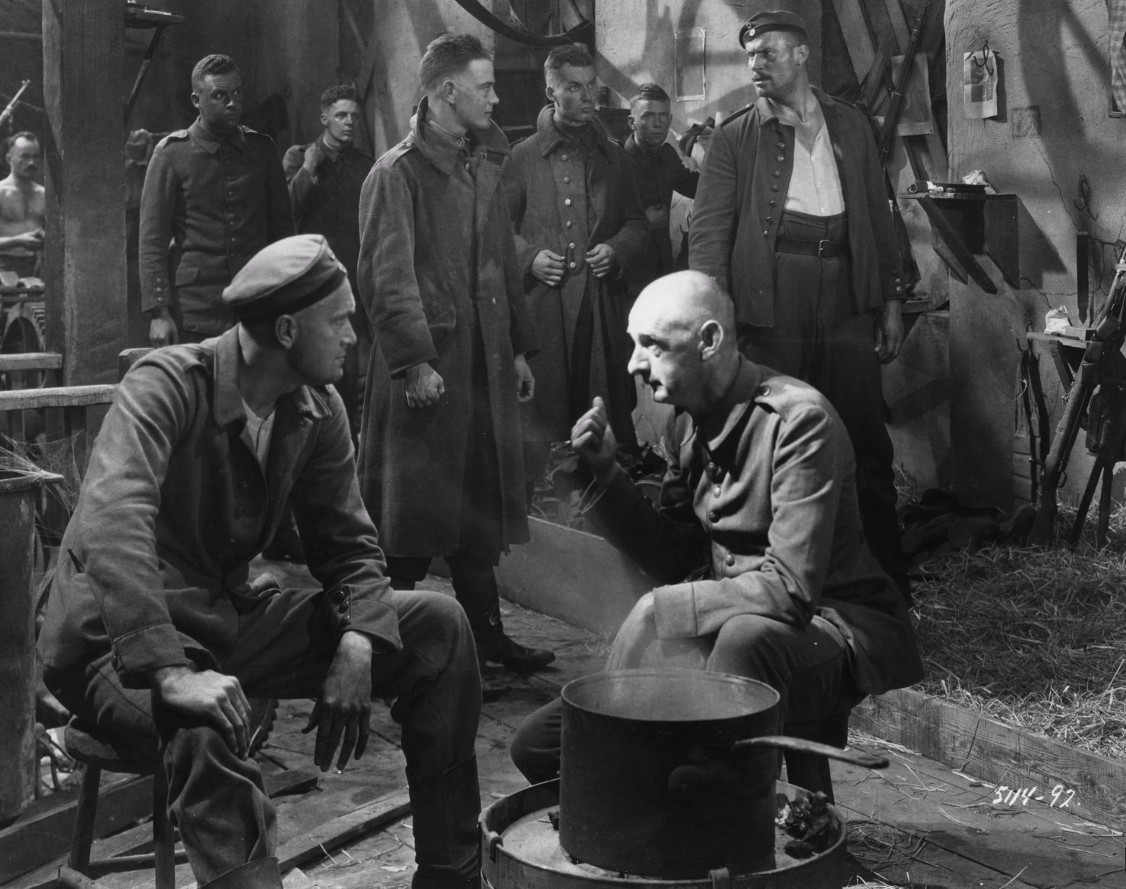
Soldiers converse in a barracks behind the front lines, gathered around a large cooking pot during a rare break from the fighting. In the foreground, Tjaden (Slim Summerville, seated at right) punctuates his argument with a raised fist while addressing a fellow soldier (Harold Goodwin, seated at left). Behind them stand Paul Bäumer (Lew Ayres, in the long greatcoat), Haie Westhus (Richard Alexander, at right with his jacket unbuttoned), and other members of their company, listening closely as the discussion turns to the question of who truly benefits from war. In one of the film’s most memorable exchanges, the soldiers joke that conflicts should be settled by kings and generals fighting each other with clubs instead of sending millions of young men to die. The rustic setting, with its straw bedding, hanging equipment, and makeshift stove, provides a brief but revealing respite from the film’s relentless combat, highlighting the camaraderie, humor, and hard-won wisdom that help the men endure the war. Public Domain.
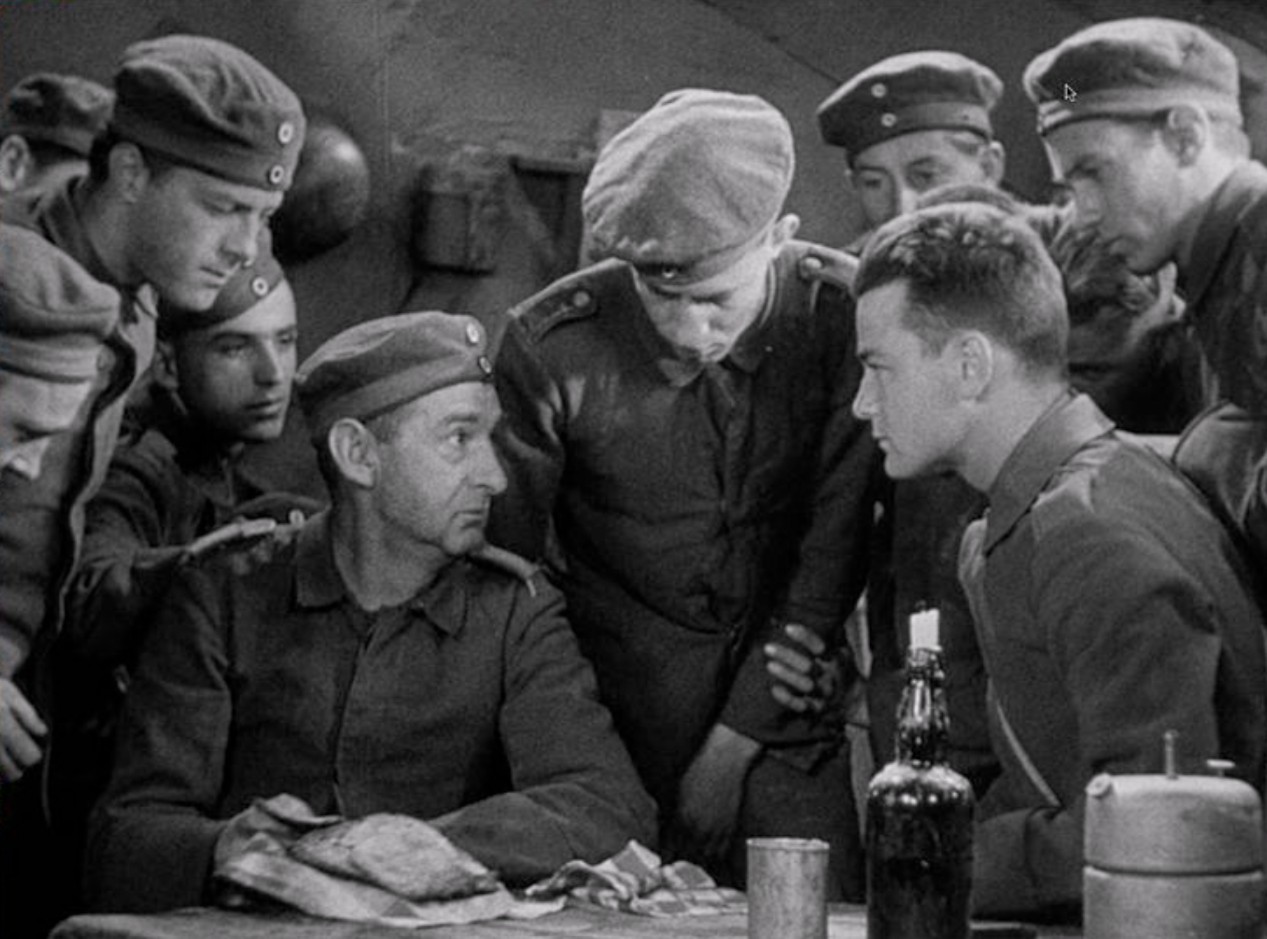
The same group of soldiers during a different break from the front lines. Seated at a table inside a dugout or mess hall, Tjaden (Slim Summerville, seated on the left with a piece of bread or food in front of him) is locked in a tense, focused exchange with Paul Bäumer (Lew Ayres, leaning in from the right). Public Domain.

The Shell-Hole and Paul’s Crisis of Conscience

The film’s emotional apex occurs when Paul mortally wounds a French soldier (Raymond Griffith) in a shell-hole. Trapped with the dying man overnight, Paul is consumed by remorse and futilely tries to save him, weeping bitterly as he begs the dead soldier’s corpse for forgiveness.
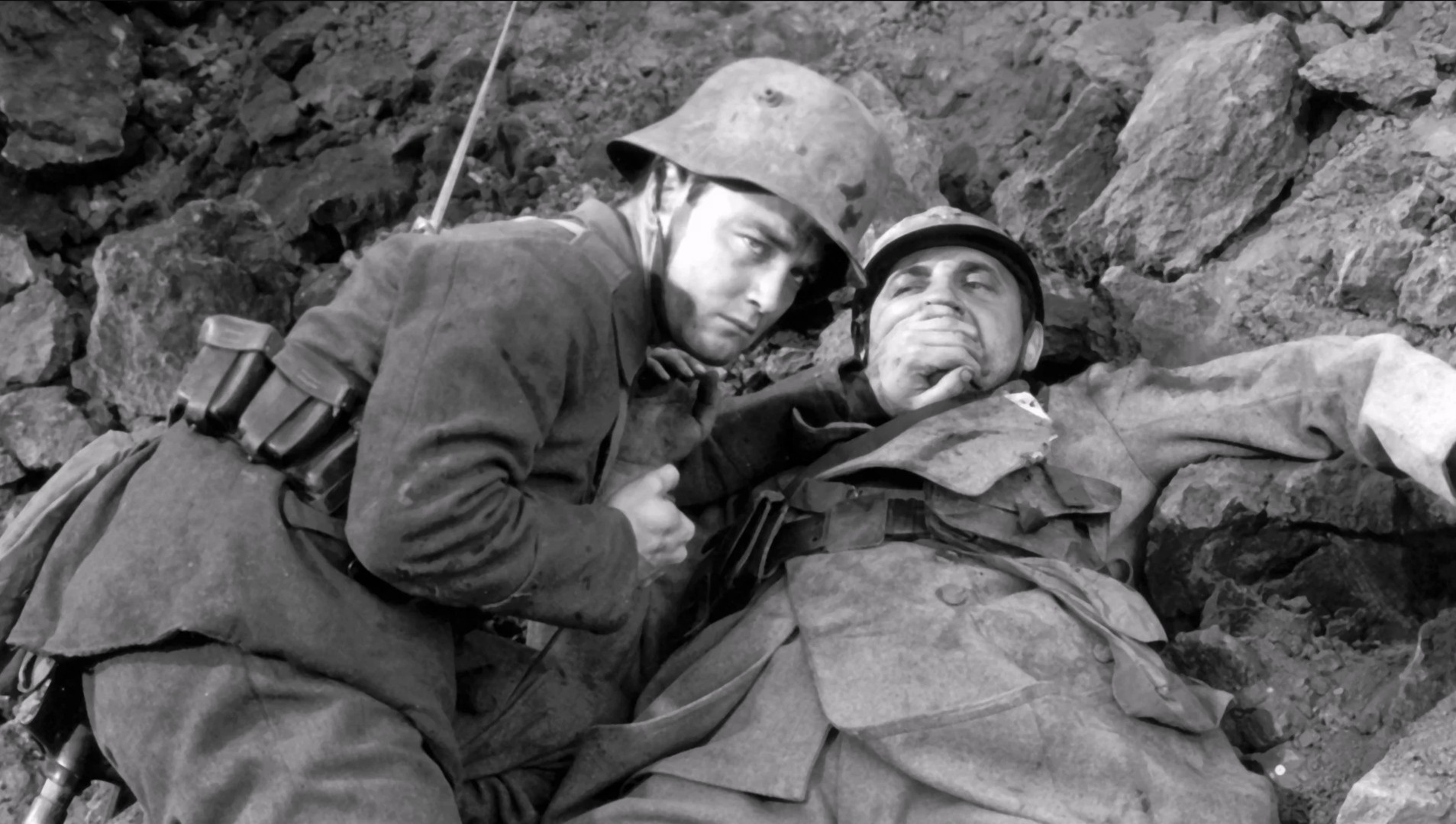
This black-and-white film still captures the agonizing shell-hole sequence, with Paul Bäumer (Lew Ayres) trapped in a bomb crater beside the mortally wounded French soldier Gérard Duval (Raymond Griffith). The episode marks the first time Paul kills a man face-to-face rather than firing blindly from a trench. Having acted out of instinct when Duval suddenly entered the crater, Paul is forced to confront the humanity of his enemy. As the long night unfolds, fear gives way to crushing guilt. Paul desperately tries to save the dying man, bandaging his wound, giving him water, and discovering a photograph of Duval’s wife and daughter. In that moment, the barriers between friend and foe collapse, shattering what remains of Paul’s faith in the war and exposing its tragic human cost. Public Domain.

Wounds, Recovery, and a Return Home

Shortly after being comforted by his comrades, Paul is severely wounded alongside his best friend, Kropp. They are sent to a Catholic hospital where Kropp’s leg is amputated, while Paul is granted a temporary furlough to visit home. Earlier Franz Kemmerich (Ben Alexander) has his leg amputated though he is unaware of it and tragically dies shortly after in the field hospital, famously leaving behind his prized leather boots to Müller.

A Stranger in His Own Country

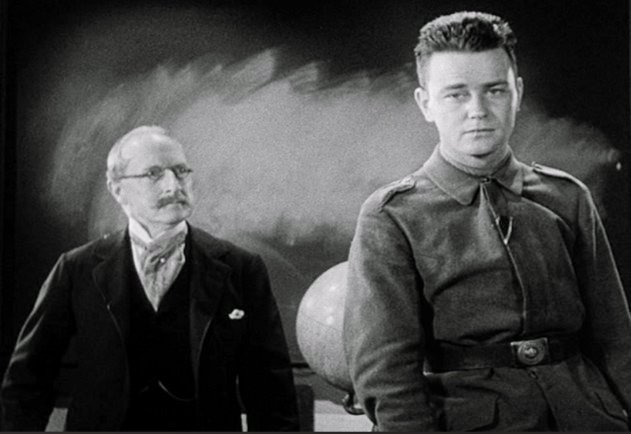
Back in Germany, Paul is profoundly isolated. The civilian populace carries on with daily life, regurgitating hollow government platitudes while remaining completely ignorant of the front-line slaughter. Shocked by this disconnect, Paul visits his old classroom, only to find his former schoolmaster, Professor Kantorek (Arnold Lucy) using the exact same propaganda on a new crop of boys. Invited to speak, Paul strips away the myth of heroism, recounting the agonizing deaths of his classmates. Rather than hearing Paul’s hard-earned truths about the battlefield, the schoolmaster turns the class against him, leading the students in angry chants branding him a “coward.”
The Front Collapses

Exiled by his experiences, Paul returns to the front to reunite with Kat and his remaining comrades, only to find the line disintegrating. While commiserating about the civilians’ inability to understand the daily violence, an incoming shell abruptly kills Kat, leaving Paul utterly devastated.
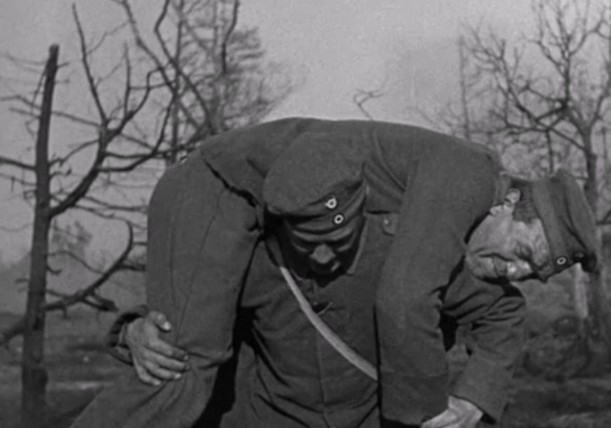
Kat’s death marks the most devastating turning point in All Quiet on the Western Front. By this stage of the war, Stanislaus “Kat” Katczinsky (Louis Wolheim) is the last surviving member of Paul Bäumer’s original circle of friends and the one person who truly understands what they have endured. During a brief lull in the fighting, Kat is wounded in the leg by shrapnel. Determined to save the man who taught him how to survive, Paul Bäumer (Lew Ayres) carries his mentor on his back across the countryside toward a field hospital. Upon arrival, however, Paul learns that Kat is already dead, killed by a second fragment of shrapnel that struck him in the head during the journey. With the loss of his friend, guide, and emotional anchor, Paul is left utterly alone. Kat’s death strips away the last reason to keep fighting and leads directly to the film’s haunting final moments, where Paul reaches toward a butterfly, no longer possessing the hard-earned survival instincts that Kat had spent so long trying to teach him. Public Domain.

The Butterfly

In the film’s iconic final sequence, Paul returns to the trenches on a deceptively quiet day. Catching sight of a solitary butterfly resting just beyond the sandbags, a faint smile crosses his face as he reaches out to touch it. A sudden crack of a sniper’s rifle rings out; Paul’s hand twitches and goes limp. The film closes on a haunting montage of ghost images—the lost generation of schoolboys marching away into a vast cemetery.
Historic Legacy and Academy Awards

Released by Universal Pictures in April 1930, All Quiet on the Western Front cemented its place in cinematic history. Its Russian-born director, Lewis Milestone (born Leib Milstein), took home his second Academy Award for Best Director, having won his first the previous year for Two Arabian Knights. The Chicago-born Laemmle Jr. accepted the Oscar for Outstanding Production, making this unforgettable masterpiece the very first Hollywood film to win both Best Picture and Best Director.

More than a war film, All Quiet on the Western Front is a human tragedy that strips away every illusion of glory to reveal the loneliness, suffering, and waste left in war’s wake.
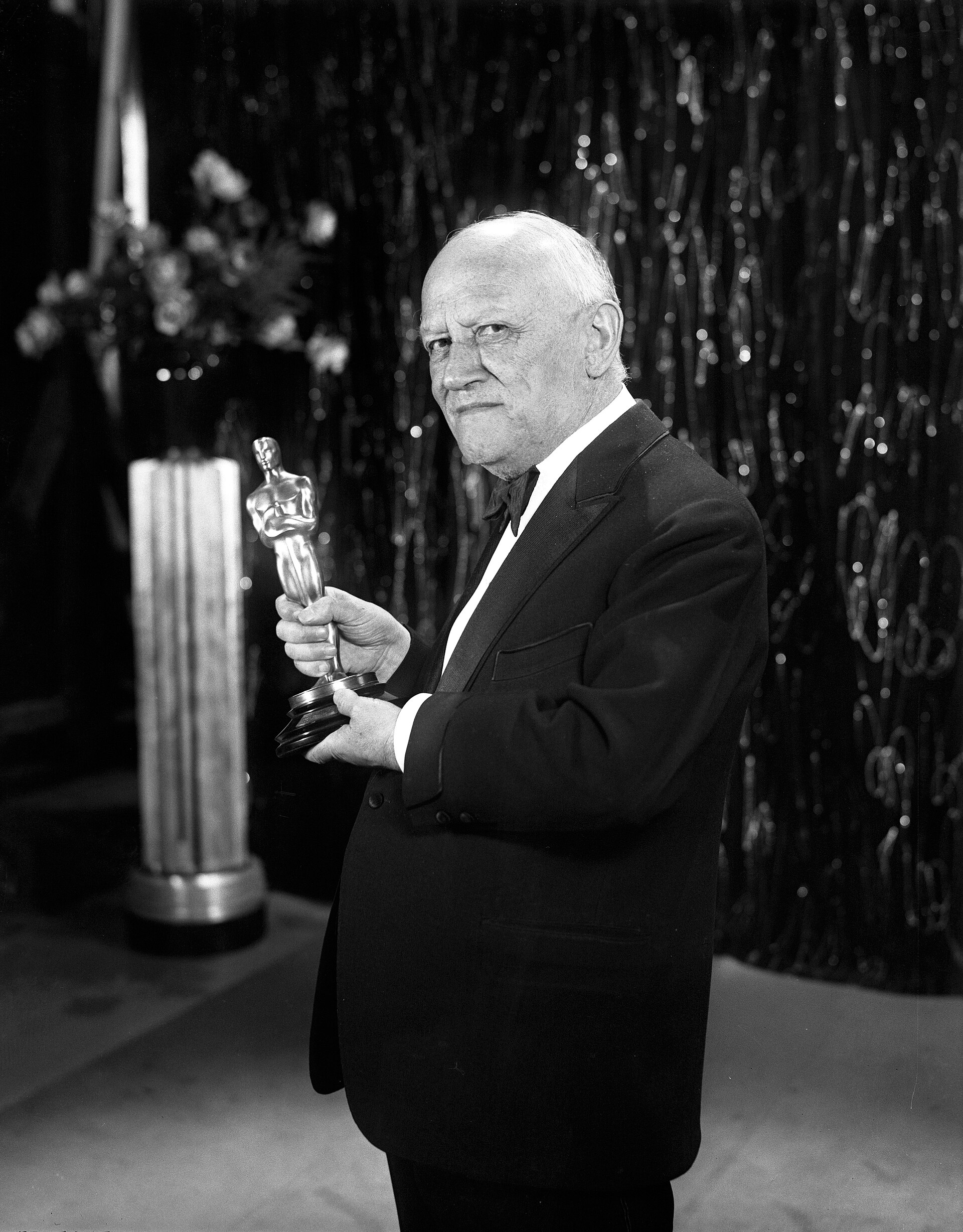
Carl Laemmle Sr., founder and head of Universal Pictures, proudly displays the Academy Award for Outstanding Production won by All Quiet on the Western Front at the 3rd Academy Awards in November 1930. Although the film was produced by his son, Carl Laemmle Jr., Universal’s head of production, the senior Laemmle accepted the statuette on behalf of the studio. The victory marked a major milestone for the early sound era, rewarding a bold and costly adaptation that rejected traditional patriotic war themes in favor of a stark anti-war message. Within weeks, however, the film became the center of an international political firestorm. When All Quiet on the Western Front opened in Berlin in December 1930, Nazi activists led by Joseph Goebbels disrupted screenings, denouncing its portrayal of German soldiers and helping spur a ban in Germany. For Laemmle, a German-born Jewish immigrant, the controversy proved deeply personal. As conditions in Nazi-controlled Europe worsened during the 1930s, he increasingly devoted his resources and influence to assisting Jewish refugees seeking escape. The Oscar he holds in this photograph stands not only as a symbol of cinematic achievement but also as an artifact connected to one of the most consequential cultural and political controversies of the era. Public Domain.

The Cinematic Milestone

The timeless tragedy of All Quiet on the Western Front extended far beyond the theaters of 1930, establishing a legacy that would echo through every major conflict of the next century. While King Vidor’s 1925 silent epic The Big Parade from MGM had previously attempted a non-heroic look at World War I, Lewis Milestone’s adaptation was vastly superior—justifiably called “the most uncompromisingly bleak statement about the nightmare of trench warfare the cinema had ever attempted.”

Humanizing the Enemy

The film’s reputation has endured precisely because of its simple story about a small group of young men who are systematically wiped out, all killed or maimed, by the carnage of war. Coming in the wake of an era where German culture had been in the aftermath of the Great War deemed verboten in America, this simple tale told from the German perspective was deeply affecting. Humanizing moments—such as Paul agonizing in a shell-hole over the French soldier he just stabbed, or reaching out from his trench toward a butterfly only to attract the sniper’s bullet that kills him—forced American audiences to confront the reality that war is hell on both sides.

Censorship and the Second World War

Meanwhile, the story’s fierce anti-war stance proved so dangerous to militaristic regimes that the book was famously burned by the Nazis, and the film was banned in Berlin, condemned in Germany for supposedly demoralizing the nation’s youth as World War II loomed. Yet, as global battlefields shifted, the core message of Remarque’s book and Milestone’s commercial masterpiece remained unshakeable.

Echoes Through Vietnam and the Post-9/11 Era

During the Vietnam War, the film’s stark depiction of a disillusioned youth betrayed by an older generation resonated deeply with a new counterculture protesting an increasingly opaque war. Decades later, amidst the prolonged deployments of the wars in Iraq and Afghanistan, modern audiences and veterans alike found a familiar, painful truth in Paul Bäumer’s struggle—the profound psychological disconnect between the horrors of the front lines and the safe, platitudinous civilian world back home.

An Enduring Cultural Mirror

Whether through Remarque’s prose or Milestone’s lens, All Quiet on the Western Front remains the definitive cultural mirror for the recurring trauma of war, proving that while the technology of combat changes, the hollow myth of glory and the fracturing of a generation’s soul remain tragically identical.

Lewis Milestone’s All Quiet on the Western Front transformed both the war film and the early sound film by combining groundbreaking cinematic techniques with an uncompromising anti-war message, revealing how modern warfare reduces idealistic young men to victims of forces beyond their control.
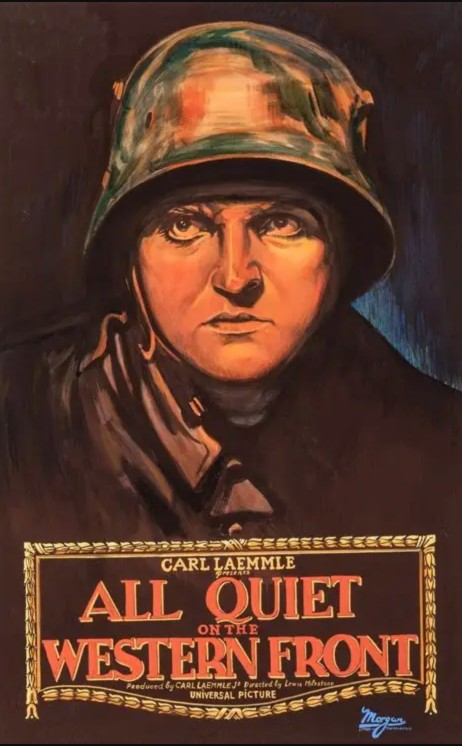
The iconic 1930 theatrical release one-sheet poster for Universal Pictures’ All Quiet on the Western Front, designed by Universal’s legendary art director Karoly Grosz and printed by the Morgan Litho Company. While many viewers assume the painted portrait depicts the film’s star, Lew Ayres, the model for this poster is actually actor Walter Rogers (also credited as Walter Browne Rogers), who played the minor supporting role of Behn—one of Paul Bäumer’s classmates who is killed early in the film. Rogers was photographed in a camouflaged German Stahlhelm (steel helmet) with a haunted, shell-shocked, thousand-yard stare. Universal’s art department felt his expressive, youthful face captured the psychological trauma and universal tragedy of the “lost generation.” Public Domain.

This explanatory article may be periodically updated.

“I Have Fifty Thousand of My People”: the Spiritual World of Joan of Arc and her Capture of Saint-Pierre-le-Moûtier (1429).

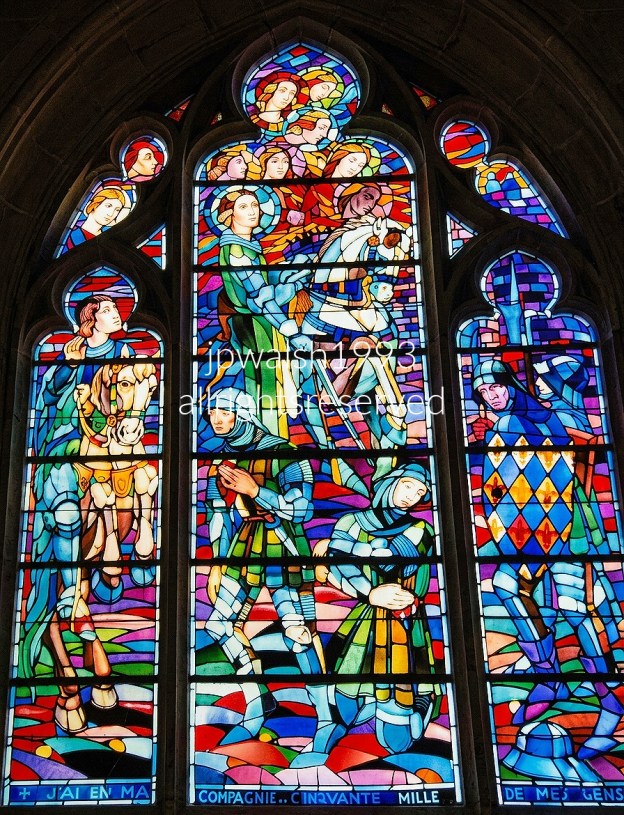
FEATURE Image: St. Joan of Arc’s capture of Saint-Pierre-le-Moûtier from Anglo-Burgundian forces on November 4, 1429, during the Hundred Years War in L’église Saint-Pierre at Saint-Pierre-le-Moûtier, France. Seotember 1993. Author’s photograph.

The stained-glass window at Saint-Pierre-le-Moûtier commemorates a pivotal moment in Joan of Arc’s military career, illustrating how her unwavering faith, personal courage, and conviction in divine assistance transformed a near-defeat into a decisive French victory during the Hundred Years’ War.

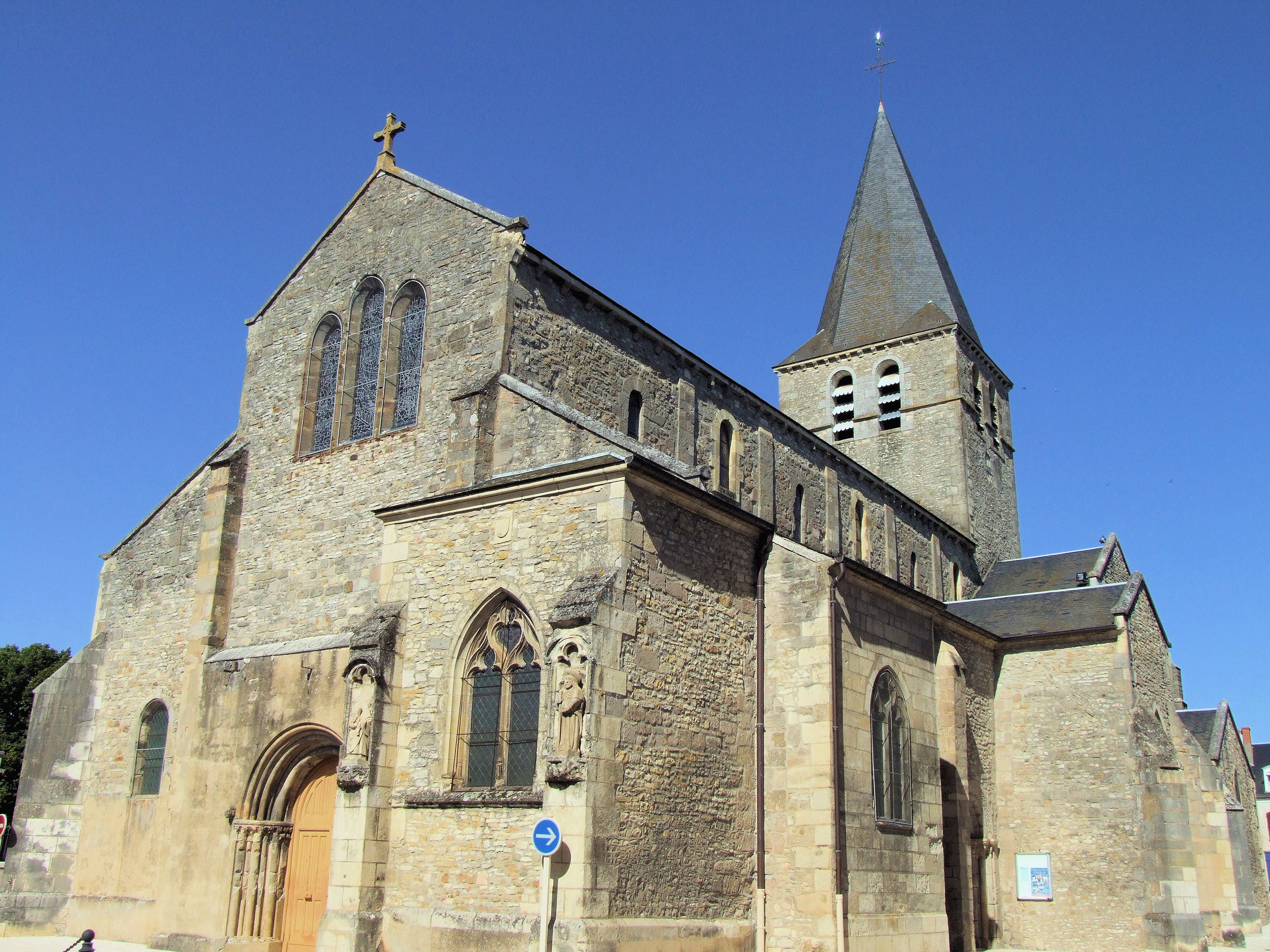
The Saint Peter Church of Saint-Pierre-le-Moûtier (Nièvre) is a 12th-century Roman Catholic building, a former Benedictine priory, classified as a historical monument since 1886. Photo by MOSSOT / Wikimedia Commons / CC BY 3.0

The Window and Its Setting

This stained‑glass window captures one of the most electrifying moments in the epic of Joan of Arc. It is part of a modern cycle in the town church of Saint‑Pierre de Saint‑Pierre‑le‑Moûtier, crafted in the mid‑20th century by the Mauméjean brothers. The artwork commemorates an event that unfolded in this very town — and inside this very church — during the Hundred Years’ War.

On November 4, 1429, Joan led a French royal force to seize Saint‑Pierre‑le‑Moûtier, a fortified stronghold held by Anglo‑Burgundian troops. The attack stalled under fierce resistance. French soldiers broke formation and began to fall back. Amid the chaos, Joan’s officer Jean d’Aulon — wounded during the fighting — suddenly realized she had been left almost alone near the moat with only a handful of men.

Author’s photograph. All rights reserved.

Joan’s Defiance and Her “Fifty Thousand”

D’Aulon mounted a horse, rode to her, and urged her to retreat before she was killed or captured. Joan removed her helmet and shouted that she was not alone. The window preserves her words across its lower banners: “+ J’AI EN MA / COMPAGNIE . . CINQVANTE MILLE / DE MES GENS.” She claimed she had fifty thousand of her people with her — the heavenly host of angels she believed fought at her side. D’Aulon saw only four or five soldiers, but Joan’s unshakable resolve reignited the army.

The Turning of the Battle

Joan ordered her men to gather wood and brush to build a makeshift bridge across the moat. The retreating French troops saw The Maid standing her ground, turned back, and launched a sudden, overwhelming assault that broke the defenses and captured the town. The upper portion of the window shows Joan on her white horse in the heat of battle, while the faces gathered in the arc above represent the “fifty thousand” she invoked — angels, Saint Michael, and the voices she believed guided her.

Aftermath and Joan’s Devotion

Following the victory, Joan prevented her troops from sacking the town. She then spent several days praying inside this church before marching on to her next campaign, leaving behind both a military triumph and a moment of mystic conviction that the Mauméjean window preserves with vivid force.

The nave of Saint-Pierre Church at Saint-Pierre-le-Moûtier, where Joan of Arc spent several days in prayer following her remarkable victory against overwhelming odds at the Battle of Saint-Pierre-le-Moûtier in November 1429. Photo by MOSSOT / Wikimedia Commons / CC BY-SA 3.0

More than a scene of battlefield heroism, the Saint-Pierre-le-Moûtier window presents Joan of Arc’s conviction that military success flowed from divine providence, portraying the inseparable relationship between faith, vision, and leadership that defined her extraordinary career.

This explanatory article may be periodically updated.

Iwo Jima at 80: Sacrifice, Victory, and the Photograph That Helped Win the Peace.

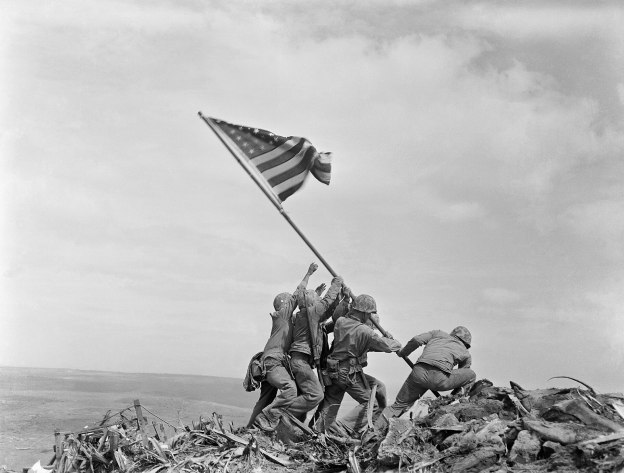
FEATURE image: Original photograph by Joe Rosenthal, February 23, 1945. Public Domain.

The Battle of Iwo Jima was one of the most costly and consequential American victories of World War II, securing a strategic foothold in the Pacific while producing iconic photographs and film footage that transformed a brutal military campaign into an enduring symbol of sacrifice, heroism, and national resolve.

The battle lasted from February 19 to March 26, 1945, and was among the fiercest engagements of the Pacific War.

Fourth Division Marines in Foxhole on Beach, Iwo Jima, February 1945. PHOTO: “Fourth Division Marines in Foxhole on Beach, Iwo Jima, February 1945” by Archives Branch, USMC History Division is licensed under CC BY 2.0.

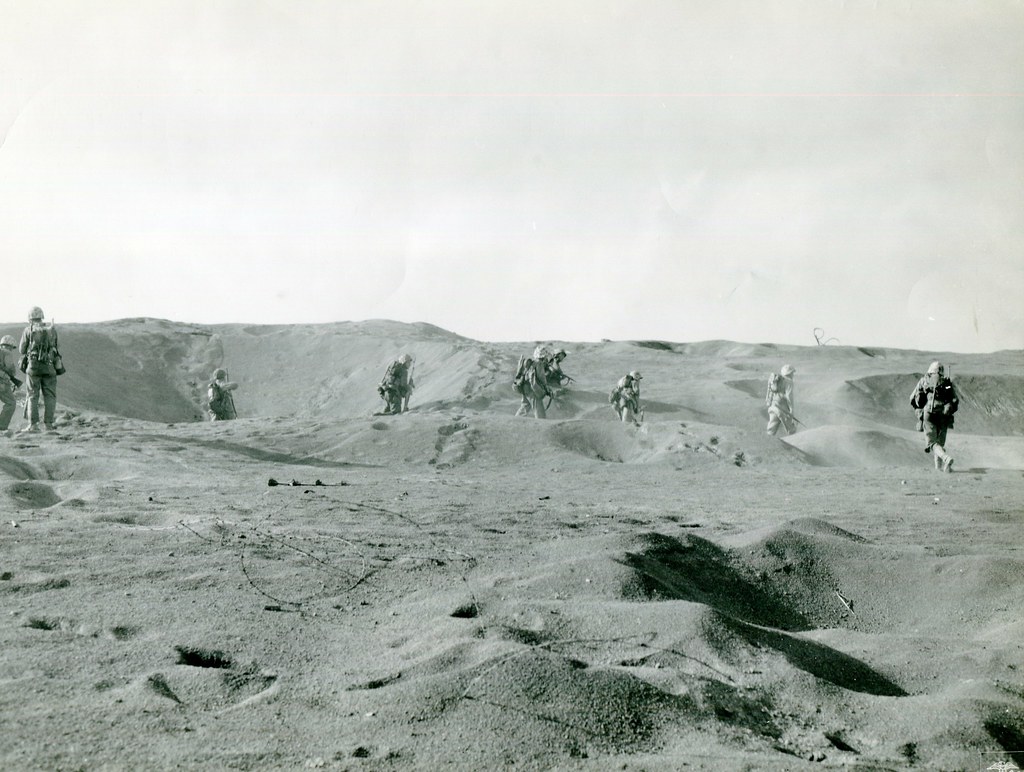
Advancing Marine Flamethrower Squad, Iwo Jima, February 1945. PHOTO: “Advancing Marine Flamethrower Squad, Iwo Jima, February 1945” by Archives Branch, USMC History Division is licensed under CC BY 2.0.

The Battle of Iwo Jima was a nearly 40-day battle campaign fought by the U.S. Marine Corps and U.S. Navy against the Japanese Imperial Army on the island of Iwo Jima in the Pacific. With 110,000 total battle personnel (over 70,000 troops), the American objective of their invasion (called “Operation Detachment”) was to capture the island and its airfields. Iwo Jima was situated between Japan and the American bomber bases in the Mariana Islands. Since summer 1944 unescorted American B-29 bombers were flying nearly 3000 miles roundtrip to bomb Japan and being lost at sea from entrenched Japanese defenses. With Iwo Jima in American hands U.S. fighter planes could escort the long-range bombers as well as have any damaged aircraft find sanctuary on the island. The American victory after a five week campaign resulted in the capture of Iwo Jima with its immediate benefit that, by war’s end, 2,400 B-29s were able to make safe forced landings on the island.

A primary American objective was to capture Iwo Jima’s airfields, allowing fighter escorts for B-29 bombers and emergency landing facilities closer to Japan.

Iwo Jima in 1945. Mount Suribachi is a knob at the bottom of the map. PHOTO: “Map of Iwo Jima, 1945” by Archives Branch, USMC History Division is licensed under CC BY 2.0.

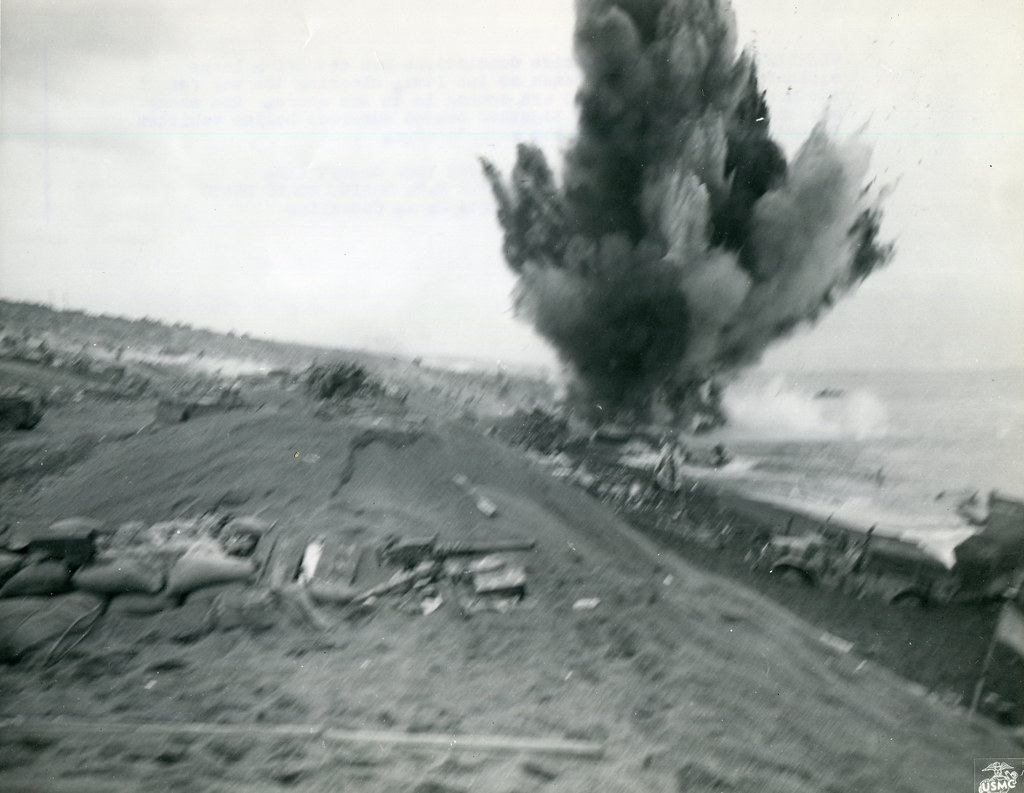
Marines Detonating Japanese Mine on Beach, Iwo Jima, February 1945. PHOTO: “Marines Detonating Japanese Mine on Beach, Iwo Jima, February 1945” by Archives Branch, USMC History Division is licensed under CC BY 2.0.

The victory came at a tremendous cost, with thousands of American and Japanese casualties.

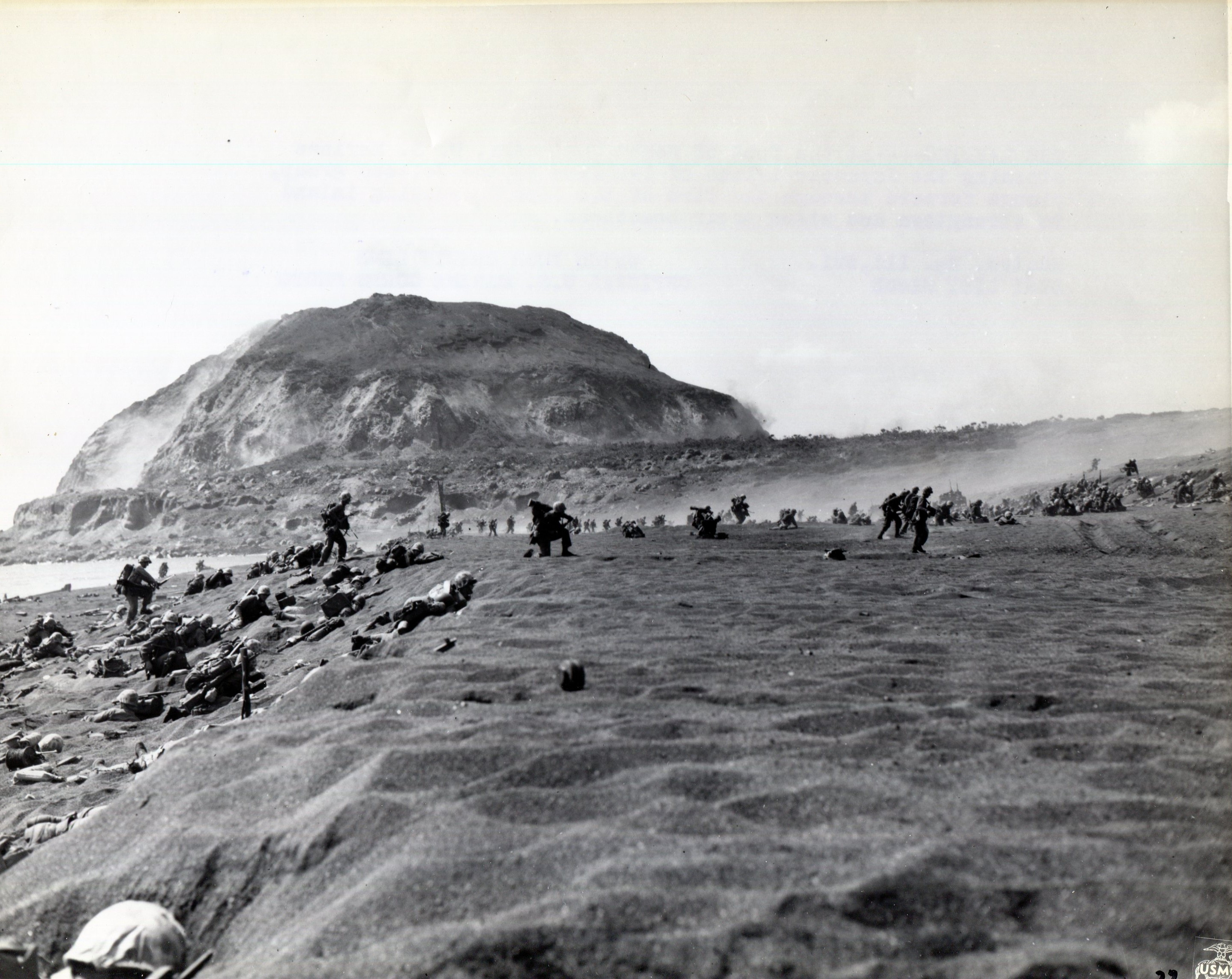
Marines Taking Shelter on the Beach, Iwo Jima, February 1945. PHOTO: “Marines Taking Shelter on Beach, Iwo Jima, February 1945” by Archives Branch, USMC History Division is licensed under CC BY 2.0.

There were 20,000 or so heavily-fortified Japanese defending the island to the death while U.S. Navy and Marine Corps aircrews had complete air superiority. The U.S. Navy provided heavy artillery gunfire support from the sea. The Battle of Iwo Jima, an American victory, took place from February 19 to March 26, 1945, and was one of the fiercest of World War II. That Americans could take the island was not the question. Its exact cost was. The casualty toll was heavy for both sides. The Japanese had 216 taken prisoner and up to 18,375 killed or missing in action. The American combat toll was also staggering: 6,821 killed in action, 19,217 wounded, and 2,648 experiencing battle trauma.

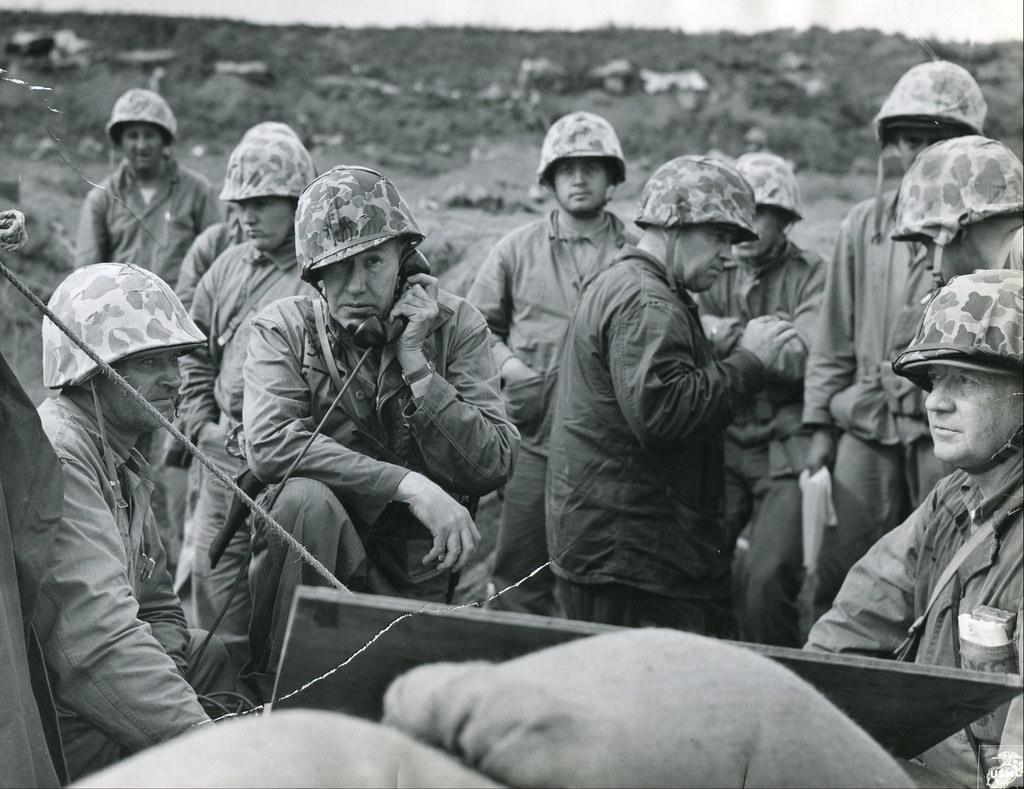
23d Regiment, Fourth Marine Division Command Post, Iwo Jima, 1945. PHOTO: “23d Regiment, Fourth Marine Division Command Post, Iwo Jima, 1945” by Archives Branch, USMC History Division is licensed under CC BY 2.0.

Fifth Marine Division Command Post, Iwo Jima, 1945. PHOTO: “Fifth Marine Division Command Post, Iwo Jima, 1945” by Archives Branch, USMC History Division is licensed under CC BY 2.0.

Joe Rosenthal (1911-2006), with his camera hanging at his side, surveys the landing beaches at Iwo Jima on March 7, 1945. Rosenthal was awarded the U.S. Navy Distinguished Public Service Award, as well as the Marine Corps Distinguished Public Service Award by the Marine Corps, for his war photography. Photo by AP/U.S. Marine Corps. Public Domain.

On Friday, February 23, 1945, Rosenthal landed on the island and heard that they were going to raise a flag on the highest point on the island which was the old volcano at the southwest end called Mount Suribachi. Rosenthal carried a Speed Graphic camera that was press standard issue and joined other photographers ready to ascend to the top. Halfway up they met a marine photographer coming down whose camera was obliterated by an enemy grenade explosion. Rosenthal and the others were told that the marines had already raised the flag. But the views were good from the summit anyway and still worth the climb. Once at the top Rosenthal and the rest saw marines who were working to affix a larger flag to a pipe under orders from a captain who wanted to replace it for the earlier smaller flag just raised. When the six marines started to raise that second larger flag on the heavy pole Rosenthal pushed his camera’s shutter. After taking the flag-raising photo, Rosenthal made his way back down Mount Suribachi to the shoreline. There, he took a transport boat out to the command ship, where he wrote captions for his photos and sent them, sight unseen, with the undeveloped film by seaplane to Guam.

Marines on Beach, Iwo Jima, February 1945. PHOTO: “Marines on Beach, Iwo Jima, February 1945” by Archives Branch, USMC History Division is licensed under CC BY 2.0.

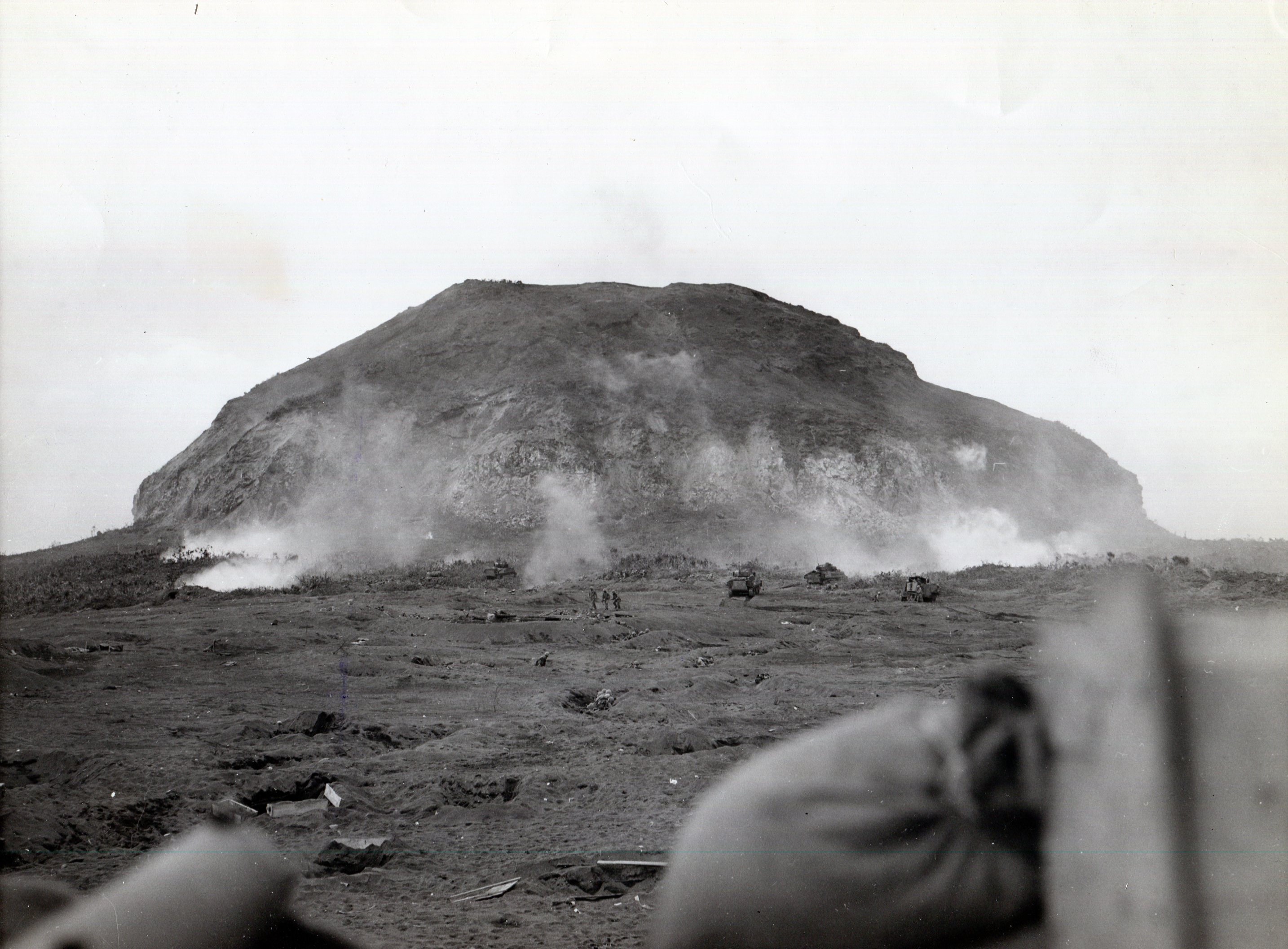
In the shadow of Mount Suribachi, Iwo Jima, 1945. PHOTO: “In the shadow of Suribachi, Iwo Jima, 1945” by Archives Branch, USMC History Division is licensed under CC BY 2.0.

Marines Advancing on Beach, Iwo Jima, February 1945 – 36324610020. PHOTO: “Marines Advancing on Beach, Iwo Jima, February 1945 – 36324610020” by Archives Branch, USMC History Division is licensed under CC BY 2.0.

American flamethrowers in a foxhole on Iwo Jima, February 1945. PHOTO: Marine Flamethrowers in Foxholes, February 1945” by Archives Branch, USMC History Division is licensed under CC BY 2.0.

Marine Firing 30mm, Iwo Jima, 1945. PHOTO: “Marine Firing 30mm, Iwo Jima, 1945” by Archives Branch, USMC History Division is licensed under CC BY 2.0.

Iwo Jima – Mt Suribachi. PHOTO: “Iwo Jima – Mt Suribachi Detail” by Agsftw is licensed under CC BY-SA 3.0

“I took the picture. But the Marines took Iwo Jima.” — Joe Rosenthal.

In February 1945 Joe Rosenthal was a 33-year-old American photographer for the AP. Rosenthal’s poor eyesight prevented him from fighting in combat though his task as an embedded photographer placed him in Harm’s Way. Before Iwo Jima, Joe Rosenthal had landed with the marines on Guam and Peleliu. His Pulitzer Prize-winning photograph of the flag raising on Iwo Jima became a sign of hope for a war-weary American home front that victory in the Pacific would be theirs. It also became the iconic symbol of everything U.S. Marines. Rosenthal was very proud of his photograph of the six marines and the Marines overall, though modest about any accolades that came his way. Rosenthal put his role in perspective, saying: “I took the picture. But the Marines took Iwo Jima.” Yet it is not to be forgotten that Rosenthal was exposing himself to the same dangers as the six marines that day when he took his iconic photograph for history of the flag raising on Iwo Jima on February 23, 1945.

Photographer Joe Rosenthal’s image of the flag raising atop Mount Suribachi became one of the most recognizable photographs in history and a symbol of American determination.

Original photograph by Joe Rosenthal, February 23, 1945. Public Domain.

Color motion picture footage of the flag raising provided a rare and powerful visual record of the battle.

Iwo Jima Flag Raising 1945 – Rare Color Film by Sgt Genaust [#Upscaled#1080p#60FPS#ww2]. Three feet to Joe Rosenthal’s right, Sgt. Genaust captured the flag-raising from nearly the same angle using color motion picture film.

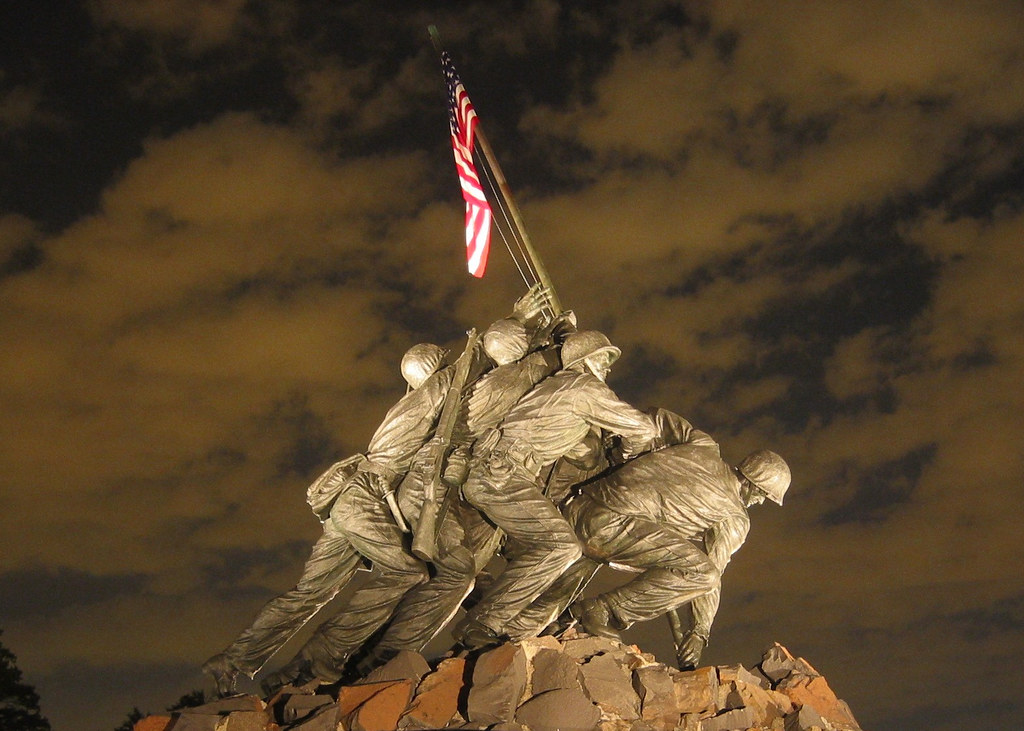
Unveiled in November 1954, the Marine Corps War Memorial in Washington, D.C. was dedicated to all Marines who have given their lives in the defense of the U.S. since 1775. see – https://www.nps.gov/gwmp/learn/historyculture/usmcwarmemorial.htm – retrieved February 19, 2025. October 2003. Author’s photograph. All Rights Reserved.

U.S. Marine Corps War Memorial (Iwo Jima Memorial) – (Arlington, Virginia) – August 1, 2015. PHOTO: “U.S. Marine Corps War Memorial (Iwo Jima Memorial) – (Arlington, Virginia) – August 1, 2015” by cseeman is licensed under CC BY-NC-SA 2.0.

The image captured by Rosenthal’s photograph was widely used in war bond drives and helped rally a weary American home front during the final months of the war. The photograph also inspired the U.S. Marine Corps War Memorial, ensuring the battle’s place in American memory.

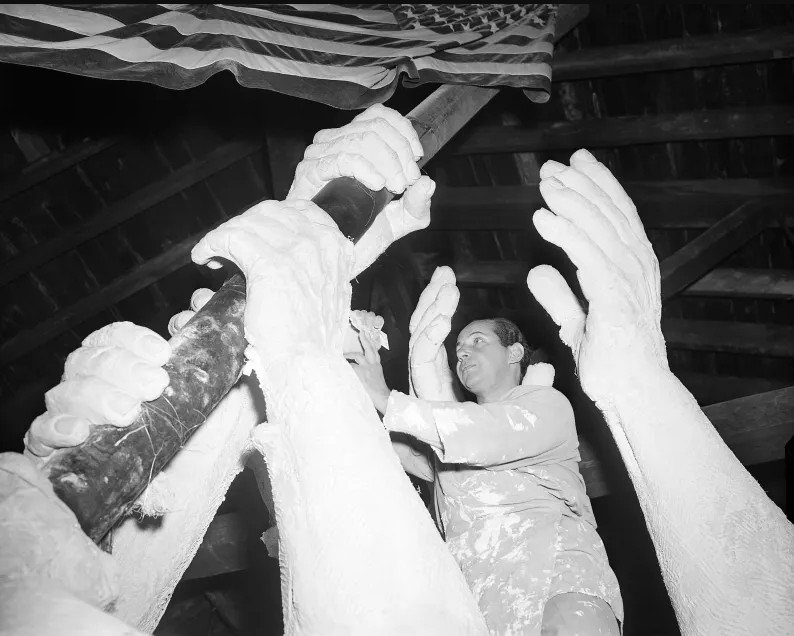
US Marine Corps War Memorial, Washington, D.C. The centerpiece of the memorial is a colossal sculpture group by Felix Weihs de Weldon (1907-2003), then on duty with the U.S. Navy, depicting the six Marines who raised the second larger U.S. flag atop Mount Suribachi on Iwo Jima on February 23, 1945. The memorial was designed by Horace Whittier Peaslee, Jr. (1884-1959) and dedicated in November 1954 by President Dwight D. Eisenhower. October 2003. Author’s photograph. All Rights Reserved.

Felix Weihs de Weldon. Public Domain.

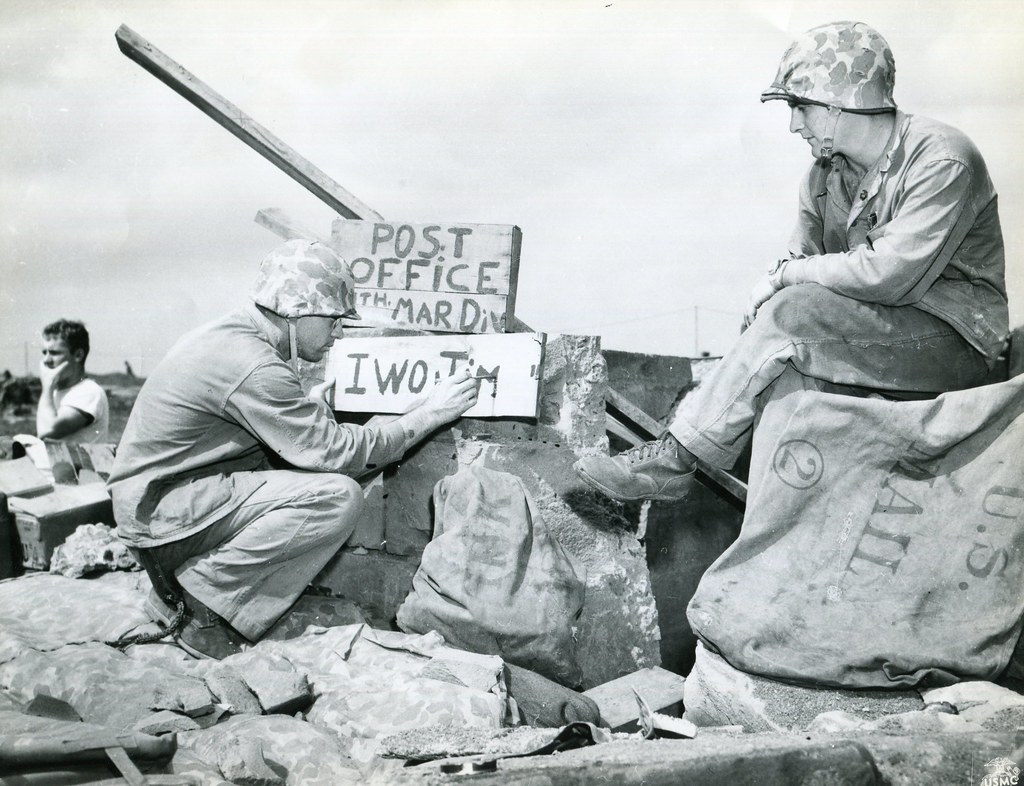
Marine Post Office, Iwo Jima, 1945. PHOTO: “Marine Post Office, Iwo Jima, 1945” by Archives Branch, USMC History Division is licensed under CC BY 2.0.

US Marine Corps War Memorial, Washington, D.C., was based on the iconic AP photograph by Joe Rosenthal taken on February 23, 1945 of the raising of the U.S. flag at the top of Mount Suribachi at the start of the Battle of Iwo Jima (February 19- March 26, 1945). Rosenthal’s photograph was flashed around the world for the first time on Sunday, February 25, 1945, and instantly became a symbol of the American war effort in the Pacific Theatre during World War II. The Marine Corps War Memorial Foundation organized the fundraising and creation of the monument. The complete cost of the memorial was $850,000 (about $10 million in 2025). The 32-foot-high bronze figures are erecting a 60-foot flag pole onto Mount Suribachi. Important dates in the history of the Marine Corps are burnished in gold into the Swedish marble base. The six marines who raised the flag on Iwo Jima have all been identified and include a sergeant, 2 corporals, and 3 privates first class. Unveiled in November 1954, the Marine Corps War Memorial was dedicated to all Marines who have given their lives in the defense of the U.S. since 1775. October 2003. Author’s photograph. All Rights Reserved.

See Iwo Jima war bond poster here = https://collections.ushmm.org/search/catalog/irn520954  – retrieved February 19, 2025.

A Battle Remembered

Flags of Our Fathers (2006) is Clint Eastwood’s powerful film about the Battle of Iwo Jima (February 19 to March 26, 1945) and the legacy of one of the most iconic images of World War II. Eastwood directed and co-produced the film and also composed its score. It was released alongside its companion film, Letters from Iwo Jima, which recounts the same battle from the Japanese perspective.

Distributed by Paramount Pictures in the United States and Warner Bros. internationally, the two films earned strong critical praise. Together they form one of cinema’s most thoughtful examinations of war, heroism, and historical memory.

The Photograph That Became a Symbol

The film is based on James Bradley and Ron Powers’ bestselling 2000 book, which explored the experiences of Bradley’s father, Navy corpsman John Bradley, and the five U.S. Marines who raised the American flag atop Mount Suribachi on February 23, 1945.

Captured by Associated Press photographer Joe Rosenthal, the image quickly became one of the most recognizable photographs in American history. Its depiction of determination and sacrifice came to symbolize the United States’ war effort in the Pacific. Decades later, however, further research led the U.S. Marine Corps to revise the identification of several men originally believed to appear in the photograph.

Beyond the Battlefield

While the film contains intense combat sequences depicting the brutal struggle for Iwo Jima, its deeper focus is the human cost of turning soldiers into national symbols.

Three of the flag raisers were killed in action less than a week after the photograph was taken. The surviving participants were returned to the United States, where they became reluctant celebrities. As the war continued, they were enlisted to help promote a nationwide war bond campaign designed to finance the final push toward victory.

The Burden of Heroism

With the war in Europe nearing its end, the photograph and the men associated with it became powerful symbols of American courage and resolve. Yet Flags of Our Fathers questions the nature of heroism itself. The surviving flag raisers struggled with grief, survivor’s guilt, public expectations, and the uncomfortable reality that their fame was based on a single moment overshadowing the sacrifices of thousands of others.

Eastwood’s film ultimately argues that history often elevates symbols while overlooking the complex individuals behind them.

Legacy

More than a conventional war film, Flags of Our Fathers is an exploration of memory, mythmaking, and sacrifice. By examining both the ferocity of combat and the pressures of the home front, the film reveals how a single photograph came to represent a nation at war while forever changing the lives of the men captured within its frame.

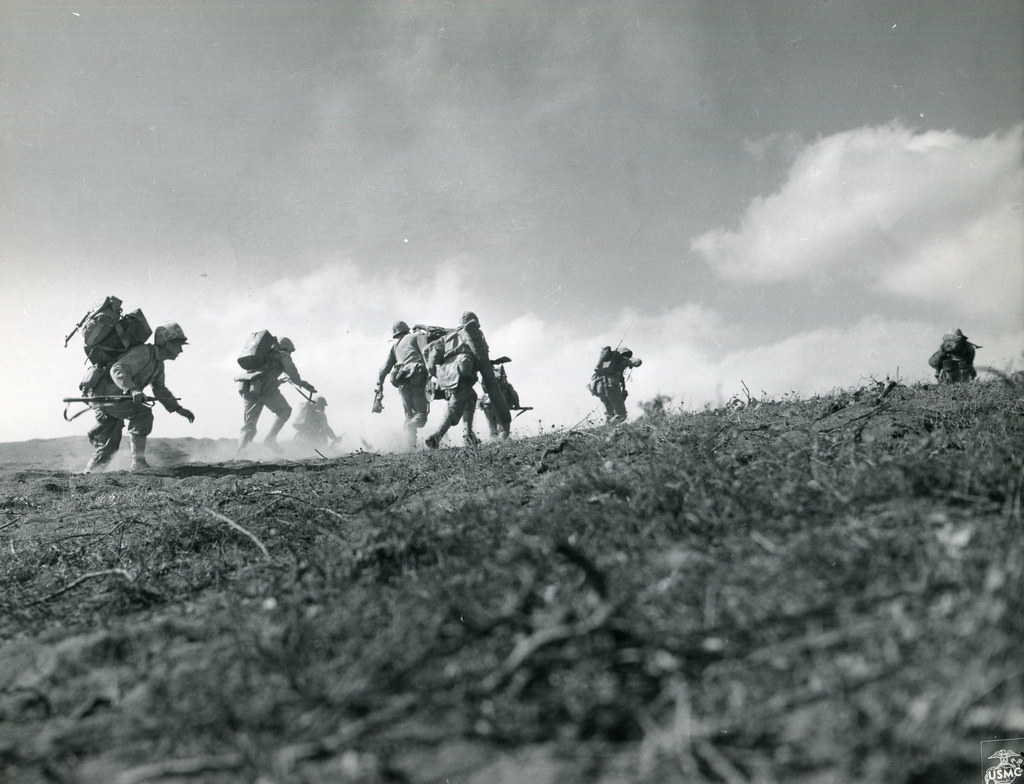
Marines Advancing on Beach, Iwo Jima, February 1945. PHOTO: “Marines Advancing on Beach, Iwo Jima, February 1945” by Archives Branch, USMC History Division is licensed under CC BY 2.0.

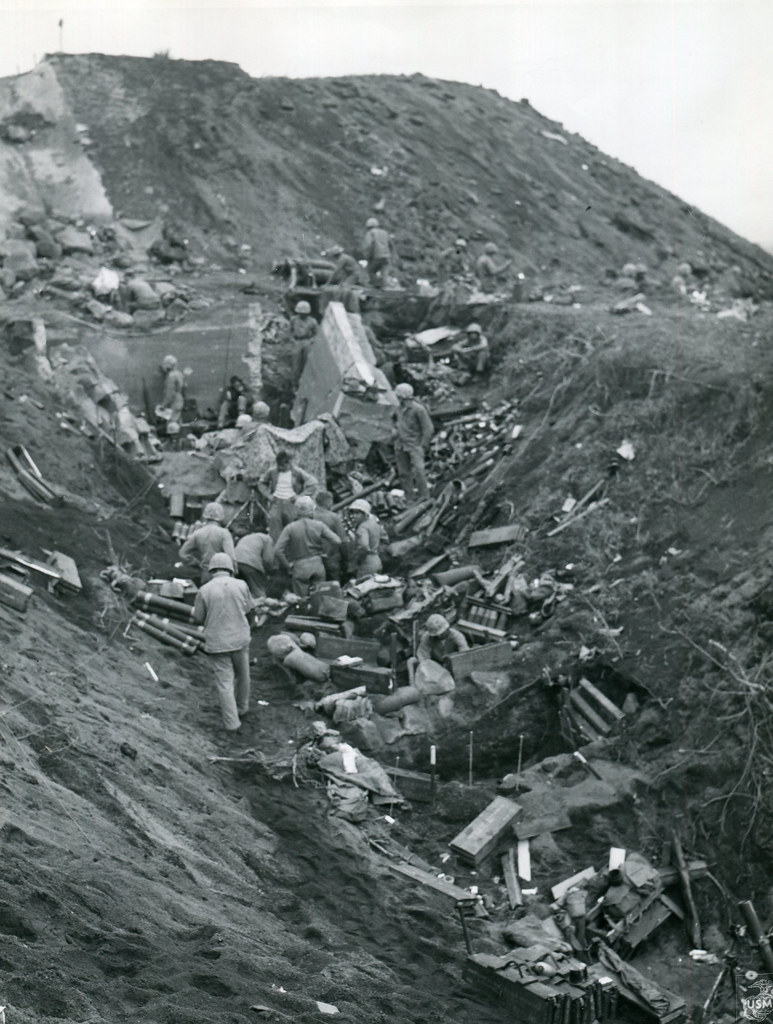
Marine Field Gun Emplacement on Beach, Iwo Jima, February 1945. PHOTO: “Marine Field Gun Emplacement on Beach, Iwo Jima, February 1945” by Archives Branch, USMC History Division is licensed under CC BY 2.0.

Rosenthal told Collier’s magazine: “The sky was overcast, but just enough sunlight fell from almost directly overhead, because it happened to be about noon, to give the figures a sculptural depth. The 20-foot pipe was heavy, which meant the men had to strain to get it up, imparting that feeling of action. The wind just whipped the flag out over the heads of the group, and at their feet the disrupted terrain and the broken stalks of the shrubbery exemplified the turbulence of war.” Quoted in https://www.usfca.edu/magazine/december-2024/feature/man-behind-the-camera – retrieved Feb. 19, 2025. Wire services flashed Joe Rosenthal’s photograph around the world where it was published on the front pages of more than 200 newspapers on Sunday, February 25, 1945. The photo appeared on magazine covers across the country as well. Following the battle of Iwo Jima, the photo was used for publicity in war bond drives from May 11 to July 4, 1945, which raised an amazing $26.3 billion – by far  the biggest haul of any of the seven U.S. war loan drives during World War II.. Rosenthal’s photograph became an enduring icon. 

USMC Iwo Jima War Memorial at Night, World War II, Veteran Soldiers, American Flag. PHOTO: “USMC Iwo Jima War Memorial at Night, World War II, Veteran Soldiers, American Flag” by Beverly & Pack is licensed under CC BY 2.0.

From Prose to Patriotism: How Thomas Paine’s Writings Defined and Emboldened the American Revolutionary Cause, 1776-1783.

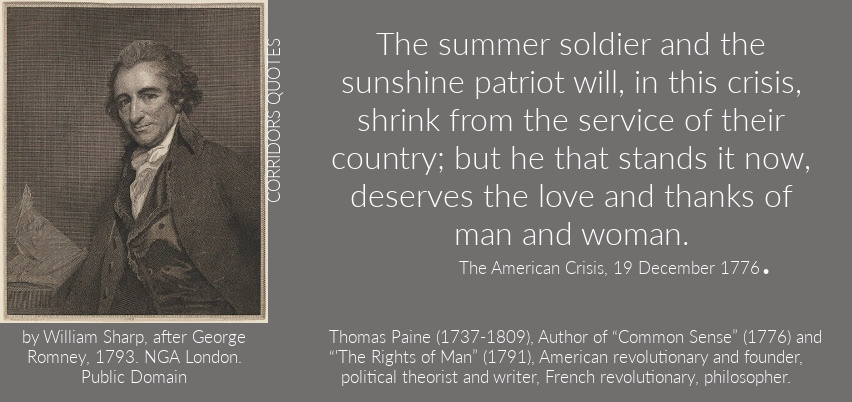
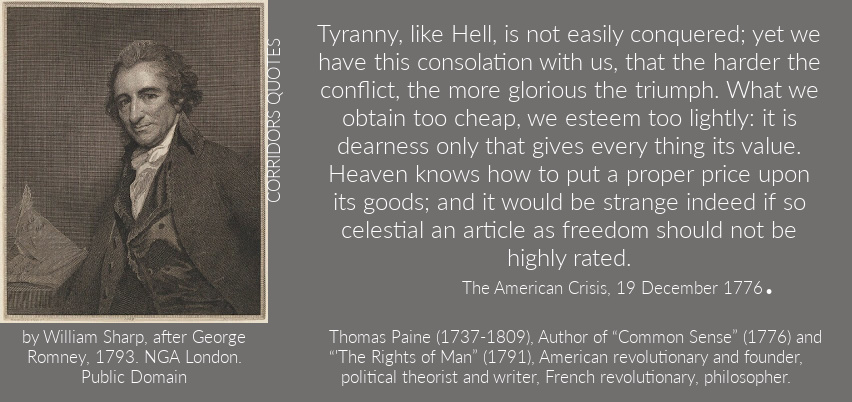
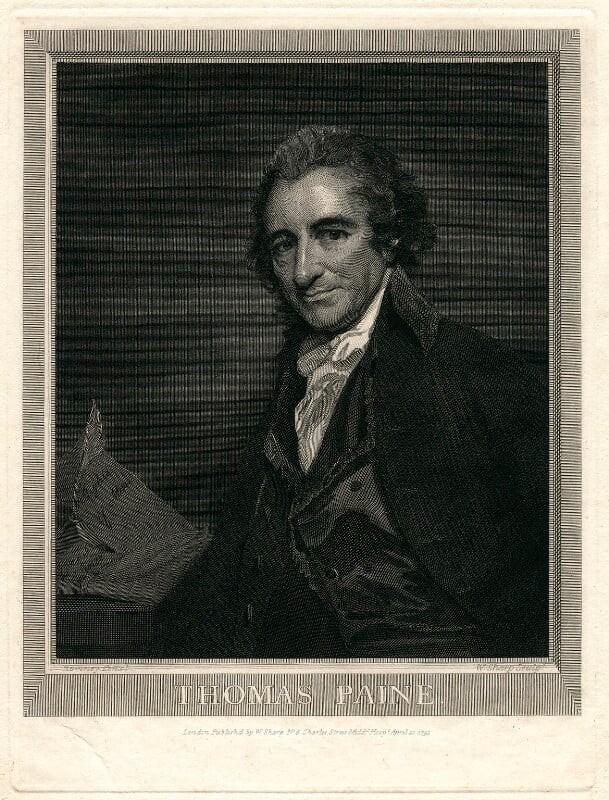
FEATURE Image: Thomas Paine, by engraver William Sharp (1749-1824), after portrait painter George Romney (1734-1802), 1793. NGA, London. Public Domain. See – https://www.npg.org.uk/collections/search/portrait/mw35502/Thomas-Paine?LinkID=mp03422&search=sas&sText=thomas+paine&role=sit&rNo=6 – retrieved June 1, 2024.

Thomas Paine’s writing served as a vital tool of psychological resilience and ideological conviction for the American Revolutionary cause during its absolute darkest hours. By juxtaposing the crushing military losses, near-total collapse of Washington’s army, and pervasive British contempt against the defiant, stirring language of The American Crisis, Paine’s prose transformed a desperate military retreat into an unyielding, spiritually justified struggle for freedom.

These are the times that try men’s souls. The American Crisis, 19 December 1776.

The summer soldier and the sunshine patriot will, in this crisis, shrink from the service of their country; but he that stands it now, deserves the love and thanks of man and woman. The American Crisis, 19 December 1776.

Tyranny, like Hell, is not easily conquered; yet we have this consolation with us, that the harder the conflict, the more glorious the triumph. What we obtain too cheap, we esteem too lightly: it is dearness only that gives every thing its value. Heaven knows how to put a proper price upon its goods; and it would be strange indeed if so celestial an article as freedom should not be highly rated. The American Crisis, 19 December 1776.
The Fall of Manhattan and the Jersey Chase

With the capture of Manhattan, British Army Commander in Chief William Howe sent Cornwallis to pursue Washington into New Jersey just sixty miles north of Philadelphia. Washington’s army was down almost 90% in December 1776 (3500 soldiers) from just August 1776. Washington just escaped Cornwallis’ grasp. As the British set up a line of forts to house and feed their soldiers during winter, Washington was the outsider.

British Confidence and the “Undisciplined Rabble”

The British believed the end of the revolution of what they called “despised” and “undisciplined rabble” which Virginia planter George Washington led (by way of the efforts of troublemaker Massachusetts lawyer John Adams), was in hand. Paine’s writing took that fragmented group and gave them a shared, elevated vocabulary of sacred duty (“celestial an article as freedom”), fundamentally expressing how they viewed their own struggle.

The Captive General and the Low Ebb of the War

The British entered into winter by taking prisoner Charles Lee, one of Washington’s senior generals in the Continental army, and locked him up as well as their own fleet in Newport, Rhode Island which they took without resistance. The British kept Lee’s horse perpetually drunk out of spite for the Americans. Before Washington’s important crossing of the Delaware River on Christmas night 1776 and surprised the mercenary Hessians, Washington’s first comeback victory, it was the lowest ebb of the war. Since July 1776, Howe had taken almost 5000 men as P.O.W.’s, including 4 generals, and hundreds of artillery pieces and many tens of thousands of rounds of Washington’s ammunition in the wake of winning battles. When Washington’s army had lost these men and material to General Howe, Paine’s prose provided the ideological “ammunition” that kept the rebellion alive.

Thomas Paine and the Times That Try Men’s Souls

It was then that 39-year-old Thomas Paine, serving in Washington’s army, wrote this propaganda tract (his Common Sense appeared earlier in January) that began with the famous line. “These are the times that try men’s souls: The summer soldier and the sunshine patriot will, in this crisis, shrink from the service of their country; but he that stands it now, deserves the love and thanks of man and woman. Tyranny, like Hell, is not easily conquered; yet we have this consolation with us, that the harder the conflict, the more glorious the triumph. What we obtain too cheap, we esteem too lightly: it is dearness only that gives every thing its value. Heaven knows how to put a proper price upon its goods; and it would be strange indeed if so celestial an article as freedom should not be highly rated.” This was Paine’s most explosive year. When he published Common Sense in January 1776, it fundamentally shifted public sentiment away from trying to reconcile with Britain and toward demanding total independence. He followed this in December 1776 with the first volume of The American Crisis, rallying a collapsing army.

A Sober Assessment from Washington

Washington wrote about the same events more soberly: “Our affairs are in a very bad way . . . the game is pretty near up—owing in a great measure to the insidious arts of the enemy.” Paine provided the psychological “engine” to reverse the momentum when the physical war was at its lowest ebb.

SOURCES: CHAPTER THREE. “The Peace Commissioners? THE HOWE BROTHERS,” The Men Who Lost America: British Leadership, the American Revolution, and the Fate of the Empire (The Lewis Walpole Series in Eighteenth-Century Culture and History), Andrew Jackson O’Shaughnessy, Yale University Press, 2013, p. 96.

The Sustained Campaign (1776–1783)

The American Crisis was not just a single essay; it was a series of 16 pamphlets published continuously throughout the entire span of the Revolutionary War. He wrote them in real-time as the conflict evolved, continuously boosting morale, clarifying the ideological stakes, and countering British peace overtures.

Paine officially closed the Crisis papers on April 19, 1783—exactly eight years to the day after the war began at Lexington and Concord—famously declaring, “The times that tried men’s souls are over—and the greatest and completest revolution the world ever knew, gloriously and happily accomplished.” Shortly after, in 1787, he left America to return to Europe, shifting his literary focus to the French Revolution.

Your failure is, I am persuaded, as certain as fate. America is above your reach….her independence neither rests upon your consent, nor can it be prevented by your arms. In short, you spend your substance in vain, and impoverish yourself without hope. To the People of England, The American Crisis: PHILADELPHIA, Nov. 21, 1778. see- https://www.ushistory.org/paine/crisis/c-07.htm – retrieved June 5, 2024.

The Shifting Tide: From Despair to Strategic Defiance

As the Continental Army endured, The American Crisis evolved into a masterclass in psychological warfare. Following the Battle of Brandywine in September 1777, Paine framed British territorial gains as a costly logistical trap that amounted to eventual defeats.

Turning the Tables on the Empire

By 1778, bolstered by a French alliance, Paine wrote as the intellectual superior of a fading global power. By 1780, he contrasted the comfortable lives of British soldiers in America with the burdens borne by ordinary American farmers and laborers.

The Glorious Accomplishment

In the spring of 1783, Paine concluded his final Crisis pamphlet celebrating the revolution’s success, famously declaring that the times that tried men’s souls were over and framing America’s birth as a triumph.

Celluloid Chronicles—The Revolutionary War to World War II on Popular Film: Honoring the Meaning of Memorial Day.

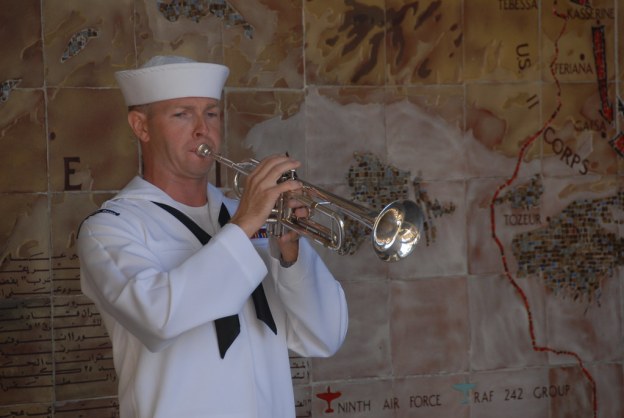
FEATURE Image: Memorial Day Ceremony – North Africa American Cemetery and Memorial – May 31, 2010. PHOTO: “Memorial Day Ceremony – North Africa American Cemetery and Memorial – May 31, 2010” by US Army Africa is licensed under CC BY 2.0.

Introduction

The first national observance of Memorial Day occurred on May 30, 1868, following the U.S. Civil War. Commander in Chief John A. Logan of the Grand Army of the Republic issued General Order Number 11 designating May 30 as a day of memorial “for the purpose of strewing with flowers or otherwise decorating the graves of comrades who died in defense of their country during the late rebellion, and whose bodies now lie in almost every city, village, and hamlet churchyard in the land.” (Source: Library of Congress). It is a day for visiting cemeteries and memorials to mourn the military personnel who died in the line of duty.

Films, music, and literature about the people, places, and events in history where military personnel as individuals and as a unit are asked to pay the ultimate price and make the greatest sacrifice for freedom are among some of the greatest stories ever told.

THE CROSSING (2000). American Revolutionary War (1775-1783).

Bringing Washington’s Gamble to the Screen

Directed by Robert Harmon and adapted by Howard Fast from his novel of the same name, The Crossing stars Jeff Daniels as George Washington.

A Revolution Hanging by a Thread

In December 1776 — barely six months after the Declaration of Independence — Washington’s Continental Army was collapsing. Starved of men, artillery, and supplies, the revolution hung by a thread. So Washington made the most dangerous decision of the war: he would gamble everything on a surprise strike at Trenton, where more than a thousand feared Hessian mercenaries held the town.

Forcing the Ice-Choked Delaware

To reach them, his exhausted army would have to force a night crossing of the ice‑choked Delaware River and march toward what looked like a hopeless fight. Instead, the attack became the stunning, against‑all‑odds victory Washington had scarcely dared imagine.

A Stunning and One-Sided American Victory

Washington’s surprise attack on the Hessian garrison at Trenton on December 26, 1776, produced a stunningly one‑sided American victory. The Continental Army suffered almost no combat losses — none killed in action, two men who froze to death during the night march, and only five wounded, including a young James Monroe, later of Monroe Doctrine fame, who took a musket ball in the shoulder.

The Destruction of the Hessian Force

The Hessians, by contrast, were effectively destroyed as a fighting force: 22 killed (among them their commander, Colonel Johann Rall), 92 wounded, and about 920 captured.

Detail. NYC – Metropolitan Museum of Art: Washington Crossing the Delaware. “NYC – Metropolitan Museum of Art: Washington Crossing the Delaware” by wallyg is licensed under CC BY-NC-ND 2.0.

GETTYSBURG (1993). The U.S. Civil War (1861-1865).

Directed by Ronald F. Maxwell whose screenplay is based on The Killer Angels, a novel by Michael Shaara, Gettysburg starred an ensemble cast including Martin Sheen, Tom Berenger, Jeff Daniels, Stephen Lang and Sam Elliott.

The Convergence of Command at Gettysburg

One of the Union army’s most respected senior commanders during the American Civil War was 42-year-old General John F. Reynolds (John Rothman) who was killed on the first day of the Battle of Gettysburg at the very start of it. Reynolds was in command of the “left wing” of the Army of the Potomac commanded by Gen. George C. Meade and which included the cavalry division of 37-year-old Brig. Gen. John Buford (Sam Elliott).

Buford’s Defensive Stand

Buford had occupied the town of Gettysburg, Pennsylvania, with his “headquarters” atop the cupola of the Lutheran seminary. With light defensive lines he resisted superior numbers of Confederate infantry brigades along the Chambersburg Pike who were blind to the Union Army’s smaller numbers because Major General J. E. B. Stuart had gone missing

The Opening Clash and a Fatal Command

When Reynolds’ I Infantry Corps arrived, he rode out ahead, met with Buford, and then accompanied some of his soldiers into the fighting. As Reynolds was supervising the placement of the 2nd Wisconsin, he shouted: “Forward men! Forward for God’s sake! and drive those fellows out of those woods.” At that moment Reynolds was shot by a sniper and fell off his horse to the ground with a mortal wound to the back of the head.

The Impact of a Leader’s Loss

The death of Reynolds impacted his troops and fellow commanders deeply. At that particular moment, they realized that any one leader (and the Union army had been through several at the top), even if he had the necessary zeal, vision, and sense of purpose, would not be enough to win the fight to save the Union. It must be a coordinated effort. Reynolds, by supporting Buford’s decision to set up defensive resistance as well as engaging his infantry, even in death effectively chose Gettysburg as that hallowed battleground for the next three days.

The Retreat to High Ground

Since Confederate numbers were superior on that first day, Union troops eventually retreated through town and rallied on Cemetery Ridge where General Meade and Maj. Gen. Winfield S. Hancock, with many others, entrenched on the high ground. They faced Confederate Gen. Robert E. Lee (Martin Sheen), and Lieutenant Generals Longstreet, Ewell, and A.P. Hill, among others. In the 1993 film, Confederate Major General Henry Heth is played by Warren Burton who was born and grew up in Chicago and attended The School of the Art Institute of Chicago. Heth was from a coal mining area near Richmond, Virginia.

The Staggering Cost of Hallowed Ground

At the Battle of Gettysburg the two armies suffered between 46,000 and 51,000 casualties. Union casualties amounted to 3,155 killed, 14,531 wounded, and 5,369 captured or missing. Reynolds’ body was immediately transported to his home-town of Lancaster, PA, where he was buried on July 4, 1863. Buford died 5 months later possibly of typhus in Washington, D.C. and was buried at West Point Cemetery in New York. Like Lincoln, Buford was born in Kentucky and grew up in Illinois (Rock Island). His father was a leading politician, but as a Democrat supported Stephen A. Douglas and opposed Abraham Lincoln.

Lutheran Seminary, Gettysburg. PHOTO: “Lutheran Seminary, Gettysburg” by josullivan.59 is licensed under CC BY-NC-SA 2.0.

THE FIGHTING SULLIVANS (1944). World War II (1941-1945).

Hollywood’s Tribute to a Tragic Brotherhood

Directed by Lloyd Bacon based on a story by Edward Doherty, Mary C. McCall Jr., and Jules Schermer, The (Fighting) Sullivans starred Anne Baxter, Thomas Mitchell, Selena Royle, Edward Ryan, John Campbell, James Cardwell, John Alvin, George Offerman, Ward Bond and Trudy Marshall.

The True Story of the Juneau Disaster

Released as The Sullivans in 1944, this 20th-Century-Fox drama film tells the true story of five brothers – George, Frank, Matt, Joe and Al Sullivan – who grew up in Waterloo, Iowa, and who were all killed in World War II when their ship, Juneau, was sunk in combat at Guadalcanal in November 1942.

The Honest Price of a World War

The film is a tearjerker not so much because it is sentimental but that it is honest. The final scene where the naval officer who recruited the five brothers (Ward Bond) comes to the boys’ house to tell the tragic news to their parents (Thomas Mitchell and Selena Royle) and the youngest brother’s widow (Anne Baxter) and mother of his child is one of cinema’s best conveyances of the price paid in a world war that claimed 420,000 American lives.

Memorial Day Ceremony – North Africa American Cemetery and Memorial – May 31, 2010. PHOTO: “Memorial Day Ceremony – North Africa American Cemetery and Memorial – May 31, 2010” by US Army Africa is licensed under CC BY 2.0.

Conclusion

Through the power of cinema and visual art, these Celluloid Chronicles serve as living monuments that permanently capture the profound weight of military sacrifice. From the frozen banks of the Delaware to the bloodied ridges of Gettysburg and the tragic depths of Guadalcanal, artistic expression bridges the gap between historical duty and modern remembrance. This creative preservation ensures that the ultimate price paid by service members in every conflict—from the nation’s founding revolutionary struggles to the modern battlefields of Iraq, Afghanistan, and Iran today—is never forgotten, keeping the sacred meaning of Memorial Day alive across generations.

Empire, Defeat, and Exile: Napoleon Bonaparte at Saint Helena at the 200th anniversary of his death on May 5, 1821.

FEATURED image: Napoleon near Borodino, Vasily Vereshchagin (1842–1904), 1897, oil on canvas, State Historical Museum, Moscow. The image of a sullen dictator seated on his field chair with boots raised onto a battle drum, as his General Staff views in their spyglasses the men of the Grande Armée in harm’s way at the Battle of Borodino, can be seen as indicative of Napoleon’s exercise of arbitrary power as the first of modern history’s tyrants.

Napoleon Bonaparte (1769-1821) transformed France and Europe through military genius, political ambition, and administrative reform, yet the same drive that built an empire ultimately led to its collapse. His final years, exile on the remote island of Saint Helena, and the creation of his death mask contributed to a legend that outlived both the man and the empire he forged.

The Emperor Napoleon in His Study at the Tuileries, 1812, Jacques-Louis David (1748-1825), National Gallery of Art, Washington, D.C.

Major facts of the life of Napoleon Bonaparte (1769-1821) are well known. Known as Napoleon I, the French Emperor who died two centuries ago was a shrewd, ambitious and skilled military leader who conquered much of Europe in the early 19th century.

Born on the island of Corsica that had recently handed authority from Italy to France, Napoleon rose rapidly in the French military during the unsettled period of the French Revolution after 1789 and until 30-year-old Napoleon seized power in a coup d’état in 1799.

Napoleon rose from a young Corsican artillery officer to become Emperor of the French in 1804.

In 1804 Napoleon crowned himself emperor in Notre Dame Cathedral in Paris in the presence of the pope. In the next decade Napoleon successfully waged war against various coalitions of European nations and expanded his empire. Following his disastrous French invasion of Russia in 1812 explored in some detail in this post, Napoleon abdicated his throne in 1814 and was exiled to the island of Elba not far from his native Corsica in the Mediterranean Sea near Italy.

In 1815, he escaped Elba and returned to France where he briefly returned to power in his Hundred Days campaign. He received a crushing defeat at the Battle of Waterloo in today’s Belgium and was exiled until his death on May 5, 1821 to the remote island of Saint Helena in the South Atlantic Ocean. Napoleon Bonaparte was just 51 years old at the time of his death stemming from mysterious circumstances, though likely something such as stomach cancer.1

Napoleon on St. Helena, Franz Josef Sandmann (1805-1856), c. 1820. Musée national des châteaux de Malmaison et de Bois-Préau.

In 2021, the bicentenary of the death of Napoleon I is commemorated. While 200 years is a long time ago, in terms of History it is a relatively short span amount of time. In other words, Napoleon, who might have come to the United States (New Orleans) after his exile, is not very far away from modern times.
Napoleon Bonaparte, born in Corsica which had just switched allegiance from Italy to France, was born in 1769. In 1821 when he died on May 5 he was 51 years old. The former French emperor died far away from Europe on the island of Saint Helena in the middle of the South Atlantic Ocean. Napoleon had been exiled there following his defeat at Waterloo in Belgium in 1815 and escape from Elba in the Mediterranean, the British Government’s first location for his confinement.

Between the continents of Africa and South America, St. Helena is much more remote. The island built its first airport only in 2011.

Napoleon lived on St. Helena for about 6 years and died there, somewhat unexpectedly, at Longwood House. Napoleon’s permanent residence was completed for him in December 1815.

Napoleon was buried on St. Helena. In 1840, stirring old wounds of controversy, the remains of the warring General and French despot were transferred to Paris. Napoleon’s tomb in Les Invalides had been a military hospital whose construction was by Louis XIV (1638-1715).

His death mask became one of the most famous relics associated with any historical figure.

Napoleon’s plaster death mask, known as the Malmaison mask, May 1821. The death mask was made on Saint Helena about two days after the former French Emperor’s death there on May 5, 1821 at Longwood House. see – http://www.lautresaintehelene.com/autre-sainte-helene-articles-malmaison2.html – retrieved May 5, 2021.

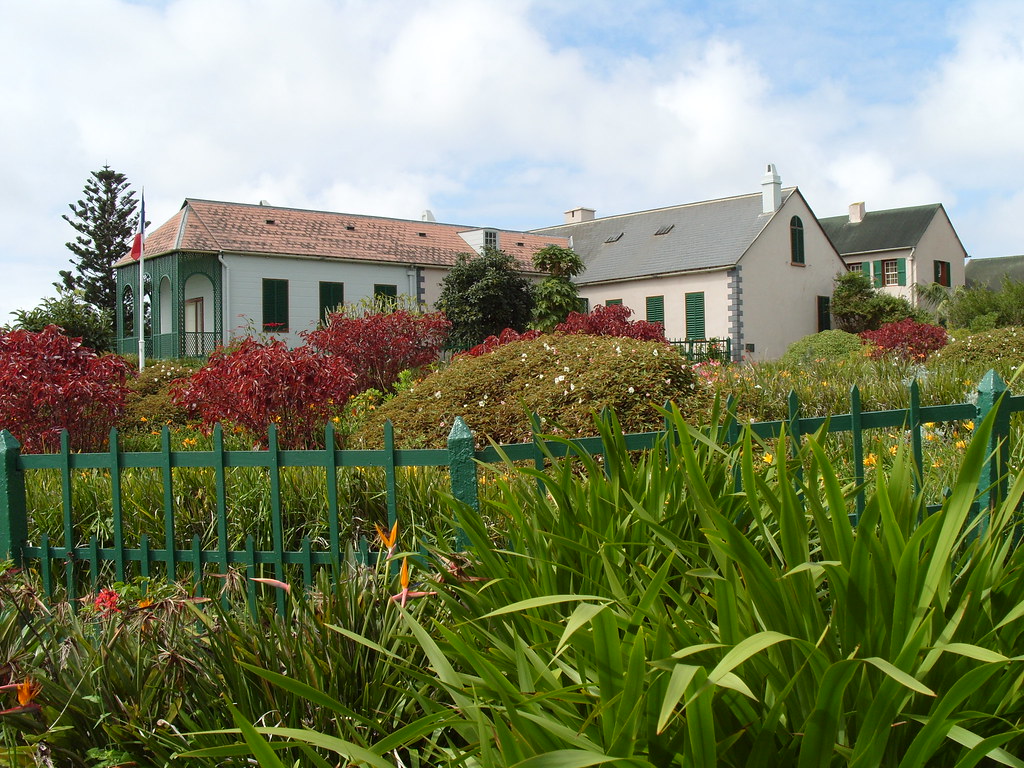
On St. Helena, Longwood House was Napoeleon’s permanent residence completed for him by his British captors in December 1815. In 1858, French emperor Napoleon III, nephew of Napoleon I, purchased Longwood House and various other lands associated with Napoleon I on St. Helena for the French government. Though Napoleon’s remains were returned to France in 1840, Napoleon III’s purchase on St. Helena remains the property of France. It is administered by a French representative under the authority of the French Ministry of Foreign Affairs. (see – https://fondationnapoleon.org/en/activities-and-services/preserving-heritage/operation-st-helena/ – retrieved May 5, 2021). PHOTO: “Longwood House (c) St Helena Tourism” by sthelenatourism is licensed under CC BY-ND 2.0.

His military victories reshaped Europe and spread many principles of the French Revolution across the continent. The Napoleonic Code became one of his most enduring legacies, influencing legal systems worldwide.

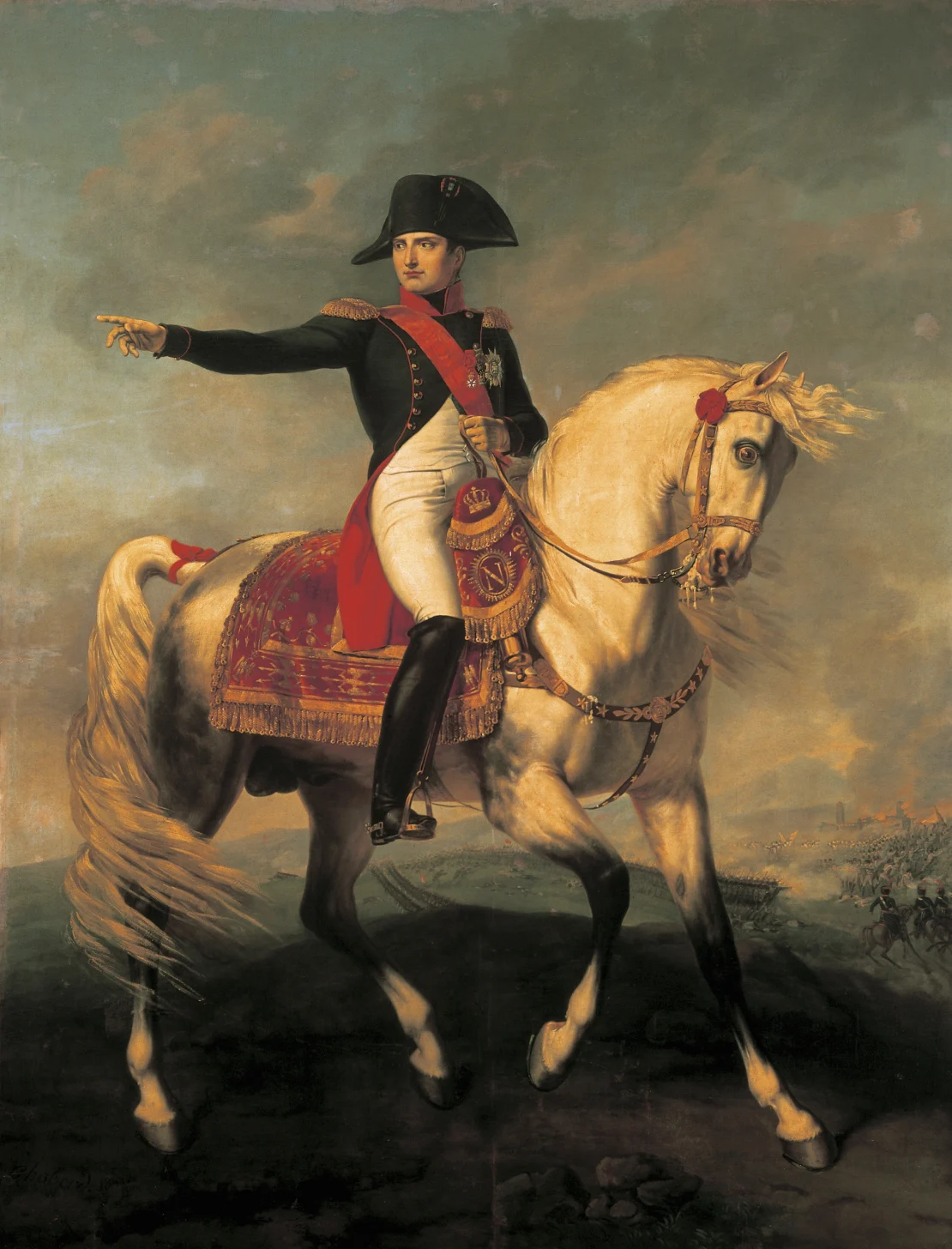
Napoléon at Battle of Wagram, July 5-6, 1809, Joseph Chabord (Chambèry 1786-Paris 1848), 293 cm (115.3 in) x 224 cm (88.1 in), Museo Napoleónico, Rome, Italy. On July 5-6, 1809, the Battle of Wagram took place north of Vienna and was the greatest battle in world history up to that time. It was Napoleon’s last and greatest victory. The battle opposed the Austrian army led by Archduke Charles, Duke of Teschen (1771-1847) against the Franco-Italo-German army under Napoleon I, Emperor of the French, King of Italy, Protector of the Confederation of the Rhine. The painting depicts the plain of Wagram, the scene of the battle with the dominant figure of Napoleon, perfectly settled upon a wild-eyed horse. The emperor wears the uniform of Colonel of the Chasseurs on Horseback with the insignia of the Legion of Honor and the Iron Crown. The grandeur of the rider-horse group, which contrasts with the small figures of the soldiers in the background, accentuates the heroic character of Napoleon, a charismatic strategist who dominates events. The commemoration painting probably was linked to an official commission. The painting was in the collection of Hortense de Beauharnais (1783-1837), the daughter of Napoleon’s first wife, Joséphine de Beauharnais. in Arenenberg, where the former Queen of Holland lived from 1817 until her death. It remained there until 1905, when the last owner of the castle, the former Empress Eugenie, wife of Napoleon III, donated it to Count Giuseppe Primoli. Public Domain. See – https://www.museonapoleonico.it/it/percorsi/percorsi_per_sale/sale_i_e_ii_il_primo_impero/napoleone_sul_campo_di_battaglia_di_wagra

THE YEAR 1812: A BAD ECONOMY, CONTINENTAL BLOCKADES, AND A DISASTROUS INVASION OF RUSSIA BY NAPOLEON

During the War of 1812 which had ramifications for the U.S., world domination by Napoleon was being attempted within a sagging, uncooperative economy in Europe.

France had 300,000 French troops and a rafter of French generals occupying Spain to keep the blockaded British from invading. Napoleon, in a near constant state of war since 1793, had created an Empire whose subjected parts didn’t cooperate. In 1812, Napoleon had to choose between losing his blockade in Spain or in Russia.

Since the Treaty of Tilsit in 1807 which followed the Battle of Friedland where Napoleon defeated the Russian army, Russia continued to transact business with England. This was a violation of the agreement and the pretext for Napoleon’s invasion of Russia in 1812.

While over 1,500 miles away from Paris, Napoleon wanted to shut down Russia’s economy and take full control. For Russia, Napoleon’s invasion required the defense of their homeland.

NAPOLEON’S NEW WAR NEEDED 700,000 FRESH CONSCRIPTS

Napoleon needed fresh conscripts but a third of Napoleon’s French draftees didn’t report for duty. Many of Napoleon’s generals advised the dictator to stay in Paris and enjoy life’s spoils. Napoleon refused. He explained that he would not rest until he fulfilled the dream to form a United States of Europe.2
Napoleon assembled 700,000 men with the monumental task to pay for it. For years the Emperor had been stockpiling supplies along the route to Russia and even arranged for their delivery on the battlefield.

Napoleon left St. Cloud for Moscow in June 1812. His high stakes gamble would affect not just Napoleon’s fortunes but the Empire’s inhabitants.
The disastrous Russian campaign of 1812 marked a turning point in his fortunes.

Ernest Meissonier (1815-1891), Campaign of France, 1814, 1864. Oil on wood, 51.5 x 76.5 cm, Paris, Musée d’Orsay.

This was the artist’s first painting produced in a cycle of Napoleon’s conquests. Though the episode Meissonier depicts was painted for the fiftieth anniversary of Napoleon’s invasion of France from Elba in 1814, it captures the overall desolation that surrounded the former French Emperor by the time of his invasion of Russia in 1812.

The series made by the 49-year-old artist, an admirer of seventeenth-century Flemish and Dutch small-format painting, not only captures the desolate landscape the Grande Armée endured, it also shows a solitary, unusually unkempt, and tenuous figure of Napoleon who is leading the General Staff and troops in an over-extended military campaign that spelled defeat.

For the painting, the artist’s imagination was informed by historical documentation and interviews of surviving eyewitnesses, including the detail of the emperor’s grey coat. Its realist style was a prevailing aspect of mid-19th century artistic taste during the Second Empire headed by Napoleon III from 1852 to 1870.

(see –https://www.musee-orsay.fr/en/collections/works-in-focus/painting/commentaire_id/campaign-of-france-1814-8947.html?tx_commentaire_pi1%5BpidLi%5D=509&tx_commentaire_pi1%5Bfrom%5D=841&cHash=41368ad16b#:~:text=Campagne%20de%20France%2C%201814%20%5BCampaign,demonstrates%20his%20nimble%2C%20polished%20style. – retrieved May 5, 2021.

FAILURE OF THE SUPPLY CHAIN AND “THE ENEMY OF LIBERTY”

The army marched 1,200 miles to Lithuania to engage the Russian army. But the Russians had retreated. Napoleon’s men had to march another 550 miles to Moscow. The generous supply lines got snarled. French troops turned sick and exhausted.
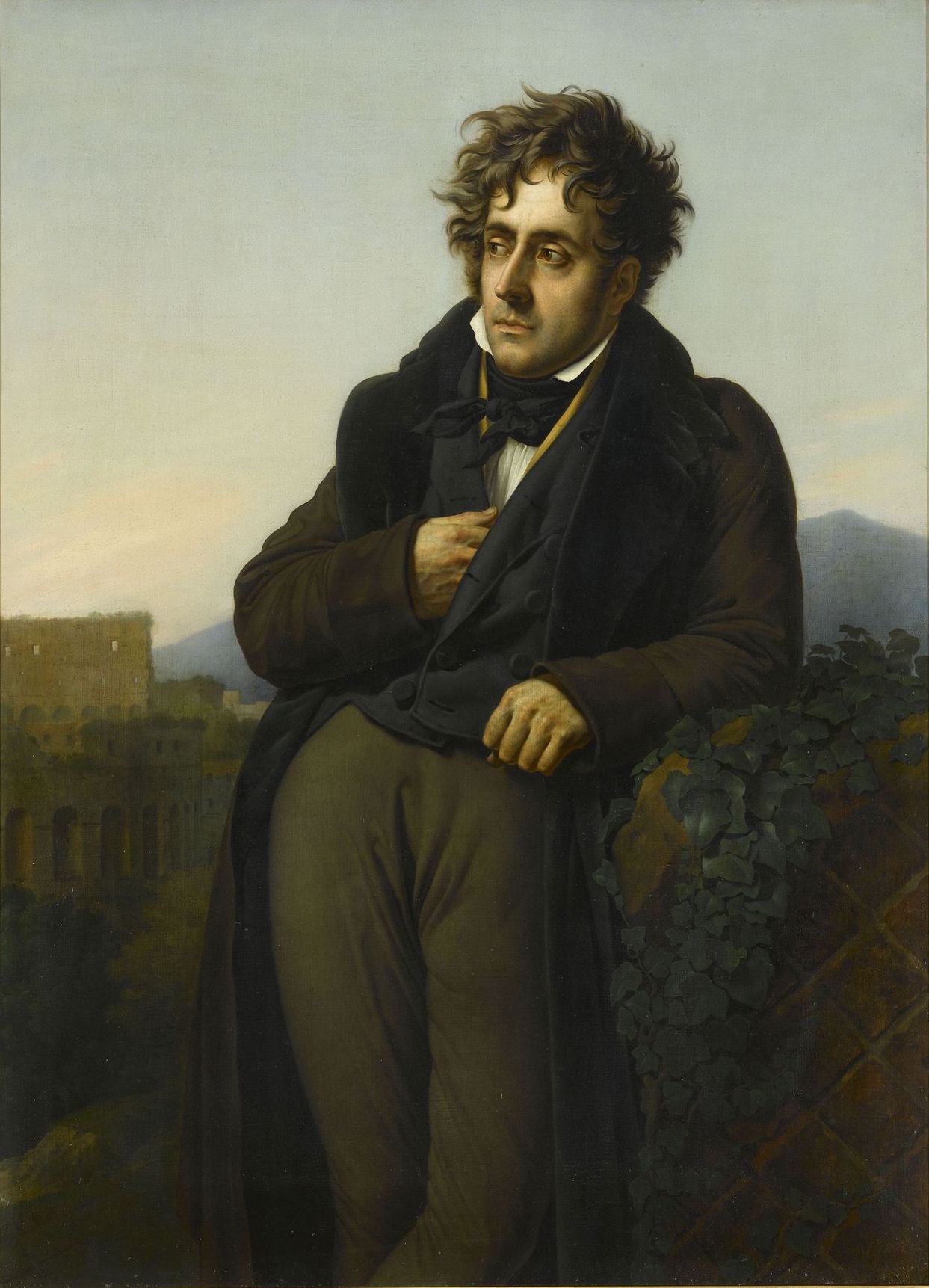
In the Battle of Smolensk, the French invaders—viewed by some to be fighting for a united liberal Europe over small state autocrats—set that town on fire. Napoleon’s criminal reputation preceded him – he murdered without mercy and often by treachery. Royalists criticized him but also articulate liberals like Alexis de Tocqueville (1805-1859) and François-René de Chateaubriand (1768-1848). The emperor was the enemy of liberty. Chateaubriand wrote: “Les Français vont indistinctement au pouvoir, ils n’aiment pas la liberté, l’égalité est leur idole. Or l’égalité et le despotisme ont des liaisons secrètes” (“The French go to power indiscriminately, they don’t like liberty, equality is their idol. But equality and despotism have secret links”).

Portrait of Chateaubriand by Anne-Louis Girodet de Roussy-Trioson, 1809, the Musée d’Histoire de la Ville et du Pays Malouin in Saint-Malo, France. Of Napoleon Chateaubriand wrote: “Les Français vont indistinctement au pouvoir, ils n’aiment pas la liberté, l’égalité est leur idole. Or l’égalité et le despotisme ont des liaisons secrètes” (“The French go to power indiscriminately, they don’t like liberty, equality is their idol. But equality and despotism have secret links”).

The Sly Old Fox of the North

With casualties for the Battle of Smolensk around 15,000 for both sides, the Czar appointed Mikhail Kutuzov (1745-1813) as commander of Russian forces. Napoleon called Kutuzov, “The sly old fox of the north“ (cited in Roger Parkinson, The Fox of the North, 1976). At 67 years old, Kutuzov was lazy and lecherous, but knew how to fight—and, regarding Napoleon’s invasion of Russia, how to retreat strategically. It made Napoleon’s thirst for further battle on his own terms impossible.

Portrait of Mikhail Kutuzov, 1829, George Dawe (1781–1829). Oil on canvas, State Hermitage Museum, Winter Palace War Gallery, St. Petersburg, Russia.

70 MILES WEST OF MOSCOW, THE BATTLE OF BORODINO PITS 242,000 TOTAL COMBATANTS WITH OVER 1,000 BIG GUNS ON SEPTEMBER 7, 1812

In his address to troops before the Battle of Borodino General Kutuzov told his men: “Napoleon is a torrent we are yet unable to stem. Moscow will be the sponge that sucks him dry.”3 Napoleon knew what he was up against. Without supplies, Napoleon ordered his men to keep marching: “Motion alone keeps this army together.”4

The march from Smolensk to Moscow took 3 weeks. Many soldiers of the Grande Armée died on the march. Kutuzov set up a defensive position in Borodino, about 70 miles west of Moscow. On Sept. 7, 1812, French forces engaged the Russians. Both sides were evenly matched – Napoleon had 587 guns and 130,000 troops and the Russians had 640 guns and 112,000 troops.

Hanging over the battlefield was the feeling that the destiny of Europe lay in the balance. The battle’s outcome was a draw. The French were masters of the field as the Russians retreated. It was another day for war’s slaughter— combined French and Russian losses was 80,000 soldiers.

Battle of Moscow (or Borodino), the Capture of the Great Redoubt. Engraving by unknown artist, 1820’s. State Borodino Military Historical Museum, Russia.

Battle of Moscow (or Battle of Borodino) in 1812. Attack of the Lithuanian Life Guards Regiment, oil on canvas, 1912, Nikolay Semyonovich Samokish (1860-1944). State Borodino Military Historical Museum, Russia.

General Uvarov at Borodino, Auguste-Joseph Desarnod (1788-1840), State Hermitage Museum, St. Petersburg, Russia.

In the War of 1812 Fedor Petrovich Uvarov (1769 -1824) commanded the 1st Cavalry Corps and then the Cavalry of the 1st and 2nd Russian Armies. With the Cossacks of Matvei Platov (1753-1818), Uvarov distinguished himself in the Battle of Borodino when he turned the left flank of the French army and made a raid to its rear. The Russian attack of the main French forces delayed Napoleon’s battle plans for two crucial hours.

WHEN LEJEUNE’S BATTLE-PICTURES WERE SHOWN IN LONDON, EAGER CROWDS CAME TO SEE THEM FOR THEIR REALISTIC, DETAILED DEPICTIONS OF SIGNIFICANT CONTEMPORARY EVENTS.

Battle of Borodino, 7th September 1812, 1822, Louis-François Lejeune (1775-1848).

In the French invasion of Russia in 1812, Lejeune was made général de brigade and chief of staff to Davout (1770-1823). During the retreat, Lejeune was frostbitten on the face and left his post where he was subsequently arrested on Napoleon’s orders.

During his military service, Lejeune produced a series of important battle-pictures based on his experiences. They were generally executed from sketches and studies made on the battlefield. Known for their lofty perspective which, according to Chase Maenius in The Art of War[s], “offer[ed] a panoramic view of the totality of the battle’s events,” the Battle of Borodino… of 1822 is considered his masterwork.

In his Memoirs of Baron Lejeune, aide-de-camp to marshals Berthier, Davout, and Oudinot (translation, 1897), Lejeune related one of the many wretched scenes that the Napoleonic Wars produced. He wrote: “As we were pushing on the next day, we came upon two poor creatures at a turn in the road whose condition tore our hearts. They were a handsome well-built man of about forty and a woman of about thirty, also with a fine figure, both stark naked. They approached us and said to us in very good French, ‘Our home has been sacked by Cossacks, who stripped us of everything and left us as you see us. For pity’s sake help us.’ We could do nothing for them but give them a little food, and we felt very wretched as we turned away. The next day at a bivouac some distance off a fresh irresistible demand was made upon our pity, and our stock of provisions was so much reduced that I don’t know what we should have done but that some German peasants brought us a few sheep, with which we replenished our larder.” p. 158, https://archive.org/details/memoirsbaronlej01maurgoog/page/n170/mode/2up
—retrieved May 5, 2021.)

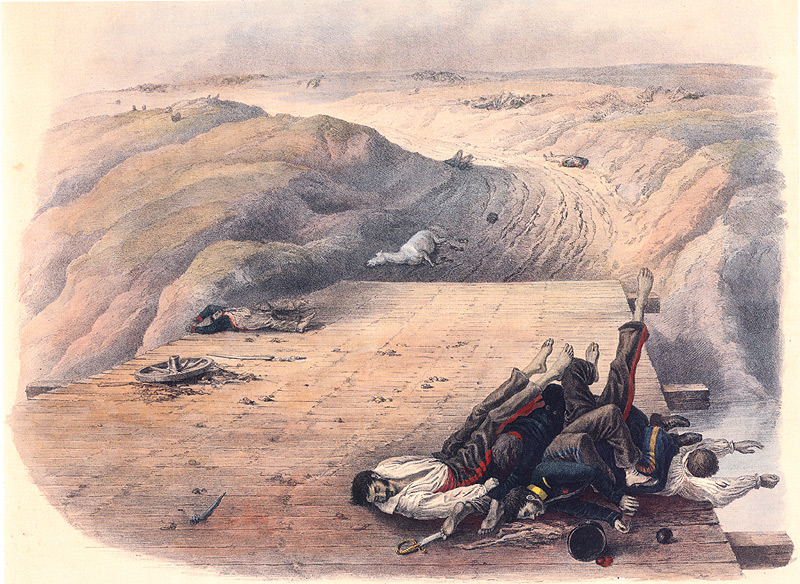
The bodies of dead soldiers of Napoleon’s Grand Armée left on the bridge over the River Kolocha after the Battle of Borodino, 1812.  Christian Wilhelm von Faber du Faur (1780-1857), published 1830’s.

Gen. Kutuzov at the conference of Fili deciding to surrender Moscow to Napoleon, Aleksey Kivshenko (1851–1895), 1880, oil on canvas, Tretyakov Gallery, Moscow.

Following the Battle of Borodino on September 7, 1812, the Russian army retreated towards Moscow and camped near Fili. A military council led by General Kutuzov assembled in a hut in Fili where, despite objections from younger generals, Kutuzov insisted on his plan to abandon Moscow.

The action not only saved the remains of the Russian army but worked to stymie and ultimately defeat Napoleon’s invasion drive. The personalities in the painting include Prince Michael Andreas Barclay de Tolly (1761-1818), who was replaced by Kutuzov on order of the Czar and sits in the corner below the Virgin Mary and Child Jesus icon. Fyodor Uvarov sits near Barclay holding a paper. Nikolay Raevsky (1771-1829) sits by the window with his fingers locked together. Aleksey Petrovich Yermolov  (1777-1861) stands on the far right. The much younger Yermolov resented old general Kutuzov’s plan and demanded to fight the enemy.

Napoleon and about 100,000 French troops reached Moscow on September 8, 1812, Napoleon found only Russia’s poor and displaced. Moscow was Russia’s largest city, its capital, and its Holy City—and French troops of the Enlightenment set it ablaze. The fires burned for 4 days as Napoleon’s army looted it.

Napoleon wrote a letter of apology and condolence to the Czar, Alexander I Pavlovich, the Blessed (1777-1825). One result was that Tthe Russians resolved never to surrender to their would-be conqueror. Only some of the wealthy in Russia looked to negotiate with Napoleon mainly out of fear of losing their assets, that is, the serfs. Napoleon surmised, “I beat the Russians every time—but that does not get me anywhere.”5 Old general Kutuzov’s inaction attained his objective to defend Russia whereas 43-year-old Napoleon failed to rally his men for his Empire these many hundreds of miles from home.

In Ridley Scott’s Napoleon, after trudging with his conscripts through most of Europe, the French Emperor (Joaquin Phoenix) reaches Moscow in Russia. Itching for a fight, the Holy City is, instead, deserted. Disappointed and mocked, Moscow is looted and set ablaze by Napoleon’s men before they retreat.

Posthumous Portrait of Czar Alexander I of Russia, 1826, George Dawe, State Hermitage Museum, St. Petersburg, Russia.

Napoleon’s interest became retreat. There was an intended coup d’état in Paris that Napoleon had to raise more fresh recruits to crush. Other parts of the Empire also raised their head following Napoleon’s inglorious retreat. But it grew worse to become one of world history’s worst defeats.

Weather in Russia turned to snow and ice. The Russians retreated into Mother Russia before they were defeated. The French retreated to the west in defeat. Reports of cannibalism among Napoleon’s army is recorded. Turning back to Paris, the French army lost another half of their men. All of Napoleon’s supply lines had been sacked. Adding further injury, the French were chased out of Russia by Kutuzov’s 80,000 troops.

Famous tell-all graph by French civil engineer Charles Joseph Minard (1781-1870) showing the size of Napoleon’s Grande Armée as it marched towards Moscow (top gray line, left to right) in summer of 1812 and its retreat (bottom black line, from right to left) in the late fall of 1812. Frozen temperatures during the humiliating retreat are plotted on the bottom graph.

On the retreat, surviving warriors fought among themselves over any existing supplies. Napoleon’s retreat included the humiliation of being chased out of Russia by Kutuzov’s redeployed 80,000 troops. The old man’s hot pursuit did not allow Napoleon, the once young Enlightenment military figure, to rest.

Under military surgeon Baron Dominique Jean Larrey (1766-1842), the Grand Army’s medical and sanitary measures were the finest in the world but the retreat route offered no food and no medical care. As a remedy for possible future ills, including his capture, Napoleon convinced his doctor to give him a vial of poison which the dictator could ingest if conditions deteriorated to become inescapably dire.

Portrait of Dominique-Jean Larrey, oil on canvas, 1804, Marie-Guillemine Benoist (1768-1826), Musée des Augustins, Toulouse, France.

Baron Dominique Jean Larrey was a French surgeon and military doctor who distinguished himself during the near endless wars of the French Revolution and under Napoleon. Baron Larrey served as the Grand Army’s medical and sanitation leader and was an important innovator in triage who is considered the first modern military doctor and surgeon.

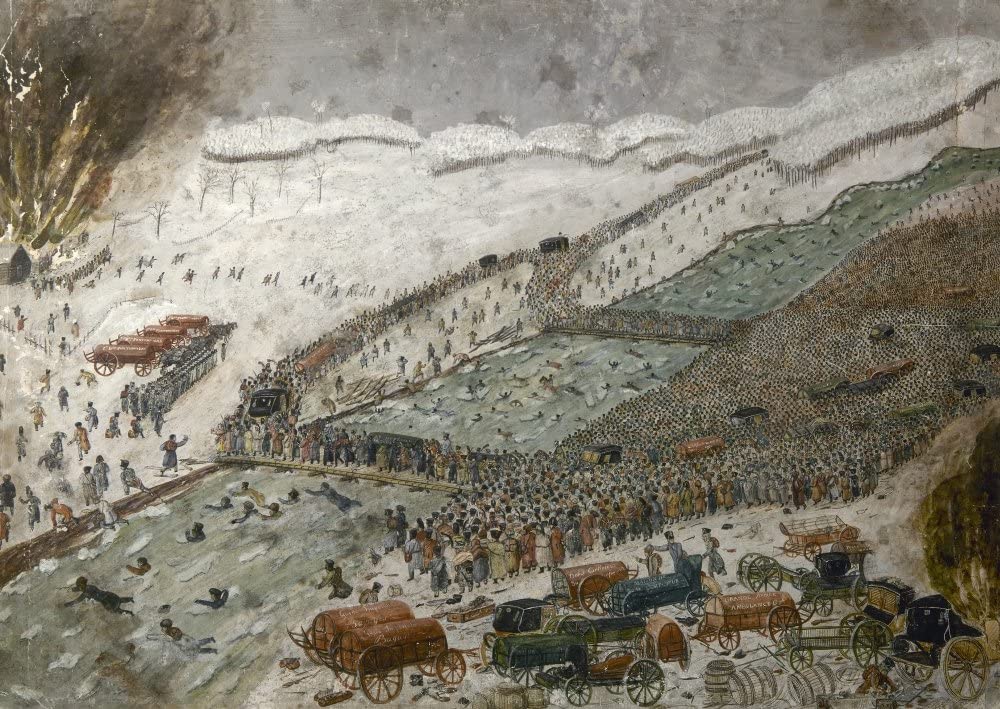
Napoleon: Retreat, 1812. /Ncrossing The Beresina River In Russia During The Retreat Of The Grand Army Under Napoleon Bonaparte, December 1812; Baggage Carts And Ambulances Have Been Abandoned In The Foreground. Watercolor, c. 1812, attributed to General François Louis Fournier-Sarlovèze (1773-1827). During the Russian Campaign, Fournier commanded a brigade of light cavalry composed of French, German, and Central European horsemen, and led a noted cavalry charge at the Battle of Smolensk.

Generals Kutuzov and Wittgenstein attacked at a bridge crossing in what today is Belarus. Hundreds of Frenchmen drowned. To slow the attack, Napoleon ordered the bridges destroyed. In the process the general stranded hundreds of his troops to enemy gunfire.

Napoleon now told his aide-de-camp, Armand-Augustin-Louis de Caulaincourt, what the Russian campaign taught him: “I can hold my grip on Europe only from the Tuileries.” In Warsaw, Napoleon met Abbé de Pradt, his ambassador, and told him: “From the sublime to the ridiculous is but a step.”6

As Tchaikovsky’s 1812 Overture with its famous climax using cannon fire, ringing chimes and brass fanfare, commemorates a Russian defensive victory, French losses were staggering. Of Napoleon’s 700,000 men led into Russia, only 30,000 survived. Only 1,000 soldiers returned to active duty.7

NAPOLEON IN RUSSIA, HIS FORCES LOSE THE PENINSULAR WAR IN SPAIN; THE FOLLOWING YEAR, IN 1813, NAPOLEON LOSES THE BATTLE OF LIEPZIG, THE LARGEST LAND BATTLE UNTIL WORLD WAR I.

Simultaneous with the debacle of Napoleon’s Russian invasion, French forces lost the long fight (since 1808) in Spain and Portugal to keep the British off the Continent.

Significant losses in the east and west of the Empire were followed in 1813 by the Battle of Leipzig, Napoleon’s penultimate defeat by an international coalition that included Austria, Prussia, Russia and Sweden.

DEFEATED, FORCED TO ABDICATE AND EXILED TO ELBA IN 1814, HE BRIEFLY RETURNED TO POWER DURING THE AUDACIOUS HUNDRED DAYS IN 1815. NAPAOLEON MET HIS WATERLOO ON JUNE 18, 1815.

After Napoleon withdrew into France, in March 1814 these allied forces captured Paris. By early April 1814 Napoleon was forced to abdicate as Emperor. Napoleon had to go for his pursuit of glory had become a menace to his country and the world.

With the Treaty of Fontainebleau, Napoleon was exiled to Elba, and, following his brief escape into France in 1814, he was defeated for the final time at the Battle of Waterloo and exiled to St. Helena which held him until his death at 51 years old on May 5, 1821.

Waterloo Battlefield taken from Lion’s Mound, July 1984. Author’s photograph. All Rights Reserved.

Center of Wellington’s Line

This vantage point looks straight down the Allied‑Coalition center under the Duke of Wellington, facing south toward Napoleon’s army. The road cutting through the field is the Chaussée de Charleroi (today’s Route N5), the main axis of Napoleon’s plan to drive north, seize Brussels, and split the Allied and Prussian forces.

La Haye Sainte: The Breakwater

The white, walled farm complex beside the road is La Haye Sainte, held on June 18 by the King’s German Legion (expatriated Hanoverians). This fortified farmhouse became the immovable center of Wellington’s line, blocking the French advance up the main road for most of the day.

D’Erlon’s Assault and the Heavy Cavalry Counter‑Charge

The east field (left) was the killing ground for Count d’Erlon’s I Corps early that afternoon. Across this slope, British heavy cavalry—including the Scots Greys—launched their legendary, chaotic counter‑charge, smashing d’Erlon’s infantry columns before overextending and being cut down in turn.

Ney’s Mass Cavalry Attacks

The rising west field (right) hosted Marshal Ney’s massive cavalry charges. Wellington’s infantry met them in a checkerboard of roughly 20 defensive squares, each holding 500–1,000 men. The French horsemen funneled through narrow gaps, unable to break the squares and instead becoming trapped, jumbled, and exposed to disciplined musket fire. It was like as Agincourt all over again.

Portrait of the Duke of Wellington, by Sir Thomas Lawrence, c. 1815–1816, Apsley House, Apsley House, London. Public Domain.

The creation of the Lion’s Mound between 1820 and 1826 permanently reshaped the original 1815 battlefield. King William I of the Netherlands ordered the monument to mark the exact spot where his son, the Prince of Orange, was wounded. To build the 141‑foot conical hill, engineers with 2,000 workers moved an enormous volume of earth—roughly 300,000 to 400,000 cubic meters—an amount equal to over 40,000 standard dump truck loads packed back-to-back—by scraping and excavating the battlefield itself rather than importing soil. In doing so, they erased key contours, slopes, and defensive features that had defined Wellington’s position during the Battle of Waterloo. The alteration was so drastic that when Wellington returned in 1827, he reportedly reacted with fury, declaring, “They have altered my field of battle!”

Exiled to the remote South Atlantic island of Saint Helena, he spent his remaining years dictating memoirs and reflecting on his career. Napoleon died on May 5, 1821, at age 51. Two centuries after his death, historians continue to debate whether he was a liberator, dictator, military genius, or all three.

Napoleon Crossing the Alps, Jacques-Louis David, 1801, oil on canvas, 102 1⁄3 × 87 in., Château du Malmaison.

NOTES:

  1. “Napoleon Bonaparte,” HISTORY, last modified April 28, 2026, https://www.history.com/topics/france/napoleon.
  2. Will Durant and Ariel Durant, The Age of Napoleon (New York: Simon & Schuster, 1975), 698.
  3. Trevor Royle, ed., A Dictionary of Military Quotations (London: Routledge, 1989), sec. 105, quote 13.
  4. “Napoleon’s Maxims,” Military-Info, accessed May 5, 2021, http://www.military-info.com/freebies/maximsn.htm.
  5. “The Napoleon Legend—A New Look; How can we know the man whose transformation into a myth began long before his death?; Napoleonic Legend,” New York Times, April 5, 1964, https://www.nytimes.com/1964/04/05/archives/the-napoleon-legenda-new-look-how-can-we-know-the-man-whose.html.
  6. John Bartlett, Bartlett’s Familiar Quotations, 13th ed. (Boston: Little, Brown, 1955), 199.
  7. Stephan Talty, “What Blown Tire? How Typhus, Transmitted by Lice, Wiped Out Napoleon’s Grand Armée,” Slate, December 21, 2012, https://slate.com/technology/2012/12/napoleon-march-to-russia-in-1812-typhus-spread-by-lice-was-more-powerful-than-tchaikovskys-cannonfire.html.


The Kennedy Model: Avoiding War in an Age of Nuclear Threats.

FEATURE image: Hawker-Siddeley Blue Steel was started privately in 1954. A contract was placed in 1956 for a stand-off missile to carry a thermonuclear device with a 1 megaton yield by the British Ministry of Supply. Blue Steel was powered by two Armstrong Siddeley Motors that were ignited on launch and enabled the missile to fly at supersonic speed. The missile was constructed of stainless steel with surfaces manufactured of titanium steel. Blue Steel first entered service in 1962 and remained as Britain’s nuclear deterrent until 1970. see- https://www.rafmuseum.org.uk/research/collections/hawker-siddeley-blue-steel/ PHOTO: “Hawker Siddeley Blue Steel” by hugh llewelyn is licensed under CC BY-SA 2.0.

While the North Korea nuclear confrontation of 2017 differed significantly from the Cuban Missile Crisis of 1962, the successful lesson from John F. Kennedy’s leadership was the necessity of restraint, patience, diplomacy, and moral responsibility in avoiding catastrophic war. President Trump should emulate Kennedy’s ability to combine military strength with a commitment to peaceful resolution rather than provoke or initiate conflict.

By John P. Walsh, August 9, 2017

In addition to Twitter, the media tells us that U.S. President Donald J. Trump loves to watch a lot of TV. Has he seen the film: Virtual JFK (2008)?

“Does it matter,” the film’s narrator states, “who is president on issues of war and peace? Can a president make a decisive difference in matters of war and peace? Can a president decisively lead his country into war or keep his country out of war? Or are the forces that drive nations into conflict far more impersonal (and) out of the control of any human being, even a president?”

Nuclear crises remain among the greatest dangers facing humanity because several nations possess nuclear weapons, including North Korea.

Donald J. Trump and John F. Kennedy. Similar to JFK in the Cuban Missile Crisis in 1962, Trump in 2017 must use the military and moral strength of the U.S. to seek and find a conclusion so that North Korea changes course on their nuclear weapons peacefully. Fair use.

Nine nations stockpile around 16,300 nuclear weapons. The U.S. possesses less than half of them.

In 2014 nine nations around the world—including North Korea—have around 16,300 nuclear weapons. Estimates are that North Korea’s arsenal today may be about 20 warheads or higher. In descending order of warhead amounts, the other nuclear states are Russia (8,000 warheads), the U.S.A. (7,300), France (300), China (250), the UK (225), India and Pakistan (about 100 each) and Israel (80).

According to the National Security Archive, the last tactical nuclear weapons left Cuba in December 1962. For a rogue state such as North Korea to possess nuclear weapons is dangerous and unpredictable to the region and world.

Kennedy prepared for war but consistently avoided taking actions that would trigger either conventional or nuclear conflict.

Like JFK in the Cuban Missile Crisis in 1962, the U.S. must use its military and moral strength to seek and find a conclusion so that North Korea changes course on their nuclear weapons peacefully. Exactly what that change should look like is an important debate not explored here, but the U.S. must not or never start or provoke a nuclear war to achieve it.

Kennedy prepared for nuclear war during the Cuban Missile Crisis, but always carefully stayed away from pulling the trigger. There can be no close analogy between Cuba, 90 miles off American shores, in 1962 and North Korea, over 6,000 miles away, in 2017.

The Cold War by the early 1960’s had become a well-worn competitive geopolitical game that hadn’t completely played itself out. The Russians built a wall in Berlin in 1961; Kennedy quarantined Cuba in 1962. In the Cuban Missile Crisis, the missiles were clearly Russian nukes. In 2017 what sources can Trump hold accountable for the North Korean weapons deployment in addition to the rogue regime? China? Russia? Iran? If Pyongyang is as remote and obscure today as the Kremlin was in Kennedy’s time, today’s political and military equations appear to be more tangled and complicated.

Kennedy’s example demonstrates that strength can be expressed through successful conflict avoidance, not merely through military action.

JFK: “It will be worse before it gets better.”

Any calculations for war must include those who may or will get killed – and how many. Is American “hyper” power any good if its allies are casualties on a massive scale? No nuclear exchange must result with a hermit kingdom dictator who is not a friend of the U.S. or its allies in the region – especially if war may incalculably spread.

If the U.S. has allies in the true meaning of the word then an attack on them by North Korea (or China or Russia) is equal to an attack on the homeland – otherwise what’s the point of the U.S. having allies at all? The U.S. must protect its allies in the region to the highest degree so to defend and preserve its esteemed alliances. In this ongoing dangerous politico-military standoff there are ramifications with severe strong risk for the U.S. as a global superpower and markedly in East Asia. North Korea must somehow stand down for there to be success from the perspective of the U.S and its allies.

Effective leadership in a nuclear crisis depends on cool-headed judgment, patience, and a careful balance of “carrot and stick” diplomacy.

Similar to the Cuban Missile Crisis that endured for 13 straight days—the Korean crisis has gone on arguably for over 60 years — patience and cool-headed leadership joined to a calibration of carrot and stick (preferring the carrot) should serve as worthwhile qualities so to craft a necessarily peaceful and successful outcome.

“Because of the ingenuity of science and man’s own inability to control his relations one with another,” said JFK in 1961 in Virtual JFK, “we happen to live in the most dangerous time in the history of the human race.” The film states that experienced military advisers believed that whenever Americans committed military force – they won the conflict.

Kennedy avoided war –and was almost impeached for it.

But as frequent and strong pressure by many advisers is put on Kennedy to commit the U.S. to a war, the president time and again chose to avoid both conventional and nuclear war. 

It may not be well remembered today but after the failure of the Bay of Pigs in 1961, there was talk of John Kennedy’s impeachment for incompetence. Many in his own Democratic party wouldn’t support him because they had convinced themselves he wasn’t a serious political leader.

JFK: “The United States as the world knows will never start a war.”

North Korea’s nuclear ambitions presented a challenge requiring both deterrence and diplomacy rather than reckless escalation. The United States has an obligation to protect its allies while preventing a wider regional or global catastrophe.

In 2017 the defeat of 33-year-old Kim Jong-un’s nuclear threat short of war will not be simply a victory for the status quo but a step forward in terms of American leadership in that part of the world.

An actual war –even if nonnuclear and limited which is improbable -– cannot be in any civilized people’s self-interest. Certainly if Kim started a nuclear war, which is very remote but possible, war would come. As Trump stated plainly, on August 8, 2017, the U.S. response would be with “fire and fury.”

In October 1962 Kennedy’s speech to the nation on the Cuban Missile Crisis included his own “fiery” rhetoric:

“Third: It shall be the policy of this nation to regard any nuclear missile launched from Cuba against any nation in the Western Hemisphere as an attack on the United States, requiring a full retaliatory response upon the Soviet Union.”

JFK concluded with the overall purpose of his actions: “Our goal is not the victory of might, but the vindication of right – not peace at the expense of freedom, but both peace and freedom, here in this hemisphere, and we hope, around the world. God willing, that goal will be achieved.”

Trump should aspire to Kennedy’s commitment to peace and responsible statesmanship in the nuclear age.

President Trump issues a stern warning to North Korea after the latest missile news, saying the nation “best not make any more threats to the United States.”

In 2017 we may look for a resolution to the North Korea crisis where history repeats itself.

All through the Cold War Kennedy looked into the face of strategic MAD (Mutually Assured Destruction) without blinking and then chose to evoke the better angels of our nature. At the United Nations in his first year as president (September 25, 1961) Kennedy exhorted the world’s representatives: “Together we shall save our planet – or together we shall perish in its flames. Save it we can.  Save it we must. Then shall we earn the eternal thanks of mankind and, as peacemakers, the eternal blessing of God.”

President Trump would do well to aspire to the same.

NOTES:

Nine nuclear nations – http://www.independent.co.uk/news/world/nine-nations-have-nuclear-weapons-here-is-how-many-each-country-has-a6827916.html

about 20 warheads – http://www.express.co.uk/news/world/791436/north-korea-nuclear-weapons-kim-jong-un-how-many

Last Cuba warheads removed – http://nsarchive.gwu.edu/NSAEBB/NSAEBB449/

Iran and North Korea – http://thediplomat.com/2016/04/the-iran-north-korea-connection/

fire and fury – https://www.nytimes.com/2017/08/09/world/asia/north-korea-trump-threat-fire-and-fury.html?_r=0

United Nations speech – https://www.jfklibrary.org/Research/Research-Aids/JFK-Speeches/United-Nations_19610925.aspx

The Warrior King and the Fatal Border War: James IV at Flodden Field, 1513.

FEATURE image: Portrait of James IV, after 1578, artist unknown, 41.2 x 33 cm, National Galleries Scotland. Public Domain.

40-year-old Scottish KING JAMES IV (1473-1513) demonstrates how the ambitions, alliances, and personal leadership of a Renaissance monarch culminated in the catastrophic Battle of Flodden Field, a defeat that abruptly ended Scotland’s most dynamic kingship and plunged the kingdom into decades of political uncertainty under infant rulers.

Detail of The Flodden Window, showing sixteen named archers who fought at the battle, St. Leonard Middleton, England.

The earliest Middleton church was dedicated to Saint Cuthbert around 880 as pagan Danes were then attacking the north of England. Following William the Conqueror in 1066, the Normans built a larger church dedicated to Saint Leonard, a French saint and patron of prisoners. In 1412, Thomas Langley (1363-1437), Prince Bishop of Durham and Lord Chancellor of England under kings Henry IV, V and VI, built a new Gothic style church though incorporating parts of the old Norman building. In 1513, Sir Richard Assheton, Lord of the Manor and member of an illustrious military and religious family, spear-headed further changes. Completed in 1524 today’s St. Leonard was built on the previous church buildings so to celebrate Sir Richard’s knighthood by King Henry VIII for his part in the Battle of Flodden Field in 1513. The stained-glass window memorializes archers from Middleton who joined the battle on the side of the English. The battle took place in England only a few miles south of the Scottish border near Branxton and about 200 miles north of Middleton.

“The Flodden Window,” c. 1524, Parish Church of St. Leonard in Middleton near Manchester in England.

https://www.middletonparishchurch.org.uk/about-us/history/

By John P. Walsh

Just over 40 years old, the reign of charismatic Scottish King James IV (1473-1513) came to an abrupt halt on September 9, 1513, when he was instantly killed in battle fighting against an English army in northernmost England.

Continental politics with its entangling alliances put Scotland in armed conflict against its neighbor for which it had signed a peace treaty only 11 years earlier.

In 1502 a treaty was signed pledging everlasting peace between the kingdoms of Scotland and England. The political settlement was sealed in the sacrament of marriage between ambitious (and religious) James IV to Margaret Tudor (1489-1541), the sister of future English King Henry VIII (1491-1547).

The Scots also had a treaty with France, their traditional ally. When the Pope in Italy excluded France from political gain in Italy—and England endorsed the pope’s action—France called on Scotland for help. In the summer of 1513, James invaded England.1

Much later in 1534 in England, papal interference in English political affairs where the pope denied the English King Henry the annulment he sought from Catherine of Aragon (1485-1536), led to England breaking with Rome and the formation of the Church of England.

When his father, James III of Scotland (1451-1488), was killed in battle in 1488, James IV became king at 15 years old. He developed into one of Scotland’s most capable and energetic rulers.

James IV of Scotland (1473-1513). Published by Peter Stent, line engraving, c.1643-1667. 6 7/8 in. x 4 3/4 in. (176 mm x 122 mm) paper size Given to the National Portrait Gallery, London, by Sir Herbert Henry Raphael, 1st Bt, 1916.
James IV of Scotland (1473-1513). Published by Peter Stent, line engraving, c.1643-1667. 6 7/8 in. x 4 3/4 in. (17.6 mm x 12.2 cm) paper size. Given to the National Portrait Gallery, London, by Sir Herbert Henry Raphael, 1st Bt, 1916.
42071fixed
Portrait of James IV, after 1578, artist unknown, 41.2 x 33 cm, National Galleries Scotland.

When James III was killed on June 11, 1488 at The Battle of Sauchieburn in Scotland, his 15-year-old son James IV succeeded him. He had been the rebels’ assumed figurehead, and for his indirect role in his father’s death James decided to wear a heavy iron belt for the rest of his life. A highly intelligent man, James IV proved an effective ruler. He spoke several languages and took an interest in literature, science, and law. Determined to establish strong central leadership he suppressed The Lord of the Isles and created a powerful navy. In 1503 he married the English king’s daughter, Margaret Tudor, in an attempt to create peace between the two countries. When England invaded France, James felt obliged to assist his old Continental ally. In 1513 he confronted the English army but was killed in the disastrous Battle of Flodden Field.

89182fixed
James IV, 1473 – 1513. King of Scots, 17th century, artist unknown, work on paper, 13.33 x 10.16 cm, Scottish National Portrait Gallery (Print Room).

His marriage to Margaret Tudor was intended to secure lasting peace between Scotland and England, but wider European alliances undermined that goal. Scotland’s traditional alliance with France drew James IV into conflict with England in 1513.

James IV married Margaret Tudor (1489-1541), the sister of future English King Henry VIII (1491-1547). While their marriage was an important part of the Truce of Perpetual Peace which was signed between Scotland and England in 1502, it did not prevent the Battle of Flodden Field over a decade later.

The Battle of Flodden Field was fought in the county of Northumberland in northern England on September 9, 1513, between an invading Scots army under King James IV and an English army commanded by the Earl of Surrey.

The Battle of Flodden Field was fought in the county of Northumberland in northern England on September 9, 1513. The battle was between the invading Scots army under King James IV and the English army commanded by the Earl of Surrey.

The Battle of Flodden Field, fought in northern England on September 9, 1513, became one of the greatest military disasters in Scottish history.

Battle strength and casualties are disputed but the Scots likely numbered more than 30,000 men and, after some delay, engaged an English force of around 20,000 men under Lieutenant-General Thomas Howard, 2nd Duke of Norfolk, Earl of Surrey (1443-1524). Howard would become the grandfather of future queens Anne Boleyn (1501-1536) and Catherine Howard (1521-1542).² 

Thomas Howard, 2nd Duke of Norfolk, Earl of Surrey (1443-1524).

Battlefield today.

The Battle begins with an artillery duel and the Scot king is quickly killed in action. Bogged down, a third of the Scot army, including nobility, is destroyed

On September 9, 1513 the two armies clashed at Flodden Field in the far north of England. The battle proved a disaster for the Scots. Scotland’s inspiring king was quickly killed in action with a third of his army, including many officers. English losses were but a small fraction of their total.³

The battle started with an artillery duel. The Scots brought heavy guns and had difficulty aiming at the English army at close range below them. Lighter English guns were able to target and pick off the Scots’ guns. In response, the Scottish left wing advanced downhill and wreaked havoc on the English right wing. The rest of the Scottish army then advanced. But a marshy valley floor bogged the army down. The Scottish pikemen became easy targets for the English infantry. The end result was that a third of the Scottish army was destroyed.

New Scot King, James V, is 17 months old, in 1513. When he dies prematurely in 1542, Mary, Queen of Scots, his daughter and successor, is 6 days old

One immediate consequence of The Battle of Flodden Field was to put James V on the Scottish throne. James was born in April 1512 and not yet two years old.

The Scots were made to wait a generation for kingly leadership in very trying times. Thirty years later, in 1542, James V would die prematurely and was succeeded on the throne by his only legitimate daughter, Mary, Queen of Scots, who was only six days old.

42072fixed
Posthumous portrait of James V, 1512 – 1542, artist unknown, c. 1579, 41.30 x 33.00 cm, National Galleries Scotland.

James V (reigned 1513 – 1542), father of Mary, Queen of Scots, became king at one-year old when his father, James IV, was killed at Flodden, fighting the English. Ignoring the advice of English King Henry VIII, his uncle, to become a Protestant, James V strengthened Scotland’s alliance with its traditional ally, France. He married the French king, Francis I ‘s daughter, Madeleine of Valois (1520 –1537). When she died, he married Mary of Guise (1515-1560), another high-born Catholic French woman. James V died at Falkland Palace, soon after his army’s defeat by the English at Solway Moss, on November 24, 1542. His six-day-old daughter Mary succeeded to his throne.

madeleinedevalois

Madeleine of Valois (1520 –1537), Corneille de Lyon (1500/1510–1575), Musée des Beaux-arts de Blois.

First wife of James V of Scotland. They married on New Year’s Day 1537 at Notre Dame Cathedral in Paris. Of delicate health from birth, Madeleine died in July 1537 at 17 years old.

attributed_to_corneille_de_lyon_-_mary_of_guise_1515_-_1560-_queen_of_james_v_-_google_art_project

Portrait of Mary of Guise (1515 – 1560), Corneille de Lyon, c. 1579, 41.3 x 33 cm, Scottish National Portrait Gallery.

Queen of James V of Scotland and mother of Mary, Queen of Scots. The daughter of a French duke, Mary of Guise had just been widowed when she married James V to strengthen the alliance between France and Scotland. Their two sons died in infancy and James died a few days after their daughter, Mary, was born in 1542. Mary of Guise chose to stay in Scotland, ruling as Regent to protect her daughter’s interests. Courageous and determined, her effort to keep Scotland in the French Roman Catholic sphere was unsuccessful in the rising tide of Protestantism on the British Isles.

10597fixed

Mary, Queen of Scots, 1542 – 1587, artist unknown (after Francois Clouet, c. 1510 – 1572), 32.90 x 27.40 cm, National Galleries Scotland.

This is probably a 19th century replica after an image made around 1561. Within eighteen months Mary, Queen of Scots, lost three members of her closest family — her father-in-law (Henry II of France), mother (Mary of Guise) and, on December 5, 1560, her husband, Francois II of France. Mary is depicted here in mourning, wearing a white hood and veil. According to the Venetian Ambassador to the French court, Mary was inconsolable. Her “tears and lamentations inspired a great pity” in everyone, the diplomat observed. Eight months later, having lost her position as Queen of France, Mary landed at Leith to take up her duties as Queen of Scotland.

The battle endured in Scottish cultural memory through commemorations and the famous lament The Flowers of the Forest.

Over two hundred years later Scottish poet Jane (or Jean) Elliot (1727-1805) wrote a poetic lamentation to an ancient Scottish tune about Flodden’s martial calamity. Published in 1776, it is called The Flowers of The Forest and is Elliot’s only surviving work.

Dule and wae for the order sent our lads to the Border;
The English for ance, by guile wan the day;
The Flowers of the Forest, that foucht aye the foremost,
The prime o’ our land are cauld in the clay.

We’ll hear nae mair lilting at our yowe-milking,
Women and bairns are heartless and wae;
Sighing and moaning on ilka green loaning:
‘The Flowers of the Forest are a’ wede away.4

King James IV corpse riddled with arrows on the battlefield

King James IV died at Flodden on September 9, 1513. His corpse was disfigured by arrows. The bow and arrow is an ancient weapon. Arrows inflicted some of medieval battle’s worst wounds when the victim was struck. Though guns and cannonade take pride of place in terms of firepower, arrows caused wounds that could be more fatal than those produced by other weapons.

Battle of Flodden Field weapons: guns, cannon, pikes, and arrows

The heavier the arrowhead, usually made of metal, the larger the feathers needed to spin it towards its target. Victims did not die usually in battle from a single arrow wound. Expert bowman could shoot one arrow every 5 to 10 seconds.

Complicating multiple wounds was that each arrowhead had to be removed. Since the arrow was constructed to have the arrowhead dislodge in the body, it made its location and removal highly dangerous and difficult. Arrowheads could not remain in the body. They were too large, sharp, and angular for bodily tissue to heal around it. They could easily become infected and caused intense pain with the slightest of bodily movement. A general medical procedure was to cut off limbs with arrow wounds. If the arrowhead was lodged into bone, it made its removal even more painful and difficult. Lodged arrows could cause nerve damage or intense muscle contractions. Arrows to the head might not penetrate the skull but could cause cerebral compression whose pressure would be alleviated by surgery. Bowmen knew to hit the trunk of the body was going to be likely fatal and this is where most combatant injuries by arrows are found.5

Taken to England after battle, the fate of the Scottish king’s disfigured corpse

After the battle, James IV’s corpse was identified and taken to Berwick-upon-Tweed where it was cleaned up and embalmed. Placed in a lead coffin, the body was transported to London.

Catherine (or Katherine) of Aragon, by Unknown artist, oil on oak panel, c. 1520,
20 1/2 in. x 16 1/2 in. (520 mm x 420 mm) overall National Portrait Gallery, London. Public Domain. see – https://www.npg.org.uk/collections/search/portrait/mw194913/Katherine-of-Aragon?LinkID=mp00801&role=sit&rNo=0

The body was received by Catherine of Aragon (1486-1536), the wife of King Henry VIII of England who was fighting in France. The body remained in Richmond upon Thames with a monastery. James IV might have been buried at the monastery except that the Scottish king had been excommunicated for breaking the Truce signed between Scotland and England in 1502. Although the pope granted permission for burial, the corpse was left in a monastery shed to, quite literally, rot.

In England the body of the Scottish king was soon forgotten about. It is conjectured someone stole the head and, after a time, that detached body part was thrown into a popular London charnel pit. The body presumably stayed at the monastery. When the monastery was demolished during the Dissolution in the 1530’s, the headless body of James IV was lost with it.

NOTES:

1 Trevor Royle, Precipitous City: The Story of Literary Edinburgh, Mainstream Publishing, Edinburgh, 1980. pp. 16-17.

2 Stanford E. Lehmberg, “The Life of Thomas Howard, Earl of Surrey and Second Duke of Norfolk, 1443-1524 by Melvin J. Tucker,” The American Historical Review, Vol. 71, No. 1 (Oct., 1965), p. 158.

3 “The Flodden Death-Roll,” The Scottish Antiquary, or, Northern Notes and Queries, Vol. 13, No. 51 (Jan., 1899), Edinburgh University Press, p. 102.

4Royle, Precipitous City, p.17.

5 arrow wounds and burial of James IV. See – https://www.bbc.com/news/uk-scotland-23993363 and