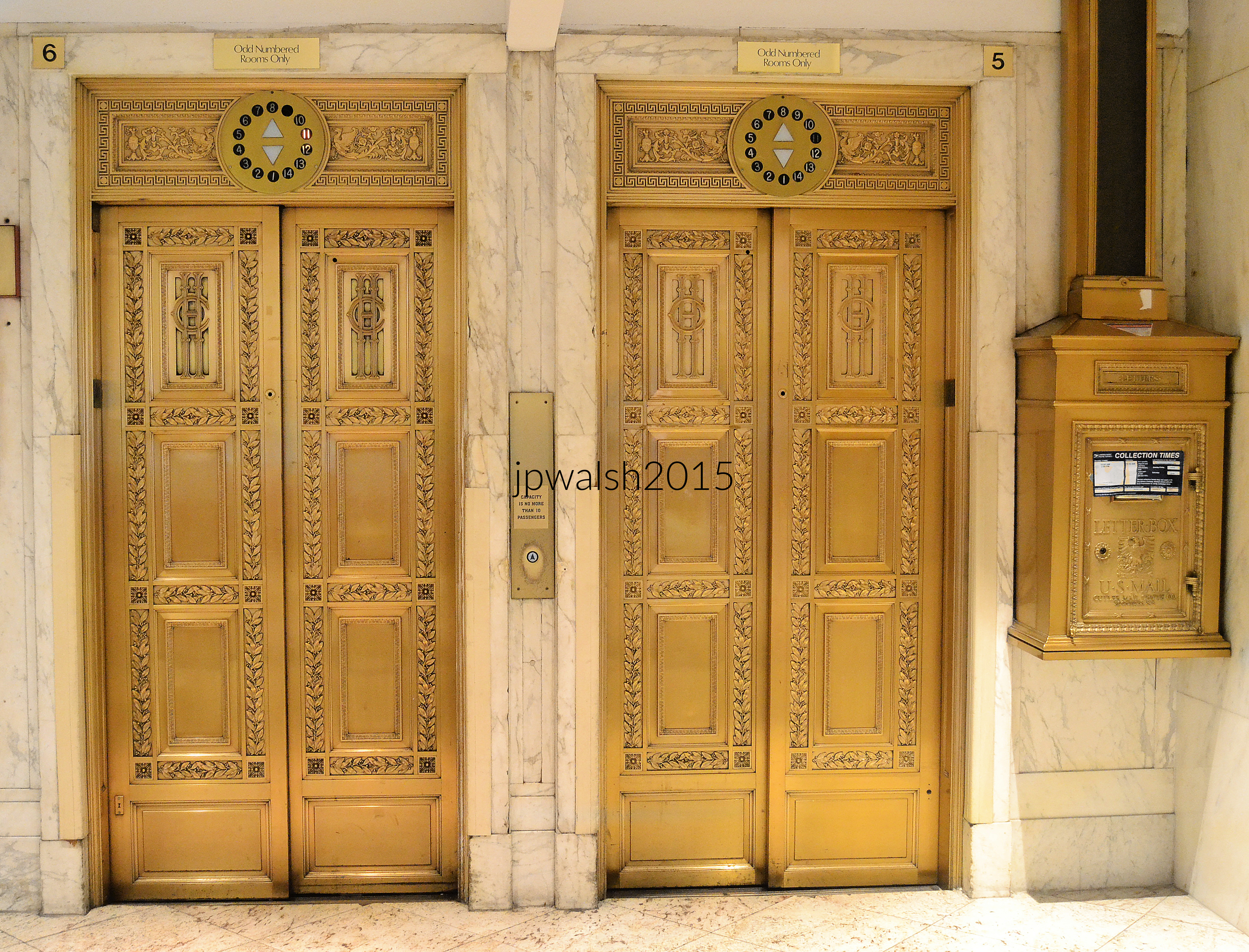
Feature Image: Congress Plaza Hotel in Chicago built in 1893 during the World’s Columbian Exposition features this later ornate Beaux-Arts gold elevator bank and the celebrated Gold Room. December 2015. Author’s photograph. 6.20 mb DSC_0617 (1).
The Congress Plaza Hotel embodies Chicago’s transformation during and after the World’s Columbian Exposition, linking the city’s emergence as a world-class destination with the architectural legacy of Clinton J. Warren and later expansions by Holabird & Roche. Through its strategic location, grand design, continuous operation since 1893, and association with major historical figures, the hotel serves as a living monument to Chicago’s Gilded Age ambitions and early twentieth-century prominence.
A Hotel of the Columbian Exposition Era
The original North Tower was built in 1893 during the World’s Columbian Exposition, held in Chicago from May 1 through October 31 of that year. The project was developed by famed hotel entrepreneur R.H. Southgate and designed by architect Clinton J. Warren (1860-1938), one of Chicago’s most prolific young hotel specialists during the late nineteenth century.
Warren moved from Massachusetts to Chicago in 1879 and joined the firm of Burnham and Root the following year. After establishing his own practice in 1886, he designed an impressive roster of Chicago hotels, including the ten-story Virginia Hotel (1889-1890) at Ohio and Rush Streets; the eight-story Metropole Hotel (1891) at Michigan Avenue and 23rd Street; the Plaza Hotel (1891-1892) at Clark Street and North Avenue; the Lexington Hotel (1892) at 22nd Street and Michigan Avenue; and the Auditorium Annex (1893) at 504 South Michigan Avenue, today known as the Congress Plaza Hotel.
Built in 1893 during the World’s Columbian Exposition and originally opened as the Auditorium Annex, it was designed by architect Clinton J. Warren, one of Chicago’s leading hotel specialists of the era.
By 1900, Warren had returned to Boston. He died in San Diego in 1938, by which time his significant contribution to Chicago architecture had largely faded from public memory. Notably, his New York Times obituary made no mention of his training under Daniel Burnham, his role in shaping Chicago’s hotel architecture over two decades, or the later notoriety of his Lexington Hotel, which served as Al Capone’s headquarters from 1928 to 1931. The obituary read in full:
“Clinton J. Warren SAN DIEGO, Calif., March 17 (AP). Clinton J. Warren, architect, who designed buildings in Europe, Mexico and Eastern United States, died at his home here last night at the age of 80. Mr. Warren formerly lived in Winchester, Mass. His widow and two sons, Clinton Jay Jr. of San Francisco and John of New York, survive.” see – TimesMachine: March 18, 1938 – NYTimes.com and The Chicago Hotels of Architect Clinton J. Warren – Owlcation – retrieved February 22, 2026.
Beaux-Arts elevator banks at 504 S. Michigan Avenue were installed in 1907. December 2015. Author’s photograph. 3.99mb DSC_0958 (2).
The Auditorium Annex and a Strategic Location
Originally known as the Auditorium Annex, the hotel opened in 1893 to accommodate the enormous influx of visitors attending the World’s Columbian Exposition. Remarkably, it has operated continuously as a hotel ever since and has also become well known for its reputed ghost hauntings.
Its location was one of its greatest advantages. The hotel stood only five blocks from both Dearborn Station and Illinois Central Station, making it the closest major hotel to two of Chicago’s principal railroad terminals. It was also the southernmost major hotel in downtown Chicago and sat just a block and a half from the elevated railway line that carried visitors directly to the exposition grounds in Jackson Park.
Expanded with the South Tower between 1902 and 1907 designed by Holabird & Roche and featuring the ornate Beaux-Arts gold elevator bank, the hotel grew to more than 1,000 rooms by 1908.
Expansion and the Famous Gold Elevators
The celebrated gold elevator bank is located in the hotel’s South Tower, an addition constructed between 1902 and 1907 and designed by the distinguished architectural firm Holabird & Roche. Executed in an ornate Beaux-Arts style, the elevators remain among the building’s most striking historic features.
The South Tower expansion also included the luxurious Gold Room banquet hall, reinforcing the hotel’s status as one of Chicago’s premier accommodations during the early twentieth century.see – Holabird & Roche. See- Chicago Landmarks – Architect Details – retrieved February 22, 2026.

William Holabird (1854-1923) and Martin Roche (1855-1927) of the architectural firm of Holabird & Roche designed the South Tower of today’s Congress Plaza Hotel between 1902 and 1907. Public Domain.
From Auditorium Annex to Congress Hotel
By 1908, the enlarged complex contained more than 1,000 guest rooms. In 1911, the property adopted the name Congress Hotel, a reference both to nearby Congress Parkway (today Ida B. Wells Drive) and its prominent location facing Grant Park.
Over the years, the hotel welcomed numerous American presidents. Among those who stayed there, and who may well have ridden these gilded elevators, were Theodore Roosevelt, William Howard Taft, Warren G. Harding, and Calvin Coolidge. Today, the elevators stand as elegant reminders of the hotel’s origins in the era of the World’s Columbian Exposition and of its long history as one of Chicago’s most prominent grand hotels. See – Congress Plaza Hotel History | Congress Plaza Hotel – retrieved February 22, 2026.
Renamed the Congress Hotel in 1911, it has hosted numerous U.S. presidents and remains one of Chicago’s longest-operating and most historically significant hotels.