Tag Archives: #RomanesqueArchitecture

Dearborn Street Station (1885): Echoes of Chicago’s Rail Empire and Last Great Link to the Railroad Age.

FEATURE Image: Completed in 1885 at a cost of $500,000 (equivalent to nearly $16 million in 2024), Dearborn Street Station in Chicago’s South Loop stood as a grand Romanesque composition of Italian brick and granite. Its architect, New Yorker Cyrus L. W. Eidlitz, would later design One Times Square (1904), the famed Manhattan tower that has served as the site of the annual New Year’s Eve ball drop since 1908. see – https://www.in2013dollars.com/us/inflation/1885?amount=500000 – retrieved February 27, 2024. November 2017. Author’s photograph. 6.44mb

Dearborn Street Station is one of Chicago’s most significant surviving railroad landmarks, embodying the city’s rise as a national transportation hub while showcasing the architectural achievement of Cyrus L.W. Eidlitz. Despite fire, alteration, and the end of passenger rail service, the station endures as a rare and tangible link to Chicago’s railroad age and urban development.

The Hoosier leaving Dearborn Street Station in Chicago (its clock tower visible at right) for Indianapolis. Public Domain (Pre-1978, no mark).

The Dearborn Street Station in Chicago with its original hipped roofs, including on the tower, c. 1908. Public Domain.

The Dearborn Street Station is Chicago’s oldest existing train station though it has not operated as one since 1971. It is a U-shaped Italian brick three-story Romanesque structure with a granite base that was originally 80 feet tall to the roof line.

The 32-year-old architect of Dearborn Street Station, Cyrus L. W. Eidlitz, came from an illustrious East Coast family of builders and architects.

Cyrus L. W. Eidlitz who built the Dearborn Street Station in Chicago in 1885 was from an influential American family of architects and builders—his father, Leopold Eidlitz (1823-1908), was a founder of the American Institute of Architects (AIA). Cyrus L. W. Eidlitz is best known for designing One Times Square, the former New York Times Building, on Times Square in 1904. He also founded HLW International, one of the oldest architecture firms in the United States. The reconstruction of Dearborn Station in Chicago in 1923 following its devastating fire was done by an unknown architect two years after Cyrus L. W. Eidlitz’s death.

Original facade completed in 1904 of One Times Square in 1919 by Cyrus L. W. Eidlitz who designed and built the Dearborn Station in Chicago in 1885. Public Domain.

Dearborn Street Station (1885) is Chicago’s oldest surviving railroad terminal building. Cyrus L.W. Eidlitz designed the station in a robust Romanesque style using Italian brick and a granite base.

Today’s flat roof is a modification by an unknown architect from its elaborate original hipped roof that was lost in a 1922 fire. The eye-catching Flemish tower, originally 166 feet tall, was also modified after the same conflagration. The station building marks the southern terminus of Dearborn Street which today extends about 4 miles to its northern terminus at the southern boundary of Lincoln Park. Author’s photograph.

Looking south to the Dearborn Street Station which sits at the southern terminus of the 4-mile downtown Dearborn Street corridor. PHOTO: “South Dearborn Street” by Reading Tom is licensed under CC BY 2.0.

The station’s frontage on Polk Street extends 212 feet. Originally the station extended 446 feet south along Plymouth Court with the train sheds 600 feet long with 8 tracks. The station’s train shed was demolished in 1976. In 1986 the station was converted to offices and shops (I had my Bank One branch in the Polk Street Station). Today it is the Dearborn Station Galleria in the South Loop Printing House Historic District.

Following demolition of the train sheds in 1976 the first phase of the Dearborn Park residential development south of the Dearborn Street Station building quickly sprang to life.

The 1885 clock tower of the Dearborn Street Station is visible at the left. Open land which for almost 100 years had been the Dearborn Street Station‘s busy train tracks into a shed equal to two football fields in length were cleared off to make room for Dearborn Park residential development. The photograph is dated from 1977 by William C. Brubaker. PHOTO: “Site for Dearborn Park residential development” by UIC Library Digital Collections is licensed under CC BY-NC-SA 2.0.

Its distinctive clock tower and monumental presence made it a defining feature of Chicago’s South Loop.

Dearborn Station Clock Tower. PHOTO: “Dearborn Station Clock Tower” by Atelier Teee is licensed under CC BY-NC-ND 2.0

The Dearborn Station had 8 tracks that accommodated 12 coaches and engines with 122 trains arriving and departing daily. The station served as a major transportation gateway, accommodating numerous railroads.

Chicago & Eastern Illinois (1877-1976):

C&EI The Danville – Chicago Flyer at Steger, Illinois on November 26, 1965. Public Domain.

Map of the Dixie Route to Florida and connecting lines, published by the C&EI, L&N, and NC&StL railroads, 1926. Public Domain.

Preferred Share of the Chicago and Eastern Illinois Railroad Company, issued 1889. Public Domain.

Chicago and Atlantic Railway, (later the Chicago and Erie Railroad, 1871-1941):

Chicago and Atlantic Railway 1889 ad featuring The New York and Chicago Vestibule Limited. Public Domain.

Atchison, Topeka & Santa Fe (1859-1996):
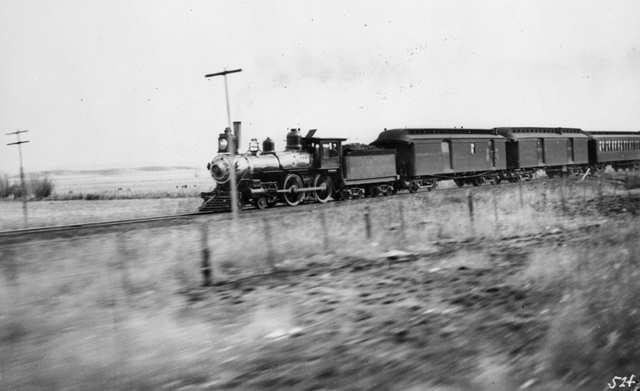
AT&SF passenger train, c. 1895. Public Domain.

Map of “The Santa Fé Route” and subsidiary lines, as published in an 1891 issue of the Grain Dealers and Shippers Gazetteer. Public Domain.

Louisville, New Albany & Chicago, or Monon (1897-1971):

Chicago, Indianapolis and Louisville Railway, route map, 1903, Unknown author – Poor’s Manual of the Railroads of the United States. Public Domain.

Grand Trunk Western Railroad Company (1859-1991):

A 1976 map of the proposed routes to be turned over by Conrail on the GTW, DT&I and P&LE. Public Domain.

Grand Trunk Western Railroad locomotive shop, Battle Creek, Michigan, 1908. GT Western RR was one of the lines into Dearborn Street Station in Chicago. Public Domain.

The Wabash Railroad (1837-1964):

1886 map of the Wabash, St. Louis and Pacific Railway. Public Domain.

System timetable back and front cover, 1887. Public Domain.

Wabash system map, early 20th century. Public Domain.

The Erie Railroad (1832-1960):

An 1855 map of the New York and Erie Railroad. Public Domain.

Chicago & Western Indiana (1880-present):

The Kansas City Chief at Dearborn Station on February 5, 1968. The glowing face of the station clock in the clocktower is visible upper-left. Photograph by A Roger Puta. Public Domain.

All lines operating into Dearborn Station, except for the Santa Fe (above), travelled over the C&WI.

Colossal damages in December 1922 fire.

On December 21, 1922, fire destroyed the roof of the Dearborn Street Station.  The blaze started on the third floor and raged throughout that top floor. Hundreds of passengers and employees were safely evacuated and there was one reported injury. The Chicago Tribune reported that when the fire reached the central tower it roared up the long shaft which became a blazing torch. The crowds watched in amazement as the tower clock stopped and the hands on its three faces crashed into the raging fire below.

The original ornate steeply pitched tiled roofs and dormers were lost in a fire in 1922 and not replaced.

At far left the 1885 clock tower of the Dearborn Street Station can be seen along Dearborn Street in downtown Chicago. June 2022. Author’s photograph.

SOURCES:

AIA Guide to Chicago, 2nd Edition, Alice Sinkevitch, Harcourt, Inc., Orlando, 2004, p. 154.

History of Development of Building Construction in Chicago, Second Edition, Frank A. Randall, Revised and Expanded by  John D. Randall, University of Illinois Press, Urbana and Chicago, 1999, pp. 104-105 and 221-223.

Chicago’s Famous Buildings, 5th Edition, Franze Schulze and Kevin Harrington, The University of Chicago Press, 2003, pp. 89-90.

http://www.connectingthewindycity.com/2017/12/december-21-1922-dearborn-station.html – retrieved February 27, 2024.

Collegiate Church of St. Gertrude (11th Century): A Monument to Ottonian Power and Early Romanesque Design in Nivelles, Belgium.

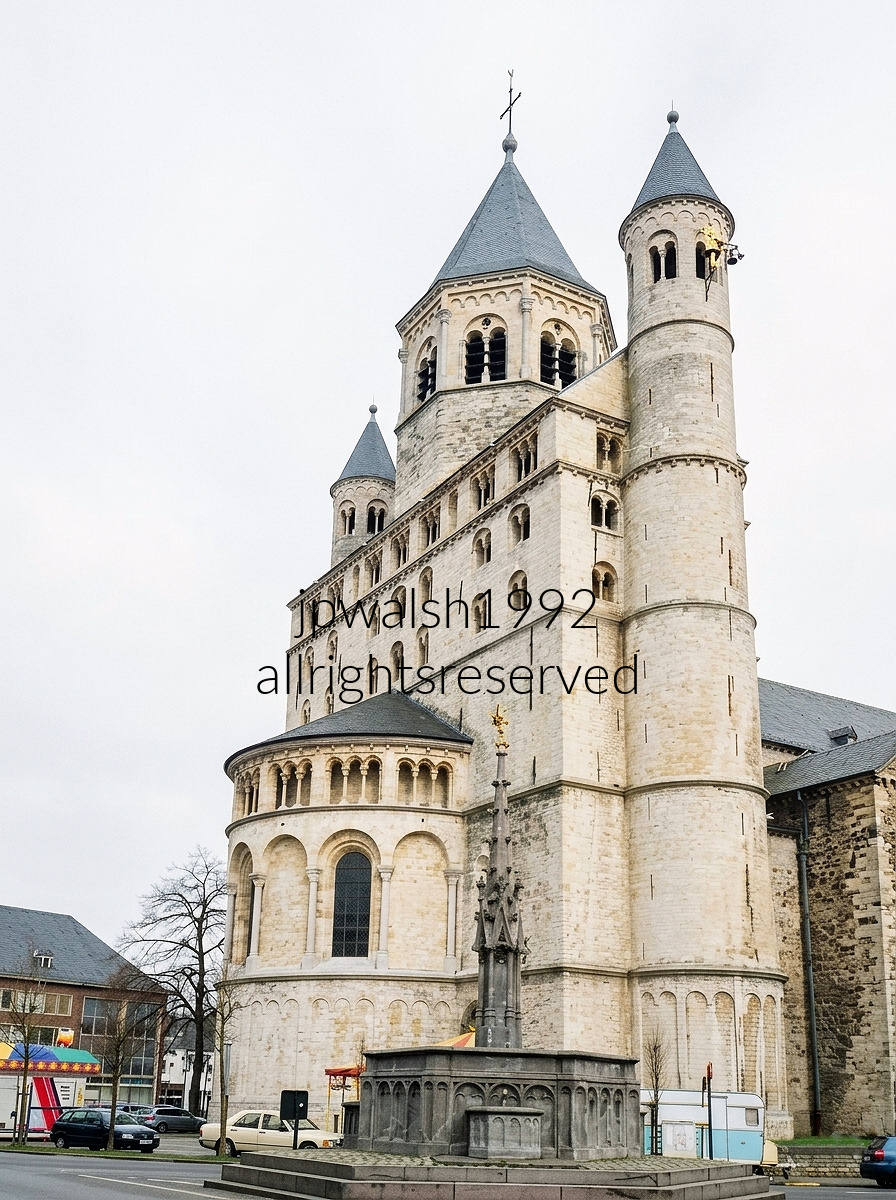
FEATURE image: The Westwork of the Collegiate Church of St. Gertrude in Nivelles, Belgium, fronts an expansive historical building of the 11th century. Nivelles is an ancient settlement about 25 miles south-east of Brussels in Belgium’s French-speaking region of Wallonia. February-March 1992. Author’s photograph.

The Collegiate Church of St. Gertrude stands as one of the finest surviving monuments of Ottonian and early Romanesque architecture in Western Europe, embodying the religious, political, and cultural influence of the abbey founded by St. Gertrude in the 7th century while illustrating how medieval architecture connected local identity with continental Christian traditions.

The Collegiate Church of St. Gertrude on Grand’ Place, c. 1050, Nivelles, Belgium. It contains the tombs of its foundress, Bl. Ita of Metz and her daughter, St. Gertrude of Nivelles, the monastery’s first abbess in the 7th century. February-March 1992. Author’s photograph.

The massive westwork, towers, and disciplined geometry reflect the transition from Carolingian traditions to Romanesque architecture. The church’s architectural simplicity emphasizes volume, proportion, and structural clarity rather than later Gothic ornamentation.

Interior, Minster (Collegiate Church of St. Gertrude), Nivelles, Belgium, c. 1050.  February-March 1992. Author’s photograph.

This structure was built in the early 11th century and consecrated by Wazo of Liège (c.985-1048) in the presences of Henry III, Holy Roman Emperor (1016-1056). it demonstrates how Nivelles emerged as a major religious center in the medieval Low Countries and survived centuries of political upheaval, war, and restoration, to become a living document of European history.

WHO IS ST. GERTRUDE OF NIVELLES, PATRON SAINT OF CATS, GARDENERS AND TRAVELLERS?

St. Gertrude of Nivelles (c. 628-659) was the daughter of Blessed Pepin of Landen (c. 580-640) and Blessed Ita of Metz, O.S.B. (592-652) who founded Nivelles monastery. Gertrude was born about 45 miles north east of Nivelles in Landen, Belgium on the boundary of Wallonia in Flanders.

St. Gertrude de Nivelles, from the Hours of Cardinal Albrecht of Brandenburg (1490-1545), Archbishop and Elector of Mainz, c. 1522. Opaque water-based paint mounted on board by Flemish artist Simon Bening (c.1484-1561). Carnegie Museum of Art, Pittsburgh, Pennsylvania.

The Abbey of Nivelles, founded through the efforts of St. Gertrude and her family in the 7th century, evolved into a major religious institution whose legacy survives in the Collegial Church of St. Gertrude, one of the most important Romanesque monuments in Belgium.

St. Gertrude of Nivelles is an unofficial, modern patron saint of cats. Her feast day is March 17—the same as St. Patrick of Ireland. By the 15th century St. Gertrude was being called upon by the populace to invoke against rats, mice, and plagues. It was the next small, logical step to connect her with being a friend to cats who naturally are used to keep mice away.

From Royal Villa to Monastery

In the 7th century, the territory was part of the Austrasian Frankish kingdom and Pepin had established a personal presence there. Following Pepin’s death when Gertrude was about 12 years old, the bishop of Maastrict in today’s Netherlands encouraged Ita to transform Pepin’s royal villa into a monastery. Pepin and Ita’s daughter, Gertrude, become the monastery’s first abbess.

A Family Devoted to Religious Life

Ita joined her daughter in the monastery to live out their days in a life of work and prayer. In the distant past, older well-endowed individuals often retired to monasteries or convents. A modern corollary may be that some retirees today choose to establish themselves in church-sponsored retirement villages. Ita’s other daughter (Begga) also eventually became an abbess; another son (Bavo), a hermit. One final son (Grimoald) took his father’s place as Mayor of the Palace. (see – http://www.santiebeati.it/dettaglio/37900 and https://www.newadvent.org/cathen/06533c.htm)

St. Gertrude: Abbess, Traveler’s Patron, and Saint

In addition to being the patron of cats and gardeners, St. Gertrude was an early medieval patron of travelers. From her birthplace of Landen to Nivelles, Belgium, it is a distance of around 40-45 miles, or a one or two-day journey on foot.

St. Gertrude was superior of the monastery her parents established and, though a young abbess, Gertrude was known for her wise rule. St. Gertrude died at a young age on account of her personal austerities and was venerated as a saint.

War Damage and Reconstruction

The impressive appearance of the westwork of the Collegial Church of St Gertrude in Nivelles is the result of a reconstruction finished in 1984 following severe damage it sustained during World War II by bombing from the German Luftwaffe (air force) in May 1940.

From Benedictine Abbey to Collegiate Church

The church was built in the 11th century to serve as a Benedictine abbey of cloistered nuns whose first abbess was St. Gertrude of Nivelles. The community of nuns developed so that by the 15th century Nivelles became professionally staffed and was designated a collegiate church. The dramatic church building is classified a major European Heritage site and remains one of the finest examples of the pure Romanesque style in Belgium. 

The Romanesque Crypt and Early Medieval Burials

Its Romanesque crypt is one of the largest of its kind in Europe where tombs of the Merovingian (5th-7th centuries) and Carolingian (7th-9th centuries) periods have been found.

St. Gertrude of Nivelles. As patron of gardeners, it was widely believed in medieval times that fine weather on her feast day predicted a prosperous, fertile season for crops.

Along with her protection against rodents, sheltering travelers was her most famous patronage during the Middle Ages, long before her popular modern association with cats. St. Gertrude became the guardian of the road due to her real-life monastic work as well as a spectacular medieval miracle legend.

St. Gertrude’s Inn

During the 7th century, Gertrude’s monastery in Nivelles sat along highly traveled European trade and pilgrimage routes.  The 11th Collegiate Church of St. Gertrude Illustrates that enduring connection between sacred space, pilgrimage, and civic identity in the Low Countries. Deeply committed to the Christian virtue of hospitality, Gertrude built a dedicated, large hospice at the monastery to provide food, safe shelter, and medical care to any weary traveler.

The Miracle of the legendary Sea Monster

Her patronage of travelers was forever established by a famous seafaring legend. According to medieval accounts, Gertrude sent some of her monks on an ocean voyage to Ireland for a missionary journey. Out on the open water, a terrifying storm struck, and a massive sea monster emerged from the deep to capsize their ship.

In utter panic, one of the monks cried out, “O Lord, through the merits of Gertrude, deliver us!” The moment her name was spoken, the sea monster plunged back into the abyss, the storm broke, and the ship sailed safely to shore.

The “Sint-Geertenminne” (Gertrude’s Cup)

Because of this miracle, Gertrude became the protector of anyone crossing water or embarking on a long journey. This birthed a highly popular medieval custom across northern Europe known as the Sint-Geertenminne (Saint Gertrude’s Cup or Drink):

  • Before a traveler, soldier, or pilgrim set out on a long or hazardous trip, they would gather with family and friends to drink a special toast of wine or beer from a dedicated decorative cup in Gertrude’s honor.
  • This blessing was believed to wrap the traveler in Gertrude’s “spiritual cloak” of protection, ensuring they would survive the road, avoid shipwrecks, and return home safely.
  • Even people who were dying drank this final toast to ensure Gertrude would grant their soul safe passage from earth to heaven.

SOURCE: The Saints: A Concise Biographical Dictionary, edited by John Coulson, Guild Press, New York, 1957.