Tag Archives: #ChicagoLoop

The Entrance to an Era: Chicago’s Metropolitan Tower (1924) and the Rise of Modern Michigan Avenue.    

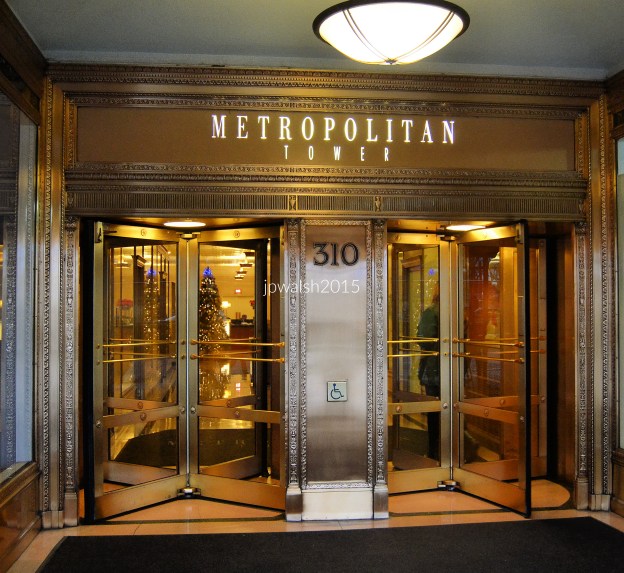
Feature Image: Main Entrance, Metropolitan Tower (1924), 310 South Michigan Avenue, Chicago, was designed by Graham, Anderson, Probst & White. December 2015. 4.89 mb DSC_0963 (1). Author’s photograph.

Metropolitan Tower’s main entrance is more than an architectural detail: it is a surviving gateway to one of Chicago’s most significant early skyscrapers, a building that embodied the ambitions, craftsmanship, and corporate prestige of the 1920s while reflecting the evolution of Michigan Avenue and modern Chicago.
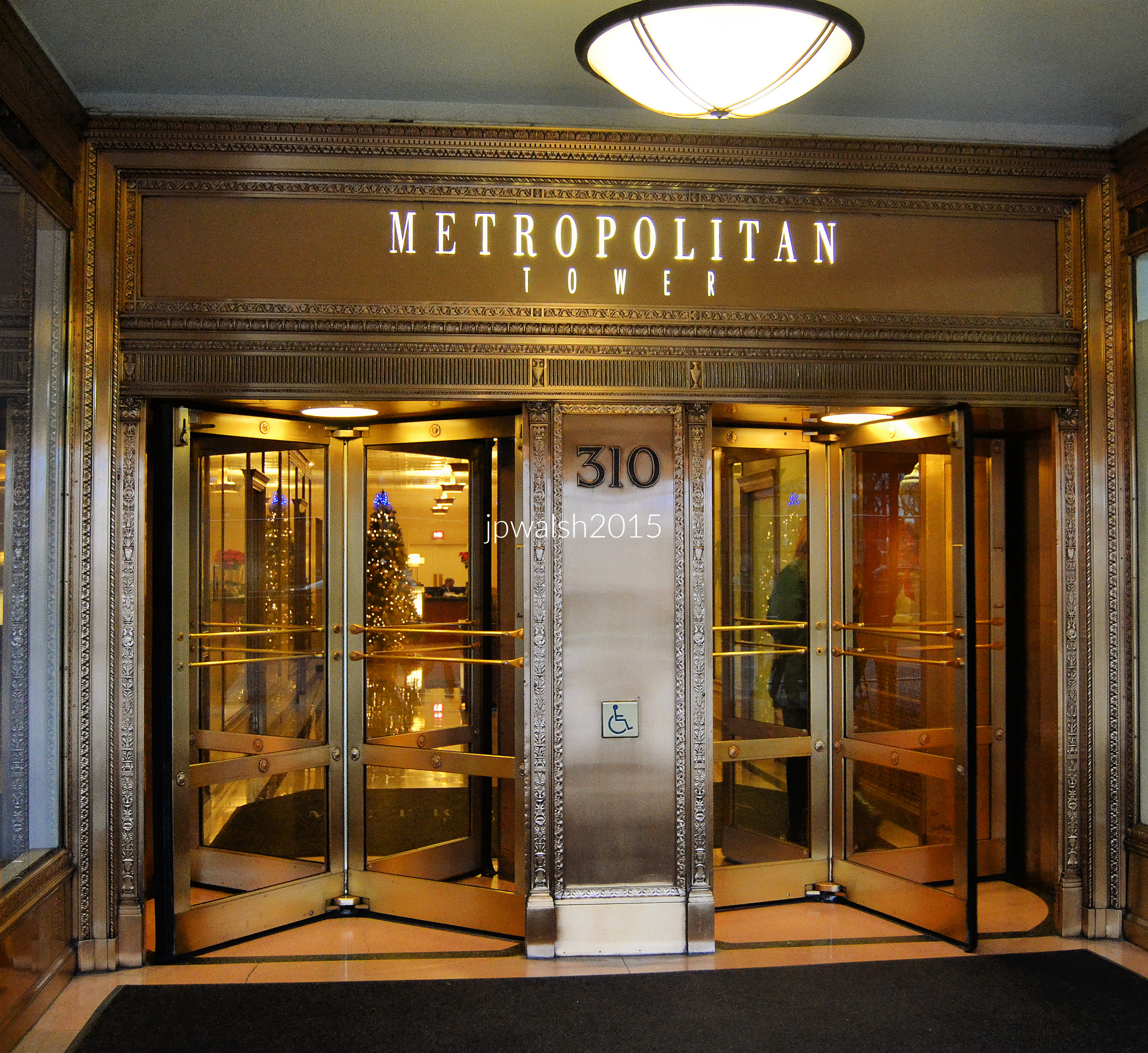
Located at 310 South Michigan Avenue on the southwest corner of Jackson Boulevard, Metropolitan Tower originally served as corporate headquarters for S.W. Straus and Co., a banking and investment firm. The building was erected in 1924 by Graham, Anderson, Probst & White in their signature classical style. The architectural firm was one of the largest in the first half of the twentieth century and went on to build Chicago’s Civic Opera Building in 1929. Founded in 1912, the firm was the successor to D. H. Burnham & Co. by way of partner, Ernest R. Graham (1868-1936), and Burnham’s sons, Hubert and Daniel Jr. Five years later the Burnhams left to form their own firm (Burnham Brothers) and Graham partnered with others of the firm’s members: William Peirce Anderson (1870-1924), Edward Mathias Probst (1870-1942), and Howard Judson White (1870-1936). No expense was spared for the Straus Building’s interior, though of the original lobby’s opulence all that remains are the elaborate bronze elevator doors. The entrance’s coffered bronze doors by Italian sculptor Leo Lentelli (1879-1961) were destroyed. see – Saliga, Pauline A., editor, The Sky’s The Limit A Century of Chicago Skyscrapers, Rizzoli New York, 1990, p. 117.

The Metropolitan Tower was built in 1924 as the headquarters of S.W. Straus & Co. and designed by Graham, Anderson, Probst & White, successors to the Burnham architectural tradition.

Ernest R. Graham (1868-1936).

William Peirce Anderson (1870-1924).

Edward Mathias Probst (1870-1942).

Howard Judson White (1870-1936).

The elaborate entrance and lobby originally featured exceptional decorative work, including bronze doors created by sculptor Leo Lentelli, although many original elements have been lost.
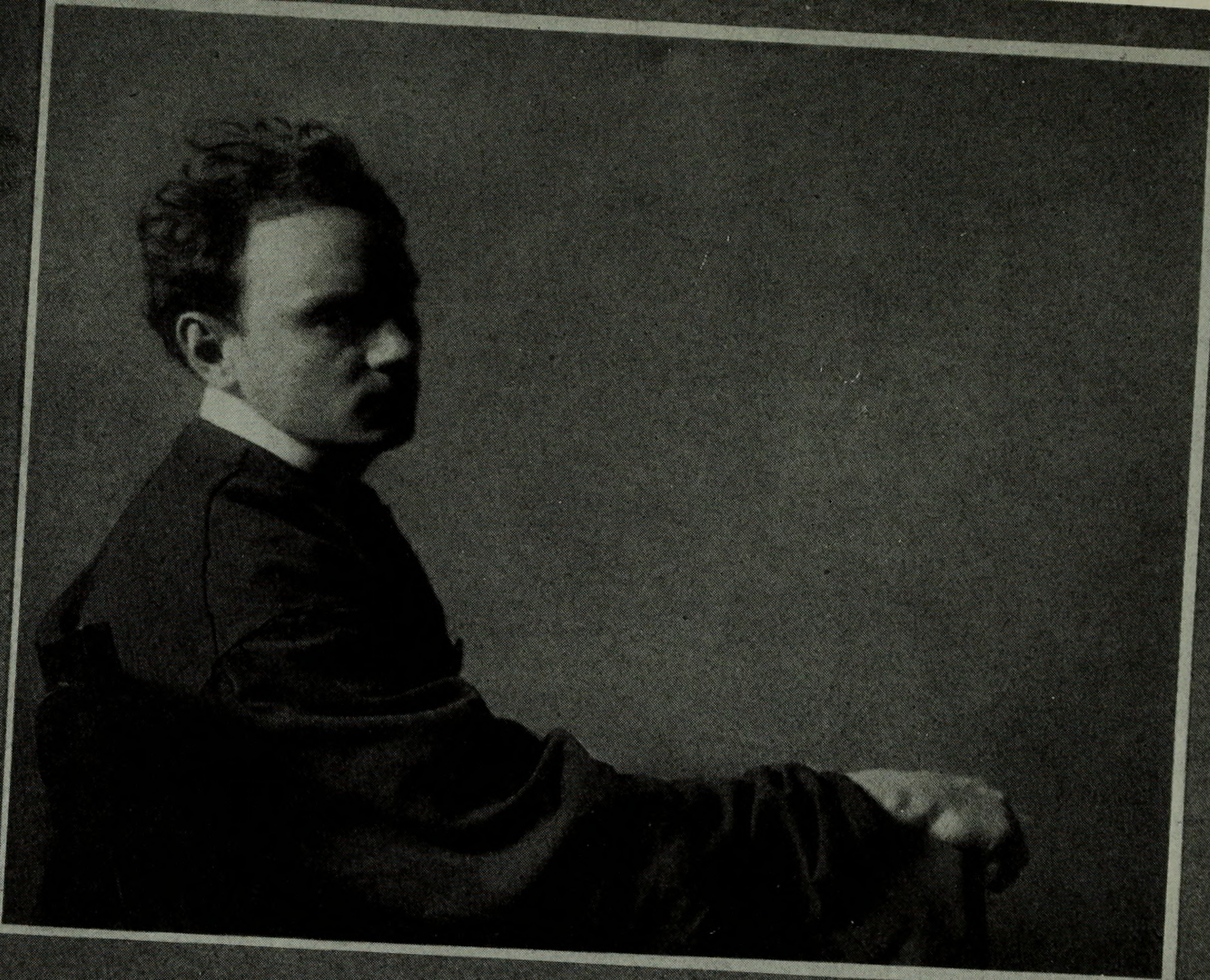
Leo Lentelli (1879-1961). The Italian sculptor created the original main entrance doors for Metropolitan Tower that were later destroyed. Public Domain.

The 30-floor classical-style Straus Building was renamed over the years for other of its famous inhabitants including Continental National Insurance Co. and Britannica Center for Encyclopedia Britannica. Metropolitan Tower was the first building in Chicago that took advantage of the new 1923 zoning ordinance for skyscrapers that allowed buildings taller than 260 feet (30 or more floors) with the necessary setbacks. Metropolitan Tower’s required setbacks begin at the 21st floor on which sits a nine-story tower until there is a second setback and then the final two stories. Crowned by a stepped pyramid and possessed of a powerful beacon that opened in 1924, the building is Chicago’s first Michigan Avenue skyscraper.

Metropolitan Tower was the first skyscraper on Michigan Avenue and one of the earliest buildings to take advantage of Chicago’s new 1923 zoning regulations permitting greater height through setbacks. Its distinctive stepped crown, beacon, and symbolic ornamentation made it a recognizable feature of the Chicago skyline.

Built in 1924, Metropolitan Tower was Michigan Avenue’s first skyscraper. PHOTO: “Metropolitan Tower, Chicago in May 2016” by MusikAnimal is licensed under CC BY-SA 4.0.

Unused for years, the building’s 1,500-pound carillon bells were restored in 1979 for Pope John Paul II’s visit to Chicago. Just steps from Metropolitan Tower, the papal visit included an outdoor mass in Grant Park on October 5, 1979, which attracted over one million attendees, the largest gathering ever in Grant Park history up to that time. see – CBS Chicago Vault: Pope John Paul II enthralls Chicagoans on 1979 visit – CBS Chicago – retrieved March 18, 2026.

At one time, the thirtieth floor was the Straus Tower Observatory, which was open to the public for viewing the city in all four directions. see – Home | Metropolitan Tower – retrieved February 24, 2026. Home to the Continental National Insurance Company soon after it was built, this iconic skyscraper is located within Chicago’s Landmark Historic Michigan Boulevard District. The glass “beehive” supported by four bison figures at the top of the building held the blue light of a four-direction beacon. The ensemble, symbolizing industry, strength, and thrift, saw its beacon, signifying global reach, permanently shut down in 1934 following the financial failure of the S.W. Straus and Company during the Great Depression. The building was converted to residential condominiums in 2007. see – Metropolitan Tower | Powered by Baird & Warner– retrieved February 24, 2026; AIA Guide to Chicago, 2nd Edition, Alice Sinkevitch, Harcourt, Inc., Orlando, 2004, page 42.

The building was constructed in a classical style and represented the high quality and prestige associated with major Chicago commercial architecture of the 1920s. Over time, the building adapted to changing uses and occupants, including Encyclopedia Britannica and residential condominiums, demonstrating its continued relevance and preservation.

Oriental Theatre, 1926: The Movie Palace That Never Stopped Entertaining Chicago.

FEATURE image: Oriental Theatre completed in 1926 and renamed the Ford Center for the Performing Arts in 1997. It became the Nederlander Theatre in 2019. December 2017. Author’s photograph.

The Oriental Theatre, designed by Cornelius Ward (C.W.) Rapp and George Leslie Rapp in 1926, represents both the architectural extravagance of America’s movie-palace era and the enduring cultural vitality of Chicago’s Loop entertainment district. Through its exotic design, long performance history, and successful restoration, the theater serves as a living monument to the evolution of popular entertainment in Chicago across nearly a century.

Ford Center For the Performing Arts/Oriental Theatre, Chicago. December 2017. Author’s photograph. 5 mb.

Rapp & Rapp designed nearly four hundred theatres in the United States between 1906 and 1926.

In Chicago’s Loop, the Oriental Theatre opened on May 8, 1926. During the first half of the 20th century, Randolph Street was one of the city’s most bustling entertainment districts.

Designed by the architectural firm of Rapp & Rapp—brothers Cornelius Ward (C.W.) Rapp (1861-1926) and George Leslie Rapp (1878-1941)—the Oriental Theatre was one of their many ornate movie palaces that they built. As its name “Oriental” suggested, it was imagined in a style inspired by a Western fantasia of India and South Asian themes and motifs. Inspired by this architecture of India and the Far East, lights consisted of elephant heads with tusks, walls were adorned with soft silk and regal velvets, and the ceiling was garishly decorated with plasterwork elephants and other exotic beasts. 

The theater’s architecture embodied a fantasy interpretation of Indian and Far Eastern motifs, featuring elephants, rich fabrics, elaborate plasterwork, and lavish ornamentation.

James M. Nederlander Theatre. Originally the Oriental Theatre. George L. and Cornelius W. Rapp, 1926. PHOTO: “James M. Nederlander Theatre interior” by Kenneth C. Zirkel is licensed under CC BY-SA 4.0.

Rapp & Rapp were alumni of the University of Illinois School of Architecture. The firm designed scores of theatres across the country in the first decades of the 20th century. The Rapp brothers were born in Carbondale in southern Illinois. Twenty-eight-year-old C.W. Rapp formed a partnership in 1889 with older architect, Canadian-born Cyrus P. Thomas (1933-1911) and they practiced together in Chicago until 1895. C.W. Rapp operated his own office for a decade until he formed a partnership with his brother G.L. Rapp in 1906. With stage entertainment and the boom of moving pictures after 1910, the firm of Rapp & Rapp quickly developed a reputation for their fantastic designs for silent film theatres in the Chicago area. Drawing on a large palette of architectural revival styles, Rapp & Rapp designed nearly four hundred theatres in the United States between 1906 and 1926.

In Chicago Rapp & Rapp designed State Street’s Chicago Theatre (1921) and the Bismarck Hotel and Theatre (1926). In New York City they built the since demolished Paramount Theatre (1926) in Times Square and the still-standing smaller-scaled Paramount Theatre (1931) in Aurora, Illinois.

Rapp & Rapp were among America’s premier movie-palace architects and designed such landmarks as Chicago’s Chicago Theatre and New York’s Paramount Theatre.

In the mid1990s, after the Oriental Theatre had been closed and shuttered for over a decade, it underwent a multi-million-dollar restoration and expansion by Daniel P. Coffey & Associates. It reopened as the Ford Center for the Performing Arts in 1998. Following its expansion, the former Oriental Theatre seats over 2,000 patrons.

Entertainment legacy

In the 1920s, the Oriental Theatre presented both movies and vaudeville acts. When talkies arrived, the Oriental Theatre became predominantly a movie house in the 1930s. Live stage, theatrical, and concert performances continued for mid20th century Chicago audiences during an era when Randolph Street was a mecca for crowds seeking out their favorite star performers. It also hosted smaller and vibrant live entertainment venues where one could seek out up-and-coming talents.

Duke Ellington and his orchestra made frequent appearances at the Oriental Theatre which welcomed patrons by way of an exotic ornate style. Some big names and legends in entertainment were seen at the Oriental Theatre including Judy Garland, George Jessel, Fanny Brice, George Burns and Gracie Allen, Cab Calloway, Eddie Cantor, Bing Crosby, Ella Fitzgerald, Jean Harlow, Billie Holiday, Bob Hope, Al Jolson, Danny Kaye, Jerry Lewis, The Marx Brothers, The Three Stooges, Frank Sinatra, Sophie Tucker, Sarah Vaughan, Henny Youngman, and a cast of thousands.

The Oriental Theatre closed in 1981 and remained shuttered for the rest of the 1980’s and into the early 1990’s depriving many young urban professionals from enjoying entertainment in a venue that, with its reopening in 1998, has operated continuously for nearly 100 years.

Ford Center for the Performing Arts in 1997 and the Nederlander Theatre in 2019

In 1997 the Oriental Theatre was renamed the Ford Center for the Performing Arts and restored and expanded for its re-opening in 1998. In 2019 the theatre was renamed in honor of James M. Nederlander (1922-2016), Broadway theatre owner/producer and Broadway In Chicago founder.

Today’s James M. Nederlander Theatre hosts touring pre-Broadway and Broadway shows whose résumé included a long-running production of Billy Elliot: The Musical. From June 2005 through January 2009, the theater housed a full production of Wicked, making it the most popular stage production in Chicago history. In December 2017, when the feature photograph was taken, a traveling national tour of Wicked had started its Chicago run.

After years of closure, the theater underwent a major restoration and expansion in the 1990s and reopened as the Ford Center for the Performing Arts in 1998. Renamed the James M. Nederlander Theatre in 2019, it continues to host major Broadway and touring productions, demonstrating the building’s enduring relevance.

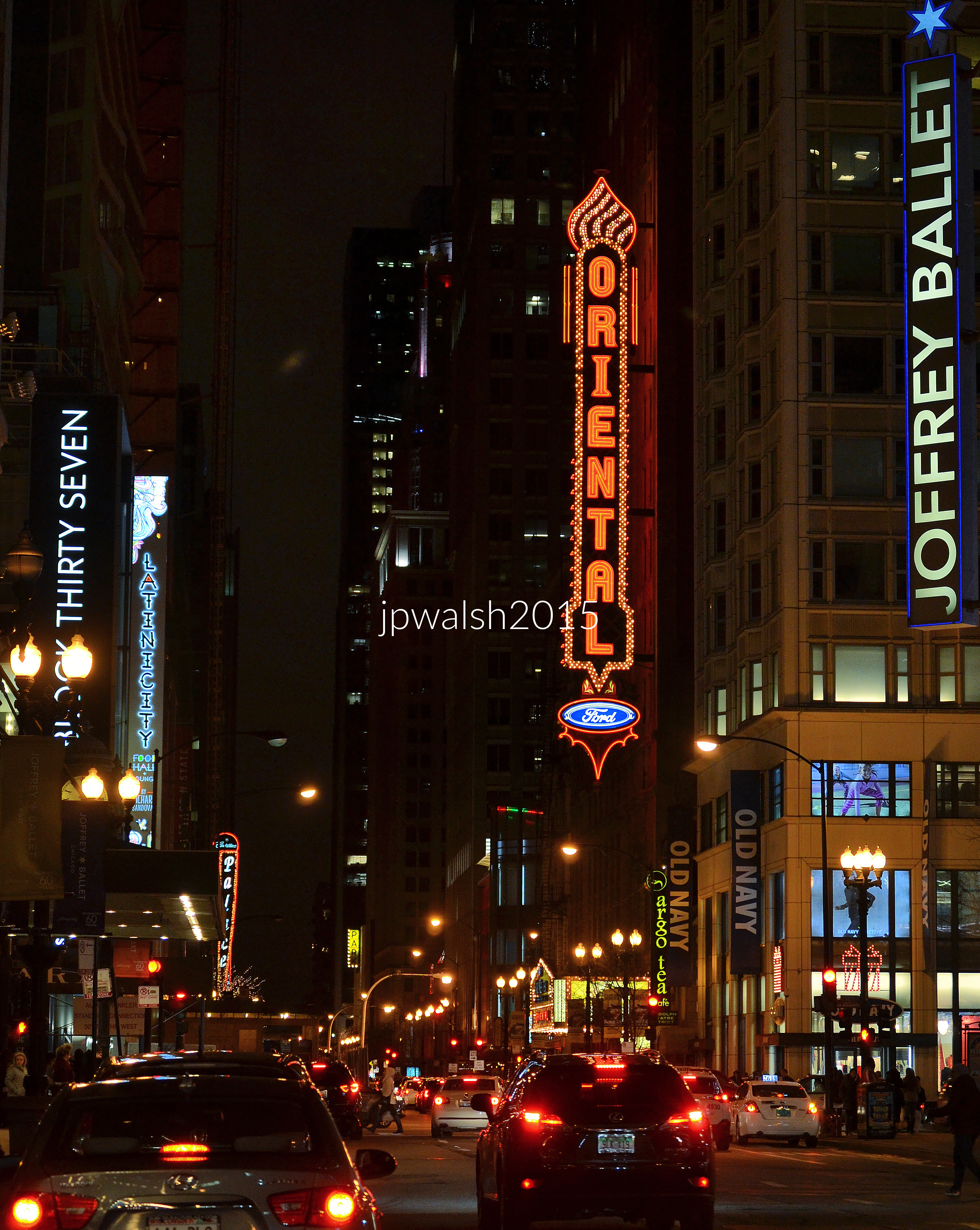
Oriental Theatre sign, Chicago. July 2016. Author’s photograph. 4.63 mb.

Major entertainers such as Duke Ellington, Judy Garland, Ella Fitzgerald, Frank Sinatra, and many others appeared there.

Oriental sign at night, Chicago. December 2015. Author’s photograph. 6.51mb DSC_0866 (1).

SOURCES:
Alice Sinkevitch, AIA Guide to Chicago, 2nd Edition, Harcourt, Inc., Orlando, 2004, p. 54.

http://www.dictionaryofarchitectsincanada.org/node/1354 – retrieved November 1, 2023.

http://www.dictionaryofarchitectsincanada.org/node/541 – retrieved November 1, 2023.

https://www.sah.org/community/sah-blog/sah-blog/2013/07/17/the-revitalized-and-the-neglected-rapp-and-rapp’s-movie-palaces-in-chicago– retrieved November 1, 2023.

Photograph & Text: