
FEATURE Image: Saint Francis kissing the leper, Zacarías González Velázquez, oil on canvas, c. 1787, 217×264 cm, Prado, Madrid. The painting is part of a serial of thirty-three scenes on the “Life of Saint Francis” commissioned for the Basilica of Saint Francis the Great in Madrid done by multiple Spanish painters. The artist was inspired by Saint Bonaventure’s biography of St. Francis that recounts this scene of Francis, dressed in the luxurious clothes of a rich knight, as he dismounts from his steed to kiss a leper. see – Saint Francis Embracing a Leper – The Collection – Museo Nacional del Prado – retrieved October 4, 2017.
By John P. Walsh
The April 20, 1949 photograph of Roberto Rossellini and Ingrid Bergman captures a pivotal turning point at which artistic collaboration, personal scandal, and cinematic innovation converged. As public fascination with their relationship intensified, Rossellini turned toward the creation of The Flowers of St. Francis (1950), a film whose central episode, Francis’s embrace of a leper despite his initial revulsion, presents spiritual transformation as the triumph over fear and self-interest. In doing so, the Italian neorealist director fashioned a work that also served as a retreat from public controversy into a world of humility, simplicity, and faith.

PHOTO: Roberto Rossellini and Ingrid Bergman – “Roberto Rossellini and Ingrid Bergman” by classic film scans is marked with CC BY 2.0.
A Photograph at the Eye of the Storm
Italian director Roberto Rossellini and Swedish actress Ingrid Bergman are seen in a photograph taken by an uncredited Associated Press photographer on April 20, 1949, during a press conference at Rome’s Excelsior Hotel. Bergman had just arrived in Italy after writing her famous, career-altering letter to Rossellini, and the announced purpose of the gathering was to discuss their forthcoming collaboration, Stromboli.
The image captures a pivotal moment. Rossellini was already celebrated as the leading architect of Italian neorealism through such postwar landmarks as Open City and Paisan, while Bergman was one of the world’s most admired film stars and an Academy Award winner. Their expressions and proximity suggest a shared artistic purpose and creative excitement. Yet the photograph also unintentionally records the beginning of a relationship that would soon become one of the most scrutinized scandals in international celebrity culture, dominating headlines and ultimately leading to their marriage on May 24, 1950.
From Public Scandal to Spiritual Retreat
Ironically, while caught in this intensifying media storm, Rossellini turned toward one of the most serene and spiritually focused projects of his career: Francesco, giullare di Dio (The Flowers of St. Francis, 1950). The film emerged in part from his desire to escape the relentless attention surrounding his private life. In place of scandal, fame, and controversy, Rossellini sought a subject grounded in humility, simplicity, peace, and detachment from worldly concerns.
Co-written with the young Federico Fellini, the film drew its structure and themes from two fourteenth-century Franciscan texts: I Fioretti di San Francesco (The Little Flowers of St. Francis) and La Vita di Frate Ginepro (The Life of Brother Juniper). Rather than constructing a conventional biographical narrative, Rossellini assembled a series of nine loosely connected episodes that celebrate the joy, innocence, and spiritual freedom of Saint Francis and his followers.
Neorealism and Franciscan Simplicity
Remaining faithful to his neorealist principles, Rossellini rejected professional actors and cast actual Franciscan friars from the Monastery of Nocera Inferiore as Francis and his companions. The production sought not spectacle but authenticity. Equally important was Rossellini’s ambition to strip away any cinematic artifice in favor of directness and humanity so to recreate on screen the visual spirit of Giotto’s proto-Renaissance frescoes of the Life of St. Francis.
Viewed in retrospect, the 1949 photograph of Rossellini and Bergman marks far more than the beginning of Stromboli. It stands at the intersection of two parallel stories: one a highly publicized romance that captivated the world, the other the creation of a film devoted to spiritual humility and transcendence. The contrast reveals the remarkable complexity of Rossellini’s career at the very moment his personal and artistic lives became inseparably entwined.
The Embrace That Changed a Life
One of the most important episodes in the life of St. Francis of Assisi (c. 1181-1226) appears midway through Roberto Rossellini’s 1950 film Francesco, giullare di Dio (The Flowers of St. Francis). In a powerful five-minute sequence (Beginning at 41:00), Francis deliberately seeks out and embraces a leper, one of the most feared and socially ostracized figures of the medieval world.
This encounter marks a decisive turning point. Until this moment, Francis had recoiled from lepers, sharing the fears and prejudices common to his age. By overcoming that revulsion and embracing the suffering man before him, he crossed the threshold from worldly, military ambition to love, humility and poverty based in spiritual commitment.
A Moment of Spiritual Transformation
Following the embrace, Francis collapses to the ground in tears and cries out, “My God, my Lord and my all! O great God!” The emotional outpouring signals a profound inner conversion. What begins as an act of compassion becomes an encounter with the divine.
For Francis, embracing the leper means more than helping someone in need. It represents the conquest of his own fear, pride, and self-interest. The rich young man from Assisi discovers a new path rooted in humility, love, and obedience to God.
The Bridge Between Two Lives
Historically and spiritually, the embrace of the leper forms the bridge between Francis’s failed military and worldly aspirations and his lifelong dedication to radical poverty, humility, and service. In Christian tradition, it is the pivotal catalyst of his transformation, the moment when he turns away from status and ambition and begins the journey that would make him one of the most beloved saints in history.
Rossellini captures this episode as the emotional and spiritual center of The Flowers of St. Francis. By portraying Francis’s willingness to embrace society’s most vulnerable outcast, the film affirms that true conversion begins not with power or achievement, but with the courage to overcome fear and recognize the dignity and humanity of others.
Is the film scene historically accurate?
The event of the embrace is historically accurate though dramatized in Rossellini’s film after Francis’s brotherhood is established. Rather, in history it occurred at the beginning of the Italian saint’s conversion – in fact, was its cause. This is an important distinction since the embrace was most significant for St. Francis. It could even be argued that without Francis’s embrace of the leper, there would be no St. Francis of Assisi at all.
In Francis’s own Testament written in 1225—one year before his death at 44 or 45 years old—the saint stated directly that his embrace of the leper became the cause of his conversion.
For a rich young man such as Francis in medieval Europe who, during an age of many French popes, sought chivalric glory in military arms, he naturally spurned the contagion of leprosy that was an incurable disease and diligently avoided lepers. As Francis put it, when he embraced the leper he “exercised mercy” to him as Francis bridged his natural ambition and religious doubt with trust in God’s grace by embracing Assisi’s despised.
In that way, the leper— a common sight throughout medieval Europe and one that readily filled the lighthearted Francis with horror—became the astonishing means for the saint’s conversion of faith.
Special order of knights founded by pope cared for lepers in Italy.
In thirteenth-century Europe, by law lepers had to live apart from the rest of society owing to their contagious infectious disease.
As early as the 6th century under Pope St. Symmachus (495–514) there were general hospitals in Rome that cared for lepers though a network of specialized leper houses became more prevalent by the 11th-century. In 1130, the hospitaller and military Order of Saint Lazarus was established so that at the Third Lateran Council in 1179, two or three years before St. Francis’s birth, Pope Alexander III helped formalize the church’s role in the care of lepers, emphasizing their separation for care rather than mere social isolation.

St. Thomas Becket takes leave of Pope Alexander III in the autumn of 1165. 13th century miniature attributed to Matthew Paris, British Library. Public domain.
In the time period that Rossellini’s poignant film scene is set — it is either 1205 or 1206—there existed in Europe tens of thousands of church-run “hospitals” for lepers. One such leper hospital was a short walk outside Assisi’s town walls. Called San Salvatore delle Pareti, the leper hospital near Assisi that began to intrigue a young Francis is today a farm field.
Before his famous encounter of embracing the leper, Francis —then around 24 years old—had to work up gradually to the crucial moment of embracing a leper.
After Francis gave up his several quests to be a soldier, he returned to Assisi disappointed and disenchanted. Though he found refuge in the embrace of family and childhood friends, the same impulses that led Francis to abandon a military career even before it started, now prompted him to walk beyond the comforts of Assisi’s walls onto the road that led to the leper hospital.
Young Francis visits the leper hospital — and it changes his life.
Near the hospital, Francis interacted very tentatively, first with those caring for lepers —a charitable church activity first recognized by Pope Gregory the Great (540-604 CE)—and then at times with the lepers themselves.
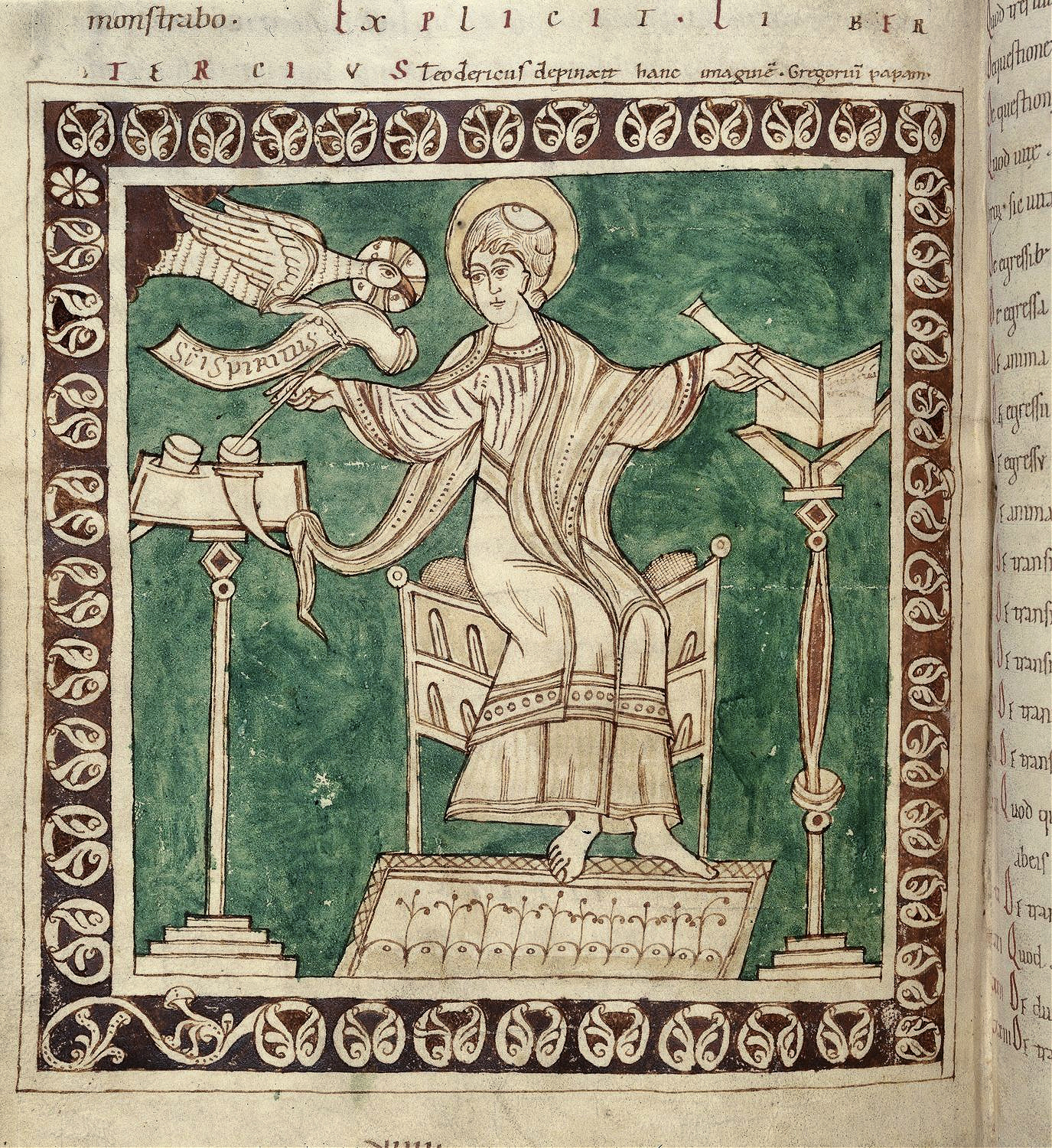
Miniature of Gregory the Great writing under the inspiration of the Holy Spirit, in a 12th-century copy of his Dialogues, British Library, London. Public Domain.
Come la notte Francesco pregando nella selva incontro il lebbroso —or, in English, “How St. Francis praying one night meets a leper.” This specific historical and cinematic moment represents the bridge between Francis’s failed worldly, military ambitions and his lifelong commitment to love, humility and poverty based in spiritual commitment.
To start, it was the sickening smell peculiar to the leper hospital wafting into Francis’s nostrils that made him flee.
But as his visits continued Francis—who by now was living as a hermit— journeyed to the leper hospital to leave them a charitable gift. After leaving it on the roadside, Francis vanished as bell-clanging lepers appeared.
It took Francis many more visits to the leper hospital as well as, in solitude, dwelling on his own thoughts and prayers to finally reach what he believed was God’s answer for him.
As clearly dramatized in Roberto Rossellini’s wonderful film, Francis discovered a deeper courage and confidence in himself—and in the same moment a supernatural faith— when along the road to the leper hospital he stepped up to leave for the leper the charitable embrace of one of the rich sons of Assisi.
Yet, following that encounter, Francis realized that the leper had given him a gift also.
After that Francis was free to profoundly pursue whatever track God called him to run. Francis could now be called to renounce the world’s riches. He married his “Lady Poverty” in their joyous mystical marriage so that even today, in the 21st century, poverty remains a major Franciscan charism. Francis and Lady Poverty have been married for over 800 years.
Following a lifetime spent in heroic Franciscan mendicancy, this world-famous Umbrian saint “Francesco” proclaimed to his Franciscan family and the world that it was at that exact moment when he embraced the leper—and the leper embraced him—that a life in and for God truly started.
St. Francis of Assisi has the indelible mark of the leper. He conquered fear and embraced the other in love no matter how godforsaken. Done in the context of divine trust and love, that faith-filled action set each man free.
SOURCE: St Francis of Assisi: A Biography by Johannes Jørgensen (1912). Translated from the Danish with the author’s sanction by T. O’Conor Sloane, Image books, 1955.

Sassetta (c.1392-c.1451), St. Francis in Ecstasy, back of the Sansepolcro altarpiece, 1437-44, Panel, 80 3/4 x 48 inches. Villa I Tatti, Florence.