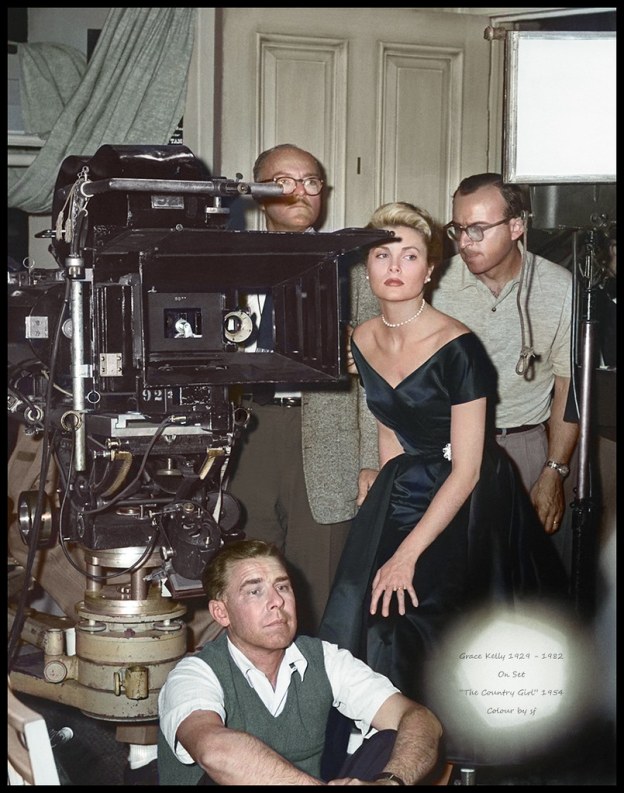

FEATURE image: Grace on the set of The Country Girl,1954. “Grace Kelly 1929 – 1982” by oneredsf1 is licensed under CC BY-NC-SA 2.0.
Grace Kelly’s rise from a disciplined, ambitious Philadelphia upbringing to international stardom was not simply the story of extraordinary beauty, but of talent, professionalism, artistic ambition, and careful career choices that transformed her into one of Hollywood’s most admired actresses before she left the screen at the height of her fame to become Princess of Monaco. Her brief film career between 1951 and 1956 produced an enduring legacy that united screen acting, fashion, celebrity culture, and modern royalty.
Philadelphia-born Grace Kelly (1929-1982) had a short but dazzling film career in Hollywood. Called the “Greatest Screen Presence in Film,”1 passionate and dramatically talented Grace Kelly was Alfred Hitchcock’s favorite actress when she starred in three of his classic films of the 1950’s: Dial M For Murder (1954), Rear Window (1954) and To Catch a Thief (1955).
After Grace was discovered in 1951 by Gary Cooper who said that Grace was “different from all these actresses we’ve been seeing so much of”2—and cast in High Noon (1951) as Cooper’s movie wife—Grace Kelly’s incomparable charm and allure swiftly impressed Hollywood and the world.
From September 1951 to March 1956 Grace Kelly’s star blazed across the silver screen in eleven major motion pictures for five different Hollywood studios. Grace was at the height of her career when she exited Hollywood to get married to the prince of Monaco in Europe, in April 1956.

Grace Kelly in 1954. Kelly was one of the 1950’s fashion icons. PHOTO credit: “Grace Kelly, 1954” by thefoxling is marked with CC BY-NC-SA 2.0.
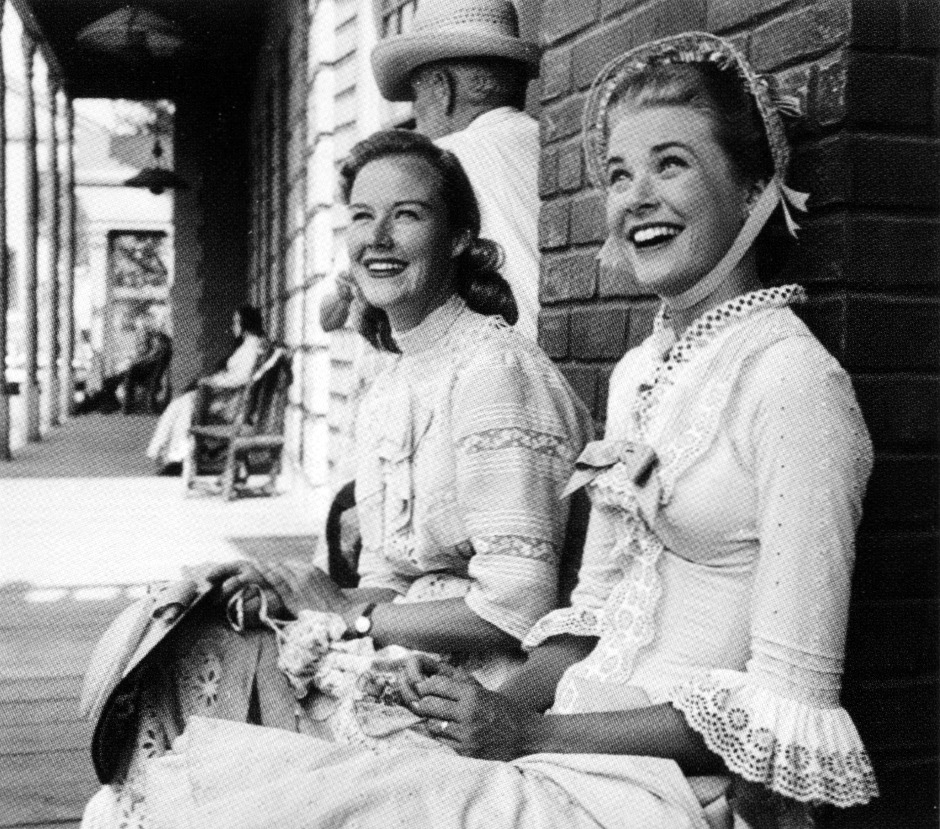
Grace Kelly and her stand-in Dorothy Towne on the set of High Noon (1952).
High Noon (1952), directed by Fred Zinnemann, is a classic American Western that unfolds in near real time. On his wedding day to Quaker bride Amy Fowler Kane (Grace Kelly), retiring Hadleyville marshal Will Kane (Gary Cooper) learns that Frank Miller, the outlaw he once sent to prison, has been pardoned and is arriving on the noon train seeking revenge. Though he has the chance to leave town with his new wife, whose pleas to flee grow increasingly desperate, Kane’s unwavering sense of duty compels him to stay. As the clock relentlessly counts down toward noon, he discovers that the townspeople who once depended on him are unwilling to stand beside him. Abandoned by friends, colleagues, and neighbors, Kane is left to confront Miller and his gang alone in one of cinema’s most powerful examinations of courage, conscience, and moral responsibility.
Gary Cooper, who co-starred with Grace Kelly in High Noon, took credit for discovering her. Cooper was impressed with her acting talent, good looks, work ethic, and professionalism.

Before she became known as Hollywood’s pristine, untouchable “Ice Queen” or the Princess of Monaco this photgraph was taken in October 1951 by photojournalist Carl Mydans for LIFE Magazine. It was taken on location in Burbank, California, on the outdoor backlot set of the classic Western High Noon (1952). Grace Kelly was 21 years old and filming her first major starring Hollywood role as the Quaker wife of Gary Cooper’s character. PHOTO: “Grace Kelly 1929 – 1982” by oneredsf1 is marked with CC BY-NC-SA 2.0.

Promotional photograph shows Ava Gardner (left) and Grace Kelly (right) standing together outdoors on location in Africa during the filming of the 1953 John Ford Technicolor adventure/romantic film Mogambo. With two Hollywood films under her belt (Fourteen Hours in 1951 and High Noon), Grace Kelly was nominated for her first Oscar for Best Supporting Actress in John Ford’s Mogambo (1953). Kelly plays Linda Nordley, who arrives at the camp in Africa with her husband. She soon has an affair with Marswell (Clark Gable), the camp’s big game hunter. When Marswell later tries to break off the affair to protect her marriage, it leads to a dramatic climax where a distraught Linda shoots him, an act that is ultimately covered up by Ava Gardner’s character to save Linda’s reputation.
Both actresses are captured in a candid, joyful moment, smiling away from the camera. Ava Gardner stands with her hands raised slightly, while Grace Kelly stands confidently with one hand on her hip, leaning against a rustic wooden fence structure. Despite their completely contrasting backgrounds and temperaments, Ava Gardner and Grace Kelly formed an incredibly close, lifelong friendship on the set of Mogambo (1953). Ava absolutely adored Grace and playfully nicknamed her “Gracie.” In her memoir, Ava: My Story, Gardner wrote warmly about her co-star: “She was a great lady and also great fun.” When Ava noticed Grace wearing a pair of old, worn-out shoes on set she joked, “Surely you can afford new shoes?” Grace explained they were sentimental favorites from high school. Ava also fondly remembered trying to get Grace to drink with her, noting, “She was never much of a drinker, though she tried hard…”
Grace deeply respected Ava’s raw beauty, honesty, and confidence. Grace remarked on how Ava commanded a room: “When Ava Gardner gets in a taxi, the driver knows at once she’s Ava Gardner… but not for me. I’m never Grace Kelly, I’m always someone who looks like Grace Kelly.” After Grace engaged in a brief, intense affair with their co-star Clark Gable and he broke it off, Grace sought Ava’s advice, who told her, “He likes to conquer, and when he’s done, he’s through.” When Grace married Prince Rainier III in 1956 to become the Princess of Monaco, Ava was personally invited to the wedding, though she ultimately declined to attend to avoid a media spectacle with her ex-husband Frank Sinatra, who was also on the guest list. However, Grace never forgot Ava’s birthday. No matter where Ava was in the world, a bottle of fine Dom Pérignon champagne and a handwritten card from Grace would arrive every single year. The two remained close confidantes and exchanged highly personal letters for decades, with Grace writing to Ava about the realities of settling into Monaco and her first pregnancy. PHOTO Credit: Ava Gardner and Grace Kelly on location in Africa for Mogambo (1953). Publicity still by Metro-Goldwyn-Mayer (MGM). Status: Public Domain.
Following High Noon for United Artists, Grace’s performance for M-G-M on John Ford’s Mogambo (1953) led to her first Academy Award nomination as Best Supporting Actress. This was a coup for Grace Kelly who had made two films and was only one of many actresses considered for the role. Neither was Grace the studio’s first choice for the part of Linda Nordley, but English actress Deborah Kerr. It was mostly thanks to fellow Irish-American John Ford that worked to get fellow half-Irish Kelly the role – and Grace got to see the continent of Africa, “all expenses paid.” Always looking ahead, Kelly did Mogambo for many reasons not least of which was its overseas international connection.
Location filming in Africa began in November 1952 and continued until the end of January 1953. It was a major production, and out of the nervous excitement that seemed to imbue the project for the actors and crew, there shortly developed a sense of camaraderie and confidence. Grace contributed to the exciting professional spirit and a major outcome was that the Technicolor film from M-G-M was successful both critically and at the box office. It also raised the career prospects of its principals—namely, director John Ford, and Clark Gable, Ava Gardner, and newcomer Grace Kelly.3
At dinner in the safari camp compound, Linda Nordley (Grace Kelly) and her husband Donald are newly arrived guests. While Donald is captivated by Victor Marswell’s animated account of the upcoming gorilla safari, Linda remains unusually quiet, studying him with unmistakable interest. Hovering at the edges of the conversation, Honey Bear Kelly punctuates the evening with her sharp wit and sardonic remarks, laying the groundwork for the film’s celebrated romantic triangle and its clash of personalities, classes, and desires.
The elegant lilac-lavender dress Kelly wears in this sequence became one of the most memorable fashion statements in the film. Designed by MGM’s legendary costume department, it perfectly reflects Linda’s privileged, aristocratic background. Paired with a simple strand of white pearls, matching earrings, and impeccably coiffed hair, the look projects sophistication, restraint, and social polish. Amid the rugged African setting, Linda appears every inch the refined outsider, a woman whose carefully ordered world is about to be tested by both the wilderness around her and the powerful emotions awakening within it.
Clark Gable repeated the role of big-game hunter Victor Marswell that he played in Red Dust, M-G-M’s 1932 film co-starring Jean Harlow and Mary Astor. In the 1953 film, Marswell’s competing love interests were now played by Ava Gardner as Eloise Kelly and Grace Kelly as Linda Nordley. Grace Kelly was dressed by Helen Rose (1904-1985) costumer designer at M-G-M, for Mogambo. She wore a memorable well-cut pink shirt and, during one evening dinner, a flower dress which inspired its imitation among movie-goers. In 1956 Grace would be dressed again by Helen Rose for The Swan, though it is by being dressed by older and prolific costume designer Edith Head (1897-1981) that Grace Kelly became a fashion film icon.

From left: hairstylist Annabella Levy, actor Elizabeth Taylor and costume designer Helen Rose in 1954. Helen Rose did most of her costume design work at M-G-M which was Grace Kelly’s home studio. Helen Rose dressed Grace in Mogambo (1953) and The Swan (1956). Public Domain.
PD-US (licensing information : [1]) – no copyright notice (see source). https://en.wikipedia.org/wiki/Helen_Rose#/media/File:Levy-Taylor-Rose_in_Rhapsody.jpg
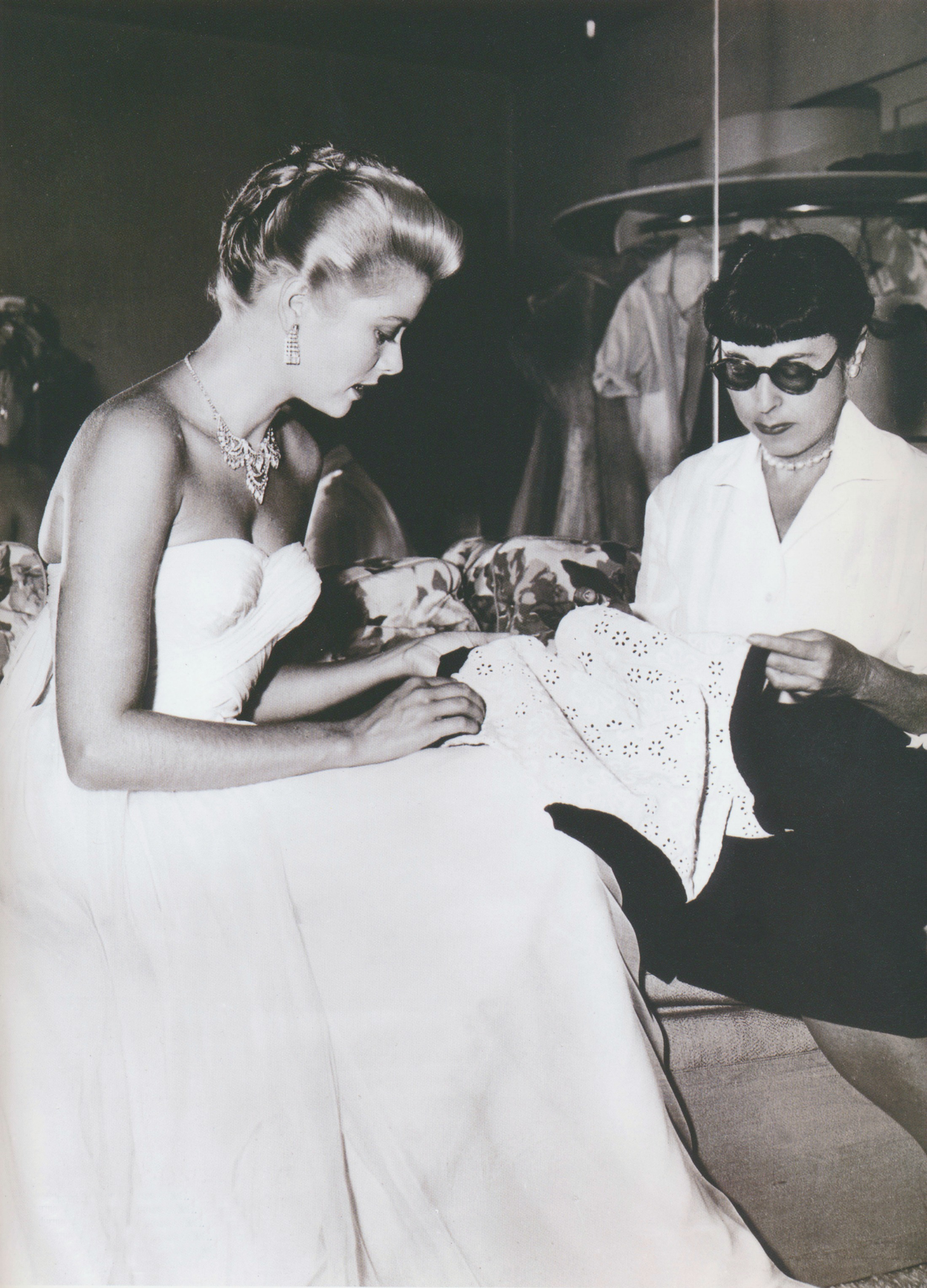
IN 1953 GRACE BEGINS HER FASHION COLLABORATION AND FRIENDSHIP WITH ACADEMY-AWARD-WINNING COSTUME DESIGNER EDITH HEAD.

The photograph was taken by Virgil Apger, one of the most accomplished portrait photographers of Hollywood’s Golden Age and head of MGM’s portrait gallery. Created as a studio publicity still, the image was designed to introduce Grace Kelly as Metro-Goldwyn-Mayer’s newest prestige star after the studio signed her to a seven-year contract following her breakthrough performance in Mogambo. Virgil Apger’s composition masterfully captures the “Ice Queen” archetype that came to define Grace Kelly’s celebrity persona.
Every detail of the portrait reinforces that carefully crafted image. The oversized black straw hat, pearl earrings, and single strand of pearls project elegance, wealth, and effortless refinement. Rather than following the overtly glamorous pin-up style popular in the period, MGM presented Kelly as something rarer: the embodiment of patrician chic, a woman whose beauty derived as much from grace, intelligence, and self-possession as from conventional Hollywood glamour.
The timing was perfect. In 1953, Kelly transformed virtually overnight from a promising stage and screen actress into one of Hollywood’s most sought-after stars. Her acclaimed performance in Mogambo earned her first Academy Award nomination and brought her to the attention of Alfred Hitchcock, who would soon cast her in Dial M for Murder and Rear Window, cementing her place among the era’s screen elite. PHOTO: “Grace Kelly” by twm1340 is marked with CC BY-SA 2.0.

Grace Kelly in wardrobe by Edith Head for The Bridges of Toko-Ri. Filming began in January 1954.
Grace Kelly’s Iconic Film Dresses Restored. By 1953 Grace Kelly was becoming as famous as Audrey Hepburn for her fashion sense so that legendary costume designer Edith Head found Kelly a joy to work with. https://youtube.com/shorts/ZkSOa7j1FlE?si=crKcmfrrVgoHr2Rl – retrieved March 17, 2026.
In July 1953 Grace began work on Dial M For Murder for Warner Brothers where she met Alfred Hitchcock who became a cinematic mentor. Soon after, The Bridges at Toko-Ri (1954) at Paramount Pictures began Grace’s ground-breaking multi-film collaboration with Academy-Award winning costume designer Edith Head. In the 1930’s, costume designer Edith Head leaned liberal in her costume designs. By the 1950’s, when she worked with Grace, Head’s fashion designs became more conservative. Edith Head and Grace Kelly became lifelong friends. Even after Grace left Hollywood and became Princess of Monaco, Edith Head, who had a very busy schedule as a prolific and successful costume designer in Hollywood – a record eight Academy Awards for Best Costume Design between 1949 and 1973 – visited Grace in Monaco on vacations right up to the time of Kelly’s untimely death at 52 years old on September 14, 1982 following a car accident.
In 1952 Grace Kelly played Amy Fowler Kane in Fred Zinnemann’s High Noon. In 1953 Kelly received an Oscar nomination for Best Supporting Actress for her performance as Linda Nordley, one side of a love triangle, in John Ford’s Mogambo with Hollywood stars Clark Gable and Ava Gardner. Grace had made her first of three films with Alfred Hitchcock as Margot Mary Wendice in Dial M For Murder (released in May 1954). So, when filming started in January 1954 for The Bridges at Toko-Ri, Grace Kelly, who just turned 24 years old, had already made remarkable films.

Taken in late 1953, this portrait captures Grace Kelly at the precise moment she stood on the threshold of international stardom. The photograph was made in New York City by the legendary celebrity photographer Milton H. Greene, whose gift for moving beyond the rigid glamour of the Hollywood studio system produced some of the era’s most natural and revealing portraits. Greene photographed many of the entertainment world’s biggest stars, including Marilyn Monroe and Judy Garland, emphasizing poise, personality, and vulnerability over conventional publicity poses.
The image was created for a major profile and fashion feature commissioned by Look magazine, which devoted an extensive spread to Kelly in early 1954 as Hollywood studios began promoting her as a leading new star. The timing was ideal. Within months, Kelly appeared in a remarkable succession of landmark films: Mogambo (1953), which earned her an Academy Award nomination; Alfred Hitchcock’s Dial M for Murder and Rear Window (both 1954); and The Country Girl (1954), for which she won the Academy Award for Best Actress. Seen in retrospect, Greene’s portrait preserves the image of a young actress just before one of the most extraordinary ascents in Hollywood history transformed her into an international icon. PHOTO image: “Grace Kelly 1929 – 1982” by oneredsf1 is marked with CC BY-NC-SA 2.0.
The year 1954 proved to be a banner year for Grace Kelly’s scintillating Hollywood career. In August/September 1954 Alfred Hitchcock’s Rear Window was released. The part of Lisa Carol Fremont solidified Kelly’s image as a fashion icon. Other films released in 1954 starring Grace Kelly were Green Fire with Stewart Granger, The Bridges at Toko-Ri with William Holden and The Country Girl with Bing Crosby – all December 1954 releases. In the dressed-down role of Georgie Elgin Grace Kelly’s performance brought her that year’s Academy Award for Best Actress in a Leading Role in March 1955. In May 1955 Grace Kelly met Prince Rainier III (1923-2005) of Monaco and the couple were engaged by the end of the year.
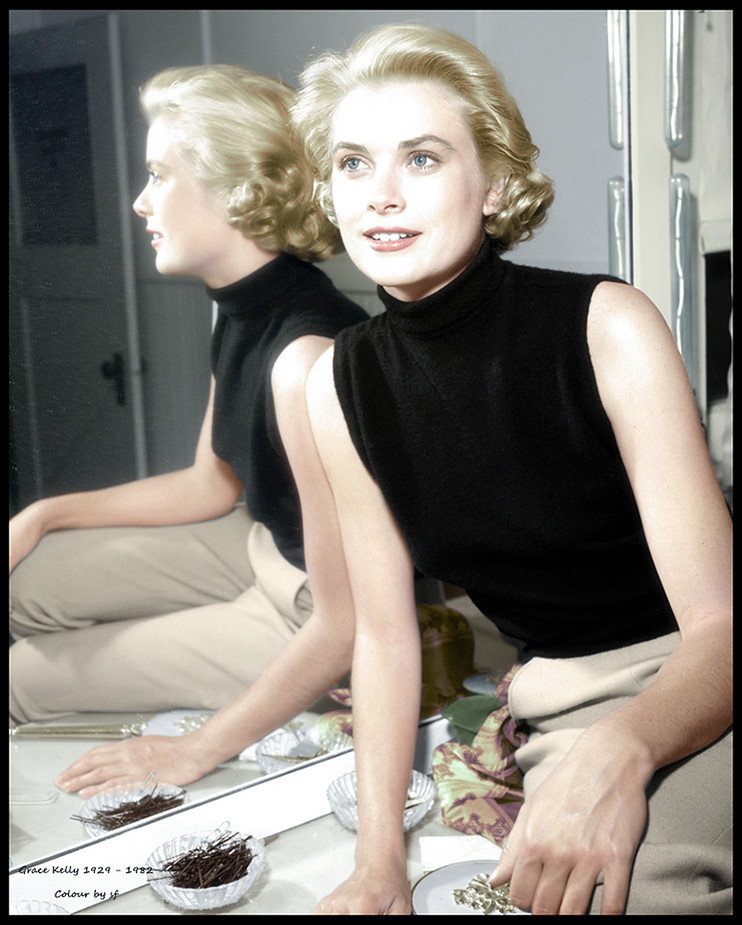
A behind-the-scenes photograph of Grace Kelly in 1954 shot by celebrity and lifestyle photojournalist Gene Lester. Captured in her studio dressing room during the filming of The Bridges of Toko-Ri, her outfit epitomizes 1950s All-American casual elegance, sometimes referred to as “patrician chic.” She wears a form-fitting, sleeveless black knit turtleneck paired with high-waisted, tailored tan slacks. While she wore high-fashion studio wardrobe designed by legends like Helen Rose and Edith Head for her movies, this minimalist, off-duty ensemble consisted of her own personal clothing rather than a formal studio design. In the film set in the Korean War, Grace played a small but pivotal role as Nancy Brubaker, wife of Lt. Harry Brubaker (William Holden). PHOTO credit: “Grace Kelly 1929 – 1982” by oneredsf1 is marked with CC BY-NC-SA 2.0
Kelly had been working constantly since 1951. She made the entertaining color action feature The Bridges at Toko-Ri for Paramount Pictures. The film is significant for the fact that it started the collaboration of Grace Kelly with costume designer Edith Head as well as was a serious film dealing with the Korean war.
Before meeting Prince Rainier III in May 1955 upon leading the American delegation that year to the Cannes Film Festival and making the Hitchcock thriller, To Catch a Thief, co-starring Cary Grant, Grace had her share of romantic involvements, including during the making of The Bridges at Toko-Ri.
In The Bridges at Toko-Ri Grace Kelly is Nancy Brubaker, the young wife of Navy pilot Lieutenant Harry Brubaker (Holden). A husband and father, Brubaker never wanted to be a flyer in the Navy and still wants out. Yet he accepts a very risky and dangerous mission during the Korean War and is killed in action. The commander asks—is it really a good mission if lives of good men are lost? The film is based on a novel by James Michener who recounted actual missions he covered as a correspondent on U.S. air craft carriers that were flying bombing missions on railroad bridges in North Korea in 1951 and 1952.

A promotional publicity still of Grace Kelly from the production of Paramount Pictures’ The Bridges at Toko-Ri (1954). She is pictured in character as Nancy Brubaker, wearing her signature elegant travel wardrobe, including a halo-style white hat and heavy winter overcoat. One of the finest major motion pictures made about the Korean war, The Bridges at Toko-Ri featured Grace Kelly playing the wife of a U.S. Navy pilot (William Holden) who is killed in action. The Bridges at Toko-Ri is based on a book by James Michener, it was filmed in Technicolor and had the full cooperation of the U.S. Navy. Image Source: Grace Kelly as Nancy Brubaker in a promotional portrait for The Bridges at Toko-Ri (1954). Publicity still by Paramount Pictures. Public Domain.
Though Kelly has a relatively small part in the war film, she is radiant in every scene. This is the first film where Grace Kelly appears in bed. Directed by prolific Marc Robson, The Bridges at Toko-Ri was one of the biggest hits of his career. Lyn Murray composed the musical score. Murray started in Hollywood in 1950 doing vocal arrangements for Walt Disney but soon was writing music for feature films throughout the 1950’s and 1960’s.
The film is a noisy and straightforward tale of one small American family in war-time. It combines humor notably provided by Mickey Rooney as CPO NAP Mike Forney that soon collides with war’s high-stakes mortal danger whose scenes look to presage Vietnam. The film’s cooperation with the U.S. Navy led to realistic and spectacular aerial and carrier action scenes that, in 1956, won the Academy Award for Best Special Effects.
Though the critical consensus surrounding Grace Kelly’s performance in The Bridges at Toko-Ri (1954) is that she is warmly sympathetic, deeply grounding, but intentionally underutilized, it showcased her versatility. Her performance as Nancy Brubaker proved she could seamlessly pivot from high-society thrillers to a grounded, emotionally raw wartime drama while effortlessly commanding the screen. This built momentum for her Oscar win as Best Actress in March 1955 for The Country Girl.
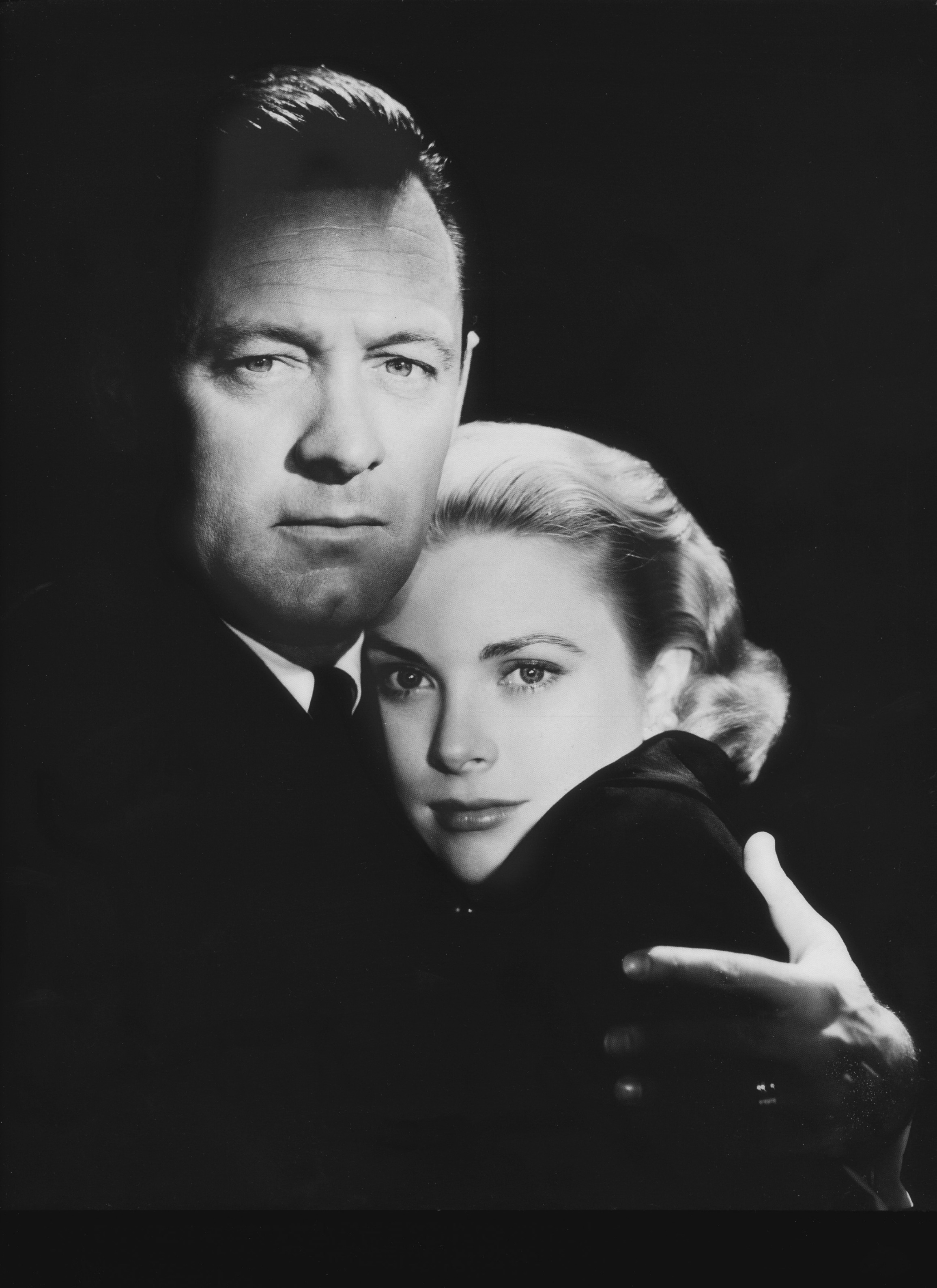
A promotional still from the 1954 Korean War drama The Bridges at Toko-Ri, the first of two films Grace Kelly and William Holden made together that year, followed by The Country Girl. Holden stars as Lt. Harry Brubaker, a World War II veteran and Naval Reservist recalled to combat service in Korea, while Kelly plays Nancy Brubaker, the devoted wife anxiously waiting for his return.
The pairing proved compelling both on and off the screen. During the production, Kelly and Holden began a passionate romance that continued through the filming of The Country Girl. In The Bridges at Toko-Ri, they portray a loving, deeply committed married couple facing the uncertainties of war, a striking contrast to the troubled and emotionally fractured relationship they would depict in their next film. At the height of their Paramount careers, their off-screen relationship added an extra layer of intensity to two of the most memorable collaborations in either star’s career. The electricity of that affair is evident in the love scenes where they played movie husband and wife.
That tension gives the photograph an added resonance today. What appears to be a conventional Hollywood publicity still also captures two major stars at the beginning of a brief but consequential romance, one that unfolded behind the carefully managed façade of 1950s studio-era glamour. Later biographers would describe the relationship as one of the most significant and emotionally charged of Kelly’s Hollywood years, although many of the more colorful stories surrounding the affair remain the subject of debate. Image Source: William Holden and Grace Kelly in a promotional portrait for The Bridges at Toko-Ri (1954). Publicity still by Paramount Pictures. Public Domain.
Holden as Airman Brubaker tenderly expresses his sense of loss when his fellow airmen Mike Forney and Nestor Gamidge (Earl Holliman) are whisked off to other navy assignments. Their entire job was to save the lives of airmen in battle—and had saved Brubaker’s – so that their sudden professional absence is personally and deeply felt.
This is a film of the mid 1950s with caring commanders who look and talk remarkably like Ike, then President of the United States and who had just ended the Korean action in July 1953. Chain smoking by nearly everyone in the cast appears to be de rigueur. Listening to navy radio Lieutenant Harry Brubaker is riveted hearing a broadcast from Chicago’s famous Chez Paree nightclub showcasing jazz trumpeter Henry Busse. The local flair and period cultural items add interest to the fine acting and timeless beauty of Grace Kelly along with the film’s fact-based war story and blockbuster action. Almost 70 years after its initial release, The Bridges at Toko-Ri continues to be a worthwhile entertainment.
Though the film was panned by many, Grace Kelly was the reason the box office thrived for Green Fire, a drama about emerald miners in South America co-starring Stewart Granger. It was produced in Cinemascope and Eastman Color.
Although Green Fire (1954) is not among Grace Kelly’s best-known films today, it was one of MGM’s most ambitious location productions of the period, filmed extensively in Colombia, South America. The Magdalena River setting gave the film an authenticity and exotic atmosphere uncommon in 1950s Hollywood adventure pictures. For Kelly, the role of Catherine Knowland continued the screen persona that was quickly becoming her trademark: intelligent, poised, and self-assured women whose elegance concealed considerable determination and strength.

Designed by M-G-M’s Helen Rose, Grace’s costume is a masterful blend of practicality and sophistication. The soft pink blouse and sturdy leather belt with matching sun hat acknowledge Catherine’s active life on a South American plantation, while the tailored silhouette preserves the refinement and understated glamour that had already become synonymous with Grace Kelly’s screen image. In Green Fire, Grace Kelly plays a coffee plantation owner in Colombia who clashes—and eventually falls in love with—an emerald miner named Rian Mitchell (played by Stewart Granger). PHOTO credit: “Grace Kelly 1929 – 1982” by oneredsf1 is marked with CC BY-NC-SA 2.0.

Taken in March 1954, this portrait captures Grace Kelly at the height of her meteoric rise to Hollywood’s front rank. Within that remarkable year, she starred in three landmark films: Alfred Hitchcock’s Dial M for Murder and Rear Window, and George Seaton’s The Country Girl, the dramatic performance that earned her the Academy Award for Best Actress. The photograph was made by Clarence Sinclair Bull, the legendary chief portrait photographer of MGM, whose images helped define the visual language of Hollywood’s Golden Age. Unlike the more intimate, candid style favored by photographers such as Milton Greene, Bull specialized in polished studio glamour. Every aspect of this portrait, from the lighting and pose to the immaculate styling, was carefully orchestrated to project elegance, refinement, and star power. The result is a quintessential MGM image: a young actress on the verge of becoming not merely a movie star, but one of the most admired and recognizable women in the world. PHOTO: “Grace Kelly” by manitou2121 is marked with CC BY 2.0
Dial M for Murder was filmed starting August 1953 and officially released in theaters on May 29, 1954. A stage play on film, the action in Dial M For Murder is limited to a few rooms. The story concerns a tennis player (Ray Milland) who arranges to kill his wife (Grace Kelly) to inherit her money. Shot in WarnerColor, the cast included Robert Cummings.

Taken in 1954, this photograph was made by legendary LIFE magazine staff photographer Loomis Dean at the absolute pinnacle of Grace Kelly’s meteoric Hollywood ascent. Renowned for his lifestyle and environmental portraiture, Dean often stepped beyond the rigid confines of studio sets, preferring to photograph celebrities in natural settings and available light. The image was created as part of a major LIFE magazine feature documenting Kelly’s emergence as the film industry’s newest “it-girl,” fashion trendsetter, and rising star.
Rather than placing her before a painted backdrop or carefully controlled studio arrangement, Dean photographed Kelly outdoors on the Paramount lot, seeking an atmosphere of effortless, ethereal glamour. He positioned her directly before the afternoon sun, employing a technique known as rim lighting. The backlighting catches the fine strands of her blonde hair, creating a luminous halo that seems to separate her from the surrounding world. The effect is both natural and carefully orchestrated, transforming a publicity photograph into an image that reinforces the qualities Hollywood was then cultivating around Kelly: elegance, poise, refinement, and an almost otherworldly beauty. PHOTO: “Grace Kelly 1929 – 1982” by oneredsf1 is marked with CC BY-NC-SA 2.0.
In the 1940s and early 1950s, Hollywood publicity was dominated by highly processed glamor portraits. Photographs of Kelly convey a completely different ideal: a natural, sophisticated, and serene presence that felt entirely authentic. It perfectly broadcasted her signature appeal—a woman of elite aristocratic poise who remained utterly relaxed and accessible.
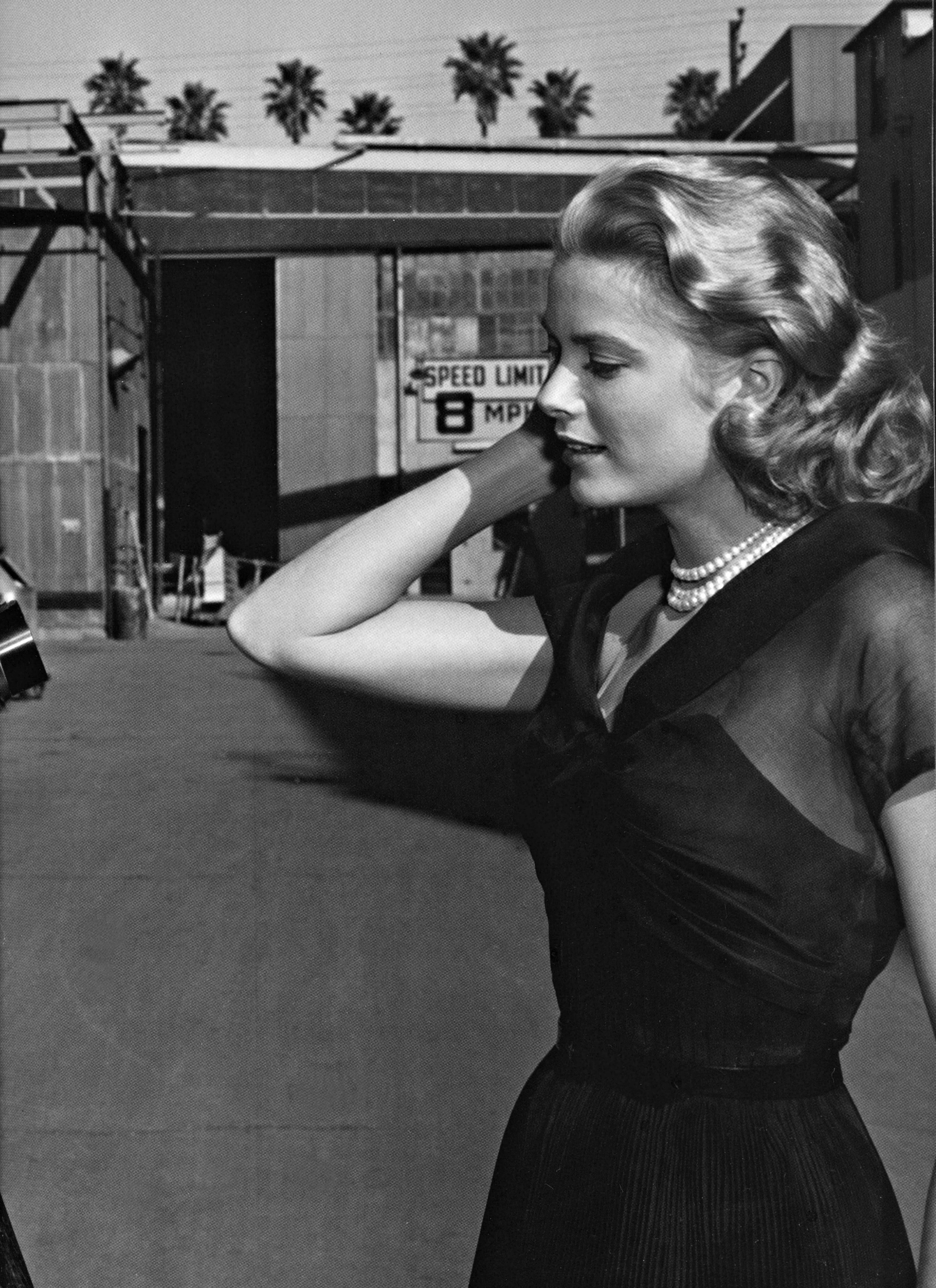
On the set of Rear Window (1954).

The background reveals Alfred Hitchcock’s enormous Greenwich Village courtyard set, constructed on Paramount’s Stage 18 and then among the largest indoor sets ever built for a motion picture. Grace Kelly wears one of the most celebrated costumes in cinema history, designed by Edith Head for her role as Lisa Fremont. Drawing on Christian Dior’s influential postwar “New Look” silhouette, Head combined a deep-cut black velvet bodice with a sweeping, multi-layered white chiffon skirt accented by delicate black branch-and-leaf embroidery at the waist and hips. Kelly’s signature pearl necklace completes the look. The costume serves a dramatic purpose beyond fashion: it instantly defines Lisa as a sophisticated Manhattan socialite whose elegance seems worlds apart from Jeff’s rough-and-ready lifestyle. Yet as the story unfolds, she proves far more adventurous, courageous, and resourceful than her glamorous appearance initially suggests, making the gown an enduring symbol of one of Hitchcock’s most memorable heroines. PHOTO: James Stewart, Grace Kelly, and director Alfred Hitchcock on the massive courtyard soundstage set of Rear Window (1954). Publicity still by Paramount Pictures. Public Domain.
Principal photography for Rear Window began on November 27, 1953, and wrapped in early 1954. Its highly anticipated premiere was in New York City on August 4, 1954, and the film was released nationally the following month. Grace Kelly received equal billing with co-star Jimmy Stewart.
Grace refused other lucrative film offers to work again with Hitchcock, this time at Paramount Pictures, on Rear Window co-starring Jimmy Stewart. In this landmark mystery thriller film which came out in summer 1954, one of Hitchcock’s dramatic emphases for Grace Kelly’s film persona was to display her natural elegance and sex appeal—he was amused by her public image as an “Ice Queen”4—by having her costumed in an array of fabulous Edith-Head-designed lingerie, dresses, and pants. Growing up in Philadelphia Grace Kelly as an adolescent and teenager had modeled in local fashion shows but, by the middle 1950’s in her mid-twenties, she became an international fashion and style icon.
Franz Waxman’s theme at first is presented as a romanza cantabile on the piano. Because Lisa’s love for Jeff is mostly unrequited—he is stubborn and resistant to letting a high-society woman into his messy life—the lonely piano notes highlight a sense of longing and romantic frustration. However, as the film moves toward its climax and Lisa proves herself, the song mirrors her triumph.

Edith Head’s famous eau de nil suit and matching pill box hat for Grace Kelly in Rear Window (1954).
PHOTO credit (above): “Grace Kelly in Rear Window” by thefoxling is marked with CC BY-NC-SA 2.0.

Edith-Head lingerie, dresses, and pants highlighted the differences in lifestyle between the character of Lisa played by Kelly and the photojournalist L.B. Jeffries played by Jimmy Stewart. Image Source: Grace Kelly as Lisa Carol Fremont in a promotional portrait for Rear Window (1954). Publicity still by Paramount Pictures. Public Domain.
In this scene from Alfred Hitchcock’s Rear Window (1954), Lisa Carol Fremont (Grace Kelly) arrives at the apartment of her boyfriend, L.B. “Jeff” Jeffries (James Stewart), after a long day in Manhattan. Up to this point, Jeff has dismissed Lisa as a polished Park Avenue socialite, far too refined for the rugged, unpredictable life of a globe-trotting photojournalist. Carrying a Mark Cross overnight case and dressed with effortless elegance, Lisa turns the encounter into a subtle rebuttal. Without saying a word, she demonstrates that sophistication and adaptability are not mutually exclusive.
The outfit, designed by legendary costume designer Edith Head, is among the most celebrated wardrobes in Hollywood history. Tailored from a striking pistachio green, or eau de nil, wool fabric, the ensemble features a structured jacket with a stand-up collar, rounded shoulders, and three-quarter sleeves, paired with a slim, belted column skirt. Yet the real brilliance of the design remains concealed beneath the jacket. When Lisa later removes it, she reveals a white silk halter-neck blouse with a dramatically bare back, transforming the look from impeccably professional to quietly seductive in an instant.
Completed by a pillbox hat, white gloves, a multi-strand pearl choker, matching pearl earrings, and an oversized gold charm bracelet, the ensemble perfectly captures Lisa’s world of wealth, style, and self-confidence. More importantly, it introduces one of Hitchcock’s central themes: appearances can be deceiving. Beneath the flawless couture is a woman far more daring, resourceful, and adventurous than Jeff ever imagined. The suit proved so iconic that Edith Head would later echo its distinctive silhouette and color palette in the celebrated green suit worn by Tippi Hedren in Hitchcock’s The Birds (1963).
Like Dial M for Murder before it, Alfred Hitchcock’s Rear Window (1954) transformed confinement into suspense. Where Dial M for Murder unfolded largely within a single apartment, Rear Window takes place almost entirely from the perspective of photojournalist L.B. “Jeff” Jeffries (James Stewart), who is immobilized in his Greenwich Village apartment by a broken leg.
What might have seemed a severe limitation became one of Hitchcock’s greatest strengths. Armed only with binoculars, a telephoto lens, and his restless curiosity, Jeff begins observing the lives of his neighbors and gradually becomes convinced that a murder has occurred. Set within the confines of a single apartment and an enclosed courtyard, Rear Window masterfully turns ordinary windows into stages, neighbors into characters, and voyeurism into high suspense. Both an artistic triumph and a major box-office success, the film remains one of Hitchcock’s most ingenious demonstrations that the most gripping drama can emerge from the most restricted settings.

The image above captures a pivotal moment in the creation of the Grace Kelly legend. Photographed by Bud Fraker, Paramount Pictures’ longtime Director of Still Photography, it presents Kelly in the celebrated black-and-white silk-and-tulle gown designed by Edith Head for Alfred Hitchcock’s Rear Window (1954). More than a costume, the dress became a visual statement of elegance, privilege, and effortless sophistication, helping define one of the most enduring star images in Hollywood history.
Although Kelly had already attracted widespread attention through Mogambo (1953) and Hitchcock’s Dial M for Murder (1954), Rear Window crystallized her screen persona. As Lisa Fremont, she embodied a rare blend of glamour, intelligence, confidence, and refinement. Edith Head’s design, with its dramatic contrast of black velvet and sweeping white tulle, perfectly conveyed the character’s status while simultaneously elevating Kelly into the ranks of Hollywood’s elite stars.
The timing could not have been more significant. Within months, Kelly would surprise critics and audiences alike by winning the Academy Award for Best Actress for The Country Girl (1954), proving that she was far more than a stylish leading lady. She followed with a remarkable run of sophisticated, high-profile productions, including To Catch a Thief (1955) and High Society (1956), films that further reinforced her association with luxury, grace, and cosmopolitan elegance.
This portrait series helped establish the public image that would captivate audiences around the world and eventually ease Kelly’s transition from Hollywood star to international royalty. By the time she met Prince Rainier III of Monaco in 1955, she was already viewed not simply as a working actress but a fairy-tale embodiment of poise, elegance, and distinction. The persona Hollywood had so carefully crafted made her transformation into Princess Grace appear less a Cinderella story than the logical culmination of an image that audiences, the press, and even a European prince had already accepted as real.
In the scene where Kelly is first introduced in the film, Stewart awakes to a full close up of Lisa coming toward him for what may be cinema’s greatest kiss. The dress Lisa describes as “fresh from the Paris plane” offered a simple neckline to frame Grace’s face for the close-up, a fitted black bodice and a full skirt to mid-calf, among other accessories. The $1,100 price tag in 1954 that Lisa talks about is about $13,000 today. Hitchcock wanted the audience to know immediately that Lisa was no ordinary woman that had arrived to Jeff’s apartment.

A silk organza floral-print day dress, designed by costume designer Edith Head for Alfred Hitchcock’s Rear Window (1954). In contrast to Grace’s introduction in the elegant black-and-white tulle gown (which established her as an untouchable, high-society creature) this dress represents a more approachable version of Lisa. She wears it during a daytime scene when she involves herself in Jeff’s neighborhood murder investigation, transitioning from a fashion ornament into a hands-on partner in solving the crime. The publicity photograph was taken by studio photographer Bud Fraker. PHOTO: “Grace Kelly in Rear Window” by thefoxling is marked with CC BY-NC-SA 2.0.

Alfred Hitchcock, actress Grace Kelly, and actor James Stewart at the Rivoli Theatre in New York City for a star-studded world premiere of Rear Window on August 4, 1954. Grace’s satin evening gown featuring a dramatic, contrasting white portrait-collar neckline, paired with her signature white opera gloves was custom-designed for her by Oleg Cassini with whom she was then seriously romantically involved. PHOTO: “Alfred Hitchcock, Grace Kelly, Jimmy Stewart (1)” by oneredsf1 is marked with CC BY-NC-SA 2.0.

Taken by theatrical and celebrity portrait photographer Erwin Blumenfeld of Grace in New York City in early winter 1955 for Cosmopolitan magazine. At this time, her Best Actress nomination for The Country Girl was a major topic of Hollywood buzz, but the voting and ceremony had not yet occurred. This exact photograph served as the front cover image for the April 1955 issue of Cosmopolitan magazine. PHOTO: “Grace Kelly 1929 – 1982” by oneredsf1 is marked with CC BY-NC-SA 2.0.
Never just a pretty face, Grace Kelly insisted in her studio contract that she be allowed regular breaks to be able to act in live theater.5 From childhood, Grace admired the art of the live stage and welcomed demanding theater and film roles that challenged and exhibited her acting range and abilities. This love of the theater was a big part of her motivation to seek the hardly glamorous but dramatically impressive role of Georgie Elgin in George Seaton’s The Country Girl (1954) for Paramount Pictures.
With co-stars Bing Crosby and William Holden, the film featured Grace playing Georgie, the long-suffering wife of an alcoholic actor struggling to resume his career (played by Crosby).

Grace Kelly studying the script during filming of George Seaton’s The Country Girl (1954). The drama film received 7 Academy Award nominations and won two Oscars – including Grace Kelly as Best Actress.
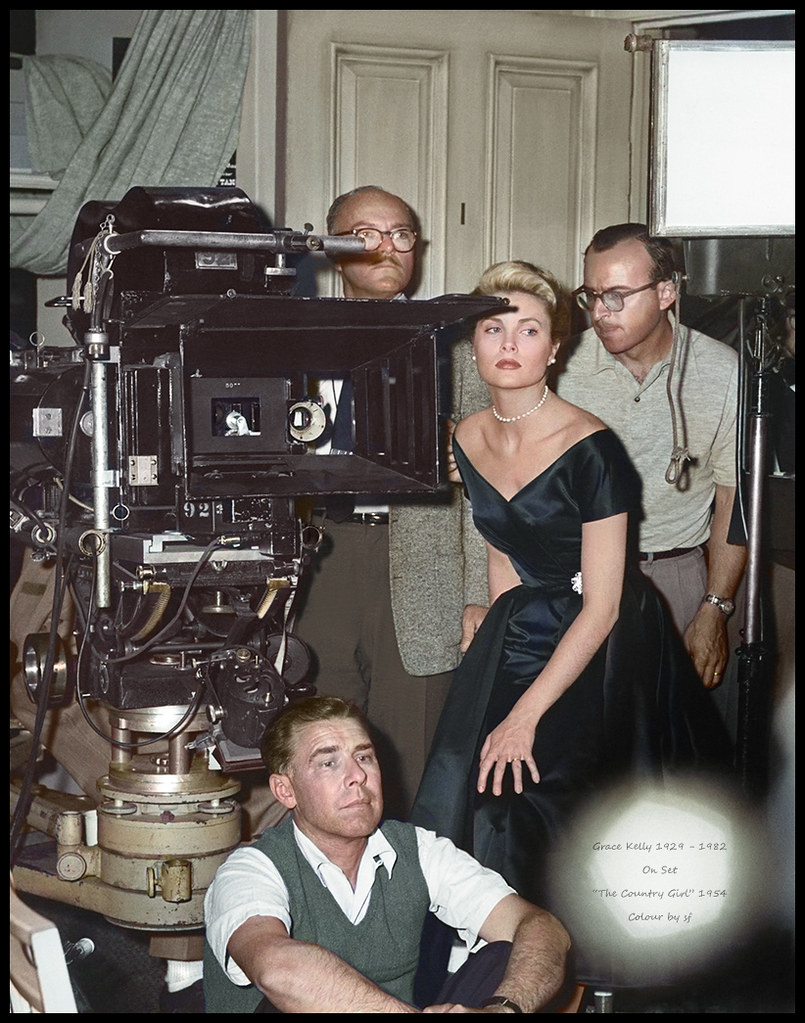
Taken in early 1954 during principal photography on the Paramount lot, this behind-the-scenes photograph, originally shot in black-and-white and later colorized, captures Grace Kelly studying a setup through the lens line of a massive Mitchell BNC camera alongside the camera operator and crew. The image comes from the production of The Country Girl (1954), the role Kelly fought to secure after persuading MGM to loan her to Paramount so she could play Georgie Elgin, a weary, unglamorous wife far removed from her polished screen persona. More than a candid production still, the photograph documents a pivotal moment in Kelly’s career, reinforcing her transformation from celebrated fashion icon into a serious dramatic actress determined to be judged by her talent rather than her beauty. PHOTO: “Grace Kelly 1929 – 1982” by oneredsf1 is licensed under CC BY-NC-SA 2.0.
At its release, The Country Girl was a hit and nominated for seven Academy Awards. On Wednesday, March 25, 1955, at the telecast of the 27th annual Academy Awards held at RKO Pantages Theatre, the third time the ceremony was televised nationally, The Country Girl won two Oscars, including one for Grace Kelly for Best Actress.6 At 25 years old Grace Kelly of the ambitious and hugely competitive Kellys of Philadelphia had reached the pinnacle of the cinema arts holding her profession’s gold-plated statuette.
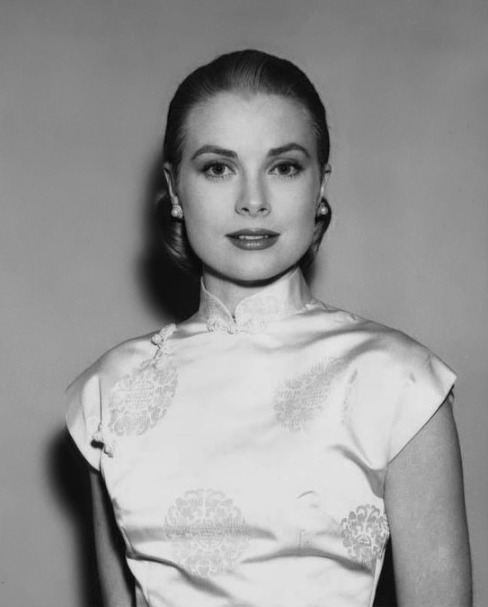
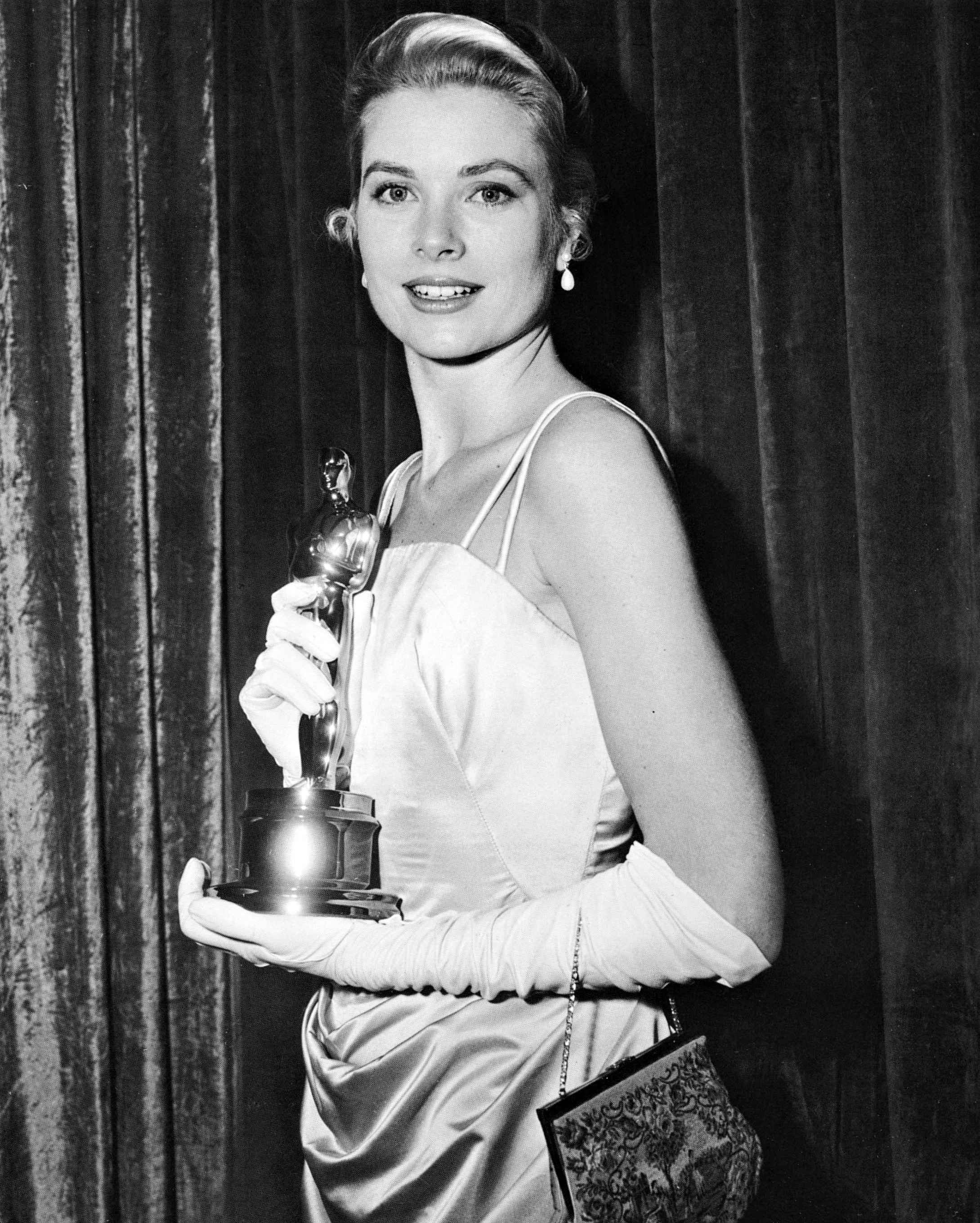
Grace Kelly backstage after the 27th annual Academy Awards on March 25, 1955.

At the 27th Annual Academy Awards, presenter Bette Davis is joined by Marlon Brando and Grace Kelly, each holding their golden trophies for Best Actor and Best Actress.

Taken in April 1955 during a Jamaican vacation following her Academy Award win, this relaxed portrait of Grace Kelly was photographed by her favorite photographer, Howell Conant. After an exhausting year that included five feature films, Kelly sought refuge from Hollywood’s relentless demands, escaping to a private villa in Montego Bay for a lifestyle-oriented photo spread in Collier’s. By posing her against a crisp navy-and-white striped cushion, Conant stripped away the cool, sculpted “Dresden China” mystique that Alfred Hitchcock often emphasized on screen. Her vibrant coral-red dress and oversized pearl-button earrings retain an air of high-fashion elegance, yet her upturned gaze, slightly parted lips, and relaxed pose make her seem approachable and warmly human. The image captured a new American ideal: a woman who could be both glamorous fashion icon and carefree vacationer basking in the Caribbean sun. PHOTO: “Grace Kelly 1929 – 1982” by oneredsf1 is marked with CC BY-NC-SA 2.0.

Grace Kelly in a chiffon-draped gown by Edith Head in To Catch a Thief (1955).
In early 1954 Grace had flown to South America to make Green Fire (1954) for M-G-M with Stewart Granger. In May 1954 she was at the French Riviera to make her third film with Alfred Hitchcock: To Catch a Thief (1955) co-starring Cary Grant for Paramount Pictures.
Grace liked the Riviera. In April 1955 she traveled there again for the 8th annual Cannes Film Festival. It was during this early spring 1955 Mediterranean trip that Grace Kelly was first introduced to Prince Rainier III of Monaco.

Sitting in a director’s chair with her co-star Cary Grant’s name emblazoned on it, Academy-Award-winning Best Actress Grace Kelly is served a beverage by director Alfred Hitchcock on the set of To Catch A Thief.


“Grace Kelly in To Catch a Thief” by thefoxling is marked with CC BY-NC-SA 2.0.
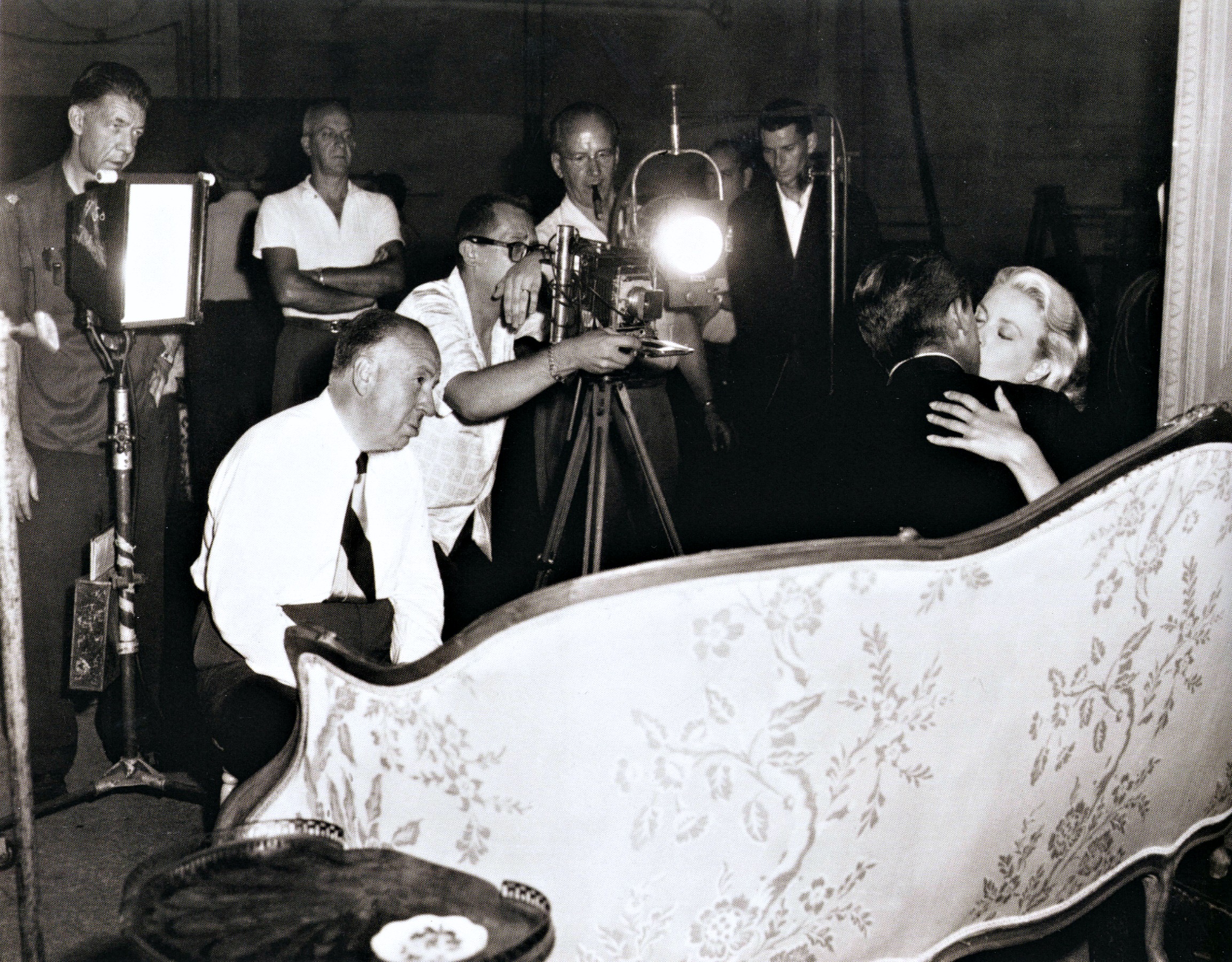

PHOTO credit: “Grace Kelly & Cary Grant, ‘To Catch a Thief’, 1955” by thefoxling is marked with CC BY-NC-SA 2.0.


Grace Kelly dressed for the ball in the penultimate scene of her penultimate film, To Catch A Thief.
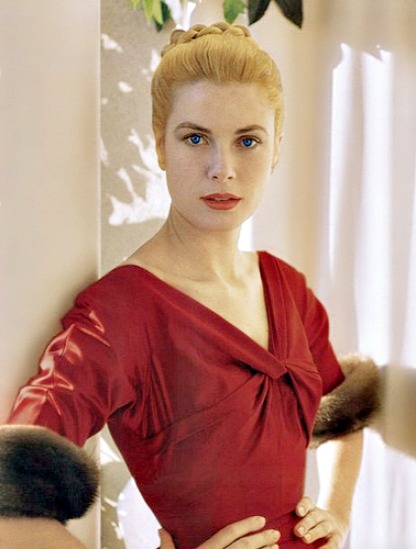
Grace Kelly by Howell Conant, 1955. Conant was Grace Kelly’s friend and favorite photographer.


Grace Kelly stood five foot seven inches tall and weighed 118 pounds. Her dress size was two.7 She was born on November 12, 1929 into the Kelly family of Philadelphia. Grace Patricia Kelly was the third of four children and one of that Irish-German family’s three girls. Elder sister Peggy and younger sister Lizanne were athletic and shared their mother Margaret’s model looks. Margaret was the family disciplinarian who the Kelly children liked to call “the Prussian General.”8
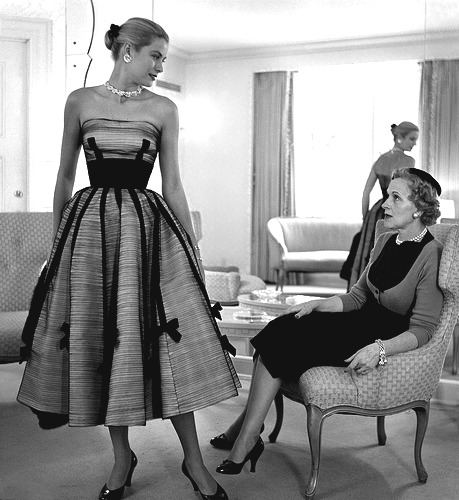
As a child Grace was dreamy and shy while her siblings were outgoing and athletic. Yet Grace inherited a keen awareness of her body using her arms and legs to be dramatically expressive in an actress’s rather than athlete’s way.9 At 18 years old Grace’s beautiful rectangle-shaped face with soft pear-shape dimensions displayed thick blond hair, almond-shaped blue eyes, a small high-bridge nose and ruby lips evident in later glamour photographs.

Each member of the Philadelphia Kelly family was an exuberant competitor in areas of American life such as athletics, business, politics, or high society.
in addition to her remarkable beauty, one of Grace’s major strengths was her ability to focus on the goal she decided to pursue whether professionally or personally until that goal was achieved.
When Grace won the Academy Award for Best Actress in 1955 it was a brick in the Kelly family wall of ambition for success.
Before she was a teenager Grace performed in plays so that during her teenage years a desire to be a professional actress grew. Since Grace was situated within a protective and affluent family as well as educated in Philadelphia Catholic and other private schools she sought theater work in New York City instead of Hollywood. Even when she had achieved the pinnacle of film success Grace still considered New York Theater a worthwhile aspiration and Hollywood as a pitiless machine of cinematic production.10


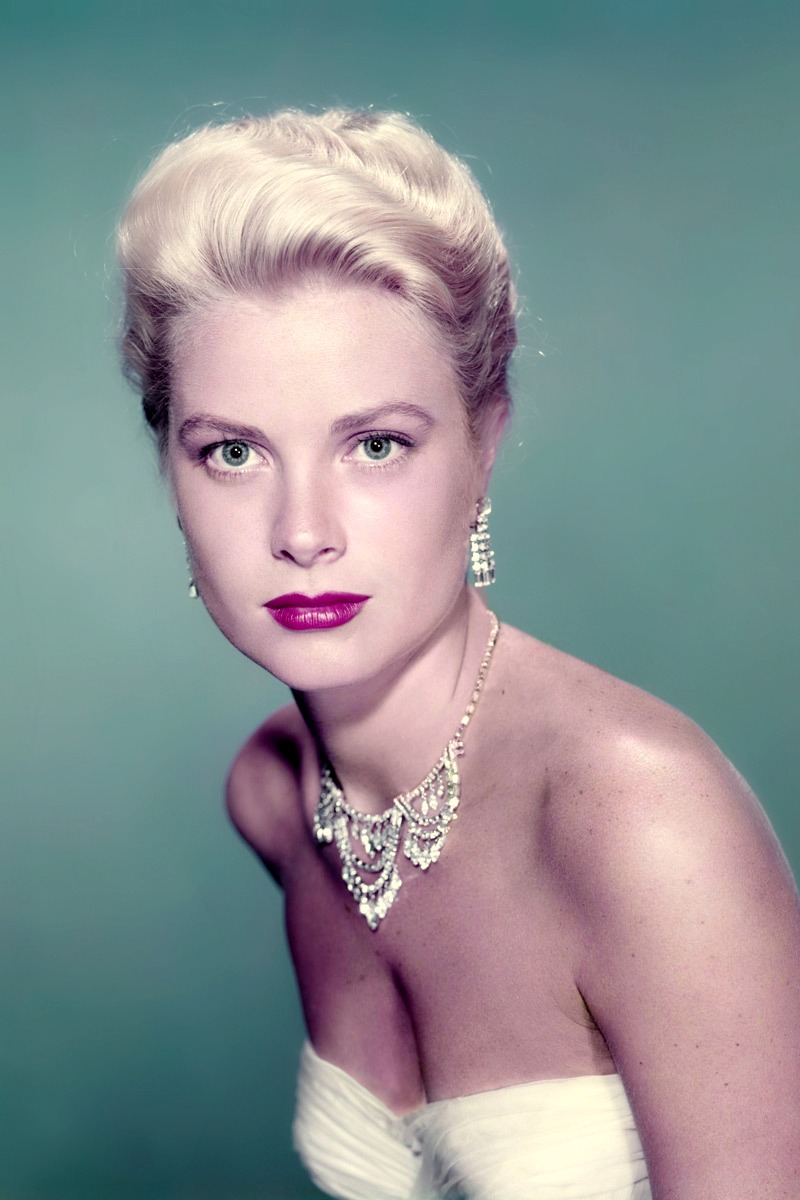
It was Aristotle Onassis who suggested to Prince Rainier that he marry a beautiful American movie star to bring the glitterati back to Monaco. Onassis’s list at the time did not include Grace Kelly.11
Invited to the 1955 Cannes Film Festival after she had won the Academy Award for Best Actress for The Country Girl one month before, Grace was curious enough about the prince to be introduced to him in Monaco on Friday, May 6, 1955.
What is memorable from the photographs of their meeting at the palace is that the Prince looks chic and handsome and Grace is at her most beautiful in a black silk floral print dress with her blond hair pulled back into a German-style bun.
That evening Grace returned to Cannes for the festival’s screening of The Country Girl helping to conclude a day that Grace herself called “pretty wild.”12 But Grace’s career in Hollywood wasn’t over—nor her life half begun. She was back in Paris before the festival’s winners were announced (she had won nothing there),13 and soon returned to Hollywood to make what turned out to be her final two Hollywood movies – The Swan and High Society.


Grace Kelly wears her engagement ring from Prince Rainier on the set of High Society.


Grace behind the wheel of a Mercedes-Benz for a scene in High Society (1956).
Ultimately, a hauntingly strange fate for a life shaped entirely by a brilliant ability to command her own narrative, yet in her final chapter a series of mundane, unmanageable coincidences were in the driver’s seat. The woman who spent her career collaborating with Alfred Hitchcock to craft a flawless illusion of untouchable safety—and who walked away from Hollywood specifically to protect her legacy from the undignified realities of aging there—was undone by a crammed backseat of luggage, a short drive she never wanted to take, and a rare medical anomaly at just 52 years old on September 13, 1982, in Monaco.
Leaving “Tinsel Town” for what turned out to be forever, the 26-year-old movie star sailed for Monaco. The Kellys paid a $2 million dowry and, in April 1956, Grace married her prince. She became a wife, mother, and royal princess of a sovereign city-state and microstate on the Mediterranean Sea – and one of the wealthiest places in the world.14 Grace, however, traveled frequentl to the United States, and though her acting career had precipitously ended, she remained Hollywood royalty as well.
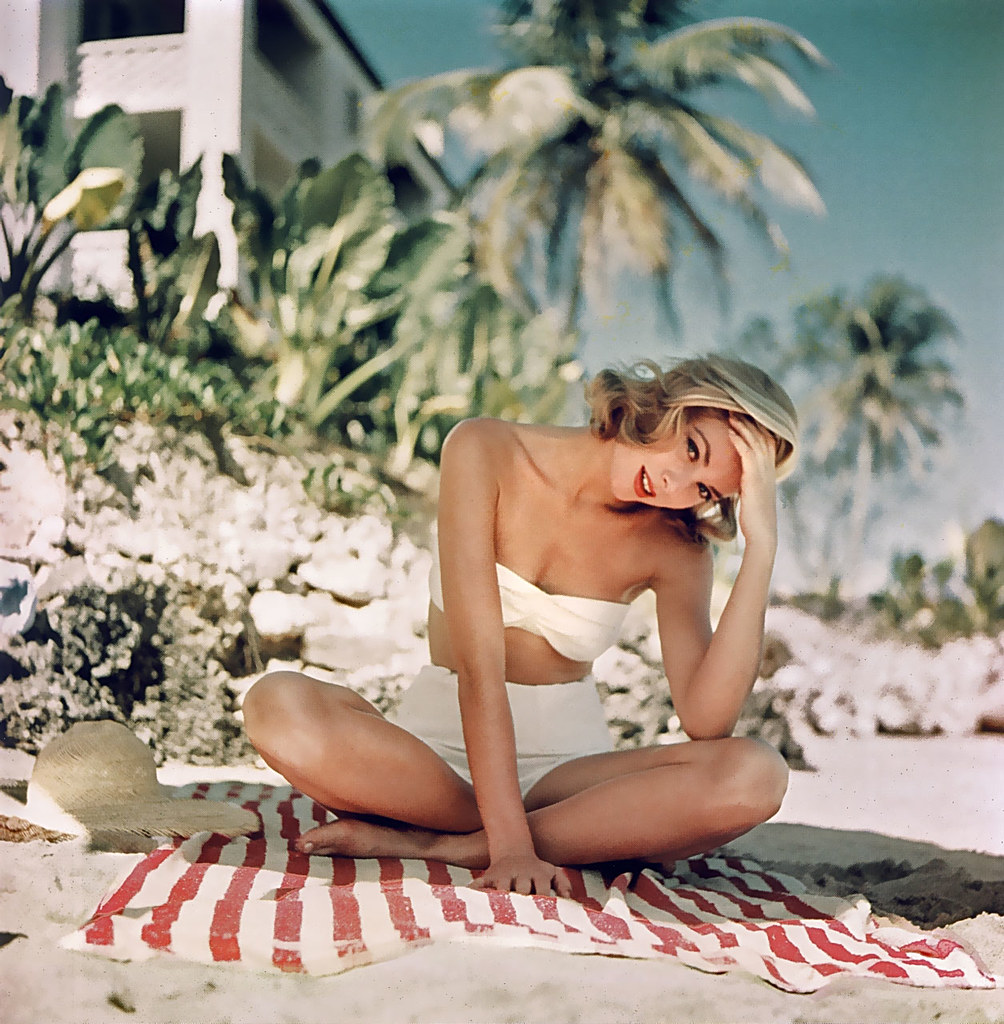
Grace Kelly relaxes on a beach in Montego Bay, Jamaica, in April 1955, just weeks after winning the Academy Award for Best Actress for The Country Girl (1954). Weary from the demands of the studio system and relentless media attention, she sought the Caribbean as a secluded refuge to rest and regroup. In retrospect, the trip served as a hidden farewell to Hollywood. One year later, in April 1956, Kelly retired from acting at age 26 to marry Prince Rainier III and become Princess of Monaco. The photograph was taken by her trusted photographer, Howell Conant, who would later serve as Monaco’s unofficial palace photographer for the next twenty-six years. PHOTO: “… Grace Kelly” by x-ray delta one is marked with CC BY-NC-SA 2.0.
GRACE KELLY HOLLYWOOD FILMOGRAPHY
1951:
Fourteen Hours
Grace Kelly as Louise Anne Fuller
Directed by Henry Hathaway
Released March 6, 1951.
Twentieth-Century Fox
1952:
High Noon
Amy Fowler Kane
Directed by Fred Zinnemann
Released July 24, 1952
United Artists
1953:
Mogambo
Linda Nordley
Directed by John Ford
Released October 9, 1953
M-G-M
1954:
Dial M for Murder
Margot Mary Wendice
Directed by Alfred Hitchcock
Released May 18, 1954
Warner Bros.
Rear Window
Lisa Carol Fremont
Directed by Alfred Hitchcock
Released September 1, 1954
Paramount Pictures
The Bridges at Toko-Ri
Nancy Brubaker
Directed by Marc Robson
Released December 31, 1954
Paramount Pictures
The Country Girl
Georgie Elgin
Directed by George Seaton
Released December 15, 1954
Paramount Pictures
Green Fire
Catherine Knowland
Directed by Andrew Marton
Released December 29, 1954
M-G-M
1955:
To Catch a Thief
Frances Stevens
Directed by Alfred Hitchcock
Released August 3, 1955
Paramount Pictures
1956:
The Swan
Princess Alexandra
Directed by Charles Vidor
Released April 18, 1956
M-G-M
High Society
Tracy Lord
Directed by Charles Walters
Released July 17, 1956
M-G-M
TEXT NOTES:
- It was actually my brother Kevin who, when he was working in the Chicago Film Office, wrote to me this description of Grace Kelly and Rear Window as the greatest film ever.
- Quoted in Roberts, Paul G., Style Icons Vol 4 Sirens, Fashion Industry Broadcast, p. 74.
- Scott Eyman, Print The Legend: The Life and Times of John Ford, Simon & Schuster, 1999, p. 419-21; Kenda Bean and Anthony Uzarowski, Ava: A Life in Movies, Philadelphia: Running Press, 2017, p. 118
- Dherbier, Yann-Brice and Verlhac, Pierre-Henry, Grace Kelly A Life in Pictures, Pavilion, 2006, p. 11.
- Edith-Head-designed apparel for Rear Window – Haugland, H. Kristina, Grace Kelly: Icon of style to Royal bride (Philadelphia Museum of Art), Yale University Press, 2006, p. 956; so she could act in live theater – TBA
- Date and place of 1955 Oscars- see https://www.oscars.org/oscars/ceremonies/1955 – retrieved April 26, 2017.
- height and dress size- http://www.bodymeasurements.org/grace-kelly/ – retrieved April 28, 2017.
- Dherbier and Verlhac, p. 9.
- Conant, Howell, Grace: An intimate portrait of Princess Grace by her friend and favorite photographer, Random House, 1992, p.18.
- Preferred theater to film-TBA
- Leigh, Wendy, True Grace: The Life and Times of an American Princess, New York: Thomas Dunne Books, 2007, p.100.
- ibid., p. 112.
- Dherbier and Verlhac, p. 12.
- The 1.25-mile waterfront stretch in Monaco that used to be the world’s most expensive street looks no different from the rest of the city — and it says a lot about Monaco’s wealth. Katie Warren, January 9, 2020. https://www.businessinsider.com/most-expensive-street-in-monaco-avenue-princesse-grace-2020-1