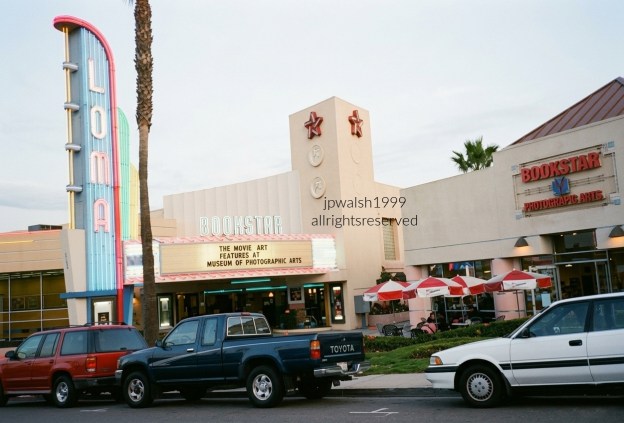

FEATURE image: The Loma Theatre with its vertical sign in San Diego, California. was opened in 1945. This is a true transitional/hybrid building for American architect S. Charles Lee. The architect retains the curves (in the sign) of his pre-war theatre buildings and moves to the angles (in the main structure) that increasingly marked his movie theatres post war. The Loma Theatre was built in the later part of Lee’s career and is one of the scores of movie theatres built by the architect between 1926 and 1950. It was operated by Mann Theatres from 1973 until it closed on December 17, 1987. In San Diego’s Midway District, the Loma Theatre had a reputation of being a friendly, classy place (see video below). Author’s photograph, October 1999 60%.
The Loma Theatre is more than a surviving neighborhood movie house; it is a significant example of architect S. Charles Lee’s late-career design evolution, reflecting the transition from the streamlined curves of prewar theater architecture to the sharper modern forms of the postwar era.
The Loma Theatre was designed by S. Charles Lee (1899-1990) and opened on May 5, 1945 with its first feature, 20th Century-Fox’s Technicolor musical film, Diamond Horseshoe, starring Betty Grable. While the year 1936 was the most prolific year for Lee’s building designs – no less than 32 individual structures in California – the years 1945-46 of which the Loma Theatre is a part were prolific with 17 new movie theatres erected in California as well as one each in Arizona (250 seats), Miami, Florida (2000 seats), and Managua, Nicaragua (2000 seats). The Loma Theatre was originally opened with 1,188 seats.

Betty Grable was a 1940’s musical star. The Loma Theatre opened their doors with “Diamond Horseshoe,” a Technicolor Fox musical that was very successful at its release. PHOTO: “Betty Grable, 1940s musical star” by Movie-Fan is licensed under CC BY-NC-SA 2.0.
S. Charles Lee was one of the foremost mid20th-century architects of movie houses on the West Coast. Simeon Charles Levi was born and grew up in Chicago. There Lee worked for Rapp & Rapp, the renowned Chicago architectural firm that specialized in movie theatre design. Rapp & Rapp’s significant work in this period included State Street’s Chicago Theatre in 1921, and the Bismarck Hotel and Theatre, and the Oriental Theatre both in 1926.
Born in Chicago, S. Charles Lee went on to become one of California’s most prolific and successful movie palace architects. Lee was also an avid pilot, routinely taking to the skies to slash travel times between coastal construction sites—a high-flying corporate strategy that never failed to leave a lasting impression on his elite clientele.

Architect S. Charles Lee in the early 1920s. Public Domain.
The Loma Theatre’s architect was influenced by Louis Sullivan (1856-1924) and Frank Lloyd Wright (1867-1959). In 1922, before moving to Los Angeles, Lee was impressed by the Chicago Tribune building competition on North Michigan Avenue whose competitors juxtaposed historicism, such as the Beaux-Arts, with modernism. Lee considered himself a modernist, and his design career expressed the Beaux-Arts discipline and a modernist functionalism and freedom of form.
Lee was influenced by Louis Sullivan, Frank Lloyd Wright, and Chicago modernism, blending Beaux-Arts discipline with modernist functionalism.
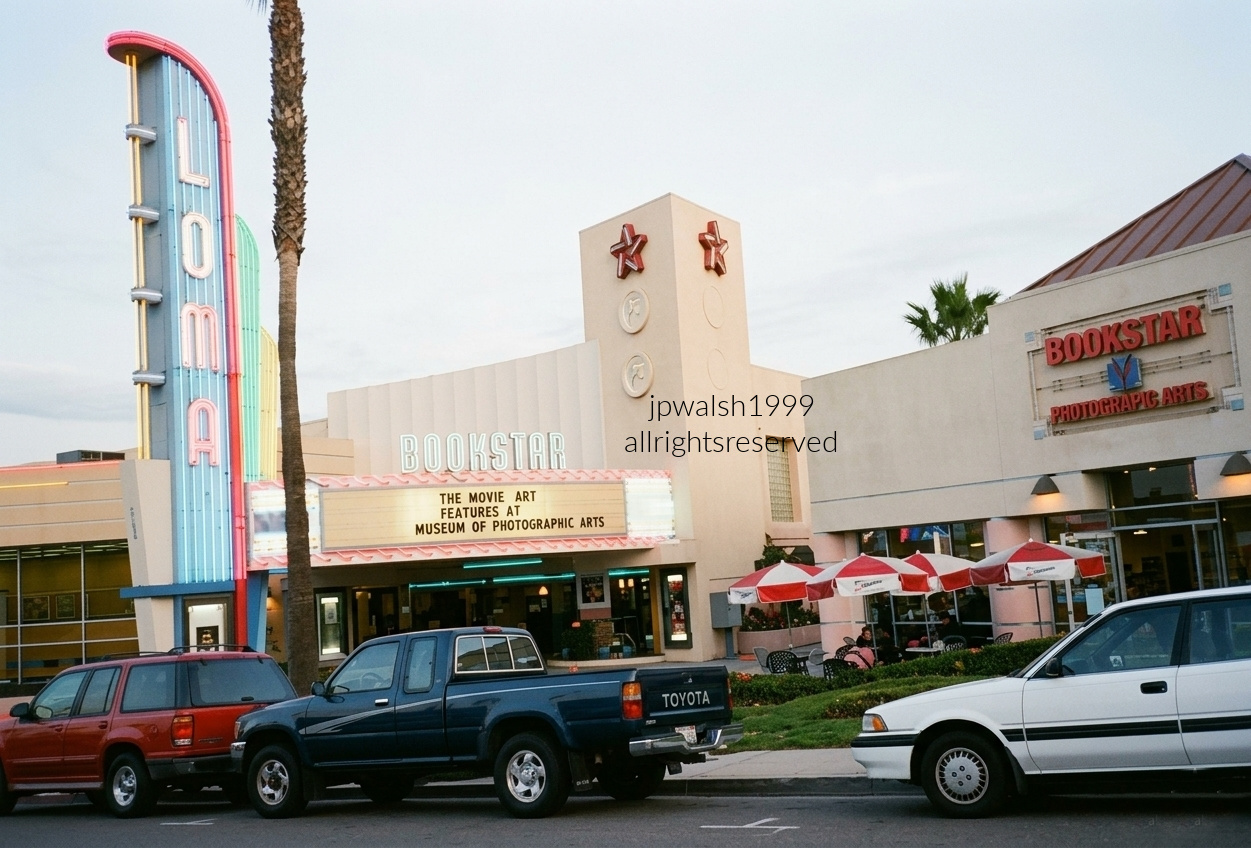
The Loma Theatre served as a popular community cinema for decades and remains notable today for retaining its iconic vertical sign and some original theater elements. The building’s later reuse as a bookstore demonstrates how historic theaters can survive beyond their original purpose. October 1999. Author’s photograph.
Beginning his career in California in the 1920’s, by the 1930’s S. Charles Lee was the principal designer of motion picture theaters in Los Angeles. Throughout the 1930s and 1940s, Lee is credited with designing many hundreds of movie theaters in California, including San Diego’s Loma Theatre at 3150 Rosecrans Boulevard.
Mann Theatres operated it from 1973 to December 1987. Its last feature was Paramount Pictures’ Fatal Attraction, starring Michael Douglas and Glenn Close. The Loma ’s vintage signage is intact along with some of its movie-house interior although today it serves as a bookstore. For other interesting memories of this friendly and classy movie house, see – http://cinematreasures.org/theaters/1716– retrieved December 29, 2022.
During the 1930s and 1940s, Lee designed hundreds of theaters, helping shape the visual identity of moviegoing in California.
The Loma Theatre occupies a distinctive place in both California and American movie-theater history. Designed by S. Charles Lee, the architect most closely associated with California’s golden age of movie-house construction, it reflects a moment when the exuberant curves of Art Deco and Streamline Moderne were giving way to the cleaner forms of postwar modernism. As one of the many theaters Lee designed across the West, the Loma brought Hollywood’s latest productions to a neighborhood audience while sharing in the architectural vision that transformed moviegoing into a national cultural experience. Its survival today, crowned by its iconic vertical sign, makes it not only a cherished San Diego landmark but also a tangible reminder of an era when distinctive theaters stood at the center of American community life.