


FEATURE image: A close-up portrait of Cary Grant taken around 1959 that captures him at the absolute zenith of his career as classic Hollywood’s gold standard of style and sophistication. It was photographed as a studio color headshot that showcased his signature look—including his famous deeply tanned skin and prominent cleft chin. At the time this photo was taken, Grant was experiencing a major career resurgence and a golden box-office era, remaining one of Hollywood’s most bankable leading men well into the 1950s and 1960s. This period directly aligns with his work on masterpieces like Stanley Donen’s Indiscreet (1958) alongside Ingrid Bergman, Blake Edwards’ massive hit Operation Petticoat (1959) with Tony Curtis, and Alfred Hitchcock’s masterpiece, North by Northwest (1959). PHOTO: “Cary Grant” by classic film scans is licensed under CC BY 2.0.
Cary Grant’s final years in Hollywood were not a leisurely epilogue but a remarkably successful closing act in which he sustained his star power through a series of popular films while simultaneously shifting his priorities from screen legend to husband and father, culminating in a carefully chosen retirement at the height of his fame.

Cary Grant in a relaxed portrait in New York City taken in 1956 by celebrity photographer Milton H. Greene. PHOTO: Cary Grant by classic film scans is licensed under CC BY 2.0.
By John P. Walsh
Cary Grant made 72 feature films between 1932 and 1966- 34 in the 1930’s, 20 in the 1940’s, 13 in the 1950’s, and 5 in the 1960’s. (Grant also appeared in 10 more short films between 1932 and 1976). His feature films ranged from all classics of the genre. The debonair English-American actor with boundless energy and superb timing tangled with THRILLERS—Suspicion (1941), To Catch a Thief (1955), North by Northwest (1959)— COMEDIES—Bringing Up Baby (1938), His Girl Friday (1940), The Philadelphia Story (1940)— ROMANCES—Notorious (1946), An Affair to Remember (1957) – and much more. Grant was nominated twice for an Academy Award for Best Actor – in 1941 for Penny Serenade (directed by George Stevens) and None but the Lonely Heart in 1944 – but did not win.
In his 34-year Hollywood career Grant made his last films in the 1960’s. These included That Touch of Mink (1962), Charade (1963), Father Goose (1964), and Walk, Don’t Run (1966). These films became some of his best work. Afterwards, Grant decided to retire at what was a professional – and personal – high note. In June 1965 the 61-year-old Grant married actress Dyan Cannon, 33 years his junior, and they both had their first child, a girl, born in February 1966. It was Dyan Cannon’s first marriage; Grant’s fourth. They divorced in 1968.
With an acting career spanning four decades—Grant’s film debut was in 1932 for Paramount Pictures’ comedy, This is the Night—Grant said good-bye to the silver screen at 62 years old. In 1970 he received his sole Oscar, an honorary one, for which he was pleased and humbled in his acceptance speech before the Academy. It was Hollywood’s Golden Age, and in that time, Cary Grant was a household name synonymous with suavity, comedy, drama, romance, and perpetually fit and tanned-and-pressed good looks.
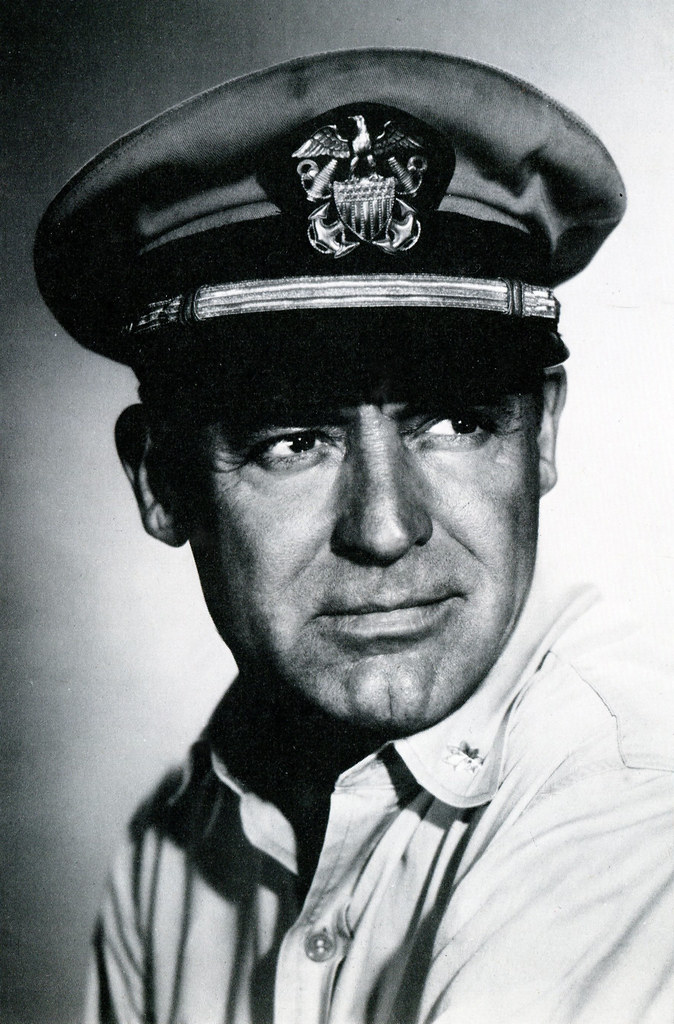
Production still from Blake Edwards’ 1959 World War II comedy Operation Petticoat. In 1959, Cary Grant was at a pivotal high-water mark of his late career and arguably the most powerful independent actor in Hollywood. In Operation Petticoat, he plays Lt. Commander Matt Sherman, the beleaguered captain of the fictional, pink-painted submarine USS Sea Tiger, starring alongside a rising Tony Curtis. By 1959, Grant didn’t just star in movies; he controlled them. He produced Operation Petticoat through his own independent company, Granart Productions and negotiated a deal with Universal that gave him a massive chunk of the gross profits. The film became a runaway box-office smash, earning over $9 million in its initial release and netting Grant the biggest single paycheck of his entire career up to that point. PHOTO: Cary Grant by classic film scans is licensed under CC BY 2.0.

The second photo from Operation Petticoat, showing him looking through a submarine periscope, showcases his unmatched gift for reactions. Even while playing a weathered military officer, Grant infused the character with his trademark double-takes and sophisticated comic timing, proving that at age 55, his charm and talent could still carry a massive blockbuster. Grant was fiercely protective of his handsome, youthful public image and grew increasingly self-conscious about aging on camera. He famously believed that audiences did not want to see a man in his late 50s or 60s playing traditional romantic leads opposite women who were decades younger than him. PHOTO: MM008600-39 by Florida Keys–Public Libraries is licensed under CC BY 2.0.
Grant’s 1970 Honorary Academy Award served as a capstone recognition of a career that had made him one of Hollywood’s defining stars.
The 66-year-old leading man and comic actor, whose film career ranged from 1932 to 1966, never won an Oscar. In 1970 he thanked the Academy whose audience that night gave him a standing ovation. Grant, who made over 80 films, including a long list of classic titles, expressed gratitude for “being privileged to be part of Hollywood’s most glorious era.”
“Ours is a collaborative medium—we all need each other,” Cary Grant said as he accepted his honorary Oscar from presenter and friend Frank Sinatra at the 42nd Annual Academy Awards ceremony on April 7, 1970 at the Dorothy Chandler Pavilion in Los Angeles, California.
Grant’s final film came in 1966 with the summer release of the comedy, Walk, Don’t Run. It was one more film made by one of Grant’s new production companies and distributed by Columbia Pictures. Grant’s departure from film coincided with the birth of his daughter, Jennifer— Grant becoming a father for the first time. Grant called her his “best production”— and now wanted to give her all his time and attention. Grant said: “My life changed the day Jennifer was born. I’ve come to think that the reason we’re put on this earth is to procreate. To leave something behind. Not films, because you know that I don’t think my films will last very long once I’m gone. But another human being. That’s what’s important.”

Cary Grant and wife Dyan Cannon with their baby daughter who was born on February 26, 1966. Newborn daughter Jennifer was roughly seven months old when this photo of the Grant family was taken in September 1966. It was an official press and publicity photo documenting a highly sentimental journey. Grant was taking his new family across the Atlantic to England specifically to introduce his baby daughter to his elderly mother, Elsie. PHOTO: Cary Grant, Dyan Cannon, and infant daughter Jennifer in September 1966. Photo: Express/Pictorial Parade/Getty Images. Fair use.
Grant left Hollywood on his own terms, retiring after Walk, Don’t Run rather than remaining in films past his prime. His relationship, marriage, and daughter with Dyan Cannon coincided with the winding down of his film career.
Grant starting wooing Dyan Cannon in 1962. Within a three-year whirlwind courtship, she became pregnant with Grant’s baby so that, in1965, the 28-year-old actress wanted a marriage proposal. Cary Grant was the epitome of cinema’s best and most important actors. After their marriage, Dyan Cannon discovered that their relationship turned polite and frostier than she had expected with Hollywood’s quintessential leading man. On March 20, 1968 — less than three years after tying the knot in a secret wedding ceremony in Las Vegas, Nevada followed by a honeymoon in England taking a private jet supplied Howard Hughes – Cannon sought and got a divorce. While Cannon received alimony from Grant to raise their daughter, the young mother and up-and-coming actress had to sort things out more completely after their break-up. Theirs had been a love affair with many memorable romantic moments. But what Grant told her when they were still dating was remembered by Cannon after the marriage failed. Grant said: “I don’t know what it is, but something happens to love when you formalize it. It cuts off the oxygen.”

Grant appears in character as an angel named Dudley in this promotional photograph for the 1947 fantasy romance film, The Bishop’s Wife. By seductively playing a certain song on the harp, Dudley convinces a rich woman to support the bishop’s cathedral building project. In real life, Grant was an ardent piano player. PHOTO: Cary Grant by twm1340 is licensed under CC BY-SA 2.0.
Grant’s last decade in film produced several commercially successful and enduring works, including That Touch of Mink (1962), Charade (1963), Father Goose (1964), and Walk, Don’t Run (1966).
That Touch of Mink (1962):
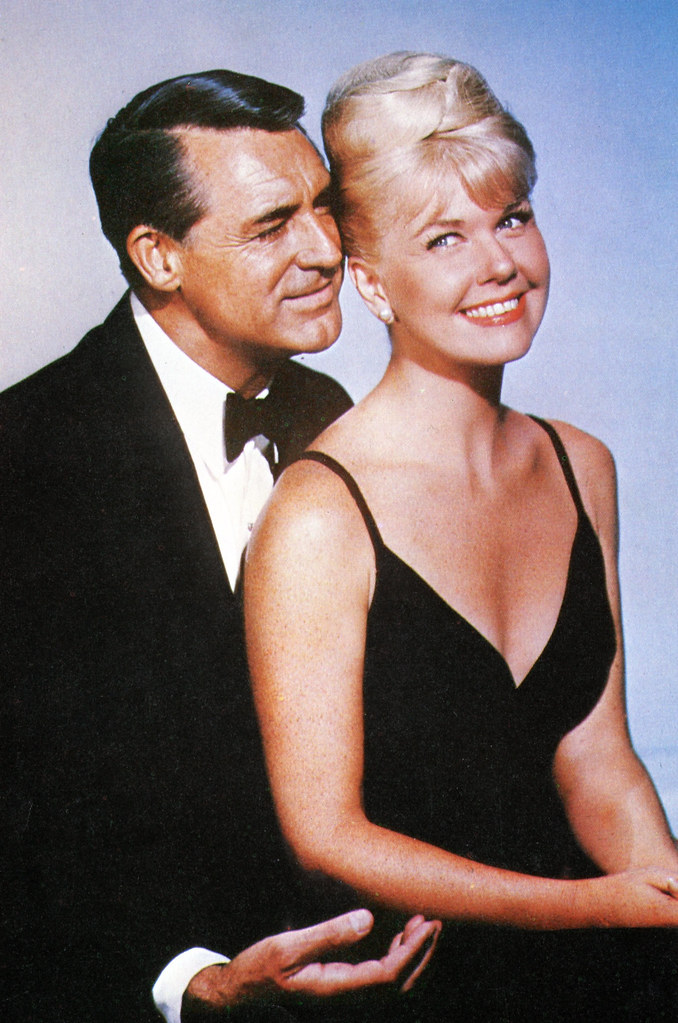
Cary Grant and Doris Day in the hit romantic comedy, That Touch of Mink. PHOTO: Cary Grant and Doris Day by classic film scans is licensed under CC BY 2.0,
That Touch of Mink co-starred Doris Day and Cary Grant. It was the hit movie of summer of 1962 though outshined in the movie world by Lawrence of Arabia and The Longest Day later that year. The romantic-comedy is great fun—it won a Golden Globe award for Best Comedy Picture-—and became a popular rerun on TV for the next decade.
Cary Grant was cast as wealthy businessman Philip Shane, a role originally meant for Rock Hudson. That Touch of Mink was, above all, intended to be a Doris Day vehicle. From 1962 to 1964 Doris Day was the top box office star in Hollywood. Her presence definitely contributed to Universal Pictures’ bottom line since That Touch of Mink was the fourth biggest money maker of the year.
Playing working girl Cathy Timberlake, the movie is basically a stylish “boy meets girl, boy loses girl, boy gets girl back”—and given a chance to learn his lesson, they get married. American audiences loved the concept as well as Day and Grant together on the big screen. The film was the fastest million-dollar earner of 1962 and set a record at the time for the highest gross earnings in an initial theatrical release.
Sitting comfortably inside the dry, luxurious interior of the car is wealthy businessman Philip Shayne (Cary Grant). The sequence relies on classic visual irony: Cathy Timberlake (Doris Day) is left standing on the rain-soaked pavement, drenched and furious, while Shayne glides away in elegance, fully aware of the chaos his vehicle has just caused. That splash serves as the catalyst for the entire story. Out of guilt, Philip later seeks Cathy out and offers to replace her ruined wardrobe, setting in motion the film’s playful cat-and-mouse romance.
Grant had wanted to work with Day for years and, as co-producer alongside her husband and manager Martin Melcher of Arwin Productions, personally helped ensure she was cast. Grant and writer-producer Stanley Shapiro then selected Academy Award-winning director Delbert Mann to helm the picture. An unusual choice for a glossy romantic comedy, Mann was best known for realistic, emotionally grounded dramas and had won the Oscar for Best Director for his feature-film debut, Marty (1955). Grant and Shapiro believed that Mann’s naturalistic approach would balance the film’s fashionable glamour and comedic situations with genuine emotional credibility. The screenplay and original story were written by veteran comedy collaborators Stanley Shapiro and Nate Monaster, whose work earned an Academy Award nomination for Best Original Screenplay.
For Grant it was his second highest grossing film of his 30-year career, which was especially prosperous since the 58-year-old actor was a co-producer. Grant made $4 million for That Touch of Mink (around $35 million in today’s money). Three weeks after its opening, Betsy Drake, Grant’s third wife, filed for divorce.
The court proceedings of the high-profile couple after over a decade of marriage were followed closely in the press. The settlement for Drake who told the papers: “I was always in love with him and I still am…but…he left me long ago,” included more than one million dollars in cash and profit sharing in every Cary Grant film ever made up to that time.
That Touch of Mink, a film thick with early 1960’s conventional sensibilities, was nominated for 3 Academy Awards. Both Grant and Doris Day never won an Academy Award. The story goes that after her exit from films Doris Day was offered the Honorary Oscar multiple times but always turned it down. Grant won and accepted his Honorary Academy Award in 1970. In 1962 That Touch of Mink was nominated for Best Sound, Best Art Direction and Best Screenplay. In the first two categories Oscar went to Lawrence of Arabia and in the third to Divorce Italian Style.
That Touch of Mink was the fastest million-dollar earner of 1962 and set a record at the time for the highest gross earnings in an initial theatrical release. It was mainly a Doris Day vehicle that co-starred Cary Grant who co-produced.
CHARADE (1963):
When Grant first asked to meet Dyan Cannon, she assumed it was for an acting part. Grant began his romance with then-25-year-old Dyan Cannon in 1962. That fall the couple flew from California to New York where Cannon began rehearsing for The Fun Couple, a Broadway comedy play starring Jane Fonda and directed by Andreas Voutsinas. Grant meanwhile worked with film director Stanley Donen on Charade, a romantic-comedy pseudo-Hitchcock mystery thriller that Grant co-starred in with Audrey Hepburn. Hepburn had been filming another romantic comedy, Paris When it Sizzles, with William Holden.

Promotional poster for Stanley Donen’s Hitchcock-inspired suspense thriller, Charade. The 1963 hit film was made in Paris in 1962 and 1963 and released during Christmas 1963. It starred Cary Grant and Audrey Hepburn. PHOTO: CHARADE by Laurel L. Russwurm is marked with CC0 1.0 PUBLIC DOMAIN
Charade’s animated Main Title and music follow a widescreen shot of a pre-dawn countryside in Europe as a speeding train finally approaches and screeches past. A body is dumped out of the moving train, plunges down the ravine and stops in a ditch, the camera providing a close-up of the dead victim’s face. Colorful animation follows of pinwheels as the wood-block-driven music heighten tension for what will be two charming lovers, Grant and Hepburn, caught in a mysterious web of criminals after money.
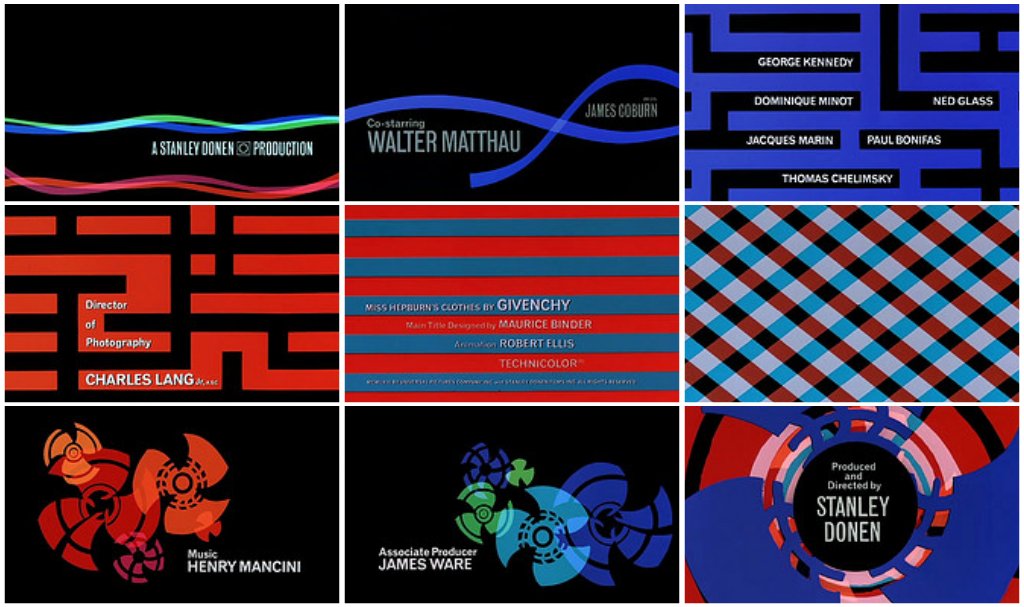
Stills montage of Maurice Binder’s Main Title for Charade that accompanies Henry Mancini’s music. The Main Title for Charade with its punchy animated titles by Maurice Binder (1918-1991) was composed by Henry Mancini (1924-1994). The Main Theme from Charade was the first of a number of successful film score collaborations Mancini had with film director Stanley Donen in the 1960’s. PHOTO: Public domain published in a collective work i.e. periodical in the US between 1925 and 1977 and no Copyright.
Grant reluctantly left Cannon and the comforts of his suite at the Plaza Hotel in New York City to make his way to Paris to shoot Charade (Hepburn lived near Paris). Many Paris locations were used in the film: near Notre Dame is the Pont au Double bridge, just below the Quai de Montebello. During the filming of Charade, Cary Grant and Audrey Hepburn walked along the riverbank below this bridge as they discussed who the killer is. Another location was the Musée Cernuschi just outside of Parc Monceau on the Avenue Velasquez. The museum is featured in Charade where it is used as Reggie’s apartment which she finds ransacked after returning from a holiday ski trip. Finally, the Palais Royal near the Louvre appears in Charade in its final scenes when the real Carson Dyle is revealed and shooting begins.

Shooting scenes for Charade involved many locations in Paris. Charade demonstrated Grant’s continued appeal as a sophisticated leading man and remains one of the most celebrated films of his later career. PHOTO: Charade_1963_Audrey_Hepburn_and_Cary_Grant public domain because it was published in the United States between 1925 and 1963 and although there may or may not have been a copyright notice, the copyright was not renewed
When Dyan Cannon had her first holiday break from Broadway rehearsals at Christmas 1962, she hopped on a flight to Paris. Arriving on December 26, Grant and Cannon spent the next several days together in his hotel. On New Year’s Eve, the couple were the special guests of Audrey Hepburn and her husband Mel Ferrer at their castle where a sumptuous dinner and many flights of crisp and creamy French champagne were served. Cannon flew back to the States on January 2, 1963, after a most pleasant holiday. She resumed her theater work in New York City while Grant and Hepburn stayed behind in Paris to continue filming Charade.

Cary Grant, making his 70th film, was reluctant to leave the U.S. in late 1962 for Paris to film Charade. The film premiered at Radio City Music Hall in New York City on Christmas Day 1963. PHOTO: Cary Grant, in Charade 1963 by Movie-Fan is licensed under CC BY-NC-SA 2.0

Charade opened on December 25, 1963, at Radio City Music Hall in New York City. The film made six million dollars while the reviews were mixed, though mainly positive. Critics did remark on the age difference between the romantic leads –Cary Grant was 59 years old and Audrey Hepburn at 34, was almost half his age. By early 1964 the suave and likeable leading man of the last 30 years was already thinking about retirement. PHOTO: Radio City Music Hall (2008) by jpellgen (@1179_jp) is licensed under CC BY-NC-ND 2.0.

In the 1963 romantic thriller Charade, the entire plot revolves around a frantic search for a hidden fortune that is ultimately discovered pasted in plain sight on an ordinary envelope in the form of rare stamps. This modern envelope poetically mirrors that classic climax by placing the face of the film’s star, Audrey Hepburn, onto the very postal medium that drove her most famous cinematic chase. PHOTO: Let’s continue this little Charade by Thiophene_Guy is licensed under CC BY-NC-SA 2.0.
The film Charade is well-known for its Hitchcock-style inspiration and screenplay by the original story’s author Peter Stone (1930-2003). From Stone’s 1961 short story, The Unsuspecting Wife, the film Charade offers witty lines and a head-knocking, heart-pounding whodunit. In Charade, Regina “Reggie” Lampert (Hepburn) is on winter holiday in the French Alps. Returning to her home in Paris, she is shocked to find that it has been ransacked of everything of value. The mysterious victim thrown off the train in the Main Title and the mysterious man Reggie met on holiday in Grenoble– Peter Joshua, alias Alexander Dyle, alias Adam Canfield, alias Brian Cruikshank (Cary Grant) –converge into her life to help her solve the mystery of why these crimes have occurred and what they mean. Charade is about hidden money, spies and larcenists, double-crossing and being on the run. In addition to all that, it’s a love story. Charade was one of the last of the suspense-screwball comedy films –a staple of the Hollywood film genre since the 1930’s that faded in the gritty realist films of the 1960’s and 1970’s until its reemergence in the 1980’s.
Father Goose (1964):
With Charade in the rear-view mirror, Grant came home just as Cannon became mostly absent. Throughout 1964 and much of 1965 Cannon had done no film work yet but continued a busy theater career as she was touring the country in the musical How to Succeed in Business Without Really Trying. Looking for something to do with his time, Grant formed a production company and made Father Goose.
Grant was dismayed that his 1964 romantic comedy adventure film Father Goose made less money than Charade and almost $6 million less than That Touch of Mink in 1962 and Operation Petticoat in 1959 combined. Set during World War II in the South Pacific, Father Goose (1964) follows Walter Eckland (Cary Grant), a slovenly, hard-drinking beachcomber who is blackmailed by the British Navy into serving as a solitary coast-watcher on a remote island. Given the radio code name “Mother Goose,” Walter cooperates because the Navy rewards his intelligence reports with hidden bottles of whiskey. His arrangement is upended when he rescues Catherine Freneau (Leslie Caron), the proper daughter of a French diplomat, and seven stranded schoolgirls. Forced to share his ramshackle island home, Catherine and Walter engage in a spirited battle of the sexes. She is horrified by his drinking, laziness, and lack of hygiene, while he resents the disruption of his peace and supply of liquor. Amid air raids, wartime dangers, and growing mutual respect, Walter gradually sheds his cynicism, becomes a reluctant father figure to the children, and falls in love with Catherine.
Grant was especially fond of Walter Eckland, later remarking that the role came closer than any other to reflecting the unpolished personality of Archie Leach, the man behind the Cary Grant image. Some biographers and commentators have suggested that audiences’ preference for the sophisticated Cary Grant persona over this rough-edged characterization contributed to the actor’s growing disillusionment with filmmaking. Whatever the reasons, Father Goose proved to be Grant’s penultimate feature, preceding his retirement from motion pictures just two years later.
Grant’s character, Walter Eckland, played against Grant’s film type. Ecklund was a bedraggled loner in the South Pacific during World War II who reluctantly takes under his protection an unmarried French school teacher (Leslie Caron) and her seven grade school students. They were suddenly made refugees from the war during a Japanese bombing raid. The heart-warming Father Goose was a mega-hit at its release during Christmas 1964 and made millions of dollars. Receipts, however, were significantly less than in each of Grant’s three previous films — Operation Petticoat in 1959 with Tony Curtis, That Touch of Mink in 1962 with Doris Day, and Charade. Despite a lot of pre-Oscar buzz, Grant wasn’t nominated for his performance. Father Goose was one more disappointment for Grant as he worked to possibly be given an Academy Award before he might retire.

Newly married in June 1965 to Dyan Cannon who was expecting their baby, Grant announced he was flying to Japan to make another movie. Grant returned to California permanently just in time to drive his wife to the hospital to deliver their first child, a baby daughter, born on February 26, 1966. PHOTO: 1947 Bristol-born Hollywood film star Cary Grant alighting from Bristol Freighter G-AGVC at Los Angeles, 13 Jan 1947. by Gary Danvers is licensed under CC BY-SA 2.0.
In June 1965, with Father Goose and the Oscars behind him and Dyan Cannon’s national tour ended—Grant and Cannon, who was now pregnant, got married. After a secret marriage ceremony in Las Vegas and a honeymoon, their news was eventually publicized. As the excitement began to settle down, Grant informed Cannon he would be making another film—and was traveling to Japan by himself for the next many months.
Walk, Don’t Run (1966):
Grant formed another production company and, with producer Sol C. Siegel, signed with Columbia Pictures to distribute his new film. Buying the rights to The More the Merrier, a World War II-era comedy, Grant took the role that had been nominated in the early 1940’s for an Academy Award. Grant’s 1966 remake was called Walk, Don’t Run in which he played a British industrialist, Sir William Rutland.

In the vibrant, pop-art aesthetic of the mid-1960s, the official poster for Walk, Don’t Run (1966), a lighthearted romantic comedy that permanently etched its place in cinema history as Cary Grant’s final feature film. The film plot set in Tokyo during the 1964 Summer Olympics, the film poster features a generational pairing of talent with Cary Grant playing Sir William Rutland, an English industrialist, Samantha Eggar playing Christine Easton, a young Englishwoman living in Tokyo and Jim Hutton playing Steve Davis, a handsome American Olympic competitor. Hutton was known for his tall stature and breezy, boy-next-door comedic style. Fair use.
In the film, Christine, whose tiny apartment it is, would prefer a female roommate. She sublets to Sir William because he is pushy, charming and a fellow Brit in need. But he immediately sublets half of his portion to Hutton, making for three. Comedy results from three outsized adults sharing a very small living space as they pursue their lives’ conflicting schedules as normally as possible.
Cary Grant’s Final Screen Role
By the mid-1960s, Cary Grant’s romantic comedies had become a familiar and reliable formula, allowing the newly married star and father to continue capitalizing on his enduring popularity. Even by the standards of earlier Grant vehicles such as Dream Wife (1953), Houseboat (1958), and Father Goose (1964), Walk, Don’t Run (1966) is exceptionally light entertainment.
A remake of George Stevens’s Oscar-nominated wartime comedy The More the Merrier (1943), the film transfers the story to Tokyo during the 1964 Summer Olympics, when a housing shortage forces three strangers to share an apartment: industrial magnate Sir William Rutland (Grant), American Olympic athlete Steve Davis (Jim Hutton), and British expatriate Christine Easton (Samantha Eggar). Grant assumes the role originally played by Charles Coburn, whose performance earned an Academy Award nomination for Best Supporting Actor.
Playing Matchmaker for a Younger Generation Instead of Leading Man
For his final film appearance, Grant deliberately chose not to get the girl. Instead, Sir William becomes a benevolent matchmaker, gently steering Christine away from her dull fiancé, British diplomat Julius Haversack (John Standing), and toward Steve. Grant personally selected both Hutton and Eggar for their roles, ensuring that the film’s romantic focus rested on a younger generation.
A Charming but Old-Fashioned Farewell
While the performances are appealing and the Tokyo Olympic setting provides contemporary window dressing, Walk, Don’t Run often feels like a relic from an earlier Hollywood era. The stage-bound direction and highly predictable story lend the production an old-fashioned quality despite its modern setting. Still, the film benefits from the effortless charm of its cast and a lively score by Quincy Jones, one of his earliest major Hollywood assignments. As a result, Walk, Don’t Run serves as a pleasant, if somewhat anachronistic, farewell to one of cinema’s most enduring stars.
Samantha Eggar glows in each of her scenes in Walk, Don’t Run though she hasn’t much to work with in terms of a script as evidenced here.
Reel Life and Real Life
The onscreen romance between Jim Hutton and Samantha Eggar in Walk, Don’t Run (1966) carries striking parallels to Cary Grant’s own turbulent relationship with Dyan Cannon during the film’s production. While Grant played the detached, older matchmaker on screen, his private life was dominated by a generational romance that profoundly shaped his outlook during his final film.
In July 1965, Grant married Cannon. At 61, he was 33 years older than his 28-year-old bride. Just as Sir William Rutland must adapt to the attitudes, lifestyles, and expectations of a younger generation in Walk, Don’t Run, Grant had courted and now was attempting to build a life with a woman who belonged to the same generation as Hutton and Eggar.
A Modern Woman Off Screen
In the film, Samantha Eggar’s Christine Easton is fiercely independent and resistant to being managed or placed into a conventional romantic arrangement. Her determination to chart her own course creates much of the story’s tension before she eventually finds genuine happiness with Hutton’s Steve Davis.
The dynamic echoed Grant’s marriage. Cannon was an ambitious, free-spirited actress whose career was just beginning to flourish. Friends, biographers, and Cannon herself later described Grant as deeply invested in shaping the details of her life, from her wardrobe and schedule to her public image. Much like Sir William’s attempts to orchestrate the lives of those around him, Grant sought order and control, while Cannon pushed back in defense of her independence. The film’s underlying theme of understanding a modern 1960s woman reflected a challenge Grant was simultaneously navigating at home.
Passing the Torch
Perhaps the most poignant parallel is visual and symbolic. In Walk, Don’t Run, Hutton plays the tall, handsome Olympic athlete who ultimately wins the girl. Grant’s character willingly steps aside, recognizing that youth belongs with youth and finding satisfaction in helping the younger couple discover each other.
By 1966, Grant was confronting a similar reality in his own life. He understood that the era of Cary Grant as Hollywood’s effortless romantic lead was drawing to a close. His marriage to Cannon and the birth of daughter Jennifer in February 1966 reinforced that realization. The role that had defined him for more than three decades was giving way to something different.
A Farewell in Disguise
Viewed in hindsight, Walk, Don’t Run feels less like a conventional romantic comedy than a subtle farewell. By guiding Hutton and Eggar together on screen rather than pursuing the heroine himself, Grant was symbolically relinquishing the role he had perfected since the 1930s. The debonair leading man steps aside, allowing a younger generation to take center stage. In that sense, Sir William Rutland was not merely a character. He was Cary Grant gracefully rehearsing his own exit from Hollywood and preparing for the uncertain next chapter of family life beyond the camera.
The music is by Quincy Jones including its main title, “Happy Feet.” Walk, Don’t Run was one of Quincy Jones’s first big breaks. The 33-year-old Chicago-born Jones came to score the film after its star and Executive Producer, Cary Grant, recommended him for the job. Grant met him briefly through their mutual friend, singer Peggy Lee. From that meeting Grant felt Jones’ style would be perfect for the film and he made sure he was hired. Jones went on to enormous success as the composer of numerous film scores such as In the Heat of the Night in 1967 and The Color Purple in 1985 as well as the producer of successful pop rock recordings such as Michael Jackson’s bestselling albums and the 1985 global recording phenomenon, We Are The World. In 2013, Quincy Jones was inducted into the Rock and Roll Hall of Fame.
The Last Curtain Call
After Grant returned from Asia and the baby was born, he insisted, both publicly and privately, that Walk, Don’t Run would be his last film. It proved to be true. Unlike many stars who announced retirements only to return, Grant kept his word. After more than three decades as one of Hollywood’s most successful leading men, Grant was ready to leave the movie business behind and focus on family life.
Retirement and Domestic Life
Grant also made it clear that he would not make a film with his wife, Dyan Cannon, a talented young actress whose career was just beginning. Instead, he believed Cannon should retire from acting and devote herself to being a stay-at-home mother. Cannon did not welcome those ideas, creating an early source of tension between the couple.
Leaving Hollywood Behind and Life Beyond the Legend
Even in 1966, following an exciting courtship and despite a 33-year age difference they rarely discussed publicly, Cannon had begun to wonder whether her marriage to Cary Grant was already on the rocks. As Grant exited a thirty-year film career at the very height of his fame, the private life he had chosen over Hollywood was proving more complicated than the romantic ending many imagined. The final chapter of Cary Grant the movie star had closed, but the final chapter of Cary Grant the man was still being written.

By 1966, understood that the era of Cary Grant as Hollywood’s effortless romantic lead was drawing to a close. His marriage to Cannon and the birth of daughter Jennifer in February 1966 reinforced that realization. The role that had defined him for more than three decades was giving way to something different. Fair use.
The birth of his daughter Jennifer fundamentally altered Cary Grant’s priorities and contributed to his decision to retire from filmmaking.
CARY GRANT HOLLYWOOD FILMOGRAPHY (1962-1966):
1962:
That Touch of Mink
Cary Grant as Philip Shayne
Directed by Delbert Mann
Released June 14, 1962
Universal Pictures
1963:
Charade
Peter Joshua / Alexander Dyle / Adam Canfield / Brian Cruikshank
Directed by Stanley Donen
Released December 5,1963
Universal Pictures
1964:
Father Goose
Walter Christopher Eckland
Directed by Ralph Nelson
Released December 10, 1964
Universal Pictures
1966:
Walk, Don’t Run
Sir William Rutland
Charles Walters
Released June 29, 1966
Columbia Pictures
NOTES:
Best production— “Hollywood loses a legend”. Montreal Gazette. December 1, 1986. p. 1.
That’s what’s important— McCann, Graham (1997). Cary Grant: A Class Apart. Columbia University Press, 1998.
Cuts off the oxygen— http://worldnewsblogx.blogspot.com/2011/10/my-husband-cary-grant-force-fed-me-lsd.html
Charade film locations—https://www.wessexscene.co.uk/travel/2017/02/21/audrey-hepburn-in-paris/
Fastest million-dollar earner of the year and record for highest gross earnings in an initial theatrical release – “Million-$ Gross In 5 Weeks; ‘Mink’ A Radio City Wow”. Variety, July 18, 1962. p.1. and “B’way as Spotty as Weather; ‘Town’ Big $41,000, ‘Guns’ Only Okay $20,000, ‘Grimm’ Giant 59G, ‘Mink’ 151G, 10th” Variety, August 22, 1962. p.9.
Betsy Drake settlement – Eliot, Marc, Cary Grant A Biography, Harmony Books, NY 2004, p 337.
Last film and would not make a film with his wife— Ibid., p. 352.
Might be in trouble—Cannon, Dyan, Dear Cary: My Life with Cary Grant, 2011, p. 217 ff.
This explanatory article may be periodically updated.



*The photograph copyright may be believed to belong to the distributor of the film, Universal Pictures and Columbia Pictures, the publisher of the film or the graphic artist. The copy is of sufficient resolution for commentary and identification but lower resolution than the original photograph. Copies made from it will be of inferior quality, unsuitable as counterfeit artwork, pirate versions or for uses that would compete with the commercial purpose of the original artwork. The image is used for identification in the context of critical commentary of the work, product or service for which it serves as poster art. It makes a significant contribution to the user’s understanding of the article, which could not practically be conveyed by words alone. As this is a publicity photo (star headshot) taken to promote an actress, these have traditionally not been copyrighted. Since they are disseminated to the public, they are generally considered public domain, and therefore clearance by the studio that produced them is not necessary. (See- Eve Light Honthaner, film production expert, in The Complete Film Production Handbook, Focal Press, 2001 p. 211.) Gerald Mast, further, film industry author, in Film Study and the Copyright Law (1989) p. 87, writes: “According to the old copyright act, such production stills were not automatically copyrighted as part of the film and required separate copyrights as photographic stills. The new copyright act similarly excludes the production still from automatic copyright but gives the film’s copyright owner a five-year period in which to copyright the stills. Most studios have never bothered to copyright these stills because they were happy to see them pass into the public domain, to be used by as many people in as many publications as possible.” Kristin Thompson, committee chairperson of the Society for Cinema and Media Studies writes in the conclusion of a 1993 conference with cinema scholars and editors, that they “expressed the opinion that it is not necessary for authors to request permission to reproduce frame enlargements … [and] some trade presses that publish educational and scholarly film books also take the position that permission is not necessary for reproducing frame enlargements and publicity photographs.”(“Fair Usage Publication of Film Stills,” Kristin Thompson, Society for Cinema and Media Studies.)
