
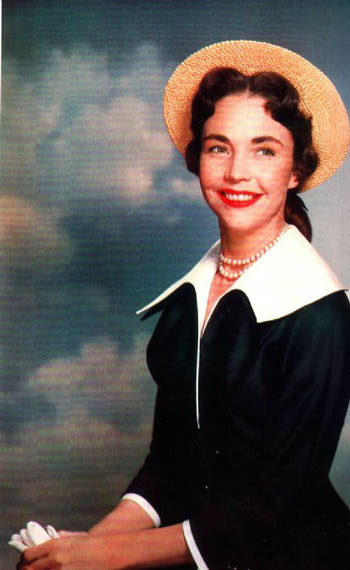

FEATURE image: Jennifer Jones in Good Morning, Miss Dove! (1955). The 36-year-old actress plays an elderly teacher taken ill at school who, in flashbacks reviewing her life, as a young woman had been about to marry the man she loved when her father died unexpectedly and was secretly heavily in debt. Miss Dove decides not to marry but to repay the debt by becoming the town’s spinster teacher.
Good Morning, Miss Dove endures because it presents the teacher as a moral center of community life, portraying personal sacrifice, discipline, and lifelong influence as virtues worth celebrating, while simultaneously reflecting mid-century America’s nostalgia for stable educational values during a period of social change.
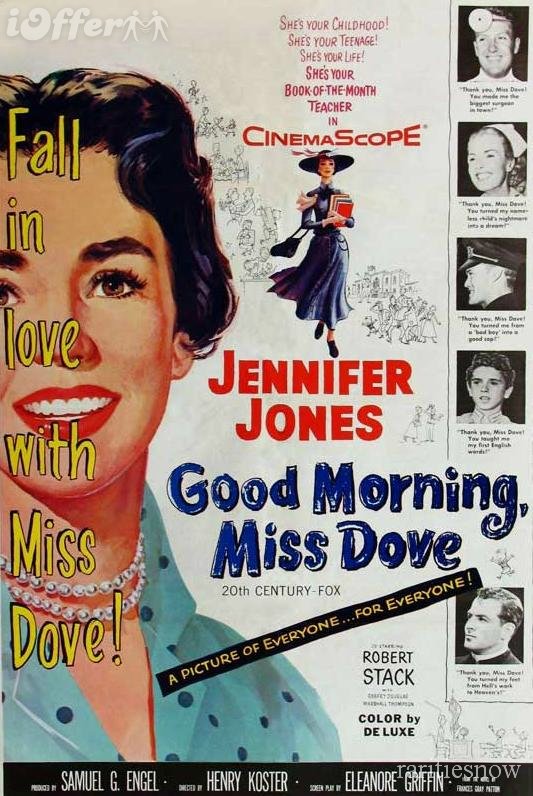
This is the original American theatrical poster for the 1955 release of Good Morning, Miss Dove! While the British campaign poster (below) relied on abstract whimsy, the domestic poster takes a more emotionally driven marketing approach to convey romanticized nostalgia, community gratitude and pride, and the title character’s deeply felt generational legacy. The film stars Jennifer Jones, Robert Stack, Kipp Hamilton, Robert Douglas, Peggy Knudsen, Marshall Thompson, Chuck Connors, and Mary Wickes. The movie was released by 20th Century-Fox the day before Thanksgiving in 1955.
The film opened to good reviews and was popular at the box office. A New York Times review observed: “Since it is unashamedly sentimental without being excessively maudlin about its heroine, ‘Good Morning, Miss Dove’ deserves credit for being honest and entertaining.”

This gorgeous portrait captures Jennifer Jones during a pivotal creative shift in her career, specifically serving as a promotional costume test or publicity still for the 20th Century Fox drama Good Morning, Miss Dove (1955). The wardrobe seen here was orchestrated by Academy Award-nominated costume designer Mary Wills whose look relies on distinct mid-century cinematic signals to convey morality and time period. The dark navy or black dress accented by a sharp, oversized white collar is a deliberate visual nod to a schoolteacher’s uniform—signaling propriety, rectitude, and strict boundaries. The double-strand pearl necklace, white gloves, and classic straw hat firmly ground her in a bygone era of immaculate gentility. Styled with a traditional 1950s bright red lip and perfectly pinned dark curls, the look emphasizes her youth. This directly contrasts with the aging makeup and prosthetics used later in the film to transform her into the elderly version of the character.
The film balances sentimentality with thoughtful observations about duty, character, service, and education.
By John P. Walsh
Good Morning, Miss Dove! is Frances Gray Patton’s contemporary tale of a middle-aged spinster elementary school geography teacher in Liberty Hill who, when suddenly taken ill, sees the entire small town rally to her side.
It is a mythical period piece from the mid-1950’s. It depicts an unchanging town whose students obey their beloved teacher. Though directed by Henry Koster in a stagey way, the film boasts progressive casting. One year after the milestone 1954 Supreme Court decision in Brown v. Topeka Board of Education establishing racial segregation in public schools as unconstitutional, Good Morning, Miss Dove! presents a newly-integrated public school classroom in Cinemascope and De Luxe color.
Film-going audiences in 1955 loved the film.
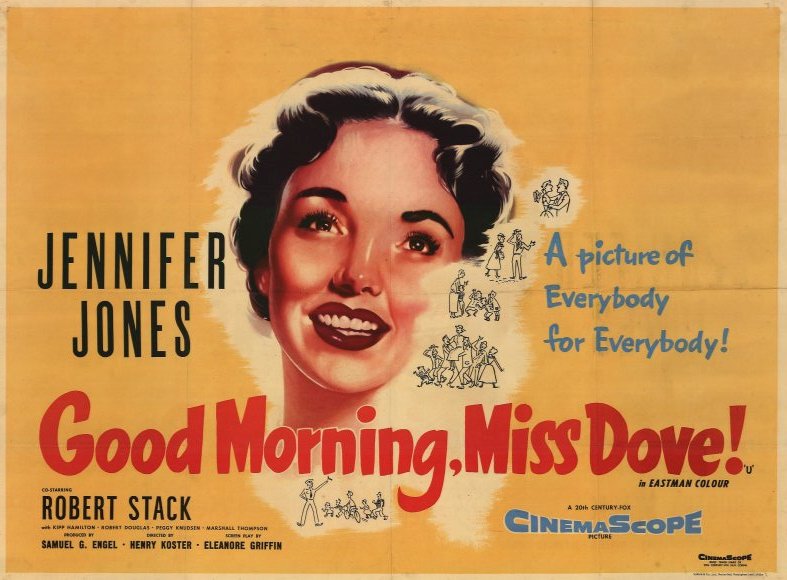
Original British theatrical poster for the 1955 20th Century Fox cinematic drama Good Morning, Miss Dove! starring Jennifer Jones and Robert Stack. Its core tagline: “A picture of Everybody for Everybody!” conveys universal appeal and wholesome, cross-generational family entertainment. The giant, warm illustration of Jennifer Jones looking upward with a glowing smile capitalizes on her existing star power as a traditional Hollywood romantic leading lady framing the movie as an uplifting, heartwarming emotional journey rather than grim drama. The prominent placement of the CinemaScope logo and the note “in Eastman Colour” were meant to convey the film’s modern technical prestige and cinematic scale.
Awaiting a risky operation, Miss Dove (Jennifer Jones) thinks back on her life and those of her prized grown-up former students. They included Robert Stack (a surgeon), Chuck Connors (a policeman), and Jerry Paris (a playwright). All of these students overcame difficult childhoods and found worldly achievement with the help of Miss Dove.
Based on popular Book of the Month Club novel.
Patton’s novel had enjoyed success in 1954 as a Book of the Month Club and Reader’s Digest selection. Its release as a major motion picture by 20th Century-Fox continued the novel heroine’s popularity.
Release of the film during the Thanksgiving weekend 1955 was in the same year that Jennifer Jones starred in another Deluxe color film, the American drama-romance Love is a Many-Splendored Thing.
For the Academy-Award winning actress to play an elderly spinster (many early scenes feature the naturally dark-haired Miss Jones without her older character’s make-up), she moves beyond type. In the mid-1950’s as America settled into the Eisenhower years, Good Morning, Miss Dove! showed a lead film character -– the “terrible” Miss Dove played by Jennifer Jones — as an unflinching and beloved disciplinarian. Yet in the 1950’s the American public education system was undergoing copious and difficult change. In that way, the character of Miss Dove is further complicated by becoming a popular icon in the American culture by being mostly a nostalgic figure.
Released in the exact same year as her massive romantic hit Love Is a Many-Splendored Thing, Good Morning, Miss Dove was a unique departure for Jones. Known primarily for playing passionate, emotionally turbulent leading ladies, this film marked her only true character-actor role.
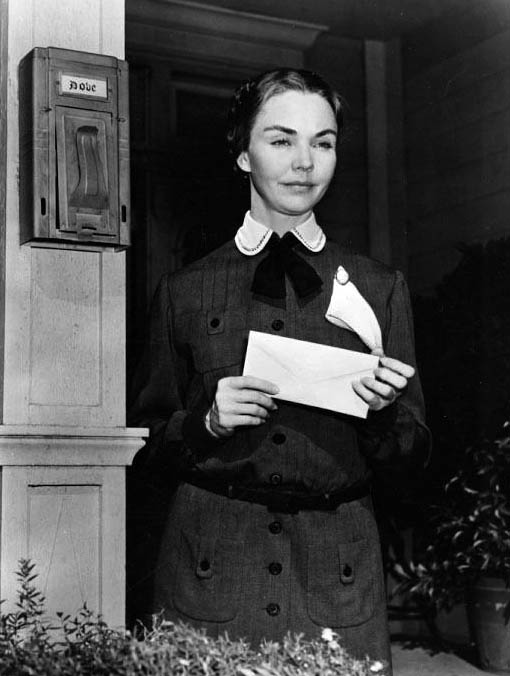
In 1955 Jennifer Jones was a 36-year-old beauty. Through the magic of Hollywood make-up (Ben Nye) and hair styling (Helen Turpin), she was transformed into the elderly Miss Dove for Good Morning, Miss Dove! In 1954 after Grace Kelly wore make-up for The Country Girl that hid her good looks and went against her youthful image (Kelly was 24 years old), she won the Academy Award for Best Actress for that year.
While the film itself leans into nostalgic melodrama, Jones’ performance was highly praised for balancing a severe, uncompromising facade with deep, underlying warmth. That balance was evident in the strict, modest dress she wore of a smalltown schoolteacher juxtaposed to a genuine, radiating smile.
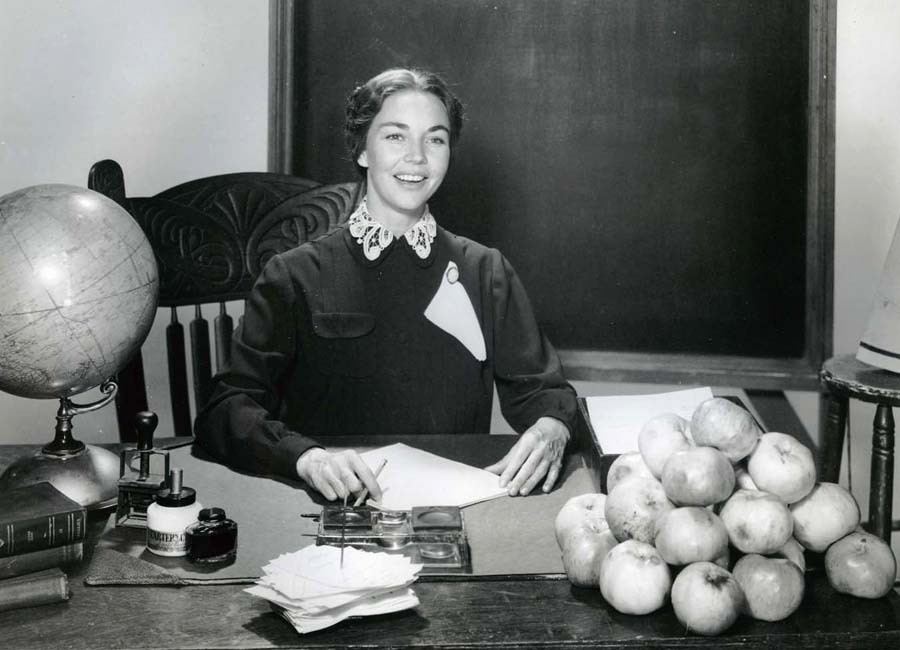
Jennifer Jones as the elderly teacher in Good Morning, Miss Dove! set in the fictional Midwest town of Liberty Hill. Before filming began in July 1955, director Henry Koster wanted Olivia deHavilland for the role and have it set in England. Though set in contemporary America, critics saw Miss Dove as a character out of Charles Dickens.
The audience meets the elder Miss Dove at the movie’s start—make-up and hair-styling artists Ben Nye and Helen Turpin transformed the 35-year-old Jennifer Jones into the 55-year-old Miss Dove—and by flashbacks.
The film dramatizes her youth as she is about to marry. But she receives the unexpected news that her father has died suddenly and that he has debts. To pay them back, she steels herself to remain single and take a teaching post. Her chilly veneer is part of her honor to do the proper thing along with the sober accommodation to life’s necessary sacrifices.

Miss Dove (Jennifer Jones) in a costume by Mary Wills. In the 1950’s Mary Wills was nominated for an Academy Award four times.
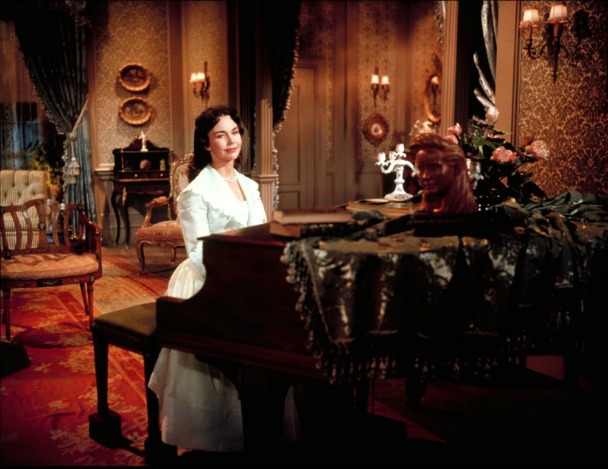
Young Miss Dove played by Jennifer Jones gives up marriage to the man she loves for a future as a spinster teacher so to pay back her late father’s debts. The story is based on a book by Frances Gray Patton that was itself based on her short stories. When 20th-Century Fox bought the rights for $52,000, it was the equivalent of about half a million dollars today.
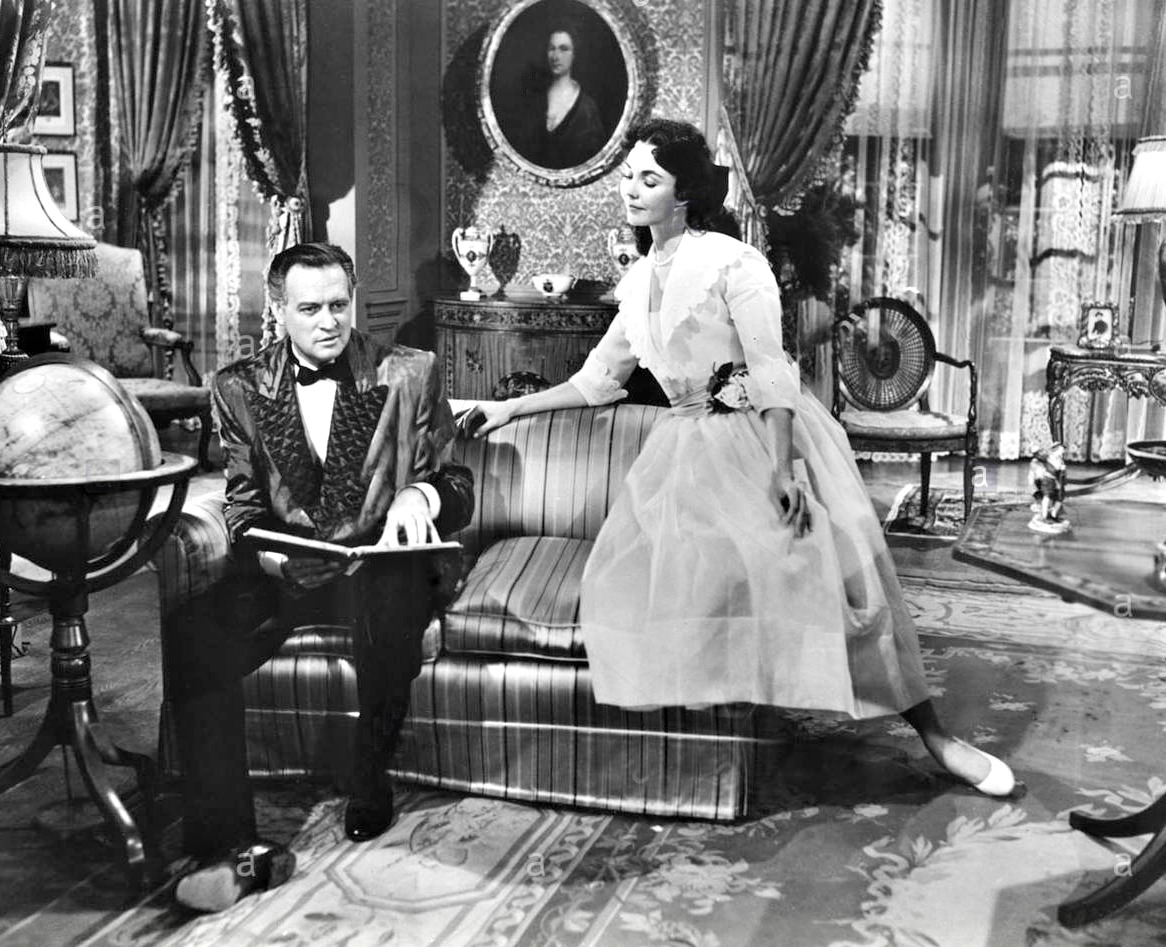
A flashback scene from Good Morning, Miss Dove! Jennifer Jones as young Miss Dove with her father, Alonso Dove (Leslie Bradley). When he dies unexpectedly and in debt, Miss Dove resolves to pay it back and upends her own life’s plans to do so. Costumes by Mary Wills.
While those who did not know Miss Dove behind her back mock her and say she couldn’t have had much of a life—never married, no family, no kids, never traveled anywhere—her army of students think about her and judge her radically differently.

In Good Morning, Miss Dove! Jennifer Jones is a beautiful young woman who rejects a marriage proposal to become the town’s grade school teacher to repay her late father’s debts. Costumes by Academy Award nominated costume designer Mary Wills.
Beyond any possibly wider cultural meaning, the film presents a unique person who by the logic of her experience and the experience of her logic enters into a series of social interactions that are amusing and honest. These include the film’s penultimate scene. Miss Dove is on her sick bed when she tells her pastor, Reverend Burnham (Biff Elliot): “Life, whatever others may think, has been for me…I have been happy. I have made many mistakes. Perhaps even sinned. I admit my human limitations, but I do not in all honesty find the burden of my sins intolerable. Nor have I strayed like a sheep. I have never been AWOL. I have never spoken hypocrisy to my Maker and now is scarcely a propitious moment to begin.”

On the day of Miss Dove’s surgery, classes are dismissed and the townspeople of Liberty Hill wait outside the hospital for news of the operation’s success. The film provides a sentimental picture of mid-20th century America of Norman Rockwell proportions. Yet the film’s crisp dialogue and sharp character development engages the moviegoer. By the end of the film the outcome of Miss Dove’s surgery is as important to the audience as it is the denizens of the fictional town of Liberty Hill.
While these thoughts may be judged from different perspectives, they are expressive of a woman’s life completely dedicated to her profession and students at Cedar Grove Elementary School. The film’s denouement is powerful. Accompanied by Leigh Harline’s memorable soundtrack, it is a sentimental tribute to Miss Dove’s life which benefited many different people because of nothing other than her good character.

Jincey Baker (Kipp Hamilton), Miss Dove (Jennifer Jones), and Dr. Tom Baker (Robert Stack). Promotion for the film included advertising that encouraged moviegoers to see it for its portrayal of the state of education in the country. Costumes by Mary Wills.
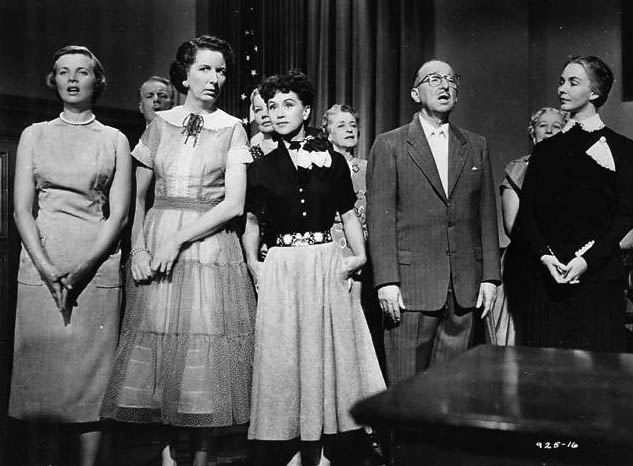
A 1955 drama that is both contemporary and nostalgic. Mary Wickes plays Miss Ellwood (second from left). Costumes by Mary Wills.
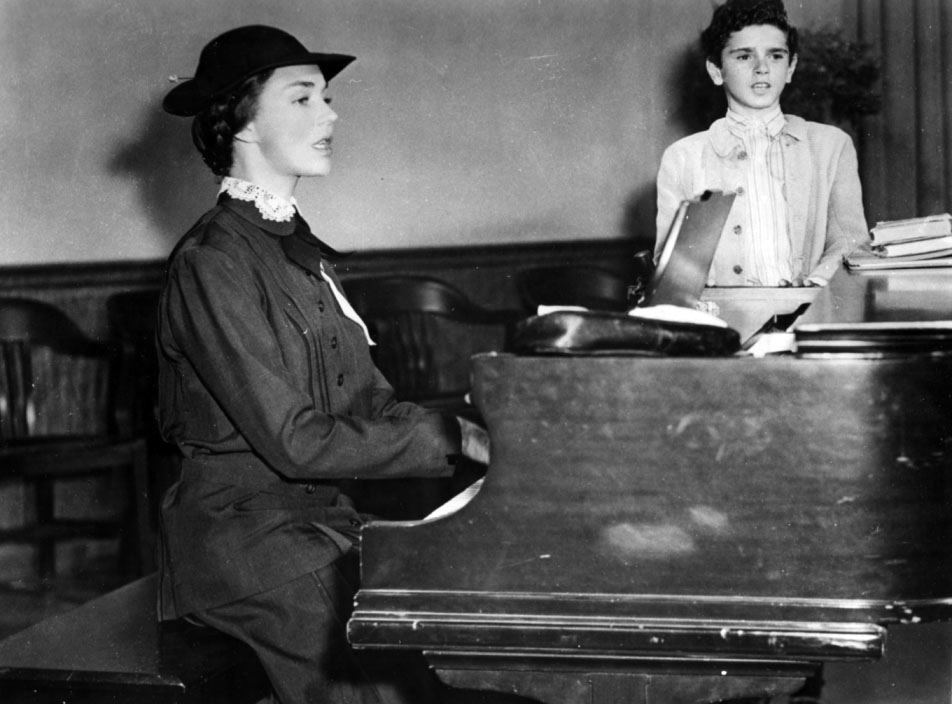
Jennifer Jones as a small-town spinster teacher who falls ill in the film Good Morning, Miss Dove! Her stern and upright demeanor masks her personal sacrifices and devotion to her students. That world is thrown into chaos when Miss Dove experiences an acute pain and grows numb in her leg. While she is in her hospital bed awaiting risky surgery, she relates her life in flashbacks.
Later, in the 1970’s, when actress Peggy Knudsen was suffering from a debilitating illness (she died in 1980 at 57 years old), in real life she wa cared for by her close friend, Jennifer Jones.

In the hospital Miss Dove is cared for by Nurse Billie Jean Green (Peggy Knudsen). Billie Jean is one of Miss Dove’s former student who left Liberty Hill and had a child out of wedlock. Back in Liberty Hill, Billie Jean is infatuated with the local policeman, Bill Holloway (Chuck Connors). Bill is another of Miss Dove’s former students and was one of her best pupils.

Miss Dove with former student and Liberty Hill policeman Bill Holloway (Chuck Connors). Miss Dove tells nurse Billie Jean Green how Bill first arrived to her classroom: a poor, unkempt boy being raised by an alcoholic grandmother. Miss Dove gave Bill odd jobs and bought him a suit for his grammar school graduation. After Bill entered the Marines, he wrote to Miss Dove often, and when he returned to Liberty Hill, she was the first person he came over to see for career advice.
Miss Dove emerges as a cultural symbol whose influence extends far beyond the classroom through the lives of her former students.
THE MOVIE:
In the film, Jennifer Jones portrays the titular character, Miss Dove, an intensely disciplined, upright geography teacher navigating life in a small Midwestern town. The narrative details how she began life as a vibrant, promising young woman with a loving fiancé. However, when her father unexpectedly passed away leaving behind massive bank debts, she made the agonizing decision to reject her marriage proposal. She chose a life of strict spinsterhood to systematically pay back every dime, transforming herself into the town’s famously stoic and beloved educator.
Mary Wills: Oscar-winning costume designer
The costume designer for Good Morning, Miss Dove! (1955) is Mary Wills (1914-1997). She worked mainly for Samuel Goldwyn productions and Twentieth Century-Fox, breaking into the movie business as a sketch artist for Gone With The Wind (1939). In her nearly 40-year career Mary Wills was nominated for an Oscar seven times and won the Academy Award in 1962 for her colorful designs for The Wonderful World of the Brothers Grimm.
First woman admitted to Yale Art and Drama program. “The Fabulous Miss Wills.”
Born in Prescott, Arizona, Wills moved to Los Angeles after receiving her Master’s degree from the Yale Art and Drama School. She was the first woman admitted into that program.
Wills started designing costumes in 1944 at RKO with Belle of the Yukon and soon after designed costumes for Disney’s Song of the South (1946). She started working for Samuel Goldwyn in 1948 where she designed costumes for Enchantment. For the next six years at Goldwyn Studio the costume designer was referred to as “The Fabulous Miss Wills.”
She was regularly nominated for her costume design in the 1950’s when she designed the costumes for Good Morning, Miss Dove! including Hans Christian Anderson (1952), The Virgin Queen (1954), Teenage Rebel (1956), A Certain Smile (1958), The Diary of Anne Frank (1959), The Passover Plot (1976) and the film for which she won the Academy Award in 1962. Mary Wills also designed the Rogers and Hammerstein musical film Carousel in 1956.

Academy-Award winning costume designer Mary Wills at the Samuel Goldwyn Studio (c. 1948). The Oscar-winning costume designer worked mainly for Samuel Goldwyn Productions and Twentieth Century-Fox.
Ice Follies. Camelot and Funny Girl.
Mary Wills demonstrated a special talent for designing historical costumes, especially after she moved to 20th-Century Fox in 1954 to make The Virgin Queen starring Bette Davis. Later she showed great aptitude for designing dance and folk costumes. A collection of her original sketches are online at the Los Angeles County Museum for live productions including the Shipstad & Johnson Ice Follies, now known as the Ice Follies. Mary Wills worked on two major films that she did not get film credit for — namely, Camelot (1967) and Funny Girl (1968). For Funny Girl, she designed the Ziegfeld show-girl brides costumes as well as the costumes for Omar Sharif.
The artistry and craftmanship of costume designer Mary Wills and makeup artist Ben Nye contributed behind the scenes to Jennifer Jones’s transformation as Miss Dove.
SOURCES:
Barrett, Michael. “The Sentimental Pedagogy of Good Morning, Miss Dove.” PopMatters, June 5, 2014. http://www.popmatters.com/review/182178-good-morning-miss-dove/.
Green, Paul. The Life and Films of Jennifer Jones. Jefferson, NC: McFarland & Co., 2011.
“Good Morning, Miss Dove.” The Makeup Gallery. Accessed September 26, 2015. http://www.themakeupgallery.info/age/1950s/dove.htm.
“Good Morning, Miss Dove Overview.” The New York Times. Accessed September 26, 2015. http://www.nytimes.com/movies/movie/93588/Good-Morning-Miss-Dove/overview.
Leach, William. “John Dewey vs. The Terrible Miss Dove: Frances Gray Patton’s Postwar Schoolmarm and the Cultural Work of Nostalgia.” Academia.edu. Accessed September 26, 2015. https://www.academia.edu/1848534/_John_Dewey_vs._The_Terrible_Miss_Dove_Frances_Gray_Pattons_Postwar_Schoolmarm_and_the_Cultural_Work_of_Nostalgia.



*The photograph copyright may be believed to belong to the distributor of the film, 20th Century Fox, the publisher of the film or the graphic artist. The copy is of sufficient resolution for commentary and identification but lower resolution than the original photograph. Copies made from it will be of inferior quality, unsuitable as counterfeit artwork, pirate versions or for uses that would compete with the commercial purpose of the original artwork. The image is used for identification in the context of critical commentary of the work, product or service for which it serves as poster art. It makes a significant contribution to the user’s understanding of the article, which could not practically be conveyed by words alone. As this is a publicity photo (star headshot) taken to promote an actress, these have traditionally not been copyrighted. Since they are disseminated to the public, they are generally considered public domain, and therefore clearance by the studio that produced them is not necessary. (See- Eve Light Honthaner, film production expert, in The Complete Film Production Handbook, Focal Press, 2001 p. 211.) Gerald Mast, further, film industry author, in Film Study and the Copyright Law (1989) p. 87, writes: “According to the old copyright act, such production stills were not automatically copyrighted as part of the film and required separate copyrights as photographic stills. The new copyright act similarly excludes the production still from automatic copyright but gives the film’s copyright owner a five-year period in which to copyright the stills. Most studios have never bothered to copyright these stills because they were happy to see them pass into the public domain, to be used by as many people in as many publications as possible.” Kristin Thompson, committee chairperson of the Society for Cinema and Media Studies writes in the conclusion of a 1993 conference with cinema scholars and editors, that they “expressed the opinion that it is not necessary for authors to request permission to reproduce frame enlargements … [and] some trade presses that publish educational and scholarly film books also take the position that permission is not necessary for reproducing frame enlargements and publicity photographs.”(“Fair Usage Publication of Film Stills,” Kristin Thompson, Society for Cinema and Media Studies.)
