FEATURE IMAGE: The monument inside Vézelay Abbey features a striking statue of Saint Bernard of Clairvaux sculpted from fine French limestone by Honoré Jean Aristide Husson (1803–1864). Depicted in traditional monastic robes, the influential Cistercian monk and reformer triumphantly raises a large Latin cross in his right hand while holding an abbot’s crozier in his left, a powerful posture that directly signifies his historical role as a passionate orator and preacher rallying the faithful. The landmark monument was completed and installed in 1846, commissioned to commemorate exactly 700 years since Bernard famously preached the launch of the Second Crusade on Easter Sunday, March 31, 1146. This installation coincided with a critical period for Vézelay Abbey, which was in a severe state of decay until the French government launched a massive restoration project headed by the famous architect Eugène Viollet-le-Duc. Husson’s sculpture was an integral part of that grand, 19th-century revival designed to honor the abbey’s illustrious medieval legacy. Directly below the main statue, a finely carved stone relief panel depicts the historic outdoor assembly where the crusade was declared. The figures shown enthroned in the relief represent the French monarchy, specifically King Louis VII and his queen consort, Eleanor of Aquitaine. Because the crowd gathered to hear Bernard was far too vast to fit inside the abbey walls, the event was forced to move to an open field just outside the abbey. His sermon proved so profoundly moving that the inspired crowd immediately began shouting “Crosses! Crosses!” and eagerly tearing up their own clothing to fashion cloth crosses to stitch onto their shoulders. September 1993. Author’s photograph.
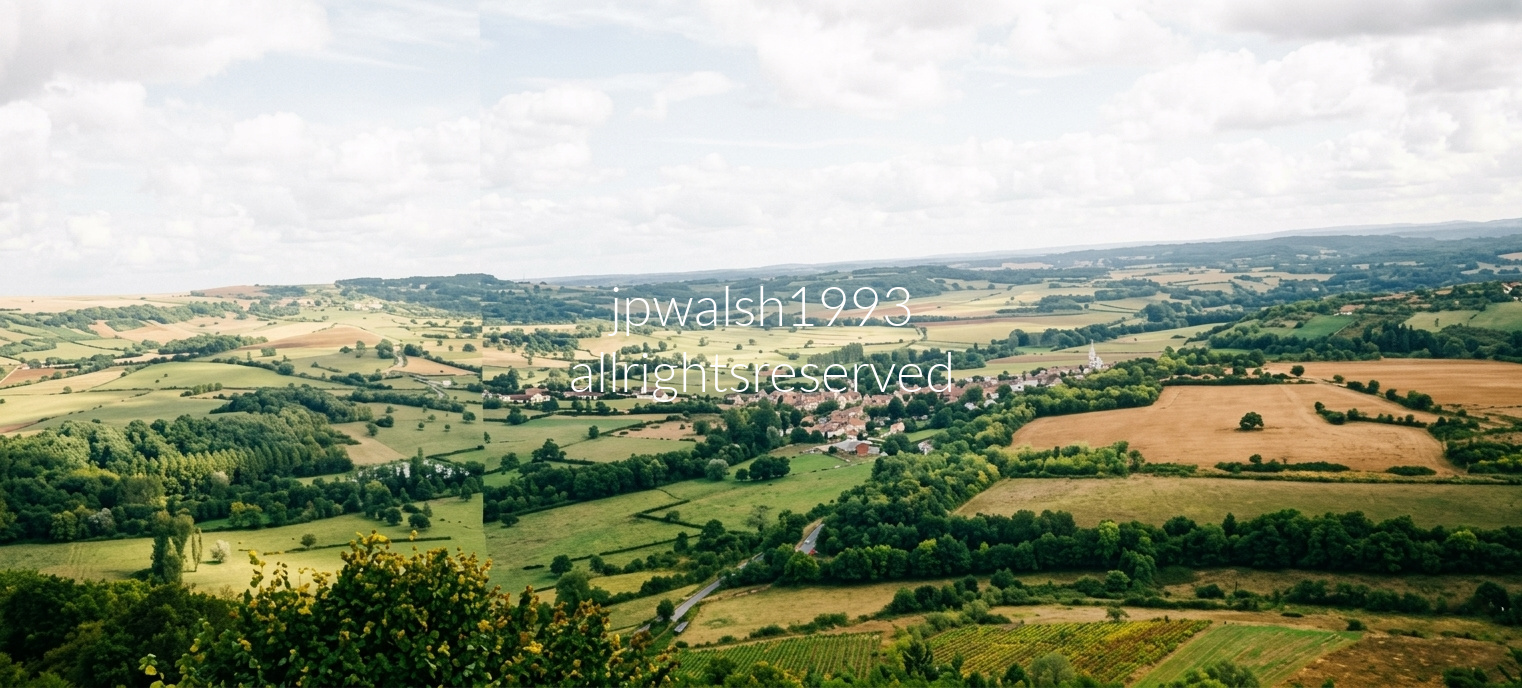
Burgundy landscape. September 1993. Author’s photograph.
A wide panorama of the Burgundy countryside reveals a landscape shifting seamlessly between plateaus, low ridges, and broad depressions, the very geology that produces the south‑ and east‑facing slopes essential to the region’s viticulture. Flat, fertile basins cut between the rolling hills, arranged in the traditional patchwork of small fields bordered by dense hedgerows and tree lines. A compact village sits naturally in the folds of a low valley, echoing the historic pattern of settlements clustering along gentle contours near water and travel routes. Higher ridges carry thick stands of deciduous and coniferous forest, breaking the farmland into measured intervals and acting as natural windbreaks. It was in this terrain that St. Bernard preached the Second Crusade in 1146, rallying the vast crowd gathered on the open meadow outside Vézelay.
Bernard’s Voice & the Call to Arms
A contemporary witness wrote that Bernard’s voice “rang out across the meadow like a celestial organ,” and when he finished, the crowd surged forward to enlist en masse. History recalls that the Second Crusade they joined would collapse into a disastrous sequence of defeats for Christendom in the East.
Early Life & Vocation
Born into a wealthy Burgundian family, Bernard was intelligent, intense, and strikingly handsome in appearance. His decision to become a monk was unusual enough; choosing Cîteaux, a new and absolutely impoverished monastery founded in 1098, horrified his relatives. Bernard’s choice presaged, a century early, the radical poverty later embraced by St. Francis: a literal return to the gospel and to St. Benedict’s rule, even as Cîteaux struggled to attract recruits.
The Cistercian Surge
In 1113, Bernard’s charisma famously drew thirty of Burgundy’s finest young men into Cîteaux, transforming the monastery overnight. Historian Christopher Holdsworth later wrote that “Bernard’s first and greatest miracle was himself.” Under Abbot Stephen Harding, Cîteaux’s English co‑founder, Bernard and the new monks began founding daughter houses. Their example ignited a movement so strong that the 12th century became the “Cistercian century.”
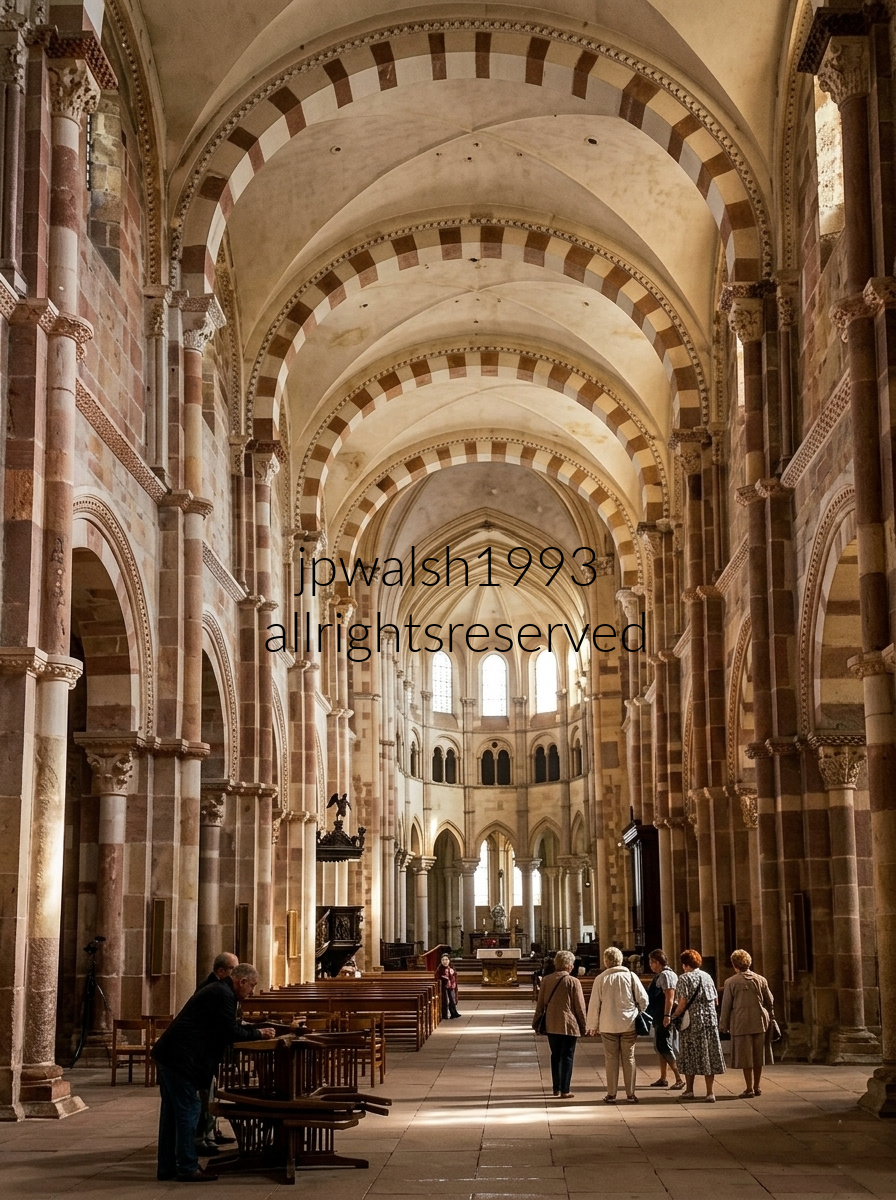
Interior nave of Vézelay Abbey. September 1993. Author’s photograph.
The interior nave of Vézelay Abbey (Basilica of Sainte‑Marie‑Madeleine) in Burgundy presents a Romanesque masterpiece moving confidently toward early Gothic. The most commanding feature is the series of semicircular arches (arcs doubleaux) that span the nave, each built from alternating light and dark stone voussoirs that create a striking banded pattern and echo a revived Roman design vocabulary.
Clairvaux & Opinionated Leadership
With twelve companions, Bernard founded Clairvaux, the “Valley of Light.” Life there was harsh, marked by privation and illness, but Bernard’s sharing in all the foundation’s suffering sharpened his authority. As abbot, he became a sought‑after voice on the political and ecclesiastical crises of his day. His wit was cutting, his opinions unfiltered, and his influence immense.
Reform & Conflict
Bernard championed the Hildebrand reforms of Pope Gregory VII, targeting simony, enforcing clerical celibacy, and resisting secular control of church appointments. He pushed for a purified clergy and a Church independent of royal interference. The 12th century’s chronic schisms—among popes, kings, princes, and bishops—made reform urgent. Bernard helped secure unity at the Second Lateran Council (1139), where the anti‑pope’s adherents were finally condemned.
Bernard clashed with the wealthy monks of Cluny, though he remained friendly with their abbot, and dismissed Peter Abelard as a marketplace intellectual.
West façade of Vézelay Abbey. September 1993. Author’s photograph.
The west façade of Vézelay Abbey evolved over several centuries, merging Romanesque engineering, Gothic heightening, and 19th‑century restoration into a single composite front. While the abbey’s celebrated internal narthex tympanum dates to the 1140s, the exterior tympanum above the main entrance is a 19th‑century reconstruction. The original Romanesque Last Judgment—one of Vézelay’s masterpieces—was mutilated and destroyed by revolutionaries in 1793. The current tympanum was carved by Michel‑Pascal under the direction of Eugène Viollet‑le‑Duc, whose restoration campaign reshaped the façade’s sculptural program and stabilized its structural envelope. The south tower began around 1150 in the Romanesque style, then rose higher through 13th‑ and 14th‑century Gothic phases. A matching north tower was planned but never built, leaving the façade asymmetrical. The main stone portals and doorways were constructed between 1140 and 1150 as part of a major western porch expansion designed to handle the heavy influx of medieval pilgrims traveling to Vézelay.
The Second Crusade & Reputation
In 1142, the pope ordered Bernard to preach the Second Crusade, a duty he accepted but which later rebounded against him when the campaign failed catastrophically. The stain on his reputation lingered into his final years.
Death, Canonization & Legacy
Bernard died on August 20, 1153, now his feast day. He was canonized in 1174 and named a Doctor of the Church in 1830.
After his death, Vézelay remained a stage for major political drama. In 1166, the exiled Archbishop Thomas Becket used Vézelay to threaten King Henry II with excommunication. In 1190, Richard the Lionheart and King Philippe Auguste met there and spent three months at the abbey before departing on the Third Crusade.
This explanatory article may be periodically updated.
FEATURE image: The North Porch was constructed at the start of the 13th century. The North Porch, like the North Rose Window (below) crafted in the same time, depicts the glories of the Virgin Mary along with Old Testament figures. PHOTO: “Chartres, North Porch, Central Portal, LeftJamb” by profzucker is licensed under CC BY-NC-SA 2.0.
The Royal Portal of Chartres Cathedral represents one of the defining achievements of early Gothic art, where architecture, sculpture, and theology were fused into a monumental visual statement of Christian belief. Created in the mid-twelfth century and remarkably preserved, its sculpted kings, queens, prophets, and Christ figures reveal the moment when medieval Europe began transforming stone into a sophisticated language of faith, learning, and artistic innovation.
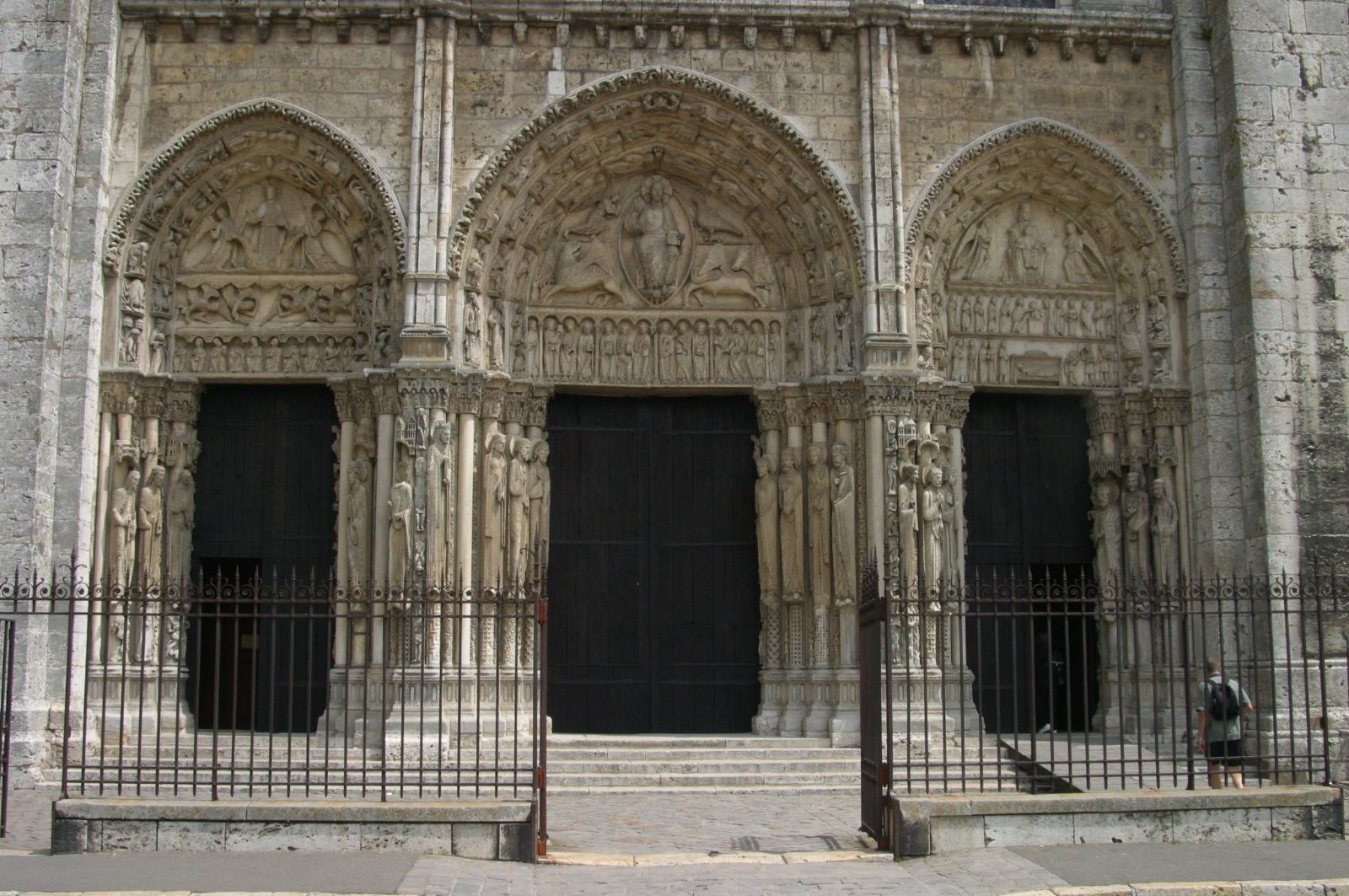
The Royal Portal (Portail Royal) on the west façade of Chartres Cathedral, carved between 1145 and 1155, is one of the finest surviving ensembles of Early Gothic sculpture. Its three richly coordinated doorways present a sweeping vision of Christ’s role in salvation history. Above the left portal, a semicircular tympanum depicts Christ’s Ascension; the central portal illustrates the Apocalypse and the Second Coming of Christ; while the right portal focuses on Christ’s nativity and entrance into human history while crowning the composition is the Sedes Sapientiae (Throne of Wisdom), where the Virgin Mary sits enthroned with the Christ Child in her lap, flanked by two incensing angels. The portals are further enriched by sculpted lintels and archivolts populated with biblical figures and symbolic imagery. Lining the doorways below are the celebrated jamb statues attached to the columns, their elongated, otherworldly forms depicting the kings and queens of the Old Testament. Together, these sculptures create a monumental stone theology that welcomed medieval pilgrims while proclaiming the spiritual and royal lineage of Christ. PHOTO: “Chartres” by Photo:Nina Aldin Thune User:Nina-no is licensed under CC BY 2.5.
The Royal Portal of Chartres is more than a cathedral entrance; it is one of the earliest and most influential masterpieces of Gothic art, transforming carved stone into a timeless expression of faith, knowledge, and medieval imagination.
Jamb statues from the Royal Portal (west façade) of Chartres Cathedral. These columns stand on the right-hand side of the Central Portal. These statues were carved between 1145 and 1155. They represent a critical turning point in Western art history, standing as the definitive bridge between the rigid, blocky Romanesque style and the lifelike naturalism of the Early Gothic period. While individual identities are debated, the overarching program represents the Kings and Queens of the Old Testament. PHOTO: “Cenral tympanum Chartres” by Cancre is licensed under CC BY-SA 2.5.
First Visit and Returning to Chartres Across the Years
I first visited Chartres Cathedral in 1985, returning in 1989, 2002, and 2005. That first visit included a Malcolm Miller tour—my introduction to a guide who, since 1958, had devoted his life to interpreting one building. As I backpacked through Europe, his example showed me how a single enduring monumental work can anchor a lifetime of study.
The Great Glass of Chartres
Chartres is celebrated above all for its 12th‑ and early‑13th‑century stained glass, a nearly intact ensemble unmatched anywhere in Europe. The windows shimmer with deep blues, ruby reds, and jewel‑like greens—colors that have survived more than 800 years. Their narratives unfold left to right, beginning at the base and rising upward, guiding viewers through biblical cycles, guild stories, and royal symbolism.
Layers of Cathedrals on a Roman Site
The cathedral stands on what was once a Roman site, and several earlier churches rose and fell here. Structures were destroyed during the Merovingian era, again in Viking raids, and once more in the fires of the 12th century. Each catastrophe cleared the ground for a new architectural vision, culminating in the High Gothic monument seen today.
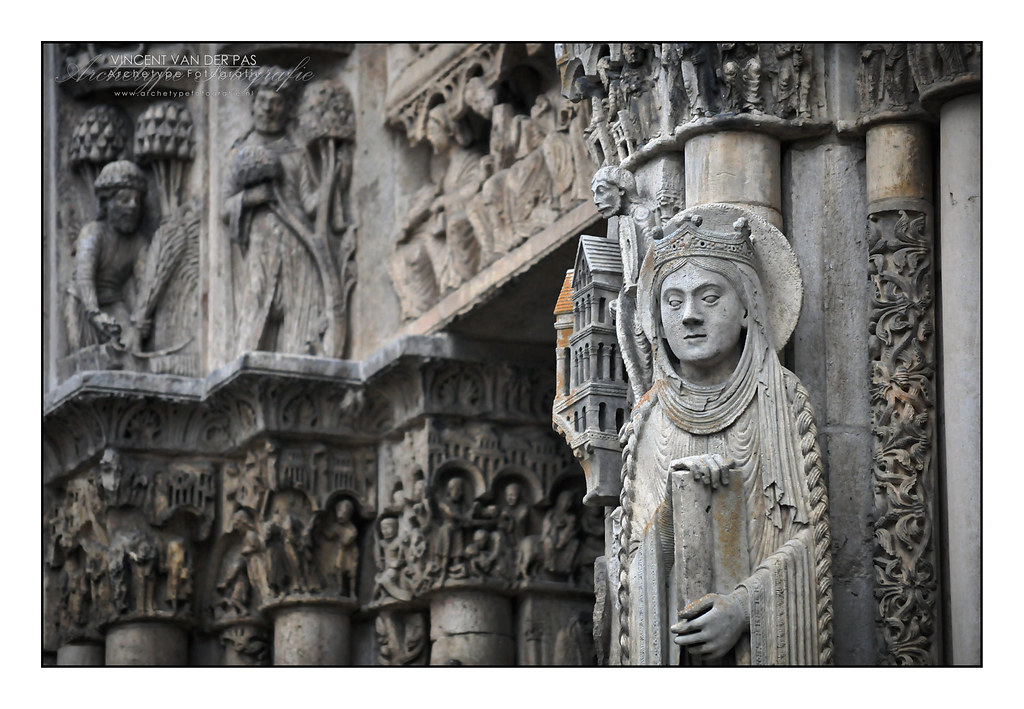
Detail of jamb statue located on the on the Central Doorway of the North Portal (Portail Nord) of Chartres Cathedral. The prominently featured statue is identified as Saint Anne, the mother of the Virgin Mary. While the Royal West Portal y dates to the mid-12th century (1145–1155), the North Portal was constructed later, between 1204 and 1220. This timing difference explains why Saint Anne’s face features a much more advanced, deeply expressive, and three-dimensional High Gothic naturalism compared to the highly stylized, strictly column-like figures of the west façade. PHOTO: “France, Detail ‘Cathédrale Notre-Dame de Chartres’” by Vincent_AF is licensed under CC BY-SA 2.0.
The Cult of the Virgin Mary
A powerful cult of the Virgin Mary developed at Chartres, strengthened by the arrival of the cathedral’s most famous relic in the 9th century: the Sancta Camisa, believed to be the Virgin’s veil. When devotion to Mary surged across Europe in the 12th century, Chartres—already dedicated to Mary’s Assumption—was perfectly positioned to become a major pilgrimage center, drawing travelers from across Christendom.
Arrival in Chartres
On my first visit to Chartres Cathedral in 1985, I left Paris after breakfast, walked to Gare Montparnasse, and boarded a direct train to Chartres. That day’s tour with Malcolm Miller centered on the great windows of the north side: the North Rose Window (c. 1231), the Blue Virgin Window (c. 1194), and portions of the Noah Window (c. 1210). The Noah Window includes a portrait of St. Lubin, the 6th‑century bishop of Chartres and patron of wine merchants—one of the guilds that financed the glass.
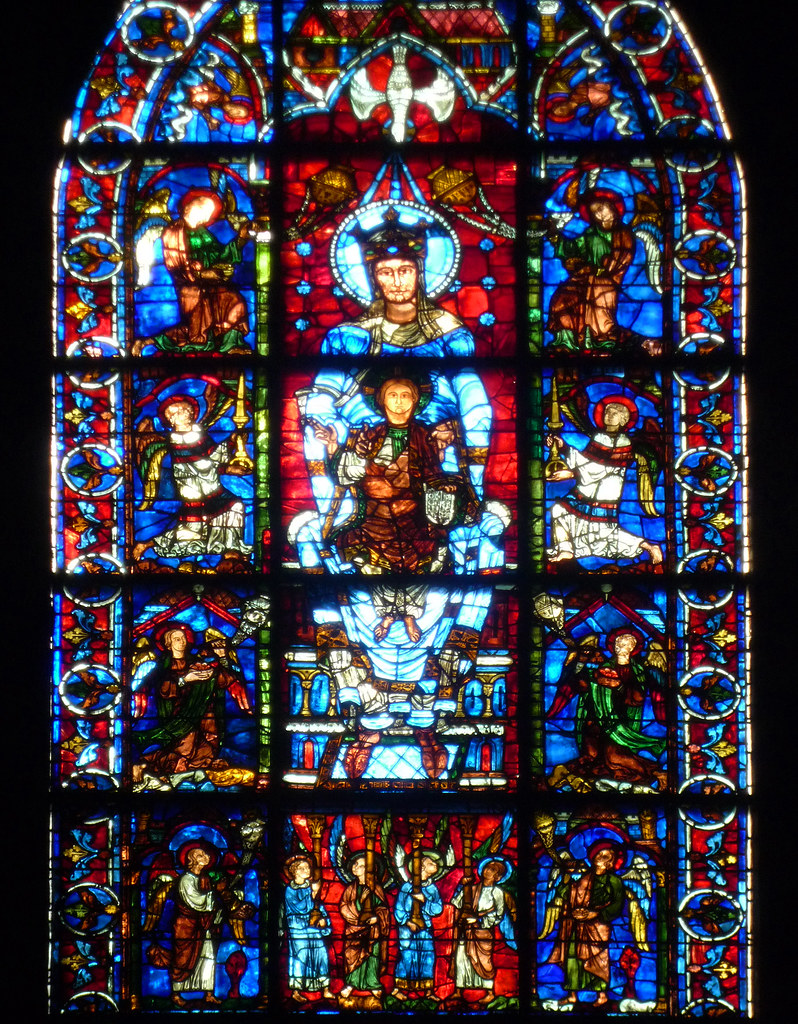
The Blue Virgin Window (Notre-Dame de la Belle-Verrière) is located completely away from the transept roses, tucked into the south aisle of the choir ambulatory (Bay 30). it was one of the incredibly rare pieces of glass that miraculously survived the great cathedral fire of 1194. The central figures of the Virgin Mary and Child date to approximately 1180. When the cathedral was rebuilt in the early 13th century, the master glasiers saved this sacred 12th-century panel and carefully framed it with new 13th-century outer border panels (circa 1215–1220), blending Romanesque and High Gothic glass art seamlessly. PHOTO: “Chartres, Notre-Dame de la Belle-Verrière (detail of Virgin)” by profzucker is licensed under CC BY-NC-SA 2.0.
The portal celebrates Christ’s majesty while emphasizing the relationship between the Old and New Testaments. Its sculptural program unites architecture and theology, turning the cathedral entrance into a visual lesson in Christian belief.
Sculpture of the West Front
Miller also took us outside to study the 12th‑century statuary of the Royal Portal on the west front—figures I photographed again in 1989. These sculptures belong to the cathedral’s Romanesque‑Gothic transitional phase and survived multiple disasters that reshaped the building.
Early Fires and Romanesque Foundations
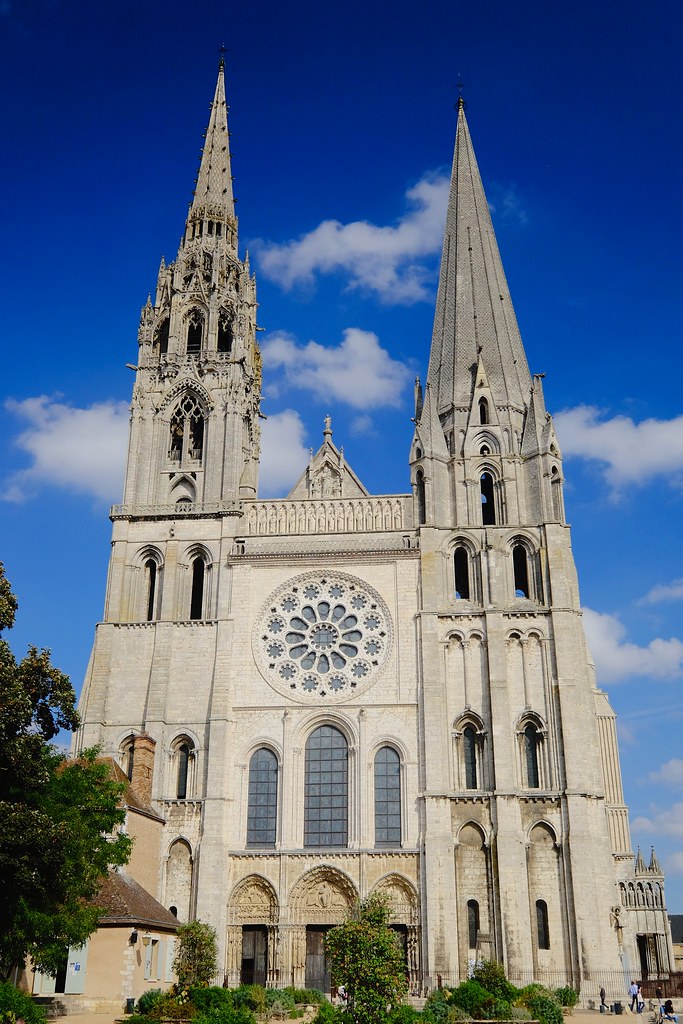
A major fire in 1120 destroyed the earlier church, prompting construction of a large Romanesque structure contemporary with Vézelay Abbey. Another fire in 1134 damaged the building and led to the construction of the north tower, completed in 1150. The south tower followed roughly a decade later. The Royal Portal itself was built between 1145 and 1155, forming the nucleus of the west front that still stands today.
The 1194 Fire and Gothic Rebuilding
The defining catastrophe came in July 1194, when a devastating fire destroyed nearly the entire church and much of the city. Remarkably, the mid‑12th‑century west front, its royal doors, and the two contrasting towers survived. Everything else—the soaring nave, the sculptural program, and nearly all the stained glass—was rebuilt between 1195 and 1220, creating the unified High Gothic masterpiece seen today.
The survival of the Royal Portal through fires, wars, and centuries of change makes it an extraordinary witness to medieval civilization.
The North Rose window in Chartres Cathedral displays the Virgin Mary and Child in the center surrounded by small circles of doves, angels and thrones. In the outer circles are depicted the 12 kings of Judah (who were Jesus and Mary’s ancestors) and the 12 minor prophets. “Chartres – cathédrale – rosace nord” by Eusebius@Commons is licensed under CC BY 2.0.
Royal Patronage of the North Rose:
In the rebuilding of Chartres, The North Rose Window (created c. 1230-1235) was donated by Blanche de Castile, mother and regent, who ensured the design honored both her lineage and her teenage son, King Louis IX, whose royal patronage helped define the Gothic cathedral’s luminous 13th‑century glass program both here and soon in Paris.
Political Strategy Behind the Glass
The window is not only a devotional masterpiece; it is a calculated piece of 13th‑century political messaging crafted at a moment when Blanche of Castile faced rebellions from French barons who resented both her gender and her foreign birth to rule France. By shaping the iconography, Blanche used the cathedral’s most prominent glass to assert her divinely sanctioned authority.
Heraldry as a Statement of Power
Blanche inserted unmistakable symbols of legitimacy:
the arms of France — golden fleurs‑de‑lis on blue
the arms of Castile — golden castles on red
Placed together, they proclaimed the union of dynasties and the rightful lineage of her son, Louis IX, whose minority she was defending.
The Lancet as a Warning to the Barons
Directly beneath the great rose, Blanche added a lancet window pairing righteous biblical kings standing triumphantly over fallen, corrupt rulers. It was a visual admonition to rebellious nobles: oppose the rightful sovereign, and you align yourself with the defeated enemies of God.
Saint Anne and Blanche of Castile
At the center of the vertical lancets stands Saint Anne, holding the infant Virgin Mary. This was a deliberate, intimate parallel. Blanche positioned herself as a holy mother‑protector, raising the sacred child — Louis IX — to rule France. The imagery reinforced her maternal authority and the sanctity of her regency.
Revolutionary Upheaval and Restoration
During the French Revolution, Chartres Cathedral was desecrated and repurposed as a Temple of Reason, part of the radical de‑Christianization campaign. It was not returned to the Church or reconsecrated until 1855, beginning the long modern era of preservation and study that continues today.
The survival of the Royal Portal through fires, wars, and centuries of change makes it an extraordinary witness to medieval civilization. Chartres became a model for later Gothic cathedrals throughout France and Europe.
The West Front is from the 12th, 13th and 16th centuries. The photograph’s column statues below are on the right side of the West Portal’s central door. Though likely originally intended in the 12th century to be enclosed in a narthex, that structure was not built and these sculptures remained outdoors. “Chartres 2014 – 2” by evocateur is licensed under CC BY-SA 2.0.
The Rise of Cathedral Learning
By the 11th century, Europe experienced a renewed intellectual energy, especially in Northern Europe, where monastic and later cathedral schools became centers of study. One of the pivotal figures in this revival was Gerbert of Aurillac (c. 946–1003), later Pope Sylvester II, who had studied in Spain and led the cathedral school at Reims in the 970s. His most influential pupil, St. Fulbert of Chartres, carried this legacy forward.
Fulbert and the Great School of Chartres
As bishop, St. Fulbert founded the Chartres Cathedral School, which became the most illustrious center of learning in the 12th century. It marked a turning point in Western intellectual life. Scholars there debated emerging philosophical questions about God, humanity, reason, and creation—the very issues that defined the 12th‑century renaissance of thought.
Completion and Consecration of the Gothic Cathedral
Although the present Gothic cathedral was roofed and essentially finished around 1220, it was formally reconsecrated in October 1260. By then, Chartres had already become a magnet for major religious figures. Three popes visited during the 12th century, and in later centuries saints such as Thomas Becket, Bernard of Clairvaux, Francis de Sales, Vincent de Paul, Louis de Montfort, and Benedict Joseph Labre prayed there.
Pilgrimage Through the Centuries
Pilgrimages to Chartres began before the 12th century and remained important through the 16th and 17th centuries, though they declined sharply after the French Revolution. By the late 19th century, pilgrims were returning, but the revival of the traditional Paris‑to‑Chartres route is credited to the French poet Charles Péguy.
Charles Péguy and the Modern Pilgrimage
On June 14, 1912, Péguy set out on the nearly 150‑kilometer walk from Paris to Chartres, completing it in three days. The pilgrimage fulfilled a vow he had made the previous year at the bedside of his ill son. “Chartres is my cathedral,” he later wrote. His life ended two years later: on September 5, 1914, serving as a lieutenant in the 19th Company, 276th Infantry Regiment, he was killed near Villeroy, Seine‑et‑Marne. Péguy was 41.
The Royal Portal is the oldest surviving section of Chartres Cathedral and predates much of the present Gothic structure. Elongated jamb figures of kings and queens bridge Romanesque traditions and the emerging naturalism of Gothic sculpture.
The Royal (West) Portal, 12th century, Cathédrale de Chartres (1145-1220), France. December 1989. Author’s photograph 1.24 mb
Identifying the Figures
While art historians have attempted to identify the portal statuary at Chartres, the conclusions remain speculative. The figures appear to represent Old Testament characters—and in this photograph, the pair may be King Solomon, at right holding a scroll, and the Queen of Sheba beside him. Their identities matter less than the expressive force the sculptor carved into their faces nearly a millennium ago.
Faces Filled With Life
What is striking is the inexpressible joy radiating from these stone faces. The 12th‑century sculptor concentrated the entire vitality of the figures in their expressions—an artistic ambition that still feels modern. Even after 900 years of weather, war, and revolution, the faces retain a startling immediacy.
Statuary at the Height of 12th‑Century Art
Although Chartres is world‑famous for its flying buttresses and stained glass, many art historians argue that the statuary is the cathedral’s most compelling achievement. These portal figures represent 12th‑century sculpture at its zenith, where spiritual intensity, architectural innovation, and human emotion converge in stone.
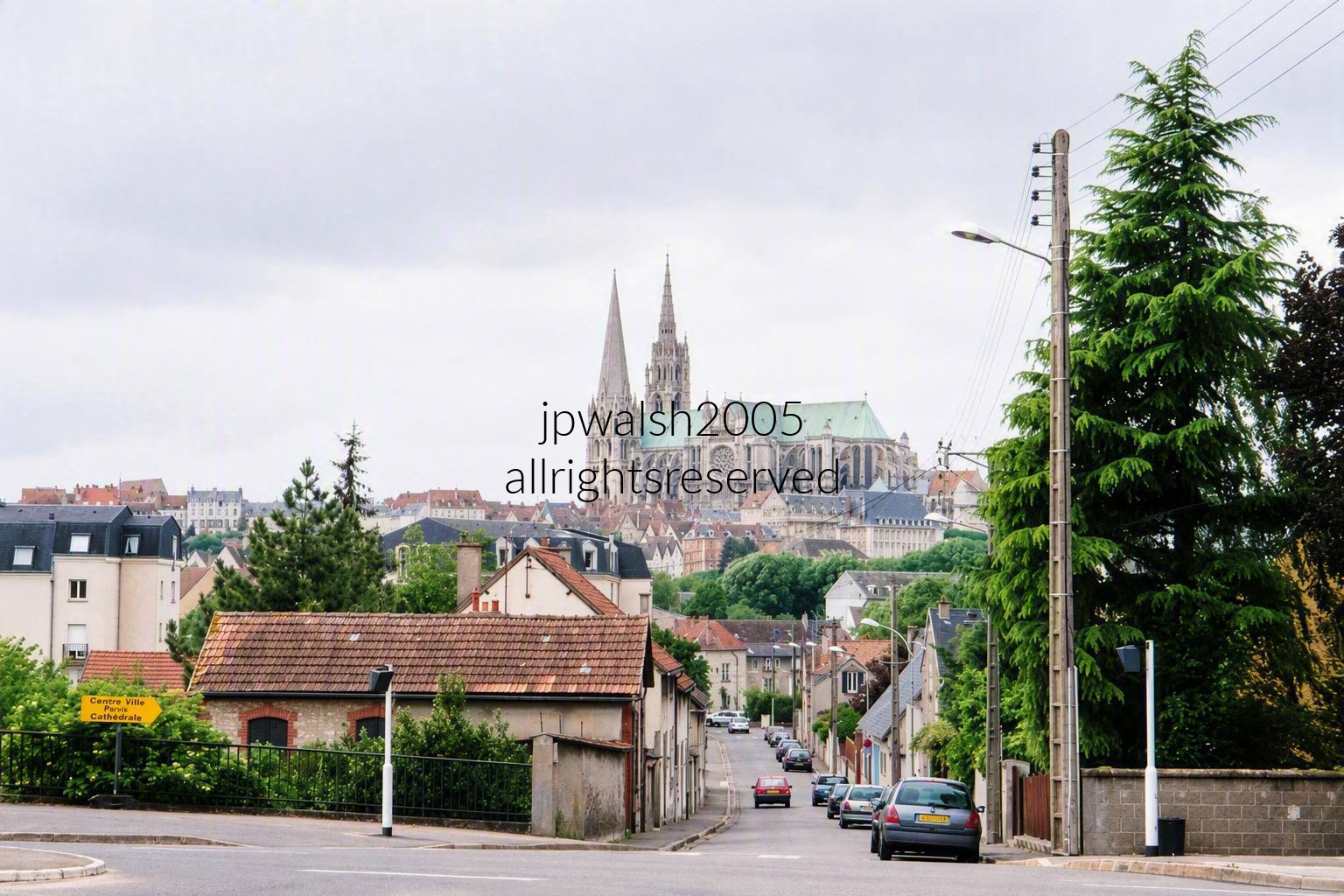
Cathédrale Notre-Dame de Chartres. May 2005. Author’s photograph,
Taken from Jardin de Sakuraï, this view looks west-southwest along 35 Rue du Faubourg Guillaume toward the historic center of Chartres, France, where the world-famous Cathédrale Notre-Dame de Chartres dominates the skyline. This High Gothic masterpiece is instantly recognizable for its asymmetrical spires, soaring flying buttresses, and expansive green copper roof. From this eastern vantage point, the cathedral’s two towering western spires rise at the far left. Following the roofline to the right, the large projecting cross-shaped section in the middle is the north transept façade. Beyond it, the lower rounded end of the church, encircled by an impressive ring of flying buttresses, forms the apse, the cathedral’s eastern termination. Together, these elements reveal the monumental scale and architectural complexity that have made Chartres one of the most celebrated cathedrals in Europe.