
Tag Archives: #CulturalHeritage

Jan Brueghel’s Flowers in a Vase (1608): Flemish Art, Italian Patronage, and the Making of Milan’s Ambrosiana Collection.

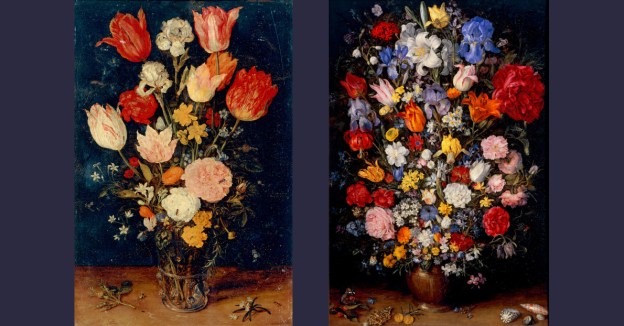
Feature Image: Flowers in a Vase and Flower Vase with Jewel, Coins, and Shells, both 1608, oil on copper, by Jan Brueghel the Elder and in the Pinacoteca Ambrosiana, Milan, Italy.

In these remarkable 1608 flower paintings, Jan Brueghel the Elder transformed floral still life from decorative accompaniment into an independent artistic subject, combining scientific observation, extraordinary technical precision, and spiritual reflection. The works reveal how early seventeenth-century Flemish art celebrated the beauty, diversity, and transience of nature while elevating close observation into an act of wonder and devotion.
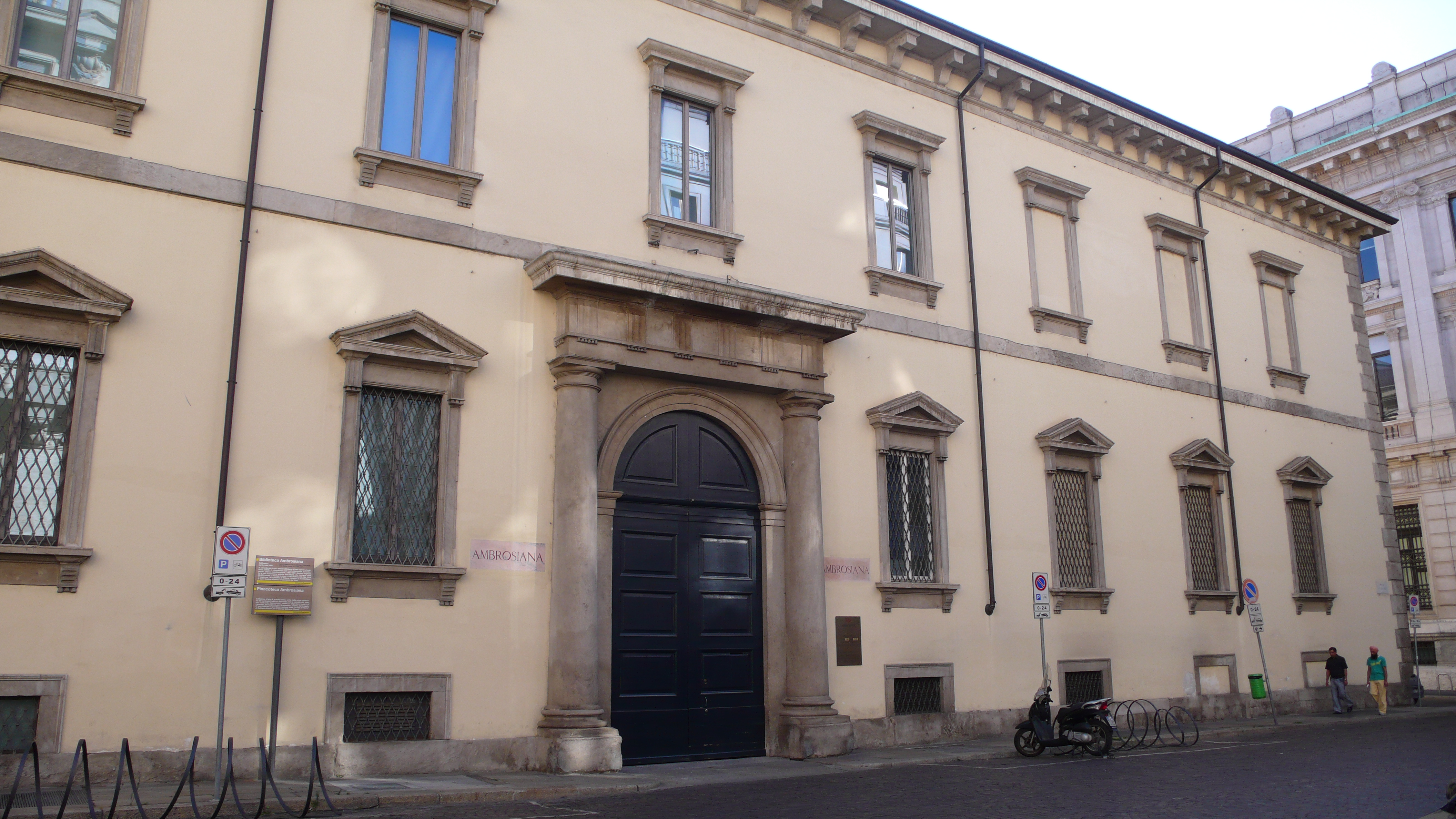
Late Renaissance (Mannerist) style façade of the Palazzo dell’Ambrosiana in Milan, Italy, which houses both the Pinacoteca Ambrosiana and the Biblioteca Ambrosiana. The palace was designed by the prominent Italian architect Fabio Mangone. Cardinal Federico Borromeo commissioned Mangone to expand the initial complex—previously handled by Lelio Buzzi and Francesco Maria Richini—specifically to house the art collection and academy. At its center the main entrance features a prominent, classic arched stone portal flanked by two doric columns supporting a structured architrave and pediment. The lower-level features windows protected by prominent metal grilles topped with decorative triangular pediments, while the upper-level windows exhibit simpler rectangular lintels. The cream-colored plaster walls are cleanly partitioned by stringcourses and vertical downspouts, culminating in a decorative bracketed roof cornice. The expansion designed by Mangone began construction around 1611 and was fully operational by 1618, the year the Pinacoteca Ambrosiana was officially founded. PHOTOS: “Milano Ambrosiana” by Welleschik is licensed under CC BY-SA 3.0.

Jan Brueghel the Elder (Flemish, 1568-1625) produced hundreds of paintings by his own hand and in collaboration with other master painters. His painterly skill ranged over an immense variety of subject matter including these innovative still life floral artworks of which the artist is seen as the founder of the genre. These flowers are not allegorical or imaginative accessories nor merely decorative but a stand-alone subject whose sole focus is the opportunity for a close observation of nature through the artistic lens. Brueghel’s pioneering still lifes show a bouquet bursting with a wide variety of colorful flowers seen from an elevated viewpoint that have been carefully delineated and are clearly visible. Born in Brussels in 1568, Jan Brueghel was the son of Pieter Brueghel the Elder (c. 1525–1530-1569) and younger brother of Pieter Brueghel the Younger (1564-1638). Brothers Jan and Pieter were both sent to Antwerp to study oil painting. In 1568, at 20 years old, Jan Brueghel left Antwerp for Italy where he settled and worked in Naples and, by 1592, in Rome. In Rome Jan Brueghel worked for Cardinals Ascanio Colonna (1560-1608), Benedetto Giustiniani (1554-1621), Francesco Maria del Monte (1549-1627) and Federico Borromeo (1564-1631) who patronized Caravaggio and was the official “Cardinal Protector” of the Roman Accademia di San Luca, an artists’ association founded in 1593 by Federico Zuccari (1539-1609).
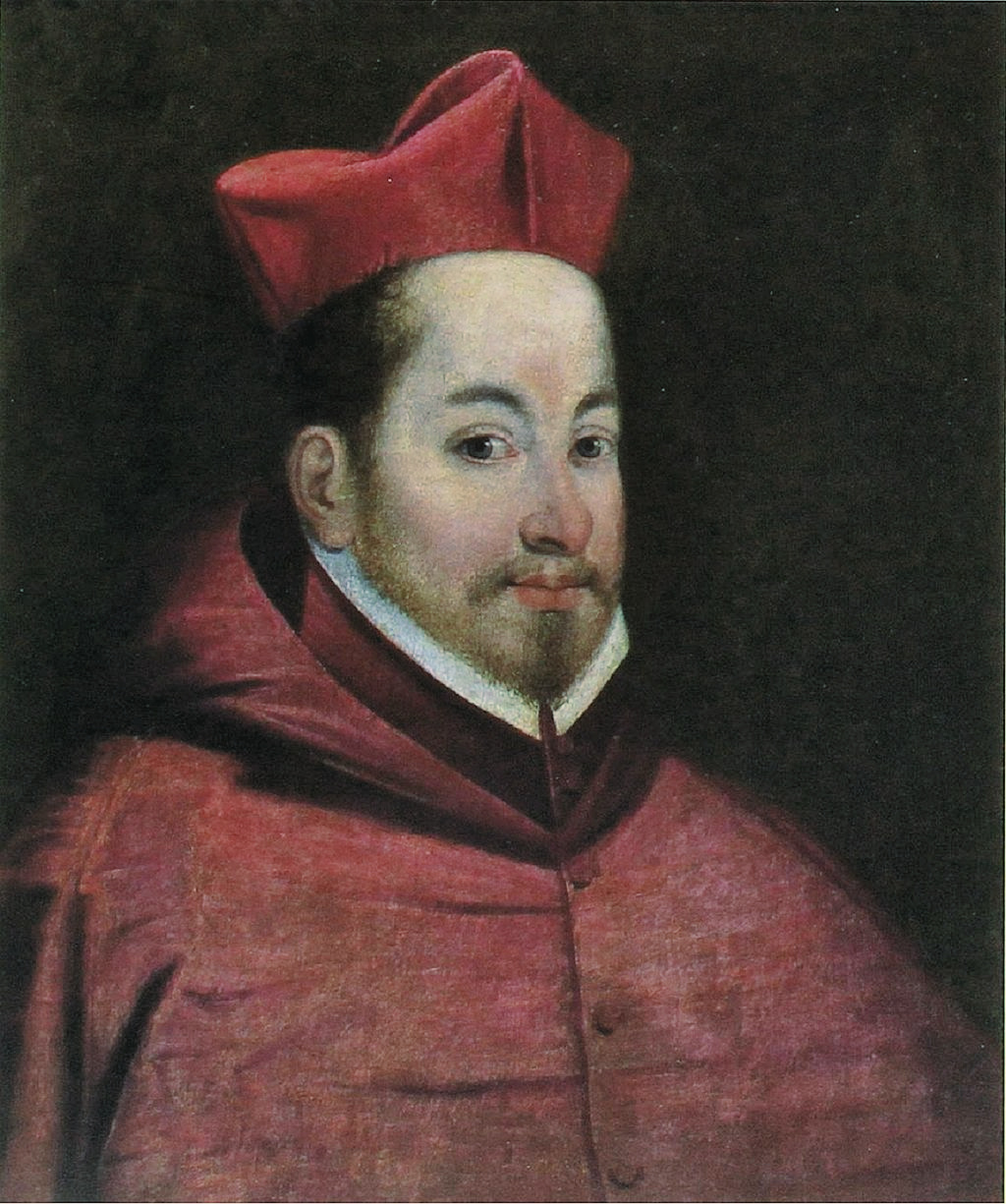
16th-century portrait of Cardinal Ascanio Colonna (1560–1608), painted by an anonymous Roman master around 1586, the exact year he was elevated to the cardinalate by Pope Sixtus V. The young cardinal enjoyed a profound reputation for eloquence and learning. Dressed in his formal scarlet cardinal biretta and mozzetta, Colonna was celebrated not only for his scholarly mind and diplomatic skill, but also as an immense patron of letters, amassing an extraordinary personal library that would later become a vital asset to the scholarly world.

Portrait of Benedetto Giustiniani (1554–1621) an exceptionally influential Italian nobleman and papal treasurer, who was elevated to the cardinalate by Pope Sixtus V in 1586. Attributed to the Genoese painter Bernardo Castello, the portrait captures the cardinal looking out with a discerning, scholarly gaze, wearing the dark winter mozzetta and academic cap befitting an elite clerical connoisseur. Born into an immensely wealthy Genoese aristocratic family that had previously ruled the Aegean island of Chios, Cardinal Giustiniani went on to become one of the most intellectually distinguished figures of late 16th and early 17th-century Rome. While he was deeply involved in high-stakes papal diplomacy, serving as papal legate to Bologna and participating in multiple papal conclaves, his lasting legacy sits firmly in the history of art. Alongside his younger brother, the prominent banker and aristocratic patron Vincenzo Giustiniani, Benedetto built what became known as the Giustiniani Collection, a cornerstone of the Roman Baroque era. At the time of his death in 1621, his personal post-mortem inventory recorded 280 paintings, demonstrating an immense, voracious appetite for contemporary art including as the absolute earliest and most enthusiastic protector of Caravaggio. Because Benedetto passed away first, his massive share of 280 paintings merged seamlessly into his brother’s holdings, helping form an aggregated collection of over 300 supreme masterpieces and ancient marbles housed inside the family’s Roman palazzo.

The direct-from-life study executed by the master portraitist Ottavio Leoni depicts Cardinal Francesco Maria del Monte (1549–1627). Rendered in black chalk with white heightening on paper 1616 drawing captures him at age 67, radiating the seasoned authority of a high-ranking Vatican diplomat while clad in his formal clerical cap and buttoned cassock. Born in Venice into a noble Tuscan aristocratic family, del Monte rose to become a powerful diplomat, the unofficial cultural ambassador for the Medici family in Rome, and a supreme connoisseur of late-Renaissance and early-Baroque arts. Four centuries later his fame rests on his early patronage of Caravaggio and his vast and meticulously art collection which provides detailed provenance for many important works of the period.

This 17th-century portrait engraving, published by Giovanni Giacomo de Rossi, celebrates the legacy of the Borromeo family in Milan. While the inscription notes that this print specifically commemorates the elevation of his nephew and namesake, diplomat and Cardinal Federico Borromeo the Younger (1617–1673), on December 22, 1670 (MDCLXX), it mirrors the deep-seated connoisseurship pioneered by his elder namesake Federico Borromeo (1564–1631) who was art patron, collector, and founder of the Ambrosiana.

The bouquets combine numerous flower species that would not naturally bloom simultaneously, creating an idealized vision of nature. Every blossom, insect, leaf, and stem is rendered with near-miniaturist precision, reflecting both artistic mastery and a growing scientific interest in the natural world.

FLOWERS IN A VASE, 1608, oil on copper, 43 × 30 cm by Jan Brueghel the Elder. Pinacoteca Ambrosiana, Milan, Italy.

In a Römer glass vase, typical of Rhenish manufactures and often depicted in Northern European painting of this period, there are colorful blooms with tulips used to anchor his bouquet. The painting was likely the one mentioned by Brueghel in a letter dated June 13, 1608. The letter is evidence for the origin of the painting as well as that these Flemish artists, in dialogue with the Italian renaissance, practiced copying nature from life, frequently with a scientific precision. Brueghel, the younger son of Flemish Renaissance painter Pieter Bruegel the Elder (c. 1525-1569), was a close friend and frequent collaborator with Peter Paul Rubens (1577-1640). Both Jan Brueghel and Rubens were the leading Flemish painters in Flemish Baroque painting of the first three decades of the 17th century.
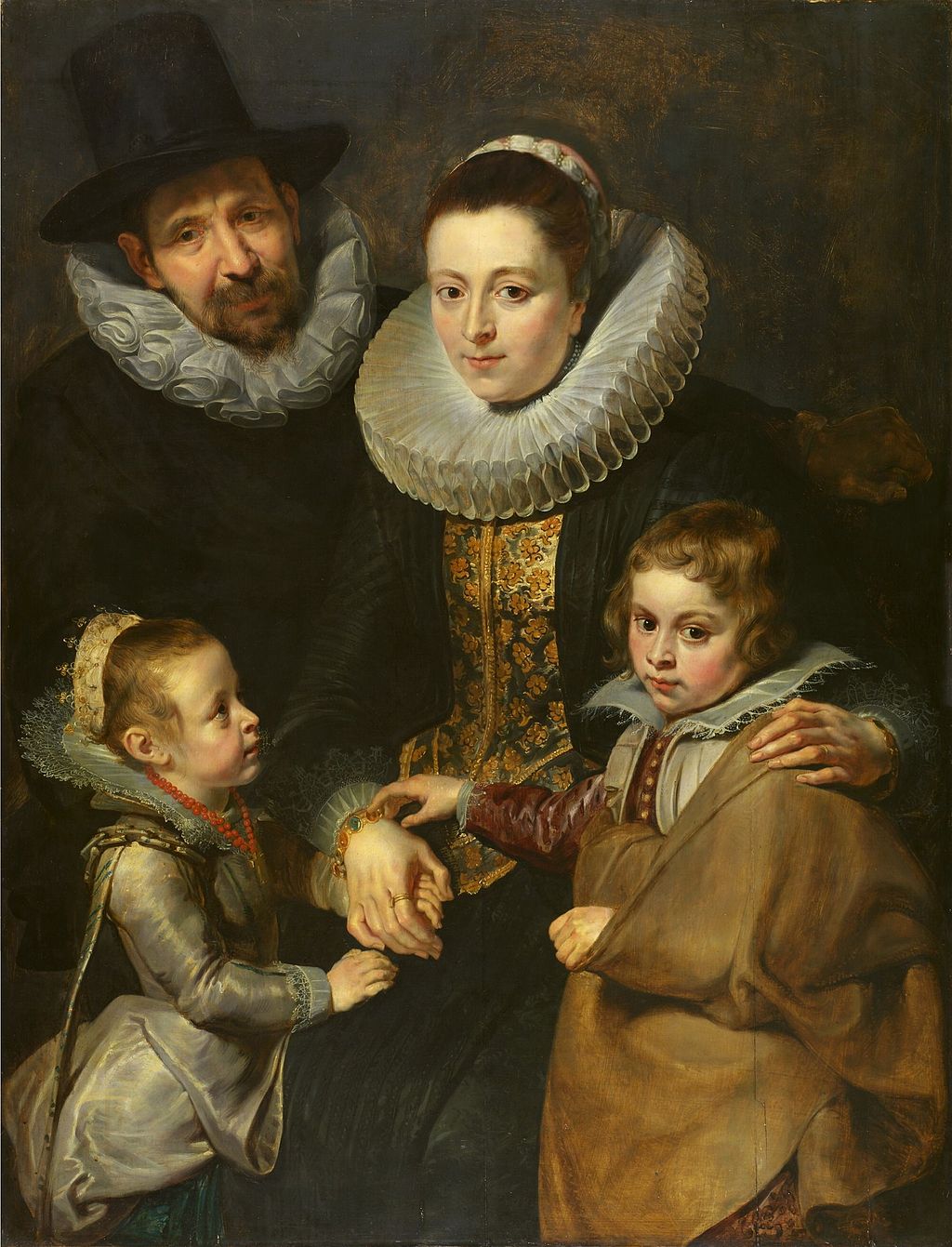
Family of Jan Brueghel the Elder by Peter Paul Rubens. 1613-15. oil on panel, 125.1x 95,2 cm,The Courtauld Gallery, London. Jan Brueghel, painter and friend of Rubens, poses with his second wife, Catherina, and their two children, Peter and Elisabeth. Both children, along with their father, died during the cholera epidemic of 1625. see – https://gallerycollections.courtauld.ac.uk/object-p-1978-pg-362 – retrieved June 24, 2025.

Jan Brueghel the Elder was a pioneer of the floral still life, helping establish flowers as a stand-alone subject worthy of serious artistic treatment. The paintings demonstrate Brueghel’s astonishing attention to detail, earning him the nicknames “Flower Brueghel” and “Velvet Brueghel.”

The painting Flowers in a Vase is in the collection of the Ambrosian Art Gallery (Pinacoteca Ambrosiana) of the Biblioteca Ambrosiana in Milan, Italy. It was in the possession of Cardinal Federico Borromeo, cousin to Saint Charles Borromeo (1538-1584), both cardinal archbishops of Milan.

Saint Charles Borromeo (1538-1584) was a cousin of Federico Borromeo. Both were cardinal archbishops of Milan, Italy. Proclaimed a saint in Rome in 1610, Charles was much loved in his diocese for his numerous good works and for his personal humility as well as a spirit of self-sacrifice that he showed during the plague of 1576 and 1577, Cardinal Borromeo was a great reformer and played an important role in the Council of Trent. There is a colossal statue of him outside Arona on Lake Maggiore. The so-called Sancarlone, it was based on a design by  Giovanni Battista Crespi, known as “ il Cerano.” Its sculptors Siro Zanella and  Bernardo Falconi made the copper parts to be assembled for a work that was completed in 1698. see – https://terreborromeo.it/en/about-us/history and https://www.statuasancarlo.it/la-statua/– retrieved June 24, 2025.

The colossus of St. Charles Borromeo (1698).

In May 1585 Federico earned a doctorate in theology at the University of Pavia and was sent to Rome where he was made a cardinal at 23 years old by Pope Sixtus V. Federico voted in the papal conclaves of 1590 (Urban VII, Gregory XIV), 1591 (Innocent IX), 1592 (Clement VIII), 1605 (Leo XI, Paul V) and 1623 (Urban VIII). He missed the 1621 conclave (Gregory XV). At the August 1623 papal conclave Cardinal Borromeo received 18 votes out of 54 votes but was opposed by the Spanish party, one of the church’s major factions. The church had to compromise with Urban VIII, a neutral candidate known as the first pope to actively campaign for votes.
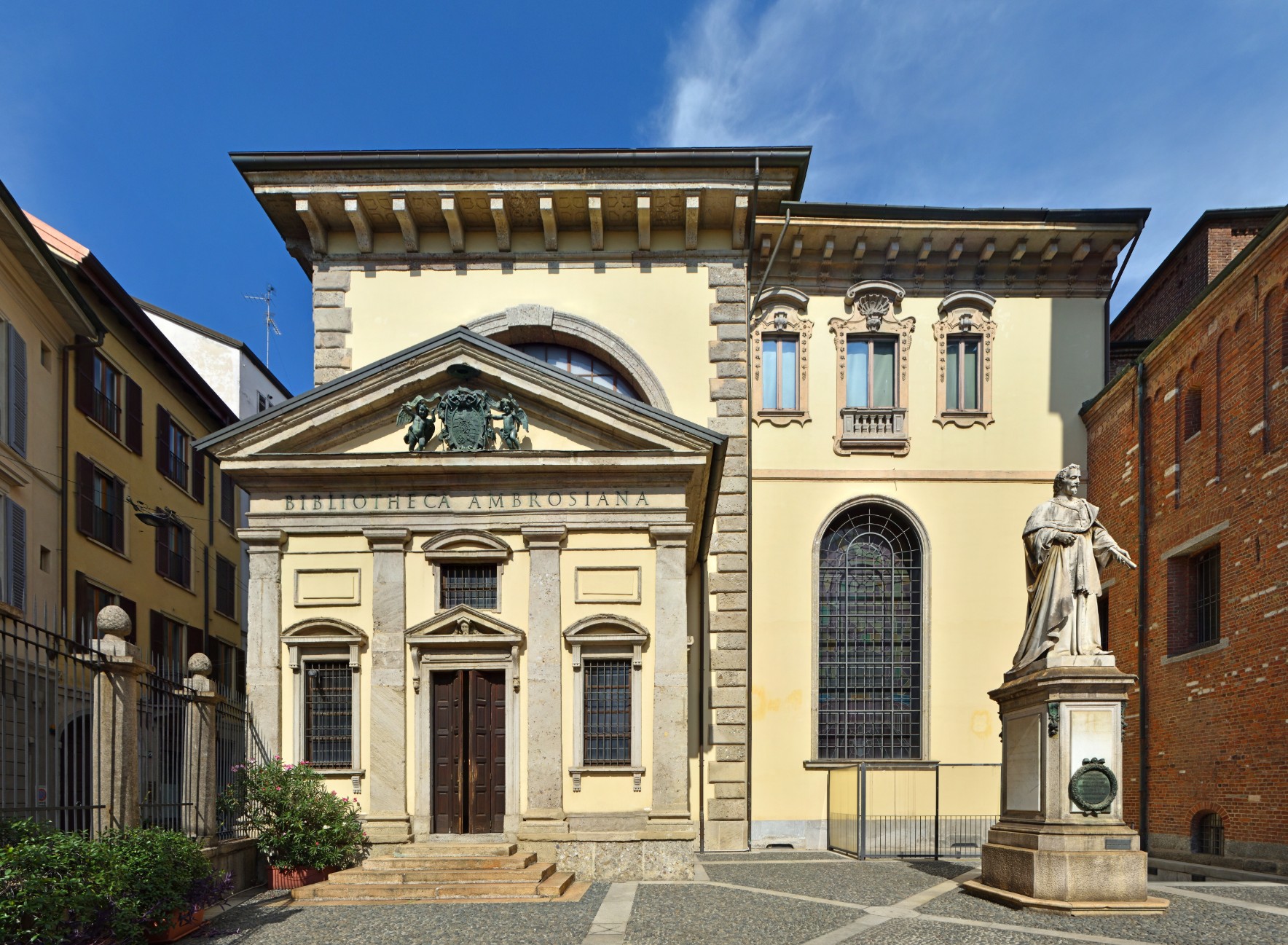
Biblioteca Ambrosiana, Milan. Its collections have been open to the public since 1609. “Milan Biblioteca Ambrosiana 016 4839” by Ludvig14 is licensed under CC BY-SA 4.0.

The Biblioteca Ambrosiana and a Lasting Legacy
In April 1618 Archbishop Federico Borromeo bequeathed Flowers in a Vase with his collection of paintings, drawing, and statues in his will to the Biblioteca Ambrosiana, which he founded on September 7, 1607 and opened on December 8, 1609. Conceived by the cardinal as a center for study and culture it was open to the public from the beginning. The library collections include over one million printed volumes (including thousands of incunabula and books dating from the 16th century), 40,000 manuscripts (including the celebrated Codex Atlanticus) in many languages, 12,000 drawings (including works by Raphael, Pisanello, and Leonardo), 22,000 engravings, and miscellanea including old maps and musical manuscripts. Along with the cardinal’s achievement, other institutions flourished beside it such as the Board of Fellows (Collegio dei Dottori, 1607), the Art Gallery (Pinacoteca Ambrosiana, 1618) and the Academy of Drawing for teaching painting, sculpture and architecture (Accademia del Disegno, 1620).

The Treasures of the Pinacoteca Ambrosiana
The Pinacoteca Ambrosiana consists of some of the Italian Renaissance’s great masterpieces such as the Portrait of a Musician by Leonardo da Vinci, The Basket of Fruit by Caravaggio, the cartoon for the School of Athens by Raphael, the Adoration of the Magi by Titian, the Madonna of the Pavilion by Sandro Botticelli and the magnificent Flowers in a Vase by Jan Brueghel. The museum’s collection today includes paintings by 17th-century Lombard artists such as il Morazzone (1573–1626), Giulio Cesare Procaccini (1574–1625), Daniele Crespi (1598 – 1630) and Carlo Francesco Nuvolone (1608-1669) and 18th-century artists such as Giovanni Domenico Tiepolo (1727-1804), Fra’ Galgario (1655-1743), and Francesco Londonio (1723-1783).

Cardinal Federico Borromeo: Scholar, Collector, and Patron
Cardinal Federico Borromeo, who lived in Rome from 1586 to 1601, was not particularly interested in politics, but focused on classical and oriental scholarship and prayer. In the Counter-Reformation, the cardinal was a great propagator of the faith using religious art, but also was an avid collector of still life.

Jan Brueghel and the Cardinal’s Cultivated Eye
Jan Brueghel the Elder, nicknamed “Velvet,” was a contemporary artist who was erudite and innovative – he invented new types of paintings such as flower garland paintings and paradise landscapes – and his art did not escape the cardinal’s cultivated eye. The Cardinal and young artist met in Rome where the Cardinal became his patron so that the artist took up residence in Cardinal Borromeo’s palazzo.
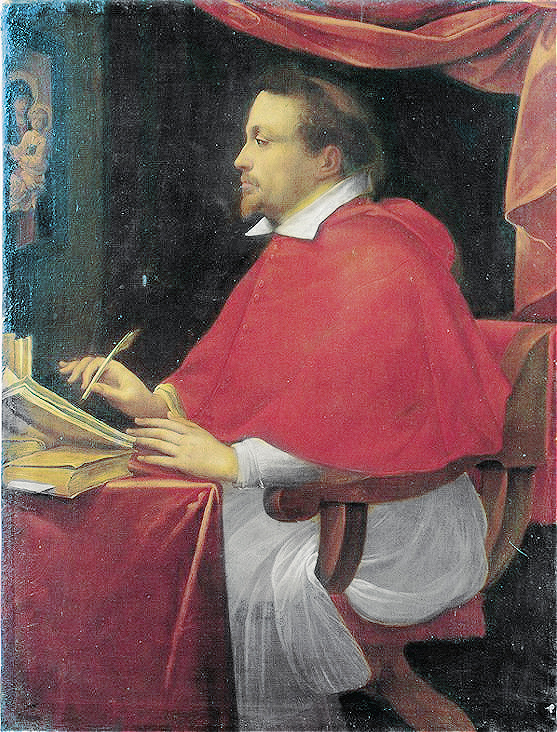
Cardinal Federico Borromeo by Giulio Cesare Procaccini (1574-1625), Museo diocesano di Milano. The Borromeos, a prominent Italian noble family, started as merchants around 1300 in San Miniato in the province of Pisa in Tuscany and became bankers in Milan after 1370.  The elder Cardinal Federico Borromeo was a monumental figure in European art history who transformed Milan into a premier cultural hub by founding the Biblioteca and Pinacoteca Ambrosiana. He held a profound, visionary appreciation for the intrinsic value of art, famously championing the work of northern masters like Jan Brueghel the Elder.

When Borromeo became archbishop of Milan in June 1595, Brueghel followed him and became part of the Cardinal’s household. Cardinal Borromeo was a reformer in the sense of promoting discipline among the clergy, founding new parishes and schools, as the faith flourished in the 50 years since the Council of Trent completed in 1564. The archbishop was accessible to the flock. Under his leadership, Milan underwent both prosperity and significant cultural flourishing and renewed spiritual energy for a generation. Brueghel stayed with the Cardinal for a year where he painted landscapes and flower paintings and then returned to Antwerp where he lived and worked for the rest of his life. Also nicknamed “Flower” Brueghel, the artist’s flower pieces such as Flowers in a Vase, are dominated by floral arrangements placed against a neutral dark background. Brueghel repeated these motifs in his flower pieces and yet each work was imbued with its own singular freshness and vitality.

FLOWER VASE WITH JEWEL, COINS, AND SHELLS. 1608, oil on copper, 65 × 45 cm by Jan Brueghel the Elder. Pinacoteca Ambrosiana, Milan, Italy.
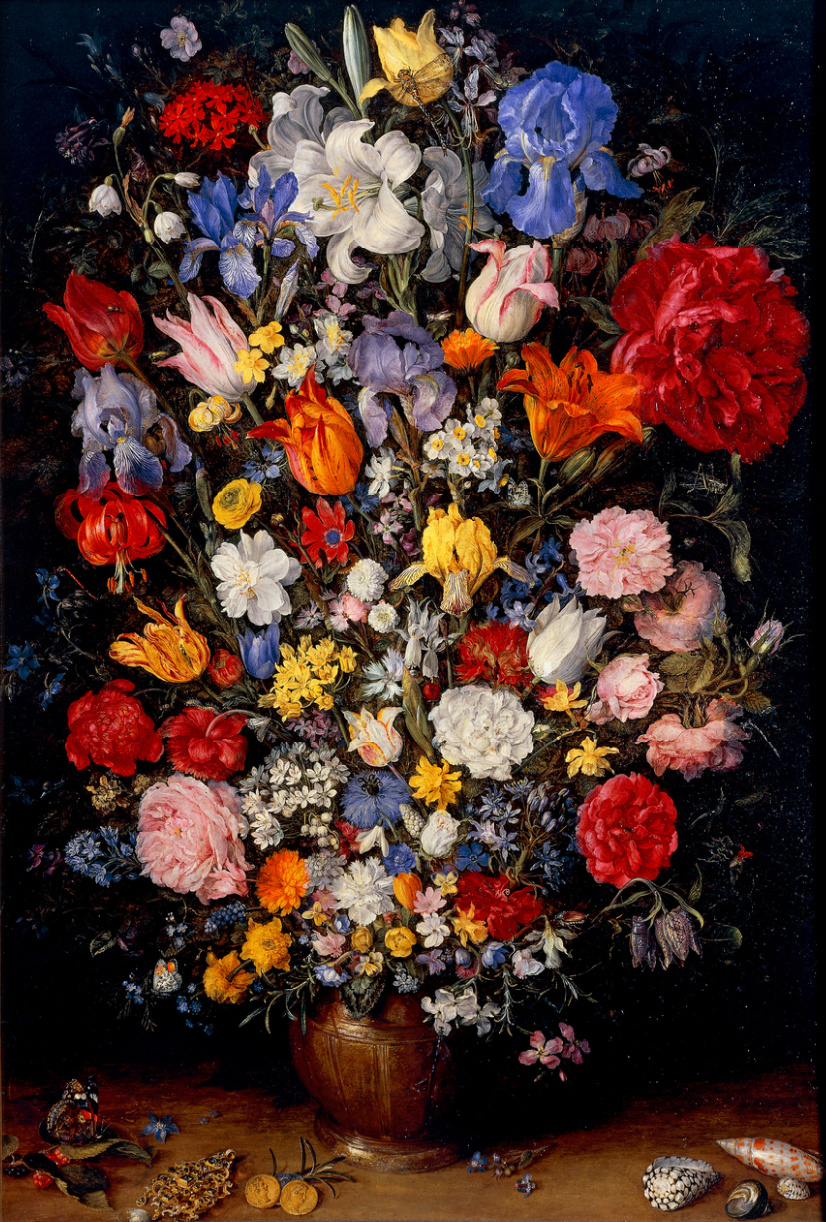
A lush bouquet of flowers, executed by the artist for Cardinal Federico Borromeo (1564-1631), was innovative as a stand-alone bouquet painting of its kind. The subject is composed of around one hundred different species of flowers, some of which are very rare and of great value. In addition to its execution of profuse natural beauty, the picture expressed the nature of the early 17th century culture’s encyclopedic curiosity which extended, among leading collectors, into the natural sciences. It is known by way of a letter that Brueghel was working on the picture in 1606 after he had seen many of these flower varieties in the garden in Brussels of Albert VII, Archduke of Austria (1559-1621) and Isabella Clara Eugenia (1566-1633), who jointly ruled the Spanish Netherlands (1556-1714). The artist’s picture of these flowers was, in a scientific approach, intended to “portray them from nature.” Virtually nothing today remains of the Archdukes Albert and Isabella’s Palace of Codenberg in Brussels nor of their summer retreat at the Château of Mariemont (today’s Morlanwelz in Belgium) south of Brussels which was painted frequently by Jan Brueghel the Elder nor anything of their hunting lodge in nearby Tervuren east of Brussels. In 1633, at the death of Isabella, Albert (who died in 1621) and Isabella’s magnificent collections of art works, scientific instruments, naturalia and artificialia were scattered and much of it lost.

Brueghel’s flowers function as both botanical studies and meditations on beauty, abundance, and the fleeting nature of life. The works embody the Baroque fascination with observation, variety, and visual richness while retaining a spiritual dimension rooted in the wonder of creation.

The Archdukes Albert and Isabella Visiting the Collection of Pierre Roose, c. 1621-1623, Jan Brueghel the Elder and Hieronymus Francken II, oil on panel, 37 ×  48 ½ in. (94 × 123.19 cm). see – https://art.thewalters.org/object/37.2010/ – retrieved June 21, 2025.

Some of that magnificence was evoked in a picture from 1621-23 by Jan Brueghel the Elder with Hieronymus Francken II (1578-1623) called Albert and Isabella visiting an art gallery. The large format painting (around 3 feet by 4 feet) in the Walters Art Museum depicts a private gallery (or cabinet) of Pierre Roose in Brussels being visited by the Archdukes Albert and Isabella. It includes in a foreground corner an immense vase of flowers by Jan Brueghel and depicts how these collectors are as interested in natural botany and scientific instruments as they are of paintings and sculpture.
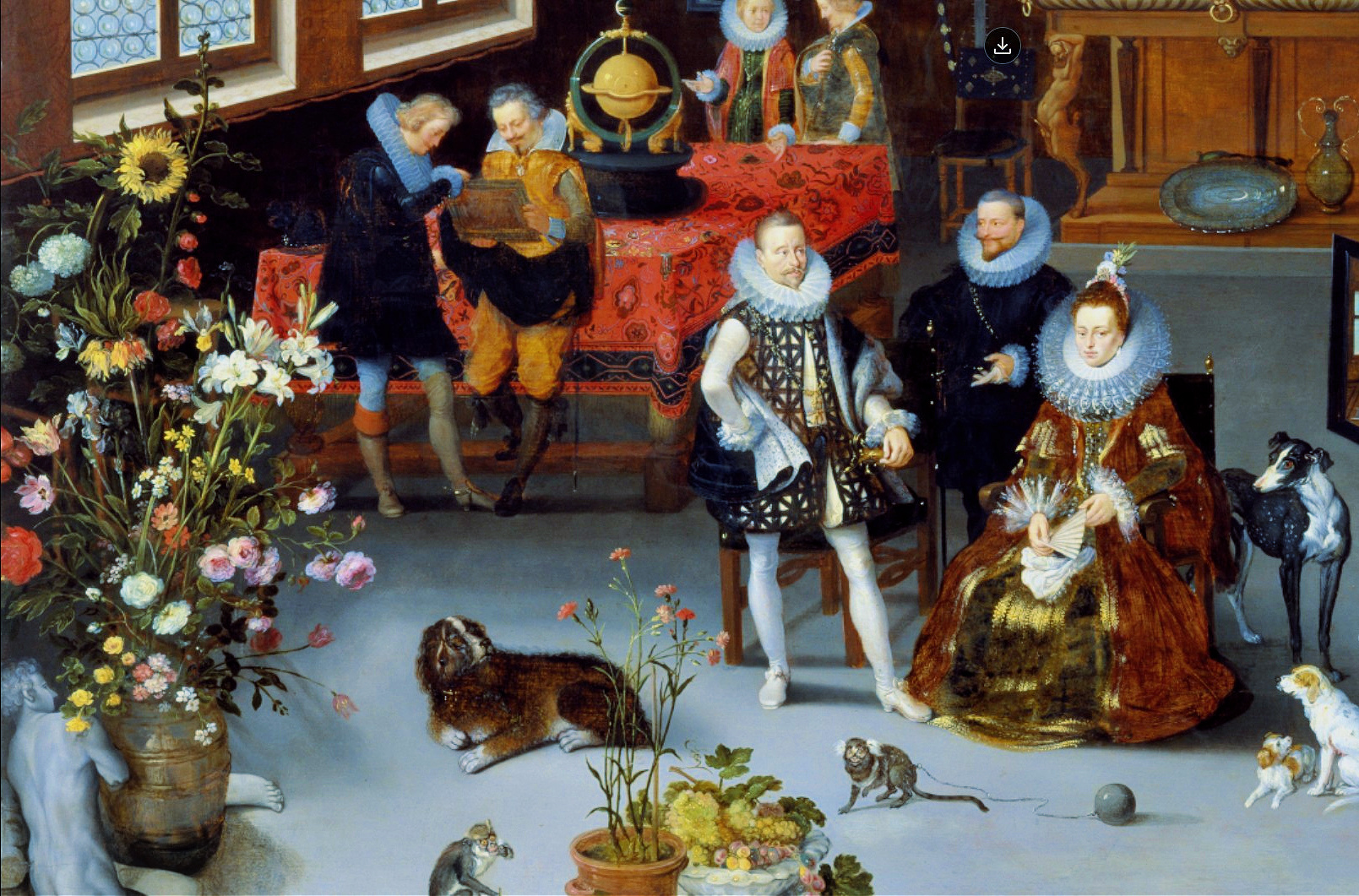
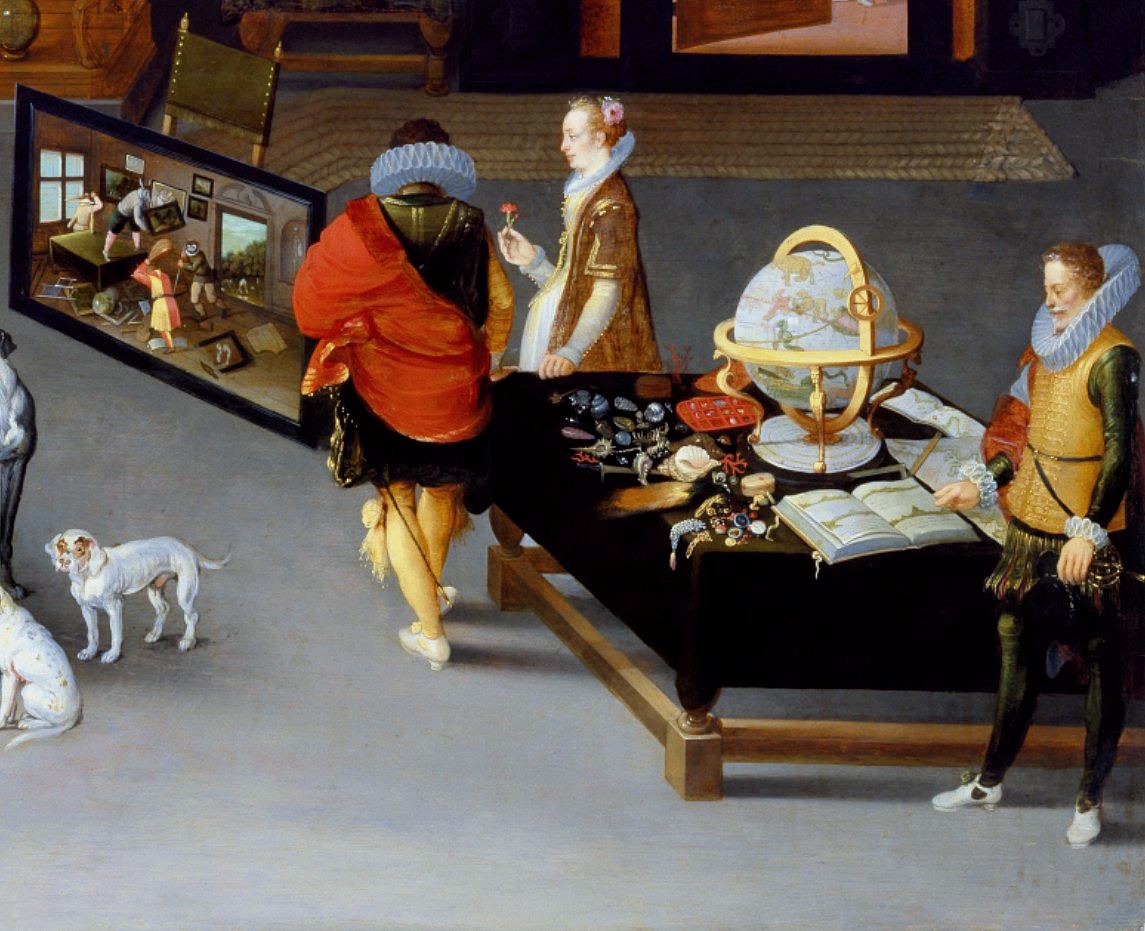
DETAIL of above: Isabella is seated, while her husband standing to her right and their host, Pierre Roose, behind.
DETAIL of above: These collectors are as interested in natural botany and scientific instruments as they are of paintings and sculpture.

Isabella’s Rule and the Catholic Restoration of the Southern Netherlands
Following Albert’s death, Isabella continued to rule on behalf of her nephew Philip IV of Spain (1605-1665) though it was Albert and Isabella’s reign which marked the consolidation of Catholic rule in the Southern Netherlands following severe persecutions of Protestants that ended only in 1597. Though most Protestants had left the region, in 1609 an act of toleration was granted to the Protestants that remained though they could not publicly practice their religion.

Religious Orders and the Patronage of Power
Conversely, Catholic religious orders like the Jesuits, Capuchins, and Discalced Carmelites received large cash grants and endowments by the wealthy governing elite which helped fund many of these religious groups’ ambitious building and artistic programs in Brussels and Antwerp. As a widow Isabella joined the Third Order of Franciscans until her death.

Patrons of the Arts in an Age of Faith
Though despotic and kingly, these rulers have earned a well merited reputation in art history as patrons of the arts. A most notable example is that, in 1609, one year after the Pinacoteca Ambrosiana’s flower picture was created, the Archdukes, whose gardens inspired the work in Italy, appointed Peter Paul Rubens (1577-1640) as their court painter.

Borromeo on the Value of Brueghel’s Masterpiece
About Brueghel’s masterpiece Flower Vase with Jewel, Coins, and Shells—which Borromeo purchased specifically for his Milano Ambrosiana—the Cardinal wrote a striking passage in his catalog, the Musaeum:

“Brueghel painted a diamond on the lower part of the vase…: the author wanted to indicate that the value of his work was equal to that of the gems and this is the price we paid to the artist.”

This observation perfectly captures the elder Borromeo’s philosophy: that supreme artistic genius was not merely a decorative luxury, but a precious entity whose cultural and intellectual worth directly rivaled the world’s most costly physical gems.
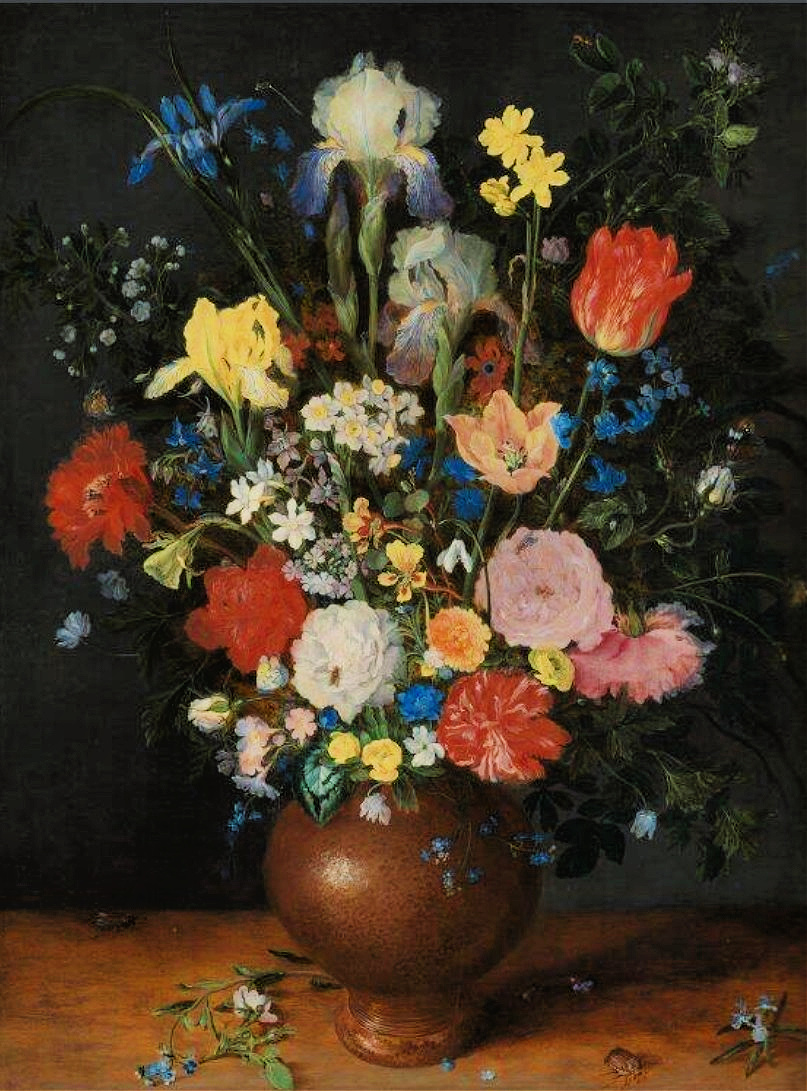
Bouquet in a Clay Vase, 1609, Jan Brueghel the Elder,oil on wood, 56 x 42 cm. The National Gallery, London. see – https://www.nationalgallery.org.uk/paintings/jan-brueghel-the-elder-bouquet-in-a-clay-vase – retrieved June 24, 2025. Jan Brueghel the Elder is considered the 17th century northern painter, active in the Low countries as well as Italy, who invented and mastered the genre of flower still life. While used at times as a decorative or allegorical element within a painting, there are major examples where the artist aesthetically assembled and presented an impressive bouquet from a high viewpoint based on scientific observation of rare garden species as the sole focus of the painting. Bouquet in a Clay Vase in The National Gallery in London is one such artwork.

Jan Brueghel the Elder’s flower paintings of 1608 demonstrate how the Flemish master elevated botanical observation into a new art form, creating images that are at once scientific records, celebrations of beauty, and spiritual reflections on the richness of creation.

SOURCES:

Brueghel, Jan. n.d. “About Jan Brueghel.” Jan Brueghel the Elder: A Virtual Catalogue. Accessed October 25, 2026. janbrueghel.net.

Veneranda Biblioteca Ambrosiana. n.d. “Biblioteca.” Accessed October 25, 2026. ambrosiana.it.

Veneranda Biblioteca Ambrosiana. n.d. “Fiori in un vaso.” Accessed October 25, 2026. ambrosiana.it.

Veneranda Biblioteca Ambrosiana. n.d. “Flowers in a Vase.” Accessed October 25, 2026. ambrosiana.it.

Veneranda Biblioteca Ambrosiana. n.d. “Pinacoteca Ambrosiana.” Accessed October 25, 2026. ambrosiana.it.

Veneranda Biblioteca Ambrosiana. n.d. “Vase of Flowers with Jewel, Coins, and Shells.” Accessed October 25, 2026. ambrosiana.it.

Veneranda Biblioteca Ambrosiana. n.d. “Vaso di fiori con gioiello, monete e conchiglie.” Accessed October 25, 2026. ambrosiana.it.

Walters Art Museum. n.d. “The Archdukes Albert and Isabella Visiting a Collector’s Cabinet.” Online Collection. Accessed October 25, 2026. thewalters.org.

Wikipedia, s.v. “Albert VII, Archduke of Austria.” Last modified August 29, 2026, 06:39. wikipedia.org.

Wikipedia, s.v. “Isabella Clara Eugenia.” Last modified October 15, 2026, 18:53. wikipedia.org.

Wikipedia, s.v. “The Archdukes Albert and Isabella Visiting a Collector’s Cabinet.” Last modified October 23, 2026, 06:18. wikipedia.org.

This explanatory article may be periodically updated.

Architecture for a Universal Faith: Louis Bourgeois and the Baháʼí Temple (1912-1953) in Wilmette, Illinois.

FEATURE image: Architect Louis Bourgeois incorporated a variety of religious architecture and symbols including for Hindus, Buddhists, Native Americans, Jews, Christians and Muslims, to convey the Baháʼí principle of the unity of religion. Author’s photograph.

The Baháʼí Temple in Wilmette is one of America’s most distinctive religious monuments, where architect Louis Bourgeois fused spiritual ideals, innovative design, and intricate ornament into a landmark that took more than forty years to complete and remains a singular achievement in twentieth-century sacred architecture.

Text & Photographs by John P. Walsh.

The temple was designed by French-Canadian architect Louis Bourgeois (1856–1930). By 1906 Bourgeois and his wife joined the Baháʼí faith. Photo c. 1922. Public Domain.

The Chicago Baháʼí Temple House of Worship is the second such house of worship constructed and the oldest one that is still standing. The popular destination along Lake Michigan on Chicago’s Northshore attracts visitors from around the world today for its amazing architecture, beautiful gardens, and message of religious unity in prayer and for peace.

The temple was designed by French-Canadian architect Louis Bourgeois (1856–1930). After studying and traveling in Paris, Italy, Greece, Egypt, and Iran, Bourgeois settled in Chicago in 1896 where he worked with Louis Sullivan. Bourgeois moved to Southern California and, in 1898, designed in Hollywood a landmark Mission Revival style house for painter Paul de Longpré (1855-1911) whose architecture and gardens became a tourist attraction.

The building serves as the North American Baháʼí House of Worship. Located in Wilmette, Illinois, it has become one of Chicagoland’s most recognizable landmarks.

The nine sides of the building represent the largest single digit number which stands for the Baháʼí belief in the unity and oneness of humankind. June 2014. Author’s photograph. 6.55mb

The idea for the construction of the first Baháʼí Temple in the Western world began in Chicago in 1903. When there was a call for designs, Louis Bourgeois’ plans were the most promising. He worked on the complex design from 1909 to 1917. Before that time, Louis Bourgeois and his wife had joined the Baháʼí faith after having come into association with the Baha’i Faith through Boston’s Baháʼí community. In that time Bourgeois constructed a plaster model of his completed vision and in the 1920’s until his death in 1930 worked on the temple’s construction in Wilmette, Illinois.

While building activity was delayed though the Great Depression of the 1930’s and into World War II, temple construction began again in earnest in 1947 and the temple was dedicated in 1953.

Designed by French-Canadian architect Louis Bourgeois, its more than 40-year construction history reflects the determination of the Baháʼí community to realize Bourgeois’s ambitious vision.

Abdu’l-Bahá (1844-1921), eldest son of Baháʼu’lláh (1817-1892), the founder of the Baháʼí Faith, participated in the ground-breaking ceremony in 1912 of Baháʼí Temple. Construction began in earnest in the 1920s. It is four stories of reinforced concrete. June 2014. Author’s photograph. 4.11mb

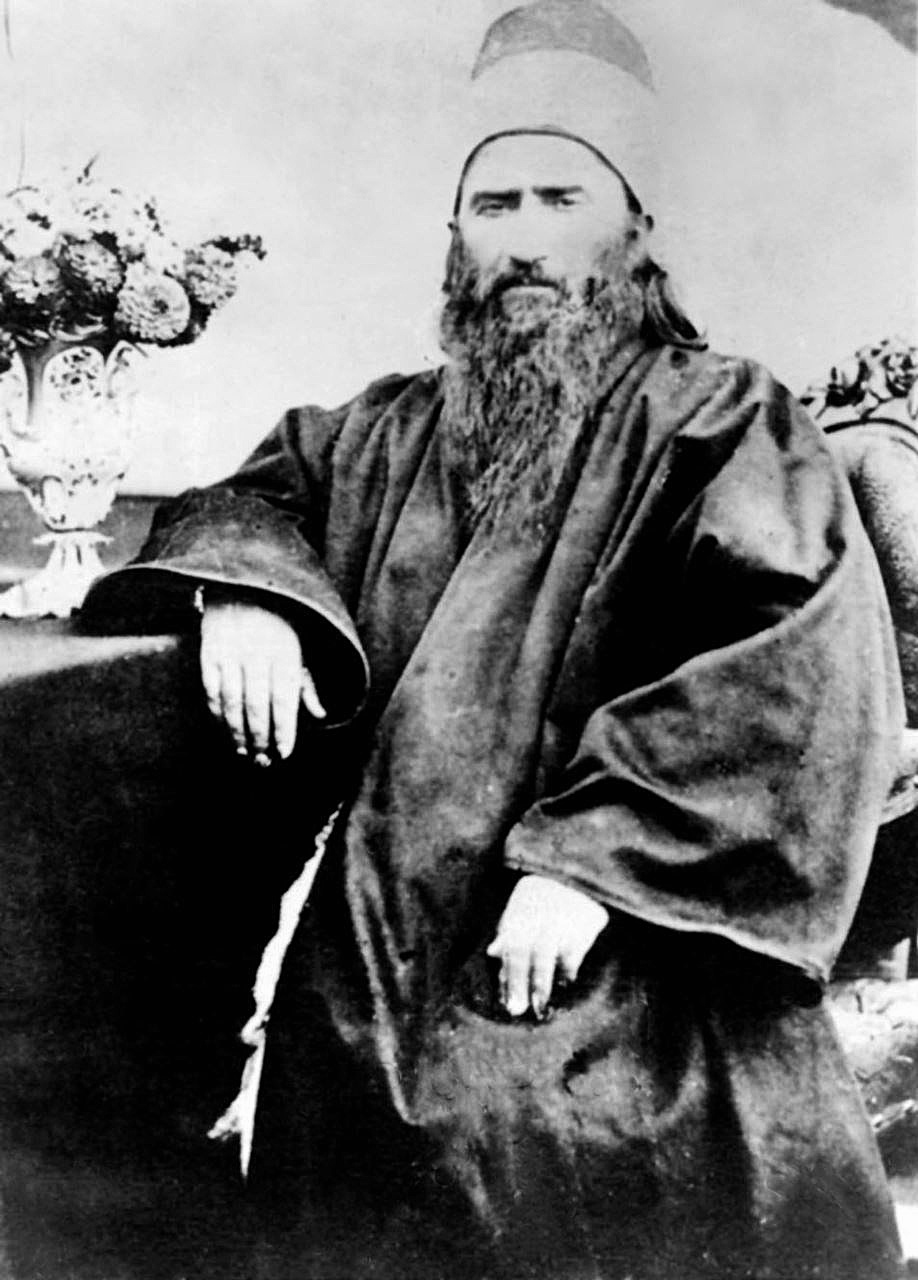
Baháʼu’lláh (1817-1892) was an Iranian religious leader who founded the Baháʼí Faith. Public Domain.

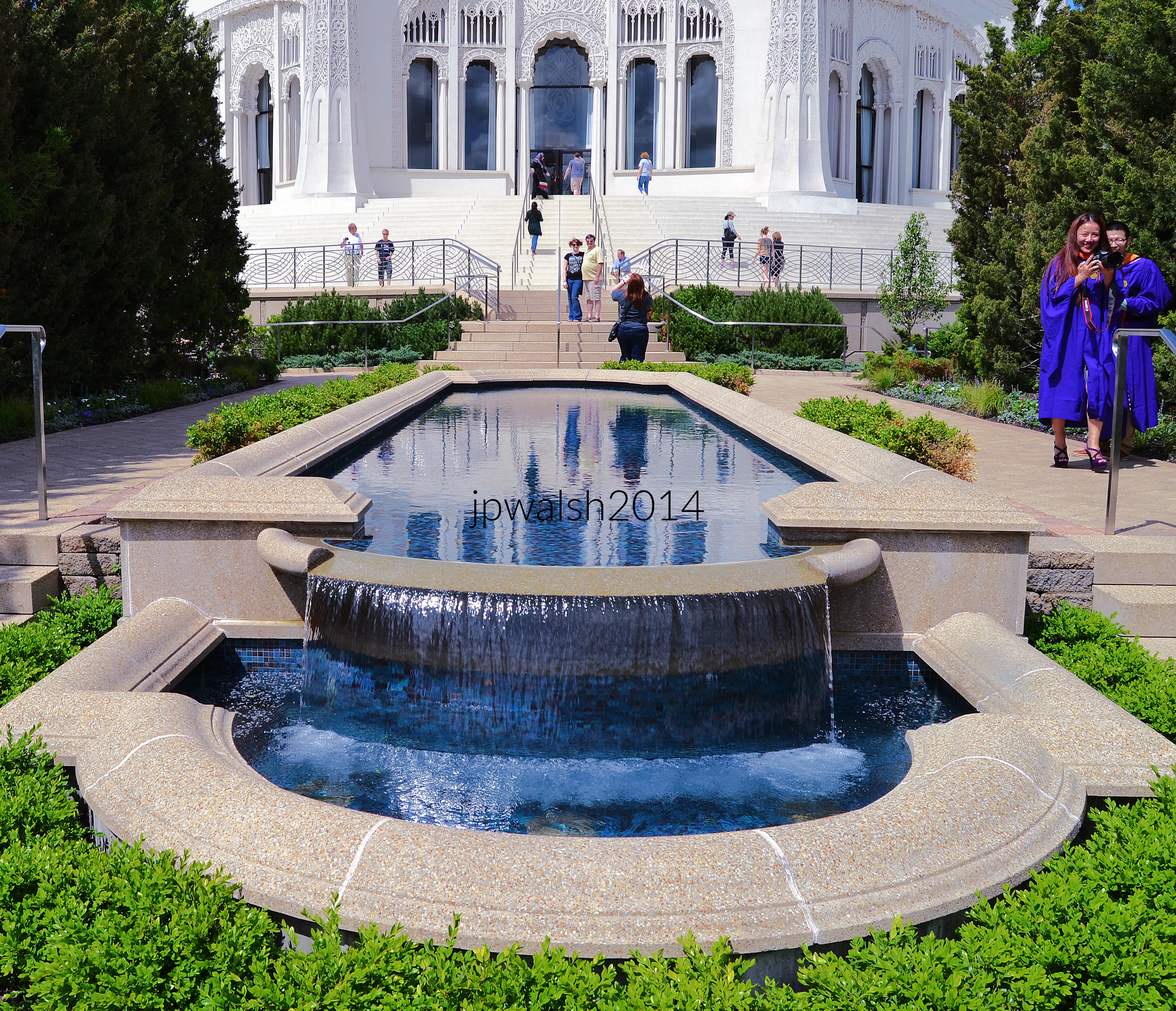
Money for the building was raised entirely by the temple congregants as their gift to the people of the world. June 2014. Author’s photograph. 6.30mb

The temple blends influences from Gothic, Islamic, Byzantine, Renaissance, and other world architectural traditions into a unified design. Its lace-like concrete ornamentation creates one of the most elaborate exterior surfaces in American architecture.

The temple rises 191 feet from its base to its ribbed dome’s peak. The main story pylons are 45 feet high each. The building’s surfaces are teeming with carved lacelike ornamentation. June 2013. Author’s photograph. 4.50mb

The Baháʼí Temple has a highly traditional appearance whose architectural reputation—in an age of orthodox modernism and postmodernism—has grown only more positive with the years. June 2013. Author’s photograph. 4.85 mb

Interior of the auditorium inside the Baháʼí House of Worship in Wilmette, Illinois. The entire surface—from the towering walls to the massive dome ceiling—is covered in highly detailed, openwork ornamental lattice patterns that filter natural light.

  • The Grand Dome: A central, monumental circular dome rises high above the space, featuring a gilded calligraphic emblem at its center. Molded seamlessly into the pillars and lace-like quartz masonry are major global religious symbols layered chronologically from bottom to top—including Christianity, Judaism, Islam, and Hinduism—symbolizing the fraternity and evolution of mankind.
  • Soaring Arches and Pillars: Nine main pillars and towering arched window bays flank the multi-layered walls, drawing the eye upward. The number nine is the highest single-digit number, mathematically representing oneness, perfection, and the ultimate completion of God’s revelation.
  • Concentric Seating Layout: Curved rows of rich, red velvet-cushioned wooden seating wrap around a highly polished, reflective floor that mirrors the warm lighting from above.
    PHOTO: “The forbidden temple.” by kern.justin is licensed under CC BY-NC-ND 2.0.

The room is strictly dedicated to prayer, quiet contemplation, and meditation.  There are no sermons, rigid ritualism, or set religious dogmas permitted here. Because the faith emphasizes that all major world religions originate from the same Creator, the devotional readings regularly feature sacred scriptures from different faiths. In alignment with Baháʼí principles, the room features no professional clergy, religious imagery, or musical instruments. Any music performed during devotionals comes strictly from a cappella choirs or soloists.

The temple occupies a unique place in American religious architecture because it is unlike any traditional church, synagogue, mosque, or cathedral.

The temple’s main prayer room seats 1,200 people. In the Baháʼí faith there are no clergy, no sermons and no rituals. Scriptures are read from many different faith traditions and music by soloists or a cappella choir. June 2013. Author’s photograph. 5.31mb

The Baha’i House of Worship Choir, under the direction of Van Gilmer, performs “This is the Day”—featuring words by Báha’u’lláh and arranged by Stanford E. Scriven—at the 17th Annual Choral Festival in Wilmette, Illinois.

“The Source of All Learning is the Knowledge of God – Exalted Be His Glory.” There are an equal number of entrances each with a quotation above it by Baháʼu’lláh  (1817-1892), founder of the Baháʼí faith. June 2013. Author’s photograph. 5.94mb

The Baháʼí temple is open year-round presenting its unique beauty through the seasons. February 2021. Author’s photograph.7.97mb

The nine-sided plan reflects Baháʼí religious symbolism and the principle of unity. The structure demonstrates how architecture can express universal spiritual ideals through light, geometry, and decoration.

The building is on the National Register of Historic Places and situated on a broad, landscaped site that looks towards Lake Michigan. PHOTO: “Wilmette, 2015” by gregorywass is licensed under CC BY-NC-SA 2.0.

SOURCES:

Chicago Churches and Synagogues: An Architectural Pilgrimage, George Lane, S.J., and Algimantas Kezys, Loyola University Press, Chicago, 1981, pp. 160-161.

Chicago’s Famous Buildings, Fifth Edition, Franz Schulze and Kevin Harrington, Chicago and London: University of Chicago Press, 2003, pp. 267-269.

A Guide to Chicago’s Historic Suburbs on Wheels and on Foot, Ira J. Bach, Swallow Press/Ohio University Press, 1981, p. 535.

The 12th Century West Front/Royal Portal of Chartres: A Medieval Vision of Heaven at the Dawn of the Gothic Age.

FEATURE image: The North Porch was constructed at the start of the 13th century. The North Porch, like the North Rose Window (below) crafted in the same time, depicts the glories of the Virgin Mary along with Old Testament figures. PHOTO: “Chartres, North Porch, Central Portal, LeftJamb” by profzucker is licensed under CC BY-NC-SA 2.0.

The Royal Portal of Chartres Cathedral represents one of the defining achievements of early Gothic art, where architecture, sculpture, and theology were fused into a monumental visual statement of Christian belief. Created in the mid-twelfth century and remarkably preserved, its sculpted kings, queens, prophets, and Christ figures reveal the moment when medieval Europe began transforming stone into a sophisticated language of faith, learning, and artistic innovation.

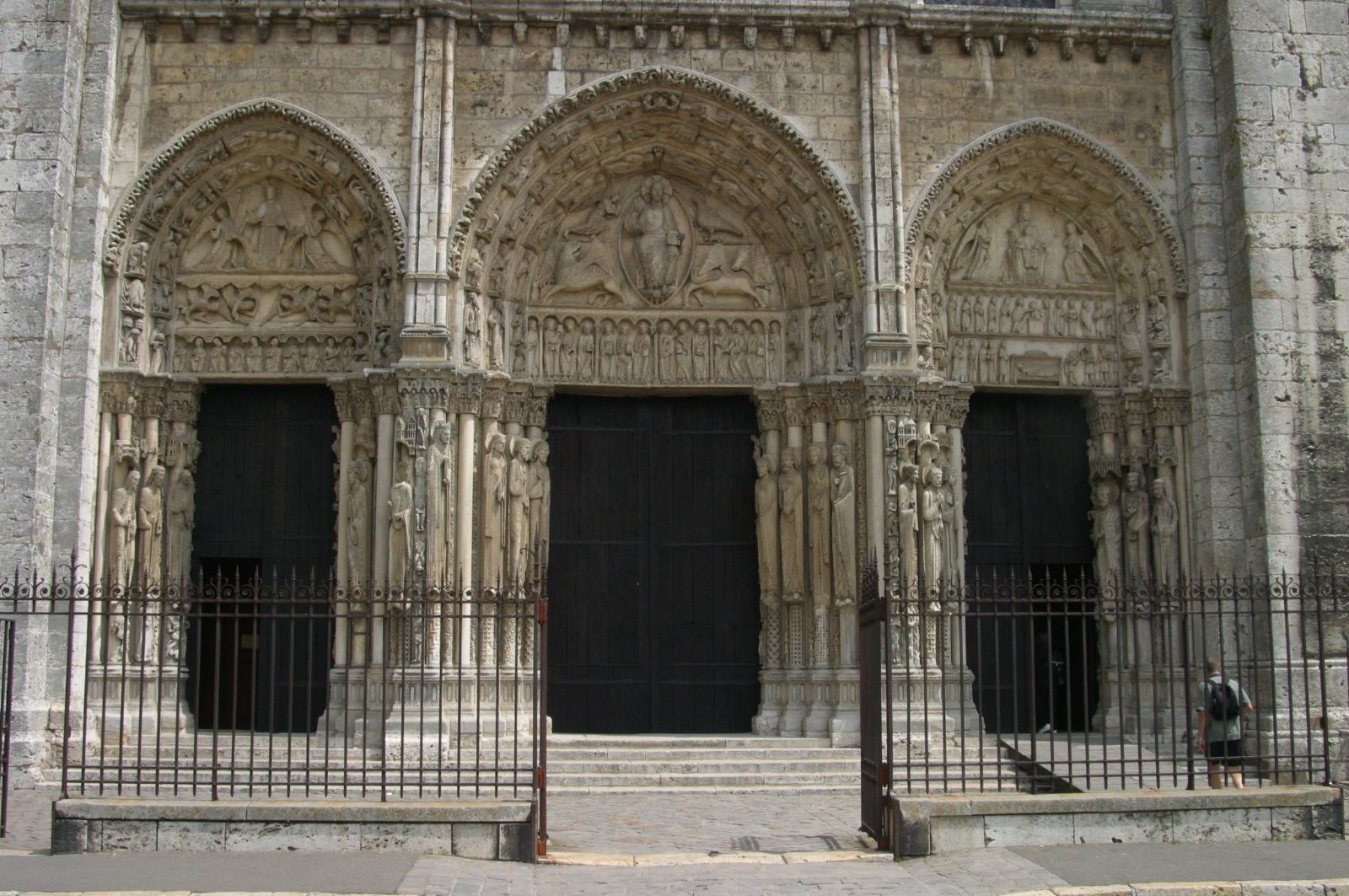
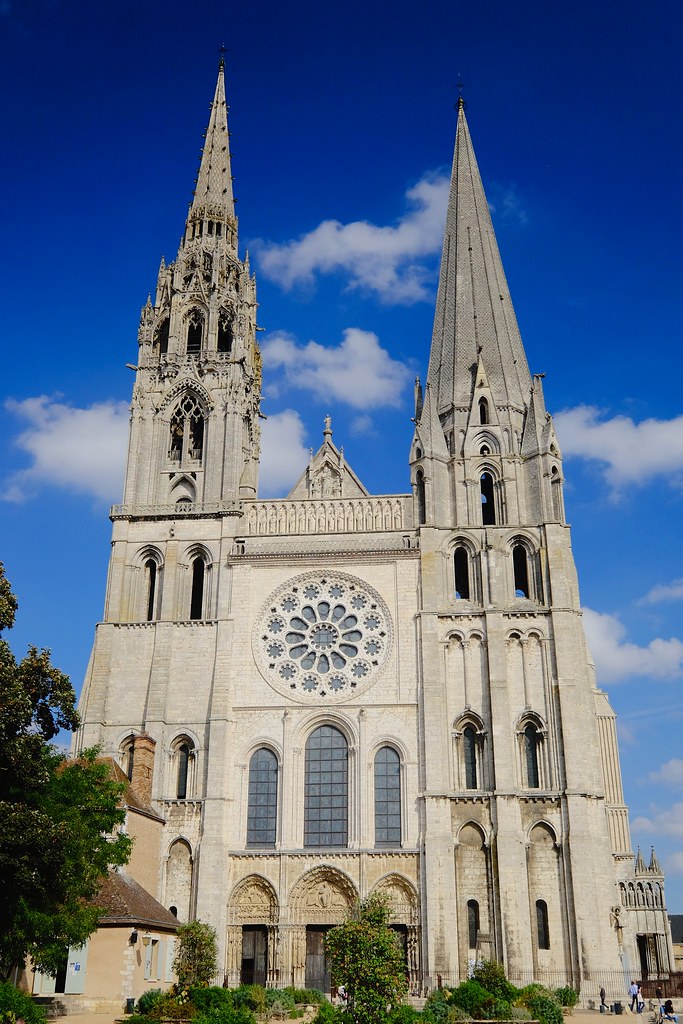
The Royal Portal (Portail Royal) on the west façade of Chartres Cathedral, carved between 1145 and 1155, is one of the finest surviving ensembles of Early Gothic sculpture. Its three richly coordinated doorways present a sweeping vision of Christ’s role in salvation history. Above the left portal, a semicircular tympanum depicts Christ’s Ascension; the central portal illustrates the Apocalypse and the Second Coming of Christ; while the right portal focuses on Christ’s nativity and entrance into human history while crowning the composition is the Sedes Sapientiae (Throne of Wisdom), where the Virgin Mary sits enthroned with the Christ Child in her lap, flanked by two incensing angels. The portals are further enriched by sculpted lintels and archivolts populated with biblical figures and symbolic imagery. Lining the doorways below are the celebrated jamb statues attached to the columns, their elongated, otherworldly forms depicting the kings and queens of the Old Testament. Together, these sculptures create a monumental stone theology that welcomed medieval pilgrims while proclaiming the spiritual and royal lineage of Christ. PHOTO: “Chartres” by Photo:Nina Aldin Thune User:Nina-no is licensed under CC BY 2.5.

The Royal Portal of Chartres is more than a cathedral entrance; it is one of the earliest and most influential masterpieces of Gothic art, transforming carved stone into a timeless expression of faith, knowledge, and medieval imagination.

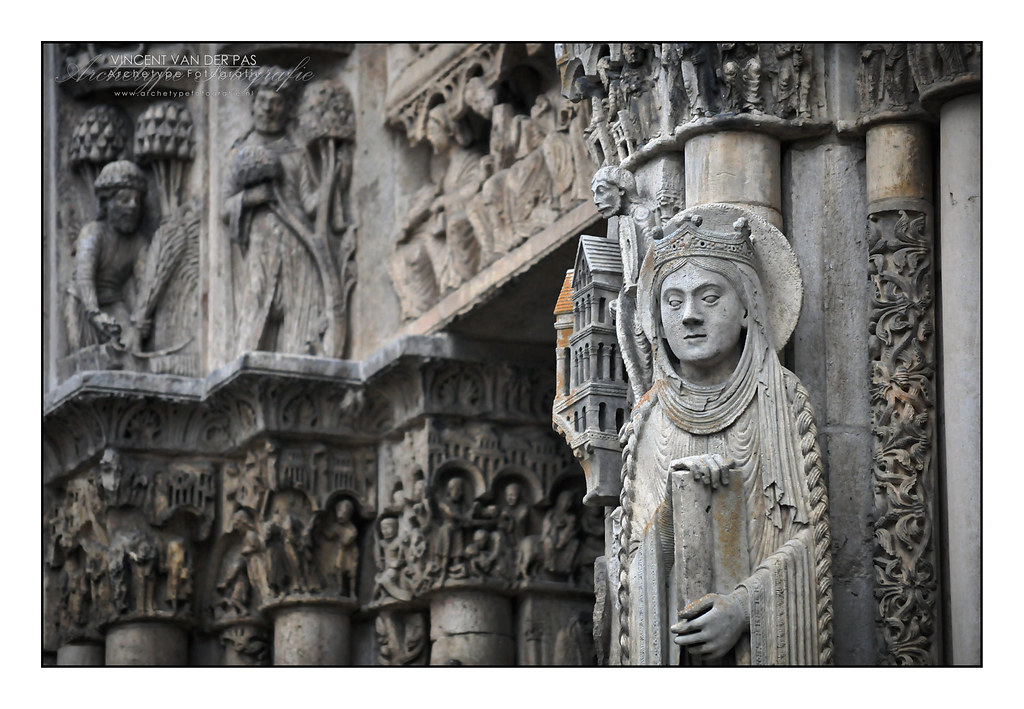
Jamb statues from the Royal Portal (west façade) of Chartres Cathedral. These columns stand on the right-hand side of the Central Portal. These statues were carved between 1145 and 1155. They represent a critical turning point in Western art history, standing as the definitive bridge between the rigid, blocky Romanesque style and the lifelike naturalism of the Early Gothic period. While individual identities are debated, the overarching program represents the Kings and Queens of the Old Testament. PHOTO: “Cenral tympanum Chartres” by Cancre is licensed under CC BY-SA 2.5.

First Visit and Returning to Chartres Across the Years

I first visited Chartres Cathedral in 1985, returning in 1989, 2002, and 2005. That first visit included a Malcolm Miller tour—my introduction to a guide who, since 1958, had devoted his life to interpreting one building. As I backpacked through Europe, his example showed me how a single enduring monumental work can anchor a lifetime of study.

The Great Glass of Chartres

Chartres is celebrated above all for its 12th‑ and early‑13th‑century stained glass, a nearly intact ensemble unmatched anywhere in Europe. The windows shimmer with deep blues, ruby reds, and jewel‑like greens—colors that have survived more than 800 years. Their narratives unfold left to right, beginning at the base and rising upward, guiding viewers through biblical cycles, guild stories, and royal symbolism.

Layers of Cathedrals on a Roman Site

The cathedral stands on what was once a Roman site, and several earlier churches rose and fell here. Structures were destroyed during the Merovingian era, again in Viking raids, and once more in the fires of the 12th century. Each catastrophe cleared the ground for a new architectural vision, culminating in the High Gothic monument seen today.

Detail of jamb statue located on the on the Central Doorway of the North Portal (Portail Nord) of Chartres Cathedral. The prominently featured statue is identified as Saint Anne, the mother of the Virgin Mary. While the Royal West Portal y dates to the mid-12th century (1145–1155), the North Portal was constructed later, between 1204 and 1220. This timing difference explains why Saint Anne’s face features a much more advanced, deeply expressive, and three-dimensional High Gothic naturalism compared to the highly stylized, strictly column-like figures of the west façade. PHOTO: “France, Detail ‘Cathédrale Notre-Dame de Chartres’” by Vincent_AF is licensed under CC BY-SA 2.0.

The Cult of the Virgin Mary

A powerful cult of the Virgin Mary developed at Chartres, strengthened by the arrival of the cathedral’s most famous relic in the 9th century: the Sancta Camisa, believed to be the Virgin’s veil. When devotion to Mary surged across Europe in the 12th century, Chartres—already dedicated to Mary’s Assumption—was perfectly positioned to become a major pilgrimage center, drawing travelers from across Christendom.

Arrival in Chartres

On my first visit to Chartres Cathedral in 1985, I left Paris after breakfast, walked to Gare Montparnasse, and boarded a direct train to Chartres. That day’s tour with Malcolm Miller centered on the great windows of the north side: the North Rose Window (c. 1231), the Blue Virgin Window (c. 1194), and portions of the Noah Window (c. 1210). The Noah Window includes a portrait of St. Lubin, the 6th‑century bishop of Chartres and patron of wine merchants—one of the guilds that financed the glass.

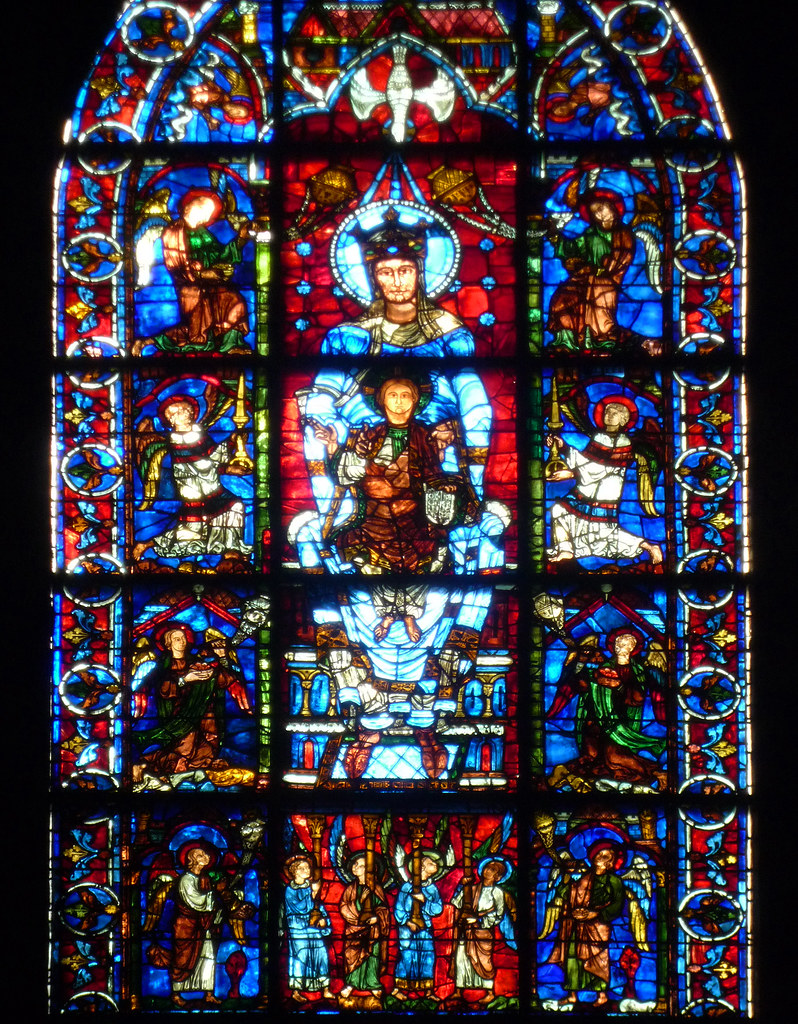
The Blue Virgin Window (Notre-Dame de la Belle-Verrière) is located completely away from the transept roses, tucked into the south aisle of the choir ambulatory (Bay 30). it was one of the incredibly rare pieces of glass that miraculously survived the great cathedral fire of 1194. The central figures of the Virgin Mary and Child date to approximately 1180. When the cathedral was rebuilt in the early 13th century, the master glasiers saved this sacred 12th-century panel and carefully framed it with new 13th-century outer border panels (circa 1215–1220), blending Romanesque and High Gothic glass art seamlessly. PHOTO: “Chartres, Notre-Dame de la Belle-Verrière (detail of Virgin)” by profzucker is licensed under CC BY-NC-SA 2.0.

The portal celebrates Christ’s majesty while emphasizing the relationship between the Old and New Testaments. Its sculptural program unites architecture and theology, turning the cathedral entrance into a visual lesson in Christian belief.

Sculpture of the West Front

Miller also took us outside to study the 12th‑century statuary of the Royal Portal on the west front—figures I photographed again in 1989. These sculptures belong to the cathedral’s Romanesque‑Gothic transitional phase and survived multiple disasters that reshaped the building.

Early Fires and Romanesque Foundations

A major fire in 1120 destroyed the earlier church, prompting construction of a large Romanesque structure contemporary with Vézelay Abbey. Another fire in 1134 damaged the building and led to the construction of the north tower, completed in 1150. The south tower followed roughly a decade later. The Royal Portal itself was built between 1145 and 1155, forming the nucleus of the west front that still stands today.

The 1194 Fire and Gothic Rebuilding

The defining catastrophe came in July 1194, when a devastating fire destroyed nearly the entire church and much of the city. Remarkably, the mid‑12th‑century west front, its royal doors, and the two contrasting towers survived. Everything else—the soaring nave, the sculptural program, and nearly all the stained glass—was rebuilt between 1195 and 1220, creating the unified High Gothic masterpiece seen today.

The survival of the Royal Portal through fires, wars, and centuries of change makes it an extraordinary witness to medieval civilization.

The North Rose window in Chartres Cathedral displays the Virgin Mary and Child in the center surrounded by small circles of doves, angels and thrones. In the outer circles are depicted the 12 kings of Judah (who were Jesus and Mary’s ancestors) and the 12 minor prophets. “Chartres – cathédrale – rosace nord” by Eusebius@Commons is licensed under CC BY 2.0.

Royal Patronage of the North Rose:

In the rebuilding of Chartres, The North Rose Window (created c. 1230-1235) was donated by Blanche de Castile, mother and regent, who ensured the design honored both her lineage and her teenage son, King Louis IX, whose royal patronage helped define the Gothic cathedral’s luminous 13th‑century glass program both here and soon in Paris.

Political Strategy Behind the Glass

The window is not only a devotional masterpiece; it is a calculated piece of 13th‑century political messaging crafted at a moment when Blanche of Castile faced rebellions from French barons who resented both her gender and her foreign birth to rule France. By shaping the iconography, Blanche used the cathedral’s most prominent glass to assert her divinely sanctioned authority.

Heraldry as a Statement of Power

Blanche inserted unmistakable symbols of legitimacy:

  • the arms of France — golden fleurs‑de‑lis on blue
  • the arms of Castile — golden castles on red

Placed together, they proclaimed the union of dynasties and the rightful lineage of her son, Louis IX, whose minority she was defending.

The Lancet as a Warning to the Barons

Directly beneath the great rose, Blanche added a lancet window pairing righteous biblical kings standing triumphantly over fallen, corrupt rulers. It was a visual admonition to rebellious nobles: oppose the rightful sovereign, and you align yourself with the defeated enemies of God.

Saint Anne and Blanche of Castile

At the center of the vertical lancets stands Saint Anne, holding the infant Virgin Mary. This was a deliberate, intimate parallel. Blanche positioned herself as a holy mother‑protector, raising the sacred child — Louis IX — to rule France. The imagery reinforced her maternal authority and the sanctity of her regency.

Revolutionary Upheaval and Restoration

During the French Revolution, Chartres Cathedral was desecrated and repurposed as a Temple of Reason, part of the radical de‑Christianization campaign. It was not returned to the Church or reconsecrated until 1855, beginning the long modern era of preservation and study that continues today.

The survival of the Royal Portal through fires, wars, and centuries of change makes it an extraordinary witness to medieval civilization. Chartres became a model for later Gothic cathedrals throughout France and Europe.

The West Front is from the 12th, 13th and 16th centuries. The photograph’s column statues below are on the right side of the West Portal’s central door. Though likely originally intended in the 12th century to be enclosed in a narthex, that structure was not built and these sculptures remained outdoors. “Chartres 2014 – 2” by evocateur is licensed under CC BY-SA 2.0.

The Rise of Cathedral Learning

By the 11th century, Europe experienced a renewed intellectual energy, especially in Northern Europe, where monastic and later cathedral schools became centers of study. One of the pivotal figures in this revival was Gerbert of Aurillac (c. 946–1003), later Pope Sylvester II, who had studied in Spain and led the cathedral school at Reims in the 970s. His most influential pupil, St. Fulbert of Chartres, carried this legacy forward.

Fulbert and the Great School of Chartres

As bishop, St. Fulbert founded the Chartres Cathedral School, which became the most illustrious center of learning in the 12th century. It marked a turning point in Western intellectual life. Scholars there debated emerging philosophical questions about God, humanity, reason, and creation—the very issues that defined the 12th‑century renaissance of thought.

Completion and Consecration of the Gothic Cathedral

Although the present Gothic cathedral was roofed and essentially finished around 1220, it was formally reconsecrated in October 1260. By then, Chartres had already become a magnet for major religious figures. Three popes visited during the 12th century, and in later centuries saints such as Thomas Becket, Bernard of Clairvaux, Francis de Sales, Vincent de Paul, Louis de Montfort, and Benedict Joseph Labre prayed there.

Pilgrimage Through the Centuries

Pilgrimages to Chartres began before the 12th century and remained important through the 16th and 17th centuries, though they declined sharply after the French Revolution. By the late 19th century, pilgrims were returning, but the revival of the traditional Paris‑to‑Chartres route is credited to the French poet Charles Péguy.

Charles Péguy and the Modern Pilgrimage

On June 14, 1912, Péguy set out on the nearly 150‑kilometer walk from Paris to Chartres, completing it in three days. The pilgrimage fulfilled a vow he had made the previous year at the bedside of his ill son. “Chartres is my cathedral,” he later wrote. His life ended two years later: on September 5, 1914, serving as a lieutenant in the 19th Company, 276th Infantry Regiment, he was killed near Villeroy, Seine‑et‑Marne. Péguy was 41.

The Royal Portal is the oldest surviving section of Chartres Cathedral and predates much of the present Gothic structure. Elongated jamb figures of kings and queens bridge Romanesque traditions and the emerging naturalism of Gothic sculpture.

The Royal (West) Portal, 12th century, Cathédrale de Chartres (1145-1220), France. December 1989. Author’s photograph 1.24 mb

Identifying the Figures

While art historians have attempted to identify the portal statuary at Chartres, the conclusions remain speculative. The figures appear to represent Old Testament characters—and in this photograph, the pair may be King Solomon, at right holding a scroll, and the Queen of Sheba beside him. Their identities matter less than the expressive force the sculptor carved into their faces nearly a millennium ago.

Faces Filled With Life

What is striking is the inexpressible joy radiating from these stone faces. The 12th‑century sculptor concentrated the entire vitality of the figures in their expressions—an artistic ambition that still feels modern. Even after 900 years of weather, war, and revolution, the faces retain a startling immediacy.

Statuary at the Height of 12th‑Century Art

Although Chartres is world‑famous for its flying buttresses and stained glass, many art historians argue that the statuary is the cathedral’s most compelling achievement. These portal figures represent 12th‑century sculpture at its zenith, where spiritual intensity, architectural innovation, and human emotion converge in stone.

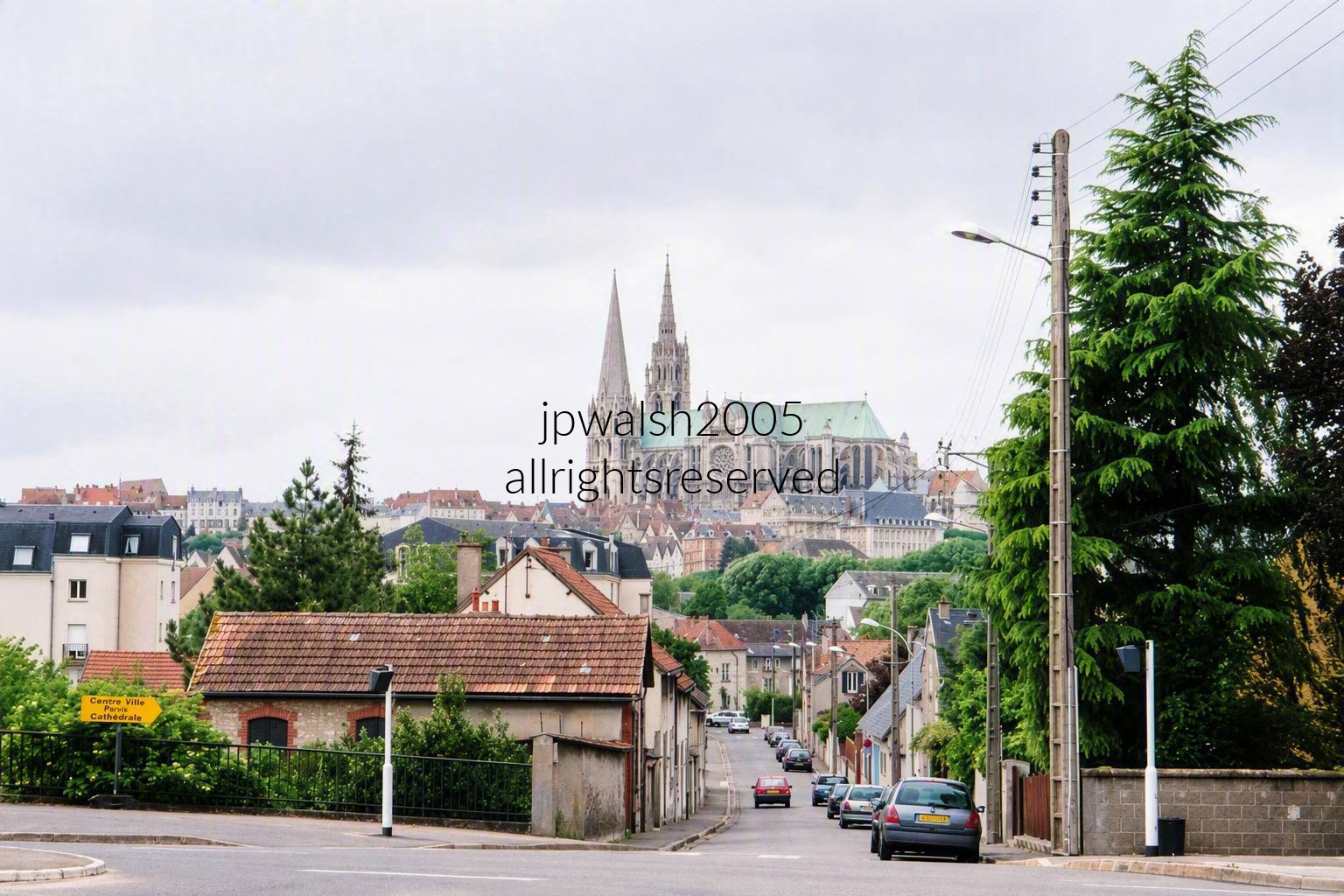
Cathédrale Notre-Dame de Chartres. May 2005. Author’s photograph,

Taken from Jardin de Sakuraï, this view looks west-southwest along 35 Rue du Faubourg Guillaume toward the historic center of Chartres, France, where the world-famous Cathédrale Notre-Dame de Chartres dominates the skyline. This High Gothic masterpiece is instantly recognizable for its asymmetrical spires, soaring flying buttresses, and expansive green copper roof. From this eastern vantage point, the cathedral’s two towering western spires rise at the far left. Following the roofline to the right, the large projecting cross-shaped section in the middle is the north transept façade. Beyond it, the lower rounded end of the church, encircled by an impressive ring of flying buttresses, forms the apse, the cathedral’s eastern termination. Together, these elements reveal the monumental scale and architectural complexity that have made Chartres one of the most celebrated cathedrals in Europe.

SOURCES: 

Cartwright, Mark. “The Stained Glass Windows of Chartres Cathedral.” World History Encyclopedia, October 16, 2018. https://www.worldhistory.org/article/1277/the-stained-glass-windows-of-chartres-cathedral/.

Houvet, Étienne. Chartres: Guide of the Cathedral. Revised by Malcolm B. Miller. Chartres: Éditions Houvet-la Crypte, n.d.

Leff, Gordon. Medieval Thought. Highland, NJ: Humanities Press, 1958.

“The Great Pilgrimages.” Cathédrale de Chartres. Accessed August 23, 2025. https://www.cathedrale-chartres.org/en/cathedrale/pilgrimages/the-great-pilgrimages/. [1]

“The Voice of Chartres.” America Magazine. Accessed August 23, 2025. https://drupal.americamagazine.org/issue/681/article/voice-chartres.


This explanatory article may be periodically updated.

Byzantine Heritage in Modern Chicago: Yaroslaw Korsunsky’s Sts. Volodymyr and Olha Church (1975).

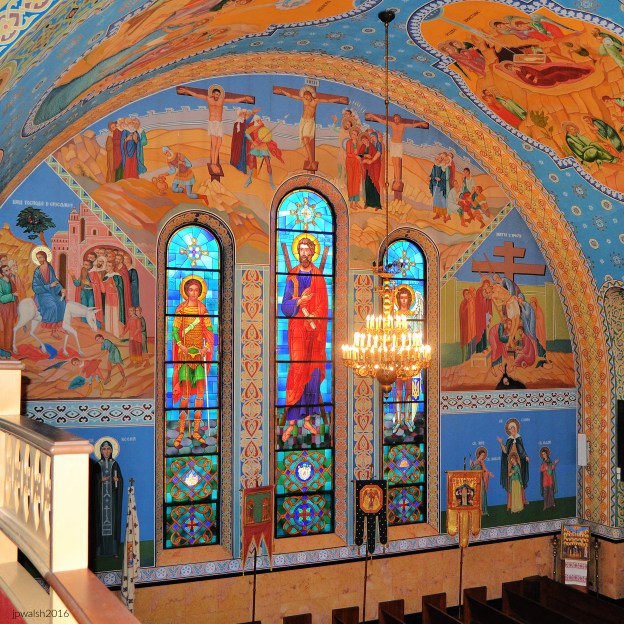
FEATURE image: Stained glass, paintings, banners, and chandelier blend together and provide a more complete picture of people and episodes of the faith. North wall and ceiling. Chicago. Sts. Volodymyr and Olha Church. October 2016. Author’s photograph. 5.88 mb

Sts. Volodymyr and Olha Church (1975) stands as a powerful expression of Ukrainian religious and cultural identity in Chicago, blending traditional Byzantine forms with modern architectural design. Architect Yaroslaw Korsunsky created a monumental house of worship whose soaring domes, geometric forms, and richly symbolic design connect an immigrant community to centuries of Eastern Christian tradition while asserting its presence within the modern American city.

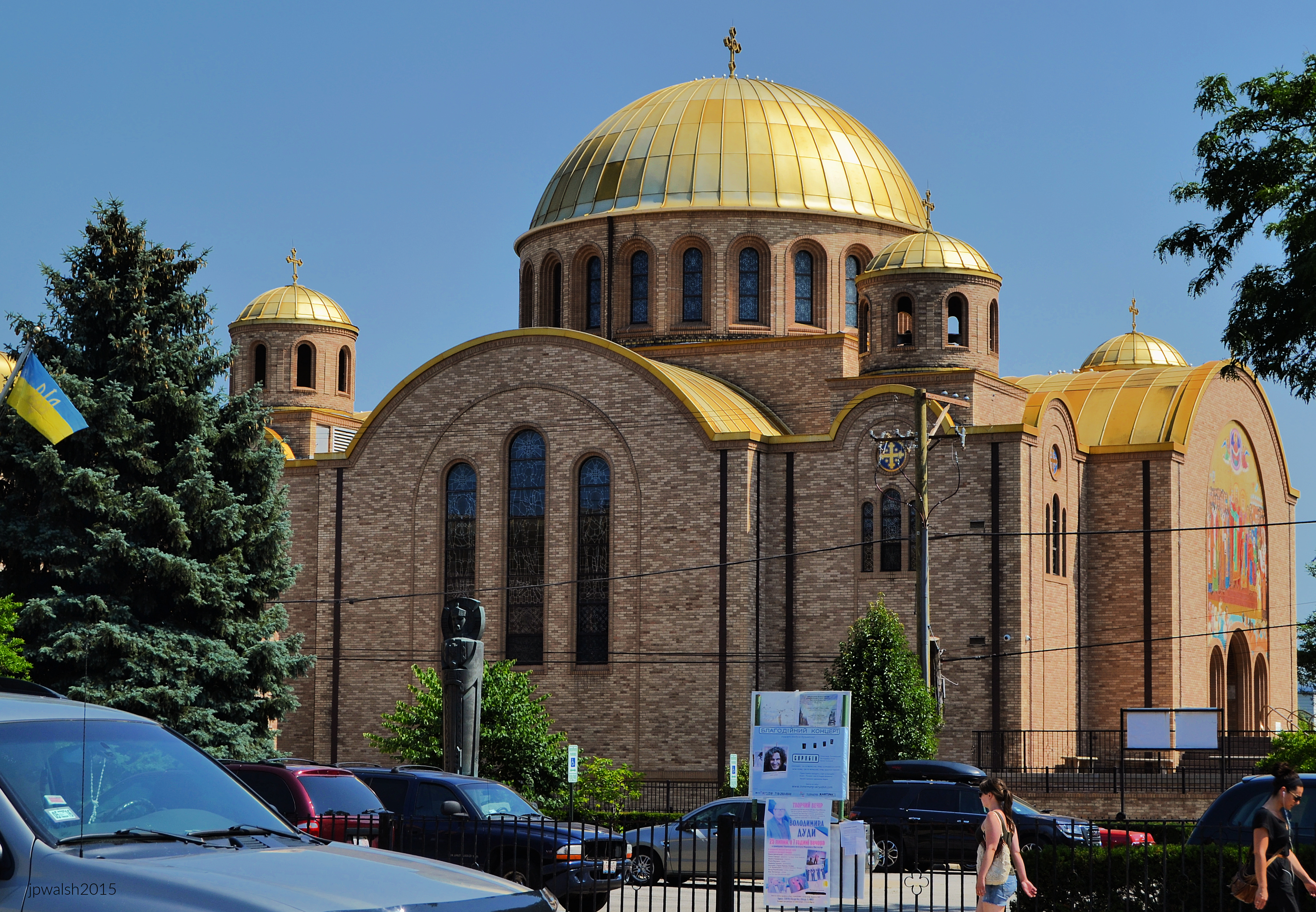
Chicago. Sts. Volodymyr and Olha Church. July 2015. Author’s photograph.

At 739 N. Oakley Boulevard Sts. Volodymyr and Olha Church in Chicago displays with its gold domes. The tradition-minded parish, founded in early 1970s, serves a busy urban community.

Chicago. Sts. Volodymyr and Olha Church. July 2015. Author’s photograph. 2.52 mb

The building’s design balances monumentality, symbolism, and modern construction techniques.

Sts. Volodymyr and Olha Church, Chicago. The huge mosaic over the main entrance memorializes the conversion of the Ukrainians to Christianity in 988 by St. Volodymyr of Kyiv or Vladimir of Kiev (957-1015). The mosaic was executed by Hordynsky, Makarenko, and Baransky. The church is built in the modern Byzantine style. In addition to the colorful and bright mosaic, the upward angle and its perspective adds to the feeling of entering into a sacred space. Along with the archways and curve of the main golden dome, the eye focuses on the artwork’s bright figures. July 2015. Author’s photograph. 7.68 mb

Chicago. Sts. Volodymyr and Olha Church. July 2015. Author’s photograph. 5.42 mb

WHO IS ST. VOLODYMYR?

St. Volodymyr is the apostle to proto-Russian and Russian Christianity. He was the great prince of Ukraine in Kiev. It was ruled by the Varangians, a barbarous Viking  tribe from Scandinavia – and Volodymyr (or Vladimir) of Kiev was as barbarous as any of them.

In 988, when Volodymyr was about 31 years old, he was converted to Christianity. The missionaries came from the Byzantine world at Constantinople. The results were immediate: Ukraine was now in close contact with the Byzantine world to the south and its Christian church under the pope.

Volodymyr married the daughter of the Byzantine emperor, Basil II (957-1025). But it was Volodymyr’s personal embrace of the Christian faith that infused the Ukrainian people with their deep and abiding faith. Having received baptism, he set out to be a Christian and not corrupted by money and power that proved a serious temptation for many church and state leaders in the Dark Ages.

Volodymyr used his temporal powers to evangelize the people – his personal example his greatest asset to its success. Though he encouraged various activities and programs in the lives of the people – including the multi-faceted work of Greek missionaries – it was his sincere, transparent, and fundamental reform of his own life that by far had the greatest impact on the Ukrainian people. More than one thousand years after his rule, Volodymyr is still recalled as a generous, humble and devout soul.

As a Christian ruler Volodymyr had doubts about inflicting the death penalty. Though assured by his Byzantine church counselors that his Catholic faith allowed him to follow the law which allowed for it, Volodymyr corrected them and said that that sort of reasoning was not satisfactory to his faith.

Volodymyr, the great prince of Kiev, died a poor man – not only various from his origin but, again, that of many of the ecclesiastics now in the realm. Before his death, Volodymyr dispersed all his money and personal belongings to the poor and to his family and friends. St. Volodymyr’s feast day is July 15. He is patron of Ukrainian and Russian Catholics.

WHO IS ST. OLHA?

Saint Olha was the wife of the Kyivan Great Prince Igor. Igor signed a peace treaty with the Greeks in 944. The treaty of 944 was drawn up at Constantinople and allowed for Christianity in Ukraine. This toleration already indicates some sympathy for Christianity among the powerful in Kiev. Igor himself, however, in his official position did not embrace Christianity nor officially allow the presence of a structure of Church hierarchy. The treaty was drawn up  to quietly allow co-existence of Christians in a pagan Viking culture.

Yet when the Byzantine emissaries arrived in Kyiv, pagan opposition had emerged from the Varangians. The Christians were thrown into abeyance and Igor was murdered in 945. Into this volatile situation the burden of government fell upon Igor’s widow — the Kyiv Great-Princess Olha, and her three-year-old son Svyatoslav (945-972). Her first act was to avenge Igor’s murder.

Olha belonged to one of the obscure ancient-Rus’ princely dynasties, whose Slavic line had intermarried with assimilating Varangian newcomers. Olha’s Varangian names includes Helga and Olga.

Though still a pagan, Olha’s revenge on the Varangians on behalf of her late husband was a victory for the realm’s Christians. Further, having weakened the influence of petty local princes in Rus’, Olha centralized the whole of state rule. She became a great builder of the civil life and culture of Kyivan Rus. Her centralization became an important network of the ethnic and cultural unification of the nation which, when Olha became a Christian, aided in the building of a network of churches. Her essential activities proved key in developing what is the modern Ukrainian national identity. At the same time, important trade with Poles, Swedes, Germans, and so forth, led to significantly expanding foreign connections. One noteworthy development was that wooden buildings were replaced with stone edifices.

Rus’ had become a great power. Only two European realms could compare with it in the tenth century – the Byzantine empire in the east, and the kingdom of Saxony in the west. Both these empires were Christianized and pointed the way to future greatness for Rus’. In 954 Great-princess Olha sailed to Constantinople. Though a display of Rus’ military might on the Black Sea, it was a spiritual mission. Olha’s might and the Byzantines’ wealth and beauty were mutually impressive.

Constantinople was the city of the Mother of God as dedicated by Constantine the Great in 330. Olha made the decision to become a Christian. She was baptized by Patriarch Theophylactus (917-956) with her godfather being the emperor Constantine Porphyrogenitos (905-959). She took the Christian name Helen for Constantine’s mother. Following  the rite, the Patriarch said: “Blessed are you among the women of Rus’, for you have forsaken the darkness and have loved the Light. The Rus’ people shall bless you in all the future generations, from your grandson and great-grandson to your furthermost descendants.” Olha replied: “By your prayers, O Master, let me be preserved from the wiles of enemies”. It is precisely in this way, with a slightly bowed head, that Saint Olha is often depicted in religious artwork. During her state visit, and following her baptism, Great princess Olha of Rus’ was fêted throughout Constantinople

Saint Olha devoted herself to efforts of Christian evangelization among the pagans, and also church construction, including Saint Sophia Cathedral. Yet, many despised her new found Christianity and paganism became emboldened. They looked to the reign of Svyatoslav who angrily spurned his mother’s Christianity. Meanwhile Byzantine church and state leaders were not eager to promote Christianity in Rus’. In Olha’s lifetime, Kyiv favored paganism and had second thoughts about even accepting Christianity. By order of Svyatoslav, churches were destroyed and Christians murdered. Byzantine political interests found the church and state looking to undermine Olha’s influence and favored the Rus’ pagans.

Olha attempted to help Svyatoslav during a period of wartime, though Kyiv was a backwater to his imperial interests for the next 18 years. In the spring of 969 the Pechenegs besieged Kyiv and Olha headed the defense of the capital. Svyatoslav rode quickly to Kyiv, and routed the nomads. But the warrior prince wished to rule elsewhere than Kiev. Svyatoslav dreamed of uniting all Rus’, Bulgaria, Serbia, the near Black Sea region and Priazovia (Azov region), and extend his borders to Constantinople. Olha warned her son that his plans were bound to fail as the Byzantine Empire was united and strong.

On July 11, 969 Saint Olha died. In her final years, with the triumph of paganism, she had to secretly practice her faith. Before her death, she forbade the pagan celebration of the dead at her burial and was openly buried in accord with Orthodox ritual. A priest who accompanied her to Constantinople in 957 fulfilled her request.

Considered by Ukrainians the holy equal of Great Prince Volodymyr, St. Olha was invoked by St. Volodymyr on the day the people of Rus’ were baptized. Before his countrymen, St. Volodymr said of St. Olha: “The sons of Rus’ bless you, and also the generations of your descendants.”

Cardinal Major Archbishop Josyf Slipyj (1892-1984), “Confessor of the Faith” and Founder of Sts. Volodymyr and Olha Church. Cdl. Slipy was imprisoned by the Soviet authorities from 1945 to 1963 for refusing to convert to Russian Orthodoxy. He was finally set free through the intervention of Pope John XXIII and President John F. Kennedy.

Chicago. Sts. Volodymyr and Olha Church. July 2015. Author’s photograph. 7.46 mb

A beautiful outdoor garden with the residential streets of Ukrainian Village as its background is the setting for the larger-than-life-sized statue of Major Archbishop Josyf Slipyj (1892-1984). He was made a cardinal by Pope Paul VI in 1965 and is a “Confessor of the Faith.” The founder of the parish, Cdl. Slipyj blessed the new church building’s cornerstone. Supporting the Ukrainian state and refusing to convert to Russian Orthodoxy, he was imprisoned by the Soviet authorities from 1945 to 1963. Through the intervention of St. Pope John XXIII and U.S. President John F. Kennedy, Josyf Slipj was released by Nikita Khrushchev in early 1963 and participated in the Second Vatican Council. Josyf Slipyj died in Rome in 1984 and his cause for canonization as a saint of the Catholic Church has been introduced at the Vatican.

Sts. Volodymyr and Olha Church sit in Chicago’s Ukrainian Village.

Ukrainian Village. October 2016. Author’s photograph. 317 kb 30%

Ukrainian Village. October 2016. Author’s photograph. 316 kb 20%

Chicago. Sts. Volodymyr and Olha Church. October 2016. Author’s photograph. 6.86 mb

High above the sanctuary is a magnificent view of the main dome painted in bright colors with the figure of Christ Pantocrator. Christ gives his blessing as he holds an open book with the Greek letters: alpha and omega. It signifies one of Christ’s titles: “I am the beginning and the end” (Revelation, 21:6, 22:13).

Chicago. Sts. Volodymyr and Olha Church. October 2016. Author’s photograph. 5.88 mb

North Wall.

Chicago Sts. Volodymyr and Olha Church. October 2016. Author’s photograph. 7.84 mb

South Wall.

Chicago. Sts. Volodymyr and Olha Church. October 2016. Author’s photograph. 4.54 mb

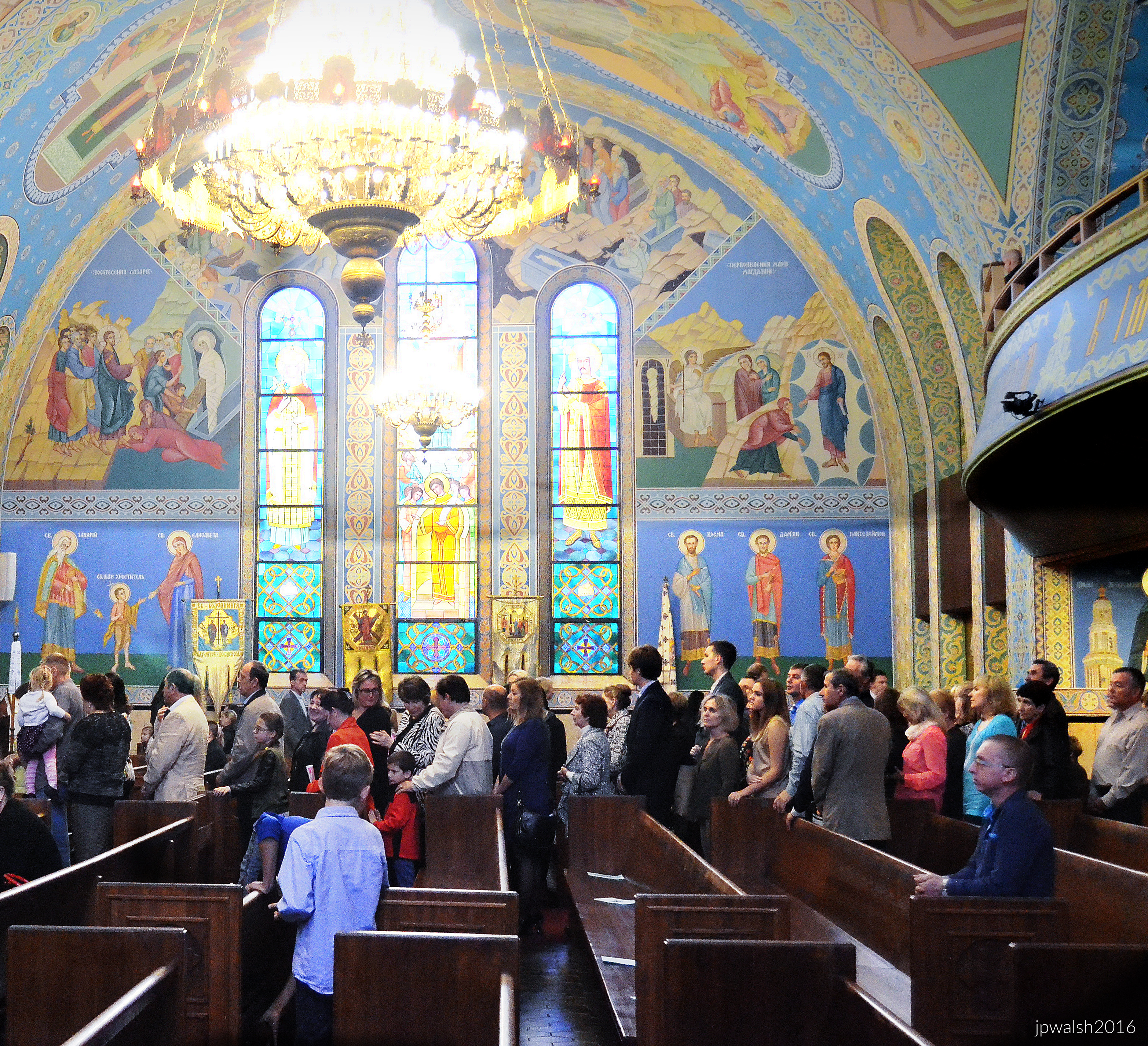
Parishioners praying and going to Communion at Sunday Mass.

Chicago. Sts. Volodymyr and Olha Church. October 2016. Author’s photograph. 4.54 mb

Chicago. Sts. Volodymyr and Olha Church. October 2016. Author’s photograph. 5.40 mb

With the artists’ skills, the bright colors and evocative forms of the artwork surround churchgoers as they move toward the altar at Communion during the Divine Liturgy.

Chicago. Sts. Volodymyr and Olha Church. October 2016. Author’s photograph. 6.18 mb

Chicago. Sts. Volodymyr and Olha Church. October 2016. Author’s photograph. 544kb 30%

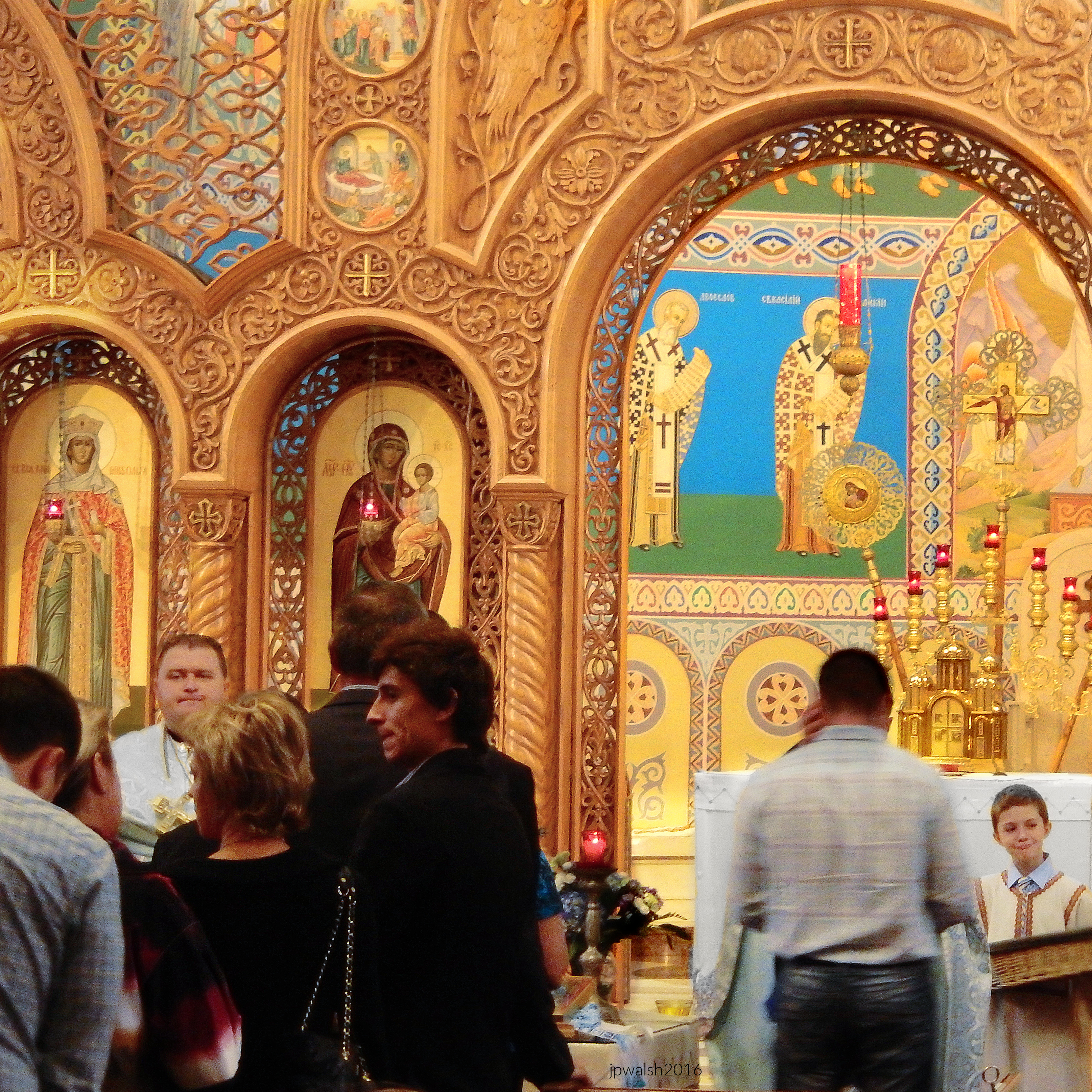
The colorful and vibrant decorations that include paintings, carvings, vestments, books, stained glass, and more, are integral to the parish’s liturgy and life.

Chicago. Sts. Volodymyr and Olha Church. October 2016. Author’s photograph. 5.46 mb

Chicago. Sts. Volodymyr and Olha Church. October 2016. Author’s photograph. 4.35 mb

Icon of Sts. Volodymyr and Olha with a smaller icon of the Blessed Virgin.

Chicago. Sts. Volodymyr and Olha Church. October 2016. Author’s photograph. 4.47 mb

Every nook and cranny of the church is decorated with colorful images from religious and Catholic Ukrainian history. The natural light streaking down from the main dome’s windows adds a heavenly glow.

Chicago. Sts. Volodymyr and Olha Church. October 2016. Author’s photograph. 6.15 mb

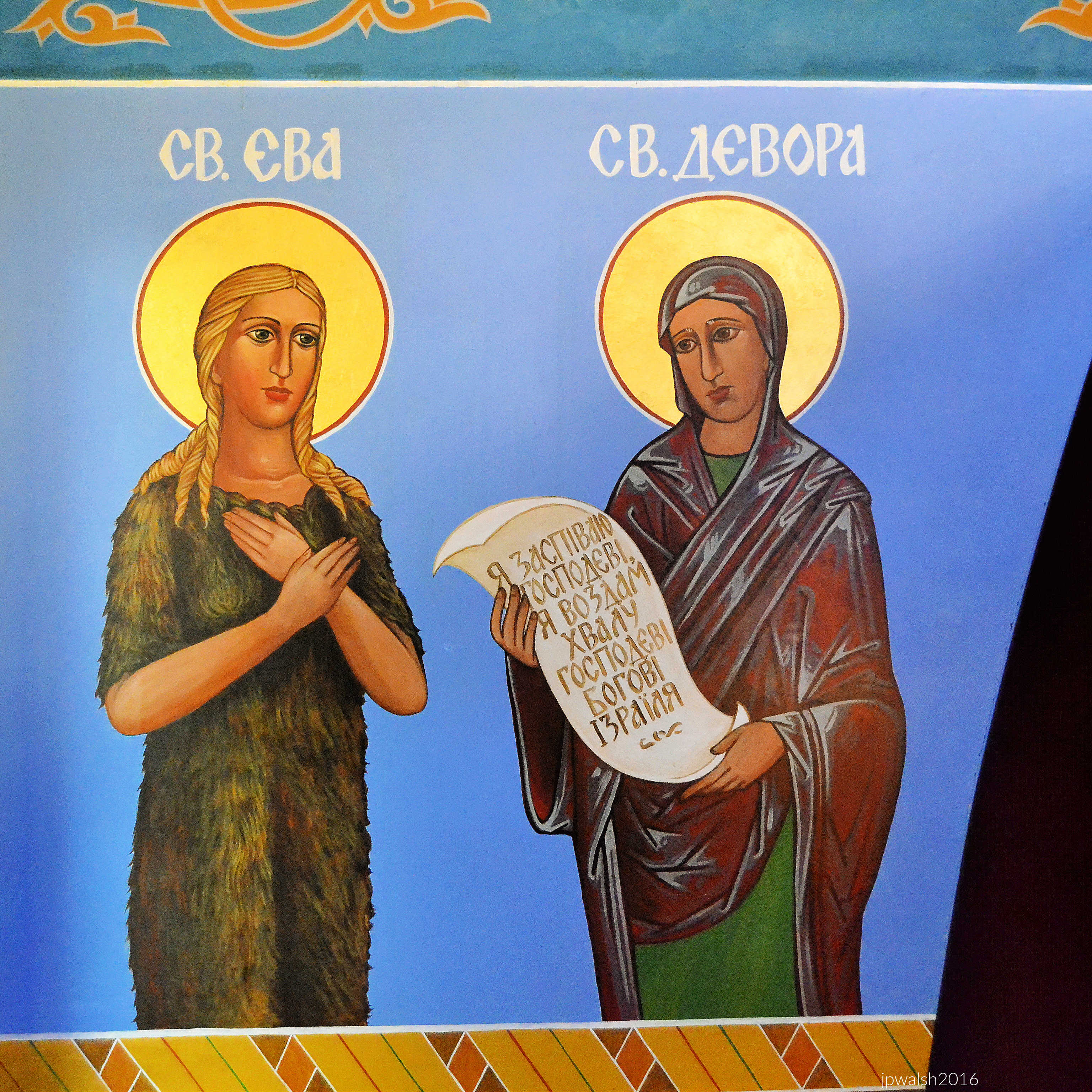
Two female haloed saints in a modern art style are marked by their unique attire as one holds an unfurled scroll with words in Ukrainian. Christianity arrived into Ukraine by way of the Greco-Byzantine world over 1000 years ago.

Chicago. Sts. Volodymyr and Olha Church. October 2016. Author’s photograph. 4.90 mb

A painting of the dormition of Mary is emphasized by an icon of Mary and the child Jesus. Colors, forms, and subject matter are very high quality, soft and peaceful, making them pleasant to look at and pray with.

Chicago. Sts. Volodymyr and Olha Church. October 2016. Author’s photograph. 6.18 mb

The wood carvings and full-length portrait icons are gorgeous. The fresh flower arrangements further brighten the scene.

Chicago. Sts. Volodymyr and Olha Church. October 2016. Author’s photograph. 7.68 mb

Visitors are joined by worshippers lighting candles and praying before a large icon of Mary and the child Jesus.

Chicago. Sts. Volodymyr and Olha Church. October 2016. Author’s photograph. 10.68 mb

The main altar gate of carved wood with icons and gold curtain. The Last Supper in center above.

SOURCES:

Coulson, John, ed. The Saints: A Concise Biographical Dictionary. Guild Press, 1957, pp. 577; 760-761.

Howe, Jeffrey. Houses of Worship: An Identification Guide to the History and Styles of American Religious Architecture. Thunder Bay Press, 2003.

Pacyga, Dominic A., and Ellen Skerrett. Chicago: City of Neighborhoods. Loyola University Press, 1986, p. 193.

Sinkevitch, Alice. AIA Guide to Chicago. 2nd ed. Harcourt, Inc., 2004, p. 260.

St. Elias Brampton. “St. Olha (Olga, Ol’ha).” Saint Elias (blog). July 11, 2017. Accessed April 26, 2022. https://www.saintelias.com/blog/2017/7/11/st-olha-olga-olha. [1]


John P. Walsh, 2015-16. All rights reserved. All text and photos are the property of the author, except for materials explicitly credited as public domain or licensed content.

Walls, Parks, Streets, and Stories: Art Outdoors.

Art outdoors transforms streets, parks, plazas, and building walls into public galleries where history, memory, community identity, and creative expression become part of everyday life, demonstrating how art can engage audiences beyond the traditional museum setting.

All photographs & text by John P. Walsh.

September 2001. Philadelphia, Pennsylvania 70% Progress of Women was completed by artists Larissa Preston Danowitz and Cesar Viveros and collaborators in 2001. At 1307 Locust Street the mural shows work of the New Century Guild to promote women in the workforce. At the top of the mural is the visage of Eliza Turner (1826-1903) who founded the New Century Guild in 1882 and lived in Philadelphia.

October 2003. Corcoran Gallery of Art, Washington, D.C. The Renoir-inspired outdoor sculpture (“Dance at Bougival,” 1883, The Boston Museum of Fine Arts) was in conjunction with that year’s exhibition called “The Impressionist Tradition in America.” Closed in 2014, the former museum is today the Corcoran School of the Arts and Design, a part of the George Washington University.

November 2017. Crown Fountain, Jaume Plensa [Krueck + Sexton Architects], Millennium Park, Chicago. 368kb 35%

October 2015. Chicago. 4.48 mb

June 2018 Chicago. 4.65 mb

July 2015. Chicago. 4.32 mb

May 2014. Chicago. 4.72 mb

June 2022. Chicago. 7.89 mb 86%

December 2013. Chicago. 6.79 mb

June 2022. Chicago (Rogers Park). 4.20 mb

June 2022. Chicago. 7.66 mb 84%

June 2022. Chicago 11.71 mb

June 2022. Chicago 2.38 mb 50%

August 2015. Chicago. 7.92 mb 96%

August 2018. Chicago. 7.29 mb

August 2015. Chicago. 5.26 mb

October 2016. Chicago. Daniel Buren (b. 1938), Attrape-soleil, 2013. 4.49 mb.

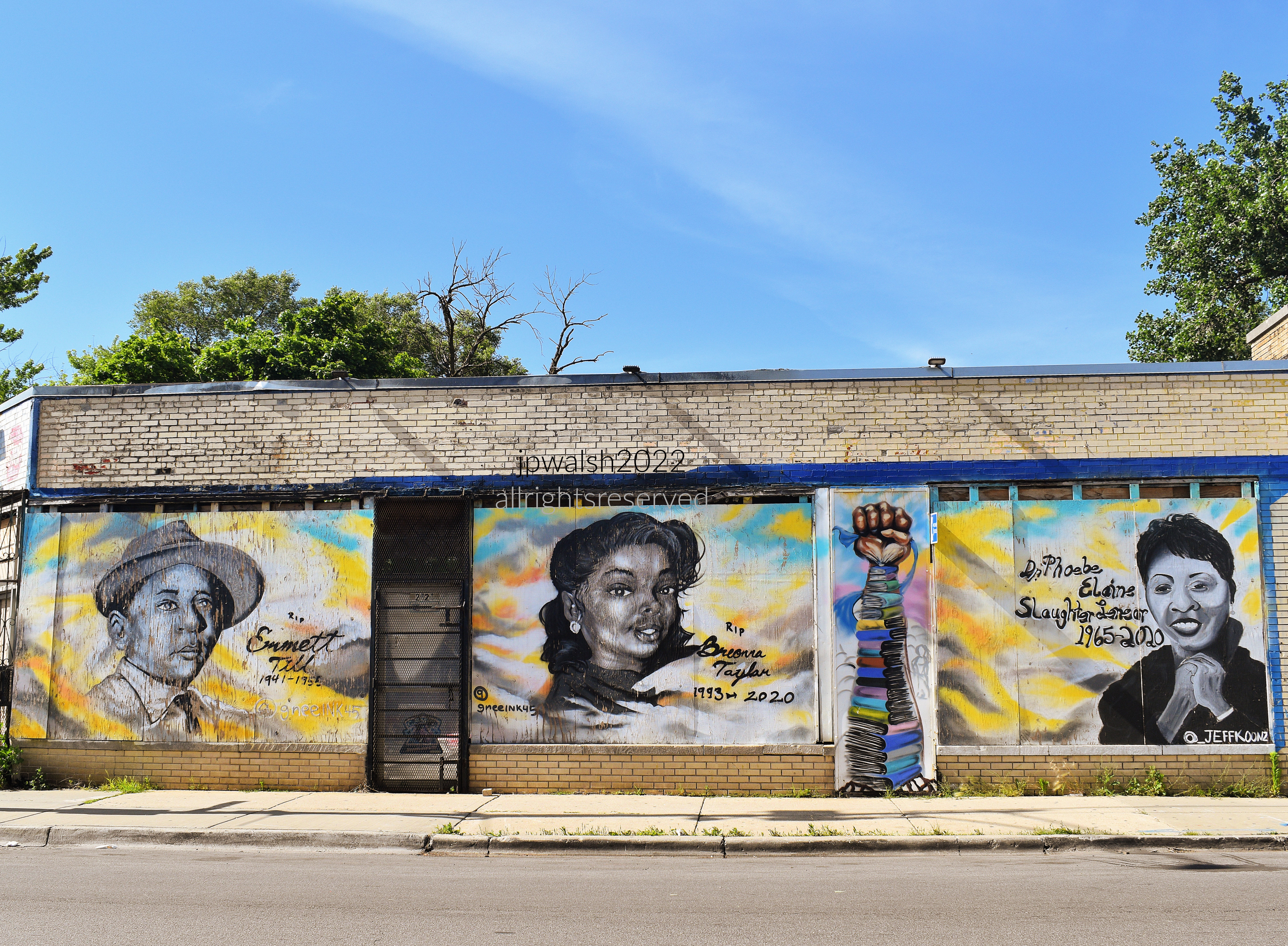
Featured on the exterior wall of a building in the Englewood/Morgan Park area located on the South Side of Chicago, three prominent civil rights figures and community leaders are memorialized in this mural created in 2020. Emmett Till (1941–1955) is A 14-year-old Chicago youth whose brutal lynching in Mississippi became a primary catalyst for the American Civil Rights Movement; Breonna Taylor (1993–2020) is a 26-year-old emergency room technician who was fatally shot by police officers in her Louisville, Kentucky home. And Dr. Phoebe Elaine Slaughter-Lenear (1965–2020) is a respected local Chicago educator, humanitarian, and community leader. Created in the midst of the nationwide civil rights protests that summer, the mural was painted as a collaboration by Chicago-based visual artists GNEE ART (@gneeink45) and Calin Bruett, professionally known as JEFF K%NZ (pronounced “Jeff Koonz”).

August 2021. Chicago. 7.23 mb 99%

2021. Chicago. 7.82 mb 90%

May 2021. Chicago. Cloud Gate (“The Bean”), 2006, Anish Kapoor, Millennium Park. 7.97mb 97%

July 2015. Chicago. 7.10 mb

March 2014. Melrose Park, IL. 4.06mb

April 2013. Chicago. 1.07 mb 40%

January 2024. Downers Grove, IL 7.75 mb 97%

September 2015. Chicago. 5.82 mb

April 2013. Chicago (Pilsen). 3.46mb

April 2013. Chicago (Pilsen). 4.96mb

April 2013. Chicago (Pilsen). 4.63mb

August 2024. Chicago. 87% 7.75 mb _1500 (1)

October 2016. 99% 7.59 mb DSC_0828

November 2017. Chicago. Opened in July 2004, Crown Fountain in Millennium Park was designed by Spanish artist Jaume Plensa (b. 1955) and executed by Krueck and Sexton Architects. 66% 7.91 mb DSC_3423

April 2013. Chicago Pilsen. 4.89mb102_0165 (1)

July 2015. Chicago 5.66mb DSC_0083 (1)

December 2015. Chicago (State Street). 5.13mb DSCN1936 (1)

May 2016. Chicago. 4.97mb DSCN2708 (1)

May 2013. Chicago (Pilsen) 4.37mb 102_0387 (1)

Where Astronomy Became Architecture: Chichén Itzá and the Genius of the Ancient Maya.

FEATURE image: Chichén-Itzá serpent head sculptures guard a staircase. May 1988. Author’s photograph.

All text and photographs by John P. Walsh, except where noted.

Rising from the jungles of the Yucatán, Chichén Itzá reveals the intellectual, architectural, and spiritual achievements of the Maya, whose temples, pyramids, and astronomical observatories transformed a remote landscape into one of the most remarkable urban centers of the ancient world.

Serpent head at the base of El Castillo. May 1988. Author’s photograph.

Cancún: Gateway to the Ancient Maya

Cancún’s sandy spit of land at the northern tip of the Yucatán peninsula was uninhabited by the ancient Mayans. It was trodden by the conquistadores and used by pirates as a hide-out. Today, oozing like wet plaster into the Caribbean sea, the beaches are a new jet-age resort. I visited the Yucatán from Chicago for a few days in May 1988.

Though the tourist board in Cancún was telling of more resort development by the mid-1990s, it already boasted of 85 hotels and about 9,000 guest rooms during my trip.

Leaving the Resort Coast for the Yucatán Interior

After two days acclimating myself nicely to the Caribbean climate and working my way un poco with the Spanish language, I signed up with a local tour operator for a 12-hour bus tour. The destination was to one of the most famous sites on the Yucatán peninsula and the world: the ancient Mayan archeological site of Chichén-Itzá.

With its mysterious, virtually-intact looming pyramids and temples as well as startling tales of human sacrifice and one of the world’s most accurate cosmic calendar systems—all over 1,000 years old—I was excited to adventure out of the comfort of Cancún’s “Zona Hotelera” into the Yucatán jungle interior.

Setting out from Cancún into the Yucatán jungle

IGUANA – CC BY-SA 2.0 view terms.

The ancient Mayan cities and later Spanish colonial ones that sit on top of them are a stark contrast to the touristy jet-set beaches of Cancún.

Across the Jungle Peninsula

An extensive jungle stretches across the Yucatán’s three states of Quintana Roo, Campeche, and Yucatán that are inhabited by human communities as well as wild animals such as jaguars. We frequently saw black-headed, blue-bodied birds called Yucatán jays. We saw iguanas on sun-washed rocks.

In the landscape of Chichén-Itzá there are a variety of mammals, hundreds of species of birds and many reptiles. On the Yucatán peninsula there are almost 150 varieties of snakes, many of which, including at the archeological site, are highly venomous. May 1988. Author’s photograph.

PHOTO: “Coral Snake Closeup” by MyFWC Florida Fish and Wildlife is marked with CC BY-ND 2.0.
Yucatán jays.

YUCHATAN JAYS – Licensed under the Creative Commons Attribution 2.0 Generic  license. Tony Hisgett – originally posted to Flickr as Yucatan Jays – immature

Along Highway 180 to Chichén-Itzá

I left the hotel and met the bus in Cancún town at 8:00 a.m. Francisco drove the air-conditioned 40-seater as Raúl toted a microphone and told the group about some of the things we were seeing along the way.

They took us out of Quintana Roo’s Cancún to Yucatán’s Chichén-Itzá about 125 miles away. On arrow-straight highway 180 we drove into small local communities along the two-lane road. We would reach Chichén-Itzá out of Valladolid, the Mayan/Spanish colonial city which is sometimes called the most colorful town in Mexico.

Chichén-Itzá’s famous complex of Mayan ruins dates from the Classic period of 600 CE to 1200 CE. Important archeological sites in the Yucatán still await reclamation from the jungle today –such as smaller Cobá in Quintana Roo. Guided tours are recommended for an extensive and remarkably safe visit into these interesting backwater places.

Yucatán’s South 180: Route From Cancún to Valladolid. May 1988. Author’s photograph.

The bus climbed onto south highway 180 and followed it through villages such as Cocoyol, Catzin, Chemax, Xalaú, and others. Along the route there were thatched-roof dwellings which held patterned hammocks inside. Outside, dogs slinked around and small farm animals sometimes shared the road. The entire Yucatán peninsula is sparsley populated with only a fraction (about 4%) of Mexico’s total population. 

Traditional Mayan Life in Modern Yucatán

Francisco told us that the thatched-roof dwellings were durable. One such dwelling could last almost 20 years. The huts were made of sticks which we were told kept dwellers cool and comfortable year-round. Raúl said that the average year-round temperature on the peninsula was 93 degrees Fahrenheit. Starting in April, humidity levels rose and the temperature hovered over 100 degrees. Thatched hut dwellings were the predominant local housing we saw from highway 180.

Traditional Mayan homes. May 1988. Author’s photograph.

With exceptions, the lifestyle of modern Mayans has not strayed from their ancestors’ of the last millennia. Traditional Mayan homes are oval-shaped huts made of sticks bound together to form walls. Palm fronds are laid upon the wood frame for a peaked roof. Inside there is a main room usually with a dirt floor. Hammocks create a sleeping area.

Valladolid: A Colonial City Built on Maya Ground

In Valladolid, a Spanish colonial town founded in 1543, there were larger stores. From the bus windows, we saw local women in the huipil, the traditional garment worn by indigenous women from central Mexico to Central America, doing their errands. They outnumbered men on the street who were mostly absent on this sunny and hot May morning in the middle of the week.

Valladolid. May 1988. Author’s photograph.

Larger Stores in Valladolid. May 1988. Author’s photograph.

Raúl said the men worked in Cancún during the week for about eight dollars a day, This wage was significantly higher than the $5 a day usually earned on the peninsula. The workers, Raúl said, are “smart” because when they are working, they live at the hotels where they eat, shower, and live rent-free. When they return home to the villages, they bring all of their earnings with them to their families. In most of these outlying towns it requires about $40 per week in income to meet living expenses, whereas workers in Cancún can earn nearly twice that amount.

The Church of San Servacio (1545) and the Crime of Mayors in 1703

The Iglesia de San Servacio is in the center of Valladolid on the south side of the main square. It was founded and built by Fr. Francisco Hernandez on March 24, 1545.

In 1705 part of the original church was demolished by order of the Benedictine bishop of Yucatán, Pedro Reyes de los Ríos de Lamadrid (1657-1714). The bishop ordered this partial demolition following the desecration of the sacred building during a political battle in July 1703 known as the “Crime of Mayors.”

San Servacio in Valladolid, Mexico. May 1988. Author’s photograph.

After Captain Hipólito de Osorno lost political favor in Valladolid he decided, together with his lawyer Pedro Gabriel de Covarrubias, to take refuge in the church of San Servacio.

But the political excitement of the time had reached an uncontrollable situation. In the pre-dawn hours of July 1703, a frenzied mob, led by Valladolid’s newly-elected mayors, Señors Avuso and Tovar, broke into the sacred enclosure.

The lawyer De Covarrubias was killed in the church after being driven through by a spear. His blood spilled on the altar and stained it. The captain was mortally wounded when the mob found him hidden behind the organ. The ruckus in no way benefitted the two new mayors. Both Señors Ayuso and Tovar were found guilty of murder and hanged.

Due to this murder in the cathedral the bishop had it rebuilt in 1706 as it is seen today. The altar’s position was moved to face north and west towards Rome. The church building is located on Valladolid’s main square named after Francisco Cantón Rosado (1833-1917), a conservative governor of Yucatán (1898-1902).

In early 18th Century Yucatán, a Benedictine Bishop and Franciscan Church

The church building’s main façade has a coat of arms carved on stone with arabesques, a royal crown, and a Franciscan cord. There are images of an eagle and a palm that were frequently used in the decoration of Franciscan churches in the Yucatán. Two square-shaped towers rise on either side of the central façade.

Downtown Valladolid. May 1988. Author’s photograph.

Origins of the Maya Civilization: Ancient Mayans are 1,000 years older than the oldest books of the Bible

The Mayan civilization is shrouded in the mists of history. Archeologists, anthropologists and historians have speculated that they originated in about in 2600 BCE in the middle of the Bronze Age (3300 BCE to 1300 BCE). The origins of the Mayans therefore predate the oldest books of the Bible by 1,000 years.

Science, Astronomy, and Urban Planning

Mayan technical skill extended to complex calendar systems and hieroglyphic writing whose images are in evidence at Chichén-Itzá. Mayan artisans were skillful weavers and potters and artifacts have been found in vast quantities at the site. The ancient Mayans also cleared routes for trade. Their main source of fresh water was from cenotes (sink-holes) and they stored rainwater in reservoirs called chultun.

Mayan culture made remarkable advances in mathematics and astronomy. Mayans are known for their impressive urban planning, farming methods, and architectural achievements. All of these impressive achievements are to be seen at Chichén-Itzá in its pyramids, temples, ball courts, palaces, and astronomical observatories.

The Rise and Decline of a Maya Empire

By 300 BCE Mayan society had evolved into a hierarchical social structure where kings and priests ruled. Stretching from Cancún through the Yucatán, Belize, and Guatemala to the coast of the Pacific Ocean, Mayan civilization was a highly structured society. It consisted of several independent states, each possessed of several classes—a ruling class, warrior class, and agricultural class. The society reached its apex in the Classic period from about 200 CE to 900 CE.

The stone monuments at Chichén-Itzá were built as a ceremonial center during the Classic period. As it continues to impress visitors today, it accomplished the same thing for ancient Mayans over 1,000 years ago.

The decline of ancient Mayan civilization started around 900 CE as they began to surrender their independence to the Toltecs who absorbed them. The Toltecs were another pre- Colonial Mesoamerican civilization located in central Mexico that reached its height between around 900 to almost 1200 CE. Though Chichén-Itzá as a ceremonial center would not die for another 250 years, the city became a vestige of itself whose remnants alone of a great civilization survived when conquered by the Spanish colonists in the 15th century.

Arrival at Chichén-Itzá

A visitor climbs atop the Nunnery, the Mayan temple complex built in the Puuc style during the Classic period of 600-1200 CE at Chichén-Itzá. May 1988. Author’s photograph.

It was hot and humid when we arrived into Chichén-Itzá. Discovered by explorers as early as the 1830’s—and opened to the public in 1922—it was today an impressive and expansive series of ancient stone monuments on a grassy 1200-acre campus carved out of jungle. Do people live further into the jungle? Raúl said about one mile from the road there are small communities of two or three hundred people who live in farther from the main road.

Kukulcan and the Toltec Influence

The pyramids and temples of Chichén-Itzá are the Yucatán’s best known monuments. The Mayan city was absorbed by the Toltecs in 987 CE. According to legend, a man named Kukulcan—who is the same figure as Quetzalcoatl from the Toltec capital of Tula —arrived from the west “for the redemption of his people.” In Chichén-Itzá, Kukulcan built this magnificent city which combined the Puuc style of the Mayans and the motifs of the Toltecs, namely, the feathered serpent, warriors, eagles and jaguars.

Rediscovering the Lost City

Starting in the midnineteenth century and again at the end of the century, there was a range of scientists and explorers associated with the discovery and excavation of the archeological site of Chichén-Itzá that is seen today.

Lithograph of a maize god by Frederick Catherwood in Views of Ancient Monuments in Central America, Chiapas, and Yucatán published in 1844. Public Domain.

Edward Thompson and the Sacred Cenote

As its great natural water well (or cenote) likely gave Chichén-Itzá its name, one major figure worth considering is the early American explorer Edward Thompson (1857-1935). For most of his adult life Edward Thompson lived and worked at Chichén-Itzá including famously dredging and diving into the sacred well in search of treasure and human remains for evidence of legends of human sacrifices.

A diplomat by profession and an amateur archeologist, Thompson had an indefatigable curiosity about the ancient Mayan ceremonial city and did important work here.

Stephens, Catherwood, and the Maya Revival

As a young scholar Thompson was inspired by the writings of American explorer and diplomat John Lloyd Stephens (1805-1852). Together with English artist Frederick Catherwood (1799-1845) they were pivotal figures in the rediscovery of Maya civilization in Central America.

Catherwood’s detailed drawings of the ruins of the Maya civilization explored by Stephens led to best-selling books published in the early 1840s such as Incidents of Travel in Central America, Chiapas and Yucatán and Incidents of Travel in Yucatán. These were illustrated works that introduced Europe and the United States to the civilization of the ancient Maya.

Portrait of John Lloyd Stephens, whose Incidents of Travel in Central America, Chiapas and Yucatán was published in 1854. Public Domain.

Stephens and Catherwood in turn had been inspired by earlier pioneers of scientists and explorers. Two figures who influenced them were Alexander von Humboldt (1769-1859) and Juan Galindo (1802–1840).

Portrait of Alexander von Humboldt by Joseph K. Stieler (1843). Charlottenhof. Public Domain.

Juan Galindo before 1839. From the book Ancient Maya Cities: The Hidden Wonders in the Forest. Public Domain.

Von Humboldt was a Prussian geographer, naturalist, and explorer whose work in botanical geography led to the development of the field of biogeography. Galindo was an Anglo-Irish military and administrative officer in the short-lived liberal Federal Republic of Central America (1823-1841) and who was actively engaged in Maya archeology.

Exploration After the Caste War

In 1847 the Caste War of Yucatán broke out limiting access to the Yucatán’s unexcavated ruins. The Caste War restricted the borders of Yucatán and Quintana Roo to all but indigenous Maya for nearly 60 years, making travel to the area dangerous. When the United States appointed Edward Thompson archaeological consul to the Yucatán in 1895 he became one of the first to explore the land since the Caste War.

Edward Thompson, before 1920. Thompson famously dredged and dived the sacred well at Chichén-Itzá and brought up a fortune of gold and jade as well as human skeletons providing evidence for legends of ancient human sacrifice. Public Domain.

Edward Thompson arrived in the Yucatán at Mérida in 1895. He had purchased land in 1894 that included the unexcavated site of Chichén-Itzá. For the next 30 years Thompson dedicated his life to exploring the site.

Thompson Searches the Depths of the Sacred Well

In 1904 Thompson started to explore the bottom of the sacred well— the cenote sagrado. Thompson used divers (including himself) and dredges. Over six years he brought up a fortune in gold, copper and jade as well as a wealth of vases, obsidian glass knives and Maya incense called copal. Thompson did some of his explorations for major American museums such as The Field Museum in Chicago and the Peabody Museum at Harvard University, among others.

From his arrival, the sacred well attracted Thompson’s intense interest. In his 1932 book, People of the Serpent, Thompson stated he became intrigued with the murky waters of the great well as soon as he first saw it from the top of El Castillo.

Though most ancient Maya artifacts as well as its codice books with its written language were destroyed by the local Catholic Church authorities in the 16th century, Thompson read the colonial Spanish accounts of Mayan history.

Spanish Franciscan Fray Diego de Landa (1524-1579), colonial bishop of Yucatán. De Landa later regretted destroying the Maya civilization’s cultural treasures and wrote a history of the Mayas (Relación de las cosas de Yucatán, c. 1566) to make up for his thoughtless, wholesale destruction. Edward Thompson read the bishop’s account of the “cenote,” where Fray Diego detailed the pilgrimages of ancient Maya priests and farmers to the sacred well to “appease the gods.” These pilgrimages included throwing gold and ornaments into the waters. The bishop’s history also told of human sacrifices there as well. Public Domain.

To implement his plan to explore the cenote, Thompson returned to his hometown of Boston where he raised money, took diving lessons, and constructed a specialized diving mechanism. Thompson sent the dredging bucket, winch, tackles, steel cables, derrick and 30-foot boom to Chichén-Itzá.

Controversy and Discovery

The dredge buckets brought up ornaments and objects of daily life. Thompson’s and another diver’s plunges discovered more precious treasures, including human skeletons. These discoveries were controversial. The fact that this ancient site was being disturbed brought critics. Further, Thompson was neither a scientist nor academic but simply an enthusiastic amateur. He published his Maya civilization studies in Popular Science Magazine. But these critiques aside, Thompson’s field work virtually single-handedly put Chichén-Itzá on every world explorer’s own bucket list.

Sacred cenotes played a vital role in Maya religious life and ritual practices.

Cenote from the platform of El Castillo. This is the view Edward Thompson had when he first became fascinated with the sacred well in the late 1890’s. May 1988. Photograph by author.

Edward Thompson dredged the sacred well at Chichén-Itzá between 1904 and 1910. Public Domain.

Thompson excavated graves at the Ossario (High Priest’s Temple), the mid-sized step-style pyramid within the Ossario Group complex of Mayan temples found just south of the Kukulkan pyramid series. Thompson’s discoveries offered an outcome not unlike the cenote. In the Ossario pyramid and its cave Thompson found more jade, pottery, human bones, and various other ancient Mayan artifacts.

Building a Maya City

Close to Chichén-Itzá Thompson discovered pits with quarried veins of lime gravel that the Mayan’s used for mortar. Nearby he found stones of calcite (to hammer), flint (to pick) and smooth stones used to produce flat surfaces on walls. Ancient Mayan craftsmen had no metal tools, but these stone implements helped scientists to reconstruct how the monumental buildings could be constructed. Thompson also uncovered shards of nephrite (a type of jade) as well as the so-called Mayan “date” stone, known later as the Tablet of the Initial Series. This stone let iconographers decipher the dates of Chichén-Itzá’s Classic period.
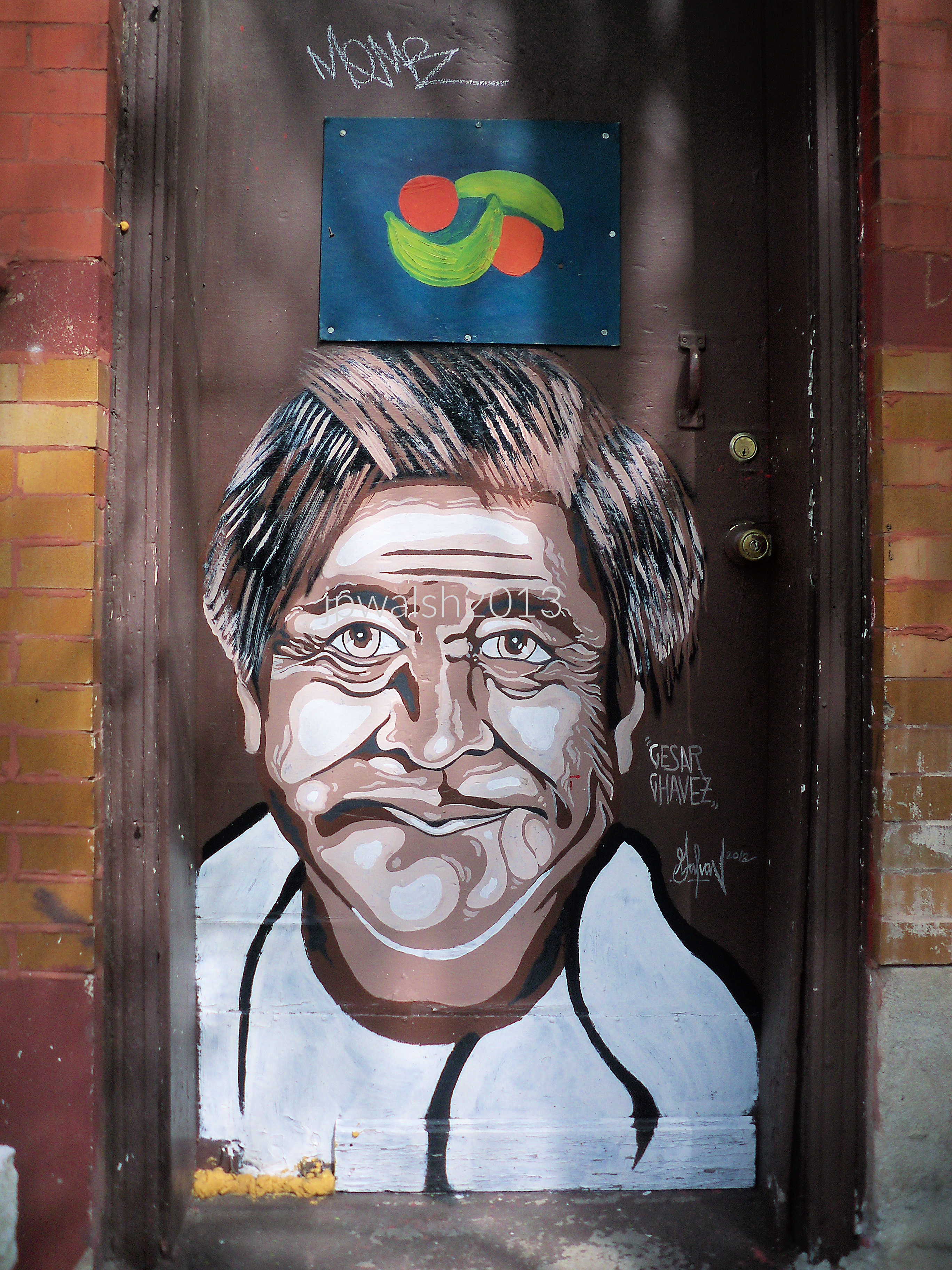
In 1926 Thompson’s land was seized by authorities of Mexico’s new nationalist government and Thompson was charged with removing artifacts illegally. It was only in 1944, almost a decade after Thompson’s death, that the Mexican Supreme Court ruled in the North American explorer’s favor.

Major sites at Chichén-Itzá

El Castillo (Temple of Kukulcán) is among the world’s most recognizable pyramids and reflects sophisticated celestial alignments

Visitors climb El Castillo’s steps to the top in May 1988. A visit to the pyramid (Temple of Kukulkan), is a highlight at Chichén-Itzá. May 1988. Photograph by author.

El Castillo: Pyramid of the Feathered Serpent

It is frankly thrilling to see the pre-Columbian Mesoamerican step pyramid. At nearly 80 feet tall, the pyramid dominates the center of the archaeological site of Chichén-Itzá. It was built between 700 and 1100 A.D.

Chac-Mool statue on top of the Temple of the Warriors at the ancient Mayan archeological site of Chichén-Itzá on the Yucatán peninsula. The impressive sculpture was used in ancient times as an altar for sacrifices. May 1988. Author’s Photograph.

Chichén-Itzá relief carving depicting a Mayan warrior in elaborate headdress and jewelry. Warriors were one of the major classes in Mayan society in the Classic period. May 1988. Author’s photograph.

Architecture as a Calendar

El Castillo served as a temple to the god Kukulkan. Each side of the pyramid has 91 steps for a total of 364 steps. With the platform at the top, it equals the 365 days of the year. There are 52 smooth stone panels on each side of the pyramid which coordinates with the ancient Mayan calendar’s 52-year cycle. The nine terraces on each side of the pyramid represent the 18-month solar calendar.

Twice during Spring Equinox (March 21) at sunrise and sunset, the sunlight is observed to move down stair by stair from the top stair of the northern stairway until it touches the famous serpent head stone carving at the base of the pyramid. In a marvel of nature, sunlight and shadow work to form a “serpent” that appears to descend into the earth. The cosmological phenomenon was an important fertility symbol for the Mayans whose society was agricultural. It signaled that the golden sun had entered the earth in the form of a serpent and that it was time to plant corn.

Unexcavated El Castillo in 1882 in a photograph by Teobert Maler Teobert Maler (1842–1917) was a pioneer of ancient Maya research. Maler’s expeditions to over 150 ruins in the Yucatán began secretly in the 1870s. Several ruins Maler described and photographed had been discovered by him, and his photographs of its architecture and inscriptions aided further research in ancient Maya civilization. Many sites Maler photographed were not visited by scientists until decades later. As the ruins were often further damaged by climate events or human impact—Maler’s photographs remain some of the best record of Maya ruins. Because of Maler’s work at Chichén-Itzá and elsewhere, the German explorer is regarded as one of the most important research photographers of the 19th century.

El Castillo dominates the Great North Platform Series. Known as the Kukulkan Pyramid and the Temple of Kukulkan, the 8-story 1,500-year-old stone structure is a masterpiece of ancient Mayan Cosmovision. Author at Chichén-Itzá. May 1988. Author’s collection.

Snakehead sculpture at Chichén-Itzá in Mexico. There are smaller pyramids inside the Chichén-Itzá ruins with “snakehead” statues scattered around. The wife at Chichén-Itzá. May 1988. Author’s photograph.

Author walking with another tourist towards the Nunnery complex with the stone steps of its north side in the distance. May 1988. Author’s collection.

This 1892 photograph of El Palacio (Templo de tres Cuerpos) of the building complex called the Nunnery at Chichén-Itzá gives record to one of Teobert Maler’s many expeditions. Public Domain.

Same El Palacio in the building complex called the Nunnery. Edward Thompson used these buildings as his headquarters during his first explorations of Chichén-Itzá. May 1988. Author’s photograph.

Buildings of the Nunnery (Las Monjas) include La Iglesia (partial view, left). At Chichén-Itzá, Mayan-temple structures in the Puuc style. These buildings at Chichén-Itzá shared similar designs with the ruins at Kabah and Uxmal about 100 miles to the southwest of Chichén-Itzá. May 1988. Author’s photograph.

Temple of Warriors. The Chac-Mool sits atop the platform of this temple dedicated to the Mayan warrior class. May 1988. Author’s photograph.

The site demonstrates advanced knowledge of astronomy, mathematics, and engineering.

The El Caracol observatory temple at Chichén-Itzá. We visited the dark recesses of El Caracol’s central circular tower. The Mayas built the observatory over an extended period of time to coincide its construction with their increasing knowledge of day-time and night-time skies. The Mayas’ objective in building and using the observatory was to acquire more exact measurements of cosmic bodies. May 1988. Author’s photograph.

The “Venus” staircase of the observatory at Chichén-Itzá. The highly sophisticated Maya calendar system was based on their study of the movements of the sun, moon, and planets, particularly Venus’s orbit. The position of El Caracol’s front staircase aligns with Venus’s most northern position while the building‘s corners are affixed to the sun’s position at sunrise of summer solstice (June 21) and sunset of winter solstice (December 21). May 1988. Author’s photograph.

The Observatory temple at Chichén-Itzá in a photograph by Teobert Maler. When explorers first viewed the ruin in the late 19th century, it was buried in centuries of natural debris. Public Domain.

Maya Calendar System. Ancient Maya time-keepers designed highly accurate methods to measure time that interwove calendars as space/time cycles. Mayan calendars formed an understanding of the interrelationships of cosmic bodies—the moon orbiting the Earth; the Earth orbiting the sun; and the sun as it travels in the galaxy. May 1988. Author’s photograph.

In the day’s heat and humidity, the profligate flora delights the visitor’s senses at Chichén-Itzá. On the site’s 1200 acres, the blooms of jungle growth offer a feast of fragrances, colors and living forms. From the Temple of Warriors, the visitor can see nestled beyond a field of red flowers the Grupo de las Mil Columnas (“The Forest of 1,000 Columns”). These stone columns may once have had a thatched ceiling to enclose an expansive space. May 1988. Author’s photograph.

Grand Ballcourt—field of play. Almost two football fields in length (181 yards), it is enclosed by 13-foot high stone walls and is the largest ball court in ancient Mesoamerica. Sports arenas like this were a staple in the sacred complexes of ancient Mayan cities. Some archeological anthropologists believe the nature of play in the ball courts had a purely sporting purpose, though the games may have had high-stakes cosmological and mythological dimensions. May 1988. Author’s photograph.

Chichén Itzá served as a political, religious, and economic center in the Yucatán Peninsula and remains one of the most important archaeological sites in the Americas and a powerful symbol of Mexico’s pre-Columbian heritage.

On Display: Encounters with Art in Museums, Galleries, and Other Settings.

FEATURE image: May 2015. Michigan Avenue Main Lobby. The Art Institute of Chicago. 4.57mb DSC_0366 (1)

Whether displayed in museums, galleries, historic houses, homes, offices, public buildings, sculpture gardens, or private collections, the focus of this collection remains the artwork itself. Through photography, it explores painting, sculpture, design, and other forms of visual expression while also acknowledging how their settings can enrich our understanding of their artistic, historical, and cultural significance.

Photographs and Text by John P. Walsh.

September 2015. 7.68 mb 99%

Michigan Avenue entrance of The Art Institute of Chicago.

May 2015.

Sculpture Court, The Art Institute of Chicago.

September 2015.

Modern Wing, The Art Institute of Chicago.

June 2014. The Art Institute of Chicago. 20th Century. American. Pop.

Andy Warhol (1928-1987), Mao, 1972, Acrylic, silkscreen ink, and pencil on linen, 448.3 × 346.7 cm (176 1/2 × 136 1/2 in.). The Art Institute of Chicago.

June 2014. The Art Institute of Chicago. 40%

The Chauncey McCormick Gallery refers to exhibition space (often featuring Asian and European decorative arts) at the Art Institute of Chicago named after Chauncey Brooks McCormick (1884–1954), a prominent Chicago businessman, philanthropist, and president of the museum from 1944 until his death

June 2014. 5.59mb

Robert Irwin (1928-2023), Untitled, Acrylic lacquer on cast acrylic disk, 1969. The Art Institute of Chicago. Irwin was a pioneering figure in California Light and Space art.

February 2013. Galleries 124–127, The Art Institute of Chicago.

The exhibition “The Artist and the Poet” at the Art Institute of Chicago ran from February 1 to June 2, 2013, exploring the dialogue between visual art and literature through works on paper, prints, and illustrations. It was presented in the Jean and Steven Goldman Prints and Drawings Galleries (Galleries 124–127), located on the first floor of the museum’s historic Ryerson and Burnham Libraries building.

September 2015. 6.25 mb

Modern wing, The Art Institute of Chicago.

August 2015. The Art Institute of Chicago. 21st Century. American.

Frances Stark (1967-) from Intimism, 2015. The Art Institute of Chicago.

August 2015. Alexander McKinlock Memorial Court. AIC. 20th Century. Nordic. Sculpture.

Carl Milles (1875-1955), Triton Fountain, 1926, bronze, Alexander McKinlock Memorial Court, The Art Institute of Chicago. Swedish sculptor Carl Milles (1875-1955) studied in Paris from 1897 to 1904, working in the studio of Auguste Rodin (1840-1917). Yet Milles departed from the prevailing naturalism that dominated sculpture in the Belle Époque era, and embraced ideas and forms that reflected the artist’s independent spirit, his knowledge and appreciation of classical and Gothic sculpture, and his Nordic roots.

Speaking of his fountain at the Art Institute of Chicago, Milles observed: “The great classicists knew that it was impossible to reproduce the appearance of flesh in marble, and they set themselves to create forms of pure beauty that would merely suggest and symbolize the living creature, and then to invest those forms with a meaning that mankind would feel intuitively to be universal and significant. This is what I have tried to do.”

September 2015. The Art Institute of Chicago. 21st Century. American. Sculpture.

Charles Ray (1953-), Young Man, 2012, Solid Stainless Steel.

May 2015. The Art Institute of Chicago.

Lorado Taft (1860-1936), Fountain of the Great Lakes, 1913. South Garden. The Art Institute of Chicago.

November 2017. North Garden, The Art Institute of Chicago.

Alexander Calder (1898-1976), Flying Dragon, 1975, Steel plate and paint, 365 × 579 × 335 cm (120 × 228 × 132 in.), North Garden, The Art Institute of Chicago. 20th Century. American. Sculpture. Modernism.

November 2017. North Garden, The Art Institute of Chicago. Partial view: Flying Dragon, Alexander Calder, 1975.
November 2017. North Garden, AIC. 20th Century. British. Modernism. Sculpture.

Henry Moore (1898-1986), Large Interior Form, bronze (ed. of 6), 1953/4, 16 ft. 9 in., North Garden, The Art Institute of Chicago. Henry Moore’s 16-foot sculpture was made when the 84-year-old British artist was concerned with the construction of three-dimensional space, internal forms within solid volumes, and placing his work in a natural setting. Moore had worked primarily in stone but as these formal concerns emerged, he shifted to modeling and bronze casting.  Large Interior Form explores mass and void as well as gravity and growth within a nature-inspired artist-created form.

March 2010. Washington, D.C.

Aristide Maillol (1861-1944), Nymph—Central Figure for the Three Graces, 1930, The Hirshhorn Museum and Sculpture Garden, Washington D.C. Acquired by the museum in 1966, photographs show that the statue stood in an open location by a garden pool at the museum. In 1991 following a whirlwind of euphoria associated with the successful completion of Operation Desert Storm, a victory celebration at the Mall in June of that year involved hovering military jets and helicopters. Their downdraft sent gravel footpath debris flying in the air that scratched and cracked several statues in the sculpture garden. Though none appeared to sustain damage beyond some repair, the Nymph—Central Figure for the Three Graces suffered the most damage as the nude female statue had pitted indentations on her backside. In 2010 when this photograph was taken, the sculpture was located in front of a protective garden wall. See- https://www.baltimoresun.com/news/bs-xpm-1991-06-12-1991163158-story.html 20th Century. France. Sculpture. Modernism.

August 2015. The Art Institute of Chicago. 1.43 mb
May 2015. Art Institute of Chicago. 3.34 mb

Indian and Islamic Art.

September 2015. The Art Institute of Chicago. 6.90 mb
May 2015. Frédéric Bazille. The Art Institute of Chicago. 19th Century. France. Impressionism.

Frédéric Bazille, Self-portrait, 1865/6. The Art Institute of Chicago.

November 2012. Toledo (Ohio) Museum of Art. 18th Century. France. Terracotta.

Clodion (1738-1814). The See-Saw. 1775. Toledo (Ohio) Museum of Art.

November 2012. Toledo (Ohio) Museum of Art. 17th Century. France. Sculpture.

Michel Anguier (1612-1686), Amphitrite, marble, 1684. Toledo (Ohio) Museum of Art.

November 2012. Toledo (Ohio) Museum of Art.

Venus, Roman, Asia Minor, marble, c.165 CE, Toledo (Ohio) Museum of Art.

September 1993. Museum of Anthropology, UBC, Vancouver, B.C. 20th Century. Canada.

Bill Reid (1920-1998), Birth of the World or The Raven and the First Men/Humans, yellow cedar, 1980. Museum of Anthropology, UBC, Vancouver, British Columbia.

August 2005. National Gallery of Art, Washington, D.C.

“The Café-Concert,” Édouard Manet, c. 1879. The Walters Art Museum, Baltimore at the National Gallery of Art, Washington, D.C. Next to it is Portrait of Estelle Balfour by Edgar Degas, c. 1863-65, oil on canvas mounted on panel, also at The Walters.

September 2016. Milwaukee Art Museum. 20th Century. Germany. France. Fauvism. Expressionism.

From right to left: Kees van Dongen (1877-1968), Woman with Cat, 1908, and Quai, Venice, 1921; Gabriele Münter (1877-1962), Portrait Young Woman, 1909. Milwaukee Art Museum.

August 2015. The Art Institute of Chicago. 16th Century. Japan.

Mikazuki (male deity) Noh Mask, cypress wood, brass, colors. The Art Institute of Chicago.

May 2014. The Art Institute of Chicago. Impressionist galleries.

Pierre-Auguste Renoir (1841-1919): Chrysanthemums, 1881/2; Acrobats at the Cirque Fernando (Francisca and Angelina Wartenberg), 1879; Fruits of the Midi, 1881; Seascape, 1879; Lucie Berard (Child in White), 1883. The Art Institute of Chicago.

September 2013. The Art Institute of Chicago. Impressionist galleries.

Berthe Morisot (1841-1895), Woman in a Garden, 1882/3, The Art Institute of Chicago.

September 2012. Snite Museum of Art, Notre Dame, Indiana. 20th Century. American. Realism.

William Glackens (1870-1938), The Dressing Table, c.1922, oil on canvas. Snite Museum of Art, Nore Dame University, South Bend, Indiana.

September 2016. Milwaukee Art Museum. 20th Century. Germany. Expressionism.

Gabriele Münter (1877-1962): Kirche von Reidhausen, oil on canvas board, 1908 and Mädchen mit Puppe, oil on cardboard, 1908/9. August Macke (1887-1914), Geraniums Before Blue Mountain, oil on canvas, 1911. Milwaukee Art Museum.

May 2015. The Art Institute of Chicago.

Above and below: Bodhisattva; Diety; Buddha. 4th-6th Centuries. Afghanistan/Pakistan. Stucco. The Art Institute of Chicago.

May 2015. The Art Institute of Chicago.
September 2015. Room 235, The Art Institute of Chicago.
September 2015. The Art Institute of Chicago.
August 2015. The Art Institute of Chicago.
May 2015. At The Art Institute of Chicago.

Charles Collins (1680-1744), Still Life with Game, 1741. Private Collection. 18th Century. Ireland.
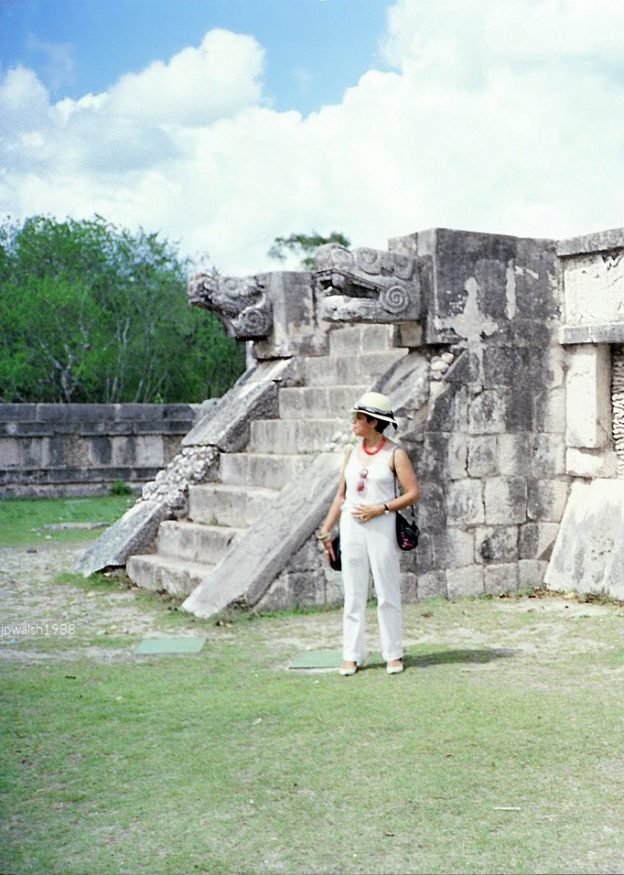
May 2015. At The Art Institute of Chicago.

James C. Timbrell (1807-1850), Carolan the Irish Bard, c. 1844, oil on canvas. Private collection. 19th Century. Ireland.

May 2015. The Art Institute of Chicago. 256 kb 25%
May 2015. At The Art Institute of Chicago.

John Kelly, wire-strung Bunworth harp, 1734, Museum of Fine Arts, Boston, and Robert Fagan (c. 1761-1816), Portrait of Lady as Hibernia, c. 1798. Private collection. The Bunworth harp is inscribed: “made by Iohn Kelly for the Revd Charles Bworth Baltdaniel 1734″. The wire-string harp was made by Catholic instrument maker John Kelly for the Reverend Charles Bunworth, also of Baltdaniel, who was the Protestant rector of Buttevant, County Cork.  The many aspects of the instrument—from soundbox, harmonic curve, fore-pillar, tuning pegs, and ornamentation and color— invite interest. Though it may be the female head at the top of the harmonic curve that at first most intrigues. (see – https://harp.fandom.com/wiki/Bunworth_Harp and http://www.earlygaelicharp.info/harpmakers/ – both retrieved October 14, 2021). Robert Fagan was an Irish painter who was born in London but spent most of his artistic career in Rome and Sicily (Fagan first arrived into Italy in 1781). Though an expatriate, Fagan’s oil on canvas depicts a woman who represents Ireland careessing the strings of the harp, the country’s national instrument and symbol. Seated next to an Irish wolfhound, she holds a scroll that reads: “Ireland Forever” (“Erin go bragh“). 18th century. Ireland.

August 2005. Yale Center for British Art, New Haven, CT.

Includes (below) John Dodd, of Swallowfield, Berkshire, 1739, John Vanderbank (1694 – 1739) and (above) Portrait of a Woman, Probably Elizabeth Aislabie, of Studley Royal, Yorkshire, c. 1749, Thomas Hudson (1701-1779), Yale Center for British Art, New Haven, CT.

August 2015. The Art Institute of Chicago.

Loutrophoros (Bath water vase), 4th Century BCE. Greece. Italy (Apulia). Terracotta. The Art Institute of Chicago.

August 2015. Ancient Greek and Roman Art, The Art Institute of Chicago.
October 2014. AIC. 6.64mb 35% The Art Institute of Chicago.

Black-figure painting was the primary technique for decorating Greek vases for over 200 years. The technique started in Corinth and expanded east to Athens in the mid first millennium BCE (700- 500 BCE). In this time period ancient Corinth was, with almost 100,000 people, one of the largest cities of Greece. In 146 BCE the Romans besieged, captured and demolished Corinth. The site lay deserted for almost 100 years until the Romans rebuilt it as a new city populated with around 50,000 Romans, Greeks and Jews.

August 2015. The Art Institute of Chicago.

Oil Jar, 450 BCE, Athens, Greece, terracotta. The Art Institute of Chicago.

May 2015. The Art Institute of Chicago. 19th Century. France. Impressionism.

Gustave Caillebotte (1848-1898), Paris Street; A Rainy Day (“Rue de Paris, Temps de pluie”), 1877. The Art Institute of Chicago.

October 2014. The Art Institute of Chicago. 19th Century. American.

Abbott Handerson Thayer (1849-1921). Winged Figure, 1889, oil on canvas. 130.8 × 95.9 cm (51 1/2 × 37 3/4 in.). The Art Institute of Chicago.

October 2014. The Art Institute of Chicago. 19th Century. American.

James McNeill Whistler (1834-1903), The Artist in his Studio, c. 1865-66, oil on boarded mounted on panel, 62 × 46.5 cm (24 7/16 × 18 5/16 in.). The Art Institute of Chicago.

May 2014. The Art Institute of Chicago. 19th Century. France. Sculpture. Modernism.

Auguste Rodin (1840-1917), Eternal Springtime, 1884. Bronze. Fonderie Alexis Rudier, Paris (20th century). The Art Institute of Chicago.

May 2015. The Art Institute of Chicago. 19th Century. France. Impressionism. Sculpture.

Edgar Degas (1834-1917), Spanish dance (c.1883), Arabesque (c.1885), and Woman seated in an armchair, (c.1901), bronze (cast later). The Art Institute of Chicago.

May 2014. The Art Institute of Chicago. 19th Century. French. Sculpture. Modernism.

Auguste Rodin (1840-1917), Adam, 1881. Bronze. The Art Institute of Chicago.

September 2015. Africa. The Art Institute of Chicago.

Headdresses. 19th/20th Century. Africa. The Art Institute of Chicago. The headdresses at the right and at the left are Gelede headdresses. The headdress in the middle is perhaps a Gelde or Efe headdress. The headdress at the left is made of wood and the oldest of the headdresses. It was made in Nigeria or Benin by the Yoruba community in the late 19th/early 20th centuries. Gelede headdresses often portray women. The headdresses in the center and at right depict women. One is wearing a head tie and the other is showing a woman with a plaited hairstyle. These were made in Nigeria by the Yoruba community in the early 20th century. The Gelede festival of the Yoruba community in western Africa is a public spectacle which uses colorful masks that combines art and ritual dance to educate, entertain and inspire worship. Gelede includes the celebration of “Mothers,” a grouping that includes female ancestors and deities as well as the elderly women of the community whose power and spiritual capacity in society is convoked. The Efe is a nighttime public performance held the day before the Gelede.

May 2015. 7.05 mb The Art Institute of Chicago.

Mariano Fortuny (1838-1874), African Chief, 1870, oil on canvas, 41 × 32.9 cm (16 1/8 × 12 15/16 in.). The Art Institute of Chicago. African Chief in The Art Institute of Chicago was recently exhibited in a 2017-2018 monographic retrospective at the Prado in Madrid. The show, simply entitled “Fortuny (1838-1874),” reflected the Prado’s holdings of many of this artist’s masterpieces. The Prado’s collection is due to their own acquisitions but mainly the generous bequests of the artist’s oils, watercolors, and drawings by late 19th century Mexican collector Ramón de Errazu (1840-1904) as well as the painter’s son, Mariano Fortuny y Madrazo. Fortuny’s artwork is often Orientalist in style that reflects the many trips he made to North Africa. In his career, Fortuny was noted for his precision of anatomy and archaeological scrupulousness though African Chief tends to the modern broken brush style for which the Spanish artist was prescient following his many trips to Paris. 19th century. Spain. Romanticism.

October 2014. The Art Institute of Chicago.

Left to right: Kramer Brothers Company (Dayton, Ohio), Settee, c. 1905/25; Cecilia Beaux (American, 1855-1942), Dorothea and Francesca, 1898, oil on canvas; Daniel Chester French (American, 1855- 1931), Truth, 1900, plaster.

September 2015. The Art Institute of Chicago. 19th Century. American. Modernism.

Above and next three below: Fragments, Dankmar Adler (1844-1900) and Louis Sullivan (1856-1924), The Art Institute of Chicago. 19th Century. American. Modernism.

September 2015. The Art Institute of Chicago. 560kb 40%
August 2015. The Art Institute of Chicago. 2.87mb DSC_0644 (1)
November 2015. 6.38mb DSC_0352 (1)

With the arm detail of Rodin’s bronze Adam (1881), the landing of the Grand Staircase at The Art Institute of Chicago.

September 2015. Help desk, The Art Institute of Chicago.
May 2021. 7.35 mb The Art Institute of Chicago.

Bisa Butler (1973-), The Safety Patrol, 2018, by Bisa Butler. Cotton, wool, and chiffon; appliquéd and quilted. The Safety Patrol considers the potential of a group of children as future caretakers of the world led by a boy in a sash with outstretched arms whose duty it is to protect the others. Bisa Butler uses the technique of appliqué quilt making to create her work. For the figures, the artist cuts, layers, and pins together fabrics and arranges them on the ground fabric. This comprises the quilt top. Between this quilt top and a backing fabric is a layer of fiber “batting” or stuffing. These layers are stitched to form the quilt with the thread lines part of the structure, texture and details of the image. Butler seeks to use fabric colors and patterns to contribute to the quilt’s subject and narrative. 21st Century. American.

May 2014. The Art Institute of Chicago. 18th century. France. (60)

Hubert Robert (French, 1733-1808), The Fountains, 1787, oil on canvas, 255.3 × 221.2 cm (100 1/2 × 88 1/8 in.). The Art Institute of Chicago.

May 2015. 7.73 mb The Art Institute of Chicago.

Joseph Wilson (d. 1800), Adephi Club – Belfast, oil on canvas, 1783.

May 2015. 6.62 mb The Art Institute of Chicago.

The State Ballroom, Saint Patrick’s Hall, Dublin Castle, oil on wood, c. 1845, signed and inscribed: F. J. Davis/Dublin. St Patrick’s Hall had long been a key location for Ireland’s political, military and social elite to gather (B. Rooney, Creating History, Stories of Ireland in Art, 2016, p.179). These dance proceedings are overseen by the Lord Lieutenant of Ireland and his wife visible at the end of the hall. The 1840s was a period of fashion indulgence. The social ball with attendees in sumptuous costume took place during the period of the Irish famine (1845-1849) where approximately one million people died. Another one million or more emigrated out of the country at the same time, many to the United States. Court dress for gentleman allowed personal expression in fabric and style for the waistcoat. Military officers and political office holders wore court uniforms indicating their position and rank. For ladies, to signal their marital situation, unmarried women wore jewelry and fresh flowers in their hair. Conventionally-minded single ladies added two ostrich feathers behind one ear. Matrons sported a third ostrich feather in their hair and wore lace ribbons.

May 2021. The Art Institute of Chicago. 16th Century. Spain.

El Greco (Doménikos Theotokópoulos) (1541-1614), Saint Francis Kneeling in Meditation, c. 1595, oil on canvas. 92 × 74 cm (36 3/16 × 24 1/8 in.). The Art Institute of Chicago.

October 2014. The Art Institute of Chicago. 19th Century. American.

Arthur Wesley Dow (1857-1922), Boats at Rest, c. 1895, oil on canvas, 66 × 91.4 cm (26 × 36 in.). The Art Institute of Chicago.

October 2016. Ukrainian National Museum (2249 W. Superior Street), Chicago. 4.55 mb
May 2015. Aurora, IL. The David L. Pierce Art & History Center (20 East Downer Place). 4.15 mb
May 2014. The Art Institute of Chicago.

Pompeo Batoni (Italian, 1708-1787), Allegory of Peace and War, 1776, oil on canvas, 53 1/2 × 39 in. The Art Institute of Chicago. 5.73 mb Pompeo Batoni was a leading 18th-century Roman painter. The artist was known for his portraits and commissioned large format historical and religious paintings. The painting entitled “Allegory of Peace and War” represented the mythological figure of the god Mars being restrained by a semi-nude embodiment of peace. Peace lays her hand on War’s sword and bears to him an olive branch. The painting was the result of Batoni’s own invention – no one commissioned this artwork – and it stayed in the artist’s studio until at least the early 1780s.

December 2015. Chicago Cultural Center. 3.62 mb
March 2002. Louvre, Paris. 312 kb

Statue of Aphrodite, called Venus de Milo because it was found on the Greek Island of Milos in the Aegean Sea. It dates from around 150 B.C. In the Louvre in Paris, the Venus de Milo is one of the most famous statues in the world. Its soft, sensual handling of the marble was characteristic of the late Hellenistic period. She is monumental – the topless, armless Venus de Milo stands, independent of her base and pedestal, six feet five inches in height. In the course of the second half of the 19th century, the Venus de Milo became a favorite statue of Parisians and its visitors. It was around 1875 that it was moved away from the wall which it stood against and placed in the middle of a 17th century room so that it could be viewed completely around. It was accorded this baroque effect first used at Versailles at the start of the 18th century so to isolate monumental sculpture for display to produce maximum impact and enjoyment of the artwork. SOURCES: Masterpieces of the Louvre, Marcel Brion, NY: Abrams; Creators Collectors and Connoisseurs, Niels Von Holst, NY: G.P. Putnam’s Sons.

November 2017. 74% 7.84mb DSC_3350 The Art Institute of Chicago.

Fragment of a Funerary Monument, c. 330 BCE Greek; Athens, 152.4 × 111.8 × 33 cm (60 × 44 × 13 in.), The Art Institute of Chicago. see- https://www.artic.edu/artworks/55887/fragment-of-a-funerary-naiskos-monument-in-the-shape-of-a-temple – retrieved March 31, 2025. This is one of the fashionable burial markers, whether of Greek or Roman families, encountered by the public in ancient times. Made in all sorts of shapes and sizes, this large stone monument from the 4th century BCE shows three figures carved in very high relief so much so that they are nearly in the round. The two male figures’ gestures of parting indicate that it is a funerary scene. The standing man is likely the person who has died and this funerary marker depicts his sharing a final farewell with loved ones – their relationship, obviously close, after 2500 years, completely unknown.

November 2017. 69% 7.88mb DSC_3355 The Art Institute of Chicago.

Cristoforo Stati (Italian, 1556–1619). Samson and the Lion, 1604-1607, marble, 210 × 112 × 84 cm (82 11/16 × 44 1/8 × 33 1/8 in.). The Art Institute of Chicago. see – https://www.artic.edu/artworks/146875/samson-and-the-lion – retrieved April 1, 2025. Stati studied in Florence under Giambologna (1529-1608). In 1601, Tuscany’s archduke, Ferdinando I de’ Medici (1549-1609), sent a sculpture of Samson by Giambologna to the palace of Spain’s prime minister in Valladolid as a gift. Later, Stati’s sculpture of Samson and the Lion was also sent to Spain as a complementary gift and installed in Madrid. The work was in a Swiss private collection before it was acquired by The Art Institute of Chicago in 1996.

November 2017. The Art Institute of Chicago. 80% 7.88mb DSC_3315
December 2012. 1st century. Roman. The Art Institute of Chicago. .2.25mb 101_1469

Head of Hercules. Roman, First Century CE. The Art Institute of Chicago. The Romans adapted the stories of Hercules’ superhuman feats of strength from the Greeks. The earlier Greeks viewed him as a demigod, the later Romans saw him as one of their hero figures.

May 2016. The Art Institute of Chicago. 7.44mb DSCN2611 (1)

Head of Pierre de Wissant (1889) by Auguste Rodin, part of The Burghers of Calais (1884–89) in the collection of the Art Institute of Chicago, originates from the larger sculptural ensemble commemorating the six citizens of Calais who offered themselves as hostages to the English during the Hundred Years’ War. When displayed independently, the head emphasizes Rodin’s exploration of psychological intensity and human vulnerability. The sculpture conveys a moment of profound emotional anguish: the downward gaze, deeply furrowed brow, and partially opened mouth collectively articulate a state of acute despair and inner turmoil. Through these expressive distortions, Rodin captures not only the historical gravity of the subject’s sacrifice but also the universal experience of psychological suffering.

December 2025. 98% 7.84mb DSC_9937 The Art Institute of Chicago.

Crèche, mid-18th century, Naples, Italy. Details of daily life are connected to the biblical narrative of the Nativity of Jesus Christ.

December 2025. The Art Institute of Chicago. 7.33mb DSC_9933 (1)

The mid-18th century Neapolitan Crèche invites viewers to witness the miraculous among the mundane. The Art Institute of Chicago. see – Neapolitan Crèche | The Art Institute of Chicago – retrieved December 14, 2025.

December 2025. The Art Institute of Chicago. 7.66mb DSC_9896 (1)

Auguste Rodin (1840-1917), A Burgher of Calais (Jean d’Aire), modelled 1889, plaster, 82×26 in. The figure was exhibited in the 1893 World’s Columbian Exposition in Chicago and entered the Art Institute’s collection that same year. The monument includes six individualized figures on a heroic scale and was commissioned in France in 1884. Completed in 1889 by Rodin the monument was installed in Calais’s town hall square in 1895. Rodin depicts Jean d’Aire, one of the town fathers, in sackcloth with the keys of the city, surrendering to the English during the Hundred Years War, in exchange for their lifting a nearly year-long siege that led to the starvation of the city’s inhabitants.. see – Monument to The Burghers of Calais | Musée Rodin – retrieved December 15, 2025.  

December 2025. The Art Institute of Chicago. 73% 7.86mb DSC_9847

Exhibition Strange Realities: The Symbolist Imagination (October 4, 2025- January 5, 2026). Over 85 works of major artists including Odilon Redon, Paul Gauguin, and Edvard Munch, drawn from the Museum’s collection of drawings and prints exploring the late 19th century pan-European Symbolist movement of art, literature and theatre.see – Strange Realities: The Symbolist Imagination | The Art Institute of Chicago – retrieved December 16, 2025.

December 2025. The Chauncey McCormick Gallery, The Art Institute of Chicago. 93% 7.89mb DSC_9889
September 2014. The Art Institute of Chicago. 3.55mb DSC_1038 (1)

Greyed Rainbow, 1953, Jackson Pollock, oil on linen, 182.9 × 244.2 cm (72 1/16 × 96 3/16 in.) and Streetcar, 1951, Alexander Calder, Brass, sheet metal, rod, wire, and paint, 9’8″ long, Art Institute of Chicago. See – Streetcar (1951) | Calder Foundation – retrieved Jan. 29, 2026 and Greyed Rainbow | The Art Institute of Chicago – retrieved Jan. 29, 2016.

Ed Harris’s December 2000 biographical film Pollock reconstructs the mid-20th-century modern art world through a meticulous ensemble cast, highlighted by Marcia Gay Harden’s Academy Award-winning portrayal of pioneering Abstract Expressionist painter Lee Krasner.


POLLOCK: IF PEOPLE WOULD JUST LOOK AT THE PAINTINGS I DON’T THINK THEY’D HAVE ANY TROUBLE ENJOYING THEM. IT’S LIKE LOOKING AT A BED OF FLOWERS. YOU DON’T TEAR YOUR HAIR OUT OVER WHAT IT MEANS.

In a stellar cinematic year defined by Gladiator, Traffic, Almost Famous, and Erin Brockovich, Marcia Gay Harden triumphed at the Academy Awards, winning Best Supporting Actress for her riveting performance in Pollock. Harden portrayed Lee Krasner (1908–1984), the pioneering American Abstract Expressionist painter and wife of the biographical film’s brilliant but tortured title character, Jackson Pollock (1912–1956). In addition to her Oscar victory, Harden secured the Best Supporting Actress prize from the New York Film Critics Circle.

Ed Harris pulled impressive double duty on the project, earning an Academy Award nomination for Best Actor in what also marked his directorial debut. Behind the camera, Harris assembled a flawless ensemble cast to bring the mid-20th-century modern art world to life. The film features Jennifer Connelly as Ruth Kligman (1930–2010), the American abstract artist and romantic partner to both Pollock and Willem de Kooning. Val Kilmer portrays the iconic Dutch-American abstract expressionist de Kooning (1904–1997) himself, alongside Bud Cort as writer and dealer Howard Putzel (1898–1945).

Rounding out the historic inner circle are Jeffrey Tambor as art critic Clement Greenberg (1909–1994), John Heard as sculptor Tony Smith (1912–1980), Robert Knott as Jackson’s older brother Sande Pollock (1909–1963), Sada Thompson as Pollock’s mother Stella (1875–1958), and Amy Madigan as American art collector Peggy Guggenheim (1898–1979). Much like its Pollock and Krasner’s revolutionary artwork, the film made an indelible splash upon its December 2000 release, remaining a memorably fine and enduring effort. https://youtu.be/z0xiovbDML0?si=XupBbr5gZnhuTVqP – retrieved Jan. 30, 2026.

September 2014. Modern Wing, Art Institute of Chicago. 3.49mb DSC_1061 (1)
August 2015. Modern Wing, Art Institute of Chicago. 3.76mb DSC_0672 (1)
August 2015. The Art Institute of Chicago. 3.14mb DSC_0068 (1)
August 2015. The Art Institute of Chicago. 4.14 mbDSC_0181 (1)
August 2015. The Art Institute of Chicago. 1.22mb DSC_0014 (1)
October 2015. Art exhibit. Oak Park, IL. 4.72mb DSCN1739 (2)
November 2015. Art Institute of Chicago. 3.77 mb DSC_0094 (1)
September 2016. Milwaukee Art Museum. 2.63mb DSC_0054 (1)

Thomas Hart Benton, Poker Night (from A Streetcar Named Desire), 1948 (Whitney Museum of American Art), Milwaukee Art Museum. 2.63mb DSC_0054 (1)

September 2016. Haggerty Art Museum, Milwaukee, WI. 3.54mb DSC_0922 (1)
Frida Kahlo (1907-1954), Untitled called Self-Portrait with Thorn Necklace and Hummingbird (“Autorretrato con Collar de Espinas y Colibrí”), 1940, oil on canvas mounted to board,  61.2 cm × 47 cm (24.11 in × 18.5 in),Harry Ransom Center, Austin, Texas. The Ransom Center acquired the self-portrait in 1965 as one of a large collection of artworks assembled by photographer Nickolas Muray (American, b. Hungary, 1892–1965). Kahlo gifted the painting to Muray soon after it was completed in 1940. 

Frida Kahlo’s Self‑Portrait with Thorn Necklace and Hummingbird (1940) is a concentrated display of her mature portrait style. Despite its small scale, the composition is intricate, drawing the viewer’s eye across a dense constellation of figures and symbolic objects. At the center sits Kahlo herself, rendered with imaginative realism and surrounded by a menagerie: a monkey on her left, a cat on her right, and a lifeless hummingbird suspended at her throat. Beneath her signature joined eyebrows, she meets the viewer with a calm, unwavering gaze that feels both resolute and quietly intense.

The animals around her animate the scene with contrasting energies. The monkey, distracted, toys with the thorn necklace, while the cat appears tense and ready to strike. The necklace itself encircles her neck and extends downward, its sharp thorns pressing into her half‑length figure. Against this harshness, delicate butterflies—whether real or hair clips—rest motionless in her hair, and above them hover two dragonflies, creatures that in Mexican art often signal a link between nature and the spirit world, messengers of transformation and guardians of the soul.

Within this symbolic framework, the monkey can be read as an emblem of lust or moral temptation, the cat as mysticism and freedom, and the thorn necklace as a sign of bodily suffering and constraint. It also evokes Christ’s crown of thorns, allowing Kahlo to cast herself in a mode of imitatio Christi—a figure bearing pain, betrayal, and emotional anguish after failed relationships. In this light, the butterflies and dragonflies become signs of renewal, hinting at the possibility of resurrection emerging from her world’s suffering.

Finally, hummingbirds (colibríes) are powerful symbols of the warrior spirit, deeply linked to Aztec mythology, embodying courage, vitality, and the fierce renewal of life. By the modern era hummingbirds have also come to represent love, hope, joy, and inner strength while being understood as messengers carrying the presence of departed loved ones returning in brief, luminous visitations.

Collegiate Church of St. Gertrude (11th Century): A Monument to Ottonian Power and Early Romanesque Design in Nivelles, Belgium.

FEATURE image: The Westwork of the Collegiate Church of St. Gertrude in Nivelles, Belgium, fronts an expansive historical building of the 11th century. Nivelles is an ancient settlement about 25 miles south-east of Brussels in Belgium’s French-speaking region of Wallonia. February-March 1992. Author’s photograph.

The Collegiate Church of St. Gertrude stands as one of the finest surviving monuments of Ottonian and early Romanesque architecture in Western Europe, embodying the religious, political, and cultural influence of the abbey founded by St. Gertrude in the 7th century while illustrating how medieval architecture connected local identity with continental Christian traditions.

The Collegiate Church of St. Gertrude on Grand’ Place, c. 1050, Nivelles, Belgium. It contains the tombs of its foundress, Bl. Ita of Metz and her daughter, St. Gertrude of Nivelles, the monastery’s first abbess in the 7th century. February-March 1992. Author’s photograph.

The massive westwork, towers, and disciplined geometry reflect the transition from Carolingian traditions to Romanesque architecture. The church’s architectural simplicity emphasizes volume, proportion, and structural clarity rather than later Gothic ornamentation.

Interior, Minster (Collegiate Church of St. Gertrude), Nivelles, Belgium, c. 1050.  February-March 1992. Author’s photograph.

This structure was built in the early 11th century and consecrated by Wazo of Liège (c.985-1048) in the presences of Henry III, Holy Roman Emperor (1016-1056). it demonstrates how Nivelles emerged as a major religious center in the medieval Low Countries and survived centuries of political upheaval, war, and restoration, to become a living document of European history.

WHO IS ST. GERTRUDE OF NIVELLES, PATRON SAINT OF CATS, GARDENERS AND TRAVELLERS?

St. Gertrude of Nivelles (c. 628-659) was the daughter of Blessed Pepin of Landen (c. 580-640) and Blessed Ita of Metz, O.S.B. (592-652) who founded Nivelles monastery. Gertrude was born about 45 miles north east of Nivelles in Landen, Belgium on the boundary of Wallonia in Flanders.

St. Gertrude de Nivelles, from the Hours of Cardinal Albrecht of Brandenburg (1490-1545), Archbishop and Elector of Mainz, c. 1522. Opaque water-based paint mounted on board by Flemish artist Simon Bening (c.1484-1561). Carnegie Museum of Art, Pittsburgh, Pennsylvania.

The Abbey of Nivelles, founded through the efforts of St. Gertrude and her family in the 7th century, evolved into a major religious institution whose legacy survives in the Collegial Church of St. Gertrude, one of the most important Romanesque monuments in Belgium.

St. Gertrude of Nivelles is an unofficial, modern patron saint of cats. Her feast day is March 17—the same as St. Patrick of Ireland. By the 15th century St. Gertrude was being called upon by the populace to invoke against rats, mice, and plagues. It was the next small, logical step to connect her with being a friend to cats who naturally are used to keep mice away.

From Royal Villa to Monastery

In the 7th century, the territory was part of the Austrasian Frankish kingdom and Pepin had established a personal presence there. Following Pepin’s death when Gertrude was about 12 years old, the bishop of Maastrict in today’s Netherlands encouraged Ita to transform Pepin’s royal villa into a monastery. Pepin and Ita’s daughter, Gertrude, become the monastery’s first abbess.

A Family Devoted to Religious Life

Ita joined her daughter in the monastery to live out their days in a life of work and prayer. In the distant past, older well-endowed individuals often retired to monasteries or convents. A modern corollary may be that some retirees today choose to establish themselves in church-sponsored retirement villages. Ita’s other daughter (Begga) also eventually became an abbess; another son (Bavo), a hermit. One final son (Grimoald) took his father’s place as Mayor of the Palace. (see – http://www.santiebeati.it/dettaglio/37900 and https://www.newadvent.org/cathen/06533c.htm)

St. Gertrude: Abbess, Traveler’s Patron, and Saint

In addition to being the patron of cats and gardeners, St. Gertrude was an early medieval patron of travelers. From her birthplace of Landen to Nivelles, Belgium, it is a distance of around 40-45 miles, or a one or two-day journey on foot.

St. Gertrude was superior of the monastery her parents established and, though a young abbess, Gertrude was known for her wise rule. St. Gertrude died at a young age on account of her personal austerities and was venerated as a saint.

War Damage and Reconstruction

The impressive appearance of the westwork of the Collegial Church of St Gertrude in Nivelles is the result of a reconstruction finished in 1984 following severe damage it sustained during World War II by bombing from the German Luftwaffe (air force) in May 1940.

From Benedictine Abbey to Collegiate Church

The church was built in the 11th century to serve as a Benedictine abbey of cloistered nuns whose first abbess was St. Gertrude of Nivelles. The community of nuns developed so that by the 15th century Nivelles became professionally staffed and was designated a collegiate church. The dramatic church building is classified a major European Heritage site and remains one of the finest examples of the pure Romanesque style in Belgium. 

The Romanesque Crypt and Early Medieval Burials

Its Romanesque crypt is one of the largest of its kind in Europe where tombs of the Merovingian (5th-7th centuries) and Carolingian (7th-9th centuries) periods have been found.

St. Gertrude of Nivelles. As patron of gardeners, it was widely believed in medieval times that fine weather on her feast day predicted a prosperous, fertile season for crops.

Along with her protection against rodents, sheltering travelers was her most famous patronage during the Middle Ages, long before her popular modern association with cats. St. Gertrude became the guardian of the road due to her real-life monastic work as well as a spectacular medieval miracle legend.

St. Gertrude’s Inn

During the 7th century, Gertrude’s monastery in Nivelles sat along highly traveled European trade and pilgrimage routes.  The 11th Collegiate Church of St. Gertrude Illustrates that enduring connection between sacred space, pilgrimage, and civic identity in the Low Countries. Deeply committed to the Christian virtue of hospitality, Gertrude built a dedicated, large hospice at the monastery to provide food, safe shelter, and medical care to any weary traveler.

The Miracle of the legendary Sea Monster

Her patronage of travelers was forever established by a famous seafaring legend. According to medieval accounts, Gertrude sent some of her monks on an ocean voyage to Ireland for a missionary journey. Out on the open water, a terrifying storm struck, and a massive sea monster emerged from the deep to capsize their ship.

In utter panic, one of the monks cried out, “O Lord, through the merits of Gertrude, deliver us!” The moment her name was spoken, the sea monster plunged back into the abyss, the storm broke, and the ship sailed safely to shore.

The “Sint-Geertenminne” (Gertrude’s Cup)

Because of this miracle, Gertrude became the protector of anyone crossing water or embarking on a long journey. This birthed a highly popular medieval custom across northern Europe known as the Sint-Geertenminne (Saint Gertrude’s Cup or Drink):

  • Before a traveler, soldier, or pilgrim set out on a long or hazardous trip, they would gather with family and friends to drink a special toast of wine or beer from a dedicated decorative cup in Gertrude’s honor.
  • This blessing was believed to wrap the traveler in Gertrude’s “spiritual cloak” of protection, ensuring they would survive the road, avoid shipwrecks, and return home safely.
  • Even people who were dying drank this final toast to ensure Gertrude would grant their soul safe passage from earth to heaven.

SOURCE: The Saints: A Concise Biographical Dictionary, edited by John Coulson, Guild Press, New York, 1957.

Royal Patronage and Popular Life: Francisco de Goya’s First Tapestry Cartoons for the Princes of Asturias, 1775-1778.

FEATURED image: Francisco de Goya (1746-1828), The Kite (detail), 1777/78. Oil on canvas, 269 x 285 cm.

Francisco de Goya’s first tapestry cartoons for the Princes of Asturias (1775-1778) reveal the young artist at the beginning of his royal career, transforming scenes of everyday Spanish life into sophisticated works of design that celebrated national identity, courtly leisure, and Enlightenment-era ideals, while foreshadowing the artistic genius that would later redefine Spanish painting.

These are a selection of the first two suites of decorative tapestry cartoons (or designs) completed for El Escorial in 1775 and El Palacio Real del Pardo between 1776 and 1778 by Spanish artist Francisco de Goya (1746-1828) .

Both of these palaces were the residences of the future Carlos IV (reigned, 1788-1808) and his wife, Queen consort of Spain, María Luisa de Parma—they are the Prince and Princess of Asturias for whom the artist did these works.

1. DINING ROOM OF THE PRINCES OF ASTURIAS IN SAN LORENZO DE EL ESCORIAL, 1775.

Goya’s first major royal commission was to produce tapestry cartoons for the dining room of the Princes of Asturias, the future Charles IV and Maria Luisa. The series depicts popular Spanish customs, hunting scenes, rural festivities, games, and leisure activities.

1. Decoy Hunting 1775. Oil on canvas, 112 x 179 cm.

The cartoon called Decoy Hunting is part of the first commission that Goya received for the Royal Tapestry Factory of Santa Bárbara in 1774-1775.

It was part of a series of fourteen tapestries—of which Goya rendered nine of them. They depicted hunting subjects, a keen passion for the Spanish nobility, to hang as decoration in the dining room at El Escorial of the Prince and Princess of Asturias.

Newly arrived to Madrid in January 1775 , Goya completed and submitted his cartoons for this commission between May and October 1775.

untitled6fixed
untitled10fixed

The cartoon called Decoy Hunting is part of the first commission that Goya received for the Royal Tapestry Factory of Santa Bárbara in 1774-1775.

It was part of a series of fourteen tapestries—of which Goya rendered nine of them. They depicted hunting subjects, a keen passion for the Spanish nobility, to hang as decoration in the dining room at El Escorial of the Prince and Princess of Asturias.

Newly arrived to Madrid in January 1775 , Goya completed and submitted his cartoons for this commission between May and October 1775.

2. Dogs on a leash 1775. Oil on canvas, 112 x 174 cm.

This is Goya’s tapestry cartoon of two hunting dogs chained together—one of which sits up and holds a fixed gaze on the viewer—with hunters’ tools on the ground. It is part of a series of decorative tapestries depicting hunting subjects for the new Bourbon rooms installed in 1773 by the architect Juan de Villanueva (1739-1811) at El Escorial.

Goya, newly arrived to Madrid from Zaragoza in 1775, was brought into the project because one of its originators, Ramón Bayeu y Subías (1746-1793), after having completed five of the intended fourteen cartoons by March 1775, was appointed to assist painter Anton Raphael Mengs (1728–1779) at El Palacio Real de Madrid in the execution of several frescoes there. 

Goya rendered the remaining nine cartoons, six of which are included in this blog post.

untitled16fixed2

3. Hunting Party 1775. Oil on canvas, 290 x 226 cm.

Hunting Party is one of the nine cartoons Goya provided for the royal dining room at El Escorial. This cartoon scene displays different types of hunting.

While Goya worked closely with the designs of Ramón and elder brother Francisco Bayeu y Subías (1734-1795), the originators of this project, the young artist placed his own stamp upon the commissioned work.

For instance, in the background, Goya’s sprinting greyhound provides an original and engaging study of how to represent rapid animal movement in a painting.

untitled4fixed

4. Hunter with his Hounds 1775. Oil on canvas, 268 x 67.5 cm.

The two cartoons below called Hunter with his hounds and Hunter Loading his Rifle are paired for a tapestry in El Escorial to hang by a window or door.

The cartoon is notable in part for Goya’s successful rendering of a hunter depicted from the back with a rifle on his shoulder and two leashed dogs — a “modern figure in a landscape.” Goya’s late 18th-century artistic accomplishment became a leading challenge for later 19th century French Impressionists such as Claude Monet (1840-1926) and Pierre-Auguste Renoir (1841-1919) to attempt the same sort of figural art work.

untitled8fixed

5. Hunter loading his Rifle 1775. Oil on canvas, 292 x 50 cm.

Goya’s cartoon is called Hunter loading his rifle. It is paired with Hunter with his hounds. the cartoon depicts a face-forward hunter with a sitting dog who stares at the viewer. In the background are others in the hunting party.

The design is for a dining room tapestry at El Escorial for the future Carlos IV (1748-1819) and his wife, María Luisa de Parma (1751-1819).

untitled9fixed

6. The Angler 1775. Oil on canvas, 289 x 110 cm.

Two activities are represented in this cartoon scene—fishing and hunting. A transition between them is marked by the sports’ different tools that overlap in the middle of the canvas. 

The Angler completed the commission begun in 1774 by Francisco and Ramón Bayeu to prepare a set of fourteen tapestry cartoons for the decoration of the dining room of the future Carlos IV and María Luisa de Parma at El Escorial, of which Goya produced nine of them. 

The theme of hunting was specifically selected to merge with the monarchs’ use of El Escorial in the autumn as a hunting grounds.

Two activities are represented in this cartoon scene—fishing and hunting—with a transition between them marked in the sports’ different tools overlapping in the middle of the canvas. 

The Angler completed the commission begun in 1774 by Francisco and Ramón Bayeu to prepare a set of fourteen tapestry cartoons for the decoration of the dining room of the future Carlos IV and María Luisa de Parma at El Escorial, of which Goya produced nine of them. The theme of hunting was specifically selected to merge with the monarchs’ use of El Escorial in the autumn as a hunting grounds.

2. DINING ROOM OF THE PRINCES OF ASTURIAS IN THE PALACE OF EL PARDO, 1776-1778.

7. The Picnic 1776. Oil on canvas, 271 x 295 cm.

The Picnic is part of Goya’s 10-tapestry decorative cartoon series depicting leisure in the countryside for a dining room tapestry at El Pardo for the Prince and Princess of Asturias.

Notable for its foreground still life, this scene depicts young revelers sitting on the banks of the Manzanares River at Madrid’s periphery.

The Picnic is joined in Goya’s second cartoon series by Dance on the Banks of the Manzanares, A Fight at the Venta Nueva, An Avenue in Andalusia (or The Maja and the cloaked Men), The Drinker, The Parasol, The Kite, The Card Players, Children blowing up a Bladder, and Boys picking Fruit. 

untitled13fixed
untitled12fixed

8. A Fight at the Cock Inn 1777. Oil on canvas, 41.9 x 67.3 cm.

An early draft called El Mesón del Gallo by Goya for his preparatory sketch for the cartoon of A Fight at the New Inn.

Goya’s artistic models for the cartoon range from typical seventeenth century Flemish and Dutch genre scenes to elements of Italian classicism.

The 32-year-old Goya displays a creative edginess in a tapestry that is to hang in the royal house. The artist presents a brutal and ironically humorous scene showing country folk from diverse regions of Spain and of varying social roles using several weapon types to violently contest a card game involving money.

Although created for royal interiors, the series focuses on common people rather than aristocratic subjects. The works represent a transitional moment between Rococo elegance and the more realistic, psychologically complex vision that would characterize Goya’s mature career.

untitled15fixed

9. Dance on the Banks of the Manzanares 1776 – 1777. Oil on canvas, 272 x 295 cm.

The resulting tapestry was to be hung on a wall of the dining room at the Palacio de El Pardo in Madrid for the princes of Asturias. Progressing from his hunting cartoon suite done on behalf of the brothers Bayeu the year or so before, this 10-part series of country life scenes was completely Goya’s own invention.

Goya’s cartoon called Dance on the Banks of the Manzanares depicts a scene of majos and majas (country folk) dancing the seguidillas, a dance that was popular in Madrid and throughout Spain’s Castile region.

The view of the river banks and the figure of the man clapping his hands are composition elements preserved in Goya’s drawing notebook suggesting they were taken from life.

untitled17fixed-2

10. Children blowing up a Bladder 1777 – 1778. Oil on canvas, 116 x 124 cm.

The tapestry resulting from this cartoon hung in the dining room of the future Carlos IV and Queen consort María Luisa de Parma in El Palacio de El Pardo in Madrid.

With his cartoon Goya started his childhood scenes in this series of ten tapestries of “country” subjects for the royal house.

In a playful yet dramatic scene, a boy of about 7 years old inflates an animal bladder as his companion awaits the outcome raising one hand to her heart.

Two women seated in the background are perhaps the children’s mothers. One of the women displays a melancholic disposition as she holds a hand to the head while the other looks straight at the viewer.

Bright colors, lively figures, and naturalistic settings distinguish the cartoons from the more formal court art of the period.

untitled18fixed

11. An Avenue in Andalusia or The Maja and the cloaked Men 1777. Oil on canvas, 275 x 190 cm.

This tapestry cartoon presents an ostensible love scene of a well-dressed young woman with her companion. in the tapestry factory invoice Goya identified both figures as gitanos, or gypsy people.

The scene is populated with other stealthily dressed figures, perhaps with their own sinister intent, suggesting an undercurrent of jealous spying on the gitano pair.

For a Madrid royal palace’s dining room (El Pardo), Goya considered this scene a fanciful contemporary walk in far-off Andalucia in southern Spain.

untitled21fixed

The tapestry cartoons demonstrate Goya’s ability to blend decorative function with artistic innovation.

untitled20fixed
untitled19fixed

12. The Parasol 1777. Oil on canvas, 104 x 152 cm.

A bottom-to-top perspective view joined to its format indicates that this tapestry cartoon for the El Pardo dining room was intended to decorate an over-arch.

A cortejo holds a green-color parasol to shade an elegant young woman from the Iberian sunshine.

Goya’s cartoon could have possibly been modeled on the work of Jean Ranc (1674–1735), a French portrait painter or on a lunette entitled Vertumnus and Pomano by Italian painter Pontormo (1494-1557).

If it is the Pontormo that inspired Goya then, in this instance, the artist creatively transformed what was an ancient mythological subject into a scene of modern Spanish life.

untitled22fixed-closer

The paintings reflect Enlightenment interest in ordinary life and national culture as these works helped establish Goya’s reputation within the Spanish court.

13. The Kite 1777 – 1778. Oil on canvas, 269 x 285 cm.

In this mid-to-late eighteenth century contemporary scene, possibly drawn from life, Goya describes it as young people who “have gone out to the field to fly a kite.”

A majo is smoking, body splayed upon the ground, sending smoke into the air. In the cartoon’s center three majos fly the popular kite with a sun face on it. One figure holds the spindle, another guides its string, and a third in heroic stance, launches and maintains the kite aloft.

In the background, couples chat and watch the kite’s flight, while a dog sits and looks towards the viewer.

The building in the cartoon’s upper right part has been interpreted as an astronomical observatory, a scientific project popularly spoken of in the days of Carlos III (1716-1788).

untitled23fixed
untitled24fixed
untitled25fixed
untitled26fixed

14. The Drinker 1777. Oil on canvas, 107 x 151 cm.

A cartoon for a tapestry in the dining room in the Palace of El Pardo in Madrid, one of a series of ten made by Goya between 1776 and 1778.

The scene has been interpreted as has been seen as Goya’s allegory of gluttony. A young man drinks from a boot and a boy eats a raw turnip snatched out of a collection of meager vegetables with a round loaf of bread that constitutes the cartoon’s still life.  

These images would be based on characters from a 1554 Spanish novella entitled The Life of Lazarillo de Tormes and of His Fortunes and Adversities. The novella tells the story of a boy named Lazarillo who learns the world’s wiles from a blind beggar with whom he is apprenticed.

The format and bottom-to-top perspective view indicates the modern tapestry cartoon was for an over-window decoration.

untitled28fixed
untitled29fixed

15. Boys picking Fruit 1778. Oil on canvas, 119 x 122 cm.

Boys picking Fruit is another of Goya’s childhood scenes. It is one of four scenes of a set with Children blowing up a Bladder, The Parasol, and The Drinker which hung as overhead decorations in the dining room at El Pardo. 

The joyful and playful cartoon depicts four boys gathered at a tree to shake down its fruit.  It is part of a series of ten tapestry cartoons of “country” subjects—all conserved in the Prado Museum in Madrid—that Goya composed and produced.

untitled30fixed
untitled31fixed

16. The Card Players 1777 – 1778. Oil on canvas, 270 x 167 cm.

To give this scene an appearance of realism, Goya carefully crafted each individual face and unique expression for each figure. These creative details enriches the depiction of country folk cheating and being cheated at cards.

Goya’s accurate study of the contrast of light and shadow enhances his varied colors which works to heighten the scene’s realism.

A group of majos situate themselves in a field as three of them play card. They gather under a man’s cloak placed on a tree branch which shadows them from the sun at siesta.

With gold coins tossed into a hat on the ground by one of the players, the two other majos study their hands, each with an expression of concern.

Darkly humorous, the cartoon revealed to its viewer the accomplices standing behind two players and who are sending signals to a third player about the unsuspecting victims’ cards.

The Card Players concludes Goya’s 10-part cartoon series of scenes of country life for the tapestries in the dining room of El Pardo for the princes of Asturias.

untitled32fixed

CONCLUSION.

Between 1775 and 1792, Goya painted more than 60 cartoons for the Royal Tapestry Factory located in Madrid since 1720. (It moved to its present site by the main train station in the nineteenth century). Like Les Gobelins, an older counterpart in Paris, the Royal Tapestry Factory supplied the Spanish royal court with tapestries which were among the most prestigious objects owned by them.

By the late eighteenth century, large tapestries were hung in palaces mainly for decoration. Goya’s contemporary scenes from that period illuminated newly-built Bourbon rooms at El Escorial and the dining room at El Pardo.

In 1775, that the Prince and Princess of Asturias were hanging tapestry scenes about the hunt—an activity that would become the future Carlos IV’s passion —or about peasant life had been the fashionable choice for the ruling class for around two hundred years already.

For Goya’s designs to display the artist’s playfully sensuous inventions joined with a dark and ironically humorous wit—along with the candid appreciation of the modern scene based on first-hand observation (especially the costumes) as well as using stock social characters doing things that can intelligently impress and amuse a royal audience and their guests—makes these disposable cartoons the more remarkable.

Further, the fact that they were retrieved largely intact from the basement of a Madrid royal palace almost a century after Goya’s death and are now housed in the Prado makes their firsthand study in the 21st century altogether amazing.

SOURCES:

On Goya’s cartoons:

https://www.goyaenelprado.es/obras/lista/?tx_gbgonline_pi1%5Bgocollectionids%5D=5-56;

Goya, Robert Hughes, Knopf, New York, 2003.

On tapestries:

http://www.artic.edu/aic/collections/exhibitions/divineart/usefunctap;

http://www.millefleurstapestries.com/en/history-of-tapestries.