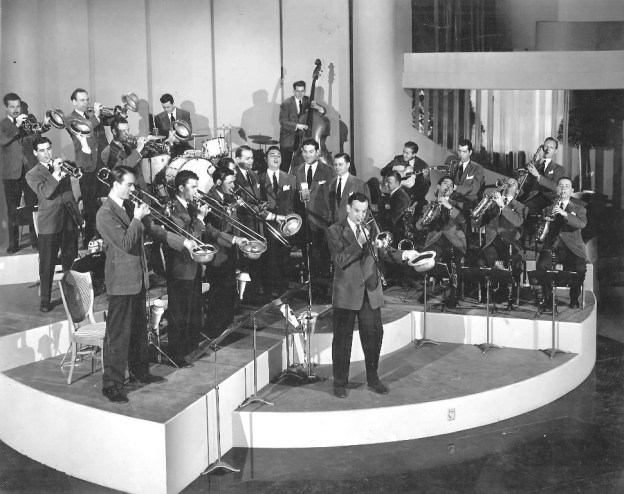

FEATURE image: Glenn Miller Orchestra, 1940-41. Public Domain.
Orchestra Wives (1942) endures not simply as a Glenn Miller swing showcase but as one of Hollywood’s most realistic portrayals of life on the road for big-band musicians and their spouses, blending first-rate wartime-era music with surprisingly mature drama about marriage, jealousy, gossip, and the pressures of touring.
The 1942 music film, Orchestra Wives, from 20th-Century-Fox is one of the best dance band movies ever made. Between 1934 and 1945 Fox studios made 57 musicals and music films (see – https://www.imdb.com/list/ls565533414/.) While M-G-M is known for its musicals where characters sing and dance in place of spoken dialogue, the music film is one that usually features a bandleader – which in Orchestra Wives is Glenn Miller – and musical performers within a band orchestra – Marion Hutton with The Modernaires – as well as music-related acts such as the Nicholas Brothers. In a music film, including Orchestra Wives, characters don’t break out into song but speak in regular speech. In the music film singing and dancing are normally set pieces in a nightclub or on a stage and the music itself is presented in a realistic setting all of which perfectly describes 20th Century-Fox’s Orchestra Wives. Musical direction of Orchestra Wives was by Alfred Newman.
ANN RUTHERFORD.

When even Mickey Rooney was being underpaid during his glory years at M-G-M, Ann Rutherford was not. When she asked L.B. Mayer for a raise, she took out her checkbook, showed him the balance, and told him she had promised her mother a new house. Ann got her raise. In 1942 at the age of 23, Ann appeared in her last Andy Hardy film, Andy Hardy’s Double Life (1942). She left M-G-M and freelanced her talent. See- https://www.imdb.com/name/nm0751946/bio/ – retrieved October 16, 2023. PHOTO: “Ann Rutherford.” by carbonated is licensed under CC BY-NC-SA 2.0.
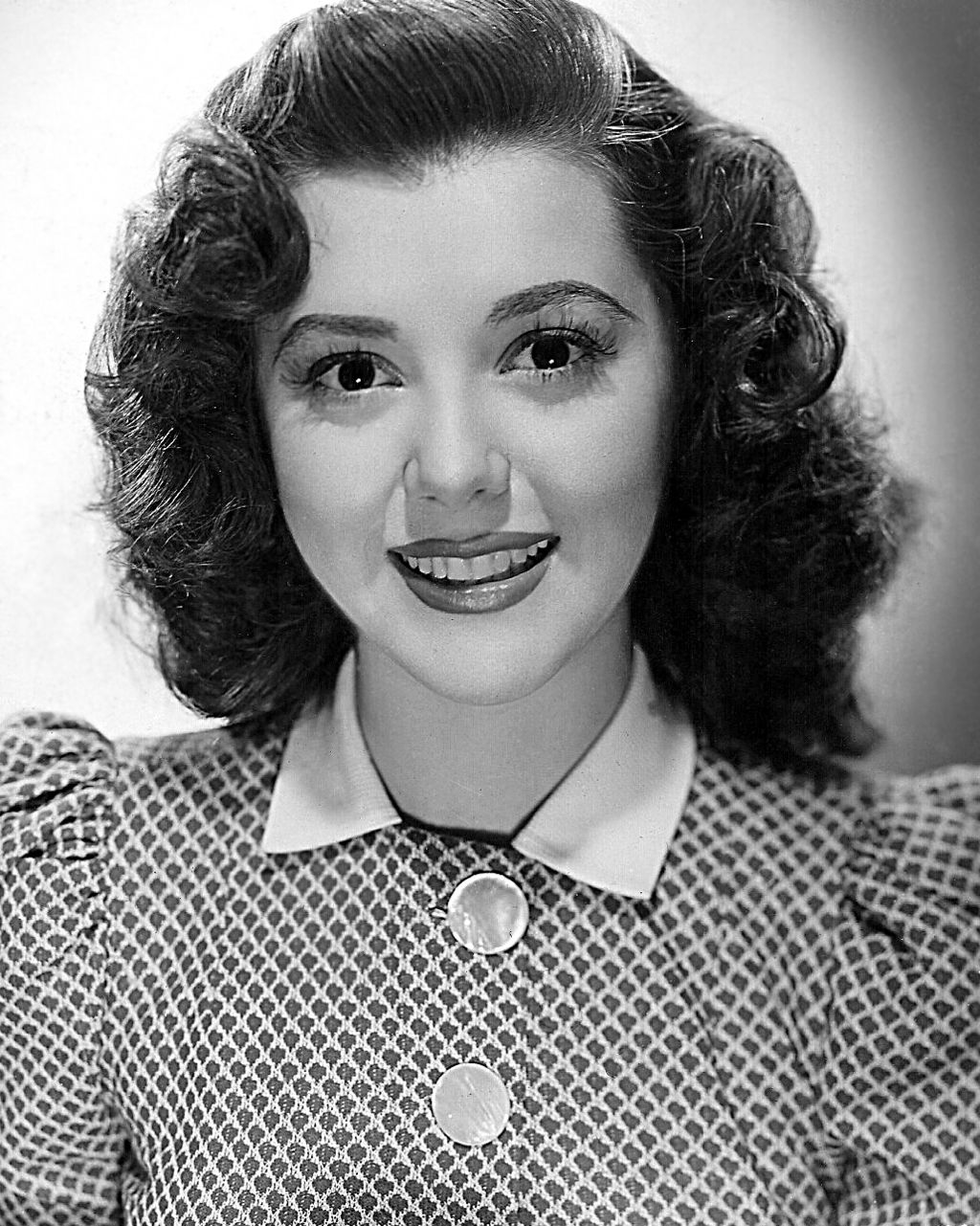
Ann Rutherford was known as “America’s Sweetheart” and a big star in 1942.
PHOTO: Original studio publicity photo of Ann Rutherford Permission details
This work is in the public domain in the United States because it was published in the United States between 1928 and 1977, inclusive, without a copyright notice. For further explanation, see Commons:Hirtle chart as well as a detailed definition of “publication” for public art. Note that it may still be copyrighted in jurisdictions that do not apply the rule of the shorter term for US works (depending on the date of the author’s death), such as Canada (50 p.m.a.), Mainland China (50 p.m.a., not Hong Kong or Macao), Germany (70 p.m.a.), Mexico (100 p.m.a.), Switzerland (70 p.m.a.), and other countries with individual treaties.
Connie Ward (played by “America’s Sweetheart” Ann Rutherford) goes on a date with soda-jerk Cully Anderson (Harry Morgan) to hear and dance to Gene Morrison’s (Glenn Miller’s) Band in Dixon, Illinois. At Last is a song that takes place on stage in the music film Orchestra Wives. Used as a musical motif throughout the film in dramatic and romantic scenes, the Harry Warren/Mack Gordon love ballad is sung in a duet featuring headliner Lynn Bari (her voice dubbed by Pat Friday, 1921-2016, and not credited). In 1942 Ann Rutherford had been in the picture business almost a decade. She starred as Polly Benedict in the Andy Hardy series in the 1930’s and 1940’s and was one of Scarlett O’Hara’s sisters in Gone With The Wind (1939). Rutherford was a big star compared to a slightly older Harry Morgan who was making his film debut. Co-star George Montgomery appeared in a string of Western films starting in 1935. He signed with 20th Century-Fox in 1939 and soon was playing leading man roles such as Bill Abbott in Orchestra Wives and several other hit films at Fox. World War II interrupted that career trajectory. In 1943, Montgomery joined the U.S. Army Air Forces First Motion Picture Unit where he made training films. When he returned to Fox in 1946, he resumed playing lead roles and left the studio in 1947.
GEORGE MONTGOMERY.

Actor George Montgomery started as a stuntman in Western films in the mid1930s. He appeared in around 87 films and later in several television series in a six-decade career. Best known for his roles in Westerns, he appeared as the leading man for a number of 20th Century-Fox rom-coms, music films and musicals. Orchestra Wives in 1942 was one of the first for the handsome and rugged star. Montgomery played trumpet player Bill Abbott in Gene Morrison’s Band. The part was played on the soundtrack by Glenn Miller’s lead trumpet player, Johnny Best (1913-2003). See – https://www.britannica.com/biography/George-Montgomery – retrieved October 16, 2023. PHOTO: “George Montgomery – in ”Roxy Hart” 1942” by Movie-Fan is licensed under CC BY-NC-SA 2.0.
ARCHIE MAYO.

The film was directed by Archie Mayo (1881-1968). Mayo was a longtime Hollywood director, having moved from New York City to the West Coast in the mid1910s where he started directing a short time later. Over a 30-year career Mayo directed scores of films and worked with James Cagney, Bette Davis, and the Marx Brothers. PHOTO: Permission details
The item has no copyright marks as can be seen in the links. At bottom right is a logo indicating the card was produced by a union print shop and Country of origin USA.
· United States Copyright Office page 2 “Visually Perceptible Copies The notice for visually perceptible copies should contain all three elements described below. They should appear together or in close proximity on the copies.
1 The symbol © (letter C in a circle); the word “Copyright”; or the abbreviation “Copr.”
2 The year of first publication. If the work is a derivative work or a compilation incorporating previously published material, the year date of first publication of the derivative work or compilation is sufficient. Examples of derivative works are translations or dramatizations; an example of a compilation is an anthology. The year may be omitted when a pictorial, graphic, or sculptural work, with accompanying textual matter, if any, is reproduced in or on greeting cards, postcards, stationery, jewelry, dolls, toys, or useful articles.
3 The name of the copyright owner, an abbreviation by which the name can be recognized, or a generally known alternative designation of owner.1 Example © 2007 Jane Doe.”
Fox musicals and music films from the mid1930’s to mid1940’s were extremely popular. Orchestra Wives features high production set pieces of original swing music envisioned by its music director Alfred Newman (1900-1970). The film itself was directed by Archie Mayo (1881-1968) whose decades-long career was coming to a close (Mayo retired in 1946, shortly after completing A Night in Casablanca with the Marx Brothers). Orchestra Wives features 38-year-old Glenn Miller (1904-1944) and his 22-piece Band, then at the height of popularity. It was the second of two films Miller made for Fox (the first was Sun Valley Serenade in 1941). The Miller band returned to Hollywood to film 1942’s Orchestra Wives and though contracted to do a third movie for Fox called Blind Date, Miller disbanded the band and entered the US Army. Called the Gene Morrison Band in Orchestra Wives, music includes vocal performances by Marion Hutton (1919-1987) with The Modernaires, tenor sax player Tex Beneke (1914–2000) and Lynn Bari (1919-1989). The film concludes with choreographed athletic tap dancing of the Nicholas Brothers. The film is filled with pop-song classics by the successful writing team of composer Harry Warren (1893-1981) and lyricist Mack Gordon (1904-1959). In Orchestra Wives Warren/Gordon songs included in whole or in part, That’s Sabotage, Chattanooga Choo Choo (a main set piece in Sun Valley Serenade indicating Orchestra Wives picked up right where the previous successful film left off), People Like You and Me, the love ballad At Last, the torch song Serenade in Blue (performed by sultry Lynn Bari) and Orchestra Wives’ main production number (I’ve Got a Gal in) Kalamazoo which was nominated for an Academy Award for Best Original Song (the Oscar went to White Christmas by Irving Berlin). Warren melodies are instantly recognized as simple and fresh and Gordon’s lyrics are free of cliché. The music that opens Orchestra Wives presents the film’s first set piece which is a Warren/ Gordon song, People Like You and Me. It is performed by Glenn Miller and his Orchestra with Marion Hutton and The Modernaires. All of the Warren/Gordon songs for Orchestra Wives were recorded by Glenn Miller – as well as many other musical artists in those years.
The film is one of the finest Hollywood music films of the swing era, distinguished by authentic performances from Glenn Miller and His Orchestra rather than conventional musical-comedy fantasy.
GLENN MILLER.

Glenn Miller in 1940. This specific portrait was captured during his “Chesterfield Moonlight Serenade” radio show era. In late December 1939, Glenn Miller and His Orchestra took over a premier, three-nights-a-week CBS radio program sponsored by Chesterfield cigarettes. PHOTO: Unknown author – Ad on page 65 of the Billboard 1943 Music Yearbook. Public Domain.
Glenn Miller was born in Clarinda, Iowa, near the Missouri-Nebraska state lines. Miller started playing professional dance music in Chicago in 1926 and quickly started freelancing as a top arranger for Ray Noble (1903-1978), Tommy Dorsey (1905 -1956), Jimmy Dorsey (1904-1957), and more. Miller formed his own band in 1936. In its first year Miller’s band was one of many swing dance bands and it soon disbanded. In 1938, when Miller reformed the band, he had developed his definitive big-band sound and his records started selling like hot cakes to his mostly younger fans. In art imitating life, Miller portrays bandleader Gene Morrison in Orchestra Wives who disbands his 22-piece band because some band members resign because of their orchestra wives. Having to cancel the rest of the tour, Miller/Morrison looks to re-assemble the band. In the film, Connie Ward Abbott, a new orchestra wife, conspires with Morrison band pianist Sinjin (Romero) to reunite the original band. This will produce, with the help of Dr. Ward (Grant Mitchell), Connie’s father, a reconciliation between Connie and Bill who had separated but remained deeply in love.
(5.51 minutes). Orchestra Wives’ opening scene is set in Melody-Tone Record Corp. featuring the Glenn Miller Band (called the Gene Morrison Band in the film). It starts with Glenn Miller’s 22-piece band recording a lively, perfectly arranged rendition of “People Like You and Me,” one of Harry Warren and Mack Gordon’s pop classics written for the film. The Glenn Miller Band, then at the height of their popularity, are presented with a touch of Hollywood: Jackie Gleason (1916-1987) appears as the Band’s bassist and César Romero (1907-1994) plays its pianist. Gleason and several other featured performers (such as Marion Hutton) went uncredited in the film. Miller had joined the armed forces where he led the Glenn Miller Army Air Forces Orchestra until his disappearance over the English Channel in December 1944 at 40 years old. The energy of the swing era is evident which includes trumpeter Bill Abbott (played by Western cowboy George Montgomery), one of the film’s romantic leads with Ann Rutherford, and singer “Tex” Beneke who played saxophone with bandleader Glenn Miller. One-minute-long opening credits showcase Glenn Miller’s theme from 1939, “Moonlight Serenade,” as its background music. This is a colorized version of the black and white film.
CÉSAR ROMERO.
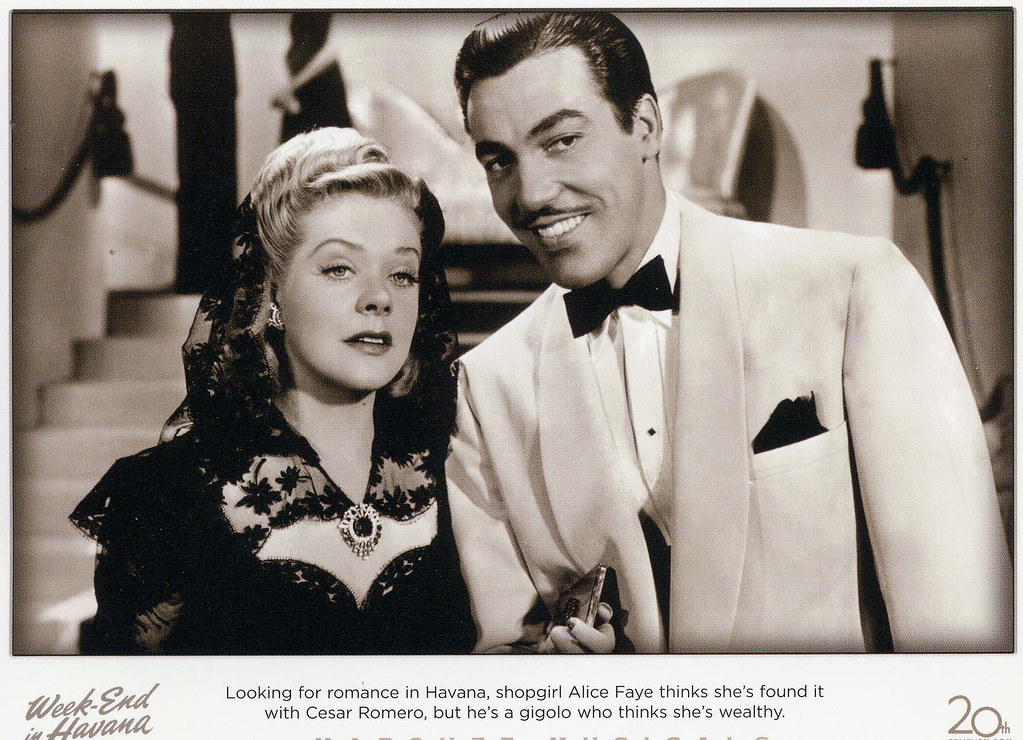
Tall, suave and sophisticated César Romero was born in New York City to Cuban parents. Romero danced and performed comedy in the 20th Century Fox films he starred in opposite Carmen Miranda and Betty Grable, such as Week-End in Havana (1941) and Springtime in the Rockies (1942). In Orchestra Wives Sinjin’s role, though minor, is pivotal to the resolution of the plot. PHOTO: “Alice faye & Cesar Romero in ”Weekend in Havanna” 1941” by Movie-Fan is licensed under CC BY-NC-SA 2.0.
The movie offers a rare and realistic look at the lives of touring band members, singers, and especially their wives, showing the boredom, gossip, and personal tensions generated by constant travel.

Poster for Orchestra Wives (1942) called in Spanish, “Las viudas del jazz.”
PHOTO: “Viudas del jazz” by Kirby York is marked with Public Domain Mark 1.0.
Orchestra Wives is one of the very few films to give insight into the lives of dance band musicians and their singers and spouses on tour. These singers and wives are portrayed in the Hollywood film by glamorous Ann Rutherford (1917-2012), Lynn Bari (1919-1989), Carole Landis (1919-1948), Mary Beth Hughes (1919-1995) and Virginia Gilmore (1916-1986). Each of their glamour and acting ability make dramatic scenes highly entertaining even as they advance the plot by way of bored and distasteful gossiping and rumor mongering.
Three spouses in Orchestra Wives.
CAROLE LANDIS.
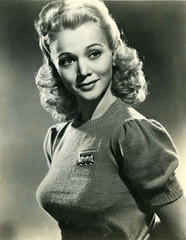
Carole Landis. PHOTO: “Carole Landis” by thefoxling is licensed under CC BY-NC-SA 2.0.
This original 1942 Twentieth Century-Fox studio glamour portrait features American actress-singer Carole Landis at the height of her wartime popularity. Photographed in a tight, short-sleeved knit top adorned with a decorative rhinestone brooch, the image highlights the iconic “Sweater Girl” aesthetic popularized by Hollywood during the late 1930s and early 1940s. Landis’s striking figure and glamorous pompadour hairstyle made her one of the most celebrated pin-up icons of World War II, earning her the famous studio nickname “The Chest” from Hollywood press agents. In Orchestra Wives, she plays Natalie, one of a group of beautiful, deeply jaded, and gossipy women navigating life on the road with the touring Glenn Miller/Gene Morrison band. Stealing nearly every scene she is in with her sharp, catty attitude, Landis delivers what film fans widely consider the absolute best line of the movie when describing a fragile new bride: “She’s a weeper! If there’s anything I hate it’s a leaky dame!”
VIRGINIA GILMORE.

Ronald Colman, Hedy Lamarr, Greer Garson and Virginia Gilmore. PHOTO: “Ronald Colman, Hedy Lamarr, Greer Garson and Virginia Gilmore” by classic film scans is licensed under CC BY 2.0.
This candid 1942 photograph captures American actress Virginia Gilmore on the far right, standing alongside Hollywood icons Ronald Colman, Hedy Lamarr, and Greer Garson. Taken during the multi-city “Stars Over America” war bond blitz in August 1942, the image shows Gilmore dressed in a crisp, multi-toned tailored suit and a small tilted tilt-hat, actively participating in a national drive that raised millions of dollars for the World War II effort. Known for her sophisticated, sharp-featured beauty and vibrant stage presence, Gilmore was a highly promising 20th Century-Fox contract player during this wartime era. In the film, she plays Elsie, one of the more grounded yet fiercely protective women navigating the complex social hierarchy and petty backbiting of the traveling band’s inner circle. While Landis brought the overt, catty glamour, Gilmore provided a sharper, more dramatic anchor to the group dynamics, helping solidify the movie as one of the most culturally enduring documents of the Big Band era.
MARY BETH HUGHES.
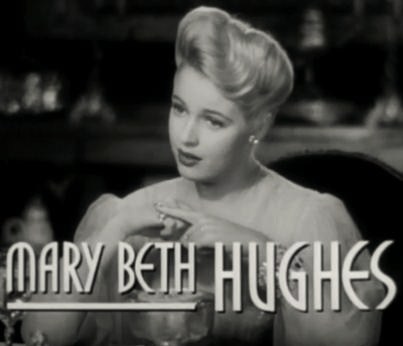
PHOTO: Mary Beth Hughes in Design for Scandal – trailer (cropped screenshot)
PD-US (licensing information : [1]). Public Domain.
This original black-and-white film still is a title card screenshot from the official theatrical trailer for the romantic comedy Design for Scandal (1941). It features American actress Mary Beth Hughes during her tenure as a prominent 20th Century-Fox contract starlet. Together with Landis and Gilmore, Hughes forms the core trio of jaded, hardened touring wives who spend their lives traveling across wartime America on trains and buses in Orchestra Wives. Hughes plays Caroline Steele, the cynical, gossip-loving wife of the band’s drummer (played in real life by Glenn Miller’s actual drummer, Moe Purtill). Bored by the constant travel, the orchestra wives pass the time by rumor-mongering, gatekeeping their social circle, and making life generally miserable for the naive new bride, Connie (Ann Rutherford).
The central story follows Connie Ward (Ann Rutherford) and trumpeter Bill Abbott (George Montgomery), whose whirlwind marriage is tested by misunderstandings, rumors, and the demands of road life. Beneath its music and comedy, the film explores serious themes including trust, infidelity, jealousy, work-life conflict, and marital strain.
Orchestra Wives is a music film with excellent swing music as a highlight and featured in regular intervals that are set on stages such as a record studio, local dance and concert halls, and in nightclubs. The film’s central drama, however, lies in the love relationships of the professional bandmembers and their wives who travel with them. It seems everyone is stressed or bored or both by the intensity of the extra work involved in cross country touring as a musician in a popular swing band. These orchestra wives – namely, Natalie (Carole Landis), Elsie (Virginia Gilmore), and Caroline (Mary Beth Hughes) – are beautiful and jaded about living conditions and unique complications as orchestra wives. When Bill Abbott, the band’s superlative trumpeter, meets Connie Ward (Ann Rutherford), it is on the road at a local dance in Dixon, Illinois. The small-town young woman – daughter of a town doctor (Grant Mitchell) – goes on a date with the local soda jerk just to see and hear Gene Morrison’s swing band. Up close to the stage, it is love at first sight for Connie when handsome trumpet player Bill Abbott (George Montgomery) steps up to perform. The next night, on the spur of the moment, Bill and Connie get married after Connie traveled by bus alone to Elgin, Illinois, for the band’s next gig.
HARRY MORGAN.

Harry Morgan in 1975. In the mid 1930s Harry Morgan was a star debater in high school in Michigan. and began acting at the University of Chicago in 1935. Orchestra Wives was one of two films Morgan made in 1942 that marked the actor’s film debut. PHOTO: Permission details
Pre-1978, no mark. Public Domain.
Connie spontaneously joins the life of traveling orchestra wives and is at first innocent of its darker side. Connie learns a lot as she takes the long rides on train tours as a musician’s wife to the band’s engagements around the country and back. Those film scenes reflect accurately the lives of dance musicians of the era who had to take these long tours to far-flung places. Connie is soon at odds with the other wives who come in shapely forms of Natalie, Elsie and Caroline who are bored by the monotony of the road so that their lives get filled with backbiting gossip and being jealous of one another.
The film bridges carefree swing-era entertainment and the darker emotional territory that would characterize postwar Hollywood dramas and film noir.
Among the many swing era musicals in this period, Orchestra Wives, while a comedy with the usual lighter fare typical for the genre, is notable for its realistic and serious plot. Though called a “musical comedy with the occasional touch of drama” (https://www.quotes.net/movies/orchestra_wives_8473) it is really more of a drama with musical comedy. The naïveté and lack of trust between lovers, namely small-town Illinois girl Connie Ward (played by “America’s sweetheart” Ann Rutherford) and Bill Abbott (played by Western cowboy George Montgomery) — whose fictional bandleader Gene Morrison (played by Glenn Miller) calls him “the best trumpet man in the business” — is raw, serious and real. Sparked by in-house rumor-mongering of band-members’ infidelities as well as other cascading gossip of bored wives on a cross- country band tour, the newlyweds Connie and Bill face their first big crisis as a couple very shortly after they are married. Upon suspecting her husband is having an affair with sultry Jaynie, the band’s lead singer, there is this confrontation between newlyweds whose misunderstanding gets mixed up in embarrassment and resentment:
CONNIE: I know there was nothing wrong between you and Jaynie (played by statuesque Lynn Bari)
BILL: That’s what I told you last night.
CONNIE: But it really wasn’t my fault. It was Natalie (Carole Landis) and Elsie (Virginia Gilmore) and Carole (Mary Beth Hughes) and their gossip started it.
BILL: From what I heard just now, you’ve been spreading a little gossip yourself.
Its musical highlights include”(I’ve Got a Gal in) Kalamazoo,” “At Last,” and “Serenade in Blue,” songs by Harry Warren and Mack Gordon that became enduring popular standards.
LYNN BARI.

Lynn Bari was born in Virginia. A statuesque, dark-haired WWII pin-up beauty, Bari paid her acting dues for years by way of bit-parts as secretary, party girl and glorified extra. At the same time, she was being groomed as a starlet under contract to MGM and Fox. Fox Studios started giving her leads and top supporting roles in second-tier films such as The Return of the Cisco Kid (1939), Pack Up Your Troubles (1939), Hotel for Women (1939), and Hollywood Cavalcade (1939). Bari had gained fame by her good looks though her better roles tended toward unsympathetic parts such as in Orchestra Wives where she played a femme fatale. See – https://www.imdb.com/name/nm0054609/bio/?ref_=nm_ov_bio_sm – retrieved October 16, 2023. PHOTO: “Lynn Bari (colorized) by manito” is licensed under CC By 2.0.
In a nightclub, Morrison band lead singer Jaynie (Lynn Bari), performs another Warren/Gordon pop classic, “Serenade in Blue.” The composers believed this song, which became a pop standard, was a superior piece of music and that Glenn Miller was able to arrange its harmonies and perform the song at its best potential in the 1942 Orchestra Wives.
Jaynie, the band’s singer, held a torch for Bill though their affair was over shortly before Bill met Connie and married her. Because Gene Morrison didn’t want to pay for the wives to accompany the band on an overnight gig to Iowa City, the newlyweds were apart for the first time. Natalie gossiped to Connie about other band members’ extra-marital affairs and Carole told Connie about Bill and Jaynie. Connie, apparently unafraid to take the bus alone between towns, travels that way late at night to meet Bill. In the meantime, the gossiping wives call Jaynie (with a reproduction of Whistler’s Mother on the wall behind them) to tell her that Connie is coming to town. After Jaynie and Bill shared an after-show chop suey dinner together, Jaynie propositioned Bill in her hotel room which he declined. Afterwards learning that Connie was coming to the hotel she telephoned Bill’s room and on the pretext of needing cash, Bill comes into Jaynie’s room. Connie discovered the pair together in Jaynie’s room in their pajamas and, as Jaynie planned, is scandalized. Though Bill tells Connie that nothing was going on, Connie storms out, hurt and angry, and gets on the next bus back to Des Moines. The next day, when the band returns, Connie learns that what she was told is gossip. In revenge, Connies spills the beans about spousal infidelities of the gossiping wives that Natalie told her before. Connie’s words result in three band members leaving the tour and to the cancellation of the rest of the tour by bandleader Gene Morrison.
It also leads to a serious dramatic scene between Connie and Bill that honestly explores a situation of any new spouse – not just an “orchestra wife” – who is in love with someone with a stressful job who has to travel and be on the road all the time. The work/home tension is a modern theme and universal to more than a swing band musician’s family. Released in September 1942, Orchestra Wives, was popular cinematic fare in a country that neared its first full year of being “all-in” fighting in World War II. The film has one foot in a carefree pre-war swing era and another in wartime America that brought one of its longest lists of casualties in its history and, soon, the Atomic Age. Orchestra Wives is a music film and ostensible comedy that provides serious treatment to scenes that point, if briefly and thus superficially to the post-war era’s film noir and its themes of jealousy, infidelity, innuendo, mystery, and the femme fatale. To combine music, comedy and serious drama is a highlight of the original screenplay by Karl Tunberg (1907-1992) and Darrel Ware (1906-1944) – a writing team nominated the year before for an Academy Award for screenwriting for Tall, Dark and Handsome also from 20th Century-Fox.
BILL: I married you because you were a happy kid. Gay, cute, cheerful. But you’ve gone neurotic on me. You trail me around like a house detective. And then with one flick of your tongue you bust up our band. Last night you said you weren’t an orchestra wife and you hit the nail right on the head. You aren’t and you never will be.
CONNIE: Maybe you’re right Bill but I’ve tried. I don’t know the two things just don’t seem to go together. Look, how can you be a real wife when you are trailing from one hotel to another like a lot of gypsies? When you have breakfast at lunchtime and lunch at dinnertime and dinner at midnight? Why this isn’t living. Why this isn’t even being married.
BILL: What did you expect – a banker? You married a trumpet player. You weren’t getting a suburban home with flowerpots and kiddies. At the time you seemed to think the idea was pretty glamorous.
CONNIE: Well at the time I was crazy. This life is about as glamorous as a gymnasium.
BILL: Well, I’ll give you a chance for something better. You know that marriage certificate? That little piece of paper with rosebuds on it? Well you can pack it with your things. I’m through with it.
CONNIE: So am I. And I’ll leave you half the pieces.
The climax of the film occurs when Connie walks out on Bill—and vice versa—and leaves their marriage and love hanging in the air. With band members’ tensions among their wives exploding into the open, Gene Morrison (Glenn Miller) has to break up the band. Though these breakups’ flashpoint is Connie and Bill’s open rift, can and will she now help to get the band back together and reconcile with Bill? And who will help her?
MARION HUTTON.

Singer Marion Hutton was discovered by Glenn Miller when she was 17 years old. Marion was the older sister of film actress Betty Hutton (1921-2007). Since the Huttons’ father had died, Glenn Miller and his wife Helen became Marion’s legal guardians which allowed her to accompany them as they worked. Marion Hutton stayed with the Glenn Miller Band until it disbanded in 1942. PHOTO: Unknown author – Ad on page 80 of Billboard 1944 Music Yearbook
· Public Domain Created: 1 January 1944
TEX BENEKE.
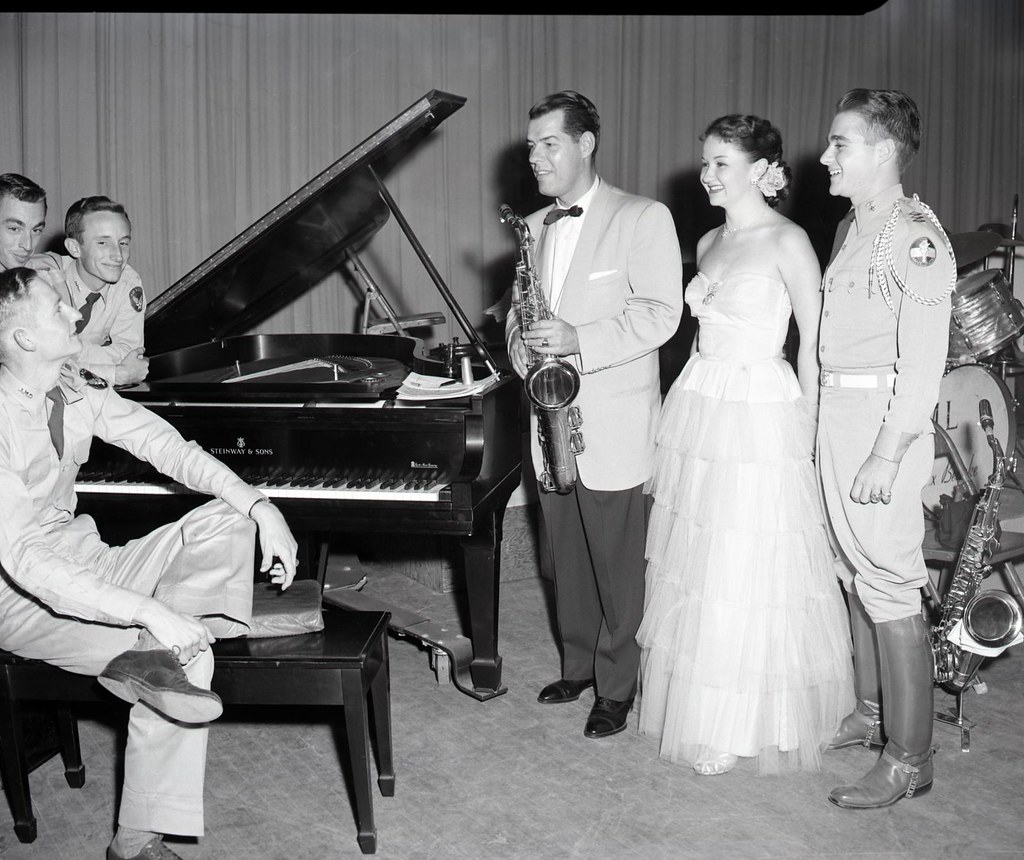
Tex Beneke was a saxophone player who played with the Glenn Miller Band, among others. Tex Beneke is featured in major production swing music numbers by Harry Warren and Mack Gordon in Orchestra Wives. PHOTO: “Tex Beneke” by Cushing Memorial Library and Archives, Texas A&M is licensed under CC BY-NC-ND 2.0.
THE NICOLAS BROTHERS.
The #1 popular song in 1942 was (I’ve Got a Gal) in Kalamazoo by Harry Warren and Mack Gordon and featured in the music film, Orchestra Wives. Featuring Tex Beneke and Marion Hutton with The Modernaires it was recorded by Glenn Miller and His Orchestra and was on the 78 r.p.m.’s A side with At Last on B side. The Glenn Miller record was 1942’s best-selling recording and spent 8 weeks in the no.1 spot. It was also nominated for the Academy Award for Best Original Song. The main production number in Orchestra Wives also featured The Nicholas Brothers composed of brothers, Fayard (1914–2006) and Harold (1921–2000). The act from the 1930s to 1950s excelled in a variety of dance techniques, especially its high acrobatics, and they were considered the greatest tap dancers of their time. See – “The Year’s Top Recordings”. The Billboard. 55 (1): 27. January 2, 1943. – retrieved October 16, 2023.
About composer Harry Warren and lyricist Mack Gordon.
Orchestra Wives provides a lot of first-class music and a dramatic film record of the dance hall scene in the swing era. (I’ve Got a Gal) in Kalamazoo was nominated for an Academy for Best Original Song. Harry Warren wrote some of the great popular songs of the 1930s and 1940s. Many of them were used in Fox musical films in their heyday. Warren had been writing music in Hollywood since 1932. When he moved from Warner Bros. to Twentieth-Century Fox he was assigned to write for Fox’s well-produced and highly popular musicals.
Harry Warren believed he saw the quality of motion pictures in Hollywood actually improve during World War II, the mid20th century’s major global crisis. Through all of it, Americans, Warren observed, expressed a general feeling of confidence that the war would ultimately be won. This excitement translated to the movies at the time.
In addition to working with lyricist Mack Gordon (1904-1959), Warren worked with Fox’s arranger-orchestrator Herbert Spencer (1905-1992). In a long career, Spencer worked with many successful composers and helped orchestrate scores in Holiday Inn (1942), Gentleman Prefer Blondes (1953), Call Me Madam (1953), Carousel (1956), Funny Girl (1968), Hello, Dolly (1969), and more, but he expressed especial enjoyment working with Warren.
Warren’s many inspired melodies, Spencer thought, were simple but logical, seemingly inevitable, and Warren’s song drafts arrived to Spencer filled with detail that helped make the orchestrator’s role more interactive. Spencer also enjoyed working personally with Warren whom the Chilean-born arranger described as “simpatico.” Warren, unlike other busy composers, was accessible to discuss and develop a musical score. With beguiling modulation, the songs rise and fall in intervals, and its notes and meter, as Herbert Spencer might have had it, follow their logical and effortless path.
Head of production at 20th Century-Fox and producer of Orchestra Wives, William LeBaron was brought to Hollywood by Joseph P. Kennedy.

William LeBaron (1883 1958) in 1919. LeBaron became the production chief at several studios, including RKO Studios (1929-1931), Paramount Studios (1936-1941) and 20th Century Fox (1941-1947). He started out working as a playwright in New York City and was brought to Hollywood in 1924 by one of his theatrical investors, Joseph P. Kennedy (1888-1969). LeBaron was born in Elgin, Illinois, an Illinois town that had a pivotal role in Orchestra Wives as the script’s setting where Connie Ward and Bill Abbott get married. Public Domain.
While not in the top ten films of 1942 that earned between $2.885 (M-G-M’s Somewhere I’ll Find You starring Clark Gable and Lana Turner) and $5.358 million (M-G-M’s Mrs. Miniver starring Greer Garson and Walter Pidgeon), 20th Century-Fox’s Orchestra Wives produced a solid and popular music film that took in a very respectable $1.3 million at the box office.
Colorized version of Orchestra Wives from 20th Century-Fox. The lively and original musical is filled with top-notch music in a story of a smalltown girl who marries a popular swing band’s star trumpeter. She joins other orchestra wives on the endless road show caravan whose cooped-up monotony leads to backstage backbiting.
SOURCES:
The Films of 20th Century-Fox A Pictorial History, Tony Thomas and Aubrey Solomon, Secaucus NJ: Citadel Press, 1985, pp. 129-130.
The Dance Bands, Brian Rust, New Rochelle, NY: Arlington House Publishers, 1974, pp. 140-142.
Harry Warren and the Hollywood Musical, Tony Thomas, Foreward by Bing Crosby, Secaucus NJ: Citadel Press, 1975, pp. 184-189.

This is a 1942 promotional studio portrait of American big band leader, composer, and arranger Glenn Miller posing with his signature trombone. Taken at the height of the swing era’s popularity, this image captures Miller in his trademark wire-rimmed glasses and a light herringbone tweed suit jacket. It was widely distributed by his record label, RCA Victor/Bluebird, and the 20th Century-Fox studio to promote his appearances in major musical films of the era, including Sun Valley Serenade (1941) and Orchestra Wives (1942). PHOTO: Unknown author – Ad on page 27 of May 16, 1942 Billboard magazine. Public Domain.