Tag Archives: #MedievalArt

The 12th Century West Front/Royal Portal of Chartres: A Medieval Vision of Heaven at the Dawn of the Gothic Age.

FEATURE image: The North Porch was constructed at the start of the 13th century. The North Porch, like the North Rose Window (below) crafted in the same time, depicts the glories of the Virgin Mary along with Old Testament figures. PHOTO: “Chartres, North Porch, Central Portal, LeftJamb” by profzucker is licensed under CC BY-NC-SA 2.0.

The Royal Portal of Chartres Cathedral represents one of the defining achievements of early Gothic art, where architecture, sculpture, and theology were fused into a monumental visual statement of Christian belief. Created in the mid-twelfth century and remarkably preserved, its sculpted kings, queens, prophets, and Christ figures reveal the moment when medieval Europe began transforming stone into a sophisticated language of faith, learning, and artistic innovation.
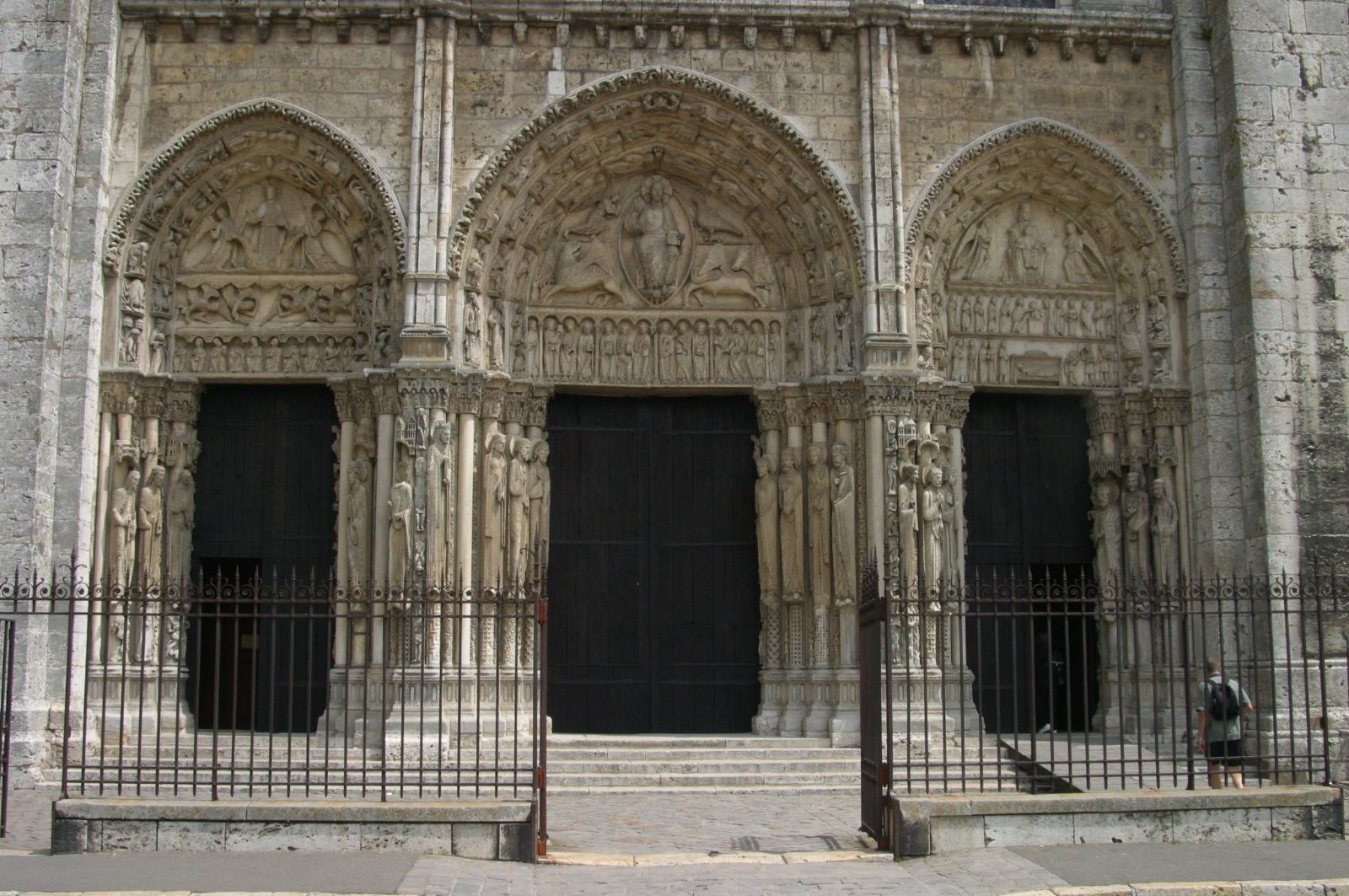
The Royal Portal (Portail Royal) on the west façade of Chartres Cathedral, carved between 1145 and 1155, is one of the finest surviving ensembles of Early Gothic sculpture. Its three richly coordinated doorways present a sweeping vision of Christ’s role in salvation history. Above the left portal, a semicircular tympanum depicts Christ’s Ascension; the central portal illustrates the Apocalypse and the Second Coming of Christ; while the right portal focuses on Christ’s nativity and entrance into human history while crowning the composition is the Sedes Sapientiae (Throne of Wisdom), where the Virgin Mary sits enthroned with the Christ Child in her lap, flanked by two incensing angels. The portals are further enriched by sculpted lintels and archivolts populated with biblical figures and symbolic imagery. Lining the doorways below are the celebrated jamb statues attached to the columns, their elongated, otherworldly forms depicting the kings and queens of the Old Testament. Together, these sculptures create a monumental stone theology that welcomed medieval pilgrims while proclaiming the spiritual and royal lineage of Christ. PHOTO: “Chartres” by Photo:Nina Aldin Thune User:Nina-no is licensed under CC BY 2.5.

The Royal Portal of Chartres is more than a cathedral entrance; it is one of the earliest and most influential masterpieces of Gothic art, transforming carved stone into a timeless expression of faith, knowledge, and medieval imagination.

Jamb statues from the Royal Portal (west façade) of Chartres Cathedral. These columns stand on the right-hand side of the Central Portal. These statues were carved between 1145 and 1155. They represent a critical turning point in Western art history, standing as the definitive bridge between the rigid, blocky Romanesque style and the lifelike naturalism of the Early Gothic period. While individual identities are debated, the overarching program represents the Kings and Queens of the Old Testament. PHOTO: “Cenral tympanum Chartres” by Cancre is licensed under CC BY-SA 2.5.

First Visit and Returning to Chartres Across the Years

I first visited Chartres Cathedral in 1985, returning in 1989, 2002, and 2005. That first visit included a Malcolm Miller tour—my introduction to a guide who, since 1958, had devoted his life to interpreting one building. As I backpacked through Europe, his example showed me how a single enduring monumental work can anchor a lifetime of study.

The Great Glass of Chartres

Chartres is celebrated above all for its 12th‑ and early‑13th‑century stained glass, a nearly intact ensemble unmatched anywhere in Europe. The windows shimmer with deep blues, ruby reds, and jewel‑like greens—colors that have survived more than 800 years. Their narratives unfold left to right, beginning at the base and rising upward, guiding viewers through biblical cycles, guild stories, and royal symbolism.

Layers of Cathedrals on a Roman Site

The cathedral stands on what was once a Roman site, and several earlier churches rose and fell here. Structures were destroyed during the Merovingian era, again in Viking raids, and once more in the fires of the 12th century. Each catastrophe cleared the ground for a new architectural vision, culminating in the High Gothic monument seen today.
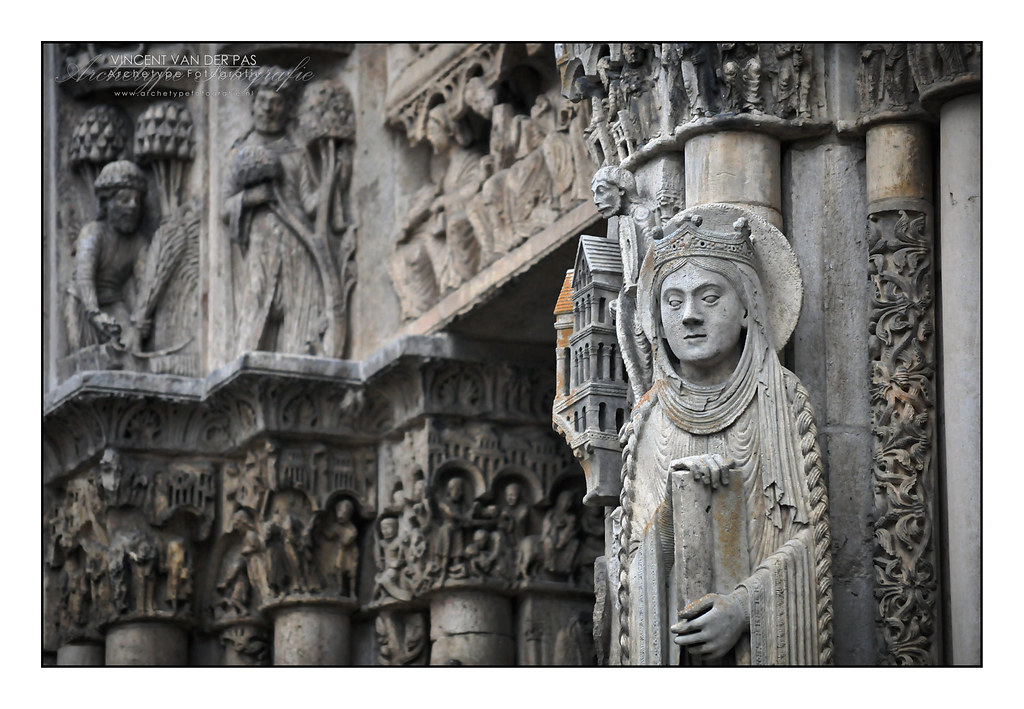
Detail of jamb statue located on the on the Central Doorway of the North Portal (Portail Nord) of Chartres Cathedral. The prominently featured statue is identified as Saint Anne, the mother of the Virgin Mary. While the Royal West Portal y dates to the mid-12th century (1145–1155), the North Portal was constructed later, between 1204 and 1220. This timing difference explains why Saint Anne’s face features a much more advanced, deeply expressive, and three-dimensional High Gothic naturalism compared to the highly stylized, strictly column-like figures of the west façade. PHOTO: “France, Detail ‘Cathédrale Notre-Dame de Chartres’” by Vincent_AF is licensed under CC BY-SA 2.0.

The Cult of the Virgin Mary

A powerful cult of the Virgin Mary developed at Chartres, strengthened by the arrival of the cathedral’s most famous relic in the 9th century: the Sancta Camisa, believed to be the Virgin’s veil. When devotion to Mary surged across Europe in the 12th century, Chartres—already dedicated to Mary’s Assumption—was perfectly positioned to become a major pilgrimage center, drawing travelers from across Christendom.

Arrival in Chartres

On my first visit to Chartres Cathedral in 1985, I left Paris after breakfast, walked to Gare Montparnasse, and boarded a direct train to Chartres. That day’s tour with Malcolm Miller centered on the great windows of the north side: the North Rose Window (c. 1231), the Blue Virgin Window (c. 1194), and portions of the Noah Window (c. 1210). The Noah Window includes a portrait of St. Lubin, the 6th‑century bishop of Chartres and patron of wine merchants—one of the guilds that financed the glass.
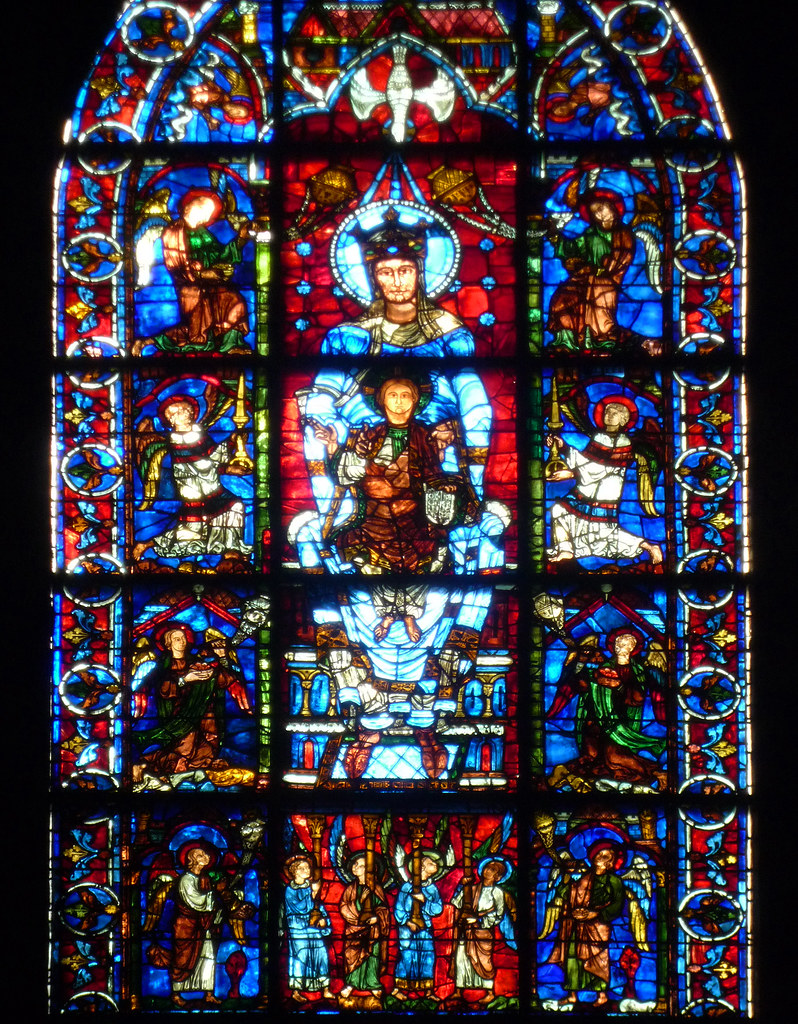
The Blue Virgin Window (Notre-Dame de la Belle-Verrière) is located completely away from the transept roses, tucked into the south aisle of the choir ambulatory (Bay 30). it was one of the incredibly rare pieces of glass that miraculously survived the great cathedral fire of 1194. The central figures of the Virgin Mary and Child date to approximately 1180. When the cathedral was rebuilt in the early 13th century, the master glasiers saved this sacred 12th-century panel and carefully framed it with new 13th-century outer border panels (circa 1215–1220), blending Romanesque and High Gothic glass art seamlessly. PHOTO: “Chartres, Notre-Dame de la Belle-Verrière (detail of Virgin)” by profzucker is licensed under CC BY-NC-SA 2.0.

The portal celebrates Christ’s majesty while emphasizing the relationship between the Old and New Testaments. Its sculptural program unites architecture and theology, turning the cathedral entrance into a visual lesson in Christian belief.

Sculpture of the West Front

Miller also took us outside to study the 12th‑century statuary of the Royal Portal on the west front—figures I photographed again in 1989. These sculptures belong to the cathedral’s Romanesque‑Gothic transitional phase and survived multiple disasters that reshaped the building.

Early Fires and Romanesque Foundations

A major fire in 1120 destroyed the earlier church, prompting construction of a large Romanesque structure contemporary with Vézelay Abbey. Another fire in 1134 damaged the building and led to the construction of the north tower, completed in 1150. The south tower followed roughly a decade later. The Royal Portal itself was built between 1145 and 1155, forming the nucleus of the west front that still stands today.

The 1194 Fire and Gothic Rebuilding

The defining catastrophe came in July 1194, when a devastating fire destroyed nearly the entire church and much of the city. Remarkably, the mid‑12th‑century west front, its royal doors, and the two contrasting towers survived. Everything else—the soaring nave, the sculptural program, and nearly all the stained glass—was rebuilt between 1195 and 1220, creating the unified High Gothic masterpiece seen today.

The survival of the Royal Portal through fires, wars, and centuries of change makes it an extraordinary witness to medieval civilization.

The North Rose window in Chartres Cathedral displays the Virgin Mary and Child in the center surrounded by small circles of doves, angels and thrones. In the outer circles are depicted the 12 kings of Judah (who were Jesus and Mary’s ancestors) and the 12 minor prophets. “Chartres – cathédrale – rosace nord” by Eusebius@Commons is licensed under CC BY 2.0.

Royal Patronage of the North Rose:

In the rebuilding of Chartres, The North Rose Window (created c. 1230-1235) was donated by Blanche de Castile, mother and regent, who ensured the design honored both her lineage and her teenage son, King Louis IX, whose royal patronage helped define the Gothic cathedral’s luminous 13th‑century glass program both here and soon in Paris.

Political Strategy Behind the Glass

The window is not only a devotional masterpiece; it is a calculated piece of 13th‑century political messaging crafted at a moment when Blanche of Castile faced rebellions from French barons who resented both her gender and her foreign birth to rule France. By shaping the iconography, Blanche used the cathedral’s most prominent glass to assert her divinely sanctioned authority.

Heraldry as a Statement of Power

Blanche inserted unmistakable symbols of legitimacy:

  • the arms of France — golden fleurs‑de‑lis on blue
  • the arms of Castile — golden castles on red

Placed together, they proclaimed the union of dynasties and the rightful lineage of her son, Louis IX, whose minority she was defending.

The Lancet as a Warning to the Barons

Directly beneath the great rose, Blanche added a lancet window pairing righteous biblical kings standing triumphantly over fallen, corrupt rulers. It was a visual admonition to rebellious nobles: oppose the rightful sovereign, and you align yourself with the defeated enemies of God.

Saint Anne and Blanche of Castile

At the center of the vertical lancets stands Saint Anne, holding the infant Virgin Mary. This was a deliberate, intimate parallel. Blanche positioned herself as a holy mother‑protector, raising the sacred child — Louis IX — to rule France. The imagery reinforced her maternal authority and the sanctity of her regency.

Revolutionary Upheaval and Restoration

During the French Revolution, Chartres Cathedral was desecrated and repurposed as a Temple of Reason, part of the radical de‑Christianization campaign. It was not returned to the Church or reconsecrated until 1855, beginning the long modern era of preservation and study that continues today.

The survival of the Royal Portal through fires, wars, and centuries of change makes it an extraordinary witness to medieval civilization. Chartres became a model for later Gothic cathedrals throughout France and Europe.
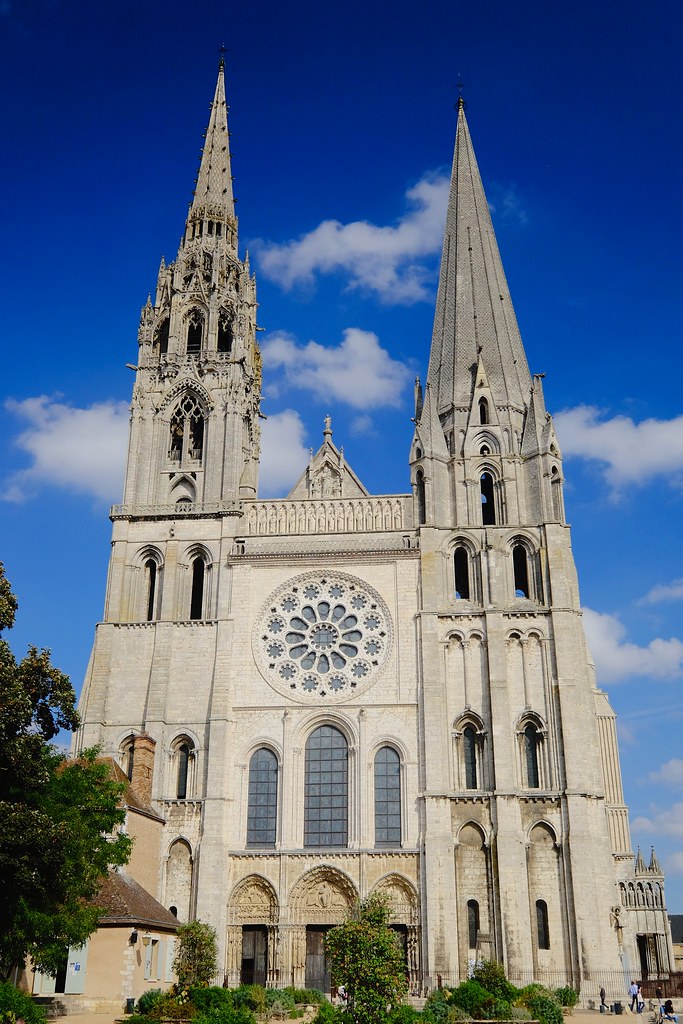
The West Front is from the 12th, 13th and 16th centuries. The photograph’s column statues below are on the right side of the West Portal’s central door. Though likely originally intended in the 12th century to be enclosed in a narthex, that structure was not built and these sculptures remained outdoors. “Chartres 2014 – 2” by evocateur is licensed under CC BY-SA 2.0.

The Rise of Cathedral Learning

By the 11th century, Europe experienced a renewed intellectual energy, especially in Northern Europe, where monastic and later cathedral schools became centers of study. One of the pivotal figures in this revival was Gerbert of Aurillac (c. 946–1003), later Pope Sylvester II, who had studied in Spain and led the cathedral school at Reims in the 970s. His most influential pupil, St. Fulbert of Chartres, carried this legacy forward.

Fulbert and the Great School of Chartres

As bishop, St. Fulbert founded the Chartres Cathedral School, which became the most illustrious center of learning in the 12th century. It marked a turning point in Western intellectual life. Scholars there debated emerging philosophical questions about God, humanity, reason, and creation—the very issues that defined the 12th‑century renaissance of thought.

Completion and Consecration of the Gothic Cathedral

Although the present Gothic cathedral was roofed and essentially finished around 1220, it was formally reconsecrated in October 1260. By then, Chartres had already become a magnet for major religious figures. Three popes visited during the 12th century, and in later centuries saints such as Thomas Becket, Bernard of Clairvaux, Francis de Sales, Vincent de Paul, Louis de Montfort, and Benedict Joseph Labre prayed there.

Pilgrimage Through the Centuries

Pilgrimages to Chartres began before the 12th century and remained important through the 16th and 17th centuries, though they declined sharply after the French Revolution. By the late 19th century, pilgrims were returning, but the revival of the traditional Paris‑to‑Chartres route is credited to the French poet Charles Péguy.

Charles Péguy and the Modern Pilgrimage

On June 14, 1912, Péguy set out on the nearly 150‑kilometer walk from Paris to Chartres, completing it in three days. The pilgrimage fulfilled a vow he had made the previous year at the bedside of his ill son. “Chartres is my cathedral,” he later wrote. His life ended two years later: on September 5, 1914, serving as a lieutenant in the 19th Company, 276th Infantry Regiment, he was killed near Villeroy, Seine‑et‑Marne. Péguy was 41.

The Royal Portal is the oldest surviving section of Chartres Cathedral and predates much of the present Gothic structure. Elongated jamb figures of kings and queens bridge Romanesque traditions and the emerging naturalism of Gothic sculpture.

The Royal (West) Portal, 12th century, Cathédrale de Chartres (1145-1220), France. December 1989. Author’s photograph 1.24 mb

Identifying the Figures

While art historians have attempted to identify the portal statuary at Chartres, the conclusions remain speculative. The figures appear to represent Old Testament characters—and in this photograph, the pair may be King Solomon, at right holding a scroll, and the Queen of Sheba beside him. Their identities matter less than the expressive force the sculptor carved into their faces nearly a millennium ago.

Faces Filled With Life

What is striking is the inexpressible joy radiating from these stone faces. The 12th‑century sculptor concentrated the entire vitality of the figures in their expressions—an artistic ambition that still feels modern. Even after 900 years of weather, war, and revolution, the faces retain a startling immediacy.

Statuary at the Height of 12th‑Century Art

Although Chartres is world‑famous for its flying buttresses and stained glass, many art historians argue that the statuary is the cathedral’s most compelling achievement. These portal figures represent 12th‑century sculpture at its zenith, where spiritual intensity, architectural innovation, and human emotion converge in stone.
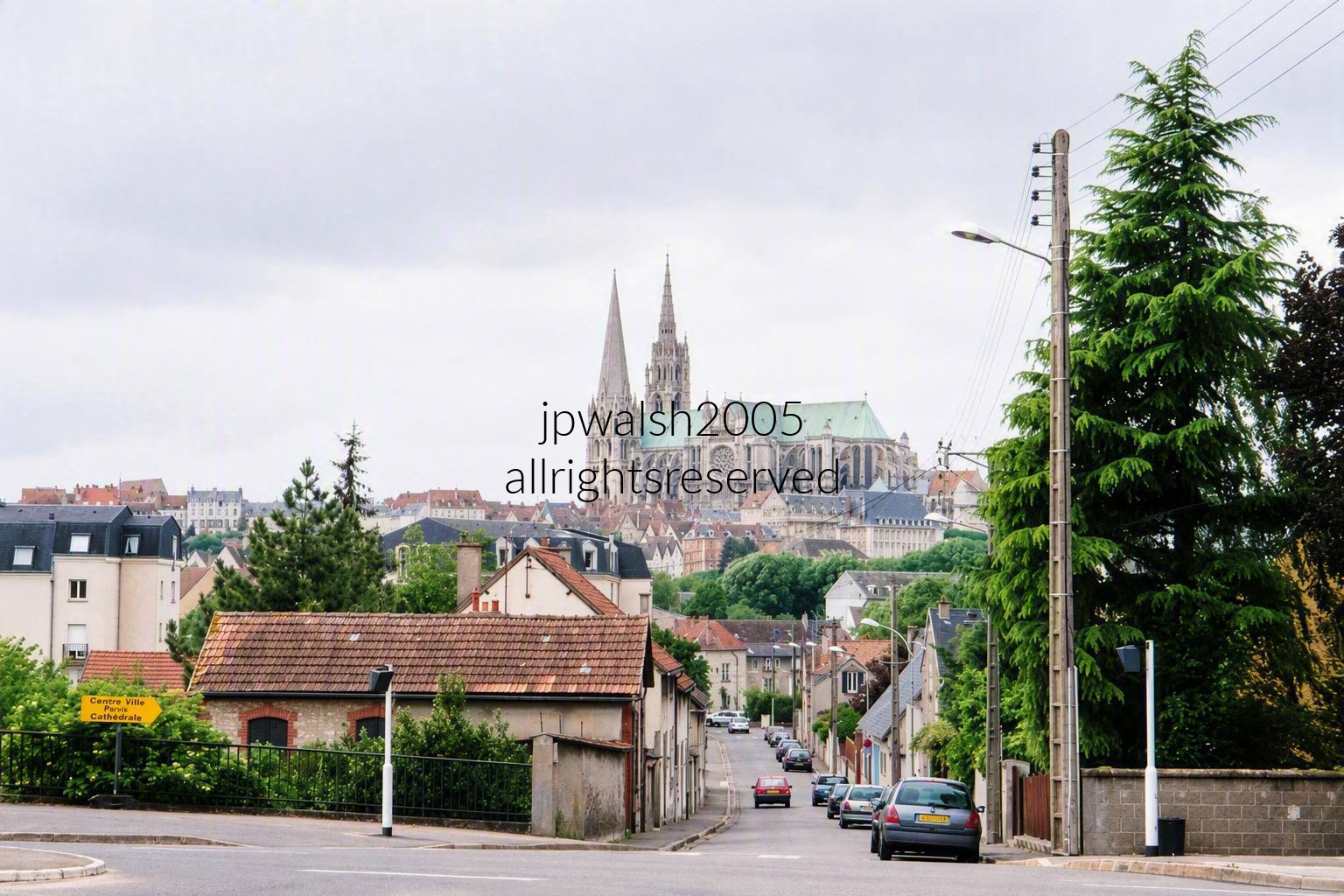
Cathédrale Notre-Dame de Chartres. May 2005. Author’s photograph,

Taken from Jardin de Sakuraï, this view looks west-southwest along 35 Rue du Faubourg Guillaume toward the historic center of Chartres, France, where the world-famous Cathédrale Notre-Dame de Chartres dominates the skyline. This High Gothic masterpiece is instantly recognizable for its asymmetrical spires, soaring flying buttresses, and expansive green copper roof. From this eastern vantage point, the cathedral’s two towering western spires rise at the far left. Following the roofline to the right, the large projecting cross-shaped section in the middle is the north transept façade. Beyond it, the lower rounded end of the church, encircled by an impressive ring of flying buttresses, forms the apse, the cathedral’s eastern termination. Together, these elements reveal the monumental scale and architectural complexity that have made Chartres one of the most celebrated cathedrals in Europe.

SOURCES: 

Cartwright, Mark. “The Stained Glass Windows of Chartres Cathedral.” World History Encyclopedia, October 16, 2018. https://www.worldhistory.org/article/1277/the-stained-glass-windows-of-chartres-cathedral/.

Houvet, Étienne. Chartres: Guide of the Cathedral. Revised by Malcolm B. Miller. Chartres: Éditions Houvet-la Crypte, n.d.

Leff, Gordon. Medieval Thought. Highland, NJ: Humanities Press, 1958.

“The Great Pilgrimages.” Cathédrale de Chartres. Accessed August 23, 2025. https://www.cathedrale-chartres.org/en/cathedrale/pilgrimages/the-great-pilgrimages/. [1]

“The Voice of Chartres.” America Magazine. Accessed August 23, 2025. https://drupal.americamagazine.org/issue/681/article/voice-chartres.


This explanatory article may be periodically updated.

From Gothic Splendor to Renaissance Vision: French Art in the 15th Century.

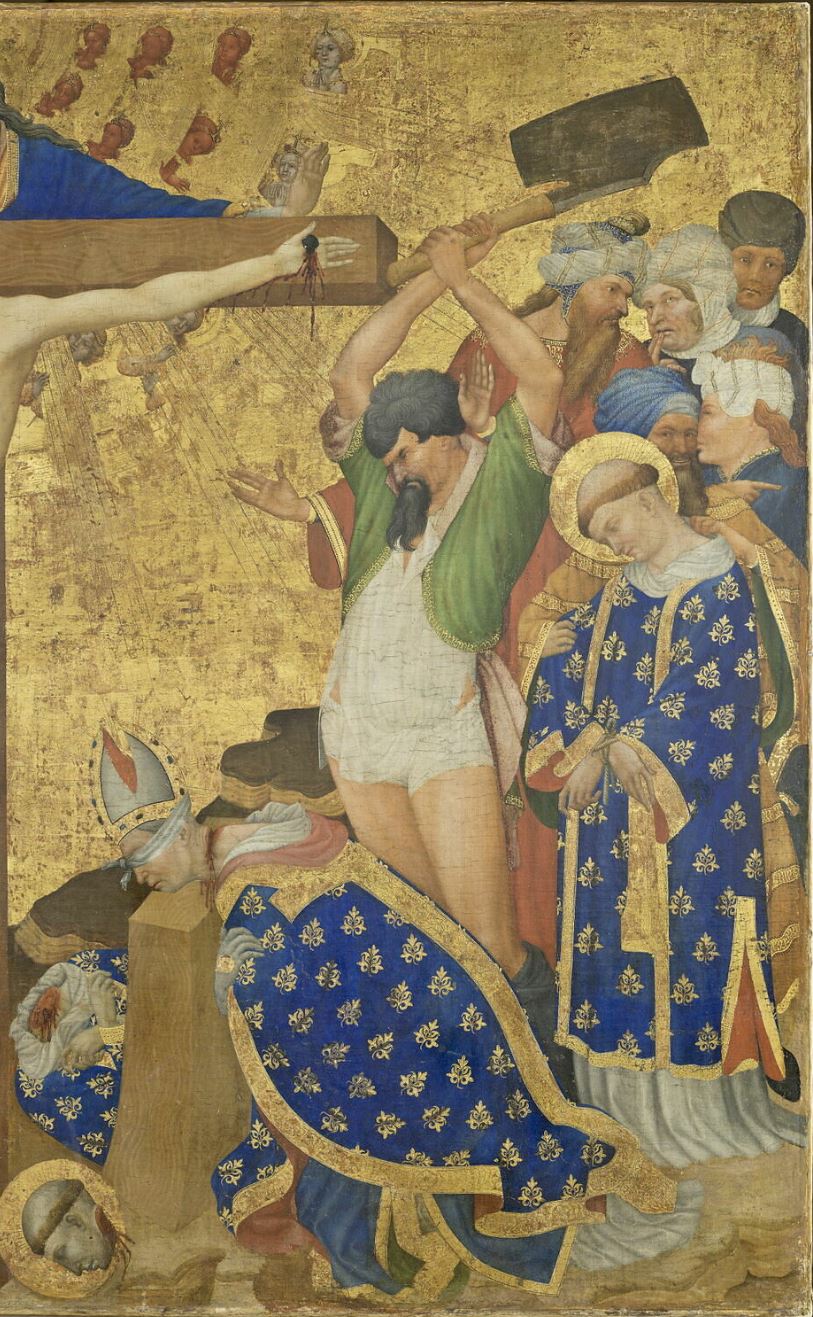
FEATURE image: DETAIL, Henri Bellechose (1415-1440), École de Bourgogne, Retable de saint Denis, 1416, https://collections.louvre.fr/ark:/53355/cl010063178

French art in the 15th century stood at the crossroads of the medieval and early Renaissance worlds, blending Gothic spirituality, courtly elegance, and devotional symbolism with growing influences from Italian and Flemish artistic innovations. Through illuminated manuscripts, altarpieces, stained glass, and panel paintings, French artists created some of Europe’s most expressive and sophisticated religious imagery while forging a distinct national artistic identity.

Anonymous master. Portrait of John le Bon (1319-1364) c. 1360. Musée de Louvre, Paris (“Louvre”).

French artistic production in the 15th century remained deeply rooted in Christian devotion, mysticism, and royal patronage.

Henri Bellechose (1415-1440), École de Bourgogne, Retable de saint Denis, 1416, https://collections.louvre.fr/ark:/53355/cl010063178

Retable de Saint Denis, (above), was completed in 1416 for the church of the Charterhouse of Champmol that is adjacent to Dijon. The artwork’s attribution has long been debated between Bellechose and Jean Malouel (1370-1415). Written evidence points to Bellechose possibly only completing the painting started by Malouel who was Bellechose’s predecessor at the head of the ducal workshop. However, recent connoisseurship does not see two different styles that would indicate two painters and the artwork in the Louvre is not the same size as the artwork mentioned in the early 15th century document that supports the dual attribution.

DETAIL, Henri Bellechose (1415-1440), École de Bourgogne, Retable de saint Denis, 1416, https://collections.louvre.fr/ark:/53355/cl010063178

St. Denis is the most famous cephalophore (beheaded saint holding his head) in Christian history. Denis and two companions were martyred on Montmartre in what became a future Paris in the mid-3rd century. Much later, in the ninth century, an anonymous chronicler told the tale of the martyr Denis and mentioned his carrying his head from his execution spot on Montmartre to Saint-Denis. There the abbey of St-Denis rose to become the burial place of French kings. Soon after, this preposterous but delicious tale of Denis’ post-mortem pilgrimage received further embellishment by an abbot chronicler so that the legend took hold in St. Denis’ hagiography and iconography. St. Denis is the patron of Paris in France and against headaches and any strife or frenzy.

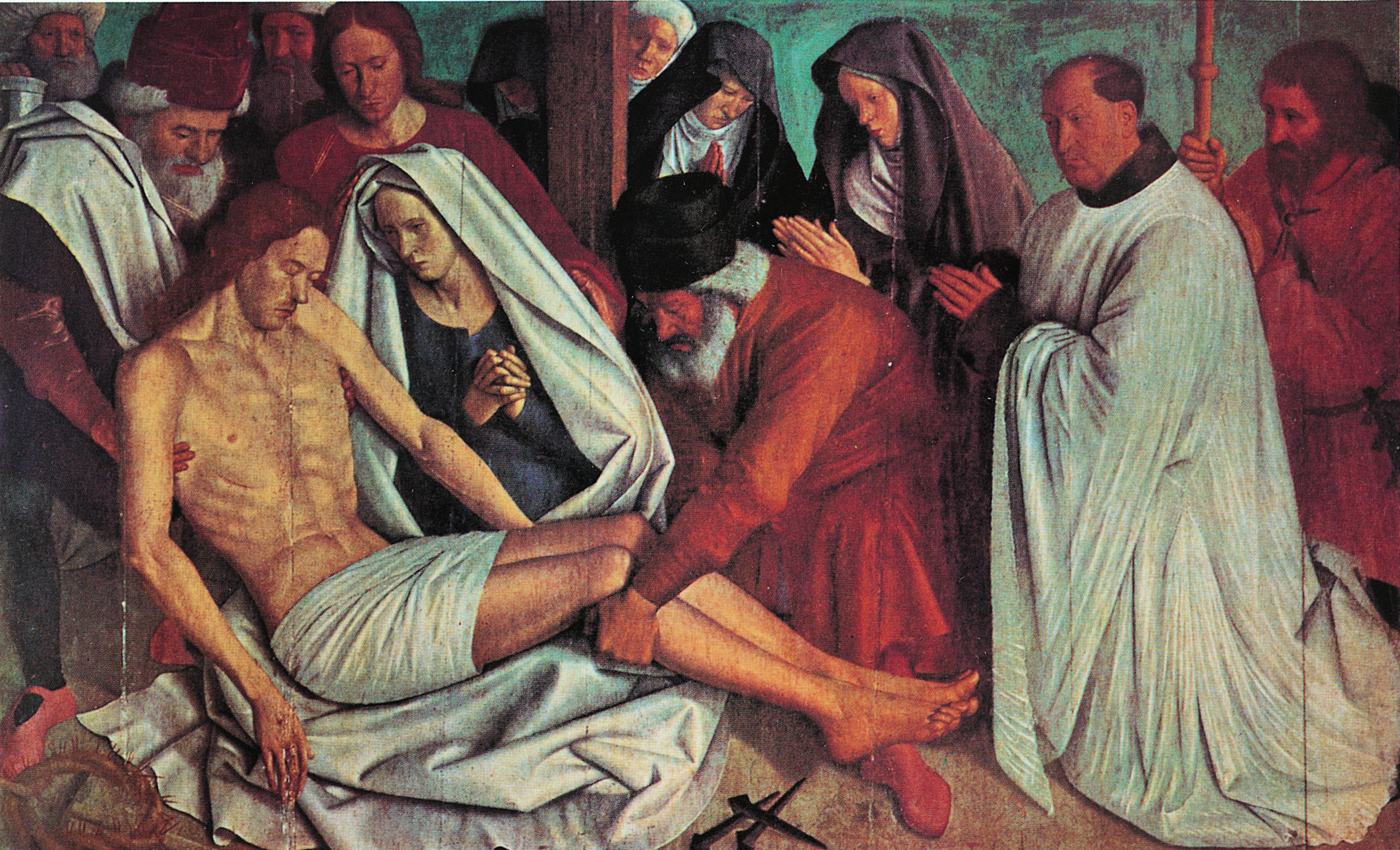
Anonymous, École de Île-de-France? Bourgogne? Studio Henri Bellechose? Dead Christ Placed in the Tomb,
1400-1425. Louvre. https://collections.louvre.fr/ark:/53355/cl010065413
Anonymous master, The Annunciation, France, possibly Netherlands, late 14th century (1380s), tempera and oil with gold on wood, 15 7/8 x 12 3/8 x 1 7/8 in. Cleveland Museum of Art.

The angel Gabriel’s wings resemble peacock feathers. The panel painting was once joined to another panel to form a diptych. Its opulent ornate style and small size allowing for easy mobility points to its use as a devotional artwork for an aristocratic patron around 1400.

Anonymous, The Crowning of the Virgin, c. 1400-1410, Paris, oak on wood. 20.5 cm. Staatliche Museum, Berlin.

In Christian Biblical tradition, the Virgin Mary was the only human person to be received into heaven after her death as a physical body prior to the Last Judgment. By the Middle Ages, the event’s narrative was elaborated so that the Virgin in Heaven came to be understood as a royal court where angels acted as court pages. In Heaven’s throne room, Mary is crowned as Queen by her son, Jesus Christ.

In the French tondo, Christ wears a red cloak symbolizing his Resurrection and a violet robe symbolizing his Passion. He sits on a stone throne and sets the crown on his mother Mary’s head as she kneels on a splendid cushion.

Strewn on the green-tiled floor of the celestial throne room are a variety of cut flowers which point to Mary’s purity and love for humanity. One angel carries her dress’s train and is himself dressed in a liturgical-type costume.

The tiny panel is remarkable for its delicate execution, lovely colors, and precise articulation of details such as the angels’ multi-colored wings. Its overall imagery was 14th century Italian in origin and arrived into Paris in the 15th century. Like the Annunciation panel in the Cleveland Museum of Art (above), this panel was likely produced as a private devotional image for a patron of high rank who dwelt among the milieu of the Parisian court.

Les Frères de Limbourg, Meeting of the Three Wise Men c. 1416 from Les Très riches heures du duc de Berry folio 51 verso. Chantilly, Musée Condé.
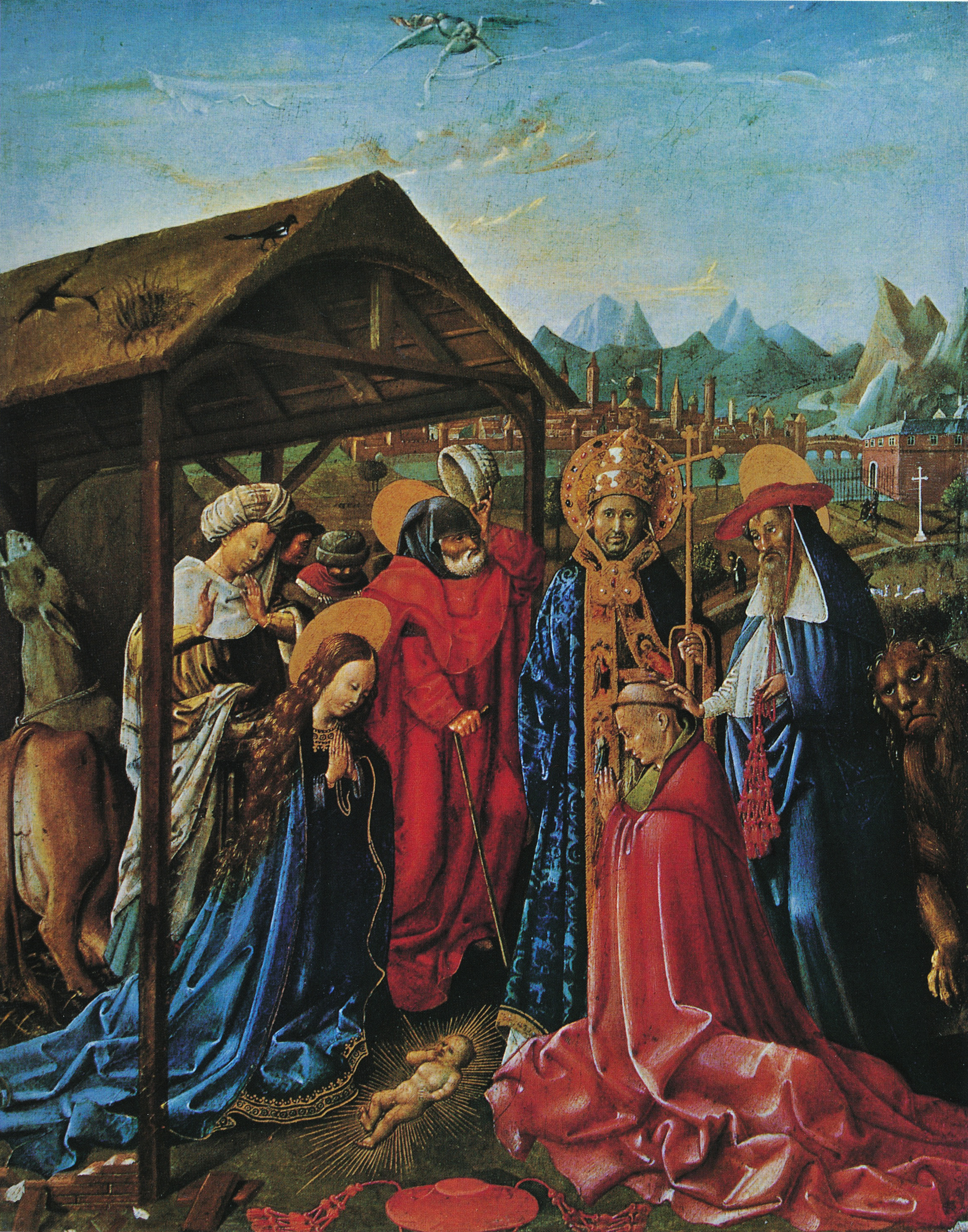
Entourage des Frères de Limbourg. Adoration de L’Enfant, c. 1415, Glasgow Art Gallery and Museum.
Maître des heures de Rohan (active 1410-1435), The Last Judgment c. 1420, Paris, Bibliothèque nationale.
Maître des heures de Rohan, Annunciation Angel and donor, c. 1420/30, Musée de Laon.

The courts of Burgundy, Anjou, and the French monarchy served as major centers of artistic innovation and patronage.

 Maître des heures de Rohan, Portrait de Louis II d’Anjou, c 1420. Paris, Bibliothèque nationale.

Not much more is known of the Maître des heures de Rohan than if he were anonymous. The artist had ties to Troyes, a Burgundian market town, and settled in Paris between 1415 and 1420. He was a commercial illuminator and is found in the service of the Dukes of Anjou around 1420. In addition to the Grandes Heures de Rohan, c.1430-1435, he produced other exceptional books, including the Hours of René d’Anjou (Bibliothèque nationale de France), the Hours of Isabelle Stuart (Fitzwilliam Museum, Cambridge, UK) and the Hours for the Use of Angers (former Martin Le Roy collection).

Artwork by Maître des heures de Rohan reflects a highly personal vision. The artist was completely unconcerned with his contemporaries’ preoccupation to introduce Renaissance realism into painting. The artist ignored perspective and chiaroscuro through concrete depictions and continued to develop his artistic meditations on faith and death using highly original invention of forms. In this way, the Maître des heures de Rohan is an enduring artist from early 15th century France as some of his more fashionably progressive contemporaries are not as he stayed true to his vision to create some of the most expressive pages of medieval Christian mysticism.

French art absorbed influences from both Italian Renaissance painting and Flemish realism while preserving distinctive Gothic traditions.

Maître of the Aix Annunciation, Annunciation, before 1445, Église de la Madeleine d’Aix-en-Provence.

The precise identification of the artist called the Maître of the Aix Annunciation is unknown. The artist is believed to be male and French, and could be Jean Chapus who lived in Aix and was working for King Réne of Anjou in the 1430s and 1440s. The Annunciation which was placed in the church in 1445 and has been there since, was part of a triptych. The other wings have been split off and are in Brussels, Amsterdam, and a private Dutch collection (one wing was also split). The style shows influence from Italy (Naples) and Flemish art.

DETAIL. Maître of the Aix Annunciation, before 1445, Église de la Madeleine d’Aix-en-Provence.

Illuminated manuscripts remained a major art form, exemplified by the work of the Master of Rohan and the Limbourg Brothers.

Maître du Coeur l’amour épris, Rencontre de Coeur et d’Humble requête, c. 1479, Vienna, National Library.
Anonymous. Annunciation, c. 1447-1450, Stained glass, Bourges cathedral, Chapel of Jacques Coeur.

The period’s art is notable for its rich symbolism, luminous color, meticulous detail, and emotional spirituality.

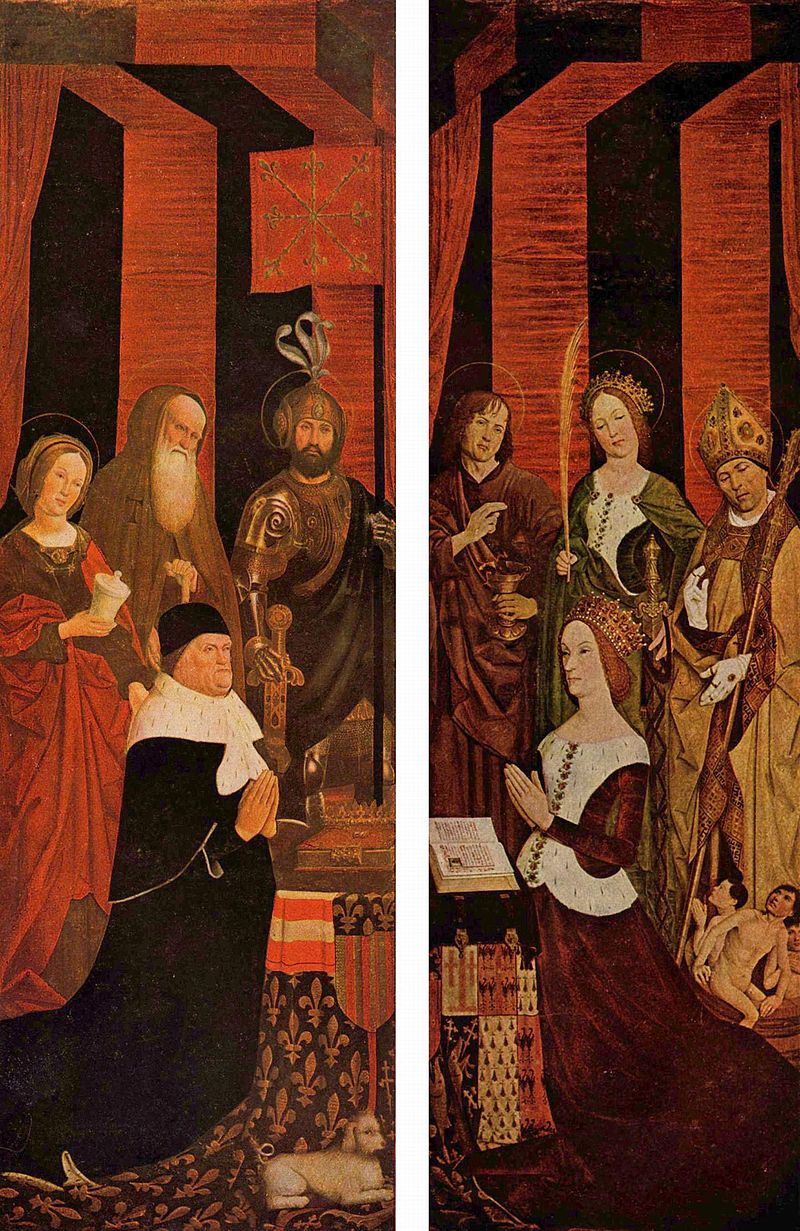
Jean Fouquet (1420-1480), Diptych de Melun, c. 1450, right panel: The Virgin and Child Jesus. Antwerp, Museum of Fine Arts.
Jean Fouquet (1420-1480), Diptych de Melun, c. 1450, left panel: Chevalier Stephan presented by Saint Stephan. Staatliche Museum Berlin.

Jean Fouquet was a major French painter of the 15th century. He was in Rome in the mid-1440s and is presumed to have painted portraits. Under what circumstances the twenty-something Fouquet traveled to Rome is unknown. In any event Fouquet returned to Tours in 1448 and was working in the court of Charles VII. Louis XI appointed him official painter to the king in 1475. A handful of miniatures are documented artworks by Fouquet though other pictures, such as the Melun diptych and others, are attributed to him.

Jean Fouquet (1420-1480), Medallion, self-portrait, 1452/1455. Louvre.
Jean Fouquet (1420-1480), Charles VII, 1440/1460. Louvre.
Jean Fouquet (1420-1480), The Visitation, c. 1450. The Musée Condé, Chantilly.
Jean Fouquet (1420-1480), Announcement of the Death of Saul to David, c. 1470. Les Antiquités Judaïques, Ms. fr. 247, folio 135 verso. Paris Bibliothèque Nationale.
Jean Fouquet (1420-1480), Pietà, c. 1470-1480. Parish church, Nouans (Indre-et-Loire).
Jean Fouquet (1420-1480), Pietà (detail), c. 1470-1480. Parish church, Nouans (Indre-et-Loire).
Retable du Parlement de Paris, c.1455. Louvre. see – https://collections.louvre.fr/en/ark:/53355/cl010061369 – retrieved September 15, 2025.

It depicts the scene on Calvary on Good Friday with Jesus Christ crucified in the center with saints at its base including, left to right, Saint Louis, John the Baptist, the Virgin Mary, Saint John, a beheaded Saint Denis, and Charlemagne. In the background is the tour de Nesle (c. 1200-1665), Seine, the Louvre, Hôtel du Petit-Bourbon, and Palais de la Cité. Formerly identified as an artwork by Philippe de Mazerolles, it is currently identified by the Louvre as “anonymous“ in the School of France influenced by the Master of Dreux Budé who is likely André d’Ypres, active between 1425-1450. Philippe de Mazerolles was also a French painter and illuminator who was active in Paris and in Bruges. Trained in Paris, Philippe de Mazerolles’ style was directly inspired by the Maître de Bedford, an anonymous illuminator active in Paris slightly earlier between 1415 and 1435. The Master of Dreux Budé was a Parisian illuminator whose works show his knowledge of the repertoire of models of the Master of Flémalle (1375-1444). see – https://initiale.irht.cnrs.fr/en/intervenant/3443 – retrieved September 15, 2025.

DETAILS retable du Parlement de Paris (above), c.1455. Louvre:

AnonymeFranceMaître de Dreux Budé (André d’Ypres?), Musée du Louvre, Département des Peintures, RF 2065 – https://collections.louvre.fr/ark:/53355/cl010061369 – https://collections.louvre.fr/CGU
DETAIL retable du Parlement de Paris (detail), c.1455. Louvre.
AnonymeFranceMaître de Dreux Budé (André d’Ypres?), Musée du Louvre, Département des Peintures, RF 2065 – https://collections.louvre.fr/ark:/53355/cl010061369 – https://collections.louvre.fr/CGU
Enguerrand Quarton (1410-1466), The Coronation of the Virgin, 1452-53, Altar of the Charterhouse (hospice) of Villeneuve-lès-Avignon.

Also known as Charonton, the French painter worked in Avignon in southern France. His large Coronation of the Virgin is a documented artwork that was completed in 1454. It is one of the most important surviving 15th century French paintings.

Enguerrand Quarton (1410-1466), The Coronation of the Virgin (detail), 1452-53, Altar of the Charterhouse (hospice) of Villeneuve-lès-Avignon.
DETAIL. Enguerrand Quarton (1410-1466), The Coronation of the Virgin, 1452-53, Altar of the Charterhouse (hospice) of Villeneuve-lès-Avignon.
Enguerrand Quarton (1410-1466), attributed, Pietà de Villeneuve-lès-Avignon. École de Provence, c. 1455. Louvre. https://collections.louvre.fr/ark:/53355/cl010063345

DETAILS Pietà de Villeneuve-lès-Avignon (above), c.1455. Louvre:

Nicolas Froment (1461-1483), Triptych (center panel): Mary in the Burning Bush, 1476. Cathedral St. Sauveur, Aix-en-Provence.

DETAIL Triptych (center panel): Mary in the Burning Bush (above), 1476. Cathedral St. Sauveur, Aix-en-Provence:

Nicolas Froment (1461-1483), Mary in the Burning Bush (detail), 1476. Aix-en-Provence, Cathedral St. Sauveur.Triptych (center panel).
Nicolas Froment (1461-1483) The Burning Bush, 1476. Aix-en-Provence, Cathedral St. Sauveur.Triptych (right and left panels).

Nicolas Froment worked in the south of France and was painter to Réne d’Anjou. The triptych is a documented artwork by the artist.

Josse Lieferinxe, called Maître de Saint-Sébastien, Part of an altarpiece shutter. The marriage of the Virgin. Musées royaux des Beaux-Arts de Belgique.
Maître de Moulins, active 1475 to 1505, Triptych de Moulins, center panel: The Virgin and the Child in Glory, c. 1498. Cathedral de Moulins.

DETAILS Triptych de Moulins, center panel: The Virgin and the Child in Glory (above), c. 1498, Cathedral de Moulins:

The Master of Moulins is one of the great French painters of the 15th century. He was influenced by Hugo van der Goes (died 1482) and takes his name from the triptych painting of the Madonna and Child with angels and Donors (above) in Moulins Cathedral dated from 1498/99. Other works attributed to the Master of Moulins are in Autun, Paris, Chicago, Brussels, London, Munich, and Glasgow.

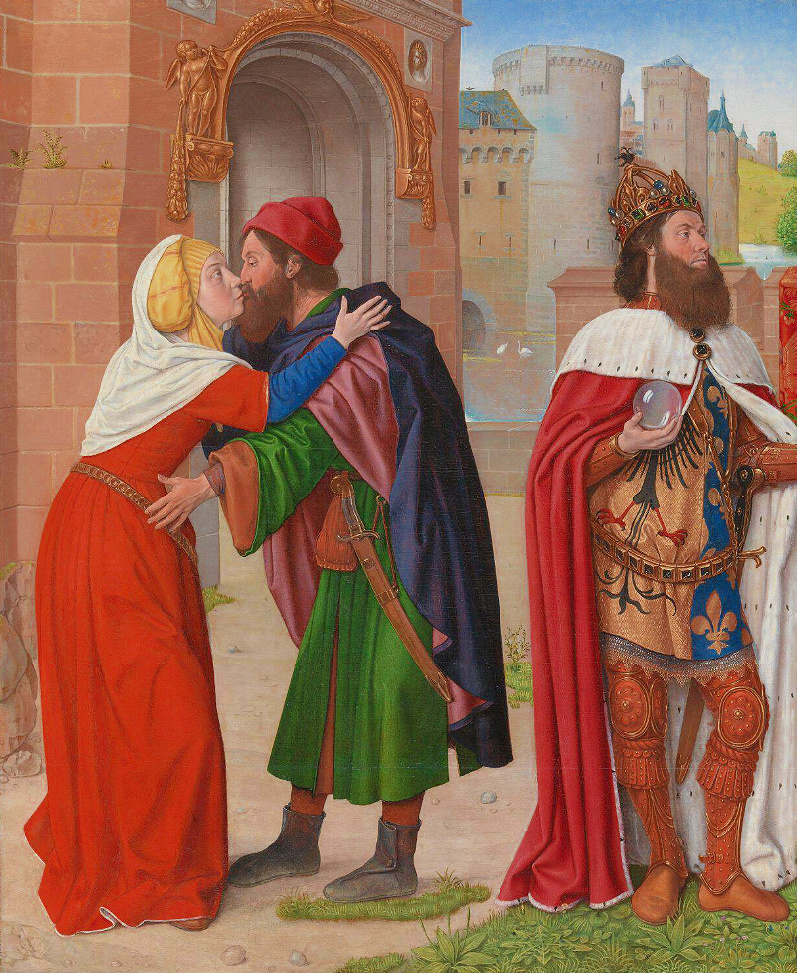
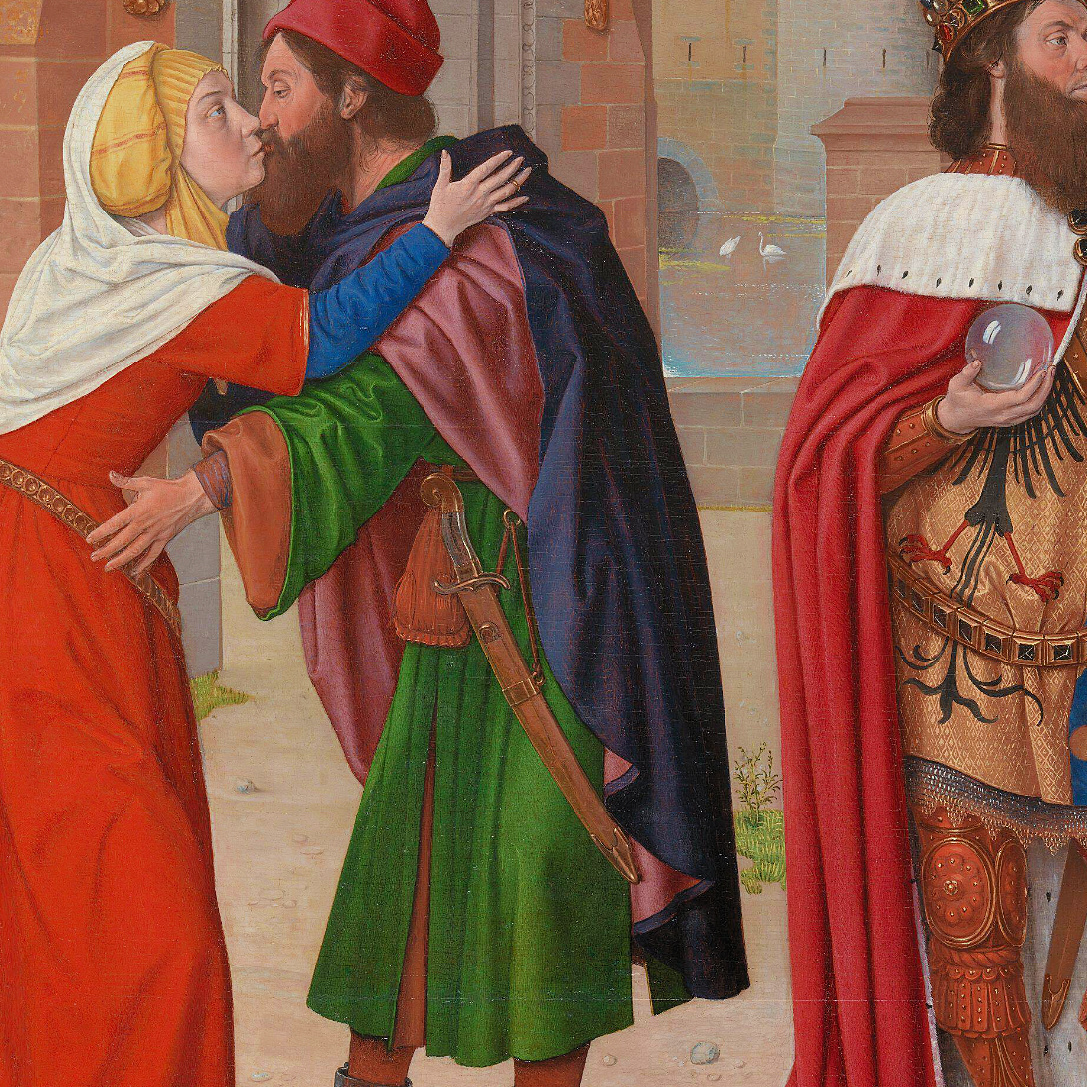
Maître de Moulins, active 1475 to 1505, Meeting of Saints Joachim and Anne at the Golden Gate with Charlemagne, oil on oak, about 1491-1494. 72.6 x 60.2 cm, National Gallery, London.

By century’s end, French artists had begun moving toward Renaissance naturalism while maintaining a uniquely French visual language.

Maître de Moulins, active 1475 to 1505, The Virgin with Child surrounded by angels, c. 1490, Musées royaux des Beaux-Arts de Belgique.
Maître de Moulins, active 1475 to 1505, François de Chateaubriand presented by St. Maurice or St. Victor with Donor, c. 1485, Kelvingrove Art Gallery and Museum Glasgow.
Jean Bourdichon (1457-1521), King David and Bathsheba, Leaf from the Hours of Louis XII, 1498–1499, Tempera and gold, Leaf: 24.3 × 17 cm (9 9/16 × 6 11/16 in.), The J. Paul Getty Museum, Los Angeles, Ms. 79, 2003.105.

Jean Bourdichon served as official court painter to four successive French kings: Louis XI, Charles VIII, Louis XII, and François I. Bourdichon was almost certainly a pupil of Jean Fouquet, the previous court painter.

Simon Marmion (active 1449-1489), The miracle of the True Cross in Jerusalem in the presence of Saint Helena Empress, 2nd half of 15th century (1450/1500). Louvre. https://collections.louvre.fr/ark:/53355/cl010061655

Simon Marmion (died 1489) who worked in Amiens and Valenciennes and temporarily in Tournai was a painter and illuminator where his miniatures were admired for their rich decoration and landscape details. In the mid1440s the artist moved from Amiens to Valenciennes where he became a leading painter. His most important painting is the Saint Bertin Altarpiece in Berlin and London.

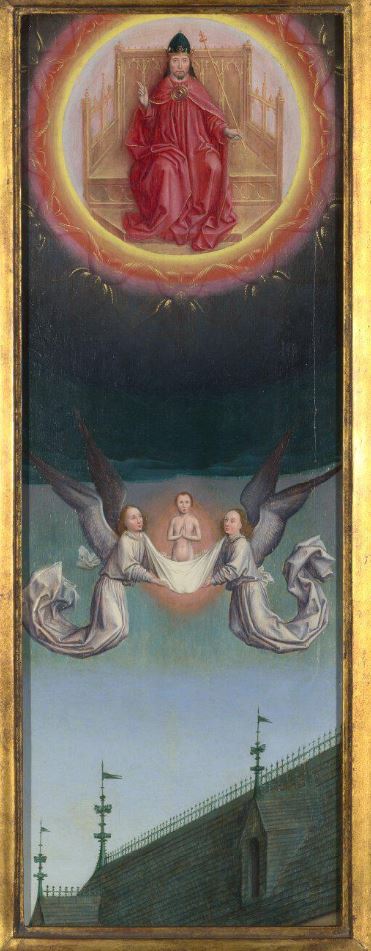
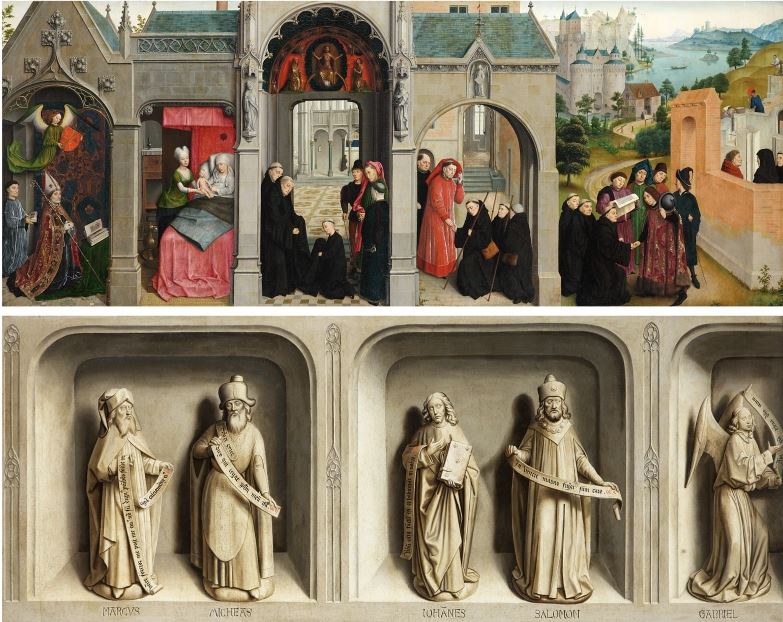
St. Bertin Altarpiece, 1459:

Simon Marmion, The Soul of Saint Bertin carried up to God. Fragment of Shutters from the St. Bertin Altarpiece, 1459. National Gallery London.

The Soul of Saint Bertin carried up to God was the upper section of a wing for an altarpiece for the high altar of the abbey church of St Bertin at Saint-Omer in northern France. It was commissioned by the influential Guillaume Fillastre, Abbot of St Bertin (1450-73), Bishop of Verdun (1437-49), Bishop of Toul (1449-60), Bishop of Tournai (1460–73), Chancellor of the Order of the Golden Fleece and a close confidant of the powerful Duke of Burgundy, Philip the Good. The artwork, whose main parts are in the Gemäldegalerie, Berlin, was consecrated in 1459. The altarpiece was intact in the abbey until 1791 when, as with many church goods, it fell victim to the French Revolution. https://www.nationalgallery.org.uk/paintings/simon-marmion-the-soul-of-saint-bertin-carried-up-to-god

Simon Marmion, A Choir of Angels. Fragment of Shutters from the St. Bertin Altarpiece, 1459. National Gallery London.
Simon Marmion, St. Bertin Altarpiece, 1459. Gemäldegalerie, Berlin. http://www.smb-digital.de/eMuseumPlus?service=direct/1/ResultLightboxView/result.t1.collection_lightbox.$TspTitleImageLink.link&sp=10&sp=Scollection&sp=SfieldValue&sp=0&sp=0&sp=3&sp=Slightbox_3x4&sp=0&sp=Sdetail&sp=0&sp=F&sp=T&sp=4
Simon Marmion, St. Bertin Altarpiece, 1459. Gemäldegalerie, Berlin. http://www.smb-digital.de/eMuseumPlus?service=direct/1/ResultLightboxView/result.t1.collection_lightbox.$TspTitleImageLink.link&sp=10&sp=Scollection&sp=SfieldValue&sp=0&sp=0&sp=3&sp=Slightbox_3x4&sp=0&sp=Sdetail&sp=0&sp=F&sp=T&sp=5

A Dictionary of Art and Artists, Peter and Linda Murray, Penguin Books; Revised,1998.

La Peinture Française: XVe et XVIe Siècles, Albert Châtelet, Skira, Genève Suisse, 1992.

French Painting: From Fouquet to Poussin, Albert Châtelet and Jacques Thuillier, Skira, 1963.

Saints, Sorceresses, and Sinless Beauties: Masterpieces of the Italian Tradition.

FEATURE image: Dosso Dossi (c. 1489–1542), Melissa, 1520s. 69.25 x 68.5 inches, Borghese Gallery, Rome.

Italian art evolved by constantly blending distinct cultural traditions—from Byzantine iconography and literary epics to Baroque drama—transforming traditional religious and narrative subject matter into deeply emotional, poetic, and atmospheric visual languages that transcended simple illustration.

Duccio Di Buoninsegna (c.1255-c.1319).

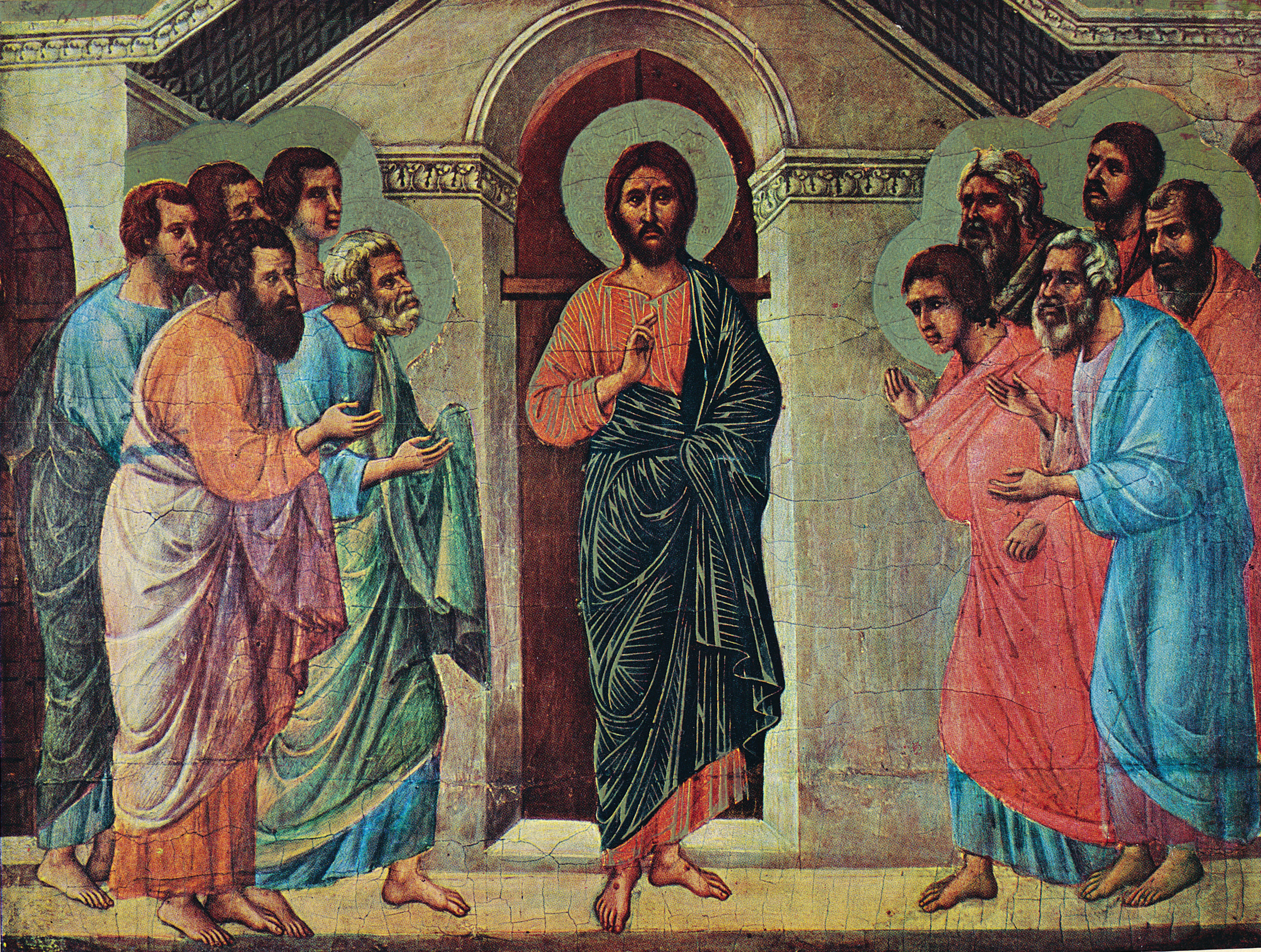
Duccio Di Buoninsegna (c.1255-c.1319), The Apparition of Jesus at the Closed Doors. The Museo dell’Opera del Duomo, Siena, Italy.

The artistic tradition of the Sienese master, Duccio di Buoninsegna (c. 1255-c. 1319) was based on older Greek painting. Duccio, however, was no less “modern” than Giotto (1266-1377). Giotto, who was trained by Cimabue (1240-1302), directed his creative artistry towards concrete reality whose perception derived from the artist’s thoughts and feelings of it. Duccio would achieve a similar but unique synthesis through and from a different direction. 

Duccio modernized the older Greek style creating the painting styles of the Sienese school as well as all of early Renaissance painting. Duccio’s artwork is distinguished by his discriminating advance of the Byzantine Post-Hellenism tradition in Tuscany—and following his own encounter with Cimabue who gave the Sienese artist his first important commission in Florence in 1285 —in a masterly delicate way. This delicacy and discrimination are seen in Duccio’s elegant, often light and airy, compositions and rich colors.

Over the next almost 25 years Duccio learned and deployed the elements of various pictorial traditions that, by his constant intelligent blending, enriched them. Duccio’s style used the iconographic schemata of the ancient Oriental-Byzantine tradition including its glorious color and poetic composition along with the ultra-contemporary French and Gothic linear style. Duccio’s oeuvre epitomizes the artist’s temperament and taste as well as a lifetime of artistic education and culture.  

Beyond its representation of an event in a scene, Duccio’s painting, not unlike Giotto’s histories, is raised to another level by some of its formal elements –- a figure, episode, or gesture -– into the artist’s magical world. This quality of Duccio’s art provides a textually clear and comprehensibly observed episode—such as of the Gospels— within a setting that is carefully observed and delineated—and with its totality imbued in finer artistic and aesthetic sensibilities.

The imminent drama manifested in Duccio’s iconography transcends its representational anecdote, even as figures or episodes of the Bible are easily recognizable. His artwork’s plasticity, with figures and surroundings in serene harmony, emanates a power whose message supersedes, or at least is contiguous to, the painting’s ostensible, usually religious, subject matter.

In the display of such a unique artistic quality, Duccio’s artwork functions in a dream-like and imaginatively timeless dimension—a unique poetical language—while it conveys an historical condition in any of his intentionally-varying episodes. Duccio’s carefully delineated religious scenes, softly and carefully conveyed, would characterize emerging Sienese painting and make religious painting exceedingly popular in Europe over the next 450 years. see – Giotto and His Contemporaries, Enzo Carli, trans. Susan Bellamy, New York: Crown Publishers, Inc., 1958.

Benozzo Gozzoli (c. 1421-October 4, 1497).

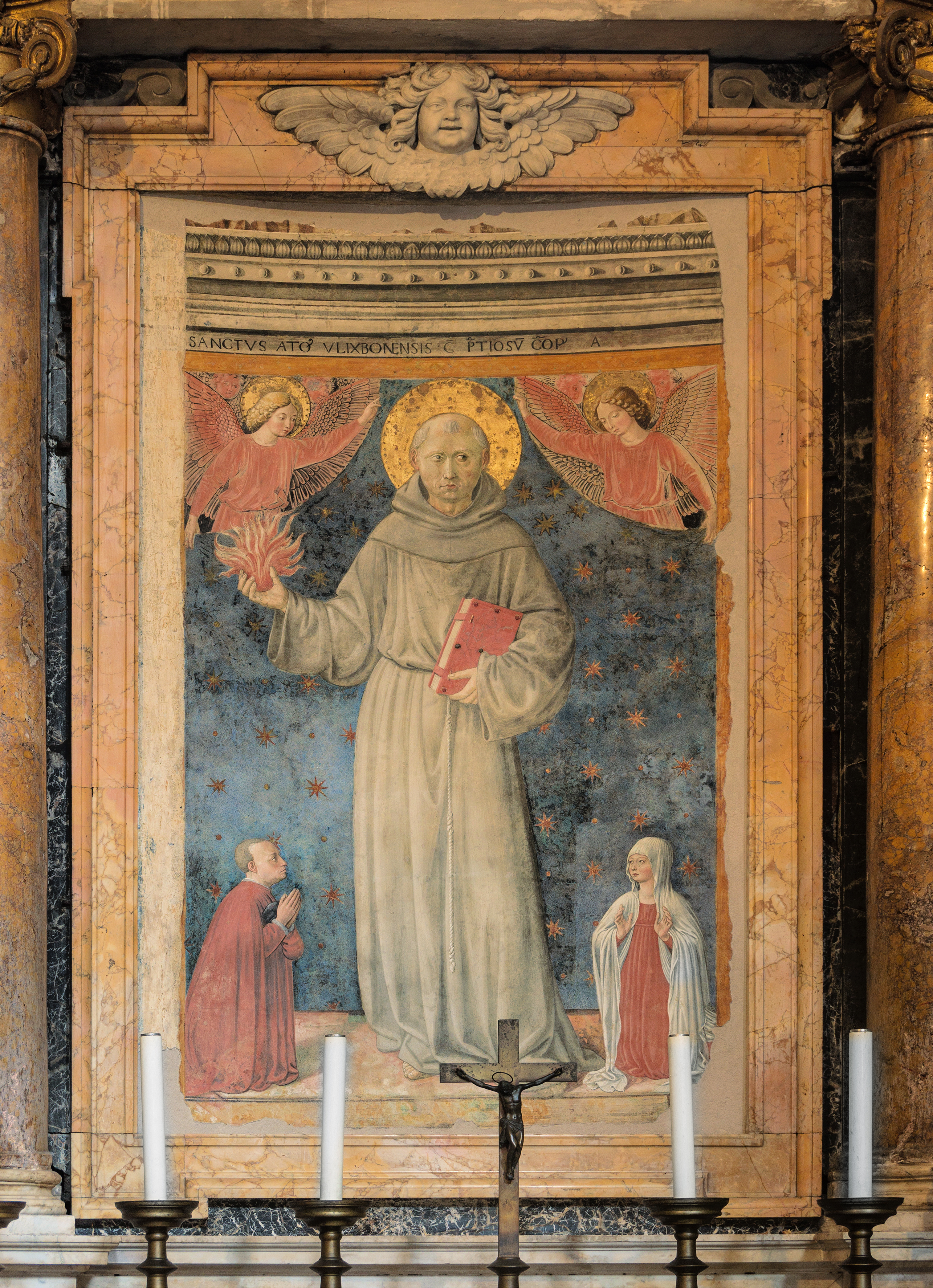
Benozzo Gozzoli (c. 1421-October 4, 1497), Saint Anthony of Padua, 1450, Santa Maria in Aracoeli, Rome, Italy. In art, the saint’s iconography often depicts him with one or more of the following: a book, a heart, a flame, a lily, or the child Jesus.

Anthony of Padua (1195-1231) had a cult in Italy that grew around him quickly and continues to today. He was born with the name Ferdinand in the last decade of the 12th century in Lisbon, Portugal. His father was a high financial official in the king’s court and a knight under Alfonso II of Aragon. Young Ferdinand was educated at the cathedral school in Lisbon and, at 15 years old, became an Augustinian Canon regular in Lisbon. After two years he transferred to a house in Coimbra in part to get away from his well-to-do relatives who were constantly seeking after their promising progeny who had decided to become a Catholic religious and priest. At Coimbra Ferdinand studied at the monastery’s renown biblical studies school for eight years. Steeped in the scriptures he became a theological and scripture scholar of unparalleled high caliber. One day the young Augustinian canon was serving as guest master for the house in Coimbra when 5 Franciscans sent out from Assisi in Italy by St. Francis (1181-1226)– the order had been founded in 1209 – stopped on their way to the missions in in Morocco. Not soon after Anthony learned that all 5 of these zealous Franciscans were butchered in Morocco as martyrs as soon as they arrived there. Their bodies brought back to Coimbra for their funeral deeply moved Anthony who wanted to emulate these Franciscans’ active witness and he decided to become a Franciscan himself in order to take their place. His family, who had been wary of his becoming a scholarly Augustinian following a venerable old rule in nearby Coimbra, grew even more upset as their son who threw away a knight’s career at court now joined a fly by night ragtag group in far flung Italy founded by another rich kid named Francesco who also renounced wealth to focus on evangelical poverty following his brand-new skeletal rule based on a few bible verses. Ferdinand was determined in his inspirations and took the difficult path of leaving the Augustinian canons for the Franciscans and then insisting on leaving Portugal for the missions in Morocco. But Ferdinand’s ambitions were stymied – he fell ill and was ordered home. But the ship he was traveling on was caught in a storm that drove Anthony off course to Sicily. From there he took the long journey to Assisi where he met St. Francis and was present at the famous Chapter of Mats in 1221 that drew, perhaps symbolically, 5,000 brethren of the new order. Though highly educated among a group of mendicants whose founder was suspicious of book learning, Anthony disappeared into menial duties in a small hospice in Forli. But the Franciscans, many of them former sons of the wealthy themselves, recognized Anthony’s brilliant abilities and he was ordered to preach to the whole of Italy. Anthony of Padua became this great preacher and, later, famous worker of miracles. In a time of heresy and controversy throughout Christendom Anthony, who was gentle, poised, charming, intelligent, thoughtful, and deeply well-versed in theology and scripture, served as a personable and effective counterweight. From that point forward until his death, Anthony was active and always on the road from Italy’s south to the north of France. Townspeople and rural folk were positively responsive to his efforts and wherever Anthony went next, churches, plazas and surrounding countryside would be packed with people to hear his sermons. Speaking events would be advertised by word of mouth so that towns often declared a holiday in anticipation of his arrival so that everyone could go out to listen to Anthony. Anthony’s preeminent issue was on the corruption of the secular clergy which scandalized the church, the faithful in the pews, and the wider world to the detriment of the faith. During a time of the rise of cities and the bourgeoisie, as the hierarchical church progressively attached themselves to the bankers and such, Anthony inveighed against the society’s greed, its lust for elite luxuriant living, with its necessary exploitation of labor to maintain themselves at such an unfair level. Anthony called such social behavior “tyrannical.” At a synod in Bourges, France, in the presence of the bishop, Anthony called him out – “as for you with the mitre on your head” and proceeded to denounce his abuses in the diocese before a petrified and perhaps also thrilled audience. Anthony happened to be in Padua when he preached his last sermons – and thus his nomenclature. Miracles and stories have a Franciscan flavor -such as preaching to the fishes or a giant walnut tree unexpectedly providing sustenance and shade to a tired evangelizing preacher. After 10 years of constant travel and preaching, like the Franciscan founder who died blind and naked on the ground outside the Portiuncula in 1226 at 44 years old, Anthony’s body had worn out at an early age. He was 36 years old. In the spring of 1231, his health deteriorated, he took a period of rest and prayer in a small hermitage in Camposampiero close to Padua. His health did not recover and he asked to return to St. Mary’s in Padua. As he was transported to the city in an ox cart he got as far Arcella, just opposite the city, where he died in a convent of Poor Clares. Though his cult hails him as a miracle worker — at his canonization 56 were recorded -– only one occurred in Anthony’s lifetime. Anthony‘s reputation, who was called the “hammer of the heretics” by his contemporaries, rests mainly on his persuasive preaching filled with the fire of the Holy Spirit. Pope Gregory IX (1227-1241) canonized Anthony less than a year after his death – faster than St. Francis himself – as this once rich kid with excellent theological and biblical training became the patron saint of losing things and the illiterate. On January 16, 1946, Pope Pius XII (1939-1958) declared Anthony a doctor of the church. In art, the saint’s iconography often depicts him with one or more of the following: a book, a heart, a flame, a lily, or the child Jesus. see – https://www.findagrave.com/memorial/5118/anthony_of_padua – retrieved June 13, 2025. The Saints: A Concise Biographical Dictionary, edited by John Coulson, Guild Press, New York, 1957, pp.73-76.

Dosso Dossi (c. 1489-1542).

Dosso Dossi (c. 1489–1542), Melissa, 1520s. 69.25 x 68.5 inches, Borghese Gallery, Rome.

Dosso Dossi (c. 1489-1542)– whose actual name was Giovanni de Lutero–was an Italian Renaissance painter who belonged to the School of Ferrara. Among scores of artists who painted mainly in the Venetian style influenced by Giorgione (c. 1477-1510), Dosso Dossi dominated the school that maintained its tradition of painterly artificiality.

Melissa is Dosso Dossi’s masterpiece: a benign personage in the Italian epic poem Orlando Furioso (1516) of Ludovico Ariosto (1574-1533). The enchantress frees humans from the black arts of the wicked sorceress Alcina. The painting depicts Melissa at the moment she burns the seals and spells of Alcina and liberates two men from the tree trunks.

The realistic dog is certainly a human being under Alcina’s spell who will be liberated by Melissa and take up again the suit of armor he watches earnestly. The trees are stylized, artificially-lighted elements – that is, Giorgionesque – that provide a magical setting for the poem’s characters.

The figure of Melissa is draped in a fringed red-and-gold-brocaded robe and enriched by Titianesque glazes. She is particularly alluring in a sparkling gold and green setting moored by meticulously and softly portrayed meadows, background figures, and distant city towers.

SOURCE: History of Italian Renaissance Art: Painting, Sculpture, Architecture, Third Edition, Frederick Hartt, New York: Harry N. Abrams, Inc. 1987.
A Dictionary of Art and Artists, Peter and Linda Murray, Penguin Books; Revised,1998.
Italian Paintings of the Sixteenth Century, Allan Braham, The National Gallery, London (William Collins), 1985.

Giovanni Battista Tiepolo (1696-1770).

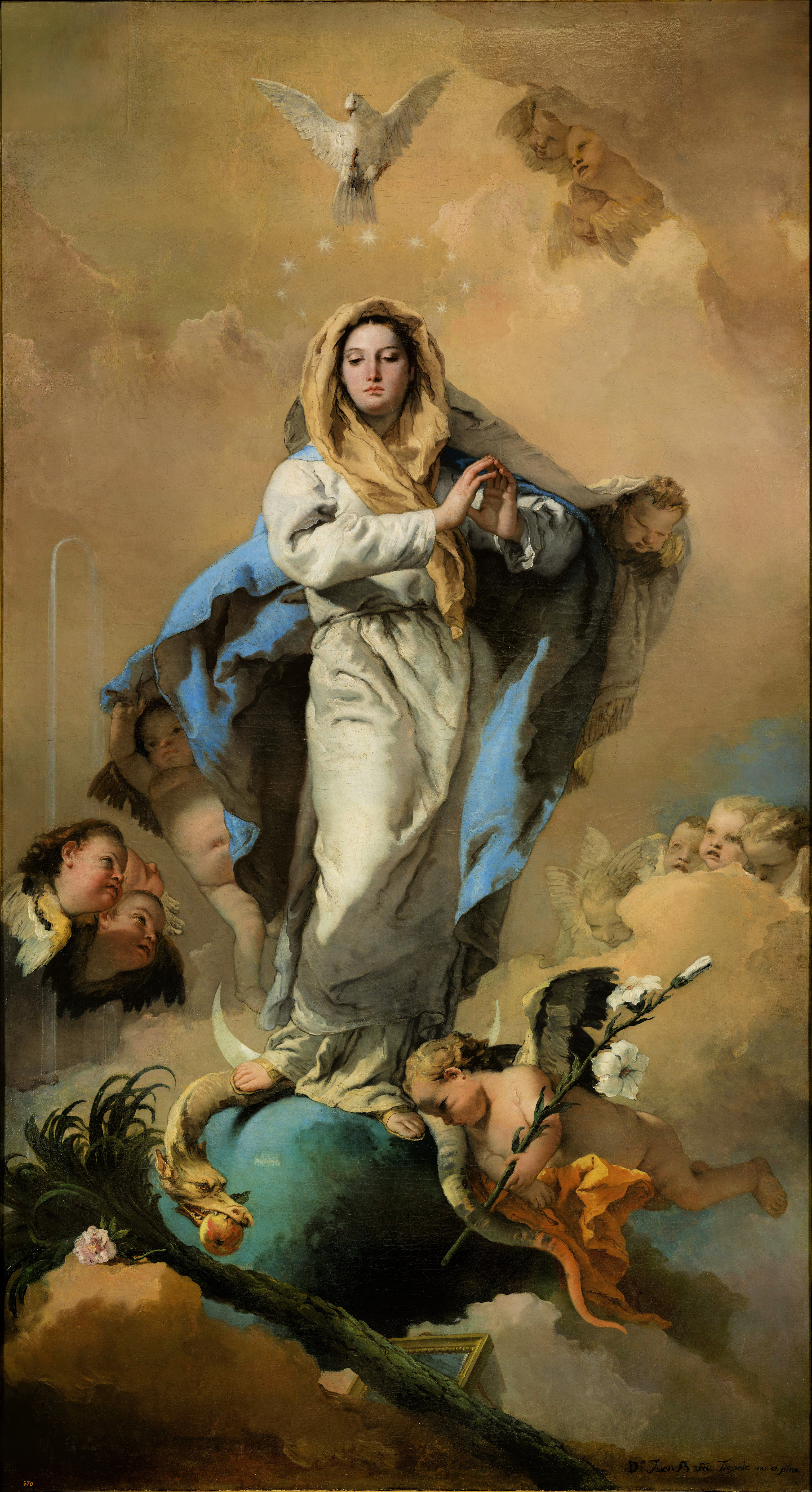
Giovanni Battista Tiepolo (1696-1770), The Immaculate Conception, 1767-1769, oil on canvas, 152x 279 cm, Prado, Madrid. 88% 7.88 mb

Tiepolo depicts Mary with proud, almost sculptural, beauty of a human being free from original sin from the moment of her conception. Mary stands as a fully mature woman who is triumphant over the tempter, the serpent, that slithers and writhes itself across the globe. Mary is surrounded by cherubim with her halo pictured as a circle of stars, usually 12 in number, though some here are implicitly hidden from view. In chapter 12 of the Book of Revelation in the New Testament, “a woman clothed with the sun, with the moon under her feet, and on her head a crown of twelve stars” (Rev. 12: 1) stands against the Dragon who is about “to devour her child when she gave birth” (Rev. 12: 4). That Biblical woman has been identified with Mary, particularly as The Immaculate Conception. The dove that hovers above her in the painting represents the Holy Spirit who emanates from the Father and the Son and rests on Mary fundamentally at her Annunciation (Luke 1) which leads to the birth of Jesus and at Pentecost (Acts 2) which is the birth of the Christian Church. Augmented by roses and lilies, Mary is clothed in her traditional symbolic colors representing her virginal purity (white) as she became pregnant by the Holy Spirit, her role as the sinless human Mother of God (red), her character of fidelity, truth and spiritual serenity (blue), and the glory of her birth as The Immaculate Conception and crowning as Queen of Heaven following her Assumption (gold). Though its dogma was not settled definitively until 1854 by Pope Pius IX (reign, 1846-1878), The Feast of the Immaculate Conception (December 8th) was on the Church calendar as early as 1708 and a popular subject for Catholic Church art throughout the 18th century.
Tiepolo was invited to Madrid in 1762 by Charles III (1716-1788). The artist was accompanied to Spain by his sons, Domenico and Lorenzo, and immediately began the frescoes in the Royal Palace that he finished in 1766. His next commission was for altar paintings, seven in number, for the new Franciscan Convent of San Pascual in Aranjuez, a Royal seat, including The Immaculate Conception. As soon as the series of paintings were finished in 1769, they were considered passé as Tiepolo’s late Baroque Rococo style had given way to the rise of neo-classicism as the next new thing that took hold of Carlos III, Europe and beyond to the United States into the first quarter of the 19th century. Tiepolo, who died in 1770, wasn’t around to see his church paintings fragmented and stored away and replaced by neo-classical artwork of the same subjects by another artist. However, The Immaculate Conception survived intact as King Carlos III ‘s confessor, the powerful Franciscan bishop Joaquín de Eleta (1707-1788) who, holding sway over artistic commissions, favored depictions of The Immaculate Conception as one of his important subjects that shaped late 18th century Spain’s visual culture. Tiepolo’s emotional and elegant version, which he signed, was conserved as a masterful contrast to neo-classicism’s colder rationality. The painting has been in the Prado since 1828 – Mary not content with being relegated to a storage closet – while a preparatory drawing that exists for the artwork made its way into the picture collection of the Lords Kinnaird in London. See- A Basic Guide to The Prado, J. Rogelio Buendia, translated by Patricia S. Parrent, Silex, 1973, pp. 240-241.

Guercino (1591-1666).

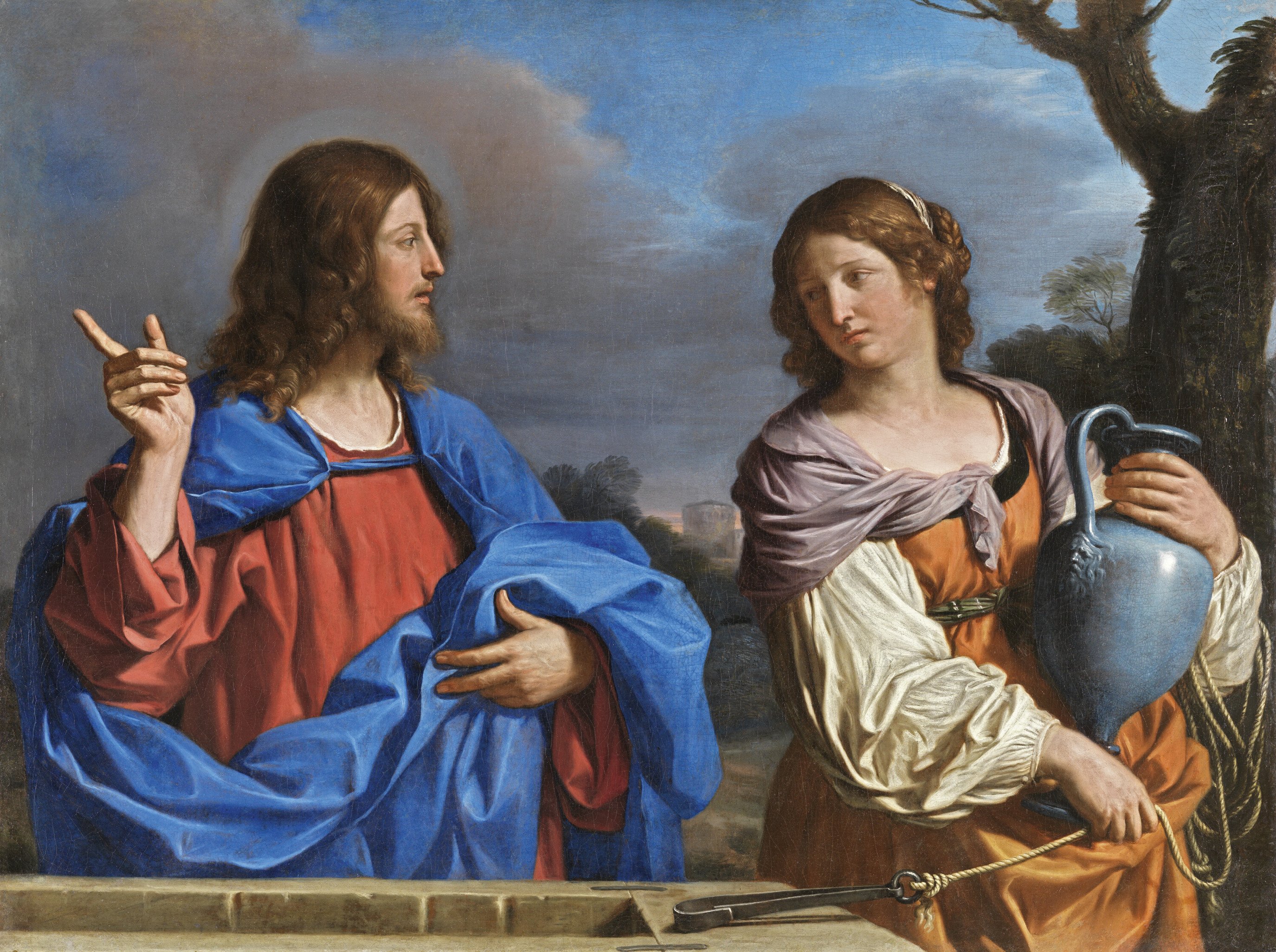
Guercino (1591-1666), Christ and the Woman of Samaria, c. 1640–1641, Museo Nacional Thyssen-Bornemisza, Madrid.

Master(s) of the Lower Basilica of San Clemente, Rome (late 11th Century).

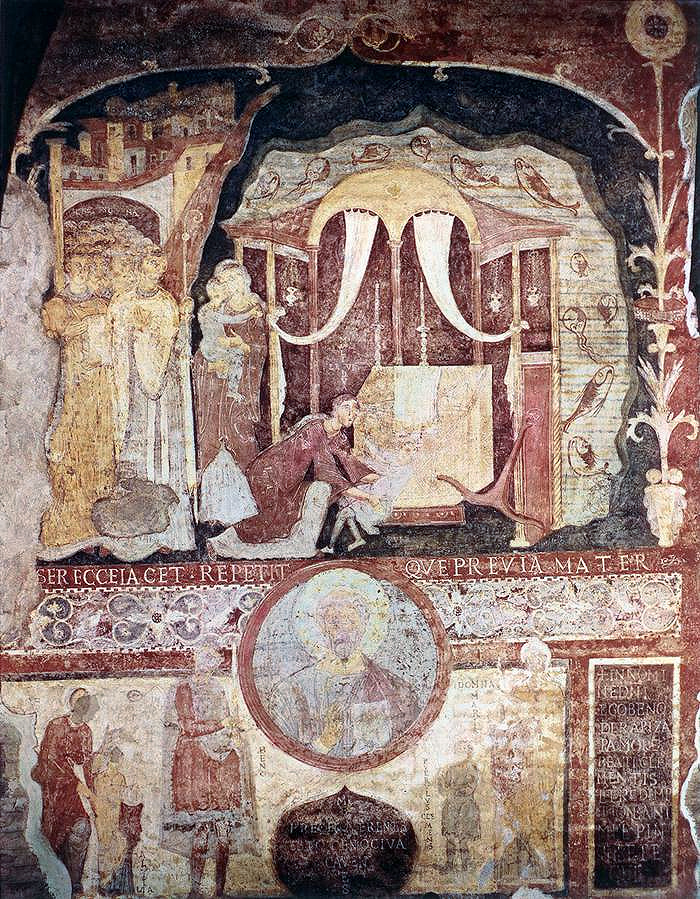
Master(s) of the Lower Basilica of San Clemente (Roman School, late 11th century), The Miracle of the Sea of Azov, fresco, in situ on the eastern wall of the narthex, 4th-century Lower Basilica of San Clemente (beneath the street-level 12th-century Basilica di San Clemente al Laterano), Rome.

St. Clement I: History, Authority, and the Growth of a Cult

Around 96 AD, Pope St. Clement I, the third successor of St. Peter, wrote a landmark letter from Rome to the Christian community in Corinth, where a faction had challenged the authority of local church leaders. Addressing the dispute with pastoral authority, Clement urged reconciliation and obedience, establishing one of the earliest and most influential precedents for apostolic succession and the primacy of the Roman bishop. Rather than merely correcting a local controversy, he grounded his argument in a broader vision of cosmic and social order, maintaining that harmony and discipline were essential virtues in the Church, the state, and even the military. The letter reflects the administrative ideals of the Pax Romana, reinterpreted through Christian concepts of charity, peace, and unity.

Early Christian tradition identified Clement with the “Clement” mentioned by St. Paul in his Epistle to the Philippians, although the historical evidence remains uncertain. Indeed, much about the historical Clement remains elusive, including the circumstances of his death. By the fourth century, however, a rich body of legend had developed around his memory, particularly in the eastern Mediterranean churches. Apocryphal homilies and romances expanded his biography and influence, while churches dedicated to him appeared throughout Italy within centuries of his lifetime. These traditions transformed Clement from an early bishop of Rome into one of the most venerated saints of medieval Christendom.

The Martyrdom Legend and Medieval Devotion

According to the Passion of St. Clement, a legendary account compiled in the late fourth century, Emperor Trajan exiled Clement to Crimea and eventually ordered him drowned in the Black Sea with an iron anchor fastened around his neck. The narrative continues that the sea miraculously receded each year, exposing a magnificent underwater shrine constructed by angels around his tomb. This legend became central to Clement’s cult and profoundly shaped his artistic representation throughout the Middle Ages and Renaissance.

The story gained renewed prominence in the ninth century when Saints Cyril and Methodius, the missionaries to the Slavs, reportedly recovered relics and an anchor believed to belong to Clement in Crimea. They brought these relics to Rome, where Pope Adrian II (867-872) enshrined them beneath the high altar of San Clemente. From this point forward, Clement’s cult acquired a renewed significance in both East and West, helping to establish his position among the most celebrated early popes and martyrs.

The Basilica of San Clemente: Archaeology, Memory, and Artistic Patronage

Rome’s Basilica di San Clemente, situated near the Colosseum and administered since 1677 by the Irish Dominicans, stands as the principal monument to Clement’s memory. Built in successive archaeological layers, the complex incorporates the remains of Imperial Roman structures traditionally associated with Clement’s family home. Descending through its levels, which I have done during my travels, reveals a fourth-century basilica adorned with early medieval frescoes—as well as an ancient Roman alleyway, a Mithraic temple, and first-century buildings lying even deeper beneath the street.

Today the basilica serves not only as a place of worship but also as one of Rome’s most remarkable repositories of medieval and Renaissance art. Virtually every major decorative program within the church reflects episodes from Clement’s life, martyrdom, miracles, and cult, making San Clemente an exceptional visual record of how medieval Christians understood and celebrated the saint.

Romanesque Frescoes and the Visual Narrative of Clement’s Cult

Among the most important works are the late eleventh-century frescoes preserved in the Lower Basilica. These paintings include scenes from the Passion of St. Clement, such as the miraculous recession of the sea, the translation of his relics to Rome by Saints Cyril and Methodius, and other episodes associated with his cult and martyrdom.

Particularly famous is the fresco depicting the pagan prefect Sisinnius attempting to arrest Clement. Through divine intervention, Sisinnius and his henchmen are struck with visual delusion, binding and struggling to drag a massive stone column in the belief that they have captured the saint. The fresco is renowned for its painted dialogue—an early precursor to speech bubbles—which preserves some of the earliest surviving examples of written Italian vernacular (volgare) spoken by the frustrated persecutors alongside the formal Latin of Saint Clement.

The Miracle of the Sea of Azov Fresco

One of the finest surviving images associated with Clement’s legend is the late eleventh-century Romanesque fresco in the narthex of the Lower Basilica depicting The Miracle of the Sea of Azov. The circular medallion below contains a portrait of Pope St. Clement himself, shown with a halo and episcopal vestments, blessing the viewer while holding a jeweled Gospel book.

The upper register illustrates a celebrated medieval miracle recounted in both the Passion of St. Clement and Jacobus de Voragine’s Golden Legend. According to the story, the sea parted annually on the anniversary of Clement’s martyrdom, allowing pilgrims to reach the angel-built shrine surrounding his tomb beneath the waters. During one such pilgrimage, a mother accidentally left her young son behind within the submerged sanctuary. When she returned the following year after the waters receded once more, she discovered the child miraculously alive and unharmed through the saint’s intercession.

The composition employs the medieval technique of continuous narration, depicting the same figures multiple times within a single image to convey successive moments in the story. At the center, the astonished mother kneels within the shrine while recovering her son beside the altar. To the left, she appears again, joyfully carrying him away as clergy and townspeople emerge from the city to witness the miracle. Fish, eels, octopuses, and other marine creatures swimming around the shrine emphasize the extraordinary setting of a sanctuary preserved beneath the sea.

Equally significant is the donor portrait occupying the lower register. Here Beno de Rapiza, his wife Maria Macellaria, and their children Clement and Altilia approach the saint with candles and gifts. A dedicatory inscription records their patronage, and the group constitutes one of the earliest surviving representations of an ordinary, non-aristocratic medieval family in Roman wall painting.

The Triumph of the Cross and the Cosmic Order of Clement’s Theology

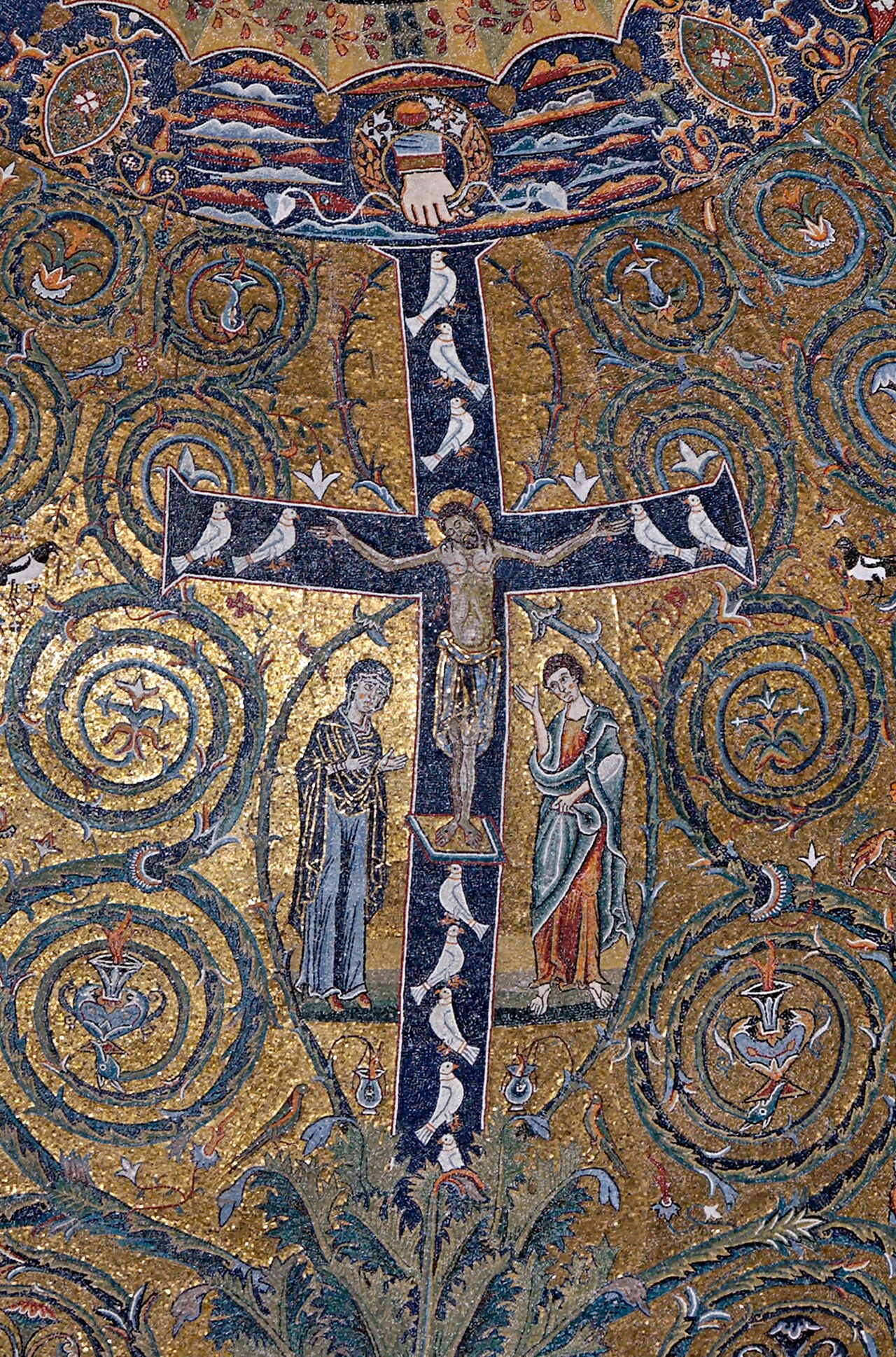
The artistic program culminates in the twelfth-century Upper Basilica, where the apse is dominated by the celebrated mosaic of the Triumph of the Cross. The cross is transformed into a luxuriant Tree of Life whose branches spread across a radiant gold background, filling the cosmos with vines, birds, animals, and human figures. More than a decorative masterpiece, the mosaic visualizes the harmonious and divinely ordered universe described in Clement’s letter to the Corinthians. The theme of spiritual unity emerging from divine order links the basilica’s greatest monument directly to the theological vision of its patron saint.

Triumph of the Cross (detail). Apsis mosaic from Upper Basilica San Clemente in Rome, 12th century.

Clement in Renaissance Art and Western Iconography

The cult of St. Clement continued to flourish during the Renaissance. Within San Clemente itself, the titular cardinal Branda Castiglione commissioned Masolino da Panicale—probably with early assistance from Masaccio—to fresco his family chapel in the late 1420s. Although that celebrated Quattrocento cycle focuses on the lives of St. Catherine of Alexandria and St. Ambrose rather than Clement himself, it underscores the enduring prestige of Clement’s titular basilica as a center of artistic patronage. Beyond Rome, Clement became a familiar figure in medieval and Renaissance painting and sculpture, instantly identifiable by the iron anchor associated with his legendary martyrdom. This attribute not only distinguished him visually but also established him as the patron saint of mariners, ensuring the enduring presence of his cult throughout Christian Europe.

#SanClemente #SaintClement #MedievalArt #RomanesqueArt #Frescoes #ChurchHistory #ArtHistory #Rome #ChristianArt #Hagiography