


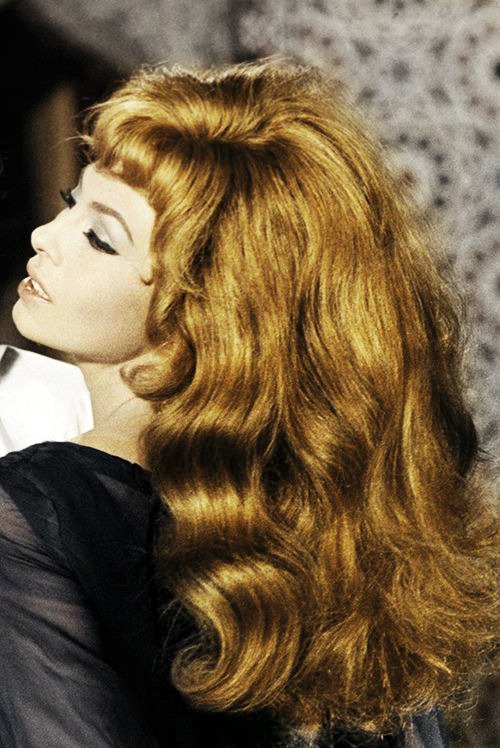
FEATURE image: Michèle Mercier c. 1965, showcasing her classic 1960s high-volume bouffant hairstyle, winged eyeliner, and mod fashion sense. This color portrait session was captured by famed French photographer Jean-Marie Mazeau. Mercier did not achieve massive international stardom until late 1964 with the release of the first Angélique film. This sudden rise to fame triggered a surge of high-end, color studio publicity shoots in 1965 to promote her as Europe’s next major screen icon. PHOTO: “Kippa – overige foto’s Reeks 1 – Michèle Mercier” is licensed under CC BY-NC-ND 4.0.
Michèle Mercier’s enduring place in film history rests overwhelmingly on her portrayal of Angélique, a role that transformed her into an international screen goddess while simultaneously defining and limiting her career. The five-film Angélique series (1964-1968) secured her cinematic immortality even as it typecast her beyond escape.
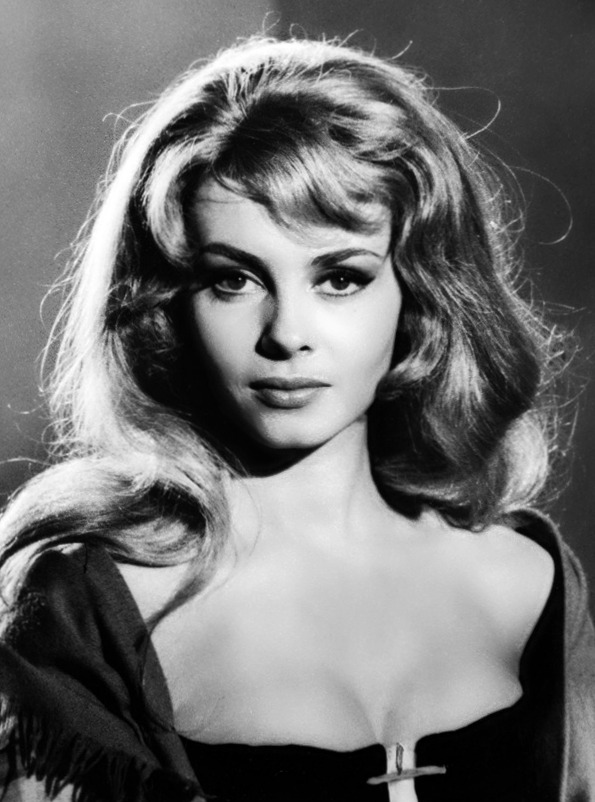
Promotional movie still and character portrait features French cinema icon Michèle Mercier, for her most famous role as Angélique. It was shot during the production on a film studio soundstage or a production set in France for the very first film in her breakthrough series, Angélique, Marquise des Anges (Angélique, Marquise of the Angels), which premiered in December 1964.
Michèle Mercier as Angélique is a French Italian beauty who has entered the pantheon of screen goddesses based largely on the legendary five-film role that stretched from 1964 to 1968.
From Novel Heroine to Screen Legend
Michèle Mercier, born New Year’s Day in 1939, is a French actress best known for playing the lead role of Angélique in the mid1960s film series of the same name based on the 1956 sensational novel Angélique, the Marquise of the Angels by husband and wife writing team of Anne and Serge Golon. Their mid-17th century character was based on a real-life Suzanne du Plessis-Bellière who was one of France’s most famous women from the time of Louis XIV, the Sun King. The historical Suzanne first appeared in a mid-nineteenth-century French novel by Alexandre Dumas, père, titled Le Vicomte de Bragelonne, ou Dix ans plus tard. Like the Angélique cycle, which had grown to six novels by 1961 and ultimately expanded to thirteen following the success of the 1964 film adaptation, Dumas’s novel was part of a larger series. The third installment in his d’Artagnan trilogy, Le Vicomte de Bragelonne was originally published in serialized form between 1847 and 1850.
The Search for the Perfect Angélique
For the part of Angélique, many other beautiful and more famous actresses were approached before Michèle Mercier who was little known in the French cinema at the time. Seasoned French film producer Francis Cosne (1916-1984) wanted sex symbol Brigitte Bardot to play the part, but she rejected the offer. Young Catherine Deneuve was considered perhaps too naive for the lusty role. American Jane Fonda spoke French but could an American play fully a quintessentially French role? Italian beauty Virna Lisi was too busy doing Hollywood films. Not being already famous eliminated statuesque Danish actress Annette Stroyberg from the running until ultimately Michèle Mercier was decided upon after almost losing the part to French actress Marina Vlady who at the last minute didn’t sign the contract.
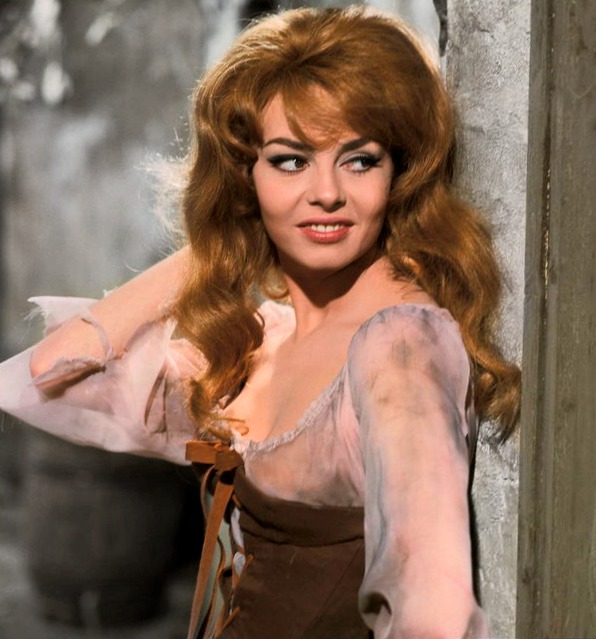
Michèle Mercier as Angélique. The photo was taken in 1964 during the production and filming of the first movie in the saga, Angélique, Marquise des Anges. Mercier is leaning against a stone wall in an outdoor or village set and wearing a peasant-style costume. While Angélique begins her journey as an elegant, wealthy noblewoman, the plot strips her of her status when her husband is falsely accused of sorcery. The tattered, dirt-streaked fabric of her sleeves directly mirrors her forced survival among Paris’s underbelly, the Cour des Miracles (Court of Miracles). The film adaptation heavily shifted away from the spiritual tone of the original novels to lean into the era’s emerging demand for a bold, free-spirited, and highly eroticized screen siren. Her low-cut corset, exposed shoulders, and undone hair visually represent her transformation into a fierce, independent femme fatale who leverages her beauty to navigate danger and protect herself.
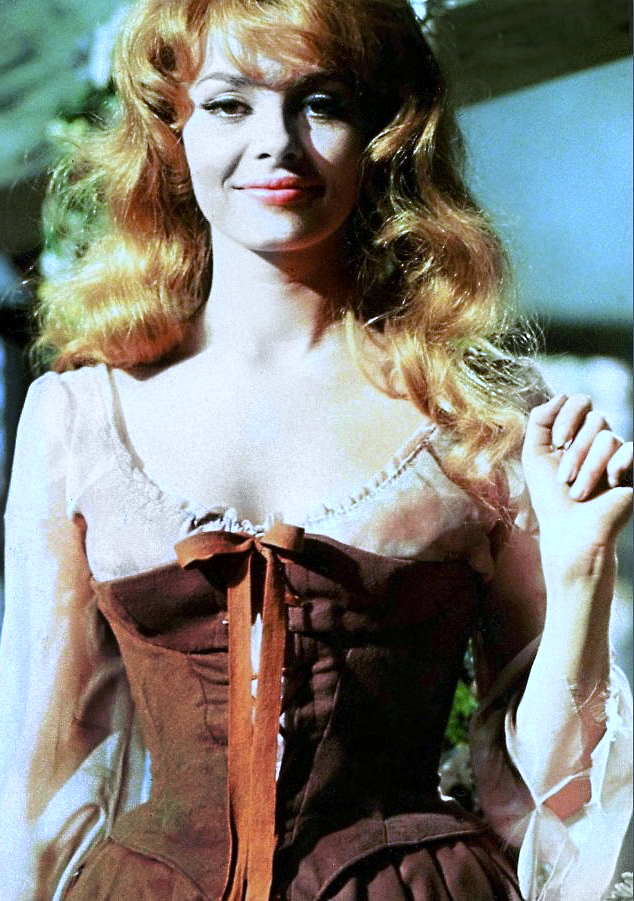
Even when Angélique is running a local tavern in the story, she doesn’t look like a standard, gritty medieval merchant. The production team leaned heavily into a romanticized “starlet” aesthetic rather than strict historical realism.

This picture was taken in 1964 or early 1965 during the production and filming of the second installment in the franchise, titled Merveilleuse Angélique (Marvelous Angélique), which was released theatrically in 1965. The photo depicts Angélique during her transition phase from the underbelly of Paris back toward respectability. In this portion of the story, Angélique manages to escape the squalor of the Cour des Miracles (Court of Miracles) and partners with her childhood friend Claude le Petit. She uses her wits to invest in a popular inn and tavern called The Red Mask (Le Masque Rouge) and becomes a respectable independent businesswoman.
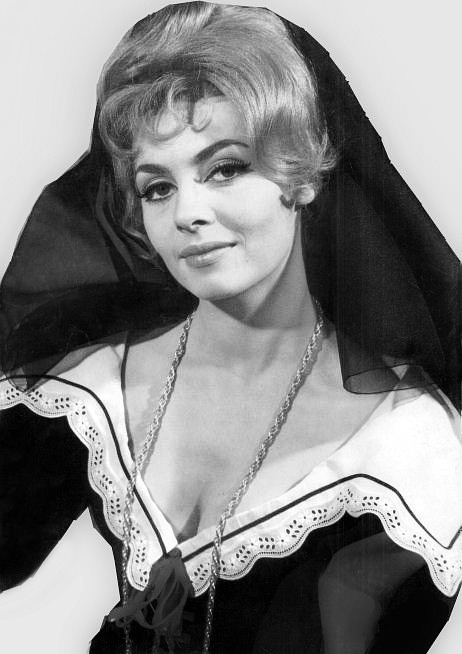
This photograph was taken in 1965 for the second film in the franchise, Merveilleuse Angélique (Marvelous Angélique). Within the plot of the film, this outfit represents her mourning the tragic death of her true love and first husband, Joffrey de Peyrac, who was executed at the stake in the climax of the first movie.
Not the Unknown Many Assumed
When the opportunity of Angélique presented itself to Michèle Mercier, she was a relative newcomer to the French cinema. But this anonymity was not the case for her either in French theatre arts or Italian films where before 1964 she had acted in over 20 of them.
Before Angélique: From Ballet Student to French New Wave Actress
With a father who was French and mother who was Italian, Michèle Mercier from her early teens growing up in Nice, France, was determined to be a professional ballet dancer.
In 1957, at 17 years old, she moved to Paris which was a decision that changed her life. By 1960, when she was just 20 years old, she was acting in French New Wave film director François Truffaut’s second film, Shoot The Piano Player.

The photo was taken in 1965 during the filming and production of the third installment in the movie franchise, titled Angélique et le Roy (Angélique and the King). The image depicts Angélique during her introduction and peak integration into the high-society royal court of King Louis XIV at the Palace of Versailles. The intricate lace gown, wide-swept neckline, and high updo heavily adorned with fresh white roses reflect a deliberate blend of historical 17th-century court style with mid-1960s beauty standards. By this point in the saga, Angélique has overcome poverty, successfully managed her own business ventures, and successfully married her cousin, Philippe de Plessis-Bellière. This marriage restores her full aristocratic status, giving her the power and position to navigate the court politics of Versailles, capture the romantic attention of the King himself, and continue fighting to clear her first husband’s name.
A Blessing and a Curse
After Angélique, the Marquise of the Angels was released —an unlikely heroine’s role where Angélique’s singular flaming red-haired beauty is acknowledged throughout—the role became a blessing and a curse for the budding actress Michèle Mercier. It catapulted her to instant stardom so that her fame rivaled sex symbol Brigitte Bardot in celebrity and popularity, but the role in five popular films typecast her and effectively ended her film career almost as soon as it started.
Five Films, One Immortal Character
Following the first Angélique film in 1964 Michèle Mercier starred in four sequels that includes Merveilleuse Angélique in 1965, Angélique et le Roy in 1966, Indomptable Angélique in 1967 and Angélique et le Sultan in 1968. All these films in the series were directed by French film director Bernard Borderie (1924-1978) and starred Michèle Mercier which bestowed upon the stories a consistent filmic world but also encased the beautiful star in a popular role that was virtually impossible to escape from.

Behind-the-scenes photograph was taken on August 12, 1965, during the filming of the series’ third installment, Angélique et le Roy (Angélique and the King) captured outdoors on the grounds of the Château de Versailles (the Palace of Versailles). Director Bernard Borderie secured permission to shoot directly on location at the famous palace and its sweeping gardens to give the movie authentic 17th-century French historical scope rather than relying strictly on indoor studio stages. This follows her survival in the slums of Paris (Angélique, Marquise des Anges) and her stint running a local tavern (Merveilleuse Angélique). In Angélique et le Roy, she has successfully married her aristocratic cousin, Philippe de Plessis-Bellière, fully restoring her status as a high-society noblewoman. This marks the exact moment she transitions from an outcast survivor into one of the most powerful, courted, and visually radiant figures in the Sun King’s inner circle.
Directed by Bernard Borderie, the five films created a consistent cinematic world centered on Mercier’s charismatic performance.
Michèle Mercier was featured on the magazine covers because she was riding the absolute peak of her global fame from the massive, multi-film Angélique cinematic franchise. The multi-national movie series was coming to its grand finale, making her one of the most talked-about and highly demanded actresses in Europe. Her legacy today remains inseparable from the fictional seventeenth-century heroine she played.

This cover features Michèle Mercier alongside French dancer and choreographer Jacques Chazot on the French television and entertainment weekly magazine, Télé 7 Jours, published for April 20 to April 26, 1968. The cover coincided with the major theatrical push for the final chapters of the Angélique saga including Indomptable Angélique (Untamed Angélique) released just a few months prior in late 1967 and that had become an enormous box-office smash hit across Europe and the fifth and final movie installment, Angélique et le Sultan (Angélique and the Sultan) which had just premiered in theaters in March 1968. Because the series was actively concluding in theaters during these exact weeks, French entertainment media heavily focused on Mercier to celebrate her definitive transition from a rising star into an enduring screen goddess of 1960s cinema.
At the Height of Angélique Mania
When Michèle Mercier was featured on the cover of the April 20-26, 1968, French weekly magazine, Télé 7 Jours with Jacques Chazot, she was riding high in the latest installment in the Angélique film series, Indomptable Angélique which had been released in October 1967 and was a world-wide smash hit. In the film, Angélique discovers that her first husband is alive and travels to the South of France not realizing he is now an infamous pirate. Angélique is captured by slave traders and taken far away to Crete where they intend to sell her. In March 1968, Angélique et le Sultan was released which was the fifth and unintended final entry in the Angélique series based on the novels of Anne and Serge Golon.
The Unmade Sixth Adventure
A planned sixth film called Angelique the Rebel was announced but never made.
Forever Angélique
Following the fifth and final film of the Angélique series in 1968 the French Italian beauty went on to make six more films before her career ended in 1972. Although Michèle Mercier had always appeared in a variety of film genres—the actress played dozens of other women besides Angélique— it was for this 17th century fictional character in five memorable films in 1960s France that has affixed her into the pantheon of screen goddesses for which she receives enduring adoration today.
The role of Angélique elevated Mercier to star status comparable to Bardot in popularity during the mid-1960s. The success of the series became a double-edged sword, as typecasting restricted opportunities beyond it.
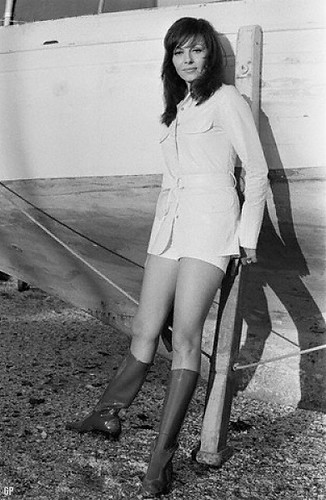
The year 1970 marked a pivotal transition for Michèle Mercier. Seeking to escape the role that had made her an international star, she embraced modern, experimental, and contemporary European films. Dressed here in the era’s trendy mod safari style, with a belted cream tunic shirt, matching short-shorts, and knee-high leather boots, Mercier looked every inch the woman of a new decade. Yet severe typecasting followed her career. Attempts to establish herself in the United States brought only limited success, and despite playing many other roles, she would remain forever Angélique, the character who made her a star and secured her place among cinema’s enduring screen goddesses. PHOTO: “hotpants-1970-michele-mercier” by Gerard Van der Leun is marked with CC BY-NC-ND 2.0.
MICHÈLE MERCIER “ANGÉLIQUE” SERIES FILMOGRAPHY
1964:
Angélique, Marquise des Anges
Michèle Mercier as Angélique
Directed by Bernard Borderie
Released December 8, 1964
Distributed by S.N. Prodi; Gloria Film; Butcher’s Film Distributors
1965:
Marvelous Angelique (Merveilleuse Angélique)
Michèle Mercier as Angélique
Directed by Bernard Borderie
Released July 7, 1965
Distributed by S.N. Prodi; Gloria Film
1966:
Angelique and the King (Angélique et le Roy)
Michèle Mercier as Angélique
Directed by Bernard Borderie
Released February 4, 1966
Distributed by Gloria Film
1967:
Untamable Angelique (Indomptable Angélique)
Michèle Mercier as Angélique
Directed by Bernard Borderie
Released October 27, 1967
Distributed by S.N. Prodi; Gloria Film
1968:
Angelique and the Sultan (Angélique et le Sultan)
Michèle Mercier as Angélique
Directed by Bernard Borderie
Released March 13, 1968
Distributed by S.N. Prodi; Gloria Film

Michèle Mercier in Cabourg, France, June 1988. PHOTO: “File:Michelemercier02b.jpg” by Roland Godefroy is licensed under CC BY-SA 3.0.



