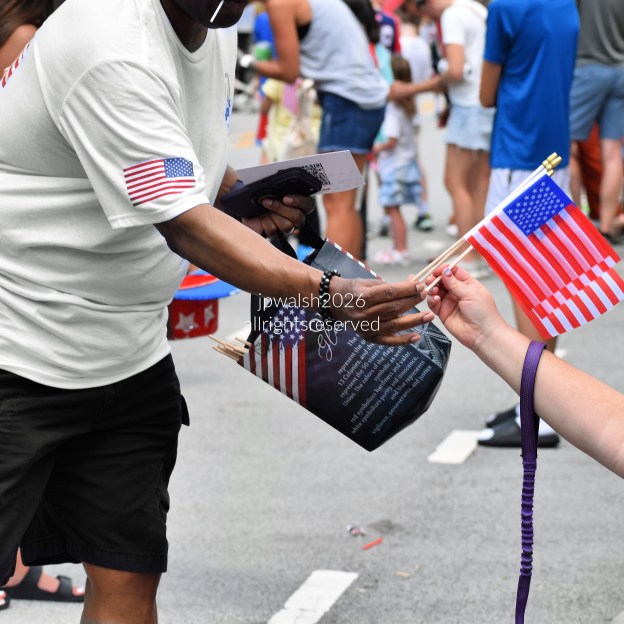
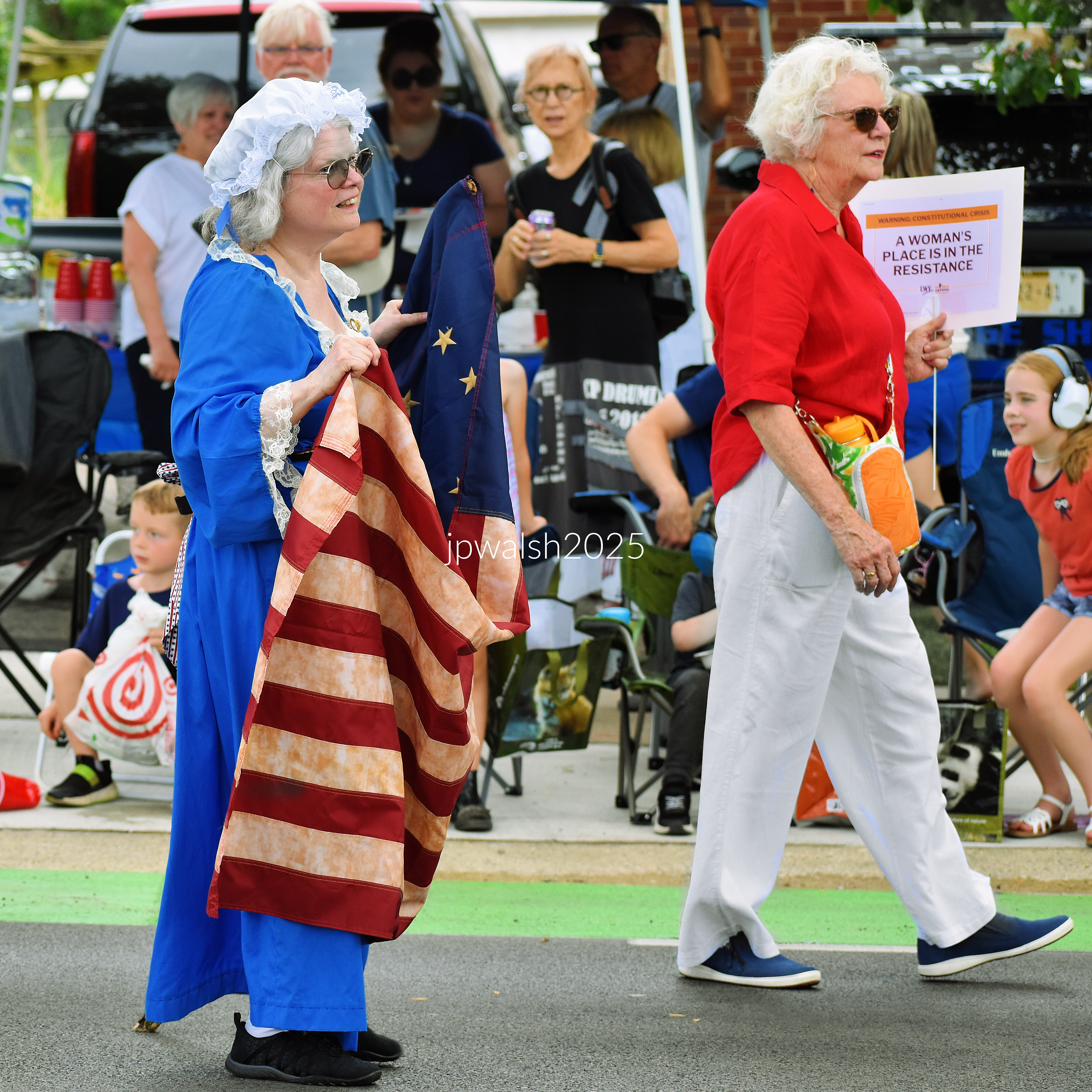
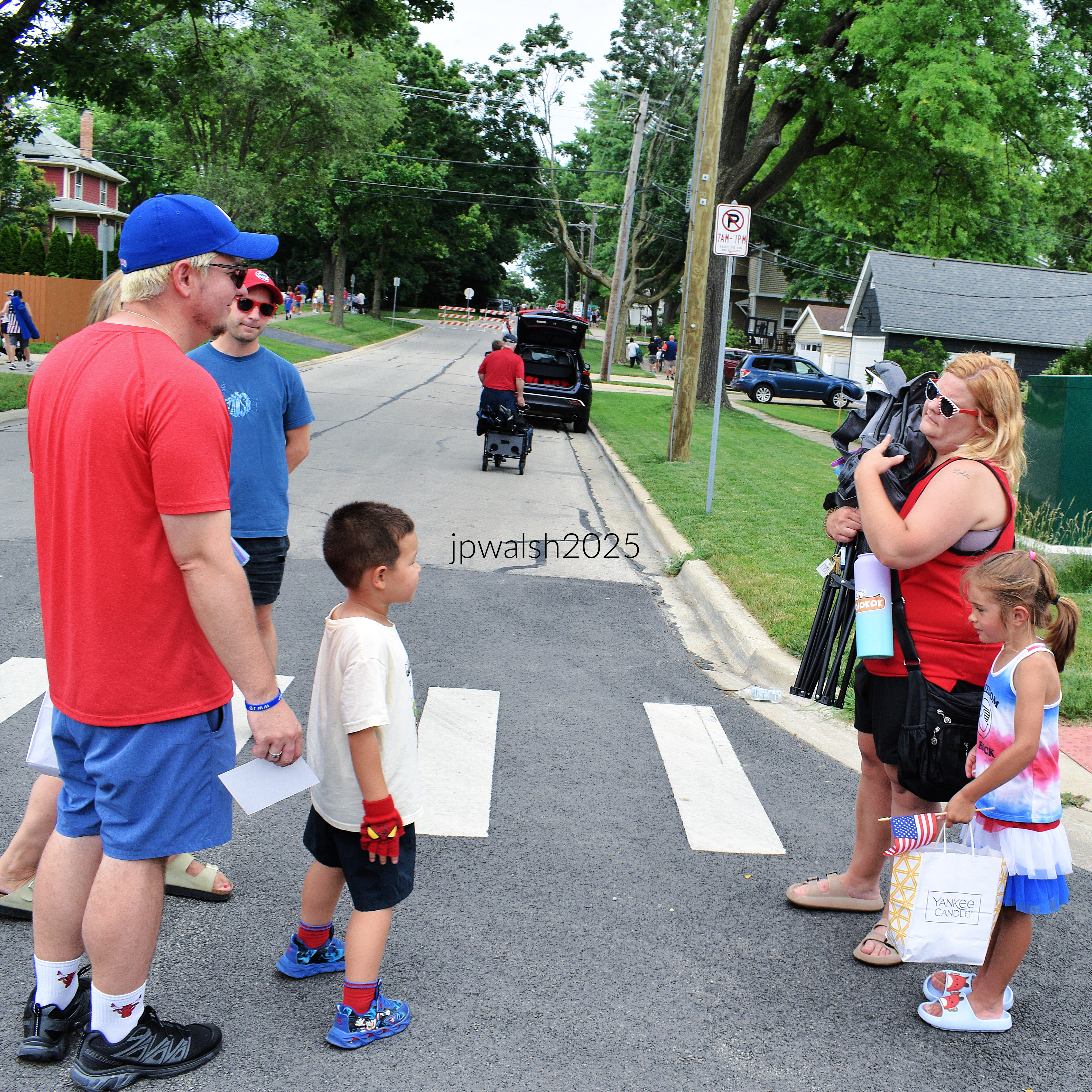
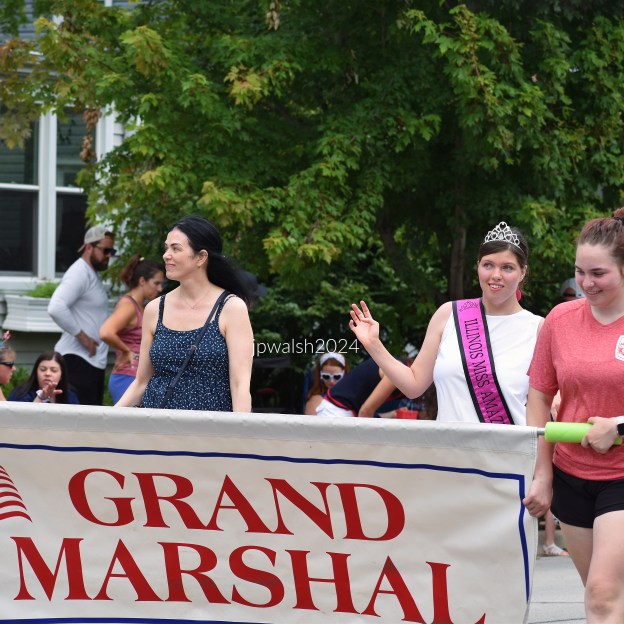
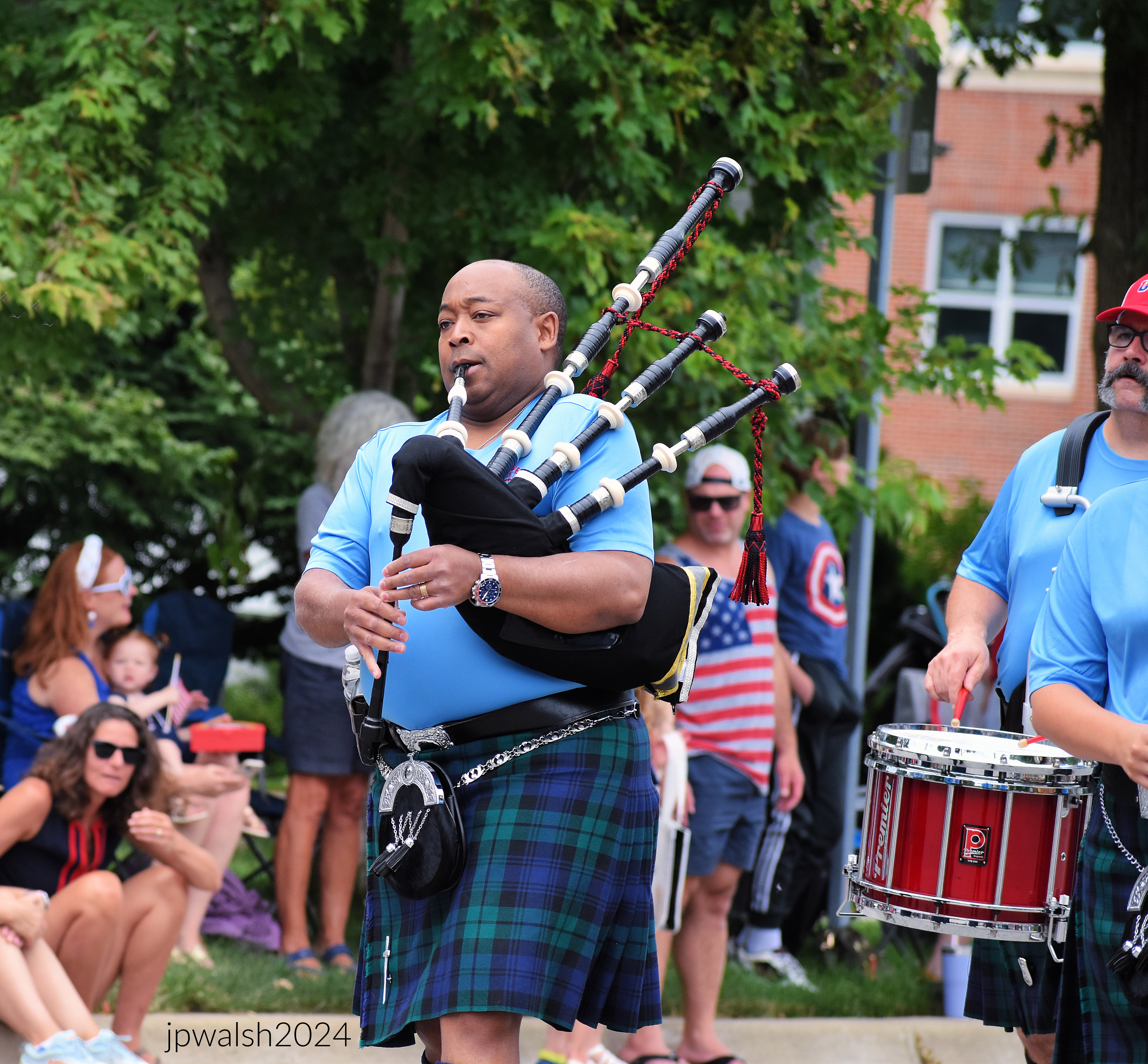
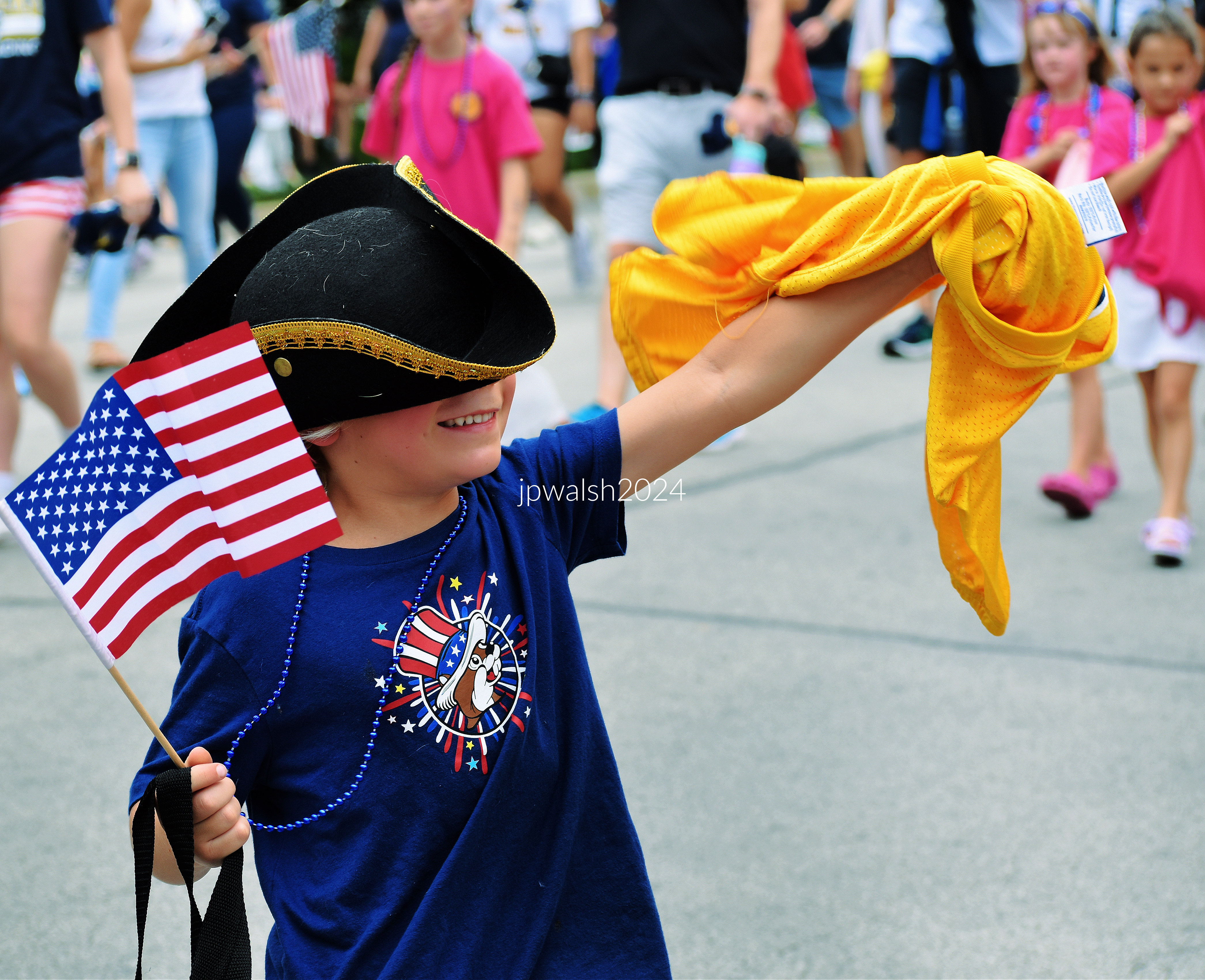
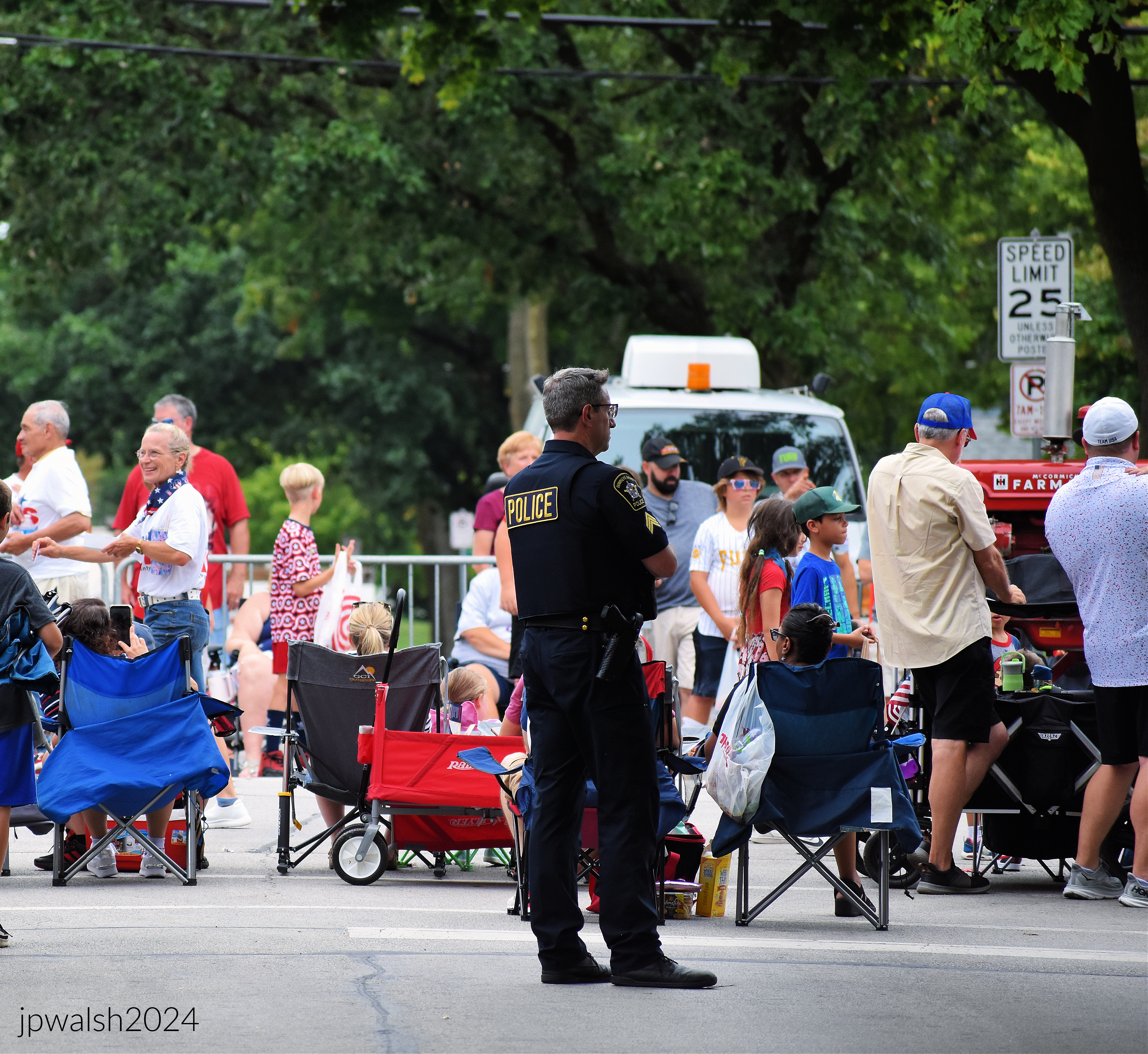
FEATURE image: A parade marcher passes a small American flag to a spectator along the route during the July 4, 2026, parade that marks the 250th Anniversary of the nation’s founding. 7.89mb DSC_9419 (1)
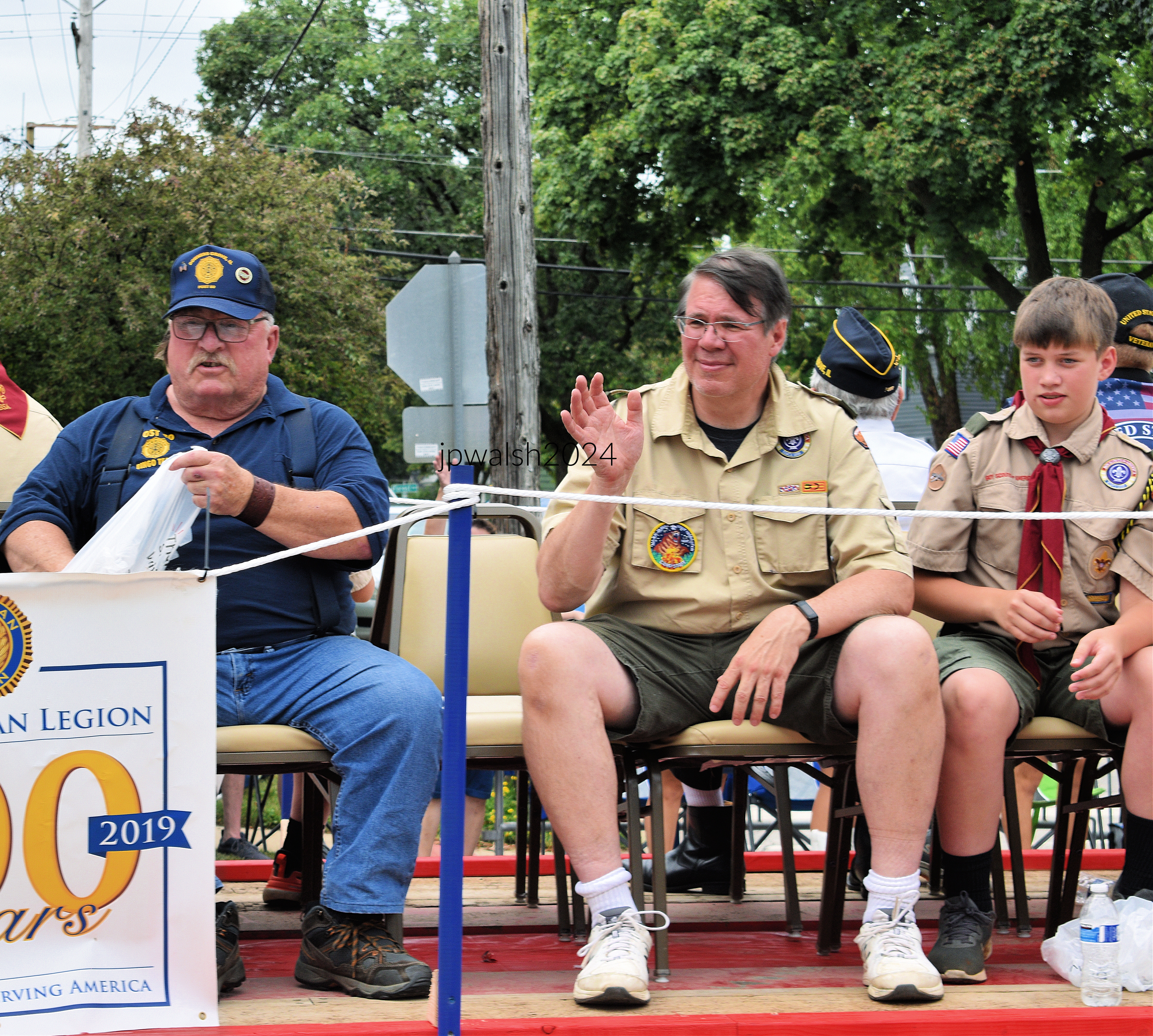
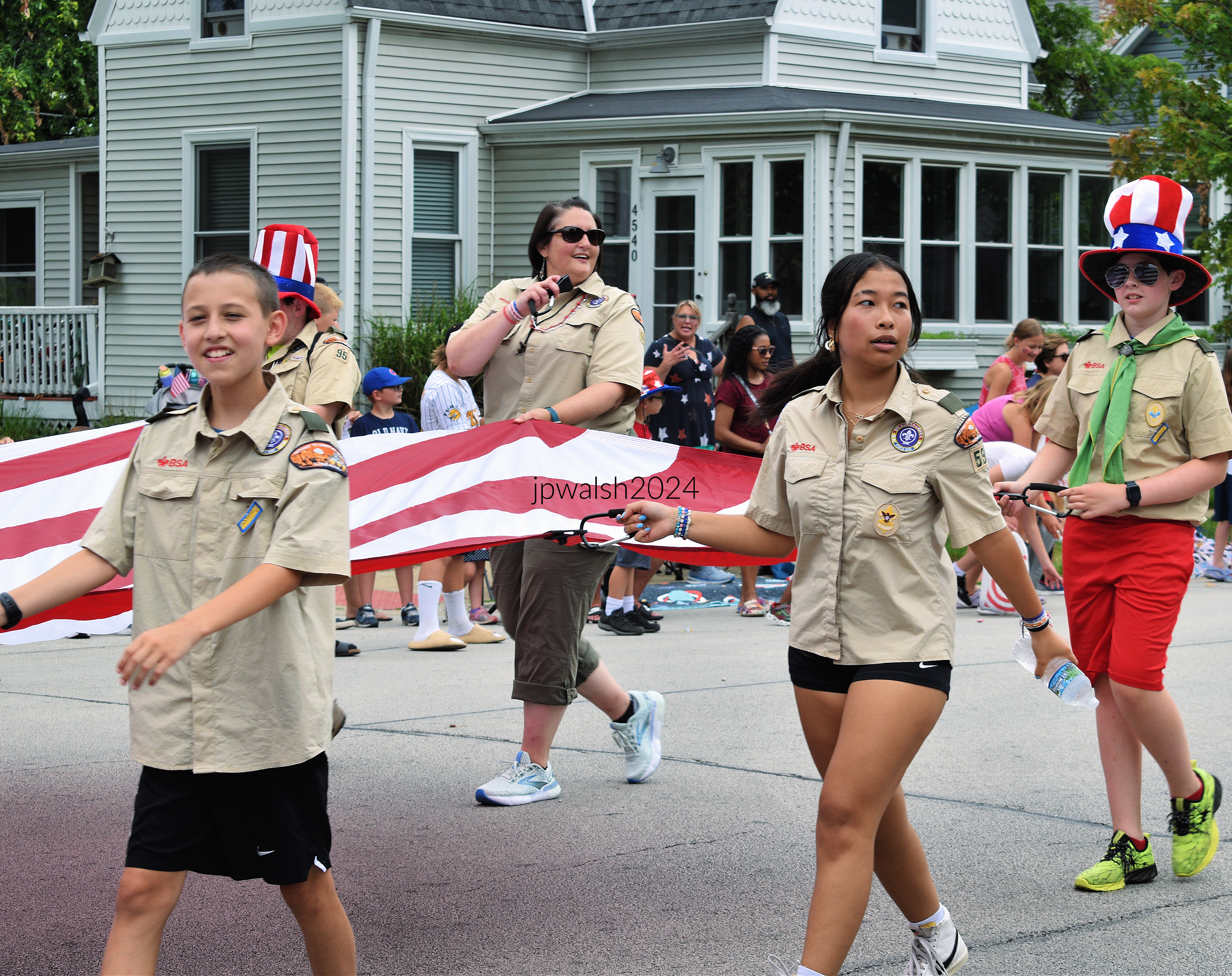
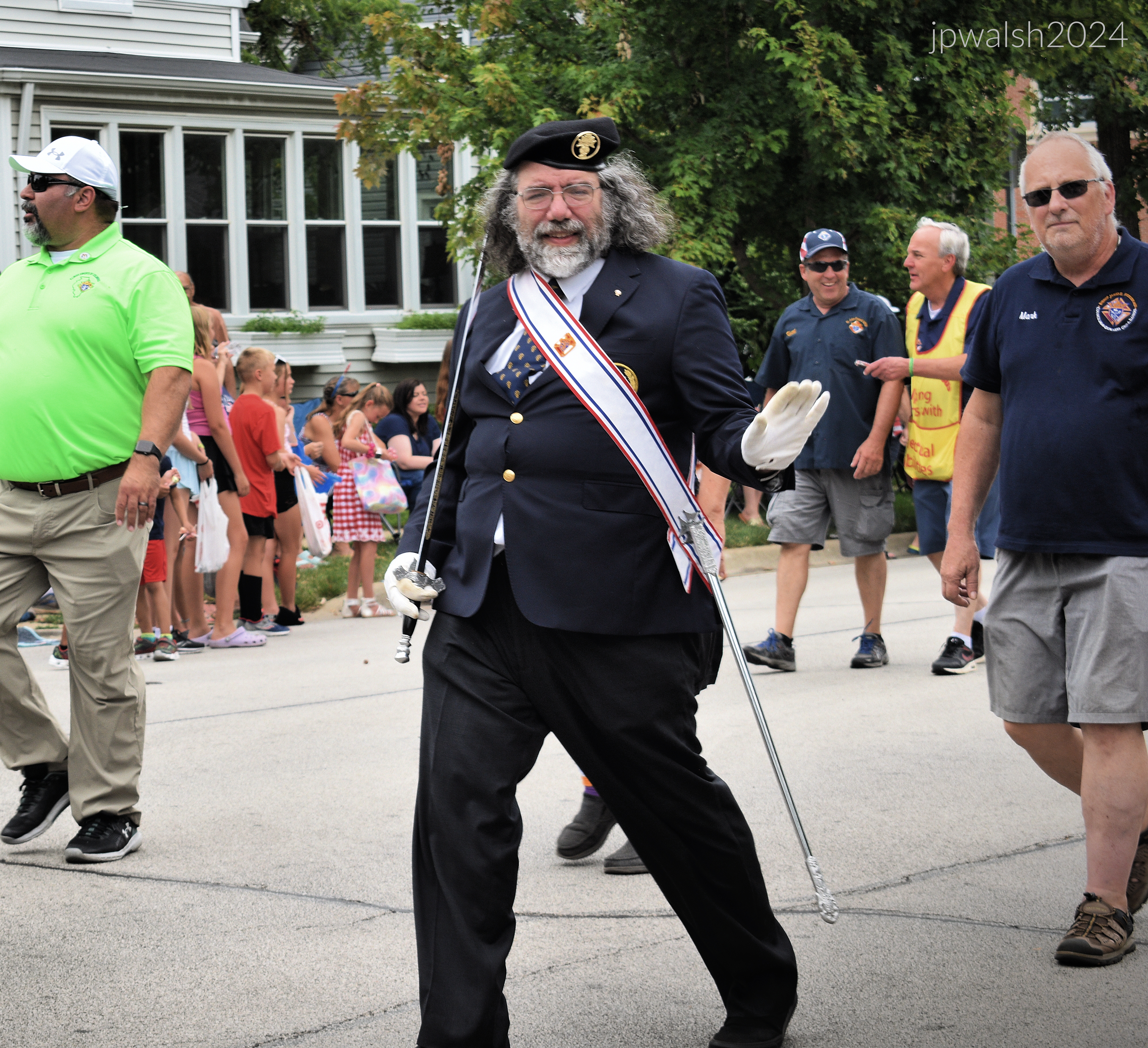
Documents the 250th Anniversary of American Independence through the local community parade in Downers Grove, Illinois.
All photographs and text by John P. Walsh.
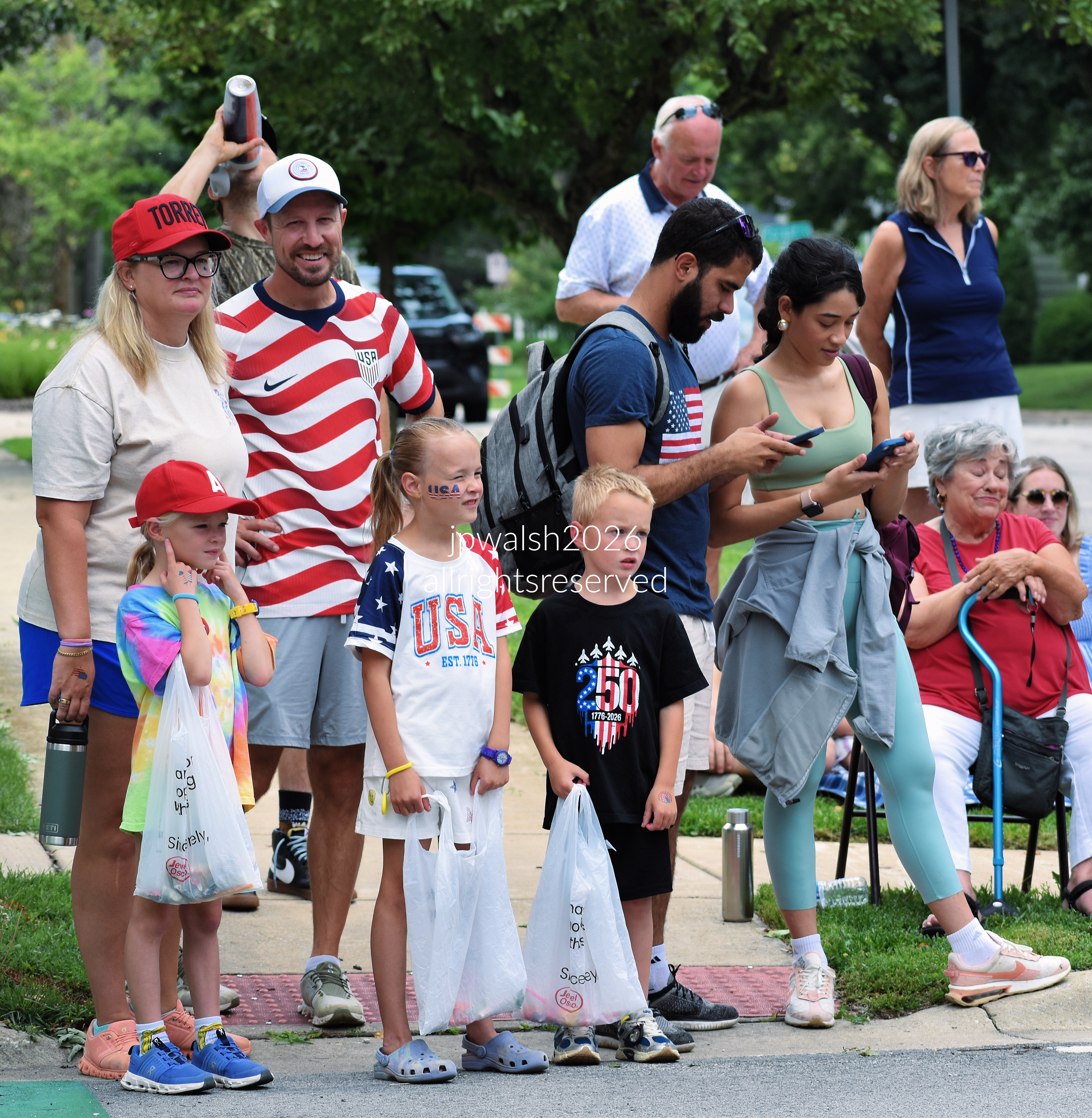
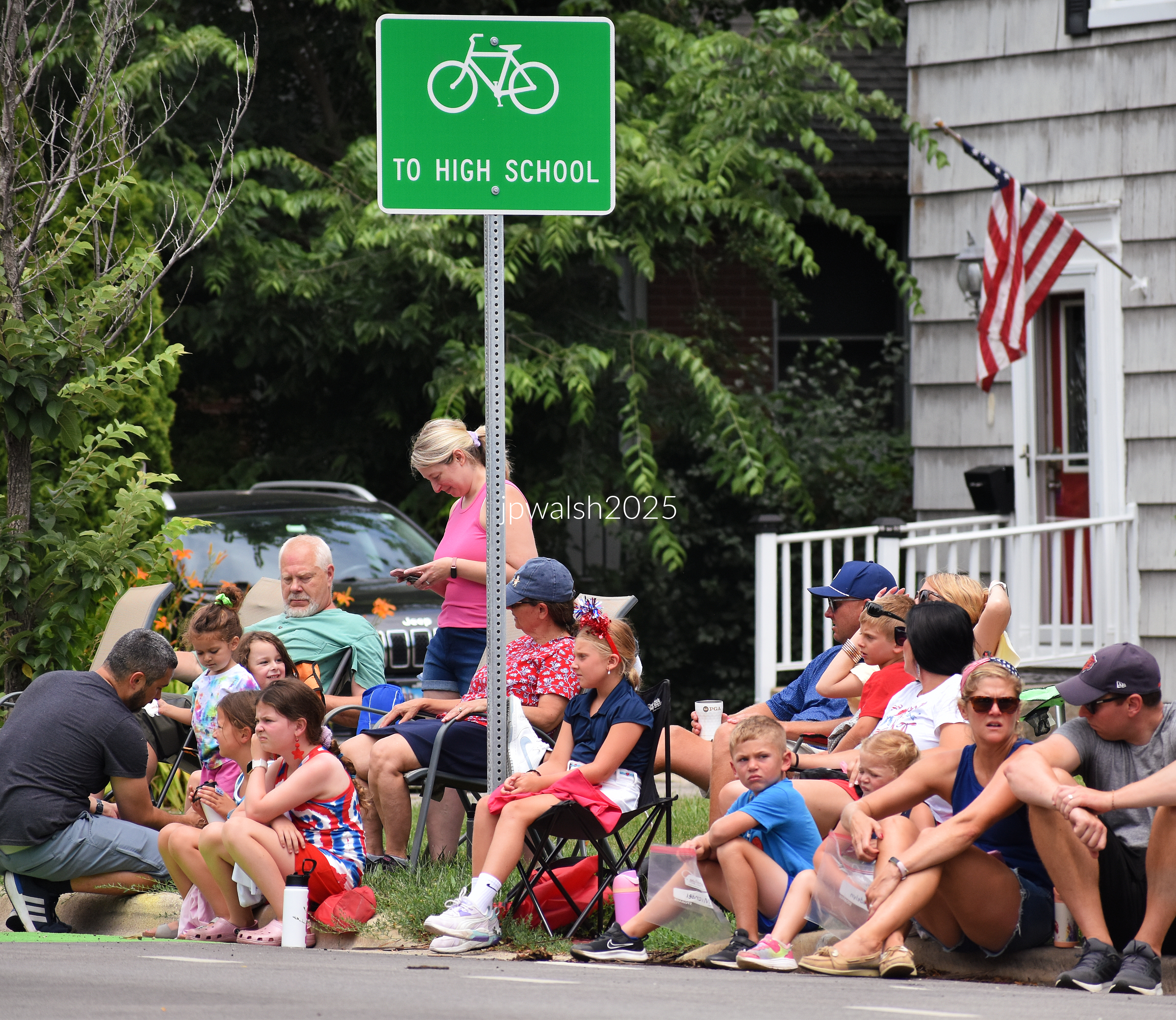
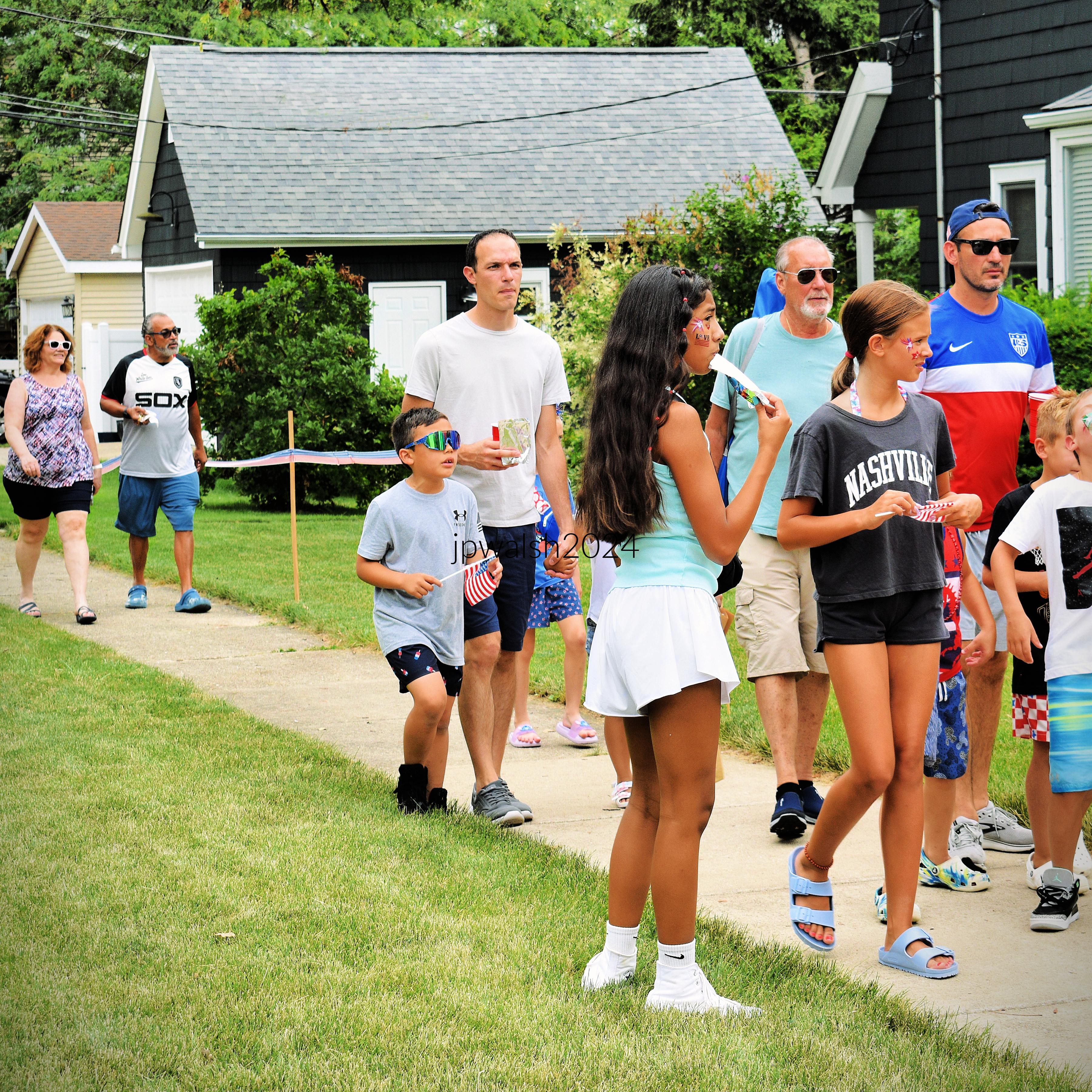
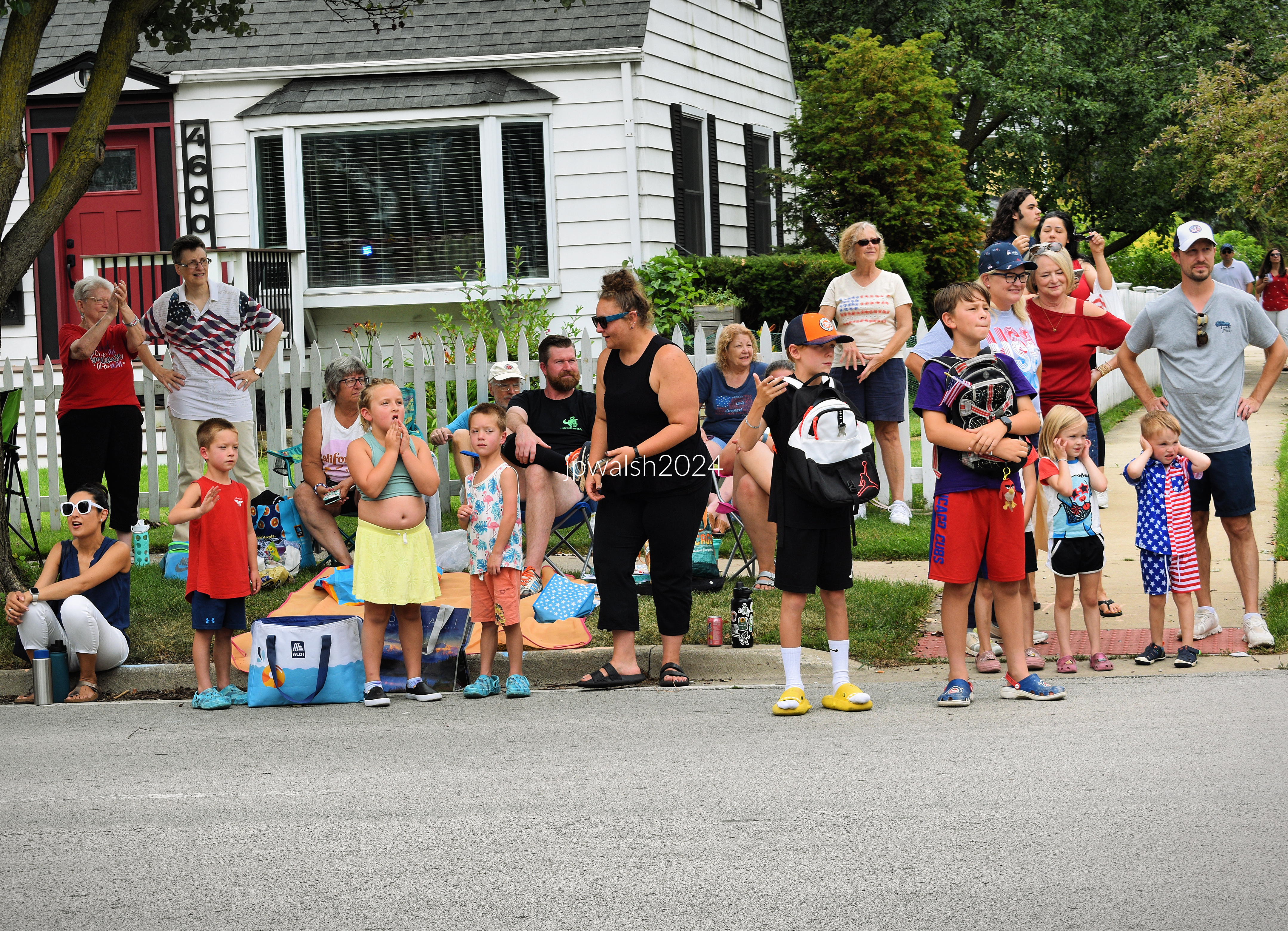
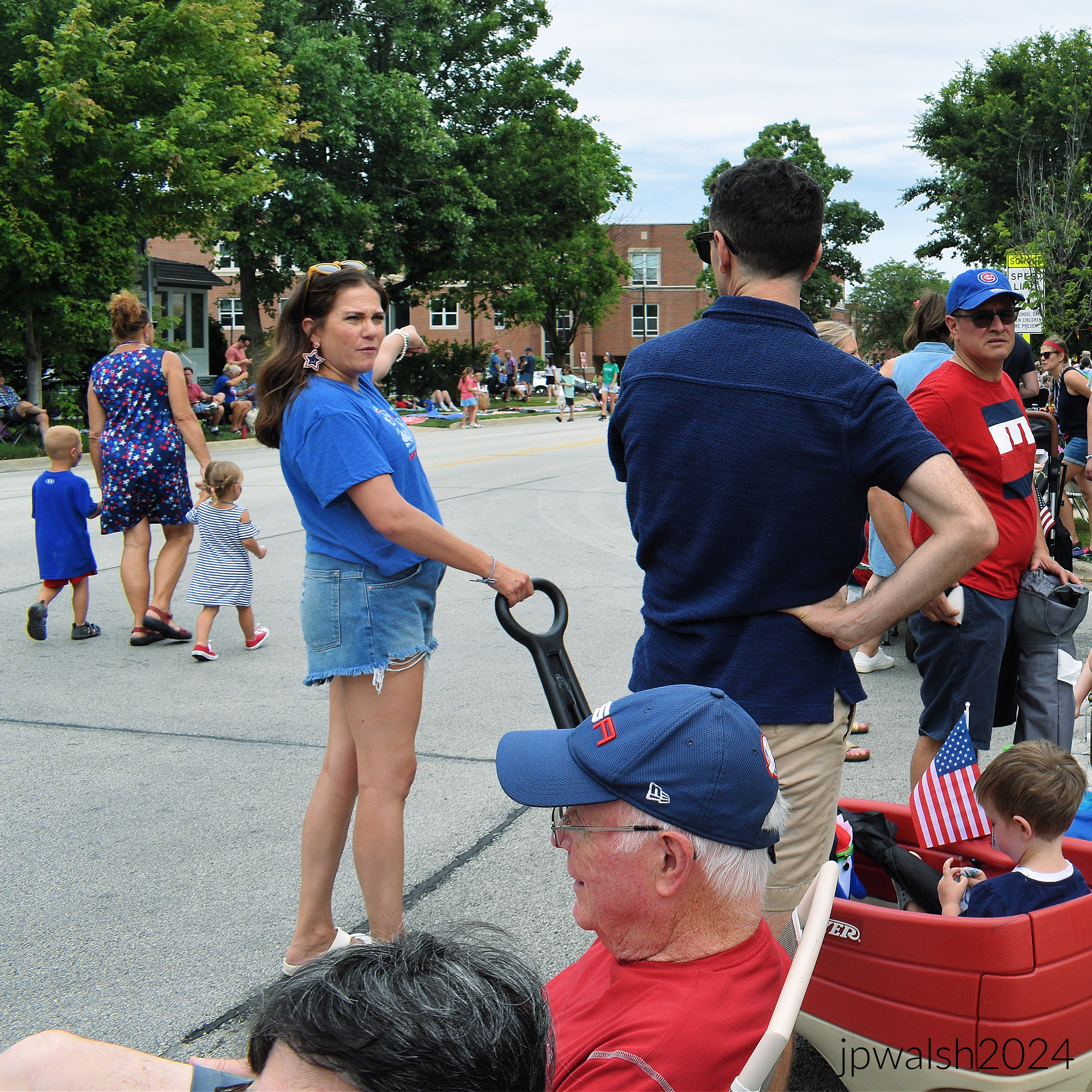
A sidewalk of red, white, and blue—neighbors gathered, kids ready, the holiday rolling in. 7.68mb DSC_9356 (1)
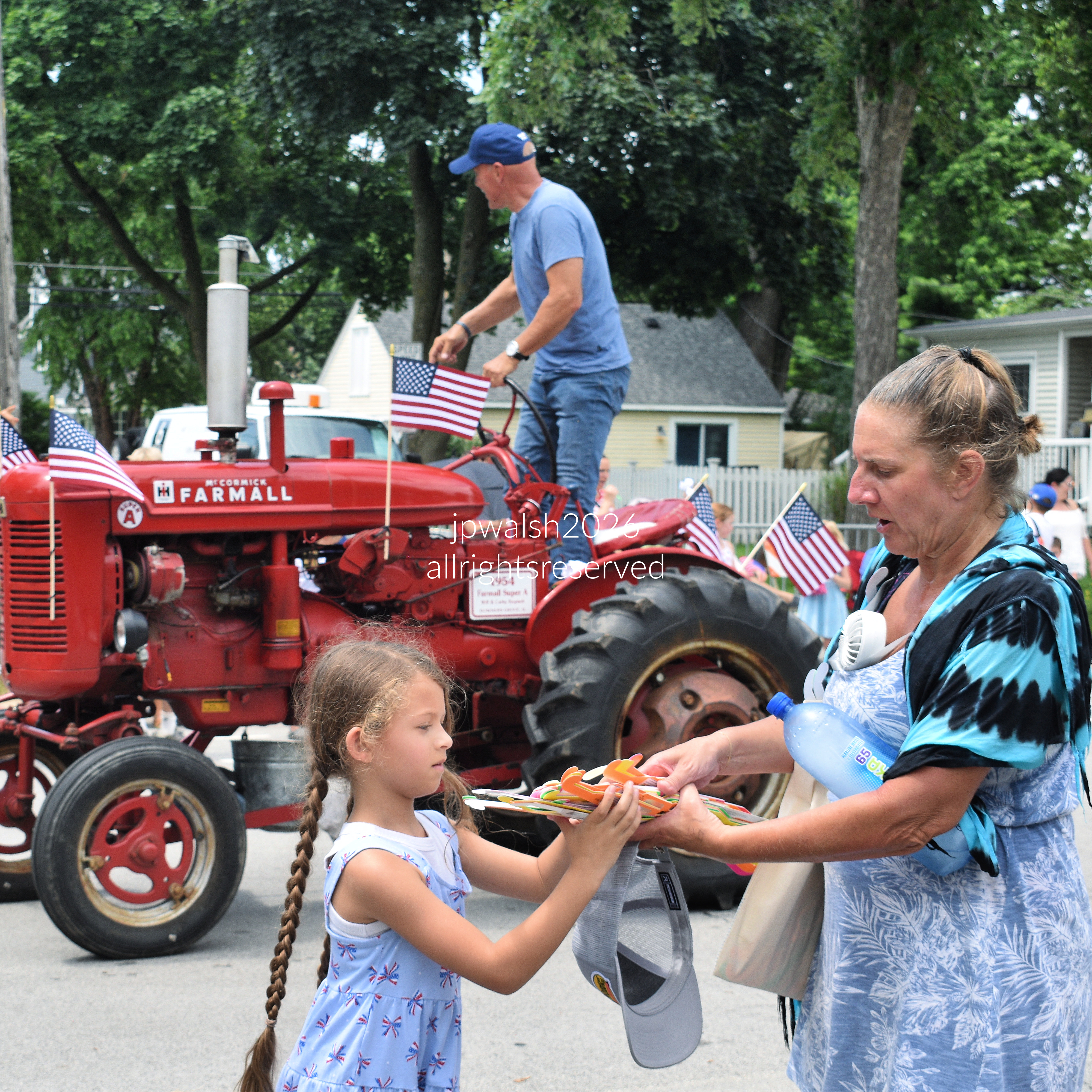
Parade heat, bright colors, and a red tractor rolling by—hands out, smiles up, summer in full stride. 6.30mb DSC_7840 (1)
A classic green Ford dressed in bunting—rolling steady, carrying the holiday’s old‑road pride into the present. 3.86mb DSC_7816 (1)
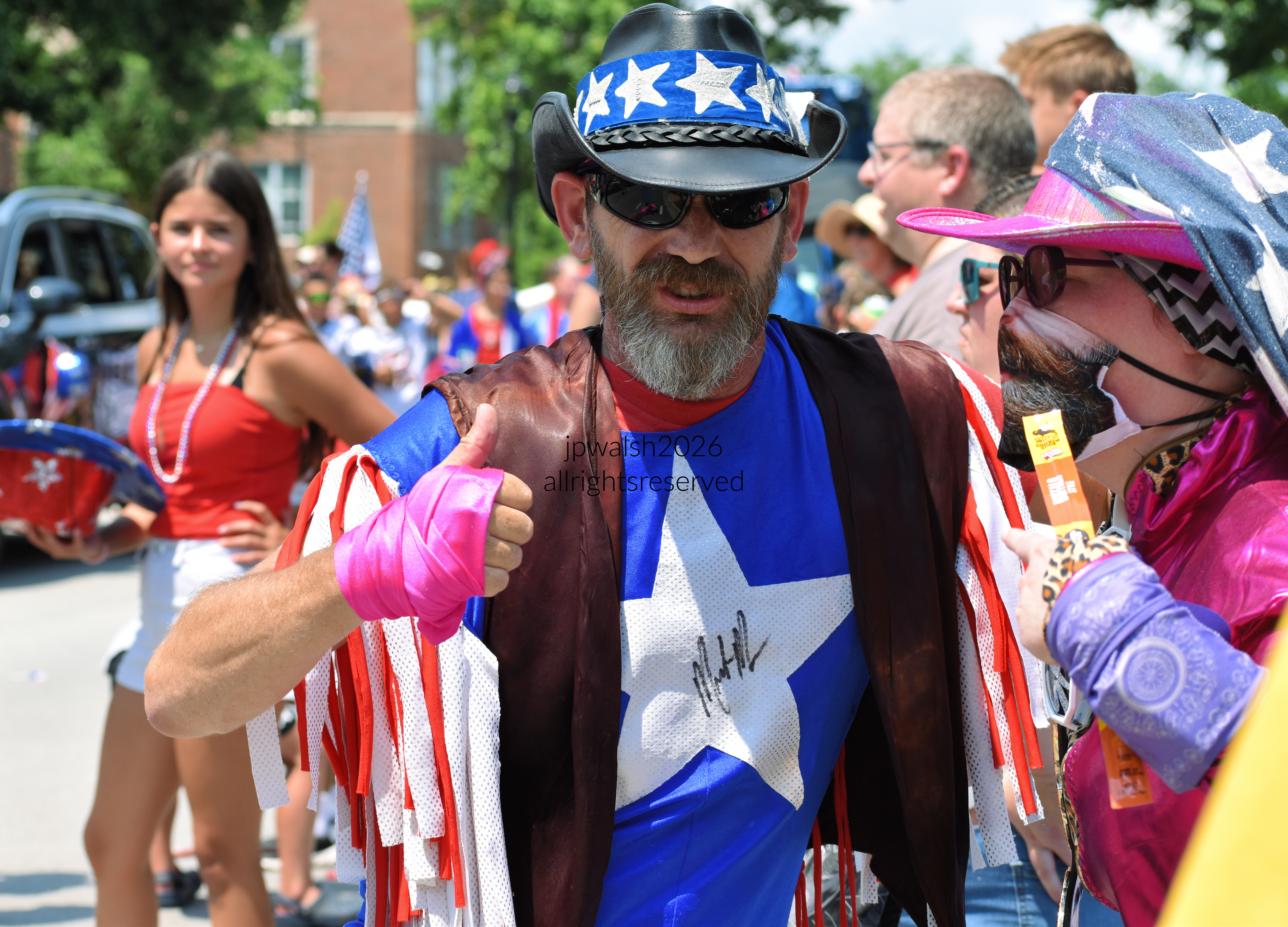
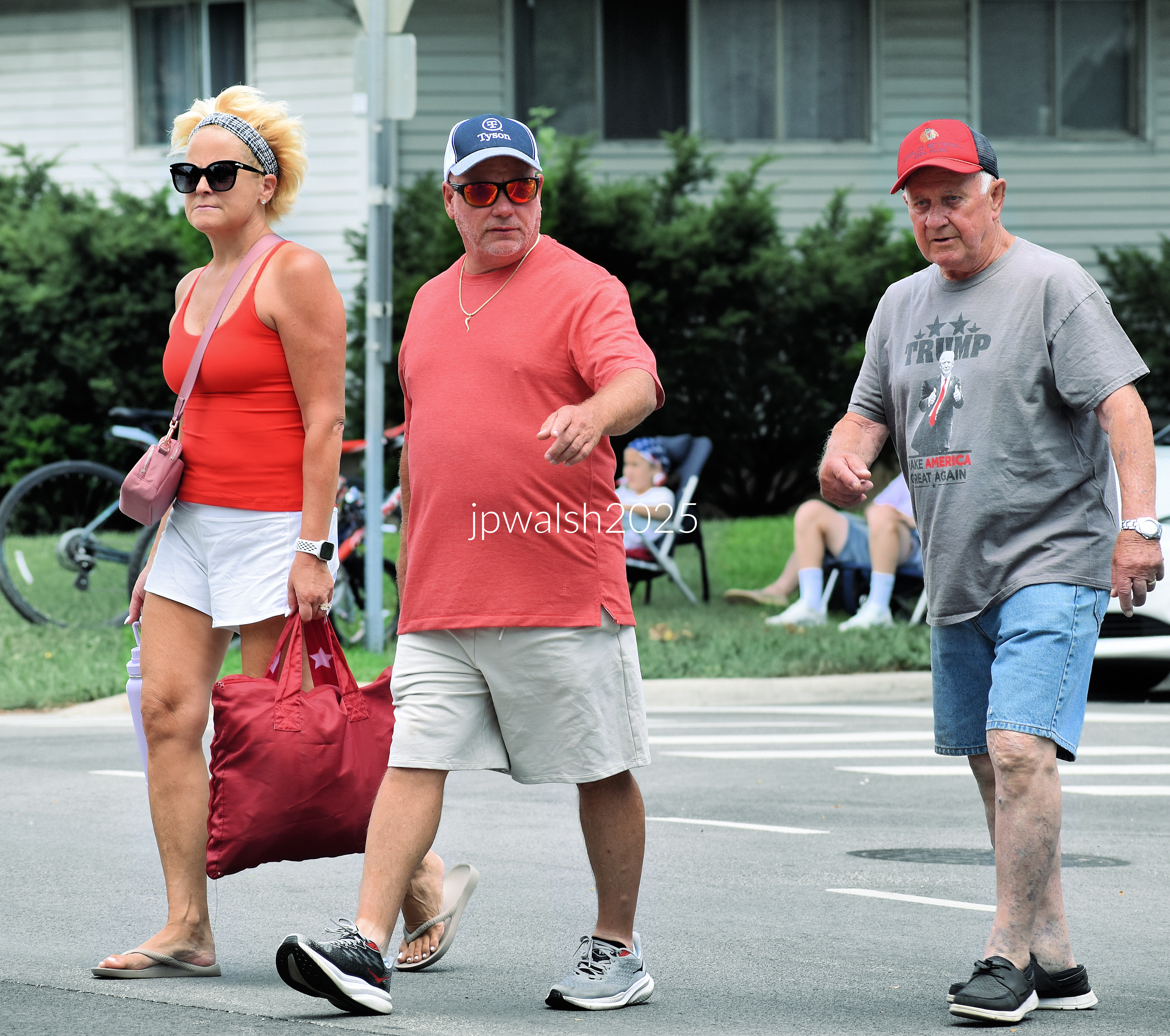
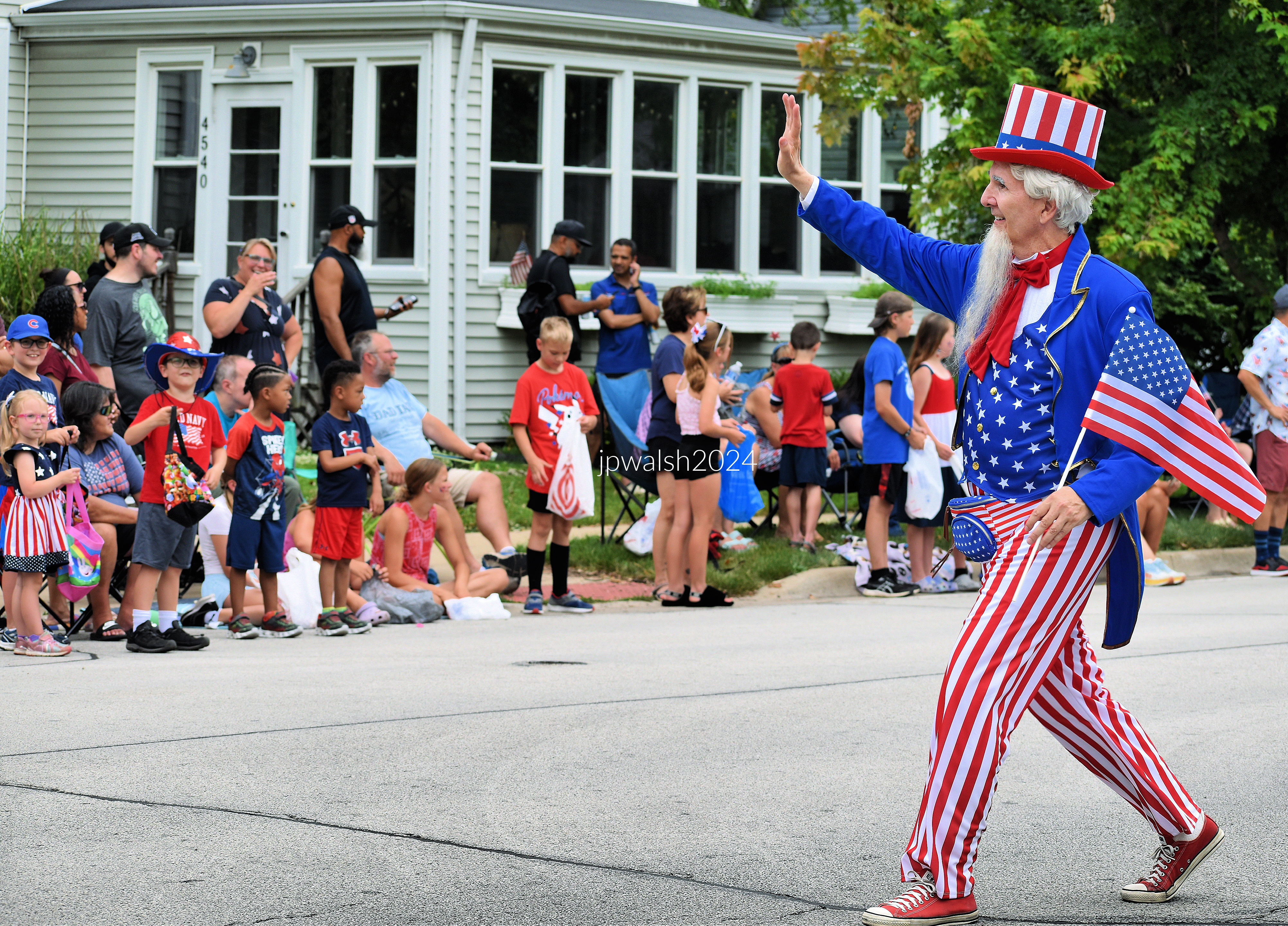
Star‑bright shirts, bold hats, and parade energy—thumbs up as the holiday spirit strides past. 99% 7.25mb DSC_9523
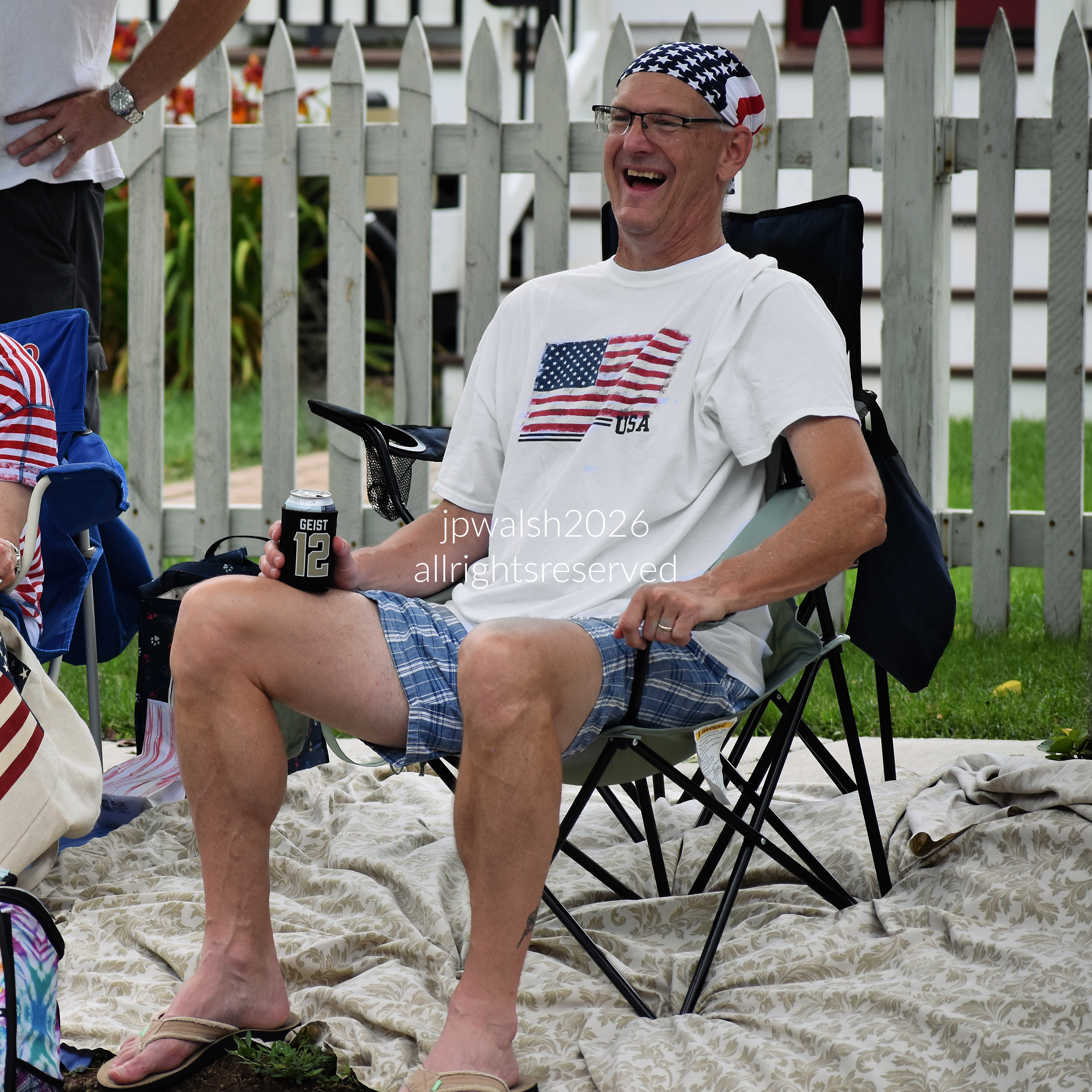
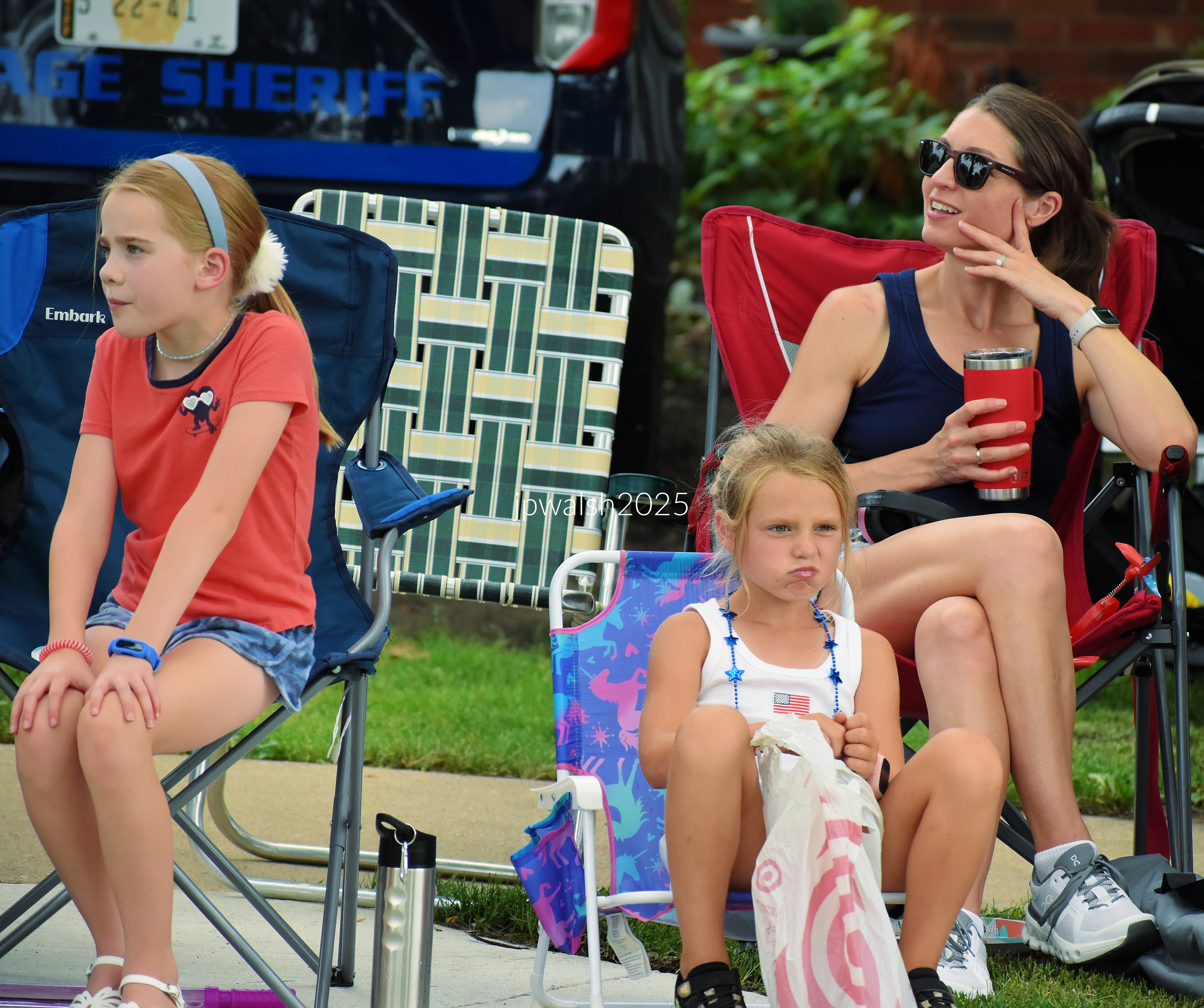
Holiday laughter in full sun—easy comfort, flag colors, and a backyard moment carrying the day’s joy. 6.06mb DSC_9335 (1)
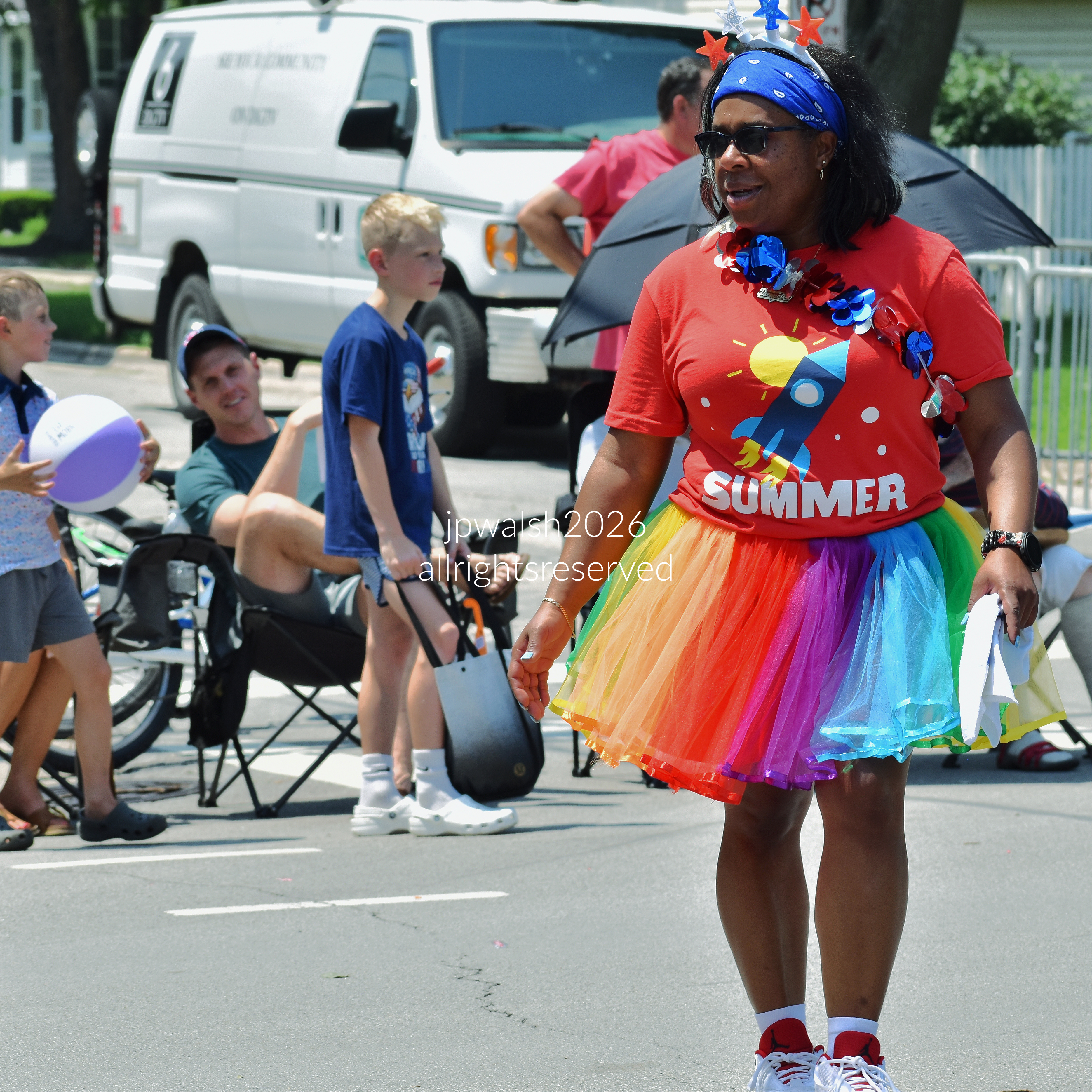
A burst of summer color on the move—rockets, rainbows, and roadside cheers carrying the holiday forward. 5.31mb DSC_9513 (1)
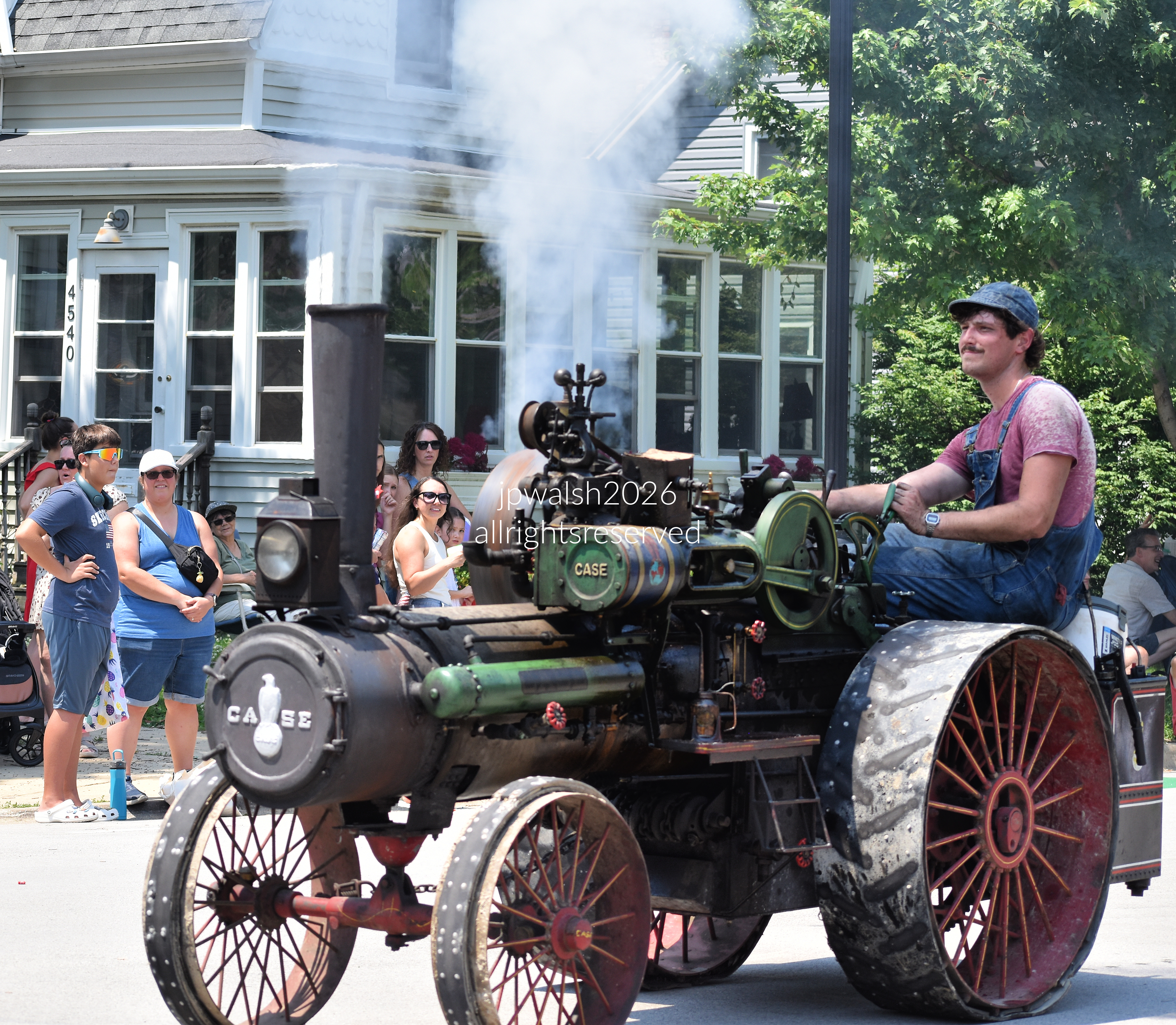
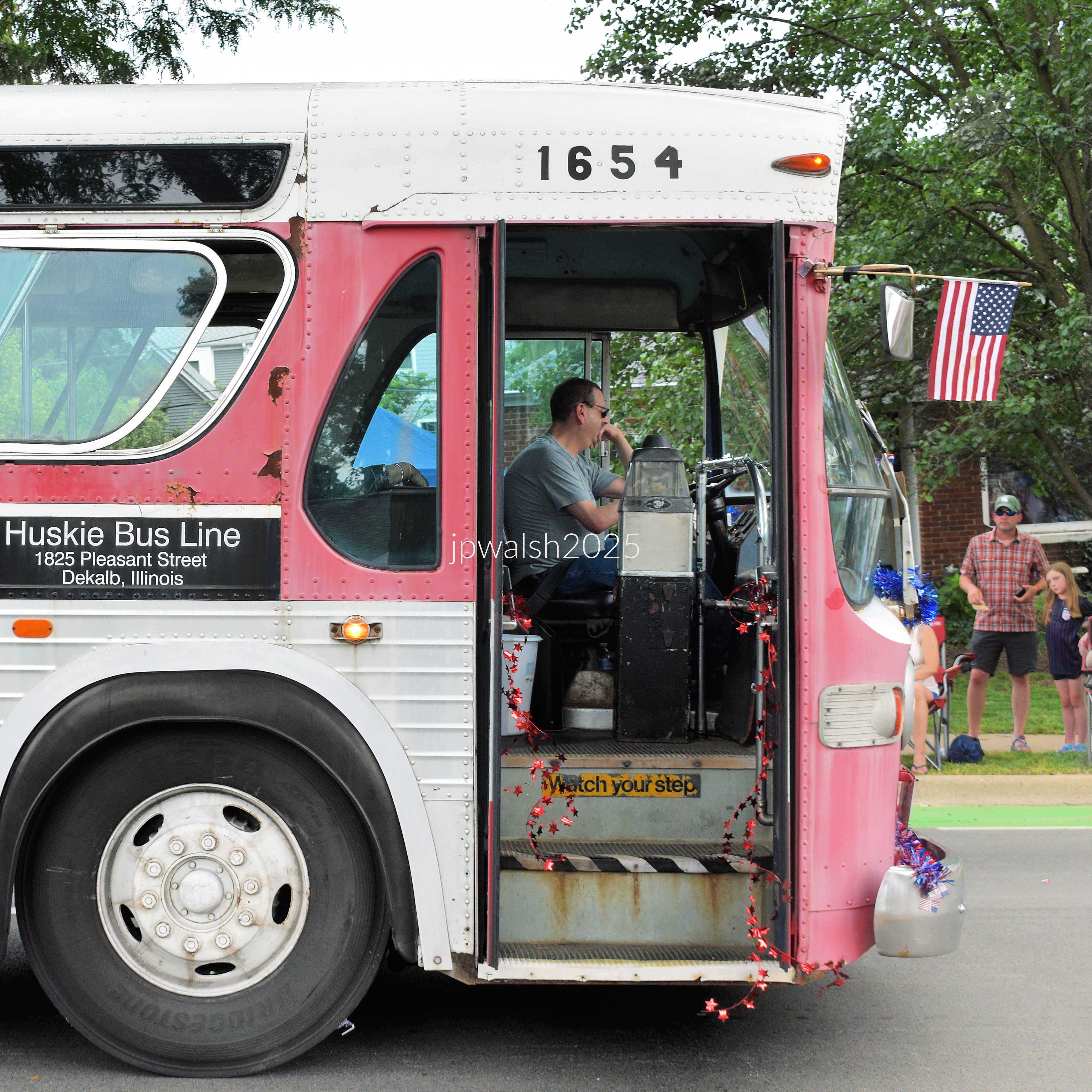
Steam up, wheels turning, and old iron alive again—holiday cheers rising as the CASE rolls by. 99.% 6.69mb DSC_9497 (2)
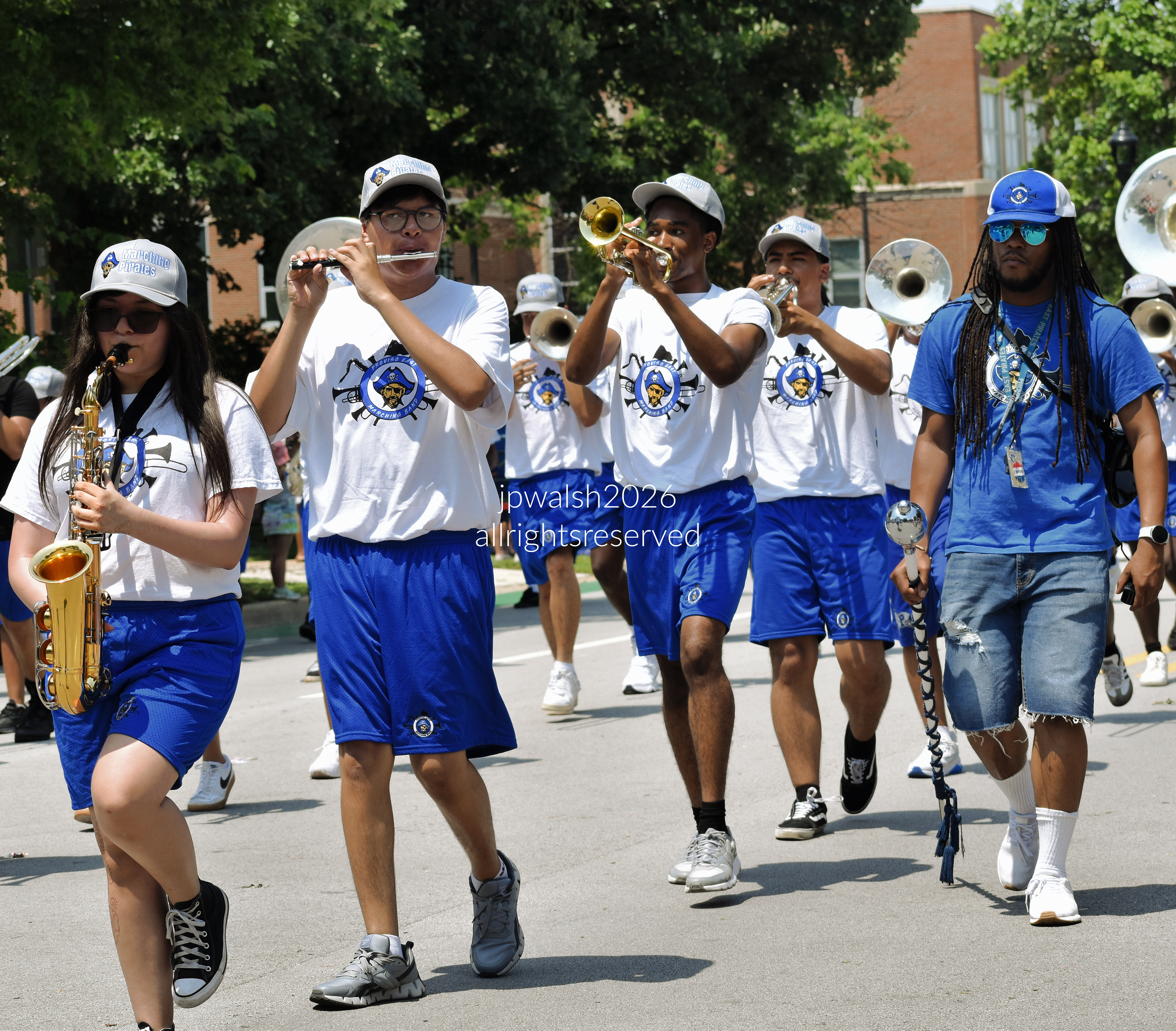
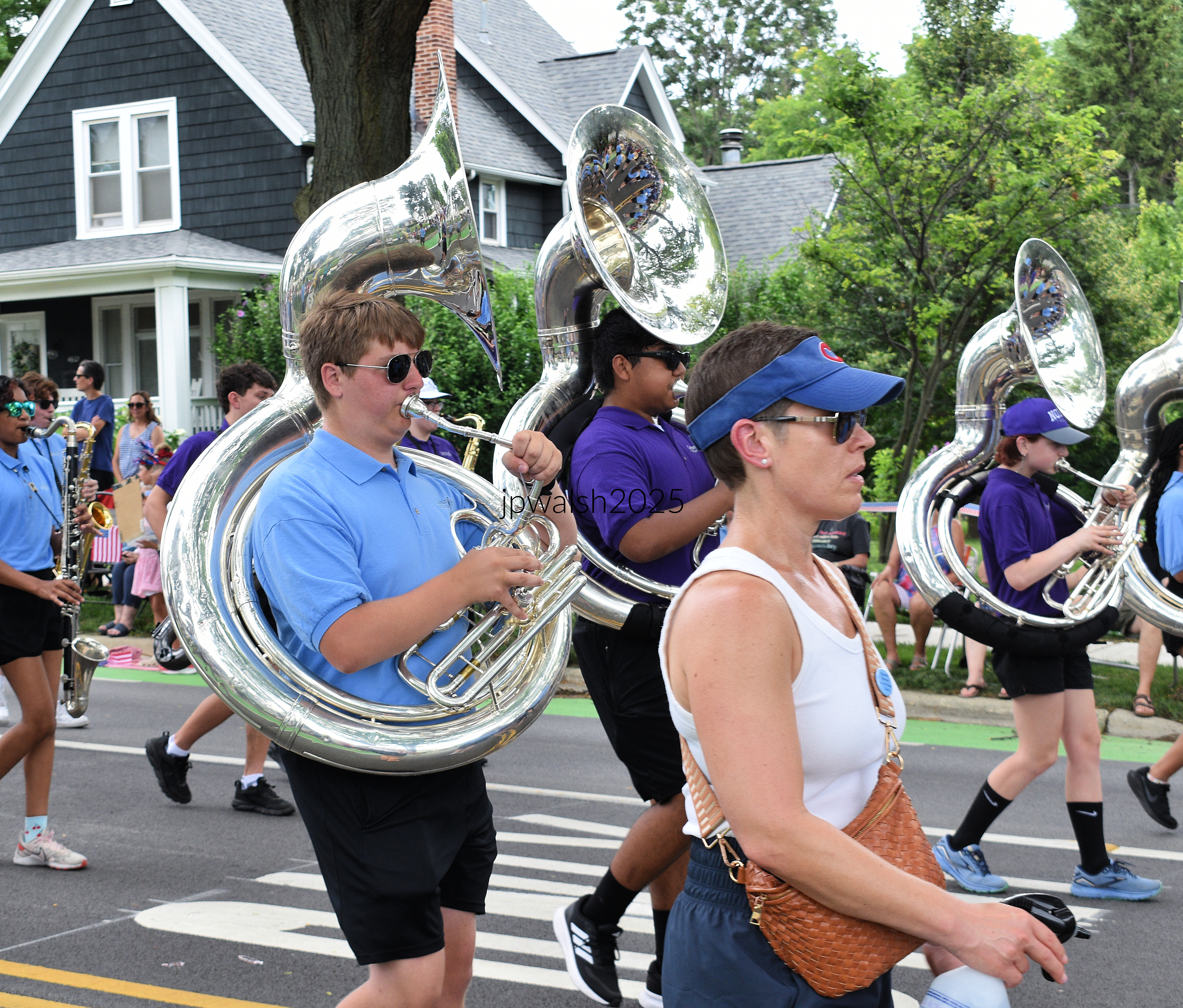
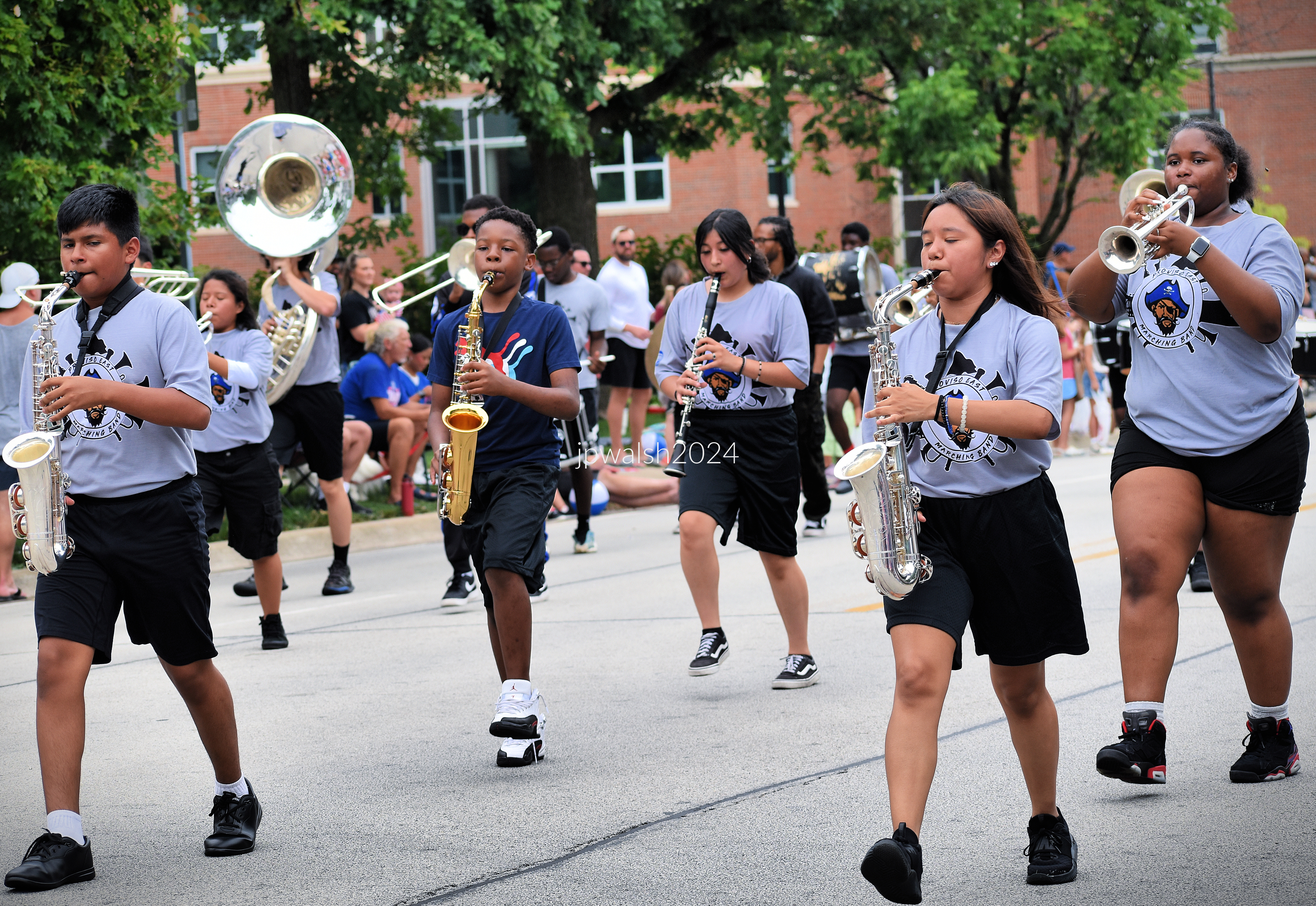
White shirts, blue shorts, brass bright in the sun—summer rhythm carrying the celebration down the street. 7.76 mb DSC_9473 (1)
A sign held high in the summer crowd—red, white, blue, and a clear call to keep the country’s promise. 5.83mb DSC_9445 (1)
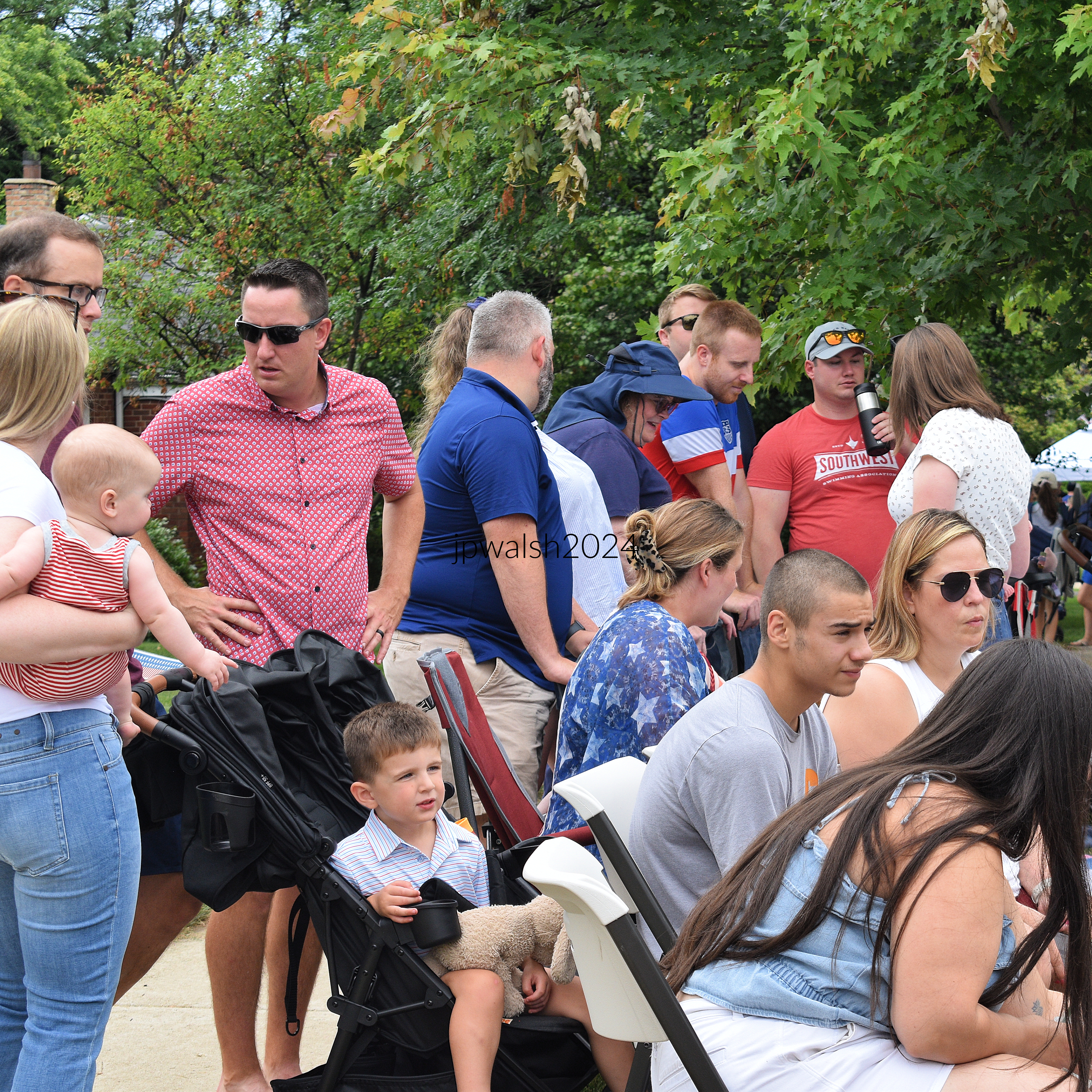
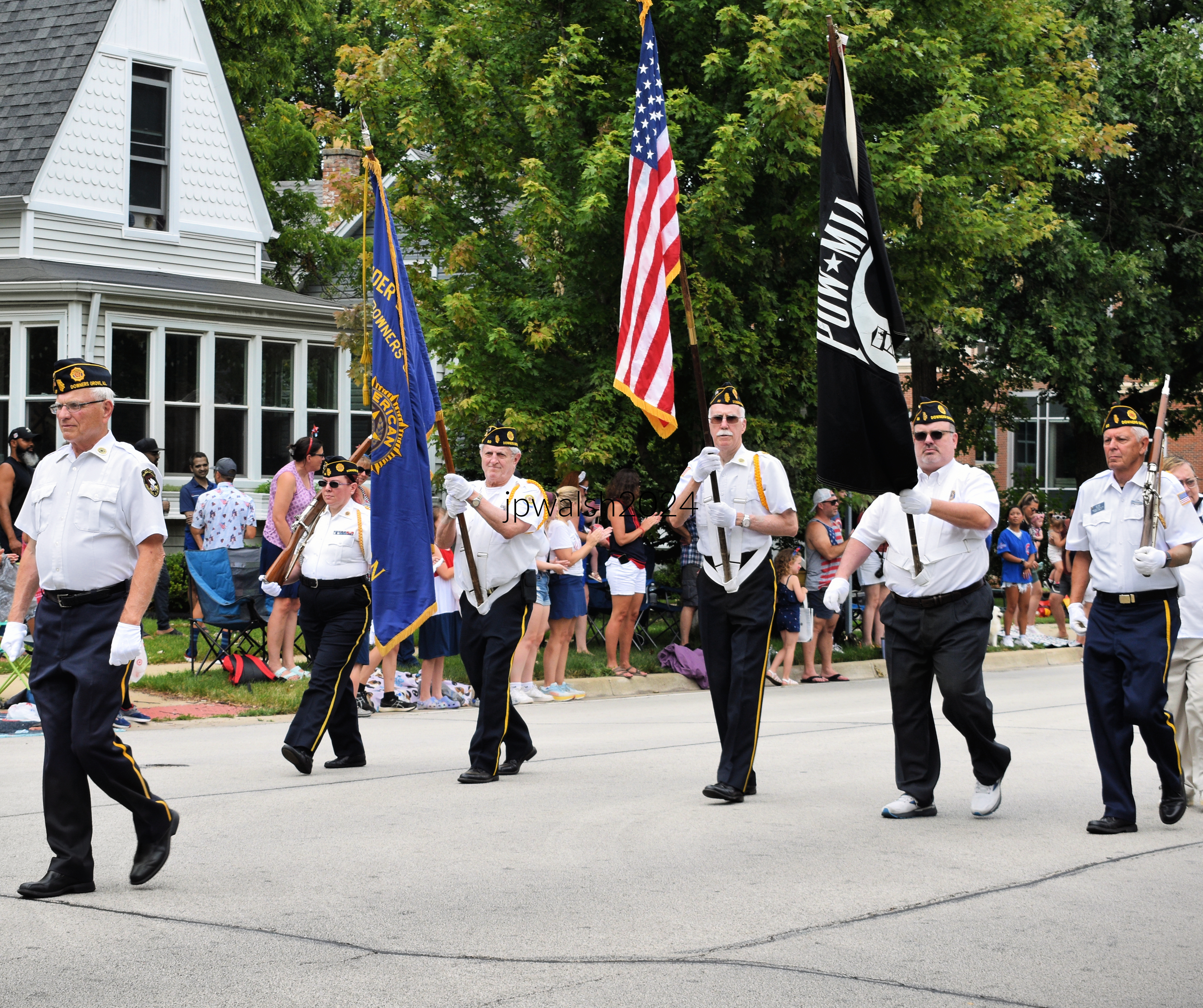
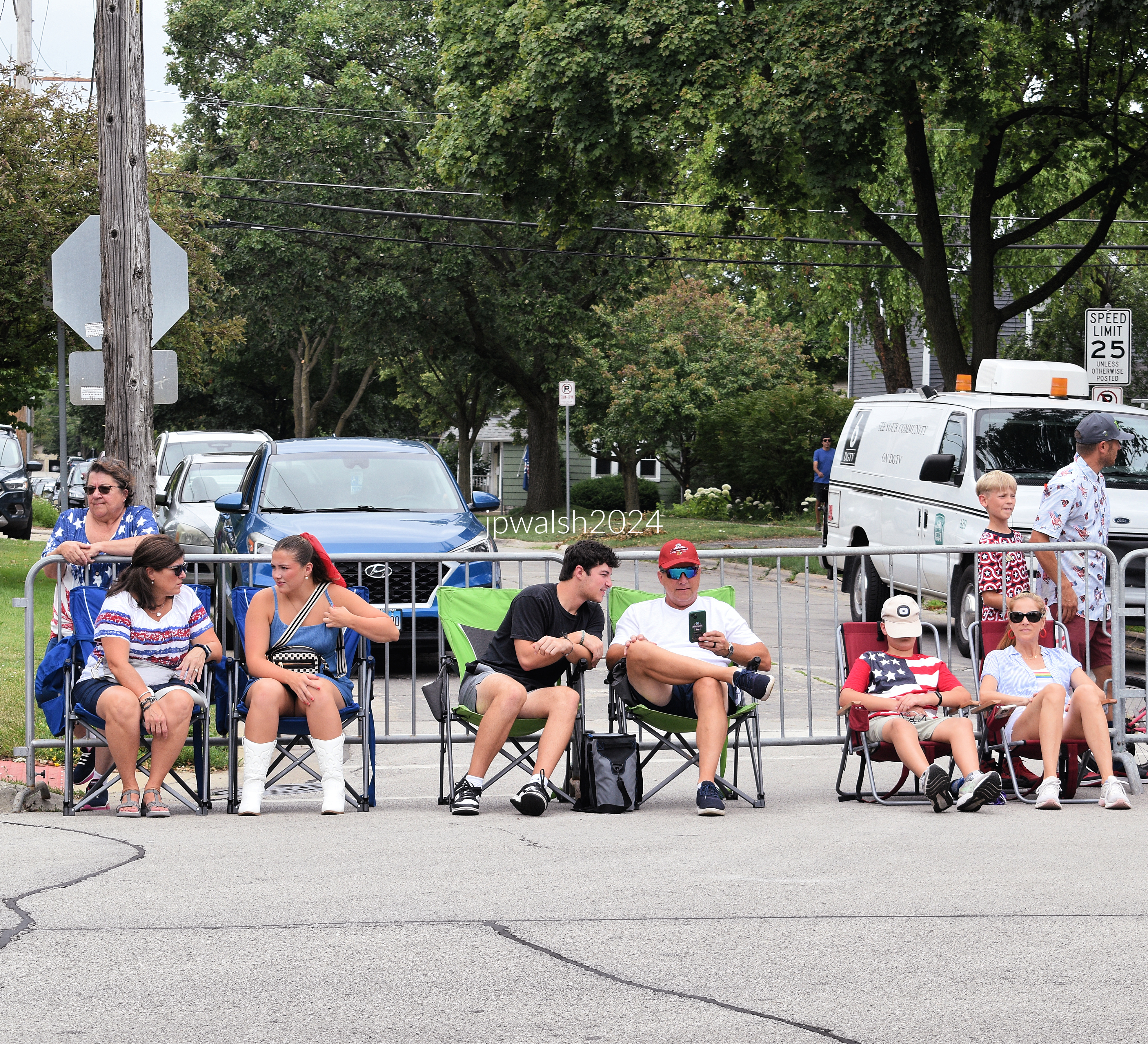
Flag up, chairs out, and a lawn full of easy holiday company—summer pride settling in for the celebration. 99% 7.81mb DSC_9326 (2)
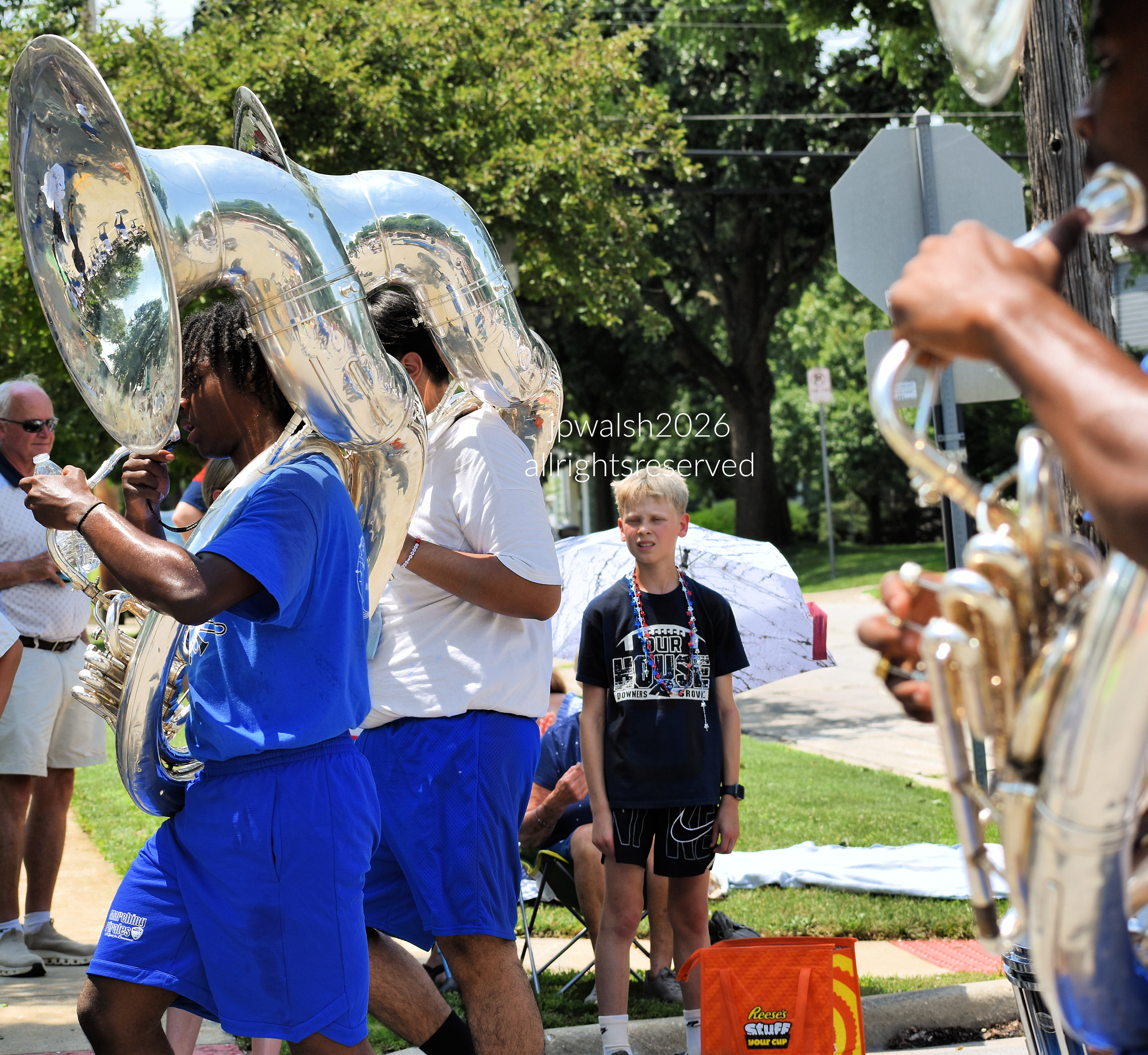
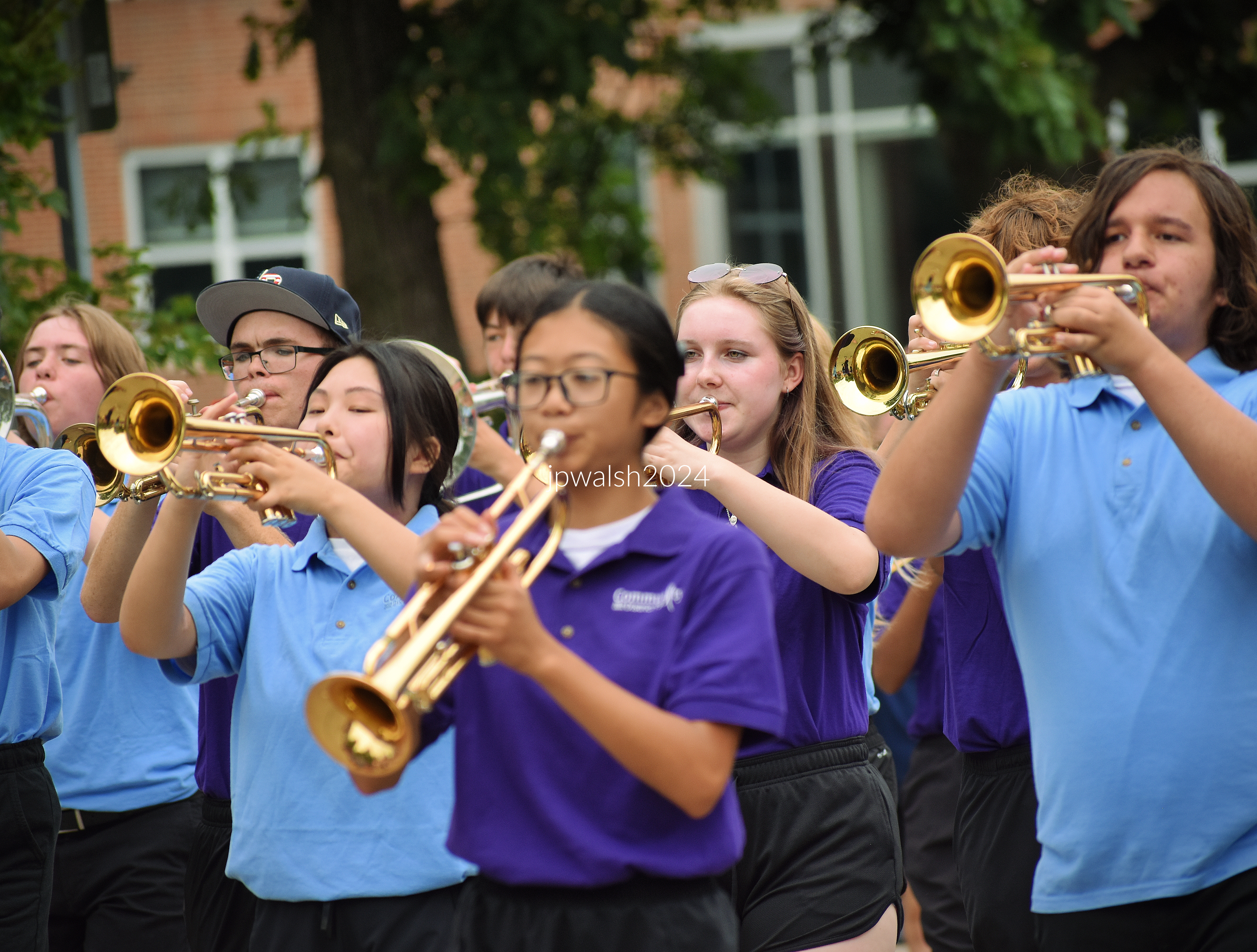
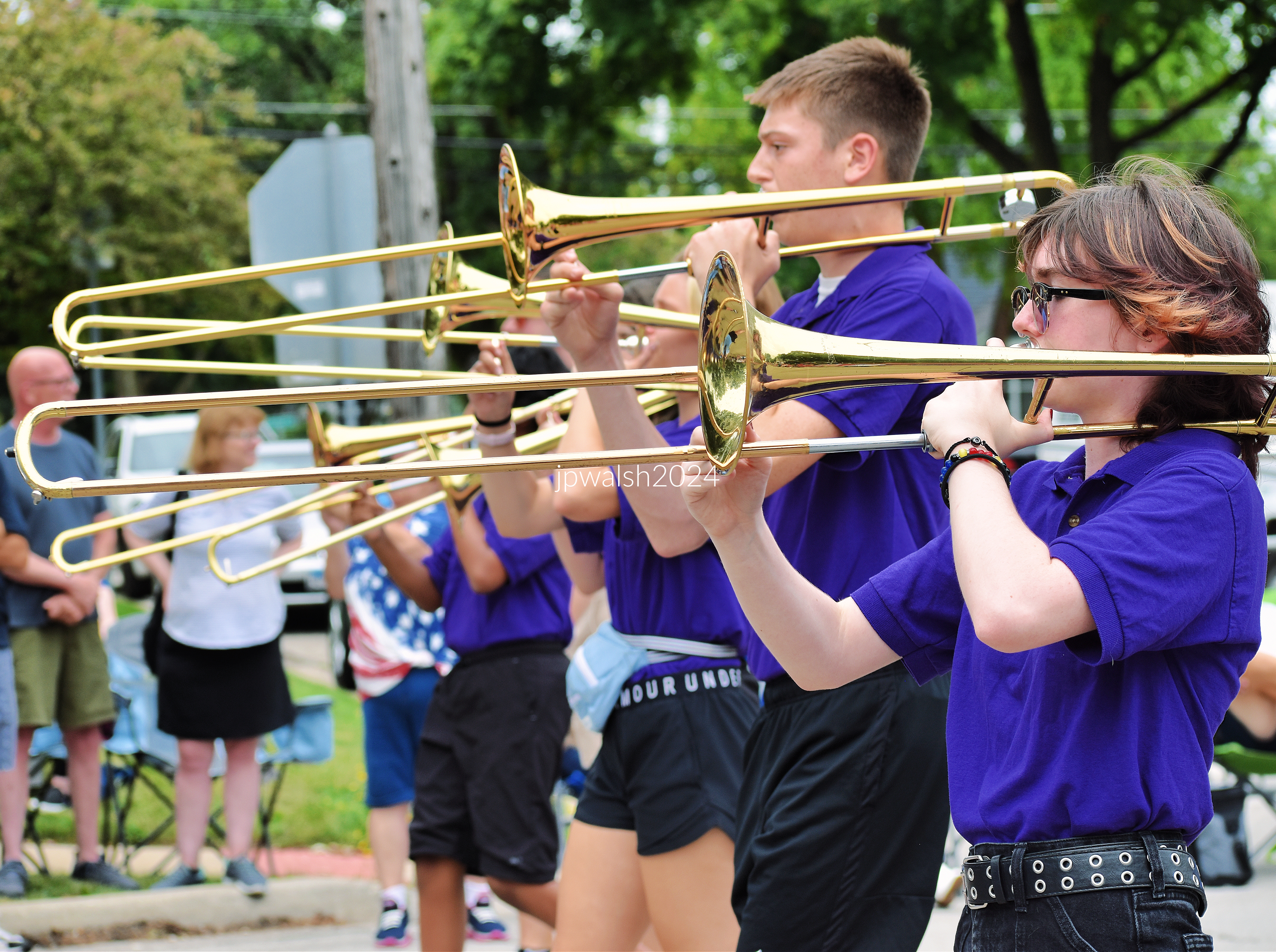
Brass lifting in the sun as the line of horns moves past and the crowd settles in along the curb, steady, bright, and fully tuned to the moment. 99% 7.34 mb DSC_9487
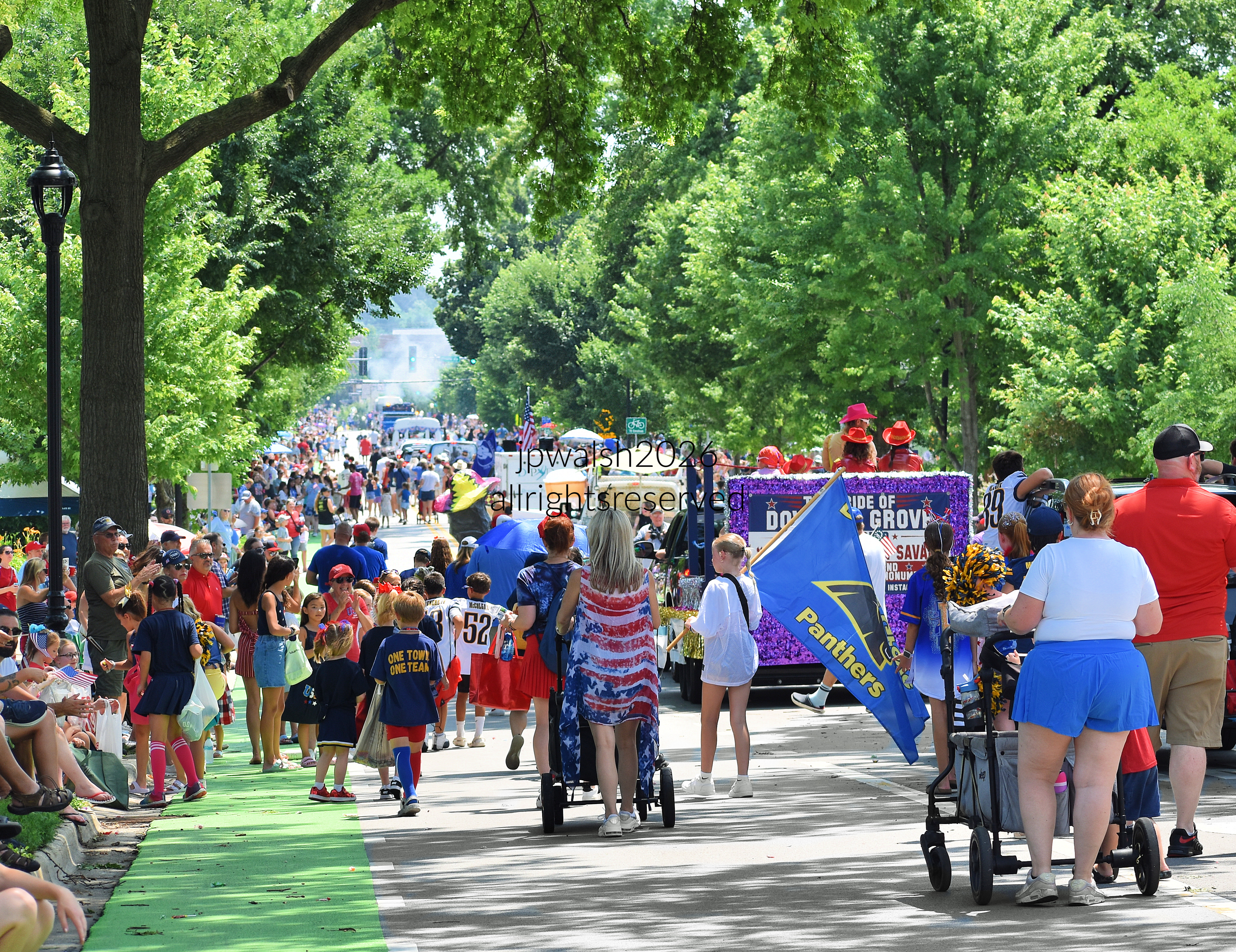
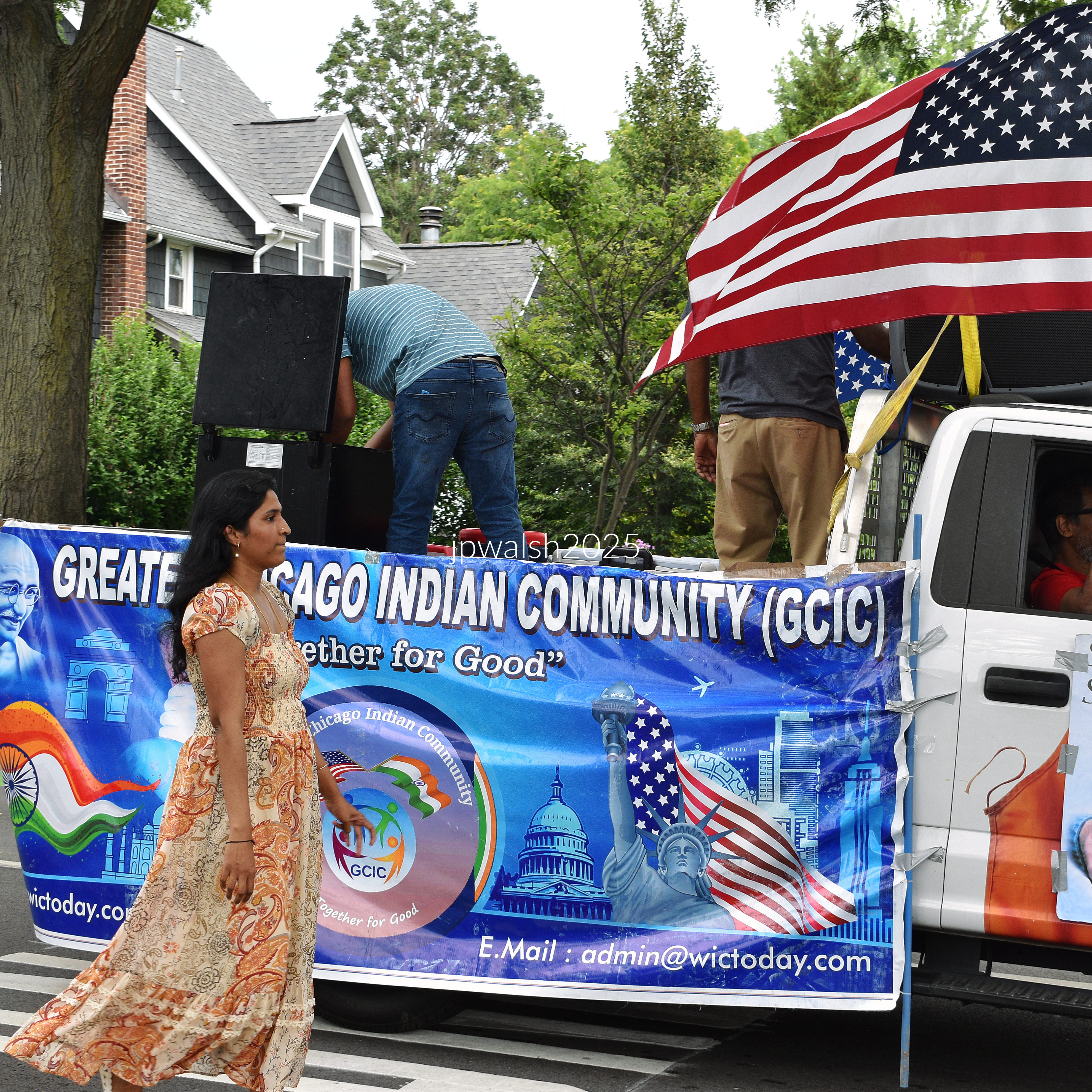
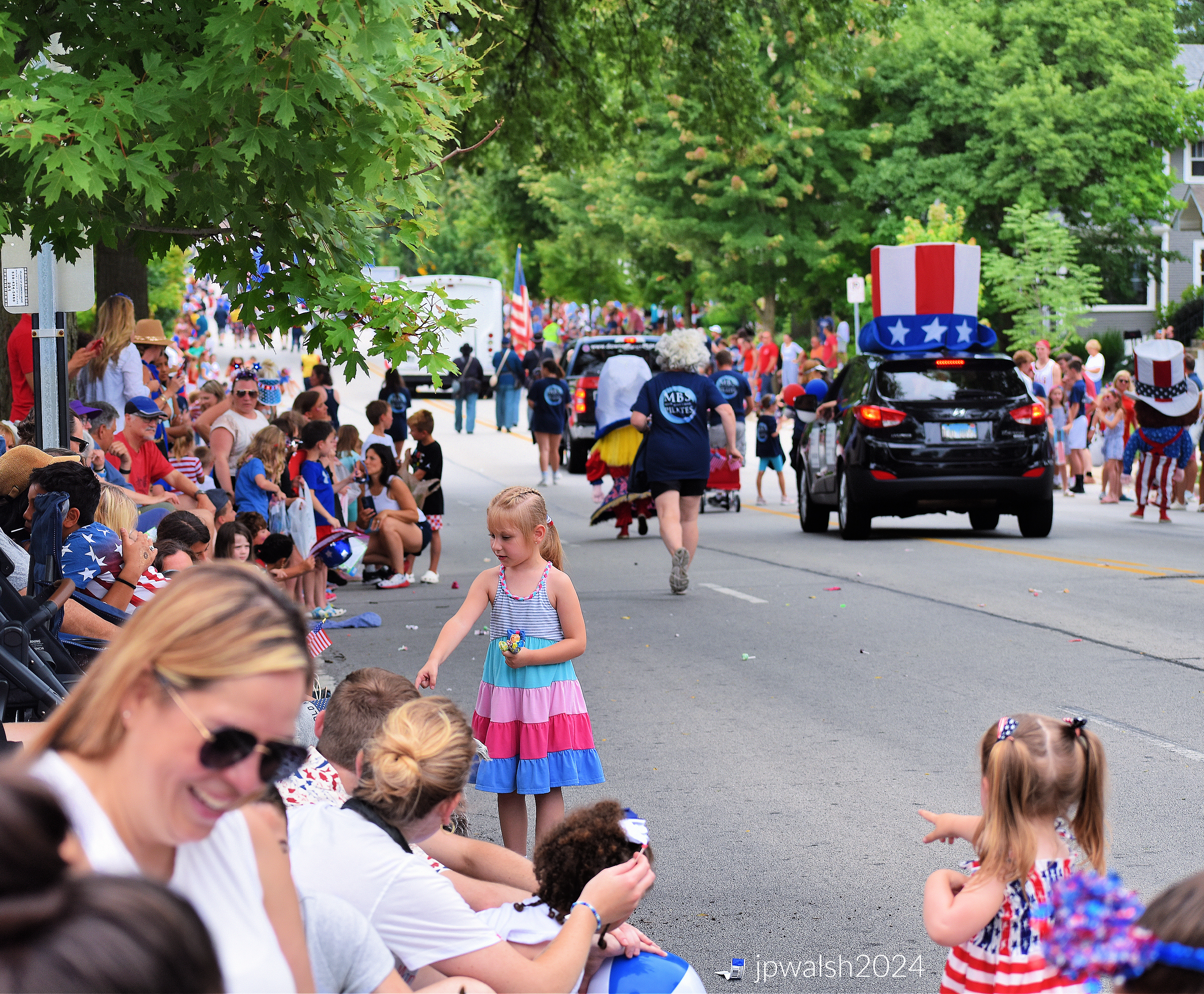
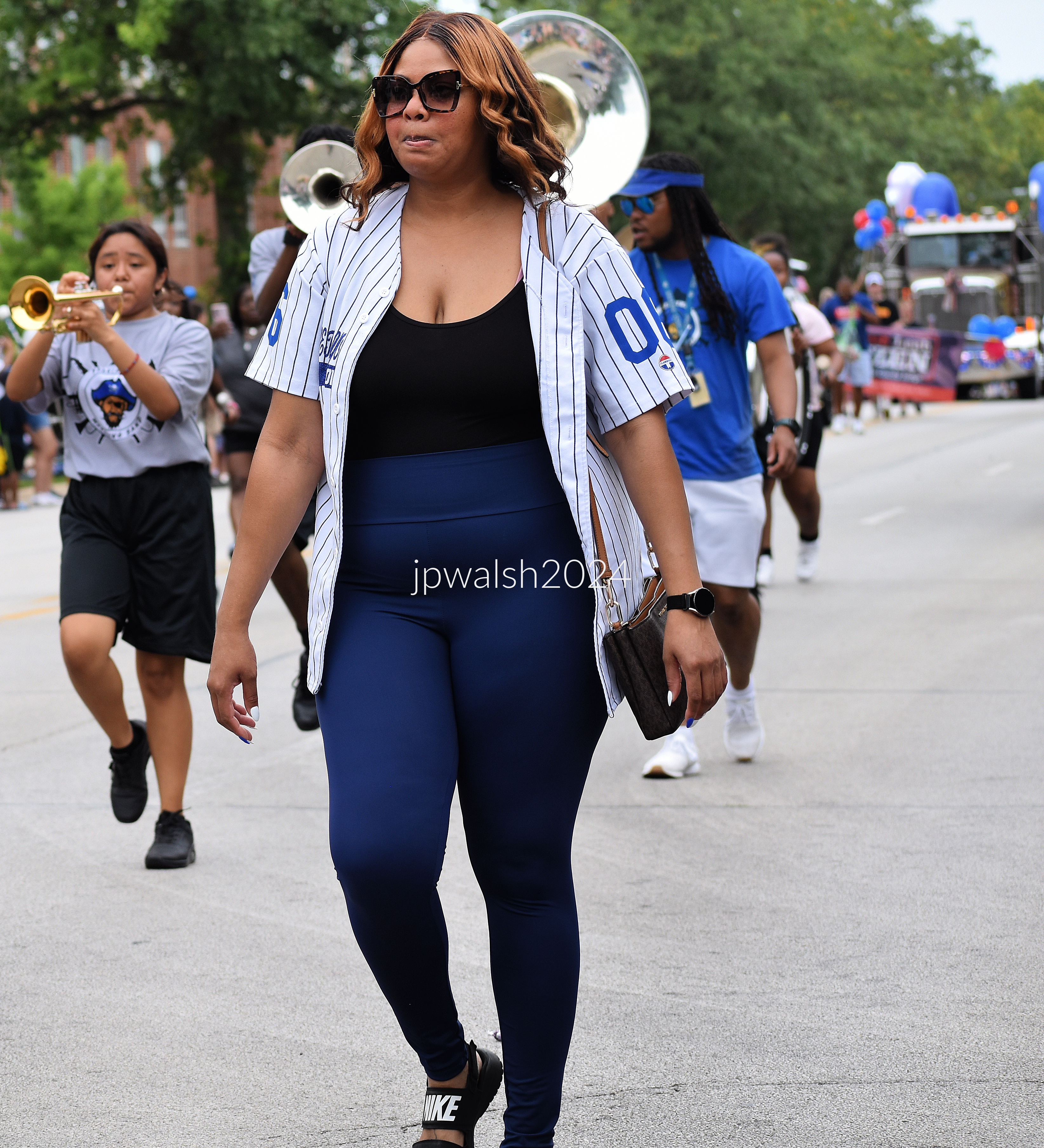
Happy 250th parade — a lively, steady moment of color and movement as floats advance and the community fills the street and lines the curbs. 99% 7.16mb DSC_9531
This explanatory article may be periodically updated.
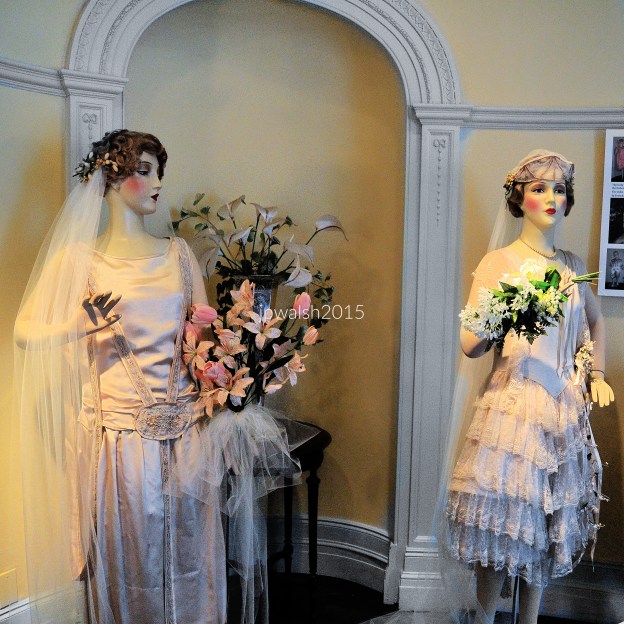
Feature Image: On Saturday, June 7, 1924, Ruth M. Anderson was married in this sleeveless wedding dress (left) to William Noling in Evanston, Illinois. The dress is now on display in the Charles Gates Dawes House in Evanston. Dawes was Vice President of the United States from 1925 to 1929 under President Calvin Coolidge. Author’s photograph (October 2015).
A surviving wedding dress and family home transform a local 1924 wedding into a study of popular culture, showing how the artistic styles and fashions of the Jazz Age reshaped American attitudes toward femininity, modernity, and social convention.
Wedding at the House of the Bride’s family
The Noling-Anderson wedding was held in the house of the bride and her parents, Isak and Jennie (née Johnson) Anderson, at 1035 Ridge Avenue in Evanston. Built in 1914, the house still stands as it did over 100 years ago.
Noling-Anderson Bridal Party Dresses, 1924 in the Charles Gates Dawes House, Evanston, Illinois. October 2015. Author’s photograph. 7.44 mb DSC_0893 (1)
The dress is made of silk satin in an egg shell color. It is accented by an oval medallion with bands also made of silk satin. The medallion is embroidered with faux pearl and other glass beads.
Thoroughly modern flapper style
While her wedding dress was very fashionable for the mid1920’s – sleeveless tops of all shapes and sizes were the rage in 1924 – it probably was not allowed in one of Evanston’s houses of worship. The fact that it was sleeveless and au courant would be deemed by many as risqué for showing too much bare skin inspired by a thoroughly modern flapper style. It was only in 1924, for instance, that the Methodist Episcopal General Conference first lifted its ban on going to the theater as well as dancing though dance music was the radio’s most popular programming.
The bridesmaid dress (right) was the height of women’s style in 1924 – a mainly straight, knee-length skirt gathered slightly or cut with front pleats. Short sleeve and sleeveless tops were the rage in 1924 reflected in Hollywood by the Mack Sennett girls who starred in movies where they pranced on the beach in a chorus line in not much more than bathing caps and short swim suits.
The fashionable bride and her court might have sported the latest style of facial make-up which is hinted at in the display– masklike with garish, even orange, lipstick and heavy red rouge on the cheeks. Popular fashion accessories from 1924 are also evident – pearls knotted at the neck and simple, though elegant, arm bracelets.
Father of the bride was an Evanston banker, local businessman, andSwedish immigrant
The bride’s father, Isak Anderson, was born in Sweden and came to the United States at 20 years old in 1890. In 1891 he married Jennie Johnson and they had Ruth and another child. Ruth’s father was a bank director and partner in a local tailoring business in downtown Evanston at 608 Davis that today is a noodle shop.
The Jazz Age transformed American social customs, fashion, and ideas of modern womanhood, with the bride’s flapper-inspired wedding attire reflecting broader cultural shifts that were fashionable, controversial, and distinctly of their time.
The dance migrated North during the Great Migration. It officially exploded into mainstream American culture on October 29, 1923, when it debuted on Broadway in the all-Black musical revue Runnin’ Wild. The show featured the hit song “The Charleston,” composed by jazz pioneer James P. Johnson, which provided the fast, syncopated 4/4 rhythm that defined the dance. The Charleston was most fashionable during the “Roaring Twenties” (1923–1929), reaching its absolute peak popularity between 1926 and 1927.
It was most popular in major urban centers—particularly New York City, Chicago, Paris and London, where young women called flappers wore short dresses, rolled down their stockings, and kicked up their heels to flout traditional social etiquette
The original Charleston craze effectively ended as a mainstream fad with the onset of the Great Depression in 1929. However, it didn’t completely disappear. The Charleston’s fast kicks, hand-to-knee swivels, and loose movements were absorbed into newer, more complex swing dances, most notably, for the Lindy Hop and the Jitterbug in the 1930s and 1940s.
They served “Prohibition highballs”
With Prohibition starting in 1920, guests at the wedding may have been served the latest popular highball whose recipe called for fruit juice and raw eggs. Their morning might have started with a bowl of Wheaties at breakfast, since the cereal of champions made its first appearance in 1924.
Wearing that dress Ruth Anderson married William Noling in this house at 1035 Ridge Avenue in Evanston, Illinois, on June 7, 1924. May 2024. Author’s photograph. 92% 7.81 mb
The bride’s attire reflected contemporary flapper fashion, including higher hemlines and sleeveless styles.
SOURCES: Charles G. Dawes House. Evanston, Illinois. Ernst Wilhelm Olson, The Swedish Element in Illinois: Survey of the Past Seven Decades (Chicago: Peter-Albin-Publishing, 1917), p. 586. Lois Gordon and Alan Gordon, American Chronicle (New Haven: Yale University Press, 1999), pp. 230–38. Thomas G. Aylesworth and Virginia Aylesworth, Chicago: The Glamour Years (1919-1941) (New York: Gallery Books, 1986), p. 14.
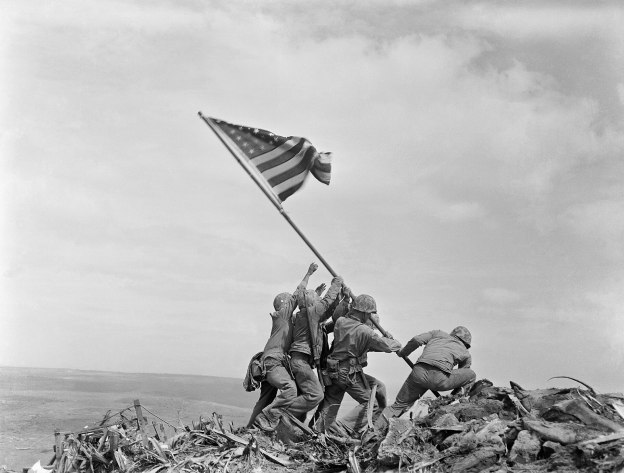
FEATURE image: Original photograph by Joe Rosenthal, February 23, 1945. Public Domain.
The Battle of Iwo Jima was one of the most costly and consequential American victories of World War II, securing a strategic foothold in the Pacific while producing iconic photographs and film footage that transformed a brutal military campaign into an enduring symbol of sacrifice, heroism, and national resolve.
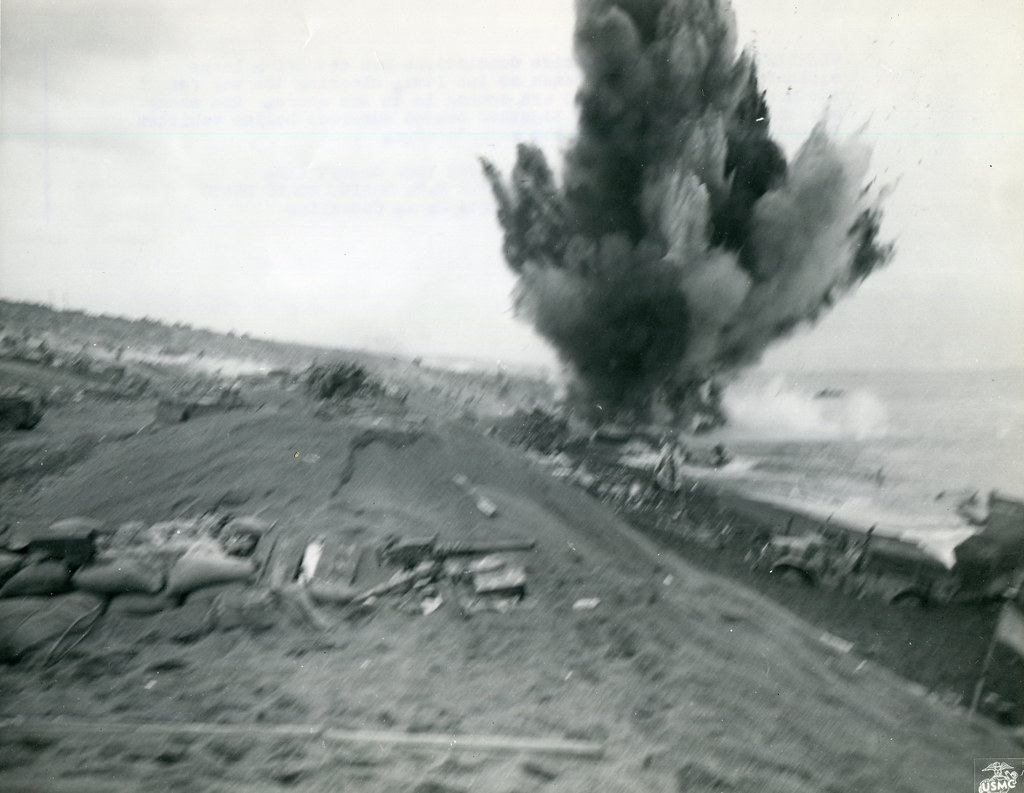
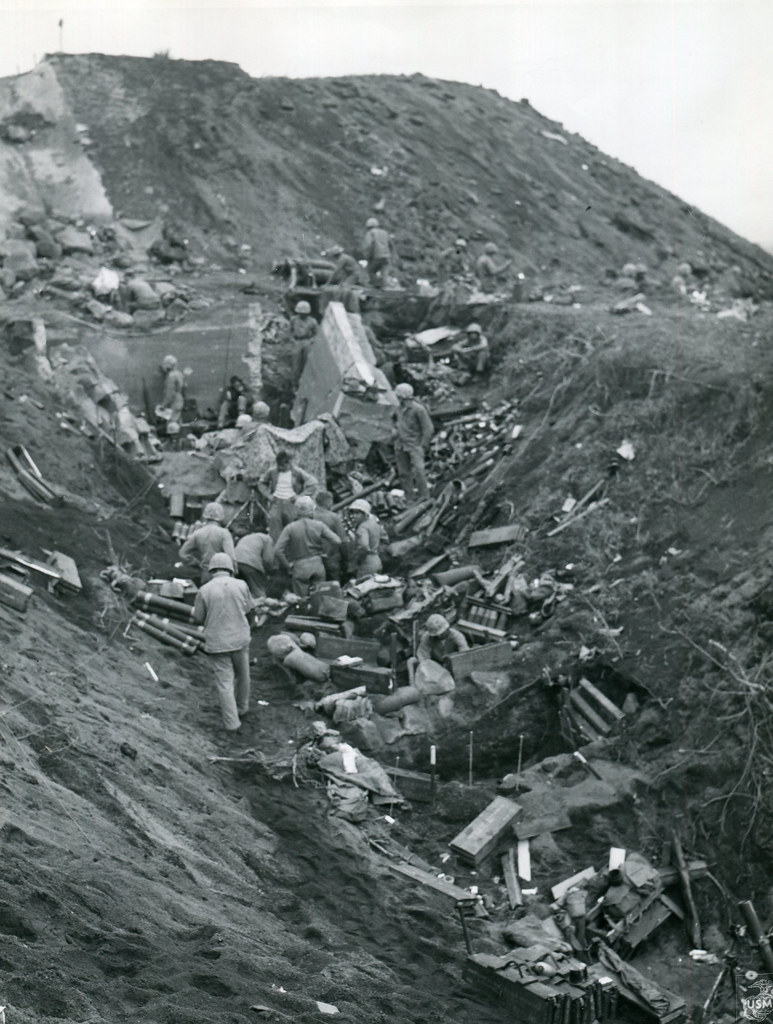
The battle lasted from February 19 to March 26, 1945, and was among the fiercest engagements of the Pacific War.
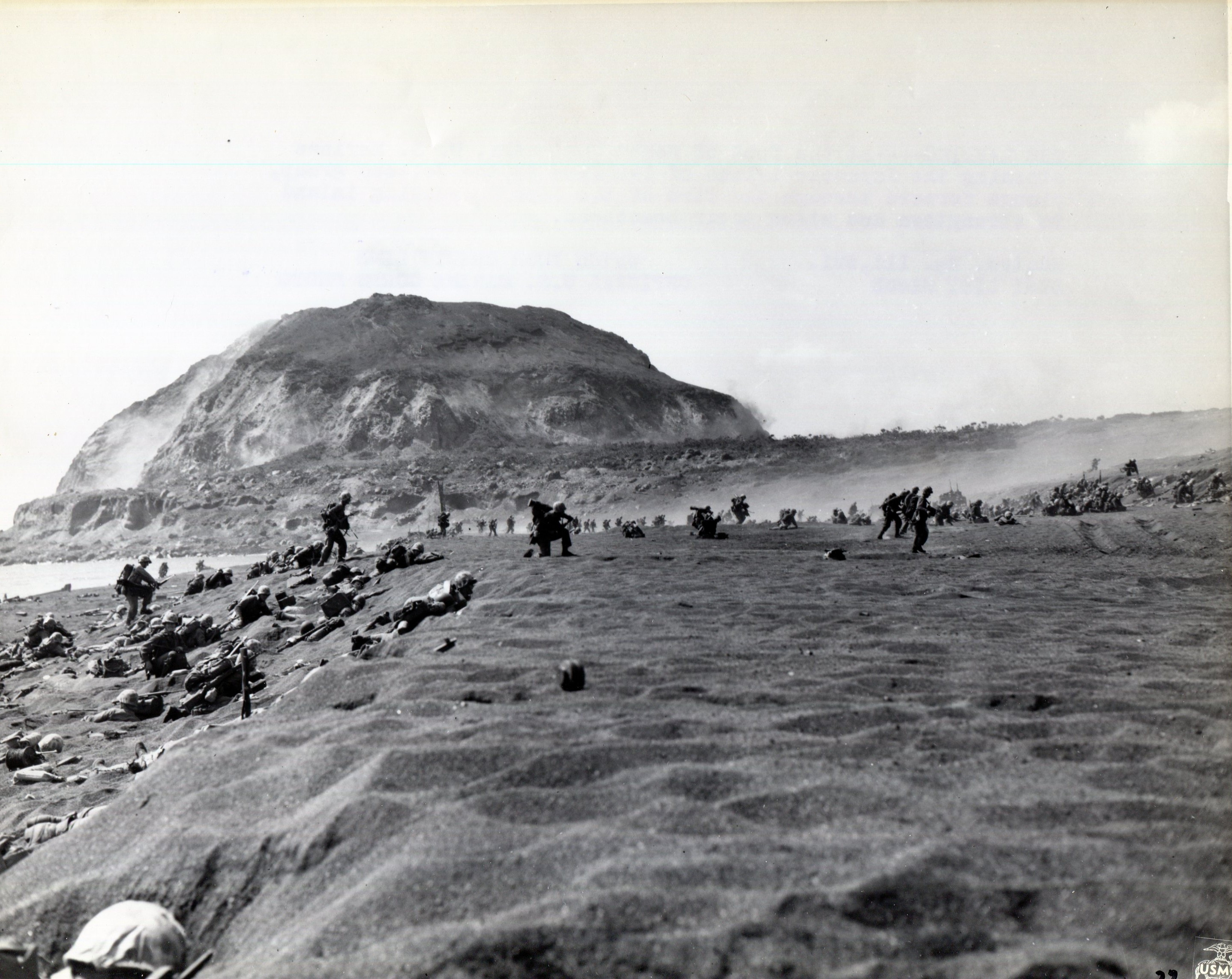
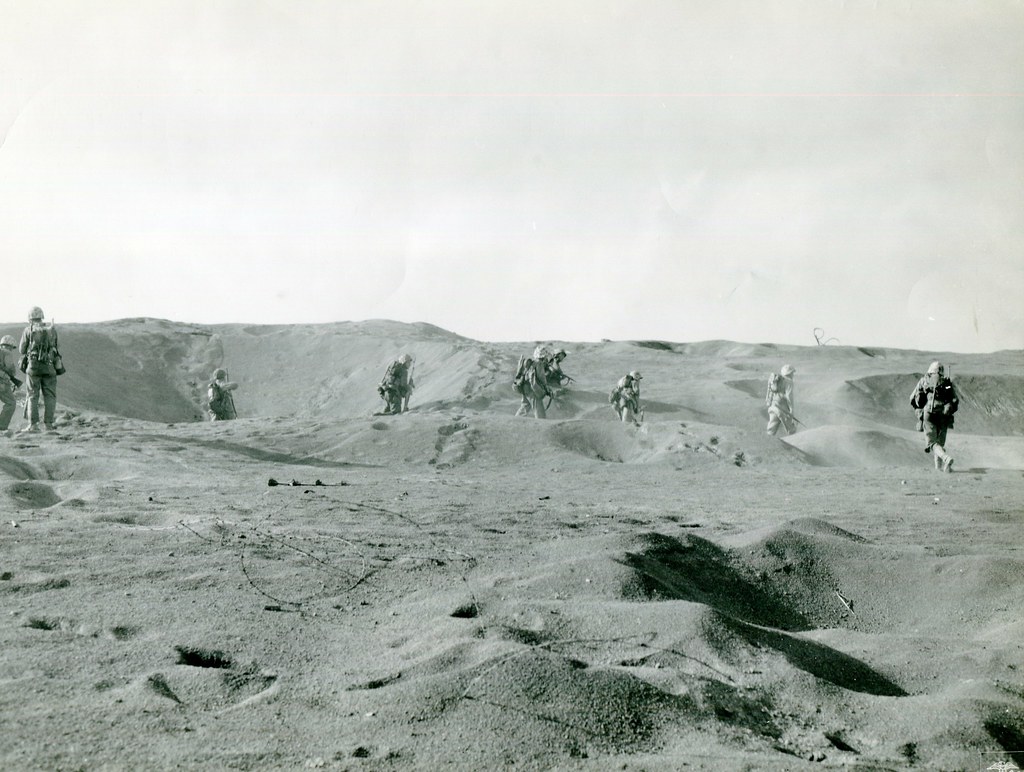
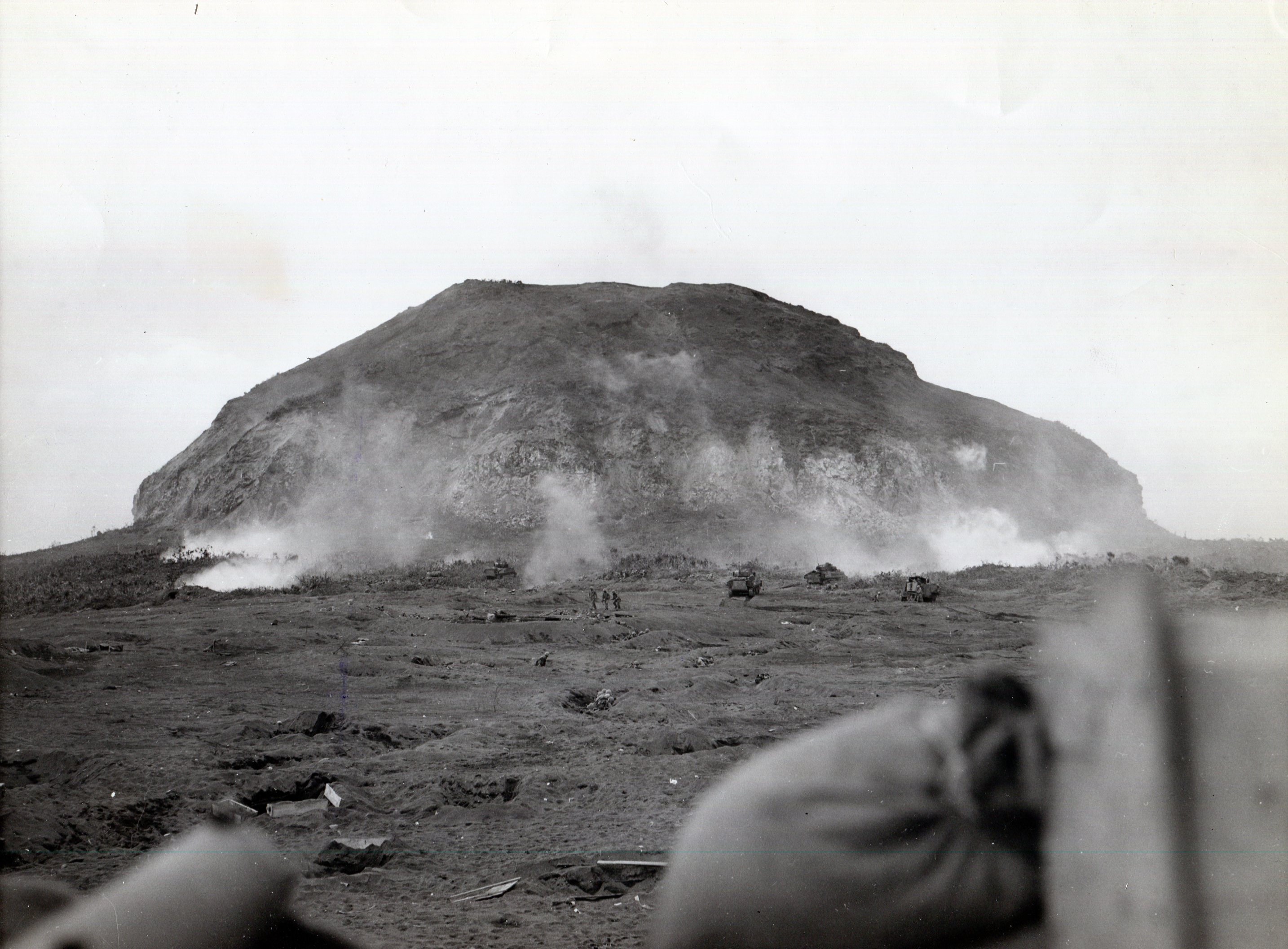
The Battle of Iwo Jima was a nearly 40-day battle campaign fought by the U.S. Marine Corps and U.S. Navy against the Japanese Imperial Army on the island of Iwo Jima in the Pacific. With 110,000 total battle personnel (over 70,000 troops), the American objective of their invasion (called “Operation Detachment”) was to capture the island and its airfields. Iwo Jima was situated between Japan and the American bomber bases in the Mariana Islands. Since summer 1944 unescorted American B-29 bombers were flying nearly 3000 miles roundtrip to bomb Japan and being lost at sea from entrenched Japanese defenses. With Iwo Jima in American hands U.S. fighter planes could escort the long-range bombers as well as have any damaged aircraft find sanctuary on the island. The American victory after a five week campaign resulted in the capture of Iwo Jima with its immediate benefit that, by war’s end, 2,400 B-29s were able to make safe forced landings on the island.
A primary American objective was to capture Iwo Jima’s airfields, allowing fighter escorts for B-29 bombers and emergency landing facilities closer to Japan.
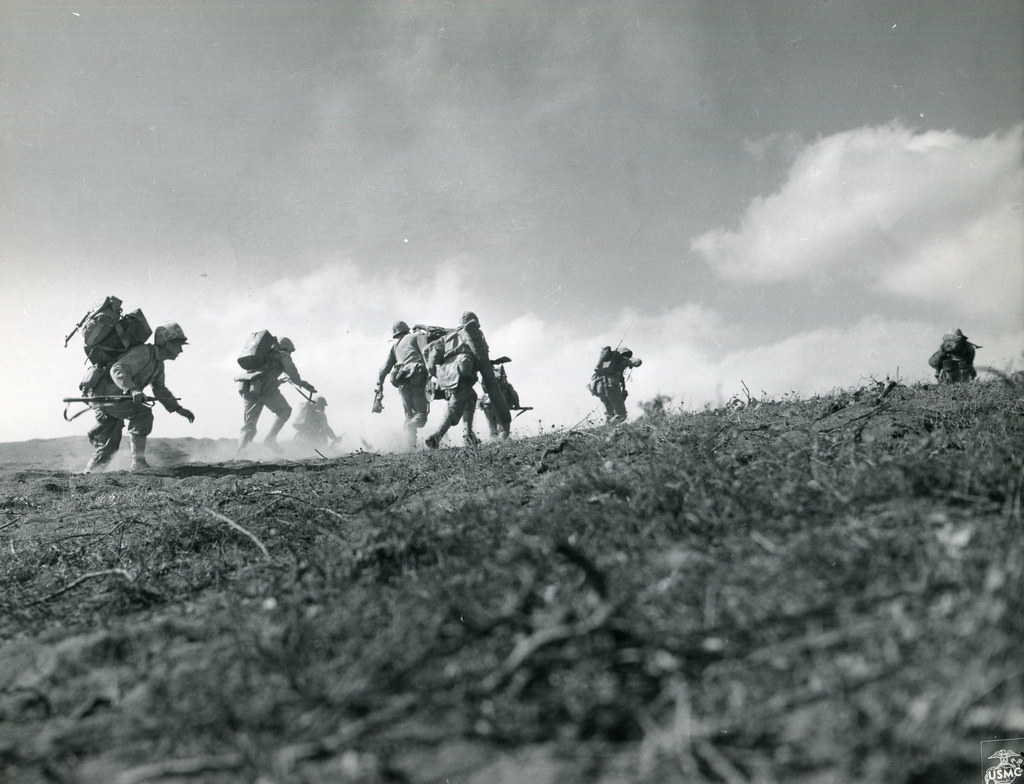
There were 20,000 or so heavily-fortified Japanese defending the island to the death while U.S. Navy and Marine Corps aircrews had complete air superiority. The U.S. Navy provided heavy artillery gunfire support from the sea. The Battle of Iwo Jima, an American victory, took place from February 19 to March 26, 1945, and was one of the fiercest of World War II. That Americans could take the island was not the question. Its exact cost was. The casualty toll was heavy for both sides. The Japanese had 216 taken prisoner and up to 18,375 killed or missing in action. The American combat toll was also staggering: 6,821 killed in action, 19,217 wounded, and 2,648 experiencing battle trauma.
Joe Rosenthal (1911-2006), with his camera hanging at his side, surveys the landing beaches at Iwo Jima on March 7, 1945. Rosenthal was awarded the U.S. Navy Distinguished Public Service Award, as well as the Marine Corps Distinguished Public Service Award by the Marine Corps, for his war photography. Photo by AP/U.S. Marine Corps. Public Domain.
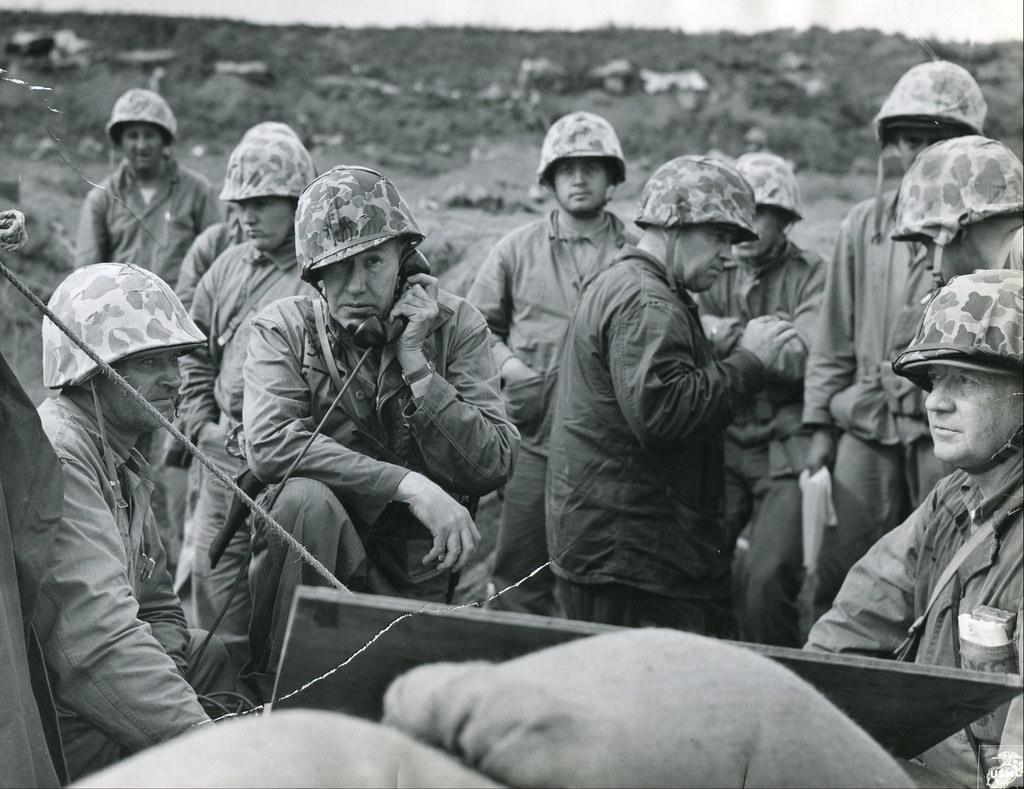
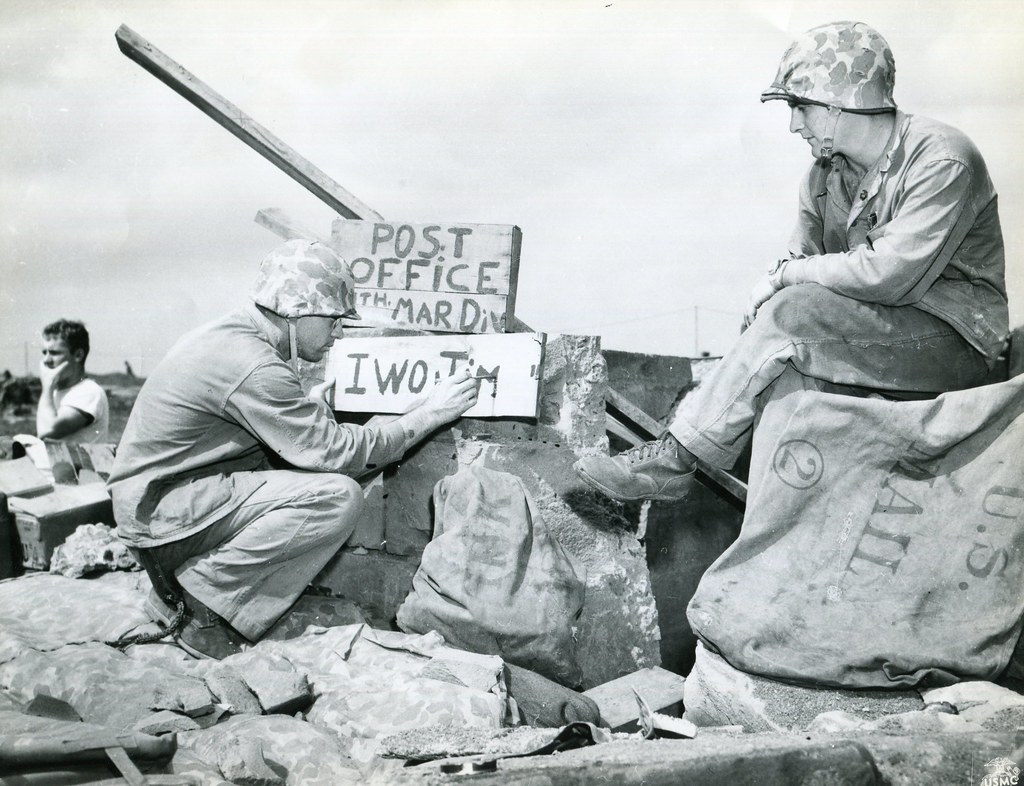
On Friday, February 23, 1945, Rosenthal landed on the island and heard that they were going to raise a flag on the highest point on the island which was the old volcano at the southwest end called Mount Suribachi. Rosenthal carried a Speed Graphic camera that was press standard issue and joined other photographers ready to ascend to the top. Halfway up they met a marine photographer coming down whose camera was obliterated by an enemy grenade explosion. Rosenthal and the others were told that the marines had already raised the flag. But the views were good from the summit anyway and still worth the climb. Once at the top Rosenthal and the rest saw marines who were working to affix a larger flag to a pipe under orders from a captain who wanted to replace it for the earlier smaller flag just raised. When the six marines started to raise that second larger flag on the heavy pole Rosenthal pushed his camera’s shutter. After taking the flag-raising photo, Rosenthal made his way back down Mount Suribachi to the shoreline. There, he took a transport boat out to the command ship, where he wrote captions for his photos and sent them, sight unseen, with the undeveloped film by seaplane to Guam.
“I took the picture. But the Marines took Iwo Jima.”— Joe Rosenthal.
In February 1945 Joe Rosenthal was a 33-year-old American photographer for the AP. Rosenthal’s poor eyesight prevented him from fighting in combat though his task as an embedded photographer placed him in Harm’s Way. Before Iwo Jima, Joe Rosenthal had landed with the marines on Guam and Peleliu. His Pulitzer Prize-winning photograph of the flag raising on Iwo Jima became a sign of hope for a war-weary American home front that victory in the Pacific would be theirs. It also became the iconic symbol of everything U.S. Marines. Rosenthal was very proud of his photograph of the six marines and the Marines overall, though modest about any accolades that came his way. Rosenthal put his role in perspective, saying: “I took the picture. But the Marines took Iwo Jima.” Yet it is not to be forgotten that Rosenthal was exposing himself to the same dangers as the six marines that day when he took his iconic photograph for history of the flag raising on Iwo Jima on February 23, 1945.
Photographer Joe Rosenthal’s image of the flag raising atop Mount Suribachi became one of the most recognizable photographs in history and a symbol of American determination.
Original photograph by Joe Rosenthal, February 23, 1945. Public Domain.
Color motion picture footage of the flag raising provided a rare and powerful visual record of the battle.
Iwo Jima Flag Raising 1945 – Rare Color Film by Sgt Genaust [#Upscaled#1080p#60FPS#ww2]. Three feet to Joe Rosenthal’s right, Sgt. Genaust captured the flag-raising from nearly the same angle using color motion picture film.
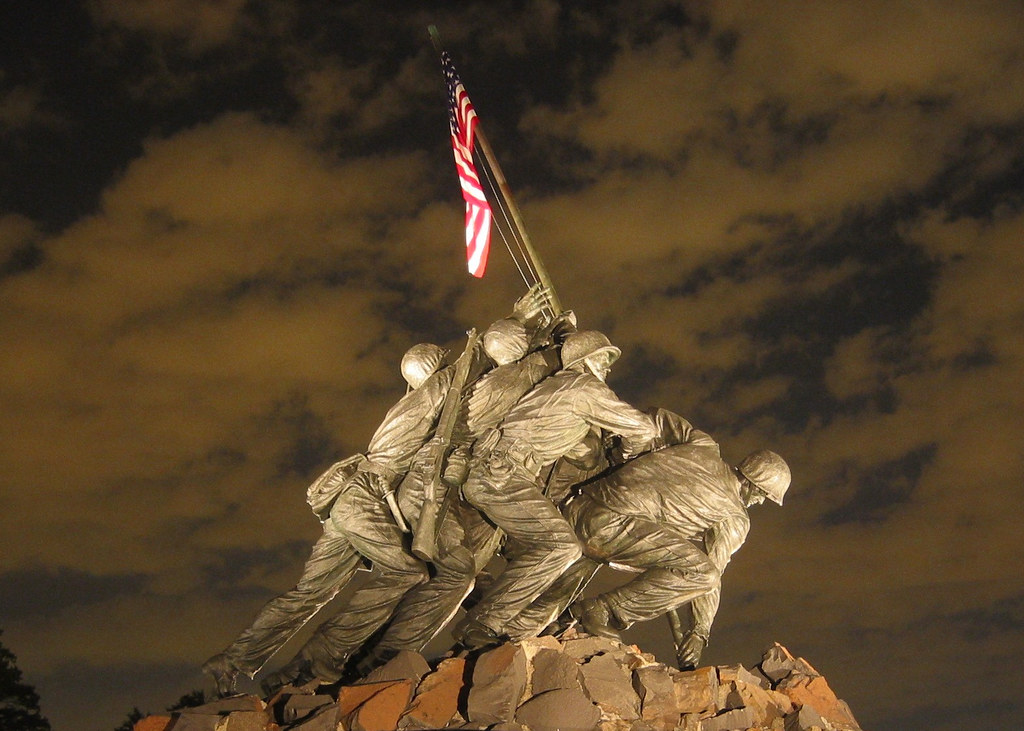
Unveiled in November 1954, the Marine Corps War Memorial in Washington, D.C. was dedicated to all Marines who have given their lives in the defense of the U.S. since 1775. see – https://www.nps.gov/gwmp/learn/historyculture/usmcwarmemorial.htm – retrieved February 19, 2025. October 2003. Author’s photograph. All Rights Reserved.
The image captured by Rosenthal’s photograph was widely used in war bond drives and helped rally a weary American home front during the final months of the war. The photograph also inspired the U.S. Marine Corps War Memorial, ensuring the battle’s place in American memory.
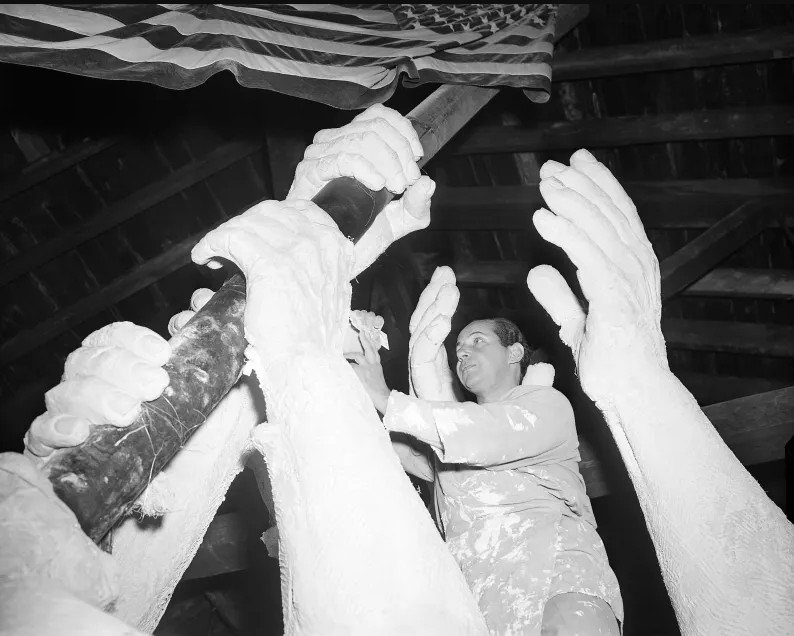
US Marine Corps War Memorial, Washington, D.C. The centerpiece of the memorial is a colossal sculpture group by Felix Weihs de Weldon (1907-2003), then on duty with the U.S. Navy, depicting the six Marines who raised the second larger U.S. flag atop Mount Suribachi on Iwo Jima on February 23, 1945. The memorial was designed by Horace Whittier Peaslee, Jr. (1884-1959) and dedicated in November 1954 by President Dwight D. Eisenhower. October 2003. Author’s photograph. All Rights Reserved.
US Marine Corps War Memorial, Washington, D.C., was based on the iconic AP photograph by Joe Rosenthal taken on February 23, 1945 of the raising of the U.S. flag at the top of Mount Suribachi at the start of the Battle of Iwo Jima (February 19- March 26, 1945). Rosenthal’s photograph was flashed around the world for the first time on Sunday, February 25, 1945, and instantly became a symbol of the American war effort in the Pacific Theatre during World War II. The Marine Corps War Memorial Foundation organized the fundraising and creation of the monument. The complete cost of the memorial was $850,000 (about $10 million in 2025). The 32-foot-high bronze figures are erecting a 60-foot flag pole onto Mount Suribachi. Important dates in the history of the Marine Corps are burnished in gold into the Swedish marble base.The six marines who raised the flag on Iwo Jima have all been identified and include a sergeant, 2 corporals, and 3 privates first class. Unveiled in November 1954, the Marine Corps War Memorial was dedicated to all Marines who have given their lives in the defense of the U.S. since 1775. October 2003. Author’s photograph. All Rights Reserved.
Flags of Our Fathers (2006) is Clint Eastwood’s powerful film about the Battle of Iwo Jima (February 19 to March 26, 1945) and the legacy of one of the most iconic images of World War II. Eastwood directed and co-produced the film and also composed its score. It was released alongside its companion film, Letters from Iwo Jima, which recounts the same battle from the Japanese perspective.
Distributed by Paramount Pictures in the United States and Warner Bros. internationally, the two films earned strong critical praise. Together they form one of cinema’s most thoughtful examinations of war, heroism, and historical memory.
The Photograph That Became a Symbol
The film is based on James Bradley and Ron Powers’ bestselling 2000 book, which explored the experiences of Bradley’s father, Navy corpsman John Bradley, and the five U.S. Marines who raised the American flag atop Mount Suribachi on February 23, 1945.
Captured by Associated Press photographer Joe Rosenthal, the image quickly became one of the most recognizable photographs in American history. Its depiction of determination and sacrifice came to symbolize the United States’ war effort in the Pacific. Decades later, however, further research led the U.S. Marine Corps to revise the identification of several men originally believed to appear in the photograph.
Beyond the Battlefield
While the film contains intense combat sequences depicting the brutal struggle for Iwo Jima, its deeper focus is the human cost of turning soldiers into national symbols.
Three of the flag raisers were killed in action less than a week after the photograph was taken. The surviving participants were returned to the United States, where they became reluctant celebrities. As the war continued, they were enlisted to help promote a nationwide war bond campaign designed to finance the final push toward victory.
The Burden of Heroism
With the war in Europe nearing its end, the photograph and the men associated with it became powerful symbols of American courage and resolve. Yet Flags of Our Fathers questions the nature of heroism itself. The surviving flag raisers struggled with grief, survivor’s guilt, public expectations, and the uncomfortable reality that their fame was based on a single moment overshadowing the sacrifices of thousands of others.
Eastwood’s film ultimately argues that history often elevates symbols while overlooking the complex individuals behind them.
Legacy
More than a conventional war film, Flags of Our Fathers is an exploration of memory, mythmaking, and sacrifice. By examining both the ferocity of combat and the pressures of the home front, the film reveals how a single photograph came to represent a nation at war while forever changing the lives of the men captured within its frame.
Rosenthal told Collier’s magazine: “The sky was overcast, but just enough sunlight fell from almost directly overhead, because it happened to be about noon, to give the figures a sculptural depth. The 20-foot pipe was heavy, which meant the men had to strain to get it up, imparting that feeling of action. The wind just whipped the flag out over the heads of the group, and at their feet the disrupted terrain and the broken stalks of the shrubbery exemplified the turbulence of war.” Quoted in https://www.usfca.edu/magazine/december-2024/feature/man-behind-the-camera – retrieved Feb. 19, 2025. Wire services flashed Joe Rosenthal’s photograph around the world where it was published on the front pages of more than 200 newspapers on Sunday, February 25, 1945. The photo appeared on magazine covers across the country as well. Following the battle of Iwo Jima, the photo was used for publicity in war bond drives from May 11 to July 4, 1945, which raised an amazing $26.3 billion – by far the biggest haul of any of the seven U.S. war loan drives during World War II.. Rosenthal’s photograph became an enduring icon.
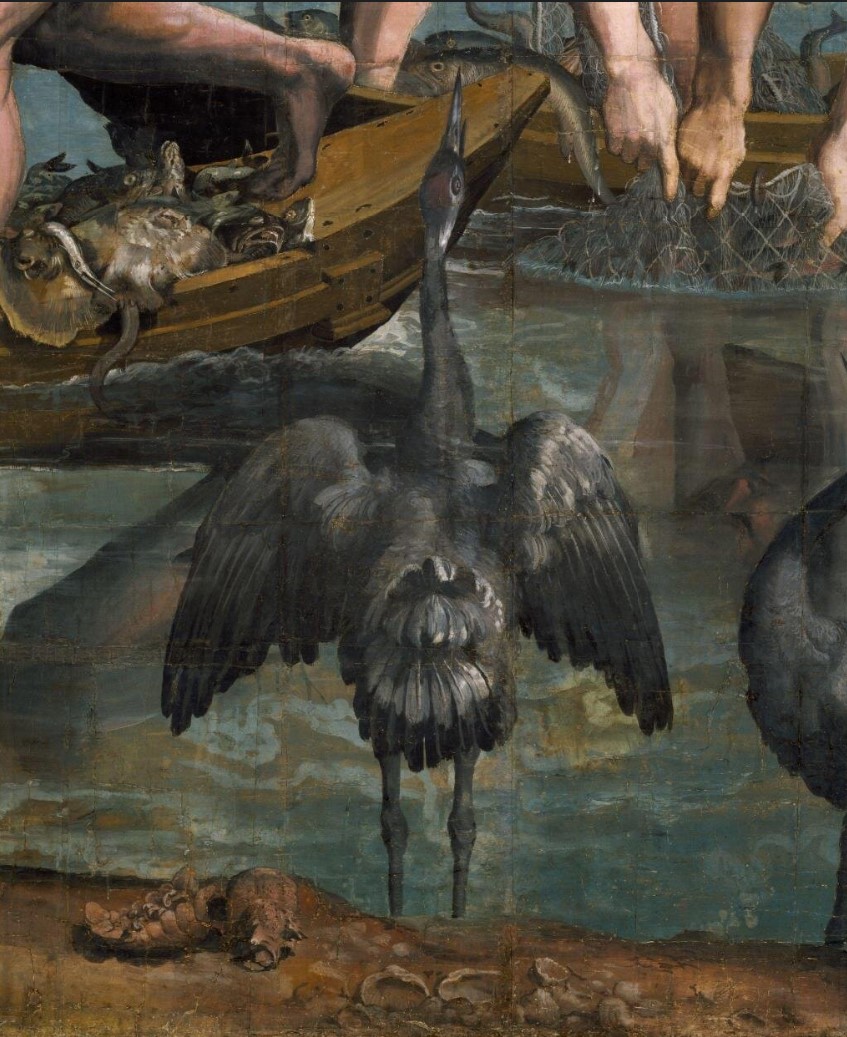
FEATURE Image: Paris Bordon/e (1500-1571), Fisherman Presenting a Ring to the Doge Gradenigo, 1534, oil on canvas, 370 x 301 cm (145.7 in × 118.5 in), Gallerie dell’Accademia, Venice.
The Venetian Renaissance was shaped by the wealth, global reach, and humanist culture of the Republic of Venice, whose artists transformed European painting through their mastery of color, light, atmosphere, and poetic invention. From Bellini to Giorgione, Lotto, and Bordone, Venetian painters created a distinctive artistic tradition that reflected both the intellectual ideals and imperial ambitions of one of Renaissance Europe’s most powerful states.
INTRODUCTION TO PART 1.
Venice is one of the great Italian cities for Renaissance art and its wide-ranging influences. Reflecting a city in the sea, its art is characterized by light and color. Its most remarkable artistic production was between 1470 and 1590 – the rise, height, and decline of the Italian Renaissance. Developed into a powerful maritime empire between the 9th and 11th centuries, Venice was an independent city state that rivaled all other Italian maritime empires such as Genoa, Pisa, and Amalfi; and lesser-known Ragusa, Ancona, Gaeta and Noli, and until the fall of the Republic in 1797. From its trade routes Venice inherited and fortified the coloristic tradition of Byzantium and the Eastern Mediterranean, Islamic countries and the Far East, Ravenna along the Italian coast to the south, and Aquileia near Trieste. Trade routes also included to the Free Cities of the North and its medieval Gothic culture. These activities led to a cosmopolitan culture manifested in Venice’s art and architecture. Around 1500 the Republic also had expanded its territorial holdings to a great extent across Italy, Dalmatia, the Alps, and the Aegean Sea.
The Tuscan Renaissance came to Venice starting around 1430 via Padua, a prestigious university town known for its science and philosophy departments, and part of the Venetian state. Artists such as Giotto (c.1267-1337), Filippo Lippi (c. 1406-1469), Donatello (c. 1386– 1466), Andrea Mantegna (1431-1506) and Paolo Uccello (1397-1475) brought essential elements of the Early Florentine Renaissance to Venice. Since 1469 Venice was a publishing center and had been a stop since late medieval times for humanist authors such as Petrarch (1304-1374). As the Mediterranean’s dominant naval force, Venice’s cosmopolitan mercantile culture brought financial and human capital to the lagoon city whose concentration spawned technological innovation. Politically, since Venice was a Republic and not a duchy or bishopric, publications and ideas were unencumbered by censorship present elsewhere. For example, Aldine Press established in 1495 began by printing Greek and Roman classics and later worked with leading humanists such as Desiderius Erasmus (1466 – 1536), Pietro Bembo (1470-1547) and Giovanni Pico (1463-1494). The Aldine Press also produced the first proto-type of today’s lightweight and portable paperbacks. By the 16th century over 250 publishing houses operated in Venice making the city a beacon for humanist writers and artists. (see – https://www.bbc.com/travel/article/20190708-the-city-that-launched-the-publishing-industry – retrieved December 15, 2024).
The legacy of Giovanni Bellini provided the foundation for the Venetian Renaissance.
These propitious contacts and developments led to the establishment of Venetian Renaissance art by GIOVANNI BELLINI (c. 1430-1516). From an old family of painters, Bellini established a dialogue between Florentine artistic principles of space and form and its philosophy of the natural world with man at the center with Venetian painterly practice. His major discovery was, beginning in his artwork of the 1490s, the situating of naturalistic color to replace the urbane decorative palette used in medieval painting. He also moved past the older mythological subject matter to a naturalistic presentation of religious themes.
Bellini was joined by Sicilian painter Antonello da Messina (1430-1479) who studied with Piero della Francesca (c. 1416-1492) and introduced the influential geometric design to his compositions that influenced CIMA DA CONEGLIANO (c. 1459 – c. 1517). More isolated in his work – and thereby more important for art practice – was the work of VITTORE CARPACCIO (1465-1526) who introduced his synthesis of strict realism, including a sense of space and proportion. Carpaccio captured not only Venice’s contemporary architecture in the work of classicist Mauro Codussi (1440-1504) and sculptor Pietro Lombardo (1435-1515) but its social activity as well. Following Antonello da Messina and Piero della Francesca, Carpaccio used original and expressive colors. Though Carpaccio’s output faded before 1510, Bellini’s work continued until 1516 and through him formed a continuity of style between the late 1400’s and early 1500’s in Venice.
Giorgione revolutionized painting through poetic landscapes, atmospheric effects, and ambiguous narrative subjects.
In this first period, GIORGIONE (1478–1510), a student of Bellini, was another important figure in exploring color in Venetian art. Though influenced by Bellini, Giorgione was original in his transformation of his teacher’s stoic elite classicism to a grounding in intimacy and humanity. Many of his religious subjects are based on individualized portraits. In his unidealized landscape painting based on the realism of German Albrecht Dürer (1471-1528), Giorgione replicates feelings produced in nature rather than rigid archeological reconstructions that Bellini, Mantegna and Donatello produced. Giorgione was also imbued in Flemish painting including Gerard David (c.1460-1523) and Hans Memling (c. 1433-1494). When Giorgione died at 32 years old in a pandemic in 1510, he left to others his melancholic contemplation of the natural world as a direction for Venetian painting, particularly TITIAN (1488-1576) who is to be featured in another post.
Titian was part of a family of artists who, in 13th-century and 14th century in Italy, had been civic leaders such as mayors, magistrates, and notaries. In Italian his name is Tiziano Vecellio, but in English the artist is famously known as Titian. Titian became the leading painter in Venice and an influential artist throughout sixteenth-century Italy. In the 15th century, two Vecellio brothers had children who became artists. Titian was the grandson of one of those brothers who was ambassador to Venice where the family had a timber trade. A follower of Giorgione, Titian was more intense and dominating in vision and style than the earlier master including his rich dark hues without drawing. Titian also took advantage of Germanic engraving and painting sources for his art, particularly its compositional realism, dynamism and classical references as manifest in Dürer. Though a perfunctory colorist, PARIS BORDON/E (1500-1571) was another artist who came under the influence of Titian’s imperially theatrical style and made a success of it.
Sebastiano del Piombo carried Venetian colorism to Rome, where he engaged with the artistic world of Michelangelo.
There were other artists who followed Giorgione by way of his subject matter rather than, as Titian had, his color. This included artwork of SEBASTIANO DEL PIOMBO (1485-1547), particularly his early Venetian work before he departed for Rome in 1511, and JACOPO NEGRETTI, CALLED PALMA IL VECCHIO (c.1480–1528) who eventually fell into Titian’s orbit but painted arcadian subject matter inspired by Giorgione.
Lorenzo Lotto developed some of the most psychologically penetrating portraits of the Renaissance.
Prolific Venetian artist LORENZO LOTTO (c. 1480 – 1556) retained his independence and highly individual style in a prolific career influenced by Bellini’s composition, Antonello da Messina’s color, and Dürer’s realism. Lotto started in Treviso in 1503 and returned to Venice in 1525 via Recanati, Rome (where he worked with Raphael in the Vatican apartments making his drawing pliant and coloring mellow) and Bergamo. Lotto’s output was primarily deeply spiritual religious paintings and portraits which plumbed psychological depth, and were very popular. In Venice Lotto became one of the leading artists with Titian and Il Pordenone (1484-1539), painting altarpieces, devotional scenes, and portraits for wealthy patrons in the city. Lotto left Venice in 1533 to return to the papal states of the Marches where he intermittently returned to Venice. In 1554 Lotto became a lay brother at the Santa Casa in Loreto and died there in 1556.
Giovanni Bellini
Giovanni Bellini (c. 1430-1516)Madonna with the Child, 1470-1476, oil on canvas transferred from wood, 20.4 in. x 16.9 in (52 x 43 cm), Museo Correr, Venice.
Giovanni Bellini came from a family of artists and began work in his father, Jacopo’s workshop. The Bellini brothers Giovanni and Gentile (d. 1507) were greatly influenced by their contemporary Andrea Mantegna who married their sister Nicolosia in 1454. The chronology of Bellini’s paintings is challenging to definitively settle upon since he ran a large workshop of pupils and assistants whose production output was signed with his name. Bellini’s pupils and influences extended to great names of Renaissance Venetian painting: Giorgione, Titian, Palma Vecchio, Sebastiano del Piombo and had influence beyond his direct contacts and into the future. Bellini also studied Donatello so to develop his personal style in the 1450’s and 1460’s. This is manifested in this Madonna and child of which there are several which expresses in light and color harmonious formal three-dimensional beauty and human feeling.
Giovanni Bellini (c. 1430-1516), Portrait of Joerg Fugger, 1474, oil on panel, 10.2 in. x 7.8 in., 26 cm x20 cm, Norton Simon Museum, Pasadena, California. https://www.nortonsimon.org/art/detail/M.1969.13.P – retrieved December 17, 2024.
In the mid 1470’s, following a practice popularized by Sicilian Antonello da Messina, Bellini moved from tempura painting to oil. Bellini began to use more rounded figures, also taken from Antonello. He also adapted Piero della Francesca’s perspective system. These artistic elements were evident in Northern European artwork commissioned by Italian families from Rogier Van der Weyden (1399-1464), Hugo Van Der Goes (c.1440-1482), Jan Van Eyck (c. 1385-1441), Petrus Christus (c. 1395-1472), Dieric Bouts (c. 1415-1475) and Hans Memling (c. 1433-1494). Bellini’s oil on panel portrait is the artist’s first. The sitter is of Joerg Fugger, the 21-year-old heir to a wealthy banking family in Germany. Bellini depicts his subject with small blue blossoms in his hair, the sign of a scholar. The portrait is three-quarter length instead of profile and set against a neutral background or, later, with landscape and sky. The portrait informed a coming generation of portraiture and religious images in Italy including Raphael (1483 – 1520), Leonardo da Vinci (1452-1519), and Fra Bartolomeo (1472-1517).
The 1470’s saw Bellini produce his most glorious landscapes including the warm and glowing St. Francis at the Frick. Specific details about this painting’s provenance are speculative. It is presumed to have been painted in the late 1470’s for Venetian patrician Zuan Michiel, and was destined for the monastery of San Francesco del Deserto on a remote Venetian island. By 1525, the painting hung in the palace of Taddeo Contarini in Venice. (further reading- https://www.frick.org/exhibitions/bellini_giorgione – retrieved December 17, 2024.). Francis is shown receiving the stigmata in a natural mystical light surrounded by a variety of animals. Bellini’s setting for this religious event that took place in September 1224 is a valley in the Venetian countryside (it took place in Umbria), with a small hilltop town in the background and Francis standing outside his hermit’s dwelling. Saint Francis is said to have composed his Canticle of Creatures also in late 1224, considered one of the first masterpieces of Italian verse.
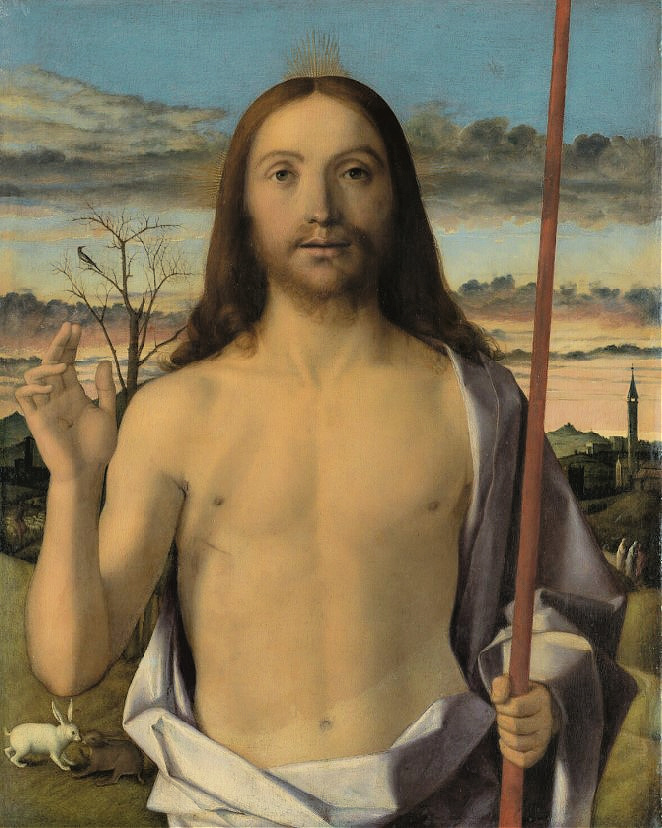
“Bellini and Giorgione in the House of Taddeo Contarini” on view until February 4, 2024, reunited for the first time in about four hundred years the Frick’s “St. Francis in Ecstasy” by Giovanni Bellini with Giorgione’s “Three Philosophers,” on rare loan from Vienna’s Kunsthistorisches Museum which hung in the palace of Venetian art collector Taddeo Contarini.Giovanni Bellini (c. 1430-1516), Christ Blessing c. 1500, Tempera, oil, and gold on panel, 23 1/4 x 18 1/2 in. (59 x 47 cm), Kimbell Art Museum, Fort Worth, Texas. https://kimbellart.org/collection/ap-196707 – retrieved December 17, 2024.
In Bellini’s long career he depicted Jesus Christ differently over time. In his early years he often depicted the dead Christ in a lonely solitude. Later he added angels, and grief-stricken figures of his mother Mary and the apostle John. Bellini developed to depict Christ as triumphant or beatified in his miraculous apparitions of the Transfiguration, Resurrection and Ascension. In Christ Blessing Bellini animatedly portrays the God-Man sent to bless the world on one hand and holding the shepherd’s rod to guide his flock in the other (it may also be logically seen, though not completely in view, as his staff with the traditional red cross on a white flag atop symbolizing his triumph over death). A devotional image presenting the Resurrected Savior, its vibrant figure is brought close to the picture plane where his level gaze and shadowed arm of blessing informs the viewer of the matter-of-fact reality of the scene in quiet harmonious colors. Yet, at the same time, golden rays of light emanate from the top and sides of his head, making thoroughly evident His Divinity. In the background Bellini depicts prolific rabbits, shepherds tending their flock and three shrouded figures who likely are the three Marys at the tomb on Easter morning. There is also a lighted church bell tower to convey the presence of Christ in his Church.
Giovanni Bellini (c. 1430-1516), Drunkenness of Noah, oil on canvas, c. 1515, 40.5 in. x 61.8 in (103 cm x 157 cm), Musée des Beaux-Arts et d’Archéologie de Besançon.
In one of Bellini’s last works the master shows how he adapts his work to the developing artistic style after 1510 led by Giorgione and Titian: the composition is fluid and dynamically conceived, with dramatic realism, aqueous colors and excited brushstrokes. Its attribution to Bellini has been accepted by scholars since 1927 though it remains open to debate.
Cima da Conegliano
Cima da Conegliano (c. 1459-c.1518), Virgin and Child in a Landscape, 1496-99, North Carolina Museum of Art, Raleigh, oil on panel, 28 x 24 3/4 in. (71.1 x 62.9 cm). https://ncartmuseum.org/object/virgin-and-child-in-a-landscape/ – retrieved December 12, 2024.
Cima was a Venetian artist who admired Bellini’s use of color and Antonello’s style of the Netherlandish masters. In contrast to renewed classicism which appeared in Venice in its art and architecture, Cima attempted a sophisticated art reliant on the study of nature that was prevalent in the provinces. Born in Treviso in about 1459, Cima worked in Vicenza in Mantegna’s circle and then moved to Venice in 1492. He was associated with the school of Alvise Vivarini (1442/1453–1503/1505), though Cima remained linked to the gentle and rustic naturalism of the provinces. His models included Madonnas and religious figures in peaceful landscapes such as this painting of a peasant mother and her child in a landscape that includes behind them a monastery and hilltop fortification. The crystalline colors and fluid drawing indicate Antonello’s influence while its overall placidness is characteristic of Cimi’s artwork.
Vittore Carpaccio
Vittore Carpaccio (1465-1526), Apparition of the Martyrs of the Mount Ararat in the Church of Sant’ Antonio di Castello, c.1513-14, oil on canvas, 47 5/8 x 68 ½ in. (121x 174 cm), Gallerie dell’ Accademia, Venice.
A pupil of Gentile Bellini (Giovanni’s brother), and a follower of Giovanni and Giorgione, his finest work began in 1490. The Legend of Saint Ursula and other pageant-type pictures was early and masterful Italian genre painting. Carpaccio depicted detailed episodes of sacred history and legend using the settings and minutiae of contemporary everyday Venetian society within a formal pictorial schema. This Apparition of the Martyrs of the Mount Ararat in the Church of Sant’ Antonio di Castello is a small canvas that captures the compelling simplicity and authentic emotion of a religious scene that was present in his earlier larger format cycles and series. The painting is of a vision of the prior of St. Anthony monastery kneeling at the altar on the far left. He turns to see the 10,000 martyrs of Mount Ararat he called upon in prayer during a plague that had broken out among the friars. As the martyrs process into the church, they are blessed by St. Peter, the first pope. Carpaccio depicts the interior of a Gothic Church – including an elaborate wooden screen at left and cargo ships suspended from the ceiling – that was demolished in 1807.
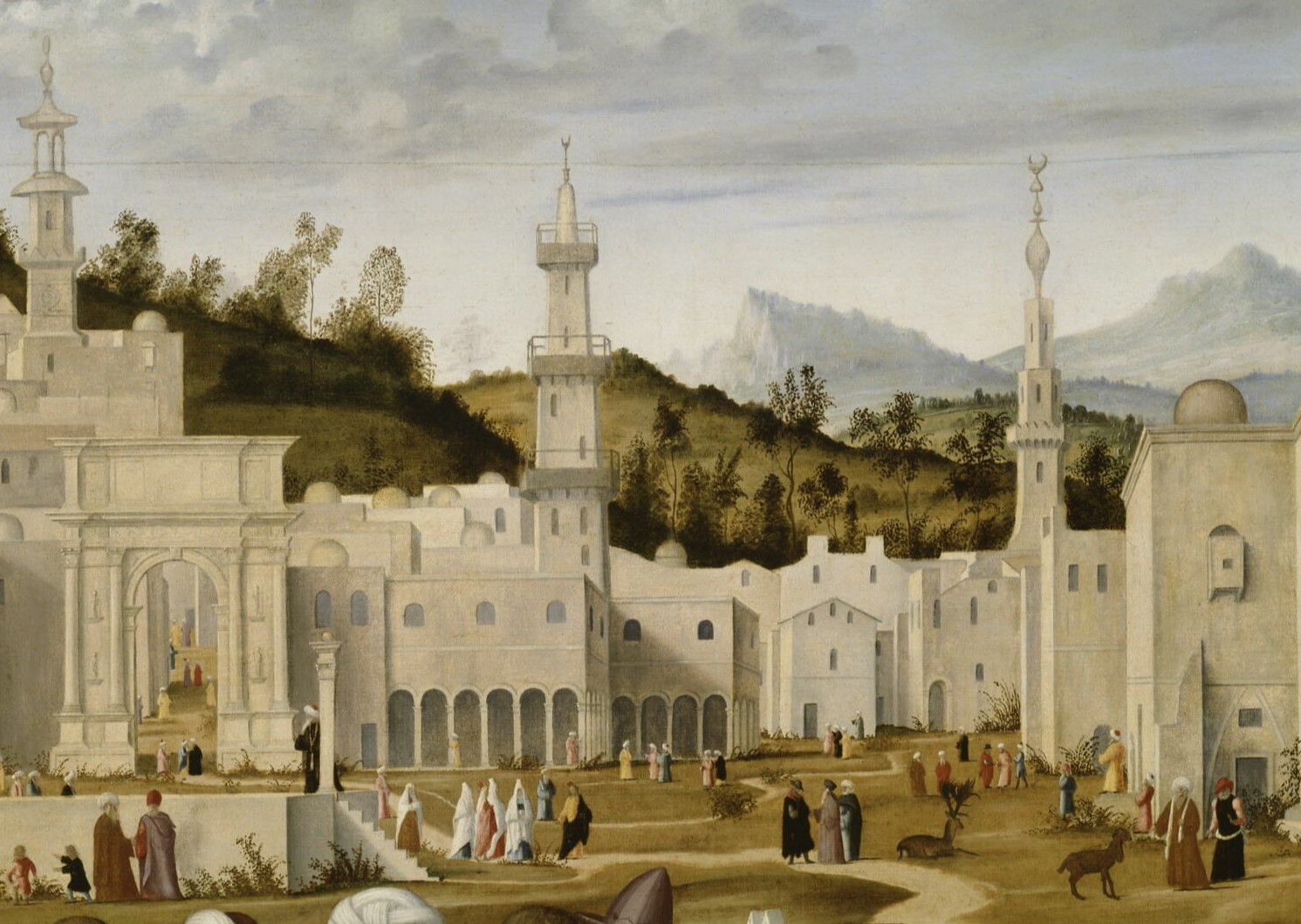
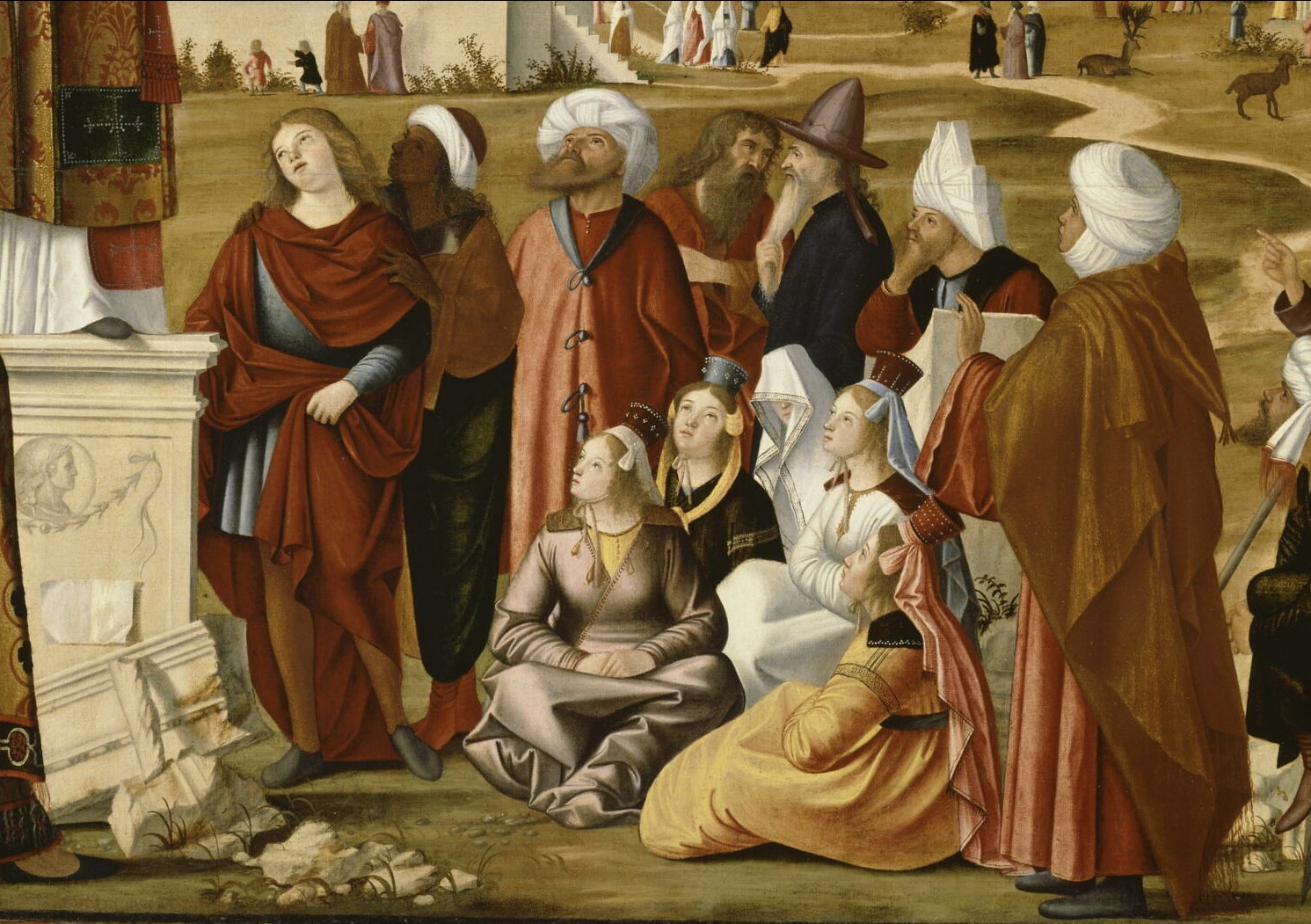
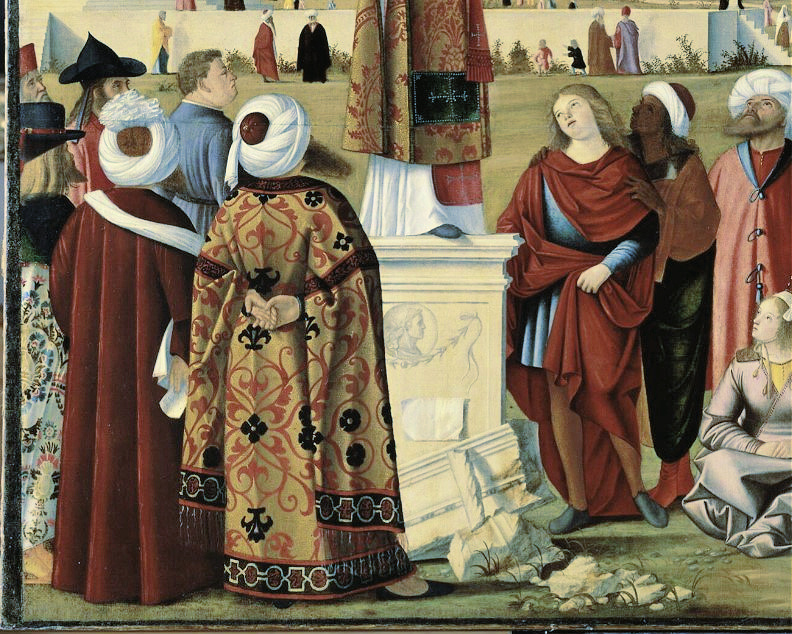
Vittore Carpaccio (1465-1526), Preaching of St. Stephen, 1500-1525, oil on canvas, 1.48 x 1.94m, Louvre. In place until the abolition of the brotherhood in 1806; P. Edwards, 1807; Pinacoteca di Brera, Milan, 1808; entered the Louvre by way of exchange, 1812. https://collections.louvre.fr/en/ark:/53355/cl010062650 – retrieved December 19, 2024. detail. detail. detail.
Preaching of Saint Stephen by Vittore Carpaccio was done on the first quarter of the 16th century. It depicts the first Christian martyr, St. Stephen, giving a sermon whose actions and words involve its audience as active witnesses. Set within a spacious landscape it reflects an ideal city view, reminiscent to Jerusalem. It is suggested that Carpaccio may have been in Jerusalem as this scene is reminiscent of life in that city and of the Haram-ash-Sharif with the Mosque of Omar.
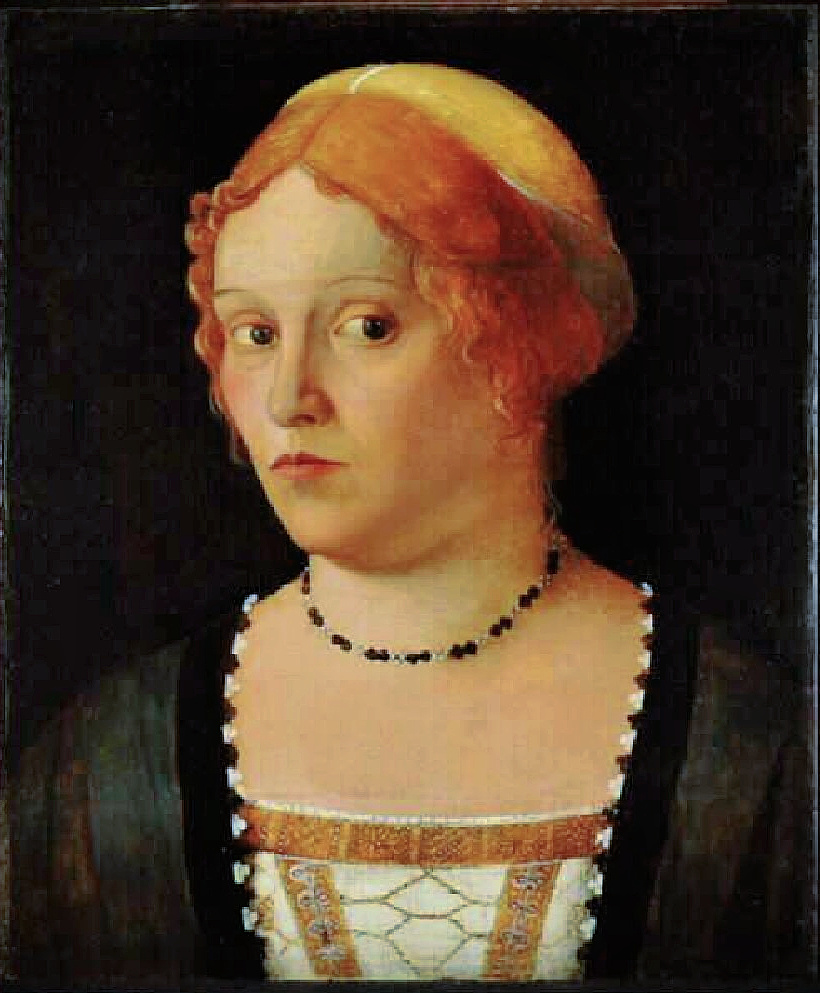
Carpaccio’s realism in numerous portraits in his ceremonial pictures was influenced by the Flemish masters already popular in Italy in the 1490’s. This bust-length independent portrait of a woman set against a plain dark background is almost an abstract construct of eyes, mouth and hairstyle. Her large head is turned slightly in one direction while her limpid eyes look in the other direction. Her reddish hair is pulled loosely back from her face and, at the crown of her head she wears a yellow net to hold some of it. Her square-neck dress is slate blue edged in black, with a white and gold embroidered front panel. Around her neck she wears a choker of white and black beads.
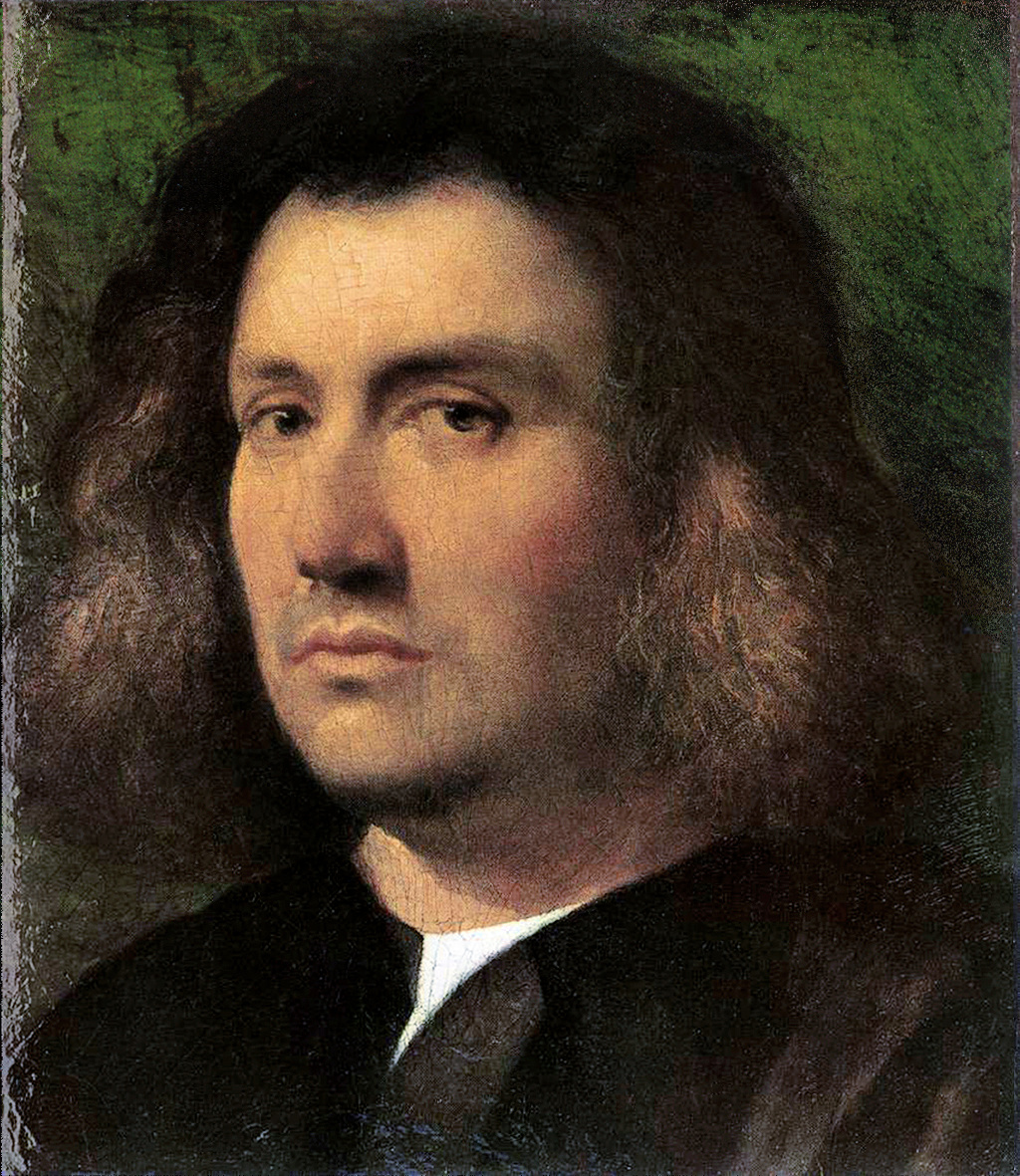
Giorgione who moved to Venice around 1500 is the transitional figure between Bellini and Titian. Instead of a prevailing late 15th century practice of precise brushstrokes and sculptural composition in his art, Giorgio expressed his subject matter in studied tonal gradations of color and precise analysis of human emotional expression described in gentle brushstrokes. Vasari saw Giorgione’s painting as if having no intermediary between art and life. Painted in the same period as Old Woman (Gallerie dell’ Accademia, Venice), this Portrait of a Man epitomizes what Vasari called the “modern manner” where Giorgione sought to paint “living and natural things.” With its plain dark background and close head crop the man’s carefully observed turning gaze and ambiguous expression is wholly engaging and alive.
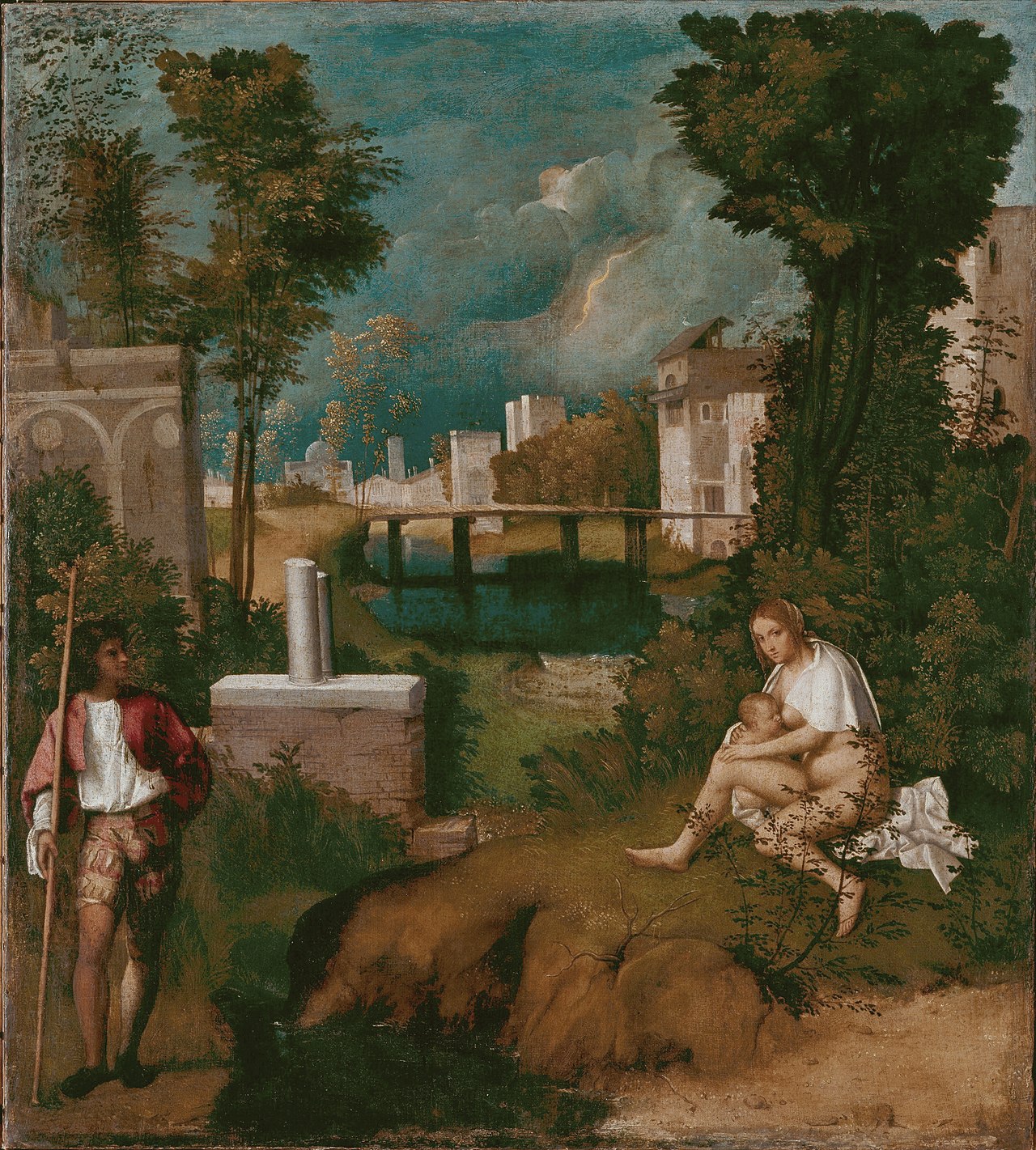
Giorgione (1478–1510), The Tempest, c. 1508, oil on canvas, 83 cm × 73 cm (33” × 29”), Gallerie dell’Accademia.
With Leonardo da Vinci, Giorgione is ranked as one of the founders of modern art. He was the first artist in Venice who often painted small artworks in oil of mysterious and evocative subjects for private commissions instead of public church works. The Tempest, originally commissioned by a Venetian noble of the House of Vendramin, is one of those artworks. Known as “a landscape of mood,” it has no discernable subject matter outside of expressing the tension and heat of an approaching storm. Its meaning remains elusive today. Giorgione’s career and personal life are equally mysterious. The artist is known to have shared a studio with Venetian painter Vincenzo Catena (c. 1480-1531) in Venice, worked on the Doges’ palace (though these works are lost) and on frescoes on the exterior of the German Merchants headquarters in Venice where Titian was working as well in a lesser role. Giorgione was an innovator but his known output is small, questionable, and, dying in the plague in 1510 at 32 years old, sometimes completed by others including his pupils, Titian and Sebastiano del Piombo, who were profoundly influenced by him.
Because of Giorgione’s early death in 1510 and other circumstances he did not complete many of his later paintings, making their ultimate identification difficult. That Titian completed many of these works is documented. Once in the collection of the House of Vendramin, this painting is such of jumble of painterly hands it is today attributed to the Circle of Titian though when earlier it was attributed to Giorgione the hand of Titian was apparent particularly in the figure of Christ. Titian was more aggressive in his use of colors –such as browns and grays- than Giorgione’s refined yellows and blues. X-rays reveal another composition – believed to be Giorgione-like- over the ponderous right hand of the angel painted over it.
Sebastiano del Piombo
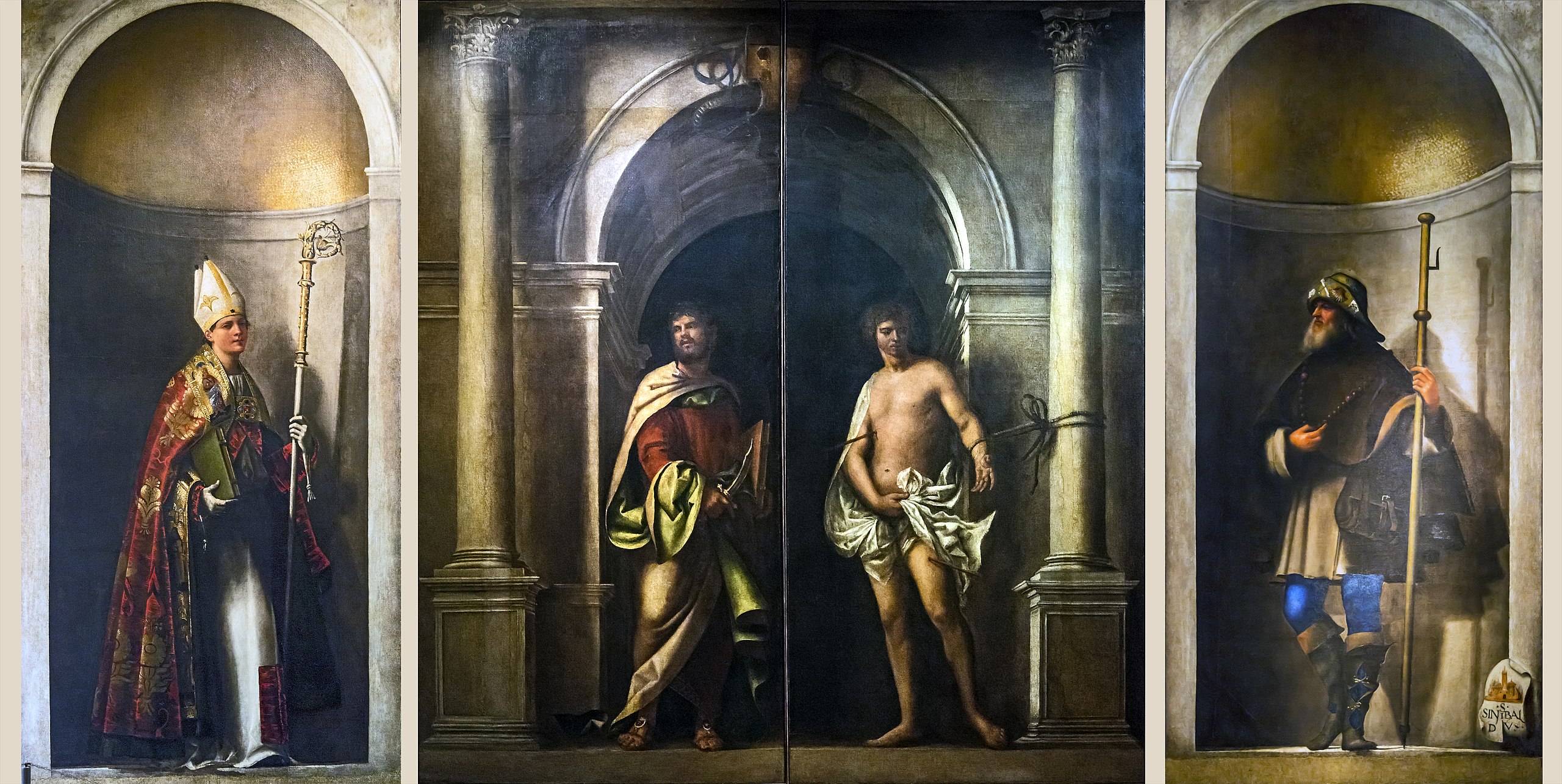
Sebastiano del Piombo (1485-1547), Organ Shutters, Four Saints, c. 1507-09, 115.3 in. x 53.9 in., 293 cm x 137 cm Gallerie delle’ Accademia, Venice (formerly in the Church of San Bartolomeo al Rialto).
When the organ shutter doors closed they formed a single image of two martyrs: Saint Batholomeo and Saint Sebastian. These organ shutters for San Bartolomeo al Rialto are the earliest documented works of Sebastiano. Commissioned by the church’s vicar in late 1507, it was completed in 1509.
Detail of above. St. Louis of Toulouse.
St. Louis of Toulouse was a bishop of Toulouse in France consecrated by Boniface VIII in 1297. Because of his princely standing Louis won the episcopal appointment, but as bishop he turned his office and efforts to meeting the material and spiritual needs of the poor in his diocese, feeding the hungry, and ignoring his own material interests. After six months, exhausted by his labors, he abandoned the position of bishop and died at Brignoles of fever, possibly typhoid, at 23 years old. St. Louis of Toulouse is one of the inside panels inside a niche of gray stone and gold mosaic (the other is St. Sebald of Nürnberg) by Sebastiano in his first documented commission.
Venice emerged as a rival to Florence and Rome, developing a distinctly Venetian style rooted in light, sensuality, and the visual splendor of the maritime republic.
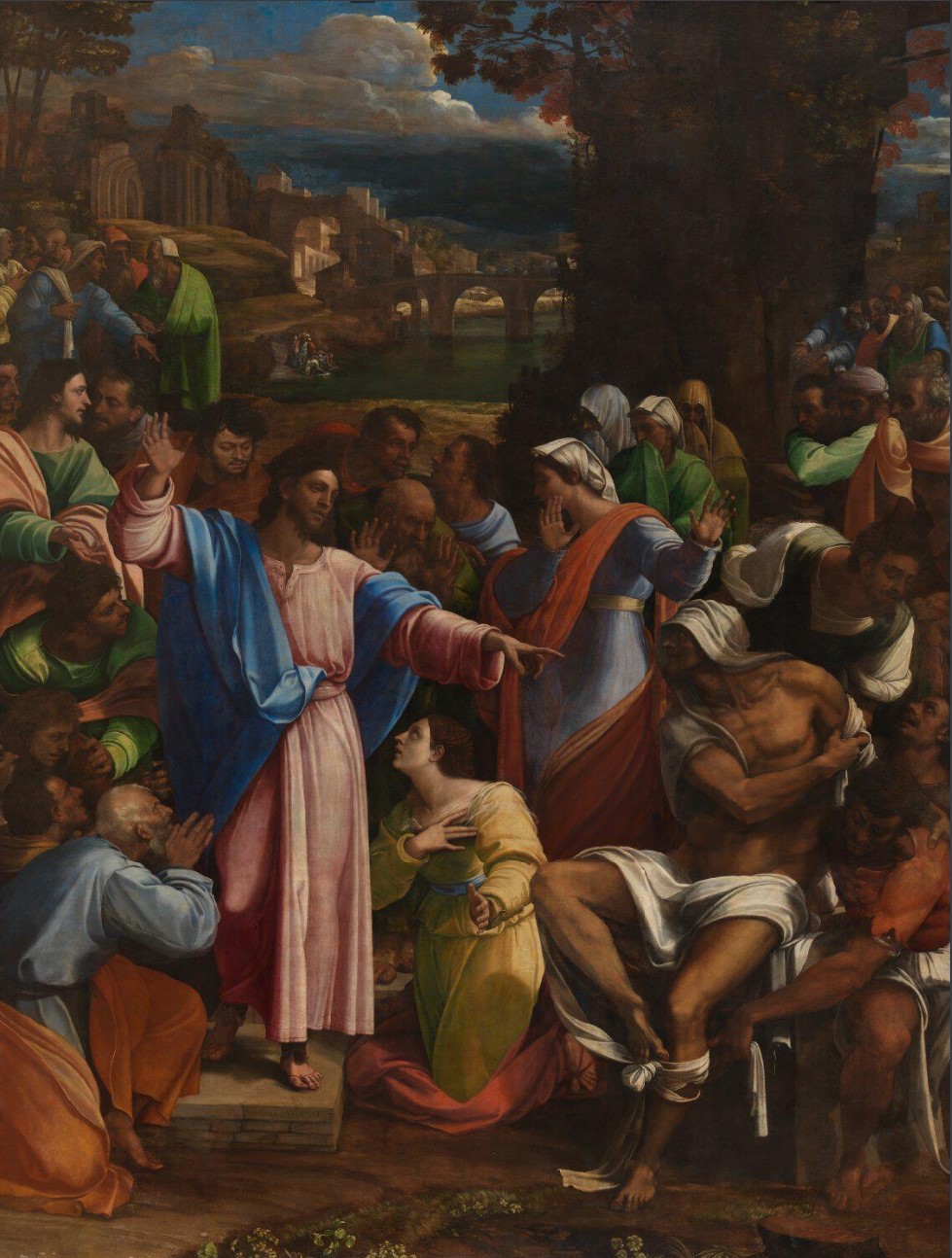
Sebastiano Luciani, a pupil of Giorgione who deeply influenced him, was born in Venice in 1485. He didn’t become “del Piombo” until after 1531 when he became Keeper of the Papal Seal (“Il Piombo”). After Giorgione’s death in 1510 del Piombo may have completed some of Giorgione’s work and, in 1511, moved to Rome. Working at Villa Farnesina in Raphael’s circle that included Baldassare Peruzzi (1481-1536), del Piombo fell out with Raphael and became a devoted follower of Michaelangelo (1475-1564). Both eagerly worked to outperform Raphael, an artistic rival, and Michelangelo lent del Piombo some of his drawings to work from for some of the main figures in the complex composition of The Raising of Lazarus. The gigantic painting was commissioned for Narbonne Cathedral in southern France by Cardinal Giulio de’ Medici (1478-1534), later pope Clement VII, who had also commissioned Raphael’s last painting Transfiguration for the same cathedral.
“The Raising of Lazarus” by Sebastiano del Piombo is introduced by curator Matthias Wivel in this talk as part of the series ‘The History of the National Gallery in Six Paintings.’Sebastiano del Piombo (1485-1547), Portrait of Clement VII, c. 1531, oil on slate, 105.4 × 87.6 cm (41 1/2 × 34 1/2 in.), J. Paul Getty Museum, Los Angeles. https://www.getty.edu/art/collection/object/103RJN – retrieved December 18, 2024.
The pope visited the artist’s studio and was pleased with his original three-quarter length portrait seated in a chair positioned diagonally, and ordered this oil copy on slate. The practice originated in Rome around 1500 in an attempt towards immortality in art. However, the material was heavy and would shatter if not handled with care. After 1531 del Piombo painted rather less and turned to making admirable portraits which combined his Venetian training in color and Roman discipline in form.
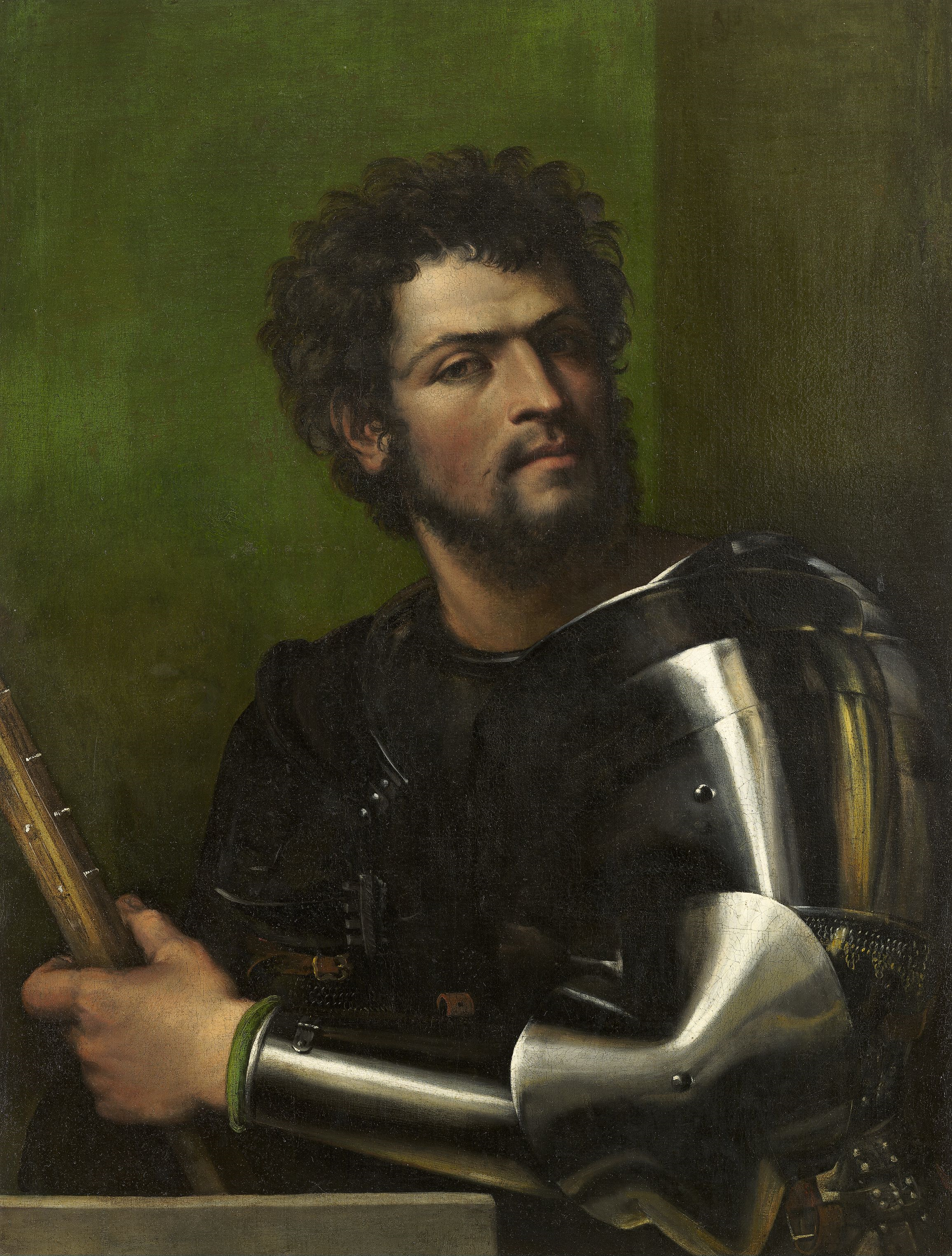
Sebastiano del Piombo (1485-1547), Portrait of a Man in Armor, c. 1511-15, oil on canvas, 34 ½ x 26 ¼ in (87.6 x 66.7 cm) Wadsworth Atheneum, Hartford.
Sebastiano made this portrait under the influence of Giorgione in terms of its gentle, engaging expression and subtly dramatic “over the shoulder” pose. Until more recently, this painting was attributed to Giorgione and, as it is Sebastiano, it recalls the deep influence Giorgione had on his pupils who imitated him profoundly. It has been postulated that the sitter is the Florentine general Francesco Ferrucci (1489-1530) who fought in the Italian Wars.
Palma Il Vecchio
Jacopo Negretti called Palma il Vecchio (c. 1480-1528), Diana and Callisto, c. 1525/28, oil on canvas, 30 ½ x 48 ¾ in. (77.5 x 124 cm), Kunsthistorisches Museum, Vienna (Kunsthistorisches Museum Wien, Gemäldegalerie) https://www.khm.at/en/objectdb/detail/1291/?offset=34&lv=list – retrieved December 12, 2024.
Palma Il Vecchio was a Venetian painter who was a pupil of Bellini and influenced by Titian, Giorgione and Lotto. He is chiefly remembered for his paintings of female figures, particularly a blonde Venetian type of ample charm which extended even to paintings of several female saints. The subject of the naked woman located in a natural setting was pioneered by Giorgione and Titian but Palma Il Vecchio progressed the subject to work out the figure in three-dimensions and reliant on the linear curves in and of a complex assembly and interplay of naked female figures. In this painting, Palma il Vecchio adapted the poses of the sculptors of antiquity and drew on Mannerist contemporaries such as Giulio Romano (1499-1546) and Marc Antonio Raimondi (c. 1470/82–c. 1534). The sensuous surface texture typically found in Venetian art has given way to porcelain-like coolness.
Giovanni Cariani
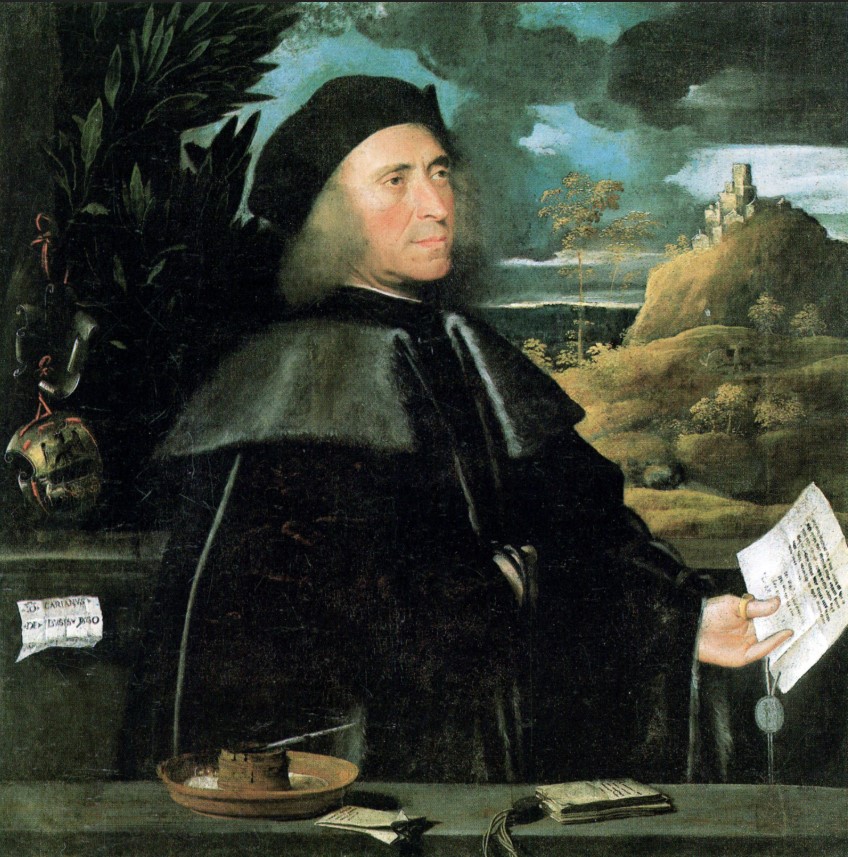
Giovanni Cariani (a. 1490-1547), Portrait of a Man, 1525-30, oil on canvas, 36 1/2 x 36 1/2 in. (92.7 x 92.7 cm), National Gallery of Canada, Ottawa.
Little is known about Cariani’s biography though it is speculated he was born in Bergamo in or before 1490. In his gentle, soft shaded subjects and arcadian elements Cariani’s early work is Venetian influenced by Giorgione. The artist was also inspired by Bellini and close to Palma Il Vecchio. He moved to Bergamo before 1520 and mastered portraiture under the influence of Lorenzo Lotto which are the highlight of his career. One of Cariani’s masterpieces is this portrait of a man of letters holding a seal that is possibly imperial or papal. The luminous colors are influenced by Palma Il Vecchio while the psychological insight of the sitter is learned from Lorenzo Lotto. The sitter is believed to possibly be Giovanni Benedetto da Caravaggio, a professor and administrator at the University of Padua.
Lorenzo Lotto
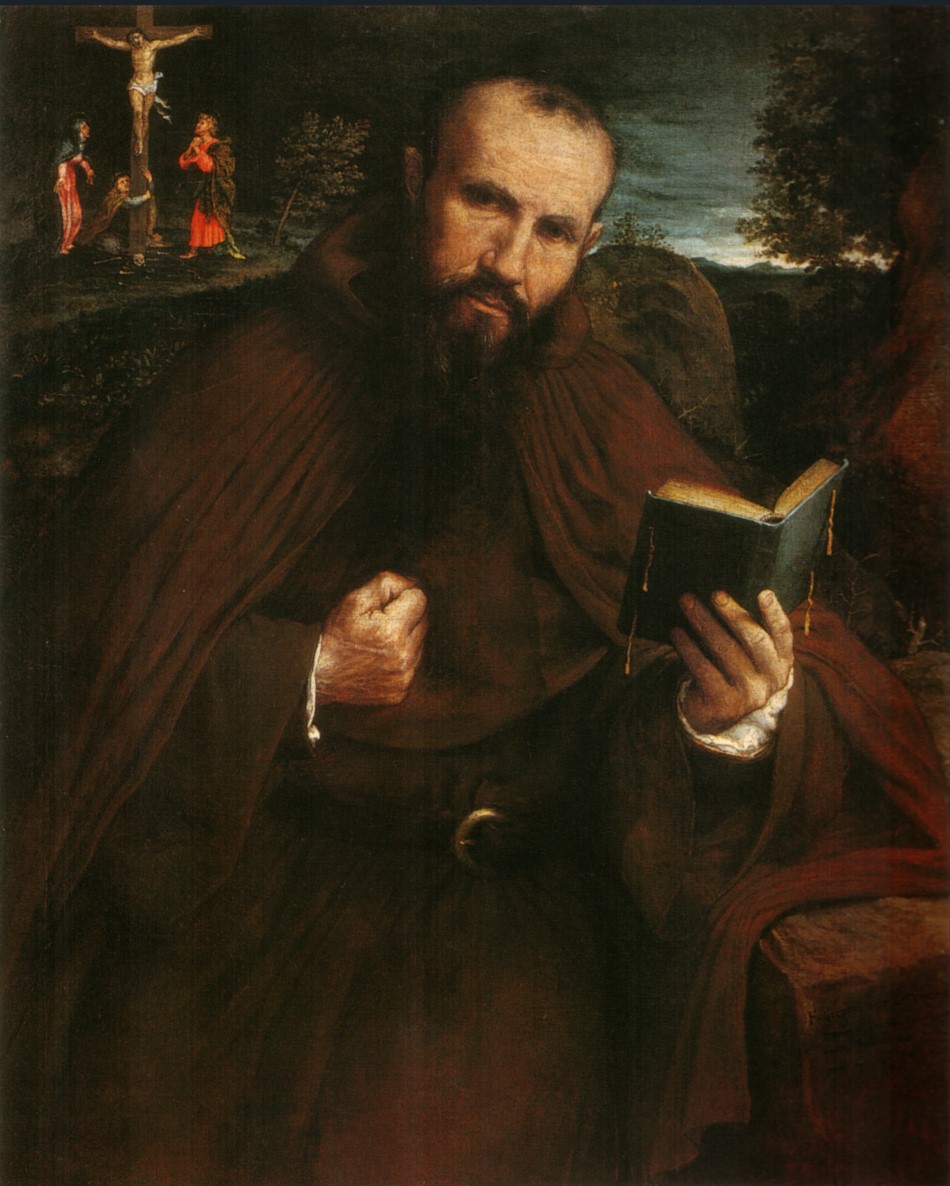
Lorenzo Lotto (c. 1480 – 1556), Fra Gregorio Belo of Vincenza, 1547, oil on canvas, 34 3/8 x 28 in (87.3 x 71.1 cm) The Metropolitan Museum of Art, New York City. https://www.metmuseum.org/art/collection/search/436917 – December 18, 2024.
The sitter beats his fist into his chest in penance, lifts an open book of Passion meditations, and is surrounded by a brooding sky and background living scene of Calvary, all of which works for the artist to scrutinize the mental state or inner thoughts of his sitter, here a religious brother in an order of poor hermits. Lotto had studied portraits of Albrecht Dürer, who made two trips to Venice, to learn to convey these deeper psychological states. Lotto’s assertively confessional portraits under his intense handling of light and dourly earthy colors, were astutely new and sometimes rejected by clients.
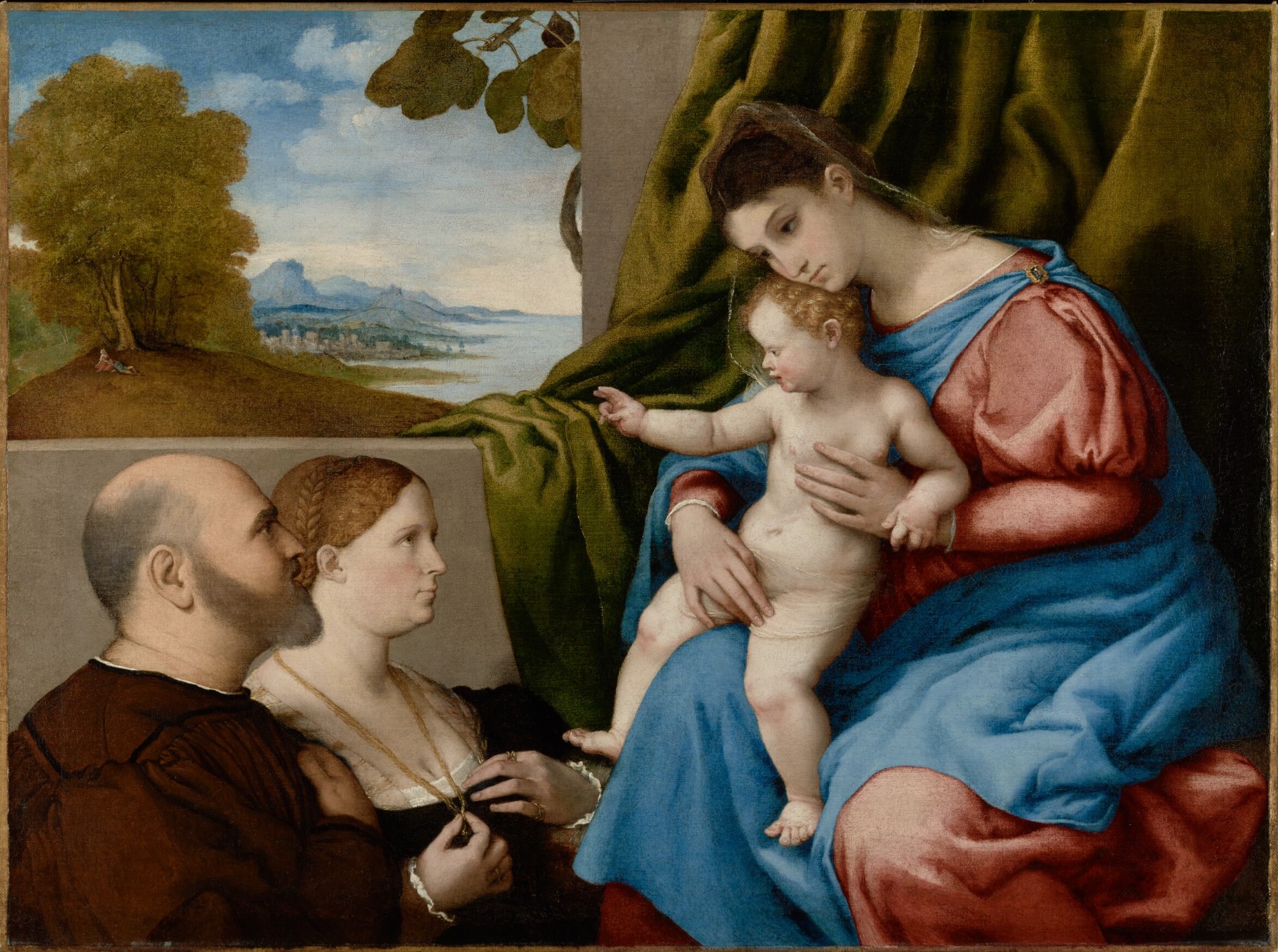
Lotto, a deeply religious man and one of the most independent of the 16th century Venetian artists, had a highly singular artistic vision with penetrating insight into the human personality. This painting is a mixture of the artist’s realism and idealism. The setting is natural as are the donors who Lotto draws with a Northern European Art sensibility. The Madonna and child are not derived from models, but expressed from an artistic conception of spiritual superiority. Kneeling donors in profile with the Virgin and Child was a motif developed in Venice in the 1490’s by Bellini. From the medieval period forward, donors were frequently portrayed in artworks they commissioned and such was more popular than ever in the early 1500’s.
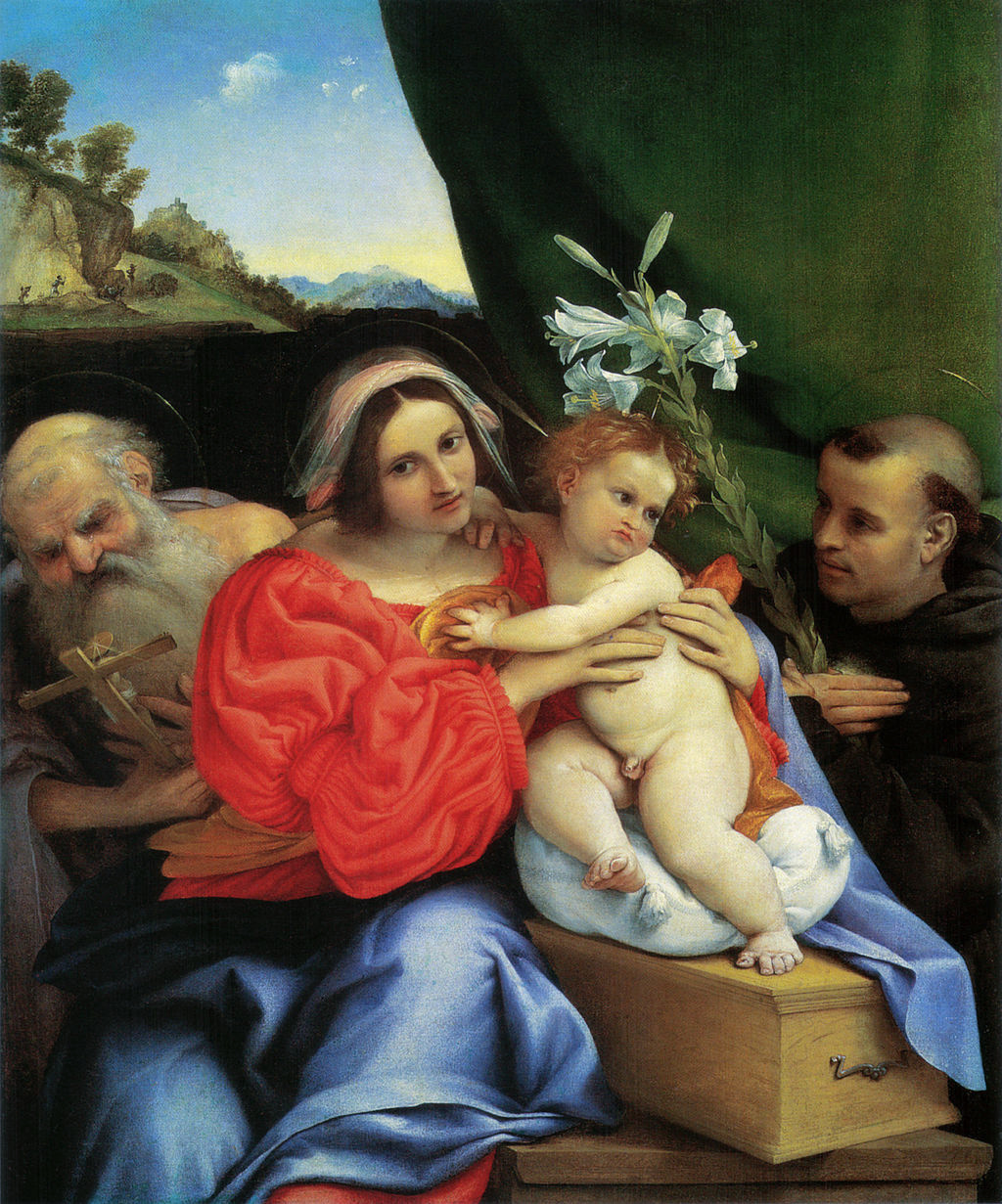
Lorenzo Lotto (c. 1480 – 1556), Madonna and Child with Sts. Jerome and Anthony of Padua, 1521, oil on canvas, 37 1/8 x 30 5/8/ in. (94.3 x 77.8 cm), Museum of Fine Arts, Boston.
While strongly influenced by Bellini at the start Lotto developed an independent chameleon-like style influenced by a range of contemporary Renaissance artists such as Sandro Botticelli (1445-1510), Fra Bartolomeo, Raphael, Corregio (1489-1534), Giorgione, Titian, as well as Germans, Dürer and Hans Holbein the Elder (1460-1524). But Lotto’s well-known character of independence had as much an historical context as a personal one. About Lotto, Bernard Berenson observed that the Venetian painter was “a psychological painter in an age which ended by esteeming little but force and display, a personal painter at a time when personality was getting to be of less account than conformity, evangelical at heart in a country upon which a rigid and soulless Vaticanism was daily strengthening its hold” (quoted in Pignatti, page 66). This painting from the 1520’s is remarkable for its renewed vision of the picture plane, here with an interlocking group of figures filling a shallow foreground like a frieze and a delimited background.
Paris Bordon, or Bordone
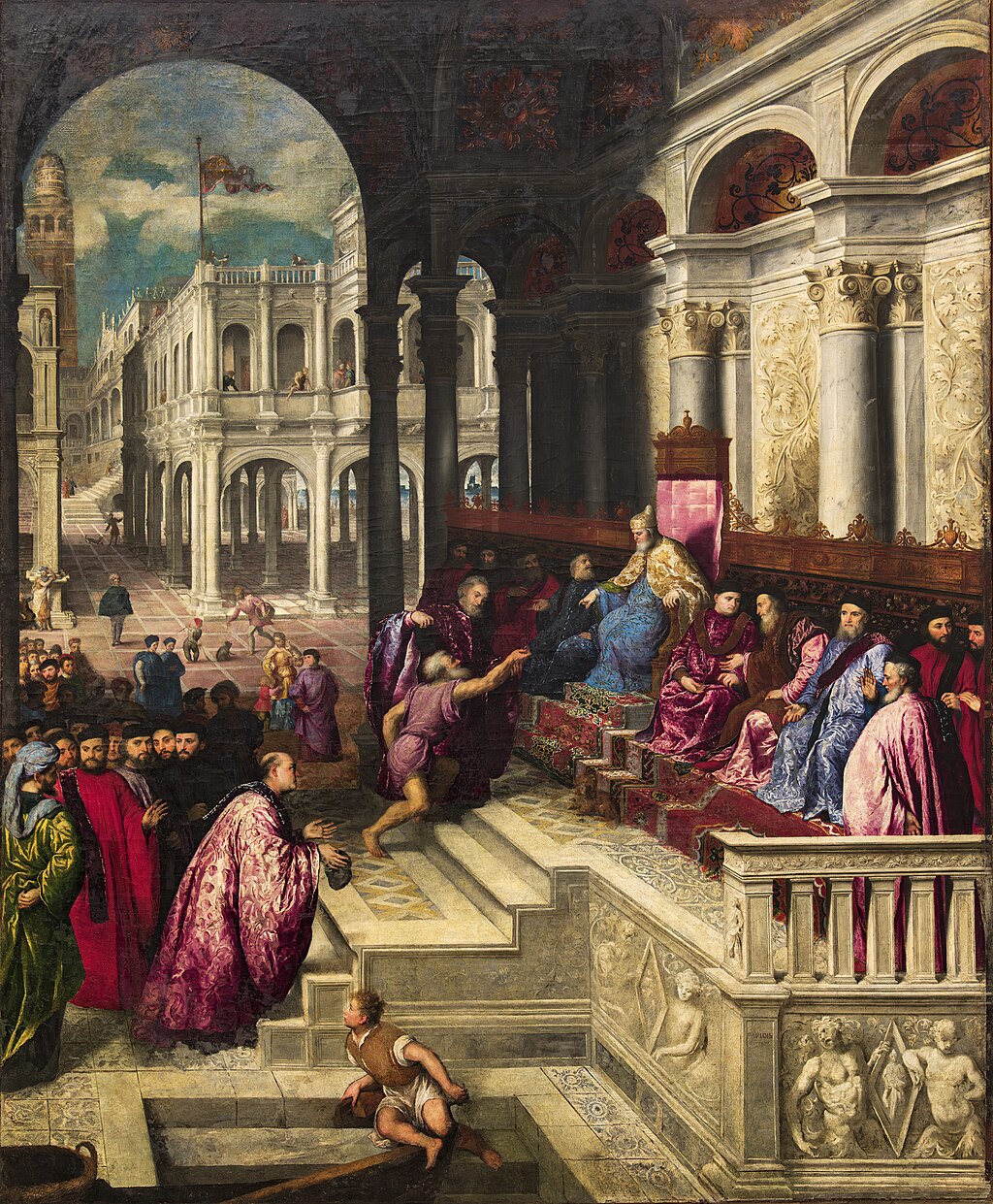
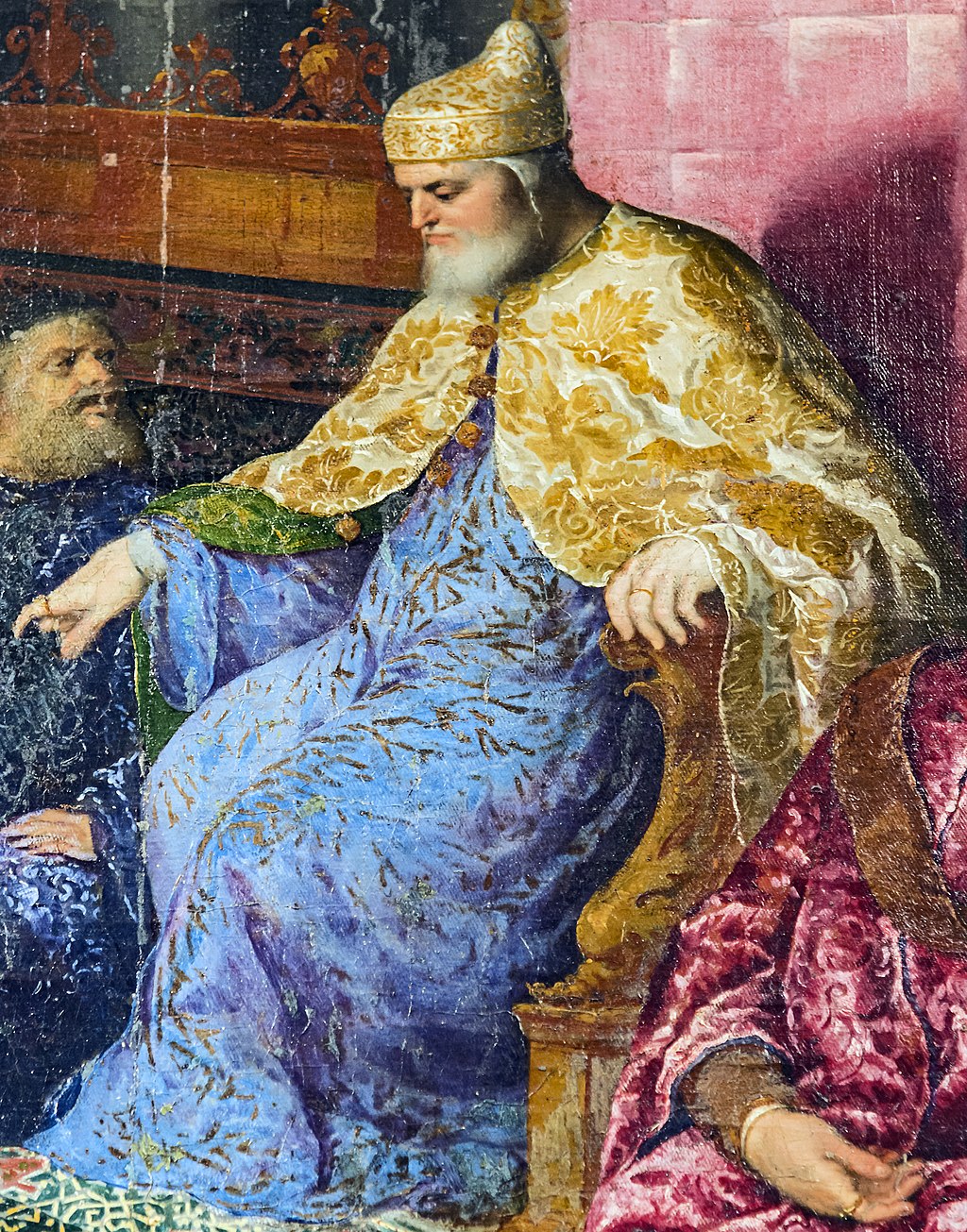
Paris Bordon/e (1500-1571), Fisherman Presenting a Ring to the Doge Gradenigo, 1534, oil on canvas, 370 x 301 cm (145.7 in × 118.5 in), Gallerie dell’Accademia, Venice.
It was painted in Venice for the confraternity of San Marco in 1540. Bartolomeo Gradenigo (1263-1342) was the 53rd Doge of Venice for three years, from 1339 to 1342. He was born in Venice to an ancient noble family and was a rich trader who practiced politics from an early age and lived a life of luxury. The painting depicts a famous legend that occurred in Gradenigo’s reign when a storm was pushed back by the intercession of Venice’s saints. Afterwards the saints gave a humble fisherman the “Ring of the Fisherman” to present to the doge.
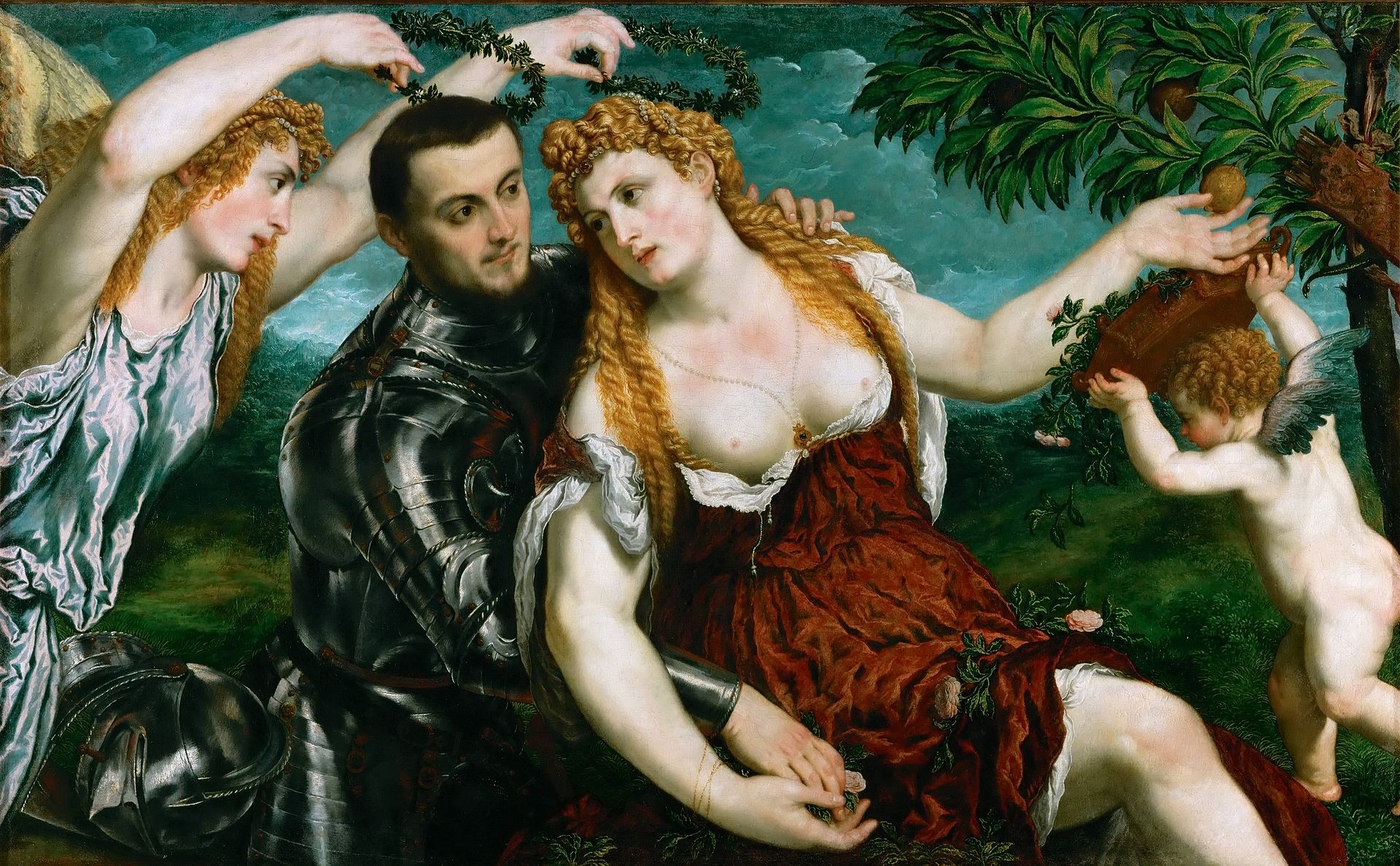
Accademia – Doge Bartolomeo Gradenigo by Paris Bordon/e.Paris Bordon/e (1500-1571), Portrait of a Knight in Armor, oil on canvas, 36 x 30 in. (91.4 x 76.2 cm) Frame: 44 3/4 x 38 x 3 1/2 in. (113.7 x 96.5 x 8.9 cm), North Carolina Museum of Art, Raleigh. https://ncartmuseum.org/object/portrait-of-a-man-in-armor/ – retrieved December 13, 2024.
Paris Bordon/e was born in Treviso in 1500 and moved to Venice in 1508. where he was based his entire life until his death in 1571. His training is unknown though apparently in Venice where he listed as an independent painter in 1518. As a young professional he reflected the influence of Giorgione in his sentimental portraits and Titian in his use of bold and fluid colors. In the mid 1520s he took on a figural monumentality reminiscent of Pordenone. In the late 1530s Bordon/e was in France at the court of Francis I making realistic portraits and, in 1540, in Augsburg, where he painted for the wealthy Fuggers. Bordon/e was well known for his subjects’ delineated costumes and detailed intellectual landscapes.
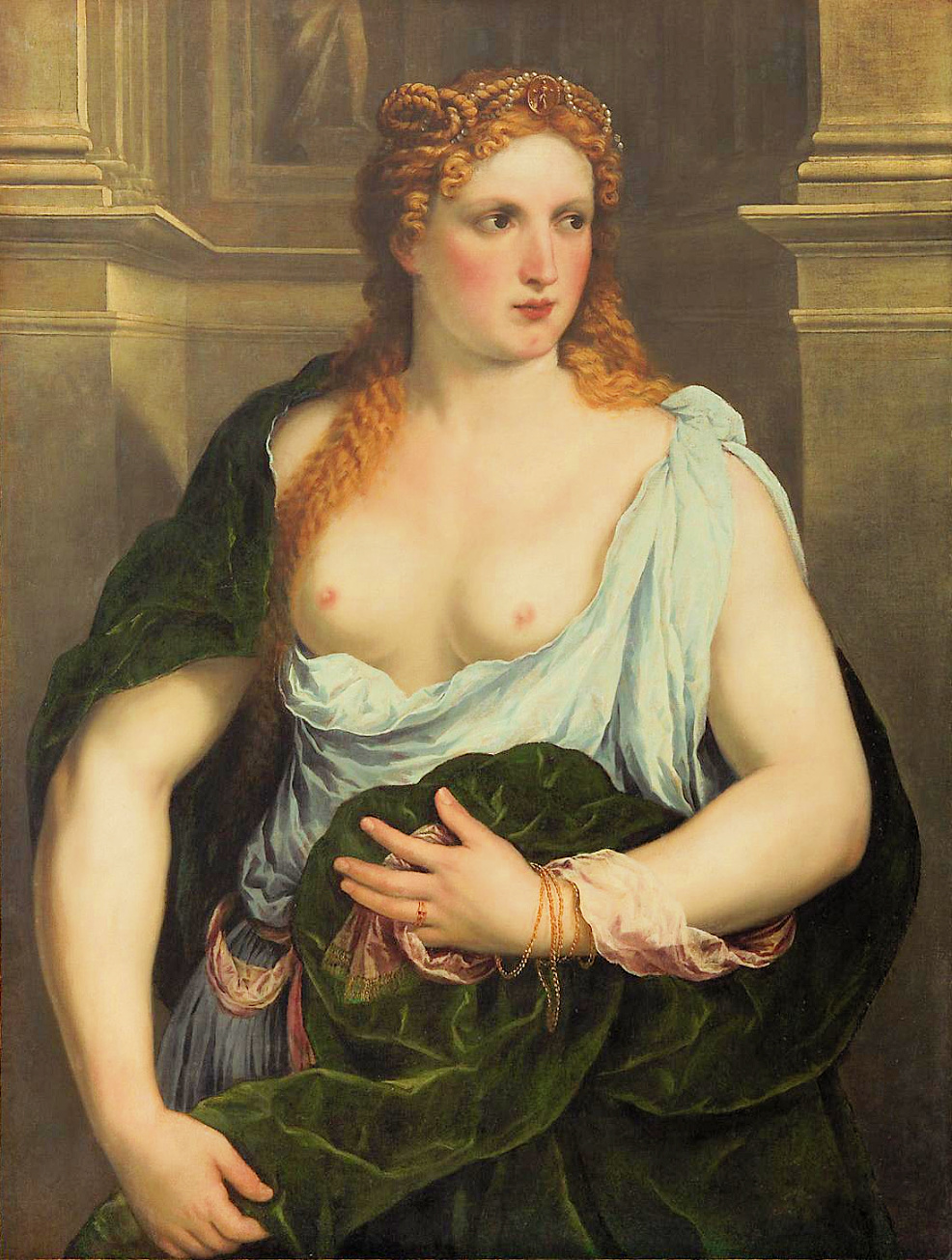
Paris Bordon/e (1500-1571). Gladiator fight, c. 1560, oil on canvas, 218 × 329 cm, Kunsthistorisches Museum Wien, Gemäldegalerie. https://www.khm.at/en/objectdb/detail/292/?offset=0&lv=list – retrieved December 13, 2024.Paris Bordon/e.Paris Bordon/e.Paris Bordon/e (1500-1571), Portrait of a Young Woman in a Green Coat, c. 1550, oil on canvas, 40 1/8 x 30 ½ in. (102 cm × 77.5 cm), Kunsthistorisches Museum Wien, Gemäldegalerie.https://www.khm.at/en/objectdb/detail/288/?offset=11&lv=list – retrieved December 13, 2024.
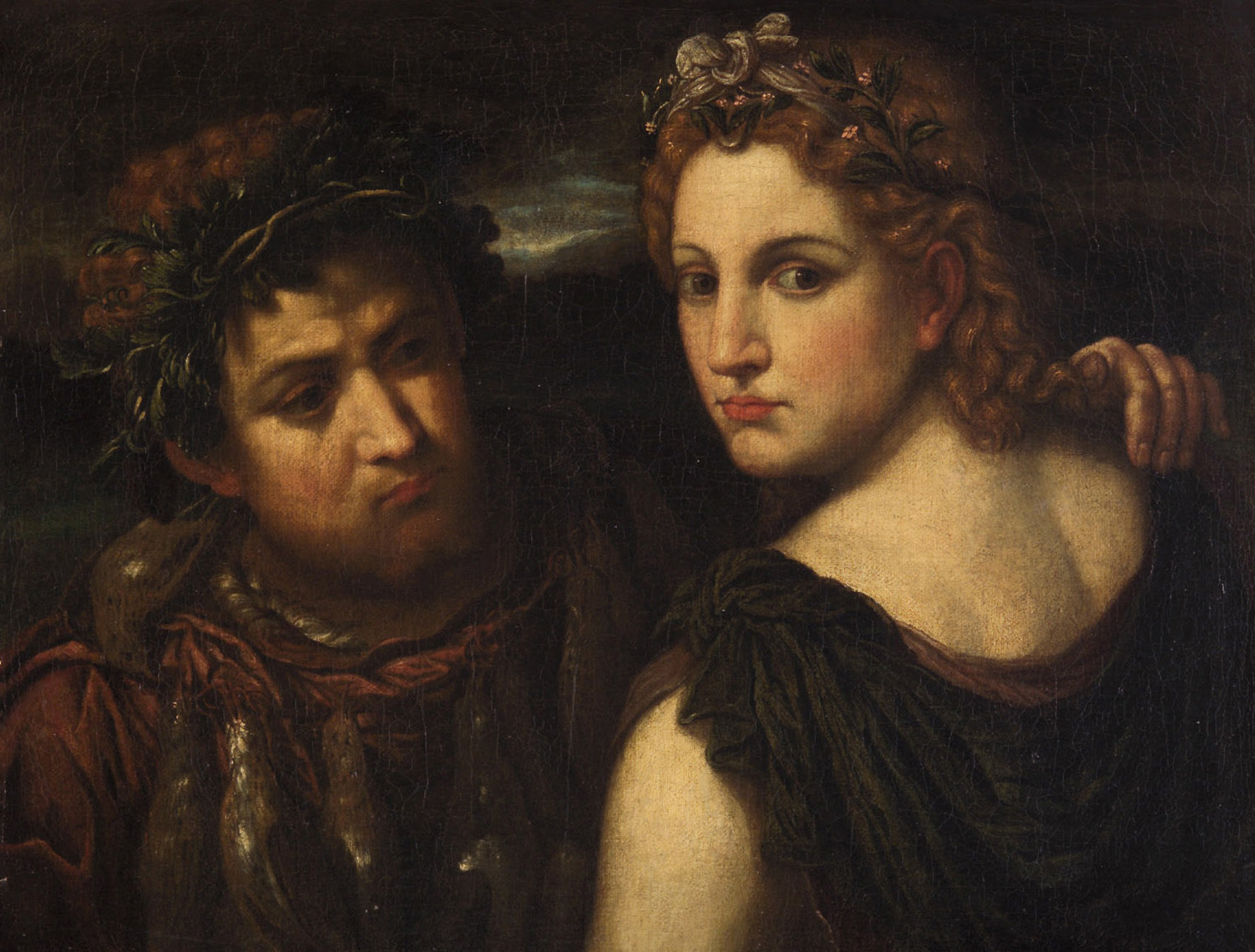
Bordon/e’s painting is closely related to Titian’s style yet in this female figure expresses with elegance and refinement Bordon/e’s own sophisticated stylistic vision. This may be a portrait of Veronica Franco, a Venetian courtesan who played an outsized role in the social and cultural life of the city in the mid16th century.
FEATURE Image: Raphael, Portraits of Agnolo Doni and Maddalena Doni, c. 1506, oil on panel, 24 ¾ x 17 ¾” Pitti Gallery, Florence.
Raphael, Self-portrait at 23 years old, 1504–1506. Tempera on panel, 47.5 cm × 33 cm (18.7 in × 13 in), Palazzo Pitti, Florence, Italy.
INTRODUCTION.
Urbino, Florence, and Artistic Formation Born in Urbino in 1483, an environment rich in the arts and humanist learning, Raphael had a remarkable capacity for personal growth and branded new incarnations of his artistic style regularly. He moved to Florence toward the end of 1504. Giorgio Vasari in his chapter on Raphael describes an episode where the artist of Urbino, already in his thirties with a reputation as a master, went back to study the nude (male) form with Michelangelo as his guide. Vasari’s admiration in telling this story goes beyond Raphael’s humility in assuming the role of student again (he studied constantly anyway) but that his learning always improved his artistic output.
Learning from Perugino, Leonardo, and Michelangelo In the study of nudes, however, artistic growth came perhaps not as the artist expected or intended. Whether Raphael entered the workshop of Perugino at that time or, as seems more likely, many years later when he was already an acknowledged artist, he quickly mastered Perugino’s delicate, ornamental style, with its open landscapes and gentle figures. It was said that contemporaries had trouble distinguishing Perugino’s work from Raphael’s, but Raphael’s compositions were more sophisticated even when he was a young artist. While Raphael mastered Michelangelo’s (and Leonardo’s) art forms convincingly, he also realized he was no match for the creator of the Sistine Chapel and other chiseled works insofar as the nude male forms.1
Testing Limits and Discovering Strengths Yet Raphael consolidated his strengths by testing his limits. A major strength, Vasari believed, was Raphael’s ability to draw and compose a wide range of subjects, such as landscape, architecture, draperies, and the human figure. Up to that time that had been what the artist was doing and would now unflinchingly continue to do on a grander scale, for example, in the Stanzae.
Rome and the High Renaissance Ideal In 1508 the pope called Raphael to Rome. Influenced by the idealized, classical art of the city’s ancient past, Raphael’s work took on a new grandeur. He also responded to the more energetic and physical style of Michelangelo, whose works he had already begun to study in Florence. Vasari believed Raphael had the gift to congeal the “poetic moment” by depicting in his painting the most significant gesture and force of action. With the possible exception of Leonardo, he is probably the unparalleled master of excellent design.2
Raphael and the Popes The precocious Raphael Sanzio also benefited from early opportunities given to him by his father to cultivate his talent. The artist’s own determination to succeed in his métier paid off when he was summoned to work at the Vatican by the Pope in 1509, arguably the greatest art patron in an age of art patrons. 3 The early sixteenth century was an age where patrons were as luminous as their artists and the coming together of Raphael and Julius II, and later Leo X, made for a celebrity team.
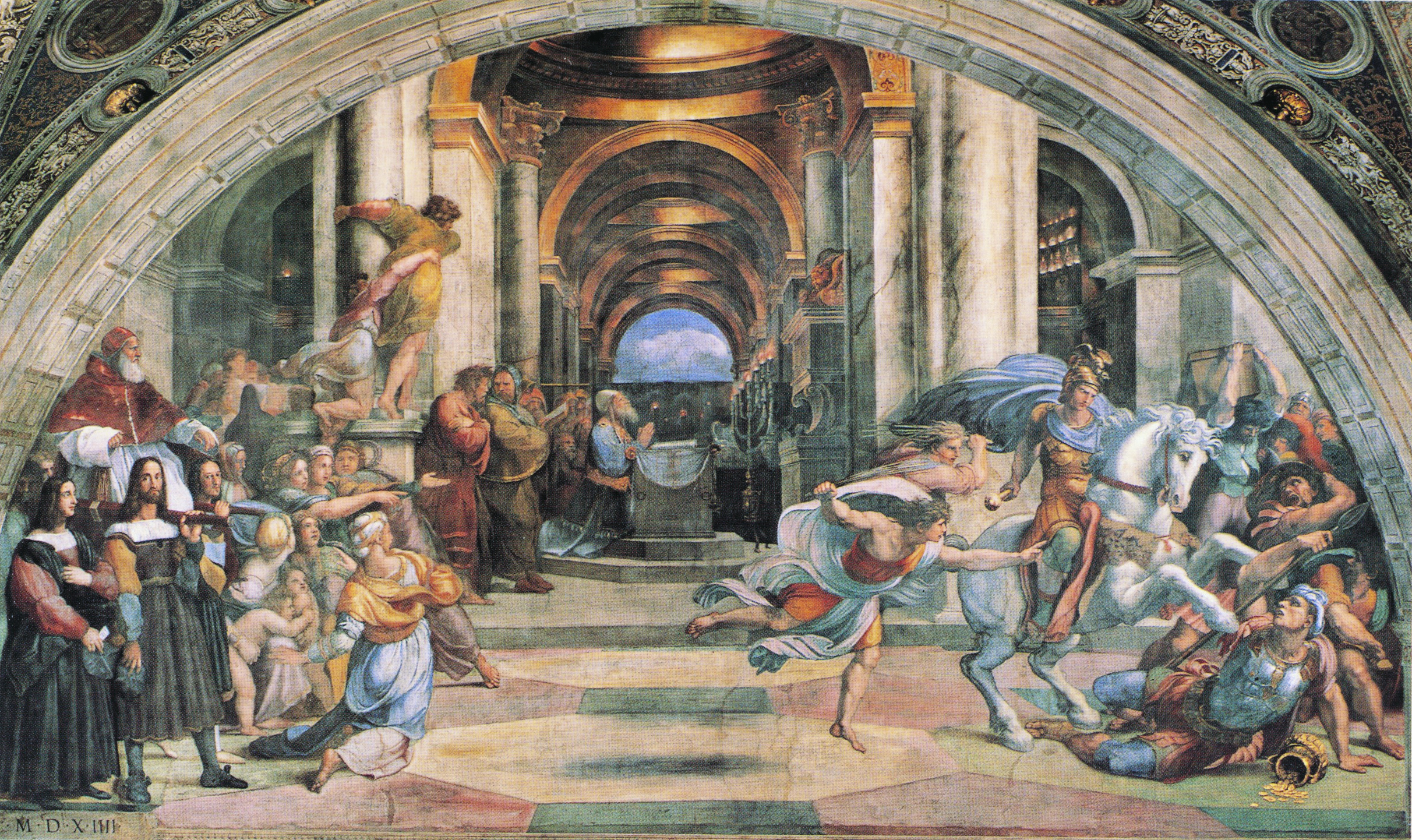
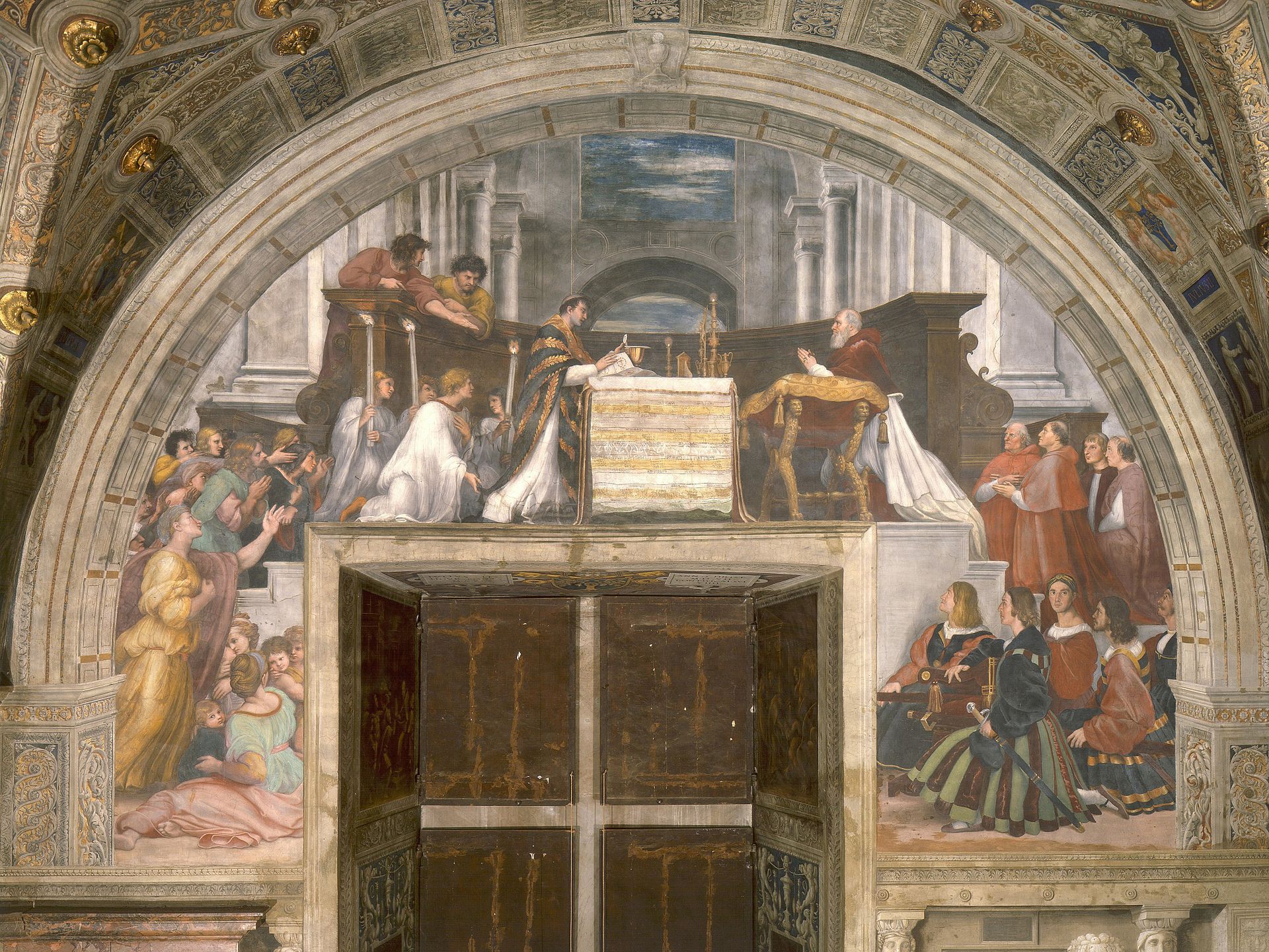
Vasari’s Judgment of Raphael While Vasari meticulously tells the reader of the artist’s “judicious” character – and that Raphael was extremely “amatory” and implying it aided in his death – the chronicler describes, often from memory, his preferences in Raphael’s art work. His collective response, for example, to all four frescos in the Camera d’Eliodoro is that he is most impressed by Raphael’s interesting decorative details, beautiful movements and gestures, the sheer number of figures portrayed, and his ability to express complex ideas and stories on a two-dimensional surface.4
Raphael’s Enduring Legacy With Leonardo da Vinci (1452-1519) and Michelangelo (1475-1564) Raphael is one of the great masters of the High Renaissance. Raphael and his large team of assistants left behind a large body of influential work, especially in the Vatican where the artist spent the last 12 years of his life, although Raphael died at 37 years old. For most of the history of Western art, the easy grace and harmonious balance of Raphael’s style has represented an ideal of perfection. His work became widely influential through the dissemination of prints. Raphael was also the city’s leading portraitist, creating penetrating psychological images that engaged viewer and sitter with a new intensity.
FROM URBINO TO FLORENCE: THE FORMATION OF A MASTER
Raphael, S. Niccolo Da Tolentino Altarpiece, 1501, oil on panel, 44 x45 ¼ in., Capodimonte Museum, Naples, Italy.
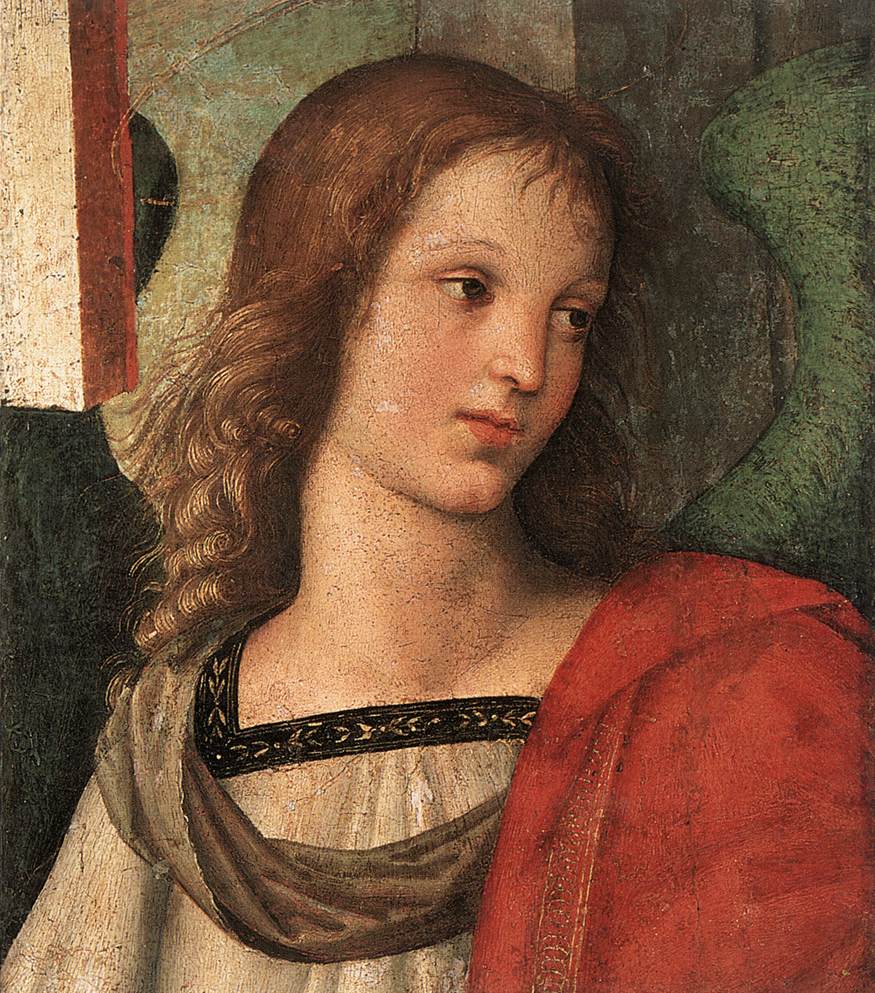
The Baronci Altarpiece is Raphael’s first recorded commission. It was made for the patron’s chapel in the church of Sant’Agostino in Città di Castello, a commune between Arezzo and Urbino, north of Perugia. In 1789 the artwork was badly damaged in an earthquake and surviving fragments were acquired by the Vatican until they mysteriously dispersed in the mid-19th century and found their way into different collections. Raphael’s commission of 1501 was to paint a large altarpiece dedicated to the Augustinian saint Nicholas of Tolentino (c. 1246– September 10, 1305). Nicholas was canonized by Augustinian Pope Eugene IV in 1446. While today’s saints require 1-2 miracles, St. Nicolas Tolentino was credited at his canonization with 300 miracles – including 3 resurrections. (see – Encyclopedia of the Middle Ages, Volume 2, André Vauchez, Richard Barrie Dobson, Michael Lapidge. Chicago: Fitzroy, Dearborn, 2000).
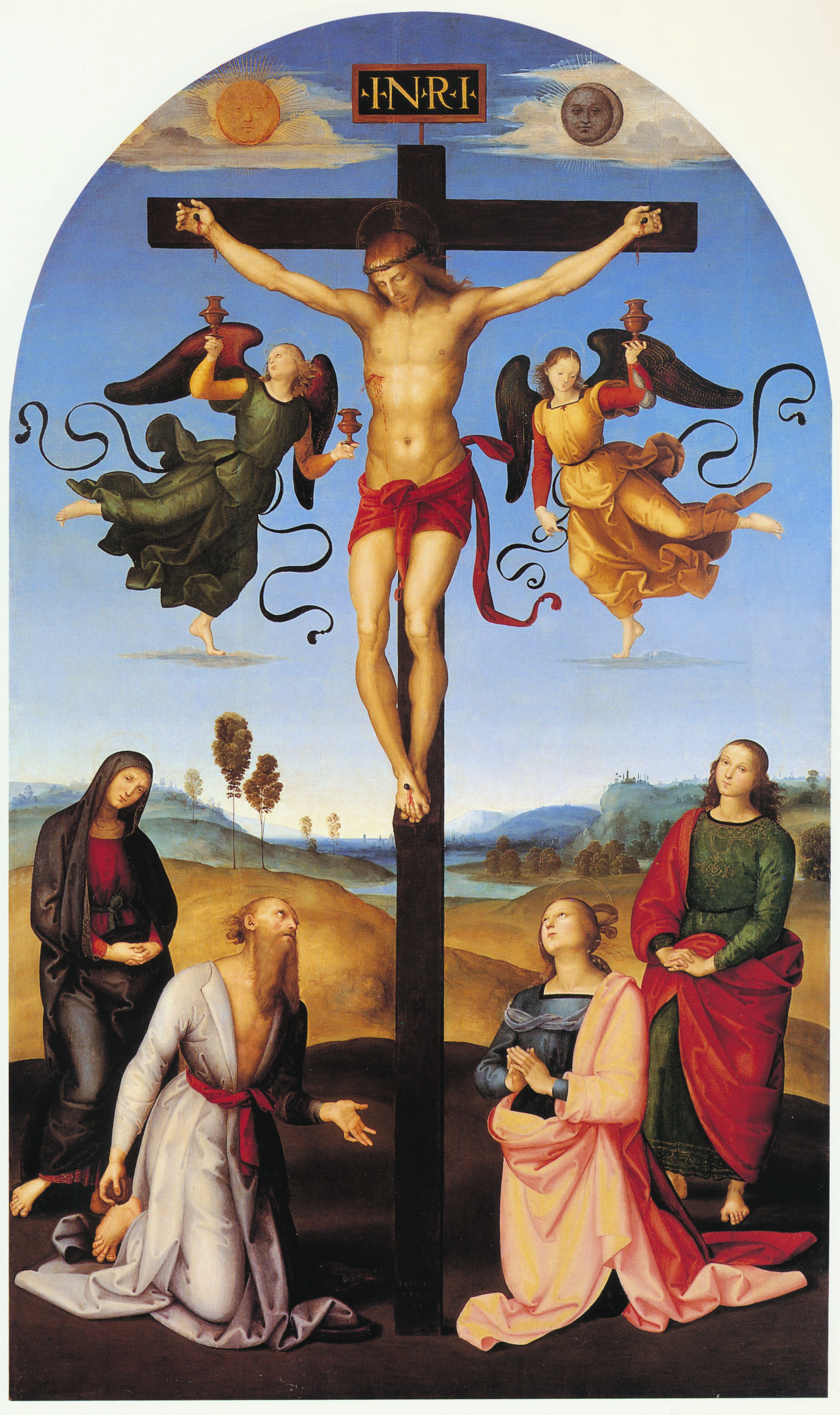
Raphael, angel, fragment Baronci altarpiece. Pinacoteca Tosio Martinengo, Brescia. Raphael, The Crucifixion, 1502-03, oil on polar, 283.3 × 167.3 cm, National Gallery, London.
The Crucifixionwas done in 1503 for Domenico Gavari for his S. Domenico chapel in Città di Castello. Angels are poised on toes on a cloud as their cups catch Christ’s dripping blood. Mary Magdelene and St. Jerome (holding a rock) are on their knees while the Virgin Mary and St. John stand. The sun and moon in the sky was characteristic of Crucifixion paintings in Umbria (p. 13, Jones & Penny). It was bequeathed to the National Gallery in 1924. Gavari was a close friend of Andrea Baronci, for whom Raphael painted the Saint Nicholas of Tolentino Altarpiece for the church of S. Agostino, also in Città di Castello. Saint Jerome, of course, was not present at the Crucifixion but is included in this scene because the chapel was dedicated to him. The overall design is based on several versions of the crucified Christ in a landscape painted by Perugino in the late 1480s and 1490s, and is especially similar to his altarpiece of the Crucifixion for the convent of S. Francesco al Monte in Perugia, commissioned in 1502 and completed 1506. https://www.nationalgallery.org.uk/paintings/raphael-the-mond-crucifixion – retrieved September 5, 2024.
Raphael, Coronation of the Virgin (Oddi Altarpiece), 1503-1504, Oil on canvas, 8’9” x 5’4”, Pinacoteca, Vatican, Rome.
Raphael painted altarpieces for the Augustinians and Dominicans and the Oddi Altarpiece (above and below) was done for the Franciscans. It was commissioned by the Oddi family chapel in S. Francesco al Prato. The Oddi were in exile from Perugia since 1495 because of battles between families and returned in 1503. The altarpiece was part of honoring their family members. The painting is divided into an upper part depicting the coronation of the Virgin and, in the lower part, the Apostles at the time of the Assumption. In the center, the apostle Thomas holds the Virgin’s girdle that the Virgin lowered to him as a token of these supernatural events. This display of theology was precious to the Franciscans at the time who were promoting the Virgin Mary. They were likely very involved in directing the artist in its composition. (Roger & Jones, pp. 15-16).
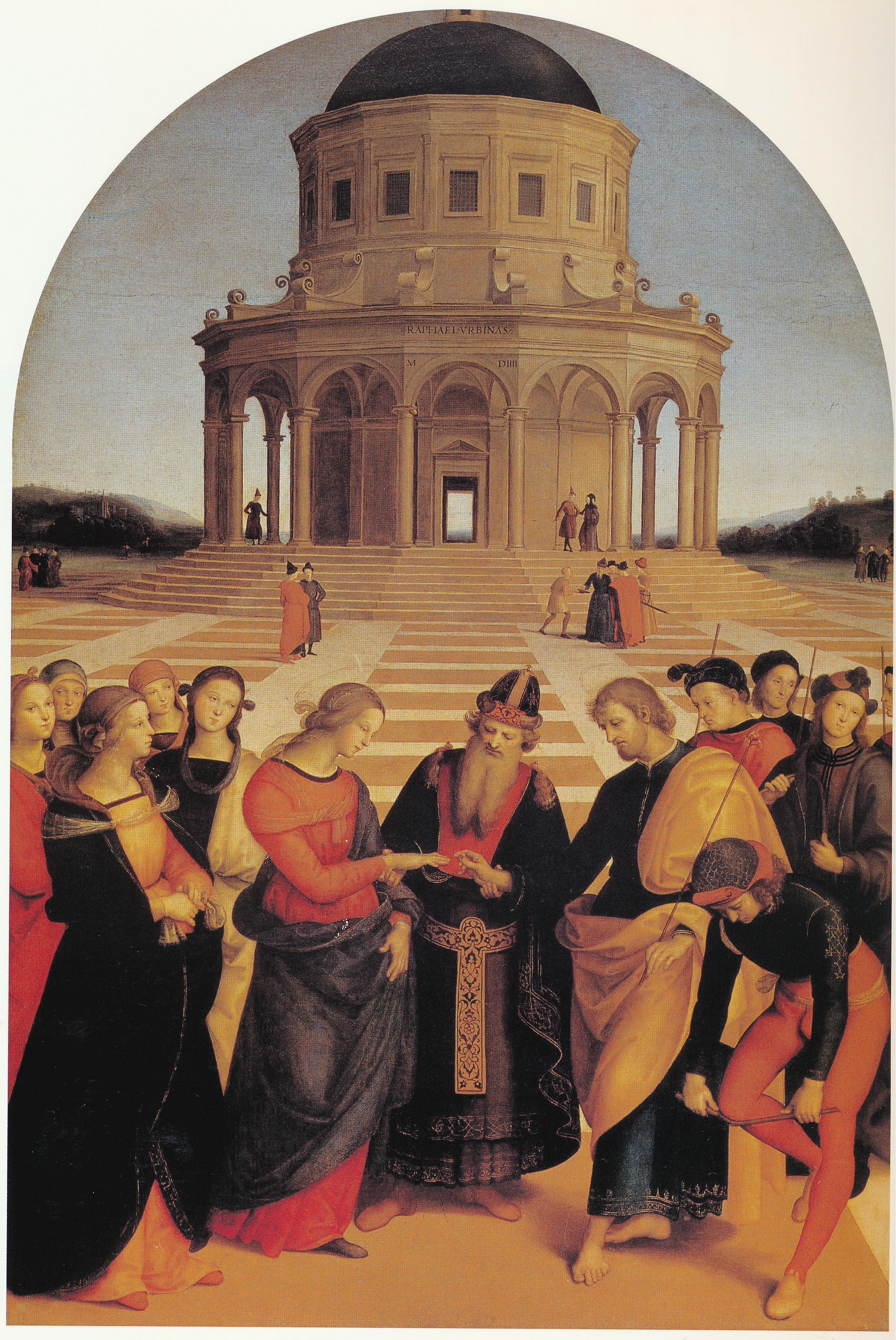
Raphael, Coronation of the Virgin (Oddi Altarpiece), 1503-1504, Oil on canvas, 8’9” x 5’4”, Pinacoteca, Vatican, Rome. DETAIL. Raphael, Spozalizio (The Engagement of the Virgin Mary), 1504, oil on panel, 67 x 46 ½” Brera Gallery, Milan.
The composition of the Spozalizioreflects the influence of Perugino, specifically the fresco done by him in the Sistine Chapel in 1484. In terms of its architectural setting, Raphael was influenced by Piero della Francesca (c.1416-1492) and Bramante (1444-1514). The painting’s architectural structure shares centrality in the painting with the foreground figures done in a perspectival arrangement. Within the figures are members of the party positioned in depth. Joseph places a ring on Mary’s finger whose positioning bisects the artwork. A tawny gold tone pervades the painting. It was commissioned by the Alberini family for a chapel in S. Francesco of the Friars Minor at Città di Castello in Perugia. (Brera Milan, p 34)
Raphael, The Madonna and Child Enthroned with Five Saints (Colonna Altarpiece), c. 1504-1505, oil on panel, 68 x 68” The Metropolitan Museum of Art, New York City.
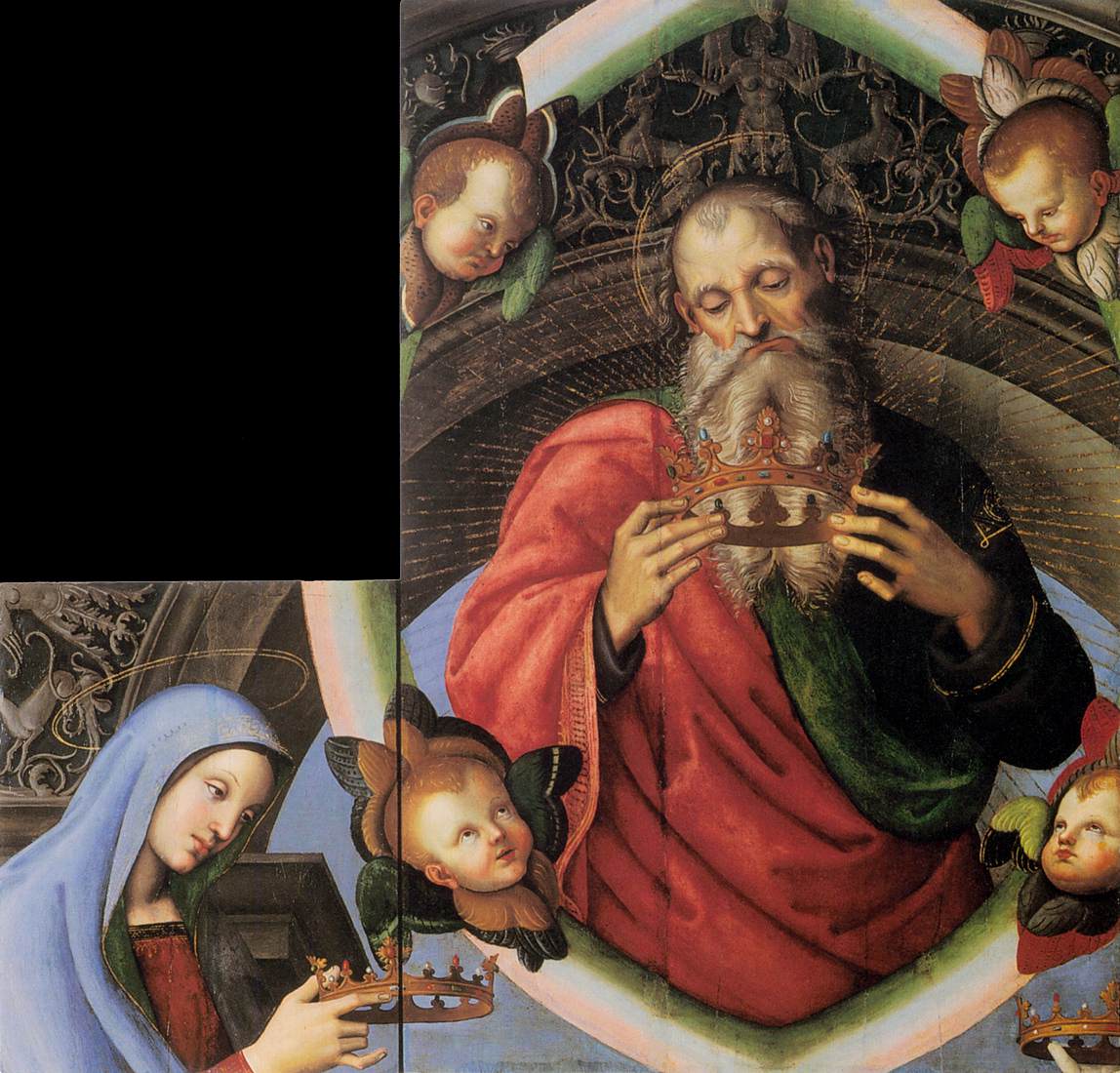
Raphael painted the Colonna Altarpiece for the Franciscan convent of Sant’Antonio in Perugia. It hung in a part of the church reserved for the nuns. The pair of voluminous saints straddling each side of the throne reflect the progressive style of Leonardo da Vinci and Fra Bartolomeo (1472-1517) that Raphael was studying in Florence. The lunette above the main panel depicts God the Father holding a globe and raising his right hand in blessing situated between two angels and two seraphim. https://www.metmuseum.org/art/collection/search/437372 – retrieved September 5, 2024.
Raphael, The Small Cowper Madonna, c. 1505 59.5 x 44 cm (23 7/16 x 17 5/16 in.), National Gallery of Art, Washington D.C.
The Small Cowper Madonna includes an agreeable background landscape. In a vertical painting, a haloed woman and nude child sit before an expansive grass field extending behind them to a group of trees and buildings on a hill in the distance among hazy blue hills beneath a blue sky. https://www.nga.gov/collection/art-object-page.1196.html – retrieved September 8, 2024.
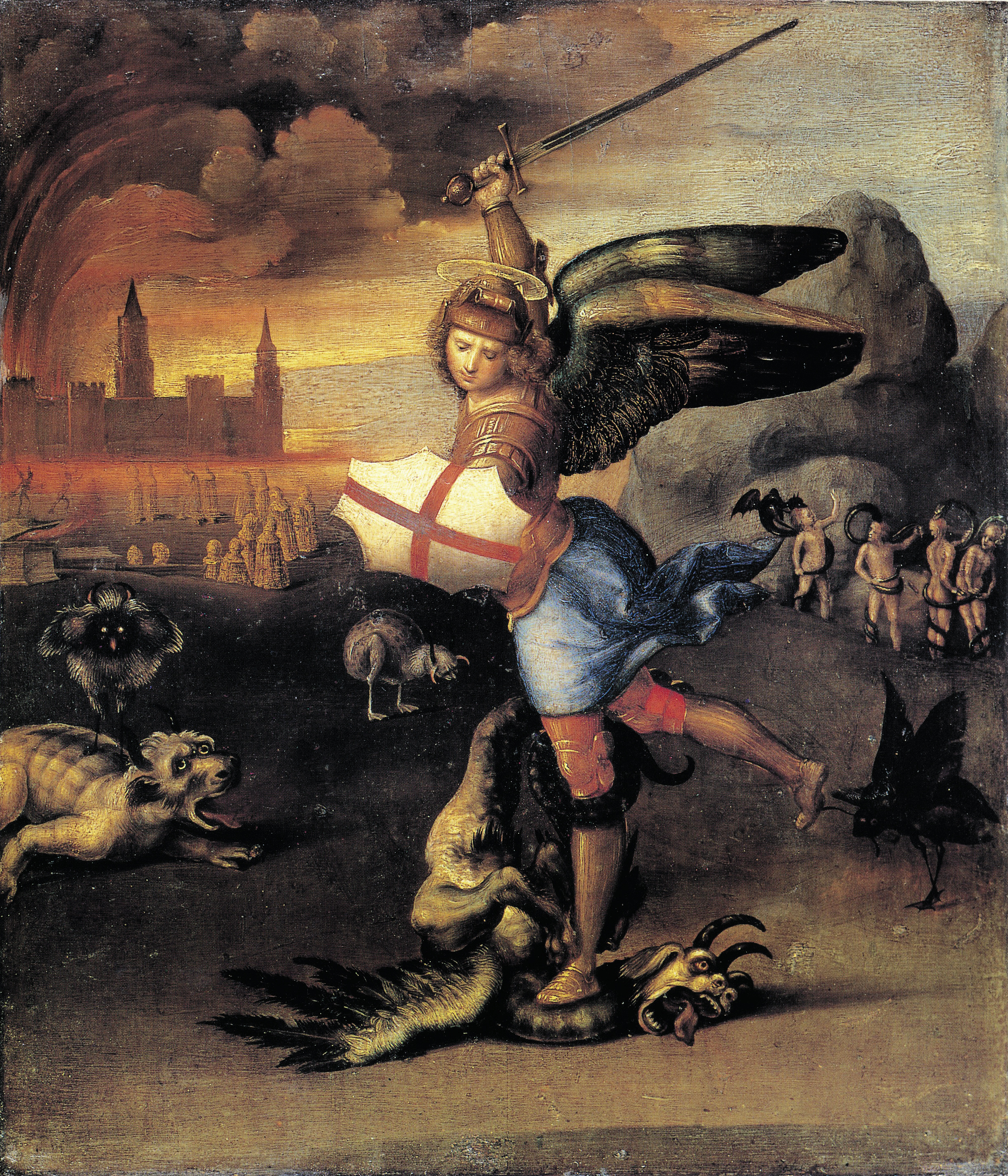
St. Michael the Archangel vanquishing Satan and Saint George slaying the Dragon.
These early works by the artist depict the popular subjects of St. Michael the Archangel vanquishing Satan and Saint George slaying the Dragon, each showing the martial subject of good combatting evil. These were early private commissions for the court of Urbino. Saint George was a Christian Roman soldier who, pious legend informs, subdued a dragon and, with the daughter of a pagan king, brought it to the city, where St. George killed it with his sword. These heroic actions witnessed by the king and his subjects led to their conversion to Christianity. The historic figure of Saint George was martyred around the year 290. https://www.nga.gov/collection/art-object-page.28.html – retrieved September 4, 2024.
Raphael, Saint Michael and The Dragon, c. 1505, oil on panel, 12 ¼” x 10 ¼” The Louvre Paris https://collections.louvre.fr/en/ark:/53355/cl010060773 – retrieved September 4, 2024Raphael, Saint Michael and The Dragon, c. 1505, oil on panel, 12 1/4 x 10 ¼” The Louvre, Paris https://collections.louvre.fr/en/ark:/53355/cl010060772 – retrieved September 4, 2024.Raphael, Saint George and the Dragon, c. 1506, National Gallery of Art, Washington, D.C.Raphael, The Three Graces, 1505-1506, oil on panel, 6 ¾ x 6 ¾” Condé Museum, Chantilly.
The panel of The Three Graces was recorded in the Borghese collection in 1650. It accompanied the Dream of Scipio, an oil on panel, today in the National Gallery of London. The figures were derived from ancient classical sculpture and depict, likely, Chastity, Beauty and Love. Chastity’s lower torso is veiled and an arm covers her breasts from view. Amor’s breasts, by contrast, are revealed. Chastity also wears no adornment as do Beauty and Amor. While the figures are modeled similarly, the space between them is disparate and Beauty blocks Chastity’s leg. (Jones & Penny, p. 8; Beck, pp. 62-63).
Raphael, Portrait of Agnolo Doni, c. 1506, oil on panel, 24 ¾ x 17 ¾” Pitti Gallery, Florence.
Agnolo Doni (above) is the only Florentine portrait in these first years mentioned by Vasari though paired with its companion portrait of Maddalena Doni (below).Doni was an art collector who married the daughter of Giovanni Strozzi in 1503. Agnolo was 10 years older than his wife who was in her teens. The portraits are painted on identically sized panel and are intended to hang next to one another. Raphael took great care in depicting the corporeal reality of his subjects, particularly appreciated in their faces and hands (though Agnolo Doni’s portrait is more detailed than his wife’s.) In both Doni portraits the sitters show-off their jewelry – such as rings and, in Maddalena’s portrait, a large pearl hanging around her neck. (Roger & Penny, p. 29-30)
Raphael, Portrait of Maddalena Doni, c. 1506, oil on panel, 24 ¾ x 17 ¾” Pitti Gallery, Florence.Raphael, The Madonna of the Granduca, c. 1506, Oil on panel, 33 x 21 1/2 “ Pitti gallery, Florence.
Raphael’s Madonna del Granduca (The Madonna of the Grand Duke), a quintessential masterpiece of the High Renaissance painted around 1505–1506. The figures emerge from a stark, dark background that was added in the 17th century. Originally, Raphael painted a window opening to a landscape behind the Madonna. Raphael utilizes Leonardo’s sfumato technique—the subtle, smoky blending of colors and tones—visible in the gentle shadows defining Mary’s eyelids, chin, and the soft flesh of the infant. The painting gets its name from Ferdinand III, Grand Duke of Tuscany, who purchased it in 1799.
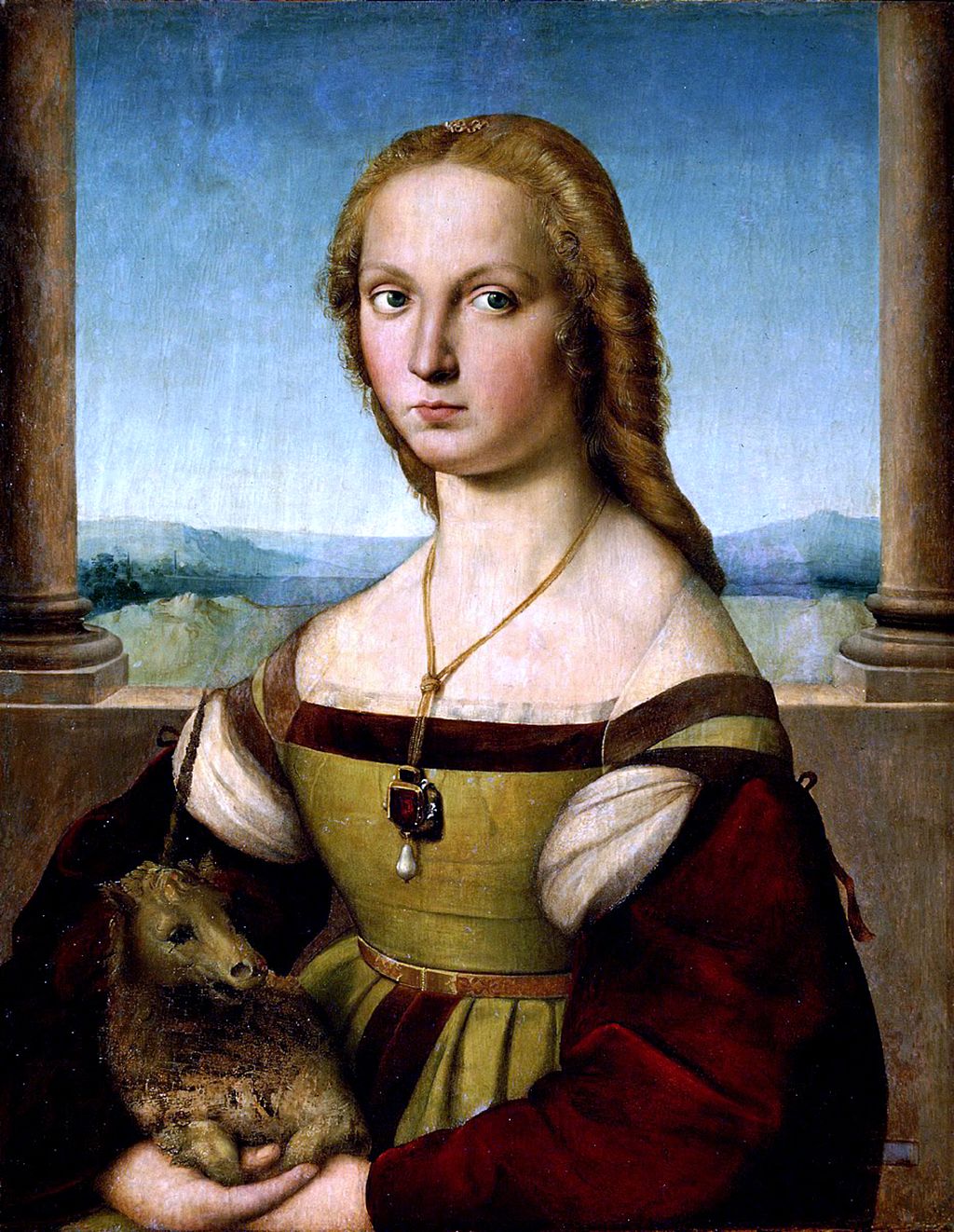
Raphael, Lady with a Unicorn, 1506, oil on panel, 65 cm × 51 cm (26 in × 20 in), Galleria Borghese, Rome, Italy.
Lady with a Unicorn was of uncertain attribution until recent times. In the 1760 inventory of the Gallery, the subject of the painting was identified as Saint Catherine of Alexandria and attributed to Perugino. A restoration of the painting in 1934 revealed a unicorn, the medieval symbol for chastity, and led to the painting’s attribution to Raphael. In 1959 an x-ray revealed a small dog under the unicorn which symbolized conjugal fidelity. https://en.wikipedia.org/wiki/Young_Woman_with_Unicorn – retrieved September 7, 2024.
Raphael, The Holy Family With Saints Elizabeth and John (The Canigiani Holy Family), c. 1506-07, oil on panel, 51 ½ x 42 1/8” Alte Pinakothek, Munich.
Visible on The Canigiani Holy Family on the hem of the Madonna’s scarf is inscribed, “Raphael Urbanas.” The fresco and easel painter was active mainly in Umbria, in Florence after 1504, and in Rome in 1509 until his death. It was painted for Domenico Canigiani where Vasari saw it later. It entered the Medici collection and when a Medici daughter married an Elector Palatine it accompanied her over the Alps to Germany. (Pinakothek Munich Great Museums of the World, Roberto Salvini, et. al., Newsweek NY 1969 pp. 126). In Raphael’s Florentine period, his work marks A transition away from the rigid, flat style of his master Perugino toward a more humanized, emotionally complex, and three-dimensional portrayal of sacred figures.
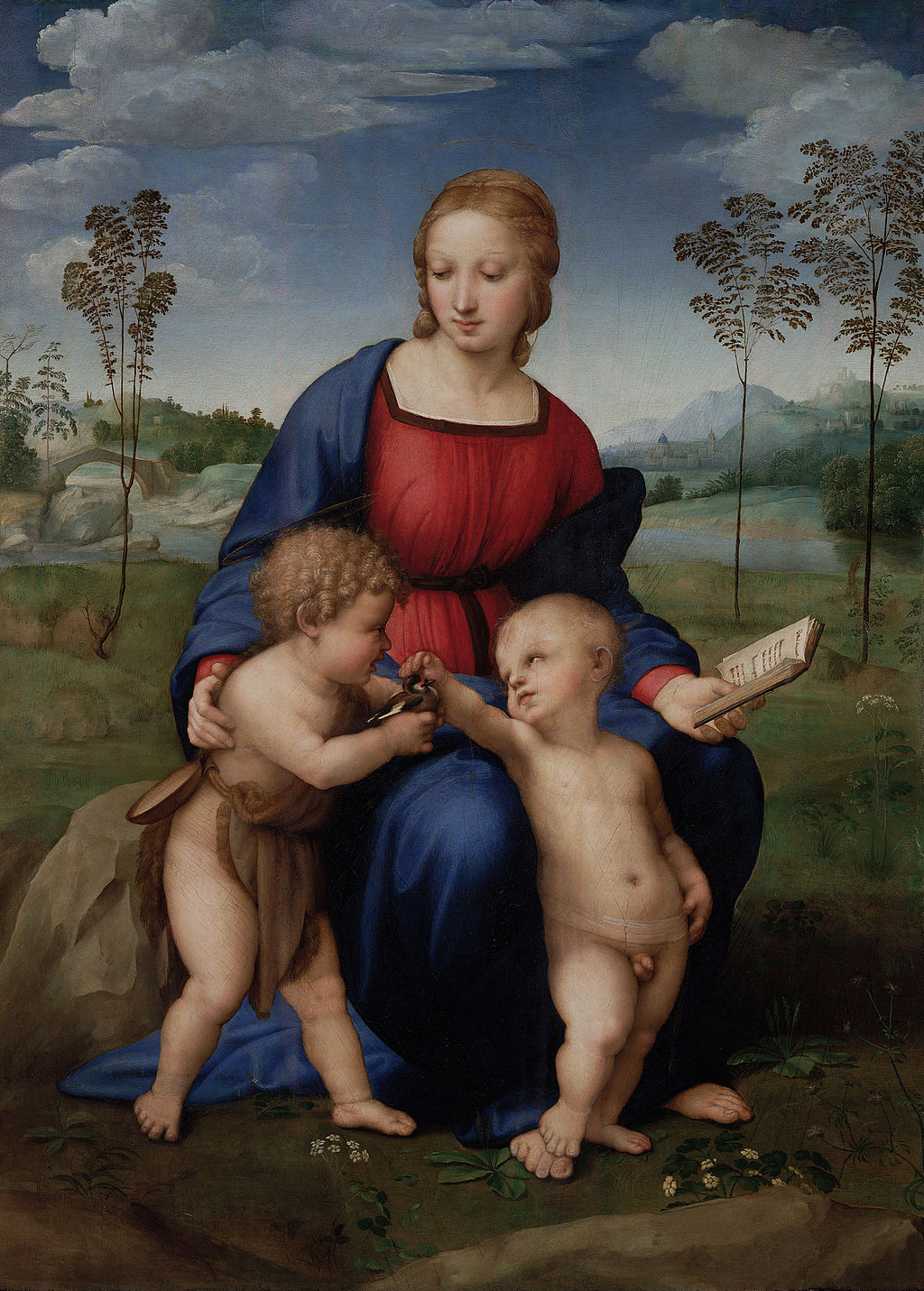
Raphael, Madonna del Cardellino, 1506-07, oil on panel, 42 1/8 x 30 ¼” Uffizi Gallery Florence.
The three figures in Madonna del Cardellinoare closely integrated and display a greater sense of volume. The painting is dated 1507 on the hem of the Virgin’s garment. In the painting Saint John the Baptist presents a goldfinch (cardellino) to the Christ child which is a symbol of the Passion. (Roger & Penny, p. 33)
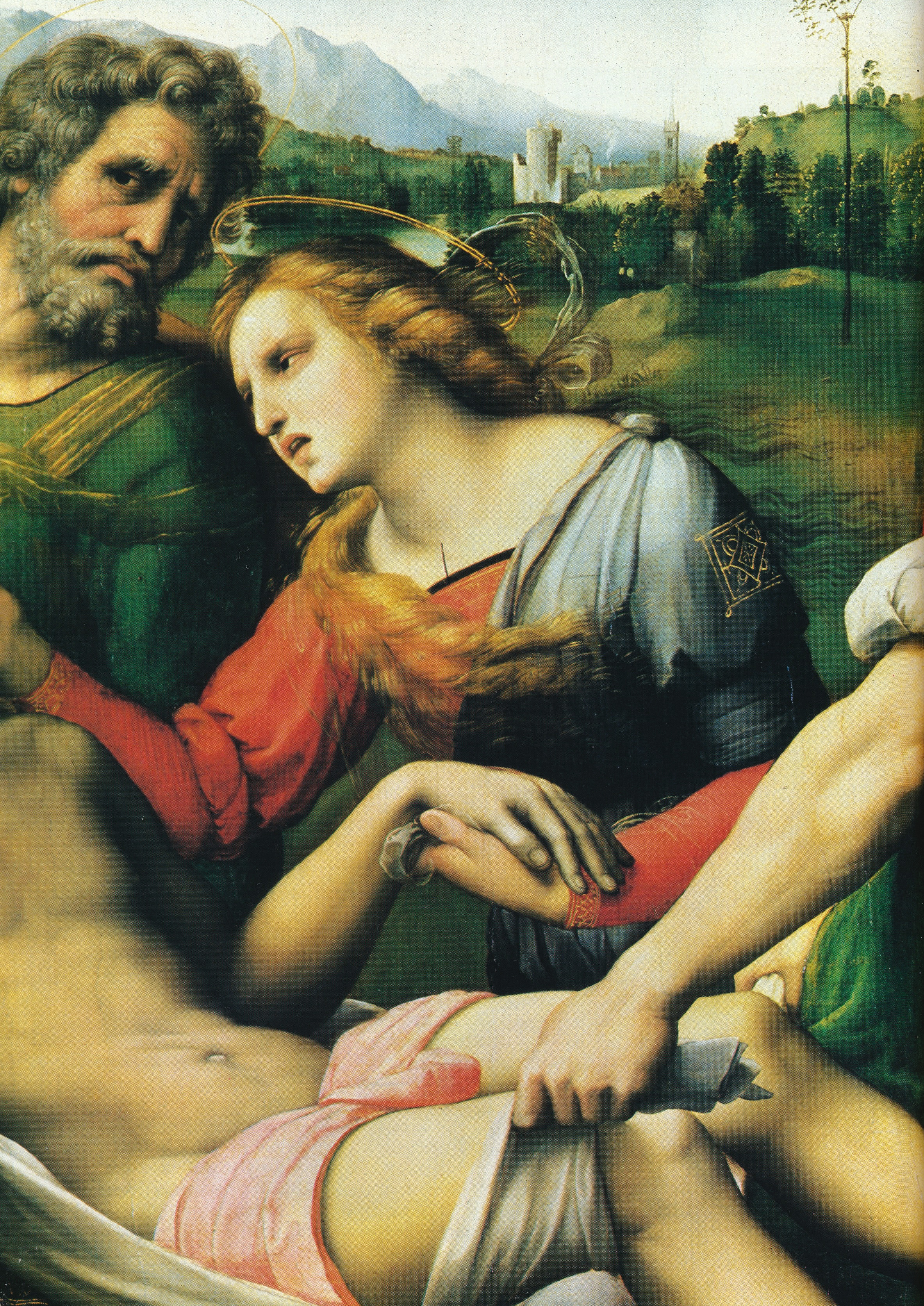
The Deposition, 1507, oil on panel, 72 ½ x 69 ¼” Borghese Gallery, Rome.
After seeing Leonardo’s Battle of Anghiari and Michelangelo’s Battle of Cascia in Florence Raphael’s style immediately applied their innovative principles changing the trajectory of his artwork. Leonardo da Vinci and Michelangelo were in a pitched battle for the future of art during their fabled competition to decorate the Great Council Hall in Florence. Raphael studied closely these complex drawings of heroic violence. Though Raphael was familiar with violent combat in Perugia and elsewhere, it was its depiction in these artworks in Florence that such dynamic convolutions began to appear in his own work such as The Deposition (above and below) although he may have had in mind Perugino’s Lamentation over the Dead Christ from 1495. In the finished painting the action takes place from right to left: a group of women attending to a swooning Virgin to the Magdalene grasping Christ’s hand to look into his face. (Roger & Penny, pp. 37-44).
The Deposition, 1507, oil on panel, 72 ½ x 69 ¼” Borghese Gallery, Rome. DETAIL. Raphael, La Belle Jardinière, 1507-08, oil on panel, 48 x 31 ½” The Louvre, Paris.
In La Belle Jardinière the arch-topped Madonna painting features Saint John the Baptist kneeling before the Christ child. It was Leonardo da Vinci who formulated the pyramidal structure for the Holy Family and half-length portrait, and it seems Raphael looked to explore his idea for his narrative. (Roger & Penny, p. 33)
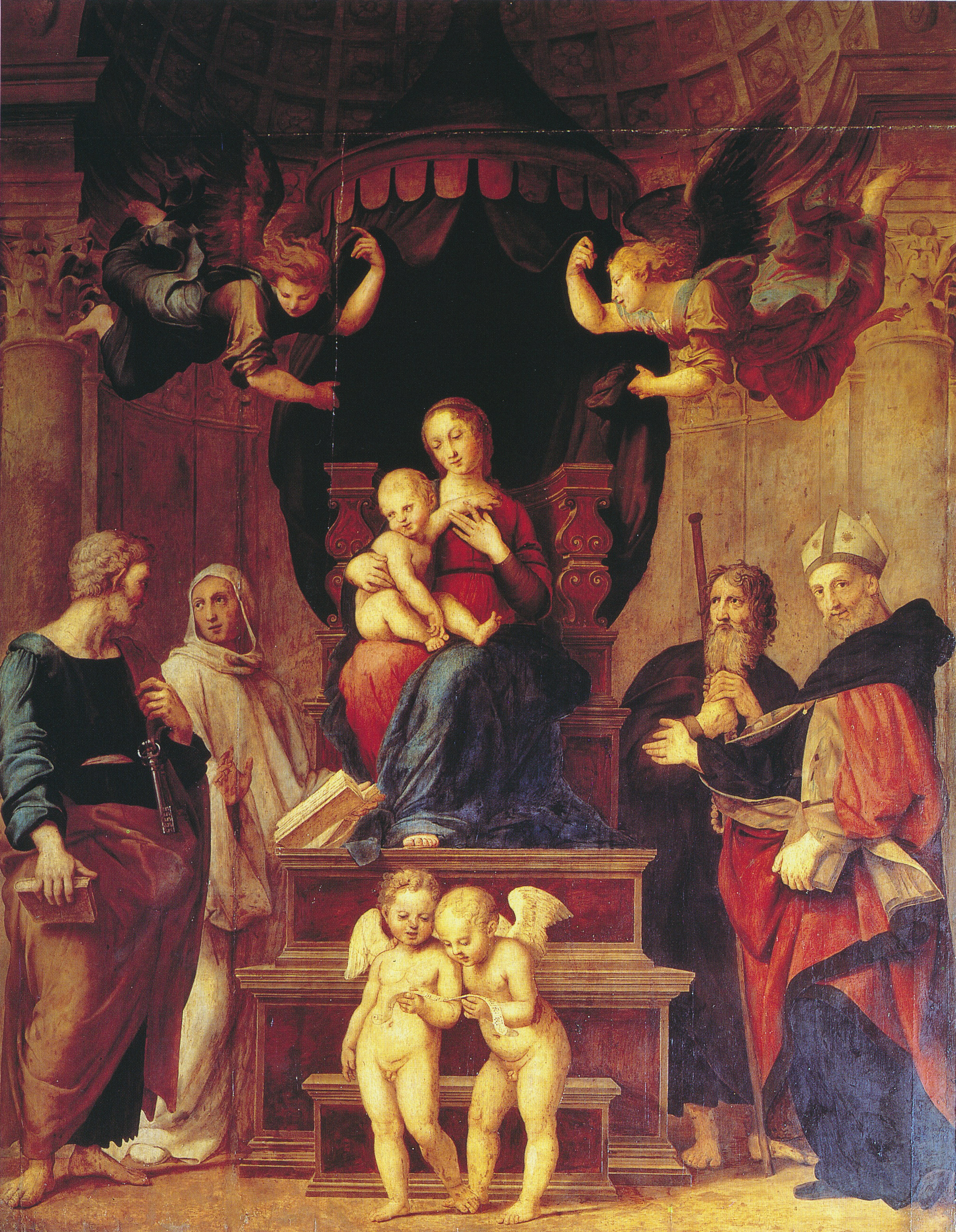
Raphael, The Madonna of the Baldacchino, 1508, oil on canvas, 9’ x7’4” Pitti Gallery Florence.
The Madonna of the Baldacchinowas started by Raphael and finished after his death (Roger & Penny, p. 44). It was Raphael’s first major commission in Florence for the Dei family chapel in the Santo Spirito basilica (1487) and remained unfinished when the 25-year-old artist was summoned to Rome by Pope Julius II, nicknamed the Fearsome, who reigned on Peter’s chair from 1503 to 1513. Pope Julius, born Giuliano della Rovere in 1443, took his name specifically from Julius Caesar (d. 44 BCE). In 1508, this “Battle Pope” as he was known, commissioned the Raphael Rooms and Michelangelo’s paintings in the Sistine Chapel at the Vatican. Raphael’s enthroned Madonna and Child is with, from left, Sts. Peter, Bernard of Clairvaux, James the Greater and St. Augustine of Hippo. The group is joined by two putti at the foot of the throne’s high pedestal steps. It is a large format painting whose size was increased when it was restored and “completed” at the end of the 17th century to meet the tastes of a Medici prince. Raphael is cited for being an imitator more than originator and this is exampled in the Christ Child playing with his toes whose pudgy type derives from the workshop of Florentine sculptor Luca Della Robbia (c. 1400-1482). The painting can be read right to left as St. Augustine, looking at the viewer, gestures, with St. James gazing in a similar direction, towards the throne and its occupants and then crosses to St. Bernard whose backward glance ends in conversation with St. Peter holding a book and large key. Once in Rome, Raphael continued these simple straight forward readings of his artworks’ often complex network of figures beginning in his famous frescoes in the Stanza della Segnatura (1508-1511) yet by then with greater refinement and heroism. In 1799 The Madonna of the Baldacchino was confiscated by French forces and taken to Paris only to be returned to Florence in 1813. (Beck, pp. 78-79).
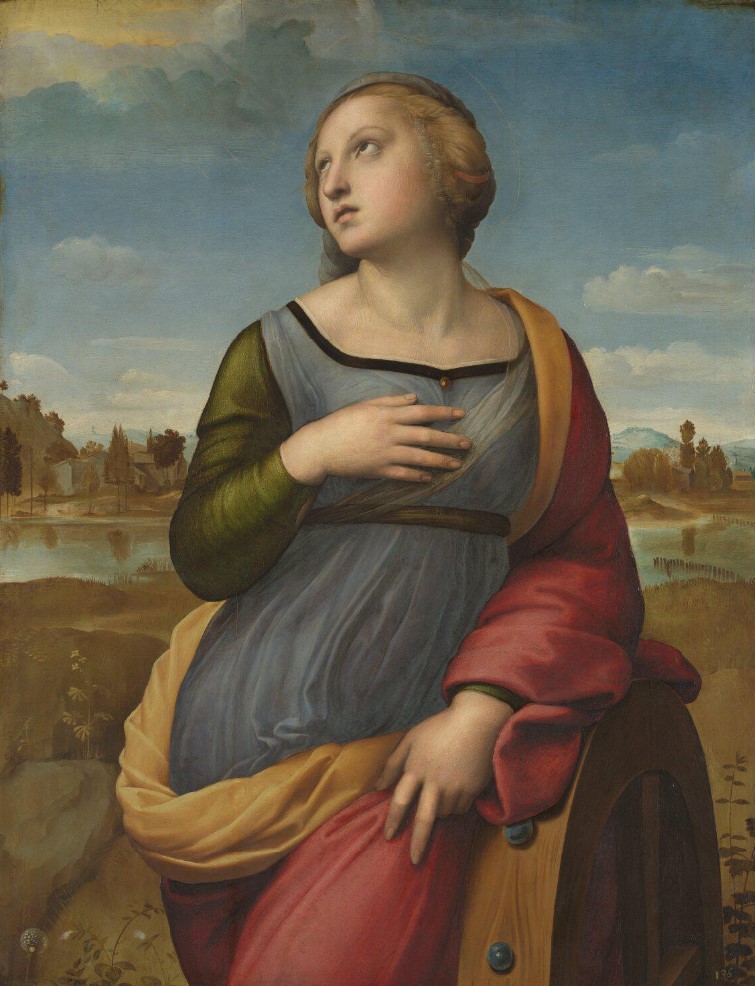
Raphael, St. Catherine of Alexandria, oil on panel, c. 1507, 71 x 56 cm, National Gallery of Art, London.
Raphael’s St. Catherine of Alexandria, a Fourth Century mystic and martyr, is not an object for devotion but dramatizes an example of devotion. The turned figure derives from Leonardo da Vinci and expresses an emotional animation that is one of the strongest depictions in Raphael’s oeuvre. (Roger & Penny, p. 44). The portrait is joined to a landscape as the saint leans on a spiked wheel which is her symbol as it was the manner of her death as a martyr. Raphael looks to capture the mystical or visionary aspect of the saint as she places her hand over her heart and gazes upwards to a golden break in the sky. The figure is very dynamic moving beyond Perugino’s influence of angelic air and distant landscapes and towards Michelangelo and Leonardo da Vinci whose monumentality and detailed arrangements Raphael studied in Florence. It is unknown who commissioned the artwork and for exactly what purpose it was intended. https://www.nationalgallery.org.uk/paintings/raphael-saint-catherine-of-alexandria – retrieved September 6, 2024.
Raphael, The Niccolini-Cowper Madonna, 1508, oil on panel, 80.7 x 57.5 cm (31 3/4 x 22 5/8 in., National Gallery of Art, Washington, D.C. https://www.nga.gov/collection/art-object-page.27.html – retrieved September 8, 2024.
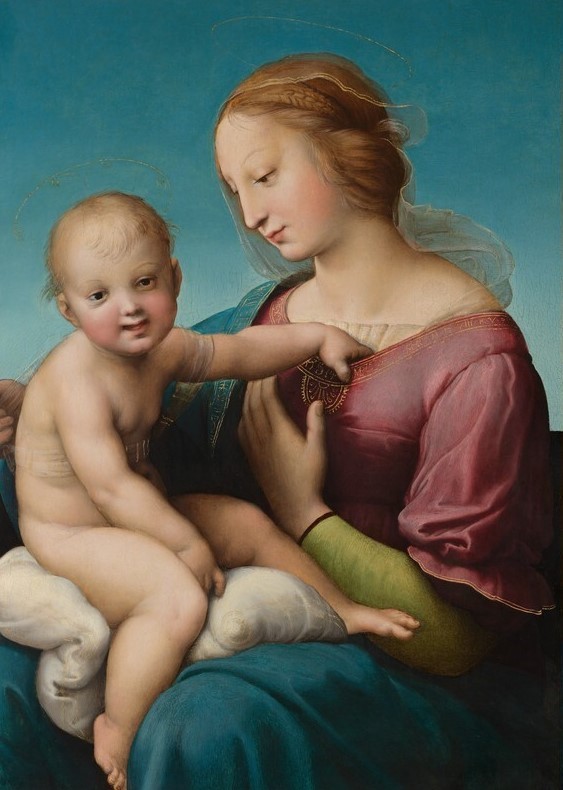
The Niccolini-Cowper Madonna (also known as the Large Cowper Madonna) was painted in 1508 near the end of Raphael’s celebrated Florentine period. The infant Jesus reaches out to clutch the bodice of Mary’s dress which introduces a deeply human element, transforming a sacred, holy icon into an intimate moment shared between a mother and her playful toddler. Raphael utilizes Leonardo’s signature sfumato technique to build physical volume and three-dimensional realism. The painting belonged to the aristocratic Niccolini family in Florence. In 1780, it was purchased by George Clavering-Cowper, the 3rd Earl Cowper who also owned a smaller earlier version of the Madonna by Raphael.
RAPHAEL IN ROME: THE VATICAN COMMISSIONS
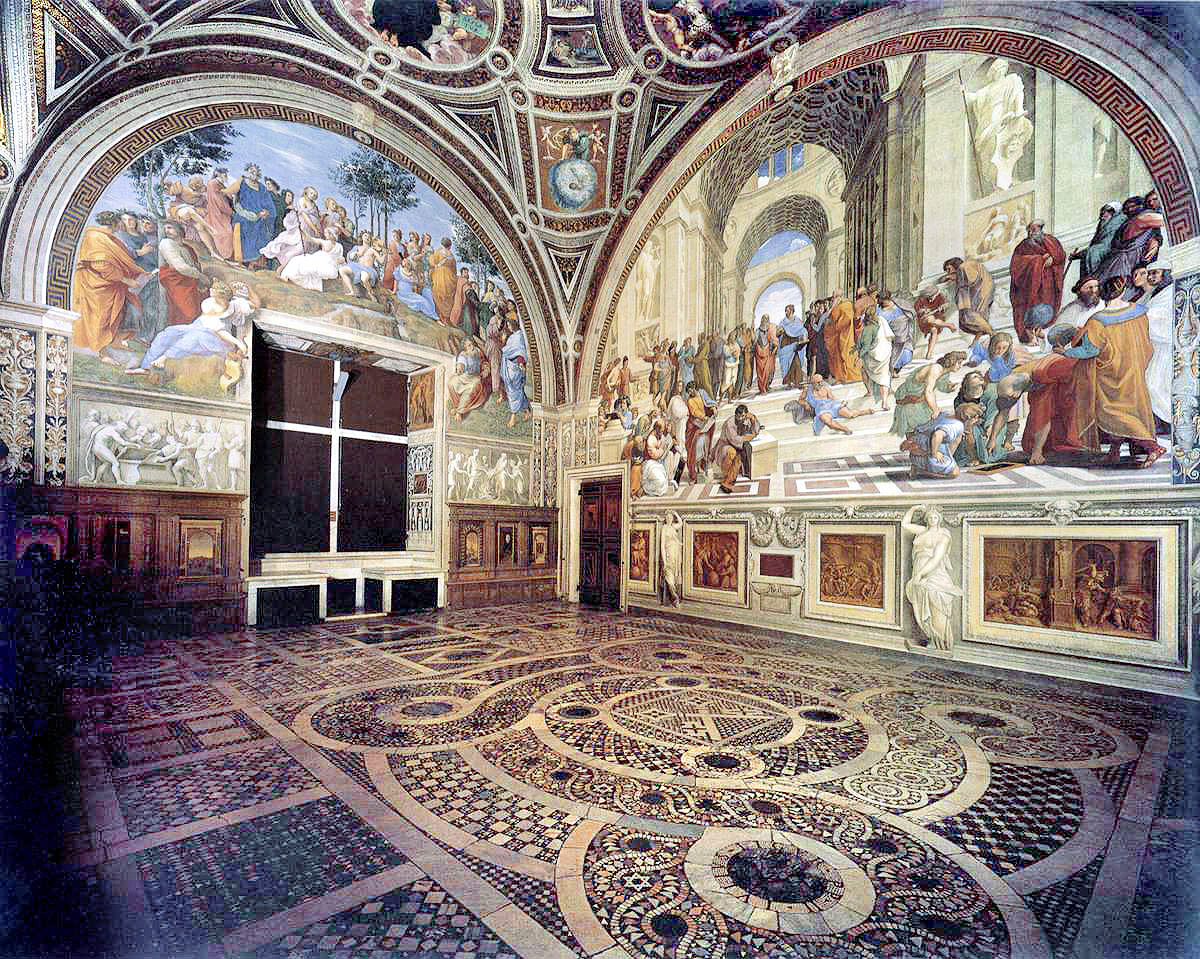
Commissioned by Pope Julius II in 1508 for his private apartments in the Apostolic Palace, The Raphael Rooms (Stanze di Raffaello) are a suite of four grand reception chambers that are now part of the Vatican Museums. These rooms include:
The Sala di Costantino. With its theme of the triumph of Christianity over paganism, it contains The Vision of the Cross, The Battle of the Milvian Bridge, The Baptism of Constantine, and The Donation of Constantine.
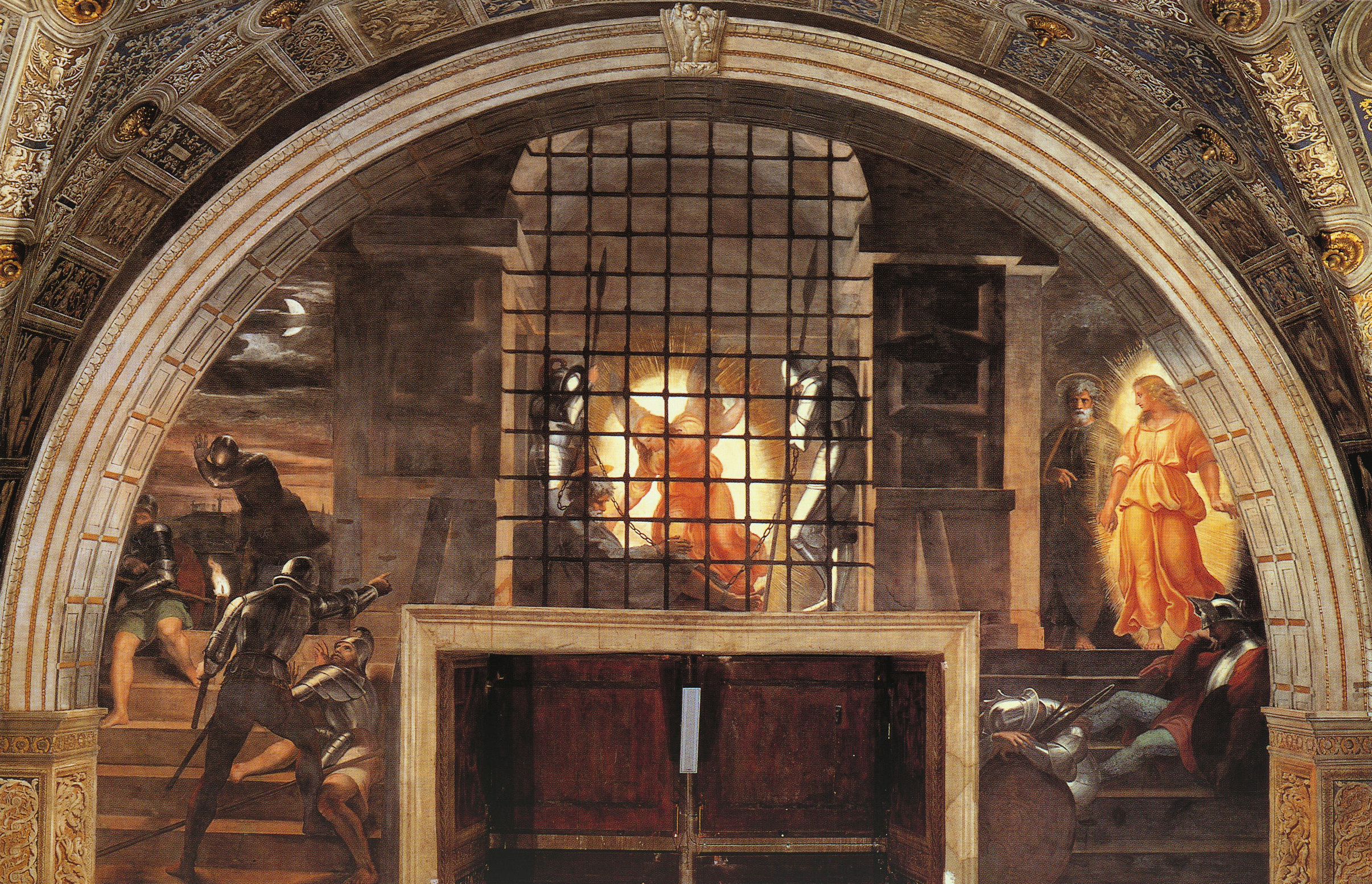
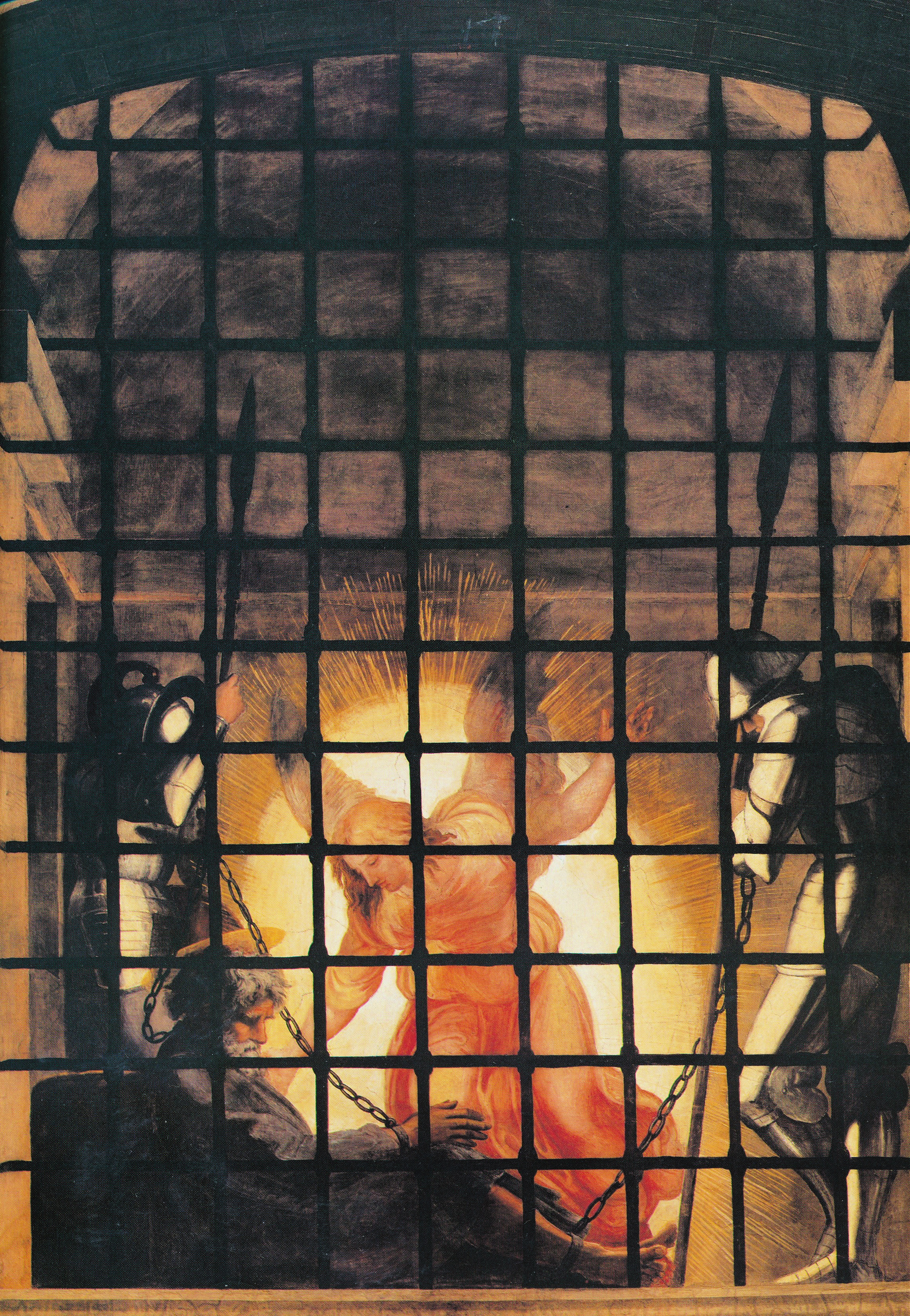
With its theme of Divine protection of the Church during political crises, the Stanza di Eliodoro contains The Expulsion of Heliodorus from the Temple, The Mass at Bolsena, The Liberation of Saint Peter and The Meeting of Leo the Great and Attila.
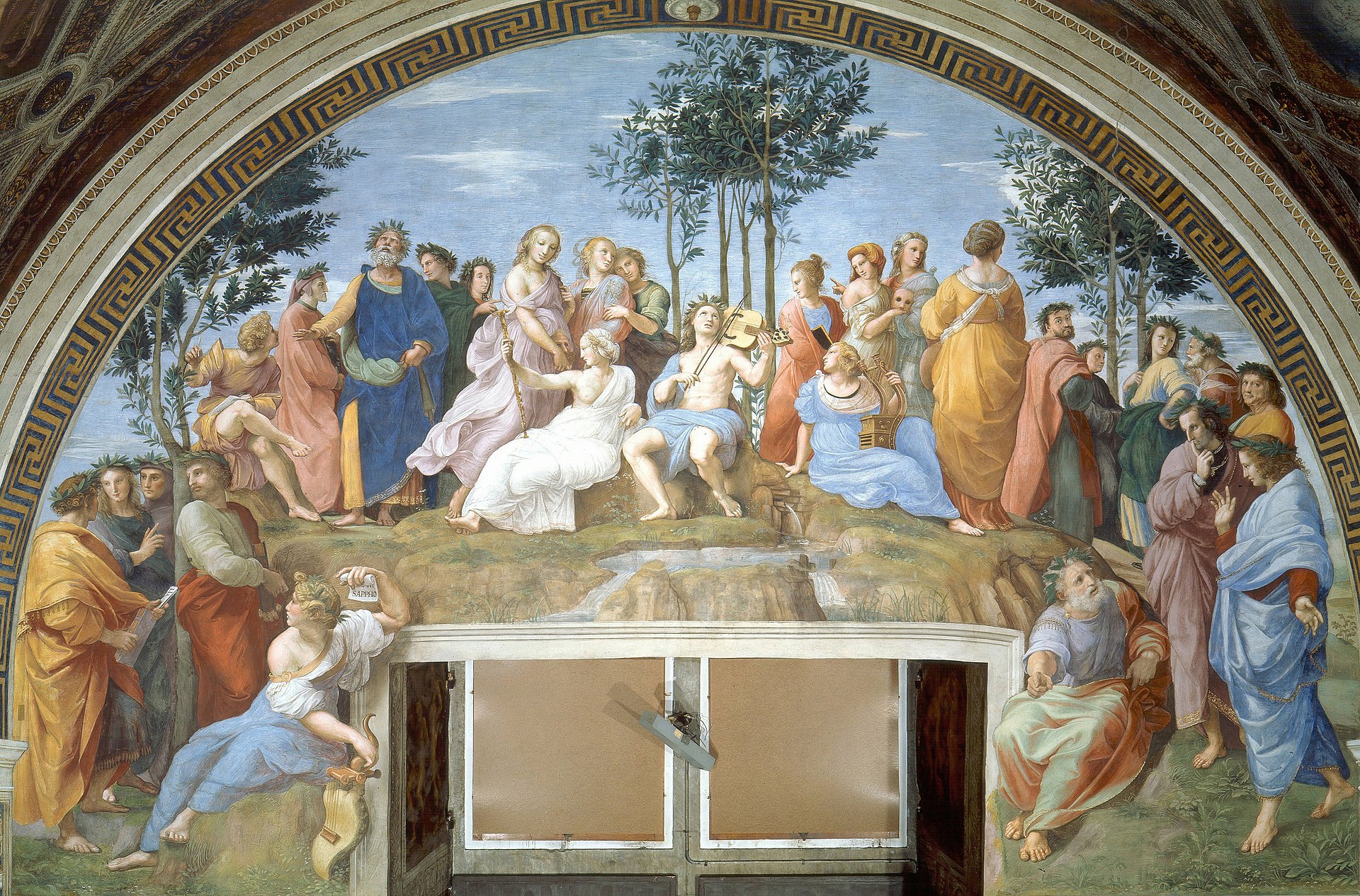
The Stanza della Segnatura (Julius II’s library/study), with its theme of harmony of human knowledge across Theology, Philosophy, Poetry, and Justice, includes The School of Athens, La Disputa, and The Parnassus.
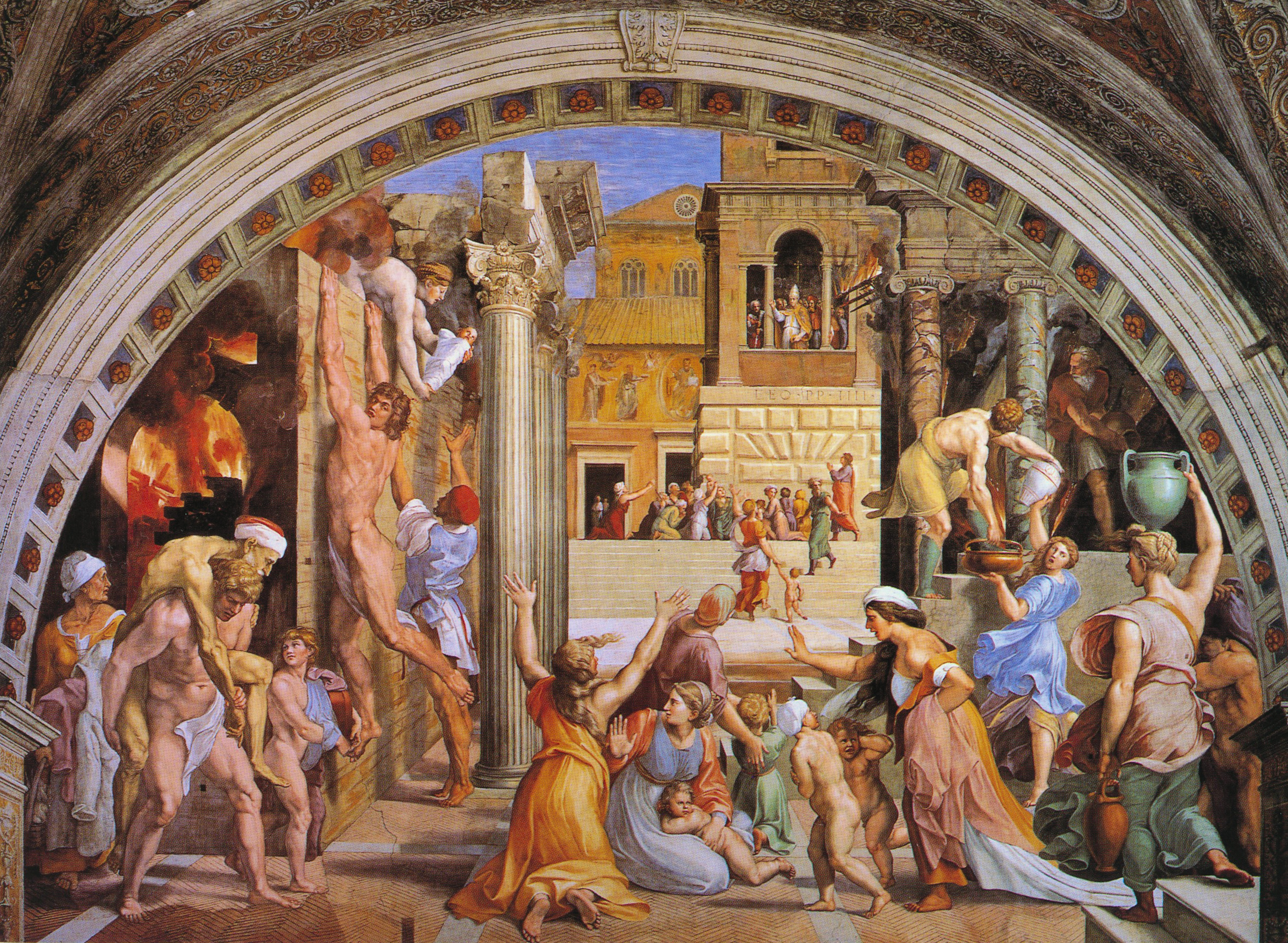
With its theme of Glorifying Pope Leo X, Stanza dell’Incendio del Borgo (papal dining room) contains The Fire in the Borgo (L’Incendio del Borgo); The Battle of Ostia; Coronation of Charlemagne; and Oath of Leo III.
The Frescoes as Immersive Theater
Raphael’s artwork in these rooms has the effect of cinema in presenting nearly life-sized figures in space that, hoisted onto the wall like a massive theatre screen, fills the room’s field of vision. Further, as a modern-day film dispels incredulity to its medium and any message it conveys, absorbing the viewer, Raphael’s fresco makes intensely real the Catholic faith.
Artistic Borrowing and Reinvention
Raphael frequently adapted individual figures and entire figural groupings from one fresco to another, refining successful visual ideas and integrating them into new compositions. This creative process enabled him to establish thematic and stylistic continuity across the Vatican rooms while continually enriching their complexity.
Michelangelo’s Influence
Raphael was also deeply influenced by Michelangelo’s newly unveiled Sistine Chapel ceiling. He studied its monumental prophets and sibyls closely, incorporating their sculptural power, dynamic poses, and psychological intensity into his own work. Rather than merely imitating Michelangelo, Raphael absorbed these innovations and transformed them within his own more harmonious and balanced visual language.
Perspective and Spatial Mastery
Beyond Michelangelo’s influence, Raphael was intensely interested in the challenges of foreshortening and the organization of large groups of figures within mathematically constructed perspectival settings. His ability to arrange complex assemblies of people within coherent architectural spaces contributed significantly to the intellectual clarity, visual grandeur, and persuasive realism that distinguish the frescoes of the High Renaissance.
Stanza della Segnatura
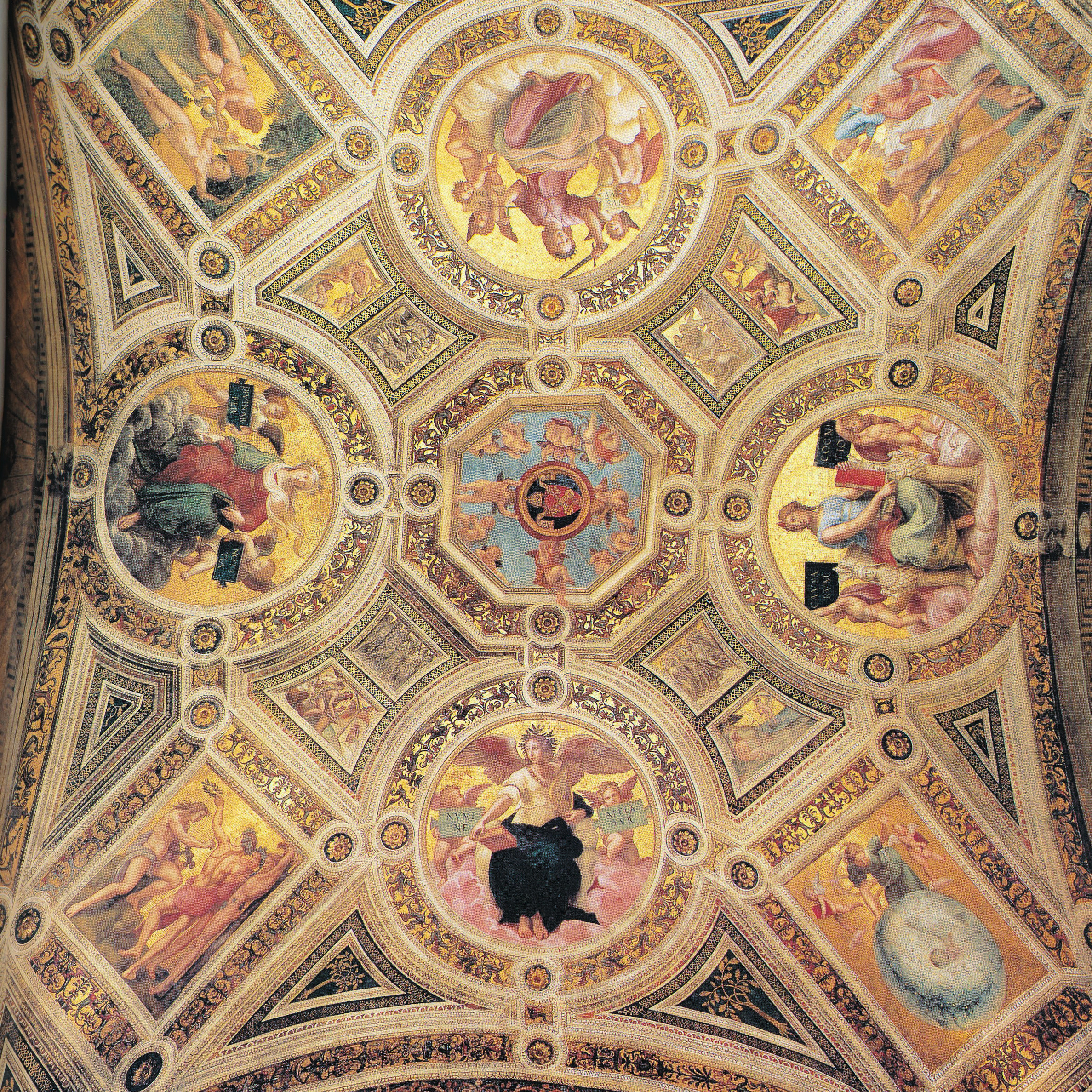
Raphael, c. 1509, fresco, 47 ½ x 41 ½” Ceiling, Stanza della Segnatura, Vatican, Rome.
At the time of the papal commission Raphael had little experience painting large frescos but revolutionized the tradition. The basic scheme of the decoration presents four tondi of abstract ideas of Theology, Poetry, Philosophy and Law. The Fall or Adam and Eve on the Brink of Disobedience, along with the Judgment of Solomon on the ceiling relates to themes of Theology and Law as the ceiling’s admixture of pagan scenes including Urania, and Apollo and Marsyas relate to Poetry and Philosophy. (Roger & Penny – pp 50-52).
Raphael, The Fall, c. 1509, fresco, 47 ½ x 41 ½” Ceiling, Stanza della Segnatura, Vatican, Rome.DETAIL.
Theology and the Catholic Faith
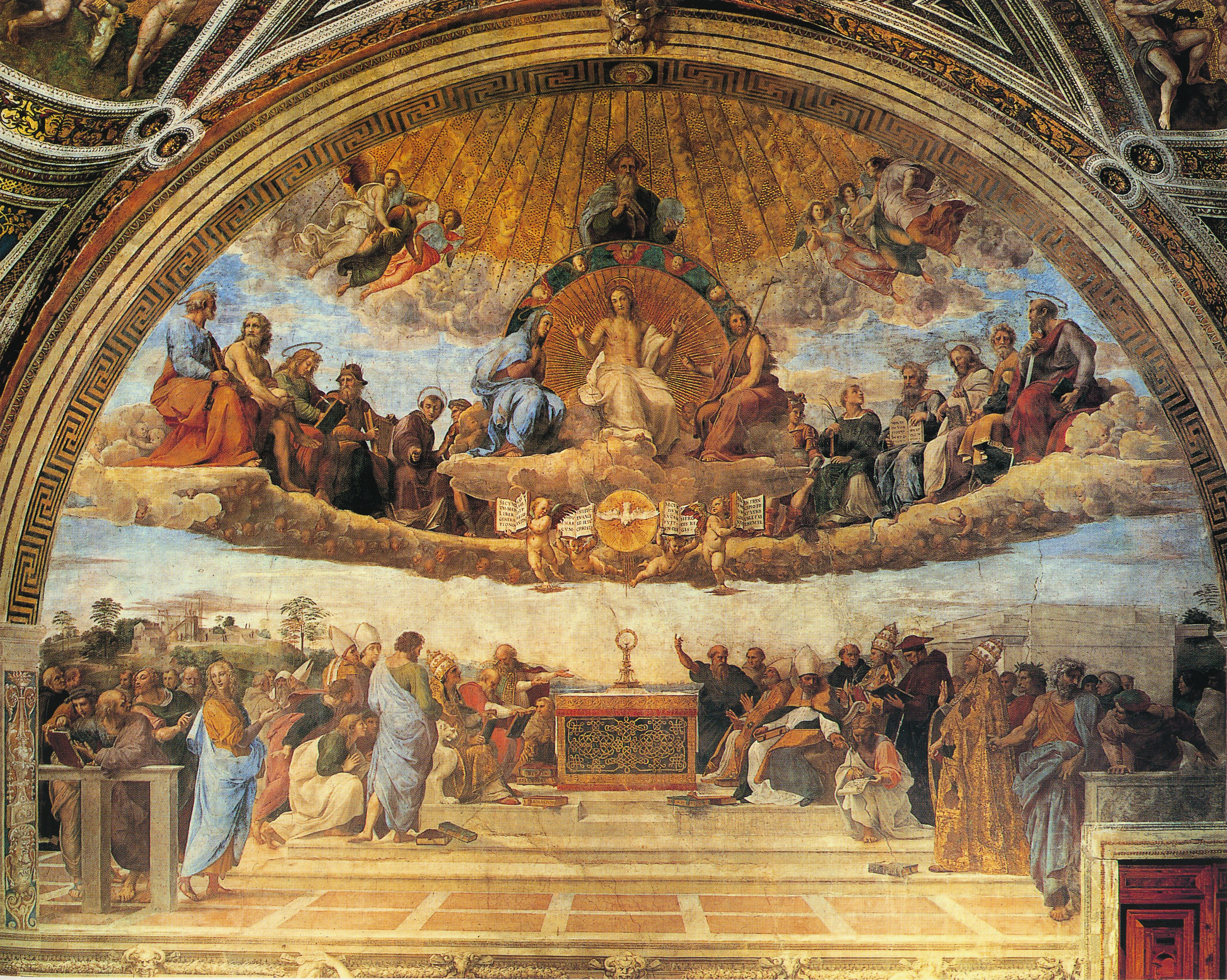
Raphael, The Disputation over the Sacrament (Disputa), 1509-10, fresco, 25’3” at base, Stanza della Segnatura, Vatican, Rome.
In The Disputationangels in the vault accompany God the Father as a white-robed God the Son sits enthroned before a golden disc displaying his sacrificial wounds of the Cross. On each side of Christ sit the Virgin Mary and St. John the Baptist while on the raised tier sits figures from the Bible. The Holy Spirit descends in the form of a dove on the monstrance holding the Eucharist. Many preparatory drawings survive for this fresco. (Roger & Penny, pp.57-58)
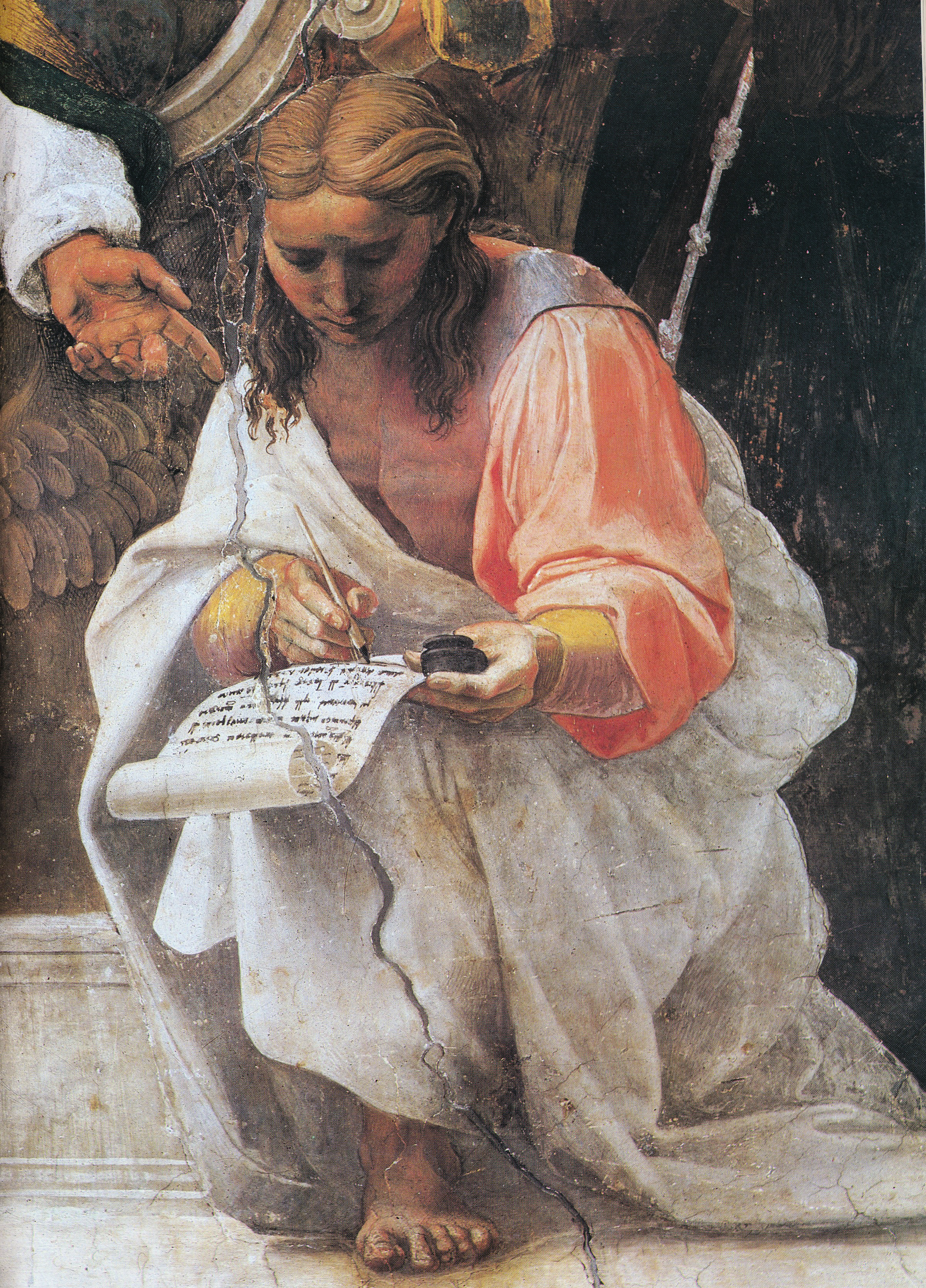
Raphael, Detail, The Disputation over the Sacrament (Disputa), 1509-10, fresco, 25’3” at base, Stanza della Segnatura, Vatican, Rome.
Detail of the young scribe (or amanuensis) at the feet of Saint Augustine from the earthly zone of Raphael’s celebrated fresco, The Disputation of the Holy Sacrament (La Disputa), located in the Stanza della Segnatura in the Vatican Palace. Raphael painted these characters using pseudo-script.
Philosophy and Classical Learning
Raphael, The School of Athens, 1510-11, Fresco, 25’3” at base, Stanza della Segnatura, Vatican, Rome.
Compared to the architecture in his Spozalizio from 1504, Raphael’s architecture in The School of Athens is more massive and yet whose angular lines are softened by the contours of colossal statues in niches. One statue is Minerva above Jurisprudence while Apollo is on the left (and closest to the Parnassus fresco). The central figures below the arches, open sky behind them, are Plato with his Timaeus and Aristotle with his Ethics. Other recognizable figures include Socrates to the left of Plato and Pythagoras to the right of the door. (Roger & Penny p 74-78).
Raphael, The School of Athens, 1510-11, Fresco, 25’3” at base, Stanza della Segnatura, Vatican, Rome.
Euclid bends down to use one of his compasses surrounded by students and disciples.
Poetry and the Imagination
Raphael, Parnassus, c. 1511, fresco, 22’1 ½” at base. Stanza della Segnatura, Vatican, Rome.
Raphael painted a poet’s paradise in Parnassus where Apollo has the central place. The window which interrupts the base of the artwork looked out onto a hill in Rome called Mons Vaticanus that was known since classical times as sacred to Apollo. This fact with the fresco’s other siting challenges (window glare) Raphael was well aware of. Apollo plays the fiddle surrounded by poets and gorgeous muses with a background of laurel trees. Mortals are below on either side of the window. (Roger & Penny, pp. 68-69)
Stanza della Segnatura. The tile floors were designed by the Della Robbia brothers. Public Domain.
PAPAL POWER AND DIVINE INTERVENTION
Stanza di Eliodoro
Raphael, The Expulsion of Heliodoris From the Temple, 1512-13, Fresco, 24’7” at base. Stanza D’Eliodoro, Vatican, Rome.
The Stanza D’Eliodoro served as a Vatican audience chamber for the Pope. Each fresco depicts a story of divine intervention and the Pope felt impelled to record them like a civic authority would record an important battle scene in the town hall. The Pope had control over the message and even had himself inserted into these works and one of the best portraits of the pope by Raphael.5 Vasari believed that in the Expulsion of Heliodorus the message was clear: it was the Pope chasing avarice out of the church. Still others, more realistic perhaps, believed the theme to be the defense of the Church’s right to worldly possessions.6While Julius II kept the treasury full and spent lavishly on public works, he also formally condemned his predecessor’s self-enrichment as well as the Church practice of buying and selling its offices. Others impute Pope Julius II making a parallel between Heliodorus’ expulsion and the Pope’s battle to expel rebellious cardinals who supported the French king against Rome.7 The first fresco painted in the Stanza D’Eliodoro and the one the room is named for is also, in my opinion, the finest: The Expulsion of Heliodorus. Heinrich Wölfflin in his book Classic Art provides the most satisfying brief account of this fresco, although there are other observers who offer insight and detail. The painting is based on an account found in 2 Maccabees, a book that treats of the events in Jewish history from the time of the high priest Onias III and King Seleucus IV to the defeat of Nicanor’s army (around 170 B.C). The biblical account of Heliodorus’ attempt to profane the Temple is a rich one and, in terms of the painting’s iconography, can be synopsized as such:
“There was great distress throughout the city. Priests prostrated themselves in their priestly robes before the altar, and loudly begged him in heaven…to keep the deposits safe for those who had made them…(T)he changed color of the (high priest’s) face manifested the anguish of his soul. The terror and bodily trembling that had come over the man clearly showed…People rushed out…in crowds to make public supplication because the Place was in danger of being profaned…Women, girded…filled the streets…While they were imploring the almighty Lord to keep the deposits safe and secure… Heliodorus went on with his plan. But just as he was approaching the treasury with his bodyguards, the Lord of spirits… (struck). There appeared to them a richly caparisoned horse, mounted by a dreadful rider. Charging furiously the horse attacked Heliodorus with his front hoofs…Then two other young men, remarkably strong…beautiful…splendidly attired, appeared…they flogged (Heliodorus) unceasingly…Suddenly, he fell to the ground enveloped in a great darkness…The man who a moment ago had entered that treasury with a great retinue and his whole bodyguard was carried away helpless…” (2 Maccabees, Chapter 3:14-28)
Raphael followed the biblical text closely. He depicts the three major parties in the religious story: the divine rider, two youths and Heliodorus; the figure of the anguished priest; and the “girded” women. As he does in The Deliverance of Saint Peter, the Pope identifies with one of the major priestly characters in the art work if one detects, as some scholars do, the features of Julius II in the High Priest Onias III.8 The Stanza D’Eliodoro and its first fresco The Explusion of Heliodorus is a milestone for its scale, its composition, its form, its treatment of subject, its color, its narrative power, and its graceful draughtmanship.
Raphael, The Mass of Bolsena, c. 1512 Fresco 21’8” Stanza d’Eliodoro, Vatican, Rome.
The fresco of The Mass of Bolsena depicts a 13th century miracle connected to the Eucharist when a traveling priest, doubting the Real Presence of Jesus in the consecrated host, is given proof of its reality when the altar cloth he uses for Mass becomes stained with blood from the Host. The cloth relic was revered by Julius II and housed in Orvieto Cathedral where it is today. From its inception, the five handsome youths in the bottom right section of the fresco have been admired for their sturdy monumentality perhaps influenced by Michelangelo as well as its colors and costumes showing Venetian influence. (Beck, pp. 100-101).
Raphael, The Mass of Bolsena, c. 1512 Fresco 21’8” Stanza d’Eliodoro, Vatican, Rome. DETAIL. Raphael, The Mass of Bolsena, c. 1512 Fresco 21’8” Stanza d’Eliodoro, Vatican, RomeDETAIL.Santi, Raffaello, dit Raphaël Rencontre entre Léon Ier et Attila 1512/1513 LOUVRE https://collections.louvre.fr/en/ark:/53355/cl020101100 – retrieved September 4, 2024.Raphael, The Liberation of Saint Peter From Prison, 1512-13, Fresco, 22’8” at base. Stanza d’Eliodoro, Vatican, Rome.
San Pietro in Vincoli in Rome (“St. Peter in Chains”) was Julius II’s titular church when he was a cardinal before becoming pope. It was also his uncle’s church before him, pope Sixtus IV (1471-1484). Pope Julius II made pilgrimage to the church in 1512 after the French evacuated from Italy. The liberation in the title of Raphael’s fresco probably refers to that of the Papal States with St. Peter taking on the physical characteristics of Julius II. The fresco was being painted during a year when the pope was dying which occurred in February 1513. Raphael’s use of light in the fresco is probably the boldest in art taking place at night in the whole of Renaissance art. (Beck, pp. 102-3).
Raphael, The Liberation of Saint Peter From Prison, 1512-13, Fresco, 22’8” at base. Stanza d’Eliodoro, Vatican, Rome.
Stanza dell’Incendio del Borgo
Raphael, The Fire in the Borgo, 1514-15, fresco, 22’1″ at base, Stanza dell’ Incendio, Vatican, Rome.
The name of the room comes from this fresco which Raphael began work on in the summer of 1514. It depicts a newly imagined historical event from the mid-9th century when a fire broke out in Rome. The pope (Leo IV) is seen giving a blessing from the balcony of Old St. Peter’s which, the story goes, tamped down the flames. In the meantime, Raphael depicted the event’s panic and drama among its foreground figures in its throes. Once more Raphael is re-inventing his art from only a couple of years earlier. As Raphael continued the practice of borrowing certain figures and themes from previous frescos, the overall classical style of the Segnatura and Eliodoro frescos are remarkably more spatially complex and intriguing in The Fire in the Borgo. Raphael absorbed what Rome offered: from Michelangelo’s latest art to the city’s ancient and contemporary architecture. The Ionic columns of Old St. Peter’s are accurately rendered as are the building fragment of Corinthian columns. (Beck, p. 110).
Raphael, the Fire in the Borgo, 1514-15, fresco, 22’1″ at base, Stanza dell’ Incendio, Vatican, Rome. DETAIL.
RAPHAEL THE PORTRAITIST
Four Rooms; Four Popes.
The popes responsible for commissioning, funding, and overseeing the completion of the Raphael Rooms amounted to three out of four consecutive reigns: Pope Julius II (r. 1503–1513) originated the commission. Under Julius, Raphael painted the Stanza della Segnatura and began the Stanza di Eliodoro. Julius II is buried in St. Peter’s Basilica.
Pope Leo X (r. 1513–1521) continued the project, keeping Raphael on as the chief Vatican artist. He oversaw the completion of the Stanza di Eliodoro, the Stanza dell’Incendio del Borgo, and the planning for the Sala di Costantino.
Pope Adrian VI, a Dutchman, then reigned after Leo X for a little over one year and eight months but halted work on the project. Adrian VI is buried in Santa Maria dell’Anima in Rome.
Finally Pope Clement VII (r. 1523–1534), Like Leo X, another Medici pope, finished the Sala di Costantino funded the late Raphael’s workshop assistants led by Giulio Romanoin 1524. Both Pope Leo X and Pope Clement VII are buried directly across from one another inside the choir of the Basilica of Santa Maria sopra Minerva in Rome.
Pope Julius II, Raphael, 1511-12.
Giuliano della Rovere (1443-1513) was described by Machiavelli in his works as an ideal prince. Becoming pope in 1503, he took the name Julius II in honor of Julius Caesar and was nicknamed the Warrior Pope. In 1506 Julius II organized the famous Swiss Guard for his personal protection and established the Vatican Museums. He was also the pope who instigated the rebuilding of St. Peter’s Basilica that exists today. The pope increased the power of the Papal States and, in 1508, he commissioned the Raphael Rooms and Michelangelo’s paintings in the Sistine Chapel. It was Julius II who also established the first bishoprics in the New World. Although the Tomb of Pope Julius II with its famous sculpture of Moses by Michelangelo is in San Pietro in Vincoli in Rome, the ensemble, extensively abbreviated than originally planned, was not finished until 1545, long after Julius II’s death in 1520. In fact, Julius II is buried in St. Peter’s Basilica.
Raphael, Portrait of Leo X and Two cardinals, 1517-18, oil on panel, 60 5/8 x 46 7/8” Uffizi Gallery Florence
This was an important group portrait commission for Raphael: the current Pope Leo X Medici (1513-1521) seated by his cousins, Cardinals Giulio de’ Medici on the left and Luigi de’ Rossi on the right. Giulio de’ Medici was soon to become the future pope Clement VII (1523-1534). Though highly individualized, Raphael captures a family resemblance between these Medici who were then the most powerful family in Italy and all about the same age. In 1517 Cardinal Giulio was an important art patron and had commissioned Raphael to do The Transfiguration, his last painting. Raphael demonstrates a wide range of artistic experience and skills so to pull any tool he needs for a successful outcome of any commission. In Urbino Raphael had been exposed to Flemish art and deploys its detailed technique in the bell and manuscript which 42-year-old Leo X uses a magnifier to see. The setting of the monumental portrait, in a room in the Vatican, is subtly captured by way of Flemish art ingenuity. The doorknob in front of cardinal Luigi de’ Rossi shows the reflection of an open window while the cape and biretta of the pope are highly detailed by the artist in its natural light. The Portrait of Leo X and Two Cardinals is considered the greatest group portrait of the 16th century. (Beck, pp. 120-121)
Raphael’s Garvagh Madonna (also known as the Aldobrandini Madonna) was painted in Rome between 1509–1511.Though its commsiion is lost to history it was a cabinet painting for private devotion and likely commissioned by a Roman aristocrat or paper courtier. The focal point is the pink carnation (dianthus) that the infant John the Baptist is handing to the Christ Child. The flower signifies Divine Love and the Passion of Christ. By the late 16th century, it entered the collection of the aristocratic Aldobrandini family in Rome and displayed in their apartments and at the Villa Borghese. During Napoleon’s invasion of Italy in 1799, an art dealer named Alexander Day acquired the painting and smuggled it to London.The painting was purchased in 1818 by the English nobleman George Canning, 1st Lord Garvagh and hidden for the next almost 50 years. In 1865 it was purchased by the National Gallery in London.
Raphael was working on the frescos in the Vatican Palace when he painted this oil on panel portrait of a “Young Cardinal.” The sitter is not known though it likely is Cardinal Francesco Alidosi (1455-1511). Cdl. Alidosi was an influential diplomat and military leader and a favorite of Julius II (1503-1513). The sitter’s expression and pose of a resting arm on the edge of the painting’s base and the slight turn of the body seems to owe much to Leonardo da Vinci. The body is monumental compared to a placid and yet almost inscrutable slightly smaller head whose depiction, while directly observed, is somewhat idealized. When Della Rovere was elected as Pope Julius II in 1503, Alidosi became his secretary and primary collaborator. He was appointed papal chamberlain and then treasurer. Though labeled “unholy” by Venetian cardinal Pietro Bembo (1470-1547), Cld. Alidosi helped guide the vocation of Bl. Elena Duglioli dall’ Olio (1472-1520), an Italian aristocrat, who wanted to be a Poor Clare nun but was forced to marry by her family and for whose endowed chapel in Bologna Raphael painted an altarpiece. In 1504 Alidosi became a bishop whose sees ranged up and down all of Italy from Mileto in 1504 and Pavia in 1505. He occupied the seat of Pavia until he was murdered in broad daylight in 1511. There were accusations traded back and forth that Cdl. Alidosi was a traitor at a time when the French occupied parts of Italy among its warring Italian families. The independently powerful pope acted to protect his favorite as long as possible. About Alidosi one historian noted: ”A favorite has no friends.” There were many unconcerned witnesses to the brutal crime whose attack included blows that split his head in two. (Beck, pp. 92-93; Herbert M. Vaughan, B.A., The Medici Popes (Leo X and Clement VII), Methuen & Co., London, 1910, p. 64-65; “Alidosi, Francesco, detto il Cardinal di Pavia”. Dizionario Biografico degli Italiani – Volume 2 (in Italian). Treccani. 1960.)
Raphael, La Donna Velata, c. 1514, oil on canvas, 33 ½ x 25 ¼” Pitti Gallery, Florence.
In La Donna Velata and Portrait of Baldassare Castiglione, Raphael, the master portraitist, present near ideal depictions. Both portraits are of almost identical dimensions. The model Raphael used for La Donna Velata he used in other artworks of this period, including The Sistine Madonna. By the mid 1510s these portraits have become gentler in their modeling than the tight, detailed study of corporeal features done before. Raphael begins a display of a mastery of forms and colors that had great influence on future artists such as Rubens and Rembrandt. However, Raphael’s painting does not forgo his mastery of drawing exampled in the female sitter’s sleeve or the overall nobility of the male sitter. (Beck, pp. 108-09; 116-17).
Portrait of Bindo Altoviti, painted circa 1515, presents its subject in a dramatic and highly original pose: a three-quarter back view with his head turned sharply over his shoulder to meet the viewer’s gaze. Bindo Altoviti (1491-1557) was a young, immensely wealthy and politically influential Florentine banker based in Rome. Among the most important patrons of the High Renaissance, he maintained close relationships with Raphael, Michelangelo, and Benvenuto Cellini. A passionate supporter of the arts, he was also a determined political opponent of the Medici family.
The striking twist of Altoviti’s body imbues the portrait with an unusual sense of movement and psychological immediacy. Raphael employs sfumato, particularly around the jawline, eyes, and flowing golden-brown curls, to create subtle transitions of light and shadow that enhance the figure’s sculptural presence. Soft illumination highlights the sitter’s youthful features against a rich dark-green background, while his hand rests lightly against his chest, drawing attention to the prominent gold ring on his finger. His attire, a sumptuous blue mantle draped over a dark tunic, conveys exceptional wealth and social standing while avoiding overt ostentation.
Raphael, The Way to Calvary (Lo Spasimo), 1516-17, oil on canvas, 10 ½ x 7’ 6 1/2” The Prado Madrid.
Raphael’s Christ Falling on the Way to Calvary (famously known in Italian as Lo Spasimo di Sicilia) was painted around 1516-1517, originally on panel before later being transferred to canvas. The painting captures the dramatic moment when Christ falls beneath the Cross and turns to look directly at his mother, who swoons in grief (the spasimo). She is supported by a group of weeping women, including Mary Magdalene, who kneels in the lower right foreground. Raphael fills the composition with intense movement and emotional tension. On the left, Roman soldiers and executioners tug brutally at ropes and force Christ onward, while Simon of Cyrene struggles to lift the heavy wooden cross. In the distance, a winding road leads toward Calvary, where other crosses are already being prepared beneath a turbulent sky.
The painting was commissioned by Jacopo Basilio for the new church of Santa Maria dello Spasimo in Palermo, Sicily. Although the church itself was never completed, Raphael’s masterpiece embarked on a remarkable journey. En route to Sicily, the ship carrying the work was wrecked at sea, yet the carefully packed painting somehow washed ashore near Genoa unharmed. It took the direct intervention of Pope Leo X to compel the Genoese authorities to surrender the masterpiece to its rightful owners in Palermo.
In 1661, the painting was acquired by the Spanish Viceroy of Sicily on behalf of King Philip IV of Spain, an avid collector of Raphael’s works. Transported to Madrid, it was installed in the royal chapel. During the Napoleonic Wars, French troops seized the painting and carried it to Paris, where restorers transferred it from panel to canvas. Following Napoleon’s defeat, the work was returned to Spain, where it eventually entered the collection of the Museo del Prado, its home today. The painting reflects Raphael´s interest in the depiction of extreme physical and psychological states. https://www.museodelprado.es/en/the-collection/art-work/christ-falls-on-the-way-to-calvary/870c8293-1691-4a90-88ff-b554a2bc3fe8?searchid=d42d76c7-eb9f-501b-f628-d03605a6ca9c – retrieved September 4, 2024.
Raphael, The Alba Madonna, c. 1511, oil on canvas (transferred from panel), diameter 37 ¼” National Gallery of Art, Washington, D.C.
Raphael’s major commissions for papal and aristocratic patrons did not interrupt his sustained engagement with the Madonna theme, a subject he had refined since his years in Umbria and Florence. The Alba Madonna exemplifies this continuity. The Virgin is presented as a Virgin of Humility, seated directly on the ground, her pose reinforcing the theological emphasis on Christ’s lowly Incarnation. She wears a rose‑pink gown beneath a topaz‑blue mantle, her hair drawn back from her face, and one finger marking a page in the book resting on her lap.
The Virgin occupies the dominant share of the tondo’s surface, receiving the young John the Baptist as he approaches with flowers gathered in the fold of his garment — a visual shorthand for his role as the forerunner who prepares and presents Christ to the world. All three figures direct their attention toward the small cross held by the Christ Child, a sign of his identity as the Lamb of God and of the sacrificial destiny that defines his mission.
Raphael integrates figure and format with characteristic finesse: the Madonna’s rounded features and gently curving posture echo the circular panel on which the scene is painted. The background opens onto an expansive plain leading to a turquoise body of water, with distant mountains rendered in deeper blue beneath a luminous sky, establishing a serene atmospheric recession typical of Raphael’s mature style. (Roger & Penny, p. 88.) https://www.nga.gov/collection/art-object-page.26.html – retrieved September 4, 2024.
Raphael, Galatea, c. 1512, fresco, 9’8 1/8” x 7’4”, Villa farnesina, Rome.
Raphael took a poem by Florentine poet Poliziano (1454-1494) for inspiration for this fresco. The poet gives a detailed description of the Palace of Venus. Galatea is described as riding on the sea in a chariot pulled by a pair of dolphins whose reins she holds. Around her is her entourage playing amorously in the sea. In 2007, the bodies of Poliziano and philosopher Giovanni Pico della Mirandola (1463-1464) were exhumed from Florence’s Church of San Marco to determine the causes of their deaths. Forensic tests showed that both men of letters likely were poisoned but it is only speculation as to why or by whom. (see – http://news.bbc.co.uk/2/hi/europe/6920443.stm – retrieved September 7, 2024). (Roger & Penny, p. 93).
Raphael, The Sistine Madonna, 1512-13, oil on canvas, 8’8” x 6’5”Gemäldegalerie Alte Meister Staatliche Kunstsammlungen, Dresden.
Raphael’s The Sistine Madonna was made for the high altar of a newly rebuilt church of Pope St. Sixtus (d. 257) in Piacenza, Italy. St. Sixtus kneels on a cloud before the Virgin and Christ Child with a hand over his chest. The saint is interceding for the worshippers of Piacenza to whom he gestures outward with his other hand. Opposite is St. Barbara, patron of soldiers, with the symbol of a tower behind her. (Roger & Penny p. 128)
Raphael, The S. Cecilia Altarpiece, 1513-14, oil on canvas, 86 ½ x 53 ½” The National Gallery of Bologna (Pinacoteca Nazionale di Bologna).
In TheS. Cecilia Altarpiece Raphael depicts St. Cecilia with an organetto slipping from her hands as she looks skyward to the preferred sound of heavenly music. Also included are Sts. Paul, John the Evangelist, Augustine and Mary Magdalene. It was an altarpiece for a chapel in S. Giovanni in Monte in Bologna founded by Elena Duglioli dall’ Olio (1472-1520). The Italian aristocrat wanted to become a Poor Clare nun. Though forced to marry by her family, she persuaded her husband not to consummate the marriage. This act of chastity was attributed to her devotion to St. John the Evangelist, patron of virginity, and St. Cecilia. Elena’s benefactor in the enterprise of her religious vocation was influential Cardinal Alidosi. Elena died on September 23, 1520, and her remains are incorrupt in the church of San Giovanni in Monte. In 1828 she was beatified by Pope Leo XII (1760-1829). Her feast day is September 23. (Roger & Penny, pp. 144-146).
Raphael, The S. Cecilia Altarpiece, 1513-14, oil on canvas, 86 ½ x 53 ½” The National Gallery of Bologna (Pinacoteca Nazionale di Bologna).Raphael, Madonna della Sedia (The Madonna of the Chair), 1514-15, Oil on Panel, diameter 28” Pitti Gallery, Florence.
Raphael’s tondo Madonna della Seggiola (Madonna della Sedia or Madonna of the Chair) was painted in Rome around 1513-1514. Its title derives from the ornate gilded chair (seggiola) on which the Virgin sits, a detail that reflects the courtly refinement of Raphael’s Roman years under Pope Leo X. The painting is celebrated for its profound tenderness and maternal warmth: Mary draws the Christ Child closely to her while the young Saint John the Baptist gazes upward in adoration, his hands clasped in prayer and a delicate reed cross foreshadowing the Crucifixion. Unusually, Mary looks directly out at the viewer with an intense and knowing expression, inviting us into what might otherwise seem a private family moment. During the Napoleonic Wars, the painting was seized by French forces in 1799 and taken to Paris, where it was admired as one of the finest treasures in Napoleon’s collection. Following Napoleon’s defeat, it was returned safely to Florence in 1815.
Raphael, Portrait of a Nude woman (“Fornarina”), oil on panel, c. 1518, 85 x 80cm, galleria Nazionale ( Palazzo Barberini), Rome.
Raphael’s Secret Muse: La Fornarina and the Artist’s Great Love
Raphael’s famously intimate and sensual masterpiece, La Fornarina (The Baker’s Daughter), was painted around 1518-1520, during the final years of the artist’s life. The half-nude sitter is widely identified as Margarita Luti, believed to have been Raphael’s secret longtime mistress and the great love of his life.
A Forbidden Romance
Although Raphael was officially engaged to Maria Bibbiena, the niece of a powerful Vatican cardinal, the artist repeatedly postponed the marriage. Contemporary accounts suggest that his devotion to Margarita overshadowed all other personal and sometimes professional commitments. The Renaissance biographer Giorgio Vasari wrote that Raphael’s passion for Margarita was so consuming that it distracted him from some of his most important artistic commissions, including work for the Vatican.
Margarita as Venus
Margarita’s pose, with one hand resting lightly on her breast and the other across her lap, deliberately echoes the ancient Venus Pudica (“Modest Venus”) type of classical Greco-Roman sculpture. Through this visual reference, Raphael transformed his working-class lover into Venus, the goddess of love, elevating her from earthly companion to idealized beauty.
Her appearance is rich with symbolic details. She wears an exotic striped silk turban adorned with a delicate pearl ornament. The pearl, margherita in Italian, serves as a playful visual pun on her first name. Such references suggest that the painting was not merely a portrait but an intensely personal tribute.
A Private Declaration of Love
Unlike Raphael’s public commissions, La Fornarina appears to have been a private work, likely kept within the artist’s workshop rather than displayed for patrons. One of the painting’s most striking details is the dark blue and gold band encircling Margarita’s upper left arm. Inscribed with the words “RAPHAEL URBINAS” (“Raphael of Urbino”), the band functions almost like a signature worn on the body of the beloved. Rather than simply identifying the artist, it creates a profound connection between painter and sitter, suggesting a mutual bond that transcends the conventions of portraiture.
The Hidden Wedding Ring
Modern scientific analysis and X-ray examinations of the painting have revealed a remarkable hidden history. Beneath the visible paint layers, conservators discovered that Margarita originally wore a large gold wedding ring on the third finger of her left hand. The surrounding landscape also once contained myrtle and laurel, traditional Renaissance symbols associated with marriage, fidelity, and enduring love.
These discoveries have fueled longstanding speculation that Raphael and Margarita may have entered into a secret union, or at the very least that Raphael wished to portray her as his wife rather than merely his mistress.
The Cover-Up After Raphael’s Death
After Raphael’s sudden death in 1520, his workshop assistants, most notably Giulio Romano and Gianfrancesco Penni, altered the painting. The wedding ring was painted over, and portions of the symbolic background were modified or removed.
Many scholars believe these changes were intended to protect Raphael’s posthumous reputation and avoid a potentially damaging scandal. Publicly, the artist was known as the unmarried fiancé of a powerful cardinal’s niece. Evidence of a secret marriage or romantic attachment to a baker’s daughter would have embarrassed both elite Vatican families and Raphael’s estate during a sensitive period following his death.
As a result, La Fornarina survives not only as one of the Renaissance’s most beautiful portraits but also as one of its most intriguing love stories, a work in which a Renaissance artist’s passion, symbolism, and secrecy are woven beneath the surface of the paint itself.
Raphael, The Miraculous Draught of Fishes (Luke 5: 1-11), 1514-15, Tempera on paper, 11’10” x 13’2” Victoria and Albert Museum, London
The Raphael Cartoons are designs for tapestries and were commissioned by Pope Leo X (1513-21) shortly after his election in 1513. The tapestries were intended to hang in the Sistine Chapel in Rome, built by Pope Sixtus IV (1471-84). The decoration of the chapel under Sixtus addressed the lives of Moses and Christ. The tapestries continued this theme, illustrating scenes from the lives of St. Peter and St. Paul.
The Visitation was commissioned by Giovanni Branconio, the Apostolic Protonotary, at the behest of his father, Marino Branconio, for the family chapel at the church of San Silvestre de Aquila. Marino´s choice of subject matter was undoubtedly guided by the fact that his wife was named Elizabeth and his son, John. In 1655, this work was acquired by Felipe IV (1605-1665), who deposited it at El Escorial. It entered the Prado Museum in 1837.
Raphael, The Holy Family of Francis I. 1518 Oil on canvas 81 ½ x 55 1/8” The Louvre Paris.
Raphael’s grand late masterpiece, The Holy Family of Francis I (also known as The Great Holy Family), was painted in 1518 during his Roman period. At the center of the composition, the infant Christ springs from his cradle into the embrace of his mother, the Virgin Mary. Beside her, Saint Elizabeth supports her young son, Saint John the Baptist, whose hands are clasped in prayer as his gaze points to Jesus. Two angels join the scene, one holding a crown of flowers above Mary’s head, symbolizing her role as the Queen of Heaven. A pensive, heavy-lidded Saint Joseph leans on his hand, quietly contemplating the gathering and awaiting the Holy Family’s next move.
More saccharine than Raphael’s other work, the painting reflects his growing attraction to the monumental, proto-Mannerist tendencies inspired by Michelangelo’s Sistine Chapel ceiling. It also bears the mark of Raphael’s increasingly busy workshop, with most of it executed by his assistant Giulio Romano. Commissioned by Pope Leo X as a diplomatic gift for King Francis I of France and Queen Claude, the painting was sent to the French royal court at Fontainebleau in 1518. The gift formed part of the Vatican’s broader effort to cultivate French goodwill and maintain a political counterweight to the growing power of the Holy Roman Emperor.
Raphael, The Transfiguration, 1518-20, oil on panel, 13’3 ¾ x 9’1 ½” Pinacoteca, Vatican, Rome.
Raphael died in April 1520 while working on The Transfiguration. Although most of the painting was already complete, his sudden passing marked the abrupt end of a brilliant but short career—Raphael was only 37 years old. Cardinal Giulio de’ Medici, the future Pope Clement VII, had commissioned the work for the Cathedral of Narbonne in France, but following the artist’s untimely death, it was instead displayed at his funeral in the Pantheon.
During its creation, the project was fueled by intense artistic rivalry. Sebastiano del Piombo, who was mentored by Michelangelo in Florence, was simultaneously producing The Raising of Lazarus for the exact same cathedral, creating a direct competition for Raphael’s work. Today, Sebastiano’s anxious letters to Michelangelo serve as our primary historical record for the progress and development of Raphael’s painting.
Initially, Raphael planned to depict only the mountaintop Transfiguration. This episode is detailed in the Synoptic Gospels but completely omitted from the Gospel of John. This omission is particularly notable because Matthew, Mark, and Luke all record that John was personally present for the magnificent event, alongside Peter and James the Greater. Ultimately, John’s omission makes thematic sense: while the Synoptic writers use the Transfiguration as a dramatic, mid-narrative revelation of Jesus’s heavenly nature, John’s entire Gospel establishes that exact divine premise right from its opening verses.
Raphael’s depiction ultimately became the definitive template for how the event on Mount Tabor has been popularly imagined ever since. He captured Christ rising majestically into the air, His face and clothes turned a dazzling white, elevated above Moses and Elijah, whom the Gospels describe Jesus as being in conversation with. Below them, the three chosen Apostles careen in various prostrations of overwhelming wonderment, shielding themselves from the brilliant light.
Raphael famously expanded the traditional scene to include the scriptural episode that immediately follows: the story of a demoniac boy whom the remaining Apostles fail to heal. In the biblical account, Christ descends the mountain after His transfiguration and cures the child, who appears here frantically gesturing in the lower right corner. In the composition, the divine peace of the Transfiguration sits elevated and farther back from this earthly, chaotic turmoil below. On the left side of the canvas, two figures—identified as the patron saints of Narbonne—can be seen making their way up the mountain to pay homage.
This inclusion was a nod to the patrons, if not a guarantee of Raphael’s full fee. As the Renaissance biographer Giorgio Vasari famously noted, Raphael lived more like a prince than a painter. His lifestyle was expensive, and Giulio Romano, one of Raphael’s chief artistic and financial heirs, eventually had to sue the benefactors in 1522 to secure the final payment for the masterpiece.
Debate continues among art historians over exactly how much of Raphael’s studio executed the final canvas, particularly in the wake of his sudden death. Even so, it is clear the workshop assisted extensively during Raphael’s lifetime, as his highly productive working method required. Nevertheless, the core invention, the preparatory drawings, and the vast majority of the brushwork were distinctly Raphael’s own. Art historians Roger Jones and Nicholas Penny note that for this final painting, Raphael looked back to the very beginning of his career, modeling many of the expressive heads in The Transfiguration after Leonardo da Vinci’s unfinished 1481 masterpiece, The Adoration of the Magi.
Just as in the Gospel narrative, light drives the artistic coloration, invention, and emotion of the painting. A blinding, heavenly radiance engulfs Peter, James, and John at the top, while a second, much sharper earthly light isolates the expressive faces, hands, and frantic gestures from deep shadows below. This complex illumination and intense contrast became an essential touchstone for later, highly influential Baroque painters, most notably Caravaggio. Vasari remarkably notes that when Raphael passed away, the loss plunged the entire papal court into deep, unmitigated grief, so much so that the Pope quite openly and bitterly wept at the tragic passing of this noble craftsman.
Conclusion
With Leonardo da Vinci and Michelangelo, Raphael became one of the defining figures of the High Renaissance. His achievement lay not only in individual masterpieces but in his ability to unite classical ideals, Christian theology, portraiture, architecture, and human emotion into a harmonious artistic vision that shaped the course of Western art for centuries.
FOOTNOTES:
1. Giorgio Vasari, Lives of the Artists, translated by George Bull (Penguin Books, Harmondsworth, Middlesex, England, 1965) pages 316-18.
2. Ibid., page 318 and Edizioni Musei Vaticani, Michelangelo and Raphael in the Vatican, (Tipografia Vaticana, Città del Vaticano, 1995) page 169.
3. Vasari, Lives, pages 285 and 291.
4. Ibid., pages 299-302.
5. Roger Jones and Nicholas Penny, Raphael, Yale University Press, New Haven and London, 1983, page 113 and 17. Carlo Ludivico, Vatican Museums Rome, page 119
6. Roger Jones and Nicholas Penny, Raphael, Yale University Press, New Haven and London, 1983, page 117 and Vasari, Lives, page 301.
7. Frederick Hartt, History of Italian Renaissance Art: Painting, Sculpture, Architecture, Harry N. Abrams, Inc. New York, Third Edition, 1987, page 513.
8. New American Bible, (Catholic Book Publishing Company, New York) page 546 and 550; Beck, Raphael, page 98.
BIBLIOGRAPHY:
Brera Milan Great Museums of the World, Carlo Ludovico Ragghianti, Newsweek NY 1970 pp. 34
Pinakothek Munich Great Museums of the World, Roberto Salvini, et. al., Newsweek NY 1969 pp. 126
Lives of the Artists, Giorgio Vasari, translated by George Bull, Penguin Books, Harmondsworth, Middlesex, England, 1965, pages 316-18
Michelangelo and Raphael in the Vatican, Edizioni Musei Vaticani, Tipografia Vaticana, Città del Vaticano, 1995 p. 169
Raffaello. Franzese, Paolo (2008). Milano: Mondadori Arte.
Raphael, James H. Beck, harry N. Abrams, Inc., Publishers, New York, 1994.
Raphael, Roger Jones and Nicholas Penny, Yale University Press, New Haven and London, 1983.
Encyclopedia of the Middle Ages, Volume 2, André Vauchez, Richard Barrie Dobson, Michael Lapidge, Chicago: Fitzroy, Dearborn, 2000.
History of Italian Renaissance Art: Painting, Sculpture, Architecture, Frederick Hartt, Harry N. Abrams, Inc. New York, Third Edition, 1987.
Raphael, Beck, James H., Harry N. Abrams, Inc. Publishers, New York, 1994.
The Medici Popes (Leo X and Clement VII), Herbert M. Vaughan, B.A., Methuen & Co., London, 1908.
“Alidosi, Francesco, detto il Cardinal di Pavia”. Dizionario Biografico degli Italiani – Volume 2. Treccani. 1960.
This explanatory article may be periodically updated.
FEATURE image: Independence Day Parade 2024 was honored to have Kate, this year’s Illinois Miss Amazing Miss Queen, as the Grand Marshal. Miss Amazing, a national organization, provides opportunities for girls and women with disabilities across the nation to make for engagement at every level of society and that dismantles stereotypes and opens up pathways for personal growth and self-esteem.
Documents the 248th Anniversary of American Independence through the local community parade in Downers Grove, Illinois.
FEATURE image: Architect Louis Bourgeois incorporated a variety of religious architecture and symbols including for Hindus, Buddhists, Native Americans, Jews, Christians and Muslims, to convey the Baháʼí principle of the unity of religion. Author’s photograph.
The Baháʼí Temple in Wilmette is one of America’s most distinctive religious monuments, where architect Louis Bourgeois fused spiritual ideals, innovative design, and intricate ornament into a landmark that took more than forty years to complete and remains a singular achievement in twentieth-century sacred architecture.
Text & Photographs by John P. Walsh.
The temple was designed by French-Canadian architect Louis Bourgeois (1856–1930). By 1906 Bourgeois and his wife joined the Baháʼí faith. Photo c. 1922. Public Domain.
The Chicago Baháʼí Temple House of Worship is the second such house of worship constructed and the oldest one that is still standing. The popular destination along Lake Michigan on Chicago’s Northshore attracts visitors from around the world today for its amazing architecture, beautiful gardens, and message of religious unity in prayer and for peace.
The temple was designed by French-Canadian architect Louis Bourgeois (1856–1930). After studying and traveling in Paris, Italy, Greece, Egypt, and Iran, Bourgeois settled in Chicago in 1896 where he worked with Louis Sullivan. Bourgeois moved to Southern California and, in 1898, designed in Hollywood a landmark Mission Revival style house for painter Paul de Longpré (1855-1911) whose architecture and gardens became a tourist attraction.
The building serves as the North American Baháʼí House of Worship. Located in Wilmette, Illinois, it has become one of Chicagoland’s most recognizable landmarks.
The nine sides of the building represent the largest single digit number which stands fortheBaháʼí belief in the unity and oneness of humankind. June 2014. Author’s photograph. 6.55mb
The idea for the construction of the first Baháʼí Temple in the Western world began in Chicago in 1903. When there was a call for designs, Louis Bourgeois’ plans were the most promising. He worked on the complex design from 1909 to 1917. Before that time, Louis Bourgeois and his wife had joined the Baháʼí faith after having come into association with the Baha’i Faith through Boston’s Baháʼí community. In that time Bourgeois constructed a plaster model of his completed vision and in the 1920’s until his death in 1930 worked on the temple’s construction in Wilmette, Illinois.
While building activity was delayed though the Great Depression of the 1930’s and into World War II, temple construction began again in earnest in 1947 and the temple was dedicated in 1953.
Designed by French-Canadian architect Louis Bourgeois, its more than 40-year construction history reflects the determination of the Baháʼí community to realize Bourgeois’s ambitious vision.
Abdu’l-Bahá (1844-1921), eldest son of Baháʼu’lláh (1817-1892), the founder of the Baháʼí Faith, participated in the ground-breaking ceremony in 1912 of Baháʼí Temple. Construction began in earnest in the 1920s. It is four stories of reinforced concrete. June 2014. Author’s photograph. 4.11mb
Baháʼu’lláh (1817-1892) was an Iranian religious leader who founded the Baháʼí Faith. Public Domain.
Money for the building was raised entirely by the temple congregants as their gift to the people of the world. June 2014. Author’s photograph. 6.30mb
The temple blends influences from Gothic, Islamic, Byzantine, Renaissance, and other world architectural traditions into a unified design. Its lace-like concrete ornamentation creates one of the most elaborate exterior surfaces in American architecture.
The temple rises 191 feet from its base to its ribbed dome’s peak. The main story pylons are 45 feet high each. The building’s surfaces are teeming with carved lacelike ornamentation. June 2013. Author’s photograph. 4.50mb
The Baháʼí Temple has a highly traditional appearance whose architectural reputation—in an age of orthodox modernism and postmodernism—has grown only more positive with the years. June 2013. Author’s photograph. 4.85 mb
Interior of the auditorium inside the Baháʼí House of Worship in Wilmette, Illinois. The entire surface—from the towering walls to the massive dome ceiling—is covered in highly detailed, openwork ornamental lattice patterns that filter natural light.
The Grand Dome: A central, monumental circular dome rises high above the space, featuring a gilded calligraphic emblem at its center. Molded seamlessly into the pillars and lace-like quartz masonry are major global religious symbols layered chronologically from bottom to top—including Christianity, Judaism, Islam, and Hinduism—symbolizing the fraternity and evolution of mankind.
Soaring Arches and Pillars: Nine main pillars and towering arched window bays flank the multi-layered walls, drawing the eye upward. The number nine is the highest single-digit number, mathematically representing oneness, perfection, and the ultimate completion of God’s revelation.
Concentric Seating Layout: Curved rows of rich, red velvet-cushioned wooden seating wrap around a highly polished, reflective floor that mirrors the warm lighting from above. PHOTO: “The forbidden temple.” by kern.justin is licensed under CC BY-NC-ND 2.0.
The room is strictly dedicated to prayer, quiet contemplation, and meditation. There are no sermons, rigid ritualism, or set religious dogmas permitted here. Because the faith emphasizes that all major world religions originate from the same Creator, the devotional readings regularly feature sacred scriptures from different faiths. In alignment with Baháʼí principles, the room features no professional clergy, religious imagery, or musical instruments. Any music performed during devotionals comes strictly from a cappella choirs or soloists.
The temple occupies a unique place in American religious architecture because it is unlike any traditional church, synagogue, mosque, or cathedral.
The temple’s main prayer room seats 1,200 people. In the Baháʼí faith there are no clergy, no sermons and no rituals. Scriptures are read from many different faith traditions and music by soloists or a cappella choir. June 2013. Author’s photograph. 5.31mb
The Baha’i House of Worship Choir, under the direction of Van Gilmer, performs “This is the Day”—featuring words by Báha’u’lláh and arranged by Stanford E. Scriven—at the 17th Annual Choral Festival in Wilmette, Illinois.
“The Source of All Learning is the Knowledge of God – Exalted Be His Glory.” There are an equal number of entrances each with a quotation above it by Baháʼu’lláh (1817-1892), founder of the Baháʼí faith. June 2013. Author’s photograph. 5.94mb
The Baháʼí temple is open year-round presenting its unique beauty through the seasons. February 2021. Author’s photograph.7.97mb
The nine-sided plan reflects Baháʼí religious symbolism and the principle of unity. The structure demonstrates how architecture can express universal spiritual ideals through light, geometry, and decoration.
The building is on the National Register of Historic Places and situated on a broad, landscaped site that looks towards Lake Michigan. PHOTO: “Wilmette, 2015” by gregorywass is licensed under CC BY-NC-SA 2.0.
SOURCES:
Chicago Churches and Synagogues: An Architectural Pilgrimage, George Lane, S.J., and Algimantas Kezys, Loyola University Press, Chicago, 1981, pp. 160-161.
Chicago’s Famous Buildings, Fifth Edition, Franz Schulze and Kevin Harrington, Chicago and London: University of Chicago Press, 2003, pp. 267-269.
A Guide to Chicago’s Historic Suburbs on Wheels and on Foot, Ira J. Bach, Swallow Press/Ohio University Press, 1981, p. 535.
FEATURE image: CIVIC OPERA BUILDING, 20 N. Wacker Drive, Chicago. The world-famous Lyric Opera of Chicago mounts its productions in one of North America’s most beautiful opera houses, the Civic Opera House at 20 North Wacker Drive in downtown Chicago, Illinois. Author’s photograph.
The Civic Opera Building (1929) represents one of Chicago’s greatest achievements of the skyscraper era, combining world-class commercial office space with a grand opera house in a monumental Art Deco landmark that symbolized the city’s cultural and economic confidence at the end of the Roaring Twenties.
Samuel Insull was the founder of Commonwealth Edison Company in Chicago. The Great Depression had a devastating effect on Insull’s utilities and transportation empire, due to what became an overly leveraged financial position of his main holding company (by one accounting Insull had less than a 1% cash stake). Insull’s fortunes as well as his shareholders’ were in ruins overnight and Insull quickly became a despised figure. Born in the U.K., Insull became a U.S. citizen in 1896 and now fled to France and then Greece. In October 1932 Insull was brought up on charges in the U.S. of financial malfeasance – bankruptcy, embezzlement, and using the mails to defraud investors. When he was returned to the U.S. to stand trial Insull was defended by Chicago criminal lawyer and former Illinois Supreme Court justice Floyd E. Thompson (1887-1960) and found not guilty on all counts. Insull ended his days living in Paris on a small pension from his business interests. On July 16, 1938, in the summer heat, 78-year-old Insull died of a heart attack after descending the stairs accompanied by his wife into the Place de la Concorde Métro station. Insull was buried in London eight days later. The once-populist multi-millionaire dubbed the “Prince of Electricity” who had been president of 11 power and transportation companies and sat on 65 boards was, at his death, worse than broke. According to his 1932 will, Insull held $1,000 in assets and $14,000,000 in debts. See – “Fortune Shrank to $1,000, Samuel Insull Will Shows”. Reading Eagle. 12 August 1938 – retrieved June 29, 2024 and https://www.chicago-l.org/figures/insull/ – retrieved June 29, 2024.
Graham, Anderson, Probst & White was one of the largest architectural firms in the first half of the twentieth century. Founded in 1912, the firm was the successor to D. H. Burnham & Co. by way of partner, Ernest R. Graham (1868-1936), and Burnham’s sons, Hubert and Daniel Jr. Five years later the Burnhams left to form their own firm (Burnham Brothers) and Graham partnered with others of the firm’s members: William Peirce Anderson (1870-1924), Edward Mathias Probst (1870-1942), and Howard Judson White (1870-1936).Pediment sculpture by Henry Hering (1874-1949).
Ernest R. Graham (1868-1936)William Peirce Anderson (1870-1924)Edward Mathias Probst (1870-1942)Howard Judson White (1870-1936)
Conceived by opera impresario Samuel Insull and designed by Graham, Anderson, Probst & White, the Civic Opera Building fused architecture, business, and the performing arts into one of the most distinctive and influential skyscrapers on the Chicago River.
Plan of Chicago Authors:
The Burnham Plan, co-authored by Daniel H. Burnham (1846-1912) and Edward H. Bennett (1874-1954) and published in 1909 encouraged making the Chicago River a focal point of building development. By 1929 massive projects including the Merchandise Mart, Chicago Daily News Building (2 N. Riverside Plaza) and Civic Opera Building (above) stood along the intersection of the three branches of the Chicago River that was part of the plan.
Daniel Hudson Burnham, c. 1890. Burnham was a great collaborator and invited architect Edward Bennett to move to Chicago to collaborate on the comprehensive plan for San Francisco, and afterwards, the Plan of Chicago. While Burnham raised money and visibility for the Chicago Plan, Bennett created the actual layouts and drawings which are so well known today. Public Domain.
The architect Edward Herbert Bennett (1874–1954) is best known as the co-author (with Daniel H. Burnham) of the Plan of Chicago, published in 1909. Bennett moved to Chicago from New York City in 1903 when he was 29 years old. Public Domain.
The Civic Opera Building is an office building wrapped around its theatres including a 3,563-seat opera house. It is the second-largest opera auditorium in North America after the Metropolitan Opera House in New York City. in 1996 the interior was named The Ardis Krainik Theatre in honor of Ardis Joan Krainik (1929-1997), an American mezzo-soprano opera singer and the former General Director for 15 years, who was responsible for its renovation after 1993.
The Ardis Krainik Theatre in the Civic Opera Building has 3,563 seats and is the second-largest opera auditorium in North America. PHOTO: “Civic Opera House, Chicago” by notmargaret is licensed under CC BY-NC-ND 2.0.
Chicago opera companies have included the Chicago Grand Opera Company (1910-1914), Chicago Opera Association (1915-1921), Chicago Civic Opera (1922-1932), Chicago Grand Opera Company (1933-1935), Chicago City Opera (1935-1939), Chicago Opera Company (1940-1946), Lyric Theatre (1954-1955), Lyric Opera of Chicago (1956-). see – https://chicagology.com/opera/chicagooperahistory/ – retrieved September 20, 2024.
The opera house remains one of North America’s largest performance venues.
Masks of Comedy and Tragedy and motifs of music (lyre and trumpet) and poetry (palm leaf and laurel leaf) which appear in terra cotta on the exterior of the building are repeated in the auditorium. Jules Guérin (1966-1946) known for his watercolors of the Plan of Chicago and murals for other skyscrapers supervised the interior design. PHOTO: “Civic Opera House (Chicago)” by Jeffrey Beall is licensed under CC BY 4.0.
Jules Guérin (1866-1946) in 1898. The artist was born in St Louis, Missouri and with his family moved to Chicago in 1880. The American muralist and interior designer was educated at the School of the Art Institute of Chicago and gained prominence for his architectural work such as his paintings for the Plan for Chicago in 1906. Guérin was noted for the large murals he painted for famous public structures such as for the Lincoln Memorial In Washington, D.C. For the Civic Opera Building Guérin supervised interior design. Public Domain.
Chicago. Civic Opera House (1929). The east elevation facing North Wacker Drive presents a long and enormous covered colonnade. May 2014. Author’s photograph. 2.79 mb
The Civic Opera House main auditorium seats 3,563 and is the second largest opera house in the country after New York City’s Metropolitan Opera House that seats 3,850. August 2021. Author’s photograph. 7.94 mb_9304 (1).
The impressive building and its ornamentation was the result of British-born business magnate and Chicago financier Samuel Insull (1859-1938) who was inspired by the concept of the Auditorium Building with its theatres and offices in a skyscraper-sized building designed by Adler & Sullivan in 1889 at 430 S. Michigan Avenue. Insull, the president of the Chicago Civic Opera Association, wanted to erect the new opera house as the new permanent home of the Chicago Civic Opera. The building itself is shaped like a chair and nicknamed “Insull’s Throne.”
Famous for its massing, often compared to a gigantic armchair facing west.
Civic Opera Building under construction in Chicago in 1928. Civic Opera Building under construction in Chicago in 1928. Public Domain.
The Art Deco/Classical building’s ambition is multi-faceted – an opera house, a smaller theater, and enough office space to fill a skyscraper. The theatres are surmounted by a central tower 45 stories high flanked by two wings with the west elevation facing the Chicago River resembling a throne. August 2024. Author’s photograph. 77% 7.81mb_1566.
Floyd E. Thompson was an Illinois lawyer and newspaper publisher who became an Illinois Supreme Court justice (term, 1919-1928) who defended Samuel Insull on charges of financial malfeasance in the 1930’s in a case that returned a verdict of “not guilty” on all counts.
Civic Opera Building’s west elevation faces the Chicago River. August 2024. Author’s photograph.5.11 mb _1562 (1).
Civic Opera Building under construction, 1927. Public Domain.
The 1929 building occupies a block bounded by W. Madison Street (above), N. Wacker Drive, W. Washington Street and N. Wacker Drive. August 2021. Author’s photograph.99% 7.89 mb_9300.
The Civic Opera building’s Classical window casement is evident facing west at the Chicago River. The building rises 555 feet on hardpan caissons, a soil layer above bedrock. August 2024. Author’s photograph. 87% 7.90mb_1560 (1).
SOURCES:
AIA Guide to Chicago, 2nd Edition, Alice Sinkevitch, Harcourt, Inc., Orlando, 2004, pages 14 and 90.
Chicago’s Famous Buildings, 5th Edition, Franze Schulze and Kevin Harrington, The University of Chicago Press, 2003, pp. 117-118.
History of Development of Building Construction in Chicago, Second Edition, Frank A. Randall, Revised and Expanded by John D. Randall, University of Illinois Press, Urbana and Chicago, 1999, p. 330-331.
Saliga, Pauline A., editor, The Sky’s The Limit A Century of Chicago Skyscrapers, Rizzoli New York, 1990, p. 152-153.
FURTHER READING: Forty Years of Opera in Chicago, Edward C. Moore, 1930.