FEATURE image: 822 Bryant, Winnetka, 1901. A grand example of the Shingle style working its way through the Arts and Crafts movement and influenced by the recent Prairie School’s horizontality and openness (see below for more details). Author’s photograph. 8/2014 99% 6.92mb.
Winnetka’s architectural identity was shaped during a formative period from the 1880s to the early twentieth century, and its houses, churches, and streetscapes continue to reveal the evolution of America’s most influential architectural styles within one of Chicago’s most distinctive suburban communities.
Text & photographs by John P. Walsh.

844 Prospect, Winnetka, 1885 (with later additions).
The central section with the steeply pitched roof with a prominent flare is the oldest part of the house. It is the American Queen Anne style in vogue in the 1880s and Classical Revival style that emerged following the World’s Columbian Exposition in Chicago in 1893. The sunporch abuts a two-story porch whose corner columns are the Ionic order. August 2014. Author’s photograph. 7.79mb 95%

The south-facing façade has a tall chimney that rises from the ground to above the roof peak. The main entrance is under a shouldered segmental arch held up by columns of the relatively uncommon Roman Doric order. The beige-colored metal siding is a modern addition. August 2014. Author’s photograph. 6.04mb

824 Prospect Avenue, Winnetka, c. 1900.
There is a prominent cornice with a garland frieze below a tiled hipped roof that has a central dormer with a Palladian window. The porch, supported by Ionic order expanded columns, wraps around the front to embrace a two-story bay facing south. Originally this offered a second -floor open sunporch. August 2014. Author’s photograph. 6.76mb

800 Lloyd Place, Winnetka, 1901.
A traditional cube structure which is half stucco and half shingled is covered by a hipped roof that is slightly flared at the eaves. The main roof’s central dormer as well as the main entrance have their own hipped roofs. There is a slight polygonal bay seen on the east side. August 2014. Author’s photograph. 6.15mb
Winnetka showcases a variety of styles, including Queen Anne, Shingle Style, Arts & Crafts, Classical Revival, and Gothic Revival. Residential architecture demonstrates the transition from Victorian complexity to the broader, more horizontal forms associated with the Prairie School era.

Sheridan Road, Winnetka, Illinois. August 2014. Author’s photograph. 3.01mb

Sacred Heart Church, exterior. August 2014. Author’s photograph. 4.58 mb
Sacred Heart Church, 1077 Tower Road, Winnetka, 1928.
The grand Neo-Gothic building that stands as Sacred Heart Church in Winnetka was built in 1928. While the parish itself was originally founded in 1897, the first wood-frame church structure was razed in 1908 to accommodate a larger building. Following a three-year fundraising campaign, construction on the current stone structure began and was finalized in 1928. The church later underwent major interior renovations in 1957 and 1994, updating its sanctuary layout and lighting while retaining its historic architecture.
In July 2018, Sacred Heart Church in Winnetka and St. Philip the Apostle in Northfield officially consolidated to form Divine Mercy Parish. This merger was born of modern necessity. A steep decline in active participation, paired with an ever-increasing reliance on private donor largesse and supplementary funding, had made it mathematically impossible for either church to independently sustain its physical footprint within the local community. When a photograph of the interior was captured in 2014, Sacred Heart still stood as its own distinct parish. At that time, its vestibule wall was proudly lined with the portraits of past pastors—a quiet testament to a long, deeply rooted history.
Yet, the structural reality facing Sacred Heart reflects a broader macro-trend. Across the United States, modern Catholic parish life and its foundational institutions have been locked in a severe downward trajectory since the 1960s. The Archdiocese of Chicago’s own data frames this cultural erosion through stark statistical realities.
Less than 17% of Catholic Millennials attend Mass on a weekly basis, while more than one-third of that same millennial demographic—those born after 1986—now claim no religious affiliation whatsoever. This detachment deepens as young people grow, resulting in an overwhelming 85% of eighth graders, across both public and private schooling, completely walking away from the practice of the Catholic faith by the time they reach early adulthood at age 23.
Over the course of just the last two decades, overall Mass attendance has plummeted by more than 25%, leaving more and more pews empty. This institutional attrition begins early in life, fracturing the traditional pipeline of the faith before adulthood even arrives. Today, a significant portion of “cradle Catholics” never complete their foundational sacraments; approximately 20% of baptized children never receive their First Holy Communion, and 40% never move on to receive the Sacrament of Confirmation. What remains on the North Shore is a consolidated, leaner presence—a community adapting to preserve its legacy in an era of rapid secularization. See – https://www.renewmychurch.org/mission – retrieved November 21, 2023.
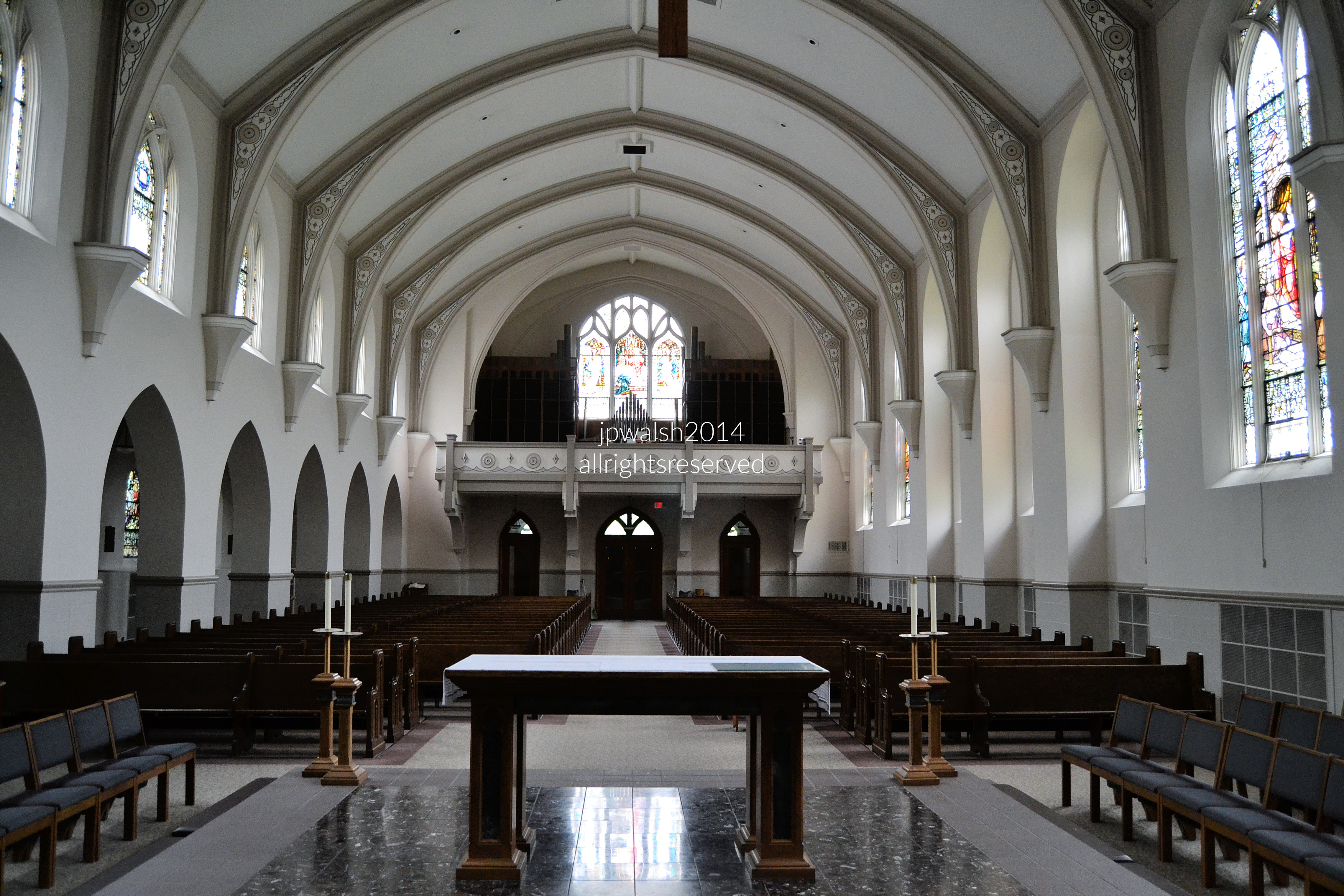
Sacred Heart Church, interior, looking to the main entrance from altar. Under the overarching “Renew My Church” initiative launched by Cardinal Blase Cupich, the Archdiocese of Chicago targeted approximately 15 to 20 parishes for formal closure or consolidation structures across its multi-phase regional planning waves in 2018. Then-121-year-old Sacred Heart Church parish could no longer survive on its own and was consolidated with another parish in Northfield that year. August 2014. Author’s photograph. 5.06mb DSC_0227 (1)

822 Bryant, Winnetka, 1901.
A grand example of the Shingle style working its way through the Arts and Crafts movement and influenced by the recent Prairie School’s horizontality and openness. The domicile was built by progressive American architect Augustus Barker Higginson (1866-1915) then associated with architects Myron Hunt & Elmer Grey in Los Angeles. Higginson later located his own firm to Santa Barbara, California. The Winnetka house is an L-shaped plan with broad sloping pitches roofs. The window groupings have plain surrounds that fit elegantly into shingle walls which flare slightly when they reach the ground. See – https://pcad.lib.washington.edu/person/7142/ – retrieved November 21, 2023.
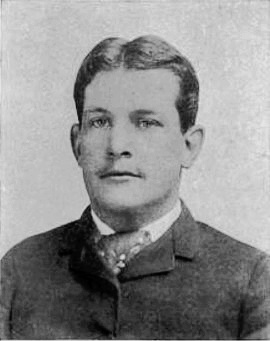
Thirty-five-year old Augustus Barker Higginson, an architect located in Los Angeles, California, built the impressive Shingle style house at 822 Bryant Avenue Winnetka in 1901. Public Domain.
Christ Church, 784 Sheridan Road, Winnetka, 1905.

Christ Church, exterior and main entrance. August 2014. Author’s photograph. 6.60mb
The church was established in 1869 with its adjacent Garland Cemetery (Christ Church Churchyard) grounds begun in 1876. The stone church was dedicated in 1905.
Religious buildings such as Christ Church contribute significantly to Winnetka’s historic character and cultural memory.

Christ Church (also known as Church on the Hill) was the gift of the William Hoyt family. It was built as a memorial to the Hoyts’ daughter and three grandchildren who were tragically killed in the 1903 Iroquois Theater fire in Chicago and buried in church’s adjacent cemetery. August 2014. Author’s photograph. 7.77mb

Gothic revival: Charles J. Connick Studio (1912-1945). Harriet Leonard, born Albany, NY, Nov. 17, 1875 – died Winnetka, Feb. 28, 1923. Connick’s work in stained glass is noted for its brilliant colors, rich symbolism and abundant use of scripture passages. August 2014. Author’s photograph. 7.66mb
About the deadly December 1903 Iroquois Theatre fire:

newspaper headline, 1903. Public Domain.
The Iroquois Theatre fire remains the deadliest single-building fire in United States history. It occurred on Wednesday, December 30, 1903, at the theater located at 69-73 Randolph Street (known today as 24-28 W. Randolph Street) in downtown Chicago, Illinois. That afternoon, the venue was packed to the brim with teachers, mothers, and young children enjoying their holiday school break.
During a performance of the musical Mr. Bluebeard, an electric arc light short-circuited and sparked a fire in the stage scenery. As the blaze grew, the theater’s “asbestos” safety curtain snagged and failed to lower. When performers fled out the large rear stage doors, the sudden influx of air created a massive cold draft, generating a ferocious fireball that shot out into the auditorium catching the ceiling on fire and trapping many hundreds of people in fiery darkness and thick, toxic smoke.
Out of an estimated crowd of roughly 2,100 to 2,200 attendees, approximately 1,500 to 1,600 people successfully escaped to survive, while more than 600 lost their lives in a span of just fifteen minutes. The vast majority of the victims were young women and children who died from asphyxiation and suffocation or were trampled by panicked crowds and crushed to death against exit doors that were locked or opened inward.
This profound tragedy fundamentally revolutionized public building safety codes globally. It led directly to the invention of the panic crash bar, which allows doors to open instantly under body pressure. It also established mandatory ordinances requiring functional outward-opening exit doors, automatic fire sprinklers, non-flammable stage curtains, and clearly illuminated, standardized exit signs. Through these permanent changes, their deaths were not in vain.
Following the fire, the heavily damaged interior of the original building was thoroughly rebuilt with strict new fire safety features and reopened in late 1904 as the Colonial Theatre. The Colonial operated for 20 years before it was demolished in 1925 to make way for a grander, completely new structure: the Oriental Theatre opened in 1926 and served as a cinema, a vaudeville house, and a live theater venue. In February 2019, the Oriental was officially renamed the James M. Nederlander Theatre.
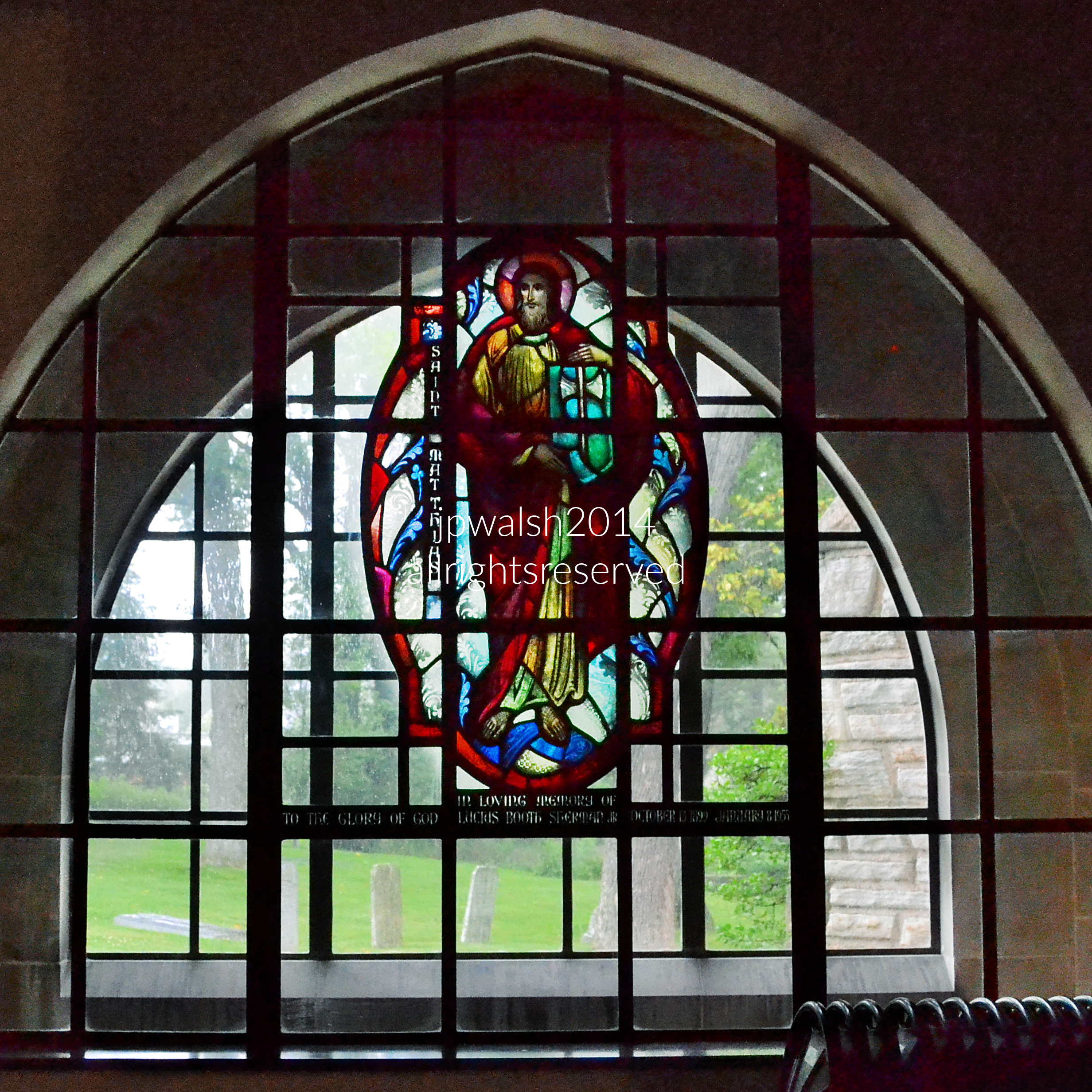
Christ Church, Winnetka. August 2014. Author’s photograph. 2.75mb DSC_0388 (1)
The saint in the central medallion is Saint Matthias, the apostle chosen by the remaining eleven disciples to replace Judas Iscariot after the crucifixion of Jesus. He is traditionally depicted holding a book or a halberd (axe). This Gothic Revival stained-glass window was also created by the Charles J. Connick Studio of Boston. Looking past the glass, the gravestones visible outside the window belong to the historic Christ Church Churchyard. Often referred to locally as the Garland Plot, it stands as the oldest cemetery on the North Shore, established in 1836. In 1876, John Garland donated the land to the Episcopal Diocese of Chicago to build Christ Church, with the strict legal condition that the churchyard remain a permanent family and pioneer burial lot. Visible just through the window are some of the historic graveyard’s headstones.
Sources:
A Guide to Chicago’s Historic Suburbs on Wheels and on Foot, Ira J. Bach, Swallow Press/Ohio University Press, 1981, pp. 565-74.