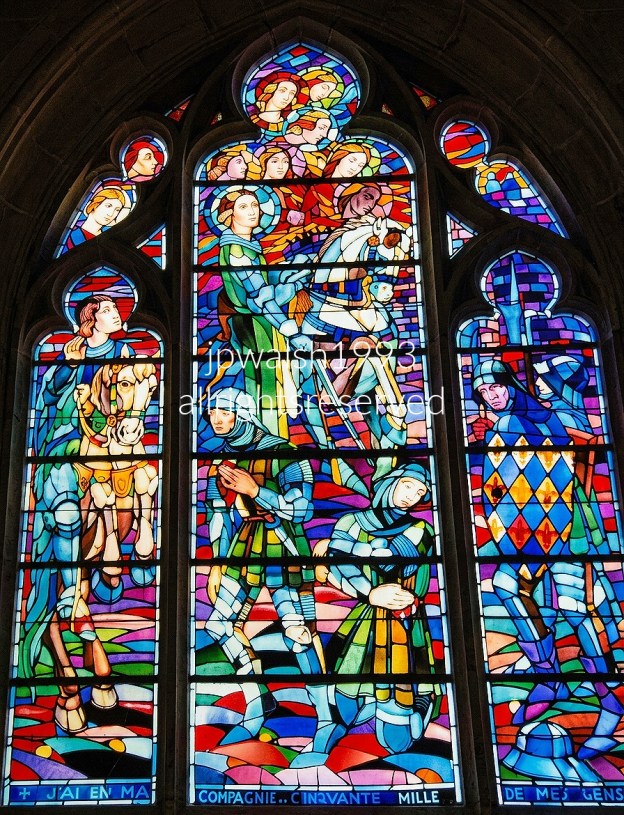
FEATURE Image: St. Joan of Arc’s capture of Saint-Pierre-le-Moûtier from Anglo-Burgundian forces on November 4, 1429, during the Hundred Years War in L’église Saint-Pierre at Saint-Pierre-le-Moûtier, France. Seotember 1993. Author’s photograph.
The stained-glass window at Saint-Pierre-le-Moûtier commemorates a pivotal moment in Joan of Arc’s military career, illustrating how her unwavering faith, personal courage, and conviction in divine assistance transformed a near-defeat into a decisive French victory during the Hundred Years’ War.
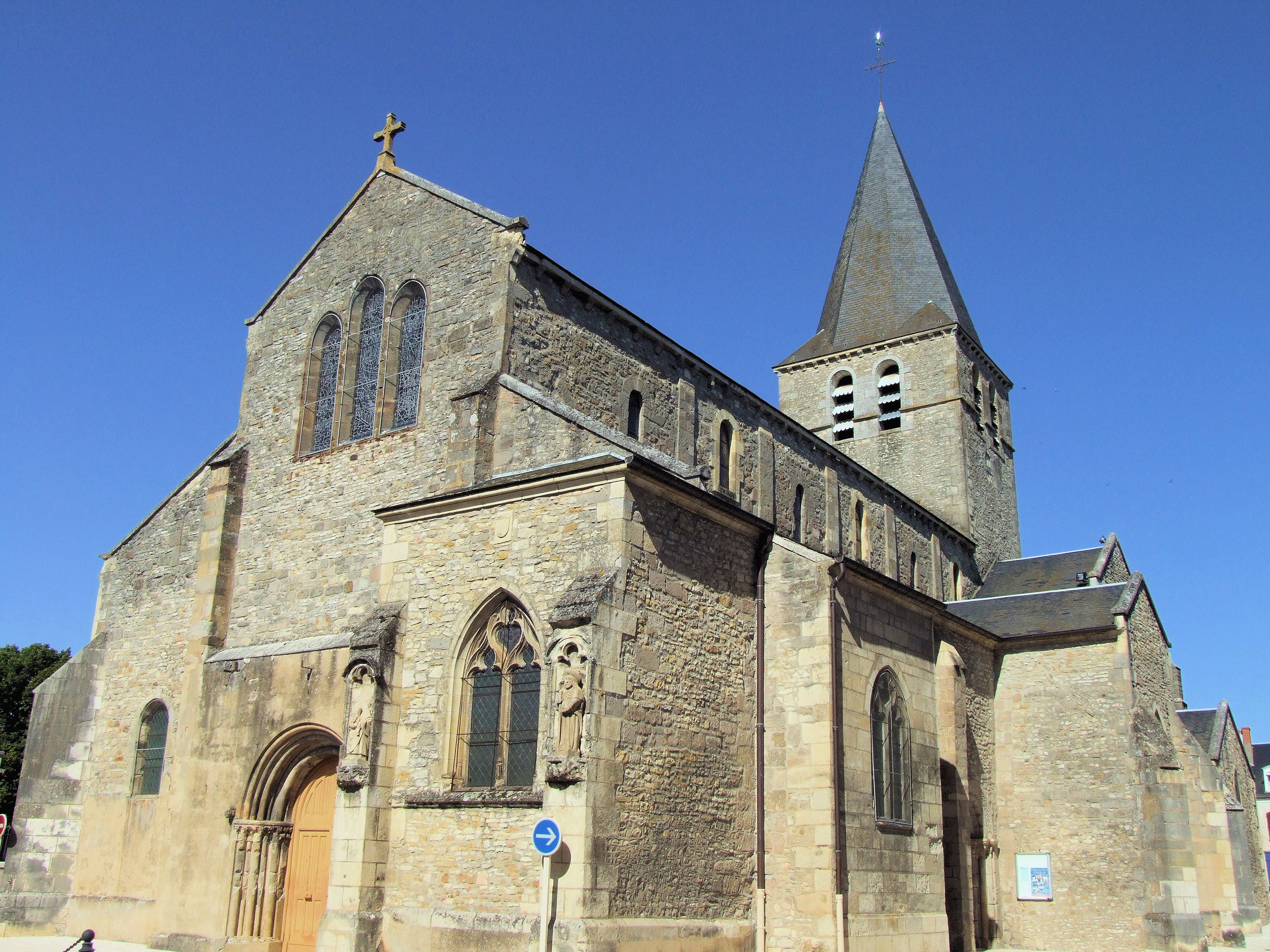
The Saint Peter Church of Saint-Pierre-le-Moûtier (Nièvre) is a 12th-century Roman Catholic building, a former Benedictine priory, classified as a historical monument since 1886. Photo by MOSSOT / Wikimedia Commons / CC BY 3.0
The Window and Its Setting
This stained‑glass window captures one of the most electrifying moments in the epic of Joan of Arc. It is part of a modern cycle in the town church of Saint‑Pierre de Saint‑Pierre‑le‑Moûtier, crafted in the mid‑20th century by the Mauméjean brothers. The artwork commemorates an event that unfolded in this very town — and inside this very church — during the Hundred Years’ War.
On November 4, 1429, Joan led a French royal force to seize Saint‑Pierre‑le‑Moûtier, a fortified stronghold held by Anglo‑Burgundian troops. The attack stalled under fierce resistance. French soldiers broke formation and began to fall back. Amid the chaos, Joan’s officer Jean d’Aulon — wounded during the fighting — suddenly realized she had been left almost alone near the moat with only a handful of men.
Author’s photograph. All rights reserved.
Joan’s Defiance and Her “Fifty Thousand”
D’Aulon mounted a horse, rode to her, and urged her to retreat before she was killed or captured. Joan removed her helmet and shouted that she was not alone. The window preserves her words across its lower banners: “+ J’AI EN MA / COMPAGNIE . . CINQVANTE MILLE / DE MES GENS.” She claimed she had fifty thousand of her people with her — the heavenly host of angels she believed fought at her side. D’Aulon saw only four or five soldiers, but Joan’s unshakable resolve reignited the army.
The Turning of the Battle
Joan ordered her men to gather wood and brush to build a makeshift bridge across the moat. The retreating French troops saw The Maid standing her ground, turned back, and launched a sudden, overwhelming assault that broke the defenses and captured the town. The upper portion of the window shows Joan on her white horse in the heat of battle, while the faces gathered in the arc above represent the “fifty thousand” she invoked — angels, Saint Michael, and the voices she believed guided her.
Aftermath and Joan’s Devotion
Following the victory, Joan prevented her troops from sacking the town. She then spent several days praying inside this church before marching on to her next campaign, leaving behind both a military triumph and a moment of mystic conviction that the Mauméjean window preserves with vivid force.
The nave of Saint-Pierre Church at Saint-Pierre-le-Moûtier, where Joan of Arc spent several days in prayer following her remarkable victory against overwhelming odds at the Battle of Saint-Pierre-le-Moûtier in November 1429. Photo by MOSSOT / Wikimedia Commons / CC BY-SA 3.0
More than a scene of battlefield heroism, the Saint-Pierre-le-Moûtier window presents Joan of Arc’s conviction that military success flowed from divine providence, portraying the inseparable relationship between faith, vision, and leadership that defined her extraordinary career.
This explanatory article may be periodically updated.
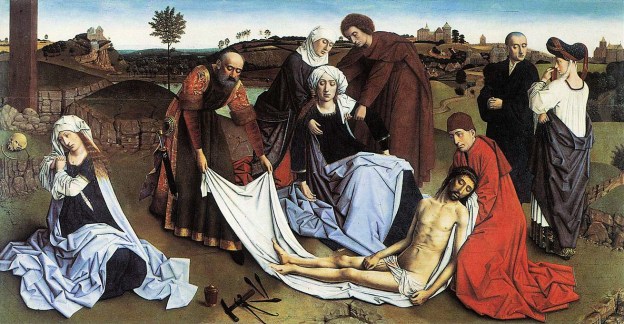
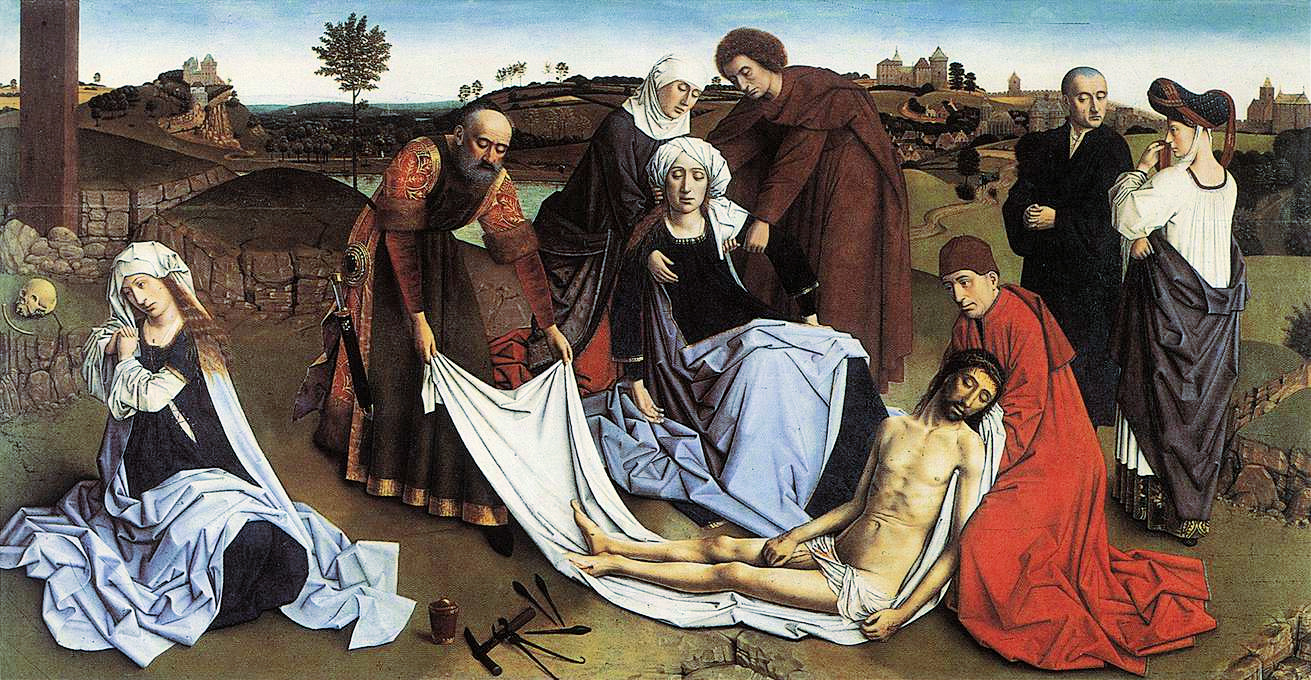
FEATURE Image: Petrus Christus (c. 1395-1472), Pietà, c. 1455–60. 39 ¾ x 75 ½ inches, Royal Museums of Fine Arts of Belgium, Brussels.
Fueled by the immense wealth of maritime trade hubs like Bruges and Antwerp, 15th-century Flemish art catalyzed the Northern European Renaissance by perfecting oil painting techniques, introducing brilliant surface luminosity, and blending meticulous naturalism with profound emotional realism.
Jan Van Eyck (or John of Bruges) (c. 1385-1441), detail, Marriage of Giovanni Arnolfini and Giovanna Cenami, 1434; National Gallery, London.
Introduction: The Wealth and Innovation of the Flemish School in the 15th century
Flemish art, as the name suggests, originates in Flanders which includes the Low Countries (Netherlands and Belgium) as well as northeastern France. The centers of Flemish art in the 15th century are Brussels, Bruges, and, later, Antwerp as well as other cities such as Liège and Tournai. Though the area had been settled as early as the 6th century, great growth and prosperity came to the region starting in the 14th century. As an international trade center centered in Bruges and, following the silting up of Bruges’ port, in Antwerp starting around 1525, Flanders experienced an influx of tremendous wealth joined to its attendant political connections and power. Such factors led to a high demand for Flemish art locally and far beyond its borders to royal courts, churches and other public and private patrons having marked influence on the European Renaissance. These rich cultural conditions in and around Flanders provided incentive for leading Flemish art masters to perfect their art technique and create magnificent pictures, particularly altarpieces, and display the latest naturalist styles, delineated forms, and bright colors within a European context. Flemish art developed systematically including its use of oil painting. This newly discovered and controversial medium greatly affected Flemish paintings’ surface luminosity by way of its range of cool colors and its ability to be applied in smooth facile layers. Most of these noteworthy Flemish painters in the 15th century found positions at court or as officials in prosperous urban centers. They became leading citizens whose workshops trained artists and made artwork for public and private consumption which worked to assure Flemish art’s primacy for the Northern European Renaissance into the 16th century.
International Gothic and the Burgundian Court
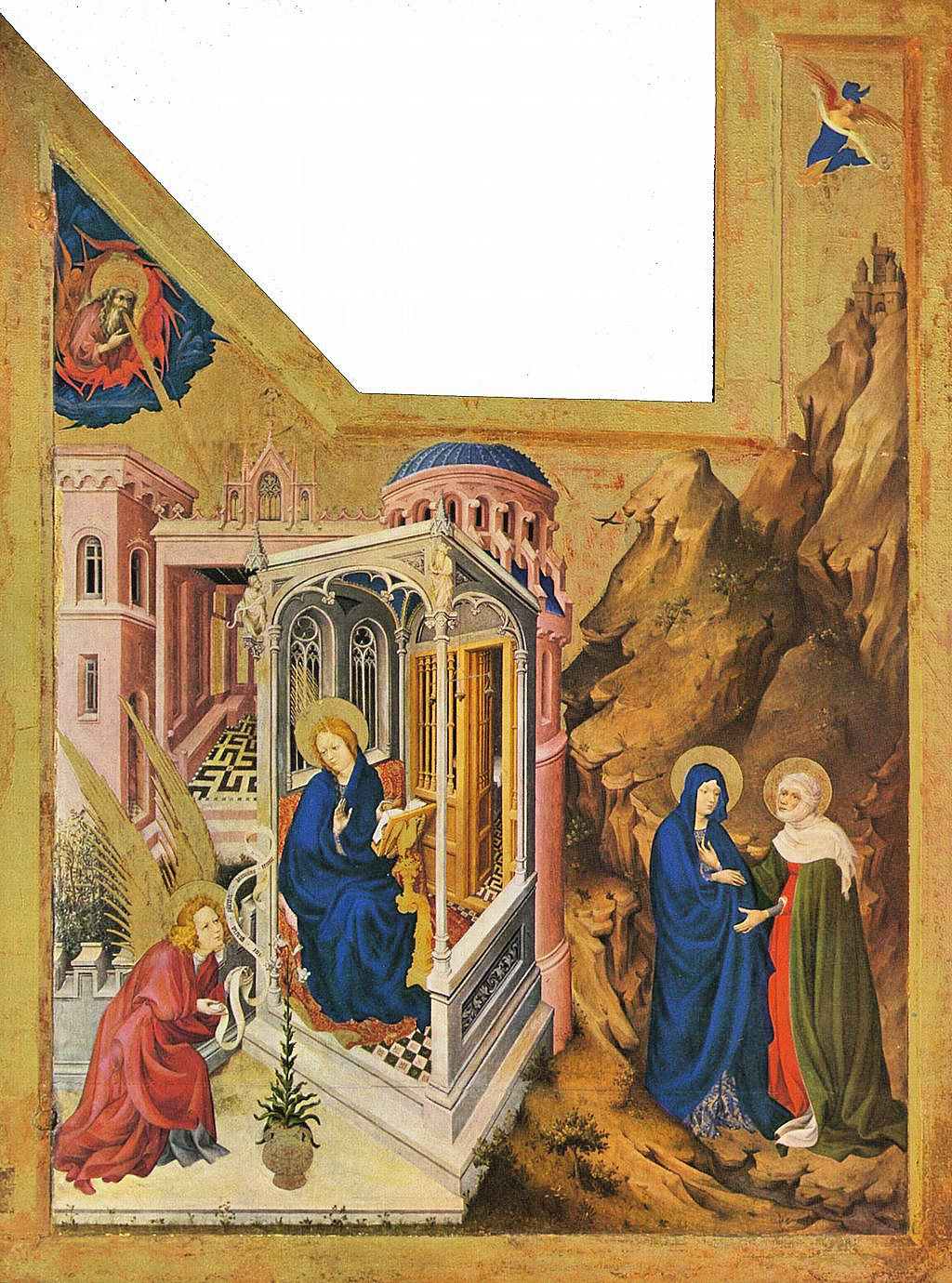
1 – Melchior Broederlam (c. 1350-1409), Champmol Altarpiece (The Annunciation and Meeting of Mary and Elizabeth), oil on wood, 1399, 65 ½ x 48 ¼ inches and 66 3/8 x 511/4 inches. Musée des Beaux-Arts de Dijon, France. 1 – Melchior Broederlam (c. 1350-1409), Champmol Altarpiece (The presentation in the Temple and Flight Into Egypt), oil on wood, 1399, 65 ½ x 48 ¼ inches and 66 3/8 x 511/4 inches. Musée des Beaux-Arts de Dijon, France.
This large diptych done for Philip the Bold, Duke of Burgundy (1342-1402) around 1399 is certainly painted over 600 years ago by Melchior Broederlam (c.1350-1409?). Broederlam was a painter in Ypres, Belgium, who entered the service as painter to Philip the Bold in 1385 and was in Paris by the early 1390’s. In the Champmol altarpiece – considered the earliest example of International Gothic in painting – Broederlam presents four stories in the life of the Virgin, some of which are contained in Luke themselves as scriptural diptychs including the Annunciation and the Birth stories of John the Baptist and Jesus. The first panel of the altarpiece presents the Annunciation (Luke 1:26–38) and the Visitation (Luke 1:39-56) while the second panel depicts the Presentation in the Temple (Luke 2:22-40) and The Flight into Egypt (Matthew 2:13-23). In the Champmol Altarpiece there is an attempt at realism by its placid gesturing figures in a landscape of crags and paths and also flowers at the foot of the picture’s imposing structures. At the same time there is a sense of unreality in the sense of it being a theatrical or stage setting in its flat, unitive display.
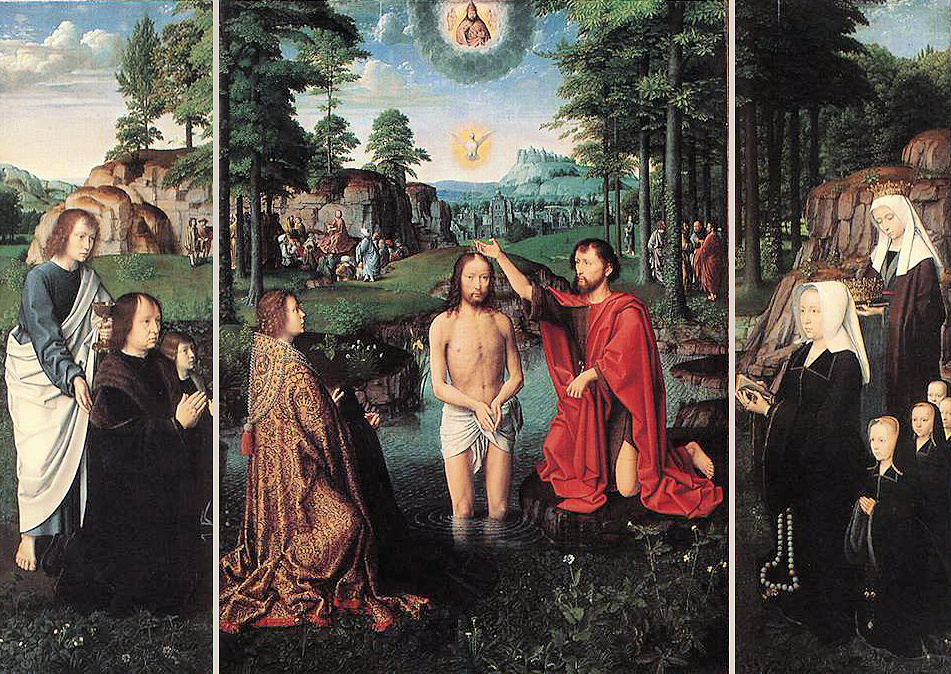
Sacred Narrative: The Presentation in the Temple
The Presentation of the Temple is the climax of the birth narratives. Up to now Luke and Matthew recounted the annunciations of Jesus and John, the Visitation of Mary to Elizabeth, the births of John and Jesus as well as the star, the stable, the Magi, the shepherds, the angels, surrounding Jesus’s birth in Bethlehem. The Presentation in the Temple was the highly anticipated strictly required formal religious ceremony for the “redemption of the firstborn” male and the first communal recognition and capstone of all these dramatic birth events described so far in Luke. Further, the setting is the Temple in Jerusalem, the very center of Jewish worship and life. This exciting and important place is where the infant Jesus and his mother are each presented for their purification in accordance with Mosaic Law. Jesus had been circumcised eight days after his birth and is now publicly presented to Yahweh in Jerusalem and formally stamped as a member of God’s chosen people. It is through the Jews that the salvation of the world is to be achieved, and Luke’s Gospel announces such hopes as fulfilled in Jesus. Though Mary’s purification at the Temple is ceremonial, it publicly reveals its agreement with what was told to her by the angel Gabriel at the Annunciation: that she is the symbol of the Jerusalem Temple (Luke 1:35).
Prophetic Witness: Simeon and Anna in the Temple
Also featured in this episode is Simeon, a righteous and devout man living in Jerusalem who, according to Luke 2:25-35, was promised by the Holy Spirit that he would not die until he had seen the Lord’s Messiah. Guided by the Spirit into the Temple, he recognized the infant Jesus during his presentation, took him up in his arms, and praised God, proclaiming Jesus as the savior for both Gentiles and Israel, a dramatic public witness to these public events whose testimony about the child “amazed” Mary and Joseph (Luke 2:33). Also present is Anna, an old prophetess, an honorable role found in both Jewish and Christian tradition who typically was a widow in service to the community. Both Anna with Judith, a devout widow in the Old Testament, are over 100 years old. Anna “never left the temple, but worshiped night and day with fasting and prayer” (Luke 2: 37). In the Rabbinic literature seven prophetesses are recognized – namely, Sarah; Miriam (Ex. 15); Deborah (Jgs. 4); Samuel’s mother, Hannah (1 Sm. 2); David’s wife, Abigail (1 Sm. 25); Huldah (2 Kgs 2); and Esther. Isaiah’s wife is also mentioned as a prophetess (Is. 8). With Anna, all these women were recognized for at least their holy lives, sometimes speaking in God’s name, as well as often their advanced years. At the Presentation Anna “gave thanks to God and spoke about the child to all who were awaiting the redemption of Jerusalem” (Lk 2:35).
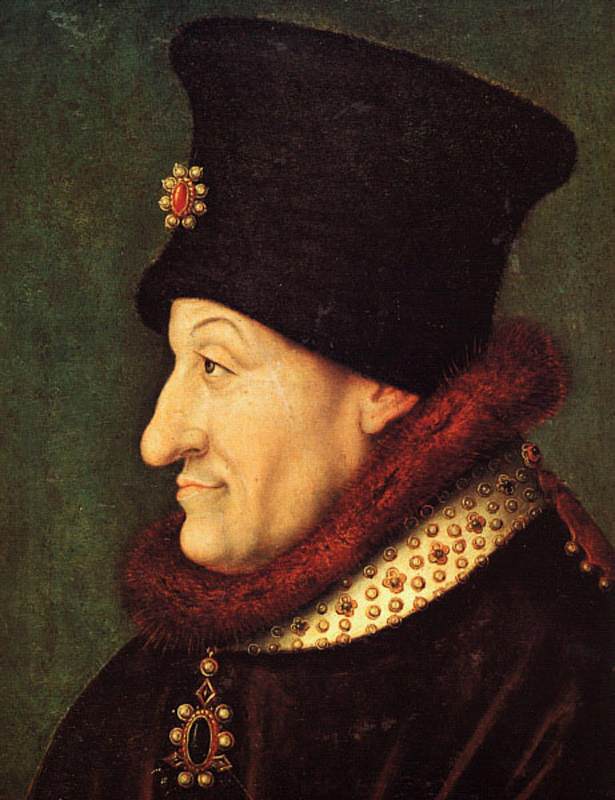
Philip II the Bold, anonymous, 16th century, 40 cm (15.7 in); width: 30 cm (11.8 in), Palace of Versailles, oil on wood.
Jan Van Eyck and the Burgundian Court
From 1422 to 1424 Jan Van Eyck (or John of Bruges) worked for John III the Pitiless (1374–1425) of the House of Wittelsbach, who was bishop of Liège (1389–1418) as well as duke of Bavaria-Straubing and count of Holland and Hainaut (1418–1425). The artist was appointed court painter to Philip III the Good (1396-1467) who was born in Dijon and died in Bruges and who founded the Burgundian state that was France’s rival in the 15th century. Philip III was the most important of the Valois dukes of Burgundy.
Philip III wearing the chain of office. Copy of painting by Rogier Van der Weyden, c, 1450.
The Mastery of Light: The Madonna of Chancellor Rolin
2 – Jan Van Eyck (c. 1385-1441), Madonna of Chancellor Rolin (or The Virgin of Autun), Oil on wood, c. 1435, 26 x 24 ¾ inches (66x 62 cm), Musée du Louvre, Paris.
Van Eyck lived in Lille between 1425 and 1429 but relocated to bustling Bruges in 1430 where he bought a house and lived until his death in 1441. On behalf of the Duke’s business concerns (including a secret marriage), Jan Van Eyck made trips to Spain and Portugal in 1427-28, and several others into the mid1430’s. There are many authenticated paintings by Jan Van Eyck, although Madonna of Chancellor Rolin is considered highly likely. The concept of composing the work to be divided into a shadowed interior and bright exterior landscape – and unified in the picture – is original. The contrasts of light, subject and form and their relation is appealing to the eye. The figures of the Virgin and the Child are delineated gently and beautifully for the donor, who is depicted behind a prayer desk, to adore. Like Italian master Leonardo da Vinci (1452-1519), Van Eyck had many cultural interests and talents in the service of Philip III such as studies in anatomy, cartography, geometry and perspective that created the illusion of three-dimensional space. These artists’ common preoccupations and concerns in the arts united the Northern and Italian Renaissance more closely. If Van Eyck did not actually invent oil painting, his work perfected its techniques. Van Eyck’s abilities make him the major artist of the Early Netherlandish School whose position is challenged only by the Master of Flémalle (Robert Campin). It was painted for the chancellor of Philip III, Nicolas Rolin (c. 1376/80-1462) to decorate a personal chapel (Saint-Sébastien chapel) that he decided to build in 1426-1428 (completed in 1430) in the church of Notre-Dame-du-Châtel in Autun, a church destroyed in 1793.
The Monumental Legacy of the Ghent Altarpiece
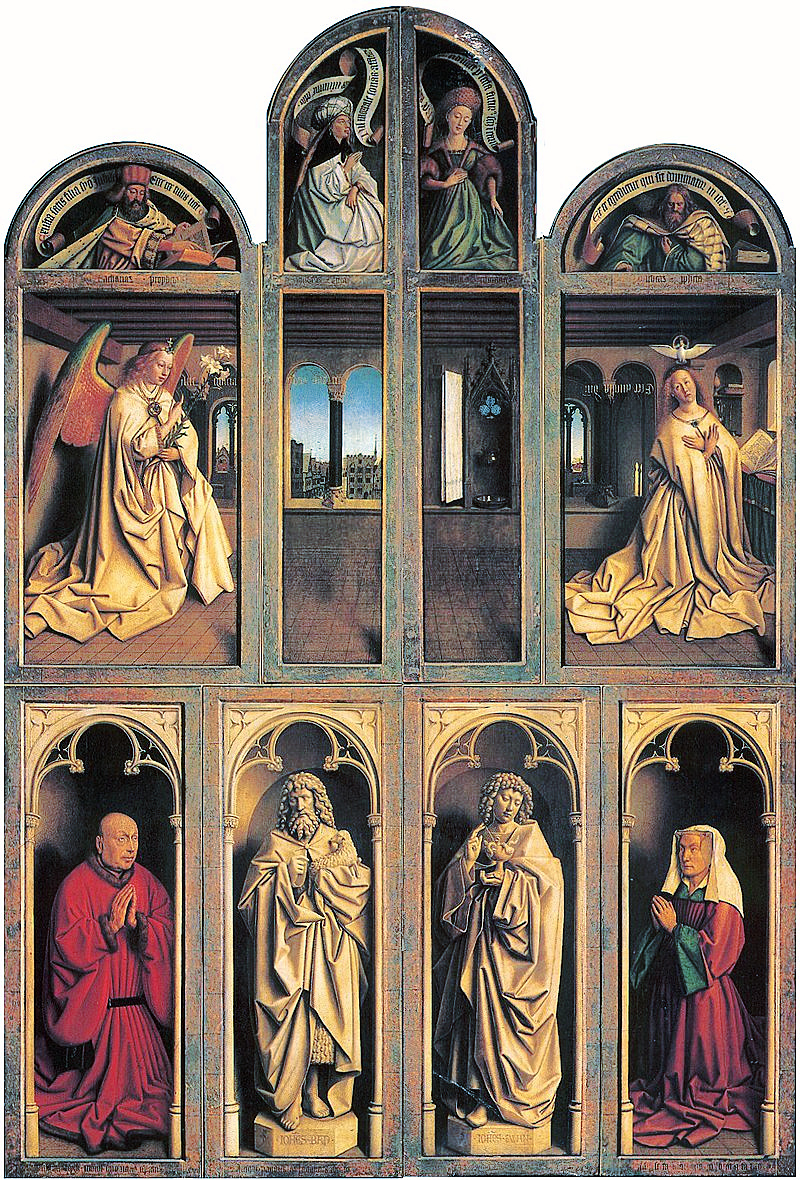
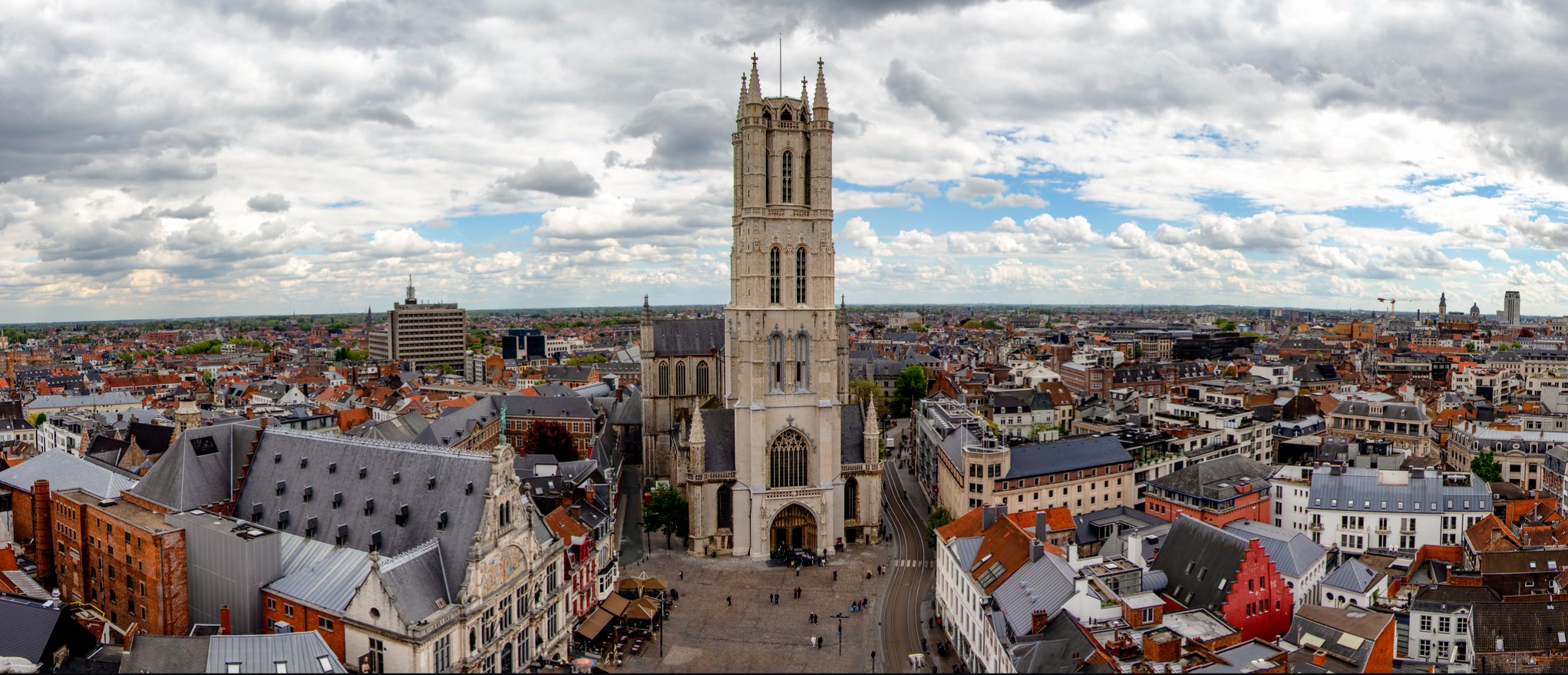
3 – 4 Hubert Van Eyck (c. 1370-1426) and Jan Van Eyck (c. 1385-1441), Closed (above) and open panel of The Ghent Altarpiece, also called the Adoration of the Mystic Lamb, c. 1425, 53 ¾ x 93 ¼ inches, Saint Bavo’s Cathedral, Ghent.St. Bavo’s Cathedral, Ghent, houses the Van Eyck brothers’ Ghent altarpiece. “Saint Bavo’s Cathedral, Ghent” by Arran Bee is licensed under CC BY 2.0.
Jan Van Eyck’s masterpiece is Adoration of the Mystic Lamb (1432), known as the Ghent Altarpiece, which he painted with his brother Hubert Van Eyck (c. 1370–1426). The Van Eycks’ artwork is known for its technical brilliance, intellectual complexity, and rich symbolism of which this very large (almost eight feet wide) and complex 15th-century polyptych is a prime testament. It was begun in the mid-1420s and completed by 1432. It marks a transition from the Middle Ages to the Renaissance in Northern European art. Its 22 panels opens and closes. When open, inside there are two rows of paintings. The middle section is Christ the King flanked by the Virgin and Saint John the Baptist. Other panels depict musicians, singing angels, and Adam and Eve. The center lower row depicts the Adoration of the Lamb with knights, hermits. judges and pilgrims who stream to behold the Lamb. In its 600-year history, there have been re-paintings, restorations and modern replacements (the original Judges panel was stolen in 1934). Little is known about Hubert Van Eyck to the point where he has been speculated in his obscurity to be a mythical figure, though this is quite unfounded. The painting was done for a nobleman’s family chapel in what become St. Bavo’s church in Ghent. The Eycks’ detail, fullness of form and luminous colors presents the mystery of the Mass whose subject is the miracle of the unity of heaven and earth in eternity. In contrast, the closed panel is beautifully calm and restrained in colors and composition. But it is just as masterful and, as it sits closed, offers a different mood for devotion.
Precursors to the Mona Lisa: Portrait of the Artist’s Wife
5 – Jan Van Eyck (c. 1385-1441), Portrait of Margaret van Eyck, 12 7/8 x 11 ½ inches (41.2cm x 34.6 cm), 1439, oil on wood, Groeningemuseum, Bruges, Belgium.
The portrait is of the artist’s wife executed in Bruges. The Van Eycks married in 1439. Like his other portraits the sitter is turned three-quarters to the left. Painted 60 years before Leonardo Da Vinci’s Mona Lisa (1503), there are affinities between them – a placid enigmatic female sitter, leftward turn, hands crossed at the lap, a possible landscape background that in the Van Eyck has been repainted.
Leonardo da Vinci, Mona Lisa (1503), Musée du Louvre, Paris.
The Next Generation: Petrus Christus and Flemish Genre Art
6 – Petrus Christus (c. 1395-1472), The Legend of Saints Eligius and Godeberta, 38 5/8 x 33 ½ inches, 1449, The Metropolitan Museum of Art, New York.
Following the death of Jan Van Eyck, Petrus Christus became the most important modern painter in Bruges who had settled there in 1444. The artwork was commissioned by the jewelers’ corporation in Bruges and depicts seventh century Saints Godeberta being given a ring by Saint Eligius to marry the Lord God as she decided to enter religious life. Though a religious painting, it is essentially a 15th century Flemish genre painting. And while not as graceful as Van Eyck’s artwork, the painting holds interest for its bold forms of figures and objects and the authority of a well-observed still life.
Landscape and Lamentation: The Deposition
7 – Petrus Christus (c. 1395-1472), Pietà, c. 1455–60. 39 ¾ x 75 ½ inches, Royal Museums of Fine Arts of Belgium, Brussels.
One of Petrus Christus’s most important works, the scene of the Deposition is poetically rendered in a mother’s lamentation over the dead Christ, her son, within the setting of a late afternoon landscape which is also perfectly rendered. The figures in the foreground are large and emphasize their placement in the space. The face of the Virgin constitutes the painting’s center. Holding the dead Christ in a sheet is NIcodemus and Joseph of Arimathea who asked Pilate for the body of Jesus so to bury him. The three figures who stand apart from the narrative’s central figures are depicted with equal stylistic power and whose strained grief they share.
Gustave Courbet, 1849-50, A Burial at Ornans, 315 cm × 660 cm (124 in × 260 in), Musée d’Orsay, Paris. The 19th century French realist artist made a trip to Amsterdam before he painted The Burial at Ornans and was likely influenced by Netherlandish painting he had seen on that trip.
Unwavering Physicality: The Master of Flémalle
8 – Master of Flémalle/Robert Campin (1375-1444), workshop, The Bad Thief (fragment), c. 1420, 56 ¾ x 20 3/8, Städel Museum, Frankfurt am Main, Germany.
The painterly style of the Master of Flémalle is earlier than Jan Van Eyck yet also progressing a naturalism that is realistic and of ordinary folk. The Master of Flémalle has been identified by consensus as Robert Campin whose pupils were Rogier van der Weyden (1399-1464) and Jacques Daret (c. 1404- c. 1470). Campin is known to have lived and worked in Tournai, Belgium. This imposing, cruelly exact image depicts the corpse of one of the two criminals crucified with Jesus. Executed in the workshop of Robert Campin in Tournai around 1420 – around the same time as the Van Eycks’ Ghent Altarpiece – the fragment is all that remains though copies of the rest exist that show the Deposition and John the Baptist. The painting presents the bad thief in a corporeal monumentality next to an embossed gold background which is a legacy of medieval art. The painting’s unwavering physicality, however, is 15th century modern. The well-constructed faces of the two observers are modeled by shadows as foreshortening suggests movement. The lower left of the picture at the thief’s broken legs reveals, as Delevoy states, “the perspective of a landscape that is concisely constructed, geometric, and intellectual.”
Synthesizing Narrative and Observation: Campin’s Nativity
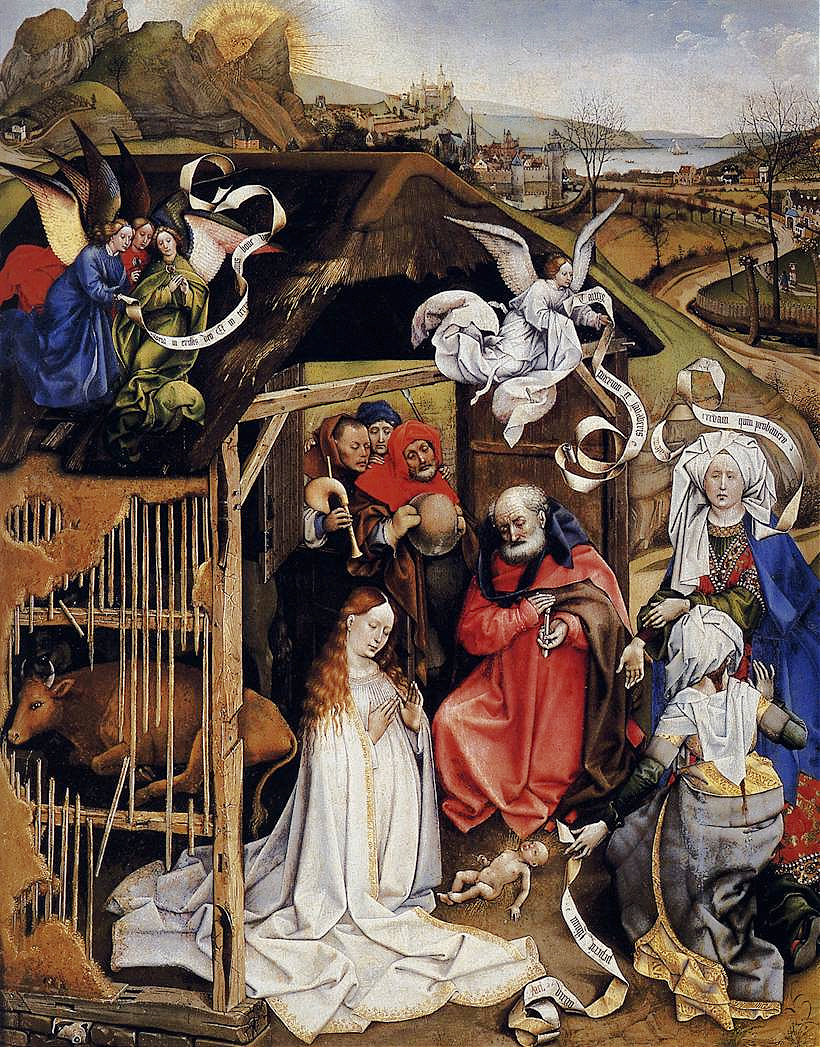
9 – Master of Flémalle/Robert Campin (1375-1444), The Nativity, c. 1420, oil on wood 87 x 70 cm, 32 5/8 x 27 ½, Musée des Beaux-Arts de Dijon, France.
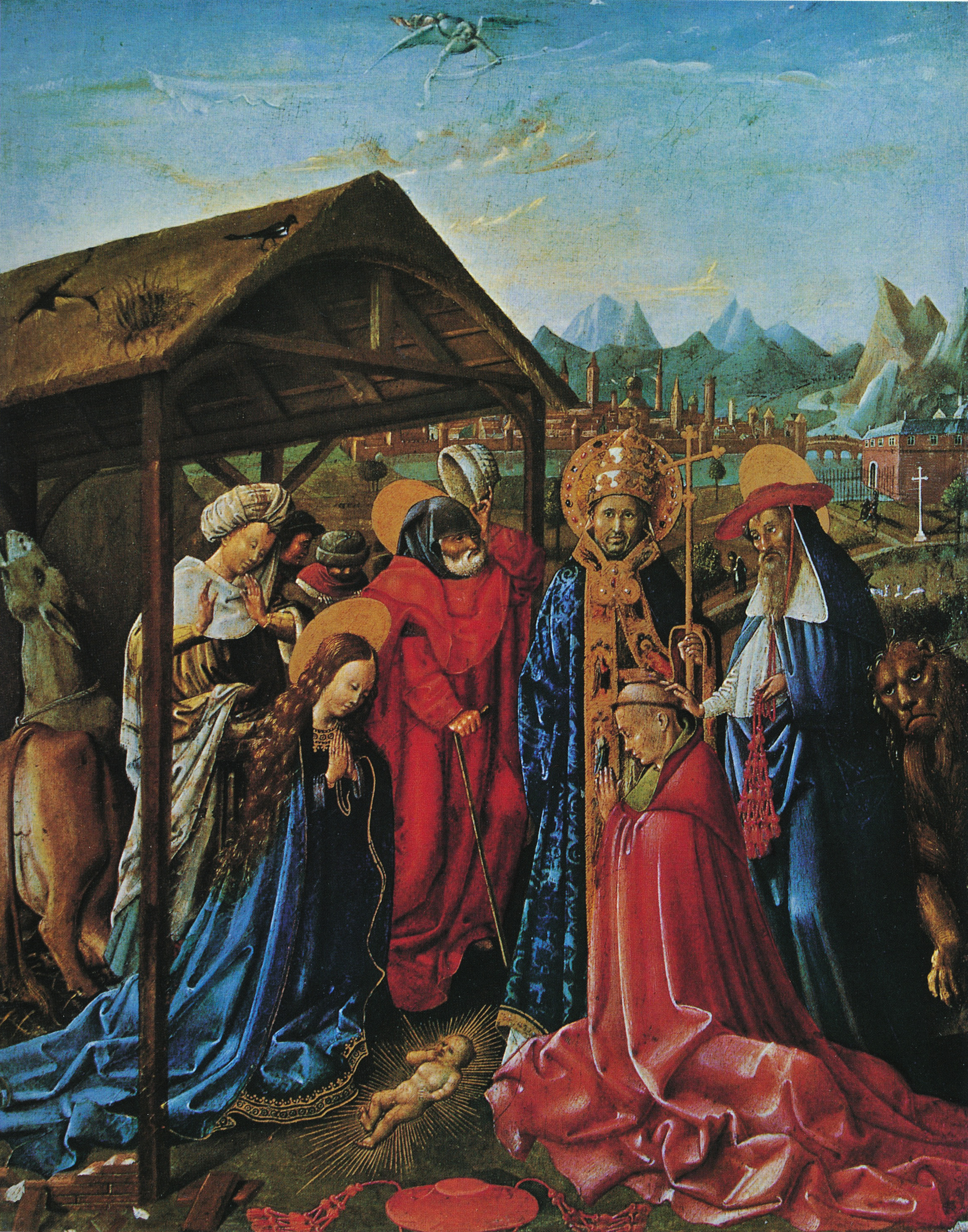
The Nativity is the most famous work of the Master of Flémalle (Robert Campin). The single panel combines dreamed up images, and meticulous objective observation and rational knowledge to depict three episodes – (1) the legend of the midwives, (2) adoration of the shepherds, (3) the Nativity. The wooden stable, with its ox and ass, has a broken wall and holes in the roof. The Virgin dressed in white is kneeling with her hands held up in adoration as the Christ Child lies naked on the ground. Joseph is depicted as an old man and holds a lit candle that he shelters. The legend of the midwives is an apocryphal Gospel tale regarding Joseph’s anxiety during the birth and summoning these midwives with complicated headdresses. The stable door is swung open and three shepherds enter behind Mary and Joseph. Four angel figures hover above the scene holding strips of parchment with messages. There is an extensive, condensed, and detailed winter landscape in the background with a wide, curving road and castle perched on a hill.
Spatial Complexity and Symbolism: The Merode Annunciation
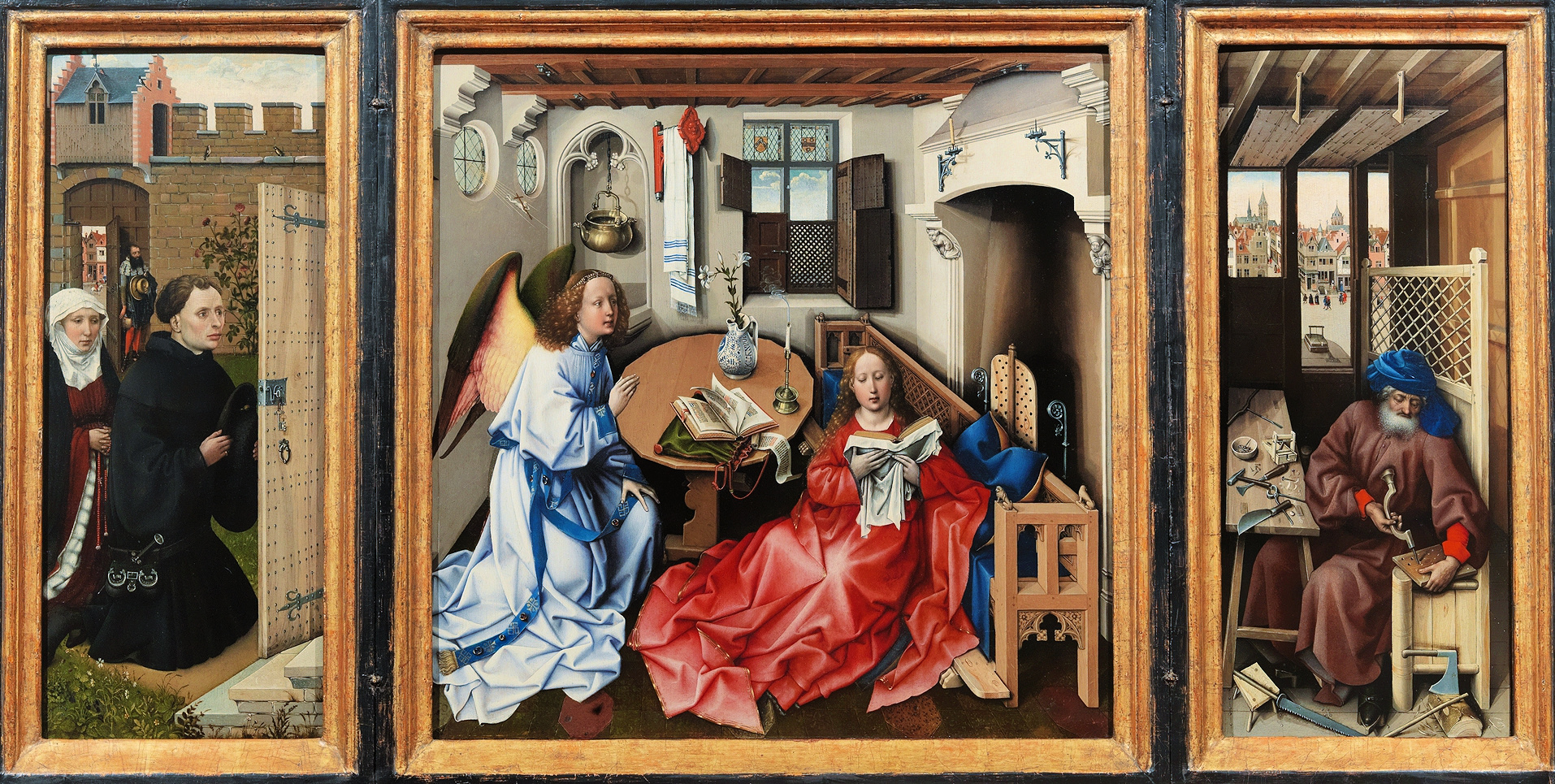
10– Master of Flémalle/Robert Campin (1375-1444), Annunciation Triptych (Merode Altarpiece), c. 1427-32, The Cloisters (Metropolitan Museum of Art), New York.
St. Luke 1: 26-29. “In the sixth month, the angel Gabriel was sent from God to a town of Galilee called Nazareth, to a virgin betrothed to a man named Joseph, of the house of David, and the virgin’s name was Mary. And coming to her, he said, “Hail, favored one! The Lord is with you.” Placid depiction of the Annunciation at the moment when the angel Gabriel alights in the Virgin’s chamber. The setting is a middle-class home and Mary is, for the moment, still completely unaware of the mystery that will now be told to her. A miniature figure with a cross comes through the oculus above the angel. The objects in the room– a lily, an immaculate towel, an extinguished taper– may be symbolic but certainly work to hold realistic tactile value. The robes in the foreground, one red, the other light blue, provide focus for the painting’s harmony and color. The Master of Flémalle experiments with Renaissance applications of perspective, depth, proportion (foreshortening) with material objects such as open shutters, an open door (left panel), and an unforgiving diagonal of the room’s bench. These material objects in varying perspectival space as well as varying light sources give the painting complexity. The right panel depicts old Joseph in his carpenter workshop. The left panel shows the painting’s donors on their knees witnessing this remarkable scene through the open door. There is speculation that the Master of Flémalle had painted the center panel and, as buyers showed interest, these donors commissioned the wings that were painted by workshop artists such as, likely, young Rogier van der Weyden (ca. 1400–1464) and Jacques Daret (ca. 1404–1468).
The Master of Emotion: Rogier Van der Weyden
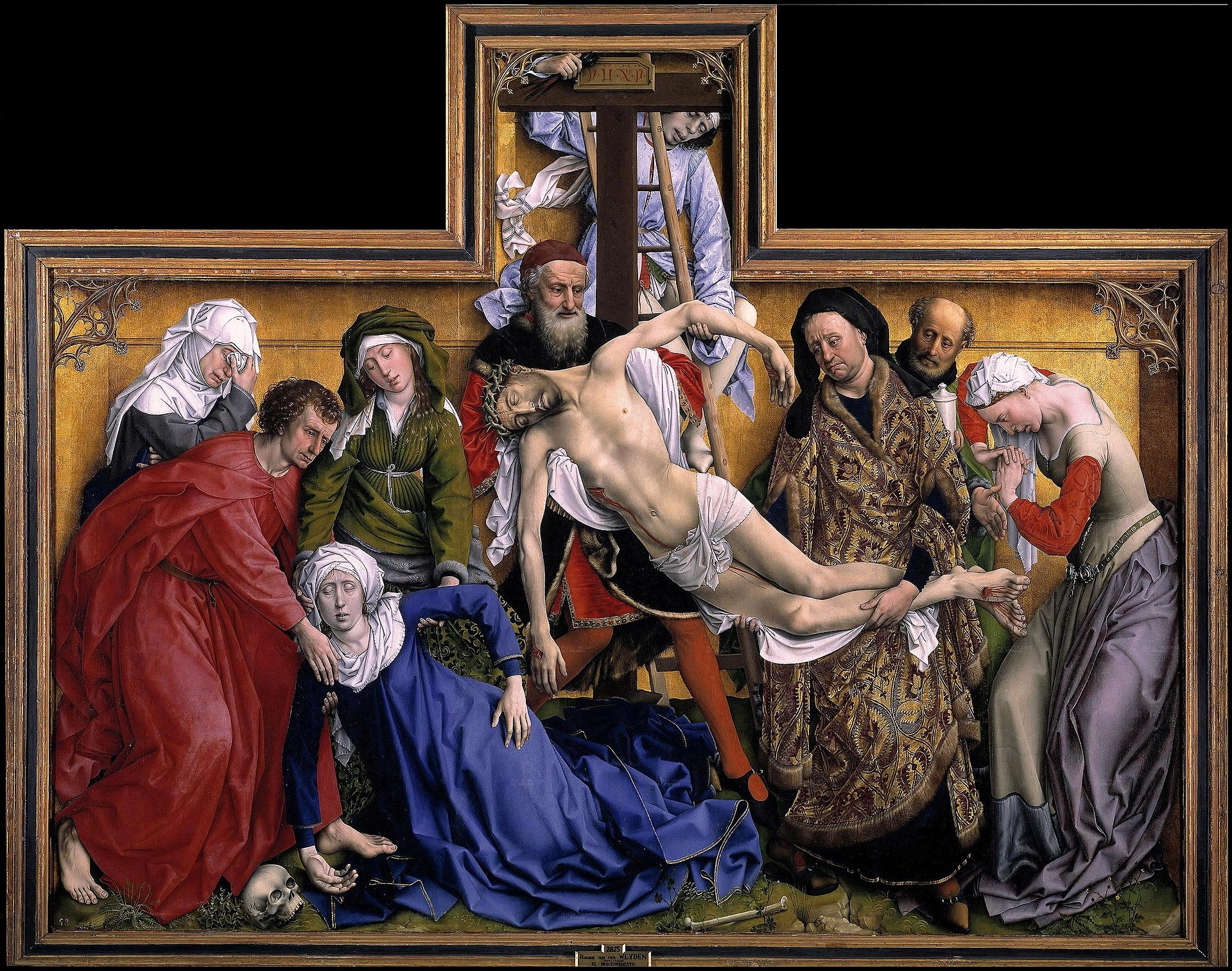
11-Rogier Van der Weyden (1399-1464), The Deposition or The Descent from the Cross, c. 1435, oil on oak panel, 86 ¾ x 110 inches, 220 × 262 cm. El Museo Nacional del Prado, Madrid.
Rogier Van der Weyden was a major artist in Flanders in the mid15th century. He was a pupil of Robert Campin, the Master of Flémalle, from which he imbued his realistic, ordinary naturalism with, what Murray said, was “more emotion, warmth and sensitiveness.” Insofar as the power of his artistic technique, Van der Weyden is a peer of Jan Van Eyck. Van der Weyden’s colors are cooler than Van Eyck’s and he subordinates his technical abilities to display the feelings of his paintings’ subject matter, typically religious. In terms of composition the striking difference between Van Eyck and Van der Weyden is that Van Eyck crafts a setting for his panorama of iconic vignettes while Van der Weyden paints flat-on action, often intensely emotional – all of which contributes to the artwork as a whole. Both Van Eyck’s Adoration of the Lamb and Van der Weyden’s The Deposition or Descent from the Cross are the most influential Flemish paintings of the mid15th century. Van der Weyden’s overall oeuvre makes him, arguably, 15th century Flemish art’s most influential figure.
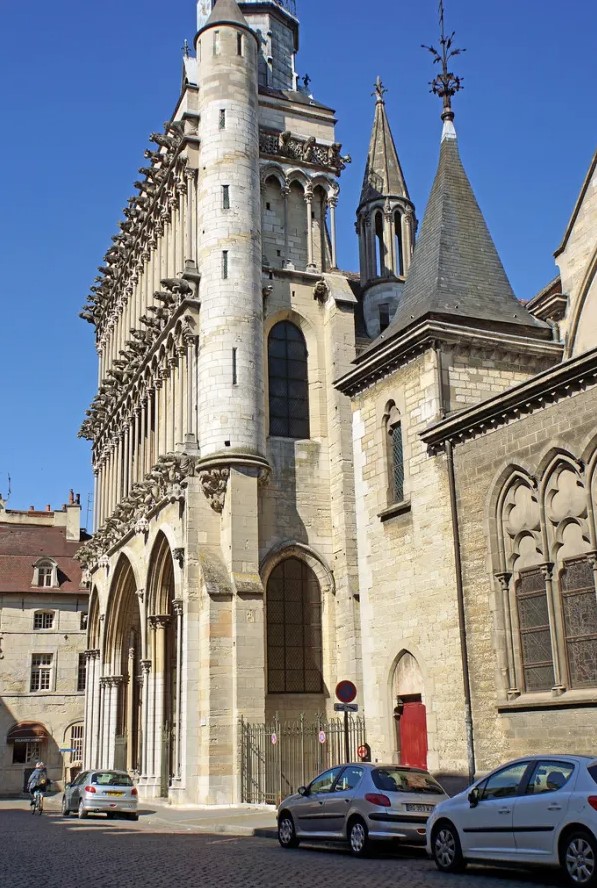
Van der Weyden’s The Deposition or Descent from the Cross are the most influential Flemish paintings of the mid15th century. The altarpiece was commissioned by the Grand Order of Crossbowman for the Church of Notre-Dame-Outside-the Walls of Dijon (13th century). PHOTO CREDIT: “France-003095 – Notre-Dame of Dijon” by archer10 (Dennis) is licensed under CC BY-SA 2.0.
Monumental Devotion: The Triptych of the Seven Sacraments
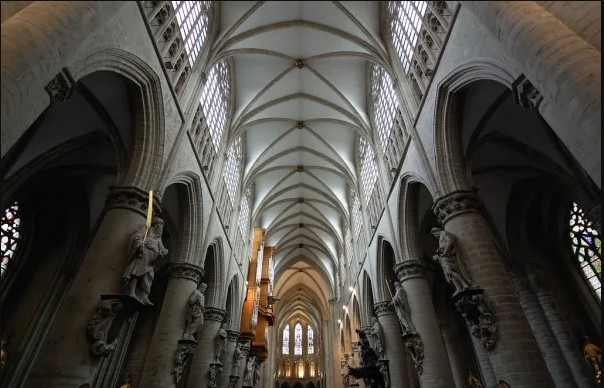
12- Rogier Van der Weyden (1399-1464), Triptych of the Seven Sacraments Altarpiece, c. 1445–1450, 78 ¾ x 87 ¾ inches. Royal Museum of Fine Arts, Antwerp.Van de Weyden’s painting, The Seven Sacraments, set in St. Gudule Church in Brussels, makes evident that the purpose for this grand and modern building is to manifest the presence of Jesus Christ in the sacraments. “St. Michael and St. Gudula Cathedral, Brussels” by tabula_electronica is licensed under CC BY-NC 2.0.
Van der Weyden married a woman from Brussels and relocated to that growing and prosperous city in the marshes of Flanders in 1426. By the mid1430’s Van der Weyden was the City Painter and did work for the Burgundian Court. In 1450 the artist traveled to Rome and Florence where the early Italian Renaissance was in full swing and whose art greatly influenced the Flemish master’s art through the 1450s and into the 1460’s. The Triptych of the Seven Sacraments Altarpiece was a return to the artist’s native city as it was painted for the Bishop of Tournai whose coat of arms appear on the upper portions of each panel. Set in the impressive Cathedral of St. Michael and St. Gudula in Brussels, the painting presents profound religious content in a finely drafted and colorful work – the left panel depicting the sacraments of initiation (baptism, confession and confirmation), the center of the Eucharist under a giant cross, and the right panel depicting the sacraments of ordination, marriage, and last rites.
Courtly Elegance: The Late Portraits of Van der Weyden
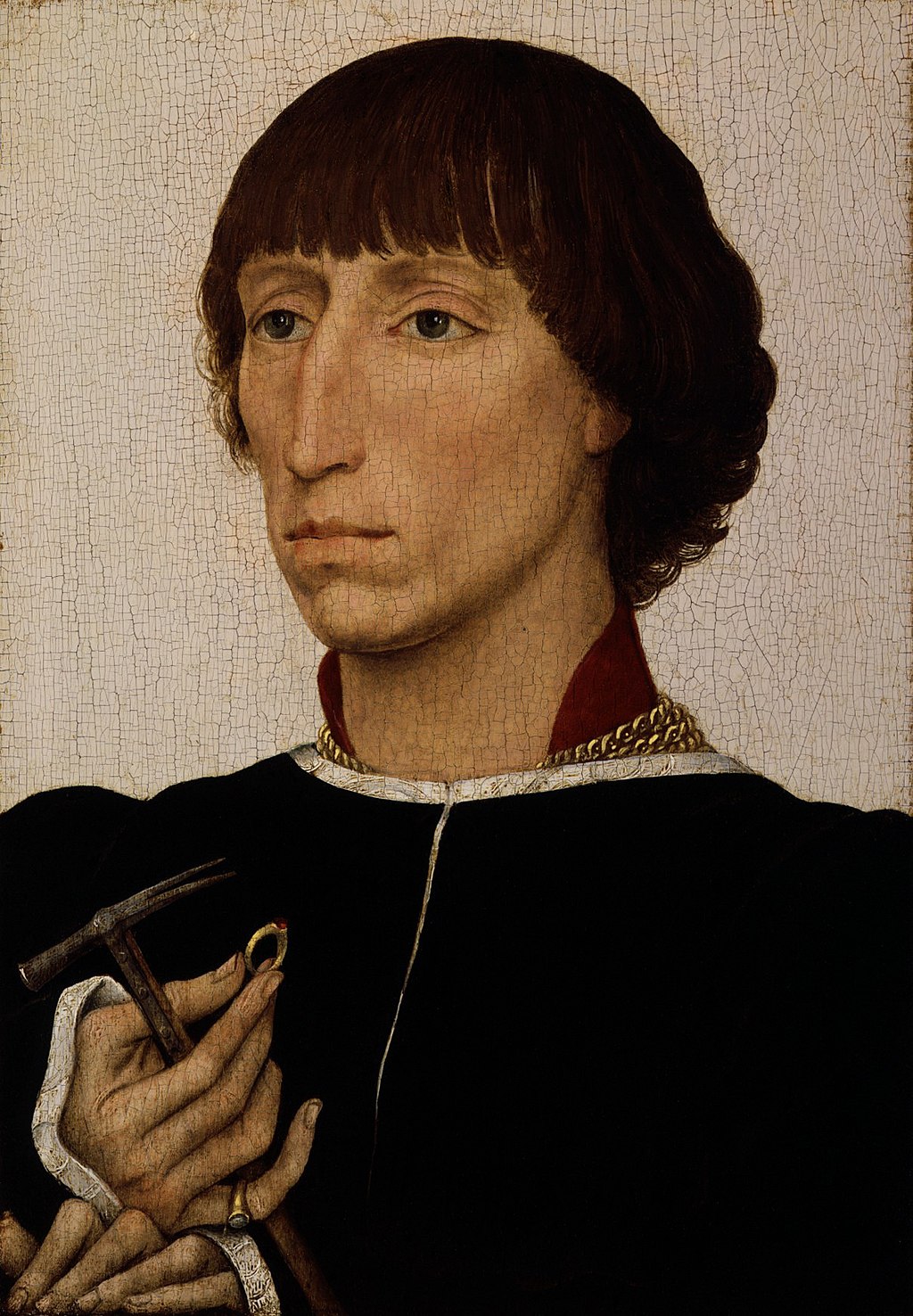
13- Rogier Van der Weyden (1399-1464), Portrait of Francesco d’Este (c. 1429-1476), ca. 1460, Oil on wood, 11 9/16 x 7 7/8 inches, The Metropolitan Museum of Art, New York.
Rogier van der Weyden painted several superb and sensitive portraits including Charles the Bold (Berlin), Le Grand Bâtard of Burgundy (Brussels), a Lady (National Gallery of Art, D.C.). Francesco d’Este was an Italian who received an education at the Burgundian Court. The d’Este family in Ferrara, Italy, was all-powerful when Rogier Van der Weyden visited there in 1450, though this portrait is done later. The sitter holds a hammer and ring whose significance is not explained with certainty.
Emotional Serenity and Architectural Precision: Dieric Bouts
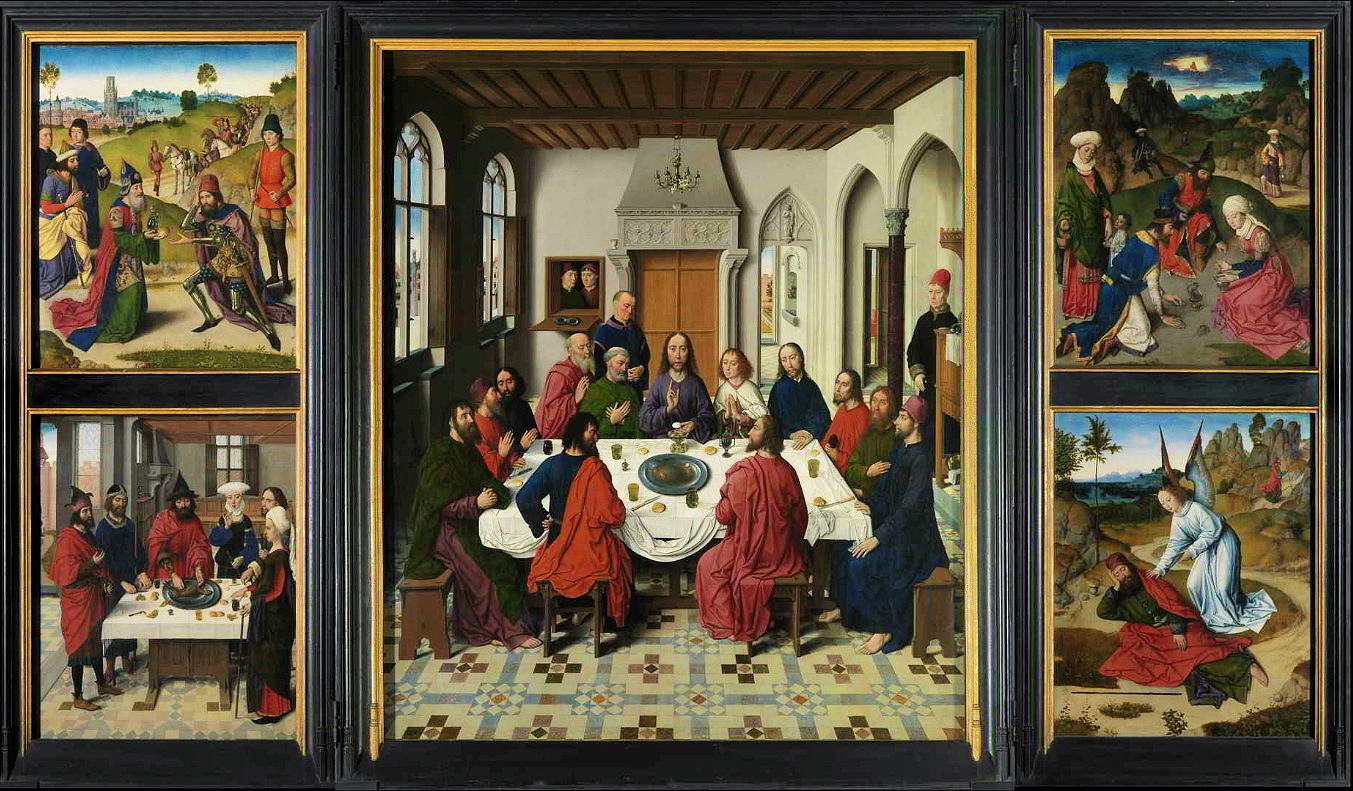
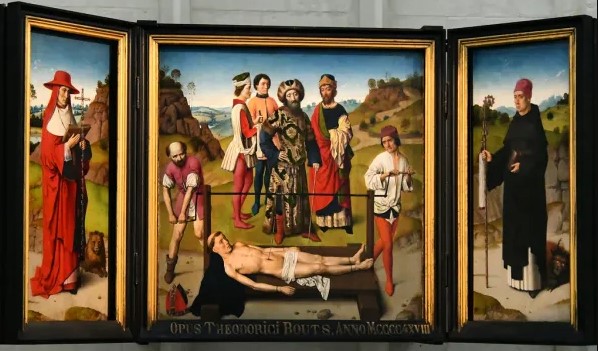
14 – Dieric Bouts (c. 1415-1475), The Altarpiece of the Last Supper or Five Mystic Meals, 1464-67, 70 ¾ x 114 inches, Church of St. Peter, Louvain, Belgium.
Dieric Bouts was born in Haarlem, the Netherlands, around 1415, where little is known of his early life. Before 1448 Bouts was working in Louvain where he married a wealthy Catharina Van der Brugghen and would work there until his death in 1475. Bouts’ finest paintings are characterized by their subtle depiction of colors and light on semi-inert and dignified and emotionally calm figures in detailed and delicately beautiful landscapes. Rogier van der Weyden influenced Bouts’ earlier work (Bouts may have trained with him in Brussels) in its greater emotionalism. In the year of Van der Weyden’s death the Brotherhood of the Blessed Sacrament of Louvain commissioned an altarpiece to place in St. Peter’s Church in Louvain. The artist worked with theologians to establish an iconography for the Eucharist which he then translated to contemporary Louvain with an exceptional plasticity whose result is that it is one of 15th century Europe’s greatest artworks. Jan Van Eyck’s influence is manifest in Bouts’ elegant intellectuality (in turn, Bouts was influential on 15th century German painting). Its perspectival calculus is matched to shapes and forms that convey emotion within the work’s compositional rigor. The head of Christ whose raised hand blesses the bread occupies the center of the artwork as the apostles gather in groupings around a table which itself develops within the room’s structure. The four side panels are scenes from the Old Testament transmitted likely by those same Catholic theologians who advised Bouts as to Biblical precedents to Christ’s Last Supper – here, the Feast of the Passover, Elijah in the Desert, the Gathering of Manna, and Abraham and Melchizedek. In 1472, Bouts was appointed city painter in Louvain, an honorary title at a time when the city was undergoing massive urban development. After Bouts’ wife died in 1473, the artist remarried in 1474 but died himself in 1475. Bouts was buried beside his first wife in the Franciscan church in Louvain. His sons, Dieric and Albrecht, were artists who continued the family tradition into the 16th century.
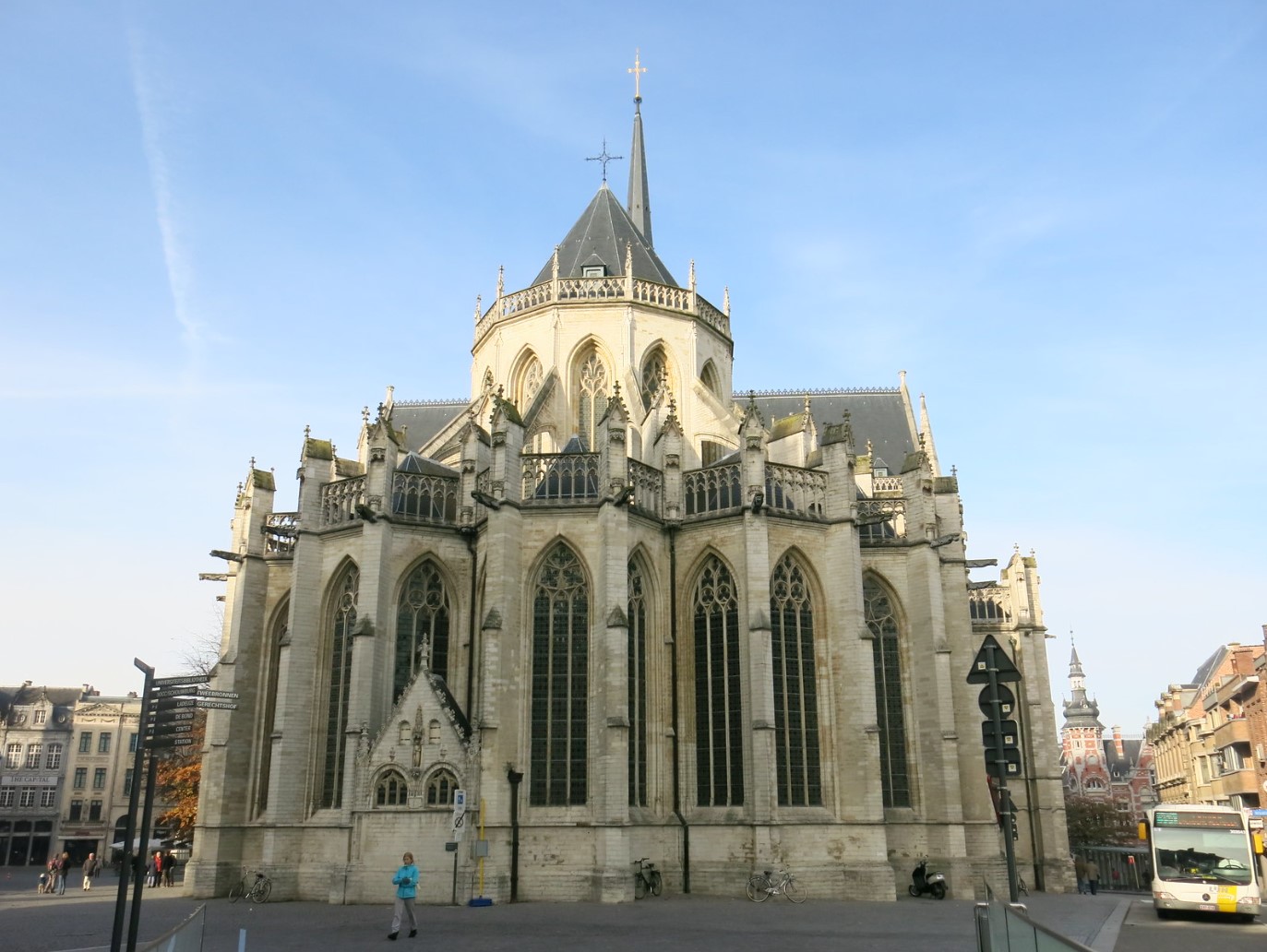
Bouts’ The Altarpiece of the Last Supper of Five Mystic Meals was to be placed in a chapel across from Bouts’ The Martyrdom of St. Erasmus in St. Peter’s, Louvain. Both artworks are hanging in the same place where it was intended for almost 600 years. “BELGIUM – LEUVEN – St Peter’s Church (7)” by eso2 is licensed under CC BY-NC-ND 2.0.St. Peter’s, Louvain. Choir and ridge 15th century. “St. Peter’s Church, Leuven” by dungodung is licensed under CC BY-SA 2.0.
Innovation in Movement: The Martyrdom of Saint Hippolytus
15 – Dieric Bouts (c. 1415-1475), The Martyrdom St. Hippolytus Triptych, 1470 – 1475 oil on wood, 35 ¾ x 35 ¾“ Groeningemuseum, Bruges, Belgium.
Unusual for Bouts this painting depicts the torture of martyrdom. There are many figures named Hippolytus in the early church. According to Prudentius’ 5th century account, one was the martyr Hippolytus who was dragged to his death by wild horses. The account led to this Hippolytus being considered the patron saint of horses. The square format panel preferred by Bouts depicts the martyrdom from above with foreshortened horsemen shown from the front. It is the first Flemish painting to depict movement not simply by using gesture. As Delevoy assesses, “The success of the picture lies in its timeless definition, its iconographic originality, its pictorial poetry, its popular feeling, its anecdotal interest.”
Civic Drama and Legal Moralism: The Justice of Emperor Otto III
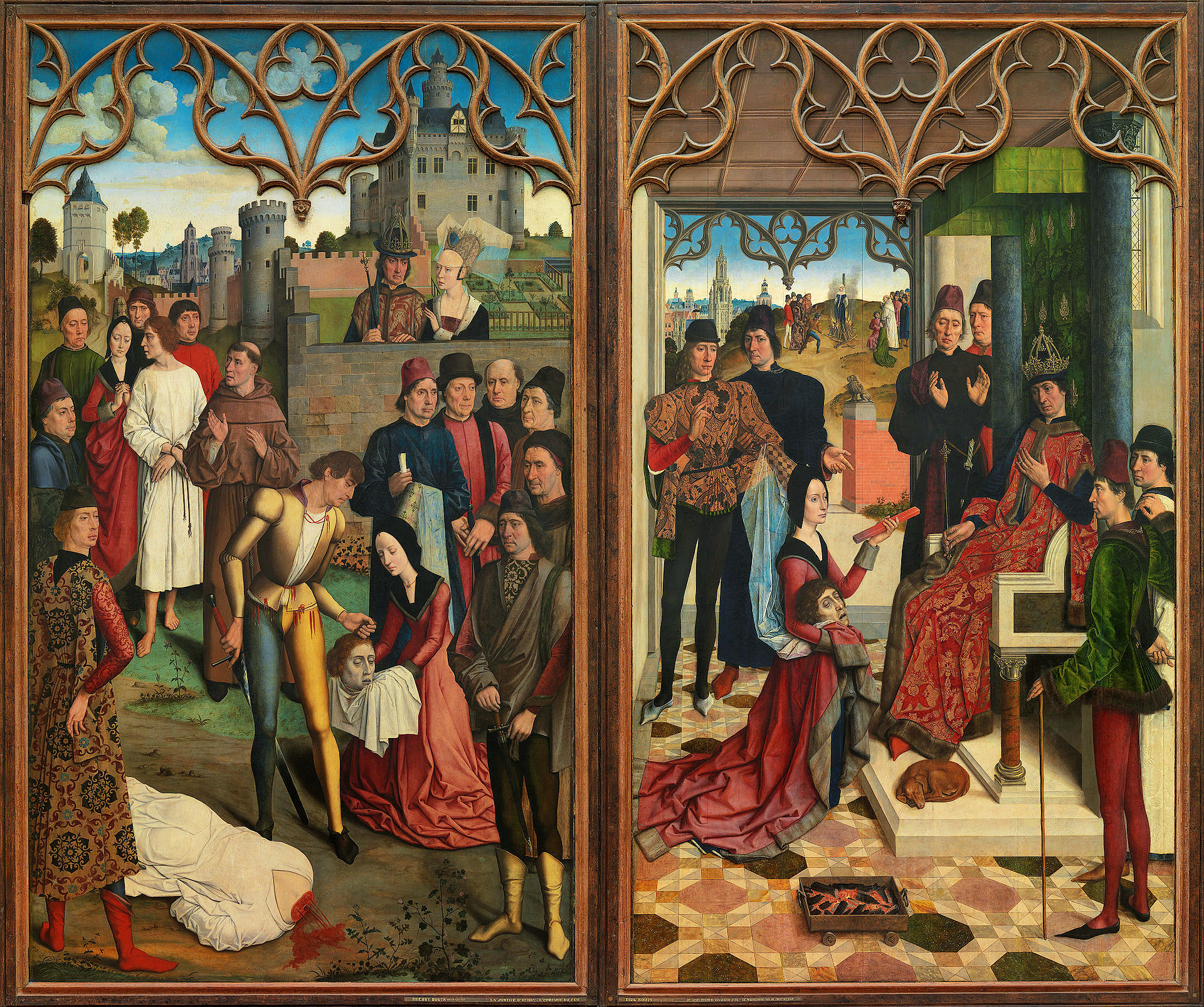
16 – Dieric Bouts (c. 1415-1475), Justice of Emperor Otto III Beheading of the Innocent Count and Ordeal by Fire, 1470 – 1475. oil on wood, 127 ½ x 72 ¼ inches, Royal Museums of Fine Arts, Brussels.
This is one of two paintings that is certain to be by Bouts (the other is Five Mystic Meals). It was commissioned in 1468 by a Louvain magistrate for the new city hall and intended to be an ambitious project on the Last Judgment. But it remained uncompleted at Bouts’s death. Panels representing heaven and hell survive and these two thematically related panels illustrating an episode from the legend of the Holy Roman emperor Otto III (980-1002). A 13th century chronicle tells how the Empress falsely accused an innocent man of a crime and persuades Otto and his court to behead him (left panel). The second panel shows the beheaded man’s wife, convinced of her husband’s innocence, approaching Otto’s throne with his head and a hot iron. Calling on God as judge, the Empress’s guilt is revealed and the royal is burned at the stake depicted in the distance. There is no lack of drama in the skillfully drawn episodes with elongated bodies, fanciful clothes, and unique facial expressions. The central focus of the panels is neither Otto nor his court but the put-upon widow of the innocent man murdered by the state through duplicity.
Edgy Mysticism and Monumental Contrast: Hugo Van Der Goes
17 – Hugo Van Der Goes (c.1440-1482), Portinari Altarpiece: The Adoration of the Shepherds, 1476-78, 96 ½ x228 Inches, Le Gallerie degli Uffizi, Florence, Italy.
Hugo Van Der Goes (c.1440-1482) was the most important Netherlandish painter working in Ghent after Jan Van Eyck. A Ghent native, Van der Goes was in a guild there in 1467 and rose to its leadership between 1473 and 1475. Soon afterwards, the artist completed the Portinari Altarpiece for an Italian who was then residing in the Netherlands. The painting was sent immediately to Florence. Though not having the opportunity to have any great influence in the Netherlands, the Flemish 15th century art practice of cool colors and exquisite oil technique impressed the Renaissance Italians, notably Domenico Ghirlandaio (1448-1494). Also, its immense size – eight feet tall and 19 feet wide – and its virtuosity made an impact. By synthesizing Van der Weyden’s drama and sensuous expression and Bouts’ three-dimensional space, Van der Goes gives increased everyday tangible reality to his sacred subjects. Sharing Broederlam’s inquiries for visual appearances, Van Der Goes’ artwork creates new forms, types, and the impetus behind them based in popular sentiments and an edgy mysticism. So, in a 15th century sort of way, this is not your father’s Nativity (i.e, Master of Flémalle’s in 1420). It is ponderable, dense, significantly tactile and spatially voluminous. The Virgin, in prayer and in maternal caress, is in the exact center of the immense triptych. Also in the circle are St. Joseph, the shepherds, angels in the air and the Christ Child. The painting is a masterpiece of contrasts – between religious, secular, and rustic architectures; heavenly and earthly figures; peace and agitation; filled space and void; warm tones and cool colors.
Hugo Van Der Goes (c.1440-1482), Portinari Altarpiece (detail).Hugo Van Der Goes (c. 1440-1482), Detail, Portinari Altarpiece, 1476-78, Uffizi Gallery, Florence, Italy.
Creative Solitude: The Later Years at Roode Cloister
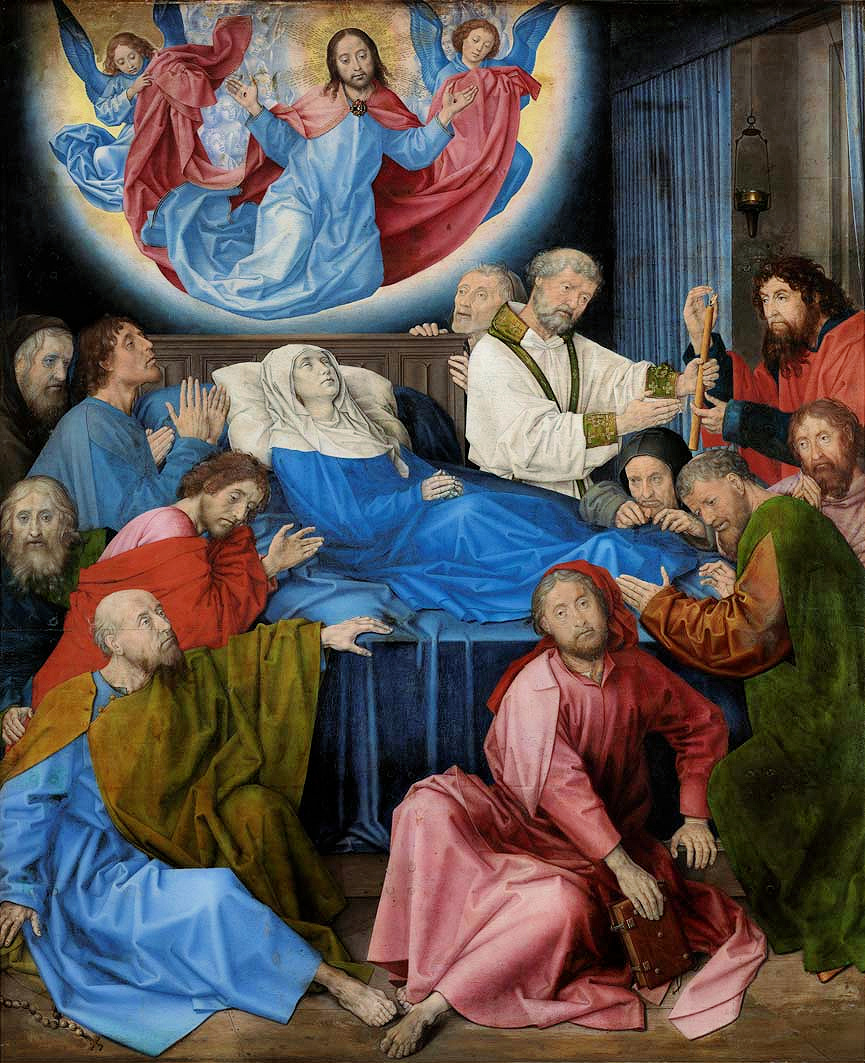
18 – Hugo Van Der Goes (c.1440-1482), The Death of the Virgin, c 1472–1480. 58 ½ x 47 ¾ inches, 147.8cm x 122.5cm. Groeningemuseum, Bruges, Belgium.
Around 1475 Hugo Van Der Goes became a lay brother in an Augustinian Priory, the Roode Cloister. Founded in 1367, the cloister is on the southeastern edge of modern Brussels. The artist continued to paint and receive visitors there, traveled to Louvain and Cologne, and died in 1482.
Global Exchange: Justus van Gent in Urbino
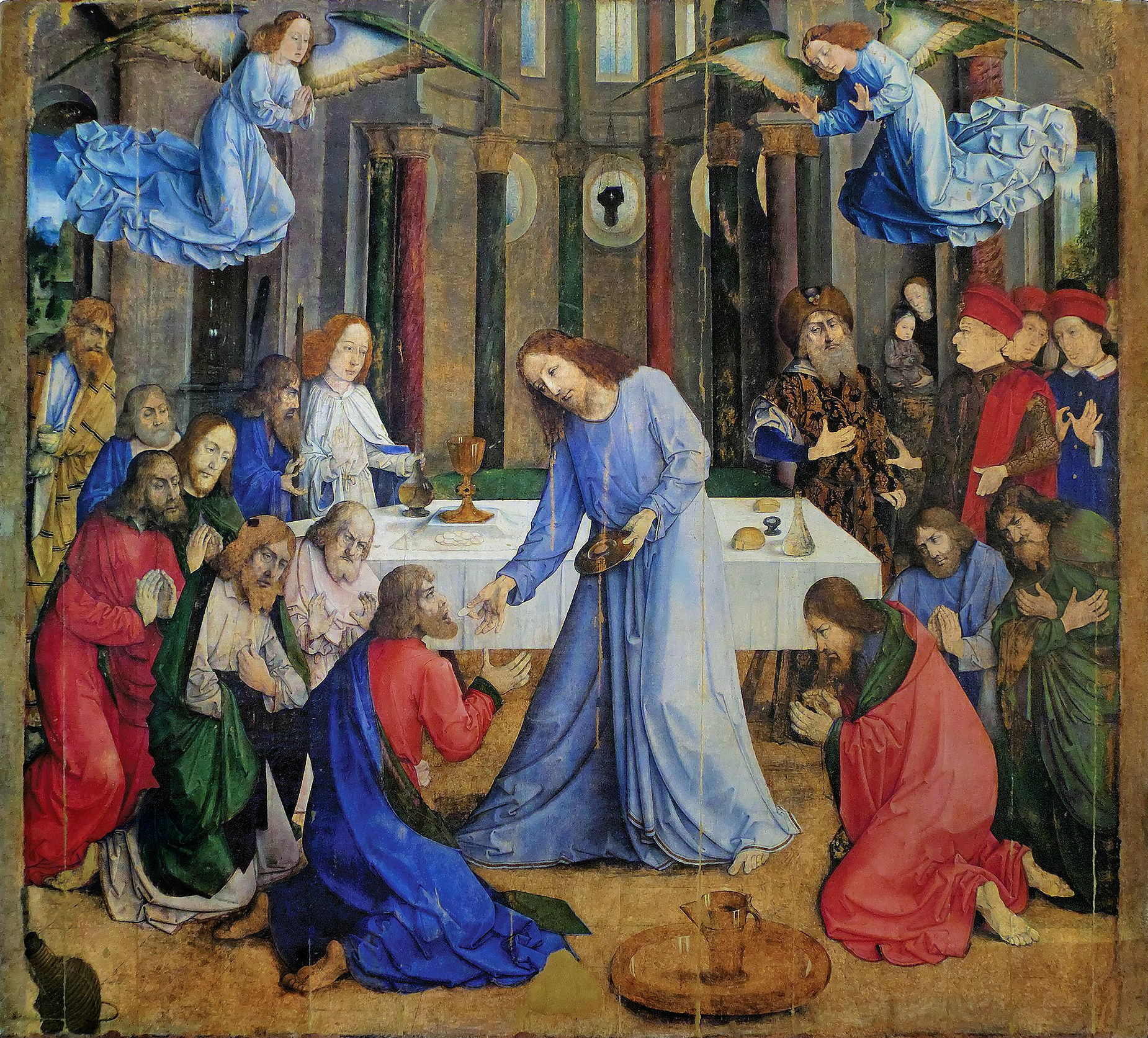
19 – Justus (Joos) van Gent (c.1435-1475), Communion of the Apostles or Institution of the Eucharist, 1473-75, 113 x125 inches, Ducal Palace, Urbino, Italy.
Justus van Ghent was a master in Antwerp in 1460 and in Ghent four years later where he met Hugo van der Goes. By the time of his death Justus van Ghent was in Rome, a city that was increasingly attracting international artists, including from northern Europe. Van Ghent was in Urbino where he painted Institution of the Eucharist in Urbino. The commission was originally given to Italian artist Piero della Francesca (1415-1492) and its predella (the altarpiece’s painting at its lower edge) was completed by Uccello (1397-1475).
Serene Piety and Commercial Success: Hans Memling
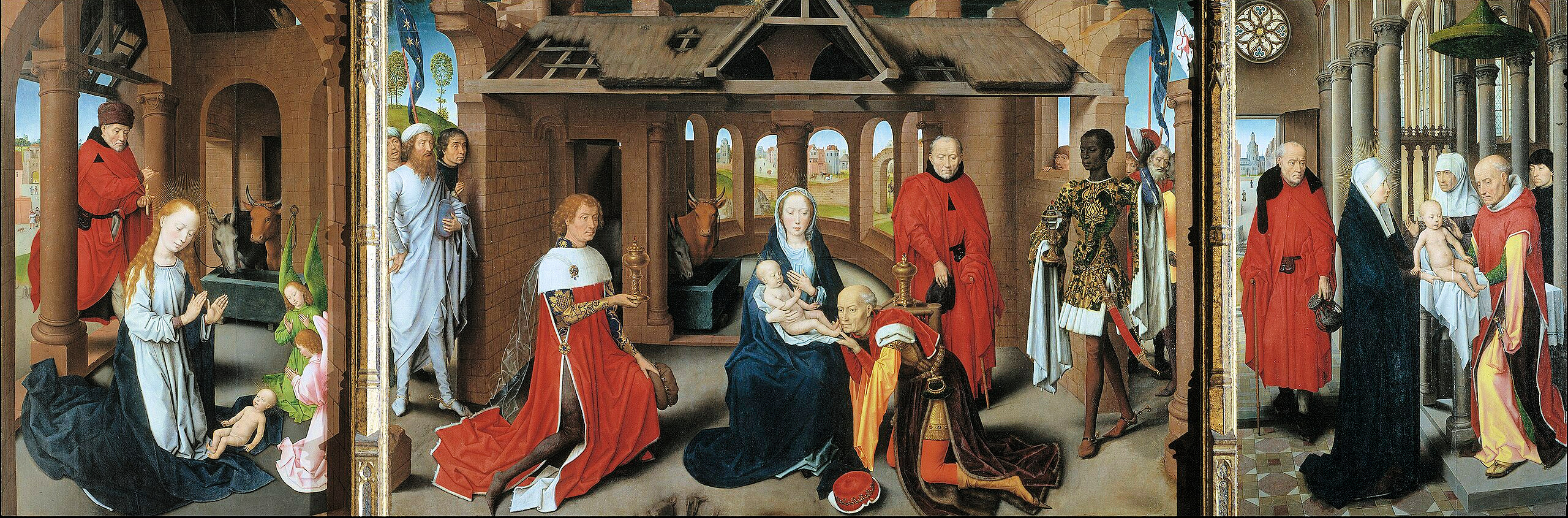
20 – Hans Memling (c. 1433-1494), The Adoration of the Magi (c. 1470), 37 ¼ x 57 inches, c. 1480, oil on panel, El Museo Nacional del Prado, Madrid.
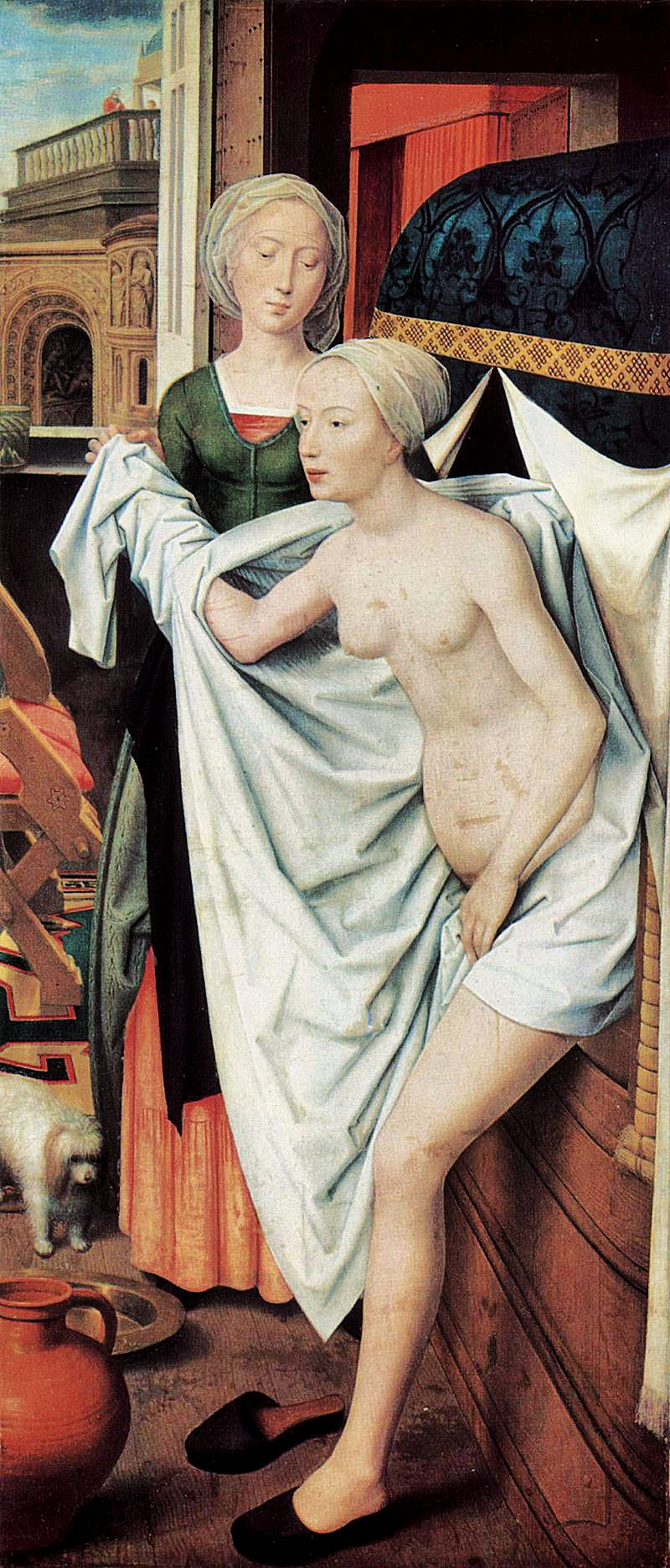
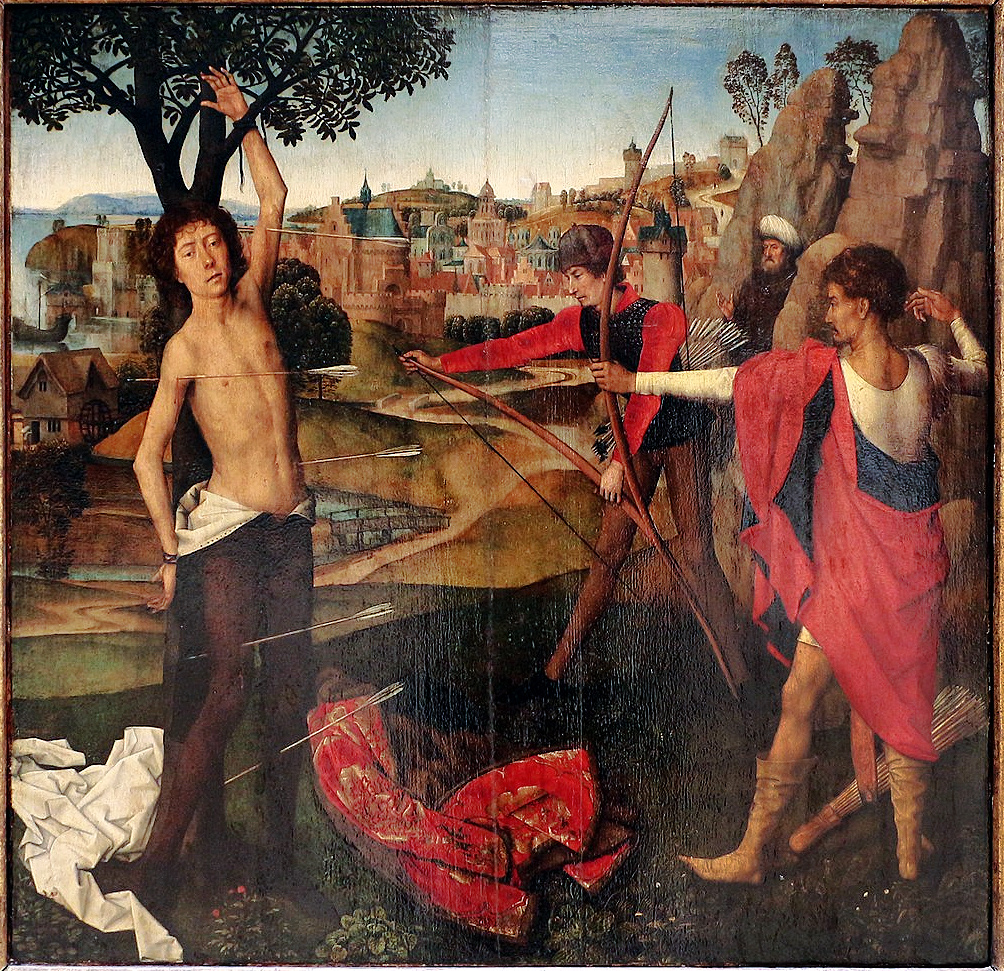
Hans Memling was a German, born near Frankfurt-am-Main. Memling was likely a student of Rogier van der Weyden and completely Netherlandish in his artistic style. Memling lived in Bruges and became a citizen in 1465. By 1480 the successful artist was one Bruges denizen who was paying the city’s largest amount of taxes. Though not innovative, Memling’s artwork depicts calm and peaceful figures full of piety. Memling also painted portraits successfully. Examples of his artwork are in collections all over the world.
21 – Hans Memling (c. 1433-1494), Bathsheba at her Bath, c. 1480-1485, 37 ¾ x 33 inches, Staatsgalerie Stuttgart, Germany.22 – Hans Memling (c. 1433-1494), The Martyrdom of Saint Sebastian, c. 1475, 26 ¼ x 25 ½ (67.4 x 67.7 cm), oil on wood, Royal Museums of Fine Arts of Belgium, Brussels.
The Culmination of the Bruges School: Gerard David
23 – Gerard David (c.1460-1523), The Justice of Cambyses: the arrest of the Dishonest Judge, 1498, Groeningemuseum, Bruges, Belgium.
Gerard David was a Dutch painter born in Oudewater. David was in Bruges by 1484. He was the last major painter from Bruges and painted pious pictures in a gentle Netherlandish style right before the rise of a new Italianate style in Antwerp. David traveled to Antwerp in 1515 and joined the Guild but returned to Bruges and died there in 1523. Though many pictures are attributed to David, the pair of Justice paintings are certainly his.
24 – Gerard David (c.1460-1523), Altarpiece of the Baptism of Christ, 1502-1508, 52 ¾ x 73 ½ inches, Groeningemuseum, Bruges, Belgium.
Conclusion: A Lasting Legacy of Northern Realism
Through this sweeping northern tier, the 15th-century Flemish School completely redefined the boundaries of Western art. Fueled by the immense mercantile wealth of trade hubs like Bruges and Antwerp, these masters looked beyond the rigid traditions of southern courtly capitals to capture the world as it was truly seen—perfecting the luminous magic of oil painting, pioneering deep three-dimensional space, and infusing sacred narratives with raw, human emotion.
From the early, groundbreaking naturalism of Robert Campin and the Van Eyck brothers to the emotional intensity of Rogier van der Weyden and Hugo van der Goes, Flemish innovation did not remain confined to the Low Countries. Its profound influence rippled across Europe, fundamentally altering artistic practices in Germany and captivating the master painters of Renaissance Italy. By marrying a meticulous observation of daily life with a powerful, independent spirit, the early Netherlandish masters created an enduring, cohesive artistic ecosystem whose brilliant light continues to fascinate and inspire the world today.
SOURCES:
A Dictionary of Art and Artists, Peter and Linda Murray, Penguin Books; Revised,1998.
Early Flemish Painting, Robert L. Delevoy, New York: McGraw-Hill Book Company, Inc., 1963.
French art in the 15th century stood at the crossroads of the medieval and early Renaissance worlds, blending Gothic spirituality, courtly elegance, and devotional symbolism with growing influences from Italian and Flemish artistic innovations. Through illuminated manuscripts, altarpieces, stained glass, and panel paintings, French artists created some of Europe’s most expressive and sophisticated religious imagery while forging a distinct national artistic identity.
Anonymous master. Portrait of John le Bon (1319-1364) c. 1360. Musée de Louvre, Paris (“Louvre”).
French artistic production in the 15th century remained deeply rooted in Christian devotion, mysticism, and royal patronage.
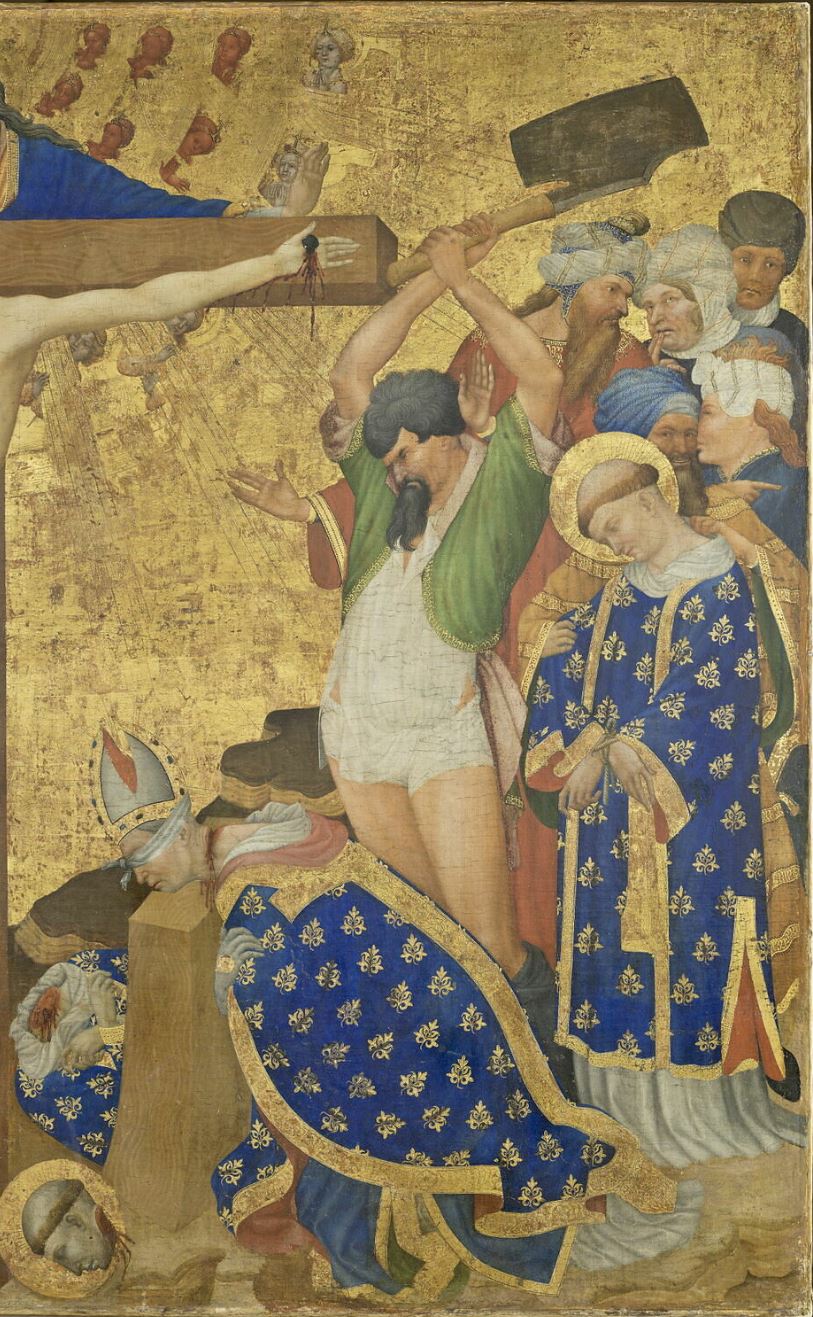
Retable de Saint Denis, (above), was completed in 1416 for the church of the Charterhouse of Champmol that is adjacent to Dijon. The artwork’s attribution has long been debated between Bellechose and Jean Malouel (1370-1415). Written evidence points to Bellechose possibly only completing the painting started by Malouel who was Bellechose’s predecessor at the head of the ducal workshop. However, recent connoisseurship does not see two different styles that would indicate two painters and the artwork in the Louvre is not the same size as the artwork mentioned in the early 15th century document that supports the dual attribution.
St. Denis is the most famous cephalophore (beheaded saint holding his head) in Christian history. Denis and two companions were martyred on Montmartre in what became a future Paris in the mid-3rd century. Much later, in the ninth century, an anonymous chronicler told the tale of the martyr Denis and mentioned his carrying his head from his execution spot on Montmartre to Saint-Denis. There the abbey of St-Denis rose to become the burial place of French kings. Soon after, this preposterous but delicious tale of Denis’ post-mortem pilgrimage received further embellishment by an abbot chronicler so that the legend took hold in St. Denis’ hagiography and iconography. St. Denis is the patron of Paris in France and against headaches and any strife or frenzy.
Anonymous, École de Île-de-France? Bourgogne? Studio Henri Bellechose? Dead Christ Placed in the Tomb, 1400-1425. Louvre. https://collections.louvre.fr/ark:/53355/cl010065413Anonymous master, The Annunciation, France, possibly Netherlands, late 14th century (1380s), tempera and oil with gold on wood, 15 7/8 x 12 3/8 x 1 7/8 in. Cleveland Museum of Art.
The angel Gabriel’s wings resemble peacock feathers. The panel painting was once joined to another panel to form a diptych. Its opulent ornate style and small size allowing for easy mobility points to its use as a devotional artwork for an aristocratic patron around 1400.
Anonymous, The Crowning of the Virgin, c. 1400-1410, Paris, oak on wood. 20.5 cm. Staatliche Museum, Berlin.
In Christian Biblical tradition, the Virgin Mary was the only human person to be received into heaven after her death as a physical body prior to the Last Judgment. By the Middle Ages, the event’s narrative was elaborated so that the Virgin in Heaven came to be understood as a royal court where angels acted as court pages. In Heaven’s throne room, Mary is crowned as Queen by her son, Jesus Christ.
In the French tondo, Christ wears a red cloak symbolizing his Resurrection and a violet robe symbolizing his Passion. He sits on a stone throne and sets the crown on his mother Mary’s head as she kneels on a splendid cushion.
Strewn on the green-tiled floor of the celestial throne room are a variety of cut flowers which point to Mary’s purity and love for humanity. One angel carries her dress’s train and is himself dressed in a liturgical-type costume.
The tiny panel is remarkable for its delicate execution, lovely colors, and precise articulation of details such as the angels’ multi-colored wings. Its overall imagery was 14th century Italian in origin and arrived into Paris in the 15th century. Like the Annunciation panel in the Cleveland Museum of Art (above), this panel was likely produced as a private devotional image for a patron of high rank who dwelt among the milieu of the Parisian court.
Les Frères de Limbourg, Meeting of the Three Wise Men c. 1416 from Les Très riches heures du duc de Berry folio 51 verso. Chantilly, Musée Condé.Entourage des Frères de Limbourg. Adoration de L’Enfant, c. 1415, Glasgow Art Gallery and Museum.Maître des heures de Rohan (active 1410-1435), The Last Judgment c. 1420, Paris, Bibliothèque nationale.Maître des heures de Rohan, Annunciation Angel and donor, c. 1420/30, Musée de Laon.
The courts of Burgundy, Anjou, and the French monarchy served as major centers of artistic innovation and patronage.
Maître des heures de Rohan, Portrait de Louis II d’Anjou, c 1420. Paris, Bibliothèque nationale.
Not much more is known of the Maître des heures de Rohan than if he were anonymous. The artist had ties to Troyes, a Burgundian market town, and settled in Paris between 1415 and 1420. He was a commercial illuminator and is found in the service of the Dukes of Anjou around 1420. In addition to the Grandes Heures de Rohan, c.1430-1435, he produced other exceptional books, including the Hours of René d’Anjou (Bibliothèque nationale de France), the Hours of Isabelle Stuart (Fitzwilliam Museum, Cambridge, UK) and the Hours for the Use of Angers (former Martin Le Roy collection).
Artwork by Maître des heures de Rohan reflects a highly personal vision. The artist was completely unconcerned with his contemporaries’ preoccupation to introduce Renaissance realism into painting. The artist ignored perspective and chiaroscuro through concrete depictions and continued to develop his artistic meditations on faith and death using highly original invention of forms. In this way, the Maître des heures de Rohan is an enduring artist from early 15th century France as some of his more fashionably progressive contemporaries are not as he stayed true to his vision to create some of the most expressive pages of medieval Christian mysticism.
French art absorbed influences from both Italian Renaissance painting and Flemish realism while preserving distinctive Gothic traditions.
Maître of the Aix Annunciation, Annunciation, before 1445, Église de la Madeleine d’Aix-en-Provence.
The precise identification of the artist called the Maître of the Aix Annunciation is unknown. The artist is believed to be male and French, and could be Jean Chapus who lived in Aix and was working for King Réne of Anjou in the 1430s and 1440s. The Annunciation which was placed in the church in 1445 and has been there since, was part of a triptych. The other wings have been split off and are in Brussels, Amsterdam, and a private Dutch collection (one wing was also split). The style shows influence from Italy (Naples) and Flemish art.
DETAIL. Maître of the Aix Annunciation, before 1445, Église de la Madeleine d’Aix-en-Provence.
Illuminated manuscripts remained a major art form, exemplified by the work of the Master of Rohan and the Limbourg Brothers.
Maître du Coeur l’amour épris, Rencontre de Coeur et d’Humble requête, c. 1479, Vienna, National Library.Anonymous. Annunciation, c. 1447-1450, Stained glass, Bourges cathedral, Chapel of Jacques Coeur.
The period’s art is notable for its rich symbolism, luminous color, meticulous detail, and emotional spirituality.
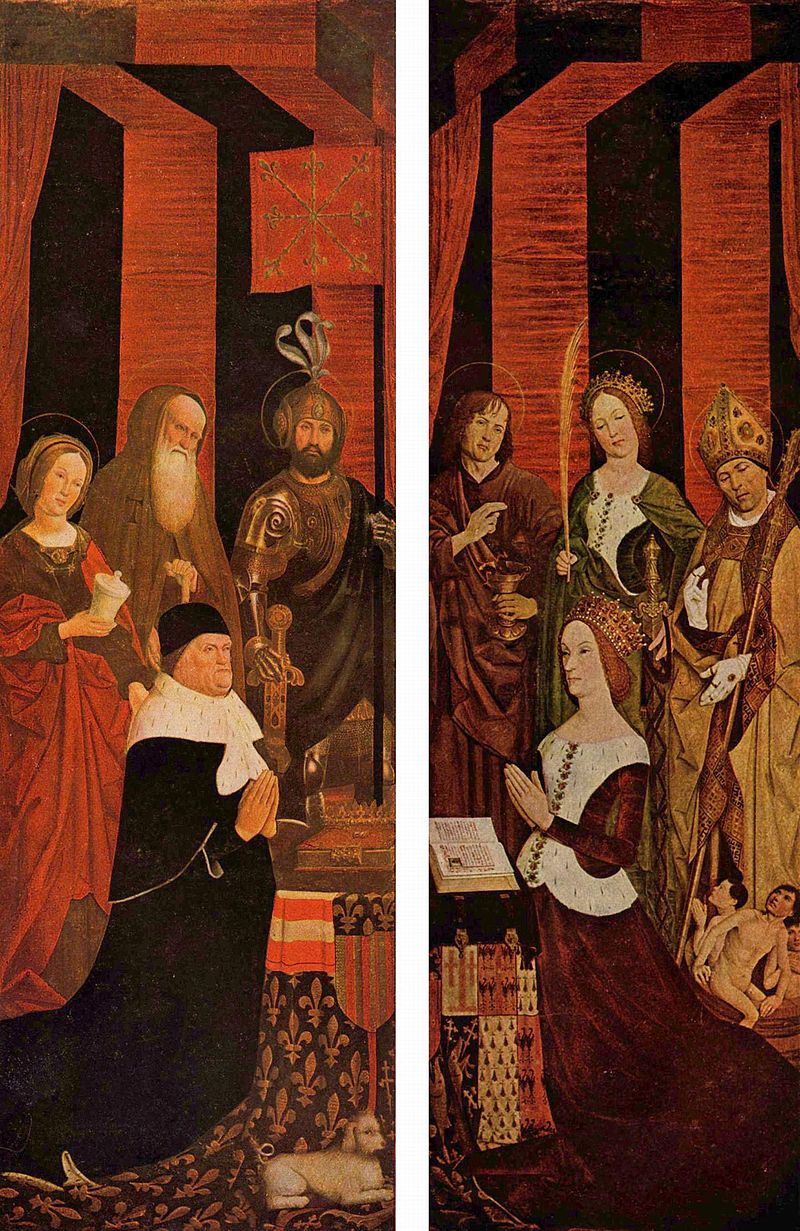
Jean Fouquet (1420-1480), Diptych de Melun, c. 1450, right panel: The Virgin and Child Jesus. Antwerp, Museum of Fine Arts.Jean Fouquet (1420-1480), Diptych de Melun, c. 1450, left panel: Chevalier Stephan presented by Saint Stephan. Staatliche Museum Berlin.
Jean Fouquet was a major French painter of the 15th century. He was in Rome in the mid-1440s and is presumed to have painted portraits. Under what circumstances the twenty-something Fouquet traveled to Rome is unknown. In any event Fouquet returned to Tours in 1448 and was working in the court of Charles VII. Louis XI appointed him official painter to the king in 1475. A handful of miniatures are documented artworks by Fouquet though other pictures, such as the Melun diptych and others, are attributed to him.
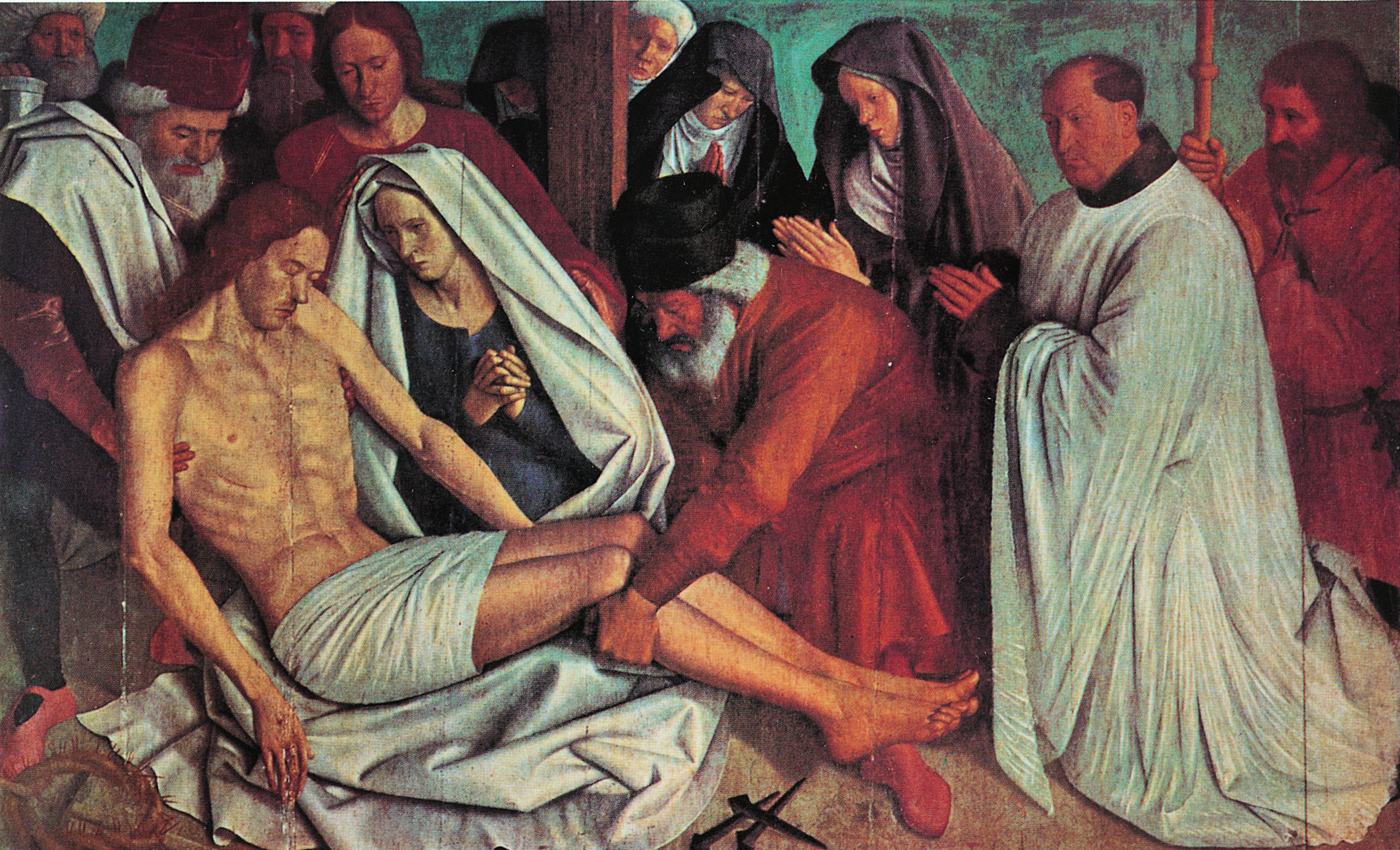
Jean Fouquet (1420-1480), Medallion, self-portrait, 1452/1455. Louvre.Jean Fouquet (1420-1480), Charles VII, 1440/1460. Louvre.Jean Fouquet (1420-1480), The Visitation, c. 1450. The Musée Condé, Chantilly.Jean Fouquet (1420-1480), Announcement of the Death of Saul to David, c. 1470. Les Antiquités Judaïques, Ms. fr. 247, folio 135 verso. Paris Bibliothèque Nationale.Jean Fouquet (1420-1480), Pietà, c. 1470-1480. Parish church, Nouans (Indre-et-Loire).Jean Fouquet (1420-1480), Pietà (detail), c. 1470-1480. Parish church, Nouans (Indre-et-Loire).Retable du Parlement de Paris, c.1455. Louvre. see – https://collections.louvre.fr/en/ark:/53355/cl010061369 – retrieved September 15, 2025.
It depicts the scene on Calvary on Good Friday with Jesus Christ crucified in the center with saints at its base including, left to right, Saint Louis, John the Baptist, the Virgin Mary, Saint John, a beheaded Saint Denis, and Charlemagne. In the background is the tour de Nesle (c. 1200-1665), Seine, the Louvre, Hôtel du Petit-Bourbon, and Palais de la Cité. Formerly identified as an artwork by Philippe de Mazerolles, it is currently identified by the Louvre as “anonymous“ in the School of France influenced by the Master of Dreux Budé who is likely André d’Ypres, active between 1425-1450. Philippe de Mazerolles was also a French painter and illuminator who was active in Paris and in Bruges. Trained in Paris, Philippe de Mazerolles’ style was directly inspired by the Maître de Bedford, an anonymous illuminator active in Paris slightly earlier between 1415 and 1435. The Master of Dreux Budé was a Parisian illuminator whose works show his knowledge of the repertoire of models of the Master of Flémalle (1375-1444). see – https://initiale.irht.cnrs.fr/en/intervenant/3443 – retrieved September 15, 2025.
DETAILS retable du Parlement de Paris (above), c.1455. Louvre:
Also known as Charonton, the French painter worked in Avignon in southern France. His large Coronation of the Virgin is a documented artwork that was completed in 1454. It is one of the most important surviving 15th century French paintings.
Enguerrand Quarton (1410-1466), The Coronation of the Virgin (detail), 1452-53, Altar of the Charterhouse (hospice) of Villeneuve-lès-Avignon.DETAIL. Enguerrand Quarton (1410-1466), The Coronation of the Virgin, 1452-53, Altar of the Charterhouse (hospice) of Villeneuve-lès-Avignon.Enguerrand Quarton (1410-1466), attributed, Pietà de Villeneuve-lès-Avignon. École de Provence, c. 1455. Louvre. https://collections.louvre.fr/ark:/53355/cl010063345
DETAILS Pietà de Villeneuve-lès-Avignon (above), c.1455. Louvre:
Nicolas Froment (1461-1483), Triptych (center panel): Mary in the Burning Bush, 1476. Cathedral St. Sauveur, Aix-en-Provence.
DETAIL Triptych (center panel): Mary in the Burning Bush (above), 1476. Cathedral St. Sauveur, Aix-en-Provence:
Nicolas Froment (1461-1483), Mary in the Burning Bush (detail), 1476. Aix-en-Provence, Cathedral St. Sauveur.Triptych (center panel).Nicolas Froment (1461-1483) The Burning Bush, 1476. Aix-en-Provence, Cathedral St. Sauveur.Triptych (right and left panels).
Nicolas Froment worked in the south of France and was painter to Réne d’Anjou. The triptych is a documented artwork by the artist.
Josse Lieferinxe, called Maître de Saint-Sébastien, Part of an altarpiece shutter. The marriage of the Virgin. Musées royaux des Beaux-Arts de Belgique.Maître de Moulins, active 1475 to 1505, Triptych de Moulins, center panel: The Virgin and the Child in Glory, c. 1498. Cathedral de Moulins.
DETAILS Triptych de Moulins, center panel: The Virgin and the Child in Glory (above), c. 1498, Cathedral de Moulins:
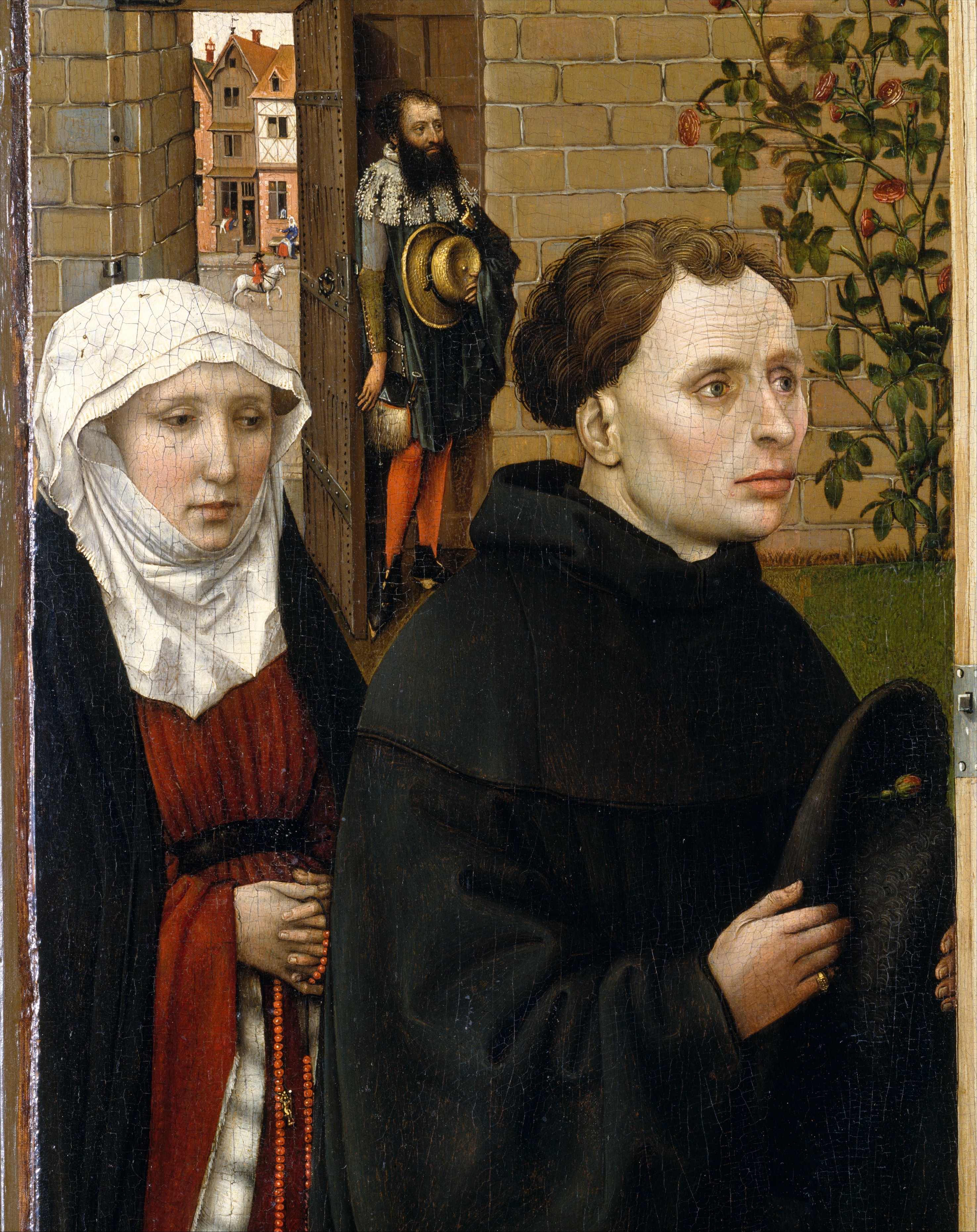
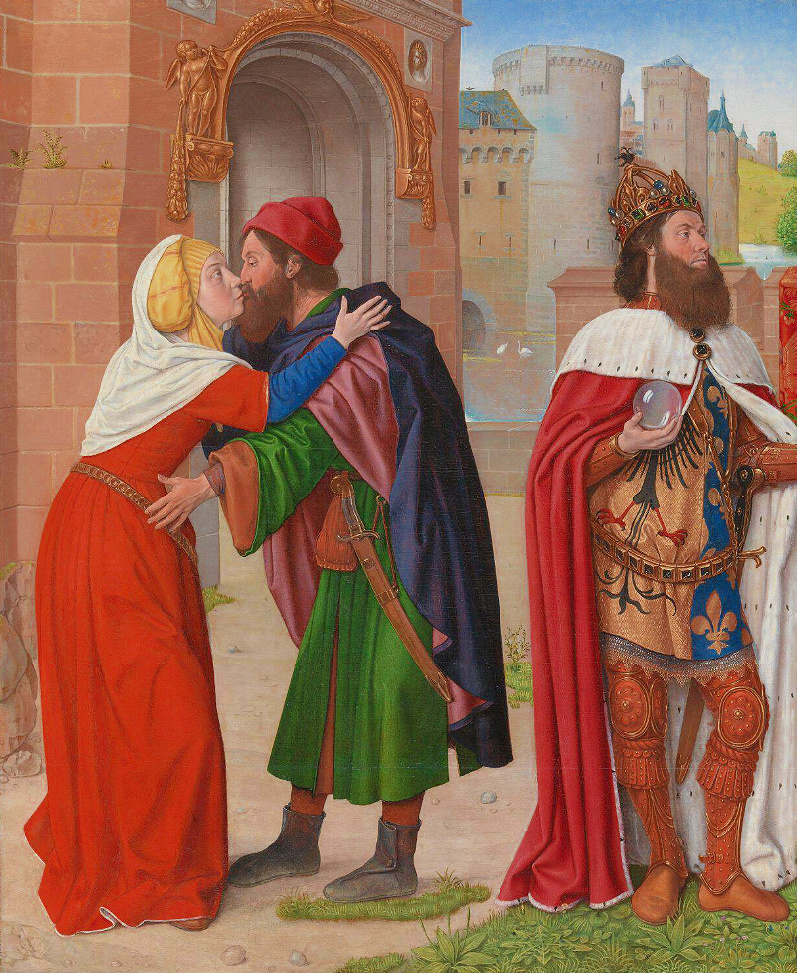
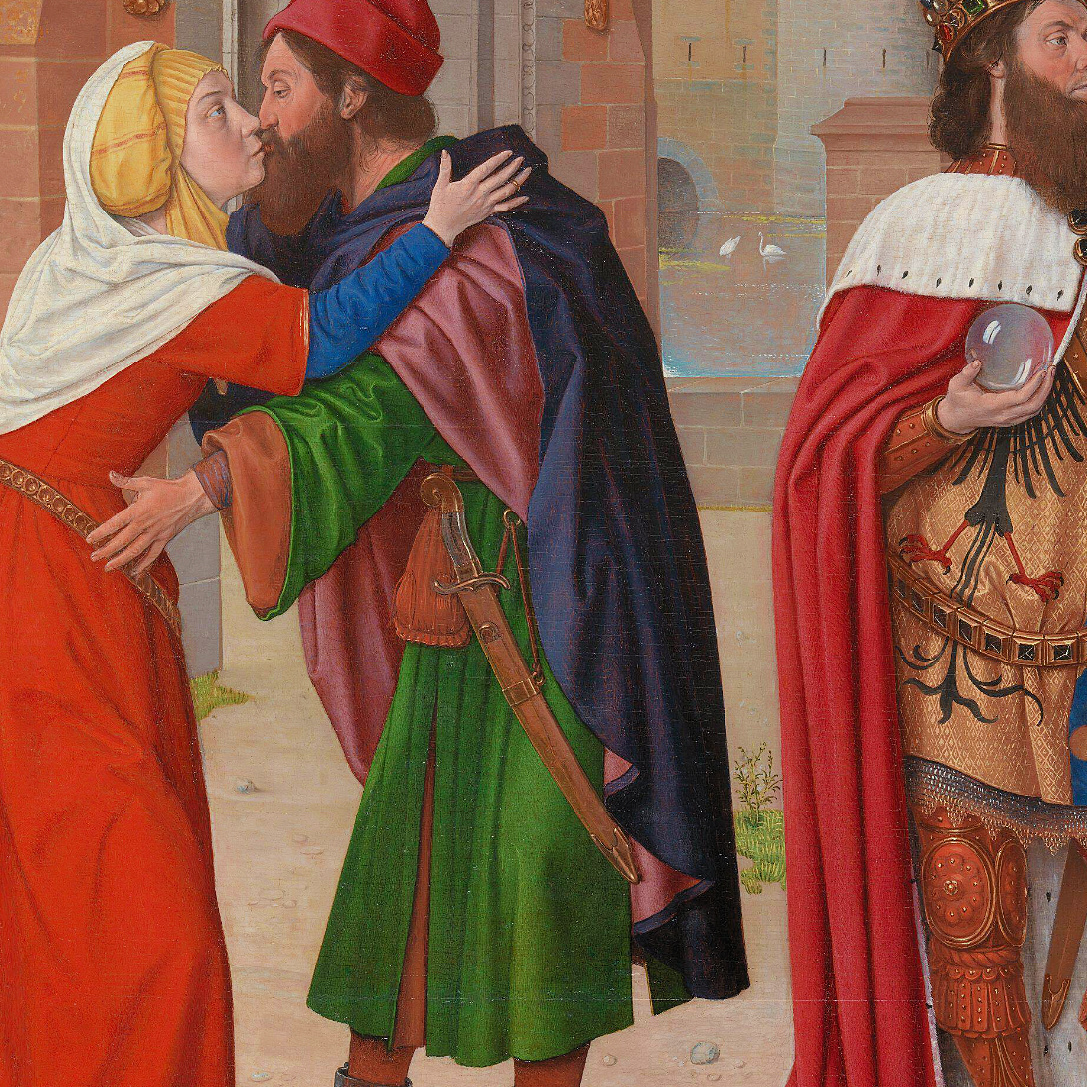
The Master of Moulins is one of the great French painters of the 15th century. He was influenced by Hugo van der Goes (died 1482) and takes his name from the triptych painting of the Madonna and Child with angels and Donors (above) in Moulins Cathedral dated from 1498/99. Other works attributed to the Master of Moulins are in Autun, Paris, Chicago, Brussels, London, Munich, and Glasgow.
Maître de Moulins, active 1475 to 1505, Meeting of Saints Joachim and Anne at the Golden Gate with Charlemagne, oil on oak, about 1491-1494. 72.6 x 60.2 cm, National Gallery, London.
By century’s end, French artists had begun moving toward Renaissance naturalism while maintaining a uniquely French visual language.
Maître de Moulins, active 1475 to 1505, The Virgin with Child surrounded by angels, c. 1490, Musées royaux des Beaux-Arts de Belgique.Maître de Moulins, active 1475 to 1505, François de Chateaubriand presented by St. Maurice or St. Victor with Donor, c. 1485, Kelvingrove Art Gallery and Museum Glasgow.Jean Bourdichon (1457-1521), King David and Bathsheba, Leaf from the Hours of Louis XII, 1498–1499, Tempera and gold, Leaf: 24.3 × 17 cm (9 9/16 × 6 11/16 in.), The J. Paul Getty Museum, Los Angeles, Ms. 79, 2003.105.
Jean Bourdichon served as official court painter to four successive French kings: Louis XI, Charles VIII, Louis XII, and François I. Bourdichon was almost certainly a pupil of Jean Fouquet, the previous court painter.
Simon Marmion (active 1449-1489), The miracle of the True Cross in Jerusalem in the presence of Saint Helena Empress, 2nd half of 15th century (1450/1500). Louvre. https://collections.louvre.fr/ark:/53355/cl010061655
Simon Marmion (died 1489) who worked in Amiens and Valenciennes and temporarily in Tournai was a painter and illuminator where his miniatures were admired for their rich decoration and landscape details. In the mid1440s the artist moved from Amiens to Valenciennes where he became a leading painter. His most important painting is the Saint Bertin Altarpiece in Berlin and London.
St. Bertin Altarpiece, 1459:
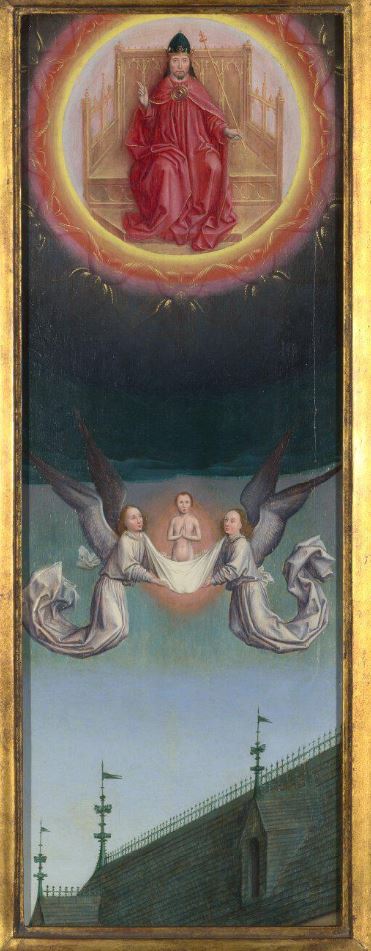
Simon Marmion, The Soul of Saint Bertin carried up to God. Fragment of Shutters from the St. Bertin Altarpiece, 1459. National Gallery London.
The Soul of Saint Bertin carried up to God was the upper section of a wing for an altarpiece for the high altar of the abbey church of St Bertin at Saint-Omer in northern France. It was commissioned by the influential Guillaume Fillastre, Abbot of St Bertin (1450-73), Bishop of Verdun (1437-49), Bishop of Toul (1449-60), Bishop of Tournai (1460–73), Chancellor of the Order of the Golden Fleece and a close confidant of the powerful Duke of Burgundy, Philip the Good. The artwork, whose main parts are in the Gemäldegalerie, Berlin, was consecrated in 1459. The altarpiece was intact in the abbey until 1791 when, as with many church goods, it fell victim to the French Revolution. https://www.nationalgallery.org.uk/paintings/simon-marmion-the-soul-of-saint-bertin-carried-up-to-god
FEATURE image: The Satyr at the Farmer’s (“Der Satyr beim Bauern”), Jacob Jordaens (Flemish, 1593-1678), c.1620.
Housing much of Munich’s most famous artwork, the Alte Pinakotek’s collection includes renowned international works from the 14th through the 18th centuries. A survey of these masterworks illustrates how European painters evolved from traditional craftsmen into divinely inspired creators. Through detailed analyses of artists like Albrecht Dürer, Valentin de Boulogne, and Claude Lorrain, the post demonstrates how these masters utilized religious self-fashioning, classical mythology, and the dramatic use of light (chiaroscuro) to inject profound emotional and psychological depth into Western art
Self-Portrait (“Selbstbildnis”), Albrecht Dürer (German, 1471-1528), c. 1520.
The Artist as Divine Creator: Albrecht Dürer’s Self-Portrait (c. 1520) deliberately uses the iconic, frontal pose of Christ Pantocrator to elevate the status of artists from manual laborers to divinely inspired creators. Humanizing the Divine: In contrast, Rembrandt did not portray himself as Christ but used his own aging, flawed face as a template for Jesus to ground him in human suffering and vulnerability.
Several prominent artists have, at various moments, fashioned their own likenesses in the image of Christ, a strategy that served both devotional and professional aims. This practice participates in the long tradition of imitatio Christi—the aspiration to model one’s life, conduct, and even physical bearing on the figure of Jesus. Within the visual arts, however, the gesture carried additional layers of meaning. By aligning themselves with the divine prototype, artists could elevate their social standing from that of manual laborers to inspired creators whose work partook in sacred authority. At the same time, such self-fashioning could signal profound personal piety, suggesting that the artist’s inner life mirrored the spiritual intensity of the Savior.
The most celebrated example is Albrecht Dürer, whose 1500s self‑portrait adopts the frontal, iconic pose associated with late‑medieval images of Christ Pantocrator. Dürer’s deliberate visual parallel not only asserts his artistic genius but also reflects his conviction that creative imagination was a God‑given faculty. His self‑portrait thus becomes a theological statement: the artist as a vessel of divine creativity.
Other painters engaged the motif in subtler ways. Rembrandt, for instance, did not present himself explicitly as Christ, yet he repeatedly used his own features as a template for the face of Jesus. This choice was less about claiming sacred authority and more about grounding the figure of Christ in lived human experience. By drawing on his own physiognomy—familiar, aging, marked by suffering—Rembrandt infused his depictions of Jesus with psychological depth and emotional immediacy. The result is a Christ who feels palpably human, capable of empathy and vulnerability.
Taken together, these strategies reveal how self‑representation as Christ could function across a spectrum: from bold assertions of artistic status to intimate explorations of spiritual identity. They also underscore the evolving conception of the artist in early modern Europe—not merely a craftsman, but a creator whose work could approach the divine.
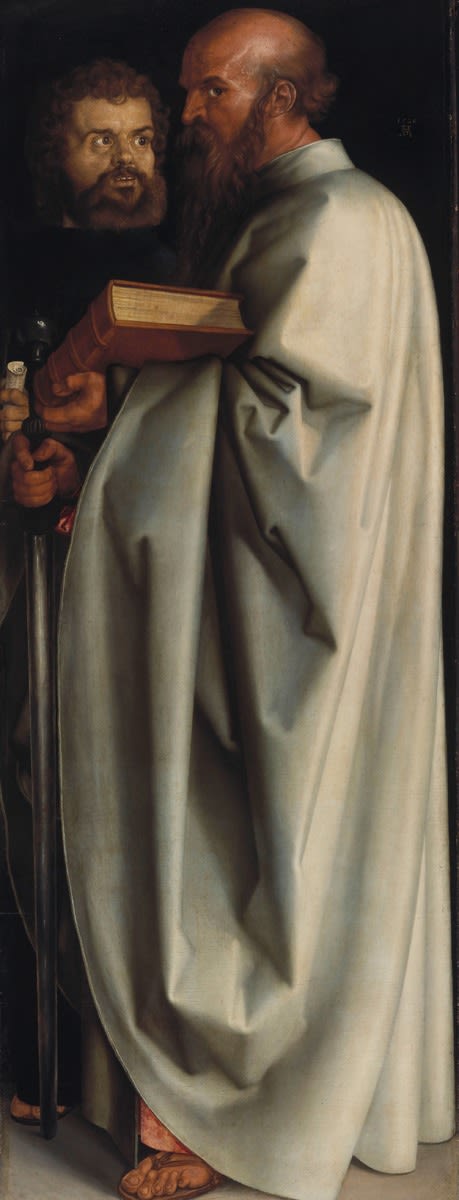
Four Apostles (“Vier Apostel”), Albrecht Dürer (German, 1471-1528), c. 1526.Detail. Dürer, Vier apostel. Mark and Paul.The Land of Cockaigne, Pieter Brueghel the Elder (Flemish, 1525/1530-1569), 1567.Head of an Old Woman, Pieter Brueghel the Elder (Flemish, 1525/1530-1569), 1563.Robbery and Melon Eaters (“Trauben- und Melonenesser”), Bartolomé Esteban Murillo (Spain, 1617-1682), c.1645.History Cycle: Battle of Alexander (Battle of Issus) (“Historienzyklus: Alexanderschlacht [Schlacht bei Issus]”), Albrecht Altdorfer (German, c.1480-1538), 1529.Adoration of the Magi, Columba Altarpiece, central panel (“Columba-Altar: Anbetung der Könige”). Rogier van der Weyden (Nederlandish, c. 1399-1464), 1455.Danae, Jan Gossaert (Brabant, 1478-1532), c. 1527.
Blending Influences: Gossaert integrated French, German, and Netherlandish styles, becoming a key “Romanist” after traveling to Italy. The Erotic Renaissance: In Danaë (c. 1527), he broke away from the medieval practice of treating the Greek myth strictly as a safe, pagan metaphor for the biblical Annunciation, choosing instead to reintroduce its original erotic context.
Jan Gossaert was probably from Maubeuge in France though the artist’s whereabouts are first documented in Antwerp, Belgium, in 1503. His early style is an amalgam of then-popular contemporary French, German, and Netherlandish influences – Hugo Van Der Goes (c.1440-1482), Albrecht Dürer, and Gerard David (c.1460-1523). After a trip to Italy in 1508, Gossaert displayed new flamboyance in his style and detail, particularly using architectual settings as the Alte Pinakothek’s later Danae shows. The northern European Hainault artist never successfully incorporated Italian Renaissance ideas into his artwork and many of his figures’ poses are actually derivative. Yet this level of stylistic incorporation led Gossaert to become an important Romanist. Gossaert was the first northern European artist to introduce nude classical figures into Flanders’ art world.
The Oracle of Delphi prophesied that King Acrisius of Argos would die at the hand of his grandson. To prevent this, the king imprisoned his daughter, Danaë, in an essentially golden cage. However, the King of the gods, Zeus, desired Danaë and came to her by way of a stream of golden rain into her cage where she conceived Perseus. It was Perseus who later, after his own adventures, killed his grandfather by accident during some athletic games.
By the Middle Ages this ancient Greek literary material was used as a pagan reference for the New Testament Annunciation. Gossaert was one of the first artists in the Renaissance period to reintroduce the original subject’s erotic content on its own terms.
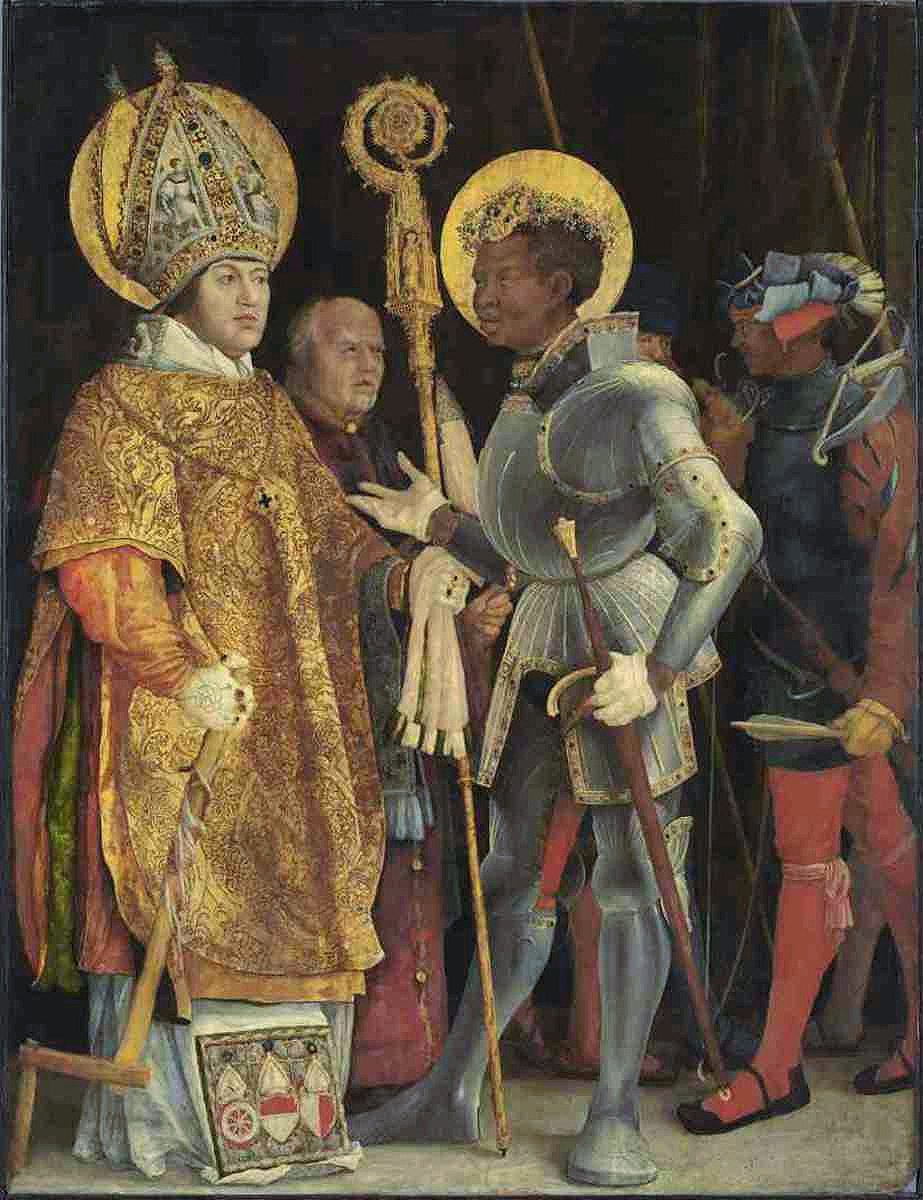
Madonna with Child, St. Mary Magdalene and Donor (“Maria mit Kind, hl. Maria Magdalena und Stifter”), Lucas van Leyden (Dutch, 1494-1533), 1522.“Pearl of Brabant”: Adoration of the Kings (“”Perle von Brabant”: Anbetung der Könige”), Dieric Bouts (Nederlandish, 1400?-1475), c.1465.Matthias Grünewald (c. 1470-1528), Meeting of Sts. Erasmus and Maurice, Martyrs, c 1520-24, 226 x 176 cm, basswood.
Emotional Weight & Late Gothic Outlook: Unlike his contemporary Dürer, Grünewald did not create prints and prints-making; instead, he used Italian Renaissance techniques solely to heighten the emotional and religious impact of his paintings.
Matthias Grünewald was a German painter of the Renaissance. Born Mathias Neithar(d)t-Gothar(d)t around 1470-75, Grünewald shared virtually the exact birth and death dates of fellow German artist, Albrecht Dürer, though the two artists were exact opposites.
Little is known about the life of Grünewald. He first enters the historical record in 1501 in Seligenstadt. It is believed the artist was also early on in Aschaffenburg and as far off as Würzburg. From 1508 to 1514 Grünewald was court painter to Albrecht of Brandenburg (1490–1545), the archbishop of Magdeburg, administrator of Halberstadt, and the archbishop and elector of Mainz (later Cardinal) who commissioned the Alte Pinakothek panel for the Neue Stift in Halle. By the mid1520s Grünewald was in Frankfurt and, apparently increasingly sympathetic to Lutheran doctrine, north to Halle where he died.
Grünewald’s first datable work is from 1503 though Grünewald is best known for his Isenheim Altarpiece in Colmar, France, produced in the mid1510s. Unlike his contemporary, Dürer, MatthiasGrünewald apparently attempted no woodcuts, engravings or even many drawings. Like Dürer, he was familiar with Italian Renaissance ideas, though Grünewald did not pursue its techniques for its own ends. Rather, Grünewald was interested in using these new Italian techniques to heighten his own art’s emotional impact as well as make a religious statement. In this sense Grünewald possessed an essentially Late Gothic outlook and style. Yet, besides the passionate, well-drawn, and colorful Isenheim Altarpiece, few paintings of Grünewald survive.
St. Erasmus (or Elmo) was a late Third Century bishop who was martyred under Diocletian around 303 CE. St. Maurice was martyred around 287 CE. Maurice wears the armor signaling his being an officer in a Roman legion which was composed almost entirely of Christians. Along with other officers and rank-and-file soldiers Maurice was slaughtered for refusing to worship the State’s pagan gods.
Valentin de Boulogne (1591-1632), Crowning of thorns of Christ, around 1616/17, oil on canvas, 173 x 241 cm Bayerische Staatsgemäldesammlungen München-Alte Pinakothek, Munich.
Street-Life Idiom: Le Valentin’s The Crowning of Thorns of Christ handles sacred biblical events by populating the scene with expressive characters who resemble everyday people from contemporary street life. Chiaroscuro & Recycle: His later works show a transition toward classical beauty and deep psychological tension, notably painting Crowning with Thorns over a discarded portrait of his patron, Cardinal Barberini.
One of the great artworks of Le Valentin’s early phase in Rome, biblical subjects painted before 1620 such as The Crowning of Thorns of Christ were interpreted in the street-life idiom, with expressive protagonists and bystanders resembling the cast of characters in his genre paintings. Although the painting was earlier believed to be by Caravaggio, it may have been a pendant to Le Valentin’s much-later Abraham Sacrificing Isaac (c. 1629) in The Montreal Museum of Fine Arts.
This is Le Valentin’s most ambitious of 3 such “crowning with thorns” pictures. The artist in horizontal-format depicts Jesus before his going to Calvary. Christ is mocked and tormented; a crown of thorns is pressed onto his head (Matthew 27: 27-31; Mark 15:16-21; Luke 23:11; John 19: 1-3). With its dramatic lighting and shadows, the naturalistic depiction of Christ’s body and soldiers in contemporary costume is Caravaggesque.
Le Valentin’s scene adheres to the Bible episode: a whole cohort of soldiers surrounded Jesus, stripped off his clothes and threw a scarlet military cloak on him. Henchmen have weaved a crown out of thorns and are placing it on Jesus’s head. Another puts a reed as a faux scepter into Jesus’s right hand. To mock him they kneel before him and say: “Hail, King of the Jews!” The soldiers spit on Jesus and then take the reed away and strike him repeatedly with it. When they were done with these violent actions, the soldiers stripped Jesus of the military cloak, dressed him in his own clothes and led him out to be crucified.
Le Valentin’s Passion theme is a later vertical-format picture of a subject he had painted masterly before. In these last years the subject matter had gained in classical beauty as well as psychological involvement compared to Le Valentin’s earlier artwork. The painting covers over a discarded portrait of Cardinal Barberini which suggests Valentin’s close relationship with the ecclesial prince, very likely being in his employ. What caused the artist to revisit the subject of a brutalized Christ is unclear though it may have been based on the artist’s own struggles or that of his employer whose portrait he painted over.
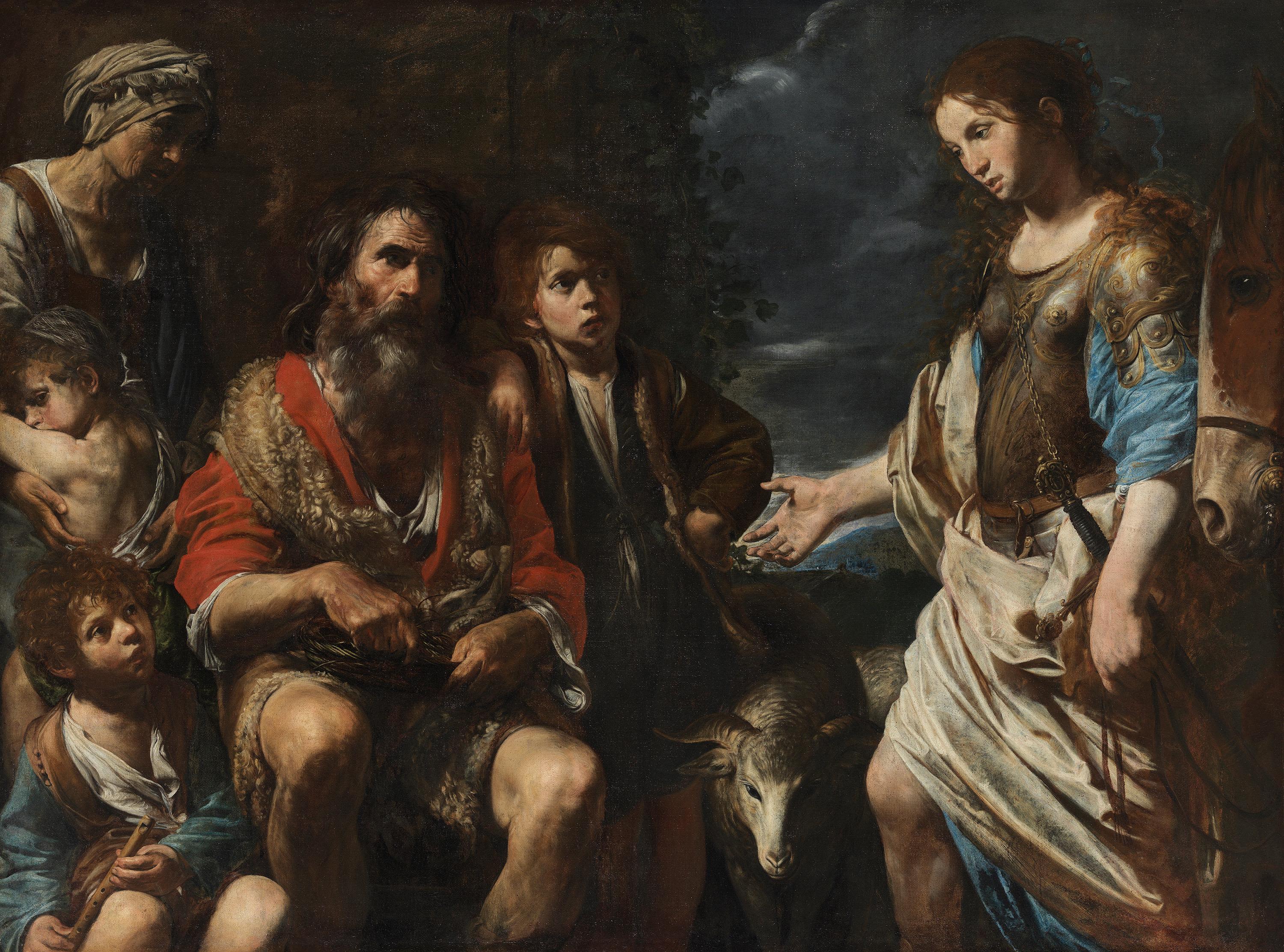
Valentin de Boulogne (1591-1632), Herminia among the Shepherds, c. 1630, oil on canvas, 134.6 x 185.6 cm (53 1/8 x 61 5/8”) Bayerische Staatsgemäldesammlungen – Alte Pinakothek München. https://www.sammlung.pinakothek.de/de/artwork/RQ4XPr8410
Erminia, the king’s daughter, escapes her persecutors and asks a peaceful shepherd family for shelter. The scene is based on a contemporary (1576) epic poem The Liberated Jerusalem by Torquato Tasso (1544-1595). The picture was a private commission whose patron was likely a Roman art collector and cognoscente. Valentin’s painting combines Caravaggesque chiaroscuro with exquisite coloring. In this realistic depiction of a human encounter between characters who represent contrasting social experiences, the subject matter is rendered psychologically sensitively.
Imaginary Worlds: Lorrain set a template for landscape painting into the 19th century by crafting muted, imaginary, stage-like scenes that blended fragments of classical antiquity with contemporary figures. The Bavarian Commission: Both Seaport at Sunrise and Idyllic Landscape in the Setting Sun were part of a trio of landscapes specifically commissioned by the Bavarian Privy Councillor Franz von Mayer.
The French artist Claude Lorrain arrived in Rome in 1615 and, except for interludes in Naples (1619-1624) and in France (1625-1627), the artist lived and worked in Rome during his life. Lorrain trained under Agostino Tassi (1578-1644), an Italian landscape painter. Lorrain’s compositions were painted in muted tones whose work displayed an ethereal mood. Using fragments from antiquity and a pleasant atmosphere, Lorrain’s mode of landscape painting set a template for such artworks into the 19th century. In Seaport at Sunrise, Lorrain’s depiction of the sunrise itself was bold and original, a haze dissolving within a scene of cities, sea and mountains and which contains contemporary figures yet harkens backwards in time or to the timeless.
In Seaport at Sunrise, the sun begins to bathe a seaport in early light, similar to the way the sun rises over the Gulf of Naples today. A working port, a boat is being loaded while travelers sit waiting on the shore. The place is imaginary – not purely contemporary, historical, mythological, or literary. Lorrain’s landscape transposes figures of everyday life contributing to the development of genre painting as its imaginary effects bend into the weight of medieval and ancient history.
There are fortified castles along the shore and a building to the right which appears very much like the triumphal Arch of Titus (80 A.D.) in Rome. Claude Lorrain’s painting is based on a composition he made from 1634 in the Hermitage in Saint Petersburg, Russia. Seaport at Sunrise is one of three landscape paintings commissioned by Bavarian Privy Councillor Franz von Mayer. The others in that trio are in the Alte Pinakothek (Idyllic Landscape in the Setting Sun – see below) and in the Dulwich Picture Gallery in London.
Before 1640, Claude Lorrain was considered the premier landscape painter in Rome. Most of his paintings are imaginary imitating a stage set for rich landscape narratives.
This painting is the first of the series of three landscape pictures commissioned by Bavarian Privy Councillor Franz von Mayer and that included Seaport at Sunrise (above). In the picture, a herd of cows crosses a ford in the Mediterranean as the sun sets behind mountains. The painting is based on one of Lorrain’s compositions from 1636.
Italian realist painter Caravaggio (1571-1610) remained very influential in contemporary art following his death. His use of targeted light and shadow as well as a muted, mainly brown palette, was key in the depiction of his figural scene. Painters in the 17th century followed this Caravaggesque practice throughout the rest of the century experimenting with using light and increasingly brighter colors as dramatic and aesthetic tools for their painting.
SOURCE: Baroque, Hermann Bauer, Andreas Prater, Ingo F. Walther, Köln: Taschen, 2006.