The First Presbyterian Church of Evanston (1895), designed by renowned local architect Daniel H. Burnham, stands as a masterwork of Gothic Renaissance architecture that masterfully balances community inclusivity with grand artistic elements—specifically highlighted by its unobstructed structural layout, a world-class Aeolian Skinner organ, and intricate, storytelling stained-glass windows.
Innovative Engineering:
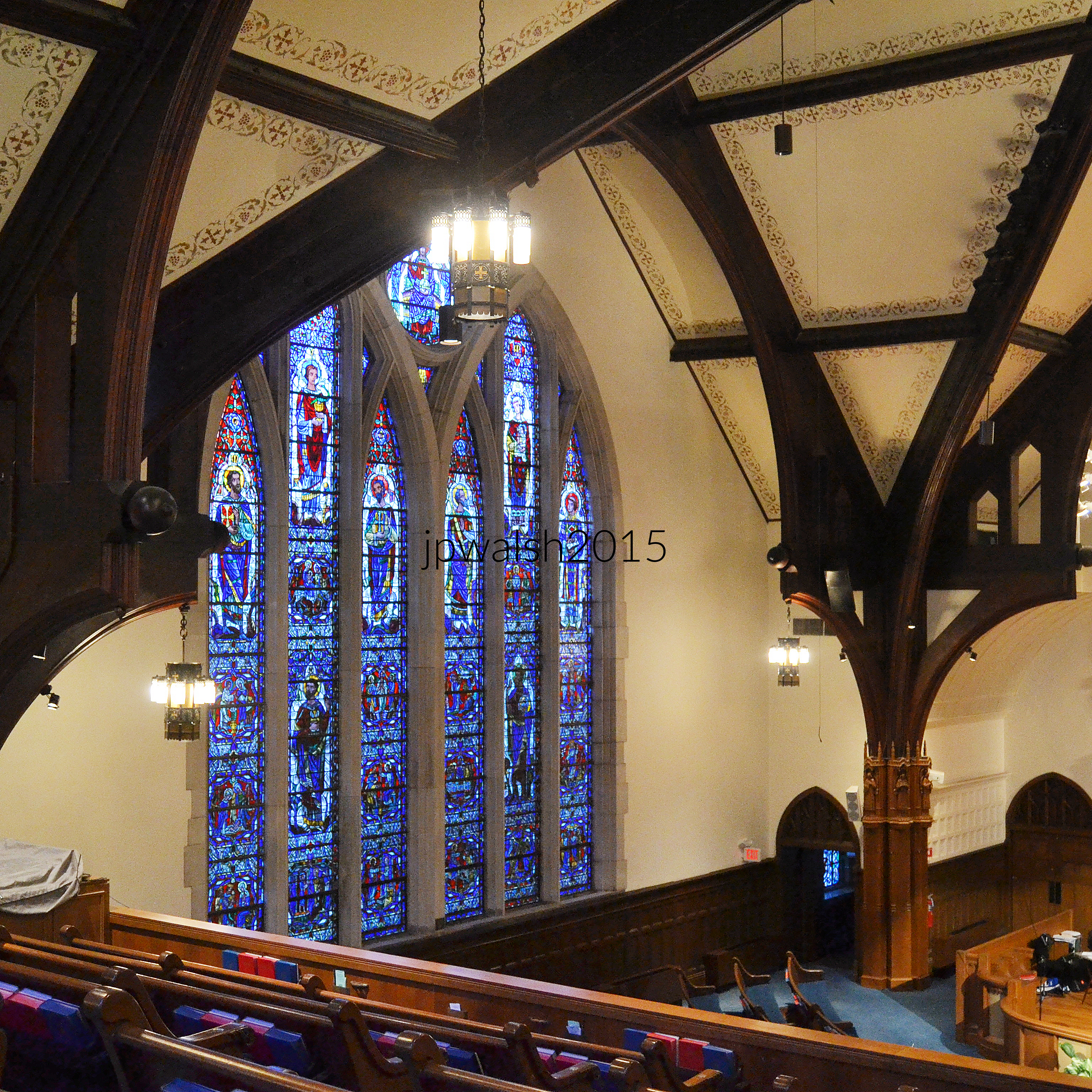
The sanctuary holds a capacity of over 1,000 worshippers. To ensure an inclusive worship space, Burnham utilized Nordic-style timber trusses to support the vaulted roof, completely eliminating major columns that would otherwise obstruct congregation views. The historic church building was constructed in 1895 by legendary architect Daniel H. Burnham, who was an Evanston resident himself at the time.
Daniel Hudson Burnham, c. 1890. The First Presbyterian of Evanston church building was designed in 1895 by architect Daniel Burnham (1846-1912) who lived in Evanston. Public Domain.
Musical Significance:
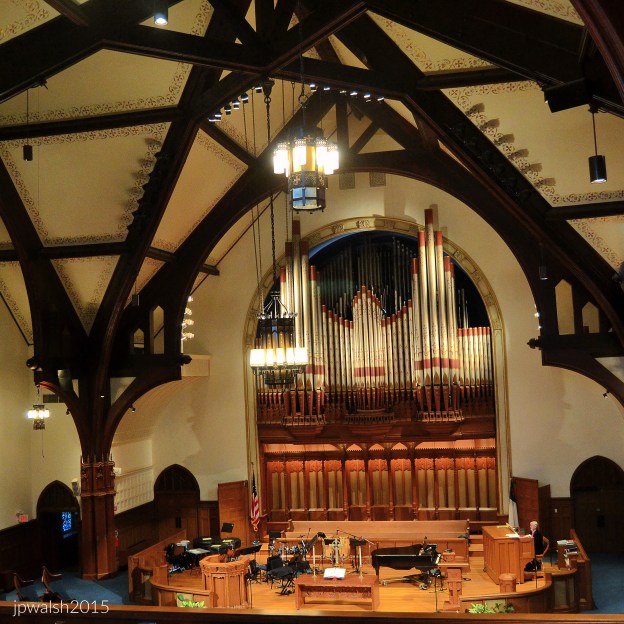
The church houses an acclaimed Aeolian Skinner organ—with portions dating directly back to the 1890s—which is widely recognized as one of the finest organs in the entire Chicago area.
The First Presbyterian Church of Evanston’s Aeolian Skinner organ is one of the finest organs in Chicagoland, portions of which date to the 1890s. October 2015. Author’s photograph.
Masterful Stained Glass:
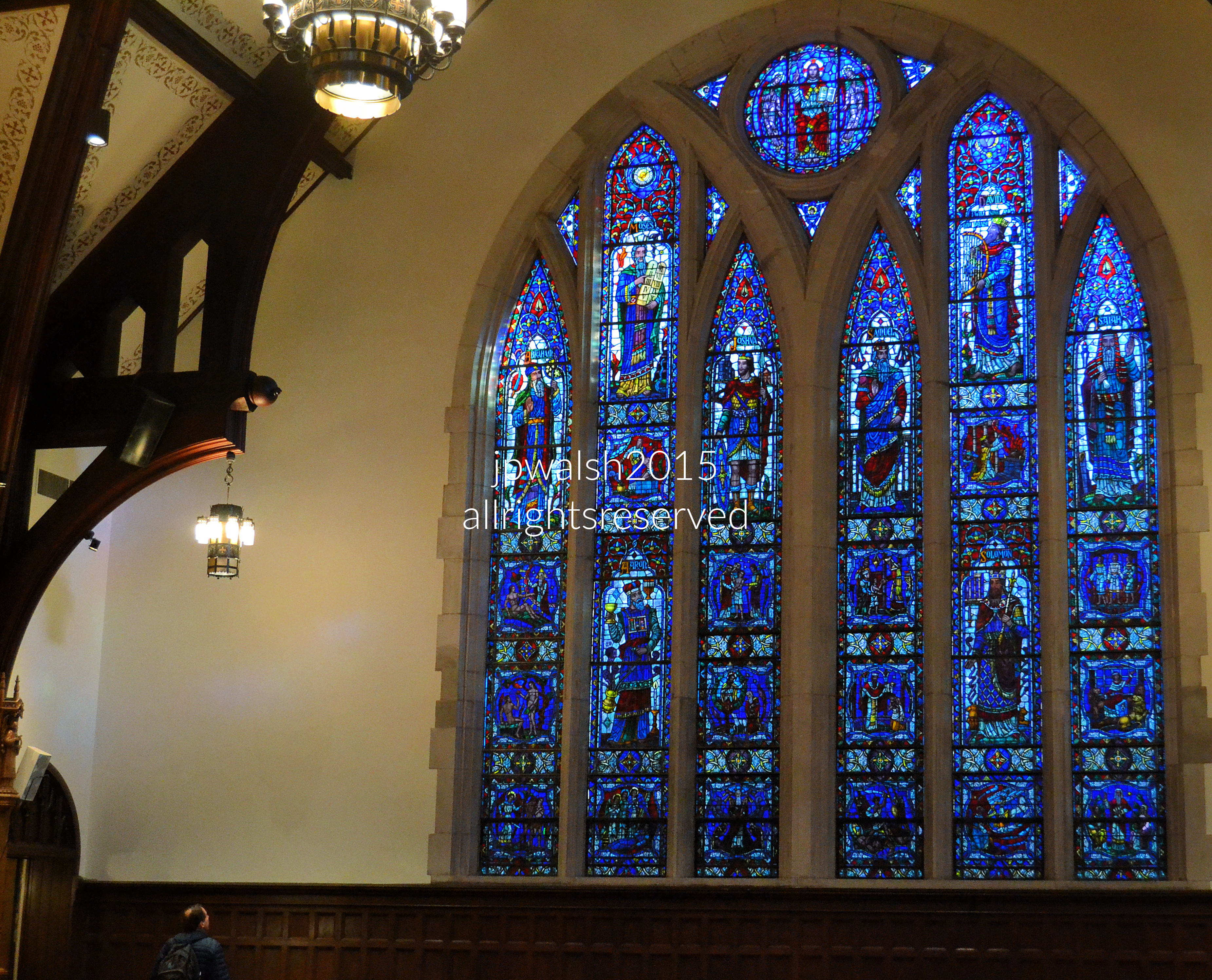
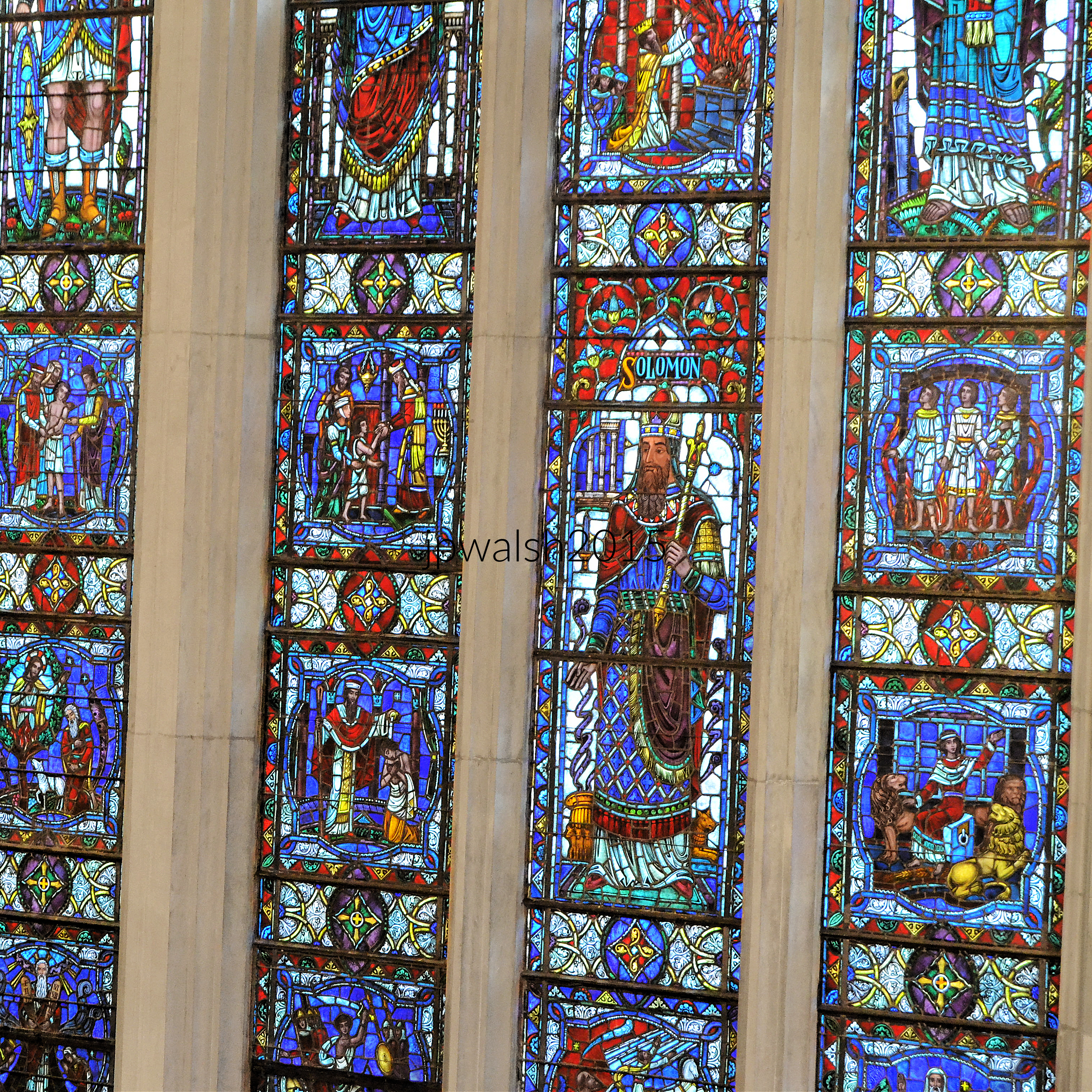
The interior is illuminated by dramatic, wall-filling arched stained-glass windows. These expansive artworks depict critical Biblical narratives, including the Creation and Fall of Adam and Eve, King Solomon, Moses, and Christ Ruler of the Universe.
Christ Ruler of the Universe. October 2015. Author’s photograph. 5.55mb
The main sanctuary window inside theFirst Presbyterian Church of Evanston. It was created by Charles J. Connick Studios, famous for his signature deep sapphire blue and medieval-style glazing techniques. October 2015. Author’s photograph. 5.46mb
Wall-filling arched stained-glass windows tell Old and New Testament stories. It was installed in 1947 as part of a post-war main sanctuary update to the 1895 Daniel Burnham-designed building. October 2015. Author’s photograph. 6.81mb
Burt J. Denman, born in Toledo, Ohio, was an engineering graduate of the University of Michigan who was vice president and general manager of the United Light Power Company. Denman was a leading Methodist layman and trustee of Northwestern University. October 2015. Author’s photograph. 2.76mb
One of the historic church’s dramatic wall-filling stained-glass windows. October 2015. Author’s photograph. 7.79mb 80%
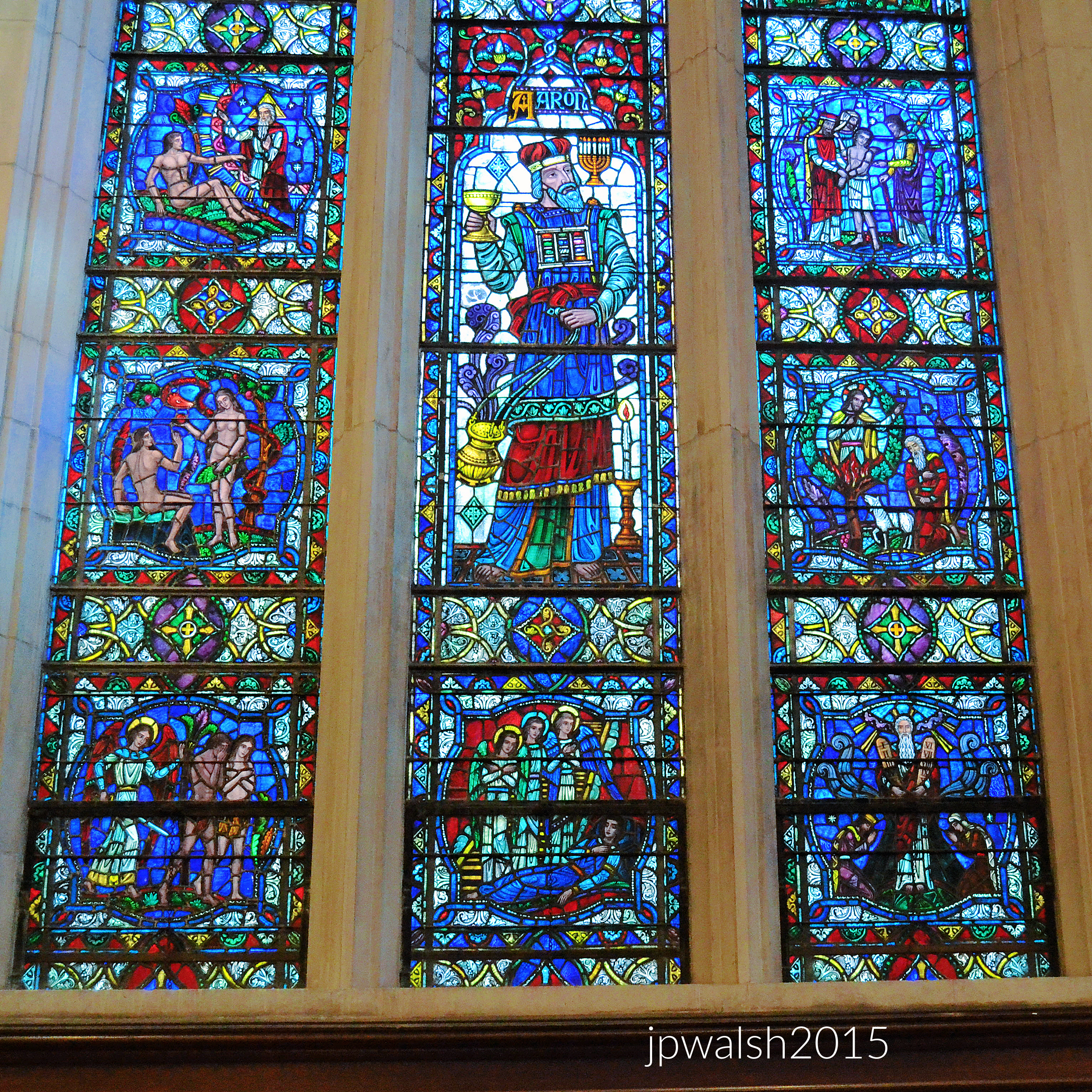
Creation of Adam; Fall of Adam and Eve; Expulsion from the Garden; Priest Aaron and brother of Moses; three angelic visitors to Abraham; the story of Moses. October 2015. Author’s photograph. 7.87mb 90%
King Solomon. October 2015. Author’s photograph. 7.81mb 98%
Material Composition:
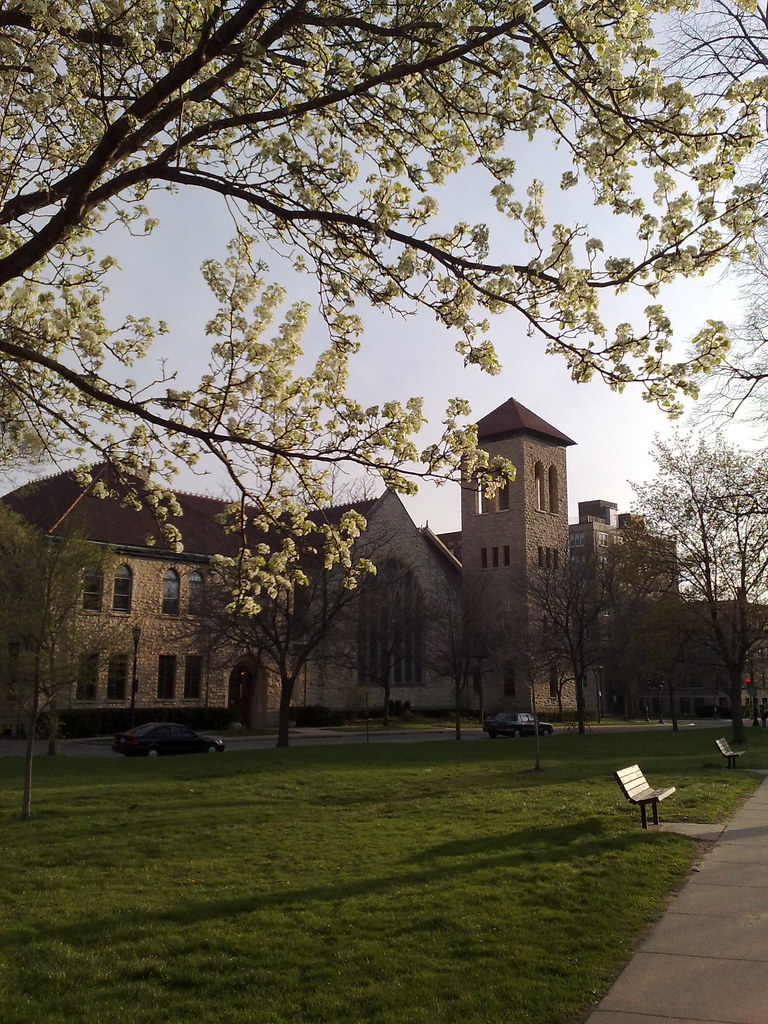
Built adjacent to Raymond Park, the Gothic Renaissance structure features massive Lemont limestone walls, a tile roof, and a striking 120-foot-tall bell tower featuring an open belfry.
From Raymond Park, stained glass window and limestone walls. October 2015. Author’s photograph. 5.35 mb
Historical Context of Raymond Park:
The neighboring park is named after Rev. Dr. Miner Raymond (1811–1897), a former cobbler who rose to become a professor of systematic theology at the Garrett Biblical Institute and a prominent leader in Northwestern University’s historical community.
Virtual American Biographies. “Miner Raymond.” Edited by James Grant Wilson and John Fiske. Appleton’s Cyclopedia of American Biography. Accessed January 10, 2024. http://www.famousamericans.net/minerraymond/.
FEATURE Image: Alice Millar Chapel, 1962, Northwestern University, Evanston, IL. October 2015. Author’s photograph. 6.78mb
The Alice Millar Chapel (1962) at Northwestern University, designed by architect Edward Grey Halstead, stands as a premier contemporary Gothic landmark on Chicago’s North Shore. Funded by philanthropist Foster G. McGaw, the chapel complex masterfully blends spiritual interfaith utility with striking architectural artistry, defined primarily by its immersive, wall-filling abstract stained-glass windows that symbolize the intersection of human, natural, and spiritual themes.
Text & Photographs John P. Walsh.
The Purpose of the Alice Millar Chapel
Breaking ground on Easter, April 21, 1962, the Alice Millar Chapel is on the campus of Northwestern University in Evanston, Illinois. The large chapel structure displaced 5 houses for the site’s four buildings on the school`s Evanston campus. It is intended as a space for prayer and reflection based in individual and communal tranquility, solitude, and celebration. At the chapel’s dedication its donor said, “[It is] a place where the soul may find quiet and repose—may be stimulated—or may just meditate. One’s character and personality cannot be fully developed unless his soul finds a purpose.” The chapel can seat over 700 people on the main floor.1
Northwestern University was founded by Methodists in 1851. At the beginning, there was no specific denominational affiliation that the university had. Alice Millar became a formal congregation in May 1971, identifying as “the church in the chapel.”2
The buildings complex (there are 4 buildings total) was designed by Edward Grey Halstead (1909-1992) who was senior partner in the Chicago architectural firm of Jensen, McClurg & Halstead. Mr. Halstead, who lived in Riverside and Wheaton, Illinois, joined the firm in 1952. The builder was Gerhardt F. Meyne Company in Chicago. Mr. Halstead was a third-generation architect born in Minnesota who studied at the University of Minnesota and University of Michigan. Though Halstead thought of himself as a hospital architect – his design projects include Elmhurst Memorial Hospital, Berwyn Community Hospital, Oak Park Hospital and Edward Hospital in Naperville – his largest project was the Alice Millar Chapel.3
Foster G. McGaw, noted philanthropist and founder of a major medical supply company based in Evanston, established the chapel in honor of his mother. Fair Use.
The contemporary Gothic landmark was built as a gift of Mr. & Mrs. Foster McGaw. Foster G. McGaw (1897–1986) was a noted philanthropist who founded the American Hospital Supply Corporation in Chicago in 1922. In 1985 McGaw’s company was acquired by Baxter Travenol Laboratories for $3.8 billion – about $11 billion in today’s dollars. Based in Evanston, at its peak, AHSC was the largest medical supplier in the world and employed thousands of Evanstonians.4 In 1953 Foster G. McGaw donated to the construction of McGaw Memorial Hall (today’s Welsh-Ryan Arena) in tribute to his father, Francis A. McGaw. At the time of construction, it was one of the largest auditoriums in Chicago. At its opening it was used in August 1954 for the Second Assembly of World Council of Churches founded in 1948 which showcased the convocation address by newly-elected President Dwight D. Eisenhower.5
Foster McGaw’s vision for the chapel was to establish a house of prayer whose space inspired the visitor to pursue a spiritual quest. Music concerts regularly appear on the chapel schedule with the chapel choir performing with in-house and guest musical ensembles and symphony orchestras. There are regular organ concerts on the 5,000-pipe organ. The Choir welcomes members from all different religious backgrounds and Sunday services to which all are welcome are given in a Protestant tradition. More interfaith activities at Millar Chapel include various faith traditions, including Muslims, Buddhists and Hindus, who pray and study at the chapel. Inspired by the interfaith witness of Rev. Dr. Martin Luther King, Jr. (1929-1968), there is a candlelight ceremony each year to honor the slain Civil Rights leader.
Who is Alice Millar?
Alice Millar for whom the chapel is named. Public Domain.
The chapel is dedicated to McGaw’s mother, Mrs. Alice Millar McGaw (1859-1910). Millar was born in Alnwick in the north of England. She studied music and notably performed a piano recital for Queen Victoria. She moved to the U.S. with her father, a medical doctor, and met and married Reverend Francis A. McGaw at McCormick Theological Seminary in September 1888. All four of her children were present at the dedication ceremony for the chapel in 1962. Alice Millar had died over 50 years earlier at Augustana Hospital (Swedish Evangelical) in Chicago’s Old Town.6
CHAPEL’S MOST STRIKING FEATURE ARE THE STAINED-GLASS WINDOWS.
The wall-filling windows of abstract and modern design allow light and color to stream into the sanctuary from every side of the chapel building. The modern-designed windows bestow to the chapel a literally awesome ambiance. These magnificent works of art include the east windows that face the sunrise of Lake Michigan (representing healing, law, discovery, literature and the arts) and the west windows that face the sunset of the prairie (representing commerce, space, communication, the State, and the human race). These side windows are in dialogue with the single chancel window with its theological themes.
Designed by Edward Grey Halstead as his career-defining project, featuring a blend of contemporary Gothic design and magnificent, thematic abstract stained-glass windows facing East (Lake Michigan) and West (the Prairie).
Across the breezeway and part of the chapel complex is the Jeanne Vail Meditation Chapel. Dedicated in 1963 it is a more traditional English style space built in memory of Mrs. Mary Vail McGaw’s daughter, Jeanne, who died in 1949 at 23 years old. The young woman died from complications of polio after having just given birth to a baby girl. Both the Alice Millar and Jeanne Vail Meditation Chapel are open daily and are very popular for weddings especially for Northwestern University alumni. The Vail Chapel seats 125 people. There is another adjacent building, Parkes Hall, that houses classrooms and the chaplain’s office and completes the complex.
Funded by philanthropist Foster G. McGaw in honor of his mother Alice Millar McGaw, and the smaller Jeanne Vail Meditation Chapel dedicated in memory of his daughter.
Alice Millar Chapel on the campus of Northwestern University in Evanston, Illinois, broke ground in 1962. Designed by Edward Grey Halstead of the Chicago architectural firm Jensen, McClurg & Halstead, the building is contemporary Gothic Revival or Modern Gothic constructed using light-colored stone walls, pointed arched windows, an intricate belfry spire, and a connecting arched stone cloister walkway. PHOTO: “File:Alice Millar Chapel – panoramio.jpg” by hakkun is licensed under CC BY-SA 3.0.
Jeanne Vail Meditation Chapel:
Unlike the abstract, mid-century modernist windows in the main Alice Millar sanctuary designed by Benoît Gilsoul, the Vail Chapel windows were designed and fabricated by Willet Stained Glass Studios explicitly in a traditional English Elizabethan style to create a quiet, contemplative atmosphere.
Vail Meditation Chapel windows (above and below) are in a traditional English Elizabethan style. October 2015. Author’s photograph. 7.73mb 98%
Vail Meditation Chapel windows. October 2015. Author’s photograph. 7.77mb
Jeanne Vail was a brilliant student, an accomplished pianist, and graduated cum laude from Denison University in 1946. Following graduation, she married Lewis Chamberlin Jr., and gave birth to their daughter, Nancy Carol, in 1949.
Tragically, just three months after her daughter was born, Jeanne contracted polio and died from complications of the virus at the young age of 23. It was in memory of her untimely death that her mother, Mary Wettling Vail McGaw, and stepfather, Foster G. McGaw, funded and dedicated the Jeanne Vail Meditation Chapel at Northwestern University in 1963.
Vail Meditation Chapel window (detail). October 2015. Author’s photograph. 3.56mb
Alice Millar Chapel: CHANCEL WINDOW
The Chancel Window behind the altar is a theological window using abstract motifsexploring themes of Creation, Redemption, and Triumph. The colors of these windows are spectacular and with sunlight penetrating through a jewel-like yet airy interior is created. October 2015. Author’s photograph. 7.71mb
Designed in 1962 by Belgian artist Benoît Gilsoul working under lead architect Edward Grey Halstead and fabricated by Willet Stained Glass Studios, this floor-to-ceiling masterpiece serves as the absolute focal point of the entire sanctuary.
The Theme & Why It Was Chosen
The great chancel window was designed to explicitly encompass all of biblical theology through the traditional abstract motifs of Creation, Redemption, and Triumph. This deep, theological anchor was purposefully chosen to provide a spiritual and transcendent foundation to ground the entire space.
Connection to the Rest of the Windows
Rather than standing alone, the chancel window is in an active visual dialogue with the side nave windows. While the side windows present more secular, academic themes relevant to university life such as law, discovery, healing, and space, they are physically and conceptually bridged together. All 12 windows utilize an overlapping, spectacular color scheme and stylized black arcs, seamlessly interweaving biblical symbolism with modern human knowledge to reflect the interfaith, holistic mission of the chapel.
Chancel window and side windows are in conversation with its subjects and themes. October 2015. Author’s photograph. 6.78mb
Altar with Chancel window behind. October 2015. Author’s photograph. 6.60mb
All 12 of the monumental leaded stained-glass windows in the Alice Millar Chapel were designed by Belgian artist Benoît Gilsoul with the full suite of windows being crafted and installed between 1962 and 1964. Gilsoul used the exact same overlapping color palette, stylized fluid lines, and geometric black framing arcs across all 12 panels, binding the secular side windows and the sacred chancel wall into one singular masterpiece.
EAST SIDE WINDOWS: LAW
LAW: Images of a dove. a sword and scales, human figures refer to law and justice. All the windows while presenting various thematic iconography maintain a similar color scheme throughout. October 2015. Author’s photograph. 7.53mb
EAST SIDE WINDOWS: HEALING
HEALING: Honoring the physician among recognizable tools of the profession – microscope, test tubes, the caduceus (staff with intertwined serpents), among others as the viewer looks up at the long window. October 2015. Author’s photograph. 6.07mb
EAST SIDE WINDOWS: DISCOVERY
DISCOVERY: Human discovery of the natural world. A central figure is surrounded by elements of air, earth, fire and water. There is bird, balloon, fish, deep-sea submersible (bathysphere), orbits. Again, the window’s height coupled with its colors and design is impressive. October 2015. Author’s photograph. 99% 7.93mb
EAST SIDE WINDOWS: LITERATURE
LITERATURE: Dove at the top represents the Holy Spirit who guides the hand of the Bible writer. Recognizable images are a cross; skull; human figures carrying grapes. October 2015. Author’s photograph. 6.37mb
EAST SIDE WINDOWS: ARTS
ARTS: Lyre; painter’s palette. October 2015. Author’s photograph. 6.05mb
Evolved from its original Protestant roots into a vibrant interfaith hub, hosting diverse groups, annual MLK commemorations, and public concerts utilizing its 5,000-pipe organ.
There are regular organ concerts at the chapel.
WEST SIDE WINDOWS: COMMUNICATIONS; THE STATE;HUMAN RACE
COMMUNICATIONS: Railroad crossing; filmstrip; the 5 senses; a telephone. THE STATE: Eagle with thunderbolts and olive branch; capitol dome; family; owl; cross, etc. RACES OF HUMANITY: lamb carrying cross; 5 hands; olive branch. October 2015. Author’s photograph. 7.78mb
WEST SIDE WINDOWS: COMMERCE
COMMERCE: Among abstracted symbols of commerce, wheat stack. October 2015. Author’s photograph. 4.13mb
WEST SIDE WINDOWS: SPACE
SPACE: Sun at top, planets, stars, constellations, a bull, astronaut. October 2015. Author’s photograph. 4.59mb
FEATURE image: At the top of the high altar’s retable in St. Michael Church in Chicago’s Old Town is the figure of St. Michael the Archangel, the parish church’s patron. St. Michael is mentioned in several places in both the Hebrew and Christian scriptures. The near northside Chicago parish has been administered by the Redemptorist Order since 1860. Author’s photograph.
In October 1871, the Great Chicago Fire reduced the surrounding neighborhood to absolute ash. Yet, the stone walls of St. Michael Church remained standing. Built by German immigrants, this Romanesque landmark stands as a literal monument to Chicago’s resilience. If you look closely at the historic brickwork, you can still trace the legacy of the fire. Inside, the structure holds a massive, hand-carved Bavarian high altar and towering stained-glass windows crafted by the renowned Mayer of Munich studio in Germany.
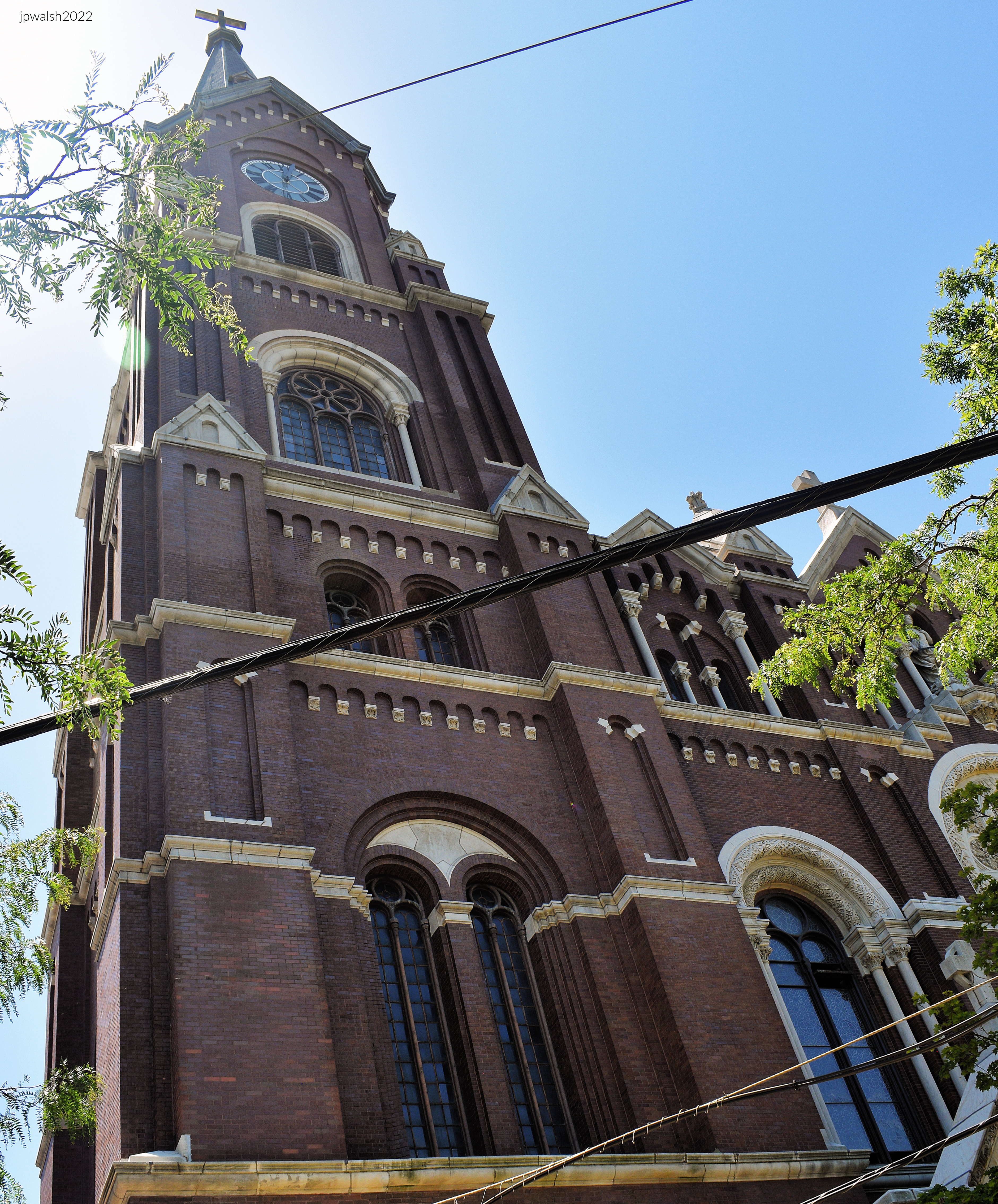
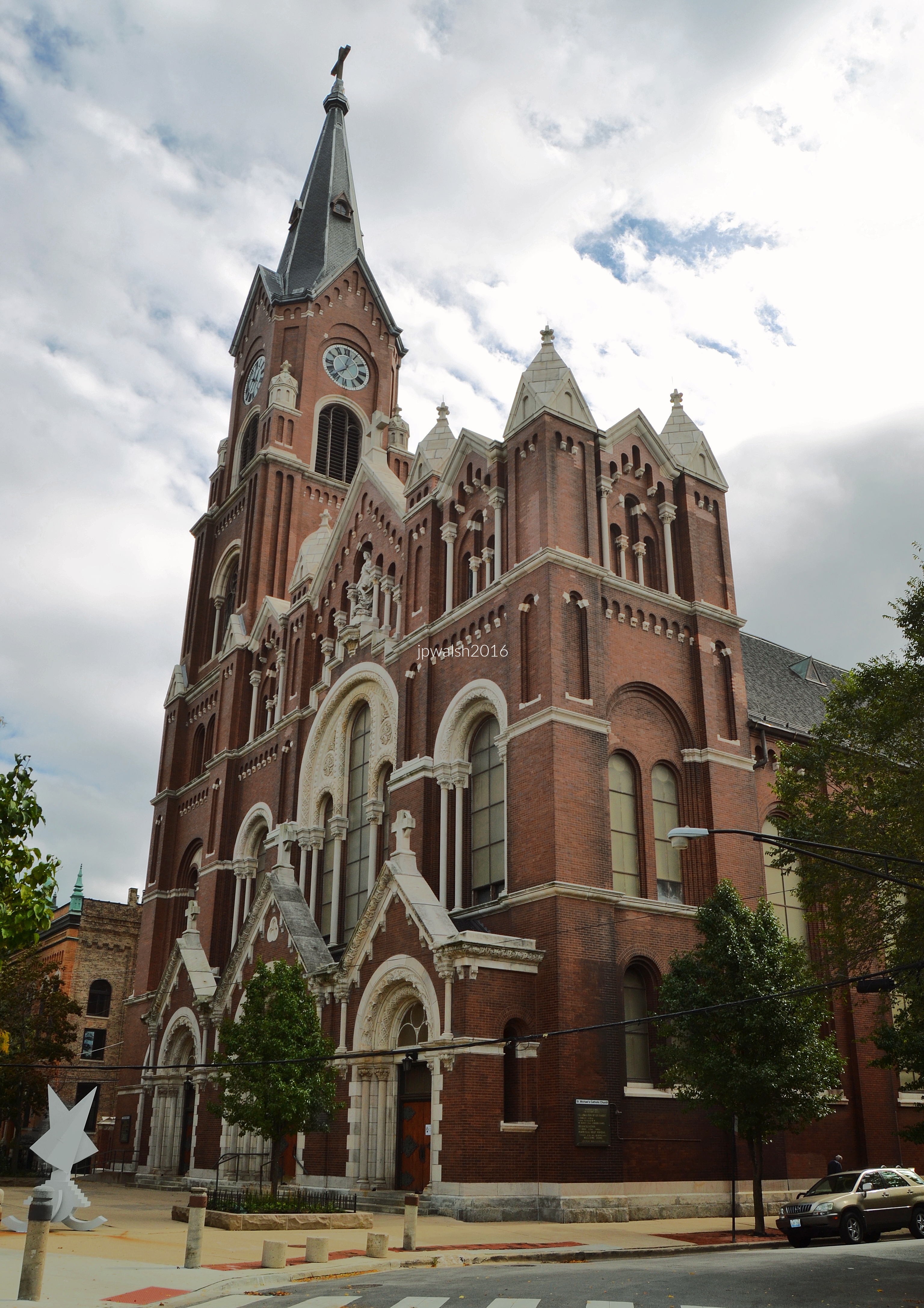
The great tower of St. Michael Church on the Near North Side of Chicago identifies the Old Town Triangle historic district. St. Michael Old Town Chicago. June 2022. Author’s photograph. 8.03mb
By John P. Walsh
The story is told that if you can hear the five 2-to-6-ton bells peel from the 290-feet-tall tower of St. Michael Church you live in Chicago’s Old Town. Yet it depends on which way the wind is blowing.
St. Michael Church is one of Chicago’s oldest parishes and church buildings. It was founded by German Catholics in 1852. From their arrival in the 1830s and 1840s until World War I, German immigrants of all faiths made up Chicago’s most numerous nationality.
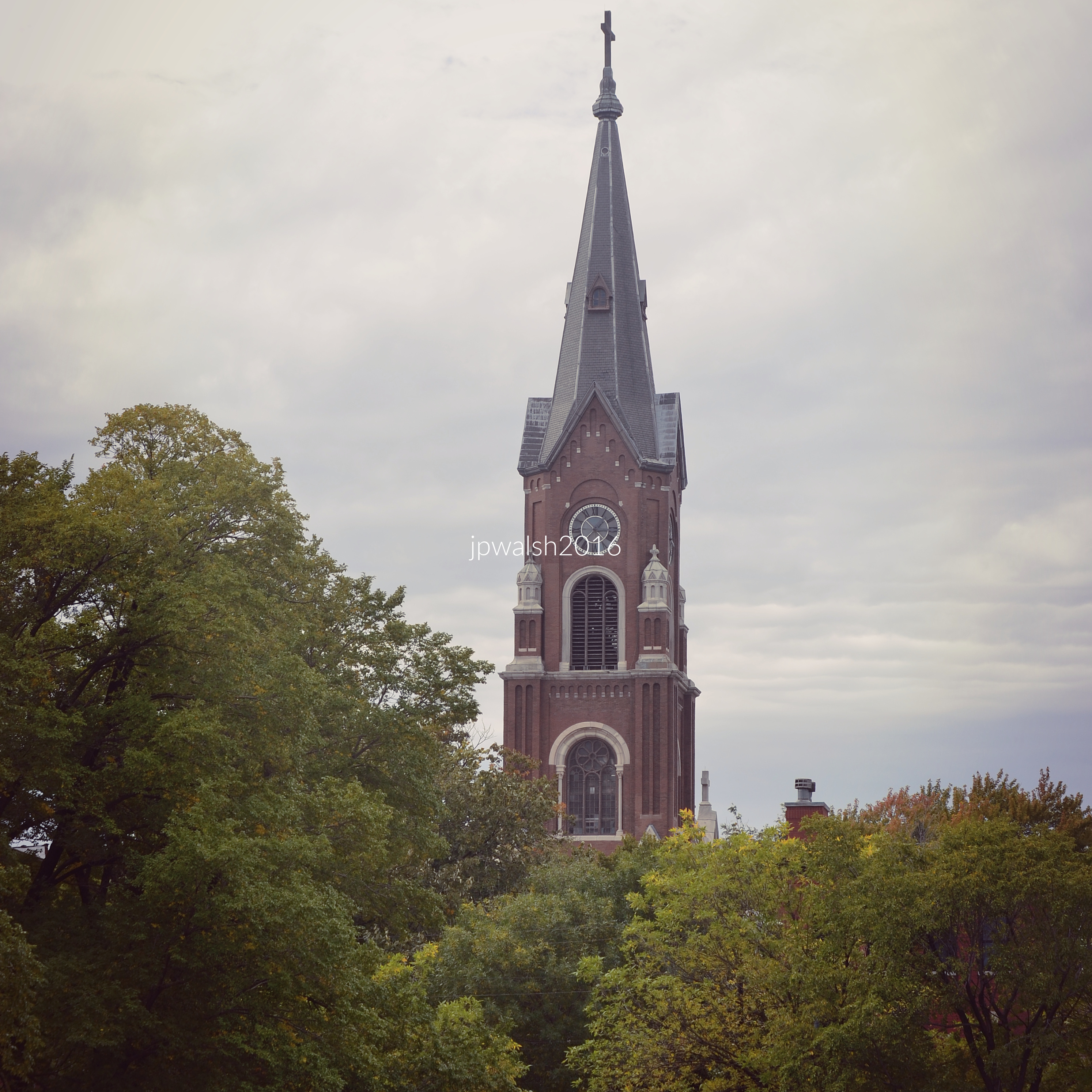
The bell tower of St. Michael Church in Chicago’s Old Town at 1633 N. Cleveland Avenue. From 1869 to 1885, this church tower was the tallest building in Chicago. It was surpassed by the old Board of Trade Building.
Saint Michael Old Town Chicago. October 2016. Author’s photograph. 2.31mb DSC_0941 (1)
German immigrants soon migrated out of downtown Chicago and about two miles north to North Avenue. The east-west thoroughfare became known as “German Broadway.”
This European immigrant community expanded to eventually settle a four-mile square area that was called “North Town.” St. Michael Church was situated in the virtual center of North Town on land donated by successful German-born Chicago businessman and brewer Michael Diversey (1810-1869). Diversey had immigrated to the United States in the 1830s from Saarland in western Germany.
Built on land donated by successful German-born brewer, businessman, and Chicago alderman Michael Diversey (1810–1869).
St. Michael Church stands on land donated expressly for the purpose of building it by successful German-American brewer Michael Diversey (1810-1869). Diversey emigrated from Germany in 1830, and by 1844 he was a Chicago alderman. The church is named after the wealthy beer maker’s patron saint, St Michael the Archangel, whose limestone figure stands in the high niche on the façade (see photograph below). Diversey’s so-called Chicago Brewery, first established in Chicago in 1839, grew to become one of the most extensive establishments of its kind in the West.
In 1876, five years after the Great Chicago Fire that ravaged the city, the rebuilt St. Michael Church raised five new bells cast by McShane Company into the tower. The four-sided clock was installed in 1888. Atop the steeple, a twenty-four-foot-tall cross weighs over one ton.
St. Michael Old Town Chicago. June 2022. Author’s photograph. 18.70mb
The church building is built of red brick with limestone trim in the Romanesque style. Construction started in 1866 and was finished three years later. In 1871 the new building was virtually destroyed in the Great Chicago Fire along with its North Town neighborhood. Only the church’s exterior walls remained. Using these existing walls, the fire-gutted St. Michael Church was rebuilt and rededicated in 1873. Ashes from that infamous conflagration can still be seen in the church’s basement.
St. Michael Old Town Chicago. June 2022. Author’s photograph. 11.43 mb
Gabled three-portal main entrance (above) was added to the façade in 1913 by a Chicago architect. The architectural design harkens back to the cathedrals of Europe.
Redecorated for its 1902 Golden Jubilee, the church features extensive European craft, including a 56-foot wood-carved Main Altar by the E. Hackner Company, stained glass by Franz Mayer & Co. of Munich, and a certified 1870 replica of the Mother of Perpetual Help icon that survived the 1871 fire intact.
St. Michael Old Town. Main altar at one end of a 190-foot central nave.June 2022. Author’s photograph. 10.01 mb
The church was gutted by the Great Chicago Fire of 1871, leaving only the exterior red brick walls. It was rapidly rebuilt and rededicated using those same walls in 1873.
St. Michael Church, Chicago. February 2013. Author’s phtograph.
St. Michael Church, Chicago. Main Altar. February 2013. Author’s phtograph.
The Main Altar of the Angels, dating from 1902, is a cacophony of German-style wood carving whose immense weight required the building of its own foundation.
In 1851 when St Michael was founded, Chicago’s total population was around 30,000 making it the twenty-fourth largest city in the United States.
Ten years later, in 1860, right before the outbreak of the American Civil War, Chicago’s population had nearly quadrupled and ranked in the nation’s top ten largest cities.
Chicago’s Catholic Church hierarchy in the middle of the nineteenth century was mostly Irish. These English-speaking bishops relied on religious orders to handle a tidal wave of non-English-speaking immigrants to Chicago, including the Germans.
In 1860, the St. Michael Church parish was entrusted to the Redemptorists, a religious order founded in 1748 in Italy. The Redemptorists with their German congregation built the St. Michael Church in Old Town that stands today. Over 170 years later, the Redemptorist order continues to shepherd the parish.
St. Michael Old Town Chicago. June 2022. Author’s photograph. 14.16 mb
A peaceful, breathtaking sanctuary in the middle of a bustling neighborhood.
June 2022. St. Michael Old Town Chicago 12.62 mb
A mosaic of Saint Michael the Archangel (above) in the floor at the entrance of the church. “Archangel” is a title that signifies he is the leader of all God’s angels.
The mosaic of the patron angel in the floor starts the church’s 190-foot-long nave. It is one of the many religious images—others in stone, wood and paint—that constitutes the interior and exterior decoration of St. Michael Church.
St. Michael the Archangel is mentioned four times in the Bible: twice in the Book of Daniel and in the Epistle of Jude and the Book of Revelation. In the Book of Daniel, St. Michael the archangel helps the prophet Daniel and is linked to the “end times” of the world. In the Epistle of Jude, St. Michael the archangel guards the tombs of Eve and Moses and combats Satan to protect these holy sites.
In the Book of Revelation St. Michael and his angels do battle with the “dragon.” In addition to being charged with expelling Satan from Heaven (as depicted in the retable), St. Michael is charged with the care of all departed souls to introduce them to the holy light. St. Michael the Archangel is the patron saint of soldiers, police, and doctors.
St. Michael Old Town Chicago. June 2022. Author’s photograph. 20%
Detail of the Main Altar retable depicts St. Michael the archangel in the traditional iconography of armor with sword and shield casting Satan out of Heaven by God’s command. St. Michael the Archangel is the patron saint of soldiers, police, and doctors.
The spacious, airy, and dramatic church sanctuary today looks basically as it did by 1902. The motivation for the church’s extensive redecoration in 1902 was its Golden Jubilee as well as one expression of the parishioners’ decided prosperity by the later 1890s.
Created and installed by Mayer & Company of Munich for St. Michael Church’s Golden Jubilee in 1902, the tall and thin stained glass windows —the fourth set of windows to be installed into architect August Walbaum’s original design— depicted Biblical and other scenes. The window’s artistic technique drew upon centuries of European craft and design – and were recently cleaned in 2012.
The stunning stained glass was crafted by the famous Mayer of Munich in Germany.
Annunciation to Mary Window (Luke 1: 26-38. St. Michael Old Town Chicago. Annunciation to Mary Window (Luke 1: 26-38). Mary’s virginal conception of Jesus is stated explicitly in verses 34-35. In Hebrew her name, Miryām, means “exalted one.” June 2022. Author’s photograph. 10.71 mb
In that Jubilee year, the stained glass was installed along with the 56-foot-high carved wood retable of the High (or main) Altar of the Angels. Though there are five altars in St. Michael Church, the main altar is the most spectacular, drawing the eye forward and upward from practically anywhere in the church. Crowning this painted construct—which is so heavy that it required a new local foundation to be dug for it—is the figure of St. Michael the Archangel described in the Book of Revelation. The angel is garbed in his panzer (“armor”) running rebellious angels out of heaven. St. Michael is flanked by the archangels Gabriel and Raphael. Nine choirs of angels and the saints Peter and Paul are also depicted in wood. Smaller human figures depict the four evangelists identified by their Christian symbols—specifically, the Winged Man (Matthew), Winged Lion (Mark), Winged Ox (Luke) and Eagle (John). All five altars were made by E. Hackner Company of La Crosse, Wisconsin, an early twentieth century designer, manufacturer and importer of artistic ecclesiastic furnishings.
St. Michael Church, Chicago.Annunciation Window, detail (above), Franz Mayer & Co. of Munich. The angel Gabriel’s greeting, “Hail, full of grace,” is a greeting that is full of peace, joy and wisdom. Mary is the object of God’s grace and favor and is shown to be chosen for a long time past. The depiction of lilies, whether in the angel’s hand or arranged into a bouquet by Mary’s side, is traditional imagery for purity. February 2013. Author’s photograph.
In 1869 the St. Michael Church building cost over $130,000 to build which is approximately $2.65 million today. After the fire the repairs in 1872 cost an additional $40,000 plus unknown amounts of insurance money–or upwards of $700,000 today. Reconstruction did not include the stained glass windows which were installed in 1902. For a history of the stained glass in St. Michael church go to: https://johnpwalshblog.com/2016/05/10/angels-in-stained-glass-1902-complete-st-michael-church-in-old-town-chicago/.
St. Michael Church, Chicago. Anointing of Jesus by Mary Magdalene at Bethany Window, 1902, Franz Mayer & Co., Munich. This stained-glass window depicts the anointing of Jesus at Bethany by the sinful woman traditionally identified as Mary Magdalene. Although the Gospel accounts differ in certain details, all four describe a meal in a house during which a woman pours costly ointment upon Jesus, prompting objections from some of those present. In Mark’s account (Mark 14:3), the ointment is identified as pure nard, a perfume of extraordinary value estimated at more than a year’s wages (Mark 14:5). Luke’s Gospel recounts a woman known for her sinful life who anoints Jesus’ feet while weeping; her tears fall upon his feet, which she then kisses and wipes with her hair (Luke 7:38). While none of the biblical texts explicitly identify this woman as Mary Magdalene, Christian tradition and artistic iconography have long associated her with the figure portrayed in these Gospel narratives.Spikenard was grown in India, China, and Nepal and known in ancient Rome where it was used as a cooking agent. By the time of Jesus, in the early Roman Empire, spikenard was used primarily in perfume. May 2016.Author’s photograph,
Coat of Arms of Pope Francis (2013-2025). According to the Vatican, the image of the plant to the right of the star on the blue background is spikenard and represents St. Joseph.
St. Michael Church, Chicago. Let the Little Children Come to Me Window. During Jesus’ public ministry, crowds frequently gathered around him, bringing not only themselves but also their children and even their infants to receive his blessing. The disciples attempted to turn them away, but Jesus rebuked them. His well-known words, recorded in all three Synoptic Gospels (Matthew 19:14, Mark 10:14, and Luke 18:16), affirm the special place of children in the Kingdom of God: “Let the little children come to me; do not prevent them, for the kingdom of God belongs to such as these.” He continued, “Amen, I say to you, whoever does not accept the kingdom of God like a child will not enter it” (Mark 10:14-15). This stained-glass window commemorates one of the most beloved episodes in the Gospels, emphasizing the humility, trust, and openness that Jesus presented as models of faith. Author’s photograph.
June 2022. St. Michael Old Town Chicago 12.82 mb
St. Michael Church, Chicago.Sacred Heart Window. The first of four great visions in which Jesus Christ revealed his Sacred Heart to French nun St. Margaret Mary Alacoque (1647-1690) took place on December 27, 1673, in her Visitation convent in Paray-le-Monial in Burgundy France. In each of these visions Christ revealed messages that the young saint was to communicate. The greatest of all the visions took place in 1676. Before the Tabernacle on the altar that exposed the Eucharist, Jesus said: “Behold this Heart which has so loved mankind, that it has spared nothing, even to exhausting and consuming itself in order to demonstrate and prove its love for them.” St. Margaret Mary was ordered by her confessor, St. Claude de la Colombière, a Jesuit priest, to write down all her visions. Afterwards, the saint suffered great persecutions from the Church and others for these visions until she fell ill and died in 1690 at 43 years old. She was beatified in 1864 and canonized in 1920. Author’s photograph.
August 2017. Christmas Window (detail). 76% 7.97 mb DSC_0980 (1)August 2017. Ascension Window (detail). 80% 7.74mb DSC_0985August 2017. Jesus at age 12 in the Temple(detail). 80% 7.74mb DSC_0985
The passage describing Jesus at age twelve in the temple appears in Luke 2:41–52, the one place in the canonical Gospels that steps beyond the infancy stories to show him in early adolescence. It offers a rare look at his formative years and stands as the only sustained biblical account of his childhood.
Ceiling mural.
St. Michael Church, Chicago. Central nave ceiling mural includes symbolic depictions of the four evangelists: the Winged Man (Matthew); Winged Lion (Mark); Winged Ox (Luke); Eagle (John). Its filigree evokes medieval illuminated manuscripts and perhaps is inspired by a scene painted in the 15th century in the dome of The Basilica of St Mark in Venice. February 2013. Author’s photograph.
Original Pulpit.
St. Michael Old Town Chicago. June 2022. Author’s photograph. 15.27 mb
This magnificent, elevated pulpit inside St. Michael Church in Chicago’s Old Town is a masterwork of historic liturgical art. While the church building itself was rebuilt immediately after the Great Chicago Fire in 1873, the highly detailed altars and intricate interior wood carvings are largely attributed to the grand 1902 Golden Jubilee renovation by the E. Hackner Company. The design combines elements of Romanesque Revival and Bavarian Baroque styles, relying on theology built directly into the woodwork.
Deep-Rooted Symbolism
The Scallop Shell Canopy: The massive scallop shell serving as the soundboard (abat-voix) holds a double meaning. In Catholic tradition, the shell is the universal symbol of pilgrimage (specifically the Camino de Santiago) and baptismal rebirth. It reminds the listener that the Word being preached guides the soul’s earthly journey.
The Dove of the Holy Spirit: Tacked at the very top underside of the shell canopy is a carved white dove. It is positioned above the priest’s head, symbolizing that the words spoken from this pulpit should be directly inspired by the Holy Spirit.
The Ten Commandments: Directly below the shell, two overlapping tablets showing Roman numerals I through X represent the law given to Moses, rooting the New Testament preaching firmly in Old Testament foundational law.
The Carved Figures: In addition to the two angels holding up the shell, surrounding the octagonal basket of the pulpit are niche carvings depicting prominent Church figures, popes, or bishops—identifiable by their liturgical mitres and croziers—representing the historic lineage, authority, and continuity of Catholic teaching.
St. Michael Old Town Chicago. June 2022. Author’s photograph. 19.11 mb
As with other American church building adaptations of earlier European architectural styles, the use of Romanesque rounded arches and corbels accentuated the use of Gothic-style glass in Chicago’s Old Town Roman Catholic church.
St. Michael Old Town Chicago. June 2022. Author’s photograph. 20%
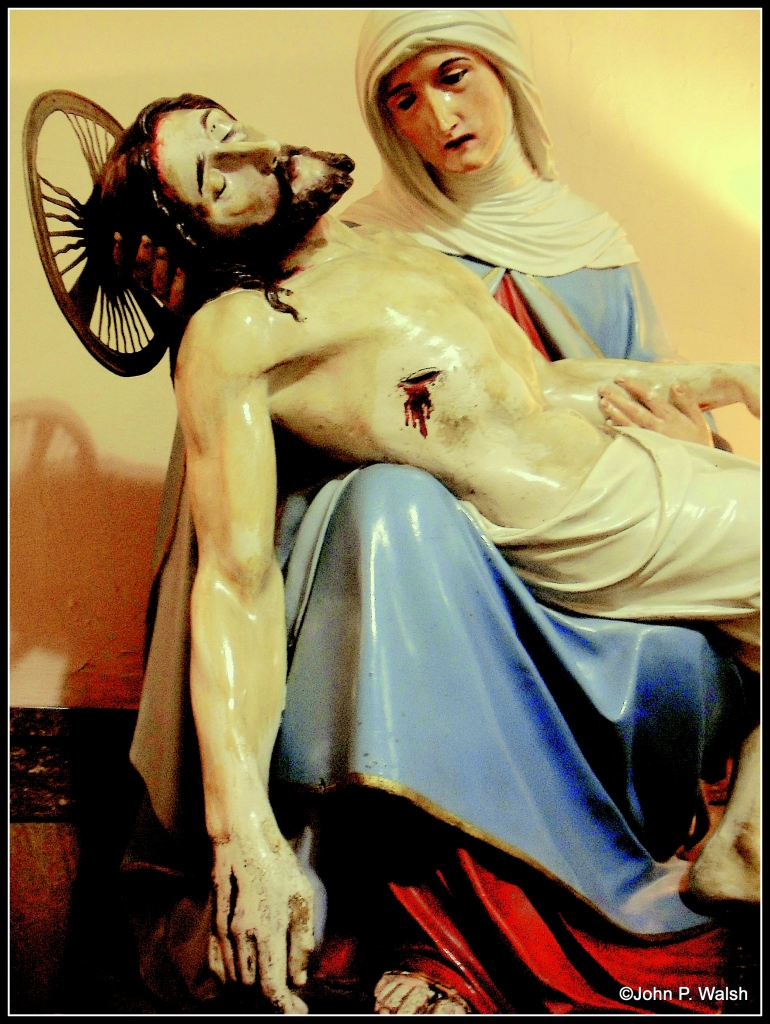
Pietà, copy of a 16th-century Swabian-style artwork made around 1913.
June 2022. St. Michael Old Town Chicago 7.8mb 70%.
This devotional and deeply moving Pietà is in the foyer of St. Michael Church. The foyer (narthex) acts as the boundary between the chaotic, bustling streets of Chicago’s Old Town and the sacred interior of the sanctuary. Encountering the raw vulnerability of the Pietà forces an immediate pause, inviting quiet reflection and reverence. By placing a monument of profound maternal grief right at the entrance, the church sends an unspoken message to its community: bring your sorrows inside. It reassures visitors that the church is a sanctuary for those carrying heavy burdens.
Though the heartbreaking image of the Virgin Mary cradling the dead body of Jesus after the Crucifixion emerged from Late Medieval and Renaissance European devotion, German and especially Swabian Pietàs often emphasized intense human suffering, a devotional sensibility sometimes described as dolorism. Swabia, a historic region of southwestern Germany, was renowned during the late fifteenth and early sixteenth centuries for its emotionally charged religious woodcarvings, produced by masters such as Michel Erhart and Jörg Syrlin. Unlike Michelangelo’s serene and idealized marble Pietà in St. Peter’s Basilica, these German works frequently stressed the physical wounds of Christ and the overwhelming grief of his mother, encouraging worshippers to contemplate the realities of sacrifice, death, and redemption through an intensely personal and emotional encounter.
Pieta. St. Michael Church, Chicago. February 2013. Author’s photograph.
Emotional Realism
The Sorrow of Mary: Mary is depicted not as a youthful queen, but as a grieving mother. Her face is heavy with sorrow, her head tilted tenderly over her son, and her heavy drapery realistically bundles around her figure, grounding the scene in heavy, earthbound grief.
The Wounds of Christ: The sculpture vividly details the physical toll of the Passion. The spear wound in Christ’s side (the Holy Wound) is prominently visible and painted with realistic blood droplets, a hallmark of Northern European devotional art designed to evoke deep empathy (compassio) from the viewer.
Sacred Heart side altar.The Sacred Heart side altar (east nave). In addition to the central statue of Christ are those depicting Redemptorist Order founder, St. Alphonsus Liguori (Italian, 1696-1787) and Discalced Carmelite Order founder, St. Teresa of Avila (Spanish, 1515-1582). February 2013. Author’s photograph.
St. Michael Old Town Chicago. St. Joseph altar (west nave) with a mural above it of Redemptorists before Christ’s Heavenly throne. In this photograph’s foreground at right is a wood confessional box. Italian-born St. Alphonsus Liguori, founder of the Redemptorists, was highly educated and spent much of his life hearing the confessions of the ordinary peopleas a home missionary in his city of Naples, Italy. June 2022. Author’s photograph. 25%
Side altar honors Mary, Mother of Perpetual Help.
St. Michael Old Town Chicago. The Redemptorists—a Catholic religious order founded in Italy by St. Alphonsus Liguori—became the custodians of this icon long after their founder’s death. On December 11, 1865, Pope Pius IX formally entrusted the original 15th‑century Byzantine icon to the order, handing it to Father Nicholas Mauron, the Redemptorist Superior General in Rome. By April 1866, the original icon was placed on public display at the Church of Saint Alphonsus on Rome’s Esquiline Hill, where it remains permanently enshrined. June 2022. Author’s photograph. 12.53 mb
Following the Pope’s directive to “make her known throughout the world,” the Redemptorists began distributing authorized copies to their missions and parishes. In 1870, one of the first four official copies sent to the United States was dispatched to St. Michael Church in Chicago. Although not placed directly into the pastor’s hands by the Pope, it was a certified first‑generation replica produced under the authority of the 1865 decree.
After the Great Chicago Fire of 1871, the Chicago icon was recovered intact from the rubble—an event taken as a sign to rebuild the church. It was later installed in the present German Baroque‑style retable.
The icon of Our Lady of Perpetual Help is regarded as miraculous because of centuries of reported healings, apparitions, and its own improbable survival. In 1798, French revolutionary forces destroyed San Matteo, the church where it had been housed in Rome. Augustinian monks rescued the icon and hid it; it remained forgotten for decades until the 1860s, when an elderly Augustinian friar and a former altar server—by then a Redemptorist priest—identified it.
When the icon was restored to public veneration on April 26, 1866, a major street procession accompanied its installation at Saint Alphonsus in Rome. Contemporary accounts record several immediate physical cures among the crowd. In the decades that followed, the Redemptorists documented hundreds of unexplained medical healings associated with prayers before the image.
Because of this long record of devotion, survival, and reported grace, the Vatican crowned the icon with gold and precious stones in 1867, a distinction reserved for ancient images linked to extraordinary divine favors. August 2017 Author’s photograph. 78% 7.75mb DSC_0981
The Stations of the Cross at St. Michael Church
Second and Third Stations of the Cross. June 2022. Author’s photograph. 12.60 mb
These magnificent high-relief panels depict the Second and Third Stations of the Cross, Jesus Is Laden with the Cross and Jesus Falls the First Time. Installed during St. Michael Church’s extensive late nineteenth- and early twentieth-century decorative campaigns, they are exceptional examples of European-influenced polychrome plaster relief sculpture. Rich in color, depth, and dramatic expression, the panels were created to draw worshippers into a meditative participation in Christ’s Passion, transforming sacred history into a vivid devotional experience.
St. Alphonsus Liguori and the Modern Stations
The fourteen traditional Stations of the Cross found in churches throughout the world today were codified in 1761 by St. Alphonsus Liguori (1696-1787). One of the most accomplished figures of the eighteenth-century Catholic Church, Liguori was a bishop, theologian, philosopher, lawyer, poet, composer, musician, artist, spiritual writer, and founder of a religious order. His reflections on Christ’s Passion became enormously influential because of their ability to move the faithful toward prayer, humility, repentance, and a deeper appreciation of Christ’s sacrifice.
Born in Naples in 1696, Liguori initially pursued a distinguished legal career before discerning a vocation to the priesthood and being ordained in 1726. Though his parents were devout Catholics, they were disappointed by his decision, in part because the clergy of the era often suffered from a reputation for corruption and worldliness. Liguori nevertheless devoted his life to pastoral ministry, becoming especially beloved for his work among ordinary people, spending countless hours hearing confessions and serving as a missionary in and around Naples.
Scholar, Bishop, and Founder
In 1732, Liguori founded the Congregation of the Most Holy Redeemer, better known as the Redemptorists, a religious community dedicated to preaching missions and serving the spiritual needs of ordinary people. His influential work Moral Theology, published in 1748, received papal approbation and helped establish his reputation as one of the Church’s foremost moral theologians. He was appointed a bishop in 1762 and, nearly a century after his death, was declared a Doctor of the Church in 1871, recognizing the enduring value of his theological and spiritual writings.
The Redemptorists and St. Michael Church
The connection between St. Alphonsus and St. Michael Church is more than devotional. In 1860, the parish was entrusted to the Redemptorists, who ministered to Chicago’s growing German Catholic population. Under their leadership, the present church was completed in 1869 in the Old Town neighborhood. Remarkably, it survived the Great Chicago Fire of 1871 and continues to stand as one of the city’s most important historic churches. More than 165 years after their arrival, the Redemptorists remain entrusted with the spiritual care of the parish.
A Living Tradition of Devotion
The Stations of the Cross at St. Michael are therefore more than decorative works of religious art. They embody a devotional tradition shaped by St. Alphonsus Liguori, preserved by the Redemptorists, and passed down through generations of Chicago Catholics. Through their vivid imagery and emotional power, these sculptures continue to invite worshippers to walk spiritually beside Christ on the road to Calvary, reflecting on suffering, sacrifice, redemption, and hope.
St. Michael Old Town. June 2022 5.83mb DSC_5296 (1)
Conclusion
The Rise of German Chicago
The history of St. Michael Church is inseparable from the rise of Chicago itself. In scarcely half a century, Chicago transformed from a frontier settlement built on low, marshy ground into the second-largest city in the United States. As railroads, industry, and commerce propelled the city onto the national stage, German immigrants emerged as one of its most influential communities, shaping neighborhoods, churches, schools, businesses, associations, and civic life.
The Age of Deutschtum
Between the Great Fire of 1871 and the years following World War I, Chicago’s astonishing growth coincided with the flourishing of Deutschtum, or “Germanness.” German-language newspapers, singing societies, breweries, social clubs, educational institutions, and Roman Catholic parishes formed a vibrant cultural world that touched nearly every aspect of urban life. St. Michael Church stood not only as a place of worship but also as an expression of the confidence, prosperity, and cultural identity of German Chicago during its height.
The End of an Era
Yet the prominence of German Chicago proved less permanent than the architecture its community left behind. The defeat of Imperial Germany in World War I unleashed powerful currents of anti-German sentiment across the United States and accelerated pressures toward assimilation. Institutions that had once proudly proclaimed their German heritage increasingly abandoned the language and public expressions of ethnic identity. By the eve of World War II, much of the cultural hegemony that Germans had exercised in Chicago for generations had largely disappeared.
A Lasting Legacy
Although Deutschtum faded as a public cultural force, its legacy remains embedded in Chicago’s built environment. Churches such as St. Michael preserve the artistic, religious, and historical aspirations of the immigrant community that helped transform Chicago from a frontier town into a world city. Their architecture and stained glass stand today as enduring witnesses to the rise, influence, and eventual assimilation of one of the city’s most important ethnic populations.
Saint Michael Old Town Chicago. October 2016. 4.52mb DSC_0836 (5)
Sources: G. Lane and A. Kezys, Chicago Churches and Synogogues. P. d’A Jones and M.G. Holli, Ethnic Chicago. D.A. Pacyga and E. Skerrett, Chicago, City of Neighborhoods. D. McNamara, Heavenly City. The Saints: A Concise Biographical Dictionary, edited by John Coulson, Guild Press, New York, 1957. The New American Bible, Catholic Book Publishing Corp, New York, 1993. Catechism of the Catholic Church, 2nd Edition, Doubleday, New York, 1997. The Jerome Biblical Commentary, edited by Raymond E. Brown, S.S., Joseph a Fitzmyer, S.J., and Roland E. Murphy, O. Carm., 1982. St. Michael Church website. https://iamjesus.net/traditional-stations-of-the-cross/https://www.emporis.com/buildings/136851/st-michael-church-chicago-il-usa
Photographs taken by author in February 2013; May and October 2016; June 2022.
This explanatory article may be periodically updated.
More of St. Michael Church in Old Town, Chicago? Please see: