Feature Image: Chicago. October 2015. Author’s photograph. 5.85mb DSCN1452 (1).
Chicago’s skyline demonstrates how architecture, engineering, and urban design combine to create one of the world’s most recognizable cityscapes, where individual landmarks become part of a larger visual composition of steel, stone, glass, light, and ambition.
Chicago skyline from Museum Campus promontory (Northerly Island). October 2016. Author’s photograph. 4.90mb DSC_0104 (1)
Chicago. October 2015. Author’s photograph. 5.85mb DSCN1452 (1).
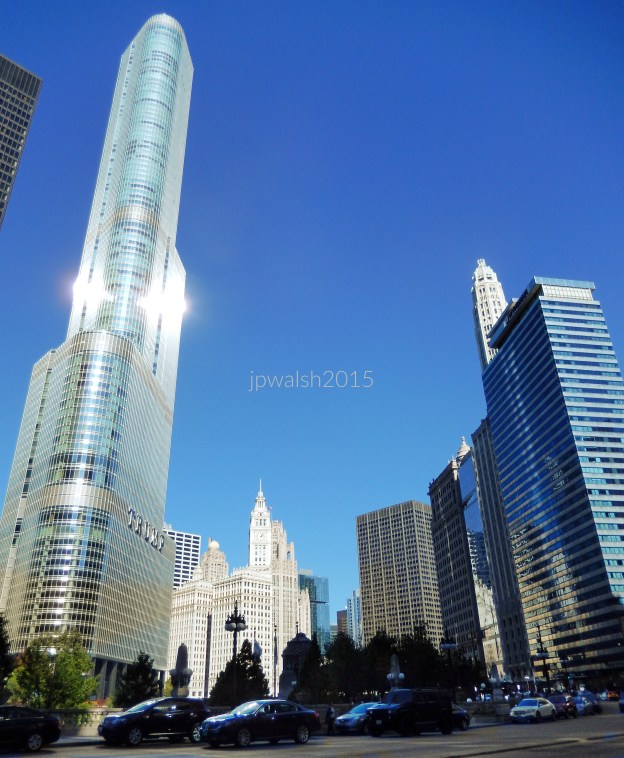
Wacker Drive and Wabash Avenue looking east, Chicago. From left: Trump International Hotel and Tower, Adrian Smith, architect (2009). Trump Tower Chicago is a 98-story skyscraper at 401 N Wabash Ave, completed in 2009. Rising 1,389 feet with its spire, it includes 486 condos, a 339-room hotel, and ranks as the 4th tallest building in the United States.
401 N Michigan Avenue (Equitable Building), Skidmore, Owings & Merrill, architect (1965/Facelift 1992/Renovation 2016). The plaza (Pioneer Court) of the Miesian 401 N. Michigan draws over 22,000 pedestrians daily from busy Michigan Avenue. Apple’s global flagship store shares the plaza that provides immediate access to the Riverwalk via the Spanish Steps. see – 401 N Michigan Ave, Chicago, IL 60611 – Office for Lease | LoopNet – retrieved February 13, 2026.
360 N. Michigan Avenue (London Guarantee & Accident Building), Alfred S. Alschuler, architect (1923).
85 E. Wacker Drive (London House).
75 E. Wacker (formerly Lincoln Tower, originally Mather Tower), Herbert Hugh Riddle, architect (1928) and Harry Weese & Assocs. (Renovation/1983).
71 E. Wacker Drive (The Royal Sonesta Chicago Downtown, formerly Executive House Hotel), Milton Schwartz, architect (1959). 71 E. Wacker Drive is the first high-rise hotel in Chicago since the Great Depression. see – Executive House Hotel, 71 E. Wacker, Chicago – retrieved February 13, 2026.
Chicago. May 2015. Author’s photograph. 99% 7.92mb DSC_0468.
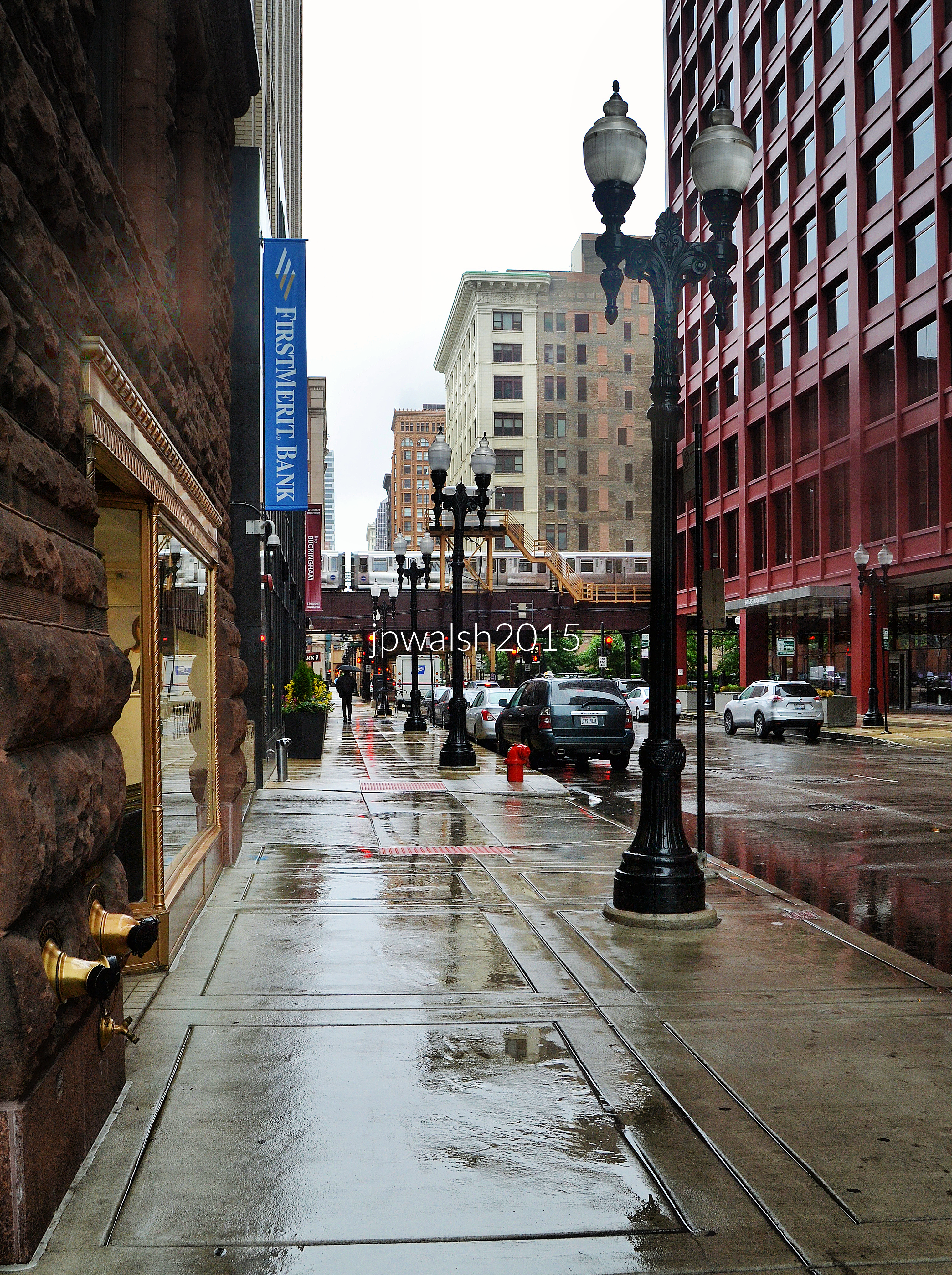
Michigan Avenue and Van Buren Street looking west on Van Buren, Chicago. Left: Chicago Club, 81. E. Van Buren, Granger & Bollenbacher, architect (1929).
Right: CNA Center (333 S. Wabash Avenue), Graham, Anderson, Probst, architect (1972).
Near background: 333 S. State, DePaul Center (formerly Goldblatt’s, originally Rothschild & Co. Store), Holabird & Roche, architect (1912), renovation 1993.
Far background: Fisher Building (343 S. Dearborn Street), D.H. Burnham & Co., architect (1896) and Northern Addition, Peter J. Weber, architect (1907). Restoration and adaptive Reuse, 2001.
Chicago. October 2015. Author’s photograph. 4.28mb DSC_0061 (1)
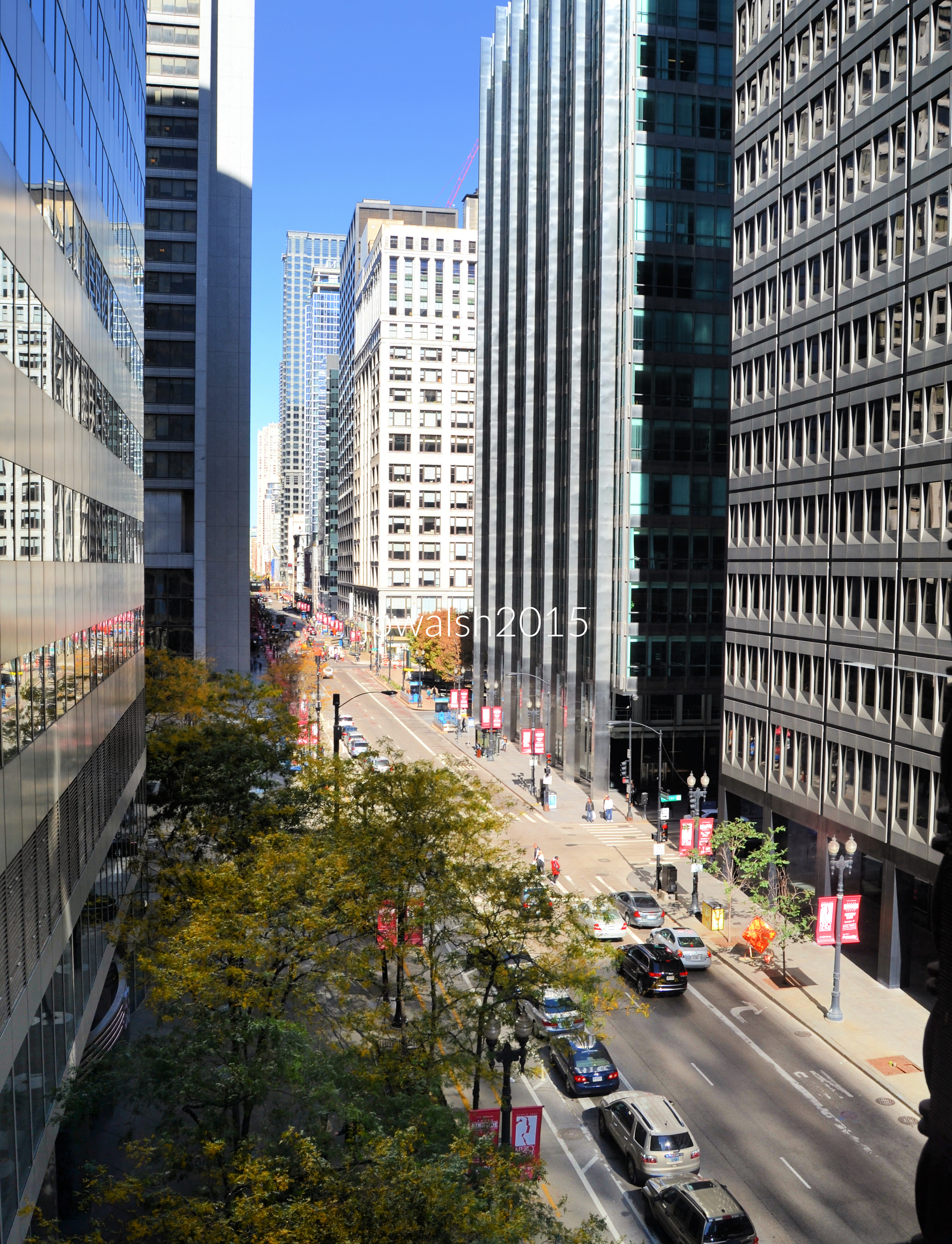
Adams and Dearborn Streets looking north along Dearborn, Chicago. Left: 55 Xerox Center, 55 West Monroe, Chicago, Helmut Jahn, architect (1977-1980). Behind (partially hidden): Chase Tower (originally First National Bank of Chicago), Perkins & Will; C.F. Murphy Assocs. (1969).
Background: 2 N. State/1 N. Dearborn Streets (originally, Boston Store), Holabird & Roche (1906; 1917), renovation (2001).
Chicago. November 2015. Author’s photograph. 3.77mb DSC_0384 (1).
Halsted Street between Adams Street and Jackson Boulevard looking east, Chicago. Union Station Tower (MidAmerica Commodity Exchange), Skidmore, Owings & Merrill, architect (1971). Willis Tower (originally, Sears Tower), Skidmore, Owings & Merrill, architect (1974).
Chicago. December 2015. Author’s photograph. 2.40mb DSC_0577 (2).
Balbo and Wabash Avenues looking north on Wabash. Left: (with Columbia College wall sign) 33 Ida B. Wells Drive building, Alfred S. Alschuler, architect, (1925/1926). DePaul University College of Law, 25 E. Jackson and, beyond, 230 S. Wabash, a 21-story building built in 1910.
Center: Trump International Hotel and Tower, Adrian Smith, architect (2009).
At right: Roosevelt University: Auditorium Building, Adler & Sullivan, architect (1887-1889) and The Wabash Building, a 32-story zigzagging glass structure, Christopher Groesbeck, AIA, architect (2012). CNA Center (333 S. Wabash Avenue), Graham, Anderson, Probst, architect (1972).
Chicago. December 2015. Author’s photograph. 3.60mb DSC_0986 (2)
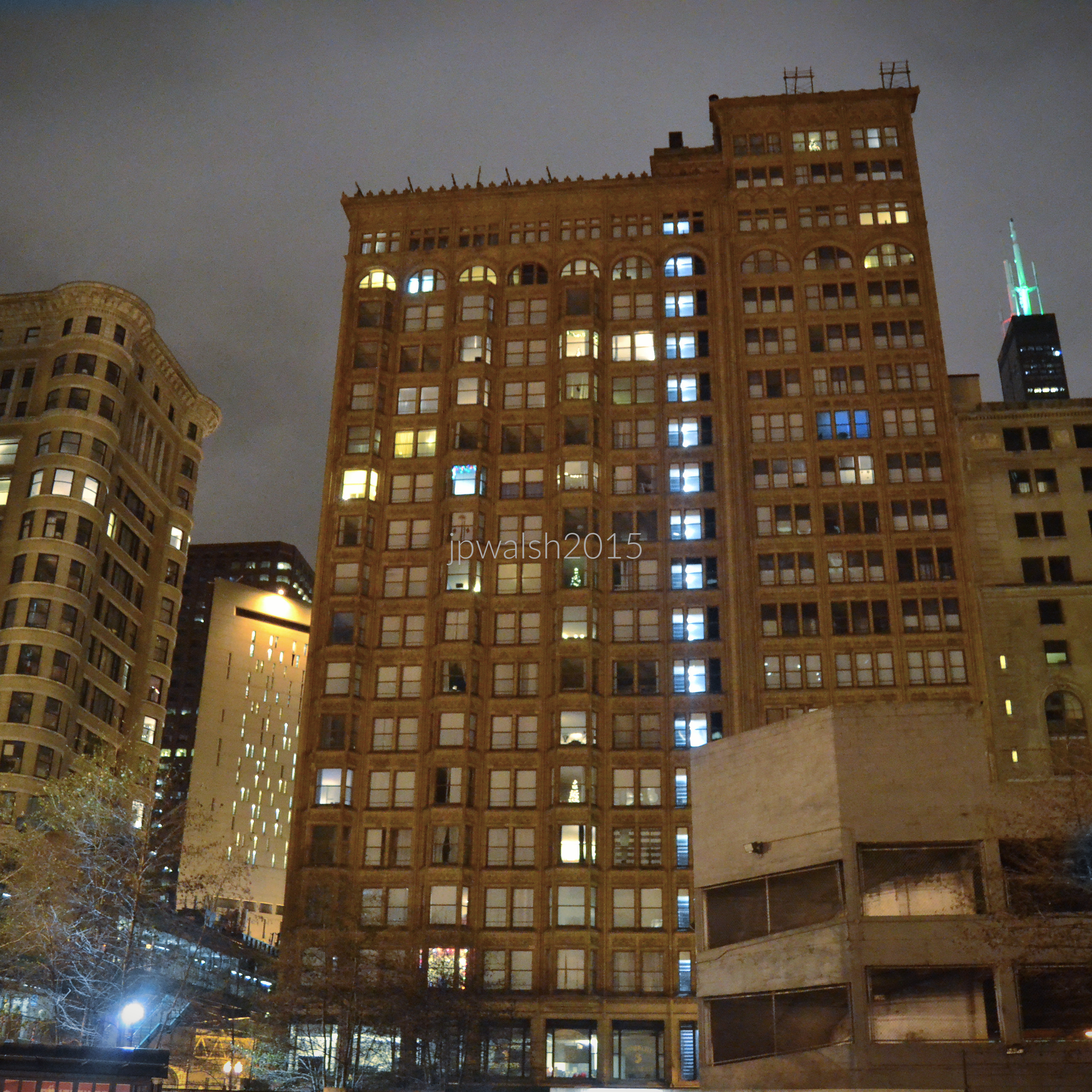
From left: Old Colony Building, 407 S. Dearborn Street, Holabird & Roche, architect (1894), Chicago Metropolitan Correctional Center, 71 W. Van Buren Street, Harry Weese & Associates (1975), Fisher Building, 342 S. Dearborn Street, D.H. Burnham, architect (1896) and Northern Addition, Peter Weber, architect (1907) and Sears Tower, 233 S. Wacker Drive, Skidmore, Owings & Merrill, architect (1974).
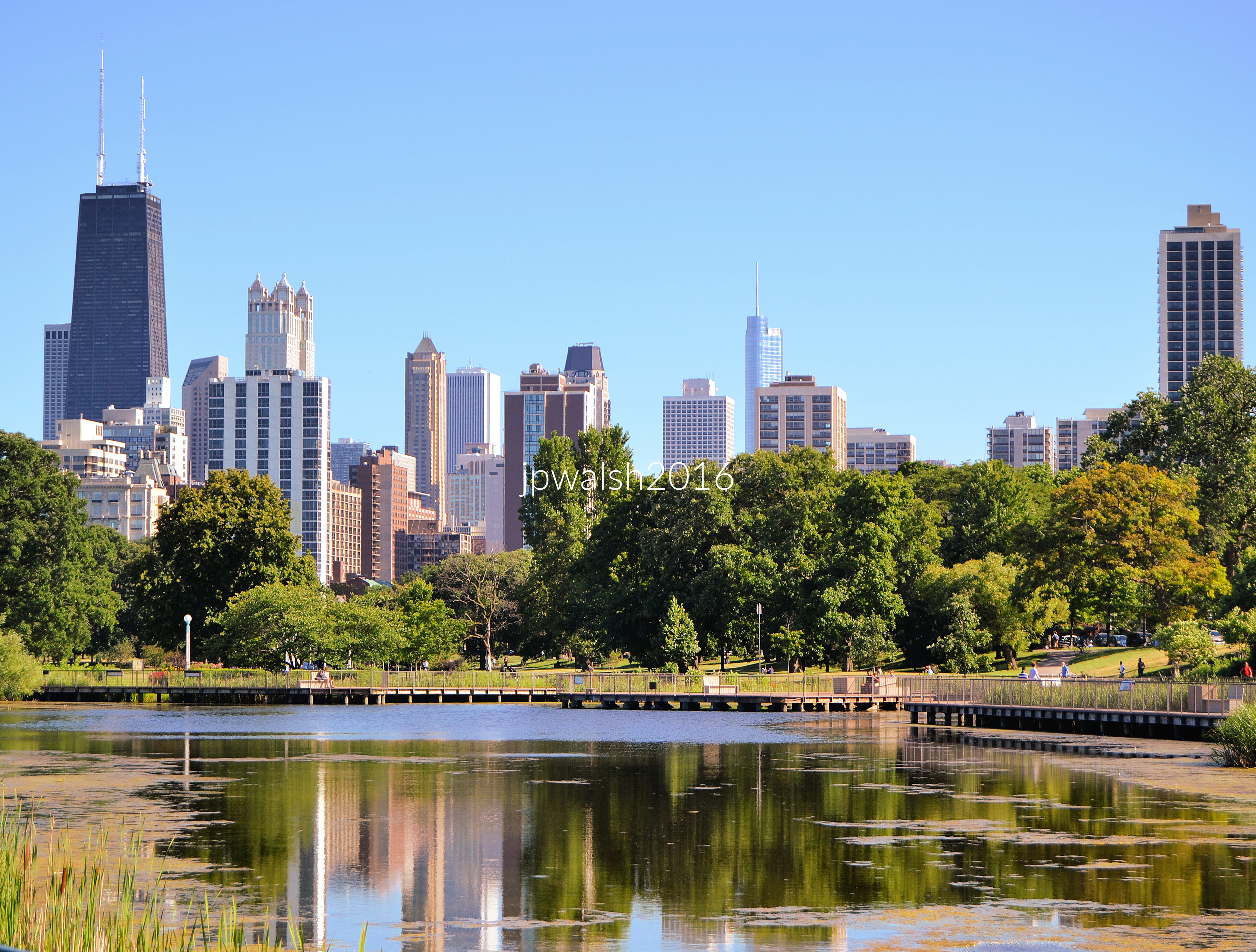
Chicago. July 2016. Author’s photograph. 5.33mb DSC_0743 (1)
Lincoln Park looking over South Pond towards downtown. At left: (partial view) Water Tower Place, 845 N. Michigan Avenue, Loebl, Schlossman & Hackl, architect (1976); John Hancock Building, 875 N. Michigan Avenue, Skidmore, Owings & Merrill, architect (1969); 900 North Michigan Avenue, Kohn Pedersen Fox, architect (1989); Park Tower, 800 N. Michigan Avenue, Lucien LaGrange & Assoc., architect (2000); The Aon Center (formerly, Amoco Building; originally, Standard Oil Building), 200 E. Randolph Street, Edward Durell Stone; Perkins & Will, architects (1973); Trump International Hotel and Tower, Adrian Smith, architect (2009); At right: James House, 1560 North Sandburg Terrace, Solomon Cordwell Buenz, architect (1971).
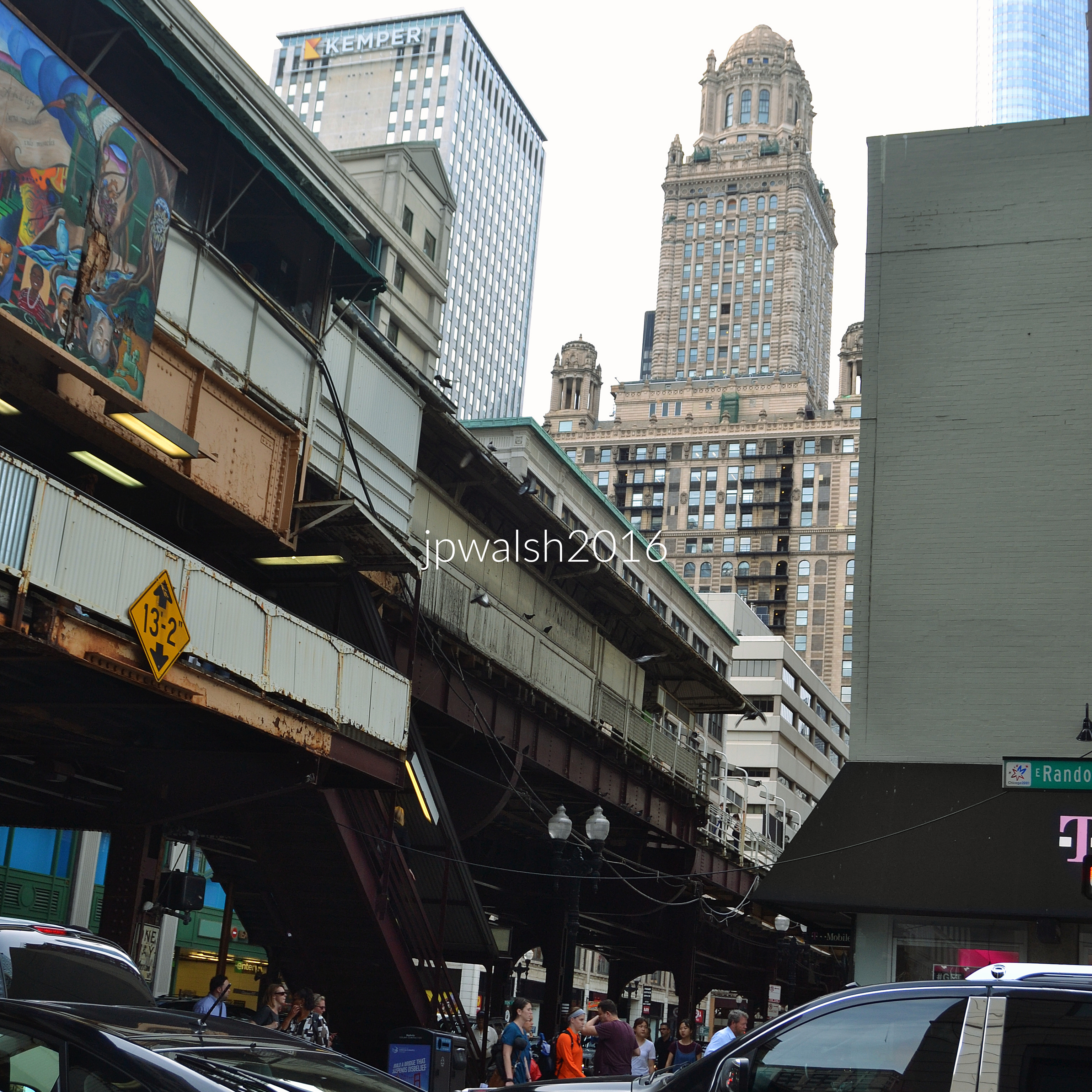
Chicago. July 2016. Author’s photograph. 3.28 mb DSC_0045 (1)
Looking north on Wabash Avenue from Randolph Street, the Chicago elevated train follows a north-south route along Wabash Avenue and has been part of downtown since the late 1890’s. The “Kemper” sign is on the relatively dull modernist Kemper Building, now One East Wacker, Shaw, Metz & Assoc., architect (1962). Followed by 35 East Wacker Drive (formerly Pure Oil Building; originally, Jewelers Building) with its distinctive dome, Glaver & Dinkelberg; Thielbar & Fugard, Assoc. Archs., architect (1926). Partial view is Trump Tower.
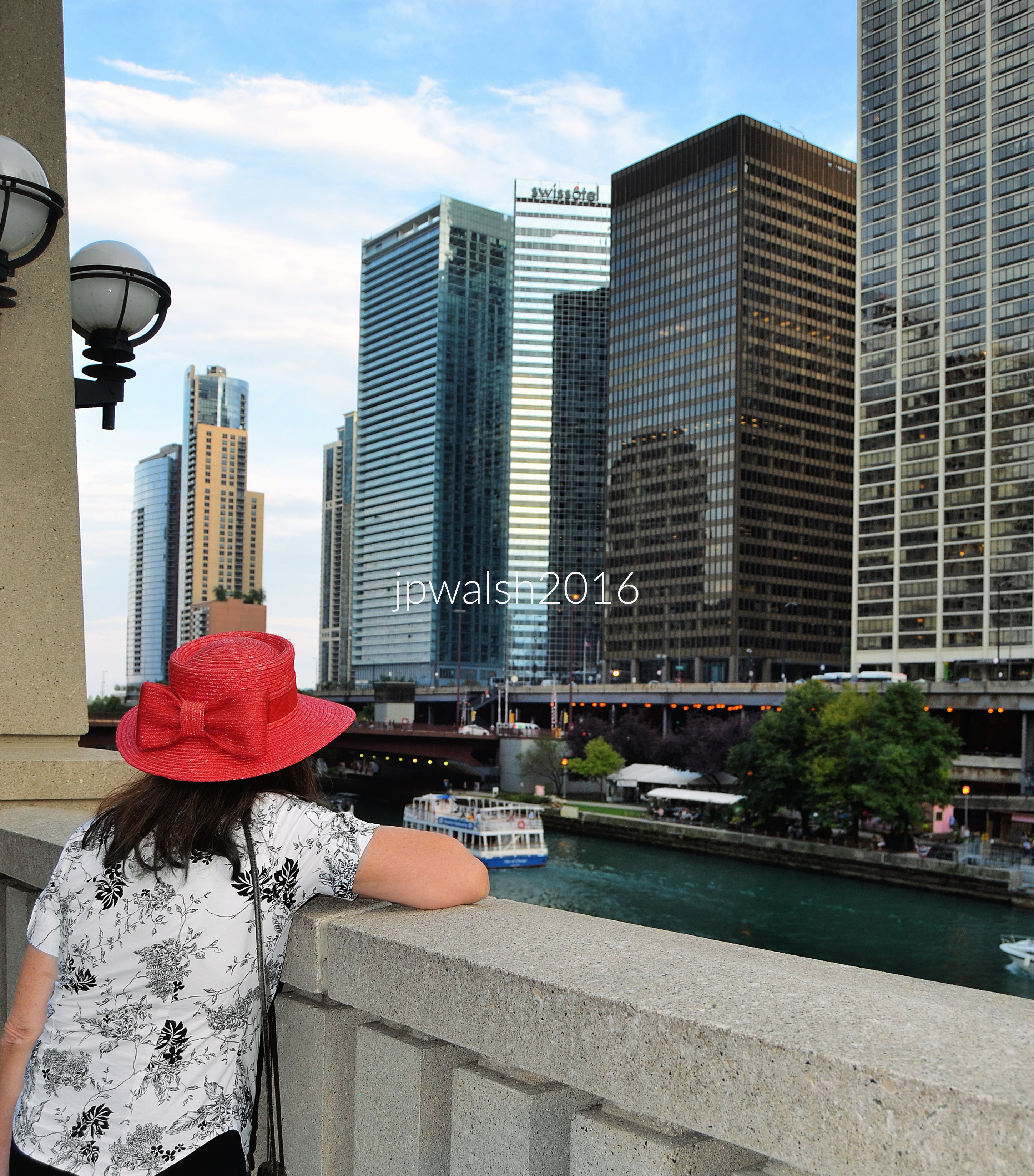
Chicago. September 2016. Author’s photograph. 3.89mb DSC_0740 (1)
Right to left: The 233 E. Wacker Drive building (known as Columbus Plaza) in Chicago is 48-story apartment building, Fujikawa Conterato Lohan and Associates, architect (1978-1980). The 111 E. Wacker Drive building (known as One Illinois Center) in Chicago, is a 30-story Modernist building featuring bronze anodized aluminum and dark-tinted glass, Ludwig Mies van der Rohe in association with Joseph Fujikawa, architect (1967-1970). The Swissôtel Chicago at 323 E. Wacker Drive, is a 45-story, triangular, all-glass luxury hotel, Harry Weese and Associates, architect (1989). The 345 E. Wacker Drive building (known as Coast at Lakeshore East) in Chicago is a 40-story residential apartment tower, bKL Architecture LLC, architect (2013).
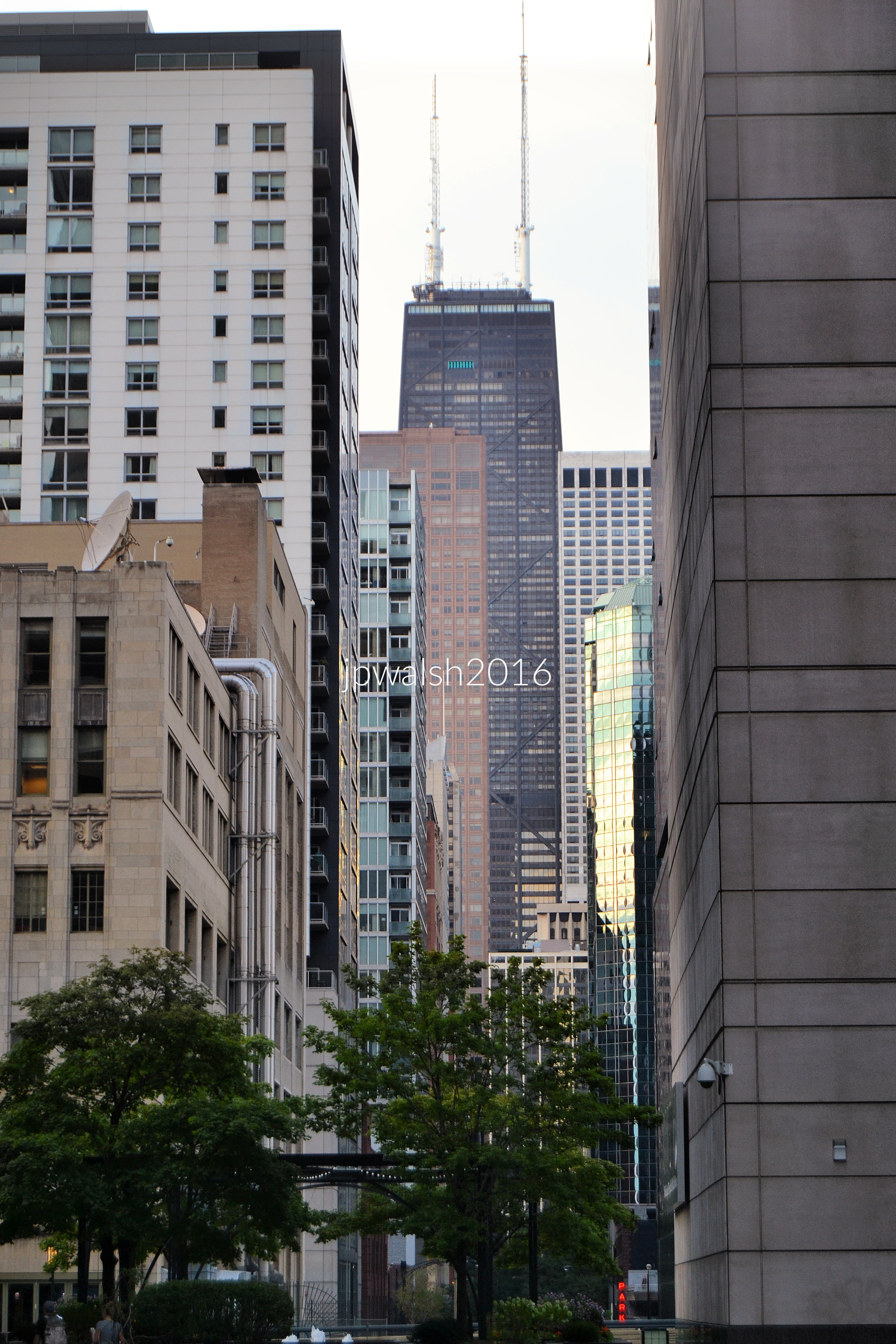
Chicago. September 2016. Author’s photograph. 4.93mb DSC_0745 (1)
From the Riverwalk looking north along N. St. Clair Street: at right, the 27-story spandrel glass and metal panel 633 N. St Clair St. building, Loebl Schlossman [later; Dart] & Hackl, architect (1991). At left, the 63-story pinkish, rose-hued Swedish granite 161 Chicago Avenue East building (known as Olympia Centre) is a mixed-use retail, office, and residential skyscraper, Skidmore, Owings & Merrill, architect (1984-85). At right, the 74-story gray marble facade Water Tower Place, the first vertical shopping center on Michigan Avenue (8 floors), also includes the Ritz-Carlton hotel, luxury condos, and office space, Edward D. Dart (Loebl Schlossman Bennett and Dart), architect (1975). The John Hancock Center—now officially 875 North Michigan Avenue—is a 100‑story, tapered mixed‑use skyscraper known for its iconic X‑bracing. Often described as a “vertical city,” it is considered one of the first major mixed‑use skyscrapers in the world and includes office space (floors 13–41), about 700 condominiums (floors 44–92), and the highest indoor swimming pool in North America on the 44th floor. Its 94th‑floor observation deck offers panoramic views of Chicago and Lake Michigan. Bruce Graham of the firm Skidmore, Owings & Merrill, architect (1969). It was engineered by Fazlur Rahman Khan, who pioneered the tubular structural system used in the tower.
Chicago. September 2016. Author’s photograph. 5.06mb DSC_0756 (2)
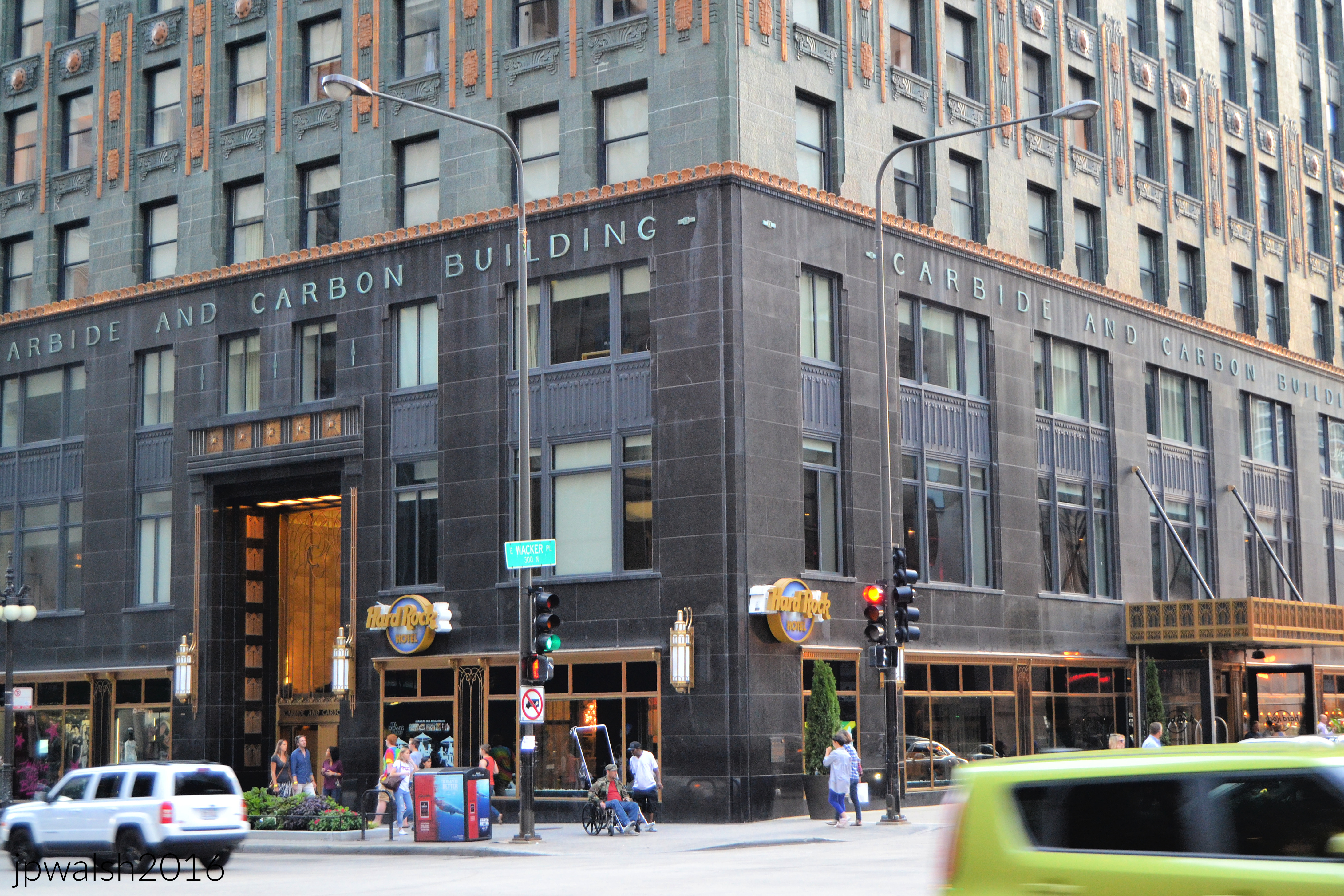
The Carbide and Carbon Building rises from 230 N. Michigan Avenue in Chicago like a gleaming Art Deco toast to the Jazz Age, Burnham Brothers, architect (1929). The 37‑story tower is instantly recognizable: its base wrapped in polished black granite, its shaft clad in deep green terra cotta, and its crown shimmering with 24‑karat gold leaf. Legend has it the architects shaped the building to resemble a champagne bottle — a fitting symbol for a city that never stopped celebrating its own ambition.
Chicago. October 2015. Author’s photograph. 3.90mb.
Above: Alexander Calder’s Flamingo (1974)sits in Federal Plaza designed by modernist architect Mies Van Der Rohe. Behind it is Mies’ 45-floor John C. Kluczynski Building at 230 S. Dearborn Street and on a sunny east side of South Dearborn his 30-story Dirksen Federal Courthouse. Moving south across Jackson Boulevard is the 5-story 33 West Jackson Boulevard building built in 1910 (with additions/remodels stretching through 1917). Next to it is The Standard Club at 321 South Dearborn Street built in 1926 and designed by Albert Kahn. The Fisher Building (1896) at 343 South Dearborn Street and its annex is next further south. Designed by D.H. Burnham & Company, it was completed in 1896. The Old Colony building on the other side of the L tracks was built between 1893 and 1894, When it officially topped out, the 17-story, 215-foot high-rise briefly held the title of the tallest building in Chicago. It was designed by the legendary architectural firm of Holabird & Roche. The framework was engineered by Corydon T. Purdy who designed it with a highly advanced, pioneering skeletal steel-frame structure that carries the entirety of the building’s massive weight allowing the exterior features absolutely no self-supporting walls.
Chicago. June 2022. Author’s photograph. 7.24 mb
Above: On the west side of Clark Street between Adams Street and Jackson Boulevard—visible directly behind Alexander Calder’s Flamingo sculpture—the prominent structures are from left to right: The Commercial Office Building located at 118 South Clark Street (directly tucked between the Bankers Building and Jackson Boulevard)—was completed in 1920 and designed by the prolific Chicago architectural firm Holabird & Roche, Willis Tower in the distance, The Bankers Building (105 West Adams Street, completed in 1927 by the Burnham Brothers, a 476-foot Art Deco masterpiece featuring characteristic deep light courts and upper-tier setbacks), and, on the other side of Adams Street, The Field Building at 140 S. Clark. Completed in 1934 by Graham, Anderson, Probst & White, it stands as one of the finest premier masterpieces of Art Deco skyscraper design in the entire United States. A corner slice of the Edison Building is also pictured.
The Park Tower Condominium (1973) exemplifies how Chicago’s late modernist architects adapted the high-rise residential tower to the city’s lakefront, creating a landmark that combines urban density, engineering sophistication, and panoramic engagement with Lake Michigan.
Park Tower Condominium, 5414 N. Sheridan Road, Chicago, SCB, 1973. View from east looking west. August 2015. Author’s photograph. 3.15mb.
Park Tower Condominium is on the lakefront next to north Lake Shore Drive and across from Foster Beach in Lincoln Park. Its address is 5414 N. Sheridan Road, Chicago
Constructed in 1973 by Solomon, Cordwell, Buenz (SCB), a Chicago architectural firm founded in 1931, the tower was planned as the first of three towers in a triangular formation but the others did not materialize.
Tallest building outside Downtown Chicago for 8 miles north to Foster Beach. Located on North Sheridan Road in the Edgewater neighborhood, directly adjacent to Lake Michigan, its height and slender profile make it a prominent visual landmark on Chicago’s northern lakefront.
At 55 stories tall (513 feet high), Park Tower Condominium is the tallest structure between downtown and Foster Beach and one of the tallest structures in Chicago outside the downtown area.
Park Tower Condominiumis one of the largest all-residential buildings in the city.It was originally built as luxury rental apartments, though the building became condos in 1979.
In the Edgewater neighborhood, Park Tower Condominium is one of three residential towers in Chicago with black Miesian windows and three rounded lobes. The others are Lake Point Tower (505 North Lake Shore Drive) and Harbor Point (155 North Harbor Drive).
The tower reflects the modernist emphasis on efficiency, structural clarity, and residential density.
Park Tower Condominium, 5414 N. Sheridan Road, Chicago, SCB, 1973.View from northeast looking southwest. August 2015. Author’s photograph. 3.15mb.
The curtain wall of the Park Tower Condominium is beautifully detailed and proportioned.
Park Tower Condominium Is a lens into late modernist Chicago residential architecture, lakefront urban development, and the emergence of high-rise luxury living along Sheridan Road.
SOURCES:
Architect Magazine. “Solomon Cordwell Buenz.” Accessed October 23, 2026. architectmagazine.com.
Emporis. “Park Tower Condominiums, Chicago, IL, USA.” Building ID 117420. Accessed October 23, 2026. emporis.com.
The links are dropped because the Emporis database was permanently shut down in 2022, and the specific URL you provide for Architect Magazine now leads to an inactive or broken page.
John P. Walsh, 2015. All rights reserved. All text and photos are the property of the author, except for materials explicitly credited as public domain or licensed content. Photographs were taken by the author on August 7, 2015.
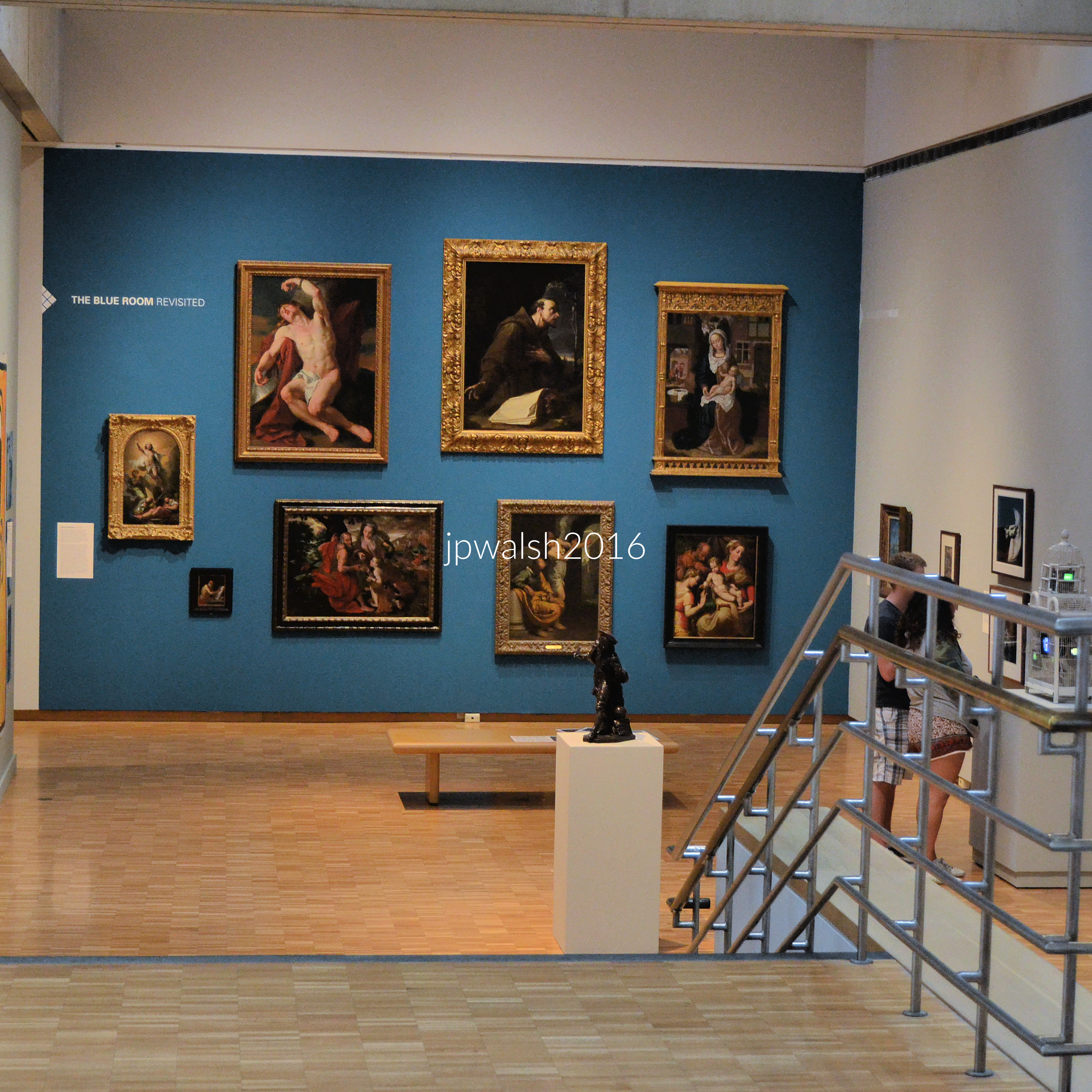
FEATURE image: May 2015. Michigan Avenue Main Lobby. The Art Institute of Chicago. 4.57mb DSC_0366 (1)
Whether displayed in museums, galleries, historic houses, homes, offices, public buildings, sculpture gardens, or private collections, the focus of this collection remains the artwork itself. Through photography, it explores painting, sculpture, design, and other forms of visual expression while also acknowledging how their settings can enrich our understanding of their artistic, historical, and cultural significance.
Photographs and Text by John P. Walsh.
September 2015. 7.68 mb 99%
Michigan Avenue entrance of The Art Institute of Chicago.
May 2015.
Sculpture Court, The Art Institute of Chicago.
September 2015.
Modern Wing, The Art Institute of Chicago.
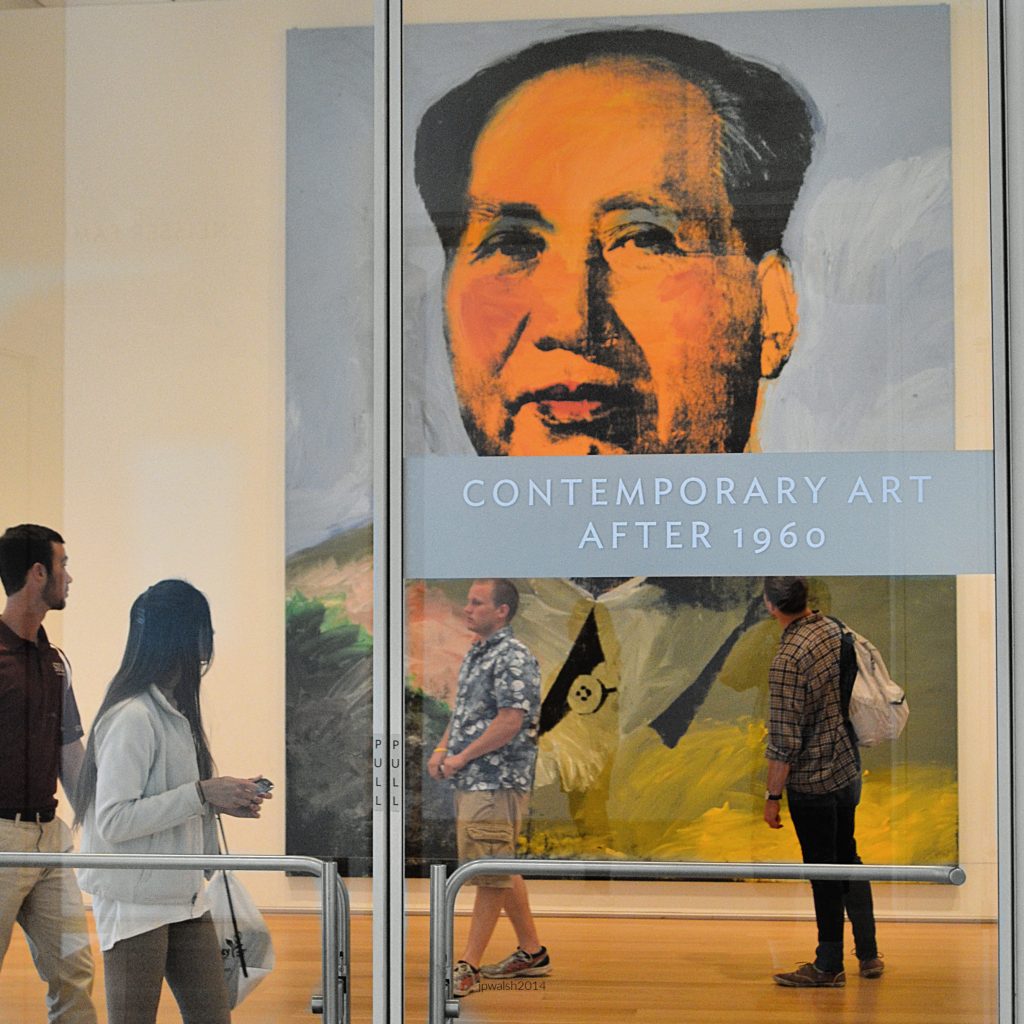
June 2014. The Art Institute of Chicago. 20th Century. American. Pop.
Andy Warhol (1928-1987), Mao, 1972, Acrylic, silkscreen ink, and pencil on linen, 448.3 × 346.7 cm (176 1/2 × 136 1/2 in.). The Art Institute of Chicago.
June 2014. The Art Institute of Chicago. 40%
The Chauncey McCormick Gallery refers to exhibition space (often featuring Asian and European decorative arts) at the Art Institute of Chicago named after Chauncey Brooks McCormick (1884–1954), a prominent Chicago businessman, philanthropist, and president of the museum from 1944 until his death
June 2014. 5.59mb
Robert Irwin (1928-2023), Untitled, Acrylic lacquer on cast acrylic disk, 1969. The Art Institute of Chicago. Irwin was a pioneering figure in California Light and Space art.
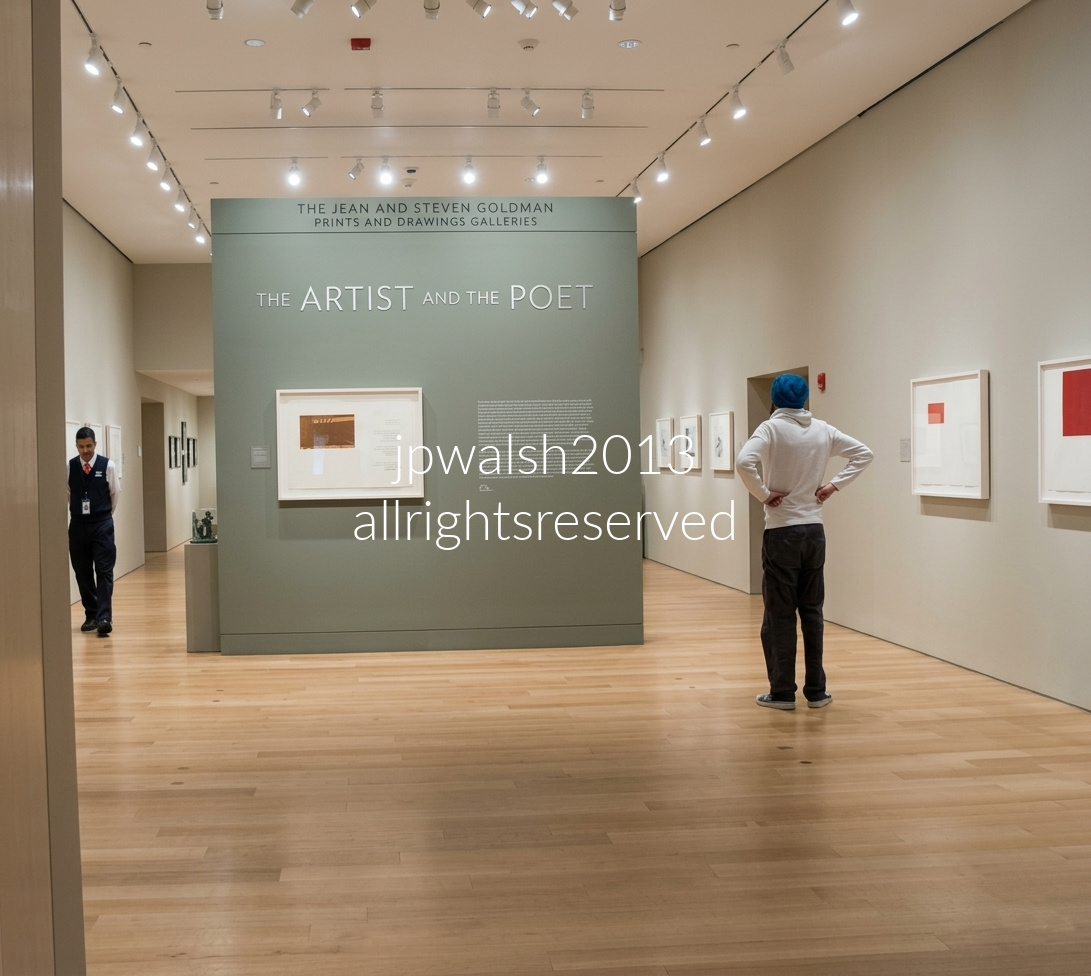
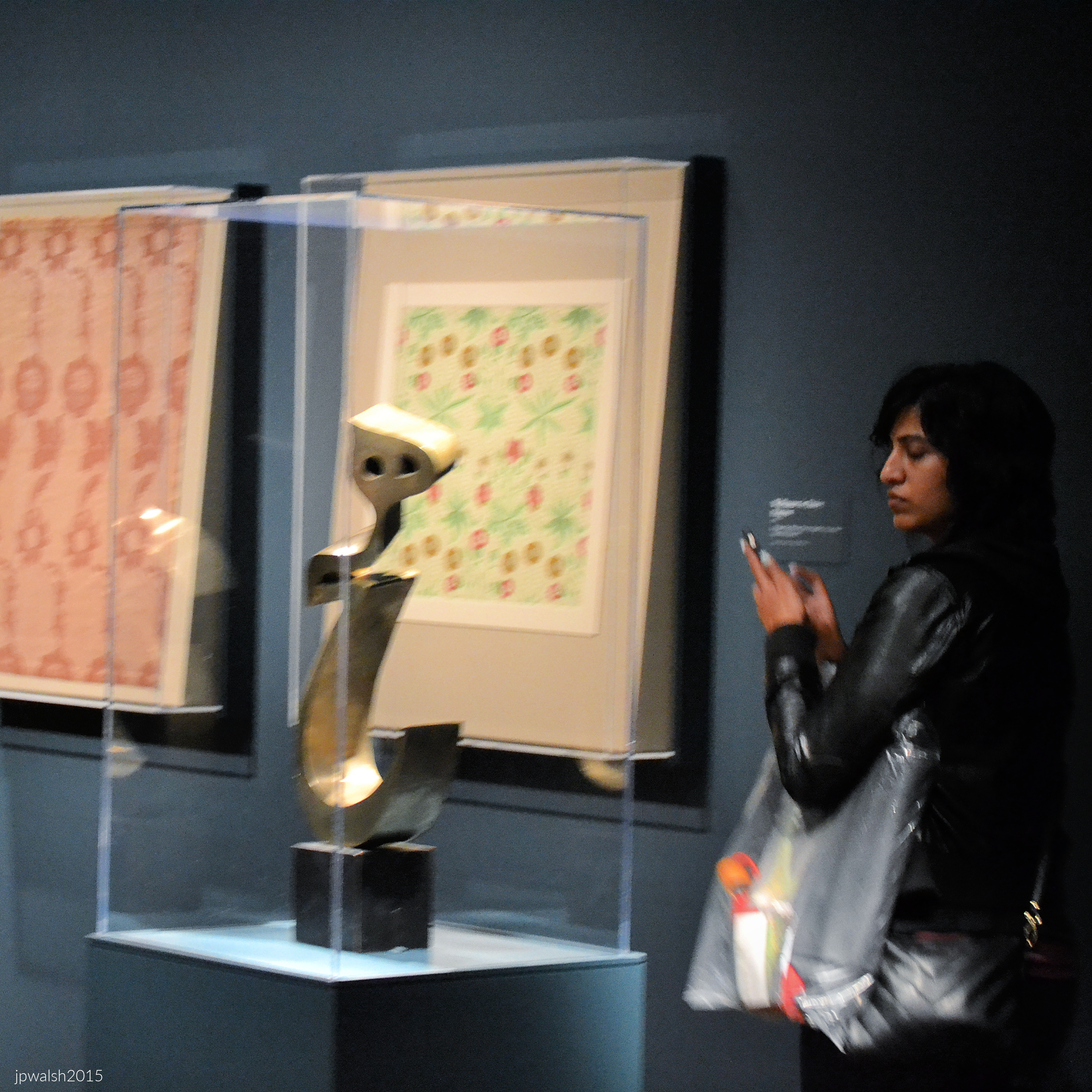
February 2013. Galleries 124–127, The Art Institute of Chicago.
The exhibition “The Artist and the Poet” at the Art Institute of Chicago ran from February 1 to June 2, 2013, exploring the dialogue between visual art and literature through works on paper, prints, and illustrations. It was presented in the Jean and Steven Goldman Prints and Drawings Galleries (Galleries 124–127), located on the first floor of the museum’s historic Ryerson and Burnham Libraries building.
September 2015. 6.25 mb
Modern wing, The Art Institute of Chicago.
August 2015. The Art Institute of Chicago. 21st Century. American.
Frances Stark (1967-) from Intimism, 2015. The Art Institute of Chicago.
August 2015. Alexander McKinlock Memorial Court. AIC. 20th Century. Nordic. Sculpture.
Carl Milles (1875-1955), Triton Fountain, 1926, bronze, Alexander McKinlock Memorial Court, The Art Institute of Chicago. Swedish sculptor Carl Milles (1875-1955) studied in Paris from 1897 to 1904, working in the studio of Auguste Rodin (1840-1917). Yet Milles departed from the prevailing naturalism that dominated sculpture in the Belle Époque era, and embraced ideas and forms that reflected the artist’s independent spirit, his knowledge and appreciation of classical and Gothic sculpture, and his Nordic roots.
Speaking of his fountain at the Art Institute of Chicago, Milles observed: “The great classicists knew that it was impossible to reproduce the appearance of flesh in marble, and they set themselves to create forms of pure beauty that would merely suggest and symbolize the living creature, and then to invest those forms with a meaning that mankind would feel intuitively to be universal and significant. This is what I have tried to do.”
September 2015. The Art Institute of Chicago. 21st Century. American. Sculpture.
Charles Ray (1953-), Young Man, 2012, Solid Stainless Steel.
May 2015. The Art Institute of Chicago.
Lorado Taft (1860-1936), Fountain of the Great Lakes, 1913. South Garden. The Art Institute of Chicago.
November 2017. North Garden, The Art Institute of Chicago.
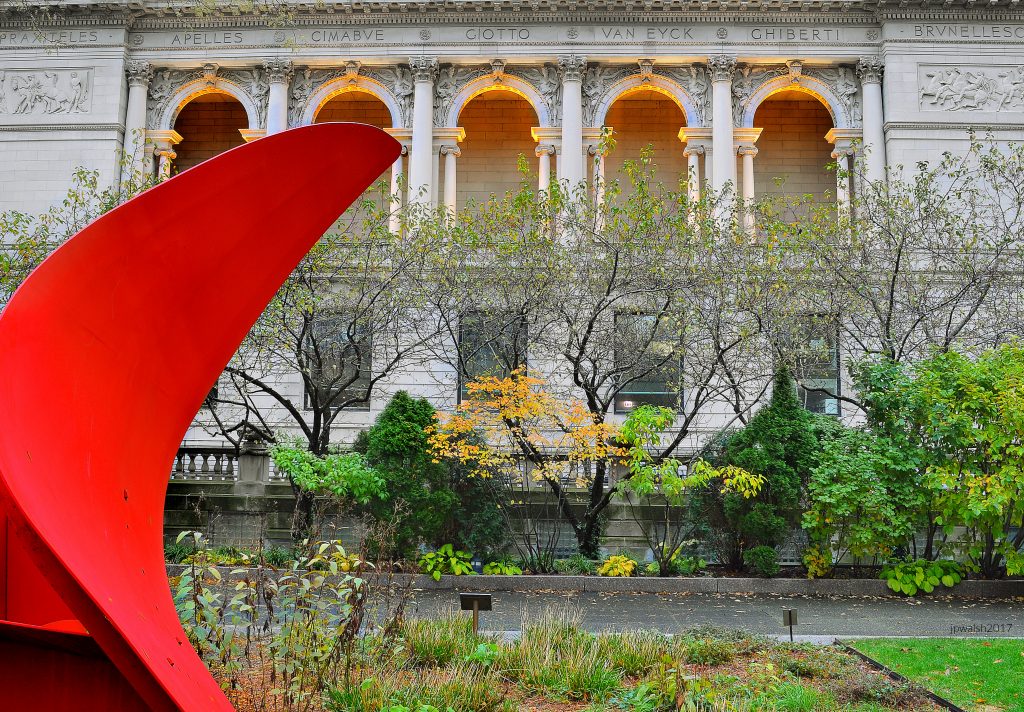
Alexander Calder (1898-1976), Flying Dragon, 1975, Steel plate and paint, 365 × 579 × 335 cm (120 × 228 × 132 in.), North Garden, The Art Institute of Chicago. 20th Century. American. Sculpture. Modernism.
November 2017. North Garden, The Art Institute of Chicago. Partial view: Flying Dragon, Alexander Calder, 1975. November 2017. North Garden, AIC. 20th Century. British. Modernism. Sculpture.
Henry Moore (1898-1986), Large Interior Form, bronze (ed. of 6), 1953/4, 16 ft. 9 in., North Garden, The Art Institute of Chicago. Henry Moore’s 16-foot sculpture was made when the 84-year-old British artist was concerned with the construction of three-dimensional space, internal forms within solid volumes, and placing his work in a natural setting. Moore had worked primarily in stone but as these formal concerns emerged, he shifted to modeling and bronze casting. Large Interior Form explores mass and void as well as gravity and growth within a nature-inspired artist-created form.
March 2010. Washington, D.C.
Aristide Maillol (1861-1944), Nymph—Central Figure for the Three Graces, 1930, The Hirshhorn Museum and Sculpture Garden, Washington D.C. Acquired by the museum in 1966, photographs show that the statue stood in an open location by a garden pool at the museum. In 1991 following a whirlwind of euphoria associated with the successful completion of Operation Desert Storm, a victory celebration at the Mall in June of that year involved hovering military jets and helicopters. Their downdraft sent gravel footpath debris flying in the air that scratched and cracked several statues in the sculpture garden. Though none appeared to sustain damage beyond some repair, the Nymph—Central Figure for the Three Graces suffered the most damage as the nude female statue had pitted indentations on her backside. In 2010 when this photograph was taken, the sculpture was located in front of a protective garden wall. See- https://www.baltimoresun.com/news/bs-xpm-1991-06-12-1991163158-story.html 20th Century. France. Sculpture. Modernism.
August 2015. The Art Institute of Chicago. 1.43 mbMay 2015. Art Institute of Chicago. 3.34 mb
Indian and Islamic Art.
September 2015. The Art Institute of Chicago. 6.90 mbMay 2015. Frédéric Bazille. The Art Institute of Chicago. 19th Century. France. Impressionism.
Frédéric Bazille, Self-portrait, 1865/6. The Art Institute of Chicago.
November 2012. Toledo (Ohio) Museum of Art. 18th Century. France. Terracotta.
Clodion (1738-1814). The See-Saw. 1775. Toledo (Ohio) Museum of Art.
November 2012. Toledo (Ohio) Museum of Art. 17th Century. France. Sculpture.
Michel Anguier (1612-1686), Amphitrite, marble, 1684. Toledo (Ohio) Museum of Art.
November 2012. Toledo (Ohio) Museum of Art.
Venus, Roman, Asia Minor, marble, c.165 CE, Toledo (Ohio) Museum of Art.
September 1993. Museum of Anthropology, UBC, Vancouver, B.C. 20th Century. Canada.
Bill Reid (1920-1998), Birth of the World or The Raven and the First Men/Humans, yellow cedar, 1980. Museum of Anthropology, UBC, Vancouver, British Columbia.
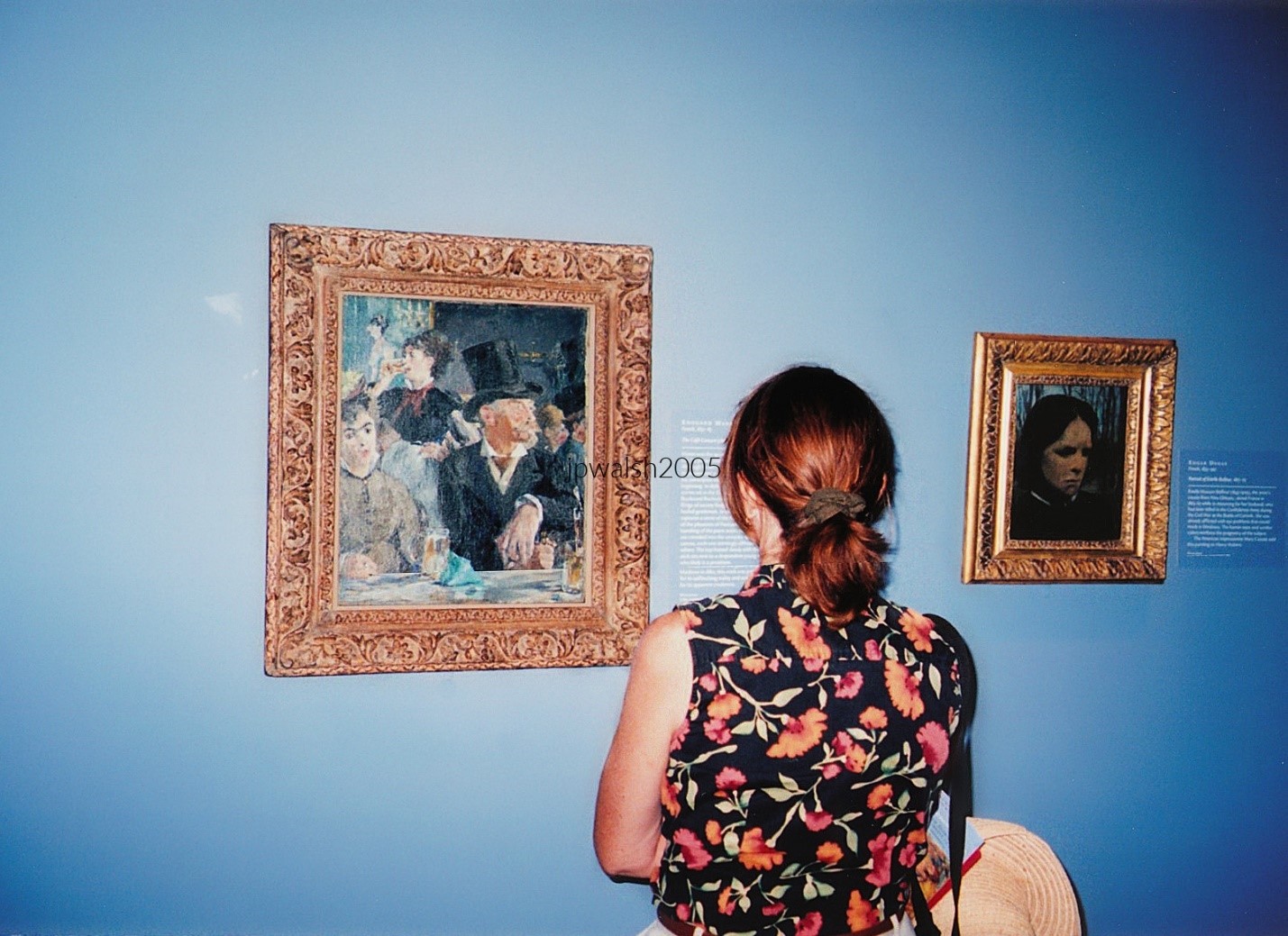
August 2005. National Gallery of Art, Washington, D.C.
“The Café-Concert,” Édouard Manet, c. 1879. The Walters Art Museum, Baltimore at the National Gallery of Art, Washington, D.C. Next to it is Portrait of Estelle Balfour by Edgar Degas, c. 1863-65, oil on canvas mounted on panel, also at The Walters.
September 2016. Milwaukee Art Museum. 20th Century. Germany. France. Fauvism. Expressionism.
From right to left: Kees van Dongen (1877-1968), Woman with Cat, 1908, and Quai, Venice, 1921; Gabriele Münter (1877-1962), Portrait Young Woman, 1909. Milwaukee Art Museum.
August 2015. The Art Institute of Chicago. 16th Century. Japan.
Mikazuki (male deity) Noh Mask, cypress wood, brass, colors. The Art Institute of Chicago.
May 2014. The Art Institute of Chicago. Impressionist galleries.
Pierre-Auguste Renoir (1841-1919): Chrysanthemums, 1881/2; Acrobats at the Cirque Fernando (Francisca and Angelina Wartenberg), 1879; Fruits of the Midi, 1881; Seascape, 1879; Lucie Berard (Child in White), 1883. The Art Institute of Chicago.
September 2013. The Art Institute of Chicago. Impressionist galleries.
Berthe Morisot (1841-1895), Woman in a Garden, 1882/3, The Art Institute of Chicago.
September 2012. Snite Museum of Art, Notre Dame, Indiana. 20th Century. American. Realism.
William Glackens (1870-1938), The Dressing Table, c.1922, oil on canvas. Snite Museum of Art, Nore Dame University, South Bend, Indiana.
September 2016. Milwaukee Art Museum. 20th Century. Germany. Expressionism.
Gabriele Münter (1877-1962): Kirche von Reidhausen, oil on canvas board, 1908 and Mädchen mit Puppe, oil on cardboard, 1908/9. August Macke (1887-1914), Geraniums Before Blue Mountain, oil on canvas, 1911. Milwaukee Art Museum.
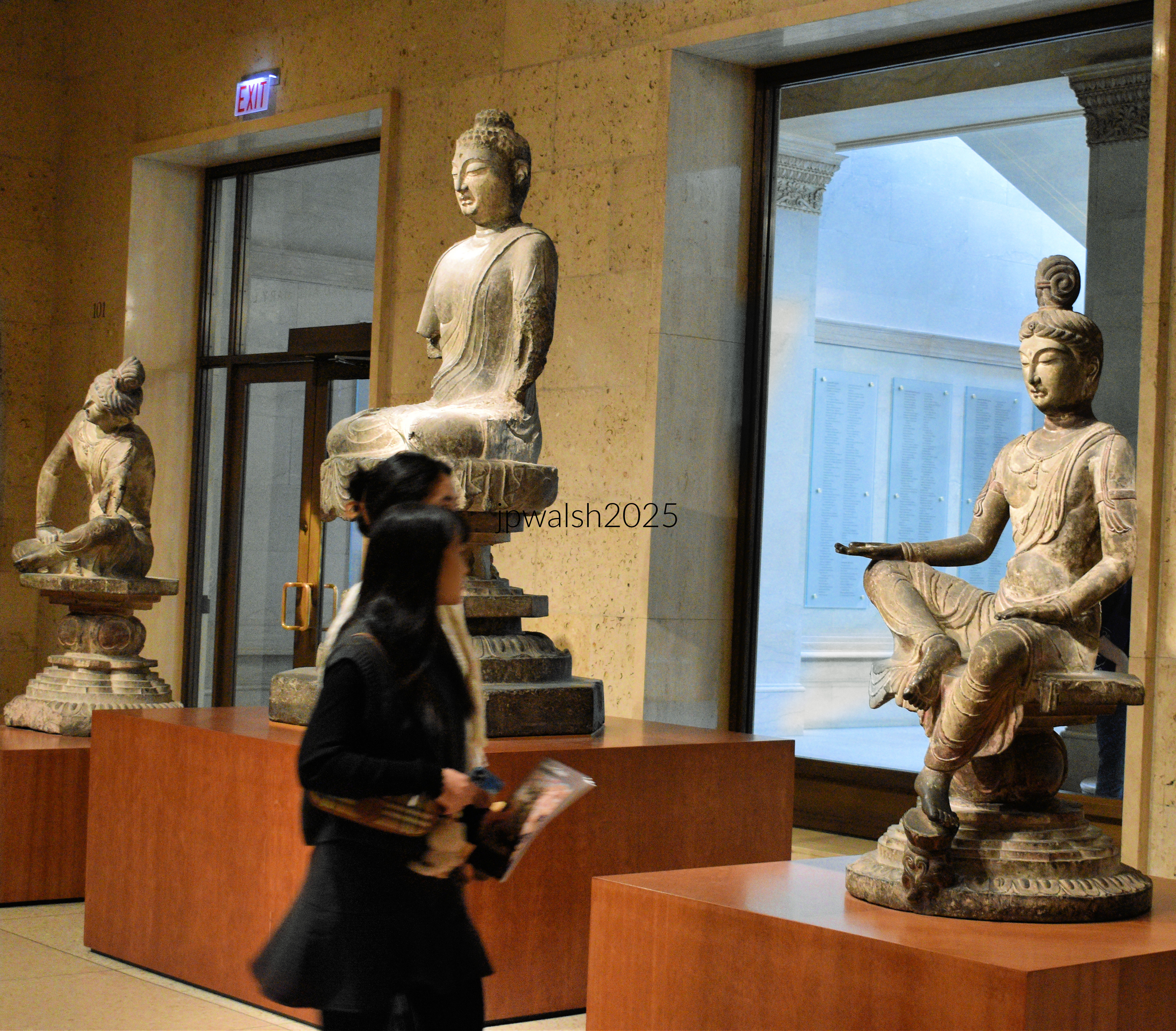
May 2015. The Art Institute of Chicago.
Above and below: Bodhisattva; Diety; Buddha. 4th-6th Centuries. Afghanistan/Pakistan. Stucco. The Art Institute of Chicago.
May 2015. The Art Institute of Chicago. September 2015. Room 235, The Art Institute of Chicago. September 2015. The Art Institute of Chicago. August 2015. The Art Institute of Chicago.May 2015. At The Art Institute of Chicago.
Charles Collins (1680-1744), Still Life with Game, 1741. Private Collection. 18th Century. Ireland.
May 2015. At The Art Institute of Chicago.
James C. Timbrell (1807-1850), Carolan the Irish Bard, c. 1844, oil on canvas. Private collection. 19th Century. Ireland.
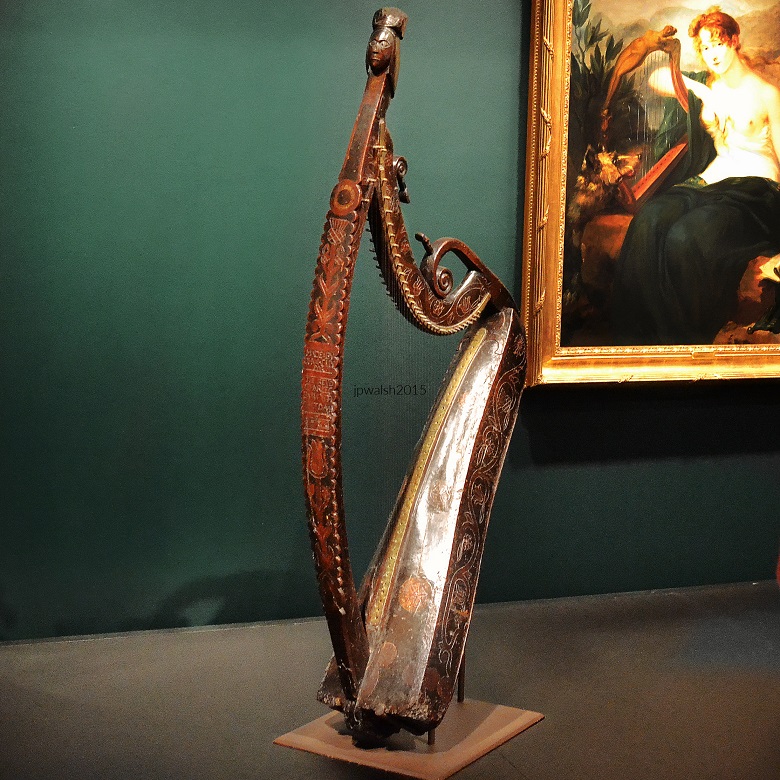
May 2015. The Art Institute of Chicago. 256 kb 25%May 2015. At The Art Institute of Chicago.
John Kelly, wire-strung Bunworth harp, 1734, Museum of Fine Arts, Boston, and Robert Fagan (c. 1761-1816), Portrait of Lady as Hibernia, c. 1798. Private collection. The Bunworth harp is inscribed: “made by Iohn Kelly for the Revd Charles Bworth Baltdaniel 1734″. The wire-string harp was made by Catholic instrument maker John Kelly for the Reverend Charles Bunworth, also of Baltdaniel, who was the Protestant rector of Buttevant, County Cork. The many aspects of the instrument—from soundbox, harmonic curve, fore-pillar, tuning pegs, and ornamentation and color— invite interest. Though it may be the female head at the top of the harmonic curve that at first most intrigues. (see – https://harp.fandom.com/wiki/Bunworth_Harp and http://www.earlygaelicharp.info/harpmakers/ – both retrieved October 14, 2021). Robert Fagan was an Irish painter who was born in London but spent most of his artistic career in Rome and Sicily (Fagan first arrived into Italy in 1781). Though an expatriate, Fagan’s oil on canvas depicts a woman who represents Ireland careessing the strings of the harp, the country’s national instrument and symbol. Seated next to an Irish wolfhound, she holds a scroll that reads: “Ireland Forever” (“Erin go bragh“). 18th century. Ireland.
August 2005. Yale Center for British Art, New Haven, CT.
Includes (below) John Dodd, of Swallowfield, Berkshire, 1739, John Vanderbank (1694 – 1739) and (above) Portrait of a Woman, Probably Elizabeth Aislabie, of Studley Royal, Yorkshire, c. 1749, Thomas Hudson (1701-1779), Yale Center for British Art, New Haven, CT.
August 2015. The Art Institute of Chicago.
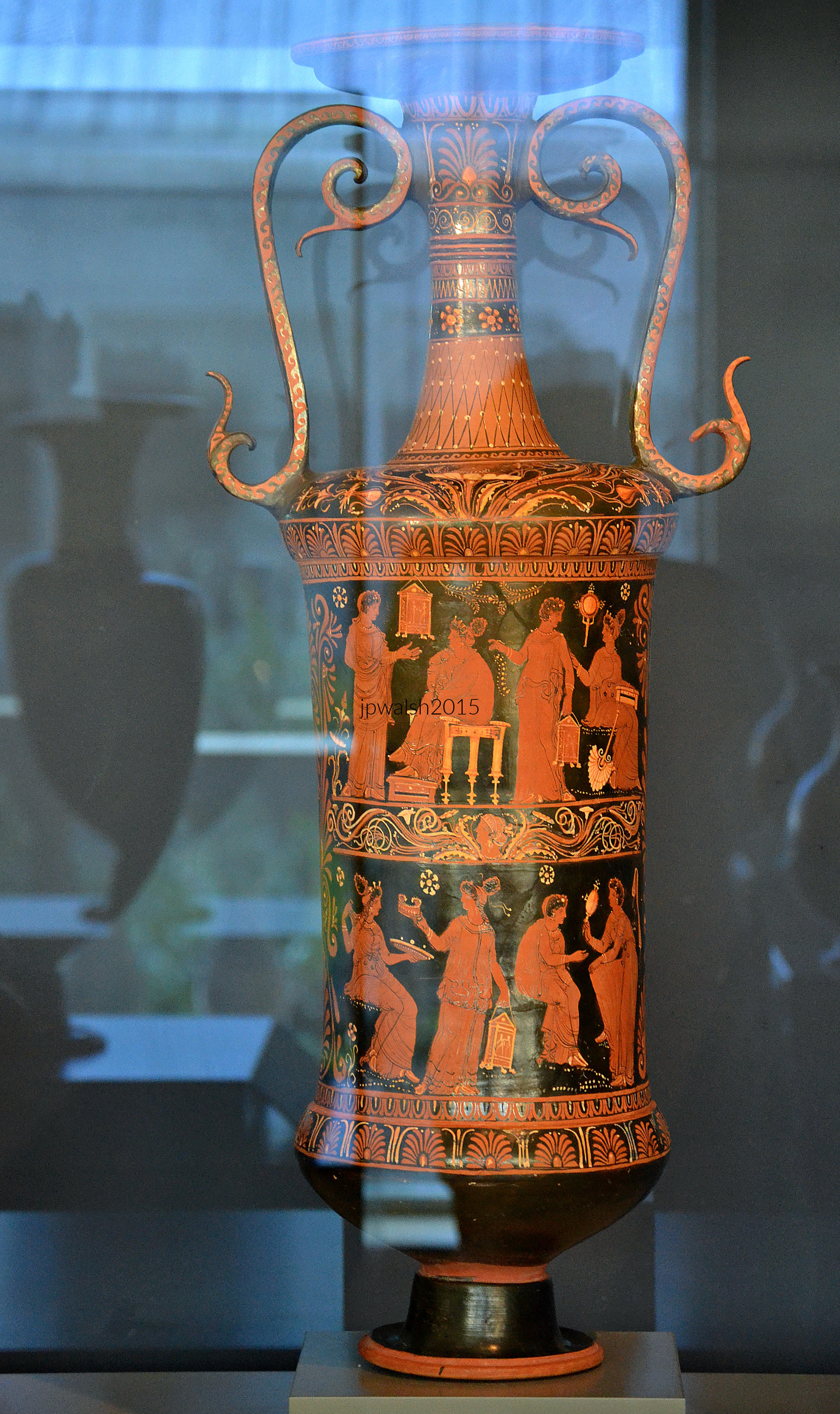
Loutrophoros (Bath water vase), 4th Century BCE. Greece. Italy (Apulia). Terracotta. The Art Institute of Chicago.
August 2015. Ancient Greek and Roman Art, The Art Institute of Chicago. October 2014. AIC. 6.64mb 35%The Art Institute of Chicago.
Black-figure painting was the primary technique for decorating Greek vases for over 200 years. The technique started in Corinth and expanded east to Athens in the mid first millennium BCE (700- 500 BCE). In this time period ancient Corinth was, with almost 100,000 people, one of the largest cities of Greece. In 146 BCE the Romans besieged, captured and demolished Corinth. The site lay deserted for almost 100 years until the Romans rebuilt it as a new city populated with around 50,000 Romans, Greeks and Jews.
August 2015. The Art Institute of Chicago.
Oil Jar, 450 BCE, Athens, Greece, terracotta. The Art Institute of Chicago.
May 2015. The Art Institute of Chicago. 19th Century. France. Impressionism.
Gustave Caillebotte (1848-1898), Paris Street; A Rainy Day (“Rue de Paris, Temps de pluie”), 1877. The Art Institute of Chicago.
October 2014. The Art Institute of Chicago. 19th Century. American.
Abbott Handerson Thayer (1849-1921). Winged Figure, 1889, oil on canvas. 130.8 × 95.9 cm (51 1/2 × 37 3/4 in.). The Art Institute of Chicago.
October 2014. The Art Institute of Chicago. 19th Century. American.
James McNeill Whistler (1834-1903), The Artist in his Studio, c. 1865-66, oil on boarded mounted on panel, 62 × 46.5 cm (24 7/16 × 18 5/16 in.). The Art Institute of Chicago.
May 2014. The Art Institute of Chicago. 19th Century. France. Sculpture. Modernism.
Auguste Rodin (1840-1917), Eternal Springtime, 1884. Bronze. Fonderie Alexis Rudier, Paris (20th century). The Art Institute of Chicago.
May 2015.The Art Institute of Chicago. 19th Century. France. Impressionism. Sculpture.
Edgar Degas (1834-1917), Spanish dance (c.1883), Arabesque (c.1885), and Woman seated in an armchair, (c.1901), bronze (cast later). The Art Institute of Chicago.
May 2014. The Art Institute of Chicago. 19th Century. French. Sculpture. Modernism.
Auguste Rodin (1840-1917), Adam, 1881. Bronze. The Art Institute of Chicago.
September 2015. Africa. The Art Institute of Chicago.
Headdresses. 19th/20th Century. Africa. The Art Institute of Chicago. The headdresses at the right and at the left are Gelede headdresses. The headdress in the middle is perhaps a Gelde or Efe headdress. The headdress at the left is made of wood and the oldest of the headdresses. It was made in Nigeria or Benin by the Yoruba community in the late 19th/early 20th centuries. Gelede headdresses often portray women. The headdresses in the center and at right depict women. One is wearing a head tie and the other is showing a woman with a plaited hairstyle. These were made in Nigeria by the Yoruba community in the early 20th century. The Gelede festival of the Yoruba community in western Africa is a public spectacle which uses colorful masks that combines art and ritual dance to educate, entertain and inspire worship. Gelede includes the celebration of “Mothers,” a grouping that includes female ancestors and deities as well as the elderly women of the community whose power and spiritual capacity in society is convoked. The Efe is a nighttime public performance held the day before the Gelede.
May 2015. 7.05 mb The Art Institute of Chicago.
Mariano Fortuny (1838-1874), African Chief, 1870, oil on canvas, 41 × 32.9 cm (16 1/8 × 12 15/16 in.). The Art Institute of Chicago. African Chief in The Art Institute of Chicago was recently exhibited in a 2017-2018 monographic retrospective at the Prado in Madrid. The show, simply entitled “Fortuny (1838-1874),” reflected the Prado’s holdings of many of this artist’s masterpieces. The Prado’s collection is due to their own acquisitions but mainly the generous bequests of the artist’s oils, watercolors, and drawings by late 19th century Mexican collector Ramón de Errazu (1840-1904) as well as the painter’s son, Mariano Fortuny y Madrazo. Fortuny’s artwork is often Orientalist in style that reflects the many trips he made to North Africa. In his career, Fortuny was noted for his precision of anatomy and archaeological scrupulousness though African Chief tends to the modern broken brush style for which the Spanish artist was prescient following his many trips to Paris. 19th century. Spain. Romanticism.
October 2014. The Art Institute of Chicago.
Left to right: Kramer Brothers Company (Dayton, Ohio), Settee, c. 1905/25; Cecilia Beaux (American, 1855-1942), Dorothea and Francesca, 1898, oil on canvas; Daniel Chester French (American, 1855- 1931), Truth, 1900, plaster.
September 2015. The Art Institute of Chicago. 19th Century. American. Modernism.
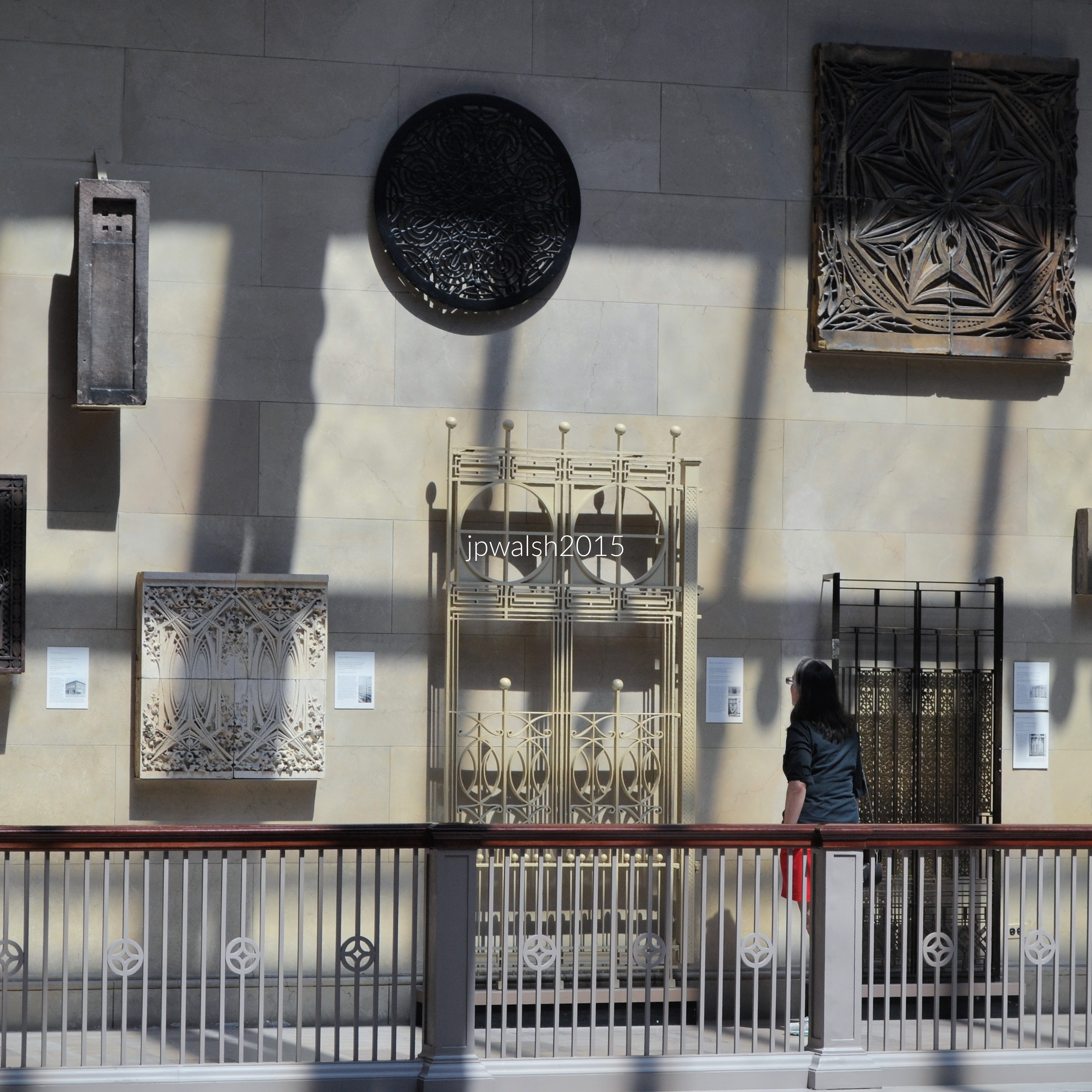
Above and next three below: Fragments, Dankmar Adler (1844-1900) and Louis Sullivan (1856-1924), The Art Institute of Chicago. 19th Century. American. Modernism.
September 2015. The Art Institute of Chicago. 560kb 40%August 2015. The Art Institute of Chicago. 2.87mb DSC_0644 (1)November 2015. 6.38mb DSC_0352 (1)
With the arm detail of Rodin’s bronze Adam (1881), the landing of the Grand Staircase at The Art Institute of Chicago.
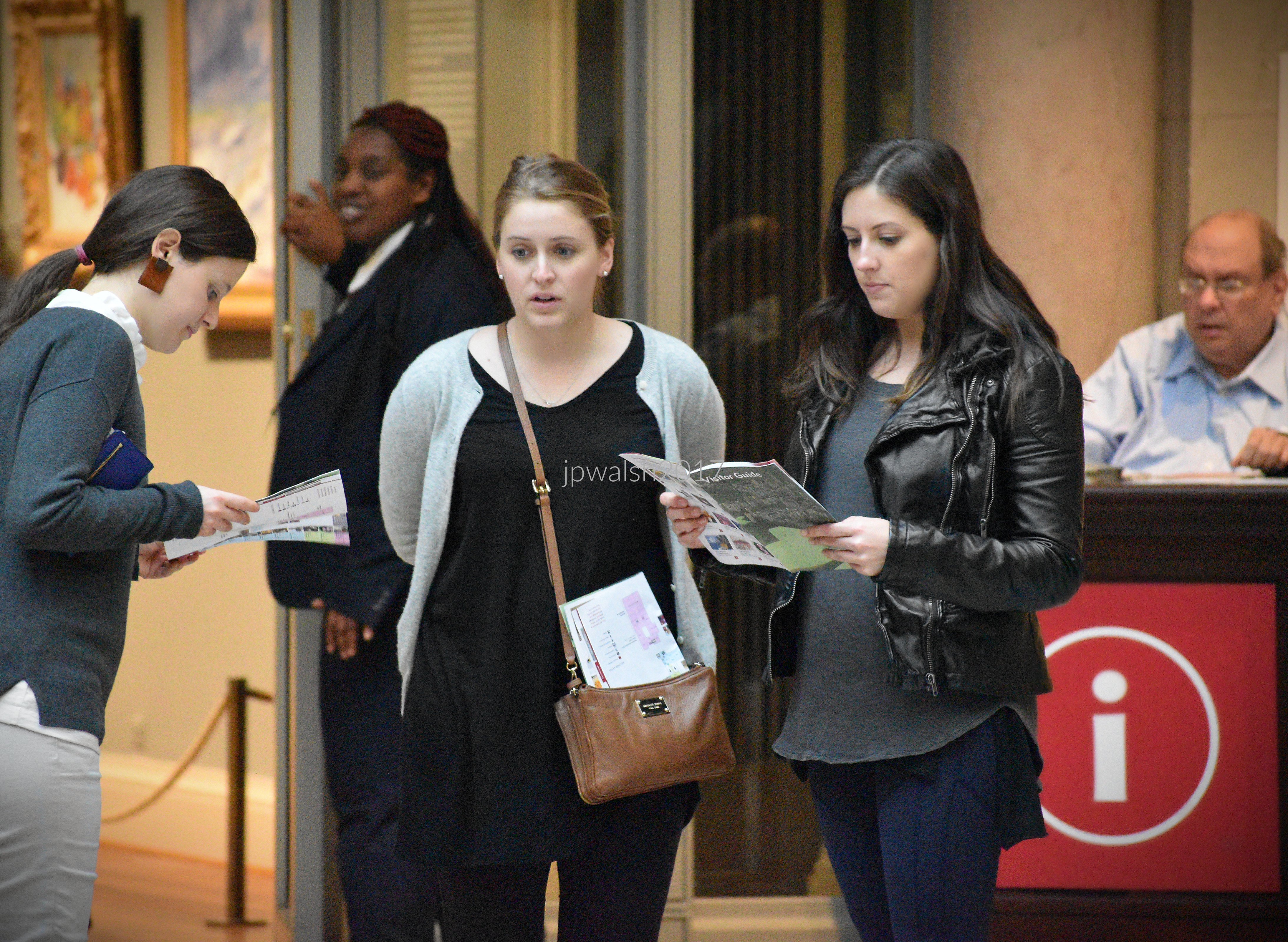
September 2015. Help desk, The Art Institute of Chicago. May 2021. 7.35 mb The Art Institute of Chicago.
Bisa Butler (1973-), The Safety Patrol, 2018, by Bisa Butler. Cotton, wool, and chiffon; appliquéd and quilted. The Safety Patrol considers the potential of a group of children as future caretakers of the world led by a boy in a sash with outstretched arms whose duty it is to protect the others. Bisa Butler uses the technique of appliqué quilt making to create her work. For the figures, the artist cuts, layers, and pins together fabrics and arranges them on the ground fabric. This comprises the quilt top. Between this quilt top and a backing fabric is a layer of fiber “batting” or stuffing. These layers are stitched to form the quilt with the thread lines part of the structure, texture and details of the image. Butler seeks to use fabric colors and patterns to contribute to the quilt’s subject and narrative. 21st Century. American.
May 2014. The Art Institute of Chicago. 18th century. France. (60)
Hubert Robert (French, 1733-1808), The Fountains, 1787, oil on canvas, 255.3 × 221.2 cm (100 1/2 × 88 1/8 in.). The Art Institute of Chicago.
May 2015. 7.73 mb The Art Institute of Chicago.
Joseph Wilson (d. 1800), Adephi Club – Belfast, oil on canvas, 1783.
May 2015. 6.62 mb The Art Institute of Chicago.
The State Ballroom, Saint Patrick’s Hall, Dublin Castle, oil on wood, c. 1845, signed and inscribed: F. J. Davis/Dublin. St Patrick’s Hall had long been a key location for Ireland’s political, military and social elite to gather (B. Rooney, Creating History, Stories of Ireland in Art, 2016, p.179). These dance proceedings are overseen by the Lord Lieutenant of Ireland and his wife visible at the end of the hall. The 1840s was a period of fashion indulgence. The social ball with attendees in sumptuous costume took place during the period of the Irish famine (1845-1849) where approximately one million people died. Another one million or more emigrated out of the country at the same time, many to the United States. Court dress for gentleman allowed personal expression in fabric and style for the waistcoat. Military officers and political office holders wore court uniforms indicating their position and rank. For ladies, to signal their marital situation, unmarried women wore jewelry and fresh flowers in their hair. Conventionally-minded single ladies added two ostrich feathers behind one ear. Matrons sported a third ostrich feather in their hair and wore lace ribbons.
May 2021. The Art Institute of Chicago. 16th Century. Spain.
El Greco (Doménikos Theotokópoulos) (1541-1614), Saint Francis Kneeling in Meditation, c. 1595, oil on canvas. 92 × 74 cm (36 3/16 × 24 1/8 in.). The Art Institute of Chicago.
October 2014. The Art Institute of Chicago. 19th Century. American.
Arthur Wesley Dow (1857-1922), Boats at Rest, c. 1895, oil on canvas, 66 × 91.4 cm (26 × 36 in.). The Art Institute of Chicago.
October 2016. Ukrainian National Museum (2249 W. Superior Street), Chicago. 4.55 mbMay 2015. Aurora, IL. The David L. Pierce Art & History Center (20 East Downer Place). 4.15 mbMay 2014. The Art Institute of Chicago.
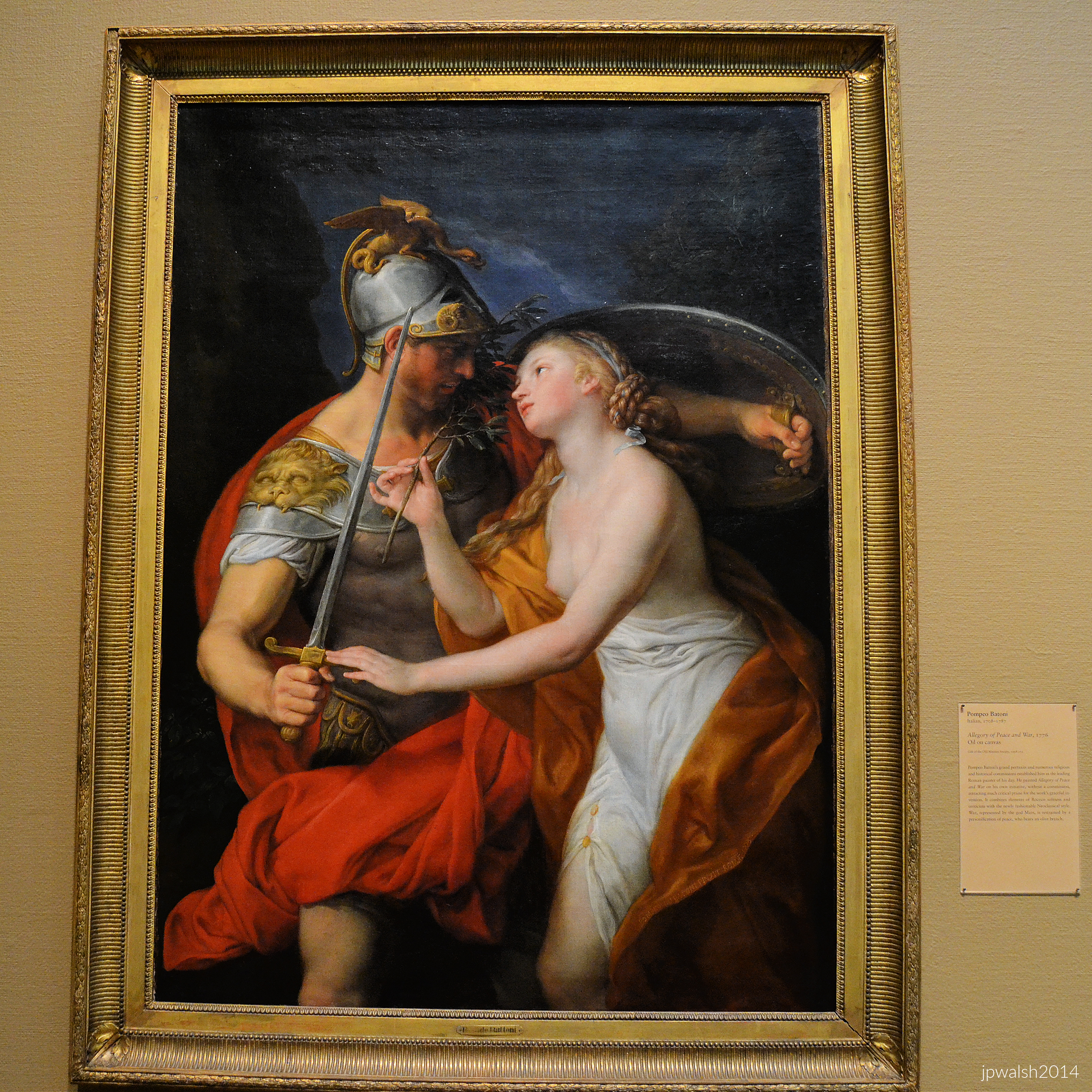
Pompeo Batoni (Italian, 1708-1787), Allegory of Peace and War, 1776, oil on canvas, 53 1/2 × 39 in. The Art Institute of Chicago. 5.73 mb Pompeo Batoni was a leading 18th-century Roman painter. The artist was known for his portraits and commissioned large format historical and religious paintings. The painting entitled “Allegory of Peace and War” represented the mythological figure of the god Mars being restrained by a semi-nude embodiment of peace. Peace lays her hand on War’s sword and bears to him an olive branch. The painting was the result of Batoni’s own invention – no one commissioned this artwork – and it stayed in the artist’s studio until at least the early 1780s.
December 2015. Chicago Cultural Center. 3.62 mb March 2002. Louvre, Paris. 312 kb
Statue of Aphrodite, called Venus de Milo because it was found on the Greek Island of Milos in the Aegean Sea. It dates from around 150 B.C. In the Louvre in Paris, the Venus de Milo is one of the most famous statues in the world. Its soft, sensual handling of the marble was characteristic of the late Hellenistic period. She is monumental – the topless, armless Venus de Milo stands, independent of her base and pedestal, six feet five inches in height. In the course of the second half of the 19th century, the Venus de Milo became a favorite statue of Parisians and its visitors. It was around 1875 that it was moved away from the wall which it stood against and placed in the middle of a 17th century room so that it could be viewed completely around. It was accorded this baroque effect first used at Versailles at the start of the 18th century so to isolate monumental sculpture for display to produce maximum impact and enjoyment of the artwork. SOURCES: Masterpieces of the Louvre, Marcel Brion, NY: Abrams; Creators Collectors and Connoisseurs, Niels Von Holst, NY: G.P. Putnam’s Sons.
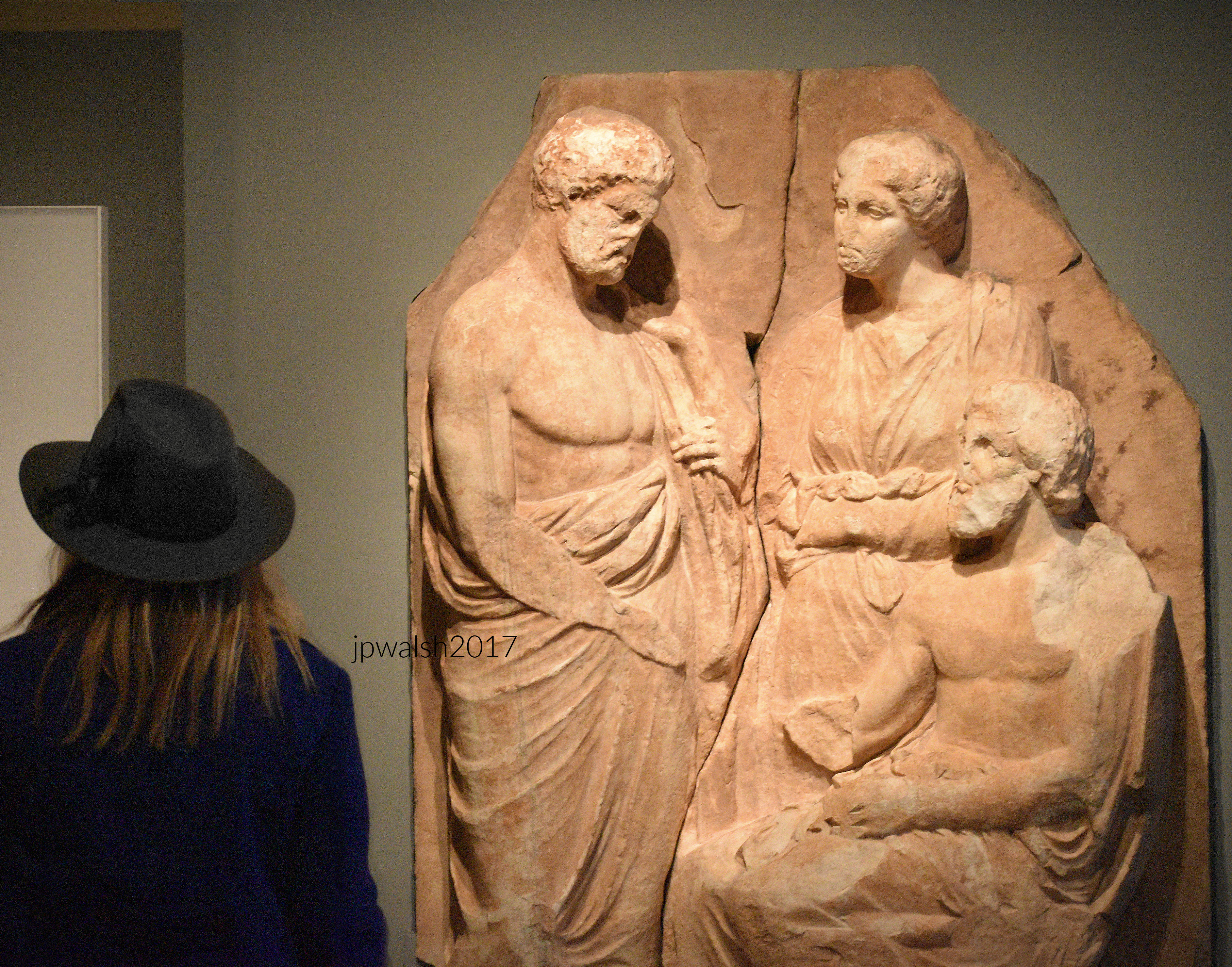
November 2017. 74% 7.84mb DSC_3350 The Art Institute of Chicago.
Fragment of a Funerary Monument, c. 330 BCE Greek; Athens, 152.4 × 111.8 × 33 cm (60 × 44 × 13 in.), The Art Institute of Chicago. see- https://www.artic.edu/artworks/55887/fragment-of-a-funerary-naiskos-monument-in-the-shape-of-a-temple – retrieved March 31, 2025. This is one of the fashionable burial markers, whether of Greek or Roman families, encountered by the public in ancient times. Made in all sorts of shapes and sizes, this large stone monument from the 4th century BCE shows three figures carved in very high relief so much so that they are nearly in the round. The two male figures’ gestures of parting indicate that it is a funerary scene. The standing man is likely the person who has died and this funerary marker depicts his sharing a final farewell with loved ones – their relationship, obviously close, after 2500 years, completely unknown.
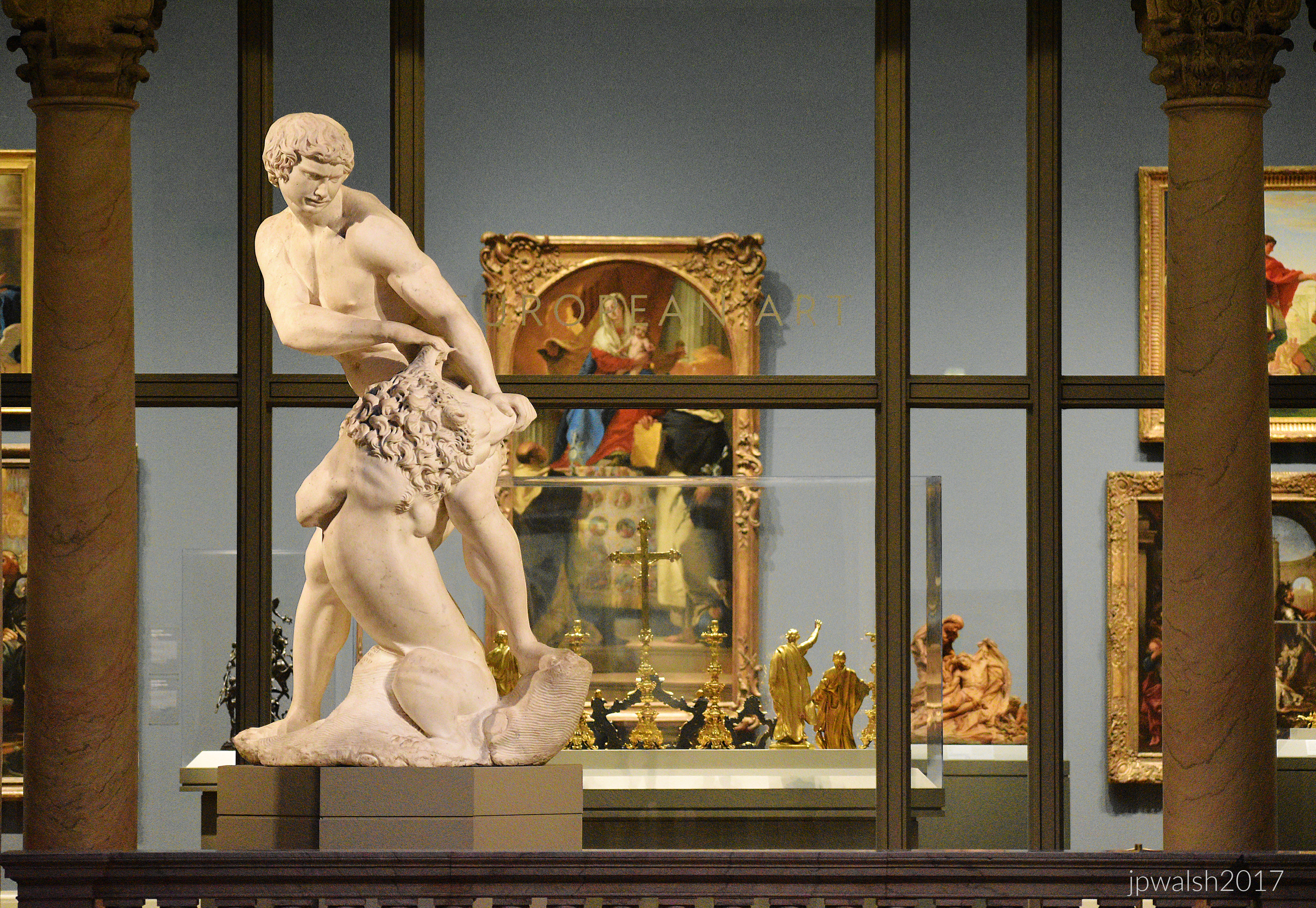
November 2017. 69% 7.88mb DSC_3355 The Art Institute of Chicago.
Cristoforo Stati (Italian, 1556–1619). Samson and the Lion, 1604-1607, marble, 210 × 112 × 84 cm (82 11/16 × 44 1/8 × 33 1/8 in.). The Art Institute of Chicago. see – https://www.artic.edu/artworks/146875/samson-and-the-lion – retrieved April 1, 2025. Stati studied in Florence under Giambologna (1529-1608). In 1601, Tuscany’s archduke, Ferdinando I de’ Medici (1549-1609), sent a sculpture of Samson by Giambologna to the palace of Spain’s prime minister in Valladolid as a gift. Later, Stati’s sculpture of Samson and the Lion was also sent to Spain as a complementary gift and installed in Madrid. The work was in a Swiss private collection before it was acquired by The Art Institute of Chicago in 1996.
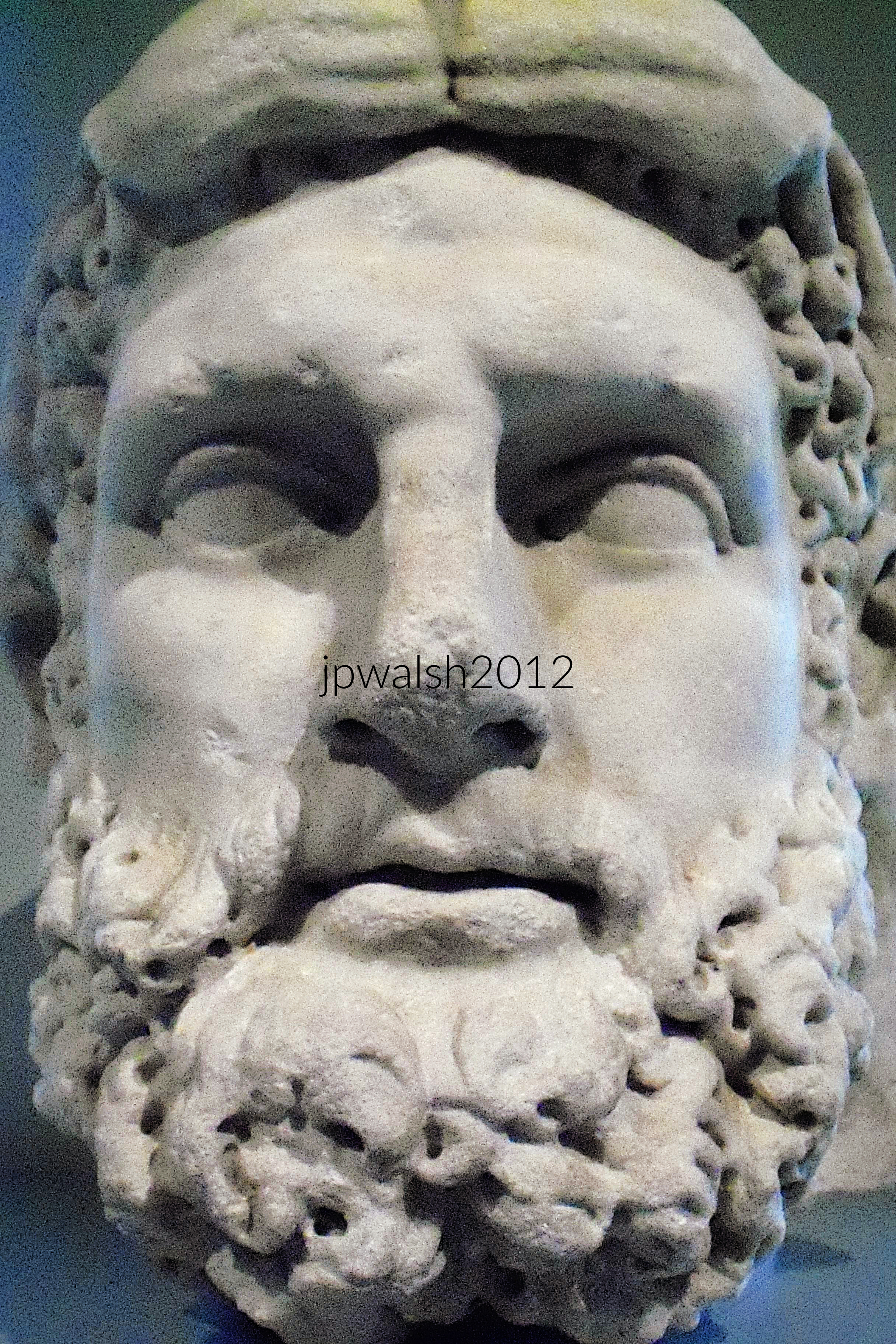
November 2017. The Art Institute of Chicago. 80% 7.88mb DSC_3315December 2012. 1st century. Roman. The Art Institute of Chicago. .2.25mb 101_1469
Head of Hercules. Roman, First Century CE. The Art Institute of Chicago. The Romans adapted the stories of Hercules’ superhuman feats of strength from the Greeks. The earlier Greeks viewed him as a demigod, the later Romans saw him as one of their hero figures.
May 2016. The Art Institute of Chicago. 7.44mb DSCN2611 (1)
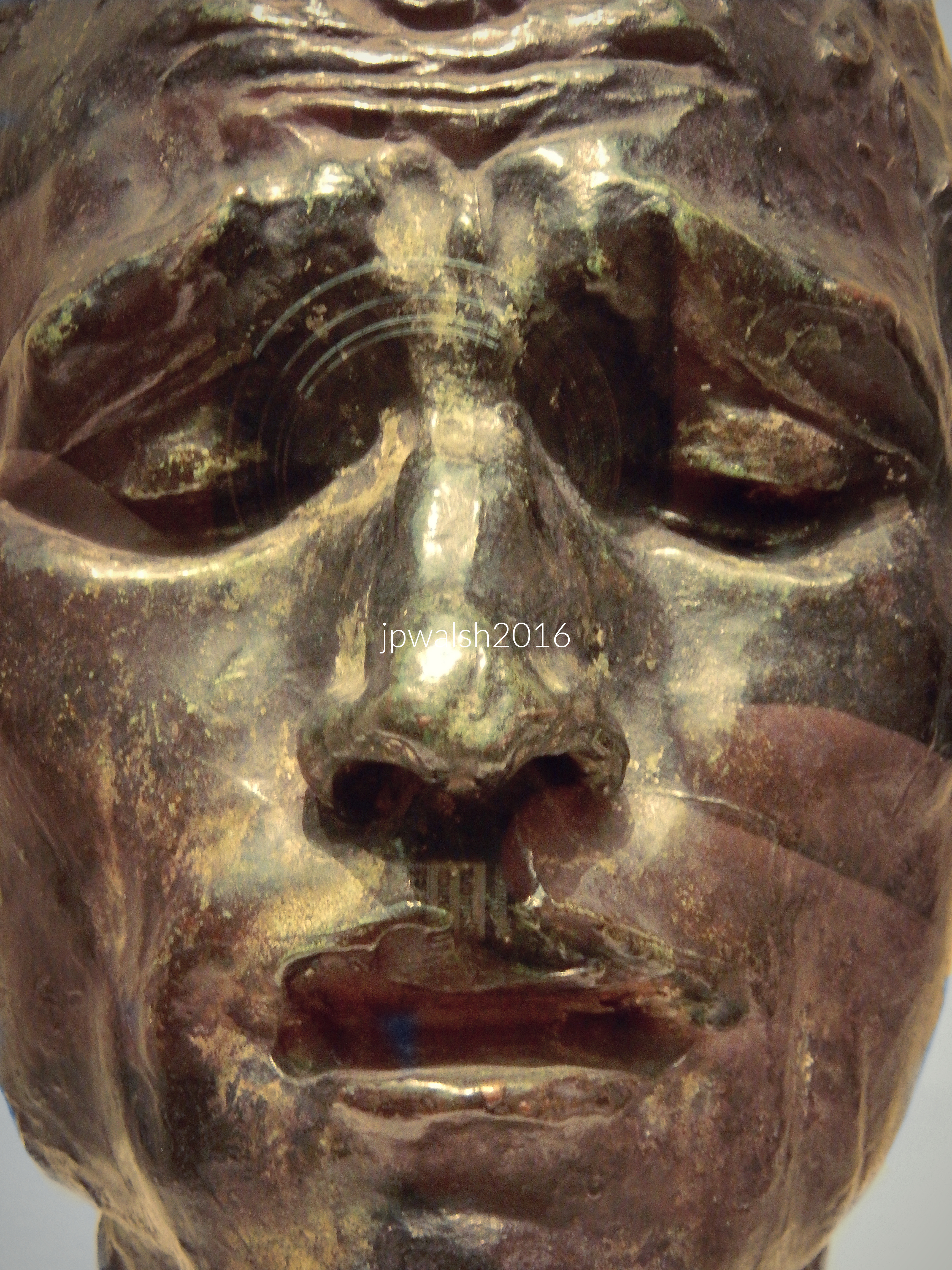
Head of Pierre de Wissant (1889) by Auguste Rodin, part of The Burghers of Calais (1884–89) in the collection of the Art Institute of Chicago, originates from the larger sculptural ensemble commemorating the six citizens of Calais who offered themselves as hostages to the English during the Hundred Years’ War. When displayed independently, the head emphasizes Rodin’s exploration of psychological intensity and human vulnerability. The sculpture conveys a moment of profound emotional anguish: the downward gaze, deeply furrowed brow, and partially opened mouth collectively articulate a state of acute despair and inner turmoil. Through these expressive distortions, Rodin captures not only the historical gravity of the subject’s sacrifice but also the universal experience of psychological suffering.
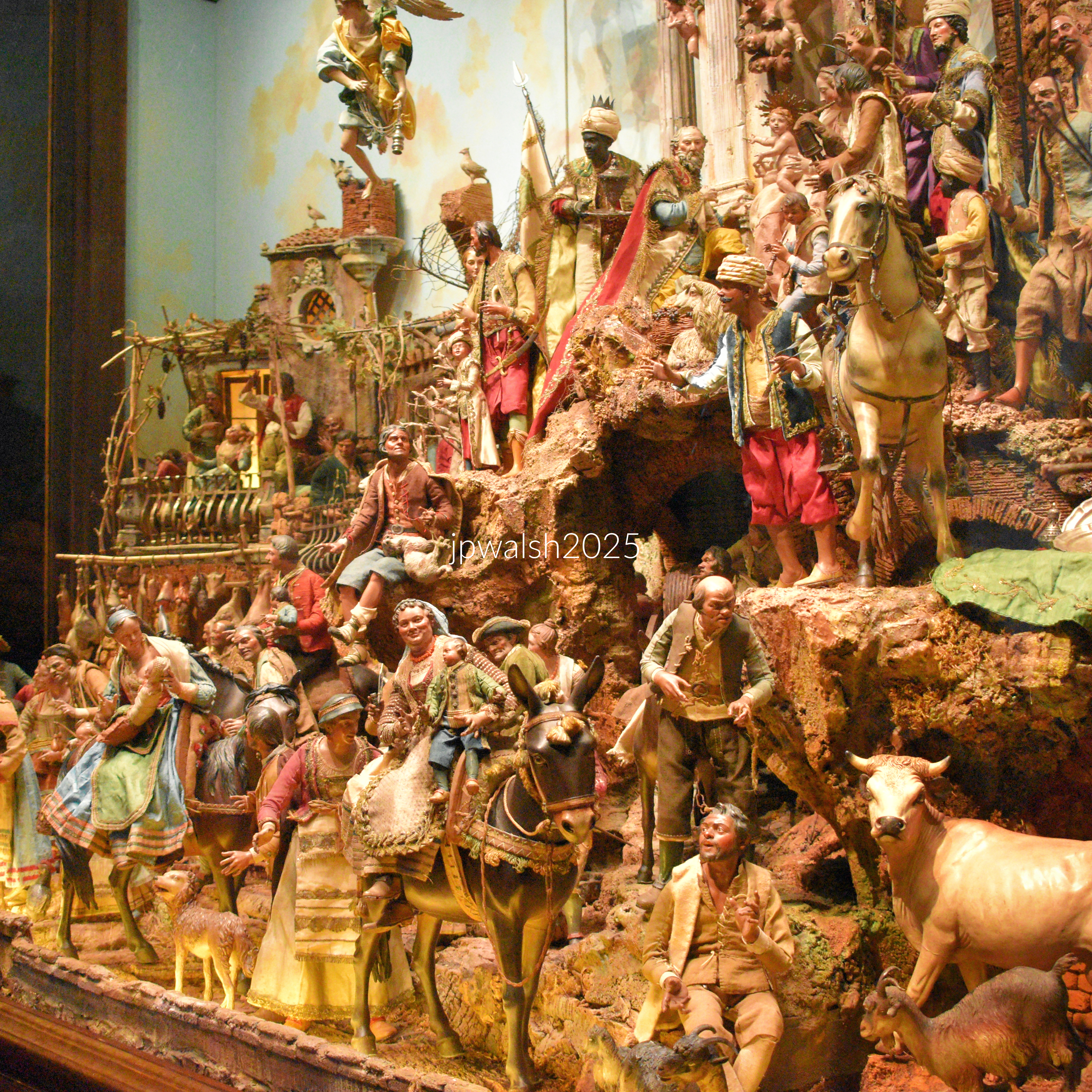
December 2025. 98% 7.84mb DSC_9937The Art Institute of Chicago.
Crèche, mid-18th century, Naples, Italy. Details of daily life are connected to the biblical narrative of the Nativity of Jesus Christ.
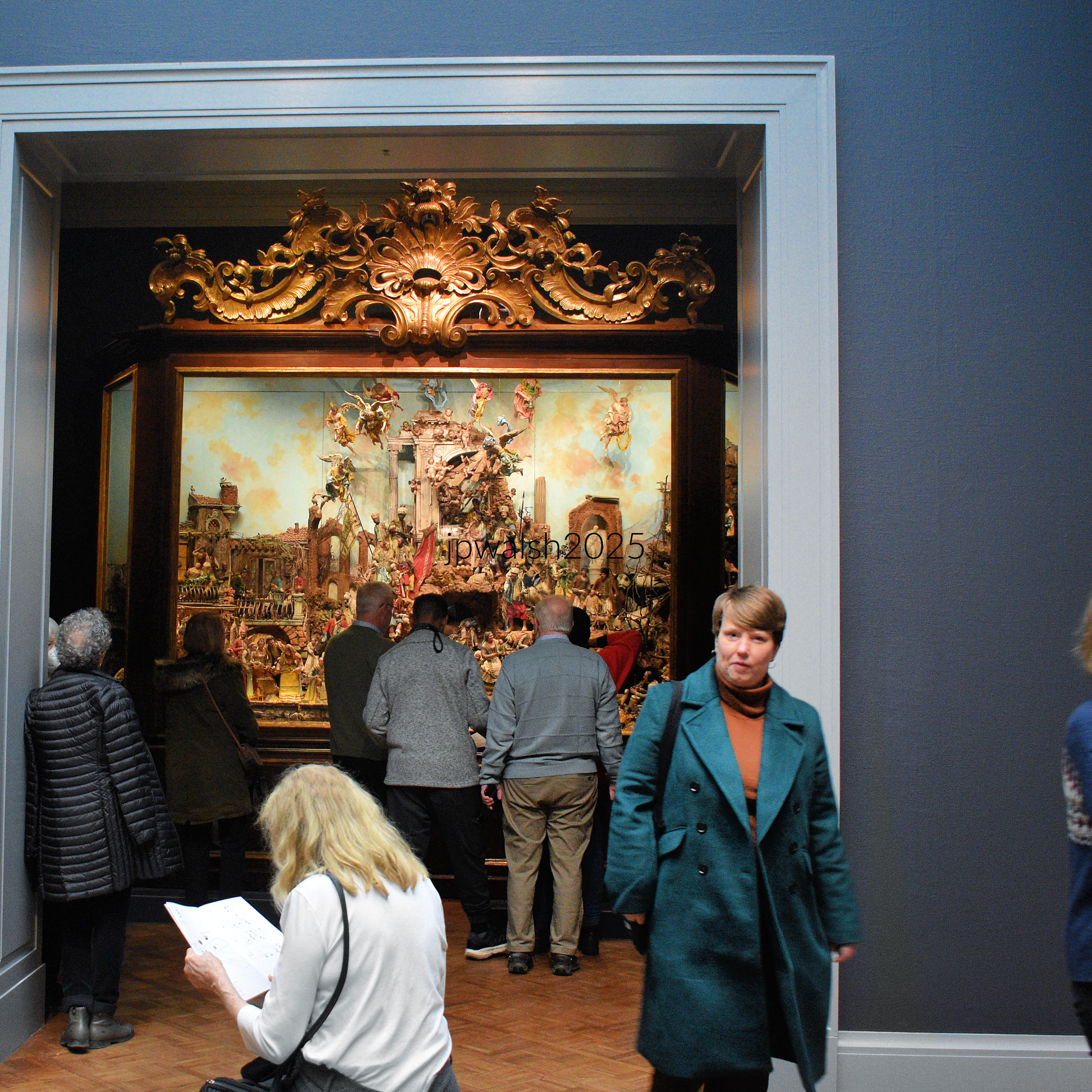
December 2025. The Art Institute of Chicago. 7.33mb DSC_9933 (1)
The mid-18th century Neapolitan Crèche invites viewers to witness the miraculous among the mundane. The Art Institute of Chicago. see – Neapolitan Crèche | The Art Institute of Chicago – retrieved December 14, 2025.
December 2025. The Art Institute of Chicago.7.66mb DSC_9896 (1)
Auguste Rodin (1840-1917), A Burgher of Calais (Jean d’Aire), modelled 1889, plaster, 82×26 in. The figure was exhibited in the 1893 World’s Columbian Exposition in Chicago and entered the Art Institute’s collection that same year. The monument includes six individualized figures on a heroic scale and was commissioned in France in 1884. Completed in 1889 by Rodin the monument was installed in Calais’s town hall square in 1895. Rodin depicts Jean d’Aire, one of the town fathers, in sackcloth with the keys of the city, surrendering to the English during the Hundred Years War, in exchange for their lifting a nearly year-long siege that led to the starvation of the city’s inhabitants.. see – Monument to The Burghers of Calais | Musée Rodin – retrieved December 15, 2025.
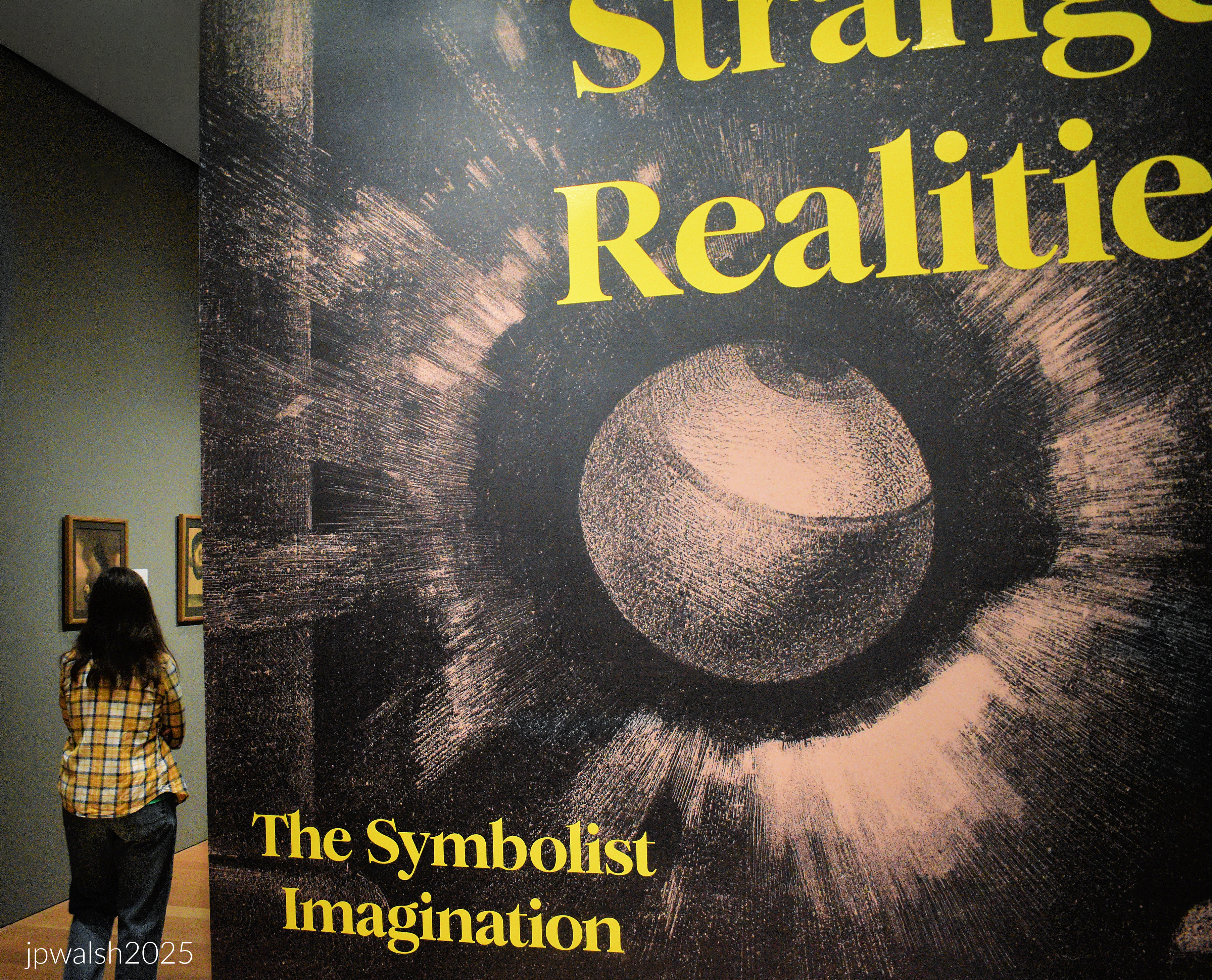
December 2025. The Art Institute of Chicago. 73% 7.86mb DSC_9847
Exhibition Strange Realities: The Symbolist Imagination (October 4, 2025- January 5, 2026). Over 85 works of major artists including Odilon Redon, Paul Gauguin, and Edvard Munch, drawn from the Museum’s collection of drawings and prints exploring the late 19th century pan-European Symbolist movement of art, literature and theatre.see – Strange Realities: The Symbolist Imagination | The Art Institute of Chicago – retrieved December 16, 2025.
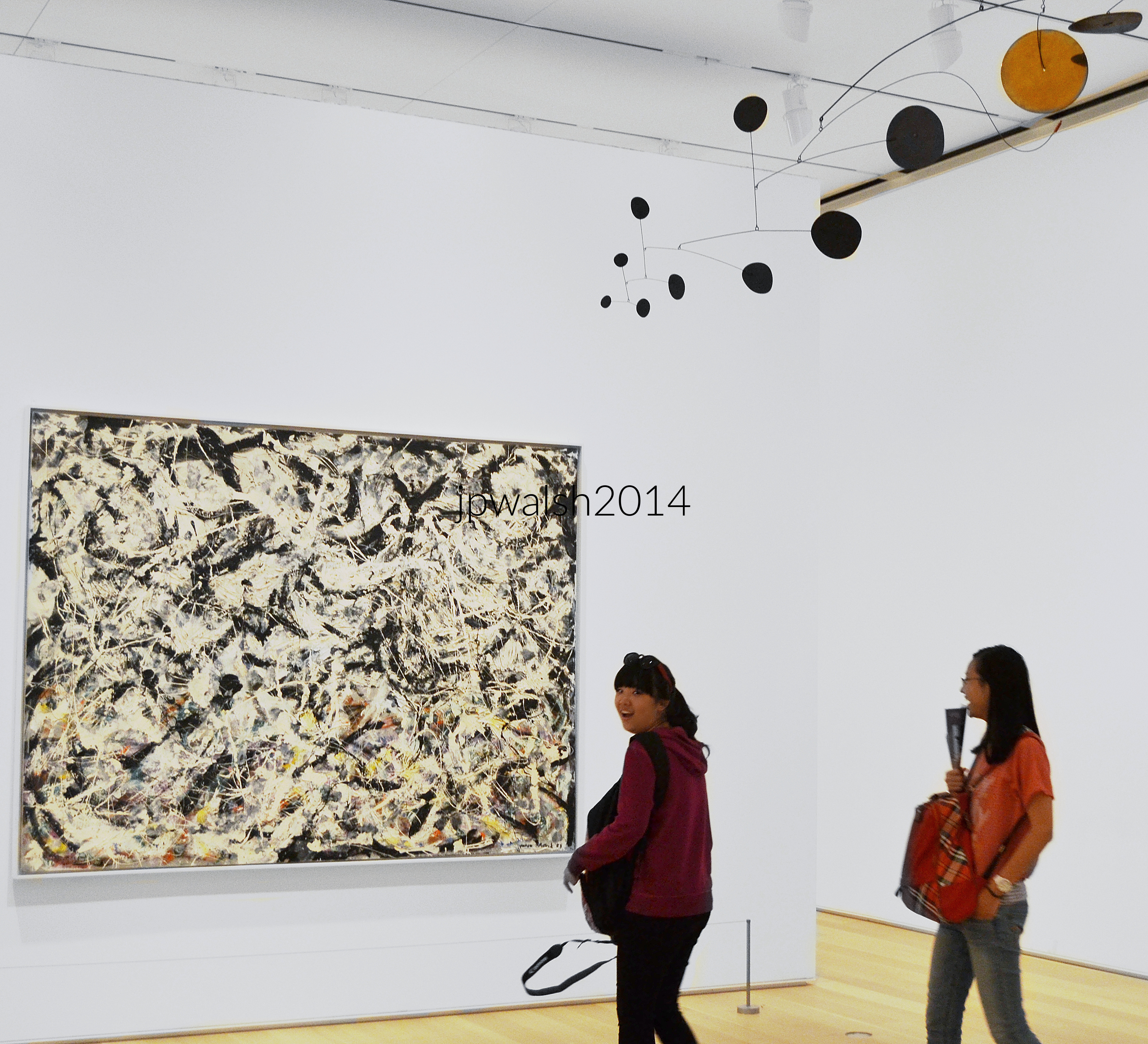
December 2025. The Chauncey McCormick Gallery, The Art Institute of Chicago. 93% 7.89mb DSC_9889September 2014. The Art Institute of Chicago. 3.55mb DSC_1038 (1)
Greyed Rainbow, 1953, Jackson Pollock, oil on linen, 182.9 × 244.2 cm (72 1/16 × 96 3/16 in.) and Streetcar, 1951, Alexander Calder, Brass, sheet metal, rod, wire, and paint, 9’8″ long, Art Institute of Chicago. See – Streetcar (1951) | Calder Foundation – retrieved Jan. 29, 2026 and Greyed Rainbow | The Art Institute of Chicago – retrieved Jan. 29, 2016.
Ed Harris’s December 2000 biographical film Pollock reconstructs the mid-20th-century modern art world through a meticulous ensemble cast, highlighted by Marcia Gay Harden’s Academy Award-winning portrayal of pioneering Abstract Expressionist painter Lee Krasner.
POLLOCK: IF PEOPLE WOULD JUST LOOK AT THE PAINTINGS I DON’T THINK THEY’D HAVE ANY TROUBLE ENJOYING THEM. IT’S LIKE LOOKING AT A BED OF FLOWERS. YOU DON’T TEAR YOUR HAIR OUT OVER WHAT IT MEANS.
In a stellar cinematic year defined by Gladiator, Traffic, Almost Famous, and Erin Brockovich, Marcia Gay Harden triumphed at the Academy Awards, winning Best Supporting Actress for her riveting performance in Pollock. Harden portrayed Lee Krasner (1908–1984), the pioneering American Abstract Expressionist painter and wife of the biographical film’s brilliant but tortured title character, Jackson Pollock (1912–1956). In addition to her Oscar victory, Harden secured the Best Supporting Actress prize from the New York Film Critics Circle.
Ed Harris pulled impressive double duty on the project, earning an Academy Award nomination for Best Actor in what also marked his directorial debut. Behind the camera, Harris assembled a flawless ensemble cast to bring the mid-20th-century modern art world to life. The film features Jennifer Connelly as Ruth Kligman (1930–2010), the American abstract artist and romantic partner to both Pollock and Willem de Kooning. Val Kilmer portrays the iconic Dutch-American abstract expressionist de Kooning (1904–1997) himself, alongside Bud Cort as writer and dealer Howard Putzel (1898–1945).
Rounding out the historic inner circle are Jeffrey Tambor as art critic Clement Greenberg (1909–1994), John Heard as sculptor Tony Smith (1912–1980), Robert Knott as Jackson’s older brother Sande Pollock (1909–1963), Sada Thompson as Pollock’s mother Stella (1875–1958), and Amy Madigan as American art collector Peggy Guggenheim (1898–1979). Much like its Pollock and Krasner’s revolutionary artwork, the film made an indelible splash upon its December 2000 release, remaining a memorably fine and enduring effort. https://youtu.be/z0xiovbDML0?si=XupBbr5gZnhuTVqP – retrieved Jan. 30, 2026.
September 2014. Modern Wing, Art Institute of Chicago. 3.49mb DSC_1061 (1)August 2015. Modern Wing, Art Institute of Chicago. 3.76mb DSC_0672 (1)August 2015. The Art Institute of Chicago. 3.14mb DSC_0068 (1)August 2015. The Art Institute of Chicago.4.14 mbDSC_0181 (1)August 2015. The Art Institute of Chicago. 1.22mb DSC_0014 (1)October 2015. Art exhibit. Oak Park, IL. 4.72mb DSCN1739 (2)November 2015. Art Institute of Chicago. 3.77 mb DSC_0094 (1)September 2016.Milwaukee Art Museum. 2.63mb DSC_0054 (1)
Thomas Hart Benton, Poker Night (from A Streetcar Named Desire), 1948(Whitney Museum of American Art),Milwaukee Art Museum. 2.63mb DSC_0054 (1)
September 2016. Haggerty Art Museum, Milwaukee, WI. 3.54mb DSC_0922 (1)Frida Kahlo (1907-1954), Untitled called Self-Portrait with Thorn Necklace and Hummingbird (“Autorretrato con Collar de Espinas y Colibrí”), 1940, oil on canvas mounted to board, 61.2 cm × 47 cm (24.11 in × 18.5 in),Harry Ransom Center, Austin, Texas. The Ransom Center acquired the self-portrait in 1965 as one of a large collection of artworks assembled by photographer Nickolas Muray (American, b. Hungary, 1892–1965). Kahlo gifted the painting to Muray soon after it was completed in 1940.
Frida Kahlo’s Self‑Portrait with Thorn Necklace and Hummingbird (1940) is a concentrated display of her mature portrait style. Despite its small scale, the composition is intricate, drawing the viewer’s eye across a dense constellation of figures and symbolic objects. At the center sits Kahlo herself, rendered with imaginative realism and surrounded by a menagerie: a monkey on her left, a cat on her right, and a lifeless hummingbird suspended at her throat. Beneath her signature joined eyebrows, she meets the viewer with a calm, unwavering gaze that feels both resolute and quietly intense.
The animals around her animate the scene with contrasting energies. The monkey, distracted, toys with the thorn necklace, while the cat appears tense and ready to strike. The necklace itself encircles her neck and extends downward, its sharp thorns pressing into her half‑length figure. Against this harshness, delicate butterflies—whether real or hair clips—rest motionless in her hair, and above them hover two dragonflies, creatures that in Mexican art often signal a link between nature and the spirit world, messengers of transformation and guardians of the soul.
Within this symbolic framework, the monkey can be read as an emblem of lust or moral temptation, the cat as mysticism and freedom, and the thorn necklace as a sign of bodily suffering and constraint. It also evokes Christ’s crown of thorns, allowing Kahlo to cast herself in a mode of imitatio Christi—a figure bearing pain, betrayal, and emotional anguish after failed relationships. In this light, the butterflies and dragonflies become signs of renewal, hinting at the possibility of resurrection emerging from her world’s suffering.
Finally, hummingbirds (colibríes) are powerful symbols of the warrior spirit, deeply linked to Aztec mythology, embodying courage, vitality, and the fierce renewal of life. By the modern era hummingbirds have also come to represent love, hope, joy, and inner strength while being understood as messengers carrying the presence of departed loved ones returning in brief, luminous visitations.
The Brooklyn Bridge stands as the greatest achievement of John Augustus Roebling’s engineering career, uniting innovative design, industrial ambition, and architectural beauty to create an enduring symbol of New York City and America’s rise as a modern nation.
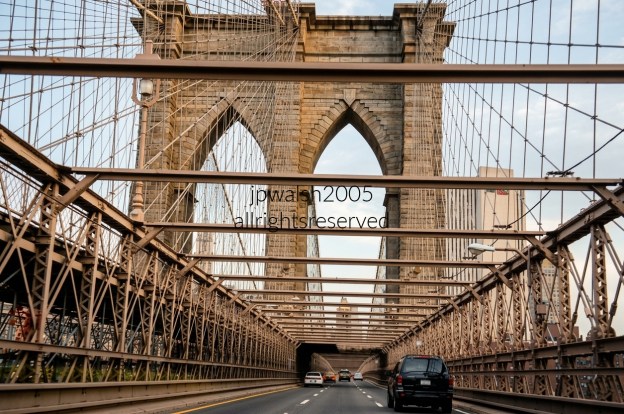
FEATURE image: The Brooklyn Bridge. Centered perfectly is one of the bridge’s massive, Gothic-arched granite suspension towers, while flanking the right side behind the suspension cables are the skyscrapers of Lower Manhattan, including the recognizable Verizon communications building. August 2005. Author’s photograph. All rights reserved.
The Brooklyn Bridge over the East River is the oldest extant bridge in New York City—a city of bridges—and is also the city’s most architecturally famous. The opening of the hybrid cable-stayed and suspension bridge in May 1883 has been called “the Dawn of Modern New York” as it is the world’s first steel-wire suspension bridge.
The Brooklyn Bridge was conceived to connect Manhattan and Brooklyn across the East River, overcoming unprecedented engineering challenges.
Recent photo of the Brooklyn Bridge taken from the Manhattan side of the East River looking across the water toward the DUMBO and Brooklyn Heights neighborhoods. PHOTO: “Brooklyn Bridge New York City” by ugod is licensed under CC BY 2.0.
Spanning the East River between the boroughs of Manhattan and Brooklyn, it was designed and built by a father-son team. Construction began in January 1870 after being approved by Congress in 1869 whose concern was that the bridge project would in no way impede free and open navigation. Over the next over 13 years, an estimated 27 men died during the bridge’s construction. The New York terminus rests on bedrock while the Brooklyn terminus rests on clay. Following its opening in 1883 by the end of that year more than one million passengers crossed the bridge.
Roebling’s innovative use of steel-wire cable technology made longer and stronger suspension spans possible. The bridge’s Gothic-inspired stone towers combine structural necessity with architectural grandeur.
Daily transit on the elevated pedestrian promenade of the Brooklyn Bridge in 1903, looking west toward the lower Manhattan skyline. In the foreground, a New York City policeman in a turn-of-the-century uniform and custodian helmet stands watch as pedestrians in Edwardian dress, men in long overcoats and bowler hats, make their way along the wide wooden boardwalk. The photograph captures the bridge’s intricate lattice of vertical suspenders and radiating steel stay cables. Flanking the promenade on either side are the lower iron trusses that separated pedestrians from the bridge’s busy trolley and cable car lines. Anchoring the composition at the vanishing point is one of the bridge’s immense granite towers, its signature neo-Gothic double arches perfectly framing the horizon and underscoring the monumentality of one of America’s great engineering achievements. Public Domain.
The total length of the bridge is 6,537 feet—nearly one-and-one-quarter miles. From the middle of the span, it is about 135 feet above the river with the span’s weight around 7,000 tons. The railroad on the Brooklyn Bridge opened in 1888. The cables on the bridge are over one foot wide (16 inches) and took almost a year and a half (15 months) to string. Their calibration had to include calculations for variables such as wind and expansion and contraction due to temperature. The height of the Gothic-inspired towers are 159 feet above the roadway.
The Brooklyn Bridge symbolizes the industrial age, urban growth, and American ingenuity. Today it remains one of the world’s most recognizable and photographed structures.
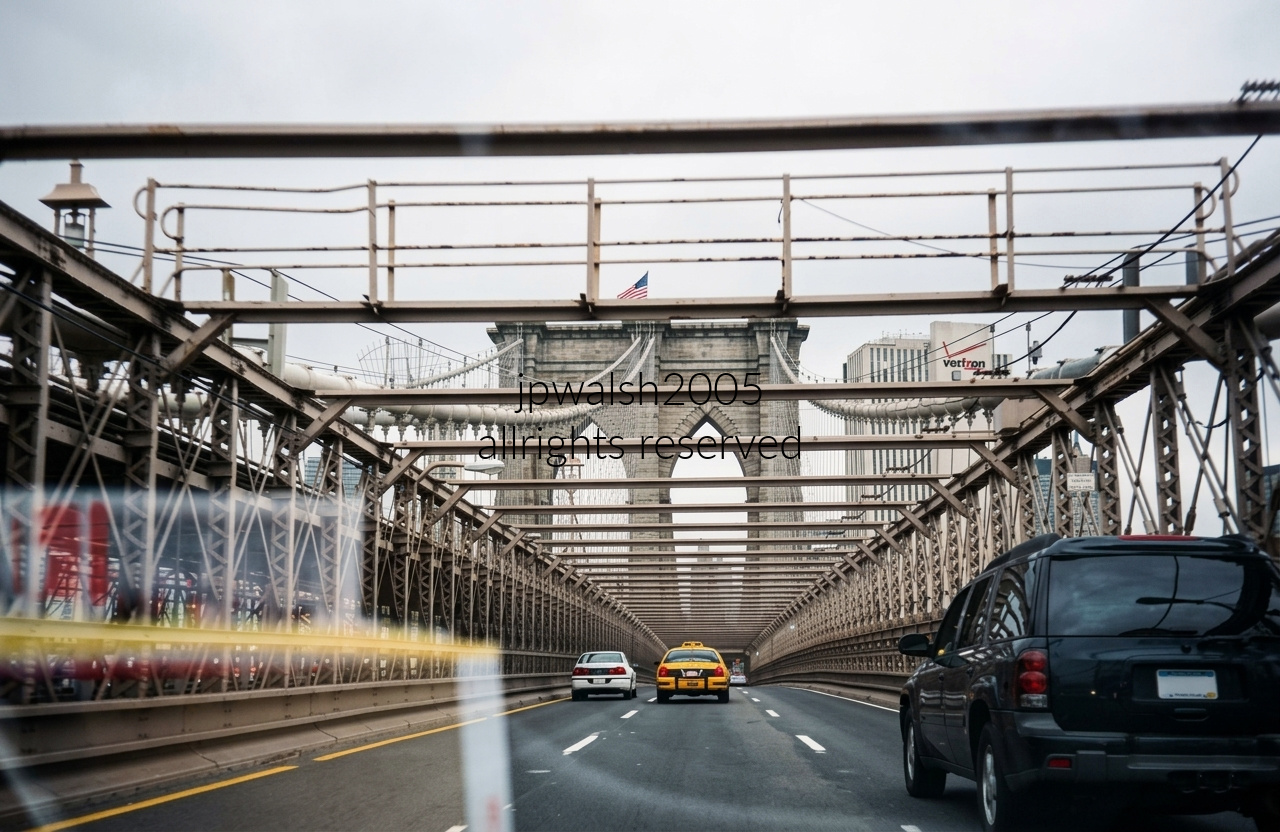
While a classic yellow New York City taxicab and a white sedan drive ahead, the bridge’s intricate, industrial steel trusses, overhead support beams, and complex web of suspension cables that line both sides of the roadway fill out the view heading from Brooklyn into Manhattan. An average of 103,051 vehicles cross the Brooklyn Bridge every single day. August 2005. Author’s photograph. All rights reserved.
SOURCES: The Sun, New York, New York, June 11, 1891. NYC DOT – Brooklyn Bridge – retrieved August 2, 2026.