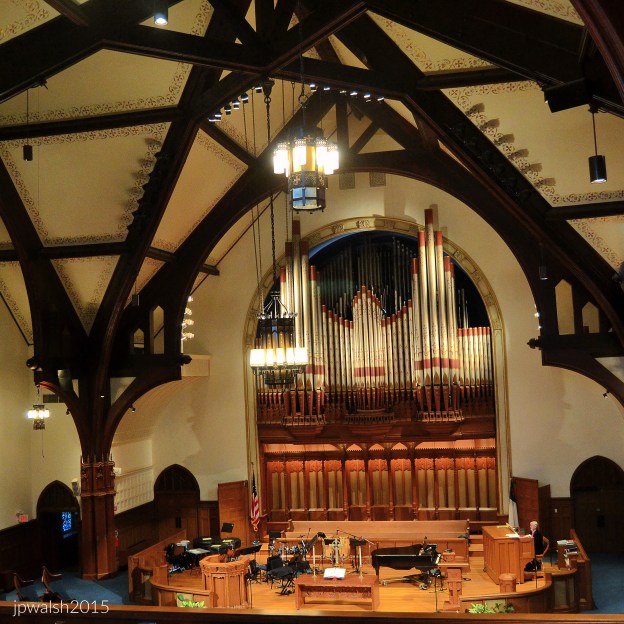

FEATURE image: Aeolian Skinner organ, sanctuary. October 2015. Author’s photograph. 6.27mb.
The First Presbyterian Church of Evanston (1895), designed by renowned local architect Daniel H. Burnham, stands as a masterwork of Gothic Renaissance architecture that masterfully balances community inclusivity with grand artistic elements—specifically highlighted by its unobstructed structural layout, a world-class Aeolian Skinner organ, and intricate, storytelling stained-glass windows.
Innovative Engineering:
The sanctuary holds a capacity of over 1,000 worshippers. To ensure an inclusive worship space, Burnham utilized Nordic-style timber trusses to support the vaulted roof, completely eliminating major columns that would otherwise obstruct congregation views. The historic church building was constructed in 1895 by legendary architect Daniel H. Burnham, who was an Evanston resident himself at the time.

Daniel Hudson Burnham, c. 1890. The First Presbyterian of Evanston church building was designed in 1895 by architect Daniel Burnham (1846-1912) who lived in Evanston. Public Domain.
Musical Significance:
The church houses an acclaimed Aeolian Skinner organ—with portions dating directly back to the 1890s—which is widely recognized as one of the finest organs in the entire Chicago area.

The sanctuary seats over 1,000 worshippers whose design retains an open, inclusive worship space. PHOTO: “PA02.2018 – 101” by Presbytery of Chicago is licensed under CC BY-NC-SA 2.0.

The First Presbyterian Church of Evanston’s Aeolian Skinner organ is one of Chicago’s finest organs, portions of which date to the 1890s. October 2015. Author’s photograph.
Masterful Stained Glass:
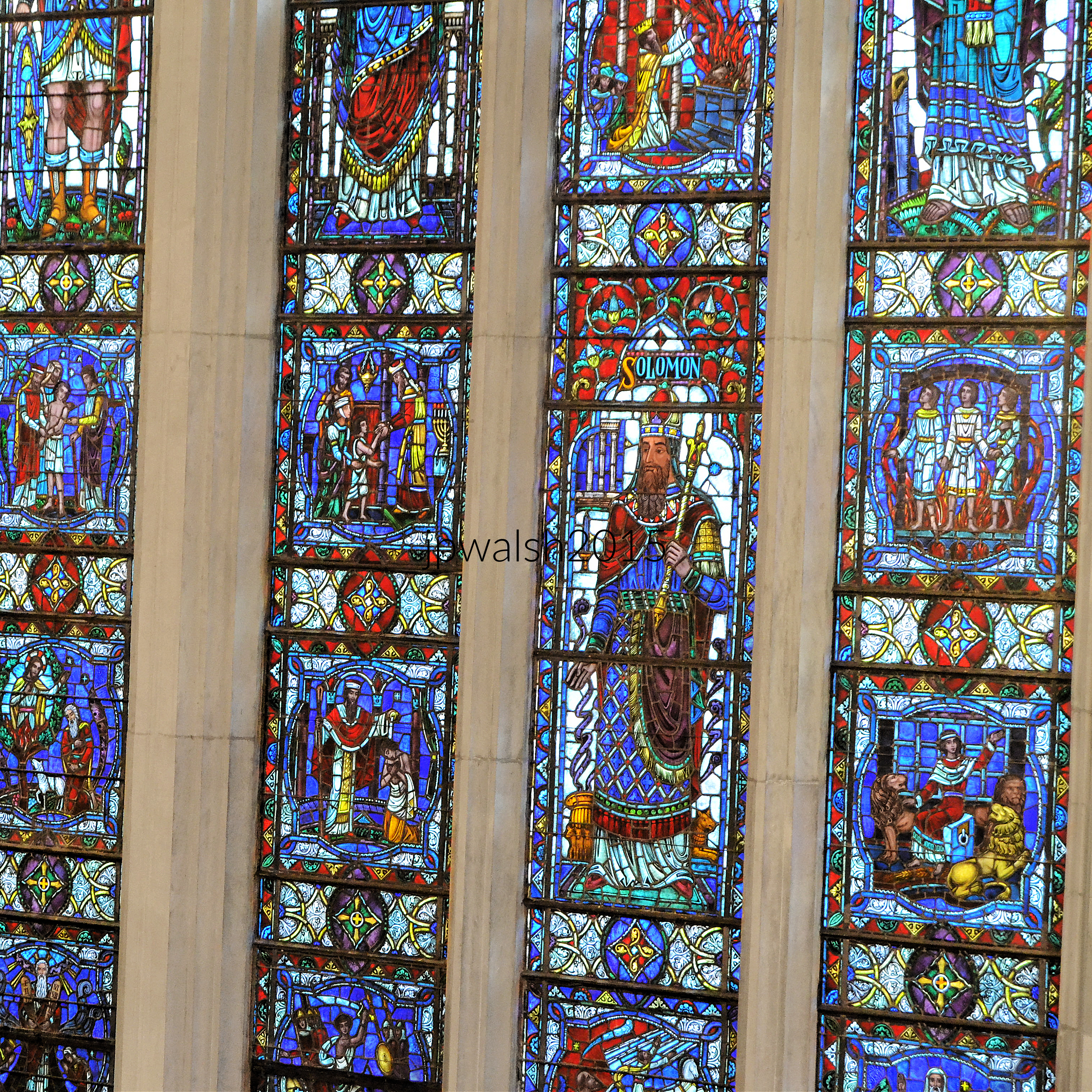
The interior is illuminated by dramatic, wall-filling arched stained-glass windows. These expansive artworks depict critical Biblical narratives, including the Creation and Fall of Adam and Eve, King Solomon, Moses, and Christ Ruler of the Universe.
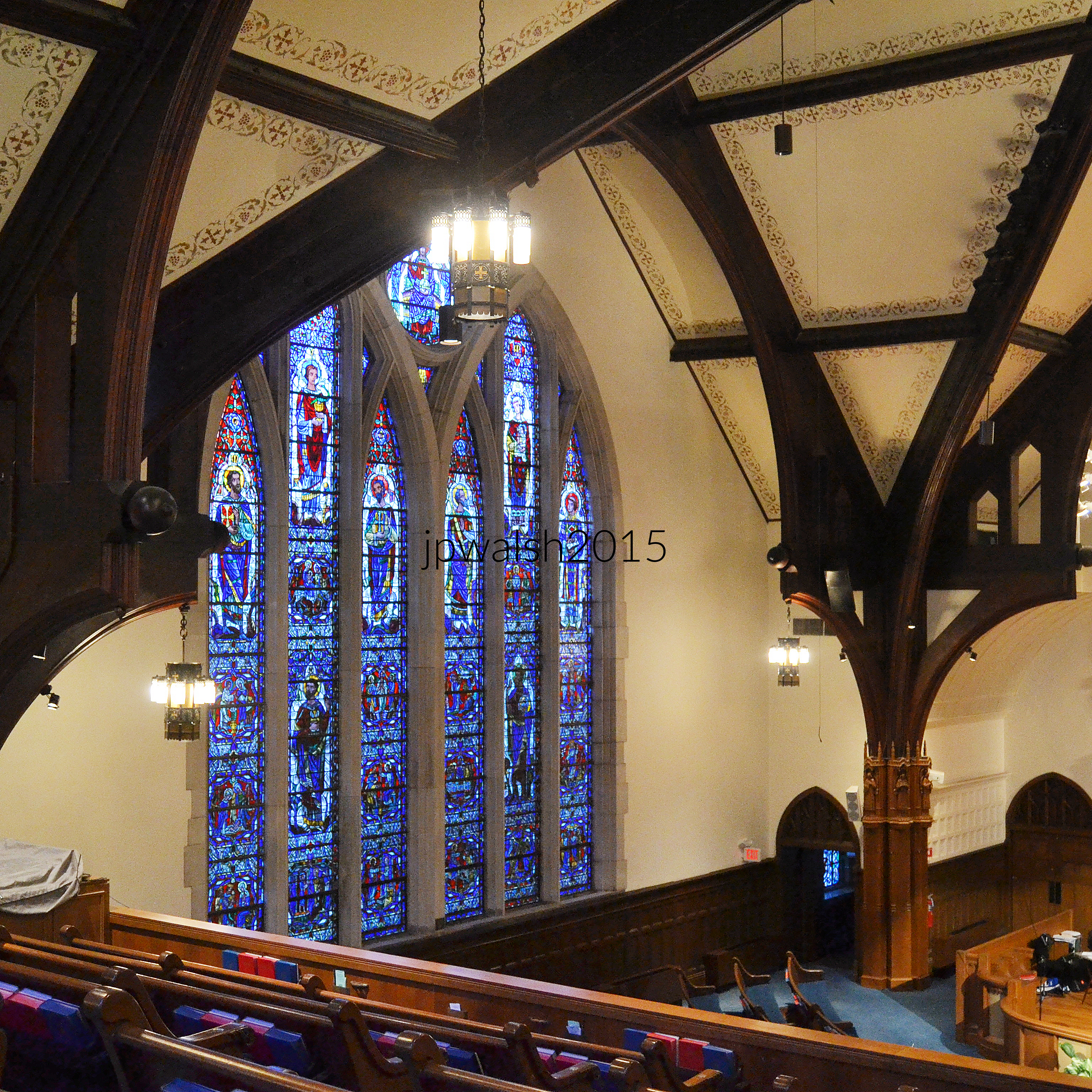
Wall-filling arched stained-glass windows tell Old and New Testament stories. October 2015. Author’s photograph. 6.81mb

Burt J. Denman, born in Toledo, Ohio, was an engineering graduate of the University of Michigan who was vice president and general manager of the United Light Power Company. Denman was a leading Methodist layman and trustee of Northwestern University. October 2015. Author’s photograph. 2.76mb

One of the historic church’s dramatic wall-filling stained-glass windows. October 2015. Author’s photograph. 7.79mb 80%
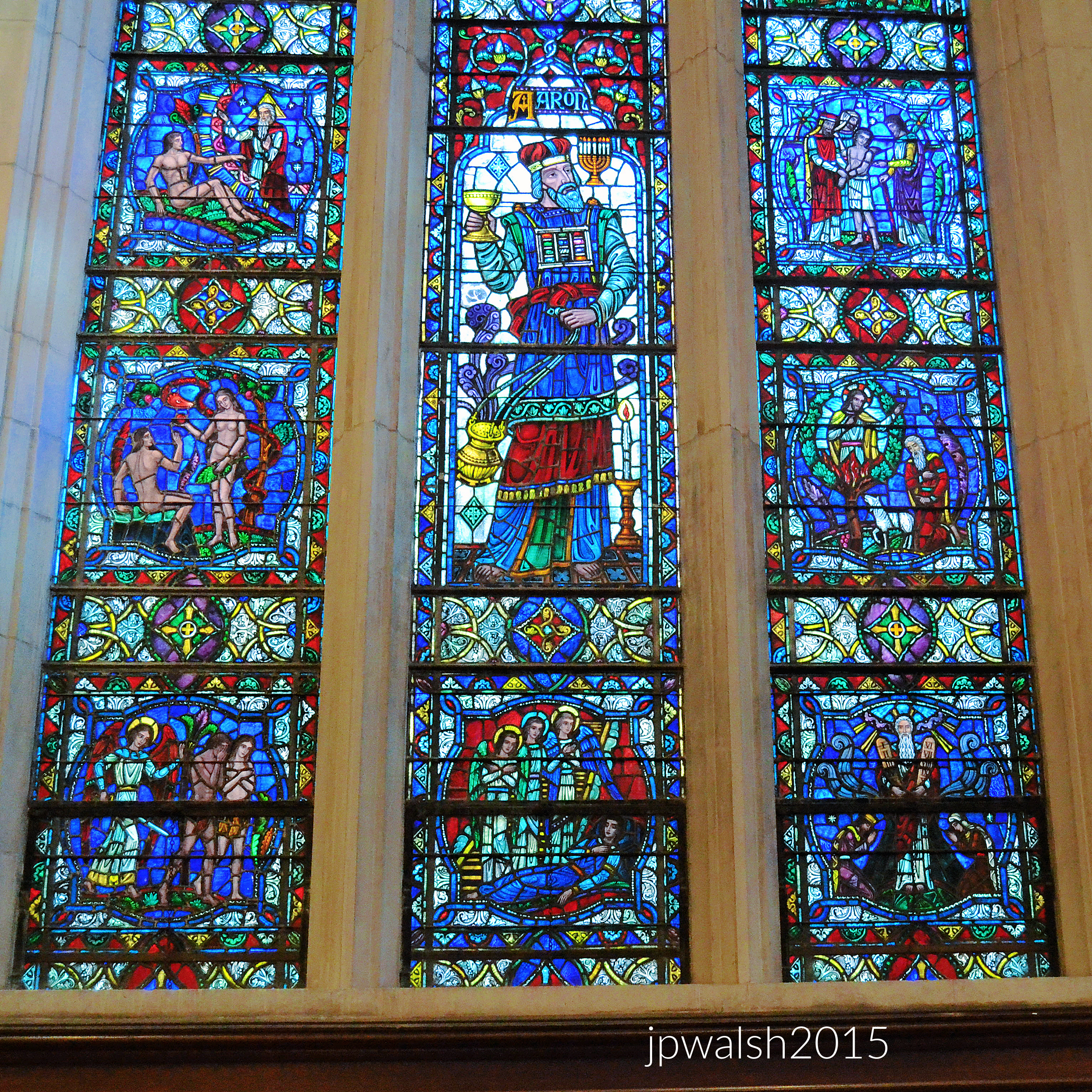
Creation of Adam; Fall of Adam and Eve; Expulsion from the Garden; Priest Aaron and brother of Moses; three angelic visitors to Abraham; the story of Moses. October 2015. Author’s photograph. 7.87mb 90%
Material Composition:
Built adjacent to Raymond Park, the Gothic Renaissance structure features massive Lemont limestone walls, a tile roof, and a striking 120-foot-tall bell tower featuring an open belfry.
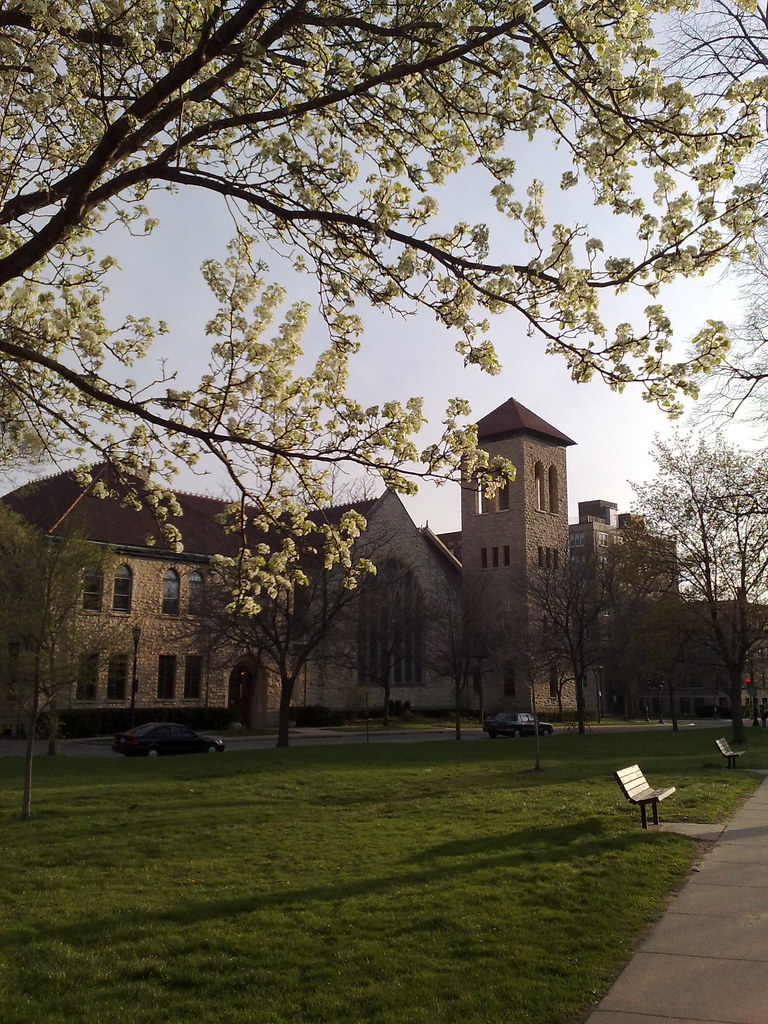

Historical Context of RAYMOND PARK: The neighboring park is named after Rev. Dr. Miner Raymond (1811–1897), a former cobbler who rose to become a professor of systematic theology at the Garrett Biblical Institute and a prominent leader in Northwestern University’s historical community.
Adjacent to Raymond Park, the 1895 Gothic Renaissance church building is made of Lemont limestone with a tile roof and 120-foot-tall bell tower and open belfry. Raymond Park is part of the Evanston parks system and named for Rev. Dr. Miner Raymond (1811-1897). Born in New York City he began his career as a cobbler. Following his matriculation at Methodist Wesleyan Academy in Wilbraham, Massachusetts, Raymond became a teacher at the school starting in 1833 and was its principal from 1848 to 1864. In 1837 he married Elizabeth Henderson in Webster, Massachusetts, and they had eight children together. In 1864 the Raymond family relocated to Illinois where he became professor of systematic theology at Garrett Biblical Institute in Chicago. In 1884 he received his LL.D. from Northwestern University. Mrs. Raymond died in 1877 so that the widower married Isabella (Hill) Binney in 1879 though she died soon after 1880. Dr. Rev. Miner Raymond died in 1897 and is buried in historic Rosehill Cemetery. PHOTO: “First Presbyterian Church of Evanston” by Marit & Toomas Hinnosaar is licensed under CC BY 2.0.
SOURCES:
First Presbyterian Church of Evanston. “Worship Connections.” Accessed January 9, 2024. https://firstpresevanston.org/connections/worship/.
Chicago Architecture Center. “First Presbyterian Church of Evanston.” Open House Chicago. Accessed January 9, 2024. https://openhousechicago.org/sites/site/first-presbyterian-church-of-evanston/.
Garrett-Evangelical Theological Seminary. “Our History.” Accessed January 10, 2024. https://www.garrett.edu/about/our-history/.
Virtual American Biographies. “Miner Raymond.” Edited by James Grant Wilson and John Fiske. Appleton’s Cyclopedia of American Biography. Accessed January 10, 2024. http://www.famousamericans.net/minerraymond/.
Find a Grave. Database and images. “Elizabeth Henderson Raymond (1814–1877).” Memorial ID 110905407. Maintained by Find a Grave. Accessed January 10, 2024. https://www.findagrave.com/memorial/110905407/elizabeth-raymond.
Find a Grave. Database and images. “Rev Miner Raymond (1811–1897).” Memorial ID 167076695. Maintained by Ace. Accessed January 10, 2024. https://www.findagrave.com/memorial/167076695/miner-raymond.
New York Times. “Burt J. Denman, 62, Utilities Leader.” June 26, 1938, TimesMachine. Accessed January 10, 2024. https://timesmachine.nytimes.com/timesmachine/1938/06/26/99547469.html?pageNumber=27.