Tag Archives: #ChicagoChurches

Byzantine Heritage in Modern Chicago: Yaroslaw Korsunsky’s Sts. Volodymyr and Olha Church (1975).

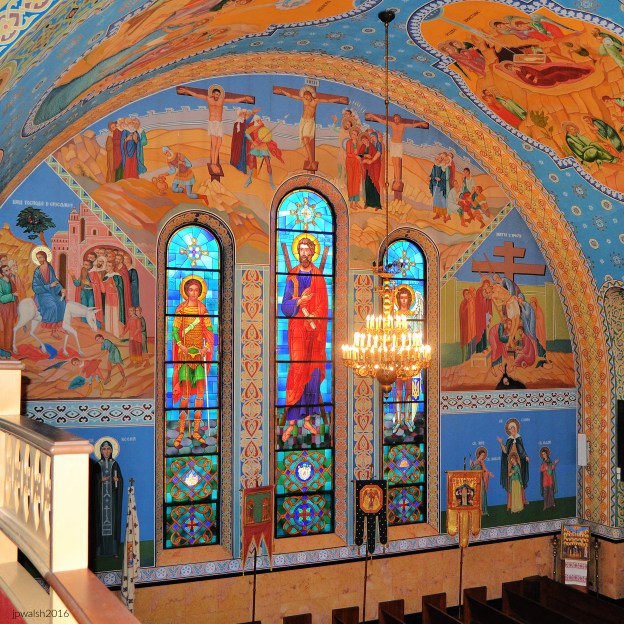
FEATURE image: Stained glass, paintings, banners, and chandelier blend together and provide a more complete picture of people and episodes of the faith. North wall and ceiling. Chicago. Sts. Volodymyr and Olha Church. October 2016. Author’s photograph. 5.88 mb

Sts. Volodymyr and Olha Church (1975) stands as a powerful expression of Ukrainian religious and cultural identity in Chicago, blending traditional Byzantine forms with modern architectural design. Architect Yaroslaw Korsunsky created a monumental house of worship whose soaring domes, geometric forms, and richly symbolic design connect an immigrant community to centuries of Eastern Christian tradition while asserting its presence within the modern American city.
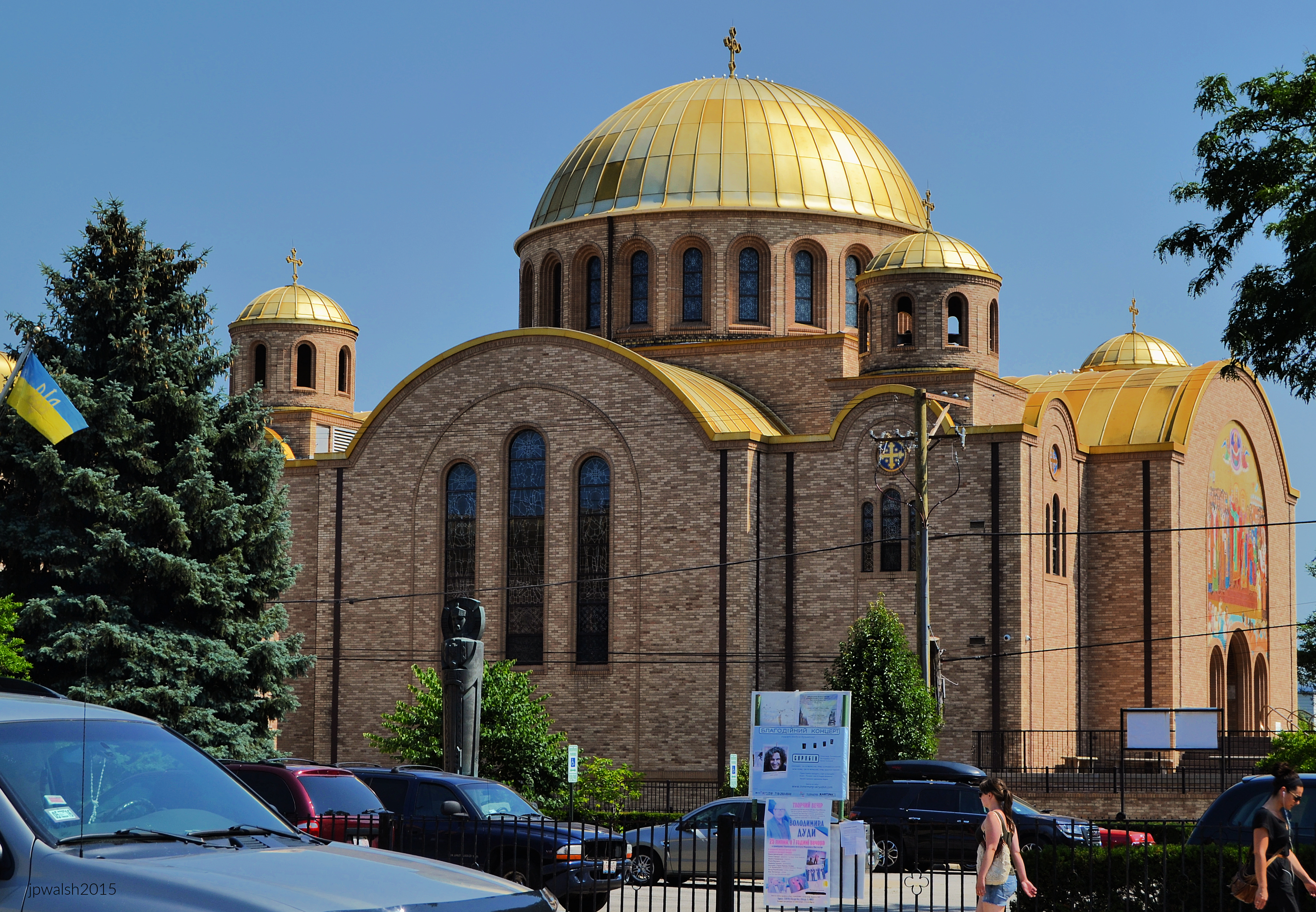
Chicago. Sts. Volodymyr and Olha Church. July 2015. Author’s photograph.

At 739 N. Oakley Boulevard Sts. Volodymyr and Olha Church in Chicago displays with its gold domes. The tradition-minded parish, founded in early 1970s, serves a busy urban community.

Chicago. Sts. Volodymyr and Olha Church. July 2015. Author’s photograph. 2.52 mb

The building’s design balances monumentality, symbolism, and modern construction techniques.

Sts. Volodymyr and Olha Church, Chicago. The huge mosaic over the main entrance memorializes the conversion of the Ukrainians to Christianity in 988 by St. Volodymyr of Kyiv or Vladimir of Kiev (957-1015). The mosaic was executed by Hordynsky, Makarenko, and Baransky. The church is built in the modern Byzantine style. In addition to the colorful and bright mosaic, the upward angle and its perspective adds to the feeling of entering into a sacred space. Along with the archways and curve of the main golden dome, the eye focuses on the artwork’s bright figures. July 2015. Author’s photograph. 7.68 mb

Chicago. Sts. Volodymyr and Olha Church. July 2015. Author’s photograph. 5.42 mb

WHO IS ST. VOLODYMYR?

St. Volodymyr is the apostle to proto-Russian and Russian Christianity. He was the great prince of Ukraine in Kiev. It was ruled by the Varangians, a barbarous Viking  tribe from Scandinavia – and Volodymyr (or Vladimir) of Kiev was as barbarous as any of them.

In 988, when Volodymyr was about 31 years old, he was converted to Christianity. The missionaries came from the Byzantine world at Constantinople. The results were immediate: Ukraine was now in close contact with the Byzantine world to the south and its Christian church under the pope.

Volodymyr married the daughter of the Byzantine emperor, Basil II (957-1025). But it was Volodymyr’s personal embrace of the Christian faith that infused the Ukrainian people with their deep and abiding faith. Having received baptism, he set out to be a Christian and not corrupted by money and power that proved a serious temptation for many church and state leaders in the Dark Ages.

Volodymyr used his temporal powers to evangelize the people – his personal example his greatest asset to its success. Though he encouraged various activities and programs in the lives of the people – including the multi-faceted work of Greek missionaries – it was his sincere, transparent, and fundamental reform of his own life that by far had the greatest impact on the Ukrainian people. More than one thousand years after his rule, Volodymyr is still recalled as a generous, humble and devout soul.

As a Christian ruler Volodymyr had doubts about inflicting the death penalty. Though assured by his Byzantine church counselors that his Catholic faith allowed him to follow the law which allowed for it, Volodymyr corrected them and said that that sort of reasoning was not satisfactory to his faith.

Volodymyr, the great prince of Kiev, died a poor man – not only various from his origin but, again, that of many of the ecclesiastics now in the realm. Before his death, Volodymyr dispersed all his money and personal belongings to the poor and to his family and friends. St. Volodymyr’s feast day is July 15. He is patron of Ukrainian and Russian Catholics.

WHO IS ST. OLHA?

Saint Olha was the wife of the Kyivan Great Prince Igor. Igor signed a peace treaty with the Greeks in 944. The treaty of 944 was drawn up at Constantinople and allowed for Christianity in Ukraine. This toleration already indicates some sympathy for Christianity among the powerful in Kiev. Igor himself, however, in his official position did not embrace Christianity nor officially allow the presence of a structure of Church hierarchy. The treaty was drawn up  to quietly allow co-existence of Christians in a pagan Viking culture.

Yet when the Byzantine emissaries arrived in Kyiv, pagan opposition had emerged from the Varangians. The Christians were thrown into abeyance and Igor was murdered in 945. Into this volatile situation the burden of government fell upon Igor’s widow — the Kyiv Great-Princess Olha, and her three-year-old son Svyatoslav (945-972). Her first act was to avenge Igor’s murder.

Olha belonged to one of the obscure ancient-Rus’ princely dynasties, whose Slavic line had intermarried with assimilating Varangian newcomers. Olha’s Varangian names includes Helga and Olga.

Though still a pagan, Olha’s revenge on the Varangians on behalf of her late husband was a victory for the realm’s Christians. Further, having weakened the influence of petty local princes in Rus’, Olha centralized the whole of state rule. She became a great builder of the civil life and culture of Kyivan Rus. Her centralization became an important network of the ethnic and cultural unification of the nation which, when Olha became a Christian, aided in the building of a network of churches. Her essential activities proved key in developing what is the modern Ukrainian national identity. At the same time, important trade with Poles, Swedes, Germans, and so forth, led to significantly expanding foreign connections. One noteworthy development was that wooden buildings were replaced with stone edifices.

Rus’ had become a great power. Only two European realms could compare with it in the tenth century – the Byzantine empire in the east, and the kingdom of Saxony in the west. Both these empires were Christianized and pointed the way to future greatness for Rus’. In 954 Great-princess Olha sailed to Constantinople. Though a display of Rus’ military might on the Black Sea, it was a spiritual mission. Olha’s might and the Byzantines’ wealth and beauty were mutually impressive.

Constantinople was the city of the Mother of God as dedicated by Constantine the Great in 330. Olha made the decision to become a Christian. She was baptized by Patriarch Theophylactus (917-956) with her godfather being the emperor Constantine Porphyrogenitos (905-959). She took the Christian name Helen for Constantine’s mother. Following  the rite, the Patriarch said: “Blessed are you among the women of Rus’, for you have forsaken the darkness and have loved the Light. The Rus’ people shall bless you in all the future generations, from your grandson and great-grandson to your furthermost descendants.” Olha replied: “By your prayers, O Master, let me be preserved from the wiles of enemies”. It is precisely in this way, with a slightly bowed head, that Saint Olha is often depicted in religious artwork. During her state visit, and following her baptism, Great princess Olha of Rus’ was fêted throughout Constantinople

Saint Olha devoted herself to efforts of Christian evangelization among the pagans, and also church construction, including Saint Sophia Cathedral. Yet, many despised her new found Christianity and paganism became emboldened. They looked to the reign of Svyatoslav who angrily spurned his mother’s Christianity. Meanwhile Byzantine church and state leaders were not eager to promote Christianity in Rus’. In Olha’s lifetime, Kyiv favored paganism and had second thoughts about even accepting Christianity. By order of Svyatoslav, churches were destroyed and Christians murdered. Byzantine political interests found the church and state looking to undermine Olha’s influence and favored the Rus’ pagans.

Olha attempted to help Svyatoslav during a period of wartime, though Kyiv was a backwater to his imperial interests for the next 18 years. In the spring of 969 the Pechenegs besieged Kyiv and Olha headed the defense of the capital. Svyatoslav rode quickly to Kyiv, and routed the nomads. But the warrior prince wished to rule elsewhere than Kiev. Svyatoslav dreamed of uniting all Rus’, Bulgaria, Serbia, the near Black Sea region and Priazovia (Azov region), and extend his borders to Constantinople. Olha warned her son that his plans were bound to fail as the Byzantine Empire was united and strong.

On July 11, 969 Saint Olha died. In her final years, with the triumph of paganism, she had to secretly practice her faith. Before her death, she forbade the pagan celebration of the dead at her burial and was openly buried in accord with Orthodox ritual. A priest who accompanied her to Constantinople in 957 fulfilled her request.

Considered by Ukrainians the holy equal of Great Prince Volodymyr, St. Olha was invoked by St. Volodymyr on the day the people of Rus’ were baptized. Before his countrymen, St. Volodymr said of St. Olha: “The sons of Rus’ bless you, and also the generations of your descendants.”

Cardinal Major Archbishop Josyf Slipyj (1892-1984), “Confessor of the Faith” and Founder of Sts. Volodymyr and Olha Church. Cdl. Slipy was imprisoned by the Soviet authorities from 1945 to 1963 for refusing to convert to Russian Orthodoxy. He was finally set free through the intervention of Pope John XXIII and President John F. Kennedy.

Chicago. Sts. Volodymyr and Olha Church. July 2015. Author’s photograph. 7.46 mb

A beautiful outdoor garden with the residential streets of Ukrainian Village as its background is the setting for the larger-than-life-sized statue of Major Archbishop Josyf Slipyj (1892-1984). He was made a cardinal by Pope Paul VI in 1965 and is a “Confessor of the Faith.” The founder of the parish, Cdl. Slipyj blessed the new church building’s cornerstone. Supporting the Ukrainian state and refusing to convert to Russian Orthodoxy, he was imprisoned by the Soviet authorities from 1945 to 1963. Through the intervention of St. Pope John XXIII and U.S. President John F. Kennedy, Josyf Slipj was released by Nikita Khrushchev in early 1963 and participated in the Second Vatican Council. Josyf Slipyj died in Rome in 1984 and his cause for canonization as a saint of the Catholic Church has been introduced at the Vatican.

Sts. Volodymyr and Olha Church sit in Chicago’s Ukrainian Village.

Ukrainian Village. October 2016. Author’s photograph. 317 kb 30%

Ukrainian Village. October 2016. Author’s photograph. 316 kb 20%

Chicago. Sts. Volodymyr and Olha Church. October 2016. Author’s photograph. 6.86 mb

High above the sanctuary is a magnificent view of the main dome painted in bright colors with the figure of Christ Pantocrator. Christ gives his blessing as he holds an open book with the Greek letters: alpha and omega. It signifies one of Christ’s titles: “I am the beginning and the end” (Revelation, 21:6, 22:13).

Chicago. Sts. Volodymyr and Olha Church. October 2016. Author’s photograph. 5.88 mb

North Wall.

Chicago Sts. Volodymyr and Olha Church. October 2016. Author’s photograph. 7.84 mb

South Wall.

Chicago. Sts. Volodymyr and Olha Church. October 2016. Author’s photograph. 4.54 mb

Parishioners praying and going to Communion at Sunday Mass.
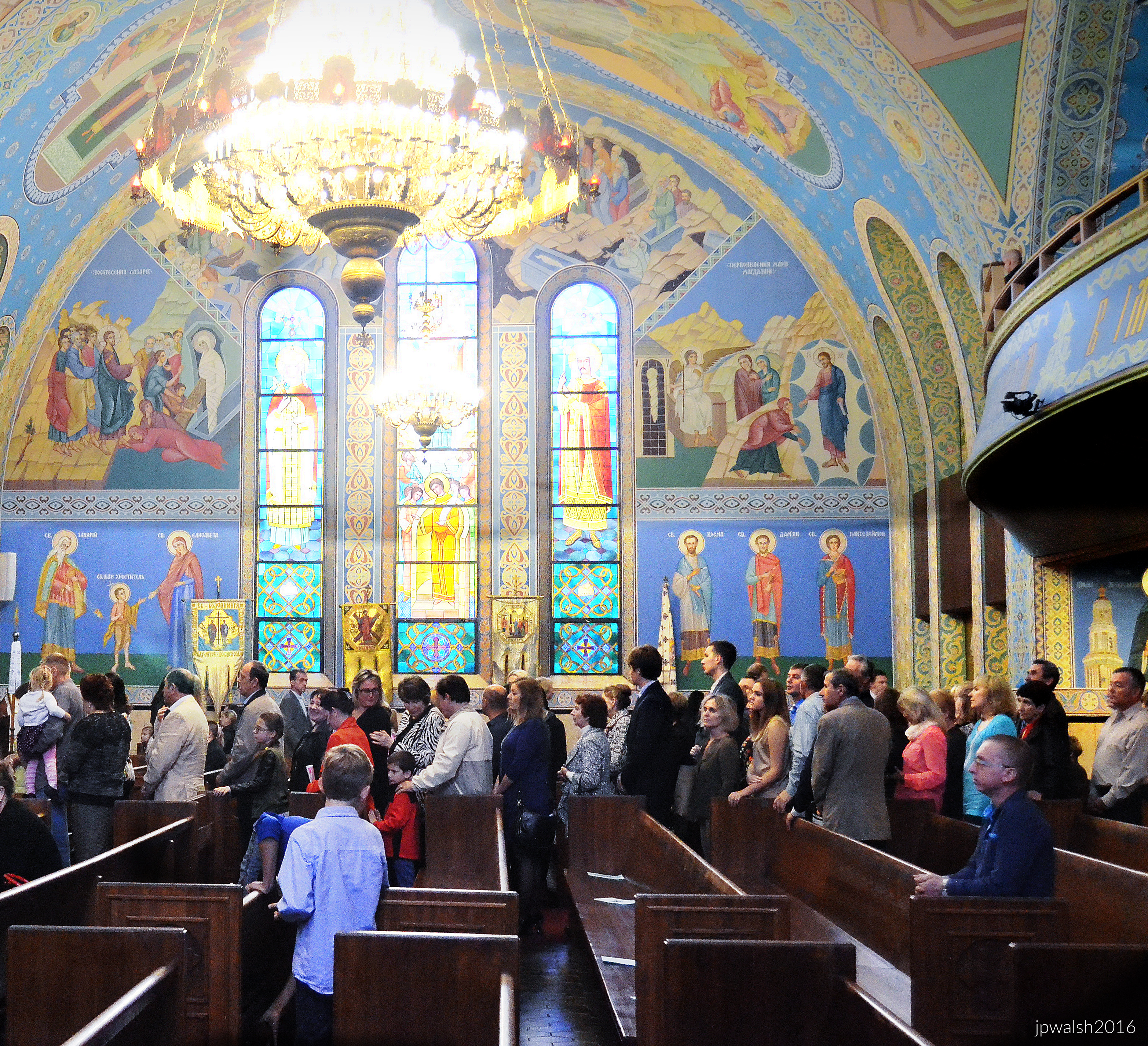
Chicago. Sts. Volodymyr and Olha Church. October 2016. Author’s photograph. 4.54 mb

Chicago. Sts. Volodymyr and Olha Church. October 2016. Author’s photograph. 5.40 mb

With the artists’ skills, the bright colors and evocative forms of the artwork surround churchgoers as they move toward the altar at Communion during the Divine Liturgy.
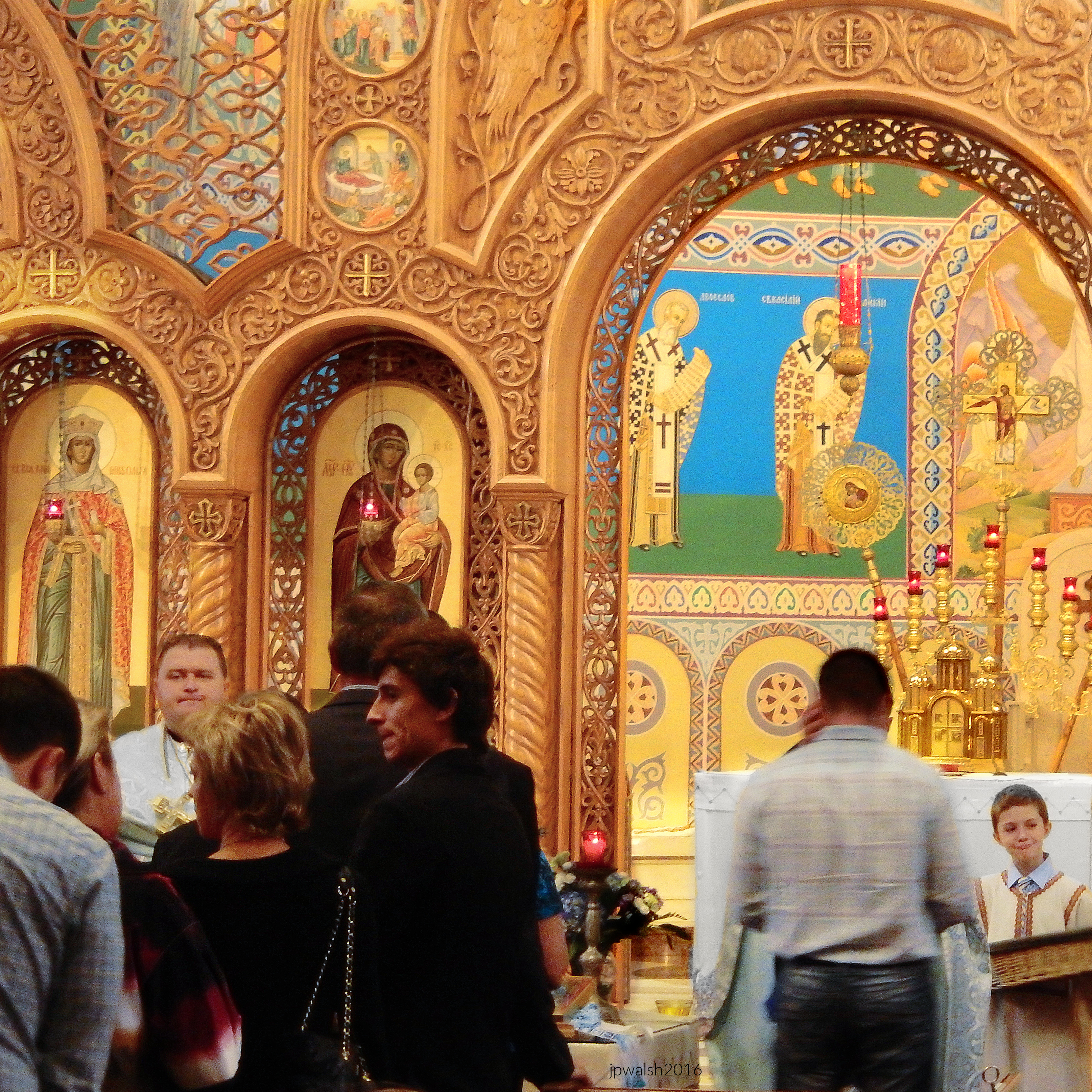
Chicago. Sts. Volodymyr and Olha Church. October 2016. Author’s photograph. 6.18 mb

Chicago. Sts. Volodymyr and Olha Church. October 2016. Author’s photograph. 544kb 30%

The colorful and vibrant decorations that include paintings, carvings, vestments, books, stained glass, and more, are integral to the parish’s liturgy and life.

Chicago. Sts. Volodymyr and Olha Church. October 2016. Author’s photograph. 5.46 mb

Chicago. Sts. Volodymyr and Olha Church. October 2016. Author’s photograph. 4.35 mb

Icon of Sts. Volodymyr and Olha with a smaller icon of the Blessed Virgin.

Chicago. Sts. Volodymyr and Olha Church. October 2016. Author’s photograph. 4.47 mb

Every nook and cranny of the church is decorated with colorful images from religious and Catholic Ukrainian history. The natural light streaking down from the main dome’s windows adds a heavenly glow.
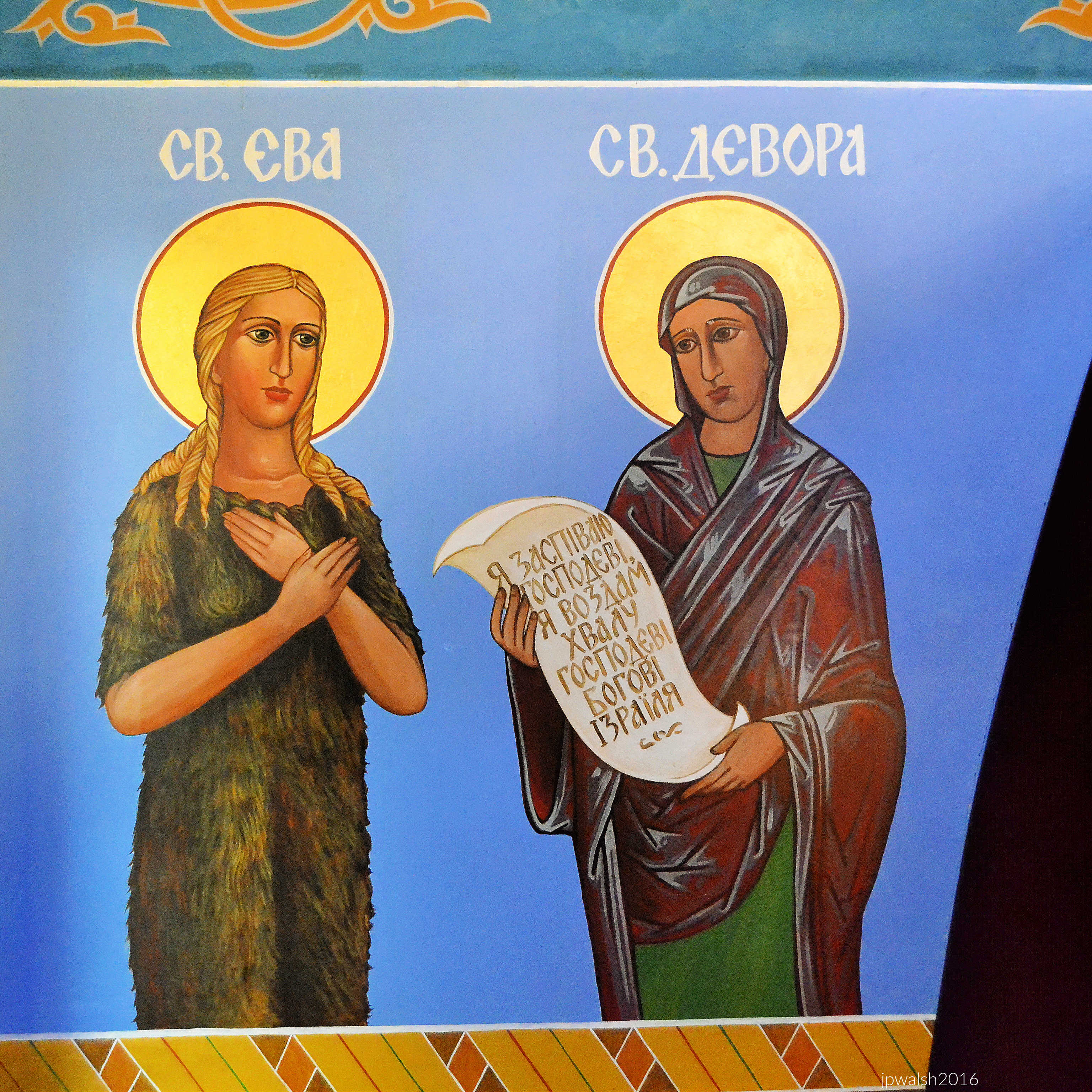
Chicago. Sts. Volodymyr and Olha Church. October 2016. Author’s photograph. 6.15 mb

Two female haloed saints in a modern art style are marked by their unique attire as one holds an unfurled scroll with words in Ukrainian. Christianity arrived into Ukraine by way of the Greco-Byzantine world over 1000 years ago.

Chicago. Sts. Volodymyr and Olha Church. October 2016. Author’s photograph. 4.90 mb

A painting of the dormition of Mary is emphasized by an icon of Mary and the child Jesus. Colors, forms, and subject matter are very high quality, soft and peaceful, making them pleasant to look at and pray with.

Chicago. Sts. Volodymyr and Olha Church. October 2016. Author’s photograph. 6.18 mb

The wood carvings and full-length portrait icons are gorgeous. The fresh flower arrangements further brighten the scene.

Chicago. Sts. Volodymyr and Olha Church. October 2016. Author’s photograph. 7.68 mb

Visitors are joined by worshippers lighting candles and praying before a large icon of Mary and the child Jesus.

Chicago. Sts. Volodymyr and Olha Church. October 2016. Author’s photograph. 10.68 mb

The main altar gate of carved wood with icons and gold curtain. The Last Supper in center above.

SOURCES:

Coulson, John, ed. The Saints: A Concise Biographical Dictionary. Guild Press, 1957, pp. 577; 760-761.

Howe, Jeffrey. Houses of Worship: An Identification Guide to the History and Styles of American Religious Architecture. Thunder Bay Press, 2003.

Pacyga, Dominic A., and Ellen Skerrett. Chicago: City of Neighborhoods. Loyola University Press, 1986, p. 193.

Sinkevitch, Alice. AIA Guide to Chicago. 2nd ed. Harcourt, Inc., 2004, p. 260.

St. Elias Brampton. “St. Olha (Olga, Ol’ha).” Saint Elias (blog). July 11, 2017. Accessed April 26, 2022. https://www.saintelias.com/blog/2017/7/11/st-olha-olga-olha. [1]


John P. Walsh, 2015-16. All rights reserved. All text and photos are the property of the author, except for materials explicitly credited as public domain or licensed content.

Russian Tradition, Chicago Design: Louis Sullivan’s Holy Trinity Cathedral (1903).

FEATURE Image: Holy Trinity Orthodox Cathedral, 1121 N. Leavitt, Chicago. The walls of the church building are load-bearing brick covered with stucco. The bell tower and octagonal belfry, dome, and roof are made of wood with metal trim and latticework. July 2015. Author’s photograph. 2.80 mb

Holy Trinity Orthodox Cathedral demonstrates how Louis H. Sullivan (1856-1924), best known for his commercial architecture, adapted his design genius to a modest immigrant church, creating a distinctive synthesis of Russian provincial tradition, Eastern Orthodox worship, and Sullivan’s own ornamental imagination within Chicago’s Ukrainian Village.

Chicago. Holy Trinity Orthodox Cathedral. July 2015. Author’s photograph. 6.48 mb

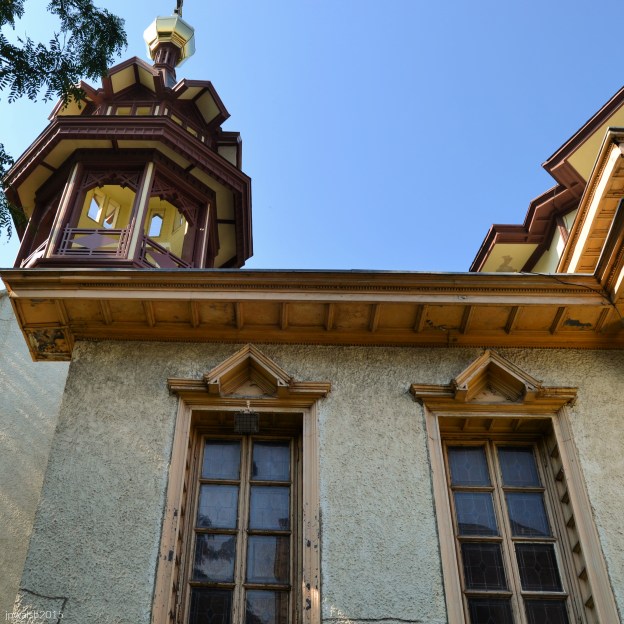
Louis H. Sullivan designed the bell tower (above and below) with its ornamentation and eaves and soffits for Holy Trinity Orthodox Cathedral in Chicago’s Ukrainian Village.

Chicago. Holy Trinity Orthodox Cathedral. October 2016. Author’s photograph. 4.16 mb

how Louis Sullivan adapted traditional Russian architecture to create the bell tower of Holy Trinity Orthodox Cathedral The octagonal open lantern where the bells hang is a classic feature of 17th-century Russian wooden architecture, traditionally referred to as an “octagon on a cube” (vosmerik na chetverike). Rising above the open belfry is a steep, grey-shingled tent-shaped roof. This architectural style was historically popular in Russia for its ability to keep heavy snow from piling up on church towers. The Wave-Like Roofline and slender window slats are Sullivanesque. Crowning both the main tent roof of the bell tower and the smaller side turret are brilliant golden onion domes. In Orthodox theology, the onion dome symbolizes a burning candle flame reaching up toward heaven.

Built in 1903 on a limited budget, the church is a relatively small structure whose architectural impact far exceeds its size.

Chicago. Holy Trinity Orthodox Cathedral. July 2015. Author’s photograph. 6.24 mb

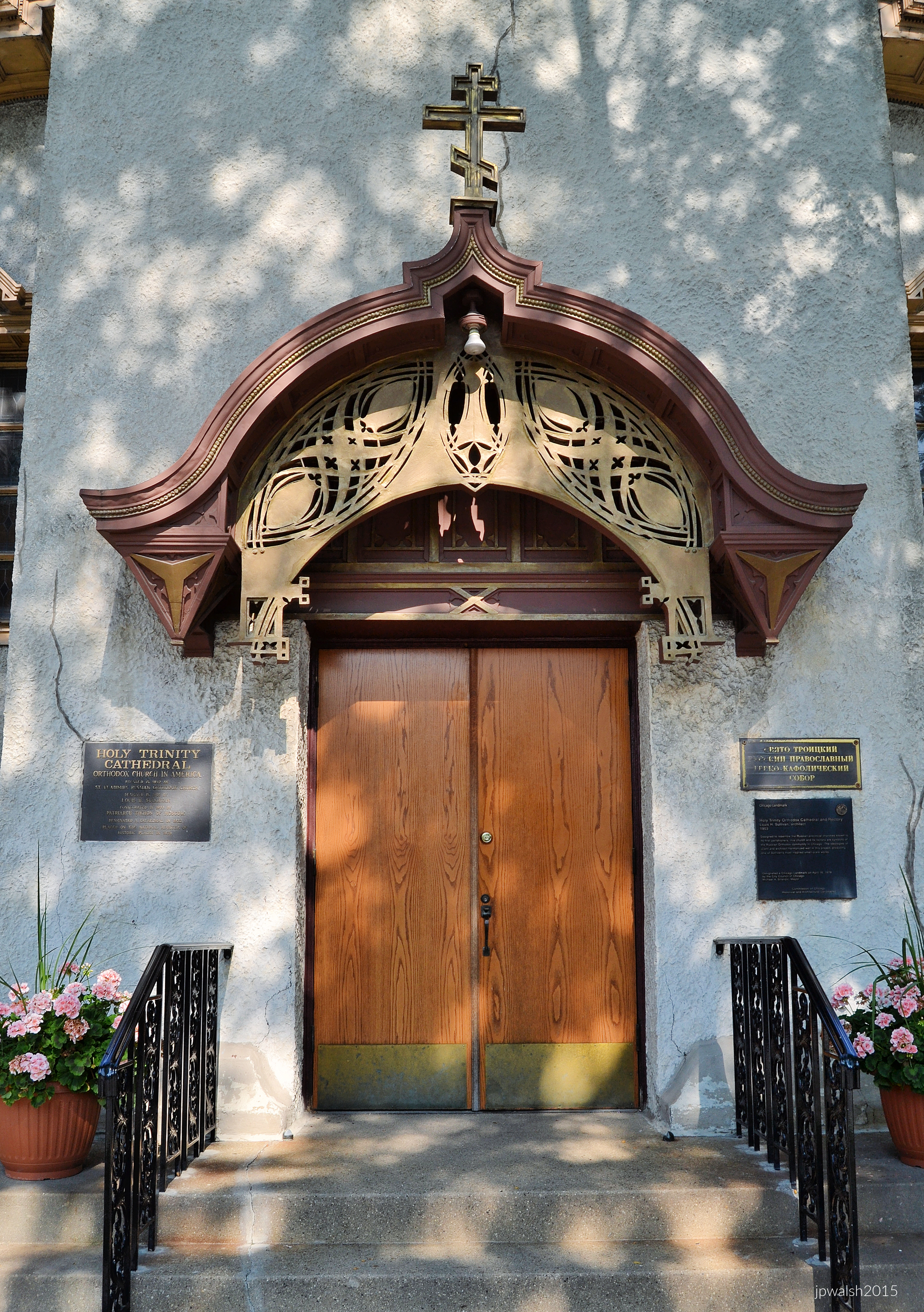
Louis H. Sullivan designed the portal canopy (above) and its ornamentation such as the fretwork. Sullivan also designed the window frames (example below).

Louis H. Sullivan designed key architectural elements of the cathedral, including the bell tower, portal canopy, window frames, and decorative ornament.

Chicago. Holy Trinity Orthodox Cathedral. July 2015. Author’s photograph. 5.53 mb

Louis Sullivan’s genius directly merges with traditional Russian Orthodox geometry in this window, which serves a vital role in illuminating the church’s interior. The top of the window frame features a uniquely Sullivanesque, multi-tiered, stepped triangular pediment that beautifully complements the sharp lines of the building’s exterior roof eaves. Along the sides, the outer wooden posts feature finely routed parallel grooves and subtle decorative blocks. This style of ornamentation is a hallmark of Sullivan’s organic philosophy—using natural light and shifting shadows to give rigid wood components a rich, rhythmic texture.

Furthermore, each major pane of leaded glass features a complex geometric pattern centered on an octagon. While the octagon served as Sullivan’s favorite transitional shape to bridge the gap between square and circle, it simultaneously held a profound meaning for the Orthodox parish. This eight-pointed geometry carries a deep spiritual resonance, symbolizing the “Eighth Day” of creation (the eternal Kingdom of God) and echoing the architectural octagons found in the cathedral’s main dome and bell tower.


Chicago. Holy Trinity Orthodox Cathedral. October 2016. Author’s photograph. 5.84 mb

Holy Trinity Cathedral was built on a limited budget. It is a small building at 47 x 98 feet situated on an east-west axis. The main body of the church is square with extensions and an octagonal dome above. The picturesque country-church entrance has a metal and wood canopy whose design and ornamentation were created by the architect, Louis H. Sullivan (1856-1924). Dedicated in 1903, the church was designated a cathedral in 1923.

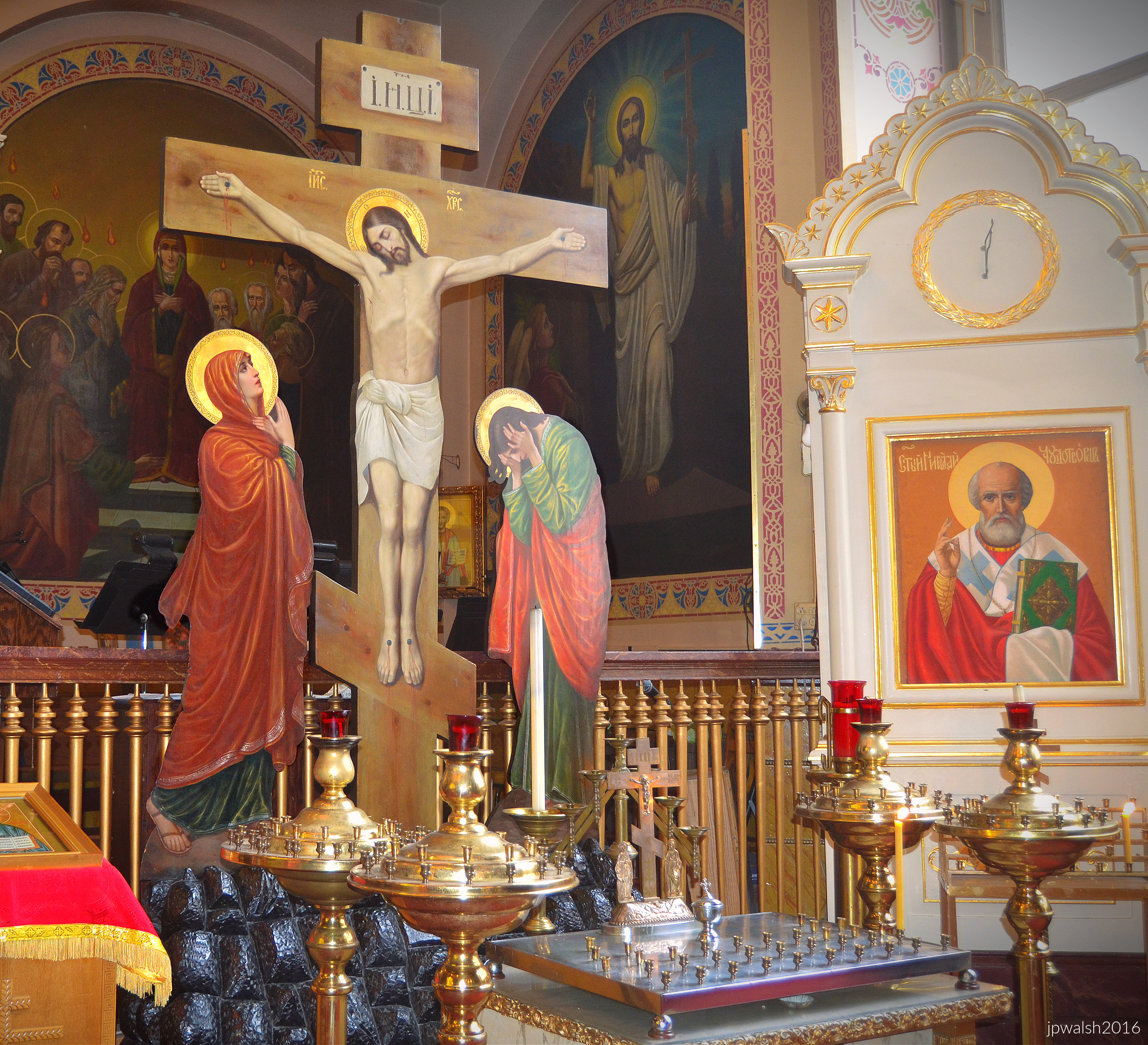
Prominently featured in the foreground is a traditional Slavic-style wooden cutout Crucifixion scene, known as a Golgotha. Mounted inside an ornate white-and-gold carved wooden kiot (shrine framework) is a distinct icon of Saint Nicholas the Wonderworker.

The icons, the painted Golgotha cutout figures, and the surrounding sanctuary murals were painted by artist Genrik Borutsky and his workshop crew between 1902 and 1903.

Chicago. Holy Trinity Orthodox Cathedral. July 2015. Author’s photograph. 5.64 mb

Chicago. Holy Trinity Orthodox Cathedral. July 2015. Author’s photograph. 2.80 mb

This exterior view of Holy Trinity Orthodox Cathedral captures the masterful architectural synthesis achieved by Louis Sullivan in 1903. Commissioned by 28-year-old Saint John Kochurov of Chicago in 1899, Sullivan deliberately blended traditional, rustic Russian provincial church aesthetics with modern American Prairie School and organic design principles.

Rather than grand stone or brick used in churches, Sullivan utilized a rough-textured stucco facade paired with heavy, natural wood ornamentation. Peeking out from the roofline on the left is the wooden octagonal lantern of the bell tower. Its open-air arched windows, multi-tiered flared roof profiles, and crowning golden onion dome are textbook elements of classical Russian Orthodox wooden church design. The deep, dramatic wooden overhang of the roofline supported by exposed structural wood rafters is a hallmark element of both Prairie School architecture. Above the two multi-paned windows are distinct, sharp triangular wooden pediments that are distinctively Sullivanesque. The building’s bell tower is organically shaped around the dome.

The church building was completed for around $27,000 in 1903 (approximately $1 million in 2022) with Sullivan donating half his commission to the church project.

Who is St. John of Chicago (1871-1917)?

After 12 years of fruitful missionary work in the American Midwest—where he helped establish several additional parishes and co-organized early Orthodox mutual aid societies—Father John returned to his native Russia in 1907.

In 1916, he was assigned to serve at St. Catherine’s Cathedral in Tsarskoye Selo, a suburb of St. Petersburg. In October 1917, the violence of the Bolshevik Revolution erupted directly in his town. To ease panic, Father John organized an outdoor prayer procession through the streets, pleading for peace among the warring factions.

On October 31, 1917, Bolshevik forces stormed the town. Because he had prayed publicly for peace rather than endorsing the revolution, Father John was arrested by a Red Guard mob, dragged to the outskirts of town, and shot to death. This tragic event earned him the solemn historical distinction of becoming the proto-hieromartyr (the very first clergyman killed) of the Soviet era. He was officially canonized and glorified as a saint by the Russian Orthodox Church in December 1994, and his memory is deeply celebrated every October 31st by Orthodox Christians globally, particularly at the cathedral he built in Chicago.

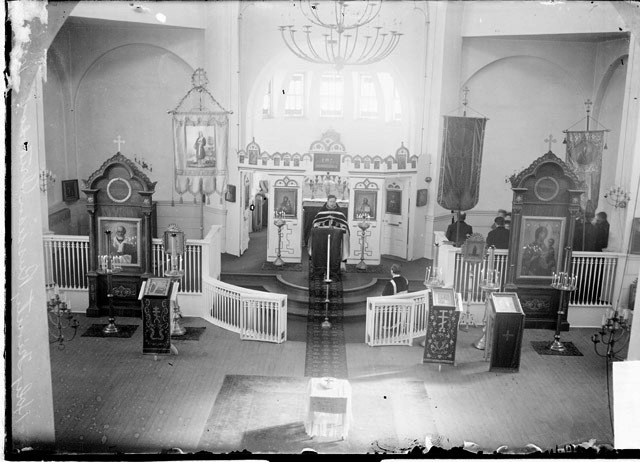
Historic photograph of the interior of Holy Trinity Orthodox Cathedral in Chicago, originally taken in 1905 by a photographer for the Chicago Daily News. The image captures a service in the cathedral shortly after its completion, with Saint John Kochurov likely visible leading the parish. Public Domain.

Same view over 110 years later. Chicago. Holy Trinity Orthodox Cathedral. October 2016. Author’s photograph. 6.95 mb

The Eastern Orthodox central plan creates an interior where the congregation stands in a square space topped by an octagonal dome. For Easter services and the like, the cathedral is filled to capacity with parishioners and others spilling out the front door with its decorative canopy onto the public sidewalk.

Chicago. Holy Trinity Orthodox Cathedral. October 2016. Author’s photograph. 4.08 mb

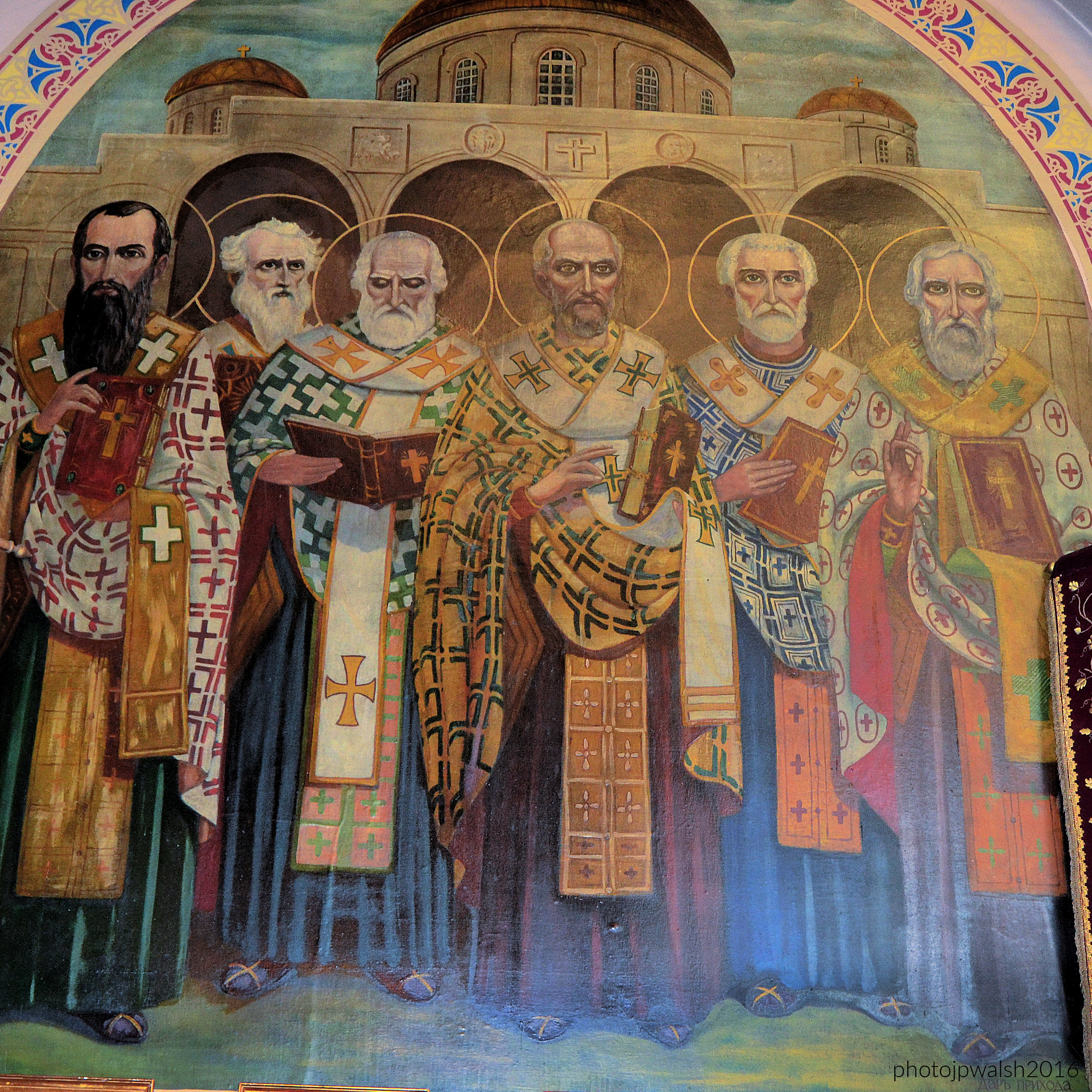
Painted by Genrik Borutsky between 1902 and 1903 during the initial interior decoration of the Holy Trinity Orthodox Cathedral in Chicago this mural is an exact full-scale replica of the fresco “The Ecumenical Councils” designed by the legendary Russian master Viktor Vasnetsov between 1885 and 1896 for St. Vladimir’s Cathedral in Kyiv, Ukraine.

The mural depicts a grouping of the Great Church Fathers and Bishops of the Early Christian Church. In front of a Byzantine domed cathedral is, from left to right, Saint Athanasius the Great (c. 296–373), Patriarch of Alexandria; Saint Gregory of Nazianzus (c. 329–390), Theologian; Saint Basil the Great (c. 330–379), Archbishop of Caesarea; Saint John Chrysostom (c. 347–407), Archbishop of Constantinople; Saint Gregory of Nyssa (c. 335–395) or Saint Cyril of Alexandria; and Saint Nicholas of Myra (c. 270–343).

The congregation was composed largely of immigrants from regions near present-day Ukraine and the Carpathian Mountains.

Chicago. Holy Trinity Orthodox Cathedral. October 2016. Author’s photograph. 4.41 mb

The parishioners that built this church were rural people who had emigrated from southern Russia near the Ukraine as well as the area of the Carpathian Mountains.

Chicago. Holy Trinity Orthodox Cathedral. October 2016. Author’s photograph. 5.18 mb 99%

The photograph captures the sanctuary (altar area), the most sacred part of an Orthodox church, situated behind the iconostasis screen and accessible only to clergy.

• The Holy Table (Altar Table): In the foreground sits the square Holy Table, draped in bright red vestments and a gold liturgical stole (epitrachelion). Resting on top are liturgical items, including a heavy book of the Gospels and a hand cross.

• The Seven-Branch Candlestick: Positioned directly behind the Holy Table is an ornate, golden seven-branched candelabra modeled after a tree, flanked by hanging processional banners.

The murals along the curved apse wall represent the Great Hierarchs and Liturgists of the Church, rendered by Genrik Borutsky in 1902–1903 as exact copies of Viktor Vasnetsov’s masterpiece designs. Depicted, left to right, are Saint Gregory of Nazianzus; Saint Basil the Great; Saint John Chrysostom; and Saint Nicholas of Myra.

High above the central gold tabernacle structure is a separate, framed icon depicting the Holy Trinity (the Hospitality of Abraham).

Chicago. Holy Trinity Orthodox Cathedral. October 2016. Author’s photograph. 8.26 mb

The image depicts Saint Mary Magdalene, as indicated by the Church Slavonic inscription at the bottom: “СВ РАВНОАП МАРIЯ МАГДАЛИНА” (Saint Equal-to-the-Apostles Mary Magdalene). In the Orthodox tradition, her title “Equal-to-the-Apostles” highlights her vital role in proclaiming Christ’s resurrection to the disciples. She carries the alabaster jar she brought to the empty tomb to anoint Jesus’s body.

While the architectural structure of the Holy Trinity Orthodox Cathedral in Chicago was designed by legendary architect Louis Sullivan, the church’s traditional interior iconography and stenciled murals were executed based on the work of famous Russian artist Viktor Vasnetsov (V. N. Vasnetoff).

Vasnetsov was a leader of the 19th-century Russian revival movement, famed for blending historical Slavic folklore with classic Byzantine iconographic principles. The elaborate decorative borders, geometric framing, and gold accents wrapping around the pillar echo this late 19th-century style rather than Sullivan’s signature secular Art Nouveau ornamentation.

Chicago. Holy Trinity Orthodox Cathedral. October 2016. Author’s photograph. 6.27 mb

The stenciled artwork (above) is not by Louis H. Sullivan. Rather, the interior murals and iconographic schemes throughout the cathedral were executed by artist Genrik Borutsky and his team. Borutsky did not paint original compositions; instead, he meticulously painted full-scale copies of the monumental frescoes designed by legendary master Viktor Vasnetsov for St. Vladimir’s Cathedral in Kyiv, Ukraine. Vasnetsov’s influential “Russian Revival” style defined late 19th-century Orthodox art by blending strict Byzantine iconographic rules with softer, emotional realist elements.

The two saints painted on this adjoining corner pillar are St. John the Baptist and St. Nicholas the Wonderworker.

The church stands as one of Sullivan’s most unusual and personal works, distinct from the skyscrapers and commercial buildings that made him famous.

SOURCES:

Chicago Churches and Synagogues: An Architectural Pilgrimage, George Lane, S.J., and Algimantas Kezys, Loyola University Press, Chicago, 1981, p. 106-107.

Alice Sinkevitch, AIA Guide to Chicago, 2nd Edition, Harcourt, Inc., Orlando, 2004, p. 260.

Portals of Faith: Renaissance Craftsmanship and Modern Devotion in Chicago’s Bronze Rosary Doors (2004).

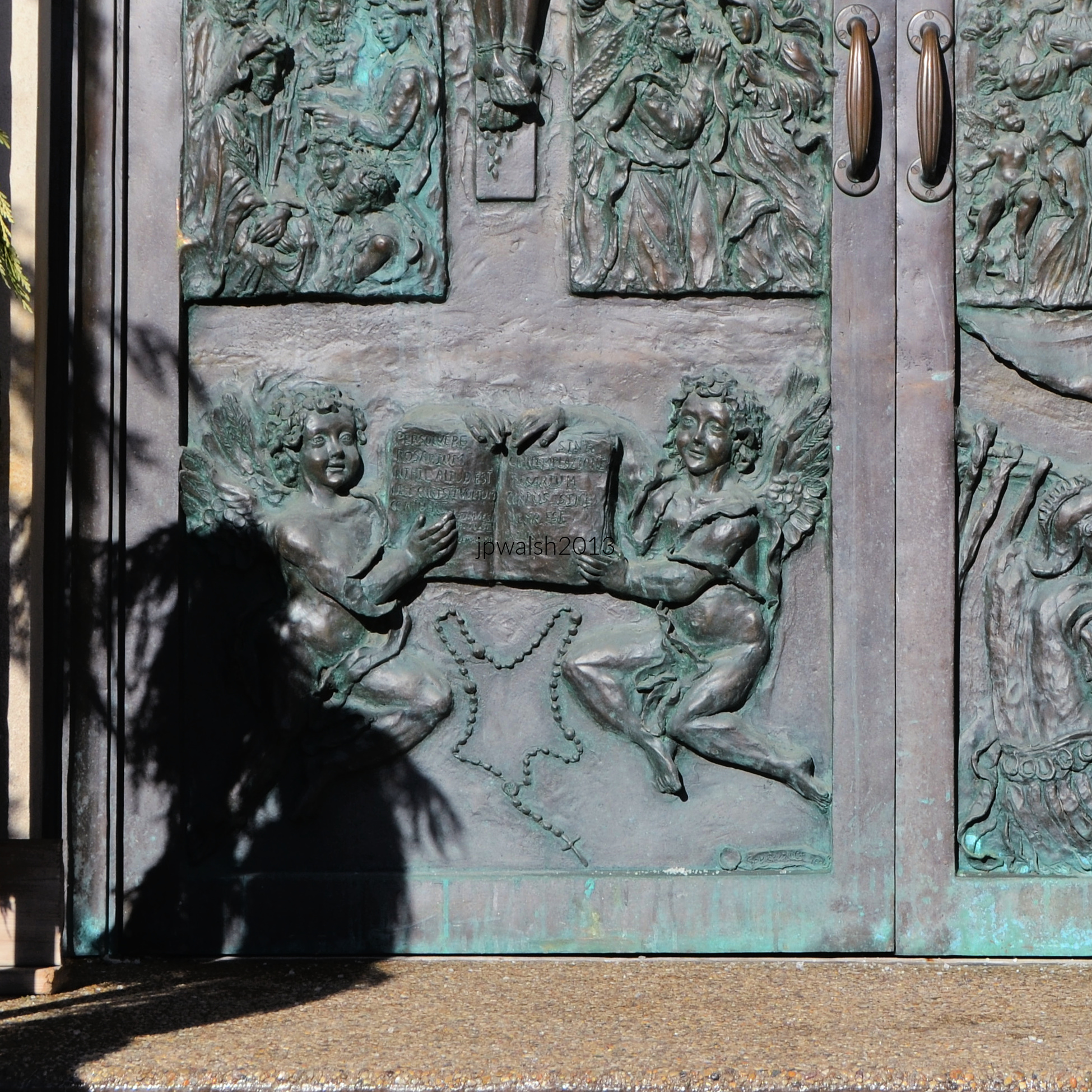
FEATURE IMAGE: CENTRAL Bronze Door: Sorrowful Mysteries panel (detail), The Shrine of Our Lady of Pompeii, Chicago. December 2013. 1.55 mb. Author’s photograph.

Biagio Governali’s 2004 bronze doors at the Shrine of Our Lady of Pompeii in Chicago stand at a crossroads of Renaissance craftsmanship, international collaboration, and Catholic devotion. Heavily inspired by Lorenzo Ghiberti’s historic fifteenth-century Gates of Paradise in Florence, this monumental three-portal work in Chicago—modeled by a Sicilian sculptor and cast by specialized foundries in Verona, Italy—visually narrates all twenty mysteries of the Rosary. By conveying scriptural narrative with sophisticated relief sculpture, the doors transform a physical church entrance into a visual and spiritual gateway of sacred art to teach, meditate upon, and experience the mysteries of the Rosary in a modern pilgrimage of prayer.


In Chicago’s Little Italy, The Shrine of Our Lady of Pompeii’s bronze doors depicting the Joyful, Sorrowful, Glorious, and Luminous Mysteries of the Rosary was dedicated on October 11, 2004, by Cardinal Archbishop Francis Cardinal George, O.M.I.

A Modern Gateway of Faith and Art

Biagio Governali’s 2004 bronze doors at the Shrine of Our Lady of Pompeii in Chicago stand at a brilliant crossroads of Renaissance craftsmanship, international art history, and Catholic devotion. Heavily inspired by Lorenzo Ghiberti’s historic Gates of Paradise in Florence, this monumental three-portal work, modeled by a Sicilian sculptor and cast by specialized foundries in Verona, Italy, visually narrates all twenty mysteries of the Rosary. By seamlessly marrying scriptural narrative with sophisticated relief sculpture, the doors transform a physical church entrance into a profound visual and spiritual gateway. Ultimately, they serve as a modern pilgrimage and living instrument of prayer, inviting both worshippers and secular passersby to learn, meditate upon, and personally experience the Gospel.

An Italian Parish in Chicago

Our Lady of Pompeii was originally established in Chicago in 1911 as an Italian national parish. The present church building at 1224 West Lexington Street in Chicago’s West Side University Village/Little Italy neighborhood was constructed in 1923 and dedicated to Mary, Queen of the Rosary in 1924. The parish began under the Scalabrinian Missionaries, a religious institute founded in Italy in 1887 to aid and serve Italian immigrants in America.

From Parish to Shrine

In 1994, Joseph Cardinal Bernardin proclaimed Our Lady of Pompeii a Shrine dedicated to honoring Mary, the Mother of God and Queen of the Holy Rosary. Ten years later, almost to the day, Francis Cardinal George, O.M.I., dedicated the Shrine’s bronze doors. On that same October day in 2004, Bishop Carlo Liberati, Pontifical Delegate to the Shrine of the Blessed Virgin of the Holy Rosary in Pompeii, Italy, established “a most fervent and fraternal link of communion” between the shrine in Pompeii and the Shrine of Our Lady of Pompeii in Chicago, formally strengthening the spiritual bond between the two communities.

Inspired by Florence’s Gates of Paradise

The Chicago doors draw direct inspiration from the Porta del Paradiso (Gates of Paradise), the celebrated bronze doors created by Florentine goldsmith and sculptor Lorenzo Ghiberti (1378-1455) between 1425 and 1452 for the Baptistry of Florence, located opposite the city’s cathedral. Governali, a native of Corleone, Sicily, adapted this renowned artistic tradition for a contemporary American shrine dedicated to the Rosary.

From Sicily to Verona to Chicago

Biagio Governali modeled each panel in wax before sending the designs to Verona, Italy, where they were cast in bronze and meticulously polished by skilled craftsmen. The Veronese artisans traveled to Chicago on two separate occasions to mount and position the massive doors before their dedication and blessing by Cardinal George in 2004. The result is a remarkable international collaboration that links Florence, Sicily, Verona, Pompeii, and Chicago through a single work of sacred art, while carrying a centuries-old tradition of bronze sculpture into the twenty-first century.

West Door: JOYFUL Mysteries

WEST Bronze Door. Joyful Mysteries of the Rosary. The Shrine of Our Lady of Pompeii, Chicago. December 2013. 6.72 mb Author’s photograph.

The West Bronze Door, dedicated in 2004, depicts the five Joyful Mysteries of the Rosary at the Shrine of Our Lady of Pompeii (1923), 1224 West Lexington Street in Chicago. Clockwise from top left, the Annunciation (Luke 1:26-38), the Visitation (Luke 1:39-56), the Nativity of Jesus (Luke 2:1-20; Matthew 1:18-2:23), the Presentation of Jesus in the Temple (Luke 2:22-40) and Christ among the Doctors (Finding in the Temple) (Luke 2:41-52). The shrine is the oldest continuous Italian-American Catholic Church in Chicago and is today a place to pray for peace that embraces pilgrims of all faiths.

1. The Annunciation (top, left)

“In the sixth month the angel Gabriel was sent from God to a city of Galilee named Nazareth, to a virgin betrothed to a man whose name was Joseph, of the house of David; and the virgin’s name was Mary.” (Luke 1:26-27).

2. The Visitation (top, right)

“In those days Mary arose and went with haste into the hill country, to a city of Judah, and she entered the house of Zechariah and greeted Elizabeth. And when Elizabeth heard the greeting of Mary, the babe leaped in her womb; and Elizabeth was filled with the Holy Spirit and she exclaimed with a loud cry, ‘Blessed are you among women, and blessed is the fruit of your womb!”‘ (Luke 1:39-42).

3. The Nativity of Jesus (center)

“In those days a decree went out from Caesar Augustus that all the world should be enrolled. This was the first enrolment, when Quirinius was governor of Syria. And all went to be enrolled, each to his own city.
And Joseph also went up from Galilee, from the city of Nazareth, to Judea, to the city of David, which is called Bethlehem, because he was of the house and lineage of David, to be enrolled with Mary, his betrothed, who was with child. And while they were there, the time came for her to be delivered. And she gave birth to her first-born son and wrapped him in swaddling clothes, and laid him in a manger, because there was no place for them in the inn.” (Luke 2:1-7).

Upper portion of WEST Bronze Door depicting Joyful Mysteries of the Rosary. The Annunciation (Luke 1:26-38); Visitation (Luke 1: 39-56), and Nativity (Luke 2:1-20; Matthew 1:18-2:23). The Shrine of Our Lady of Pompeii, Chicago. December 2013. 4.42 mb Author’s photograph.

4. The Presentation in the Temple (bottom, left)

“And at the end of eight days, when he was circumcised, he was called Jesus, the name given by the angel before he was conceived in the womb. And when the time came for their purification according to the law of Moses, they brought him up to Jerusalem to present him to the Lord (as it is written in the law of the Lord, ‘Every male that opens the womb shall be called holy to the Lord’) and to offer a sacrifice according to what is said in the law of the Lord, ‘a pair of turtledoves, or two young pigeons.”‘ (Luke 2:21-24).

5. The Finding of Jesus in the Temple (bottom, right)

“Now his parents went to Jerusalem every year at the feast of the Passover. And when he was twelve years old, they went up according to custom; and when the feast was ended, as they were returning, the boy Jesus stayed behind in Jerusalem. His parents did not know it …
After three days they found him in the temple, sitting among the teachers, listening to them and asking them questions; and all who heard him were amazed at his understanding and his answers.” (Luke 2:41-47).

The exterior doors of the Shrine of Our Lady of Pompeii in Chicago visually narrate the twenty mysteries of the Rosary. These are the Joyful, Sorrowful, Glorious and Luminous mysteries. The faithful can use each door panel as a meditation to pray each decade of the Rosary.

In Europe, most of the complete works of art that have survived undamaged and unrestored from the Middle Ages and Renaissance to today are bronze doors, most of which are in Italy.

Even when the Shrine doors are closed, the sanctuary calls to all passersby to look, ponder, and personally experience the Gospel that these doors present in its fine artwork of the mysteries of the Rosary.

The bronze doors were inspired by Florence’s famous “Gates of Paradise,” linking Chicago’s shrine to a long Italian artistic tradition.

Central Door: SORROWFUL and GLORIOUS Mysteries

The exterior doors of the Shrine of Our Lady of Pompeii in Chicago visually narrate the twenty mysteries of the Rosary – the Joyful, Sorrowful, Glorious and Luminous mysteries. The faithful can use each door panel as a meditation to pray each decade of the Rosary.
In Europe, complete works of art that have survived undamaged and unrestored from the Middle Ages and Renaissance to today are bronze doors, with most in Italy.
The Shrine doors are closed but the sanctuary calls to passersby to look and ponder on the Gospel that these doors present on the mysteries of the Rosary.
December 2013. Author’s photograph.

Sorrowful Mysteries.

1. The Agony in the Garden (top, left)

“Then Jesus went with them to a place called Gethsemane, and he said to his disciples, ‘Sit here, while I go yonder and pray.’ And taking with him Peter and the two sons of Zebedee, he began to be sorrowful and troubled. Then he said to them, ‘My soul is very sorrowful, even to death; remain here, and watch with me.’ And going a little farther he fell on his face and prayed, ‘My Father, if it be possible, let this cup pass from me; nevertheless, not as I will, but as you will.’” (Matthew 26:36-39).

2. The Scourging at the Pillar (top, right)

“Pilate released Barabbas to them, but after he had Jesus scourged, he handed him over to be crucified.” (Matthew 27:26).

3. The Crowning With Thorns (center, left)

“Then the soldiers of the governor took Jesus into the praetorium, and they gathered the whole battalion before him. And they stripped him and put a scarlet robe upon him, and plaiting a crown of thorns they put it on his head, and put a reed in his right hand. And kneeling before him they mocked him, saying, ‘Hail, King of the Jews!’” (Matthew 27:27-29).

4. The Carrying of the Cross (center, right)

“And they compelled a passer-by, Simon of Cyrene, who was coming in from the country, the father of Alexander and Rufus, to carry his cross. And they brought him to the place called Golgotha (which means the place of a skull).” (Mark 15:21-22).

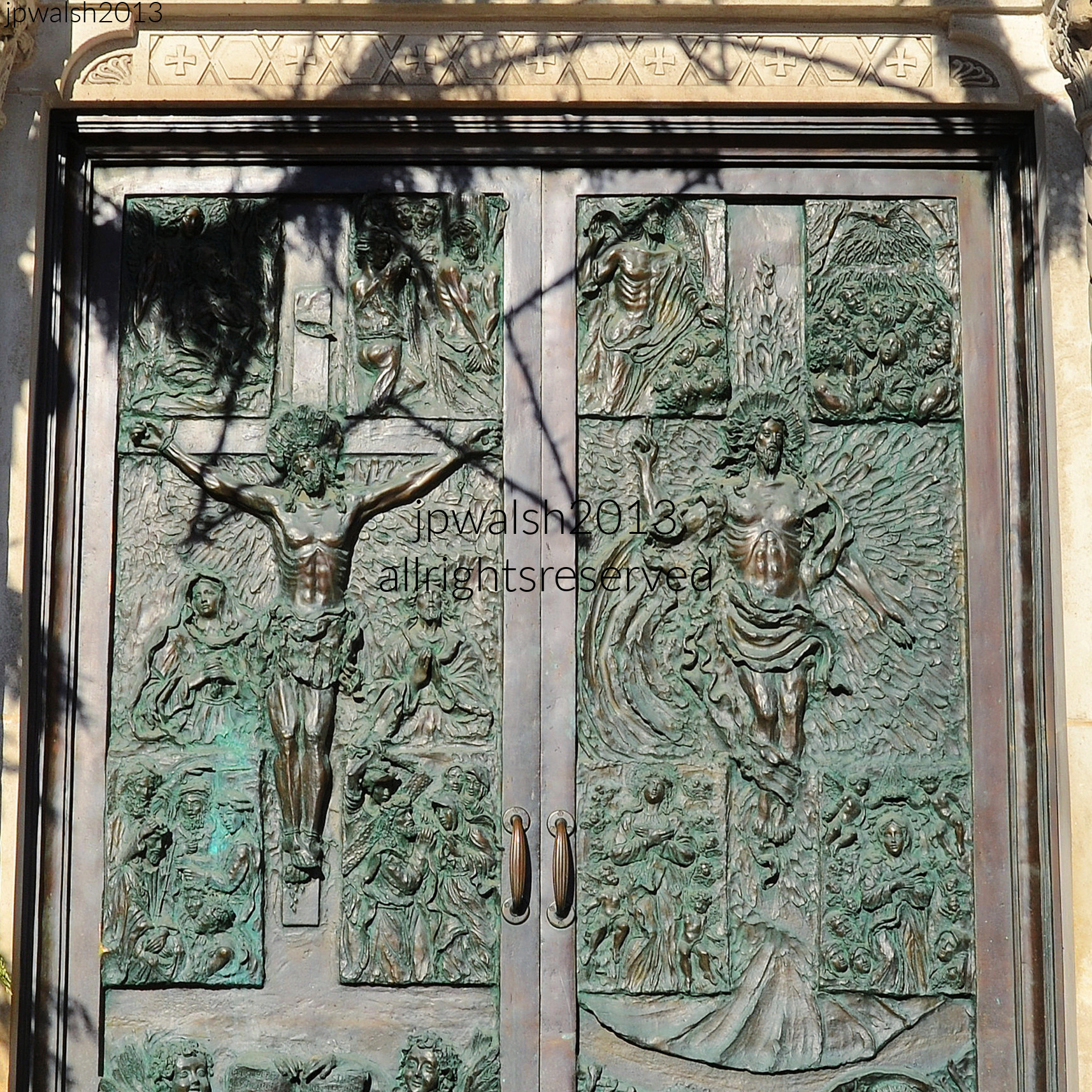
5. The Crucifixion and Death of Jesus with Mary and John (center)

“And when they came to the place which is called The Skull, there they crucified him, and the criminals, one on the right and one on the left. And Jesus said, ‘Father, forgive them; for they know not what they do’ …It was now about the sixth hour, and there was darkness over the whole land until the ninth hour, while the sun’s light failed; and the curtain of the temple was torn in two. Then Jesus, crying with a loud voice, said, ‘Father, into thy hands I commit my spirit!’ And having said this he breathed his last” (Luke 23:33-46). 

Upper portion of Central Bronze Door of Sorrowful Mysteries (left panel) and Glorious Mysteries (right panel) of the Rosary. December 2013. Author’s photograph.

The central bronze door of the Shrine of Our Lady of Pompeii in Chicago’s Little Italy is one of three doors sculpted by Italian artist Biagio Governali and dedicated in October 2004. Inspired by Lorenzo Ghiberti’s celebrated Gates of Paradise in Florence, the monumental portals visually narrate the theological mysteries of the Catholic Rosary through a richly detailed program of relief sculpture. Dominating the central door’s composition are dramatic depictions of the Crucifixion of Jesus Christ and the triumphant Resurrection and Ascension, surrounded by smaller narrative panels illustrating the Sorrowful and Glorious Mysteries. Above, a transom adorned with carved Christian crosses and geometric ornamentation separates the bronze doors from the surrounding masonry. The project was the result of an international collaboration: Governali, a native of Sicily, first modeled the figures in wax before the panels were cast and finished in bronze at specialized foundries in Verona, Italy. Veronese craftsmen then traveled to Chicago to assemble and install the completed work, creating one of the shrine’s most striking artistic and devotional landmarks.

Glorious Mysteries.

1. The Resurrection of Jesus (center)

“But at daybreak on the first day of the week they took the spices they had prepared and went to the tomb. 2They found the stone rolled away from the tomb; 3but when they entered, they did not find the body of the Lord Jesus. 4While they were puzzling over this, behold, two men in dazzling garments appeared to them.  5They were terrified and bowed their faces to the ground. They said to them, “Why do you seek the living one among the dead? 6He is not here, but he has been raised. Remember what he said to you while he was still in Galilee, 7that the Son of Man must be handed over to sinners and be crucified, and rise on the third day.” 8And they remembered his words. 9 Then they returned from the tomb and announced all these things to the eleven and to all the others. 10The women were Mary Magdalene, Joanna, and Mary the mother of James; the others who accompanied them also told this to the apostles, 11but their story seemed like nonsense and they did not believe them. But Peter got up and ran to the tomb, bent down, and saw the burial cloths alone; then he went home amazed at what had happened.” (Luke 24: 1-12).

2. The Ascension of Our Lord into Heaven (top, left)

“So then the Lord Jesus, after he had spoken to them, was taken up into heaven, and sat down at the right hand of God.” (Mark 16:19).

3. The Holy Spirit comes upon Mary and the Apostles (top, right)

“When the day of Pentecost had come, they were all together in one place. And suddenly a sound came from heaven like the rush of a mighty wind, and it filled all the house where they were sitting. And there appeared to them tongues as of fire, distributed and resting on each one of them. And they were all filled with the Holy Spirit and began to speak in other tongues, as the Spirit gave them utterance.” (Acts of the Apostles 2:1-4).

4. The Assumption of Mary into Heaven (bottom, left)

“Henceforth all generations will call me blessed; for he who is mighty has done great things for me.” (Luke 1:48-49).

5. The Coronation of Mary as Queen of Heaven (bottom, right)

“And a great portent appeared in heaven, a woman clothed with the sun, with the moon under her feet, and on her head a crown of twelve stars.” (Revelation12:1).

CENTRAL Bronze Door -Sorrowful Mysteries panel (detail), The Shrine of Our Lady of Pompeii, Chicago. December 2013. 1.55 mb Author’s photograph.

At the bottom of the Sorrowful Mysteries bronze door, the angels hold a tablet emblazoned with Latin text that contains statements on the rosary by two post-Vatican II modern popes. A translation of the text reveals the importance of the rosary to Pope Paul VI (1897-1978) and John Paul II (1920-2005), both canonized saints. Pope Paul VI: “Without contemplation, the Rosary is a body without a soul.” Pope John Paul II: “To meditate on the mysteries of the Rosary is to look into the face of Christ.”

Even when closed, the doors “call to all passersby to look, ponder, and personally experience the Gospel.”

“Looking into the Face of Christ”: A New Chapter in a Centuries-Old Devotion

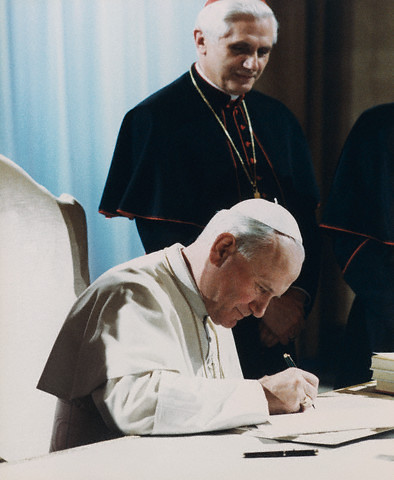
Near the end of his nearly 27-year pontificate, Pope Saint John Paul II (1920-2005) enriched the traditional rosary by establishing the five Luminous Mysteries in 2002. Reflecting on the devotion as a whole, the pope wrote, “To meditate on the mysteries of the Rosary is to look into the face of Christ.”

According to The Catholic Encyclopedia, the structure of the rosary, comprising the Joyful, Sorrowful, and Glorious Mysteries, had remained unchanged for roughly five centuries. With the publication of his Apostolic Letter Rosarium Virginis Mariae on October 16, 2002, John Paul II introduced the Luminous Mysteries, expanding the rosary’s meditation on the life of Christ while preserving its traditional character.

Why Pray the Rosary?

In Rosarium Virginis Mariae, the pope identified four principal reasons for praying the rosary:

  1. To contemplate Christ in union with Mary;
  2. To reflect upon the mysteries of Mary’s life and mission;
  3. To assimilate more deeply the mystery expressed by St. Paul: “It is no longer I who live, but Christ lives in me” (Galatians 2:20);
  4. To pray for and foster peace in one’s personal life, family, community, and the wider world.

Sacred Art as an Aid to Prayer

John Paul II also emphasized the value of sacred imagery in fostering contemplation. Drawing upon the Church’s spiritual tradition and the meditative approach of St. Ignatius of Loyola’s Spiritual Exercises, the pope argued that visual representations can engage the imagination and deepen reflection on the mysteries of the Christian faith. In this context, the bronze portals of Chicago’s Shrine of Our Lady of Pompeii serve not merely as architectural adornment but as instruments of prayer, inviting visitors to stand at the threshold between the temporal and the eternal.

Filling the Gap in Christ’s Life

While all twenty mysteries of the rosary may be described as mysteries of light, John Paul II observed that the newly instituted Luminous Mysteries bridge an important gap between Christ’s hidden life that are reflected upon in the Joyful Mysteries, and the events of Holy Week and Easter that are contemplated in the Sorrowful and Glorious Mysteries.

Revelations of the Kingdom

The Luminous Mysteries focus on five pivotal moments from Christ’s public ministry: the Baptism in the Jordan, the Wedding Feast at Cana, the Proclamation of the Kingdom of God, the Transfiguration, and the Institution of the Eucharist. Each, as John Paul II explained, is “a revelation of the Kingdom now present in the very person of Jesus,” illuminating the mission and identity of Christ through the events of his public life.

see- https://www.vatican.va/content/john-paul-ii/en/apost_letters/2002/documents/hf_jp-ii_apl_20021016_rosarium-virginis-mariae.html.  

Pope John Paul II with then-Cardinal Joseph Ratzinger. With the publication of his Apostolic Letter Rosarium Virginis Mariae on October 16, 2002, John Paul II introduced the Luminous Mysteries. PHOTO: “42-15248354” by Catholicus Fluminensis is licensed under CC BY 2.0.

East Door: LUMINOUS Mysteries

EAST Bronze Door (complete exterior), Luminous Mysteries of the Rosary. The Shrine of Our Lady of Pompeii, Chicago. December 2013. 6.89 mb Author’s photograph.

Luminous Mysteries

1. The Baptism in the Jordan (top, left)

“And when Jesus was baptized, he went up immediately from the water, and behold, the heavens were opened and he saw the Spirit of God descending like a dove, and alighting on him; and lo, a voice from heaven, saying, ‘This is my beloved Son, with whom I am well-pleased.”‘ (Matthew 3:16-17).

2. The Wedding Feast of Cana (top, right)

“On the third day there was a marriage at Cana in Galilee, and the mother of Jesus was there; Jesus also was invited to the marriage, with his disciples. When the wine failed, the mother of Jesus said to him, ‘They have no wine.’ And Jesus said to her, ‘O woman, what have you to do with me? My hour has not yet come.’ His mother said to the servants, ‘Do whatever he tells you.”‘ (John 2:1-5).

5. The Institution of the Eucharist (center)

“Now as they were eating, Jesus took bread, and blessed, and broke it, and gave it to the disciples and said, ‘Take, eat; this is my body.”‘ (Matthew 26:26).

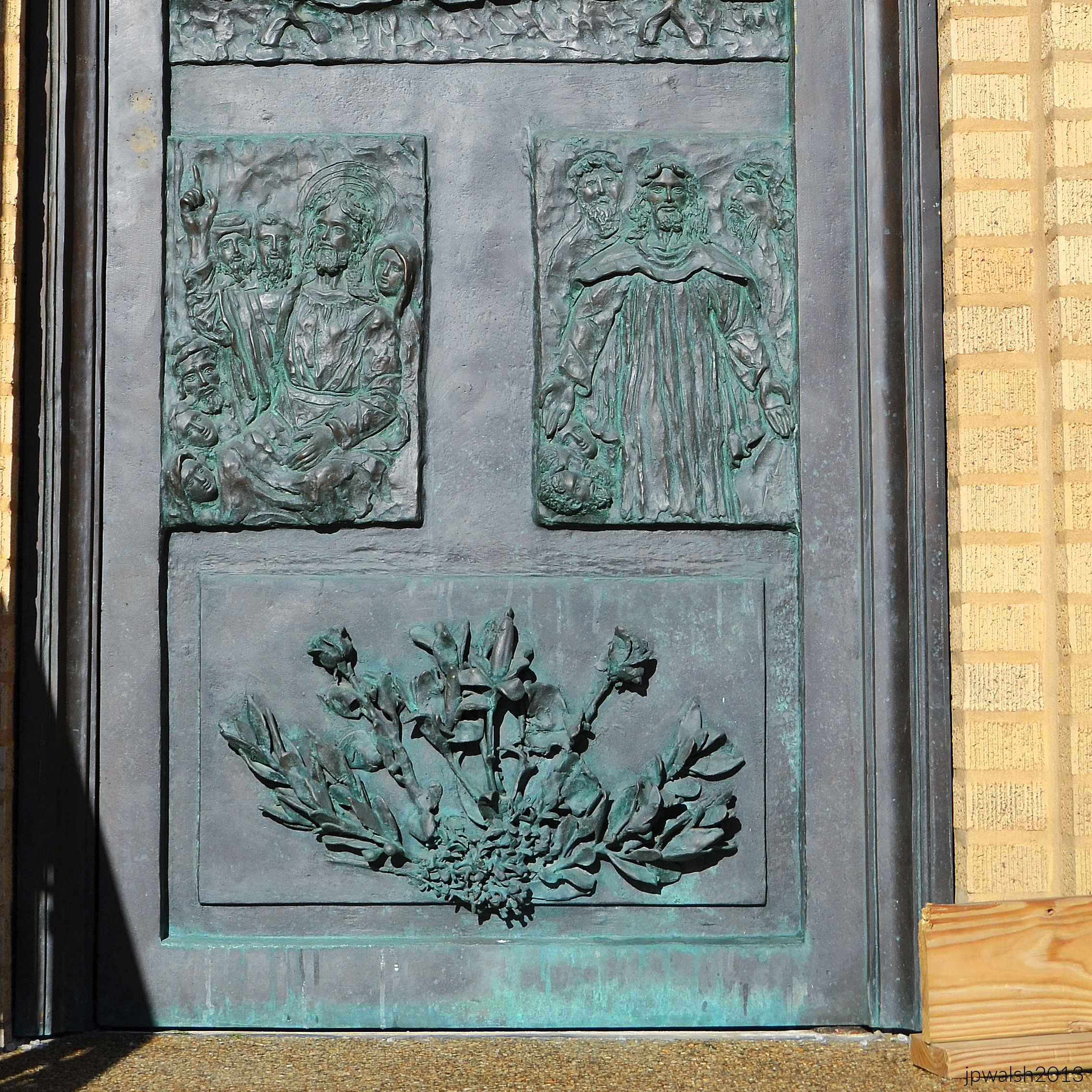
EAST Bronze Door (detail, top), The Shrine of Our Lady of Pompeii, Chicago. Upper panels of East Bronze Door depict the Luminous Mysteries of the Rosary at the Shrine of Our Lady of Pompeii in Chicago’s Little Italy. The sculptor is Biagio Governali who was born in Palermo, Sicily, and is an award-winning artist active in Italy and internationally, participating in many art exhibitions. December 2013. 3.60 mb Author’s photograph.

3. The Proclamation of the Kingdom of God (bottom, left)

“The time is fulfilled, and the kingdom of God is at hand; repent, and believe in the gospel.” (Mark 1:15).

4. The Transfiguration (bottom, right)

“And after six days Jesus took with him Peter and James and John his brother, and led them up a high mountain apart. And he was transfigured before them, and his face shone like the sun, and his garments became white as light.” (Matthew 17:1-2).

EAST Bronze Door (detail, bottom), The Shrine of Our Lady of Pompeii, Chicago. December 2013. 3.48 mb Author’s phtograph

Governali’s bronze doors demonstrate how religious art serves as both a masterpiece of craftsmanship and a living instrument of prayer, inviting worshippers and passersby alike to contemplate the Gospel through the mysteries of the Rosary.

SOURCES:

-retrieved April 5, 2026.