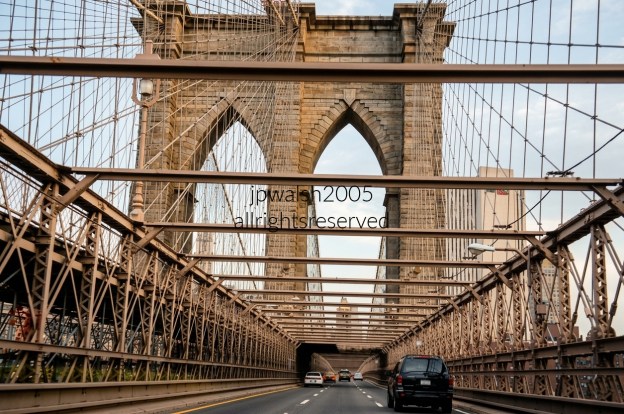

The Brooklyn Bridge stands as the greatest achievement of John Augustus Roebling’s engineering career, uniting innovative design, industrial ambition, and architectural beauty to create an enduring symbol of New York City and America’s rise as a modern nation.

FEATURE image: The Brooklyn Bridge. Centered perfectly is one of the bridge’s massive, Gothic-arched granite suspension towers, while flanking the right side behind the suspension cables are the skyscrapers of Lower Manhattan, including the recognizable Verizon communications building. August 2005. Author’s photograph. All rights reserved.
The Brooklyn Bridge over the East River is the oldest extant bridge in New York City—a city of bridges—and is also the city’s most architecturally famous. The opening of the hybrid cable-stayed and suspension bridge in May 1883 has been called “the Dawn of Modern New York” as it is the world’s first steel-wire suspension bridge.
The Brooklyn Bridge was conceived to connect Manhattan and Brooklyn across the East River, overcoming unprecedented engineering challenges.

Recent photo of the Brooklyn Bridge taken from the Manhattan side of the East River looking across the water toward the DUMBO and Brooklyn Heights neighborhoods. PHOTO: “Brooklyn Bridge New York City” by ugod is licensed under CC BY 2.0.
Spanning the East River between the boroughs of Manhattan and Brooklyn, it was designed and built by a father-son team. Construction began in January 1870 after being approved by Congress in 1869 whose concern was that the bridge project would in no way impede free and open navigation. Over the next over 13 years, an estimated 27 men died during the bridge’s construction. The New York terminus rests on bedrock while the Brooklyn terminus rests on clay. Following its opening in 1883 by the end of that year more than one million passengers crossed the bridge.
Roebling’s innovative use of steel-wire cable technology made longer and stronger suspension spans possible. The bridge’s Gothic-inspired stone towers combine structural necessity with architectural grandeur.

Daily transit on the elevated pedestrian promenade of the Brooklyn Bridge in 1903, looking west toward the lower Manhattan skyline. In the foreground, a New York City policeman in a turn-of-the-century uniform and custodian helmet stands watch as pedestrians in Edwardian dress, men in long overcoats and bowler hats, make their way along the wide wooden boardwalk. The photograph captures the bridge’s intricate lattice of vertical suspenders and radiating steel stay cables. Flanking the promenade on either side are the lower iron trusses that separated pedestrians from the bridge’s busy trolley and cable car lines. Anchoring the composition at the vanishing point is one of the bridge’s immense granite towers, its signature neo-Gothic double arches perfectly framing the horizon and underscoring the monumentality of one of America’s great engineering achievements. Public Domain.
The total length of the bridge is 6,537 feet—nearly one-and-one-quarter miles. From the middle of the span, it is about 135 feet above the river with the span’s weight around 7,000 tons. The railroad on the Brooklyn Bridge opened in 1888. The cables on the bridge are over one foot wide (16 inches) and took almost a year and a half (15 months) to string. Their calibration had to include calculations for variables such as wind and expansion and contraction due to temperature. The height of the Gothic-inspired towers are 159 feet above the roadway.
The Brooklyn Bridge symbolizes the industrial age, urban growth, and American ingenuity. Today it remains one of the world’s most recognizable and photographed structures.
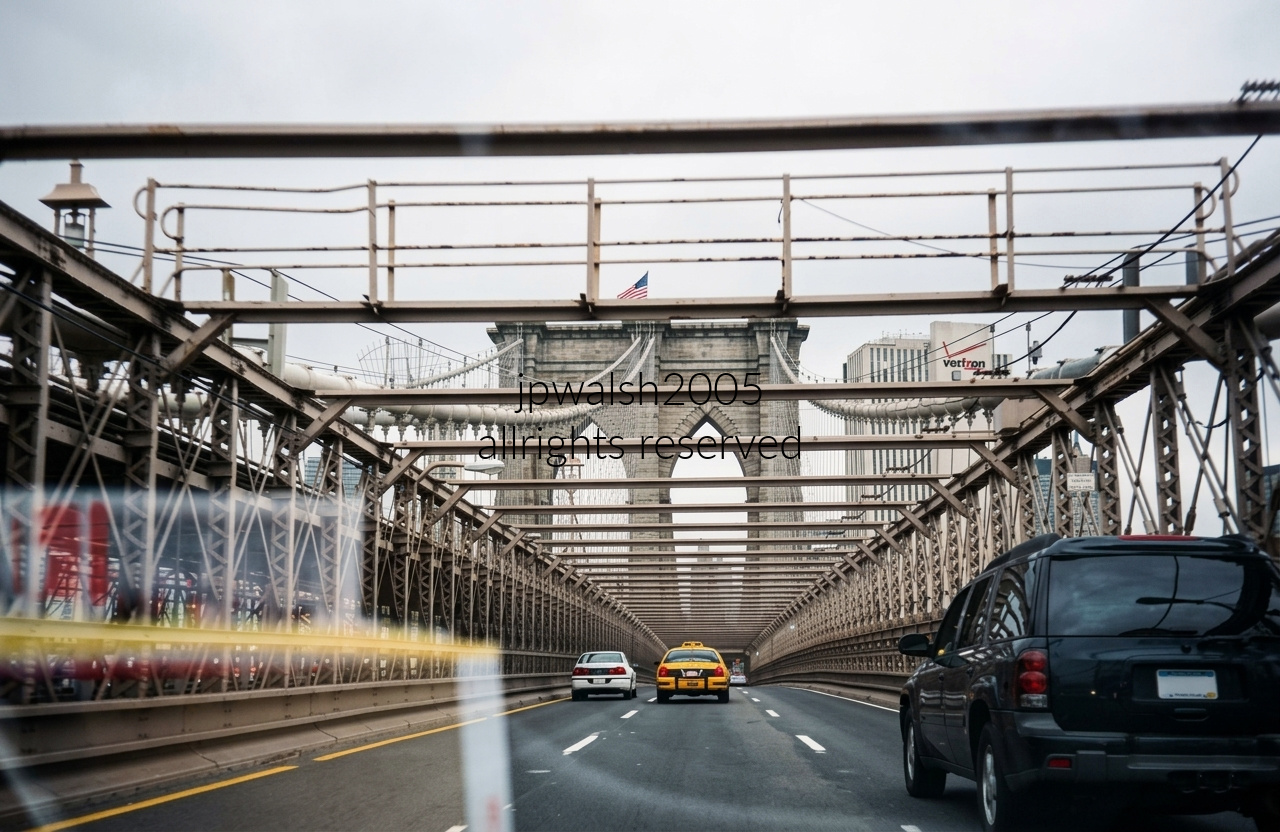
While a classic yellow New York City taxicab and a white sedan drive ahead, the bridge’s intricate, industrial steel trusses, overhead support beams, and complex web of suspension cables that line both sides of the roadway fill out the view heading from Brooklyn into Manhattan. An average of 103,051 vehicles cross the Brooklyn Bridge every single day. August 2005. Author’s photograph. All rights reserved.
SOURCES: The Sun, New York, New York, June 11, 1891.
NYC DOT – Brooklyn Bridge – retrieved August 2, 2026.