Category Archives: EuroSphere

Two Generations of Estonian Genius: Heino Eller (1887-1970) and his student Lepo Sumera (1950-2000).

FEATURE image: Heino Eller with his students from The Tartu Higher Music School in the 1930’s. The intertwined legacies of Heino Eller and Lepo Sumera demonstrate how Estonian classical music evolved across the turbulent twentieth century, preserving national identity through changing artistic styles, political upheaval, Soviet rule, and ultimately the cultural awakening of Estonia’s Singing Revolution.

Heino Eller (1887-1970) and Lepo Sumera (1950–2000) were both influential Estonian composers and music composition teachers. Following his graduation in 1920 from the Saint Petersburg Conservatory, Heino Eller taught music theory and composition in Estonia for the next 50 years.

The list of Eller’s students who are well-regarded composers in Estonia and internationally is lengthy and Eller’s musical legacy lives on through them.

Lepo Sumera is one of those students who, in Eller’s last years, studied with the legendary Estonian composer in Tallinn. Other notable Estonian composers who studied with Eller, starting in Tartu, are Eduard Tubin (1905–1982), Olav Roots (1910–1974), Karl Leichter (1902–1987), and Alfred Karindi (1901–1969). Eller’s students also included religious/minimalist music composer Arvo Pärt (b. 1985) and classical/film music composer Jaan Rääts (1932-2020), among others.

Heino Eller (center) in a group portrait with his students from The Tartu Higher Music School of composition in the 1930’s. Left to right: Estonian composers Eduard Tubin (1905–1982), Olav Roots (1910–1974), Eller, Karl Leichter (1902–1987) and Alfred Karindi (1901–1969). Photo: Public Domain, author unknown.

Lepo Sumera (1950-2000), Estonian composer, student of Heino Eller, and Minister of Culture during Estonia’s “Singing Revolution” between 1988 and 1992. Sumera is shown in his official government capacity in 1991. Estonia’s “Singing Revolution” signaled Estonia’s second revolution of independence from the Soviet Union in the twentieth century (the first was in 1920) which helped end the Cold War following World War Two. Photo: CC BY-SA 4.0.

From 1920 to 1940, Heino Eller, born in Tartu, Estonia, taught music theory and composition at Tartu Higher School for Music (today known as the Heino Eller Music School). During World War II, Eller’s wife, pianist Anna Kremer (1887-1942), was executed by the Nazis in a concentration camp because of her Jewish ethnicity.

After the war and following the Soviet occupation, Eller taught at Estonia’s Tallinn Conservatory until his death in 1970. It was at Tallinn State Conservatory (today the Estonian Academy of Music and Theatre) that Lepo Sumera studied with Heino Eller. Following Eller’s death, Sumera graduated from Tallinn Conservatory having studied with Estonian composer Heino Jürisalu (1930-1991).

Eller: Romanticism, Modernism and Folk Songs.

Eller’s early music (before 1940) is characterized by a broad romanticism which takes in impressionism, expressionism and modernism. His melodies and orchestrations are lyrical and refined by way of varying modernist modes of polyphony. Eller’s orchestral, ensemble and piano works often utilize the melodies and/or structures of Estonian folk songs.

Charles Coleman’s arrangement of Heino Eller’s Three Pieces for Flute and Piano (or string orchestra) was created in 2005. In three movements: 1. In the Valley 2. On the River and 3. In the Meadow, the performance of “In the Meadow” features soloist Maarika Järvi on flute. She performs with the Estonian National Symphony Orchestra conducted by the flutist’s brother, Kristjan Järvi. (2:06 minutes).

Three Pieces, flute and piano was composed in 1952. Whereas Eller’s music had been generally lyrical-romantic, influenced by Chopin, Grieg, Rachmaninoff and Scriabin, Eller’s musical idiom changed after World War II.

Eller’s music turned simpler and relied increasingly on folk melodies. By the early 1950’s his orchestral works with an illustrative idiom such as Flight of the Eagle (1950) and Singing Fields (1951) reflected official Soviet cultural policy to which Estonia, in Eller’s lifetime after 1940, was incorporated. It wasn’t until the end of the 1950’s, however, that Eller’s symphonic arrangements grew structurally denser.

Lepo Sumera: introduced electro-acoustic trends to Estonian music

As a student of Heino Eller, Lepo Sumera shared with the legendary composer a keen attention to compositional detail as well as being a key figure in his generation to introduce international contemporary music ideas and trends to the country.

In his 50 restive and creative years the late-20th century Estonian composer and teacher, Lepo Sumera, wrote six symphonies, the bedrock of his musical corpus. Sumera regularly collaborated with theatrical figures, film directors, choreographers, and artists to create over 70 film scores and music for the stage.

From 1988 to 1992, during the days of Estonia’s “Singing Revolution” which helped to end the Cold War, Lepo Sumera was his country’s Minister of Culture. It was not easy for the new government minister as his own house was subject to restitution to its rightful owners following the end of a half century of Soviet occupation.

Lepo Sumera was known by his students as a kind and thoughtful man. The professor and composer thought it nothing to bend down in the middle of a discussion on musical composition to tie the untied laces of a child’s shoe of one of his students. Whereas Sumera’s themes, especially in his symphonies, tackle quintessential issues of humanity—life, death, love, torment, and so on, in music that is multi-layered, dramatic and richly colored—his other and shorter works frequently offer a weightless, shimmering quality that lend to the music a sense of timelessness.

Performance at the 2019 Pärnu Music Festival of Lepo Sumera’s waltz from the animated 1986 color short film Kevadine kärbes (“Spring Fly.”). Arranged by Mihkel Kerem, Sumera’s music is characteristically playful and humorous but expressively direct. It is performed by the Estonian Festival Orchestra founded by Paavo Järvi in 2011. (7:39 minutes).

Heino Eller, Estonian stamp, 125th anniversary of Eller’s birth (2012).

The careers of Heino Eller and Lepo Sumera reveal how music can serve as both artistic expression and cultural resilience during periods of war, occupation, and national renewal.

Sketch portrait of Lepo Sumera, 2018, by Khanzhin Ivan. CC BY-SA 4.0.

SOURCES:

“Estonian Academy of Music and Theatre.” MasterStudies. Accessed January 25, 2021. https://www.masterstudies.com/universities/Estonia/Estonian-Academy-Of-Music-And-Theatre/.

“Lepo Sumera.” Estonian Music Information Centre. Accessed January 25, 2021. https://www.emic.ee/?sisu=heliloojad&mid=58&id=11〈=eng&action=view&method=biograafia.

Lill, Märt-Matis. “Lepo Sumera – a Restless Creative Mind and an Extraordinary Human Being.” Estonian World, May 29, 2020. Accessed January 25, 2021. https://estonianworld.com/culture/lepo-sumera-a-restless-creative-mind-and-an-extraordinary-human-being/.

The Raw Power and Harmony of the Angeles Chorale Reimagines John Rutter’s Challenging Gloria (1974).

FEATURE image: Though demanding and technically challenging, English composer John Rutter’s 1974 chorale masterpiece Gloria is revitalized through the Angeles Chorale’s emotionally charged, 2012 volunteer performance in Pasadena; their distinct performative exuberance and contemporary pacing deliver a vibrant, active, and deeply personal energy that keeps listeners on the edge of their seats beyond the bounds of a traditional classical record. The Angeles Chorale is based in greater Los Angeles, California, and has been active as an all-volunteer choral group for more than 40 years. Fair Use.

WHO IS JOHN RUTTER AND WHAT IS HIS GLORIA ABOUT?

Gloria by English composer John Rutter (b. 1945) is a musical setting of parts of the Latin Gloria which is a Christian hymn. Rutter’s work was written in 1974 and has been part of the Christmas concert tradition ever since.

The Latin Gloria is known as “The Hymn of the Angels” because they are the words the angels sang in Luke 2:14. The angelic host hovered over the shepherds in the field to announce Christ’s birth. “Gloria in excelsis Deo,” the shepherds heard the angels sing, “Glory to God in the highest.”

Only twenty minutes long, John Rutter’s chorale masterpiece Gloria is reputed to be a challenging work. The performance by the Angeles Chorale at First United Methodist Church in Pasadena on December 15, 2012 strives for perfection in this excellent all-volunteer chorus porformance.

Built on the ancient framework of the traditional Latin hymn, it is a work reputed for its complex rhythms and unforgiving vocal leaps.

John Rutter. “John Rutter, CBE, choral composer, conductor” by David E Henderson is licensed under CC BY-NC 2.0.

MUSIC THAT IS VIBRANT, ACTIVE, PERSONAL, ALIVE

The Angeles Chorale takes the three movement work as its own. This is a musical performance that is vibrant, active, personal, alive, and while not perhaps the most refined performance of this favorite work on record, it provides the listener with an aural experience that leaves one on the edge of their seat which is a power not typically found in other performances. This engaging vibrancy could be part of Sutton’s ease and familiarity with popular musical forms, such as for film and television, that infuses this choral piece’s unique harmonies, structures, and rhythms with a branded verve and, if imperfectly, then confidently based on the chorale and brass’s obvious performative exuberance and enjoyment.

  1. Allegro vivace – “Gloria in excelsis Deo”
  2. Andante – “Domine Deus”
  3. Vivace e ritmico – “Quoniam tu solas sanctus.”

The performance is 20 minutes.

During a remarkable winter performance at the First United Methodist Church in Pasadena, the all-volunteer Angeles Chorale proved that technical rigor does not have to come at the expense of human warmth.

VOLUNTEER CHORAL GROUP FOUNDED IN 1975

For over 40 years, the Angeles Chorale has brought inspiring choral music to greater Los Angeles, California. It is an all-volunteer choral group comprised of about one hundred voices. The Angeles Chorale was founded in 1975 as one of the local Valley Master Chorales and merged in 1987 with California State University Northridge’s Masterworks Chorale under the baton of Artistic Director John Alexander.

ARTISTIC DIRECTORS Under the baton of Dr. John Sutton, the choir bypassed the pristine, sterile precision of standard studio records to deliver an interpretation defined by a raw, unvarnished power and a brilliant performative exuberance.

For the next nine years Alexander led the assemblage into a professional standard, and changed its name to the Angeles Chorale. Donald Neuen took over the podium in the 1996-1997 season. Neuen, Director of Choral Activities at UCLA, focused the chorale’s repertoire on classical music masterworks for chorus and orchestra such as Bach, Beethoven, Brahms, and Mahler. For the 2010-2011 season, Neuen handed the baton to its present-day Artistic Director Dr. John Sutton, who had been with the chorale since 2004. Sutton continues to actively study with Professor Neuen, now retired, among others, and utilizes the Angeles Chorale’s versatility and mastery in classic music and current music in concert programming.

Gloria – The Sacred Music Of John Rutter John Rutter Collegium” by iClassicalCom is licensed under CC BY 2.0.

Christmas Choral Concert: ST. BAVO CATHEDRAL CHOIR, Haarlem, Netherlands.

FEATURE image: The St. Bavo Cathedral Choir performs Christmas carols and other seasonal music for voice, many in modern settings. Fair Use.

The Advent program (2012) includes well-known carols along with Anton Diabelli’s Pastoral Mass In F Major For Solos, Chorus and Orchestra, Op. 147. The concert also includes excerpts from Benjamin Britten’s 11-part choral piece, A Ceremony of Carols, Op. 28, composed in 1942.

Fons Ziekman conducts the Promenade Orchestra and Sanne Nieuwenhuijsen directs the chorus with soloists Jasper Schweppe, Anouk van Laake, Floris Claassens, Hidde Kleikamp and Frank de Ruijter. they are accompanied by Ton van Eck on organ and Auréli Husslage on harp. (64 minutes)

Full Program:
John Francis Wade (1711-1786) : Oh, come all ye faithful
Anton Diabelli (1781-1858): Pastoral Messe in F-dur, op.147
Willcocks: The First Nowell
Benjamin Britten (1913-1976): A Ceremony of Carols
Richards: Over the Country
Britten: A New Year Carol
Felix Mendelssohn (1809-1847): Hark the herald angels sing
Vaughan Williams (1872-1958): Fantasia on Christmas Carols

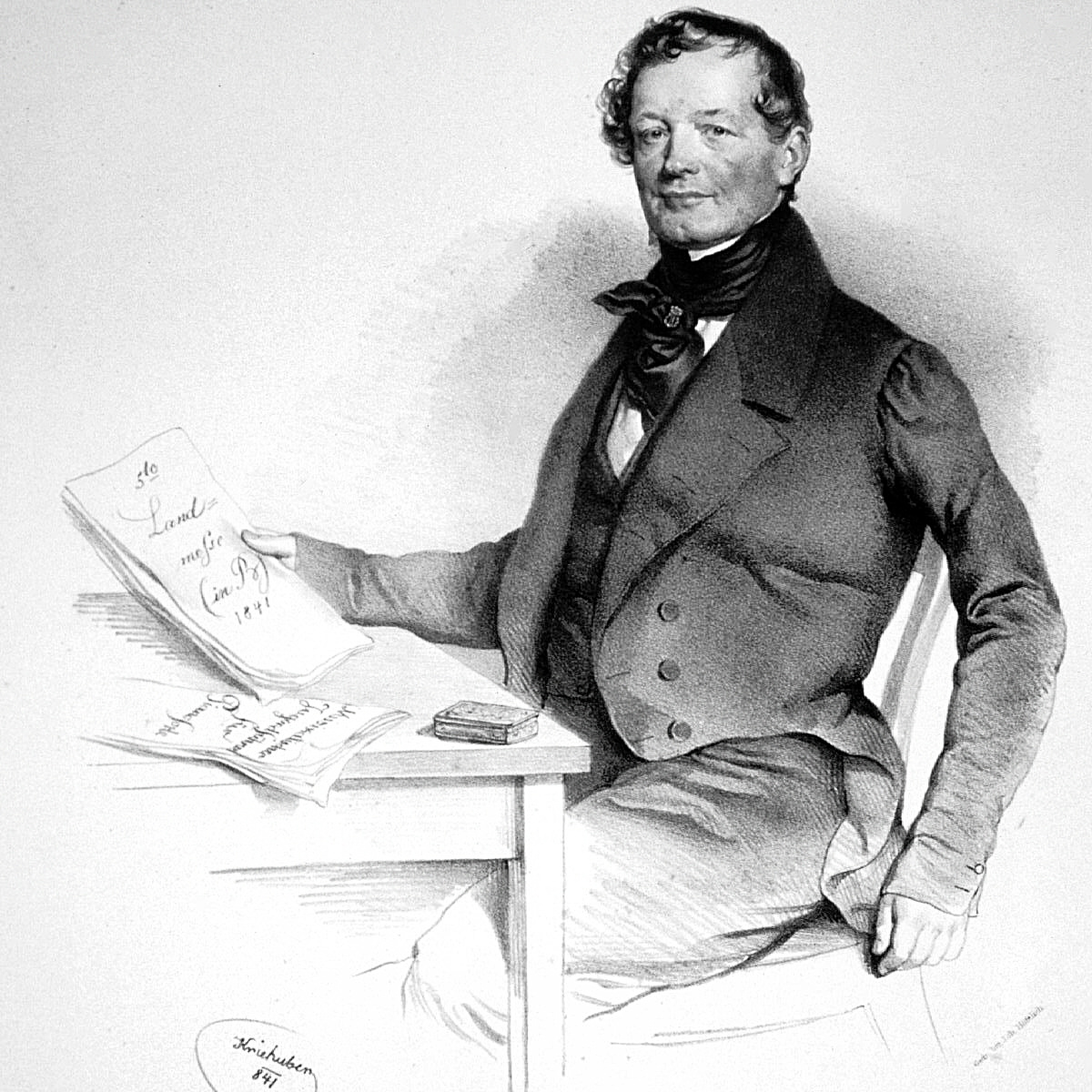
Anton Diabelli (Austria, 1781-1858). Lithograph by Josef Kriehuber (Austria, 1800-1876).
Benjamin Britten (English, 1913-1976) in 1968. Publicity photo by Hans Wild. Public Domain.

CONCERT SPACE IS EARLY 20TH CENTURY CATHOLIC CATHEDRAL IN HAARLEM, NETHERLANDS

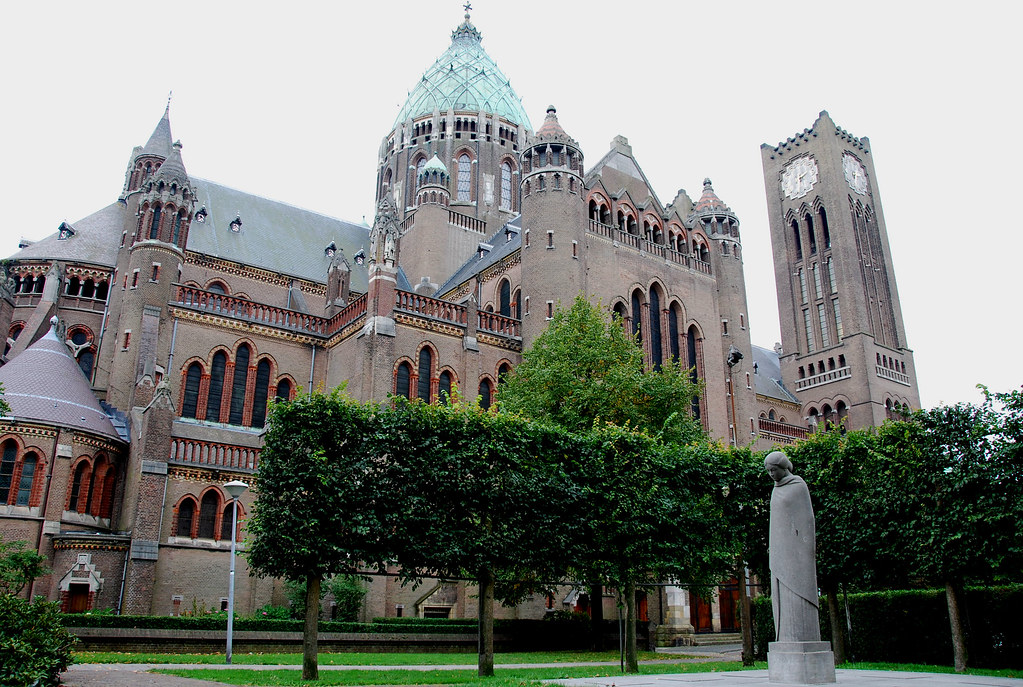
The concert was performed and recorded at the (Catholic) Cathedral Basilica St. Bavo in Haarlem on December 16, 2012 during Advent. The construction of the immense church took place between 1895 and 1930 on the Leidsevaart. It is different from and not the iconic Grote Kerk on Haarlem’s main square. As a cathedral, St. Bavo Basilica was built as the Catholic bishop’s church but it is also an active local parish. The St. Bavo Cathedral Choir is the church’s largest choral group, and an important part of the dual activity of the church.

The monumental church building, its art collection, organs, future museum, and the liturgical support of its Music Institute are all important aspects of serving and celebrating the Gospel in the service of others. The church community does not limit itself solely to believers within the territory of the parish, but offers a hospitable home for all who feel connected to it. https://rkhaarlem.nl/kerken/bavo-kathedraal-haarlem/

The church offers several choirs, including a girls’ choir, boys’ choir, men’s choir, a schola cantorum and more. http://vriendensintbavo.nl/vriendensintbavo.nl/de-koren/

The Cathedral of Saint Bavo is the Catholic cathedral in Haarlem, the Netherlands. It was built between 1895 and 1930 during a Catholic revival in Europe. The church is a 20th century replacement for Sint Bavokerk (the Grote Kerk) on Haarlem’s main square. Founded in the mid13th century, the Grote Kerk was taken over by Protestantism from Catholicism in 1578. “the new St. Bavo Cathedral” by jimforest is licensed under CC BY-NC-ND 2.0.

ORIGIN, PRACTICE OF THE CATHEDRAL CHOIR. WORKS PERFORMED

The Cathedral Choir who performs this Advent 2012 concert is comprised of all the choirs put together and can hold more than 100 people. The “Kathedrale Koor” sings on average once a month and for the major festivals such as Christmas, Easter and Pentecost. 

The full Cathedral choir is also used at large concerts and other important diocesan and other large events. The choir’s repertoire is wide with centuries of church music being represented. Large works with organ are especially performed, such as Masses by Louis Vierne (1870-1937) and Charles-Marie Widor (1844-1937) as well as works by Louis Andriessen (b. 1939) and Herman Strategier (1912-1988). The works of Jan Valkestijn, former Magister Cantus of the Music Institute and composer of several works for the Cathedral Choir, are also regularly performed.

From 6th-Century Chant and 16th-Century Polyphony to Modern Masterpiece: The Story of the 21st century opera Vivifice Spiritus Vitae Vis (Revive the Life Force Spirit).

FEATURE image: Lion, Lodi Cathedral, Italy. The cathedral commissioned the opera.Leone stiloforo di pietra. Lodi, cattedrale” by claudiobertolesi is marked with CC PDM 1.0. Public Domain.

By blending the monophonic depth of sixth-century Gregorian chant with sixteenth-century Baroque polyphony, Guido Morini’s contemporary opera Vivifice Spiritus Vitae Vis demonstrates that early religious music traditions can be revitalized into an accessible, rigorous lyricism capable of countering modern materialism and achieving universal appeal regardless of a listener’s personal faith.

Ensemble Accordone in 2010.

By John P. Walsh

The Italian early Baroque ensemble “Ensemble Accordone” was founded in 1984 by two musicologists—composer Guido Morini (b. 1959) and tenor Marco Beasley (Italian-English, b. 1957). In the last decade the duo, in collaboration with other musical artists, has recorded and released 10 albums.

The 45-minute opera called Vivifice Spiritus Vitae Vis (Revive the Life Force Spirit) is composed by Moroni and appeared in 2009. It is divided into three parts with thirteen chapters and includes a prelude and interlude in Gregorian chant.

While Ensemble Accordone’s main focus is arranging and performing musical literature mainly of the fifteenth and sixteenth centuries, Vivifice Spiritus Vitae Vis is one of two recent albums by the group conceived from original compositions by Morini.

Commissioned by the Lodi Cathedral to counter the weight of modern materialism, this masterpiece proves that sacred traditions are not fragile museum pieces.

In their interpretations, Ensemble Accordone often seeks collaboration with outside musical artists. This is also the case for Vivifice Spiritus Vitae Vis, an opera for three soloists, three choirs, organ and basso continuo concertante. With texts drawn from the the Old Testament, the first part is called Effuderunt Aquas Nubila (Poured out of murky waters).

Featured are the Helicon and Euterpe choirs as well as soloists Elisabetta de Mircovich and Claudia Caffagni. Special guest musicians include Karen Peeters, Jaap Kruithof, Edwin Derde, and Guido Morini. The opera’s conductor is Geert Hendrix.

In an era dominated by rapid consumption and digital noise, the roots of our musical heritage offer an unexpected sanctuary.

While Vivifice Spiritus Vitae Vis is imbued with the monophonic structure of sixth century Gregorian chant as well as Baroque polyphony of one thousand years later, Ensemble Accordone consciously strives in this album to have early music be easier for today’s listener to enjoy.

While today’s listener may not recognize or be able to identify this melodious music’s traditional backbone, the manifestation of a “rigorous lyricism” demonstrates Ensemble Accordone’s creative confidence in bringing early music into relevant practice for the 21st century.

Vivifice Spiritus Vitae Vis is the first part of a trilogy of compositions dedicated to the Christian Trinity—Father, Son, and Spirit. By design, the new commission by the Basilica Cattedrale della Vergine Assunta (Lodi Cathedral in northern Italy) is to counter today’s materialism by configuring the great religious traditions in a new way through contemporary music and words. Of course, the musical heritage, careful and creative arrangment, powerful lyricism and performative precision are intended to have universal appeal regardless of the listener’s ethical or religious convictions.

The opera describes the presence, vital breath, and action of the Spirit in the life of the individual and community. It’s libretto of Old Testament verses is a new Latin translation by Ettore Garioni.

At Versailles: Messe et Motets Pour La Vierge (1702) by MARC-ANTONE CHARPENTIER (1643-1704, French).

FEATURE image: “Jordi Savall à l’Arsenal.” by iJuliAn is licensed under CC BY-NC-SA 2.0.

Le Concert des Nations is an orchestra created in 1989 that performs orchestral, choral, and symphonic music with period instruments. Founded by Catalan maestro and viola de gamba virtuoso, Jordi Savall (b. 1941), Le Concert de Nations performs a wide ranging repertoire from the Baroque period (16th-17th centuries) to the Age of Enlightenment (18th century) and into the Romantic period (19th century). Their name, Le Concert des Nations, refers to a musical work by French Baroque composer and musician, François Couperin (1668-1733).

Le Concert des Nations in 2005. Fair Use.
Presumed portrait of François Couperin by 17th century aninymous French artist. oil of canvas. see- http://collections.chateauversailles.fr/#c5bd04a2-447c-430a-8d49-40848da99695

Messe et Motets pour la Vierge by Marc-Antoine Charpentier (1702):
Canticum in honorem Beate Virginis Mariae inter hominess et angelos (H.400)
In Nativitatem Domini Canticum: nuit (H.416)
Stabat Mater pour des religieuses (H.15)
Litanies de la Vierge a 6 voix et 2 dessus de violes (H.83)
Missa Assumpta Est Maria (H.11a)

Jordi Savall and Le Concert des Nation’s performance of Messe et Motets pour la Vierge (1698) by Charpentier.

What is Charpentier’s Messe et Motets Pour La Vierge about?

Marc-Antoine Charpentier (French, 1643-1704) was a prolific composer who had a diverse list of clients in Paris and the composer continually adapted his work. His religious music is complex for its musical relationships and its theological structures.

Starting in the sixteenth century one of the Catholic Church’s responses to Protestant reformers during the so-called “Catholic Counter Reformation” was the renewal of its devotion to the Virgin Mary.

Charpentier’s composition of Messe et Motets Pour La Vierge is not trivial. It supports varied and comprehensive expressions of Marian devotion. This includes a didactic dialogue in her honor (Canticum in honorem Virginis Mariae Beatae homines…); a sorrowful Virgin at the foot of the Cross (Stabat mater dolorosa); a litany of the Virgin; and a great Mass in her honor for God’s glory (Assumpta est Maria…).

Added to the theological variety of musical forms are its different musical styles for soloists, chorus and orchestra.

Charpentier’s final product is sublime and leads directly to the Mass worship on the Feast of Mary’s assumption into heaven which is August 15.

Louis XIV with his mother and brother, 1643, Philippe de Champaigne (1602-1674), Kunsthalle Hamburg.
The crown of France being offered to the young Louis (future King Louis XIV) by the Virgin Mary while his mother (Anne of Austria) and brother (Philippe, Duke of Anjou) attend. Public Domain.

Charpentier’s Messe and the Palace of Versailles

Intriguing facts coincide in this live early music performance of the Messe et Motets Pour La Vierge (Mass and Motets for the Virgin) by Charpentier and the Palace of Versailles in whose Royal Chapel it was recorded in 2007. The ninety-one-minute music video in this post is directed by Olivier Simonnet and broadcast by MEZZO.

In the Jules Hardouin-Mansart-designed chapel of 1699 (completed in 1710) is performed some of the greatest music ever composed by early music ensemble Hespèrion XXI and period instrument orchestra Le Concert des Nations led by Jordi Savall.

Fourteen miles west of Paris, there are many ways to visit Versailles’ château and grounds as it is very big and expansive. The château has over two thousand windows (exact count: 2,153).

Square feet of Versailles compared to Michael Jordan’s Chicagoland mansion

In 2012 when former Chicago Bulls superstar Michael Jordan sold his house he listed it at $29 million. For that price the residence boasted 32,683 square feet on seven acres near Chicago.

What about Louis XIV’s Versailles? The royal château is over 720,000 square feet on two thousand acres. The visitor who wanders the 30 rooms of Jordan’s house could wander Versailles’ twenty-three hundred rooms.

Chateau de Versailles – Galerie des Glaces. “File:Chateau Versailles Galerie des Glaces.jpg” by Myrabella is licensed under CC BY-SA 3.0[/caption]
Print (c. 1680’s) of M. Charpentier in the lower left corner with two ladies displaying a sheet of musical notations. Public Domain.

Versailles has over 6000 paintings and 5000 pieces of furniture

To be expected, there is much to see inside the château: by one count, 6,123 paintings, 1,500 drawings, 15,000 engravings, 2,000 sculptures and 5,000 pieces of furniture. 

Most of the palace was built in the 1670s. It is interesting that Charpentier’s Messe et Motets Pour La Vierge is performed in its Royal Chapel. Composed in 1702, this brilliant new liturgical music of the time is hosted in a architectural space that at the time was also brand new. It was completed in 1710 by the First Architect to the King’s brother-in-law because Mansart died in 1708 at nearby Marley-le-Roi.

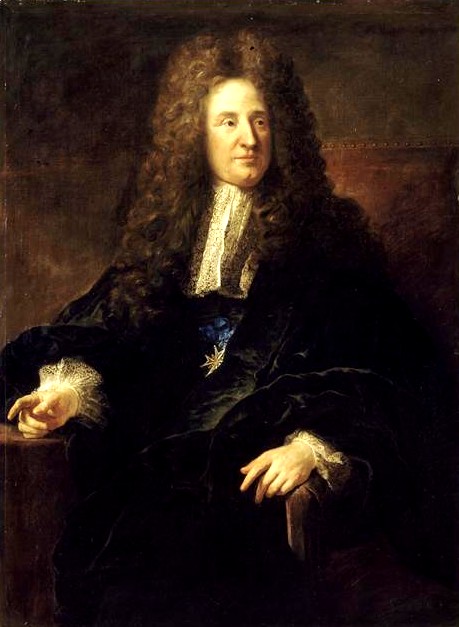
Portrait of Jules Hardouin-Mansart (1646-1708), Premier architecte du Roi by François de Troy (9 January 1645 – 21 November 1730), 1699. Palace of Versailles. see – http://collections.chateauversailles.fr/#14206cd6-00df-409f-8ae8-600784935955
The vaulted ceiling in the Royal Chapel at Versailles (1699-1710). Hardouin-Mansart (1646-1708) designed it without transverse ribs so to create a unified surface, It is dedicated to the Holy Trinity: iGod the Father in his Glory by Antoine Coypel (1661-1722) is in the center. In the apse is The Resurrection by Charles de La Fosse (1636 – 1716). Above the Royal tribune is The Descent of the Holy Ghost by Jean-Baptiste Jouvenet (1644– 1717).

Performance Vocalists and Musicians

Emmanuel Bardon, countertenor
Yves Bergé, bass
Pascal Bertin, countertenor
Daniele Carnovich, bass
Raphaële Kennedy, soprano
Jean François Novelli, tenor
Jordi Ricart, baritone
Arianna Savall, soprano
Judit Scherrer-Kleber, mezzo-soprano
Elisabetta Tiso, soprano
Luis Vilamajo, tenor

Jordi Savall, pardessus de viole
Guido Balestracci, bass viol
Bruno Cocset, bass violin
Imke David, haute-contre de viole
Xavier Diaz-Latorre, theorbo
Luca Guglielmi, organ and harpsichord
Marc Hantai and Charles Zebley, transverse flutes
Xavier Puertas, violone
Joanna Valencia, tenor viol

Music Revolution of 1800: “new” music of 30-year-old LUDWIG VAN BEETHOVEN (1770-1827, German).

FEATURE image: Ludwig van Beethoven, 1804/05, Joseph Willibrord Mähler (German, 1778-1860), Wien (Vienna) Museum.

Beethoven as a young man, c. 1800. Nineteenth century painting after an engraving by Karl Traugott Riedel (1769–c.1832).

December 16 is the birthday of Classical-Romantic German composer Ludwig van Beethoven (1770-1827).

Throughout the 1790’s young Beethoven composed in the drawing-room tradition.

In 1800, around his 30th birthday, Beethoven was telling friends that he was determined to “open a new path” for music.

Resistance to the young, gruff composer and his new music’s coarse vibrancy—a “music of man” that expressed every aspect of human living with its intrinsic engagement in the world—frequently came from the established style galant musicians. For the previous 50 years they were used to playing the shiny, cool classical music of the Bachs, Mozart, and Haydn. Haydn, though an old man in 1800, was still living and leading the old-school classical tradition as the 30-year-old Beethoven was working his musical revolution.

When Beethoven’s new music was first written and performed it was characterized as  “furious.” It was mainly the new century’s young people who had a taste for the revolutionary sound.

What was the level of defiance in Beethoven’s “new” music? The answer varies based in part on the point in time when it was first heard.

Beethoven’s work is famously divided into three epochs: his own twenties (before 1800); his thirties to mid-forties (the so-called Middle Period of around 1805 to 1818); and the final decade to his death.

Towards the end of Beethoven’s career (he died at 56 years old in 1827), his same earlier new music had become the object for critical nuance. Profound changes in society and culture directly affected his art over the next 20 to 25 years leading to the creation of his greatest music. His mature musical works changed the perception of his first “new” music after 1800. With the development of Beethoven’s music an interesting critical question arises—in what manner and to what degree is Beethoven’s earlier music a more tempered musical revolution than his young auditors first recognized?

Early Middle Period works like the Fourth Symphony which had been first received with gusto became for later auditors a source for “astounding confusion.” What had been clearly “revolutionary” at the start of the nineteenth century showed itself by the middle of the 1820’s and after Beethoven’s death to be more of a steady bridge between the classical and romantic worlds and especially more than first supposed.

One fine example of Beethoven’s critically contentious early “new” music is the Fourth Symphony in B Flat Major written in 1806. The first movement  Adagio – Allegro vivace is performed by the Royal Concertgebouw Orchestra led by Carlos Kleiber. 

Portrait of Beethoven, 1800/01. Engraving by Karl Traugott Riedel after an engraving by Johann Joseph Neidl (1776-1832), based on a drawing by Gandolph Stainhauser von Treuberg from 1801, Leipzig, 1801. (see https://www.beethoven.de/en/media/view/5005287131971584/Ludwig+van+Beethoven+-+Stich+von+Karl+Traugott+Riedel+nach+einem+Stich+von+Johann+Joseph+Neidl%2C+der+nach+der+Zeichnung+von+Gandolph+Stainhauser+von+Treuberg+von+1801+entstand%2C+Leipzig%2C+1801?fromArchive=6007892788379648).

Beethoven’s Sonata No. 5 for Piano and Violin in F major, Opus 24, Frühlings-Sonate (Spring), is in 4 movements and dedicated to Count Moritz von Fries, the son of one of the richest men in the Austrian Empire. In 1800 the 23-year-old Count had married Maria Theresia zu Hohenlohe-Waldenburg-Schillingsfürst. Written in 1800, the first movement, Allegro, begins the piece’s delicious melodic evolution. These melodies recur throughout the work down to the final page and its many designs were used by Beethoven later for parts of other works.

Since about 1800 Beethoven was a frequent guest in the Count’s house and dedicated various works to him, for example the two sonatas for piano and violin op. 23 and op. 24 as well as the string quartet op. 29 and his Seventh Symphony in 1811-1812. Between 1809 and 1810 the bank supported Beethoven in certain of his international business dealings regarding musical commissions.

Count Moritz Christian von Fries with his wife Maria Theresia Josepha, Princess Hohenlohe-Waldenburg-Schillingsfürst (1779-1819), and their son Moritz, c. 1805, by prominent French painter François Gérard.

Count Moritz Christian von Fries (1777-1826) led an affluent life. With the inheritance of his brother Count Joseph von Fries’s art collection and business in 1788, the Viennese banker was well on his way to becoming a great collector of prints and drawings. His curator was F. Rechberger, whose signature is found on the verso of many of Fries’ prints mounted on a yellowish paper. In 1825, he married his second wife, Fanny Münzenberg (1795-1869).

The firm fell into difficulties after 1815 and, declining further in the early 1820’s, the Count was forced to sell piecemeal his collections. A huge lot of prints and books went up for sale in 1824 in Amsterdam while the rest of it was sold after Fries’ premature death. In 1826 the bank in Vienna filed for bankruptcy. Moritz Christian von Fries and his wife Fanny then moved to Paris where the once extravagantly wealthy Count died only a couple of months later. He was 49 years old.

The violin sonata called the Spring, along with other of Beethoven’s works at the turn of the nineteenth century—notably the Violin Sonata No. 4, Opus 23 for which Beethoven intended to pair the pieces—retain a character of the salon, the theatre. Yet they are increasing free and happy in the play of musical faculties. The violin sonatas appeared in 1800/01 which is a year of tremendous growth for Beethoven and of which the 30-year-old composer was well aware.

Beethoven, 1802/3, engraving by Johann Joseph Neidl.

In 1800 Beethoven was also busy writing his Sonata for Piano & French Horn in F major, Opus 17 for Baroness Josephine von Braun, wife of the future head of the Vienna Opera. It premiered in Vienna on April 18, 1800 with Bohemian (Czech) virtuoso horn player Jan Václav Stich, better known as Giovanni Punto (1746-1803), as the soloist and accompanied on the piano by Beethoven himself who, at 29 years old, was highly productive but unknown outside Vienna. When Beethoven and Punto performed this piece in Budapest, a local critic argued in the press: “Punto, yes, of course, is well known. But who is this Beethoven?”

Beethoven, Sonata for Piano & French Horn in F major, Opus 17, composed in 1800 for Baroness Josephine von Braun.

In 1800 Beethoven completed the six string quartets, Opus 18, for Bohemian Prince Ferdinand Lobkowitz (1772-1816).

Beethoven, Opus 18, String Quartet No.4, first movement is part of six string quartets composed in 1800 for Bohemian Prince Ferdinand Lobkowitz (1772-1816). The prince was born in Vienna, the son of Ferdinand Philipp Joseph, 6th Prince Lobkowicz (1724–1784) and Maria Gabriella di Savoia-Carignano (1748–1828). In 1786 Emperor Joseph II (1741-1790) made him Duke of Roudnice/Herzog von Raudnitz/Vévoda roudnický. In 1792 he married Maria Karolina von Schwarzenberg, daughter of Johann I, Prince of Schwarzenberg. They had twelve children. Lobkowitz had a private orchestra at Palais Lobkowitz in Vienna. In 1804, in the palace hall, this royal and amateur musician’s orchestra performed on June 9, 1804 vagrant genius Beethoven’s Symphony No. 3 which was dedicated to the Prince in anticipation of its first public performance in April 1805.

Completed in 1801, Beethoven dedicated his Piano Sonata No. 14 in C sharp minor, Sonata quasi una Fantasia, or, named by Ludwig Rellstab, Mondschein-Sonate (Moonlight Sonata) to one of his piano students: 18-year-old Austrian Countess Giulietta (Julie) Guicciardi. This miniature found in Beethoven’s personal belongings after his death in 1827 may be her.

Beethoven, Piano Sonata No. 14 in C sharp minor, “Moonlight,” first movement. Completed in 1801, the 31-year-old Beethoven dedicated it to one of his piano students, 18-year-old Giulietta (Julie) Guicciardi.

In this turn-of-the-nineteenth-century period, the piano sonatas 12, 13, and 15 Beethoven wrote for, respectively, Prince Karl von Lichnowsky at the Imperial Austrian court; Landgravine Josepha of Fürstenberg-Weitra, her Serene Highness, the Princess of Liechtenstein; and Austro-German lawyer-writer Joseph Sonnenfels.

In 1800-1801, Beethoven wrote Piano Sonata No. 12
in A flat major, Opus 26
, for Prince Karl von Lichnowsky (1761-1814). Way back in 1792 Beethoven wrote his first opus, Piano Trio No. 1 in E flat major for the same prince.

It was at the time of Piano Sonata no. 12, that Beethoven had completed his Symphony No. 1 in C major, Opus 21, dedicated to Baron Gottfried van Swieten (1833-1803), a Dutch-born Austrian diplomat.

Beethoven, Piano Sonata No. 12 in A flat major, Opus 26, completed in 1801 for Prince Karl von Lichnowsky (1761-1814).

Baron Gottfried van Swieten served as the court library’s director prefect from 1777 to 1803. During his tenure, around 300 manuscripts, 3,000 printed works, and 5,000 diplomata came into the court library’s possession as a result of the dissolution of monasteries under Joseph II, Holy Roman Emperor (1741-1790). Gottfried van Swieten is also remembered for the organizational development of the court library and libraries wordwide. He oversaw the compilation of the first library card catalog. (see–https://www.onb.ac.at/en/about-us/650th-anniversary/timeline/1780-the-oldest-card-catalogue)

Beethoven, Symphony No. 1 in C major, Opus 21, dedicated to Baron Gottfried van Swieten (1833-1803), a Dutch-born Austrian diplomat.

For Landgravine Josepha of Fürstenberg-Weitra (1776-1848), Serene Highness, the Princess of Liechtenstein, Beethoven wrote Piano Sonata No. 13 in E flat major: “Sonata quasi una
Fantasia,” Opus 27
, in 1801.

Beethoven, Piano Sonata No. 13 in E flat major, Opus 27, was written in 1801 for the Princess of Liechtenstein.

Austro-German lawyer-writer Joseph von Sonnenfels (1732-1817) had the Piano Sonata No. 15 in D major: “Pastorale,” Opus 28 written for him by Beethoven in 1801. The patron’s depiction is by artist Franz Messmer and engraved by Johann Alexander Gottfried Jacobé. (see —http://www.virtuelles-kupferstichkabinett.de/de/detail-view)

Written by Beethoven for Joseph von Sonnenfels (1732-1817) in1801, Piano Sonata No. 15 in D major. “Pastorale,” Opus 28, includes 4 movements.

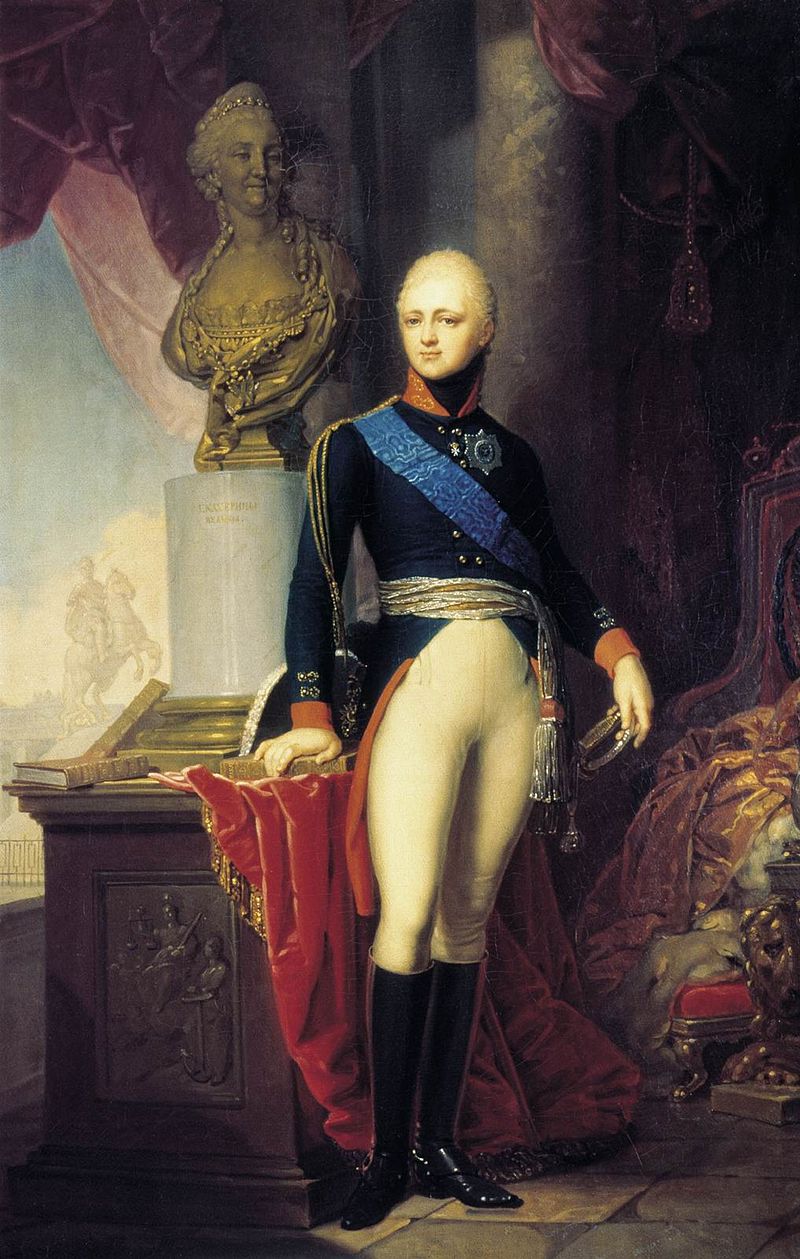
Portrait of Grand Duke Alexander Pavlovich, 1800, by Vladimir Borovikovsky. The 23-year-old Alexander became Emperor of Russia when his father was assassinated on March 23, 1801. Beethoven wrote Sonata for Piano and Violin no. 6, no. 7. and no. 8, Opus 30 for the new czar in 1801-02.

Beethoven, Sonata for Piano and Violin no. 6, no. 7. and no. 8, Opus 30, 1802, was written for the new czar of Russia.

In 1801, Beethoven was writing another symphony, his second, in D major—along with its derivative piano trio in D Major—for Prince Karl von Lichnowsky (1761-1814) at the Austrian Imperial Court. Beethoven also composed songs, concertos and bagatelles in this period for various other arts patrons. In those first years of the 1800’s, contemporaries described Beethoven, just turned 30 years old in mid-December 1800, as a small and inconspicuous person with an ugly face riddled with pockmarks. Carl Czerny (1791-1857), just a child in 1800 and a Beethoven music student, compared Beethoven to Robinson Crusoe, Daniel Defoe’s fictitious castaway. Beethoven, who proved a lifelong bachelor by choice so to dedicate himself to his music more fully, had an unruly mess of pitch-black hair and an overall neglectful personal appearance so much so that the great composer walking down the public street was sometimes mistaken for a vagrant. Yet in these first years of the nineteenth century, namely, in 1800, 1801, and 1802, Beethoven was literally working around the clock on his music for wealthy and powerful patrons and others and planning for greater accomplishments in the years ahead.

Beethoven, Symphony No. 2 in D major, Opus 36, was written for Prince Karl von Lichnowsky in 1801-1802.

SOURCES:

“Count Moritz Christian Johann von Fries.” British Museum. Accessed December 13, 2013. https://www.britishmuseum.org/collection/term/BIOG27972.

“Graf Moritz von Fries (1777-1826) mit seiner Familie – Gemälde von François Gérard, Fotografie der mit A.G. bezeichneten Reproduktion, um 1913.” Beethoven-Haus Bonn. Accessed December 13, 2013. https://www.beethoven.de/en/media/view/5699353847005184/Graf+Moritz+von+Fries+%281777-1826%29+mit+seiner+Familie+-+Fotografie+einer+mit+A.G.+bezeichnete+Reproduktion+eines+Gem%C3%A4ldes+von+Fran%C3%A7ois+G%C3%A9rard?fromArchive=4886601146564608.

Rolland, Romain. Beethoven the Creator. Garden City, NY: Garden City Publishing, 1937.

Watson, Peter. The German Genius: Europe’s Third Renaissance, the Second Scientific Revolution, and the Twentieth Century. New York: HarperCollins, 2010.