
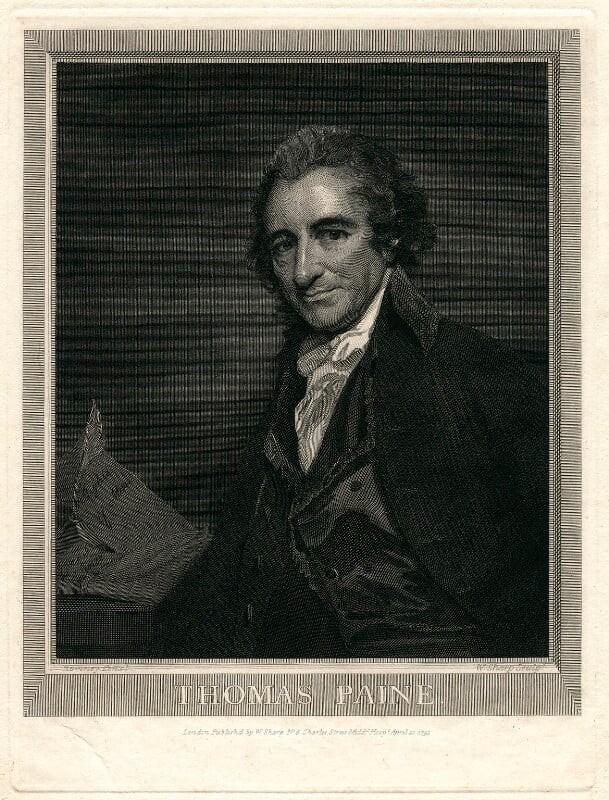
FEATURE Image: Thomas Paine, by engraver William Sharp (1749-1824), after portrait painter George Romney (1734-1802), 1793. NGA, London. Public Domain. See – https://www.npg.org.uk/collections/search/portrait/mw35502/Thomas-Paine?LinkID=mp03422&search=sas&sText=thomas+paine&role=sit&rNo=6 – retrieved June 1, 2024.
Thomas Paine’s writing served as a vital tool of psychological resilience and ideological conviction for the American Revolutionary cause during its absolute darkest hours. By juxtaposing the crushing military losses, near-total collapse of Washington’s army, and pervasive British contempt against the defiant, stirring language of The American Crisis, Paine’s prose transformed a desperate military retreat into an unyielding, spiritually justified struggle for freedom.

These are the times that try men’s souls. The American Crisis, 19 December 1776.
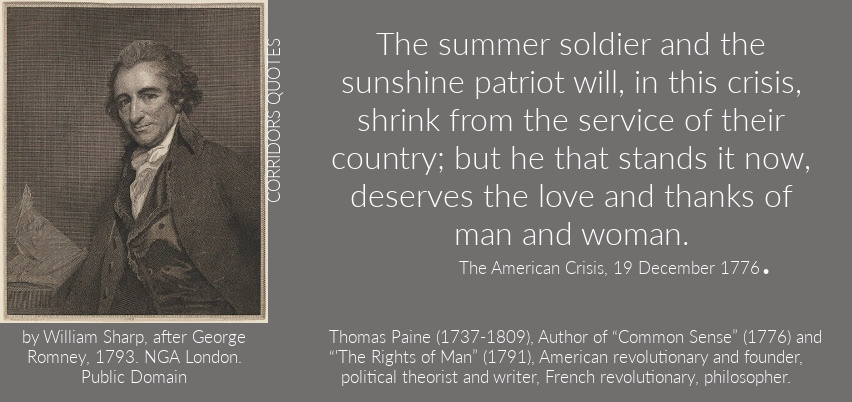
The summer soldier and the sunshine patriot will, in this crisis, shrink from the service of their country; but he that stands it now, deserves the love and thanks of man and woman. The American Crisis, 19 December 1776.
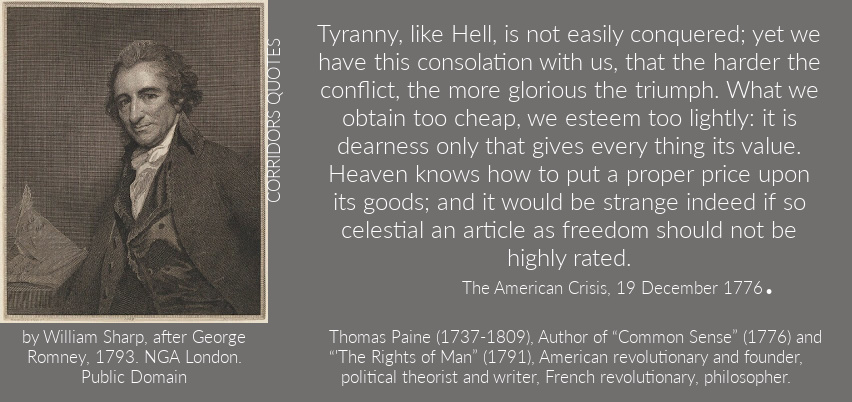
Tyranny, like Hell, is not easily conquered; yet we have this consolation with us, that the harder the conflict, the more glorious the triumph. What we obtain too cheap, we esteem too lightly: it is dearness only that gives every thing its value. Heaven knows how to put a proper price upon its goods; and it would be strange indeed if so celestial an article as freedom should not be highly rated. The American Crisis, 19 December 1776.
The Fall of Manhattan and the Jersey Chase
With the capture of Manhattan, British Army Commander in Chief William Howe sent Cornwallis to pursue Washington into New Jersey just sixty miles north of Philadelphia. Washington’s army was down almost 90% in December 1776 (3500 soldiers) from just August 1776. Washington just escaped Cornwallis’ grasp. As the British set up a line of forts to house and feed their soldiers during winter, Washington was the outsider.
British Confidence and the “Undisciplined Rabble”
The British believed the end of the revolution of what they called “despised” and “undisciplined rabble” which Virginia planter George Washington led (by way of the efforts of troublemaker Massachusetts lawyer John Adams), was in hand. Paine’s writing took that fragmented group and gave them a shared, elevated vocabulary of sacred duty (“celestial an article as freedom”), fundamentally expressing how they viewed their own struggle.
The Captive General and the Low Ebb of the War
The British entered into winter by taking prisoner Charles Lee, one of Washington’s senior generals in the Continental army, and locked him up as well as their own fleet in Newport, Rhode Island which they took without resistance. The British kept Lee’s horse perpetually drunk out of spite for the Americans. Before Washington’s important crossing of the Delaware River on Christmas night 1776 and surprised the mercenary Hessians, Washington’s first comeback victory, it was the lowest ebb of the war. Since July 1776, Howe had taken almost 5000 men as P.O.W.’s, including 4 generals, and hundreds of artillery pieces and many tens of thousands of rounds of Washington’s ammunition in the wake of winning battles. When Washington’s army had lost these men and material to General Howe, Paine’s prose provided the ideological “ammunition” that kept the rebellion alive.
Thomas Paine and the Times That Try Men’s Souls
It was then that 39-year-old Thomas Paine, serving in Washington’s army, wrote this propaganda tract (his Common Sense appeared earlier in January) that began with the famous line. “These are the times that try men’s souls: The summer soldier and the sunshine patriot will, in this crisis, shrink from the service of their country; but he that stands it now, deserves the love and thanks of man and woman. Tyranny, like Hell, is not easily conquered; yet we have this consolation with us, that the harder the conflict, the more glorious the triumph. What we obtain too cheap, we esteem too lightly: it is dearness only that gives every thing its value. Heaven knows how to put a proper price upon its goods; and it would be strange indeed if so celestial an article as freedom should not be highly rated.” This was Paine’s most explosive year. When he published Common Sense in January 1776, it fundamentally shifted public sentiment away from trying to reconcile with Britain and toward demanding total independence. He followed this in December 1776 with the first volume of The American Crisis, rallying a collapsing army.
A Sober Assessment from Washington
Washington wrote about the same events more soberly: “Our affairs are in a very bad way . . . the game is pretty near up—owing in a great measure to the insidious arts of the enemy.” Paine provided the psychological “engine” to reverse the momentum when the physical war was at its lowest ebb.
SOURCES: CHAPTER THREE. “The Peace Commissioners? THE HOWE BROTHERS,” The Men Who Lost America: British Leadership, the American Revolution, and the Fate of the Empire (The Lewis Walpole Series in Eighteenth-Century Culture and History), Andrew Jackson O’Shaughnessy, Yale University Press, 2013, p. 96.
The Sustained Campaign (1776–1783)
The American Crisis was not just a single essay; it was a series of 16 pamphlets published continuously throughout the entire span of the Revolutionary War. He wrote them in real-time as the conflict evolved, continuously boosting morale, clarifying the ideological stakes, and countering British peace overtures.
Paine officially closed the Crisis papers on April 19, 1783—exactly eight years to the day after the war began at Lexington and Concord—famously declaring, “The times that tried men’s souls are over—and the greatest and completest revolution the world ever knew, gloriously and happily accomplished.” Shortly after, in 1787, he left America to return to Europe, shifting his literary focus to the French Revolution.

Your failure is, I am persuaded, as certain as fate. America is above your reach….her independence neither rests upon your consent, nor can it be prevented by your arms. In short, you spend your substance in vain, and impoverish yourself without hope. To the People of England, The American Crisis: PHILADELPHIA, Nov. 21, 1778. see- https://www.ushistory.org/paine/crisis/c-07.htm – retrieved June 5, 2024.
The Shifting Tide: From Despair to Strategic Defiance
As the Continental Army endured, The American Crisis evolved into a masterclass in psychological warfare. Following the Battle of Brandywine in September 1777, Paine framed British territorial gains as a costly logistical trap that amounted to eventual defeats.
Turning the Tables on the Empire
By 1778, bolstered by a French alliance, Paine wrote as the intellectual superior of a fading global power. By 1780, he contrasted the comfortable lives of British soldiers in America with the burdens borne by ordinary American farmers and laborers.
The Glorious Accomplishment
In the spring of 1783, Paine concluded his final Crisis pamphlet celebrating the revolution’s success, famously declaring that the times that tried men’s souls were over and framing America’s birth as a triumph.


