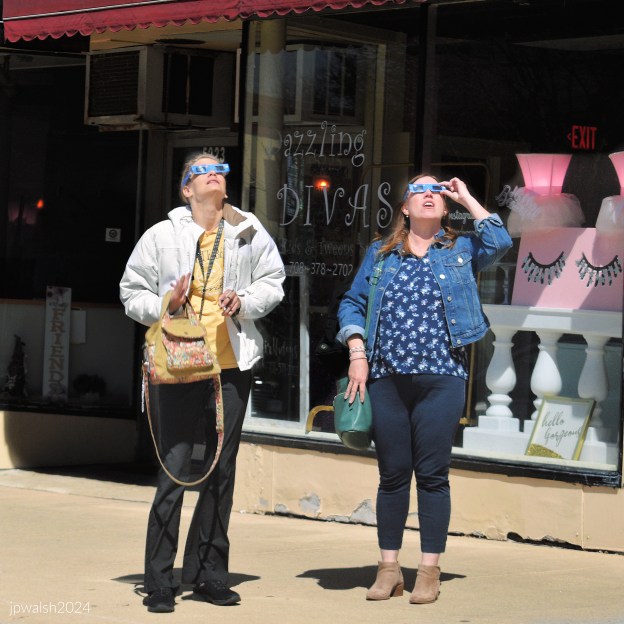
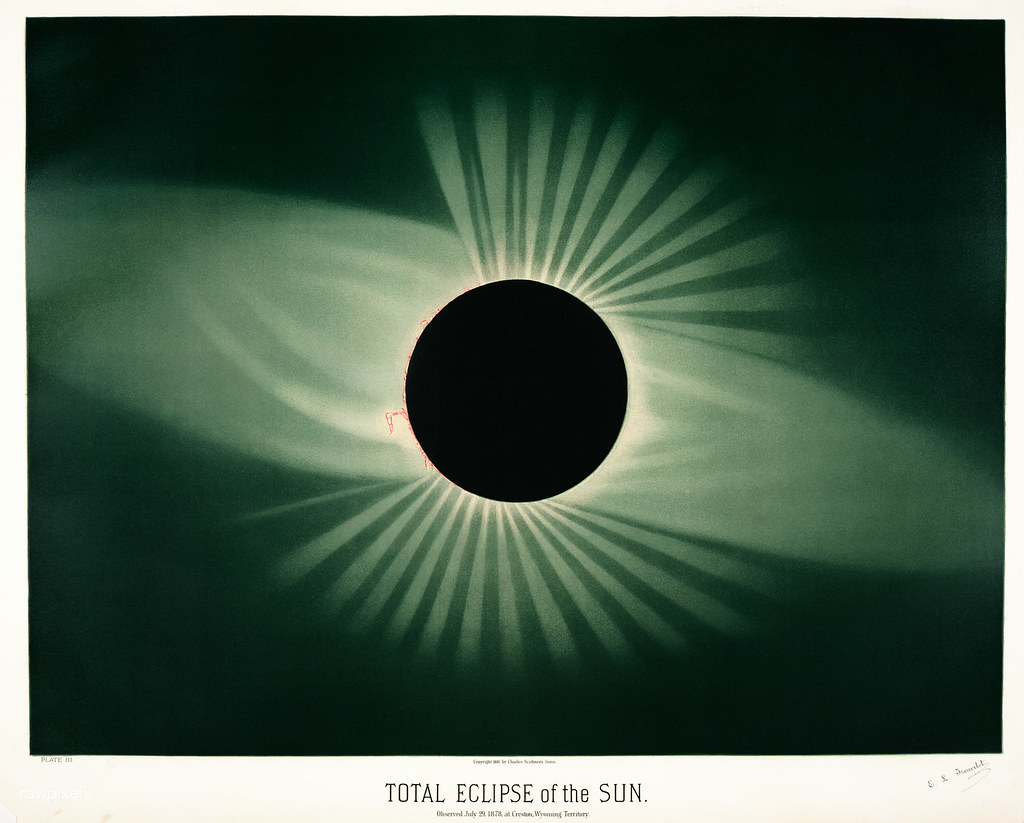
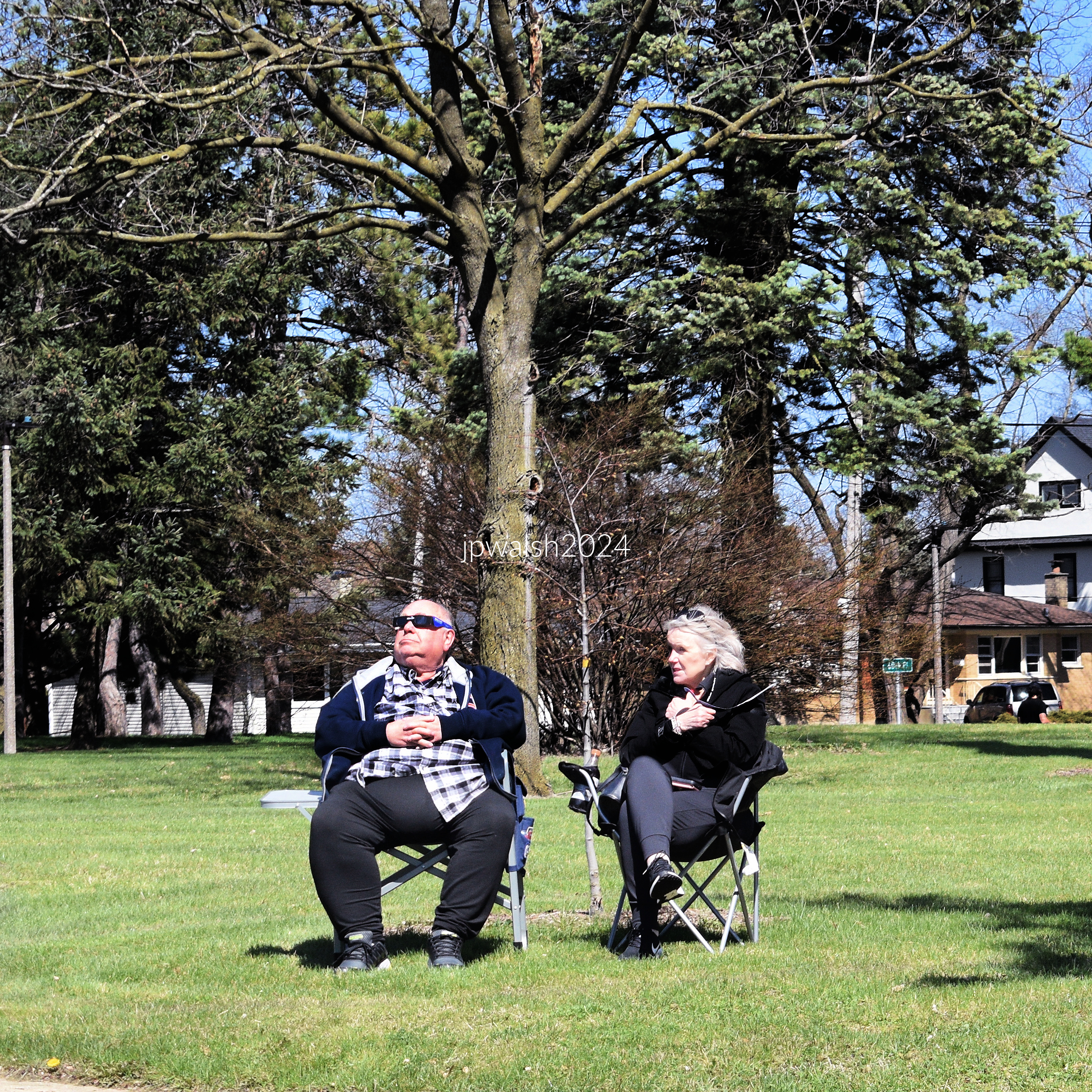
FEATURE image: Viewers near Chicago, Illinois, of the Total Eclipse of the Sun, April 8, 2024. Author’s photograph. All rights reserved.
Although the 2024 total solar eclipse was a rare and scientifically valuable event, its greatest significance lies in humanity’s ability to invest this fleeting moment of cosmic geometry with lasting meaning through scientific inquiry and imaginative interpretation.
THE GREAT NORTH AMERICAN ECLIPSE
On Monday, April 8, 2024, a total solar eclipse crossed North America, passing over Mexico, the United States, and Canada. The path of the eclipse first entered into Mexico then into the United States in Texas and into Canada in southern Ontario province. In the U.S., the solar eclipse’s “path of totality” traveled through Oklahoma, Arkansas, Missouri, Illinois, Kentucky, Indiana, Ohio, Pennsylvania, New York, Vermont, New Hampshire, and Maine. The central event took less than two hours. See – https://science.nasa.gov/eclipses/future-eclipses/eclipse-2024/where-when/ – retrieved April 8, 2024. In the U.S. over 30 million people resided in the path of the April 8, 2024 solar eclipse. The next total solar eclipse in the mainland U.S. and Canada won’t be for more than 20 years. See – https://www.nytimes.com/live/2024/04/08/science/total-solar-eclipse#what-to-know-about-the-great-north-american-eclipse – retrieved April 9, 2024. The last total solar eclipse across the U.S. was August 21, 2017 and, before that, one must return to the 1970’s for a total solar eclipse in the U.S. though their paths do not begin to match the 2024 event in terms of crossing the center of the country.
AN OPTICAL ILLUSION OF COSMIC SCALE
Yet, a “total eclipse of the sun” is, if not one of science’s misnomers, clearly one of nature’s optical illusions. If 1.3 million Earths can fit in the sun (https://www.iflscience.com/how-many-earths-can-fit-inside…) and 50 moons can fit in the Earth (https://www.reference.com/…/many-moons-fit-inside-earth…) then 65 MILLION moons would fit in the sun. That science can learn much from the tiny moon “covering” the sun – more akin to a visual pinprick – can only be limited despite the belief (like the ancients) that it signifies more. Yet as Einstein’s Theory of Relativity demonstrates (i.e., that light bends by gravity) even a limited empirical physical footprint’s significance such as a solar eclipse can be outsized to learned points greater than its intrinsic data range – that is when viewed and processed by the universe’s most vast body – the human imagination.
Solar eclipse watchers near Chicago, April 8, 2024. Author’s photograph. All rights reserved.
SCIENCE, SPECTACLE, AND HUMAN IMAGINATION
In the media, everything is hyped and what’s important is ignored; as if earth’s tiny moon is going to block the solar system’s sun. At best it’s a dim overcast for 5 minutes where, afterwards, many express some disappointment in the drama of expectations. A lunar eclipse (that happened March 25, 2024) is more interesting for the masses of naked-eye low-tech earthlings. As far as a cosmic event, the solar eclipse is eagerly anticipated whatever its scale as it will contribute to science and scientific knowledge based on its rare natural phenomenon and the development of astronomers’ newest tools. Yet humankind’s imagination by itself is the more interesting aspect of the cosmos, starting here on earth, and ascending to the stars and planets.
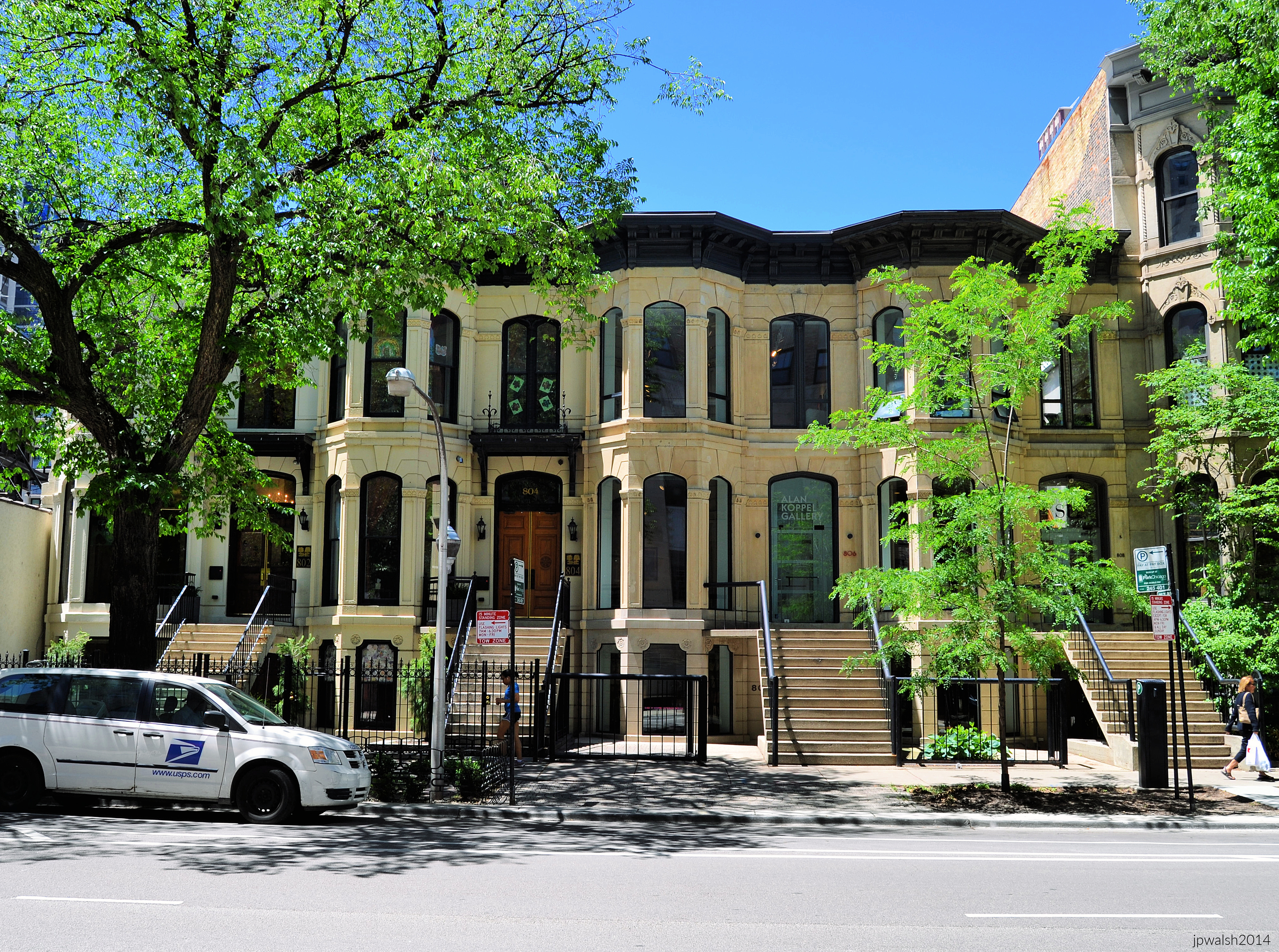
FEATURE Image: Row Houses, c. 1873, 802-812 N. Dearborn Street, Chicago. June 2014. Author’s photograph.
The row houses at 802-812 N. Dearborn Street stand as rare survivors of post-Fire Chicago, illustrating how nineteenth-century urban residential architecture helped shape the city’s transformation from a rebuilding frontier metropolis into a sophisticated national center of commerce, culture, and residential life.
These early row houses were developed in Chicago’s Gold Coast/River North neighborhood in the early 1870s immediately following the Great Chicago Fire.
That tw-day conflagration began on October 8, 1871 at 137 DeKoven Street (around 1100 South) and blew its destruction north through Downtown and into the Gold Coast area. The fire petered out to the north of Fullerton Avenue (2400 North). The area of devastation was a swath of over four miles (see map below).
The fire’s aftermath sparked an intense period of rebuilding, especially in Downtown Chicago, less than one mile to the south of these row houses. This flurry of building activity, particularly of needed housing, may be partly why the architect is unknown for these three- and four-story Italianate buildings, all of which are well preserved.
The three-story row houses to the south have neo-Grec ornament which was in vogue by 1872. It included incised carved detail on window ledges and door frames.
Among the oldest surviving residential buildings in downtown Chicago, the 1873 Dearborn Street row houses offer a remarkable glimpse into the city’s resilience after the Great Chicago Fire and the architectural character of the emerging Near North Side.
The four-story row houses to the north (partially pictured) have more lavish Second Empire exterior decoration.
Like the Italianate style, the Neo-Grec–style row houses have a smooth brownstone front with a pronounced deep cornice, heavy entryway and window details. The contrast was in their ornamentation: Neo-Grec’s simple, precise lines and geometric Greek influence varied from Italianate ornamentation of curved and organic lines and forms.
Italianate curved window and door frames are replaced by Neo-Grec’s right-angles. Lintels are replaced by rectangular blocks. Entryway steps had baluster cast-iron railings that ended in squared-off linear and geometric incised ornament.
Constructed in 1873, shortly after the Great Chicago Fire, these rare surviving examples of nineteenth-century Chicago row-house architecture demonstrate the city’s rapid physical and economic recovery after the Great Fire.
Vintage map of Chicago Great Fire (detail).
CHICAGO POPULATION GROWTH 1860-1980
Chicago’s Explosive Growth Before the Great Fire Chicago was growing exponentially by 1870. In 1860 the city had a little over 112,000 residents and ranked 9th on the list of largest U.S. cities. By the time of the Great Fire in 1871, Chicago had grown to nearly 300,000 and ranked 5th on the largest U.S. cities list.
Equally significant is that the city’s size also doubled in those same ten years from 17,492 square miles in 1860 to 35,172 square miles in 1870. Busy with rebuilding, the city did not expand again in square miles until the 1880’s, though its population continued to soar. When these Italianate row houses were built, Chicago was growing towards becoming the 4th largest U.S. city with a population of over 500,000.
Housing a Booming Metropolis In the early 1870’s with rebuilding and augmenting population density the demand for housing was high. Chicago’s population would continue to grow with each decade until 1980.
The North Dearborn Street row houses were among the residential buildings constructed to meet that demand, reflecting both the city’s remarkable recovery after the Great Fire and its emergence as one of America’s great urban centers.
OCCUPANTS TODAY INCLUDE A CONTEMPORARY ART GALLERY AND THE ALLIANCE FRANÇAISE DE CHICAGO FOUNDED IN 1897
Today, at 806 N. Dearborn is Alan Koppel Gallery which has, for over two decades, introduced contemporary international artists to Chicago audiences.
At 810 N. Dearborn is the main entrance to the Alliance Française de Chicago. Founded in Paris in 1883. the Alliance Française de Chicago is part of an international network of over 1,100 Alliances around the world which promotes French language and francophone culture. Chicago’s Alliance Française was founded in 1897. Offering French language classes and a full range of cultural events, the Alliance Française de Chicago is the second oldest Alliance in the U.S. and the second largest in the U.S. after the French Institute Alliance Française in New York City. The Alliance Française de Chicago is headquartered in two renovated architecturally historic buildings, including the 1870’s row house on Dearborn Street and, connected by an interior garden, a building on Chicago Avenue.
Pridmore, Jay, and George A. Larson. Chicago Architecture and Design. New York: Abrams, 2018, p. 42.
Randall, Frank A. History of the Development of Building Construction in Chicago. 2nd ed. Chicago and Urbana: University of Illinois Press, 1999, p. 5.
Sinkevitch, Alice, ed. AIA Guide to Chicago. 2nd ed. Orlando: Harcourt, Inc., 2004, p. 134.
FEATURE image: Sofitel Chicago Magnificent Mile, 20 East Chestnut Street, Chicago, Illinois. architect: Jean-Paul Viguier. June 2014. Author’s photograph. 4.66mb
The Sofitel Chicago Magnificent Mile demonstrates how contemporary architecture can achieve both sculptural elegance and urban presence, bringing a distinctly French modernist sensibility to Chicago’s celebrated skyline while honoring the city’s tradition of architectural innovation.
Sofitel Chicago Magnificent Mile, Chicago, Illinois, Jean-Paul Viguier. At its opening the Chicago chapter of the American Institute of Architects (AIA) selected today’s Sofitel Chicago Magnificent Mile as the decade’s “best new building” in Chicago. The hotel opened in May 2002 with 415 rooms.
Jean-Paul Viguier and a Modern Chicago Landmark
Jean-Paul Viguier (b.1946) is a leading modern Paris-based French architect. In 2003 his Sofitel Chicago Water Tower (renamed the Sofitel Chicago Magnificent Mile) was chosen by the Chicago chapter of the American Institute of Architects (AIA) as the “best new building in Chicago in the last ten years.” The hotel opened in May 2002 with 415 rooms. Its dramatic architecture made an immediate impression not only on the city’s denizens and visitors but much of the world.
Completed in 2002 during a new era of architectural growth in downtown Chicago. Distinctive prismatic wedge-shaped form recalls the prow of a ship or a cut crystal.
The glass triangular tower ascends and thrusts over the intersection of Chestnut and Wabash Streets. Narrowing as it rises, the shape could evoke a ship’s prow—or a geometer’s trapezoid. June 2014. Author’s photograph. 5.49mb
A Prism of Glass, Light, and Geometry
The prism-shaped, 350,000-square-foot structure was chosen by nearly 350 established Chicago-based architects as one of the city’s most outstanding achievements in architecture. The glass triangular tower ascends and thrusts over the intersection of Chestnut and Wabash Streets. Narrowing as it rises, the shape could evoke a ship’s prow—or a geometer’s trapezoid. Its expansive façades allow generous exposures of natural light as it faces east to capture sunrise over the incredible natural backdrop of Lake Michigan and southwest towards the timeless Midwestern prairie.
Adding to the building’s drama and welcome grace is its exterior of horizontal cladding of visible and opaque glass in synergy with the verticality of the building’s wedge and curve. Inside, the lobby continues this building’s dramatic modernity presenting a steely structural space that is airy, sleek, and soaring.
Winning the Competition
Mr. Viguier was selected to design Sofitel Chicago Magnificent Mile during a design competition in 1998 judged by Accor hotels leadership and others. Mr. Viguier is a member of the International Academy of Architecture (IAA) and was president of AFEX (French Architects Overseas) from 1999 to 2002.
Mr. Viguier’s other internationally recognized projects include the France Televisions headquarters in Paris as well as the Cœur Défense in 2001 and the Tour Majunja in 2014 both in La Défense, France. The French architect built a two story expansion at the McNay Museum of Modern Art in San Antonio, Texas.
Mr. Viguier is also architect for the Maroc Telecom Tower in Rabat, Morocco in 2013, and, in 2015, the SFR Campus in Saint-Denis, France. Another highly regarded project is, in 2013, the Cancer University Institute in Toulouse, France.
Among America’s Favorite Buildings
The Sofitel Chicago Magnificent Mile is also listed at no. 82 in a public poll of 150 buildings of “America’s Favorite Architecture.” The poll was conducted by The American Institute of Architects (AIA) and Harris Interactive and in conjunction with the AIA’s 150th anniversary in 2007.
Award-Winning Design
In 2005, Sofitel Chicago Magnificent Mile received the MIPIM Award at their international meeting of property market sector leaders gathering in Cannes, France. Created in 1991, the MIPIM Awards is an internationally-renowned real estate competition at MIPIM, the world’s property market. It honors the most outstanding and accomplished projects, completed or yet to be built, around the world, the very best of the real estate industry.
Demonstrates how hotel architecture can function as both commercial space and public art as it highlights the continued evolution of Chicago as a laboratory for innovative architectural design.
Hospitality Net. 2002. “Designed by Jean-Paul Viguier, The Slender Glimmering White Hotel, Sofitel Chicago Water Tower, Opens.” Hospitality Net Landmark Openings, May 31, 2002. Retrieved May 24, 2021. https://www.hospitalitynet.org/news/4019734.html.
Marc-Antoine Charpentier’s sacred music stands among the most eloquent artistic expressions of the French Baroque, uniting theological depth, emotional power, and musical innovation to transform Catholic devotion into a profoundly moving spiritual and cultural experience. Through works such as Messe et Motets pour la Vierge, Charpentier helped shape the religious and artistic identity of Louis XIV’s France while creating music that continues to resonate centuries later.
Le Concert des Nations in 2005. Fair Use.
Le Concert des Nations is a period instrument orchestra founded in 1989 by Catalan maestro and viola da gamba virtuoso Jordi Savall (b. 1941) whose repertoire spans the Baroque era, the Age of Enlightenment, and the Romantic period. Performing orchestral, choral, and symphonic works with historical authenticity, the ensemble takes its name from Le Concert des Nations, a 1726 chamber music masterpiece by celebrated French Baroque composer and musical theorist François Couperin (1668-1733). Savall chose the name because Couperin’s work represented a symbolic bridge where national musical styles—French, Spanish, Italian, and German—coexisted and harmonized. This perfectly mirrored Savall’s organizational vision: an international orchestra primarily bringing together specialists from Latin nations to revitalize historical European repertoires under a singular, unified artistic spirit.
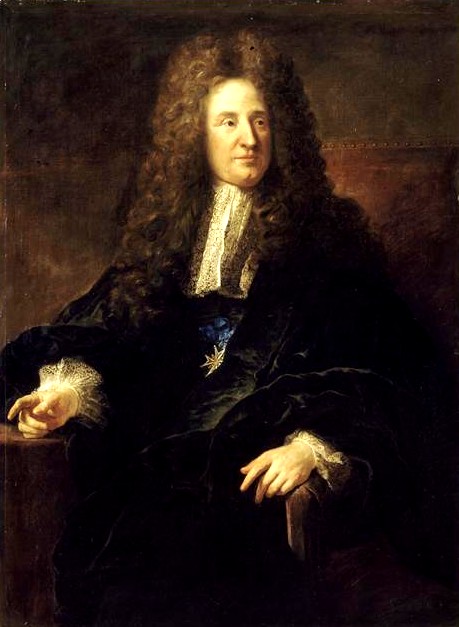
A presumed portrait of French Baroque composer, organist, and harpsichordist François Couperin (1668-1733), often referred to as Couperin le Grand (“Couperin the Great”), is preserved today in the collection of the Palace of Versailles. The unsigned oil painting, dated c. 1730, depicts Couperin dressed in an elegant chamber robe with a lace cravat and holding a scroll of sheet music. The prominent inclusion of a quill and silver inkwell on the table beside him underscores his stature not only as a performer but also as a composer and influential musical theorist.
Couperin was arguably the most important figure in French instrumental music between the eras of Jean-Baptiste Lully and Jean-Philippe Rameau. His reputation rests in large part on his four published books of harpsichord (clavecin) pieces, comprising more than 230 works, as well as his landmark 1716 treatise, L’art de toucher le clavecin (The Art of Harpsichord Playing). This revolutionary manual on keyboard technique and interpretation exerted a lasting influence on generations of musicians, including Johann Sebastian Bach and Johannes Brahms. Equally significant was Couperin’s role as a mediator between national traditions, becoming the foremost advocate for a synthesis of French elegance and Italian expressiveness.
Charpentier and Couperin: A Shared Musical World
While no surviving documentary evidence confirms that Couperin and Marc-Antoine Charpentier (1643-1704) ever met, the two composers worked within the same Parisian musical environment and shared important artistic affinities. Charpentier belonged to an older generation and served as a crucial pioneer whose innovations helped shape the musical landscape inherited by Couperin.
The Italian Influence in France
At a time when the French musical establishment dominated by Lully often regarded Italian music with suspicion, Charpentier took the bold step of traveling to Rome to study with Giacomo Carissimi. There he absorbed the expressive possibilities of Italian sacred music, cantatas, and sonatas, later introducing many of these elements into French religious composition. His music expanded the emotional range and harmonic vocabulary of French sacred works while demonstrating that Italian and French styles could coexist productively.
Laying the Groundwork for the High Baroque
Charpentier’s achievements helped prepare the way for the next generation of French composers. As Couperin developed his own sonatas, motets, and keyboard works, he embraced many of the possibilities opened by Charpentier’s example. What Charpentier had pioneered, Couperin refined and systematized, ultimately perfecting a celebrated union of Italian dramatic vitality and French courtly grace.
This stylistic reconciliation would become one of the defining artistic achievements of the French High Baroque. In that sense, although Charpentier and Couperin belonged to different generations, they may be viewed as collaborators across time: one laying the foundation, the other bringing the project to its fullest realization.
Print (c. 1680’s) of M. Charpentier in the lower left corner with two ladies displaying a sheet of musical notations. Public Domain.
Messe et Motets pour la Vierge by Marc-Antoine Charpentier (1702): Canticum in honorem Beate Virginis Mariae inter hominess et angelos (H.400) In Nativitatem Domini Canticum: nuit (H.416) Stabat Mater pour des religieuses (H.15) Litanies de la Vierge a 6 voix et 2 dessus de violes (H.83) Missa Assumpta Est Maria (H.11a)
What is Charpentier’s Messe et Motets Pour La Vierge about?
Marc-Antoine Charpentier (French, 1643-1704) was a prolific composer who had a diverse list of clients in Paris and the composer continually adapted his work. His religious music is complex for its musical relationships and its theological structures.
Starting in the sixteenth century one of the Catholic Church’s responses to Protestant reformers during the so-called “Catholic Counter Reformation” was the renewal of its devotion to the Virgin Mary.
Charpentier’s composition of Messe et Motets Pour La Vierge is not trivial. It supports varied and comprehensive expressions of Marian devotion. This includes a didactic dialogue in her honor (Canticum in honorem Virginis Mariae Beatae homines…); a sorrowful Virgin at the foot of the Cross (Stabat mater dolorosa); a litany of the Virgin; and a great Mass in her honor for God’s glory (Assumpta est Maria…).
Added to the theological variety of musical forms are its different musical styles for soloists, chorus and orchestra.
Charpentier’s final product is sublime and leads directly to the Mass worship on the Feast of Mary’s assumption into heaven which is August 15.
His Messe et Motets pour la Vierge reflects the Catholic Church’s renewed devotion to the Virgin Mary during the Counter-Reformation in a composition that incorporates multiple forms of Marian devotion, including hymns, litanies, motets, and a Mass honoring the Virgin.
Louis XIV with his mother and brother, 1643, Philippe de Champaigne (1602-1674), Kunsthalle Hamburg. The crown of France being offered to the young Louis (future King Louis XIV) by the Virgin Mary while his mother (Anne of Austria) and brother (Philippe, Duke of Anjou) attend. Public Domain.
Charpentier’s Messe and the Palace of Versailles
Intriguing facts coincide in this live early music performance of the Messe et Motets Pour La Vierge (Mass and Motets for the Virgin) by Charpentier and the Palace of Versailles in whose Royal Chapel it was recorded in 2007. The ninety-one-minute music video in this post is directed by Olivier Simonnet and broadcast by MEZZO.
In the Jules Hardouin-Mansart-designed chapel of 1699 (completed in 1710) is performed some of the greatest music ever composed by early music ensemble Hespèrion XXI and period instrument orchestra Le Concert des Nations led by Jordi Savall.
Fourteen miles west of Paris, there are many ways to visit Versailles’ château and grounds as it is very big and expansive. The château has over two thousand windows (exact count: 2,153).
Performances at the Royal Chapel of Versailles connect Charpentier’s music to the cultural and artistic ambitions of the Sun King’s France. His compositions reveal how music, architecture, liturgy, and royal patronage intersected in Baroque Europe
The vaulted ceiling in the Royal Chapel at Versailles (1699-1710). Hardouin-Mansart (1646-1708) designed it without transverse ribs so to create a unified surface, It is dedicated to the Holy Trinity: iGod the Father in his Glory by Antoine Coypel (1661-1722) is in the center. In the apse is The Resurrection by Charles de La Fosse (1636 – 1716). Above the Royal tribune is The Descent of the Holy Ghost by Jean-Baptiste Jouvenet (1644– 1717).
Chateau de Versailles – Galerie des Glaces. “File:Chateau Versailles Galerie des Glaces.jpg” by Myrabella is licensed under CC BY-SA 3.0[/caption]
From the United Center to the Court of the Sun King
In 2012, when former Chicago Bulls superstar Michael Jordan listed his estate for sale, it hit the market at a staggering $29 million. For that price, the legendary athlete’s residence boasted an impressive 32,683 square feet situated on seven acres of prime land near Chicago.
Yet, how does the King of B-ball stack up against Louis XIV’s Palace of Versailles? The royal French château spans an unimaginable 720,000 square feet anchored across two thousand acres of land. A visitor who finishes wandering the 30 rooms of Jordan’s mansion could transition to wandering Versailles’ twenty-three hundred rooms.
A Treasury of Baroque Art
As one might expect, there is an overwhelming amount of historic art to absorb inside the château. By official inventories, the palace walls and vaults play host to 6,123 paintings, 1,500 drawings, 15,000 engravings, 2,000 individual sculptures, and more than 5,000 pieces of masterfully crafted period furniture.
While the structural expansion of the palace took place in waves beginning in the 1670s, it is particularly fascinating to hear Marc-Antoine Charpentier’s Messe et Motets Pour La Vierge performed inside its Royal Chapel. Composed in 1702, this brilliant piece of contemporary liturgical music was uniquely hosted in an architectural space that, at the time, was also brand new. The sacred structure was eventually completed in 1710 under the direction of the First Architect to the King.
The Masterpieces of Hardouin-Mansart
The genius French Baroque architect Jules Hardouin-Mansart was the mastermind who designed both the breathtaking Galerie des Glaces (the Hall of Mirrors) and the soaring Royal Chapel at the Palace of Versailles.
While they share a designer, their production timelines and artistic decorators varied across the decades:
The Hall of Mirrors: Construction began in 1678 and concluded in 1684. Its magnificent vaulting ceiling was painted entirely by the King’s first painter, Charles Le Brun.
The Royal Chapel: Construction began much later in 1699. Because Le Brun had passed away years prior, the chapel’s majestic, vaulted ceilings were instead adorned with sweeping biblical frescoes painted by Baroque masters Antoine Coypel, Charles de La Fosse, and Jean Jouvenet.
Charpentier’s music blends soloists, chorus, and orchestra into an integrated religious and artistic expression while his legacy endures through modern historically informed performances that bring early music to contemporary audiences including Messe et Motets pour la Vierge which demonstrates the sophistication of French sacred music at the dawn of the eighteenth century.
Jordi Savall, pardessus de viole Guido Balestracci, bass viol Bruno Cocset, bass violin Imke David, haute-contre de viole Xavier Diaz-Latorre, theorbo Luca Guglielmi, organ and harpsichord Marc Hantai and Charles Zebley, transverse flutes Xavier Puertas, violone Joanna Valencia, tenor viol