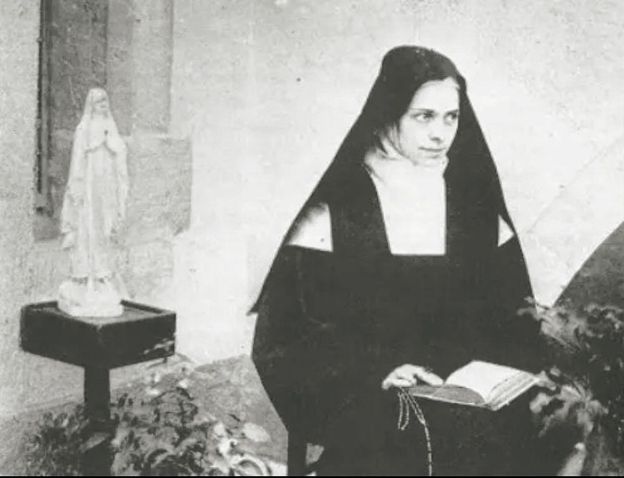
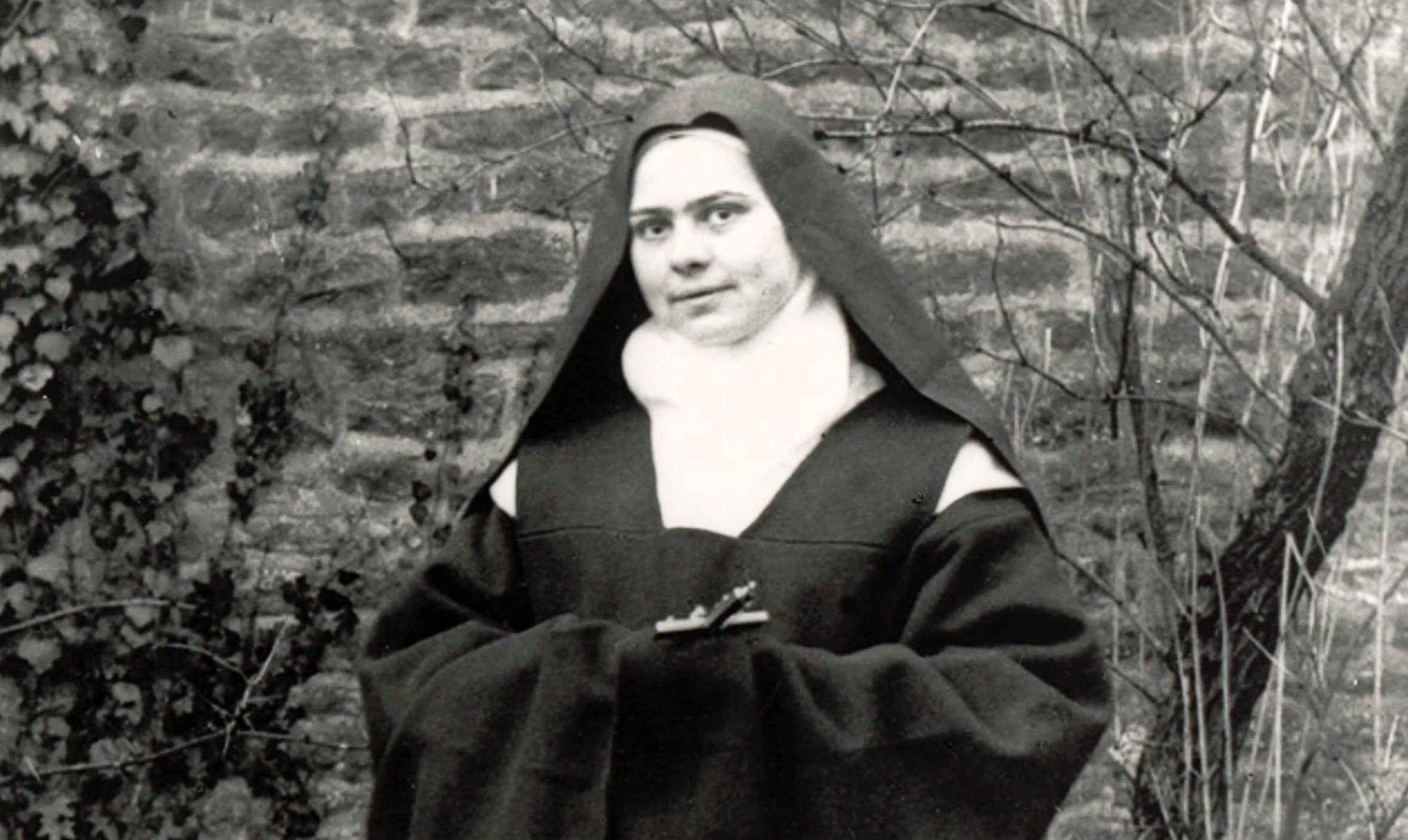
FEATURE Image: Saint Elizabeth of the Trinity (born Élisabeth Catez), a French Discalced Carmelite nun, in a photograph taken in October 1906, just a few weeks before her death at the age of 26. The statue on the table is in the style of Our Lady of Lourdes, shown standing in prayer. Public Domain.
St. Elizabeth of the Trinity’s brief but influential life demonstrates how suffering, personal loss, contemplative prayer, and unwavering devotion to the Holy Trinity transformed an ordinary young French woman into one of the Church’s great modern mystics, whose writings continue to guide souls toward deeper union with God.
By John P. Walsh.
Early Life and Family Tragedy
St. Elizabeth of the Trinity (1880-1906) actually has two different feast days depending on the liturgical calendar used. Born Élisabeth Catez in 1880 at a military camp near Bourges, France, she was the first child of Captain Joseph Catez and Marie Rolland, and was baptized in the camp’s small chapel. Much like her slightly older contemporary, St. Thérèse of Lisieux, Elizabeth suffered the devastating loss of a parent at a young age; her father died suddenly when she was only seven years old. Because Captain Catez was a devout Catholic, his passing collided directly with the fierce anti-Catholic, secularist political movement gripping France at the time. Actively working to scrub all religious influence from public life, state authorities heavily restricted the Catholic military honors and public funeral processions typically granted to officers. Elizabeth witnessed this political alienation firsthand as her grieving family was abruptly thrust out of their secure military housing into immediate financial strain.
The three western entrance portals of St Michel in Dijon. The western façade of Saint-Michel in Dijon is a masterpiece of the French Renaissance, carved in stone over a Gothic structure. It was through these exact heavy wooden doors, beneath the carving of Saint Michael fighting the dragon, that seven-year-old Elizabeth walked in 1887 to make her first confession and later communion and resolved to conquer her own explosive temper.The three portals depict a complete theological narrative centered on Creation and the Fall of Man (north portal), the Incarnation (south portal), and the Last Judgment and St Michael (central portal), with an emphasis on angelic warfare. Elizabeth was highly conscious of her fiery nature, famously writing in her childhood diaries about the “war” she had to wage against her own violent temper. Walking under the central portal of Saint-Michel—where the Archangel Michael is carved aggressively crushing the dragon—provided her with a powerful, real-world visual metaphor for her own internal struggles. She did not view her spiritual life as a passive, soft devotion; instead, her early journals reflect a gritty, warlike determination. She explicitly resolved after her first confession to “conquer” her anger and treat her soul as a battlefield where grace had to systematically defeat her volatile impulses, mimicking the very triumph of Saint Michael she passed beneath each day for Mass. She would later shift her language from this “warlike combat” of her childhood to the profound, quiet interior silence found in her famous mature prayer, “Holy Trinity, Whom I Adore.” PHOTO: “Dijon – Église Saint-Michel – Portails occidentaux” by Benjamin Smith, licensed under CC BY-SA 4.0 (Wikimedia Commons).
A Childhood of Upheaval and Conversion
This sudden family upheaval triggered in seven-year-old Elizabeth a fearful, explosive anger. The family subsequently relocated to a modest apartment in Dijon. It was there, after making her first confession in late 1887 and First Communion at Saint-Michel on April 19, 1891, to which she always looked back as the true moment of her spiritual “conversion” where she resolved to conquer her fiery, explosive temper. On June 8, 1891, Elizabeth received her Confirmation at the Church of Notre-Dame. Though she remained inherently passionate and intense like her mother, she began exercising rigorous, grace-filled self-control over her volatile temper. Playing the piano became both an artistic expression of her musical talents—winning first prize at the local conservatory—and served as a healthy emotional outlet for her deep passions.
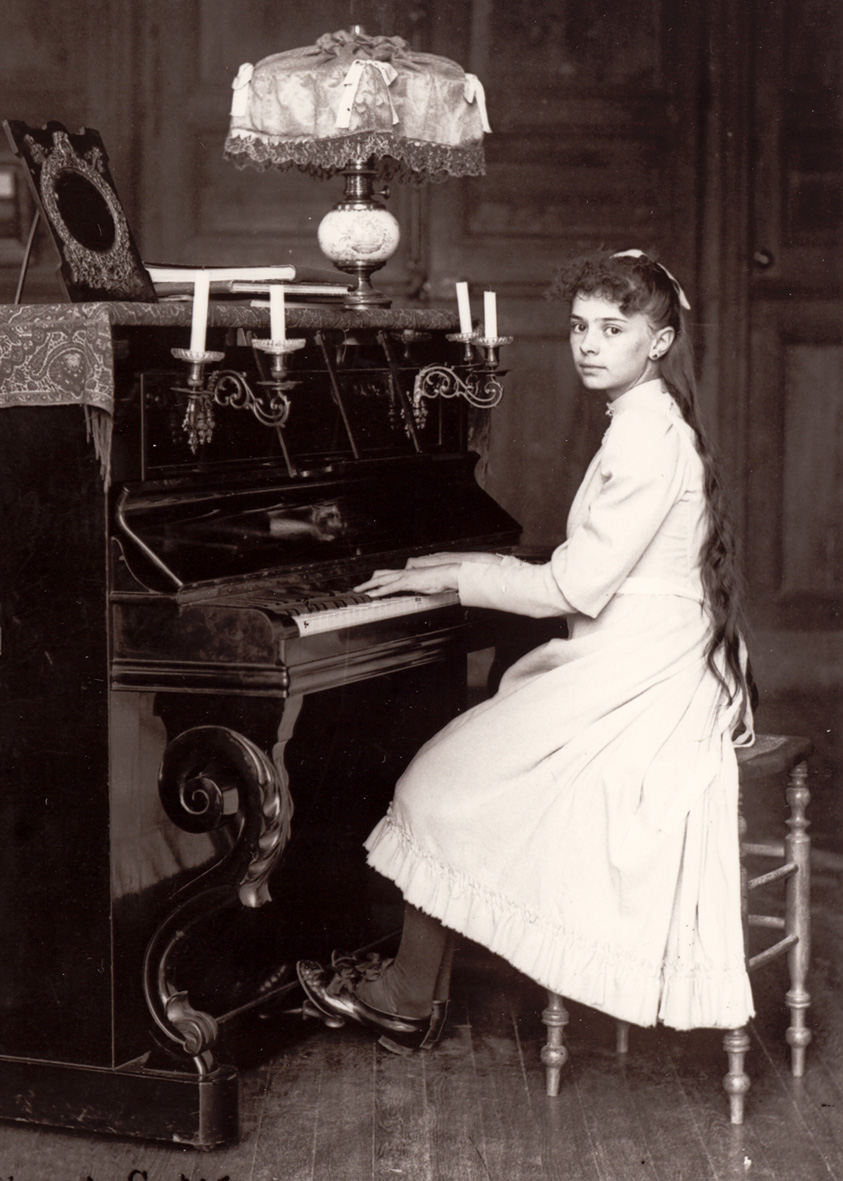
Saint Elisabeth of the Trinity as a young child playing the piano. Public Domain.
The western façade of the High Gothic Notre-Dame of Dijon where St. Elizabeth of the Trinity made her Confirmation on June 8, 1892. Begun in the early 13th century, the parish church was within a rising quarter of local merchants and craftsmen and is famed for its rows of sculpted gargoyles. Author’s photograph. March 1992.
A Soul Drawn to the Trinity
At an early age, she received a profound, infused understanding of the Trinity. This insight did not come primarily through academic study, spiritual conferences, or formal theological instruction, but through a deeply personal dialogue with God Himself, which sparked an ardent, lifelong devotion to the Holy Trinity. As a young laywoman, Elizabeth visited the sick, sang in her parish choir, and taught religion to impoverished children working in local factories to help support their families. It was a period of social transition in which child labor reforms, though motivated by compassion, sometimes left struggling families facing even greater economic hardship.
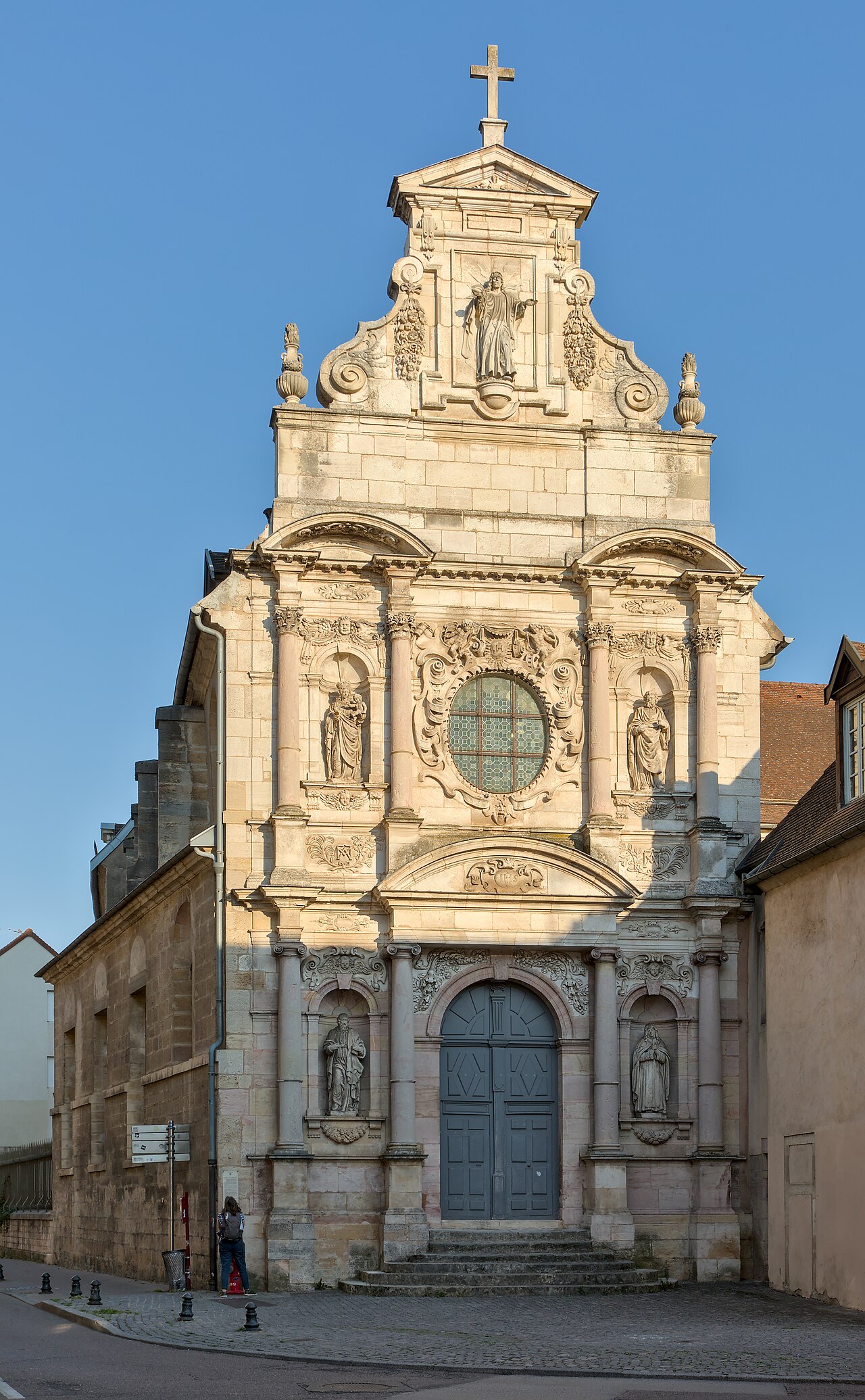
Originally, the third Carmelite convent in France was founded in Dijon in 1605 on Rue Victor Dumay. The nuns were expelled during the French Revolution, and today only the highly ornate, richly sculpted Baroque stone façade of the Chapelle des Carmélites de Dijon survives as a protected historic monument. When the Carmelite presence was reestablished in Dijon during the nineteenth century, a new monastery was constructed at what became 4 Boulevard Carnot, then known as Boulevard de la Préfecture. Situated at the intersection of Boulevard Carnot and the Place du 30-Octobre, this convent stood in the very heart of the city, only a short two-minute walk from Elizabeth’s childhood apartment and her home parish of Saint-Michel.
It was this new monastery that St. Elizabeth entered on August 2, 1901. Although the nineteenth-century buildings in which she lived have since been demolished, the site remains in downtown Dijon. The Carmelite community eventually relocated to its present, more secluded monastery in nearby Flavignerot in 1979.
Following her death from Addison’s disease at the age of twenty-six, Elizabeth was buried on November 12, 1906, in the Carmelite section of Dijon’s Cimetière des Péjoces. In accordance with both Church and civic custom, she was laid to rest alongside her deceased religious sisters in the communal cemetery rather than within a church. During the formal investigation of her cause for beatification in 1931, her remains were exhumed and transferred to a private crypt within the chapel of her own monastery at 4 Boulevard Carnot.
When the Carmelites departed the city center for Flavignerot in 1979 and sold the Boulevard Carnot property, Elizabeth’s relics were moved once more. This final translation brought her back to the parish that had shaped so much of her spiritual life: Saint-Michel Church in Dijon, where her sacred remains rest permanently today.
PHOTO: “Dijon – Chapelle des Carmélites” by Benjamin Smith, licensed under CC BY-SA 4.0 (Wikimedia Commons).
The Call to Carmel
Drawn to an intense life of prayer, Elizabeth felt a strong call to the strict cloister of the Discalced Carmelite Order. Her mother adamantly opposed the vocation, urging Elizabeth to accept one of her many marriage proposals so she could secure a wealthy, comfortable lifestyle. Elizabeth declined them all, determined to praise God in the monastery located just a short distance from her home in Dijon. The close proximity to the monastery on Boulevard Carnot (formerly known as Boulevard de la Préfecture) in the heart of Dijon. is why Elisabeth wrote that she could constantly hear the Carmelite monastery bells ringing throughout her childhood days. She finally entered the Dijon Carmel on August 2, 1901, famously writing of her ordinary duties: “I find Him everywhere, while doing the wash as well as while praying.”
Saint Elizabeth of the Trinity wearing her Carmelite habit was taken circa 1902–1904 at the Carmel of Dijon in France. It is frequently dated to December 1902, captured shortly before she made her final religious profession. Public Domain.
Mystic of the Interior Life
Her life behind the convent walls was a mixture of profound mystical highs and painful, dark interior trials. Throughout these valleys, she wrote extensively about her need for an even richer immersion into God’s infinite love. Toward the end of her short life, she took on the spiritual mantle of “Laudem Gloriae” (Praise of Glory), anticipating her eternal role in Heaven. Through her diary, poetry, and vast correspondence with family and friends, she outlined her heavenly mission: “I think that in Heaven my mission will be to draw souls by helping them to go out of themselves in order to cling to God by a wholly simple and loving movement, and to keep them in this great silence which will allow God to communicate Himself to them and to transform them into Himself”—a beautiful description of the mystical process of theosis, or divinization.
Final Suffering and Holy Death: To Light, to Love, to Life!
Elizabeth died in the monastery at the age of twenty-six from Addison’s disease, which was incurable at the time. Her death was agonizingly painful, marked by violent nausea, high fevers, and sleepless days and nights. Yet, she gratefully accepted her three years of escalating physical suffering as a sacrificial gift from God. Anchored in a profound intimacy with the indwelling Trinity, her legendary final words were: “I am going to Light, to Love, to Life!”
Why Two Feast Days?
Though she passed away on November 8, 1906, the Universal Church assigns November 9 as her official feast day. Because November 9 is also the major universal feast of the Dedication of the Lateran Basilica (the Pope’s cathedral in Rome), the Carmelite Order celebrates her memorial on November 8. This clever calendar shift effectively “cleared the path,” ensuring their beloved mystic would receive an unhindered, solemn celebration within her own religious family.
Path to Canonization
The formal path to her saintly recognition began in Dijon in 1931, where church authorities meticulously collected and examined her life, death, and writings. Pope John XXIII officially introduced her cause in October 1961, declaring her a Servant of God. Following an extensive review of her heroic virtues, she was declared Venerable in 1982. After the validation of a medical miracle, Pope John Paul II beatified her in Paris in November 1984 during his historic apostolic visit to France. In March 2016, following the approval of a second miracle, Pope Francis cleared her way for formal sainthood, canonizing her later that year, on October 16, 2016.
Legacy and Patronage
Today, St. Elizabeth of the Trinity—whose most famous contemplative prayer is titled “Holy Trinity, Whom I Adore”—is widely venerated as the patron saint of sick people, those battling chronic illness, and individuals mourning the loss of a parent.
The famous prayer “Holy Trinity, Whom I Adore” (Ô mon Dieu, Trinité que j’adore) was written by St. Elizabeth of the Trinity (Élisabeth Catez) on November 21, 1904, inside her cell at the Discalced Carmelite Monastery in Dijon, France.
Elizabeth wrote this down on a loose sheet of paper during her convent’s annual retreat. It was never intended for publication; it was a completely raw, private act of interior praise. Her prioress only discovered the written prayer among Elizabeth’s personal papers after her death in 1906.
The prayer serves as the ultimate summary of her deep, mystical theology of theosis—the total emptying of oneself (“let me entirely forget myself”) so that the indwelling Trinity can fully possess, consume, and transform the soul into a living reflection of Christ.
St. Elizabeth of the Trinity left behind influential letters, poetry, retreats, and prayers, especially “Holy Trinity, Whom I Adore.”
O my God, Trinity whom I adore, let me entirely forget myself that I may abide in you, still and peaceful as if my soul were already in eternity; let nothing disturb my peace nor separate me from you, O my unchanging God, but that each moment may take me further into the depths of your mystery! Pacify my soul! Make it your heaven, your beloved home, and the place of your repose; let me never leave you there alone, but may I be ever attentive, ever alert in my faith, ever adoring and all given up to your creative action.
O my beloved Christ, crucified for love, would that I might be for you a spouse of your heart! I would anoint you with glory, I would love you — even unto death! Yet I sense my frailty and ask you to adorn me with yourself; identify my soul with all the movements of your soul, submerge me, overwhelm me, substitute yourself in me that my life may become but a reflection of your life. Come into me as Adorer, Redeemer, and Saviour.
O Eternal Word, Word of my God, would that I might spend my life listening to you, would that I might be fully receptive to learn all from you; in all darkness, all loneliness, all weakness, may I ever keep my eyes fixed on you and abide under your great light; O my Beloved Star, fascinate me so that I may never be able to leave your radiance.
O Consuming Fire, Spirit of Love, descend into my soul and make all in me as an incarnation of the Word, that I may be to him a super-added humanity wherein he renews his mystery; and you, O Father, bestow yourself and bend down to your little creature, seeing in her only your beloved Son in whom you are well pleased.
O my ‘Three’, my All, my Beatitude, infinite Solitude, Immensity in whom I lose myself, I give myself to you as a prey to be consumed; enclose yourself in me that I may be absorbed in you so as to contemplate in your light the abyss of your Splendour!
Her reconstituted convent cell at the Carmel of Dijon (now preserved at Flavignerot), where her personal items—including this statue on the wall shelf—are kept. The statue on the table of Our Lady of Lourdes is either the exact same statue in the October 1906 feature photograph or an identical one. PHOTO: “Convent Cell of Elisabeth of the Trinity” by Willuconquer is licensed under CC BY-SA 3.0
This explanatory article may be periodically updated.
Alfred Delp, S.J., stands as one of the most compelling Christian witnesses of the Second World War: a Jesuit priest, intellectual, and Nazi resister whose prison meditations transformed personal suffering, political tyranny, and the certainty of death into enduring reflections on faith, freedom, conscience, and hope.
Alfred Delp, S.J. sailing. Fair use.
Arrested by the Gestapo on July 28, 1944—just eight days after the failed July 20 plot to assassinate Adolf Hitler—Delp was formally moved to Berlin’s notorious Tegel Prison in August 1944, following initial brutal interrogations and torture at the Gestapo’s Lehrter Straße Cell Prison (known as Moabit). Fr. Delp spent months imprisoned in Tegel, much of the time shackled. During imprisonment he wrote profound Advent and Christmas meditations, which were smuggled out of prison on scraps of paper.
Commentary written and texts compiled by John P. Walsh.
During World War II in Germany, Alfred Delp, S.J. (September 15, 1907 – executed, Berlin, February 2, 1945) was a member of the Kreisauer Kreis (The Kreisau Circle) composed of German men and women from a variety of backgrounds who opposed Adolf Hitler’s Nazi regime.
Fr. Delp was arrested by the Nazis in 1944 and, after six months in prison in shackles, the German Catholic priest and Jesuit was sentenced to death for high treason and executed by hanging on Candlemas 1945.
Following the Allied victory in 1945, Fr. Delp’s prison writings were assembled into a posthumous book called Facing Death (German: Im Angesicht des Todes). A highlight of the 37-year-old Delp’s writings are his seasonal sermons and meditations for Advent and Christmas which were written as he languished in a cell “three steps wide” surrounded by Nazi guards.
Fr. Delp’s writings, scrawled on numerous slips of paper and smuggled out before his death, have been compared to Dietrich Bonhoeffer’s Letters and Papers from Prison also written in Tegel prison in Berlin, Germany, during World War II.
Father Delp was developing his thoughts and writing about the annual Advent drama at least as early as 1933 so his prison writings became a concluding chapter of a lasting adult interest as he faced his death.
Jesuit priest Alfred Delp was a member of the German Nazi Resistance and the Kreisau Circle, a group that opposed Hitler’s regime and envisioned a democratic Germany after the fall of the Third Reich.
German-born Alfred Delp S.J. (September 15, 1907 – Berlin, 2 February 1945).
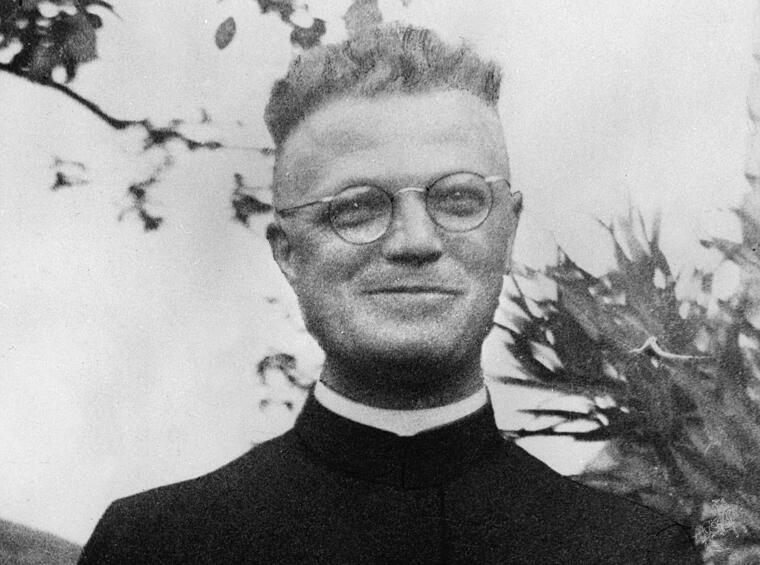
Fr. Delp wrote his meditations and sermons on Advent and Christmas when he was a political prisoner of the Nazis in Germany in World War II.This photo was taken most likely in 1942 or 1943—prior to his arrest by the Gestapo in July 1944. It captures a rare, candid moment of Delp smiling outdoors, wearing his round wire-rimmed glasses and civilian clothing. At the time, Father Delp was a Nazi resister living a dangerous double life. He was serving as a parish priest at St. Georg’s Church in Munich while secretly utilizing a covert underground network to help Jewish refugees escape Nazi persecution into neutral Switzerland. By 1942, he had joined the Kreisau Circle at the invitation of Count Helmuth von Moltke. This clandestine group of Christian intellectuals, theologians, and socialists met secretly to design a humane, democratic, and Christian-principled social order for Germany to rebuild upon after the inevitable downfall of Adolf Hitler’s regime. Though the Kreisau Circle explicitly favored peaceful planning over violence, the Gestapo rounded up its members following the failed July 20, 1944 bomb plot to assassinate Hitler. Delp was arrested on July 28, 1944, severely tortured, subjected to a mock show trial, and ultimately executed by hanging on February 2, 1945. PHOTO: “Alfred Delp Mannheim” by Graf Foto is licensed under CC BY-SA 3.0.
From Alfred Delp, S.J., “Figures of Advent,” Advent of the Heart, Ignatius Press, San Francisco, 2006 (adapted):
“I see this year’s Advent (December 1944 in Berlin’s Tegel Prison) with an intensity and discomposure like never before….Along with these thoughts comes the memory of an angel that a good person gave me for Advent in 1942. It held a banner: ‘Rejoice, for the Lord is near.’ A war bomb destroyed the angel as well as that good person although I often sense that she continues to do angel-services for me. It is the knowledge of the quiet angels of annunciation, who speak their message of blessing into the distress of our world situation and scatter their blessing’s seeds which begin to grow in the middle of the night which informs and encourages us of the truth of a situation. These angels of Advent are not loud angels of public jubilation and fulfillment but, silent and unnoticed, they come into private and shabby rooms and appear before our hearts as they did long ago. Silently they bring the questions of God and proclaim to us the miracles of God, with whom nothing is impossible. Advent is a time of refuge because it has received a message – and so to believe in God’s auspicious seeds that the angels offer an open heart are the first things we must do with our lives. The next is to go through the days as announcing messengers ourselves. We wait in faith for the abundance of the coming harvest – not because we trust the earth or the stars or our own good sense and courage – but only because we have perceived God’s messages and know about His herald angels – and even have ourselves encountered one.”
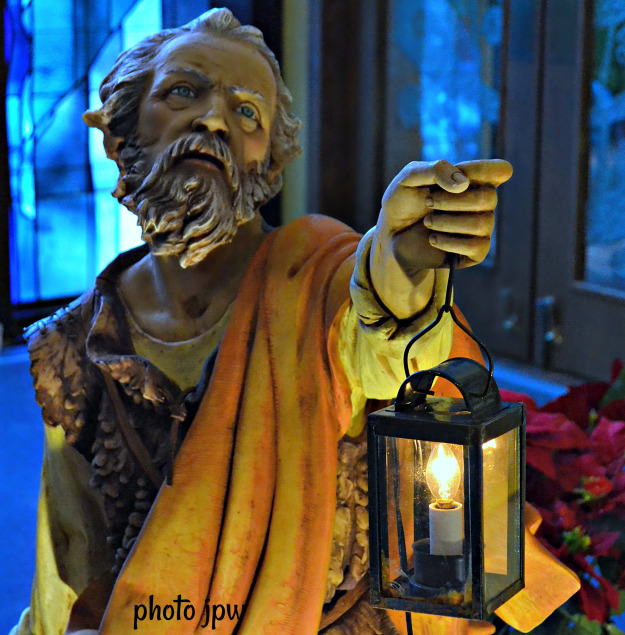
SECOND SUNDAY IN ADVENT.
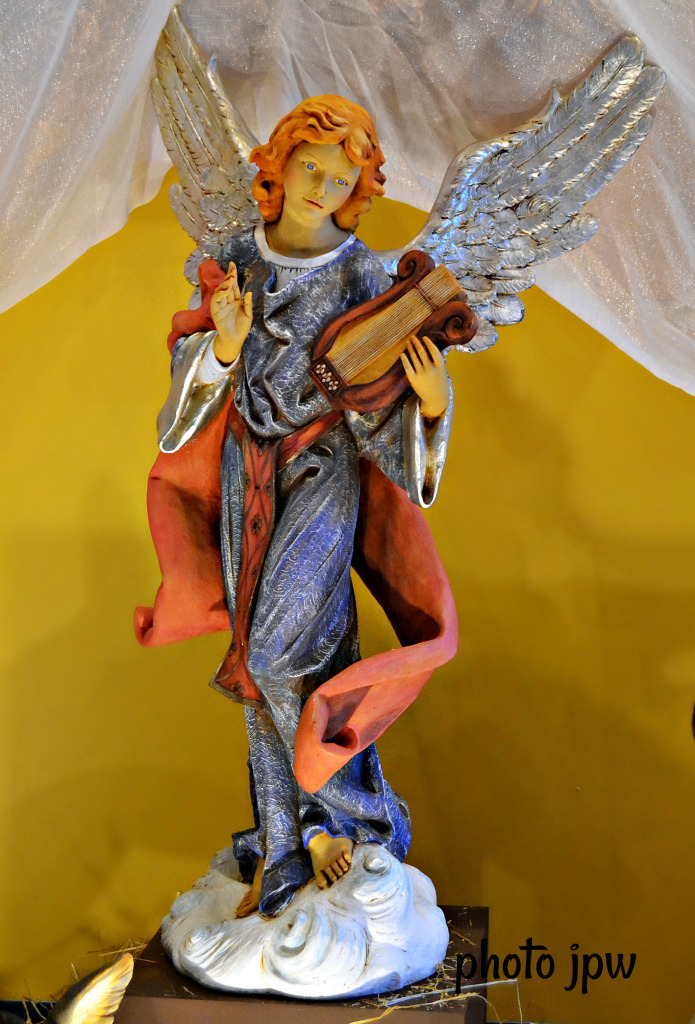
Standing Nativity Angel holding a lyre. Author’s photograph.
Thomas Merton in his introduction to Alfred Delp’s Prison Writings – a modern compilation of a young German Jesuit’s writings in prison in Berlin before he was executed for high treason as a Nazi resister in World War II – states that Fr. Delp was condemned because he and others “hoped to build a new Germany on Christian principles.” (p. xxv.)
Merton, a mid20th century Trappist monk, priest, and spiritual writer, links Fr. Delp’s political activity in the Kreisau Circle—an underground group of about twenty-five German dissidents of diverse backgrounds opposed to the Nazi regime—to broader Church doctrine and the western tradition of liberalism in evidence since the Ancient Greeks that “always hoped to attain a more equitable world order by peaceful collaboration among nations.” (ibid.)
For Fr. Delp, according to Merton, the stark choice before human beings remained the crucial one of global order or global destruction. Father Delp observed that even religious people in his time had fallen into the militaristic government’s syllogistic trap of “conquest first and a new and better world later.”
Fr. Delp’s concern when making this sort of choice is that “if the person who says it tolerates or helps further conditions which are fatal to mankind…or weakens his or her own spiritual, moral, and religious sense” – then even “the most pious prayer can become a blasphemy.” (ibid.) Fr. Delp proposed that any human indifference to honesty and justice originating in passionate conviction vitiates human nature which is left to then express itself in a vicious circle of fear and arrogance.
From Fr. Delp’s perspective, his active participation in Kreisauer Kreis for which he was executed by the Nazis in February 1945 pointed to the eschatological character of the Advent drama by the young Jesuit priest’s hope in his time for the political and social ruin of Germany which had sunk into bitter darkness and that it would find its way ahead by the light of each person’s burning candle “for honesty and justice.”
Hanging symmetrically from the classical pilasters are lush green pine Advent wreaths accented with vibrant, formal red ribbon bows. Against a peach-toned back wall is a dedicated devotional stand filled with dozens of glowing red glass prayer candles lit by parishioners. Author’s photograph.
Alfred Delp, S.J. Fair use.
From Alfred Delp S.J., Prison Writings, Orbis Books, Maryknoll, New York, 2004:
“So this Sunday we must again fold our hands and kneel humbly before God in order that his salvation may be active in us and that we may be ready to call upon him and be moved by his presence. The arrogance so typical of modern men and women is deflated here. At the same time, the icy loneliness and helplessness into which we are frozen melts under the divine warmth that fills and blesses us …If we are terrified by a dawning realization of our true condition, that terror is completely calmed by the certain knowledge that God is on the way and actually approaching. Our fate, no matter how much it may be entwined with the inescapable logic of circumstance, is still nothing more than the way to God, the way God has chosen for the ultimate consummation of his purpose, for his permanent ends. Light your candles – such candles as you possess – for they are the appropriate symbol for all that must happen in Advent if we are to live.”
THIRD SUNDAY IN ADVENT.
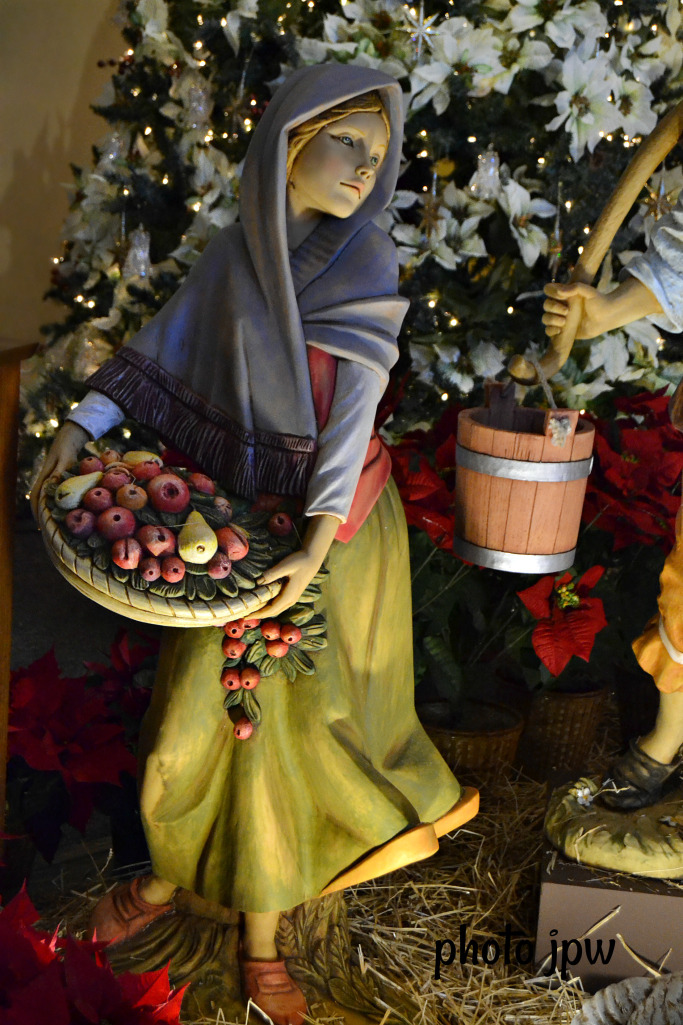
Part of a grand nativity scene, a young woman, Martha, dressed in traditional rustic garments, holds a woven basket overflowing with apples and pears, while a garland of red berries drapes down her skirt. Author’s photograph.
On Friday, July 28, 1944, two Gestapo men were waiting outside St. George’s church in Munich, a simple Baroque pile in an almost pastoral setting near the Englischer Garten.
Eight days before there had been an assassination attempt on Hitler’s life which failed. For active German dissidents to the Nazi regime in custody or, for the time being, still walking free, things were going to get worse.
Helmuth James Graf von Moltke (1907 – 1945), one of the leaders of the Kreisau Circle, a type of anti-Nazi salon, had been in prison since January 1944. Now, following the failed bombing at the Wolf’s Lair, Peter Yorck von Wartenburg (1904 –1944) who was the other leader of the Kreisau Circle, was immediately arrested and sent to Berlin where he was tried and executed on August 8, 1944.
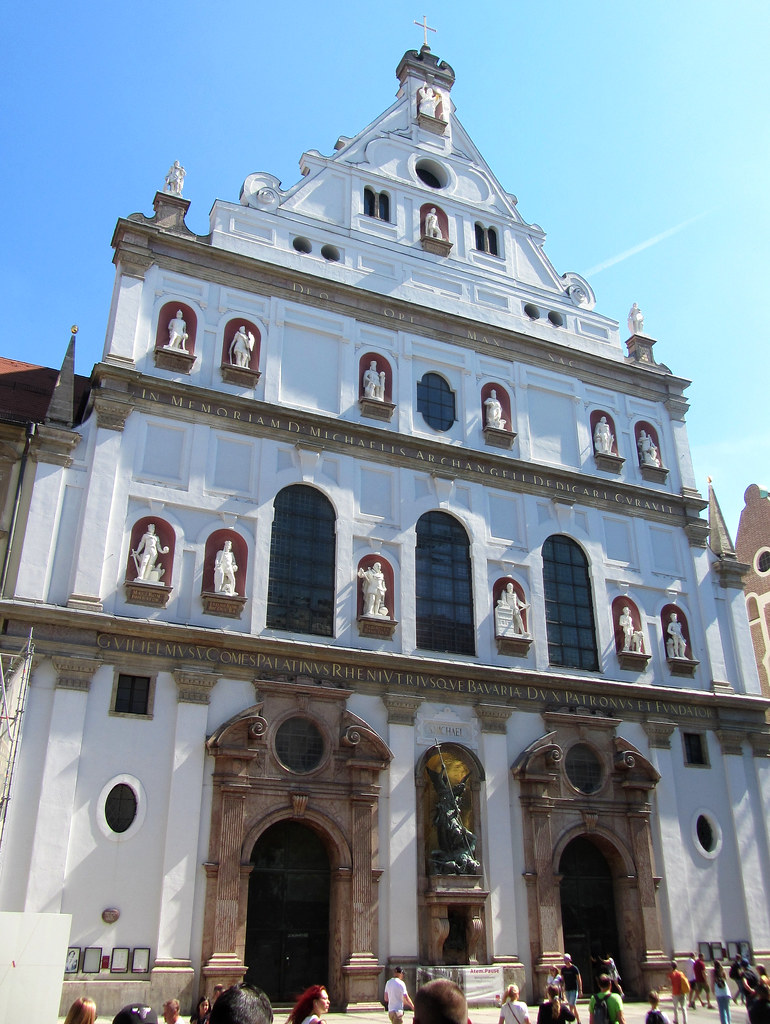
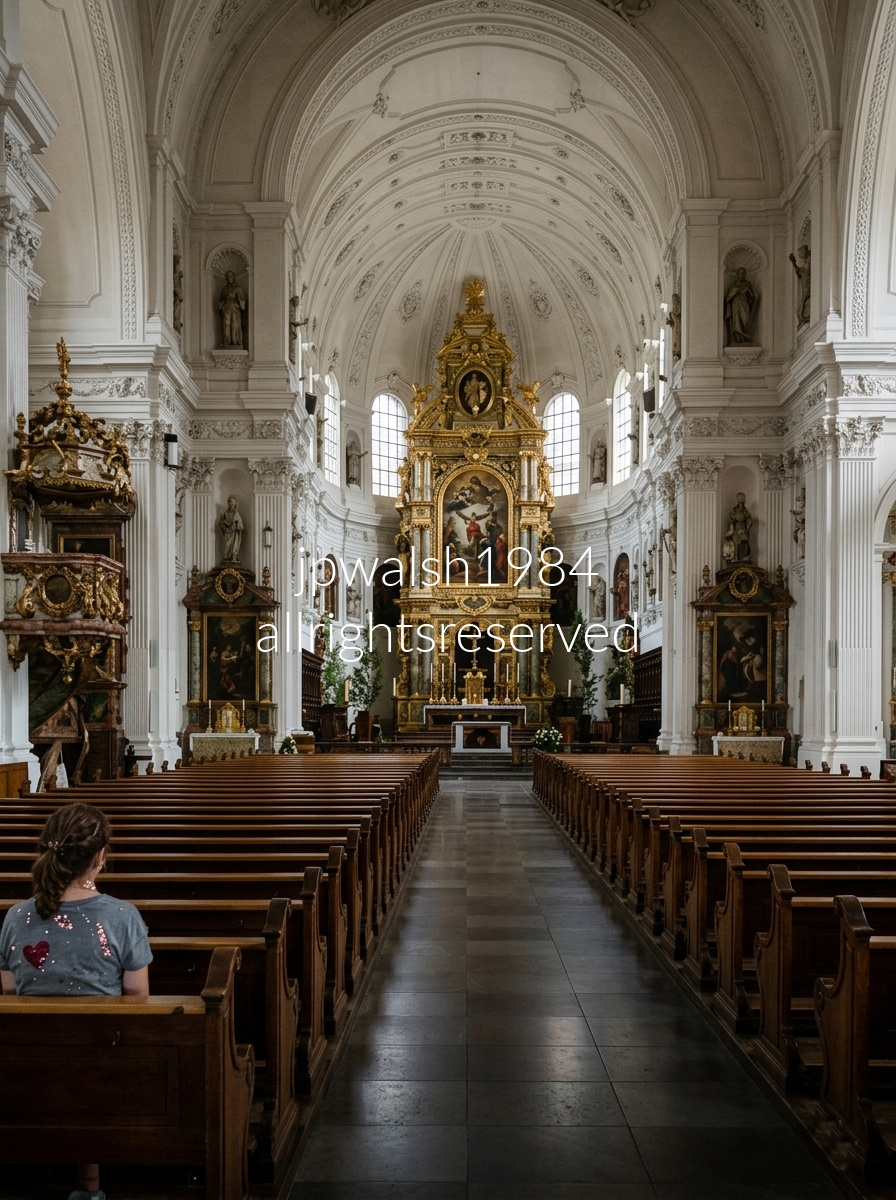
St. Michael’s Church (Michaelskirche), Munich. July 1984. Author’s photograph.
Beyond its architectural prominence as the largest Renaissance church north of the Alps, St. Michael’s maintains a deeply profound, historic connection to the German anti-Nazi resistance through Father Alfred Delp, S.J. The young Jesuit priest began his formal priestly ministry within these walls when he was ordained on June 24, 1937, by Munich’s celebrated Cardinal Michael von Faulhaber who delivered his famous anti-Nazi Advent sermons in 1933 which largely defined his ongoing critical tone towards the regime. Father Delp frequently ascended the pulpit of St. Michael’s to deliver powerful sermons that, alongside the courageous ministry of his fellow Jesuit Father Rupert Mayer, openly condemned the total incompatibility of National Socialist ideology with Christian values. This vocal opposition eventually led Delp to join the Kreisau Circle, a clandestine network of dissidents drafting plans for a humanitarian, Christian social order to rebuild Germany following the anticipated collapse of the Third Reich. Implicated in the wider resistance movements, Delp was arrested by the Gestapo in July 1944 and subsequently executed by hanging at Berlin-Plötzensee prison on February 2, 1945. In recognition of his enduring martyrdom, the Archdiocese of Munich and Freising has formally initiated the diocesan phase for Father Delp’s beatification process, ensuring that St. Michael’s continues to honor him as one of its most courageous historic voices.
St. Georg München-Bogenhausen, Munich:
St. Georg München-Bogenhausen. The exterior with its historic cemetery of St. Georg Church in Bogenhausen, Munich. A diocesan parish, a church has existed on this site since the Middle Ages. The current building was reconstructed between 1766 and 1768 and designed by Late Baroque architect Johann Michael Fischer, with interior art created by master sculptors Johann Baptist Straub and Ignaz Günther. As St. Georg was a filial church to the larger Heilig Blut (Holy Blood) parish nearby, Father Delp was the church rector—though to the ordinary churchgoers who attended his anti-Nazi sermons every Sunday, he effectively acted as their pastor.
Jesuit Father Delp’s primary assignment in Munich was serving on the editorial staff of the Jesuit journal Stimmen der Zeit (“Voices of the Times”). When the Nazi Gestapo suppressed and seized the journal’s offices in April 1941, Delp was left without a formal station. The local Archdiocese of Munich stepped in and appointed him as the rector/administrator of this small parish to keep him active. While his regional Jesuit Provincial superior (Augustin Rösch) kept close contact with him and introduced him to the anti-Nazi Kreisau Circle, the day-to-day parish staff at St. Georg was otherwise standard diocesan clergy.
The ornate, highly detailed Late Baroque (Rococo) interior of St. Georg Church in Bogenhausen, Munich, Germany. The architecture and abundant decoration emphasize dramatic composition, theatrical lighting effects, and rich faux-marble finishes characteristic of 18th-century Bavarian church design. PHOTO: “St. Georg München-Bogenhausen, Hochaltar” by Rufus46, used under CC BY-SA 3.0 / Cropped from original.
The danger surrounding Father Delp’s ministry was evident in the constant scrutiny of the Gestapo. Rather than denouncing the Nazi regime through direct political attacks, his sermons systematically dismantled its core ideology. From the pulpit, he rejected the State-as-God concept, affirming instead that only God possessed supreme authority. He also spoke forcefully about the intrinsic dignity, spiritual freedom, and equal worth of every human being, principles that stood in absolute opposition to Nazi racial doctrines and persecution.
The Gestapo fully understood what Delp was doing. Undercover agents and informants regularly filled the pews of St. Georg, reporting his sermons back to the authorities. Delp, in turn, knew they were there and occasionally mocked their presence from the pulpit itself. His dynamic and compelling preaching style drew large crowds, making his influence impossible to ignore. Ultimately, it was this fearless refusal to remain silent that kept him under permanent surveillance and led to his eventual arrest by the Gestapo.Portrait of Father Alfred Delp with glasses smiling [Photograph]. (n.d.). Historical Archives of the German Resistance / Public Domain.
One of the two Gestapo men waiting outside St. George’s to arrest Fr. Alfred Delp, S.J. happened to be an old schoolmate of his.
Like other Catholic bishops and priests who were known de facto dissenters working against the Nazi regime, especially its social and racial ideologies and practices, Fr. Delp had long been under close surveillance by the Gestapo.
As a member of the Kreisau Circle – that group of professionals of diverse religious, social, and political backgrounds with one thing in common (being dyed-in-the-wool anti-Nazis), Fr. Delp was their social scientist with a Ph.D. He illumined their minds to cutting-edge labor issues, including what could be the German worker’s role in a post-war liberated Germany.
Helmuth James Graf von Moltke (March 11, 1907 – January 23, 1945).
Count Moltke had close sympathies with the democratic forces of the day and expressed open criticism as he watched the rise of Hitler. In 1933 he refused to accept Nazi appointments. After the outbreak of World War II, as an expert adviser on international law and the laws of war he served as war administration councilor in the Office for Foreign Affairs/Counterintelligence in the Armed Forces High Command in Berlin. He was particularly active in advocating for humane treatment of prisoners of war and observance of international law. In 1940 Moltke with Peter Graf Yorck von Wartenburg became the leading figures in a group that emerged as the Kreisau Circle with its discussions held in Berlin and Kreisau. Moltke, formulating memoranda on the establishment of a new political order in Germany, systematically extended his contacts to Protestant and Catholic church leaders and to leaders of the social democratic political opposition. Moltke was arrested on January 19, 1944 after he had warned members of the Solf Circle that they were under Gestapo surveillance. His involvement in the plans for a coup against Hitler was not exposed until after the failure of the assassination attempt of July 20, 1944. Helmuth James Graf von Moltke was sentenced to death by the People’s Court on January 11, 1945 and executed on January 23, 1945 in Berlin-Plötzensee. http://www.gdw-berlin.de/home/ Fair use.
Under arrest, Fr. Delp disappeared into Nazi prisons in Munich and Berlin for almost three weeks. None of his friends could find him.
At Lehrterstrasse, a Gestapo prison in Berlin that specifically dealt with German resisters, the doctor-priest was regularly beaten. Fr. Delp was charged by the National Socialists with a half dozen crimes—being in Kriesau Circle; holding resistance meetings; knowing von Moltke and other anti-Nazis; knowing Claus von Stauffenberg who placed the bomb on July 20, 1944 to assassinate Hitler; knowing in advance of the assassination plot; and, displaying a general attitude of anti-Nazism.
The charge of knowing about the assassination plot before it happened greatly concerned Fr. Delp. He categorically denied it and, consequently worked vigorously through his lawyer to disprove it.
Having moved to Tegel Prison in Berlin on August 8, 1944, Fr. Delp’s whereabouts were finally discovered on August 15, 1944, by Marianne Hapig (1894-1973), a social worker and indefatigable friend to German resistance.
At Tegel, Fr. Delp found another significant friend—Harald Poelchau (1907-1972) the prison’s Lutheran chaplain since 1933. With the agency of chaplain Poelchau, the Catholic priest, Fr. Delp, had wafers and wine to say Mass. Also, messages could be smuggled in and out by way of the laundry.
It was through such a clandestine route that Fr. Delp made his final vows as a Jesuit on December 8, 1944. In front of a visiting witness, Fr. Delp pronounced the vow formula. Afterwards, he apologized for his emotion as he sank into a prison chair and wept.
Marianne Hapig (March 5, 1894 – March 23, 1973).Marianne Hapig discovered Father Delp’s presence at Tegel prison in Berlin after his disappearance following his arrest in Munich three weeks earlier. A career social worker and anti-Nazi Marianne Hapig and her lifelong jurist friend Marianne Pünder managed to smuggle Alfred Delp’s prison writings out of Tegel prison where soon after the war they were published. Fair use.
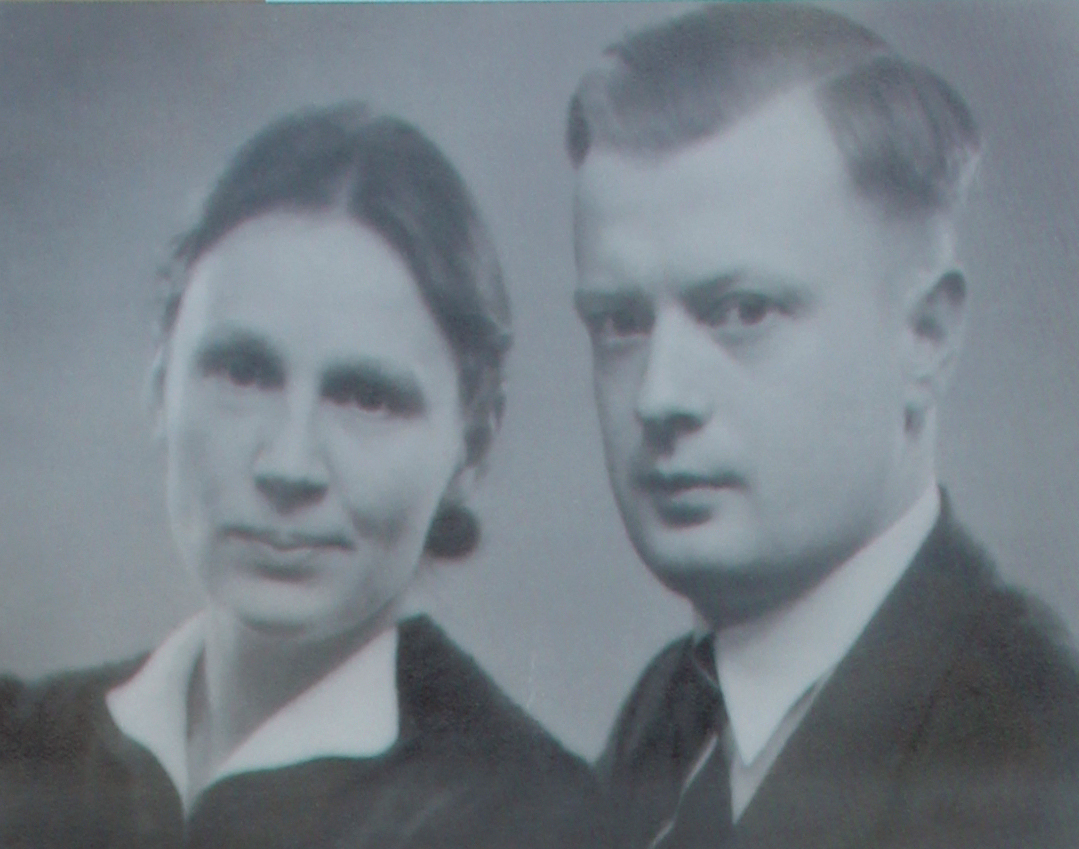
Dorothee und Harald Poelchau. Dorothee Poelchau (born Dorothee Ziegele; June 6, 1902 – November 4, 1977) was a German librarian and a prominent anti-Nazi resistance fighter who worked alongside her husband, Harald Poelchau. PHOTO: “Dorothee und Harald Poelchau (cropped)” by OTFW, Berlin is licensed under CC BY-SA 3.0.
Harald Poelchau (October 5, 1903 – April 29, 1972). Rev. Poelchau gained his doctorate in 1931 under Paul Tillich, the leading representative of Religious Socialism. At the end of 1932, Poelchau applied for a prison chaplain’s post in Berlin and became the first cleric to be employed by the National Socialist regime in a penal institution. As an official in the Justice Department he rapidly became an important source of support for the victims of National Socialist violence, and gave spiritual comfort to hundreds of people sentenced to death as they faced execution. From 1941 onwards he was a member of the circle around Helmuth James Graf von Moltke and attended the first major Kreisau Conference. After the failed coup attempt of July 20, 1944 Poelchau was able to pass on last messages and farewell letters to the relatives of many of those sentenced to death. Harald Poelchau managed to avoid being investigated by the Gestapo and survived the war. Fair use.
Many of Fr. Delp’s Advent writings come during these months in prison. They were smuggled out by Marianne Hapig and, her lifelong friend, Marianne Pünder. For more than a decade, Fr. Delp had written extensively on the Christian season of expectant waiting for the coming of Christmas.
Die gefesselten Hände (English: “Bound Hands”) by Tilman Riemenschneider (c.1460-1531).
During these months in prison, his hands almost always in chains, Fr. Delp had identified with a specific artwork as he wrote his Advent thoughts onto endless slips of paper. It was a sixteenth century German wood sculpture of St. Sebastian known as Die gefesselten Hände (English:“Bound Hands”) by Tilman Riemenschneider (c.1460-1531).
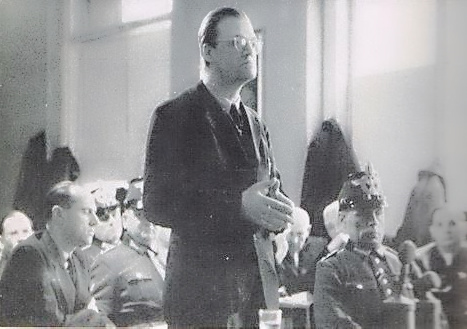
Alfred Delp, S.J. at his trial. Fair use.
In a moving ceremony while in prison and facing possible execution, Father Delp made his final Jesuit vows. Delp refused Nazi offers that could have secured his freedom if he abandoned his Jesuit vocation.
At his two-day trial in January 1945, rabid Nazi judge Roland Freisler was interested in one charge against Delp: the priest’s association with von Moltke. The leader of Kreisauer Kreis would be soon on death row and executed on January 23, 1945. Since 1942, Friesler’s reign of terror already included 5,000 death sentences as president of the People’s Court. It did not help that Fr. Delp was a Catholic priest and Jesuit.
So with Hitler, Friesler was maniacally anticlerical. Although many Nazis grew up as Catholics, in adulthood such notorious men as Hitler, Josef Goebbels, Martin Bormann, Heinrich Himmler, and others, held Christianity in utter and complete contempt. (Ian Kershaw; Hitler: a Biography; pp. 381–82). Once in power, Hitler believed that Christianity signified “the systematic cultivation of the human failure” and that its religious organization and central beliefs had to be marginalized and eventually purged from a heroic German worldview (Alan Bullock; Hitler: a Study in Tyranny; p. 218).
When Hitler invaded Poland in September 1939, the Superior-General of the Jesuits was just then a Pole, Wlodimir Ledóchowski, S.J. (1866 –1942). Ledóchowski who was in charge of neutral Vatican Radio made international broadcasts about Nazi wartime atrocities in many languages.
Wlodimir Ledóchowski, S.J. (1866 –1942). Ledóchowski, S.J. (1866 –1942) had been the Polish Superior-General of the Jesuits since 1915 when Hitler invaded Poland on September 1, 1939, setting off World War II. A renowned institutional builder, Ledóchowski established several notable institutes and colleges in Rome. In January 1940, Vatican Radio controlled by the Jesuits and with Pope Pius XII’s authorization broadcast the details of the Polish wartime situation. When the German ambassador protested the German language broadcasts, the Pope honored the request. But Vatican Radio broadcasts in other languages of the Poland situation continued and in even more explicit detail. The British press at the time hailed Vatican Radio as “tortured Poland’s powerful advocate.” see – Peter Hebblethwaite; Paul VI The First Modern Pope, Paulist Press, 1993, p. 140.Portrait of Father Wlodimir Ledóchowski, S.J. [Photograph]. (n.d.). Historical Archives of the Society of Jesus / Public Domain.
That Fr. Delp remained a Jesuit—even after he was offered a plea deal by the Nazis to walk free of all charges if he renounced his religious faith—undoubtedly deserved the death penalty in Freisler’s court.
After the death sentence was pronounced on January 11, 1945, the typical procedure of immediate execution was delayed. During this time, the bombing by British and Americans intensified. Fr. Delp desperately hoped that the Allies would arrive in time to set political prisoners, including himself, free. But, finally, on February 2, 1945, at Berlin-Plötzensee Alfred Delp was taken from his holding pen by the Nazi executioner and executed by hanging. The next day, February 3, 1945, Roland Freisler presiding in his People’s Court, was killed by collateral damage in an Allied bombing attack.
Alfred Delp, S.J.
From Alfred Delp, S.J., “Meditation for the Third Sunday of Advent Written in Tegel Prison, Berlin, December 1944” (adapted), Advent of the Heart, Ignatius Press, San Francisco, 2006:
“Mankind is challenged again to stand and deliver. Only man does not merely exchange one set of chains for another – God’s calls are always creative. They increase the very reality within us that is called upon – precisely because of their realness and authenticity…Freedom is the breath of life. We sit in musty bomb cellars and cramped prisons and groan under the bursting and destructive blows of fate. We should finally stop giving everything a false glamour and unrealistic value and begin to bear it for what it is – unredeemed life. As soon as we do this, the jangling of chains and the trembling of nerves and the faintness of heart transform themselves into a small prayer – “Drop down, dew…” We should much more definitively unite our concrete destiny with those kind of connections and call upon God’s redeeming freedom. Then the narrowness widens, our lungs breathe in fresh air again, and the horizon has promises again. Existence still weeps and mourns, but already a soft, joyous melody of longing and knowledge is ringing through the mourners’ broken voices. With this knowledge and attitude humanity releases itself from the lonely relationship to things and circumstances. A person finds wholesomeness and healing – not the goal-oriented, cool distance of calculation, mechanization, and organization. It is rather that higher level of freedom, the perspective given to someone looking from the heights to what lies below. The voice of such a person is not so quickly silenced!”
“The conditions for true joy have nothing to do with conditions of our exterior life but consist of humanity’s interior frame of mind and competence, which make it possible now and again for the person to sense, even in adverse circumstances, what life is really about…And the first answer is found in the figure of John the Baptist who personifies Advent. Humanity must be brought to an absolute clarity about himself and honestly before himself and others. He must come down from all the pedestals of arrogance onto which he always climbs…From the high-horses of vanity and self-deception that, for a time, let themselves be trotted out so proudly. Those horses though finally throw off their “master” in the wilderness…Two criteria identify whether we are following an authentic impulse or not…Both are found once again in John the Baptist. The first is service – human honesty requires a person to see himself as a servant and perceive his reality as mission and an assignment…The second criterion keeps us on track- annunciation, which calls us to praise of God. An extended personal effort is required to keep giving oneself the impulse to rise above, move away from self. But at the same time this is how a human being attains the necessary openness in which he or she must continue if sincerely wanting to strive toward the great realities God has prepared for him or her.”
FOURTH SUNDAY IN ADVENT.
Advent Nativity awaiting the birth of Jesus. Author’s photograph.
Thomas Merton makes clear about Father Delp that his writings on Advent are usually a simple presentation of the traditional Christian faith with no special originality to his images. (p. xxxv, Prison Writings). It is Fr. Delp’s application of those facts based in his personal experience – as an active dissident and prisoner of a Germany in ruins during World War II – that restores the sometimes hackneyed outcome to Advent to its original hope.
In Fr. Delp’s world, if humanity is fully alert to the desperation and bitterness of the times, Advent’s basic image of God-made-man becomes immensely opportune and favorable for humanity’s future although not holding any foregone conclusions or sudden outcomes.
“The Spirit of the Lord is upon me, because he has anointed me to bring glad tidings to the poor. He has sent me to proclaim liberty to captives and recovery of sight to the blind, to let the oppressed go free, and to proclaim a year acceptable to the Lord.” Luke 4:18-19.
Thomas Merton views Father Delp’s Advent meditations in Pauline terms, although Fr. Delp found St. Paul sometimes had a ‘tendency to over-emphasize.’ (p. 55, ibid.). Humanity hopes in God’s close alliance so to win back or have restored a future that is not any longer in ruins and in which humanity and even created life itself is absurdly helpless to fix.
His show trial before the notorious Nazi “People’s Court” took place over two days, spanning January 8–9, 1945. He was officially sentenced to death on January 11, 1945, and subsequently executed on February 2, 1945.
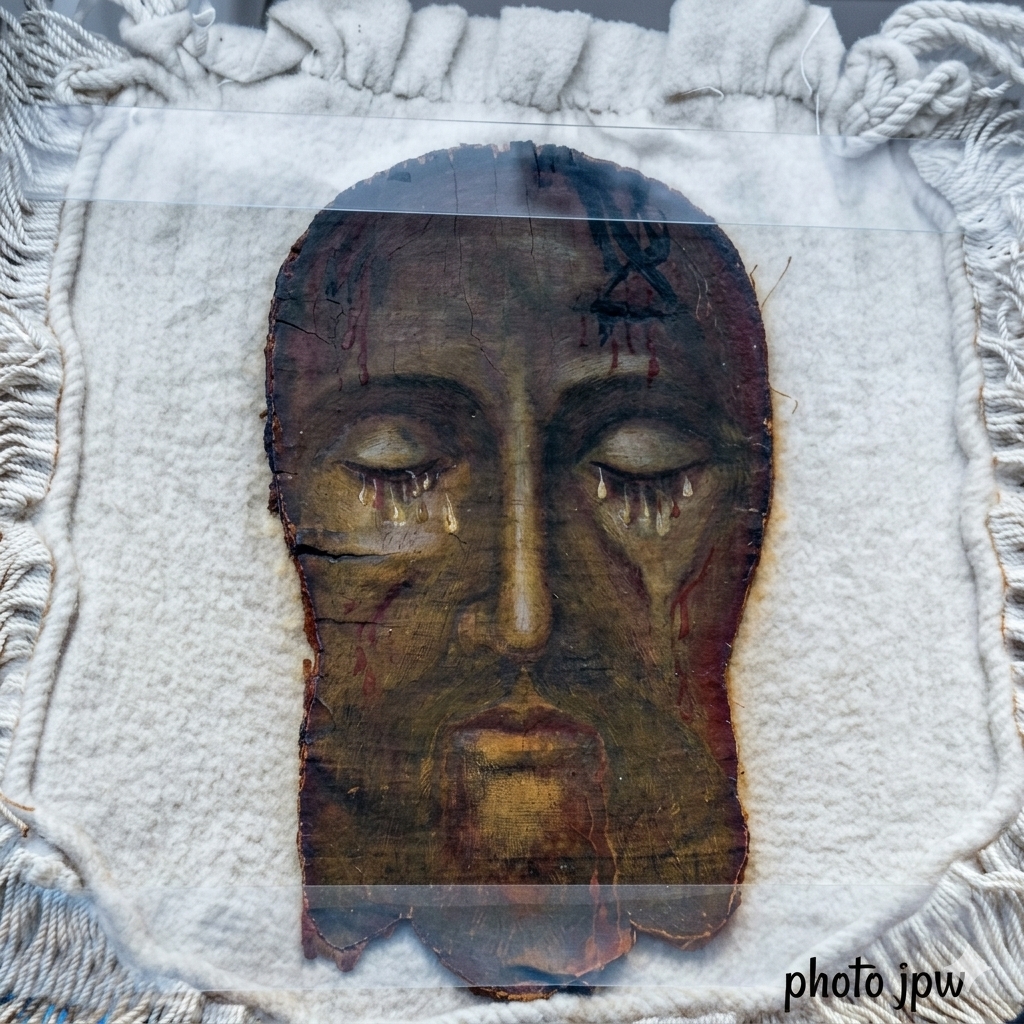
Holy Face painted by Saint Thérèse of Lisieux. National Shrine of St. Thérèse in Darien, Illinois. Author’s photograph.
Saint Thérèse of Lisieux (French, 1873-1897) traced and painted this image of the Holy Face of Jesus and tacked it to wool for hanging as a gift to her sister Céline who was at home at Les Buissonnets taking care of their widower father who was suffering from illness. The National Shrine of St. Thérèse in Darien, Illinois. It may be expected that a similar sort of facial expression was found on Father Delp. On February 2, 1945 Father Delp was imprisoned, tried and executed by the Nazis for “hop[ing] to build a new Germany on Christian principles.”
Alfred Delp S.J. Fair use.
From Alfred Delp S.J., Prison Writings, Orbis Books, Maryknoll, New York, 2004:
“God in the Christmas encounter is still the challenging God. The greatest misconceptions all center round the typical Christmas picture of God. Humanity becomes so wrapped up in appearance that the breathtaking reality of the birth of God as a human child scarcely enters our mind and the soul doesn’t grasp its significance….Of course the externals, the sweet sentimental pictures, carols, cribs and so on, are a comfort….but there is a great deal more to the nativity than that. The truth of it is too tremendous to be appreciated unless one concentrates on it fully. Since the birth of God, humanity has been confirmed in the hope that when we turn to God’s throne for favor that God is on our side. This does not mean that God has dethroned Himself any more than it means that human life has become a primrose path in the wake of that stupendous event. We need to look critically at the tendency to sentimentalize the divine attributes by personifying them in an innocent child or over-beautifying the adult Jesus. The glamorizing of the nativity story – the making the whole tone of Christ’s life equal to a Baroque sermon full of ominous warnings and grave moralizing – has contributed quite a lot to the West’s being paralyzed in the face of those conditions that hinder us and keep us trapped. God became man but nevertheless is God, master of all creation. Human beings must approach the God-made-man with reverence and adoration – disenthralling themselves in order to find themselves. It is the only way.”
His prison writings remain among the most powerful spiritual documents produced during the Third Reich, uniting Christian faith, human dignity, and resistance to totalitarianism
Alfred Delp, S.J. fair use.
BIBLIOGRAPHY:
Bullock, Alan, Hitler: a Study in Tyranny, Completely Revised Edition, Harper & Row, New York, 1964.
Delp, S.J., Alfred, Advent of the Heart, Ignatius Press, San Francisco, 2006.
Delp, S.J., Alfred, Prison Writings, Orbis Books, Maryknoll, New York, 2004.
Hebblethwaite, Peter, Paul VI The First Modern Pope, Paulist Press, New York, 1993.
Kershaw, Ian, Hitler: a Biography, W. W. Norton & Company, New York, 2010.
Kidder, Annemarie S., Ultimate Price Testimonies of Christians who Resisted the Third Reich, Orbis Books, Maryknoll, New York, 2012.
Royal, Robert, The Catholic Martyrs of the Twentieth Century A Comprehensive World History, Crossroad, New York, 2000.
This explanatory article may be periodically updated.