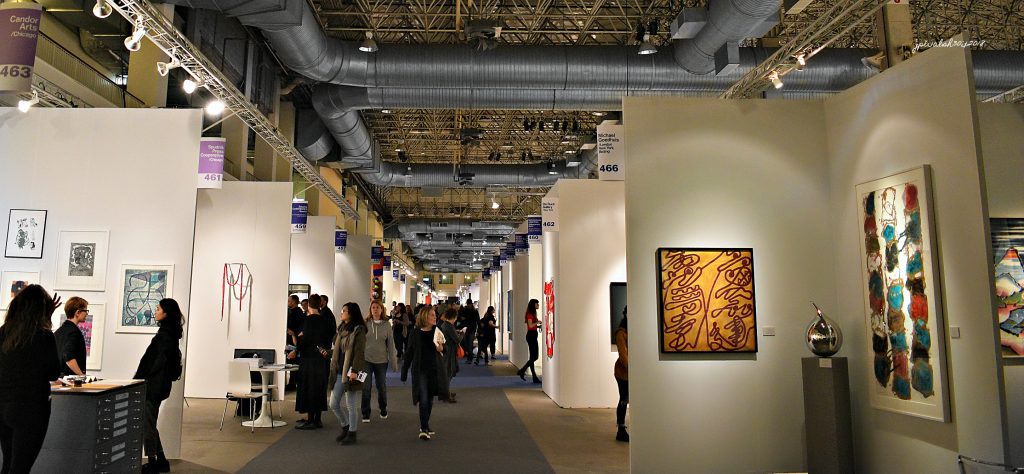
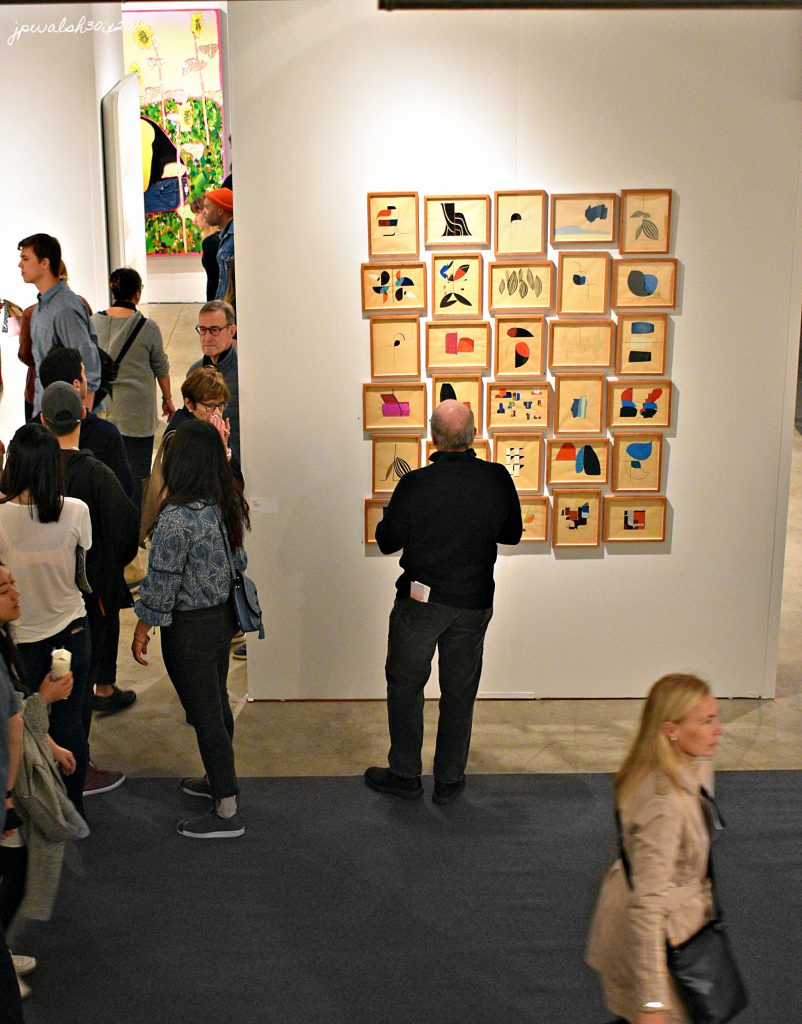
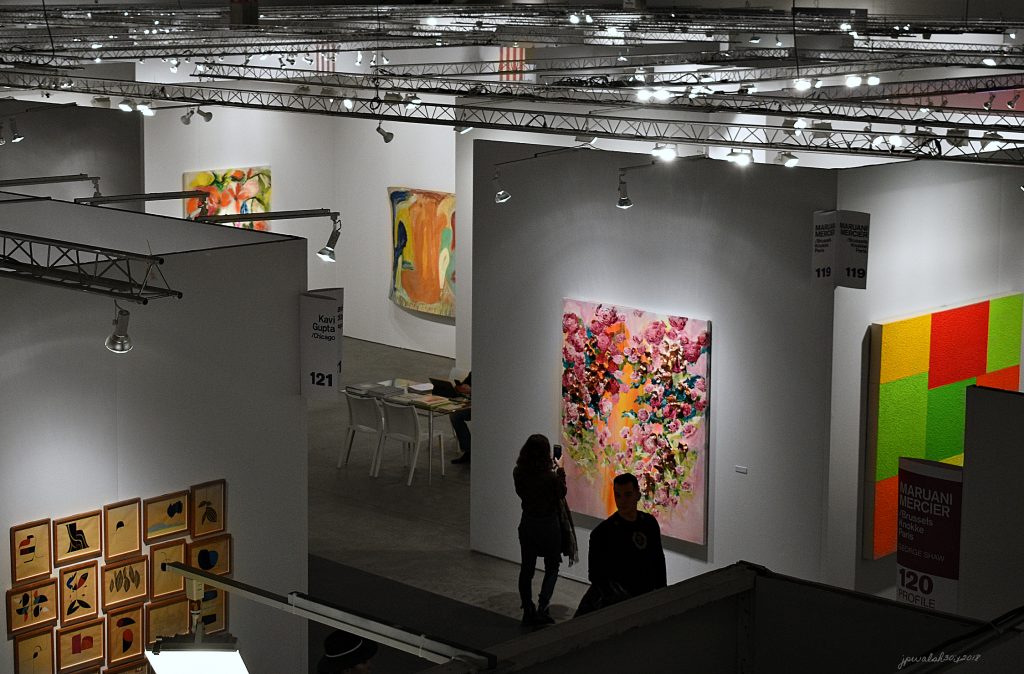
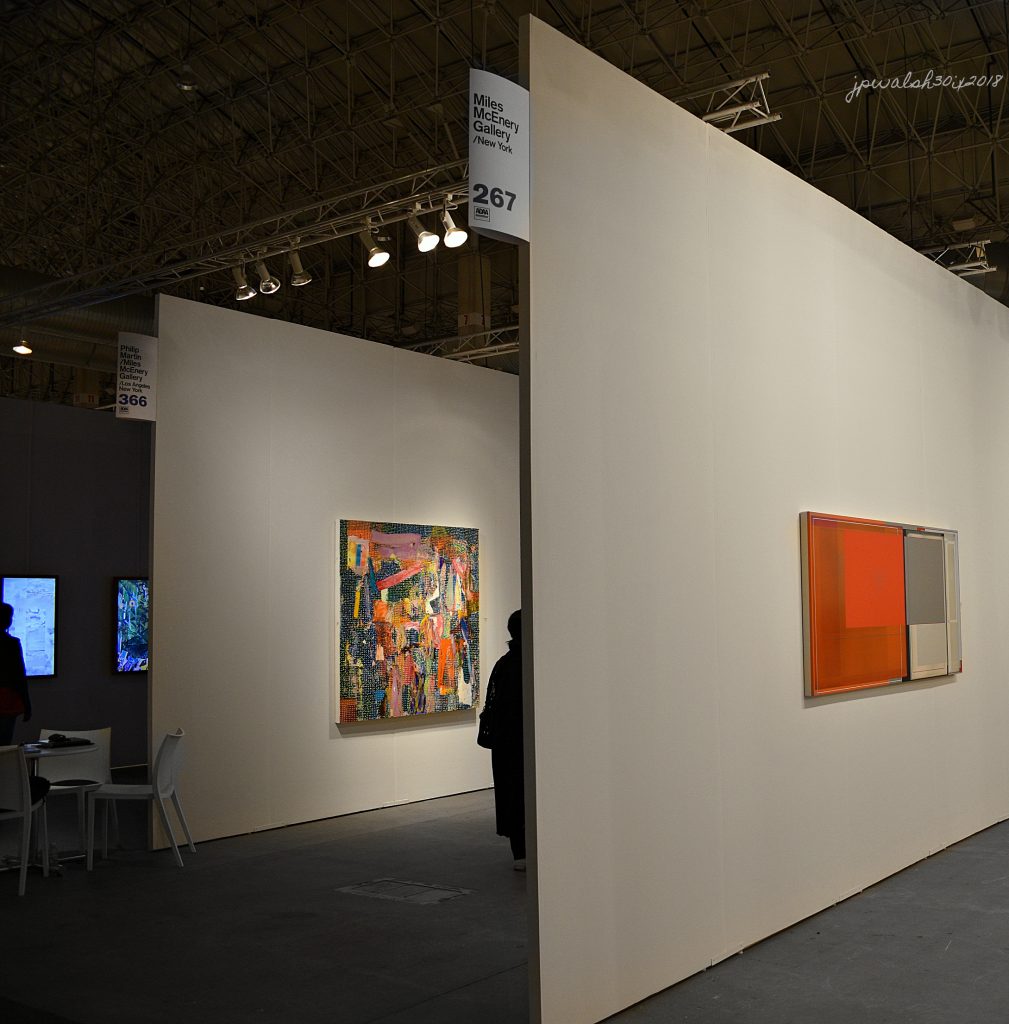
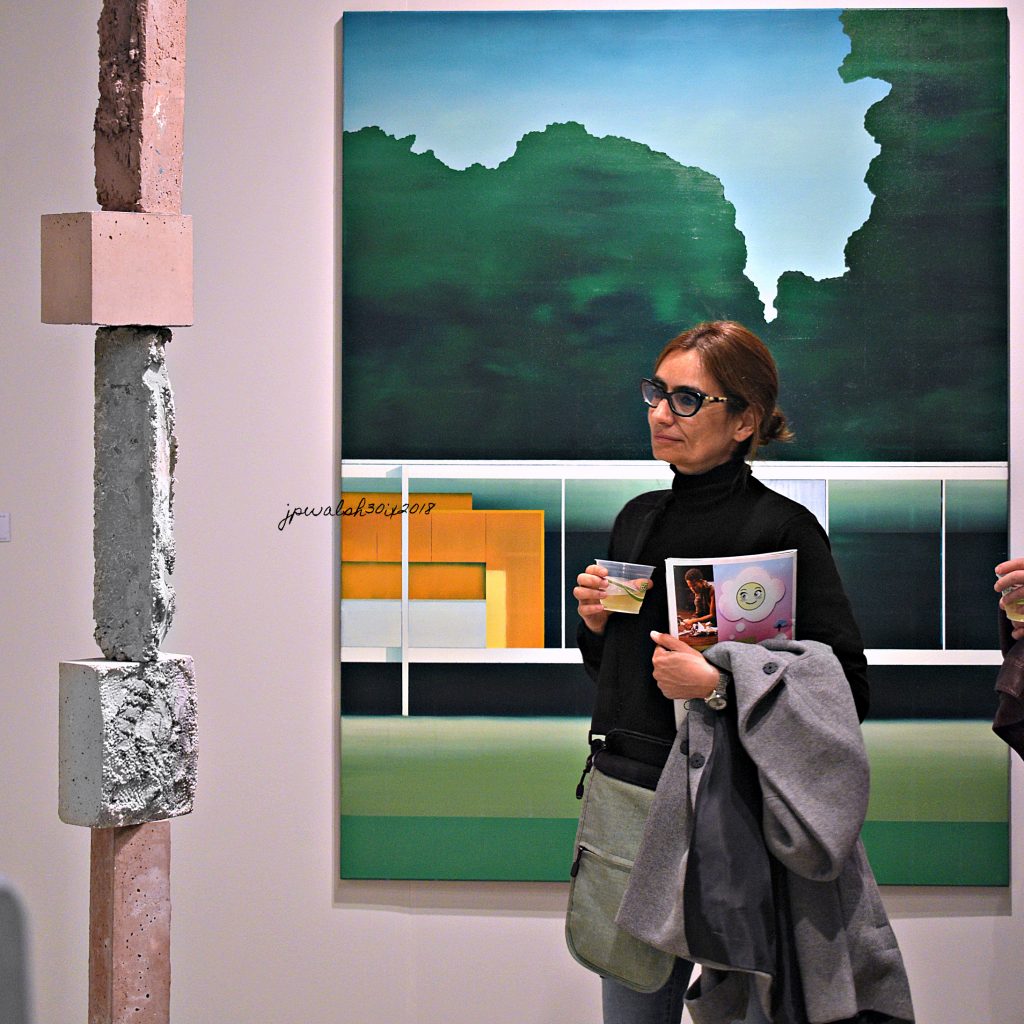
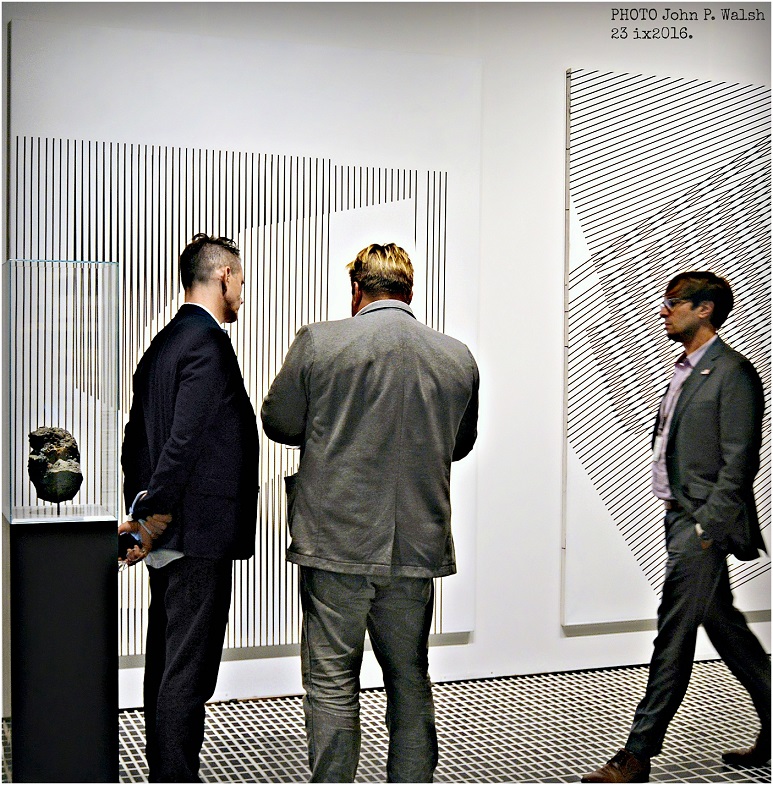
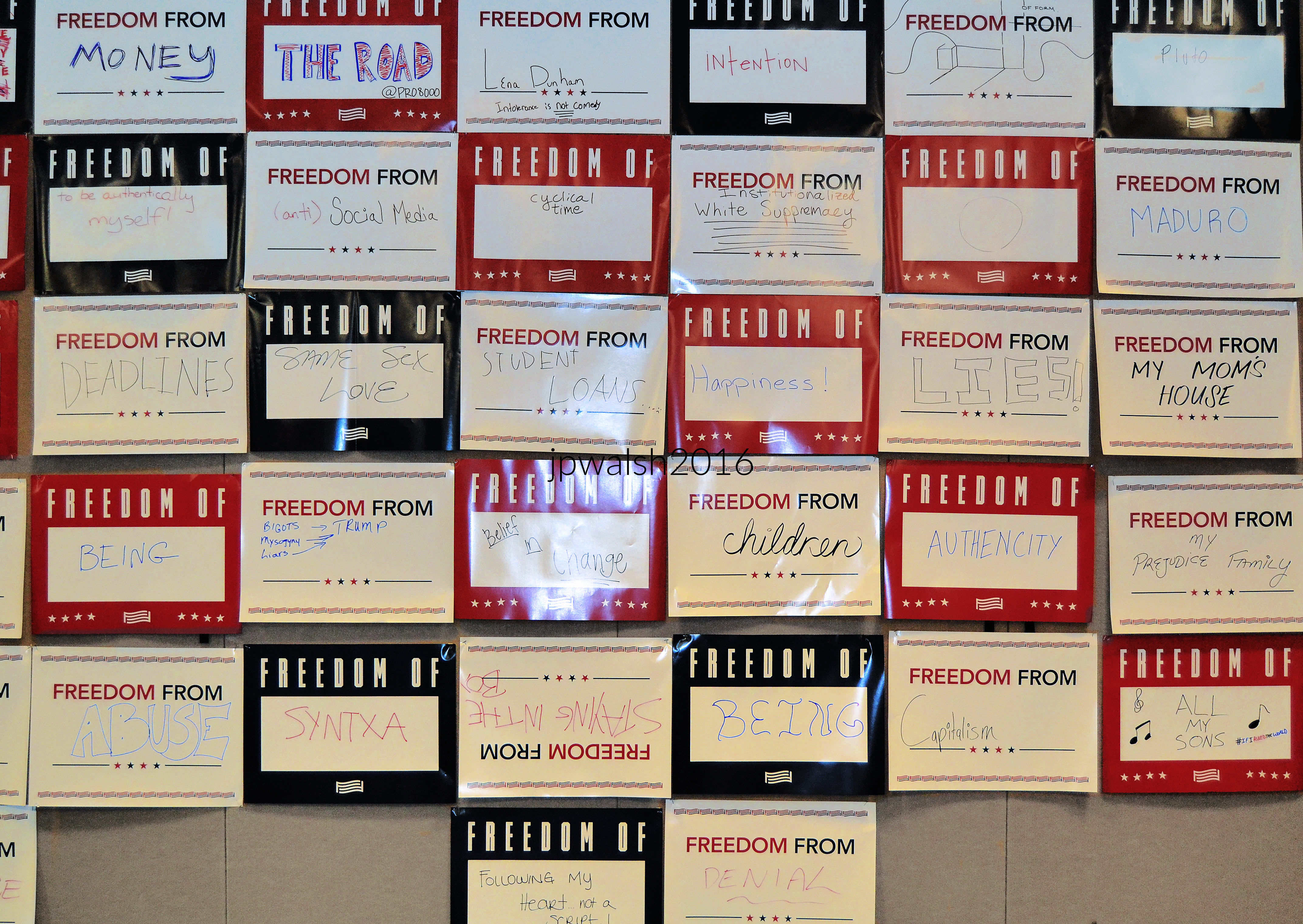
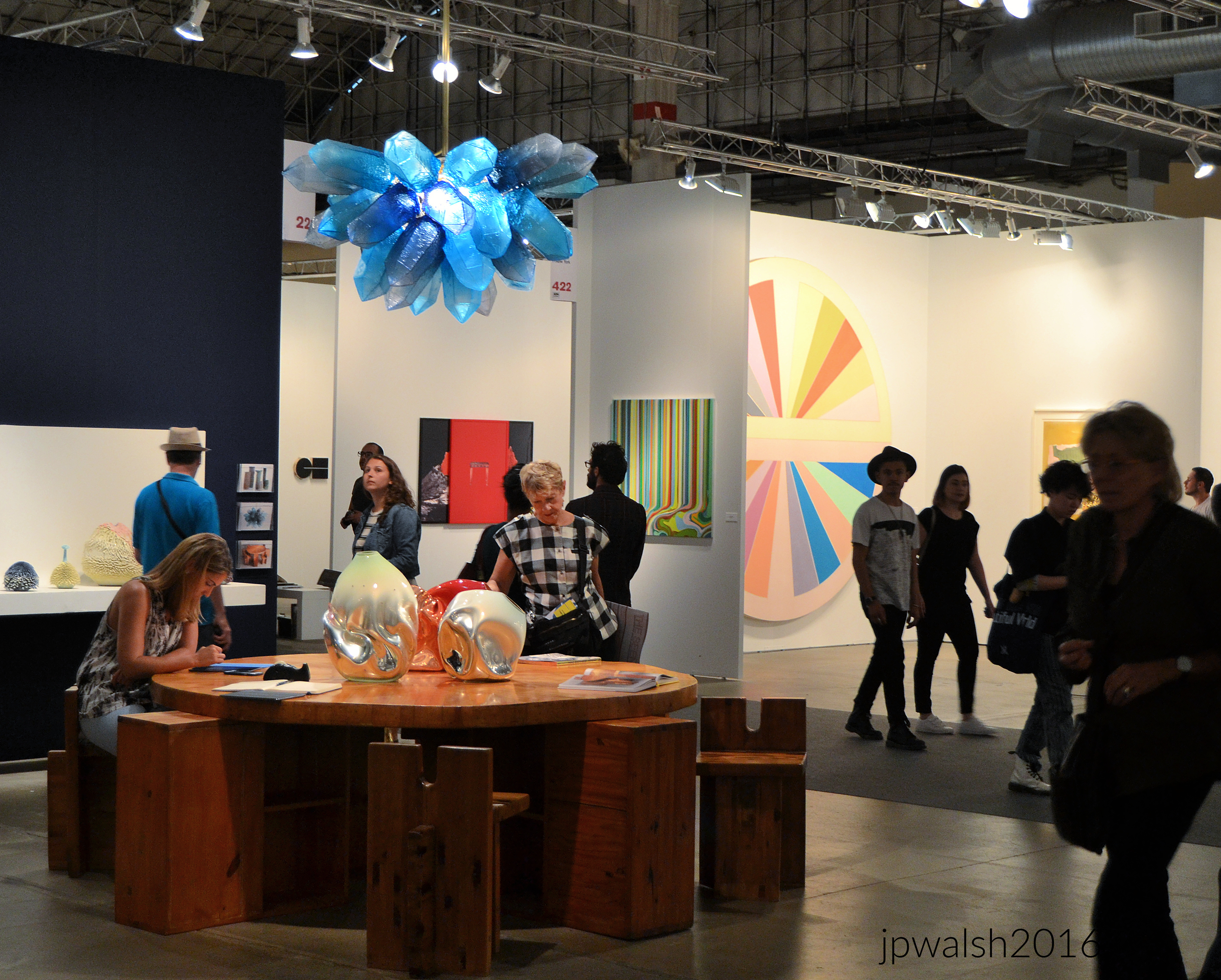
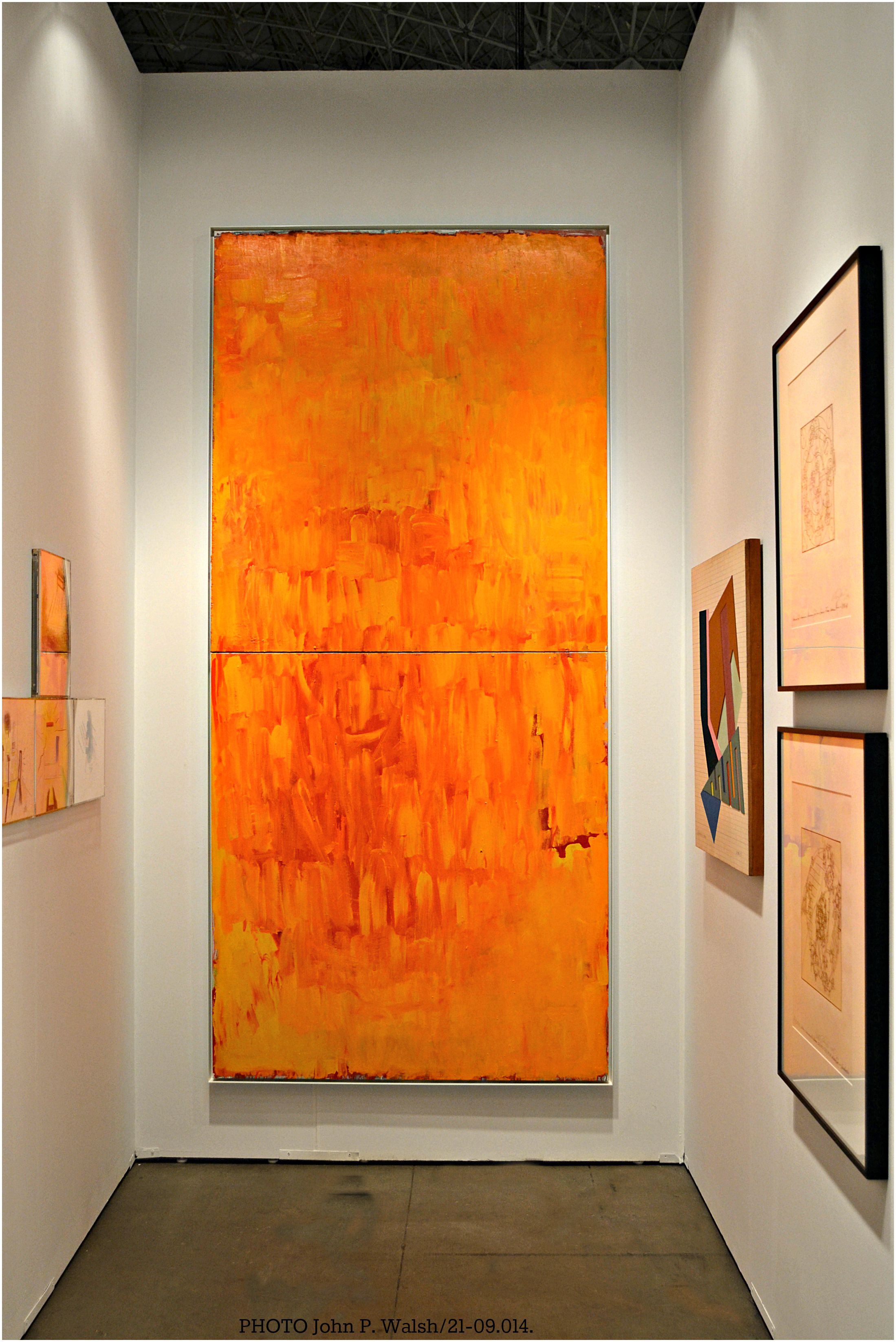
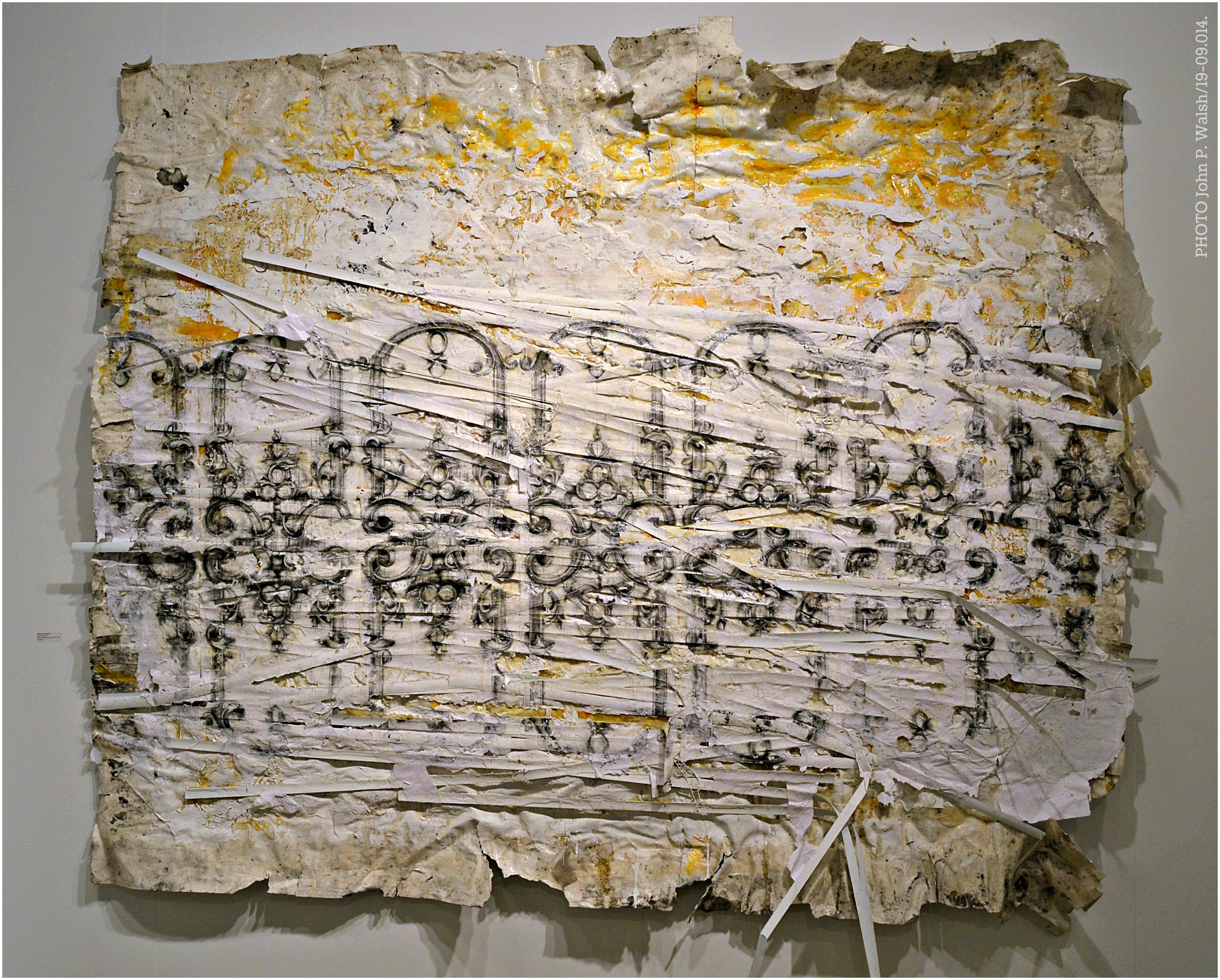
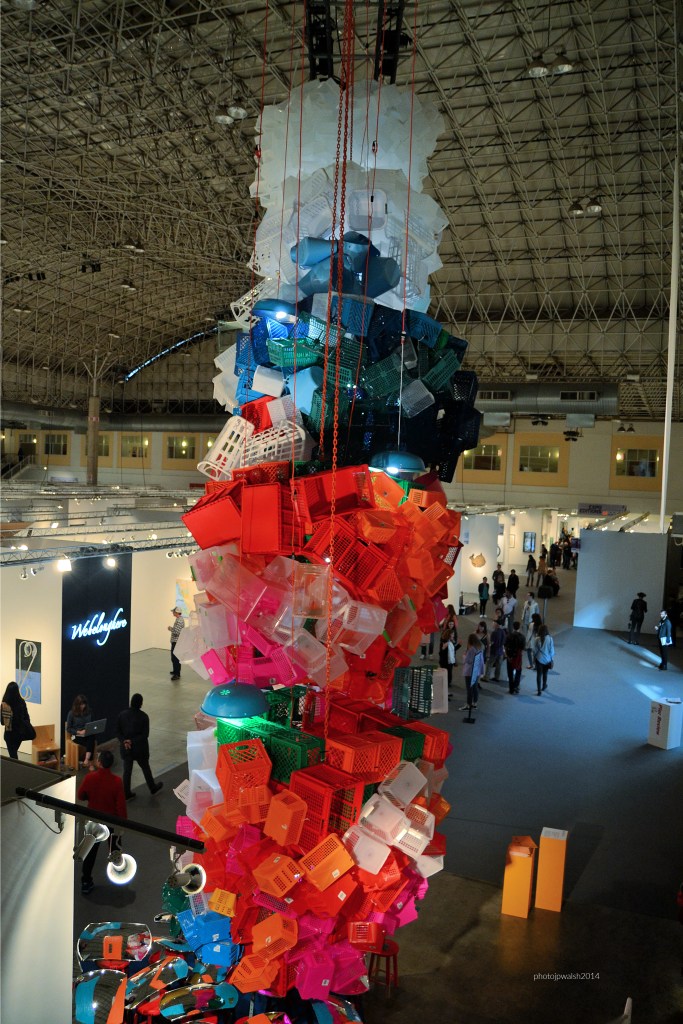
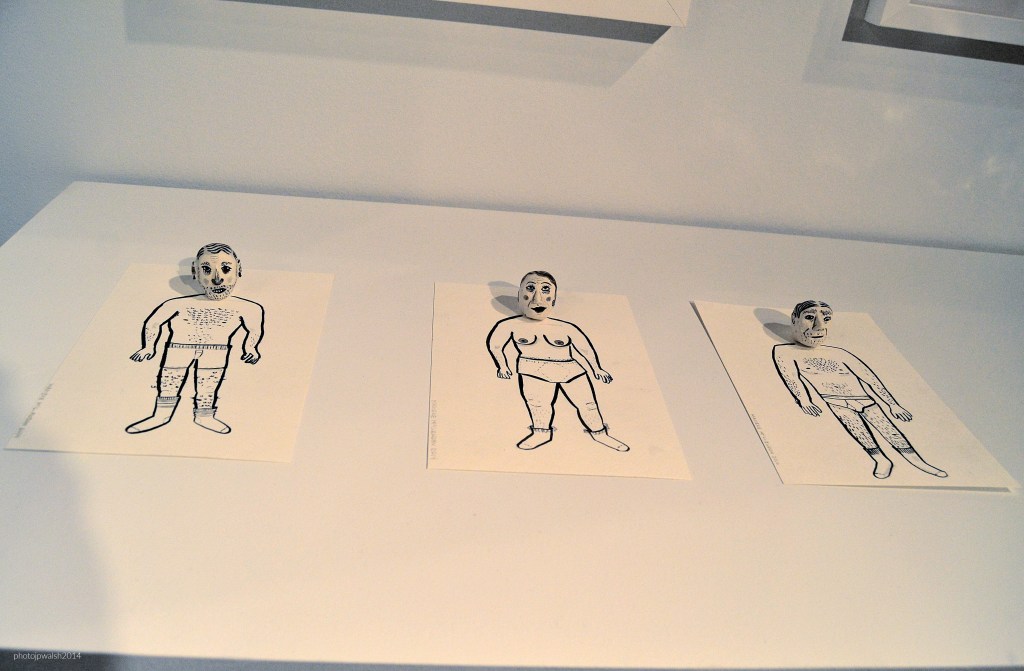
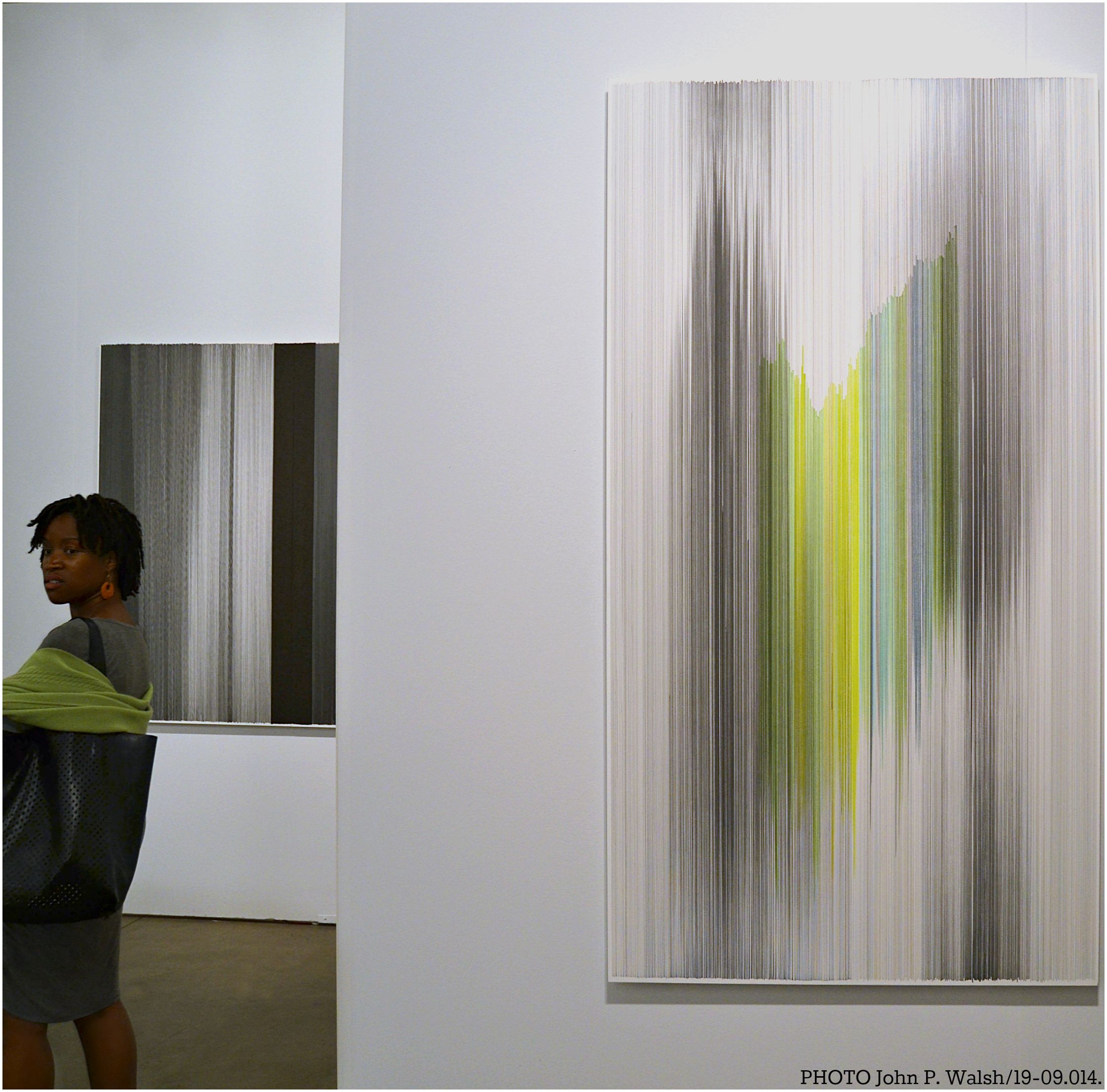
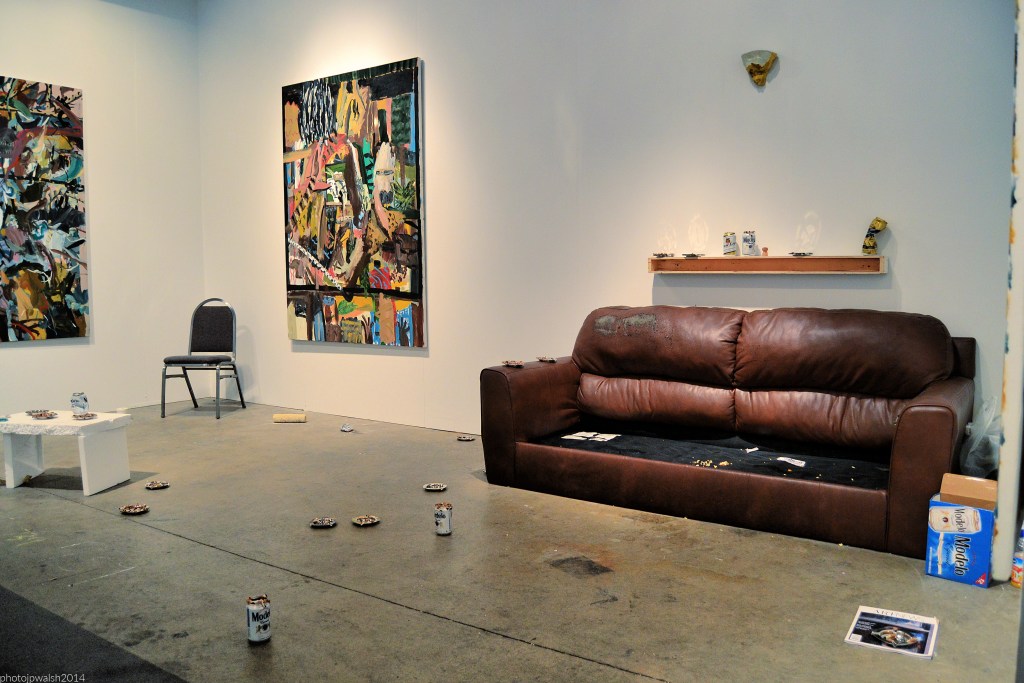
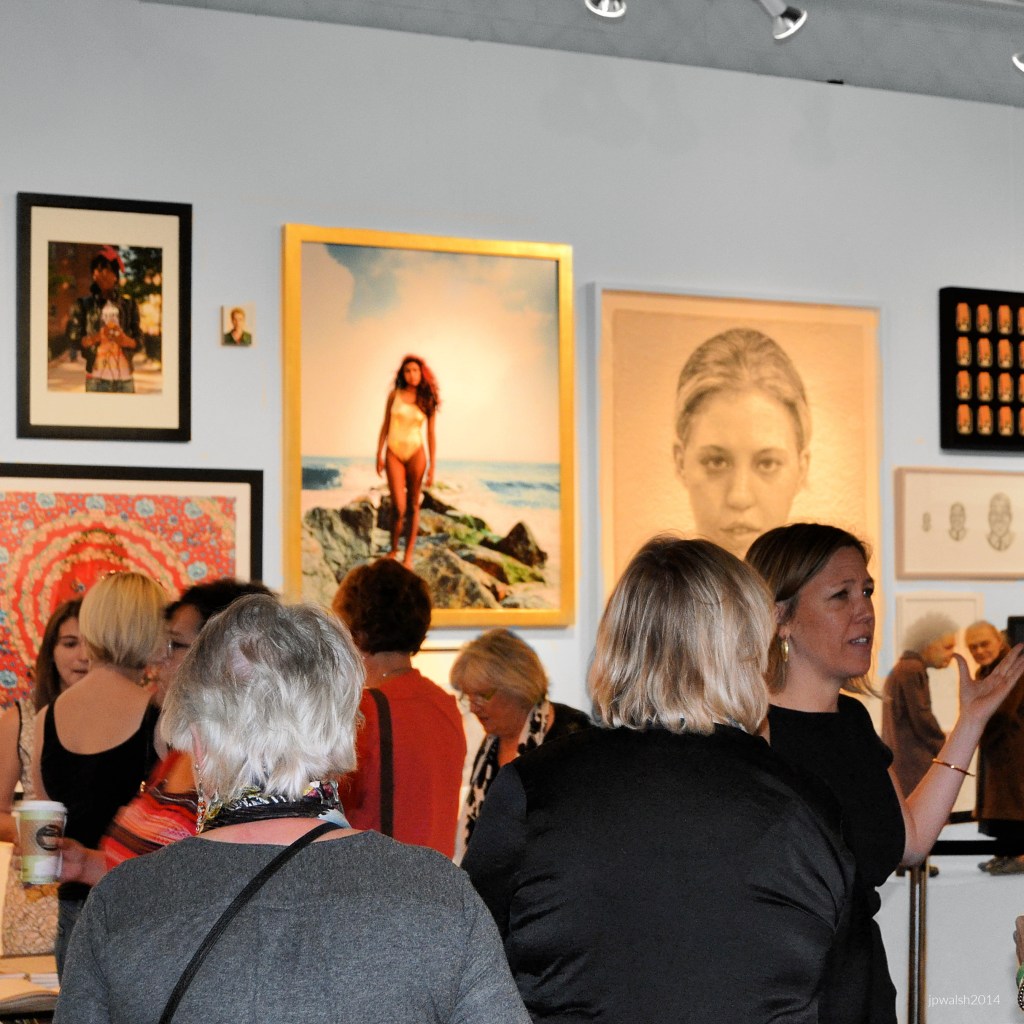
FEATURE image: EXPO CHICAGO 2018, Festival Hall, Navy Pier.
EXPO CHICAGO 2018 demonstrates how Chicago functions as a global crossroads for contemporary and modern art, bringing together international galleries, artists, and audiences while transforming Navy Pier’s Festival Hall into a temporary museum of worldwide creative exchange and experimentation.
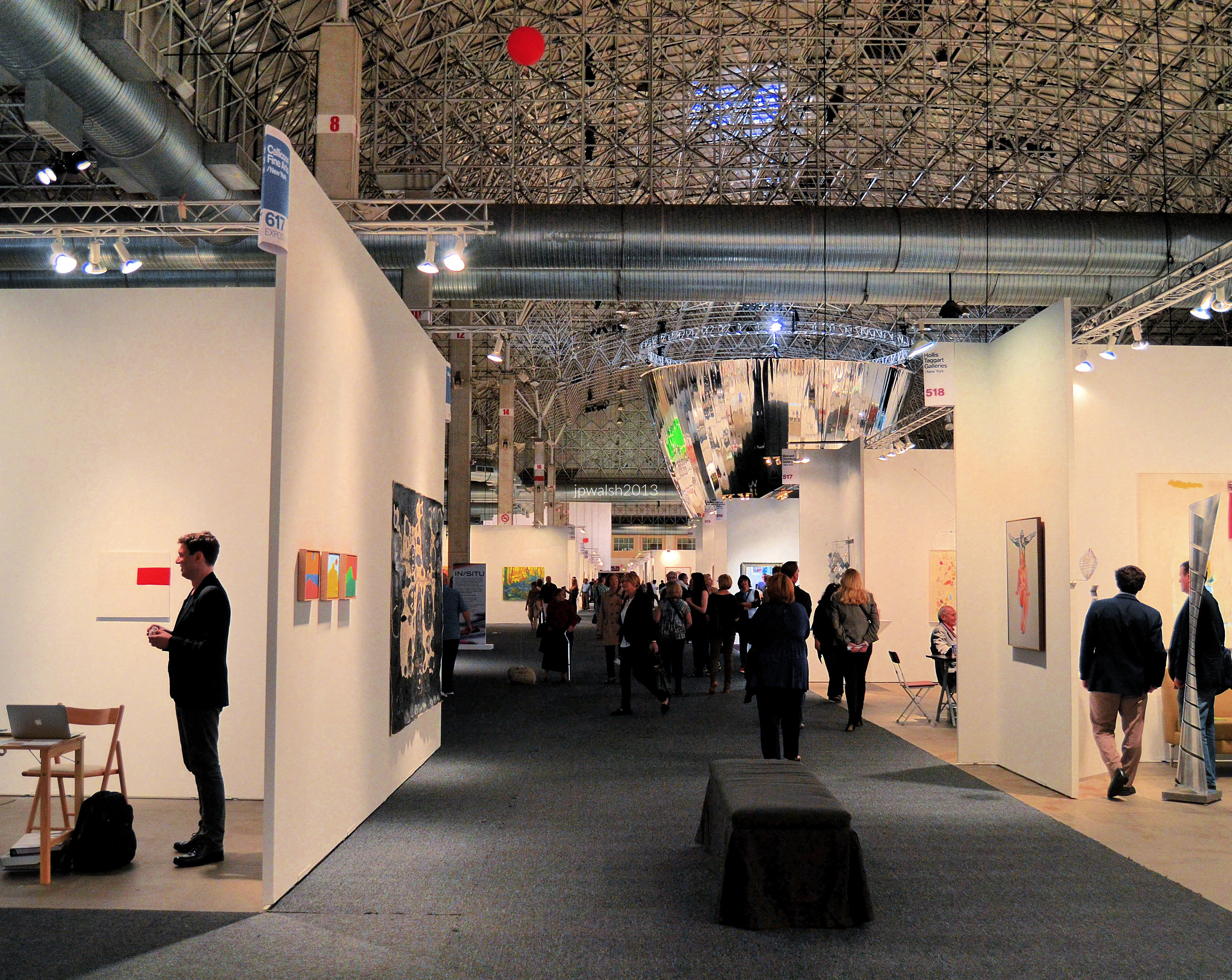
EXPO CHICAGO 2018 is the 7th annual exhibition of international contemporary and modern art held in Chicago at Navy Pier’s Festival Hall. It took place September 27-30, 2018. Expo Chicago/2018 presented 135 galleries and exhibitors representing 27 countries and 63 cities from around the world.
EXPO CHICAGO 2018 includes exhibitors four sections categorized to a specific aim: Exposure are galleries founded since 2010 featuring one or two artists; Profile are international galleries featuring solo or collective artists with focused installations, exhibitions and projects; Editions + Books highlight artist books, editions, prints, collectibles, photography, collage, drawing, etc.; Special Exhibitions” feature site specific work.
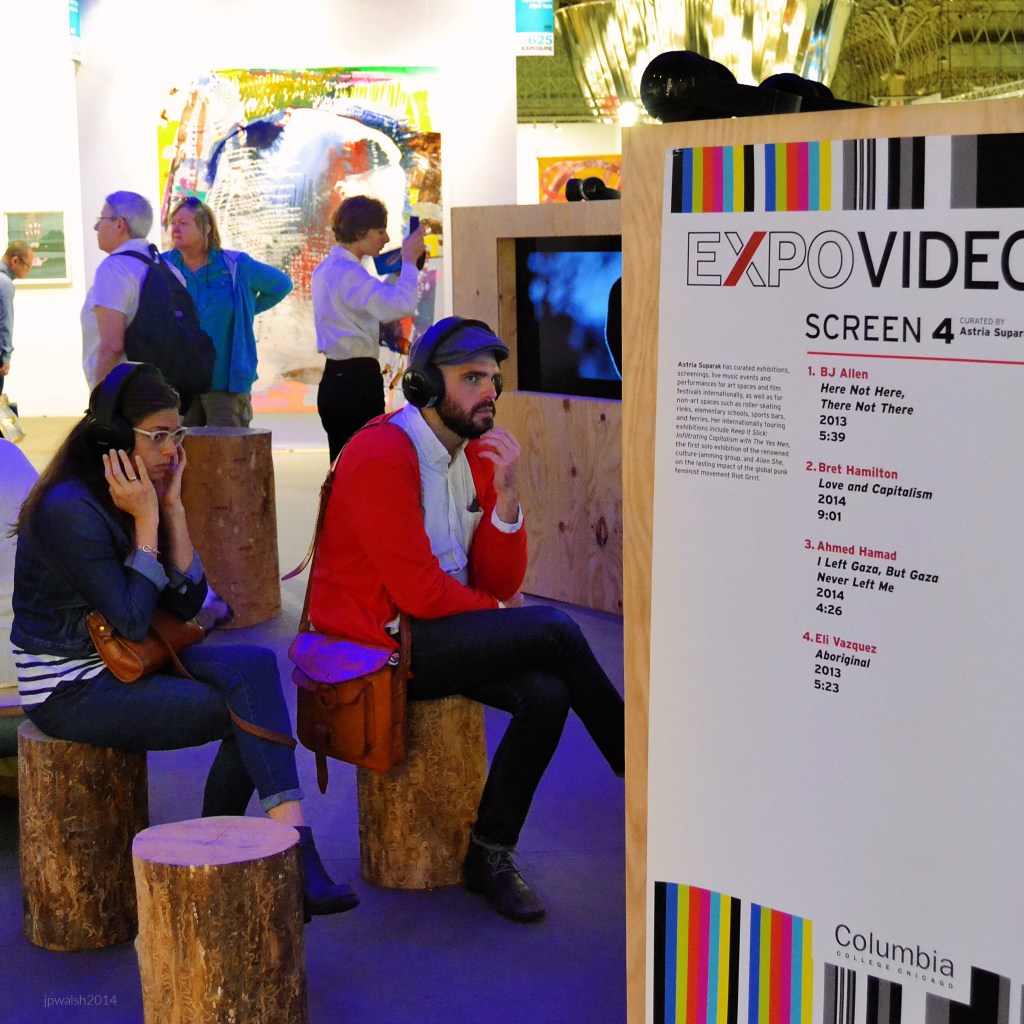
More EXPO CHICAGO 2018 sections include: IN/SITU highlighting curated large-scale installations (a second, outside version features large-scale sculptures in various Chicago locations); EXPO VIDEO highlighting curated film, video and new media work; EXPO SOUND highlighting curated sound installations and projects.
All photographs & texts by John P. Walsh
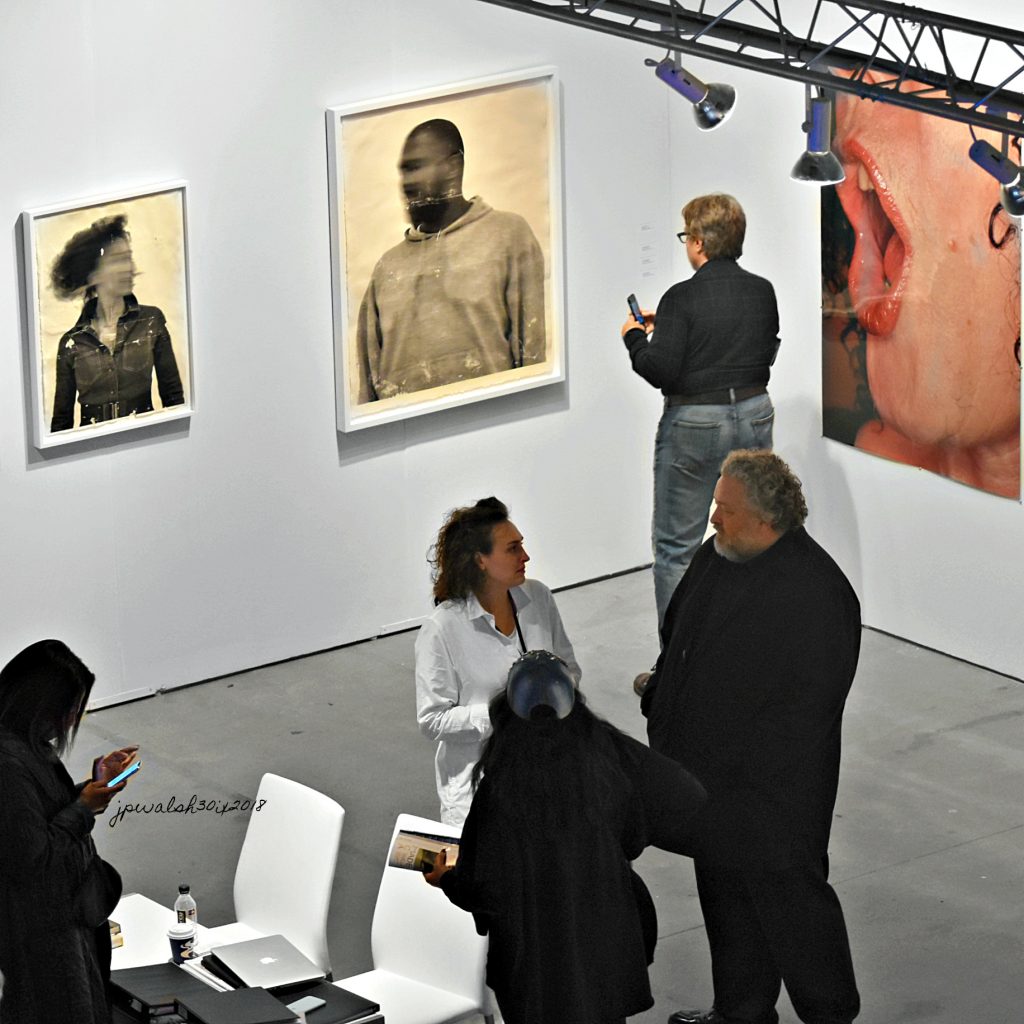
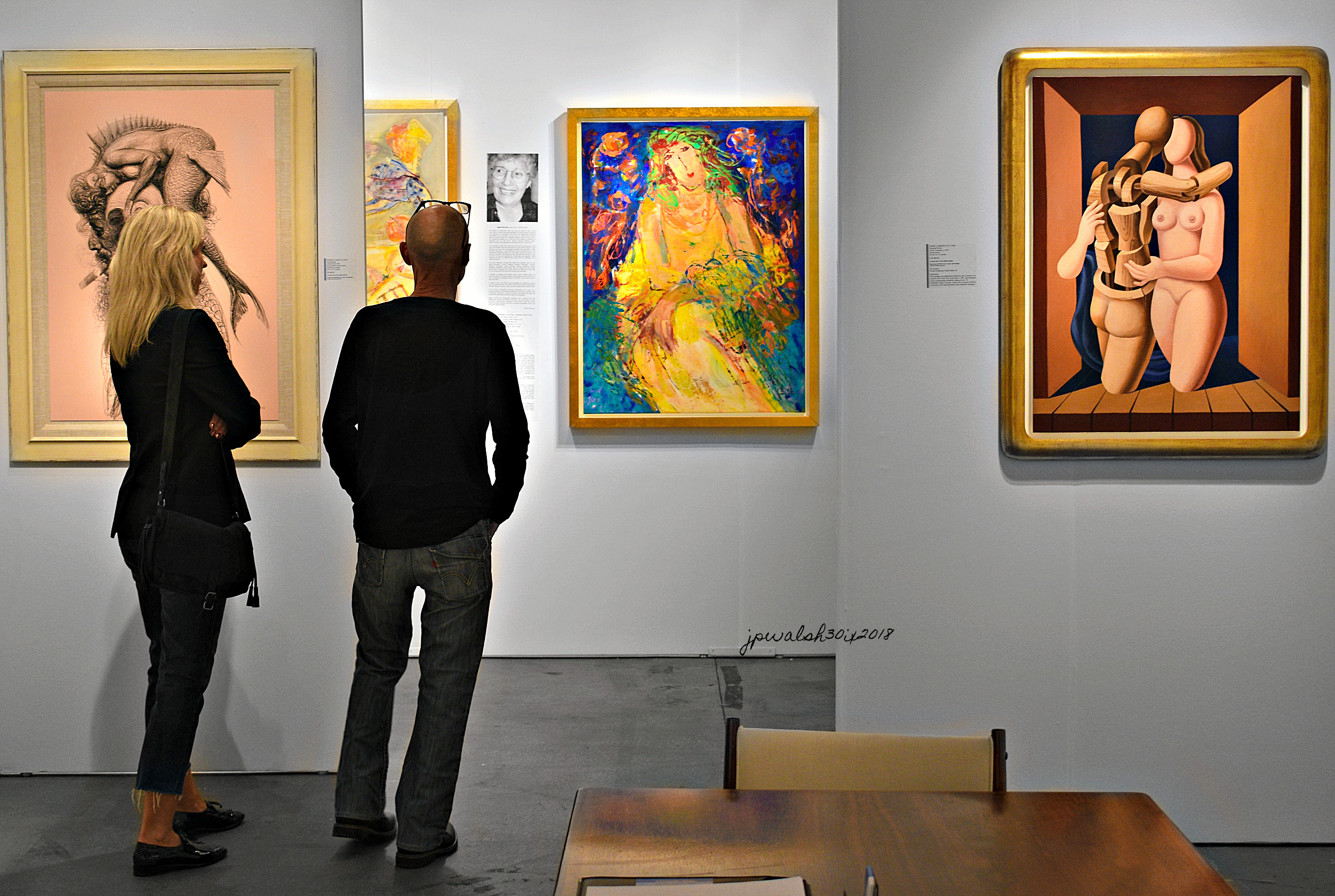
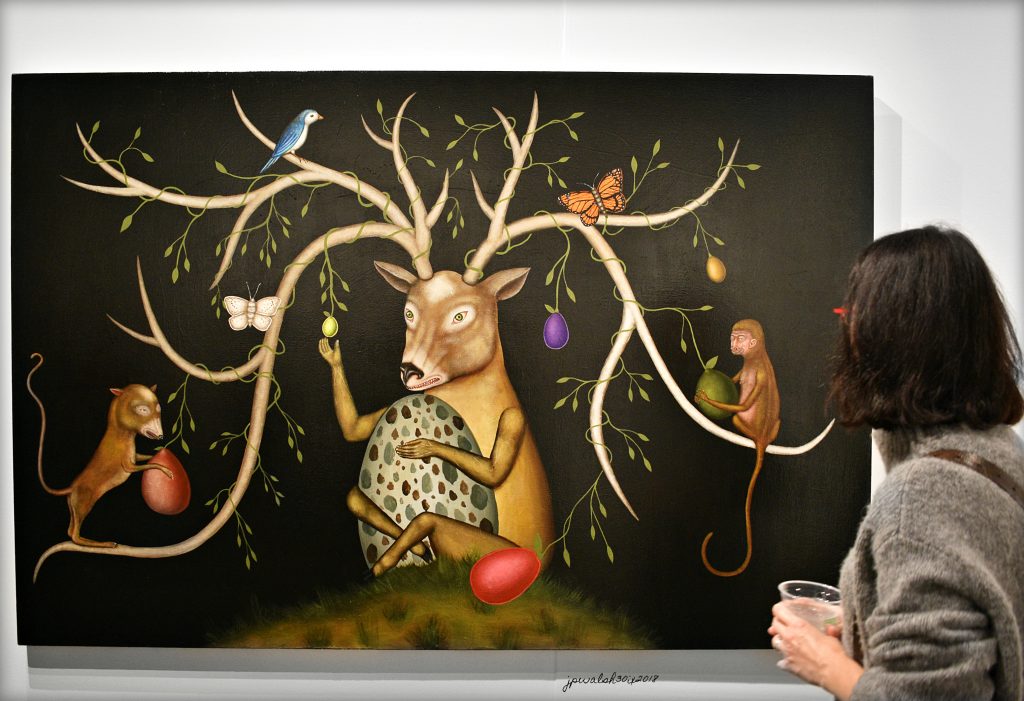
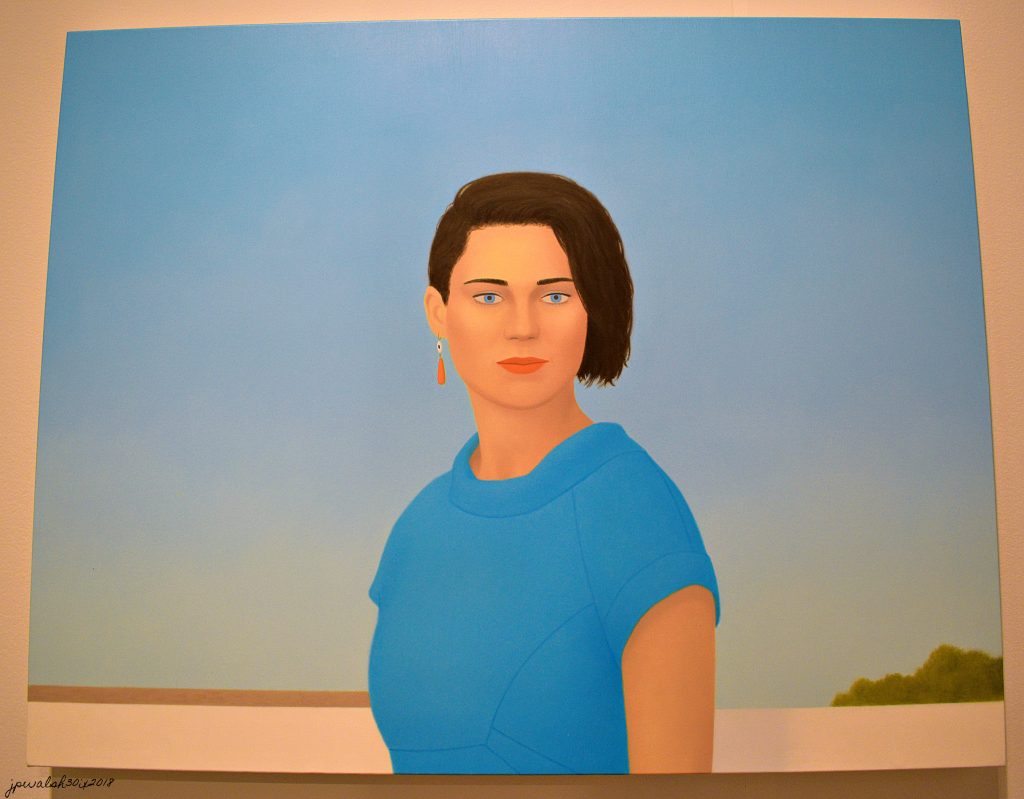
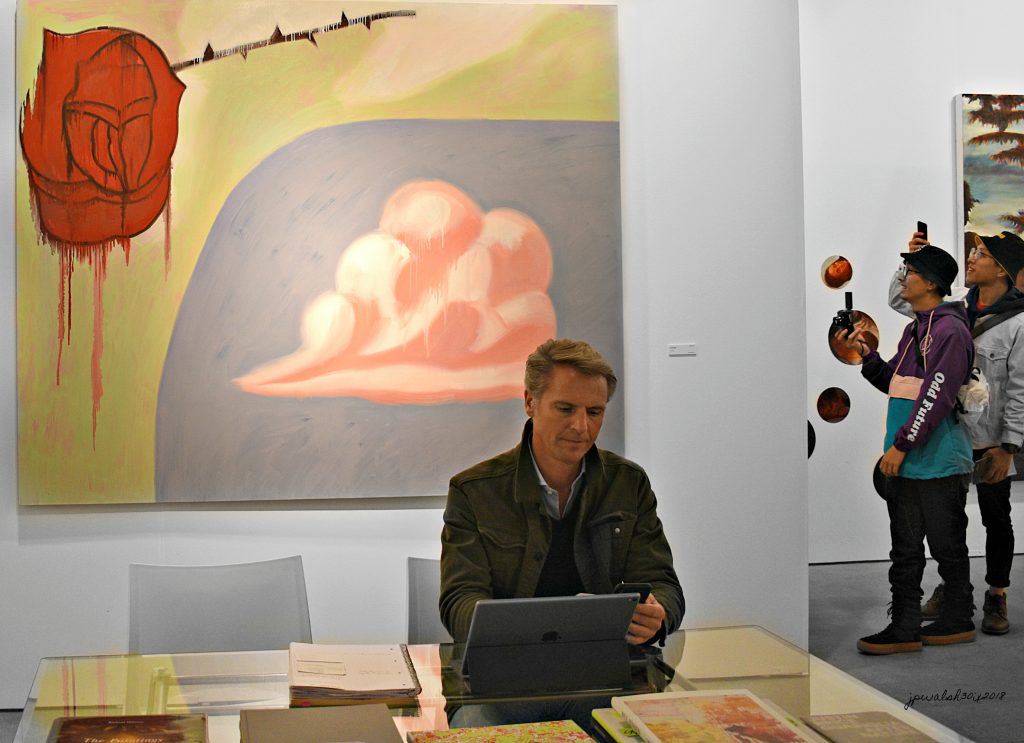
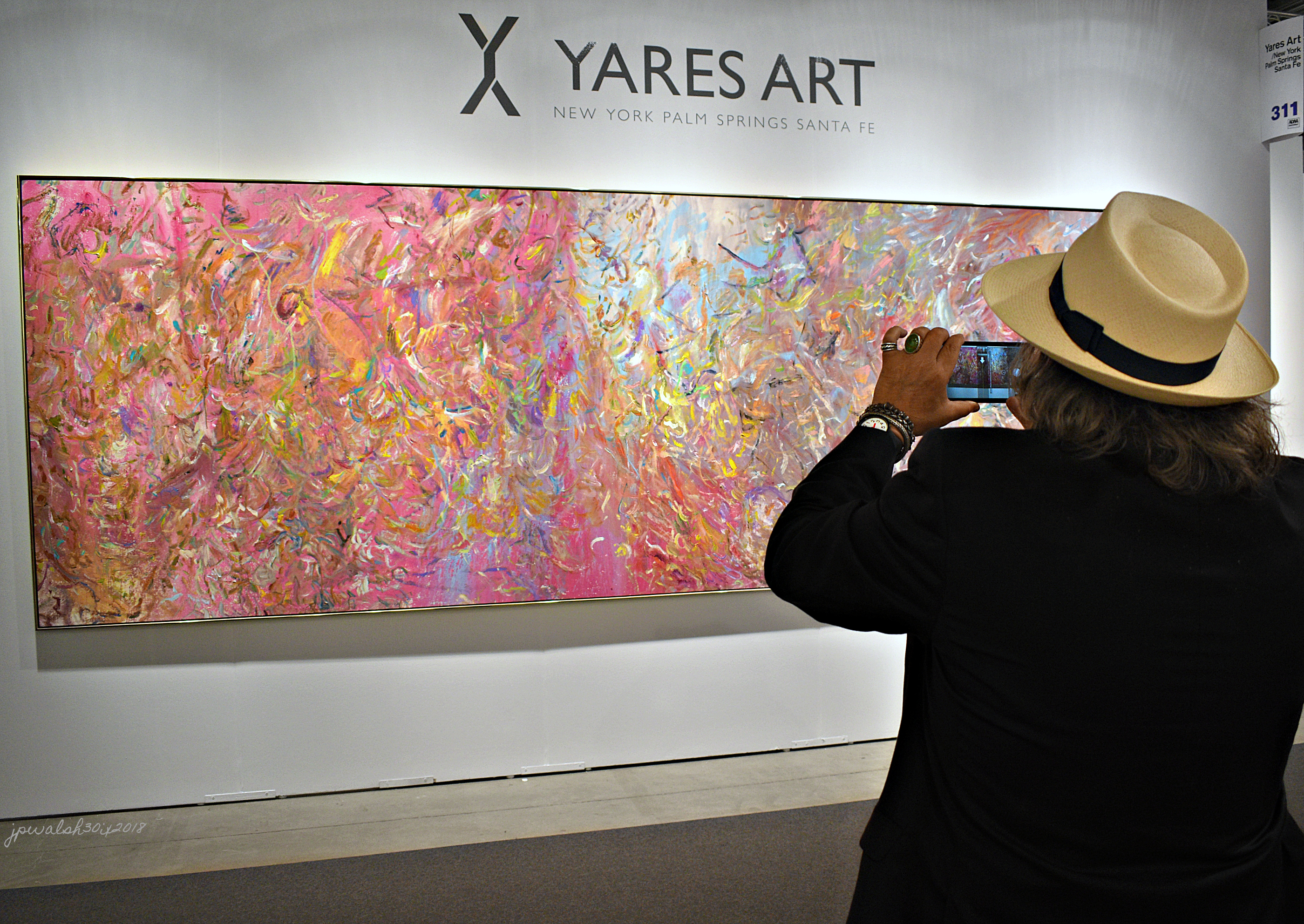
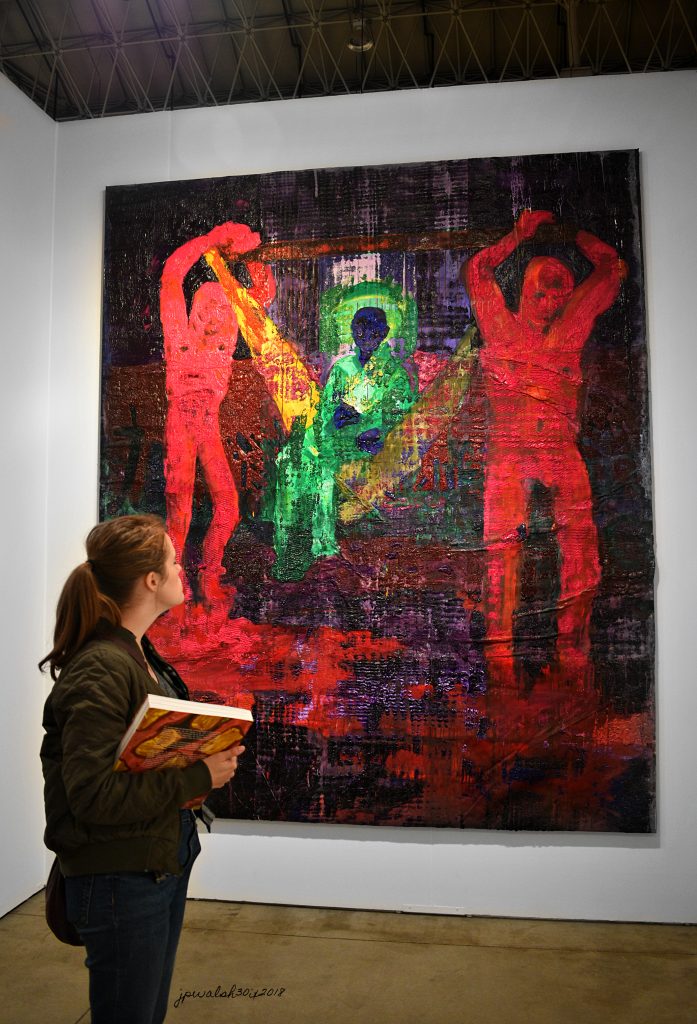
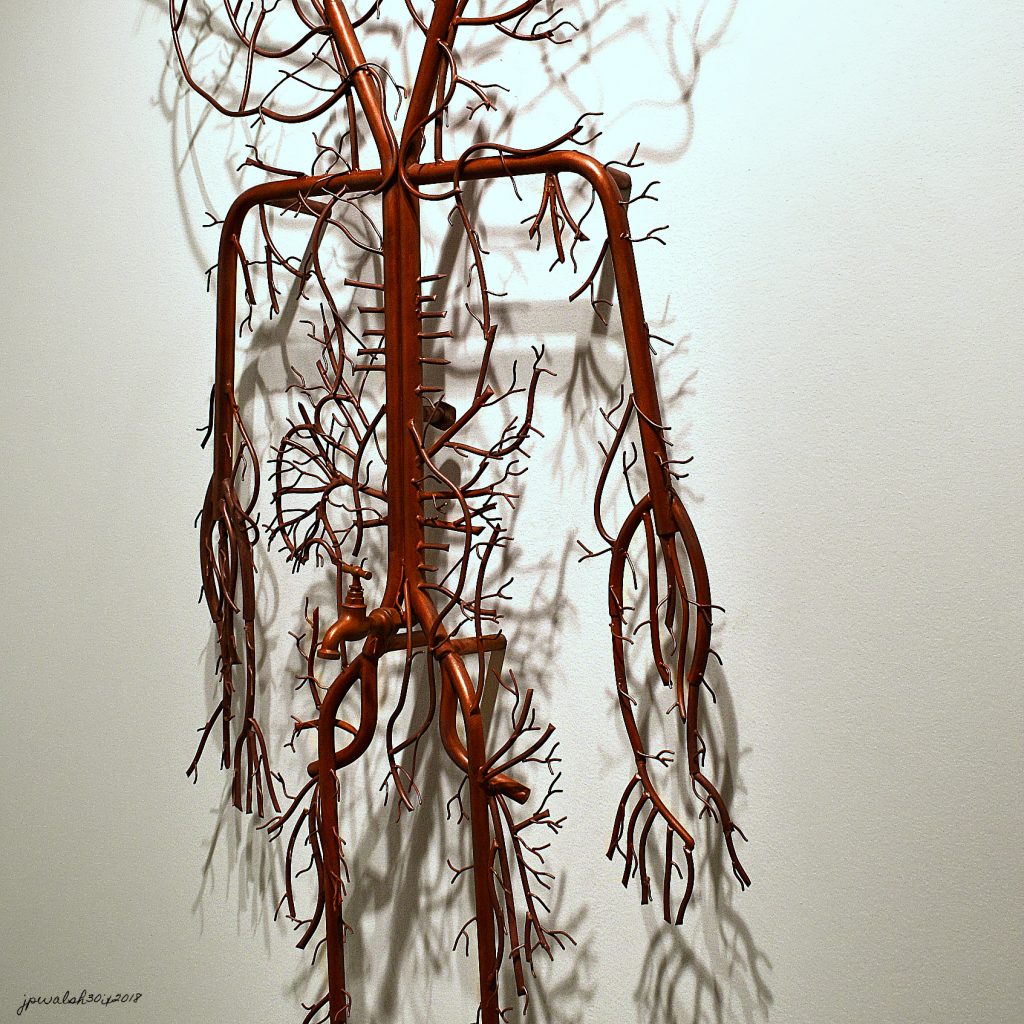
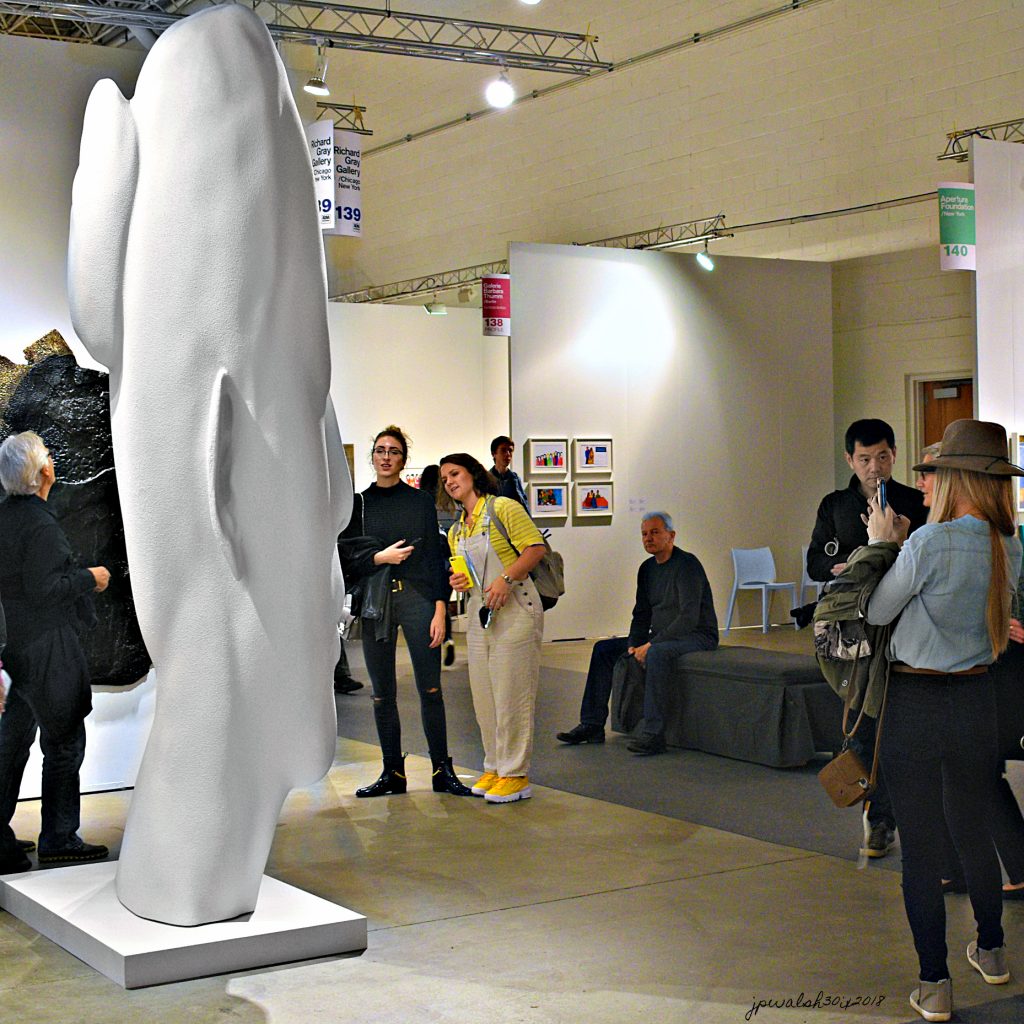
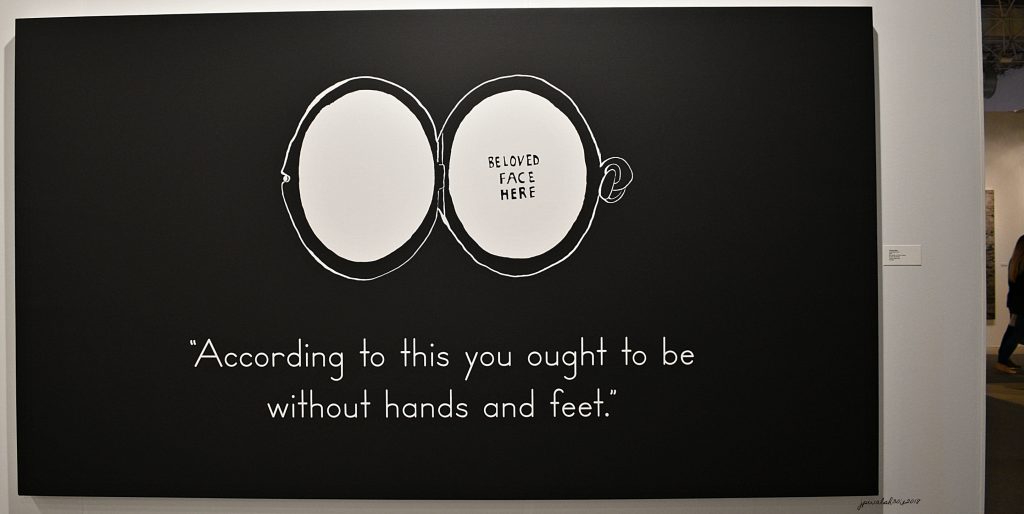
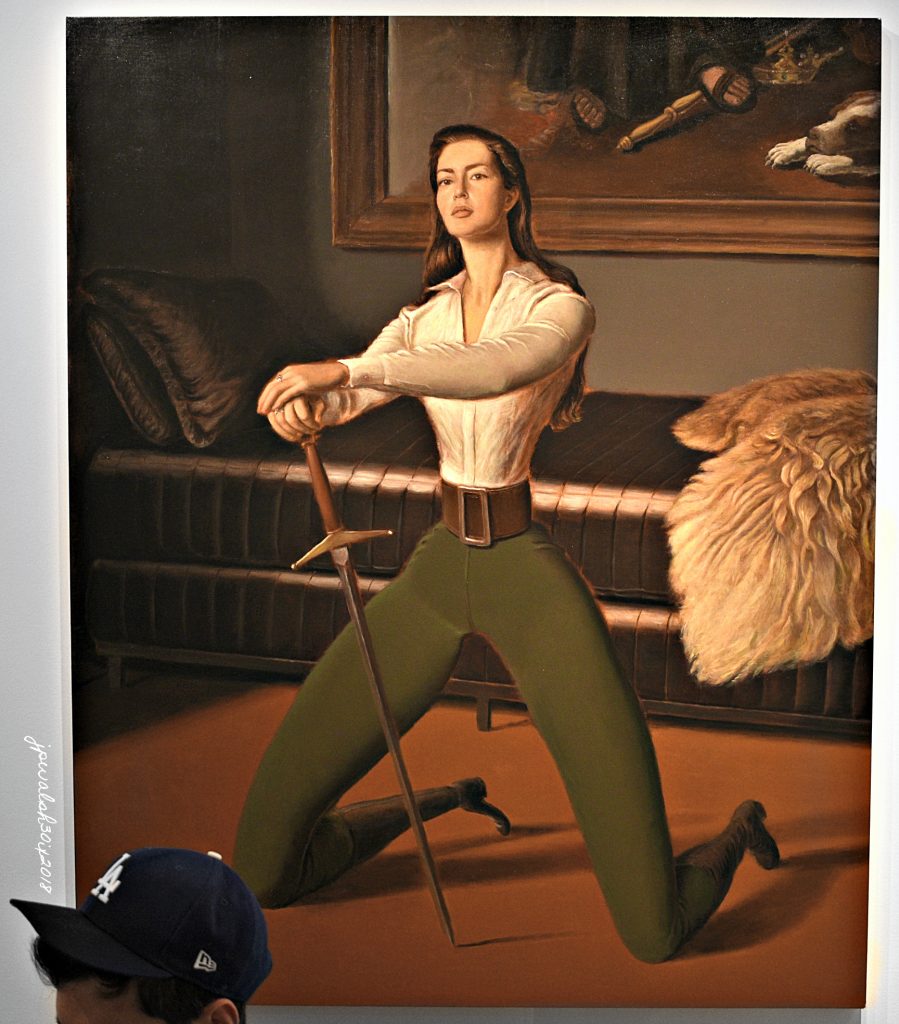
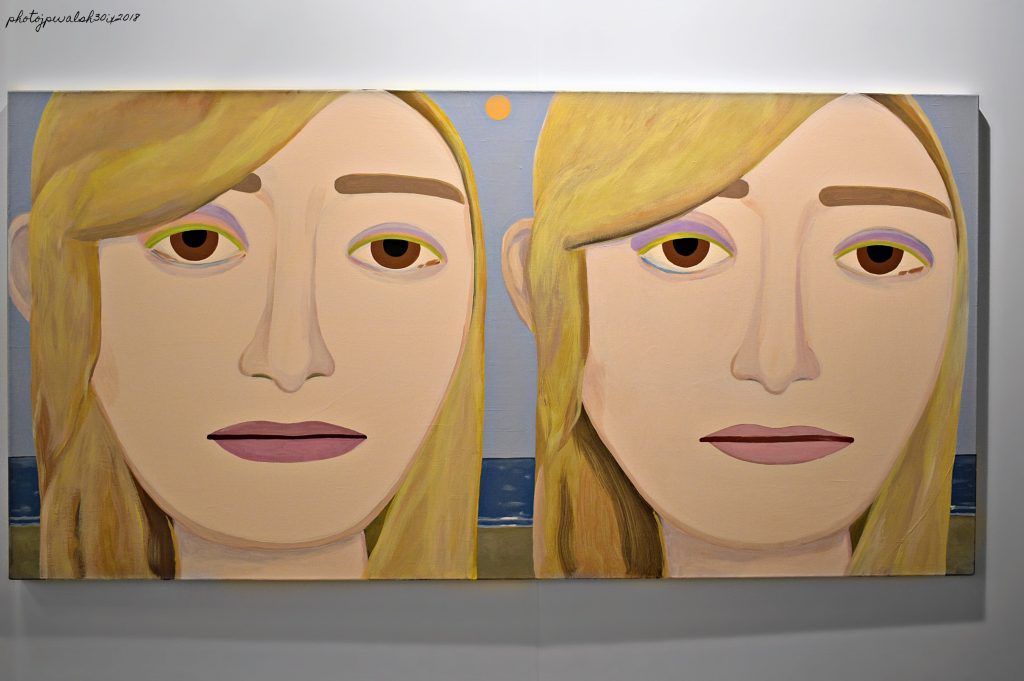
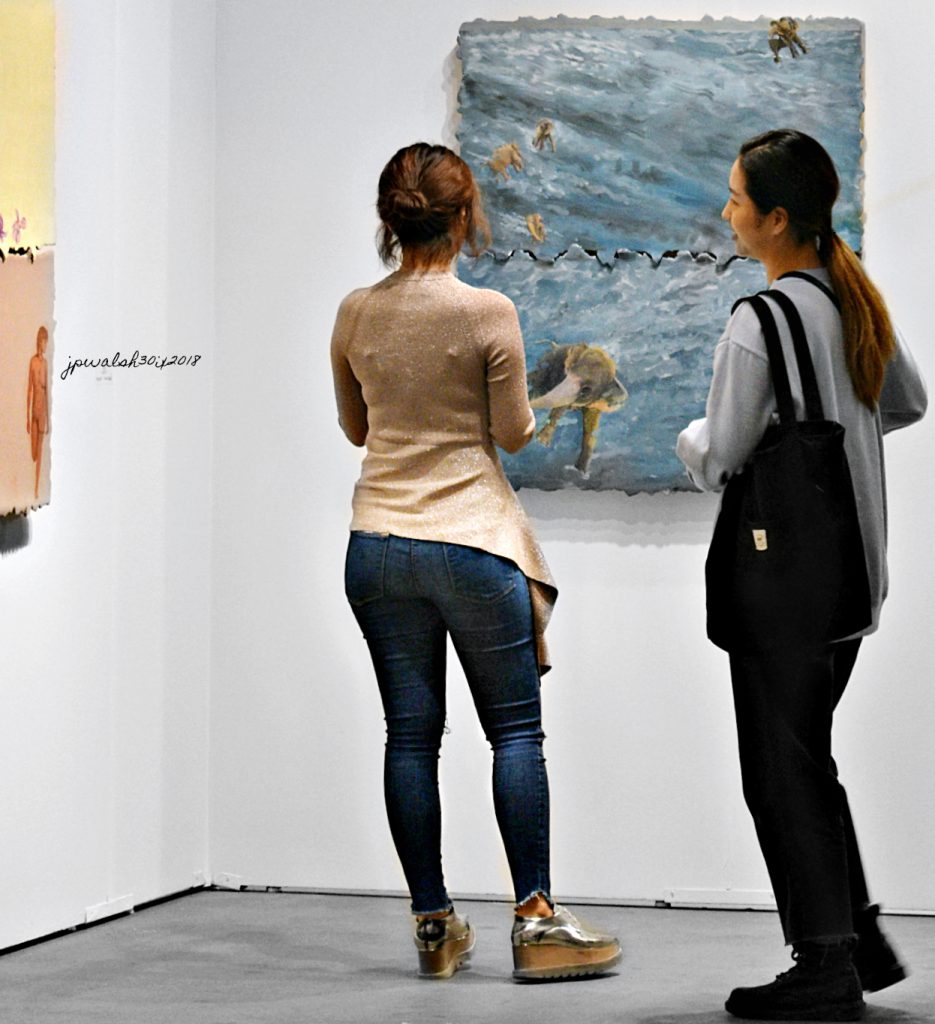
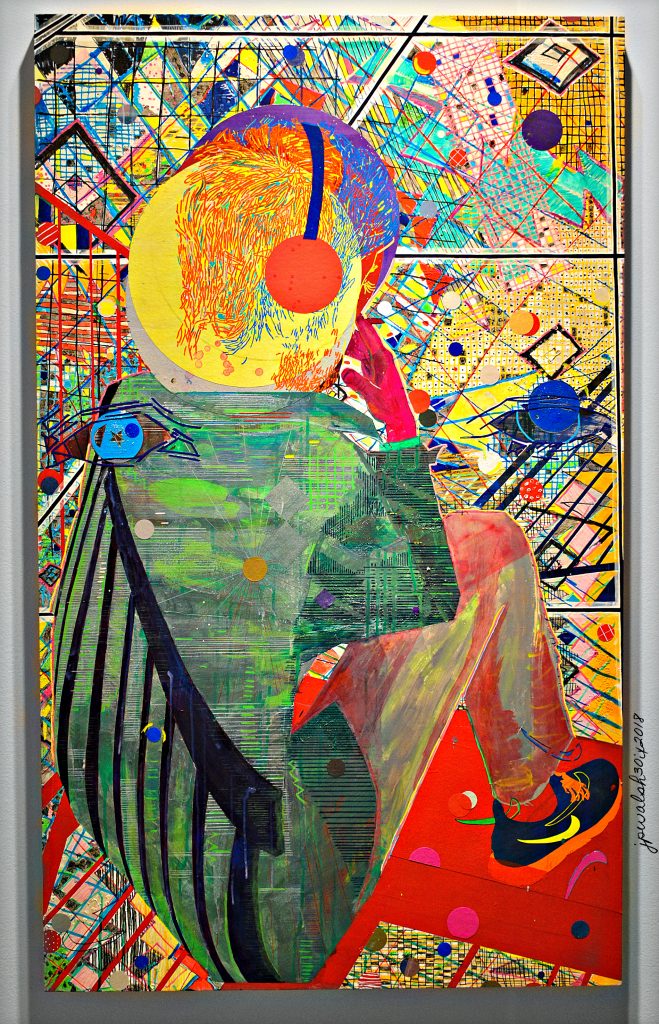
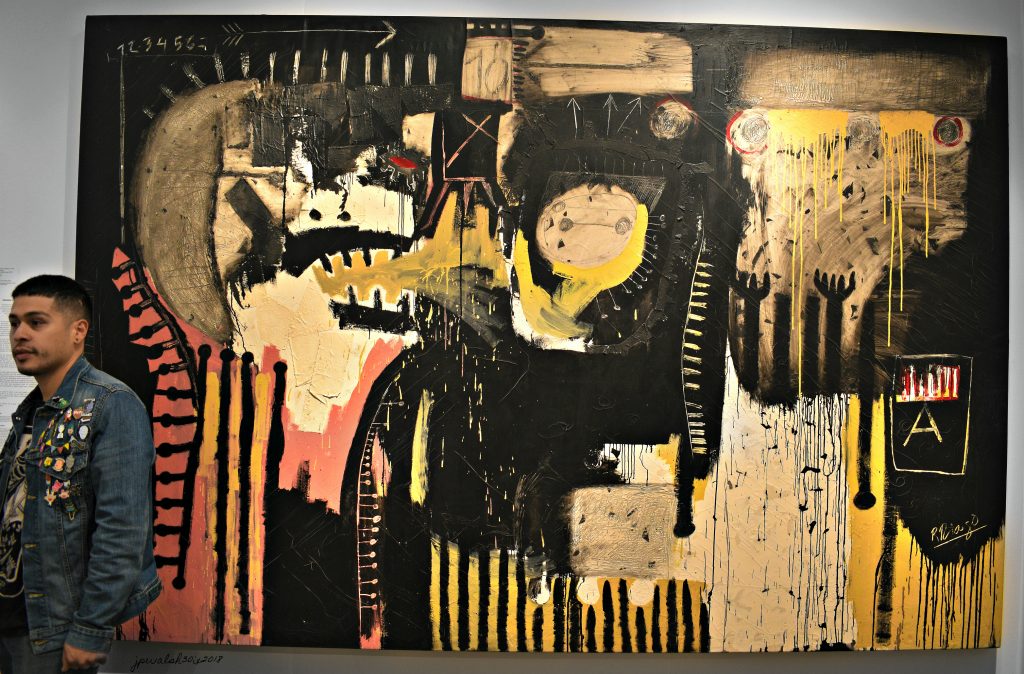
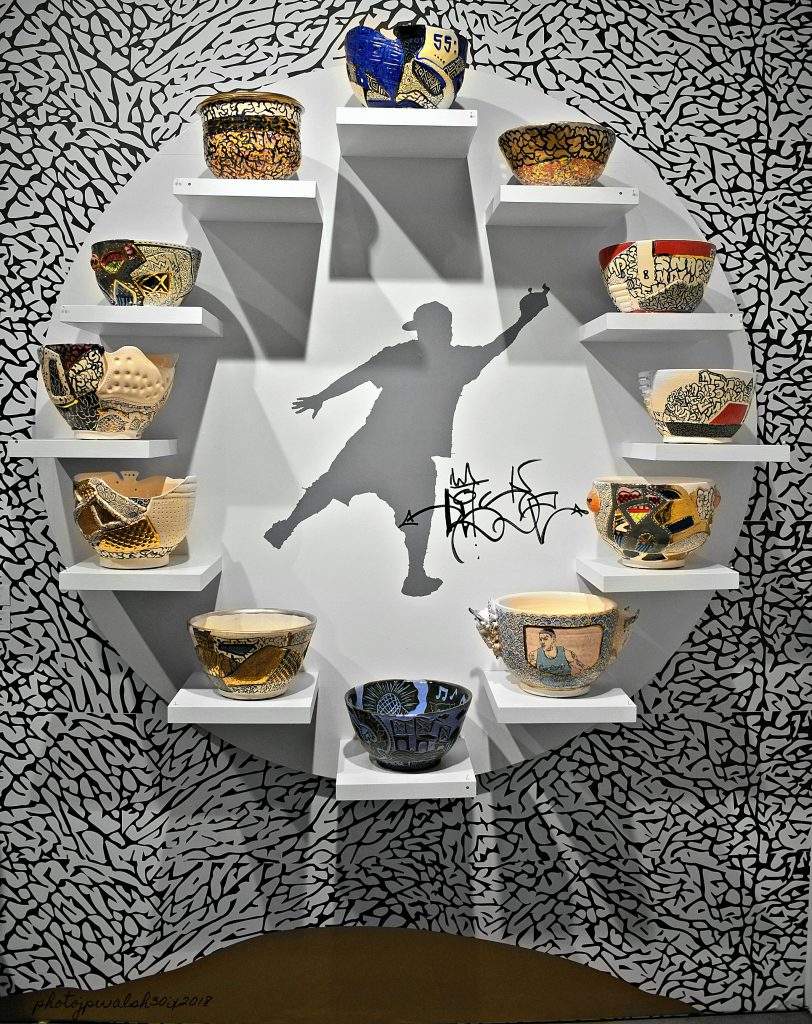
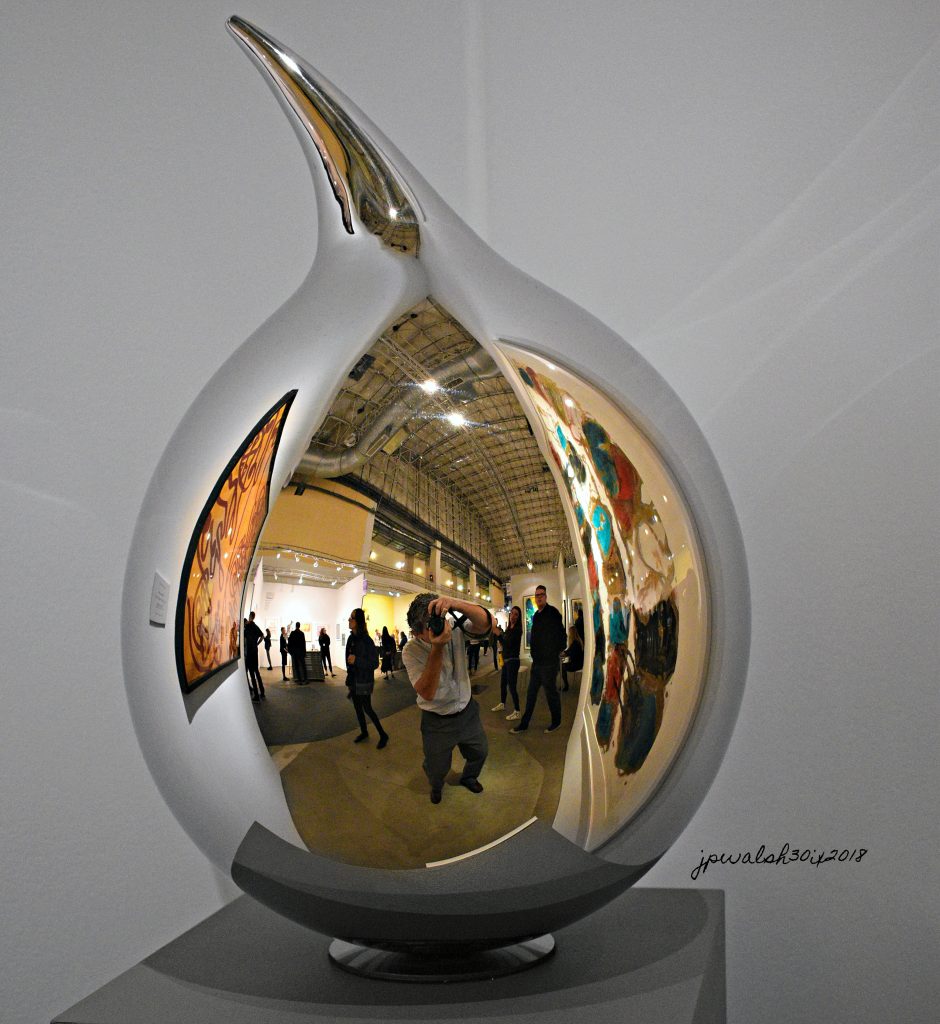
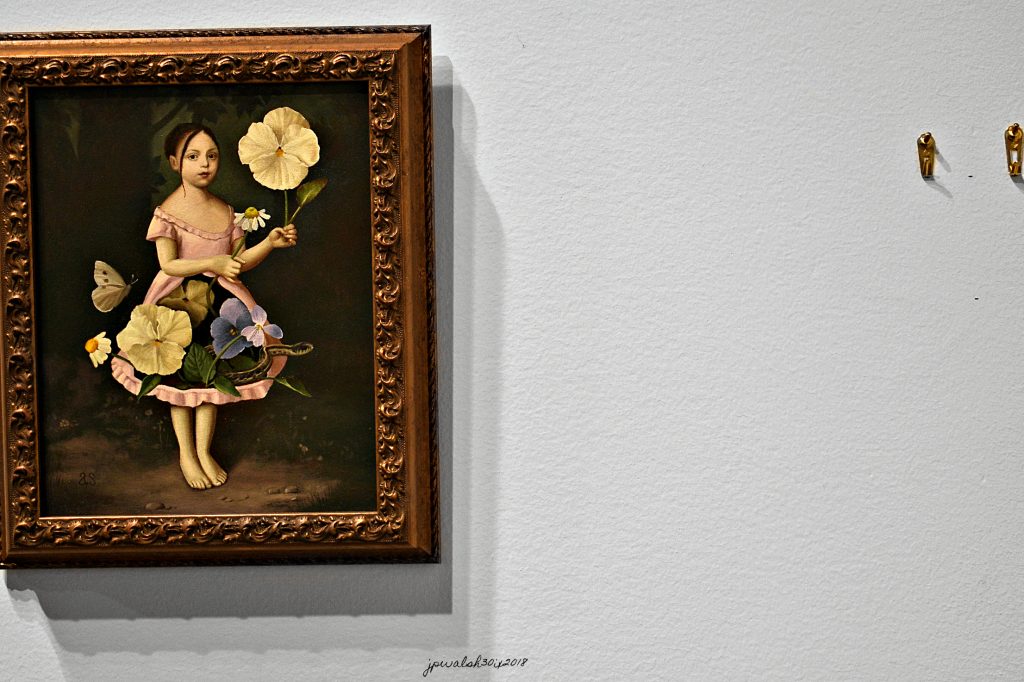
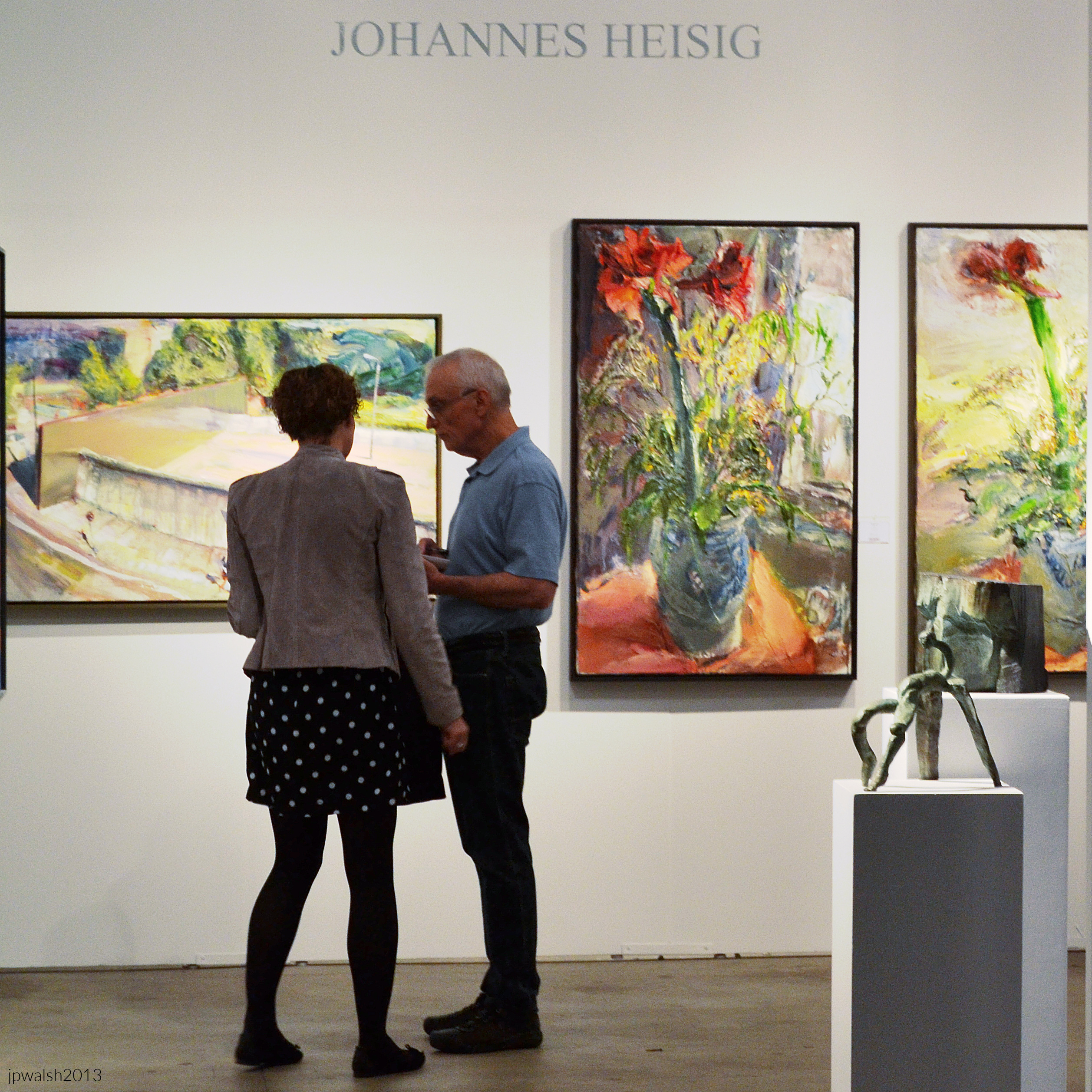
EXPO CHICAGO 2018 was held in Festival Hall on Navy Pier in Chicago. The annual event, held since 2012, is in its seventh year.EXPO CHICAGO 2018 attracts thousands of attendees to visit with hundreds of gallery owners and artists from all over the world.Expo Chicago is a major modern and contemporary art event held each year to open the Fall art season. It is held nearby to downtown Chicago and the Magnificent Mile on historic Navy Pier which is one of Chicago’s most popular tourist magnets.One of the information desks at EXPO CHICAGO 2018. EXPO CHICAGO 2018 welcomed 135 international art galleries from 27 countries and 63 cities.Georgia Scherman Projects, Toronto. Within the framework of the show’s sections, each booth showcases the artwork of their choosing .Artwork of Marcus Jansen was featured at Casterline/ Goodman Gallery, Aspen, CO, Chicago, and Nantucket, MA.Artist Gina Pellón (center) at Cerunda Arte, Coral Gables, FL.Surrealist painter Fred Stonehouse, Night King, 2018, acrylic on canvas, Tory Folliard Gallery, Milwaukee, WI.Richard Hughes, Hot Step, 2017, cast polyester resin and enamel paint, Anton Kern Gallery, New York.Ridley Howard, Blue Dress, Blue Sky, 2016, acrylic on linen, Frederic Snitzer Gallery, Miami, FL.admissions. Library Street Collective, Detroit, MI. Artist Francesco Clemente, 2018, oil on canvas at Maruani Mercier Gallery, Brussels, Belgium.Artwork of Larry Poons, Yares Art, New York, Palm Springs, Santa Fe.Artwork of Austin White, 2018, Jenkins Johnson Gallery, San Francisco and New York.In/Situ: Postcommodity, Repellent Fence, 2015, Bockley Gallery, Minneapolis, Minnesota.Peter Blake Gallery, Laguna Beach, CA.Artwork by Asmund Havsteen Mikkelsen at the booth shared by Fold Gallery, London, and Galleri Kant, Copenhagen.Prune Nourry, River Man (detail), 2018, patinated copper tubes, Galerie Templon, Paris.Gérard Garouste, The Eagle Owl and the One-Eared Woman, 2016, Galerie Templon, Paris.Jaume Plensa’s Laura Asia in White, 2017, polyester resin and marble dust, at Richard Gray Gallery, Chicago.Jaume Plensa’s Laura Asia in White, 2017, polyester resin and marble dust, at Richard Gray Gallery, Chicago.William Kentridge, Blue Rubrics, 2018, lapis lazuli pigment on thesaurus pages, NFP Field Tate Editions, Royal Academy of Arts, London.Frances Stark, According to This…, 2018, Silk screen on linen on panel, Gavin Brown’s Enterprise, New York and Rome.David Driskell (b. 1931), Jazz Singer (Lady of Leisure, Fox), 1974, oil and collage on canvas, 52 x 44 in., DC MooreGallery, New York City.Jansson Stegner, Swordswoman, 2018, oil on linen, Nino Mier Gallery, Los Angeles.Brian Calvin, Eternal Return, 2009, acrylic on canvas, Anton Kern Gallery, New York.Margot Bergman, Gloria, 2014, acrylic on linen, Corbett vs. Dempsey, Chicago.Ceysson & Bénétière, New York Luxembourg Paris Saint-Étienne.Julie Heffernan, Self-Portrait with Nuala, 2018, oil on canvas, Zolla/Lieberman Chicago.Chloe Wise, You would have been a castle for a moment, 2016, Galerie Division, Montreal and Toronto.EXPO CHICAGO 2018. EXPO CHICAGO 2018. Artwork of Devan Shimoyama, De Buck Gallery New York City.EXPO CHICAGO 2018. Chie Fueki, Kyle, 2017, DC Moore Gallery, New York City.Naudline Pierre, Deal Kindly and Truly With Me, 2018, oil on canvas, 56 x 52 inches, Shulamit Nazarian, Los Angeles.Clare Sherman, Sea Cave, 2017, oil on canvas, 84 x 66 in., DC Moore Gallery, New York City.Roberto Fabelo, Gothic Habanero, n.d., oil on canvas, Cerunda Arte, Coral Gables, FL.EXPO CHICAGO 2018 brings the world of modern and contemporary art to Chicago for the collector.EXPO CHICAGO 2018 offers the art lover opportunities to encounter the latest in modern and contemporary art from around the world.EXPO CHICAGO 2018 covers tens of thousands of square feet with modern and contemporary art of many kinds from 27 countries and 63 global cities.EXPO CHICAGO 2018Sculpture, painting, and other visual art forms were in evidence at Expo Chicago/2018. There is a popular on-site cafe that serves snacks and beverages.EXPO CHICAGO 2018EXPO CHICAGO 2018EXPO CHICAGO 2018Juan Roberto Diago, Grito, 1997. The artist talks about his artistic debt to Jean-Michel Basquiat.Fort Gansevoort, New York City.Artwork of Nick Dawes, 2018, Galerie Kornfeld, Berlin.Tsailing Tseng, Black Moor, Spring/ Sun/ Winter/ Dread/ Everything Everything, 2018, oil on linen, SAIC Booth (Tuttle Fellowship).Roberto Lugo, porcelain china, paint, luster, 2018, Wexler Gallery, Philadelphia. PA.Lavar Munroe, Spy Boy, 2018, acrylic and earring stud on canvas, Jenkins Johnson Gallery San Francisco New York.In/Situ: Ivan Argote, Among Us — Across History…, 2017.Richard Hudson, Tear, 2016, polished mirrored steel, Michael Goedhuis London Beijing New York. Aniela Sobieksi, Girl with a Garden, 2018, oil on panel, Tory Folliard Gallery, Milwaukee. The painting next to it sold just before I took this photograph.The Hole NYC.Barnaby Barford (b. 1977), Celebrity, 2018, Giclée Print, David Gill Gallery, London.
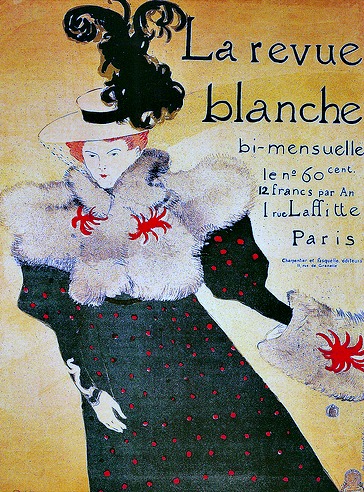
FEATURE image: Henri de Toulouse-Lautrec (1864-1901), La Revue Blanche, 1895, Paris. Lithograph in four colors.
From Montmartre to Mass Culture: Henri Toulouse-Lautrec’s 31 color posters transformed commercial advertising into modern art, using innovative color lithography, bold design, and iconic images of Parisian nightlife to democratize art and shape the visual language of the twentieth century.
By John P. Walsh
The Artist in an Age of Mass Production
The nineteenth century in France brought about a radical transformation of the role of the artist. In place of artwork for aristocratic patrons, artists in all media were increasingly left to their own devices and began creating works of art in their studios and looking to sell them in the open marketplace. Innovative forms, new subjects, and new styles emerged from these changing economic structures brought about by the dawning of the industrial and technological age as well as the growing importance of cities.
In Paris and elsewhere, enterprising artists sought to attract new clients increasingly composed of the urban bourgeoisie. By the mid-to-late nineteenth century the involvement of the public in artistic matters became an irrevocable fact which had been secured by the improved means of mass production. New processes in lithographic and photographic printmaking, for example, made art widely available to a popular audience. The entry of this sort of democracy into artistic production coincided with current aesthetic influences such as a Japonisme movement prevalent in France in the years before 1890. In addition, there was a new understanding of modern beauty that began around 1830 that rejected traditional forms of beauty manifested in classical and later art forms.
Henri Toulouse-Lautrec and the Emergence of Modern Poster Art
By the early 1890’s when Henri Toulouse Lautrec (French, 1864-1901) created his mass-produced posters in Paris a new artistic practice had appeared whose idea of beauty was contemporary, sophisticated and subtly realistic. By 1890, Lautrec’s art could react in several ways to the modern art tradition. Toulouse-Lautrec repudiated the bourgeois modernity of the Impressionists from the 1870’s and 1880’s displayed in the drawing-room paintings of Claude Monet (French, 1840-1926) and Pierre-Auguste Renoir (French, 1841-1919) and, owing to cultural spaces that had shifted by the 1880’s to artistic cabarets and literary cafés, Lautrec could also claim to be a direct heir to an earlier 1830’s romantic bohemian and 1840’s flâneur.
Montmartre, Bohemia, and the Public Sphere
There are several interpretations for this cultural shift and its effects on artists and artistic practice in the 1890’s including Toulouse-Lautrec’s mass-produced commercial posters. Building on a rejection of bourgeois art forms, Mary Gluck at Brown University argues that artists such as Toulouse-Lautrec—who with others was a creature of the cabarets and cafés—desired commercial mass media to be the means by which the public sphere would eclipse individual lives which modern society had fragmented. At the center of their art production, Gluck believes, is a distinct vision of modernity identified with a city’s public space as opposed to the private anonymity of bourgeois culture (see Popular Bohemia: Modernism and Urban Culture in Nineteenth-Century Paris, 2005).
To strive to transform the public sphere by way of the legacy of the café-concert about and for which Toulouse-Lautrec created a significant amount of his mass-produced commercial art could only be an ambitious cultural task. These cabarets and café-concerts, mostly centered on and around Montmartre in Paris, were crowded, loud and often rowdy. Its performances and clientele were often unpolished and popular. Small but well-known art movements such as Les Arts incohérents and their Montmartre cabaret Les Hydropathes begin to describe the level of social parody and frivolity to be expected within these establishments.
While Lionel Richard at the University of Picardy attributes these activities to social rebels (see Cabaret, Cabarets: Origines et décadence, 1991), Jerrold Seigel at New York University views it as a calculated new relationship between the popular classes and the bourgeoisie where the aspiring artist, such as Toulouse-Lautrec, could create art for potential customers (see Bohemian Paris: Culture, Politics, and the Boundaries of Bourgeois Life, 1830-1930, 1986). For T. J. Clark, the cabaret’s diverse audience as a venue for some form of cultural democracy by way of a mixing of classes is illusory (see “The Bar at the Folies-Bergères,” The Wolf and the Lamb: Popular Culture in France, From the Old Régime to the Twentieth Century, 1977).
Charles Rearick of the University of Massachusetts, Amherst, casts an eye on those frivolous aspects of the Montmartre cabarets, dance halls, and literary cafés. His conclusion is that these activities allowed a Parisian to escape modern society’s social constraints of respectability typically found everywhere else (see Pleasures of the Belle Epoque: Entertainment & Festivity in Turn-Of-The-Century France, 1985). Phillip Dennis Cate at The Jane Voorhees Zimmerli Art Museum at Rutgers University viewed the role of cabarets in the artistic context of these bohemian antics being the genesis of what became twentieth-century avant-garde aesthetics (see The Spirit of Montmartre: Cabarets, Humor, and the Avant-Garde, 1875-1905, 1996). It is the affirmation of the values of spontaneous experience and direct communication as an integral aspect of the modern experience and, for the fin-de-siècle bohemian, parodic performances which helped criticize the official art establishment that carried forward into artistic attitudes in the new century.
The Legacy of Toulouse-Lautrec’s Posters
The fruit of reflection for this late-nineteenth-century artistic period in Paris is numerous and diverse. It leads to the observation—whether of Henri de Toulouse-Lautrec or the variety of subjects in his mass-produced commercial art—that the stereotype of the artist, poet, or performer as bohemian, owing to their psychological nuance and stylistic antisepsis as aesthetic modernity—and possibly its inverse—becomes a source for their estrangement and alienation from modernity—that is, to emerge as an alienated human figure detached from their society and time. With Toulouse-Lautrec’s sixth poster (Divan Japonais, 1893) it is clear that his mass-produced commercial poster art in Paris was making an important impact on modern art in the 1890’s. It was a new art form for its deploying the rapidly developing technique of color printing. It utilized new approaches to composition and subject matter which were created for a mixture of new and popular commercial establishments. Finally, and perhaps most significantly, they became the first regularly displayed art commodity for public mass consumption. Each of these art principles and practices found in Toulouse-Lautrec’s posters of the 1890’s continue to impact contemporary art-making today.
Toulouse-Lautrec’s 31 posters (1891-1900) represent one of the earliest successful unions of fine art and mass-produced advertising.
1. Henri de Toulouse-Lautrec – Moulin Rouge-La Goulue, 1891.
1. Moulin Rouge-La Goulue is a lithograph done in 4 colors: yellow, blue, red, and black. The Moulin Rouge opened in 1889 and, in summer 1891, the poster was commissioned by its owners. It depicts La Goulue (“The Glutton”) who is 21-year-old Louis Weber (1870-1929) and Valentin-le-Désossé (“the Boneless”) (1843-1907). This is Toulouse-Lautrec’s first, largest, and many estimate, most complex and artistically important poster. Printed by Charles Levy, it is made up of two sheets although Toulouse-Lautrec thought the printer had made mistakes and didn’t use him again. When this poster was plastered around Paris, the artist knew that his own silhouetted profile could be found in the background of silhouetted figures. The art of the streets pioneered by Jules Chéret (1836-1932) and immediately recognized for its implications by writers such as the Goncourt brothers and J.K. Huysmans (1848-1907) Lautrec exploited in the 1890’s aided by technological advances in color printing that continued to improve throughout the decade.
2. Henri de Toulouse-Lautrec – Le Pendu, 1892
2. The poster Le Pendu is a lithograph done in 2 colors: black and dark green. It was commissioned by a magazine editor to publicize a new theater play. Based on a true story of a wrongful capital death, the poster depicts the son’s suicide. Created in charcoal in late 1891, it was printed in 1895 in a limited edition for collectors only.
3. Henri de Toulouse-Lautrec – Ambassadeurs Aristide Bruant, 1892.
3. The poster Ambassadeurs Aristide Bruant is a lithograph in 5 colors yellow, blue, red, black, and olive green. Aristide Bruant (1851-1923) was a singer and this was a promotional poster for a café concert that opened in June 1892. The poster appeared all over Paris and on stage during the performance. The café owner thought the poster was a “disgusting mess” and refused to hang it until Bruant threatened to cancel his show. The subject wears a heavy dark velvet jacket, red shirt scarf, and wide brimmed hat with a riding crop. His head rises out of a dark mass which is lifted wholesale from a Japanese print by Katsukawa Shunshō (1726-1792).
Lautrec’s posters chronicled the vibrant world of Montmartre’s cabarets, cafés-concerts, dance halls, entertainers, and literary culture.
4. Henri de Toulouse-Lautrec – Eldorado Aristide Bruant. 1892.
4. The poster Eldorado Aristide Bruant is a lithograph in 5 colors (olive green, yellow, red, blue, and black). It includes the letters “TL” and signed monogram which will appear on other posters. The poster was created for the singer’s event on Boulevard de Strasbourg (north of Boulevard Montmartre at Sebastopol). With the same but reversed design, the customer and artist cut poster costs while increasing brand identity. In modern art the figure of the imposing heroic individual performer was new and Bruant became an overnight celebrity that year in Paris. Toulouse-Lautrec made no money on this project because the café owners were shocked by its content and refused to pay him.
Lautrec helped create a new form of visual culture where art left the museum and entered everyday life through posters pasted on city streets. These works became among the first art objects produced for broad public consumption and were tied directly to the cafés, cabarets, and entertainment venues of Montmartre.
5. Henri de Toulouse-Lautrec – Reine de Joie, 1892
5. The poster Reine de Joie is a lithograph in 4 colors (olive green, yellow, red, and black). It includes the emblematic letters “TL” and is signed. The poster was an advertisement for a suggestive new serialized novel by Victor Joze (1861-1933) and depicted the moment in the novel when the heroine kisses a fat banker, the latter being modeled by Georges Lasserre, a Lautrec friend. The poster, also used as the novel’s cover, caused a scandal across Paris and prompted a poster tear-down campaign. Speculation ran rampant as to who might be the real-life personalities on which characters in the novel were based.
The posters are documents of mass entertainment, celebrity culture, advertising, consumer culture, and urban nightlife in Belle Époque Paris.
6. Henri de Toulouse-Lautrec – Divan Japonais, 1892-93.
6. The poster Divan Japonais (1892-93) is a lithograph in 4 colors (olive green, yellow, red, and black). The cabaret on rue des Martyrs came under new ownership in 1892 and was totally refurbished in a trendy Japanese style. The poster depicts 24-year-old Jane Avril (1868-1943) with critic Edouard Dujarden (1861-1949) in the cabaret. On stage are shown the long black gloves of new singer Yvette Guilbert (1865-1944). In a stylistic move, the artist cuts off Guilbert’s head and shoulders in the poster much to the consternation of the young singer just getting started in her career. (She later commissioned a poster by another artist to depict her complete figure). When this poster went up all over Paris it created a sensation and was another triumph for Lautrec. In 1894 the Divan Japonais closed to be replaced by another establishment. As with his other posters, there were several preliminary sketches the artist made for Divan Japonais. The posters used the new and improving popular mechanical technique of color printing and applied it to commercial establishments and popular entertainers, subject matter usually reserved for cruder forms of advertisement.
Divan Japonais is one of Toulouse-Lautrec’s early posters. In his poster career the artist usually used anywhere from 2 to 5 colors. It is signed by Toulouse Lautrec. This Montmartre cabaret was taken over in 1892 by a new owner and totally refurbished in the avant-garde Japanese style which was the inspiration for the cabaret’s name. By February 1893 when this sixth poster was made by Lautrec and put up all around Paris, his 5 previous posters had already made him famous.
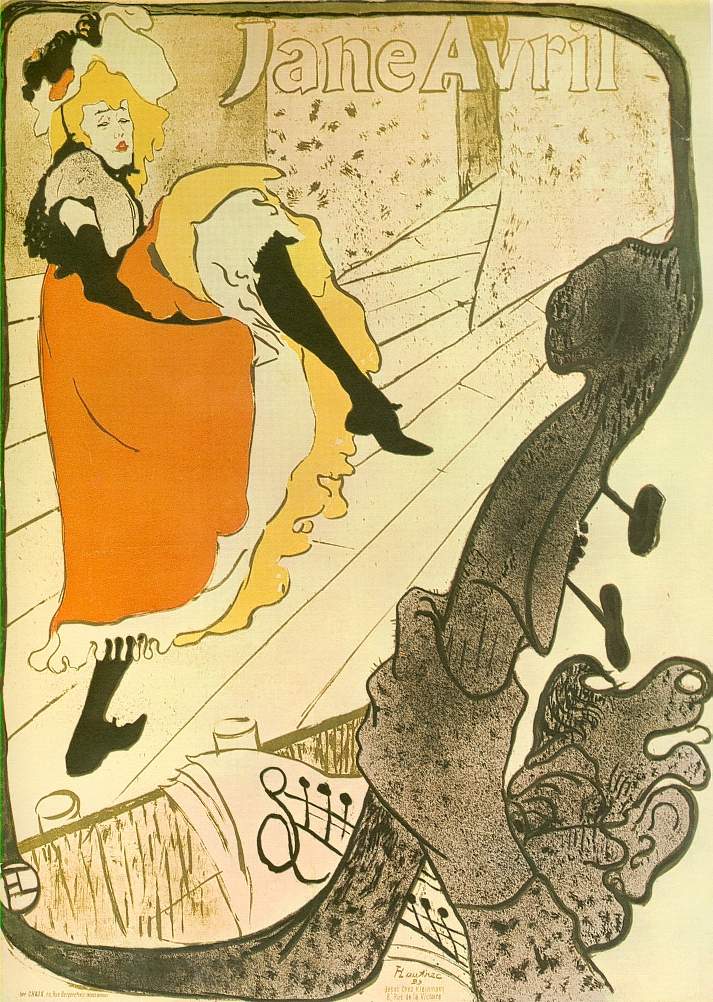
7. Henri de Toulouse-Lautrec – Jane Avril, 1893.
7. The poster Jane Avril is a lithograph in 5 colors (olive green, yellow, orange, red, and black). The same subject who appeared in Divan Japonais, Jane Avril commissioned this poster for her performance at the Jardin de Paris, a new café-concert. The letters for the name of the establishment were added later by someone other than Lautrec. The artist first produced 20 collector prints and after, with its newly-added letters, the poster went into mass production. Known as La Mélinite—a type of explosive—Jane Avril looked to this poster to reinvigorate her career as a performer in Paris. The poster helped her to take Paris by storm as she went on to perform at the Casino de Paris, the Moulin Rouge and the Folies-Bergères. In terms of composition, the poster is noteworthy for its strong diagonals inspired by Japanese prints and the detail of a large musical instrument—including the meticulously drawn hairs of a musician’s fingers—which rounds out the design and is seen as homage to Degas who used a similar motif in his artwork.
Iconic figures such as Jane Avril, Aristide Bruant, Yvette Guilbert, and La Goulue became cultural celebrities through his poster designs.
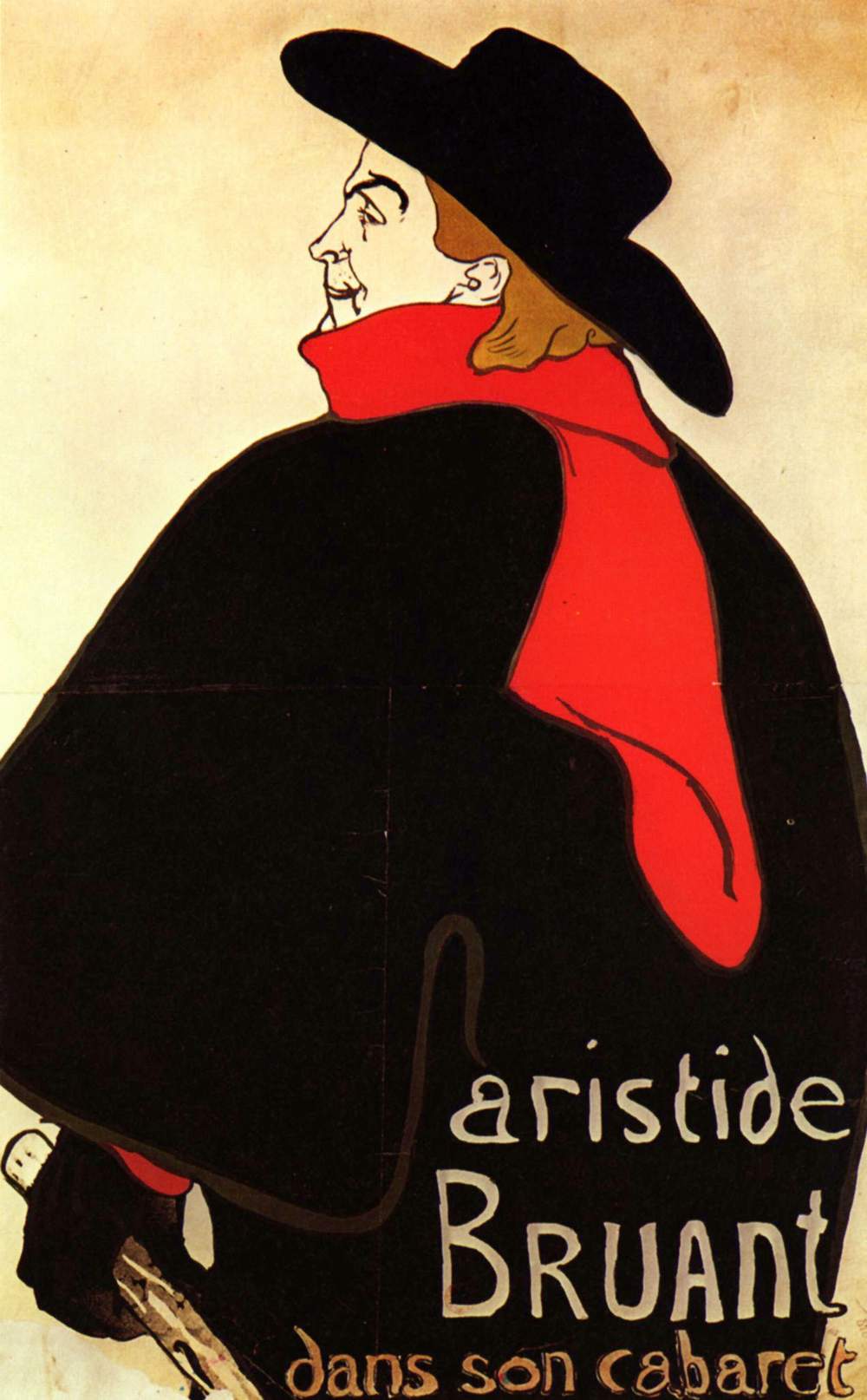
8. Henri de Toulouse-Lautrec – Aristide Bruant Dans Son Cabaret, 1893.
8. The poster Aristide Bruant Dans Son Cabaret is a lithograph in 4 colors (olive green, brown, red, and black). Lautrec’s third image of the singer became a Parisian icon. From the poster’s inception the singer used this image to promote his appearances—and for the next twenty years until 1912.
9. Henri de Toulouse-Lautrec – Au Pied De L’Echafaud, 1893.
9. The poster Au Pied De L’Echafaud is a lithograph in 4 colors (grey, red-brown, red, and black). The poster was an advertisement for the memoirs of a prison chaplain published in 1893.
10. Henri de Toulouse-Lautrec – Caudieux, 1893.
10. The poster Caudieux is a lithograph in 4 colors (olive green, yellow, red and black). Lautrec depicts Caudieux, who was a popular cabaret comedian, to be striding across the stage. Lautrec used the partial figure in the prompt box in other artwork.
11. Henri de Toulouse-Lautrec – Bruant Au Miriton, 1893.Bruant Au Miriton, 1893.
11. The poster Bruant Au Miriton is a lithograph in 2 colors (olive green or black and red). Represented with his back to the viewer, the popular performer is identified simply by his costume and the way he stands. This artistic device had already been used by Degas based on a theory by an art critic that a person’s economic and social class could be revealed simply by the way he or she comports themselves. The poster was recycled by Bruant as a songbook cover.
12. Henri de Toulouse-Lautrec – Babylone D’Allemagne, 1894
12. The poster Babylone D’Allemagne is a lithograph in 5 colors (olive green, yellow, red, dark blue and black). This was Lautrec’s second poster for another Victor Joze novel following his Reine de Joie. Lautrec wrote to his mother at this time to relate how busy he was with his art projects. Because of Joze’s anti-German message in the book, the author wanted the poster suppressed but it went up all over Paris nonetheless.
13. Henri de Toulouse-Lautrec – L’Artisan Moderne, 1894.
13. The poster L’Artisan Moderne is a lithograph in 4 colors (dark blue, yellow, green, and brown). The lettering is not done by Lautrec. Because of the impact of the cabaret and book posters, Lautrec began to be commissioned to make posters for the trades. This poster was provided to an interior design firm.
14. Henri de Toulouse-Lautrec – P. Sescau, Photographe, 1894
14. The poster P. Sescau, Photographe is a lithograph in 4 colors (dark red, yellow, green, and dark blue). The lettering is not done by Lautrec. This poster was provided to Paul Sescau, a professional photographer and personal friend of the artist.
15. Henri de Toulouse-Lautrec – Confetti, 1894.
15. The poster Confetti is a lithograph in 3 colors (dark olive green, red and yellow). This is Lautrec’s poster for the English paper manufacturer Bella & de Malherbe. The model is Jeanne Granier (1852-1939). These paper manufacturers hosted poster exhibitions in 1894 and 1896 to which Lautrec was invited.
16. Henri de Toulouse-Lautrec – May Belfort, 1895.
16. The poster May Belfort is a lithograph in 4 colors (olive black, red and yellow). Following his trades posters Lautrec returned to the subject of the single musical performer. May Egan (whose stage name was May Belfort) was an Irish singer who appeared at the Cabaret des Décadents where Jane Avril performed.
Advances in color lithography allowed his work to reach a broad urban audience, bringing art directly into the streets of Paris.
17. Henri de Toulouse-Lautrec – La Revue Blanche, 1895.
17. The poster La Revue Blanche is a lithograph in 4 colors (blue, red, black, and green). The subject is Misia Natanson (1872-1950) who was married to Thadée Natanson whose brother was editor of La Revue Blanche from 1891 to 1903. Misia was muse to a generation of avant-garde artists, composers, and writers as the publication itself was the remarkable meeting point for the Paris literary and artistic worlds in the 1890’s. Lautrec shows Misia wearing an ostrich feather hat, spotted dress, fur jacket and muff and ice skating which was a popular activity in Paris. Two preparatory drawings for this poster are known.
18. Henri de Toulouse-Lautrec – May Milton, 1895.
18. The poster May Milton is a lithograph in 5 colors (blue, red, black, yellow and olive green). This poster was never posted in Paris but produced as an advertisement in a magazine to promote the U.S. tour of May Milton, an English dancer at the Moulin Rouge in Paris. Picasso owned a copy of this poster and used some of its compositional elements in his own artwork. Art dealers would commission limited editions of black-and-white lithographs of performers such as May Milton because they sold quickly.
19. Henri de Toulouse-Lautrec – Napoleon, 1895.
19. The poster Napoleon is a lithograph in 5 colors (blue, reddish brown, black, yellow and olive green). Toulouse-Lautrec produced this poster for a book cover competition that he lost. Failing to sell this artwork, the artist produced a limited edition of 100 copies at the artist’s expense. The artist’s fee for his poster artwork varied a good deal, although during his career Lautrec clearly made more money from the output of his graphic work than his paintings.
Influenced by Japanese prints (Japonisme), Lautrec employed flattened forms, strong diagonals, silhouettes, and unconventional cropping.
20. Henri de Toulouse-Lautrec – Salon Des Cents, 1895.
20. The poster Salon Des Cents is a lithograph in 6 colors (blue, dark blue, black, yellow, ochre, and red). This poster is Lautrec’s homage to a married woman he met and became infatuated with during a summer cruise in 1895. The young woman sits in a deck chair under an awning facing out to sea. He produced the poster at his rentrée to Paris that fall and used it for international poster exhibitions sponsored by the journal La Plume at the Salon des Cent during winter 1895-96 and later in 1896 at the Libre Esthétique exhibition in Brussels.
21. Henri de Toulouse-Lautrec – The Chap Book, 1895.
21. The poster The Chap Book is a lithograph in 5 colors (olive green, blue, yellow, pink and red). The lettering is not done by Lautrec. The artist used the setting of an Irish-American bar near Place Madeleine in Paris to promote The Chap Book, an American magazine. Along with its identifiable characters, Lautrec includes the image of a bartender preparing a cocktail which was a libation newly introduced to Paris.
22. Henri de Toulouse-Lautrec – La Chatelaine, Ou ‘Le Tocsin’, 1895
22. The poster La Chatelaine, Ou ‘Le Tocsin’ is a lithograph in 2 colors (blue and blue-green). This poster was commissioned by former Republican politician and Editor-in-chief Arthur Huc (1854-1932) to advertise a novel by Jules de Gastyne (1847-1920) which appeared in his newspaper in popular serial form in 1895. Letters were added by others after copies of the poster were printed for collectors of Lautrec’s increasingly popular artwork.
His work captured the spirit of Belle Époque Paris, documenting its entertainment culture while influencing generations of graphic artists.
23. Henri de Toulouse-Lautrec – Troupe De Mlle Églantine, 1896.
23. The poster Troupe De Mlle Églantine is a lithograph in 4 colors (green-blue, red, yellow and dark brown). The lettering is not designed by Lautrec. This was commissioned by Jane Avril for her work in London at the Palace Theatre and elsewhere. The formation dance was comprised of four identified dancers including Mlle Églantine and Jane Avril and derived from the famous French can-can.
24. Henri de Toulouse-Lautrec – La Vache Enragee, 1896.
24. The poster La Vache Enragée is a lithograph in 5 colors (dark blue, green-blue, red, yellow and black). The lettering is not designed by Lautrec. This was an advertisement for a new monthly magazine founded by Adolphe Willette (1857-1926). Its editor, Adolphe Roedel, organized an annual parade through Montmartre called the Vachalcade to lampoon the artist’s state of life in a major urban center.
25. Henri de Toulouse-Lautrec – Elles, 1896.
25. The poster Elles is a lithograph in 4 colors (yellow, dark green, orange and blue). Later lettering is not designed by Lautrec. Degas would visit a Paris brothel to sketch its denizens, but Lautrec moved in for weeks at a time to do his artwork. Elles is a series of lithographs of the lives of prostitutes. Although considered some of the finest of lithographs of the nineteenth century, its portfolio of prints could not find collectors and they had to be sold singly. An exhibition of the complete lithographic series was held at La Plume starting in April 1896 where Lautrec adapted Elles’ title-page lithograph as the poster to advertise the show.
26. Henri de Toulouse-Lautrec – L’Aube, 1896.
26. The poster L’Aube is a lithograph in 2 colors (dark blue and blue-green). The lettering is not designed by Lautrec. This was another advertisement for a new journal, the leftist L’Aube, first published in 1896. After its printing, the printer and artist had a rafter of remainders of this poster which they tried to sell for next to nothing.
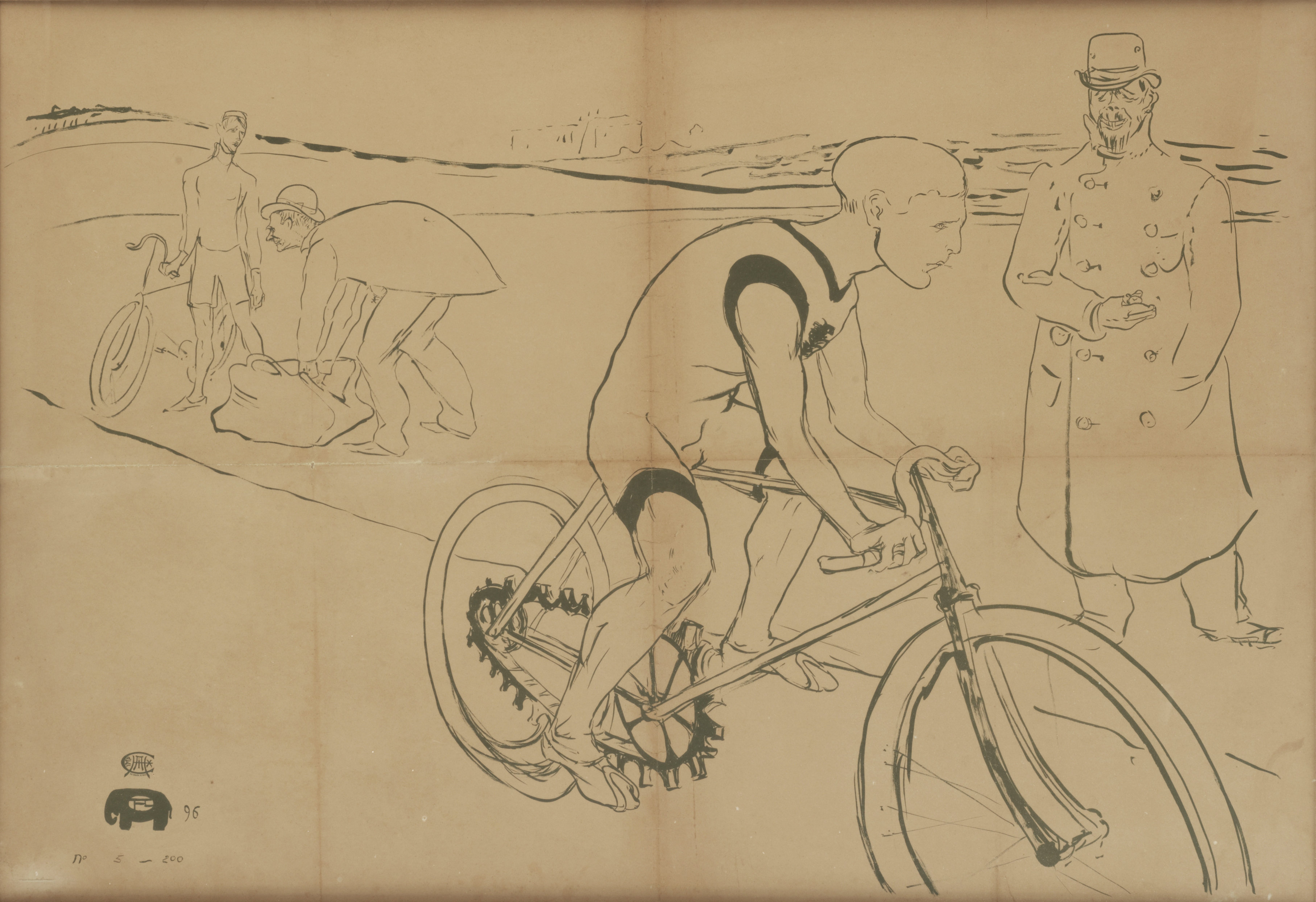
27. Henri de Toulouse-Lautrec – Cycle Michael, 1896.
27. The poster Cycle Michael is a lithograph in 1 color (olive green). Bicycling had developed into a cult sport in France by the 1890’s. Lautrec’s interest in the new sport led to this poster commission of British cyclist Jimmy Michael with his trainer (left background) and a sports writer with a hand in his coat pocket. The bicycle company rejected Lautrec’s design in part because the depiction of its mechanics was inaccurate which left the artist to print a limited edition for collectors at his own expense.
28. Henri de Toulouse-Lautrec – La Chaine Simpson, 1896
28. The poster La Chaîne Simpson is a lithograph in 3 colors (red, yellow and blue). The lettering is not designed by Lautrec. This is Lautrec’s second poster for the new sport of bicycling which had become immensely popular in France in the 1890’s. It depicts popular rider Constant Huret (left) and, in the background wearing hats, two British and French bicycle and chain manufacturers. Lautrec was fascinated with the cycling sport and its imagery appears in other of his artwork.
29. Henri de Toulouse-Lautrec – The Ault & Wiborg Co, 1896.
29. The poster The Ault & Wiborg Co is a zincograph in 4 colors (brown, red, yellow and black). The lettering is not designed by Lautrec. The smallest of Lautrec’s posters, it was commissioned by an American ink manufacturer whose sitters are not precisely identified. Before it became a poster advertisement, Lautrec had an edition of it printed which he titled Au Concert.
Posters such as Moulin Rouge: La Goulue, Divan Japonais, and Jane Avril helped establish the visual foundations of Art Nouveau graphic design.
30. Henri de Toulouse-Lautrec – Henri de Toulouse-Lautrec – Jane Avril, 1899.
30. The poster Jane Avril is a zincograph in 4 colors (black, red, yellow and blue). After six years of intense poster production, Lautrec temporarily left its practice in 1897 and 1898. When he returned to it in 1899 he found that technology had advanced to make the printing technique for his artwork more efficient. This poster was commissioned by Jane Avril but never publicly displayed. Lautrec looked to capture her dancing style and graceful and wistful figure which the artist admired. The serpentine-themed dress Jane Avril wears was a popular motif in the Art Nouveau.
31. Henri de Toulouse-Lautrec – La Gitane, 1899-1900.
31. The poster La Gitane is a lithograph in 5 colors (black, grey, red, brown and blue). The lettering is designed by Lautrec. Lautrec’s last poster was produced for a Carmen-like play that opened in January 1900 at the Théâtre Antoine in the tenth arrondissment. The play was unpopular, the poster never published, and Lautrec’s modern art poster career had come to an end.
Lautrec elevated commercial poster art from simple advertising into a respected artistic medium.
Select Bibliography: Ash, Russell, Toulouse-Lautrec:The Complete Posters, Pavilion Books Limited, London, 1991. Beauroy, Jacques, Bertrand, Marc, Gargan, Edward T., editors, The Wolf and the Lamb: Popular Culture in France, From the Old Régime to the Twentieth Century, Anma Libri, Saratoga, CA, 1977. Cate, Phillip Dennis, The Color Revolution: Color Lithography in France, 1890-1900, Peregrine Smith, Inc., Santa Barbara and Salt Lake City, 1978. Cate, Phillip Dennis and Shaw, Mary, editors, The Spirit of Montmartre: Cabarets, Humor, and the Avant-Garde, 1875-1905, Jane Voorhees Zimmerli Art Museum, Rutgers, New Brunswick, New Jersey, 1996. Denvir, Bernard, Toulouse-Lautrec, Thames and Hudson, London, 1991. Gluck, Mary, Popular Bohemia: Modernism and Urban Culture in Nineteenth-Century Paris, Harvard University Press, Cambridge, MA, 2005. Foxwell, Chelsea, Leonard, Anne, et.al. Awash in Color: French and Japanese Prints, Smart Museum of Art, University of Chicago, 2012. Oberthur, Mariel, Cafés and Cabarets of Montmartre, Peregrine Smith Books, Salt Lake City, 1984. Rearick, Charles, Pleasures of the Belle Époque: Entertainment & Festivity in Turn-Of-The-Century France, Yale University Press, New Haven and London, 1985. Seigel, Jerrold, Bohemian Paris: Culture, Politics, and the Boundaries of Bourgeois Life, 1830-1930, Penguin Books, New York, 1986. Thory-Frèches, Claire, Roquebert, Anne, Thomson, Richard, Toulouse-Lautrec, South Bank Center, 1991. Weisberg, Gabriel P., Montmartre and the Making of Mass Culture, Rutgers University Press, News Brunswick, New Jersey and London. 2001.
FEATURE IMAGE: Manuel Mendive, Este Lugar Sagrado/This Sacred Place, 2009, acrylic on canvas, Cernuda Arte Coral Gables, FL. Expo Chicago/2016.
EXPO CHICAGO 2016 demonstrates how Chicago functions as a global crossroads for contemporary and modern art, bringing together international galleries, artists, and audiences while transforming Navy Pier’s Festival Hall into a temporary museum of worldwide creative exchange and experimentation.
EXPO CHICAGO 2016 is the 5th annual exhibition of international contemporary and modern art held in Chicago at Navy Pier’s Festival Hall. It took place September 22-25, 2016. Expo Chicago/2016 presented 145 galleries and exhibitors representing 22 countries and 53 cities from around the world.
All photographs and text by John P. Walsh.
Jeff Koons, BMW M3 GT2, Expo Chicago/2016.
Alfredo Jaar, Be Afraid of the Enormity of the Possible, 2015, neon, edition 3/3 + 3AP, Galerie Thomas Schulte, Berlin, Germany. Expo Chicago/2016.
At Dittrich & Schlechtriem, Berlin, Germany includes artwork by Klaus Jörres and Julian Charrière. Expo Chicago/2016.
At Cernuda Arte Coral Gables, FL. Manuel Mendive (foreground) Este Lugar Sagrado/This Sacred Place, 2009, acrylic on canvas. Expo Chicago/2016.
Paintings I, Art+Language, Made in Zurich 1965-1972, London. Expo Chicago/2016.
The Art + Language group’s Michael Baldwin and Mel Ramsden in Chicago. Founded in the mid1960s in the United Kingdom by Terry Atkinson (b. 1939), David Bainbridge (b. 1941), Michael Baldwin (b. 1945) and Harold Hurrell (b. 1940), artist Mel Ramsden joined in 1970.
Throughout the 1970s, Art + Language dealt with questions about art production and attempted a shift from conventional forms of art, such as painting and sculpture, to theoretically linguistic (text)-based artwork. Art + Language remains active today in several collaborative projects.
September 2016. 99% 7.21 mb DSC_0630
Jonathan Lasker, The Handicapper’s Faith, 2011, Galerie Thomas Schulte, Berlin, Germany. Expo Chicago/2016.
At Gallery MOMO Cape Town/Johannesburg, South Africa. Artwork by Mary Sibande. Expo Chicago/2016.
Expo Chicago/2016.
Andrew Moore, Mirador, Gibara, Cuba, 2008, 46 x 58 inch archival pigment print, Yancey Richardson Gallery, New York.
Margot Bergman, Agnes, acrylic on canvas, 2016, Corbett vs. Dempsey, Chicago. Expo Chicago/2016.
Shannon Finley, Googol, 2015, acrylic on linen, 4 panels 95 x 189 in.,Carrie Secrist Gallery, Chicago. Expo Chicago/2016.
Euan Uglow, Sue Wearing a Blue Swimming Cap, 1978/80, oil on canvas 19.5 x 27.5 in., Browse & Darby London. Expo Chicago/2016.
Juan Garaizabal, Álvaro Alcázar Gallery, Madrid. Expo Chicago/2016.
April Martin, The Sun had not yet Risen, 2016, copper, thread, glass, vinegar, The School of the Art Institute of Chicago. Expo Chicago/2016.
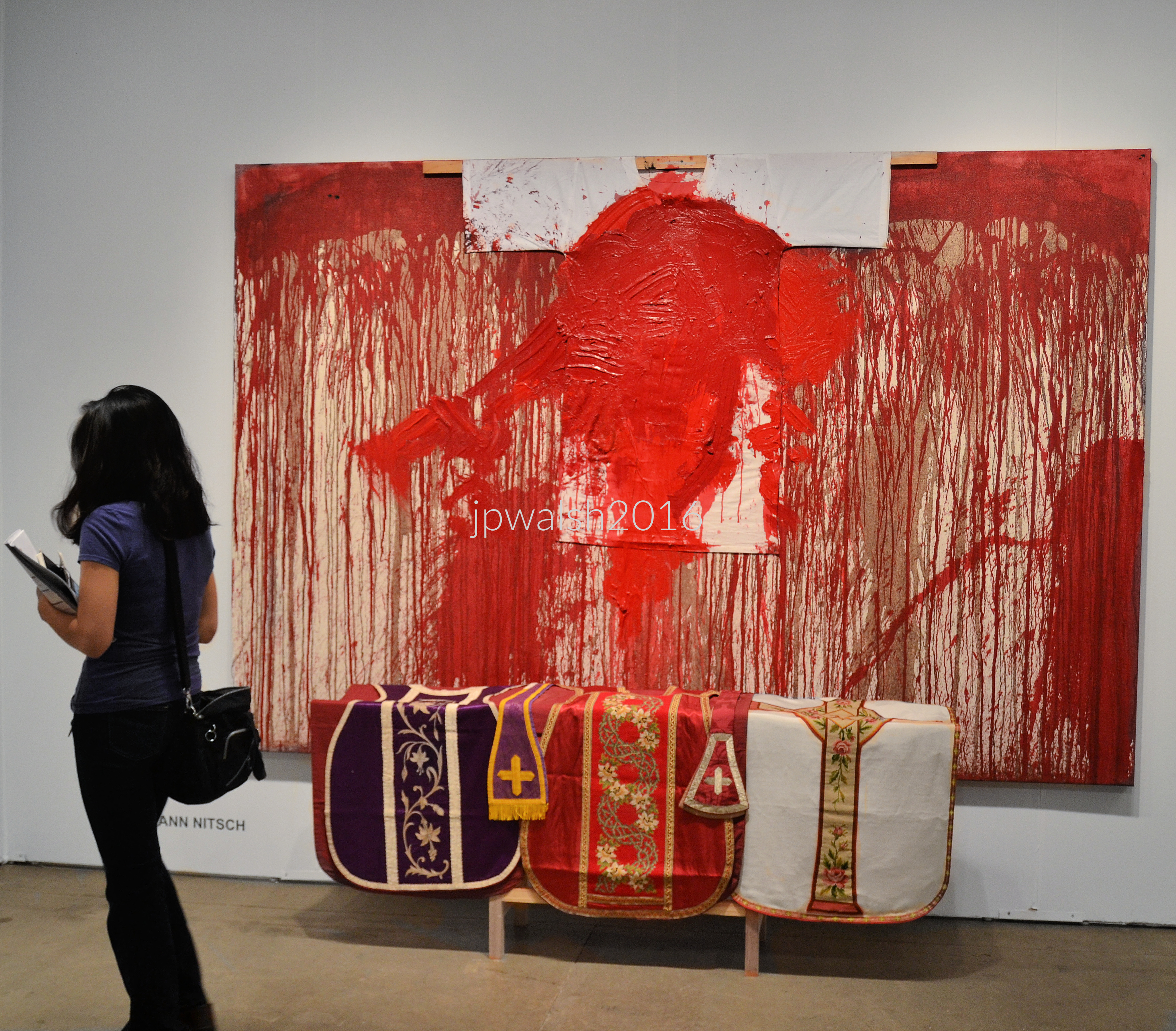
September 2016. Hermann Nitsch, Schüttbild (Shaped Image), 2013, Acrylic on Canvas, Marc Straus Gallery, New York City. 4.29mb DSC_0876 (1)
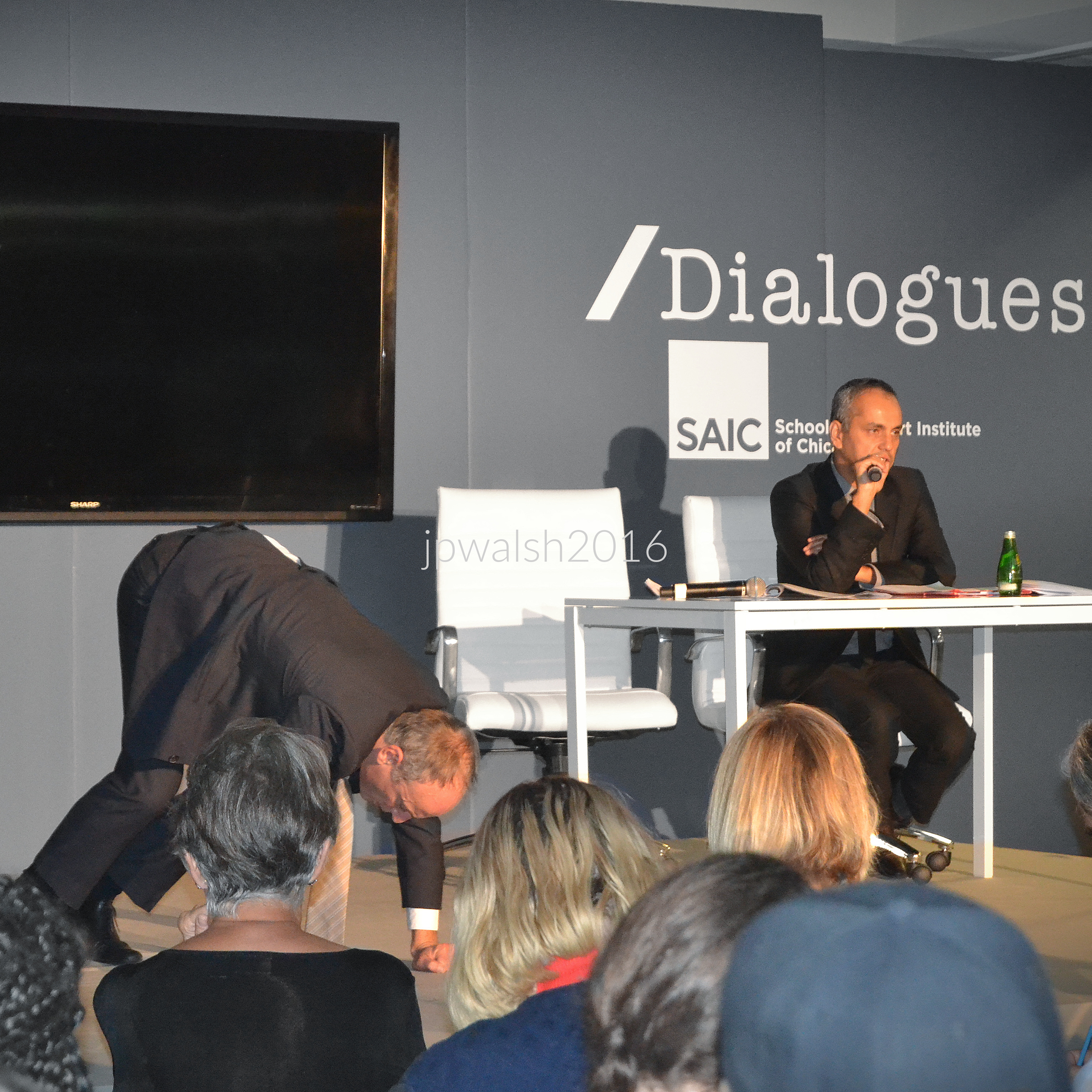
Dialogue with Miguel Aguilar and Chris Silva, Conversation Pieces. Expo Chicago/2016.
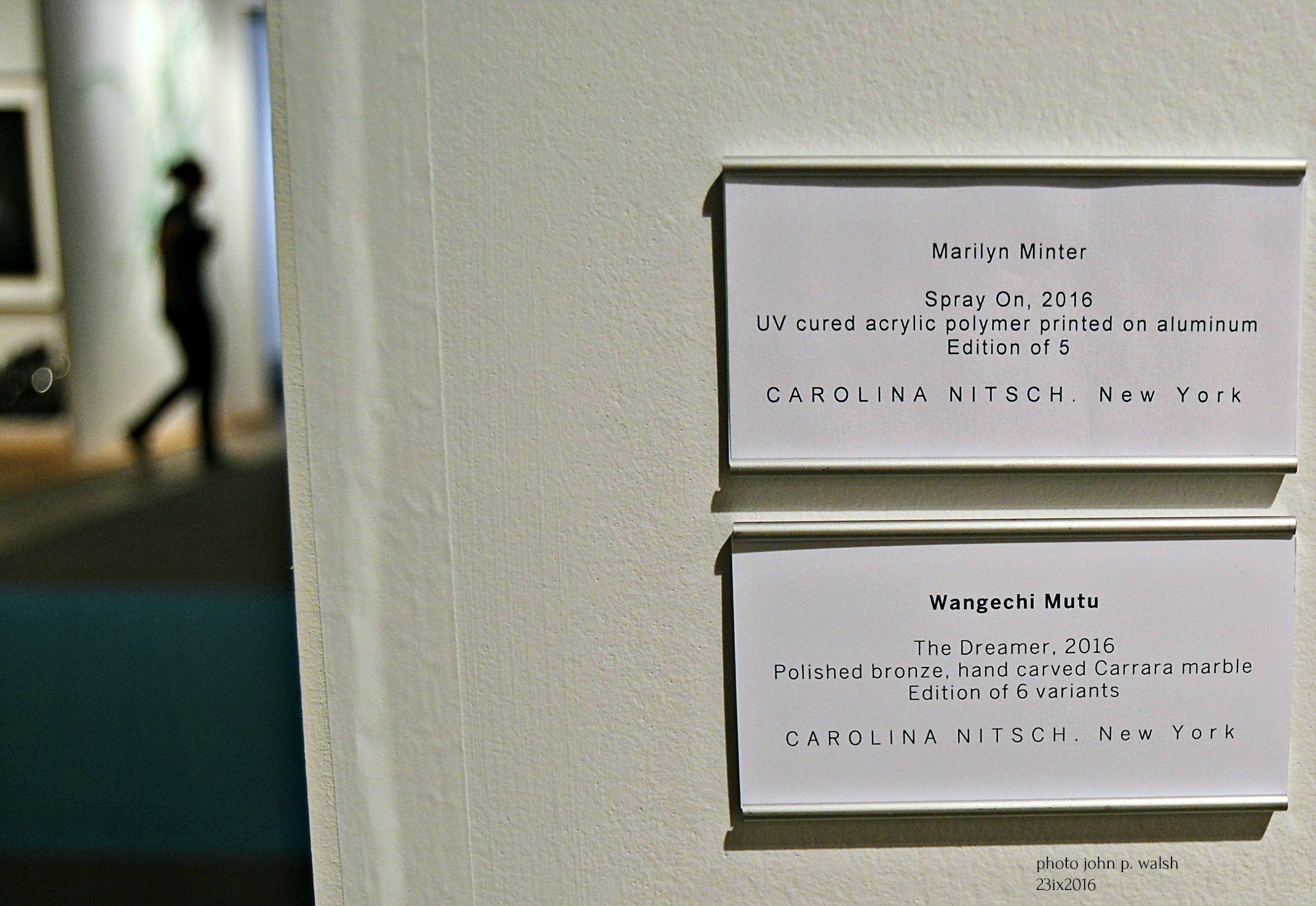
Louise Bourgeois, Girl with hair, 2007, archival dye on silk, edition of 12, Carolina Nitsch, New York City. Expo Chicago/2016.
Pace Gallery, New York City. Expo Chicago/2016.
Expo Chicago 2016.
Genieve Figgis, Half Gallery, New York City. Genieve Figgis is an artist from Ireland who began her artistic career on social media. Expo Chicago/2016.
Buddha’s tight ringlet curls by Qi Yu. Ceramic cinnabar mineral mounted on canvas. Expo Chicago/2016.
Artist Qi Yu of Redbrick Art Museum, Beijing, China.
North Cafe. Expo Chicago/2016.
Expo Chicago/2016.
Listen, you a wonder. you a city of a woman. you got a geography of your own., Amy Sherald, 2016, 54 x 43 in., oil on canvas, Monique Meloche Gallery, Chicago.
The artist’s title quotes American poet Lucille Clifton (1936-2010): “listen, you a wonder. you a city of a woman. you got a geography of your own. listen, somebody need a map to understand you. somebody need directions to move around you. listen, woman, you not a noplace anonymous girl; mister with his hands on you he got his hands on some damn body!”
Raffi Kalenderian, Sekula Benner Street, 2016, oil on canvas, Buchmann Galerie Berlin/Lugano. Expo Chicago/2016.
Ernesto Burgos, Kate Werble Gallery, New York City. Expo Chicago/2016.
Sims Reed Gallery London. Expo Chicago/2016.
Ann Agee, Negishi Heights 1957, 2015, acrylic on Thai Mulberry paper, P.P.O.W. Gallery, New York City. Expo Chicago/2016.
Expo Chicago/2016.
Performance outside Zwirner Gallery, New York City. Background: Raymond Pettibon, No Title (Manhattan rising, advancing—), 2010, ink and acrylic on paper, 59 x 118 inches. Expo Chicago/2016.
Mel Bochner, Blah Blah Blah, 2016 and Aloyson Shotz, Flow Fold #3, 2015, Carolina Nitsch Gallery, New York City. Expo Chicago/2016.
Bernar Venet, Indeterminate Line, 2013, rolled steel, 75 1/2 × 80 × 62 in. Paul Kasmin Gallery, New York City. Expo Chicago/2016.
Richard Norton Gallery. Expos Chicago/2016.
Jannis Varelas, New Flags for a New Country, The Breeder, Athens, Greece. Expo Chicago/2016.
Expo Chicago/2016.
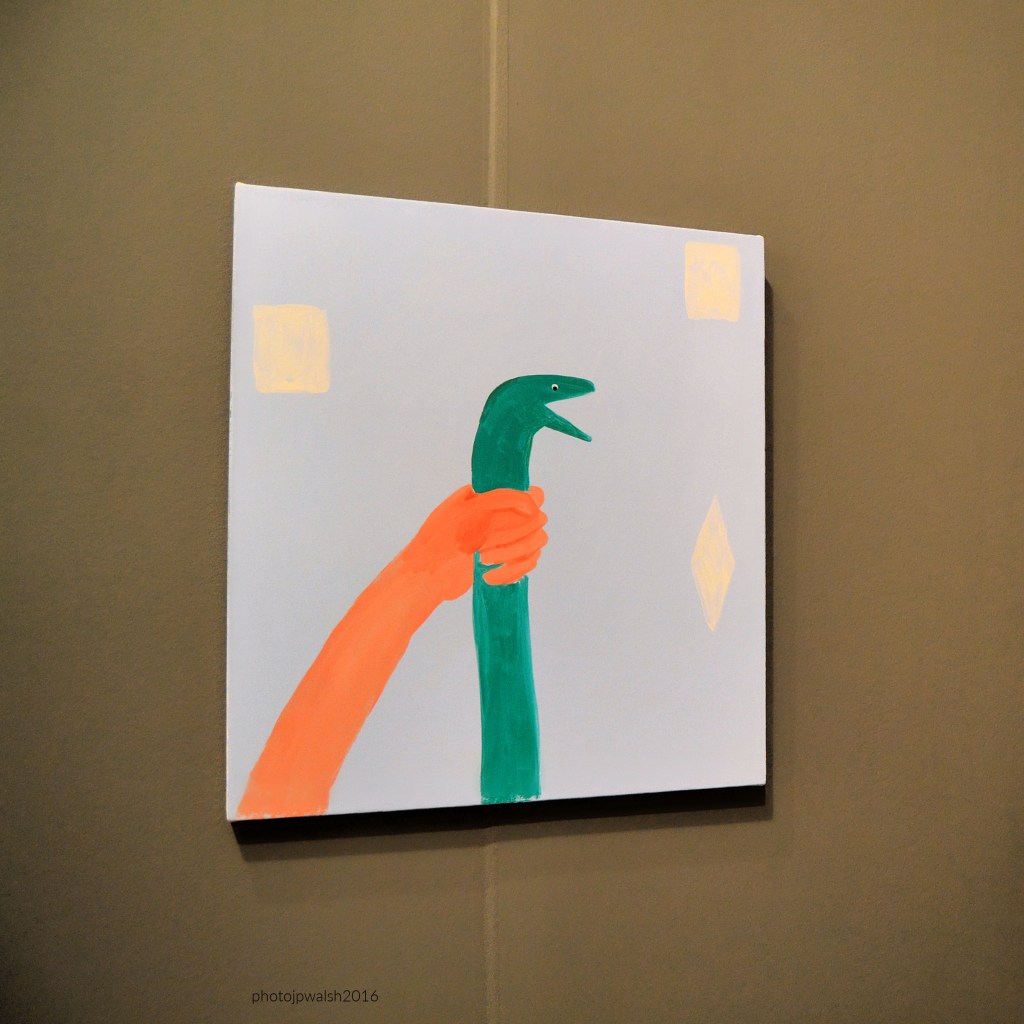
Jenn Smith, Untitled (Snake), oil and acrylic on canvas, 2016, The School of the Art Institute of Chicago. Expo Chicago/2016.
Atelier Van Lieshout, The Beginning of Everything, foam, paint, wood, paverpoll, 2016. Expo Chicago/2016.The molecule represents Glucose (C6H12O6), the primary source of energy for human life. Without glucose, nothing would function: neither the brain, intelligence, thought, muscles, movement or sports. Without energy, our lives would come to a standstill.
FEATURE image: EXPO CHICAGO 2014, Festival Hall, Navy Pier.
EXPO CHICAGO 2014 demonstrates how Chicago functions as a global crossroads for contemporary and modern art, bringing together international galleries, artists, and audiences while transforming Navy Pier’s Festival Hall into a temporary museum of worldwide creative exchange and experimentation.
EXPO CHICAGO 2014 is the 3rd annual exhibition of international contemporary and modern art held in Chicago at Navy Pier’s Festival Hall. It took place September 18 – 21, 2014.
All photographs and text by John P. Walsh.
Mylar Cone designed by Studio Gang.
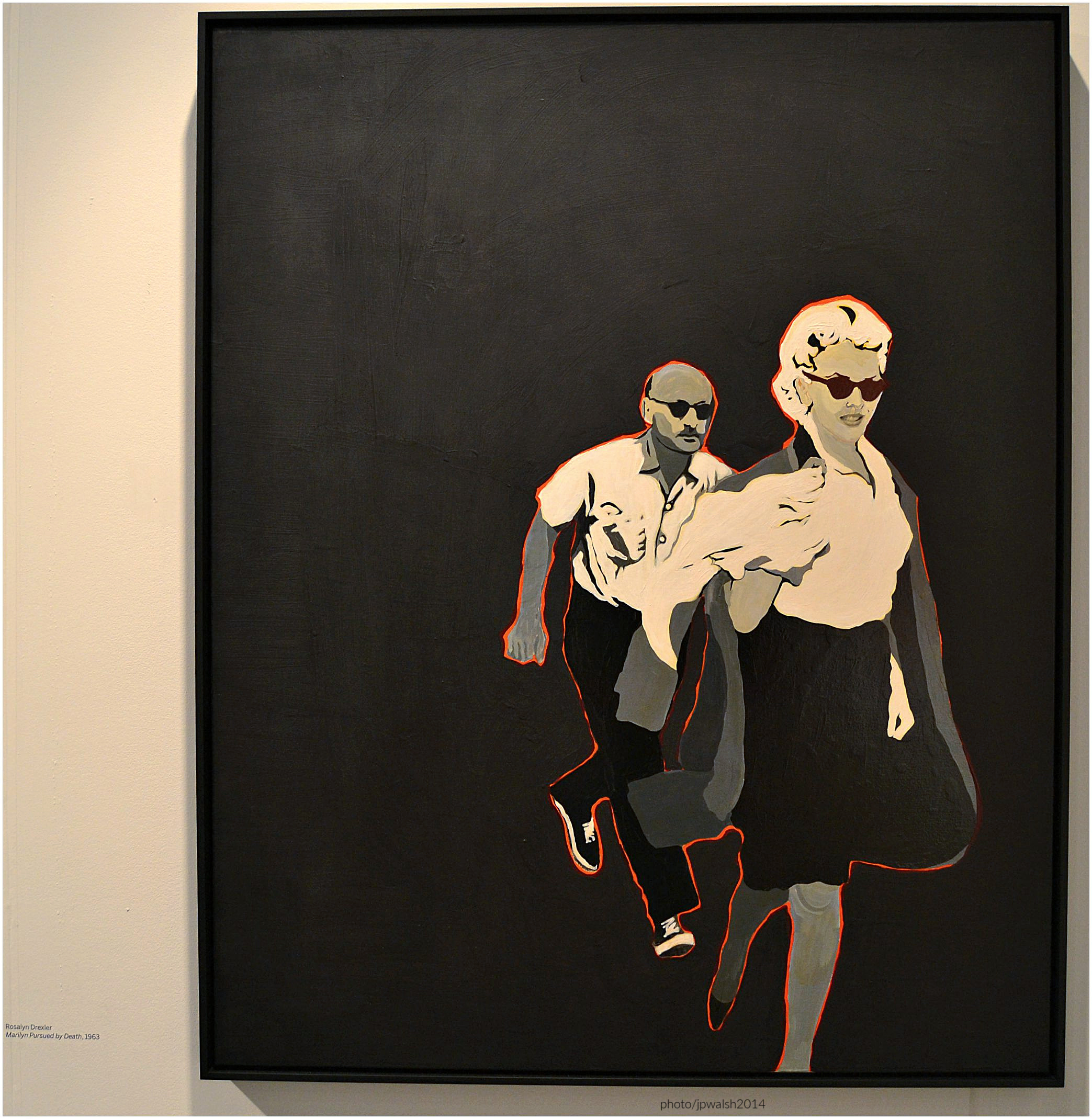
Rosalyn Drexler, Marilyn Pursued By Death, 1963, Fredericks & Freiser and Garth Greenan Gallery, New York City. This is based on a historical photograph of Marilyn as she was escaping the press.
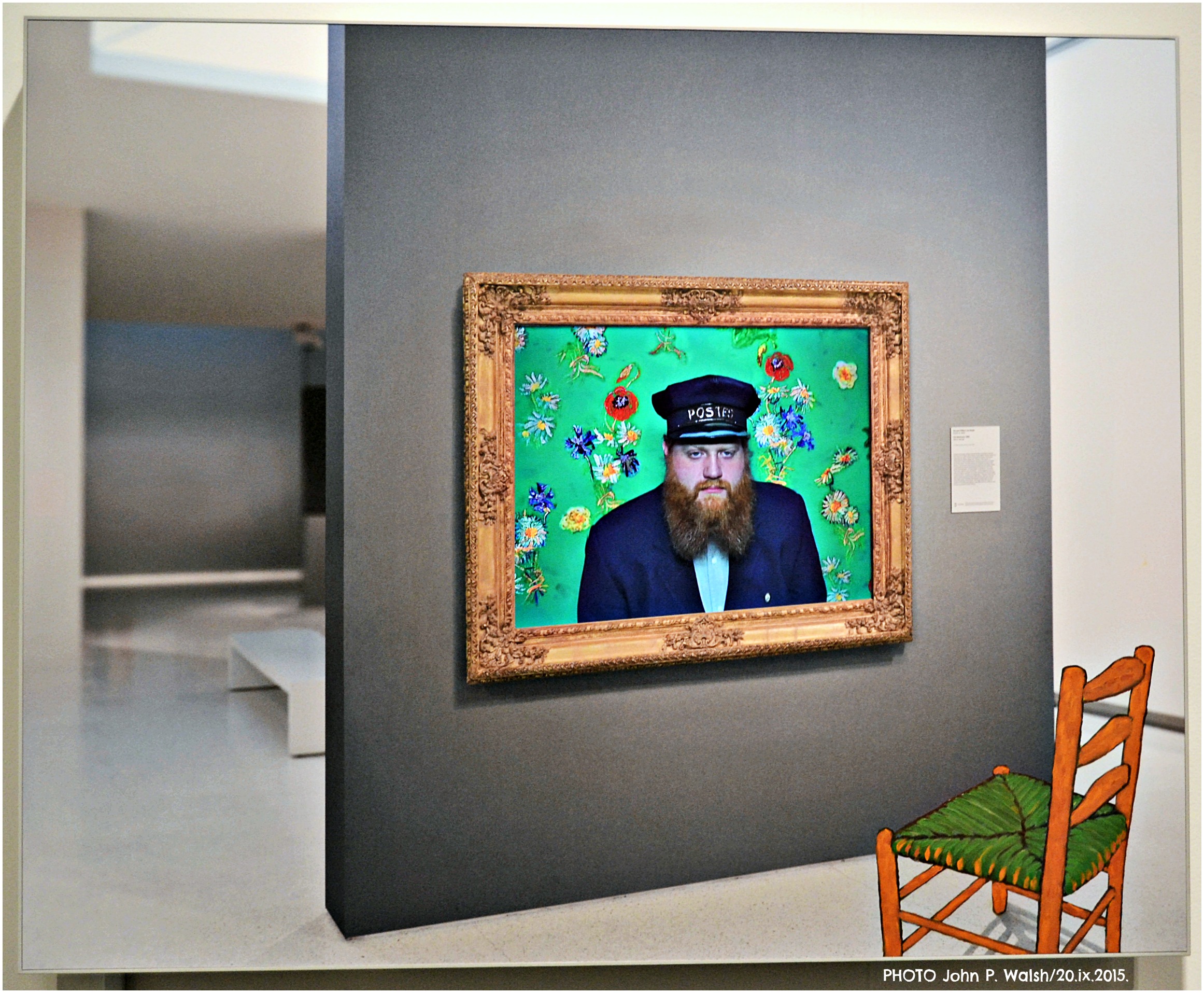
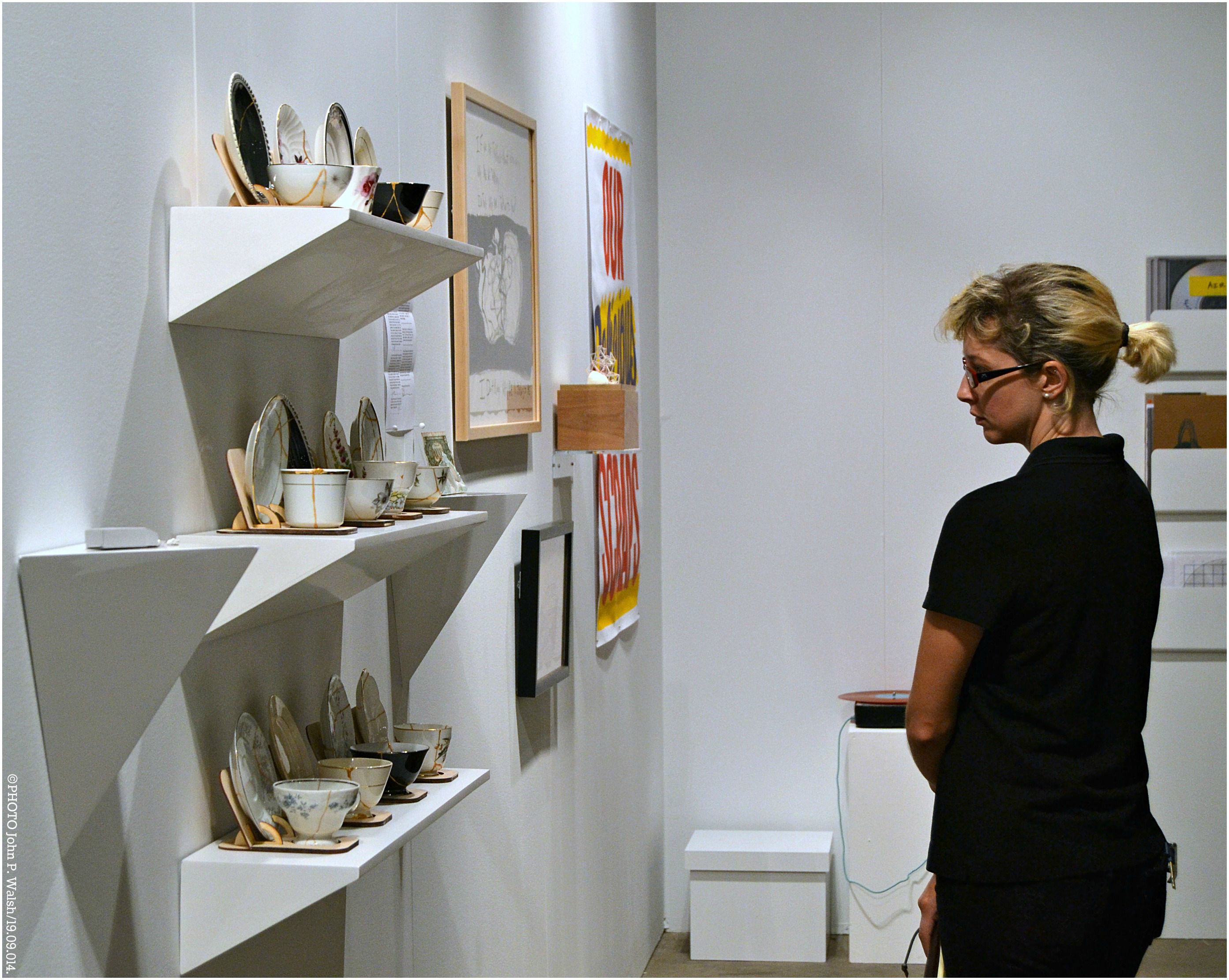
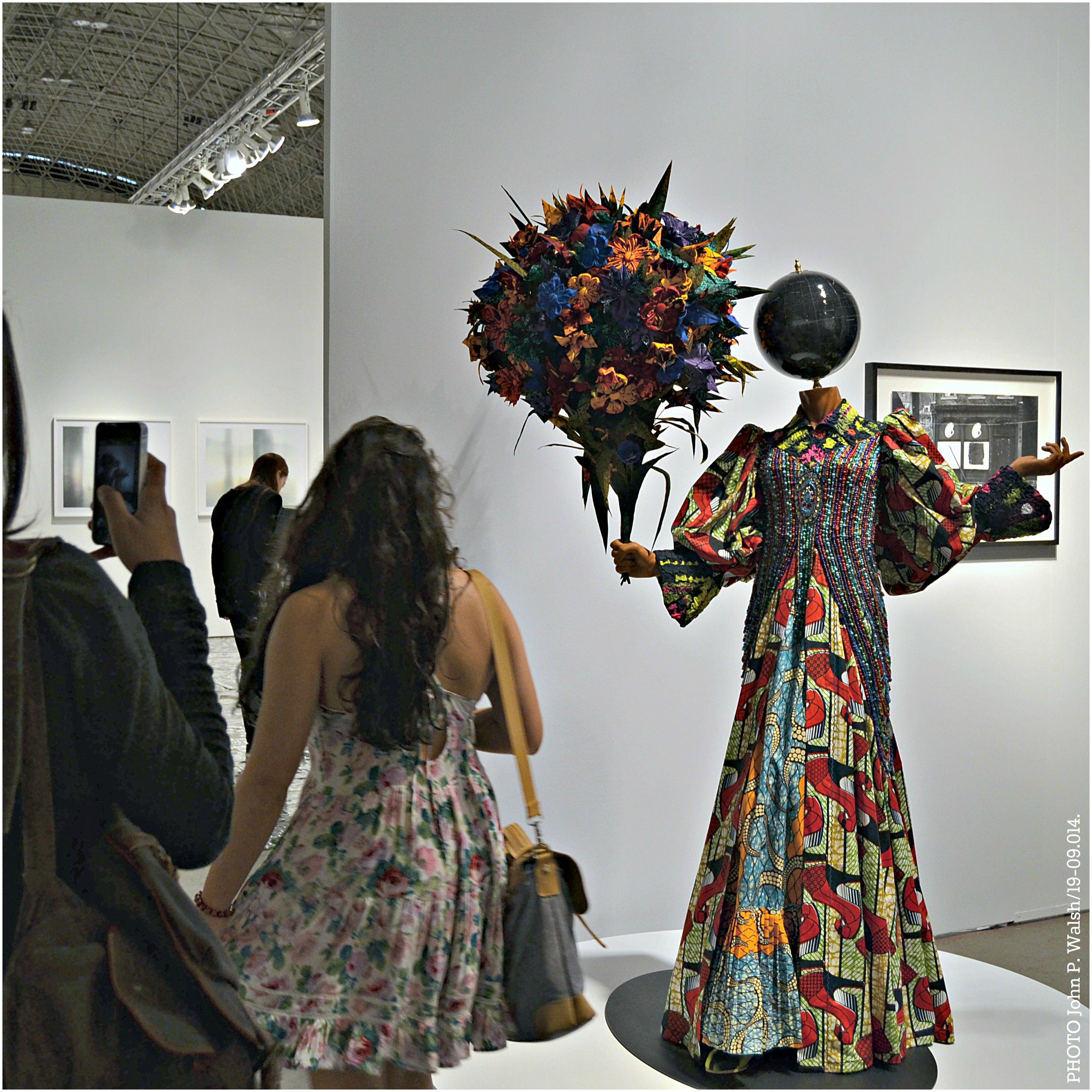
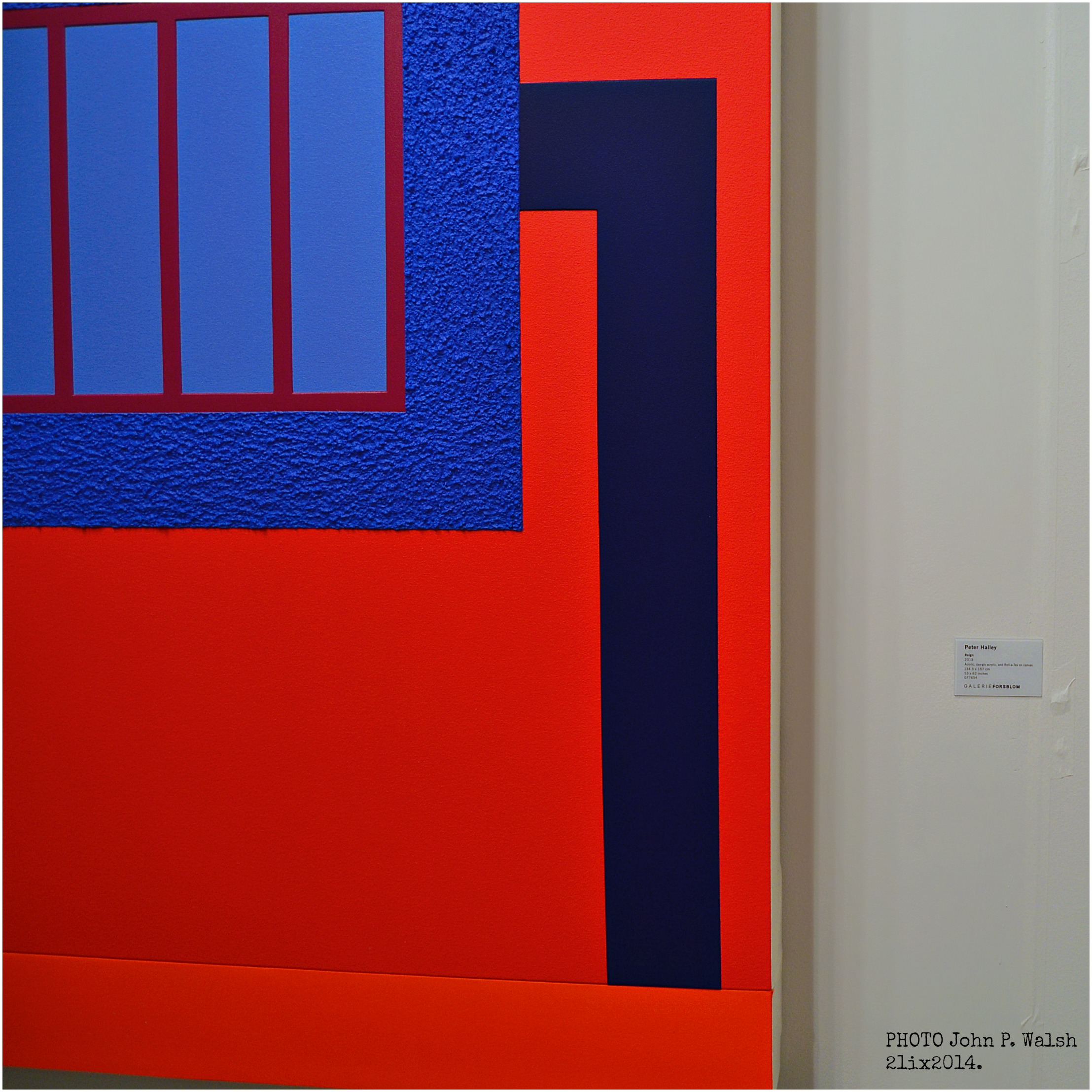
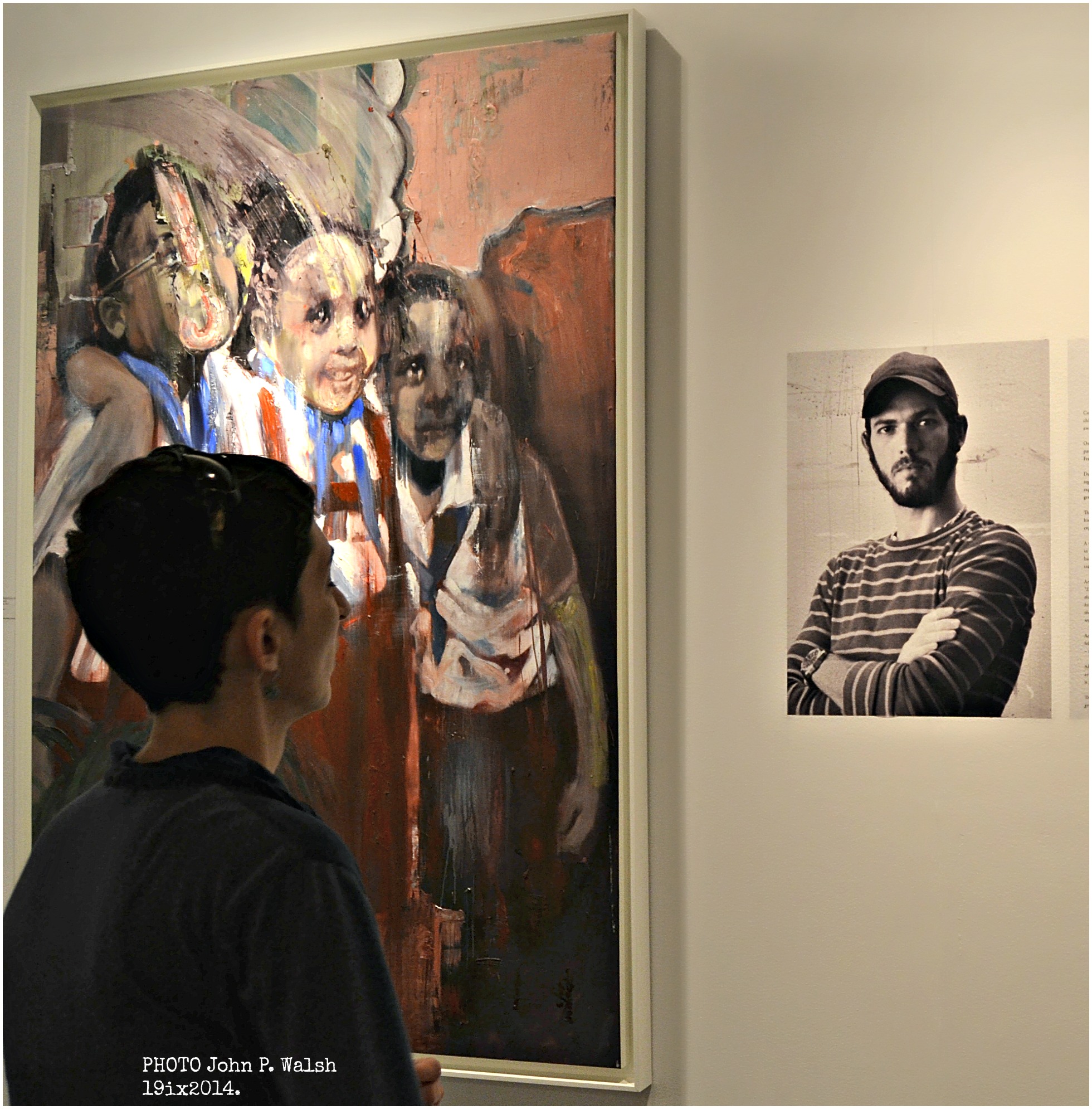
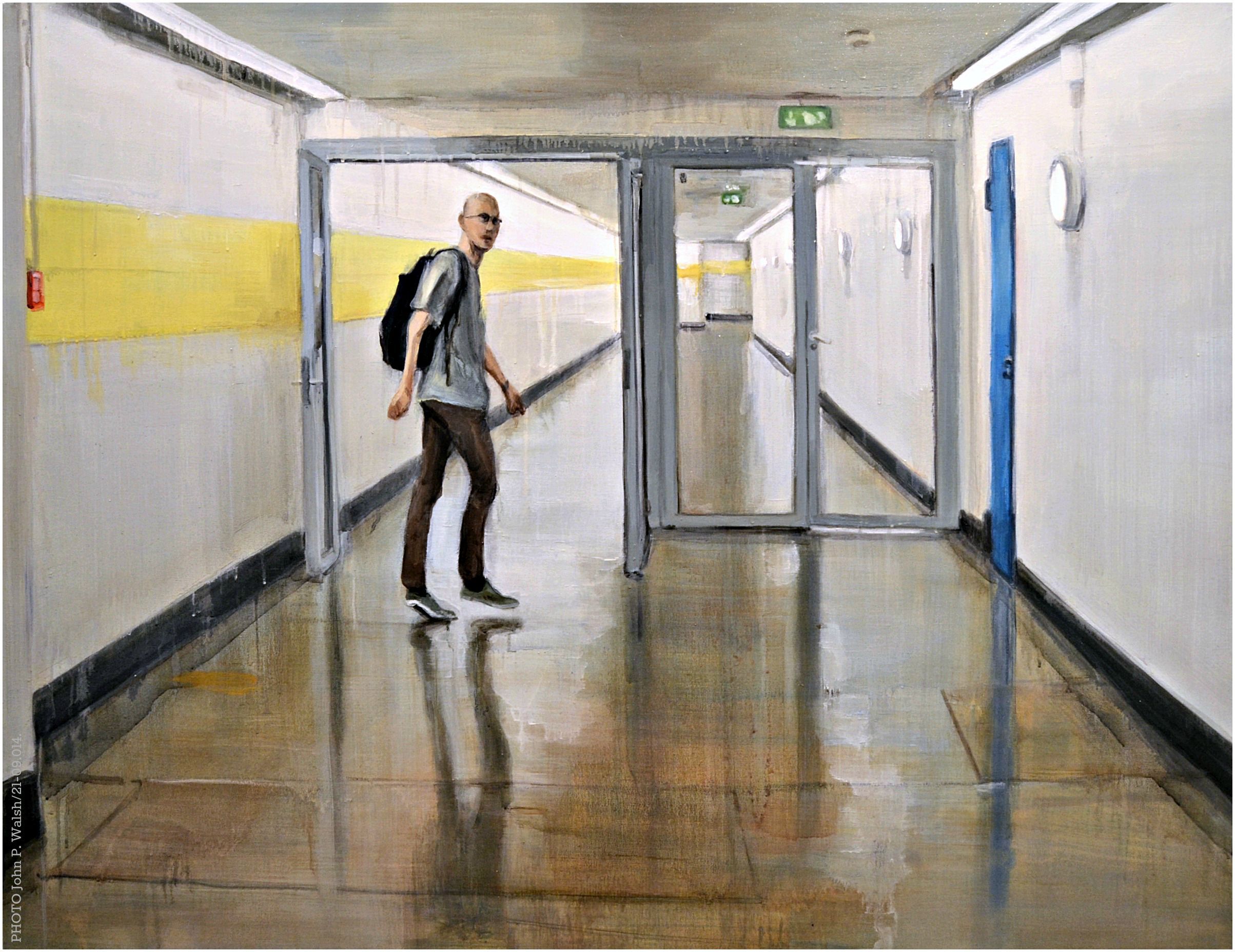
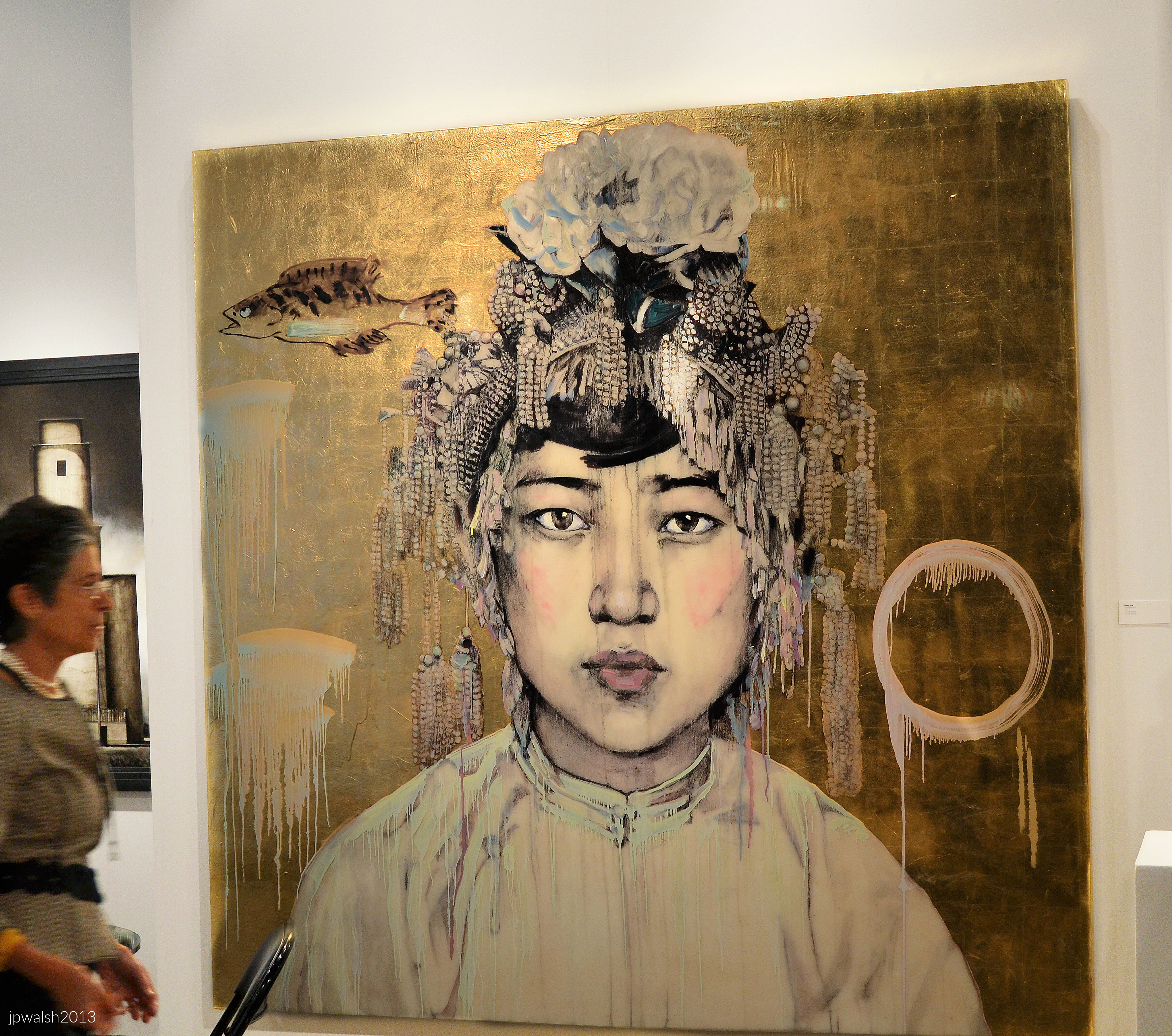
Christopher Le Brun (British, b. 1951), Friedman Benda, New York.Cernude Arte, Coral Gables, Florida. Michiko Itatani, Cosmic Kaleidoscope From the Pattern-Recognition 12 D 9, 2013, oil on canvas, 42 x 34 inches. Linda Warren Projects Chicago.Matthew Woodward, Polk Street, 2014, mixed media on paper, 101 x 96 in., Linda Warren Projects Chicago.Ramiro Gomez (American, b. 1986), American Gardeners, 2014, acrylic on canvas, 84 x 120 in., Charlie James Gallery, Los Angeles.Jessica Stockholder (American, b. 1959), Once Upon A Time, 2014, plastic, paint, mirrors, stools, carpet, chain, cables, staircase, resin, cords, light, bowls, lamp shade. Kavi Gupta Gallery Chicago/Berlin.Marieke McClendon, Clay Heads, ink on bristol board, ceramic, ShopColumbia Chicago.Works by Gideon Rubin (b. Israel,1973, works in London). Oil on canvas/linen/wood, 2009-14, and gouache on cardboard, 2012-14, Galerie Karsten Greve AG St Moritz.Nicholas Krushenick (1929-1999), Grill, 1977, Garth Greenan Gallery New York and Fredericks & Freiser New York.Expo video/2014.Gregory Scott, Van Gogh’s Bedroom, 2015, pigment print, oil on panel, HD video, Catherine Edelman Gallery, Chicago.Antonio Murado, Gardens, 2014, oil on canvas. Galeria Àlvaro Alcázar, Madrid.Three Walls Chicago.Elijah Burgher, Untitled, 2012-2014, paintings on unstretched canvas, Western Exhibitions, Chicago and Zieher Smith & Horton, New York. Anne Lindberg, Parallel 42, 2014, Graphite and colored pencil on mat board, 59 x 34 in., Carrie Secrist Gallery Chicago.Rene Portocarrero (1912-1985), Ornamental Figure in Brown Background, 1968, mixed media on paper laid down on board, 28 3/8 x 20 in., Cernuda Arte, Coral Gables, Florida.Alan Reid (American, b. 1976), Lisa Cooley Gallery New York.Henri Matisse, Marlborough Gallery New York Madrid Monaco Barcelona.Yinka Shonibare (British-Nigerian, b. 1962), Ms. Utopia, 2013, mannequin, dutch wax cotton textile, fiberglass, wire, globe, and steel baseplate. BlainSouthern, London, Berlin.. Lynn Chadwick (1914-2003), Rad Lad IV, 1962, ed. 2 of 8; Beast XX, 1956, ed. 6 of 9; Boy and Girl III, 1959, ed. 2 of 9. Bronze. BlainSouthern.John Wesley (American, b. 1928), Untitled, 2012 and Nicholas Krushenick (American,1929-1999), Wire Mill Road, 1972. Garth Greenan Gallery New York and Fredericks & Freiser New York.Alex Katz, Ena and Roberto, 1988, oil on linen, 41 x 62 in., Richard Gray Gallery, Chicago.Philip Pearlstein, Two Models with Four Geese Decoys, 1993, Watercolor on paper, Hill Gallery, Birmingham, Michigan.Tony Oursler (American, b. 1957), Galerie Forsblom, Helsinki.Aimé Mpane (b Kinshasa, 1968), Nude, wood and glue, 2008, Haines Gallery, San Francisco.Peter Halley, Reign, 2013, acrylic, day-glo acrylic, roll-a-tex on canvas, 53 x 62 in., Galerie Forsblom, Helsinki.Sandro Miller (b. 1958), Andy Warhol/Green Marilyn (1962), 2014, 29 x 29 in., Edelman Gallery, Chicago.Leonardo Drew (American, b. 1961), Number 34S, 2014, 31 x 41 x 11 inches, wood, Anthony Meier Fine Arts, San Francisco.Dayron González, Cernuda Arte, Coral Gables, Florida.Michelangelo Pistoletto (b. 1933), Golden Buddha and Mirror, 2008, Hollis Taggart Galleries, New York.Fernand Léger, Paysage Animé, 1937, oil on canvas, 35 7/8 x 23 1/4 in., Marlborough New York.Jina Park, A Genius, 2000, acrylic on linen, One And J. Gallery, Seoul.Tristian Koenig, Installation, Melbourne.
Minako Abe, Scene 29, 2011, oil on canvas, 35.8 x 92 in., Base Gallery, Tokyo.
David Hockney, Montcalm Pool, LA, 1980, oil on canvas, 12 x 16 in., Richard Gray Gallery Chicago.The Flag Art Foundation, New York, curated by Shaquille O’Neal.Mel Bochner, Money/Nothing, 2006, McCormick Gallery Chicago/Vallarino Fine Art New York.Sanford Biggers, David Castillo Gallery, Miami, Florida.Simon Edmondson, The Reader, oil on paper, 48 x 59.9 inches.
Manolo Valdés (Spanish, b. 1942, works New York City), Hojas II, 2014, Marlborough.
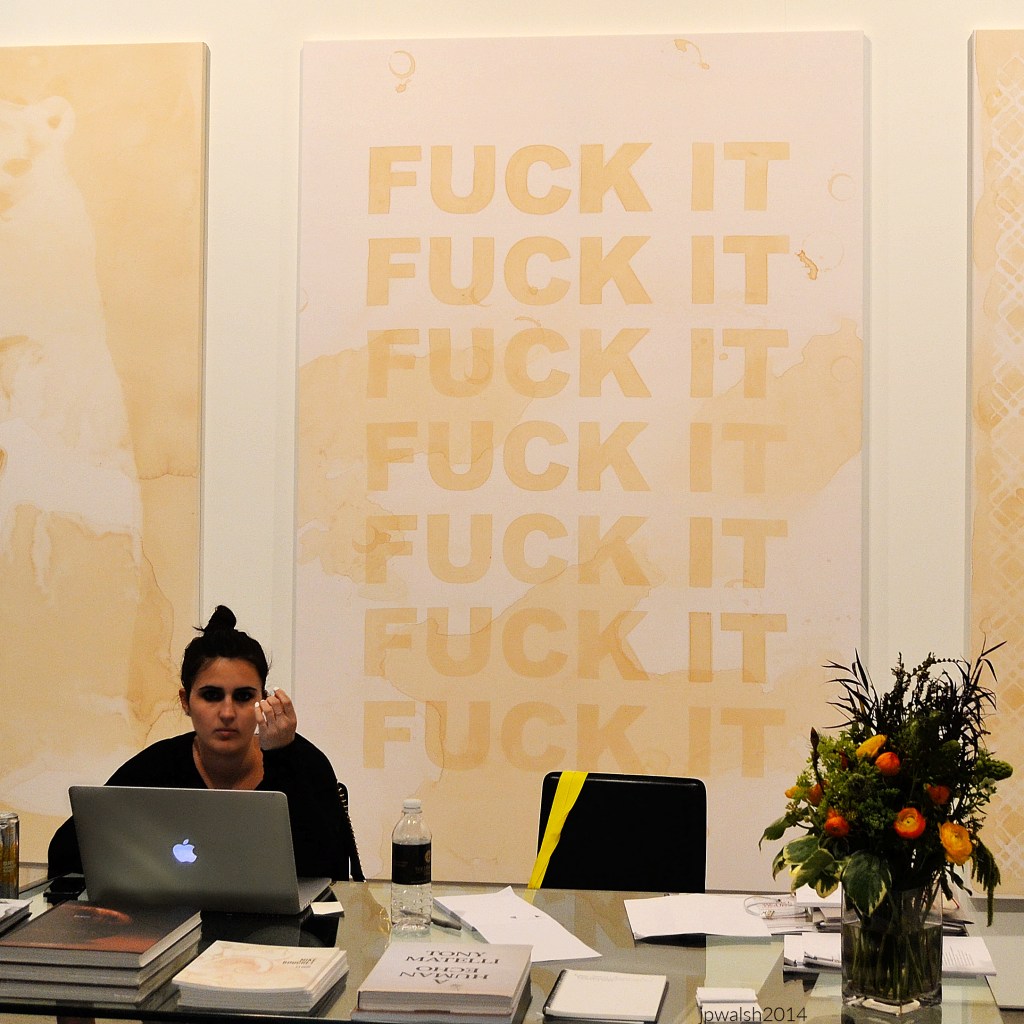
Manolo Valdés, Yvette, 2014, oil on burlap, Marlborough.Mike Bouchet, Fuck It, 2013, Marlborough Chelsea, New York.
Jina Park, Automatic Door Follow Me, 2014, oil on canvas, 100 x 130 cm, One and J. Gallery, Seoul.
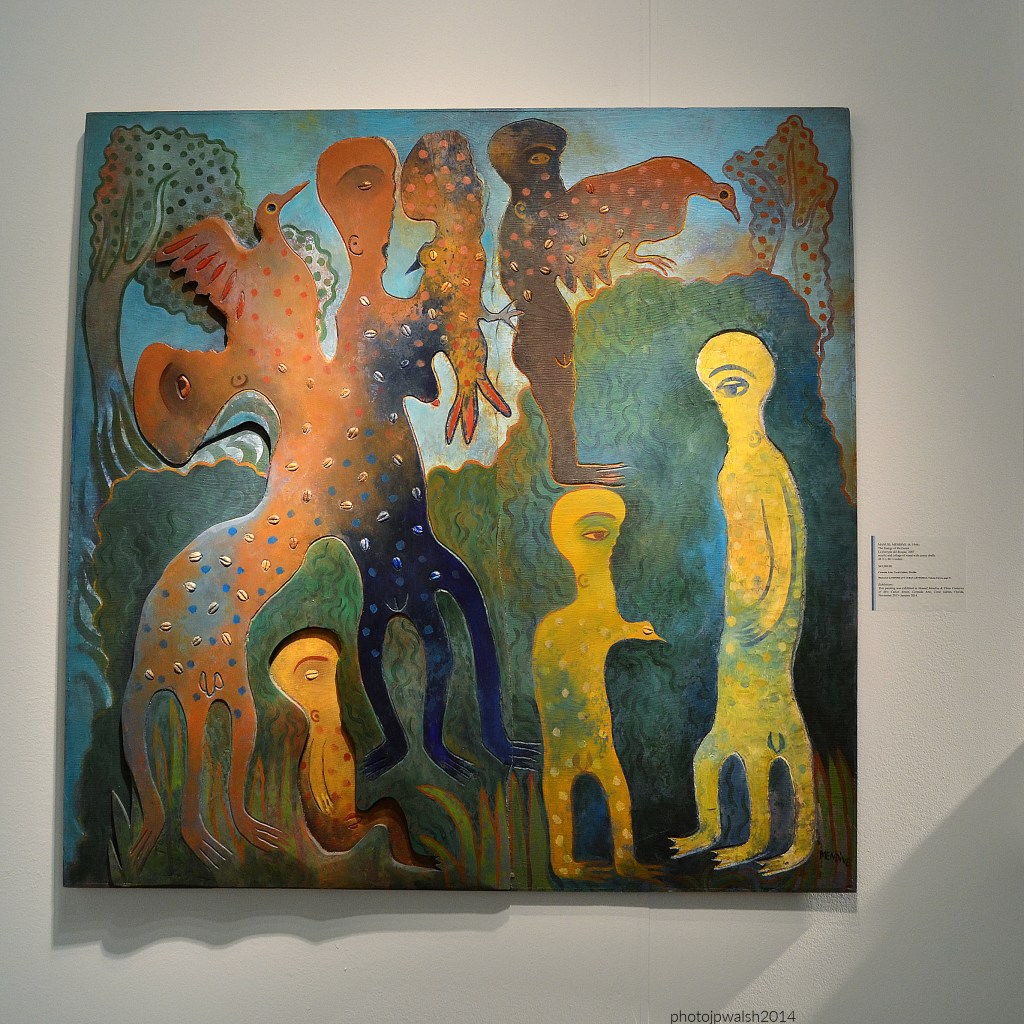
Manuel Mendive, La Energia del Bosque (The Energy of the Forest), acrylic and collage of wood with cowry shells, 2007. Cernuda Arte, Coral Gables, Florida.Alfred Leslie, Afternoon Soaps, 1983, oil on canvas. Hill Gallery, Birmingham, MI.
FEATURE Image: Glenn Kaino, Bridge, 2013. A section of a 100-foot-long construction that features 200 gold casts of Tommie Smith’s arm in a raised fist salute that occurred in the 1968 Summer Olympics on the medal podium during the national anthem after Smith broke a sprinting record to take gold.
EXPO CHICAGO 2013 demonstrates how Chicago functions as a global crossroads for contemporary and modern art, bringing together international galleries, artists, and audiences while transforming Navy Pier’s Festival Hall into a temporary museum of worldwide creative exchange and experimentation.
EXPO CHICAGO 2013 is the 2nd annual exhibition of international contemporary and modern art held in Chicago at Navy Pier’s Festival Hall. It took place September 19-22, 2013.
All photographs & texts by John P. Walsh.
Tommie Smith at Expo Chicago 2013.
Tommie Smith is an American former track and field athlete and American Football League wide receiver. On October 16, 1968, the 24-year-old Smith won the 200-meter sprint finals and gold medal in 19.83 seconds at the 1968 Summer Olympics in Mexico City.
It was the first time the 20-second barrier was officially broken in competitive sports history. Atop the medal podium and with heads bowed, Smith’s Black Power salute with silver-medal-winner John Carlos protested racism and injustice against African-Americans in the United States.
Smith’s raised fist as the national anthem played is seen as one of the most overtly political statements in the history of the modern Olympics and caused memorable admiration and criticism.
In Silent Gesture: The Autobiography of Tommie Smith (Temple University Press, 2008), Smith maintained that the gesture was not solely a “Black Power” salute but a “Human Rights” salute.
In any event, Smith’s raised fist salute in 1968 became one of the most iconic moments in the Olympic games and the history of the Black Power movement.
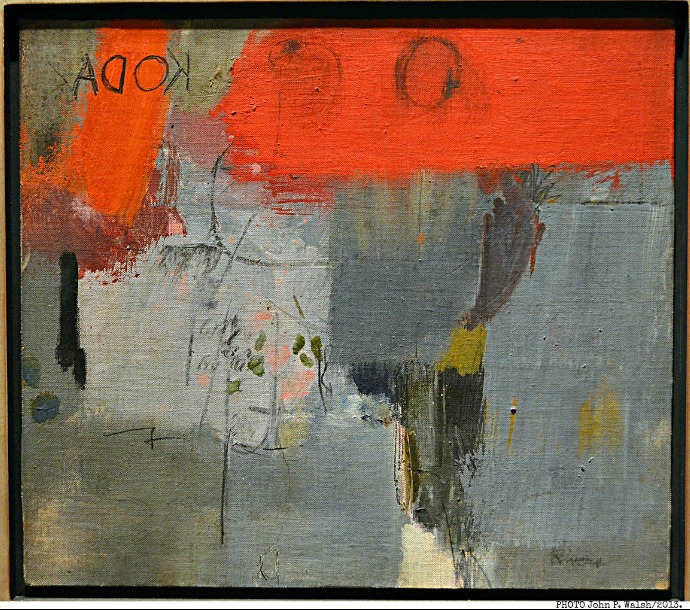
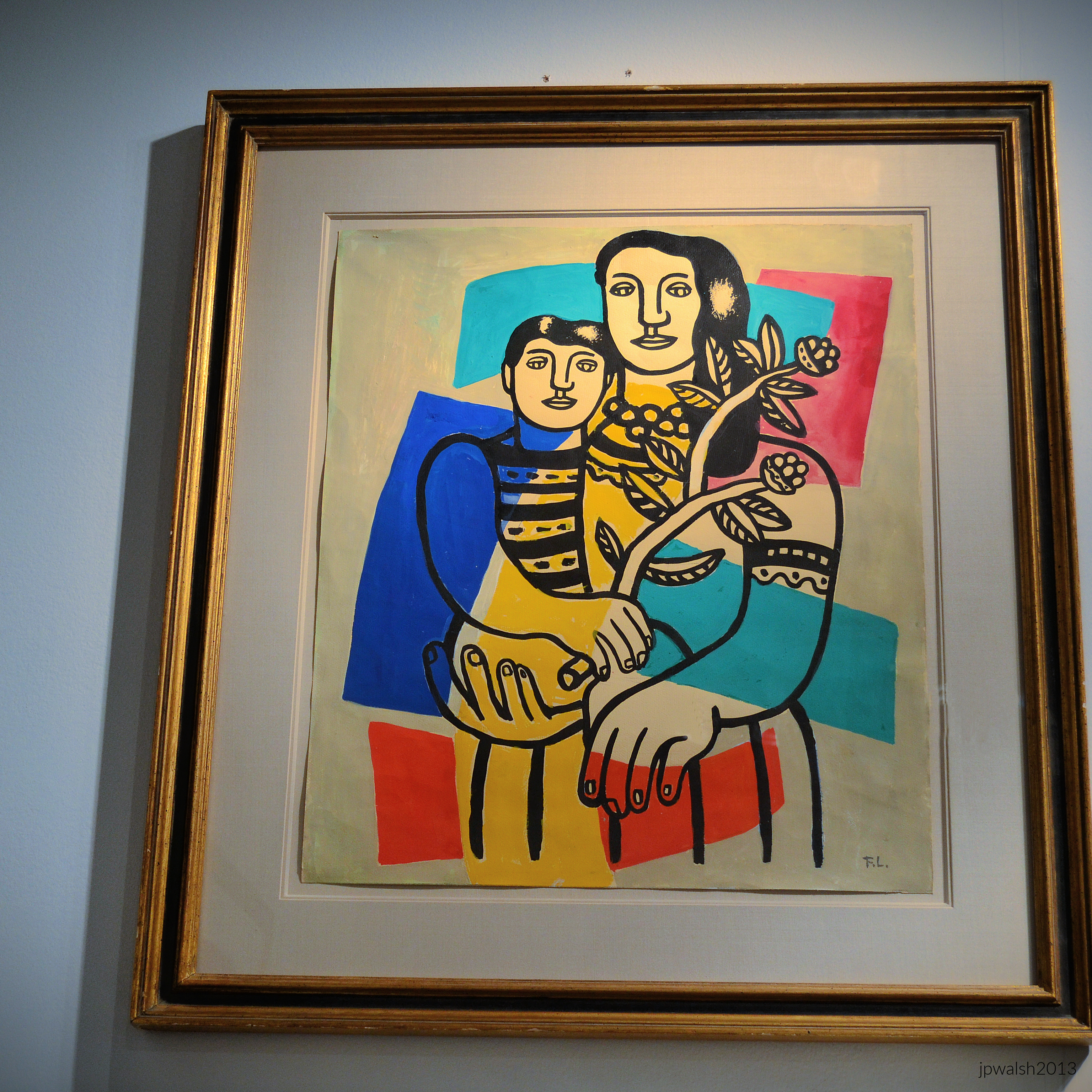
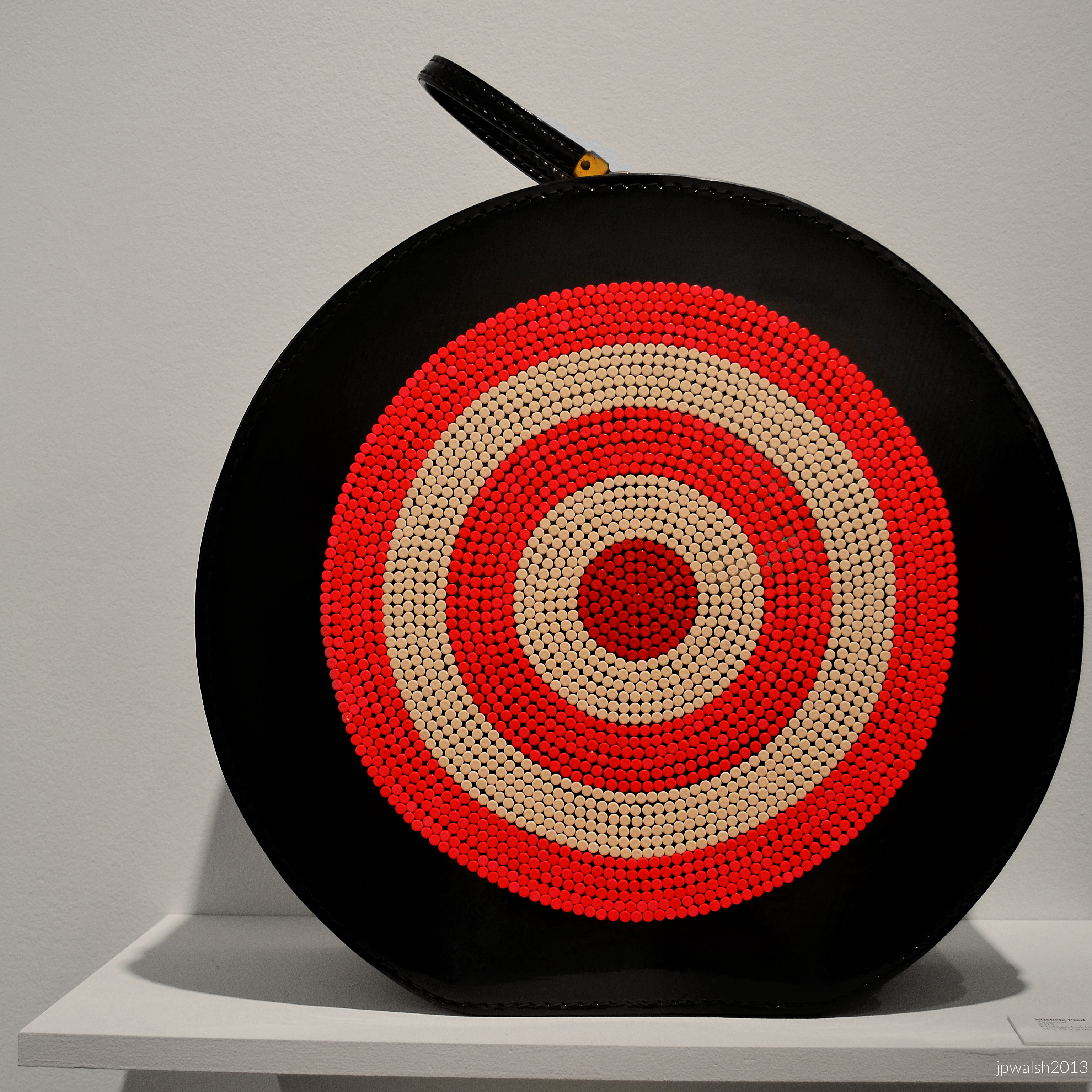
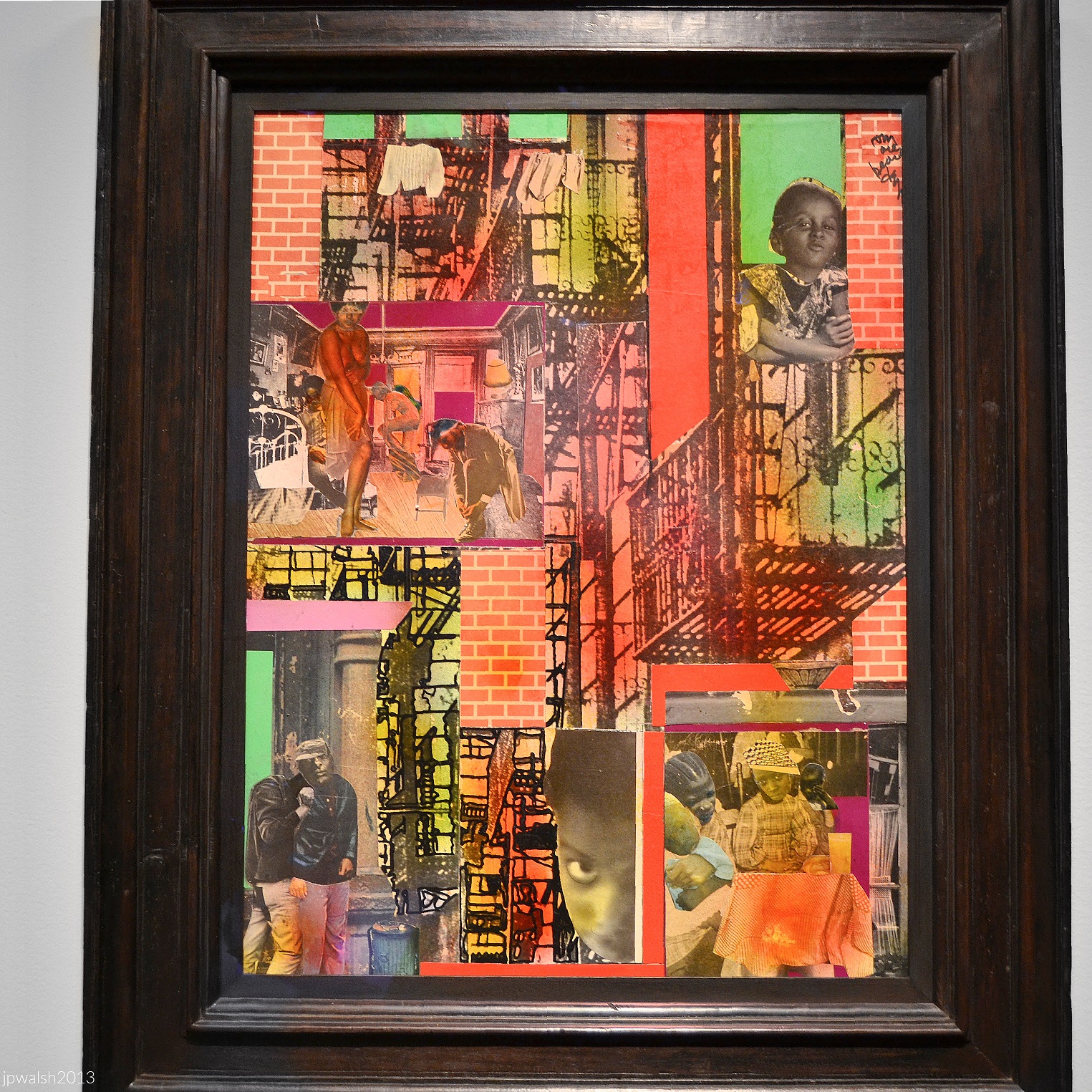
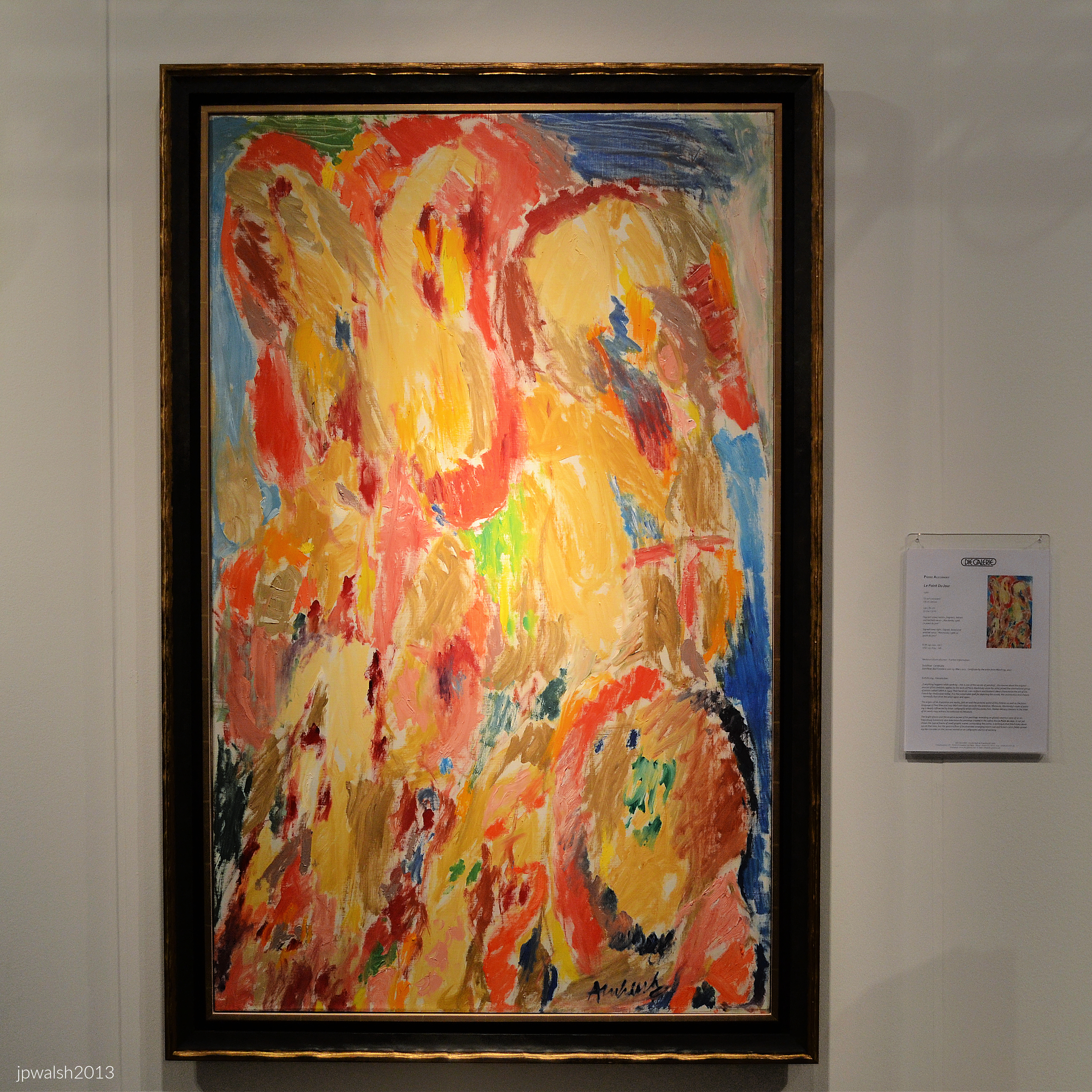
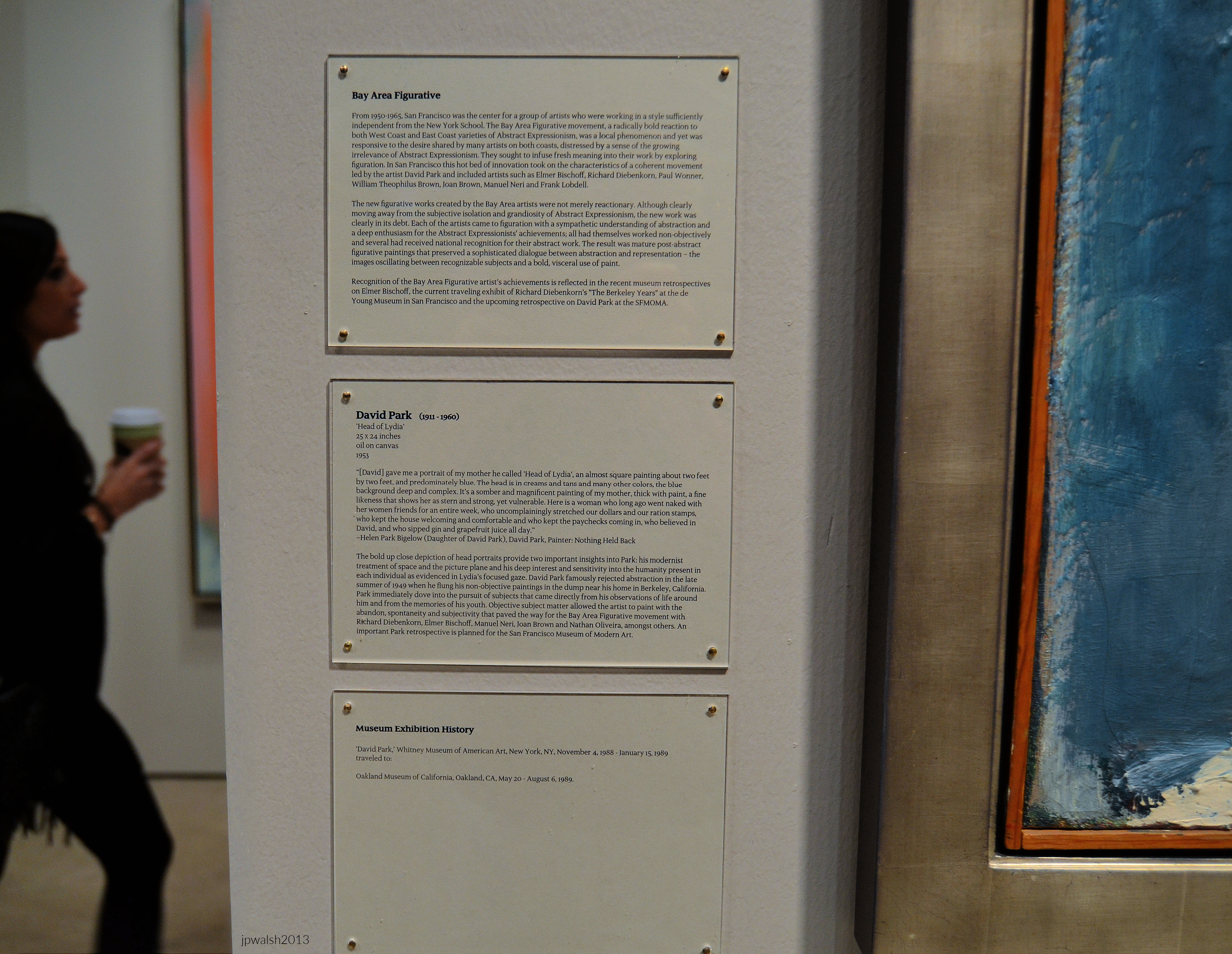
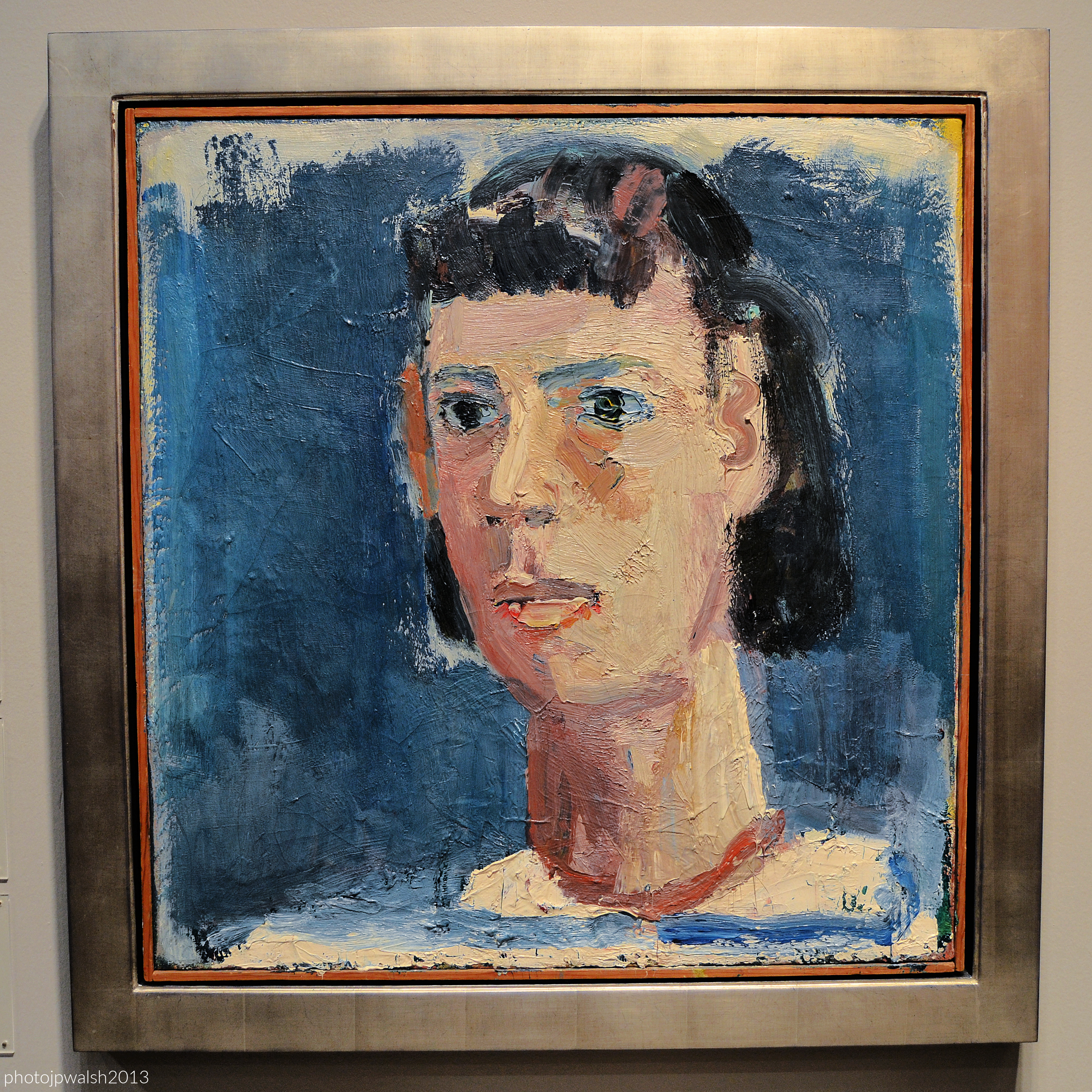
“1968 Black Power Salute” by urcameras is marked with Public Domain Mark 1.0.Robert Natkin (American, 1930-2010), Untitled, 1957, McCormick Gallery Chicago & Vallarino Fine Art New York.Hung Liu (American, Chinese, 1948-2021), Da Fa Che II, 2013, mixed media, 82 x 82 in., Nancy Hoffman Gallery, NY.Jack Roth (1927-2004), Metafour II, acrylic on canvas, 57 x 54 inches, 1980, McCormick Gallery, Chicago and Vallarino Fine Art, New York.Bruce Dorow (b. 1959), Black Shape Space, oil on canvas, 38 x 65 inches, 2012-2013. R.S. Johnson Fine Art, Chicago.Patrick Strzelec, American sculptor. Garth Greenan Gallery, Chicago.William T. Kennedy, Warhol Holding Marilyn Acetate 1, executed 1964, 2010. The photograph was made when Warhol wasn’t yet famous but at the center in a shift in the culture of the art world.Aimé Mpane (Congo, born 1968), IC Cont Series, 2011-2013, acrylic and mixed media on wood panel, 12.5 x 12 x 2 in., Haines Gallery, San Francisco.Larry Rivers (American, 1923-2002), Small Drugstore, 13.5.x.15.25 inches, oil on canvas mounted on board, 1959. Techniques of color-field painting, gestural abstraction, and calligraphy come together in a picture that is objective and abstract.Jonathan Boos, LLC, New York.Fernand Léger (1881-1955) – Mother and Child, c. 1949, gouache, signed with initials. R.S. Johnson Fine Art Chicago R.S. Johnson Fine Art, Chicago. Top left: Fernand Léger (1881-1955), Mère et Enfant, 1949, gouache; right: André Lhote (1885-1962), Les Acacias, 1959, oil on canvas. Michele Pred, Targeted, 2012, Vintage hat bag, birth control pills, 24x1x6 inches. Nancy Hoffman Gallery, New York. Michele Pred incorporates aspects of contemporary culture and politics in her art. The Berkeley, California, artist uses unconventional materials that serve as cultural artifacts for her conceptual approach.Romare Bearden (American, 1911-1988), Manhattan Suite, 1975, collage and mixed media on board, 24 x 18 inches, Jonathan Boos, LLC.50%. Elizabeth Catlett (American, 1915-2012), Star Gazer, 1997, black marble, 14.5 x 32 x 11 in., signed. Jonathan Boos LLC. Catlett is known for depictions of African-American and Latin American working-class women using simple, solid shapes in wood, stone, bronze or clay.Haines Gallery, San Francisco.Siebren Versteeg (American, b. 1971), Good Times_1081_2003_05_09, 2012, Algorithmically generated archive inkjet output to paper, tape. 92 x 56 inches, Rhona Hoffman Gallery, Chicago. The New York-based artist was educated at the SAIC and UIC. Mined digital content is presented as painterly abstractions or monitor displays.Die Galerie, Frankfurt am Main.Long–Bin Chen (Taiwan, born 1964), Edvard Grieg, 28x29x15 inches. New York-based Long-Bin Chen transforms paper products into sculpture. Books are constructed so that relevant subject parts and often titles fit together seamlessly.Mary Ellen Mark, John Belushi “Blues Brothers” Chicago IL, 1979 Gelatin silver print, 16 x 20 in. each, signed dated numbered (verso).Pierre Alechinsky, Le Point du Jour, 1966, oil on canvas, 130×81 cm, signed lower right and signed dated entitled (verso). David Park (1911-1960), Head of Lydia, 25×24 in., oil on canvas. 1953. In the late summer of 1949 David Park rejected abstraction and started the pusruit of objective subjet matter, including the mother of Helen Park Bigelow.