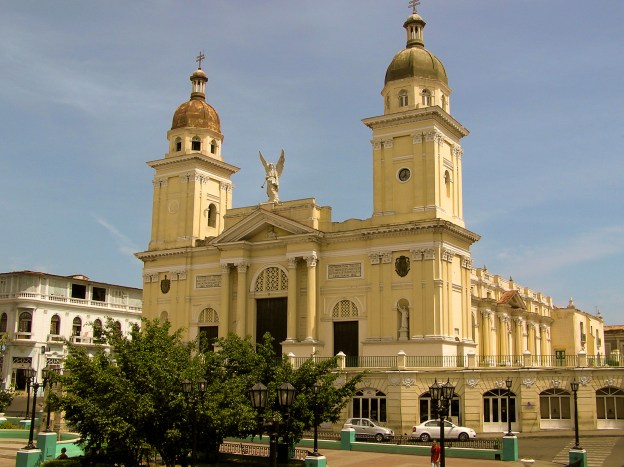
The neoclassical facade of the colonial-era Catedral Nuestra Señora de la Asunción in Santiago de Cuba, southeastern Cuba. As Archbishop of Santiago de Cuba from 1851 to 1857, St. Anthony Mary Claret used this cathedral as his primary pastoral seat, tirelessly preaching to the public and overseeing structural recovery efforts after a devastating earthquake left the building in ruins in 1852. Faced with widespread poverty, illness, and systemic inequalities, he championed the people’s well-being by establishing hospitals, schools, and diverse family-owned farms to combat the economic hardships of the local populations and enslaved workers. Photo Credit: BluesyPete / CC BY-SA 3.0
St. Anthony Mary Claret (1807-1870) combined intense personal holiness with tireless missionary activity, becoming one of the nineteenth century’s most influential Catholic reformers. From preaching missions and extensive pamphlet writing across Spain and the Canary Islands to serving as Archbishop of Santiago de Cuba, Claret devoted his life to evangelization, education, social justice, and the reform of Church and society.
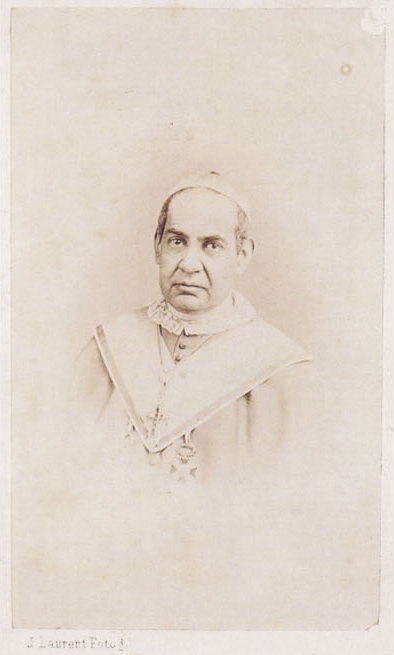
Photograph of Saint Anthony Mary Claret taken by Jean Laurent in 1862. At the time, Claret was serving as personal confessor to Queen Isabella II of Spain. The year marked a particularly productive period in his ministry, including the completion of his celebrated Autobiography in May, an intensive six-week preaching campaign during which he delivered more than 200 sermons to laypeople, clergy, seminarians, and charitable communities, and important developments in the growth of the Claretian order he had founded. Public Domain.
Early Spiritual Awakening
St. Anthony Mary Claret (1807-1870), whose feast day is October 24, was one of the great missionaries and social reformers of the nineteenth-century Catholic Church.
Born in Sallent, Catalonia, Spain, Anthony grew up in a devout Catholic family. At the age of five, lying awake one night, he reflected on God, judgment, Heaven, and Hell, lessons he had learned from his parents. As he tried to comprehend eternity, he became deeply troubled by the thought of souls separated forever from God’s love. The experience left a profound impression on him and inspired a lifelong desire to bring others closer to Christ.
Devotion to Mary and Extraordinary Graces
Throughout his life, Anthony reported receiving visions and special spiritual consolations, although he spoke of them only when doing so might strengthen the faith of others.
In his autobiography, he recounts an incident from his youth when he was swept out to sea by a powerful wave while wading near a beach with friends. Unable to swim and facing almost certain death, he prayed to the Blessed Virgin Mary for help. Moments later, he found himself safely on shore. Anthony viewed the event as a sign of Mary’s maternal protection and frequently encouraged others to seek her intercession in times of danger and distress.
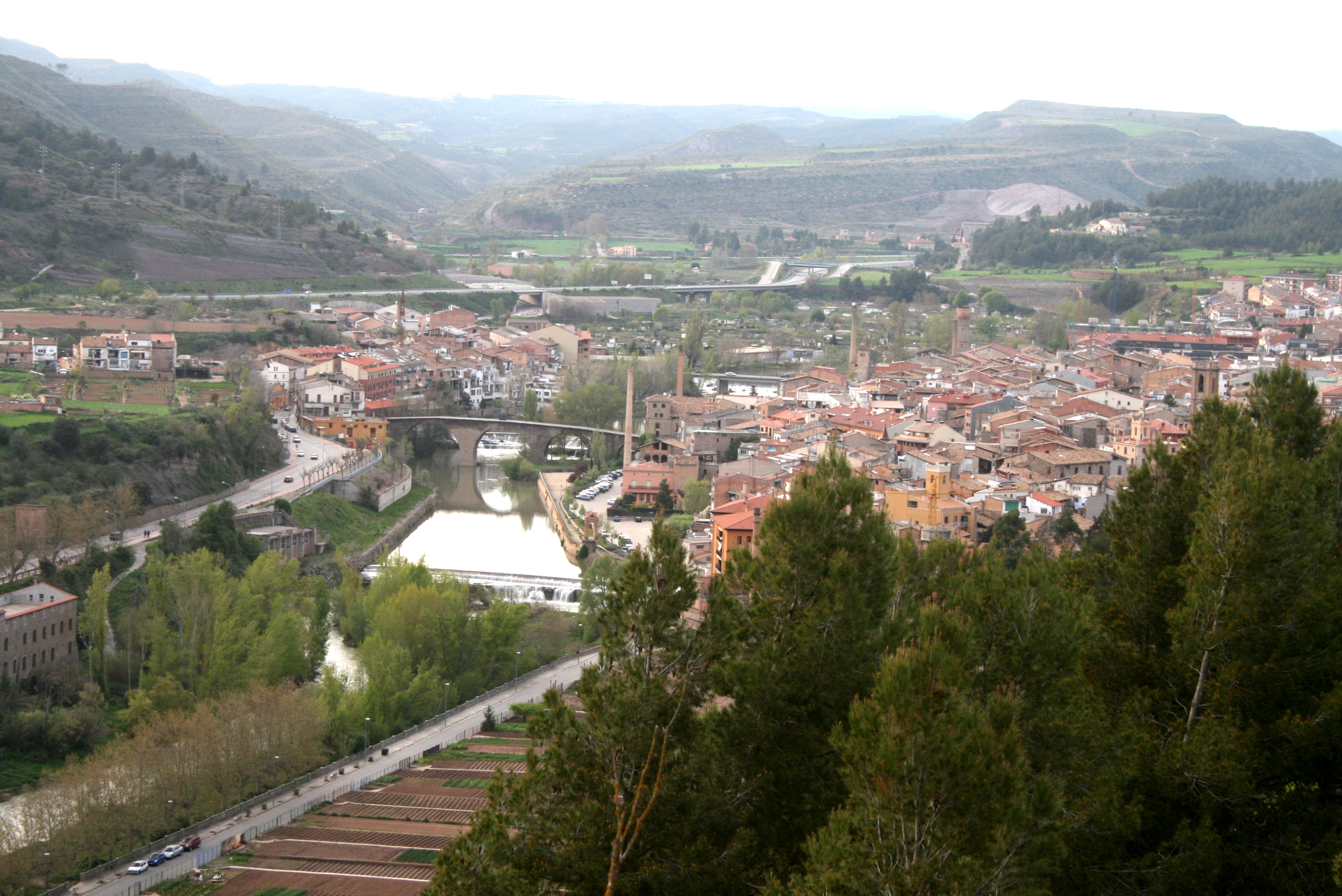
A panoramic view of Sallent from the castle, located in Catalonia, Spain, the historic birthplace of St. Anthony Mary Claret. Anthony Mary Claret was born in this small manufacturing town on December 23, 1807. The Llobregat River running through the town powered the local textile industry. Claret spent his youth here working as a weaver in his father’s textile mill, mastering the trade before moving to Barcelona to further his studies in manufacturing. Photo Credit: Joan / CC BY 3.0
Missionary Across Spain and the Canary Islands
Ordained a priest in 1835, Anthony quickly became known as one of Spain’s most dynamic and effective preachers. Unable to enter the foreign missions because of poor health, he instead devoted himself to missionary work throughout Catalonia and the Canary Islands, often traveling on foot from town to town. His powerful sermons attracted enormous crowds, and he became renowned for his ability to communicate Catholic teaching in a direct and compelling manner.
Recognizing the growing influence of the printed word, he also published books, pamphlets, and catechetical materials on a massive scale, making religious instruction accessible to ordinary people. In 1849, he founded the Missionary Sons of the Immaculate Heart of Mary, today known as the Claretians.
A Lifelong Admiration for the Jesuits
As a young priest, Anthony Mary Claret felt strongly drawn to the missionary spirit of the Society of Jesus. In 1839, he traveled to Rome and entered the Jesuit novitiate, hoping to dedicate himself to missionary work abroad. Although recurring health problems forced him to leave before completing his formation, the experience left a lasting mark on him.
Claret never lost his admiration for the Jesuits. He was deeply influenced by their discipline, intellectual rigor, missionary zeal, and devotion to the service of the Church. Throughout his life, he maintained close relationships with members of the order and frequently recommended the Spiritual Exercises of St. Ignatius Loyola as a means of spiritual growth. The Jesuit emphasis on evangelization, education, and obedience to the Church resonated strongly with Claret’s own vocation and would help shape his ministry as a preacher, founder, bishop, and reformer. Even though he did not remain a Jesuit, he carried many Ignatian ideals into the missionary work that made him one of the most influential Catholic figures of nineteenth-century Spain and Cuba.
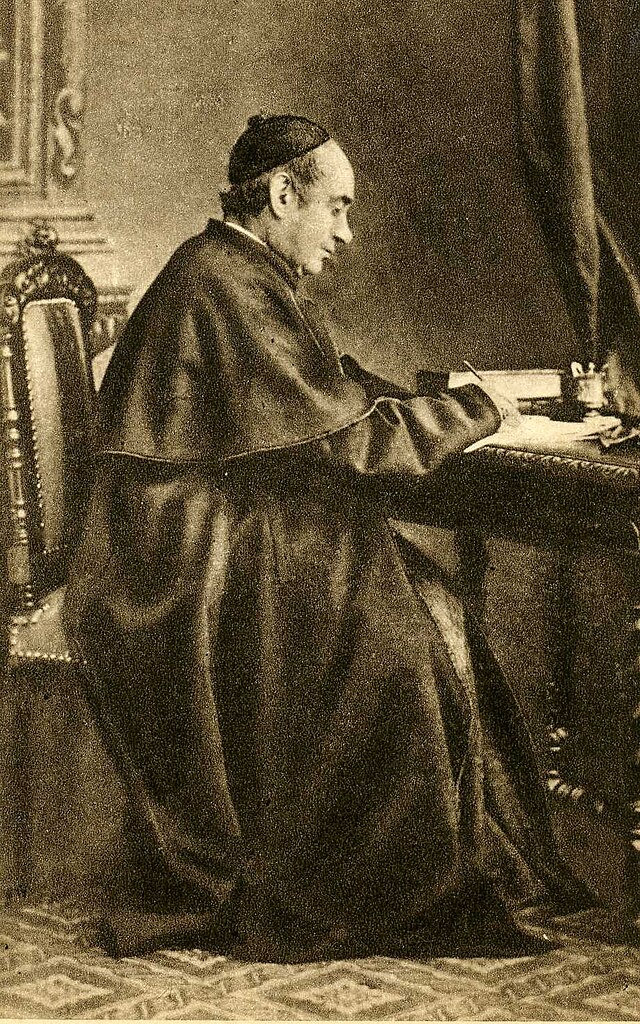
Historic photograph depicts St. Anthony Mary Claret engaged in his extensive writing ministry, commonly referred to as his “apostolate of the pen.” It was taken by French photographer Antoine René Trinquart in Paris in December 1868. Public Domain.
Archbishop and Reformer in Cuba
Later in 1849, Pope Pius IX appointed Anthony Archbishop of Santiago de Cuba, a position he held until 1857. His years in Cuba were among the most demanding and fruitful of his ministry.
He traveled tirelessly throughout his vast archdiocese, preaching missions, hearing confessions, founding schools, and promoting religious education. Determined to improve both the spiritual and material conditions of the people, he established savings banks, supported agricultural initiatives, aided the poor, and spoke out against abuses associated with slavery. Local, wealthy landowners and plantation owners reacted to St. Anthony Mary Claret’s reforms with intense and often violent hostility. Because Cuba’s wealthy elite relied heavily on a rigid, slave-reliant agricultural monopoly, they viewed his social and economic initiatives as an existential threat to their power. By dividing land, teaching modern agricultural techniques, and encouraging poor peasants and enslaved workers to run self-sufficient family farms, he threatened the cheap labor supply that major sugar plantations depended on.
Preaching Human Dignity
His fierce advocacy for racial equality, the defense of enslaved workers, and his efforts to legitimize marriages across racial lines directly disrupted the social order the plantation owners fought to maintain control.
Anthony also undertook sweeping reforms of the clergy. Priests were required to demonstrate their ability to celebrate Mass properly and to fulfill their pastoral duties. He famously argued that it was better for a village to have no priest than to have an unworthy one. His insistence on moral reform extended to society at large as he preached forcefully against adultery, concubinage, and other practices he believed undermined Christian family life.
His efforts won him widespread admiration among the faithful but also powerful enemies among those whose interests were threatened. The elite tried to silence him by launching a series of smear campaigns, labeling him a dangerous subversive, and hiring hitmen to eliminate him. In 1856, he survived a violent assassination attempt in Holguín, Cuba, where an assassin slashed his face and arm with a knife. Yet he responded with forgiveness and mercy toward his attacker and later successfully advocated to commute his attacker’s death sentence to a prison term.
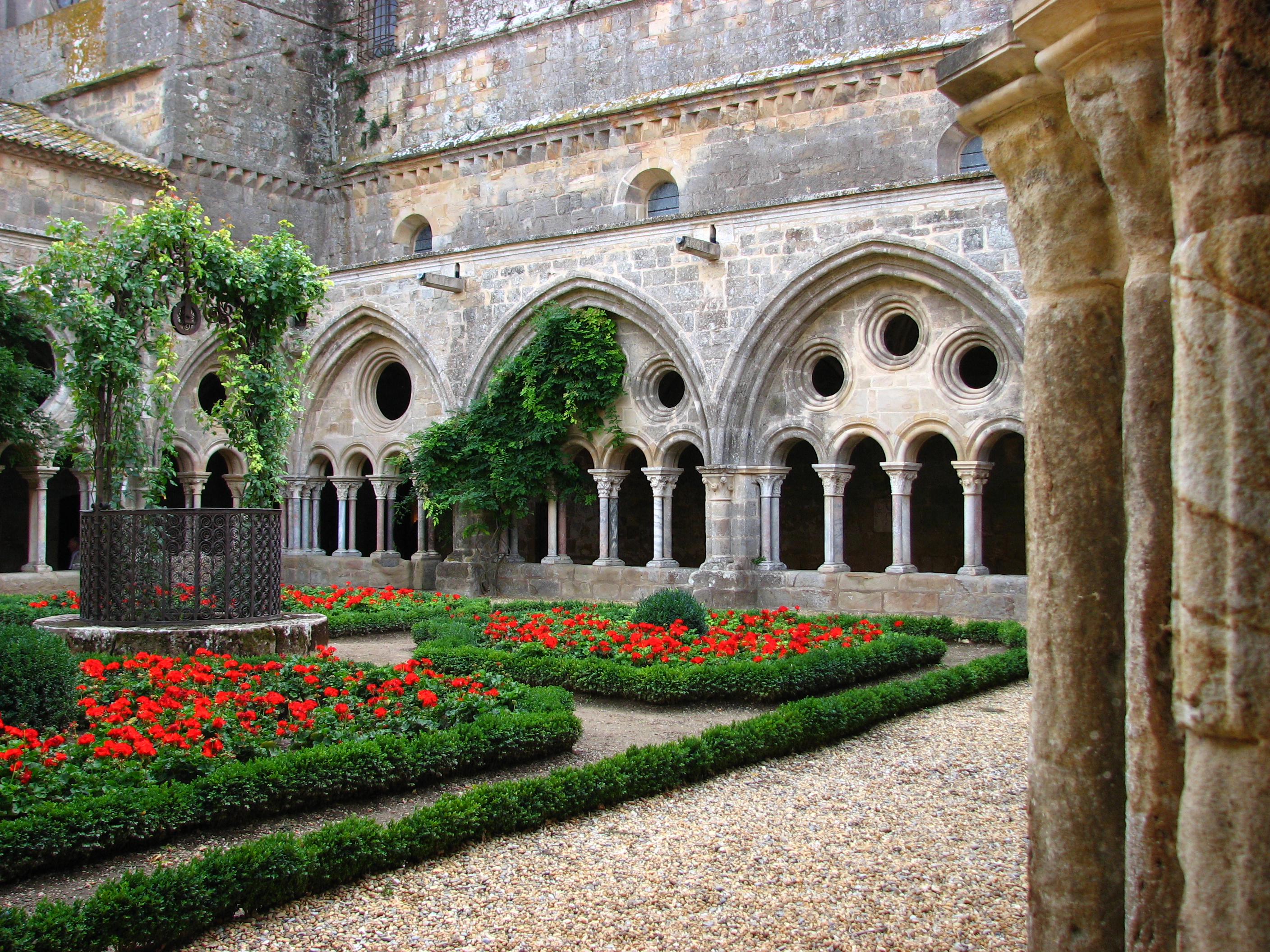
Cloister garden of Fontfroide Abbey, founded in 1093 by Aymeric I, Viscount of Narbonne. In 1870, St. Anthony Mary Claret found refuge here after fleeing political persecution in Spain. Sheltered by the abbey’s Cistercian monks and hidden for his own safety within these ancient walls, Claret spent his final weeks walking, praying, and preparing for death among these Gothic cloisters constructed largely in the late twelfth and thirteenth centuries. He died peacefully at Fontfroide on October 24, 1870. Photo Credit: Nancy / CC BY-SA 4.0
First Vatican Council, Exile, and Death (1870)
St. Anthony Mary Claret died in exile on October 24, 1870, at the Cistercian Monastery of Fontfroide near Narbonne in southern France at the age of 62. Following the Glorious Revolution of 1868, which deposed Queen Isabella II, Claret fled Spain alongside the royal family. After spending time in Paris and attending the First Vatican Council in Rome—where he spoke ardently in favor of Papal Infallibility—his presence continued to draw intense hostility from his Spanish political enemies, a powerful coalition of anticlerical revolutionaries, radical liberals, and Freemasons.
Because Claret was the Queen’s personal confessor, the new radical secular government viewed him as a dangerous political opponent and a symbol of the monarchy they were determined to destroy. They weaponized the legal system against him, trumping up political charges of treason and subversion to justify his arrest, suppress his religious orders, and seize Church property. Suffering from rapidly failing health, Claret initially sought peace with an exiled Claretian community in Prada de Conflent in the French Pyrenees. However, when Spanish government agents and diplomats tracked him there to execute the warrant, he was forced to flee once more in the middle of the night.
He found his final sanctuary at the isolated Cistercian Abbey of Sainte-Marie de Fontfroide near Narbonne and the Spanish border, where the monks shielded him under practical house arrest for his own safety. He passed away peacefully at the monastery shortly after his arrival, succumbing to his illnesses. Although he was initially buried in France, his remains were later returned to his homeland and are entombed today at the Claretian sanctuary in Vic, Spain.
Legacy of a Missionary Saint
St. Anthony Mary Claret was officially recognized by the Catholic Church as Venerable in 1899 by Pope Leo XIII; Beatified in 1934 by Pope Pius XI; and formally canonized a saint on May 7, 1950, by Pope Pius XII.
St. Anthony Mary Claret was a preacher, publisher, missionary, bishop, social reformer, and founder. Whether traveling through rural Spain, evangelizing in the Canary Islands, or reforming the Church in Cuba, he was driven by a profound concern for the salvation of souls and the welfare of the poor. Remembered as the “Spiritual Father of Cuba,” he remains a powerful example of missionary zeal, devotion to Mary, and courageous Christian leadership.