FEATURE Image: Row Houses, c. 1873, 802-812 N. Dearborn Street, Chicago. June 2014. Author’s photograph.
The row houses at 802-812 N. Dearborn Street stand as rare survivors of post-Fire Chicago, illustrating how nineteenth-century urban residential architecture helped shape the city’s transformation from a rebuilding frontier metropolis into a sophisticated national center of commerce, culture, and residential life.
These early row houses were developed in Chicago’s Gold Coast/River North neighborhood in the early 1870s immediately following the Great Chicago Fire.
That tw-day conflagration began on October 8, 1871 at 137 DeKoven Street (around 1100 South) and blew its destruction north through Downtown and into the Gold Coast area. The fire petered out to the north of Fullerton Avenue (2400 North). The area of devastation was a swath of over four miles (see map below).
The fire’s aftermath sparked an intense period of rebuilding, especially in Downtown Chicago, less than one mile to the south of these row houses. This flurry of building activity, particularly of needed housing, may be partly why the architect is unknown for these three- and four-story Italianate buildings, all of which are well preserved.
The three-story row houses to the south have neo-Grec ornament which was in vogue by 1872. It included incised carved detail on window ledges and door frames.
Among the oldest surviving residential buildings in downtown Chicago, the 1873 Dearborn Street row houses offer a remarkable glimpse into the city’s resilience after the Great Chicago Fire and the architectural character of the emerging Near North Side.
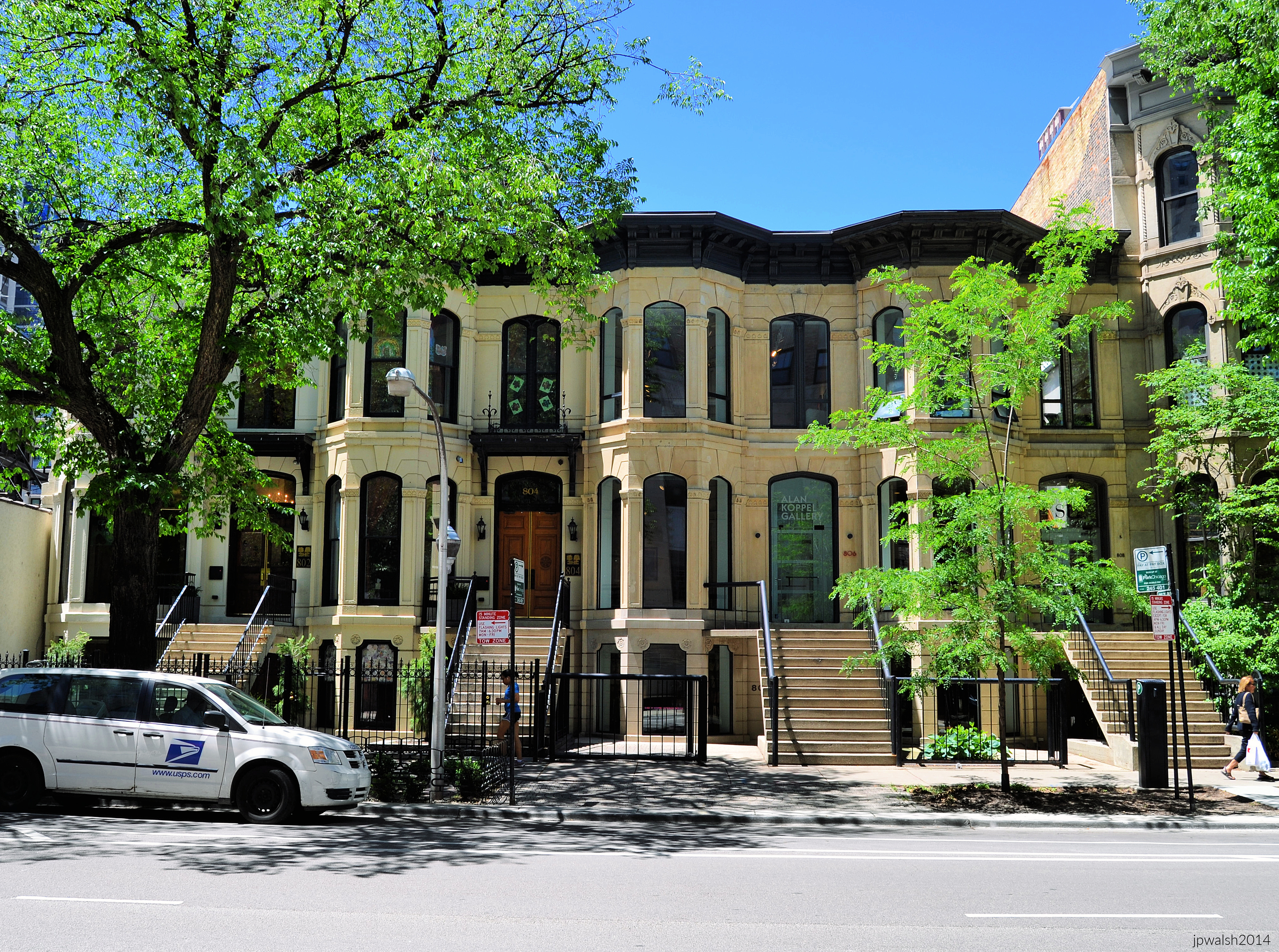
The four-story row houses to the north (partially pictured) have more lavish Second Empire exterior decoration.
Like the Italianate style, the Neo-Grec–style row houses have a smooth brownstone front with a pronounced deep cornice, heavy entryway and window details. The contrast was in their ornamentation: Neo-Grec’s simple, precise lines and geometric Greek influence varied from Italianate ornamentation of curved and organic lines and forms.
Italianate curved window and door frames are replaced by Neo-Grec’s right-angles. Lintels are replaced by rectangular blocks. Entryway steps had baluster cast-iron railings that ended in squared-off linear and geometric incised ornament.
Constructed in 1873, shortly after the Great Chicago Fire, these rare surviving examples of nineteenth-century Chicago row-house architecture demonstrate the city’s rapid physical and economic recovery after the Great Fire.

CHICAGO POPULATION GROWTH 1860-1980
Chicago’s Explosive Growth Before the Great Fire
Chicago was growing exponentially by 1870. In 1860 the city had a little over 112,000 residents and ranked 9th on the list of largest U.S. cities. By the time of the Great Fire in 1871, Chicago had grown to nearly 300,000 and ranked 5th on the largest U.S. cities list.
Equally significant is that the city’s size also doubled in those same ten years from 17,492 square miles in 1860 to 35,172 square miles in 1870. Busy with rebuilding, the city did not expand again in square miles until the 1880’s, though its population continued to soar. When these Italianate row houses were built, Chicago was growing towards becoming the 4th largest U.S. city with a population of over 500,000.
Housing a Booming Metropolis
In the early 1870’s with rebuilding and augmenting population density the demand for housing was high. Chicago’s population would continue to grow with each decade until 1980.
The North Dearborn Street row houses were among the residential buildings constructed to meet that demand, reflecting both the city’s remarkable recovery after the Great Fire and its emergence as one of America’s great urban centers.
OCCUPANTS TODAY INCLUDE A CONTEMPORARY ART GALLERY AND THE ALLIANCE FRANÇAISE DE CHICAGO FOUNDED IN 1897
Today, at 806 N. Dearborn is Alan Koppel Gallery which has, for over two decades, introduced contemporary international artists to Chicago audiences.
At 810 N. Dearborn is the main entrance to the Alliance Française de Chicago. Founded in Paris in 1883. the Alliance Française de Chicago is part of an international network of over 1,100 Alliances around the world which promotes French language and francophone culture. Chicago’s Alliance Française was founded in 1897. Offering French language classes and a full range of cultural events, the Alliance Française de Chicago is the second oldest Alliance in the U.S. and the second largest in the U.S. after the French Institute Alliance Française in New York City. The Alliance Française de Chicago is headquartered in two renovated architecturally historic buildings, including the 1870’s row house on Dearborn Street and, connected by an interior garden, a building on Chicago Avenue.
SOURCES:
Alan Koppel Gallery. n.d. Gallery Homepage. Accessed October 30, 2021. https://www.alankoppel.com.
Alliance Française de Chicago. n.d. Organization Homepage. Accessed October 30, 2021. https://www.af-chicago.org/.
Biggest US Cities. 2021. “Chicago, Illinois Population History.” Accessed October 30, 2021. https://www.biggestuscities.com/city/chicago-illinois.
Pridmore, Jay, and George A. Larson. Chicago Architecture and Design. New York: Abrams, 2018, p. 42.
Randall, Frank A. History of the Development of Building Construction in Chicago. 2nd ed. Chicago and Urbana: University of Illinois Press, 1999, p. 5.
Sinkevitch, Alice, ed. AIA Guide to Chicago. 2nd ed. Orlando: Harcourt, Inc., 2004, p. 134.
Spellen, Suzanne. 2016. “Neo-Grec Architecture: For Highbrow Folks Who Knew the Italianate Style Was ‘So Over’.” Brownstoner, July 13, 2016. Accessed October 30, 2021. https://www.brownstoner.com/guides/%25guides%25/neo-grec/.
Vintage Map Shop. n.d. “1871 R.H. McDonald’s Map of Chicago with a Correct Outline of the Great Fire.” Product Catalog. Accessed October 30, 2021. https://thevintagemapshop.com/products/1871-mcdonalds-map-of-chicago-great-fire.