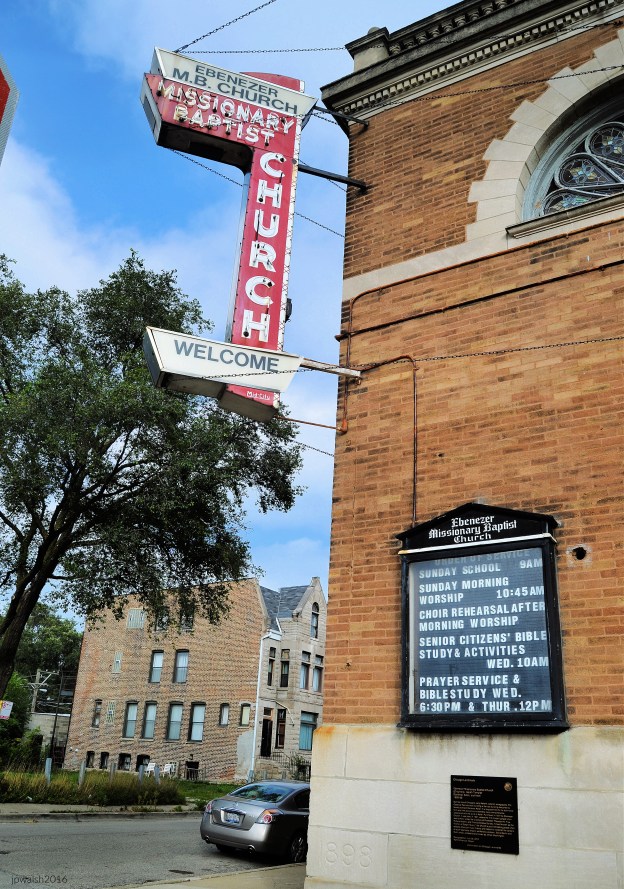

FEATURE Image: Signage of Ebenezer Missionary Baptist Church, 4501 S. Vincennes Avenue, Chicago. The church is known as “the birthplace of Gospel music” since Thomas A. Dorsey (1899-1993) started his first modern gospel choir here in 1931. October 2016. Author’s photograph, 6.06 mb
Ebenezer Missionary Baptist Church embodies multiple layers of Chicago history: as the last known building designed by architect Dankmar Adler (1844-1900), as a landmark of Bronzeville’s cultural and religious life, and as the cradle of modern gospel music whose influence extended far beyond the South Side.
Text & photographs (October 2016) by John P. Walsh.
African-American gospel singer Mahalia Jackson performing her iconic live rendition of the traditional spiritual hymn, “He’s Got the Whole World in His Hands.” Widely recognized as the “Queen of Gospel Music,” Mahalia Jackson was one of the most influential vocalists of the 20th century. Known for her powerful contralto voice, she played a monumental role in bringing gospel music out of Black churches and onto secular, global stages. She was also a prominent civil rights figure and close friend of Dr. Martin Luther King Jr., famously singing right before his “I Have a Dream” speech in 1963. Her studio recording of “He’s Got the Whole World in His Hands” became a massive hit on the Billboard charts in 1958, prompting several televised appearances around that exact era.
Designed by Dankmar Adler (1844-1900) and completed in 1898-99, the building was originally constructed as a Reform Jewish synagogue and represents the architect’s final known work.

Built as one of Chicago’s early Reform Judaism synagogue in 1898, the Classical Revival style golden brick and stone building is the last one designed by Dankmar Adler. The building with its form distinctive to other Adler buildings as well as its fine acoustics, was purchased by Ebenezer Church in 1921.
The Classical Revival structure stands out for its golden brick construction and celebrated acoustics.

In the heart of the Bronzeville neighborhood on Chicago’s Southside, Ebenezer Missionary Baptist Church was formed in 1902. During the Great Migration, African-Americans made Ebenezer their church home in the early 1920’s.
Purchased by Ebenezer Missionary Baptist Church in 1921, it became a spiritual anchor for African Americans settling in Bronzeville during the Great Migration.

Ebenezer developed a reputation as a center for gospel music. Under the direction of Theodore R. Frye, Roberta Martin and, the “Father of Gospel Music,” Thomas A. Dorsey (1899-1993), the church’s groundbreaking gospel choir introduced a blend of Christian praise and blues at Ebenezer that established the careers of the “Mother of Gospel,” Sallie Martin (1895-1988), Mahalia Jackson (1911-1972) and Dinah Washington (1924-1963) who was inducted into the Rock ‘n Roll Hall of Fame in 1993.
I’ll Tell It Wherever I Go – Sallie Martin. Sallie Martin helped popularize the songs of Thomas A. Dorsey. Martin also worked with Cora Martin-Moore (1927-2005), Dinah Washington and Brother Joe May (1912-1972), the “Thunderbolt of the Midwest,” when Sallie Martin formed the Sallie Martin Singers. Sallie Martin was inducted into the Gospel Music Hall of Fame in 1991.
Ebenezer earned national significance as the”birthplace of gospel music” after Thomas A. Dorsey organized his pioneering gospel choir there in 1931. The church helped launch or develop the careers of gospel legends including Thomas A. Dorsey, Mahalia Jackson, Sallie Martin, Roberta Martin, and Dinah Washington.

Sanctuary. During the 30-year pastorate of Rev. Frank K. Sims, distinguished guests of the church included Rev. Dr. Martin Luther King, Jr. (1929-1968), Ralph Metcalfe (1910-1978), Adam Clayton Powell (1908-1972) and Mahalia Jackson.
“A voice like this comes only once in a millennium,” so said Dr. King about Mahalia Jackson. During the Chicago Freedom Movement in 1966, Mahalia Jackson, who lived in Chicago, joined her friend Rev. Martin Luther King Jr., when he was visited a church to preach a sermon about justice and equality. Like Dr. King, Mahalia Jackson was a devout Christian and Civil Rights activist. At the August 28, 1963 March on Washington, she sang “How I Got Over” and was on the Lincoln Memorial platform behind King while he was pronouncing his “I Have a Dream” speech.
Ebenezer also played a role in Chicago’s Civil Rights era, hosting events connected to Dr. Martin Luther King Jr. and the broader struggle for racial justice.

In 1966 a banquet honoring Dr. Frank Kentworth Sims on the 7th anniversary of his pastorate of Ebenezer Missionary Baptist Church featured Nobel Peace Prize recipient the Rev. Dr. Martin Luther King, Jr. as the guest speaker and Mahalia Jackson as guest vocalist.
Though there were literally as many church choirs as there were churches, Dinah Washington (1924-1963), then Ruth Jones, made a name for herself as a teenage gospel singer in Chicago. In 1940 Ruth gave a recital that included “Precious Lord Take My Hand,” one of Thomas A. Dorsey’s most popular songs. The music for this version of the Christian prayer, “The Lord’s Prayer,” was written by Albert Hay Malotte (1895-1964) in 1935. It was released in 2010 on the compilation album, The Fabulous Miss D! (The Keynote, Decca & Mercury Singles 1943–1953), which traces the first decade of Dinah Washington’s recording career on 78s and 45s, starting with her stint with Lionel Hampton (1908-2002) and continuing through the early years of her solo career.
Few buildings in Chicago connect architecture, religion, music, and civil rights as powerfully as Ebenezer Missionary Baptist Church. Designed as Dankmar Adler’s final architectural work and later transformed into the birthplace of modern gospel music, it remains one of Bronzeville’s most important cultural landmarks.
SOURCES:
Chicago Public Library. “Ebenezer Missionary Baptist Church Archives.” Accessed October 26, 2026. chipublib.org.
Sinkevitch, Alice. AIA Guide to Chicago. 2nd ed. Orlando: Harcourt, Inc., 2004.
The Historic Ebenezer M.B. Church. “About.” Accessed October 26, 2026. https://ebenezerbronzeville.org/about/.