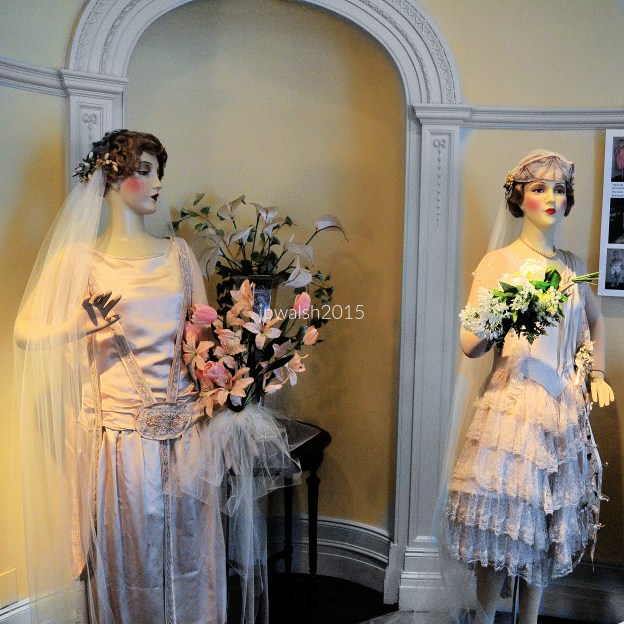
Feature Image: On Saturday, June 7, 1924, Ruth M. Anderson was married in this sleeveless wedding dress (left) to William Noling in Evanston, Illinois. The dress is now on display in the Charles Gates Dawes House in Evanston. Dawes was Vice President of the United States from 1925 to 1929 under President Calvin Coolidge. Author’s photograph (October 2015).
A surviving wedding dress and family home transform a local 1924 wedding into a study of popular culture, showing how the artistic styles and fashions of the Jazz Age reshaped American attitudes toward femininity, modernity, and social convention.
Wedding at the House of the Bride’s family
The Noling-Anderson wedding was held in the house of the bride and her parents, Isak and Jennie (née Johnson) Anderson, at 1035 Ridge Avenue in Evanston. Built in 1914, the house still stands as it did over 100 years ago.

Noling-Anderson Bridal Party Dresses, 1924 in the Charles Gates Dawes House, Evanston, Illinois. October 2015. Author’s photograph. 7.44 mb DSC_0893 (1)
The dress is made of silk satin in an egg shell color. It is accented by an oval medallion with bands also made of silk satin. The medallion is embroidered with faux pearl and other glass beads.
Thoroughly modern flapper style
While her wedding dress was very fashionable for the mid1920’s – sleeveless tops of all shapes and sizes were the rage in 1924 – it probably was not allowed in one of Evanston’s houses of worship. The fact that it was sleeveless and au courant would be deemed by many as risqué for showing too much bare skin inspired by a thoroughly modern flapper style. It was only in 1924, for instance, that the Methodist Episcopal General Conference first lifted its ban on going to the theater as well as dancing though dance music was the radio’s most popular programming.
The bridesmaid dress (right) was the height of women’s style in 1924 – a mainly straight, knee-length skirt gathered slightly or cut with front pleats. Short sleeve and sleeveless tops were the rage in 1924 reflected in Hollywood by the Mack Sennett girls who starred in movies where they pranced on the beach in a chorus line in not much more than bathing caps and short swim suits.
The fashionable bride and her court might have sported the latest style of facial make-up which is hinted at in the display– masklike with garish, even orange, lipstick and heavy red rouge on the cheeks. Popular fashion accessories from 1924 are also evident – pearls knotted at the neck and simple, though elegant, arm bracelets.
Father of the bride was an Evanston banker, local businessman, and Swedish immigrant
The bride’s father, Isak Anderson, was born in Sweden and came to the United States at 20 years old in 1890. In 1891 he married Jennie Johnson and they had Ruth and another child. Ruth’s father was a bank director and partner in a local tailoring business in downtown Evanston at 608 Davis that today is a noodle shop.
The Jazz Age transformed American social customs, fashion, and ideas of modern womanhood, with the bride’s flapper-inspired wedding attire reflecting broader cultural shifts that were fashionable, controversial, and distinctly of their time.
The dance migrated North during the Great Migration. It officially exploded into mainstream American culture on October 29, 1923, when it debuted on Broadway in the all-Black musical revue Runnin’ Wild. The show featured the hit song “The Charleston,” composed by jazz pioneer James P. Johnson, which provided the fast, syncopated 4/4 rhythm that defined the dance. The Charleston was most fashionable during the “Roaring Twenties” (1923–1929), reaching its absolute peak popularity between 1926 and 1927.
It was most popular in major urban centers—particularly New York City, Chicago, Paris and London, where young women called flappers wore short dresses, rolled down their stockings, and kicked up their heels to flout traditional social etiquette
The original Charleston craze effectively ended as a mainstream fad with the onset of the Great Depression in 1929. However, it didn’t completely disappear. The Charleston’s fast kicks, hand-to-knee swivels, and loose movements were absorbed into newer, more complex swing dances, most notably, for the Lindy Hop and the Jitterbug in the 1930s and 1940s.
They served “Prohibition highballs”
With Prohibition starting in 1920, guests at the wedding may have been served the latest popular highball whose recipe called for fruit juice and raw eggs. Their morning might have started with a bowl of Wheaties at breakfast, since the cereal of champions made its first appearance in 1924.

Wearing that dress Ruth Anderson married William Noling in this house at 1035 Ridge Avenue in Evanston, Illinois, on June 7, 1924. May 2024. Author’s photograph. 92% 7.81 mb
The bride’s attire reflected contemporary flapper fashion, including higher hemlines and sleeveless styles.
SOURCES: Charles G. Dawes House. Evanston, Illinois.
Ernst Wilhelm Olson, The Swedish Element in Illinois: Survey of the Past Seven Decades (Chicago: Peter-Albin-Publishing, 1917), p. 586.
Lois Gordon and Alan Gordon, American Chronicle (New Haven: Yale University Press, 1999), pp. 230–38.
Thomas G. Aylesworth and Virginia Aylesworth, Chicago: The Glamour Years (1919-1941) (New York: Gallery Books, 1986), p. 14.