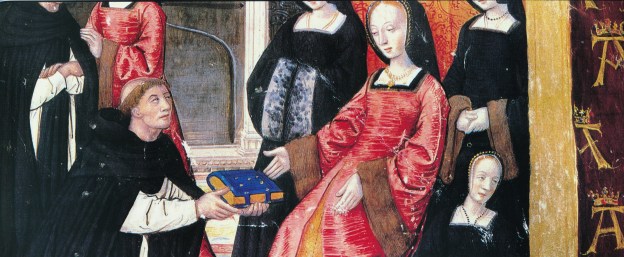
FEATURED image: Manuscript 16th century (detail): Queen consort Anne of Brittany (1477-1514) receiving a Book of Hours from her Dominican confessor, Antoine Dufour (d.1509). Montfort L’Amaury returned to the crown of France after Anne of Brittany married Charles VIII “the Affable” (1470-1498) in 1491.
Thirty miles from Paris, Montfort-l’Amaury condenses a thousand years of French history into one small town, where medieval fortifications, Renaissance religious art, royal patronage, and modern cultural figures reveal the continuous evolution of France from the age of crusaders to the twentieth century.
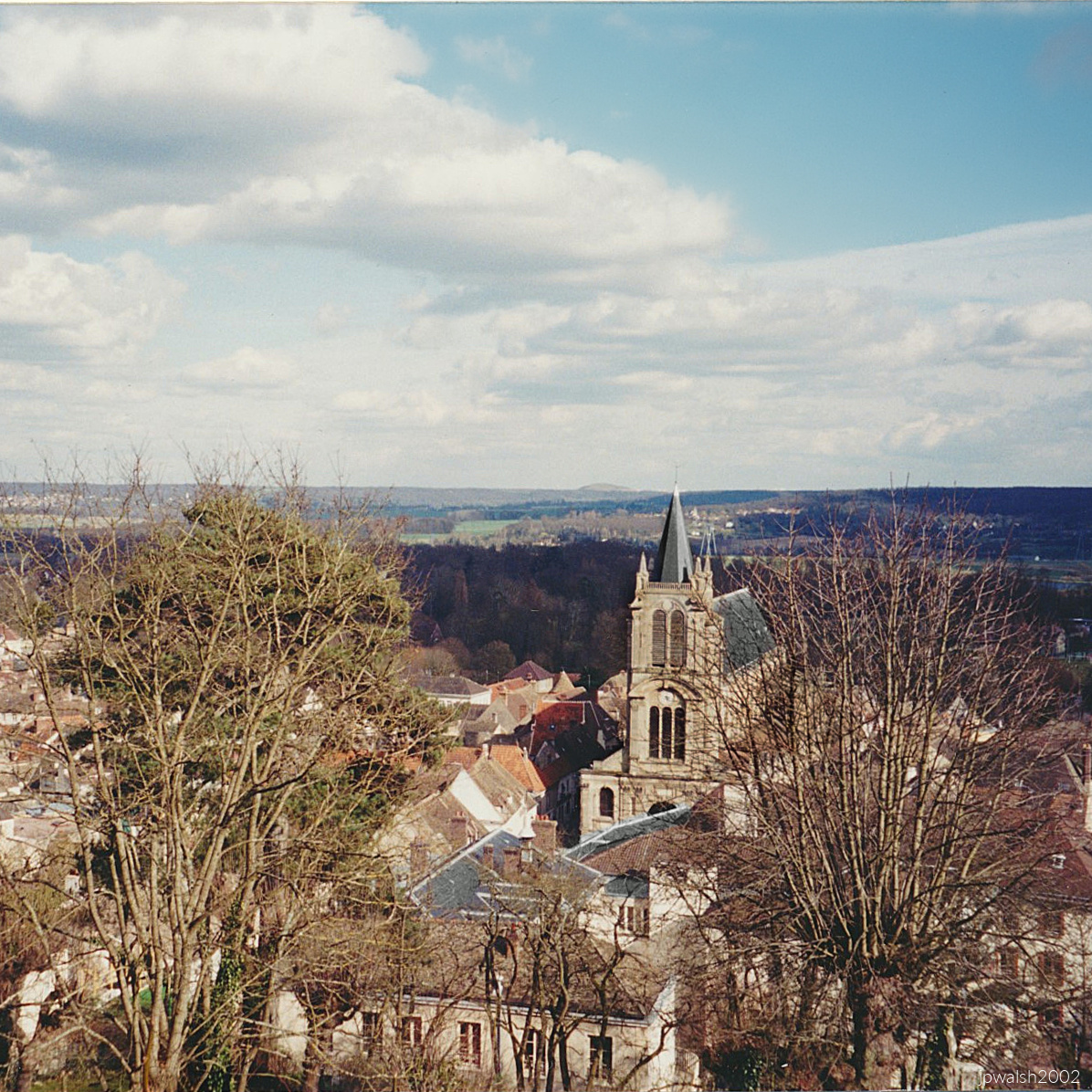
Started in the 11th century, L’Église St. Pierre anchors part of the centre ville of Montfort L’Amaury, a town in France about 30 miles west of Paris. The photograph is taken from the ruins of the chateau on the town’s heights. The late 10th century Frankish king Robert II built a castle in the hills of Montfort. From the start of the 11th century, Montfort-l’Amaury was the stronghold of the Montfort family. March 2002. Author’s photograph.
At the north edge of the Rambouillet forest the city of Montfort L’Amaury spreads along the restored ruins of its ancient fortified castle. Founded under the Capetian kings, the city owes its fame to Simon de Montfort (1208-1265), Anne de Bretagne (1477-1514), the Valois royal dynasty, and Henry IV (1553-1610). Its monuments begin in the 11th century, stretch towards exceptional Renaissance stained-glass windows and half-timbered houses as its civilization has attracted writers, artists, and musicians to live there. This would include the house of Maurice Ravel (1875-1937) called Le Belvédère where he lived from 1921 until his death and where we were invited to sit at, and play, the piano where Ravel composed Boléro. It was in March 2002 during a visit to Paris and the Île-de France that we ventured through Yvelines by train to Montfort-L’Amaury for a day trip which included a memorable déjeuner in a restaurant that has since disappeared.
L’Église Saint-Pierre

Interior, L’Église Saint-Pierre (Church of St. Peter), late 15th century, Montfort L’Amaury, France. March 2002. Author’s photograph.
The interior of Saint Pierre church is bright and intimate. Like other French monuments, today’s Saint-Pierre was completed over many centuries. Its origin is in the 11th century. A notable reconstruction of the edifice began in the late 15th century by initiative of Queen Consort, Anne of Bretagne. There is a vast ambulatory around both sides of the nave. Since 1840, the church has been an historic monument because of its unique ensemble of 37 stained glass windows. The oldest date from the 1540s and 1570s. The others were installed in the late16th century. That ecclesial project was started by Catherine de Medicis (1519-1589) in 1562. The windows were installed during the time of the Council of Trent (1545-1563) and some of the glass commemorates that event. As none of the glasswork is signed, it is not known whether its painters are from Montfort L’Amaury or elsewhere.

South exterior of L’Église Saint-Pierre along Rue de Dion in Montfort L’Amaury. March 2002. Author’s photograph.
The exterior wall shows flying buttresses designed in the French Renaissance style as well as gargoyles that were sculpted in the late 15th century. The building is constructed of calcified stone that came from towns to the north, precisely, Maule, and a more distant Vernon on the Seine. The interior ambulatory that surrounds the nave on both sides and ends at the chevet expresses the building’s gothic aspect. Street lamps and a narrow street with tight parking has room for a small tree next to the church.

St. Peter Window. L’Église Saint-Pierre, Montfort L’Amaury, France. Public Domain.
Throughout France starting in the 1540s there was a growing taste and demand for stained glass windows in their local churches. The experimentation in glasswork and painting by the middle of the 16th century allowed for the iconography in these stained glass windows to express numerous details and refined techniques.

Detail. St. Peter Window. Public Domain.
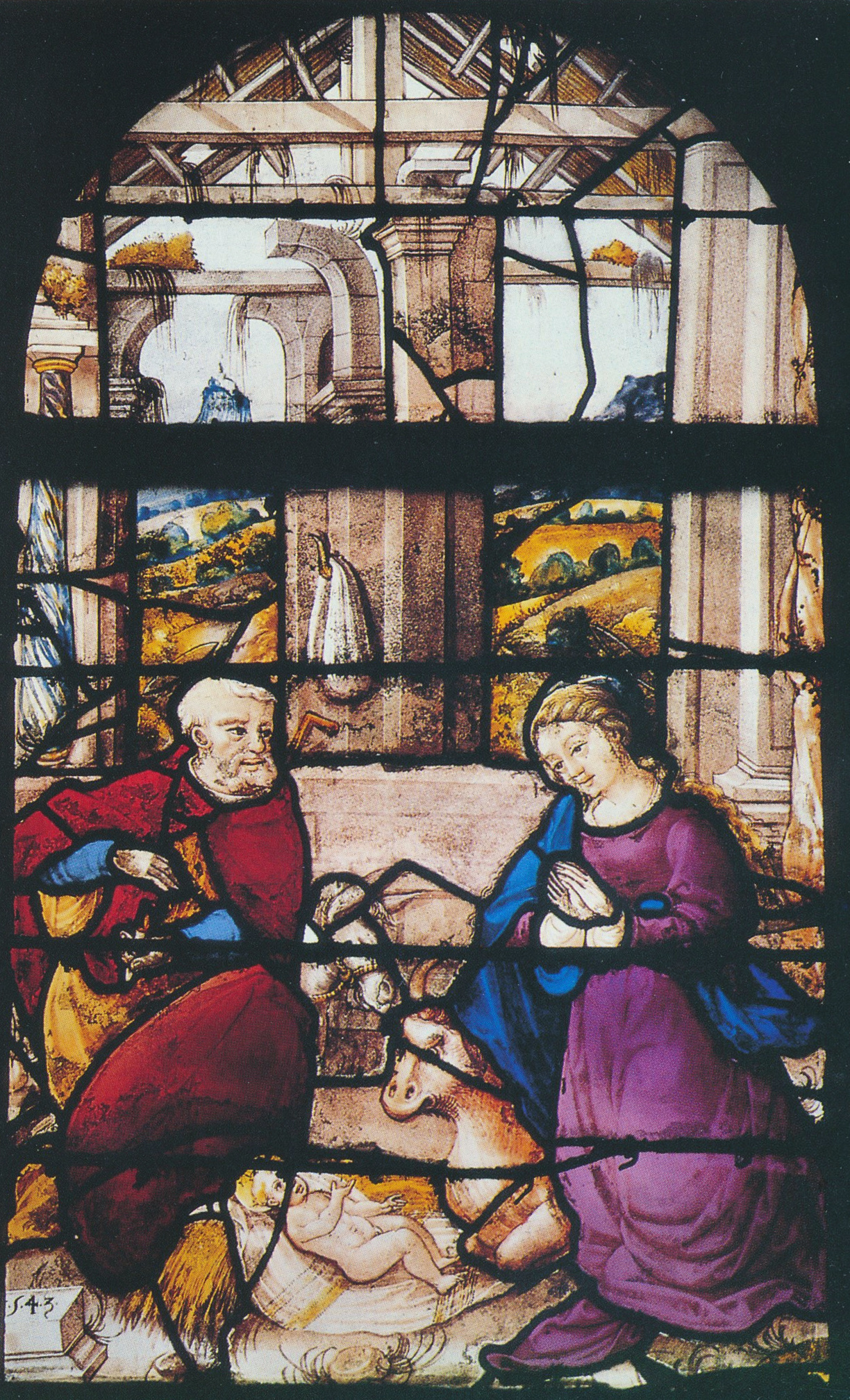
Detail. Nativity Window. Public Domain.
Historic 16th-century half-timbered house located in Montfort-l’Amaury

Montfort L’Amaury has half-timbered houses dating to the 16th century. March 2002. Author’s photograph.
This is no. 16, Place de la Libération, just steps from the front entrance of Église St. Pierre. The building features a classic colombage (half-timbered) facade with vertical wood beams, diagonal braces, and traditional window shutters. Houses like this were common during the 15th and 16th centuries in the region.
Victor Hugo
At the beginning of October 1825 young Victor Hugo (1802-1885) lived in Montfort L’Amaury for a few days. He wrote a letter to his father in Paris and described it as “a charming little town ten leagues from Paris, where there are ruins, woods, and one of my friends…”

Portrait de Victor Hugo sur fond de Notre-Dame de Reims, Jean Alaux, 1825, Maison de Victor Hugo – Hauteville House, oil on cardboard. Public Domain.
https://www.parismuseescollections.paris.fr/fr/maison-de-victor-hugo/oeuvres/portrait-de-victor-hugo-sur-fond-de-notre-dame-de-reims
Victor Hugo stayed in Montfort-l’Amaury primarily to visit his close friend, the poet Adolphe de Saint-Valry. At the beginning of October 1825, a young, 23-year-old Victor Hugo and his wife, Adèle, spent several days at Saint-Valry’s family home located on Rue de la Treille. Saint-Valry was a fellow literary intellectual and one of the co-founders of the conservative romantic journal La Muse française.
The trip profoundly influenced French literature in two major ways: first, upon returning to Paris, Hugo wrote a letter to his father describing Montfort-l’Amaury as described above; and second, during Hugo’s wanderings through the village, the future author of The Hunchback of Notre Dame (1831) became captivated by the crumbling medieval fortifications and the 12th-century castle keep (The Tower of Anne de Bretagne). This inspired him to write his famous poem, “Aux ruines de Montfort-L’Amaury” (published in his 1828 collection Odes et Ballades). It marks the very first time Hugo integrated the romantic grandeur of medieval ruins into his poetry—a thematic hallmark he would develop extensively throughout the rest of his legendary career.

View of the church from the east. March 2002, Author’s photograph.
The church of Saint Pierre is of late gothic origin. It was rebuilt and decorated in the 15th, 16th, and early 17th centuries. Following the French Revolution and its aftermath, the church building received an extensive restoration in the mid19th century, including a new steeple. Except for one stained glass window that was restored in situ, all the 16th century stained-glass windows were taken out, restored, and reinstalled by a master painter in Metz between 1851 and 1857.

Chevet. L’Église Saint-Pierre. Public Domain.
Taken from Rue Pétau de Maulette, the historic photograph captures the apse and side facade of the Church of Saint-Pierre de Montfort-l’Amaury. Built largely under the patronage of Queen Anne of Brittany in the late 15th and early 16th centuries, the lower structure features the dramatic flying buttresses, pointed arches, and intricate stone tracery characteristic of late Flamboyant Gothic architecture. The upper galleries and the grand rounded apse roof visible in the foreground display the classical proportions, decorative balustrades, and orderly lines of the French Renaissance style of the later 16th century. The building is a remarkable architectural hybrid, illustrating the transition between two major eras in French history. It also houses one of France’s most important and complete collections of Renaissance stained-glass, dating from 1530 to 1580. These 37 monumental windows are celebrated for their vivid colors, exceptional draftsmanship, and richly detailed biblical and historical narratives.

Place de la Libération with Rue de la Libération just beyond. March 2002. Author’s photograph.
On Saint Pierre’s front stoop is busy Place de la Libération. Like many town squares throughout France, this area was renamed to commemorate the town’s liberation from Nazi occupation during World War II. Montfort-l’Amaury was officially liberated on August 18, 1944, when American military forces entered the village center. Following a brief firefight with a heavily armed detachment of retreating German soldiers, the town was successfully freed, bringing an end to the local German Kommandantur. Prior to this 20th-century renaming, the historic area was known as the Place Normande—the dark site where the municipal guillotine was briefly erected during the height of the French Revolution. At the end of the street is the rounded 16th century La Porte Bardoul, one of gateways to the chateau. It was named in the 16th century for the captain who built the ramparts of Montfort L’Amaury in the 11th century (Hugues Bardoul).

Charles Aznavour (1924-2018), dubbed France’s Frank Sinatra, didn’t live in Montfort L’Amaury but for 60 years, the singer lived a five–minute car ride away in neighboring Galluis. In those many years, Aznavour frequently came to Montfort L’Amaury, sometimes to go shopping or visit friends or eat at one of its restaurants. In 2018 Aznavour was buried in the cemetery in Montfort L’Amaury and it has become a pilgrimage site for his many fans. PHOTO: “Charles Aznavour – Disque D’Or” by Piano Piano! is licensed under CC BY 2.0.

The cemetery at Montfort-l’Amaury. Fair Use.
The cemetery at Montfort-l’Amaury dates to the sixteenth century and is a fascinating site for its history, architecture, and the notable individuals buried there. For centuries, the dead were interred in the ground as they are today, but as burial space became scarce, especially during recurring epidemics, older graves were exhumed and the bones transferred to ossuaries to make room for the newly deceased. Built to resemble the arcades of a cloister, these elegant galleries are in fact a vast communal repository of human remains. The contrast between their graceful architecture and their somber purpose gives the cemetery a distinctive atmosphere, combining historical necessity with the melancholy charm of a Romantic-era bone yard.
The initial fortified stronghold on this strategic hill was erected by Amaury I of Montfort around the turn of the 11th century under the orders of King Robert II of France.

Ruins of the castle of Montfort-l’Amaury. The Tour d’Anne de Bretagne (the castle keep) stands as the focal point of the medieval Château. In the foreground is Le Belvédère, the house of Maurice Ravel. PHOTO: Montfort-l’Amaury Donjon by ℍenry Salomé (Jaser !) 08:12, 21 November 2006 (UTC) – Cliché personnel, own work is licensed under CC BY-SA 3.0
The role of Montfort l’Amaury as a town began to develop in the High Middle Ages when Capetian king, Robert II (976-1031), built a castle there in the forest of Yvelines which was then a royal prerogative. William of Hainaut built the castle whose walls were finished around 1050. Hugues Bardoule was captain of the castle and thus a later 16th century gateway is named after him. It is in the 11th century that L’Église Saint-Pierre and L’Église Saint Laurent begin to be built. Robert II was married three times, and excommunicated by the Catholic Church – one of the early examples of French royals who married as they wished.
In the twelfth century, Bertrade de Montfort (1070-1117), after giving birth to a boy who would become King of Jerusalem, left her husband, the Duke of Anjou, Fulk IV (1043-1109) in 1092. She married the king of France, Philip I “the Amorous” whose spouse, Bertha of Holland, was also still living.
Philip was so in love with Bertrade that he refused to leave her even when threatened and finally excommunicated by Pope Urban II (1035-1099) in 1095. Because of his excommunication Philip was prevented from taking part in the First Crusade (1096-1099).
Montfort-l’Amaury reflects major themes in French history, including crusading movements, dynastic politics, the Wars of Religion, and the growth of royal power.
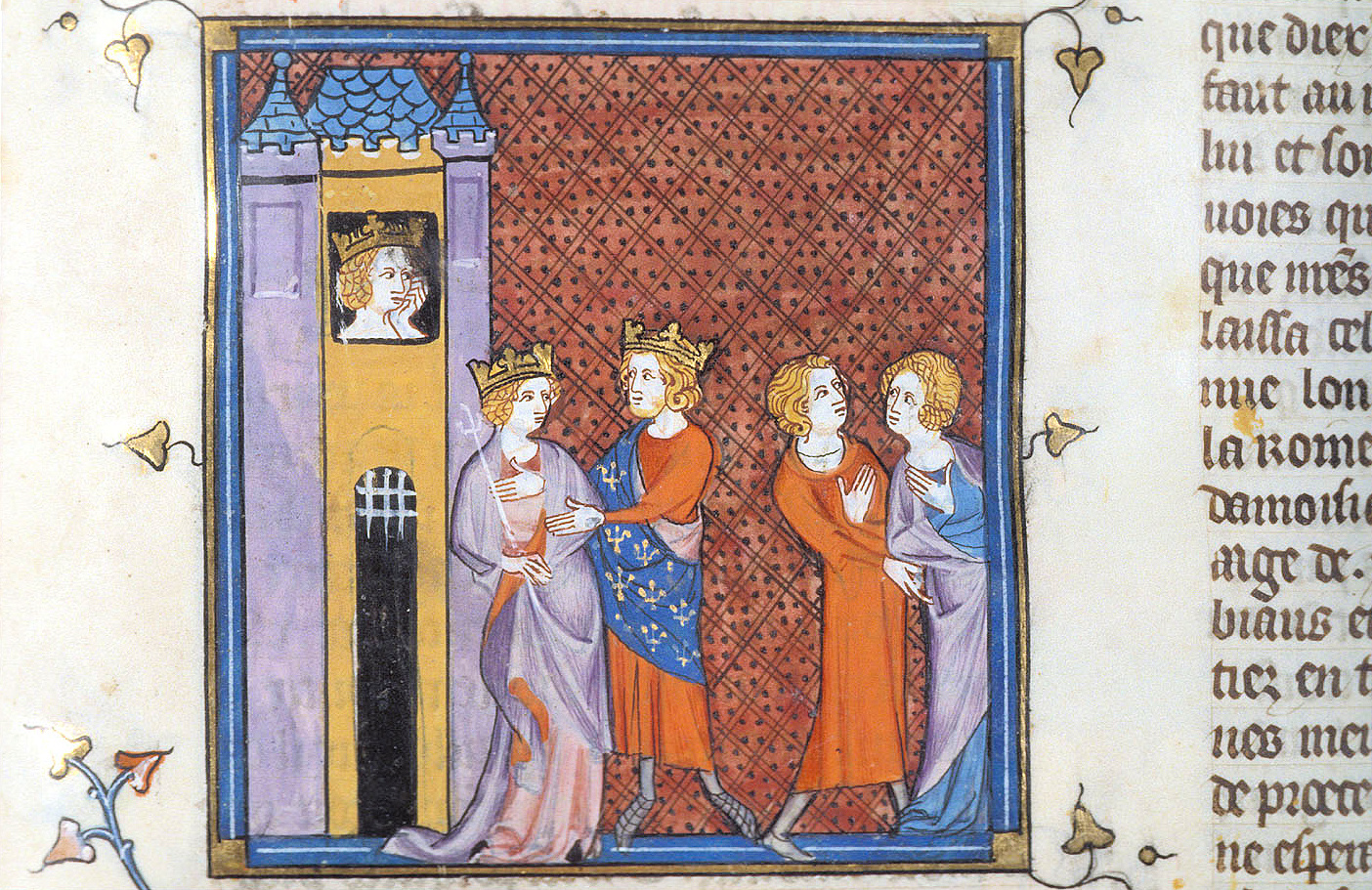
Bertrade de Montfort and King Philip I “the Amorous.” Chroniques de Saint-Denis (ou de France), British Library, Royal 16 G VI f. 271. 14th Century (1332-1350). https://www.bl.uk/IllImages/Kslides%5Cbig/K137/K137596.jpg

The ramparts and castle. The specific, octagonal brick-and-stone residential keep tower in the photo were erected by Queen Anne of Brittany in the late 1490s. She added the elegant Renaissance-style tower to make the defensive castle a comfortable royal manor. When the castle was dismantled and blown apart in the 1600s, the front and back walls of the tower collapsed entirely, leaving only the structural core intact giving appearance of two towers. March 2002. Author’s photograph.
The ramparts and castle were destroyed by the English during the Hundred Years’ War in the 15th century. After the battle of Agincourt in 1419, the English occupied the French domain and it was during this time that the castle at Montfort was destroyed. The two rebuilt towers were named for Anne of Brittany after she assisted in the castle’s restoration. From this height, the fort overlooked the old Roman road from Beauvais to Chartres.
Also from this place, troops assembled at Montfort L’Amaury in the 12th century as Amaury III raised lords and knights to fight alongside Louis VI (1081-1137) against the Emperor of Germany. Simon IV fought alongside Philippe II Auguste (1165-1223) against the English as well as to the Crusades in the Middle East and the Albigensian Crusade in southern France. The Montforts distinguished themselves especially in this crusade against the Cathars.
At the beginning of the Third Crusade (1189-1192), not wanted by King Philippe Auguste (1165-1223), the future Louis VIII “the Lion” (1187-1226) was looking for companions. Simon IV, Lord of Montfort (1175-1218), embarked on the crusade where victory was equalled by its terror.
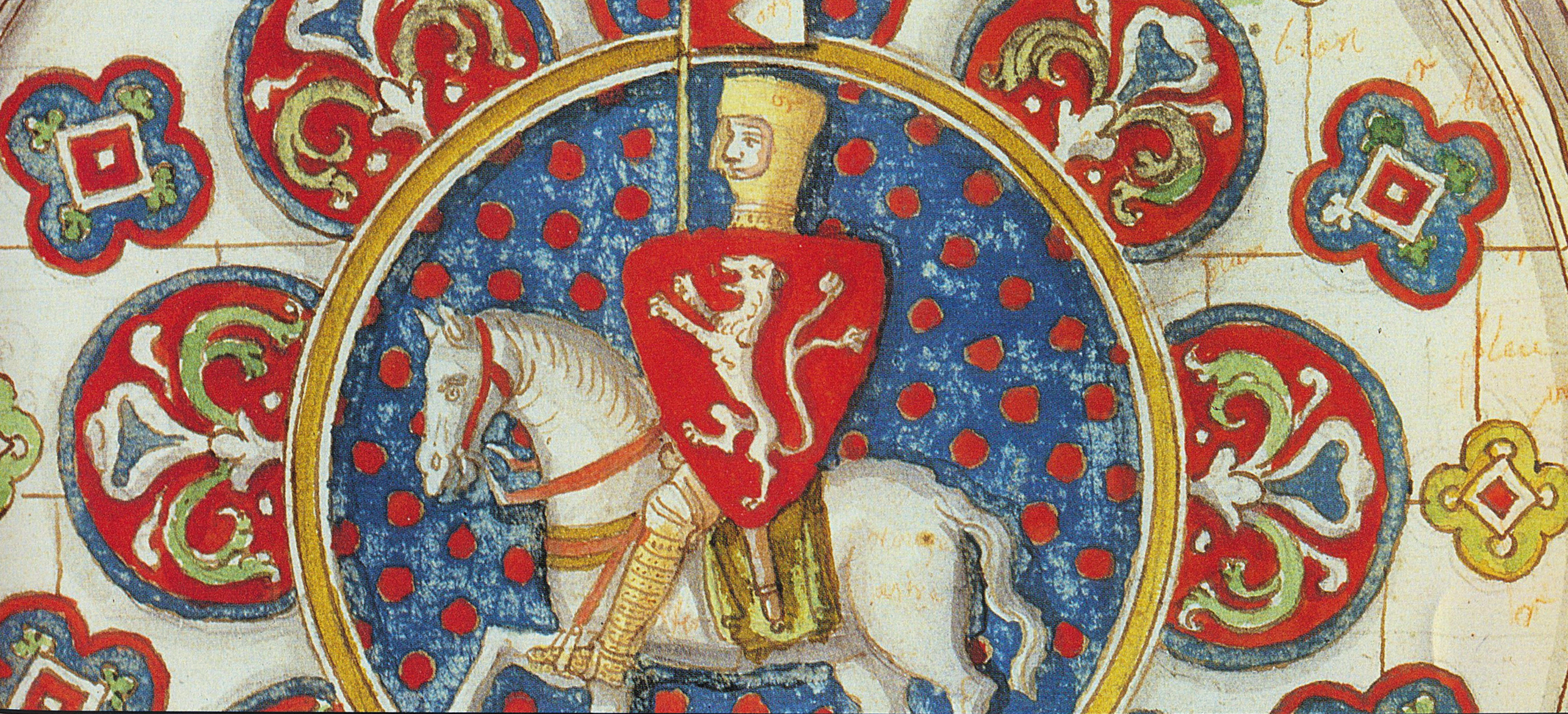
Stained glass (detail) Chartres cathedral: Simon de Montfort V (1208-1265). Simon was born in the chateau in 1208. Whereas his brother Amaury V (1191-1241) inherited his father’s French properties, including in the south of France owing to his father’s Cathar crusade, Simon V is known to history as having a major role in the constitutional development of England where he successfully led the barons’ opposition to the absolute rule of King Henry III (1207-1272) of England. During his rule of England Simon de Montfort V called two famous parliaments, one of which recognized the voices of ordinary town citizens in the affairs of government making him one of the progenitors of modern parliamentary democracy. Public Domain.
In January 1238, Montfort married Eleanor of England, daughter of King John and Isabella of Angoulême and sister of English King Henry III. While this marriage took place with the king’s approval, the act itself was performed secretly and without consulting the great barons. Eleanor had previously been married and swore a vow of perpetual widowhood after her husband died. This vow was broken when she married Montfort and, for that reason, the Archbishop of Canterbury condemned it. The English nobles protested the marriage of the king’s sister to a foreigner who was only of modest rank. Most notably, Richard, 1st Earl of Cornwell, the king’s and Eleanor’s brother, rose up in revolt over the marriage. King Henry III eventually bought off his brother and peace was restored. The marriage brought property to Montfort and when a child was born of the union in late 1238, he was baptized Henry, in honor of his uncle, the king. In February 1239, Montfort was finally invested as Earl of Leicester where he acted as the king’s advisor and became godfather to Henry’s eldest son, Edward, who became King Edward I (“Longshanks”).
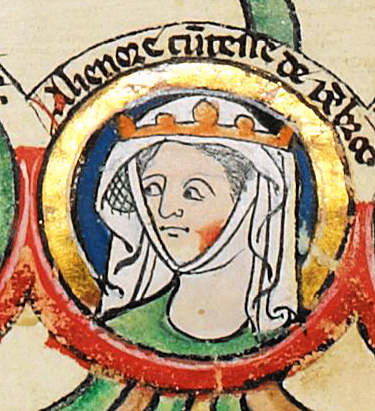
Eleanor of England who married Simon de Montfort V in 1238 in an early-fourteenth-century Genealogical Roll of the Kings of England. Public Domain.
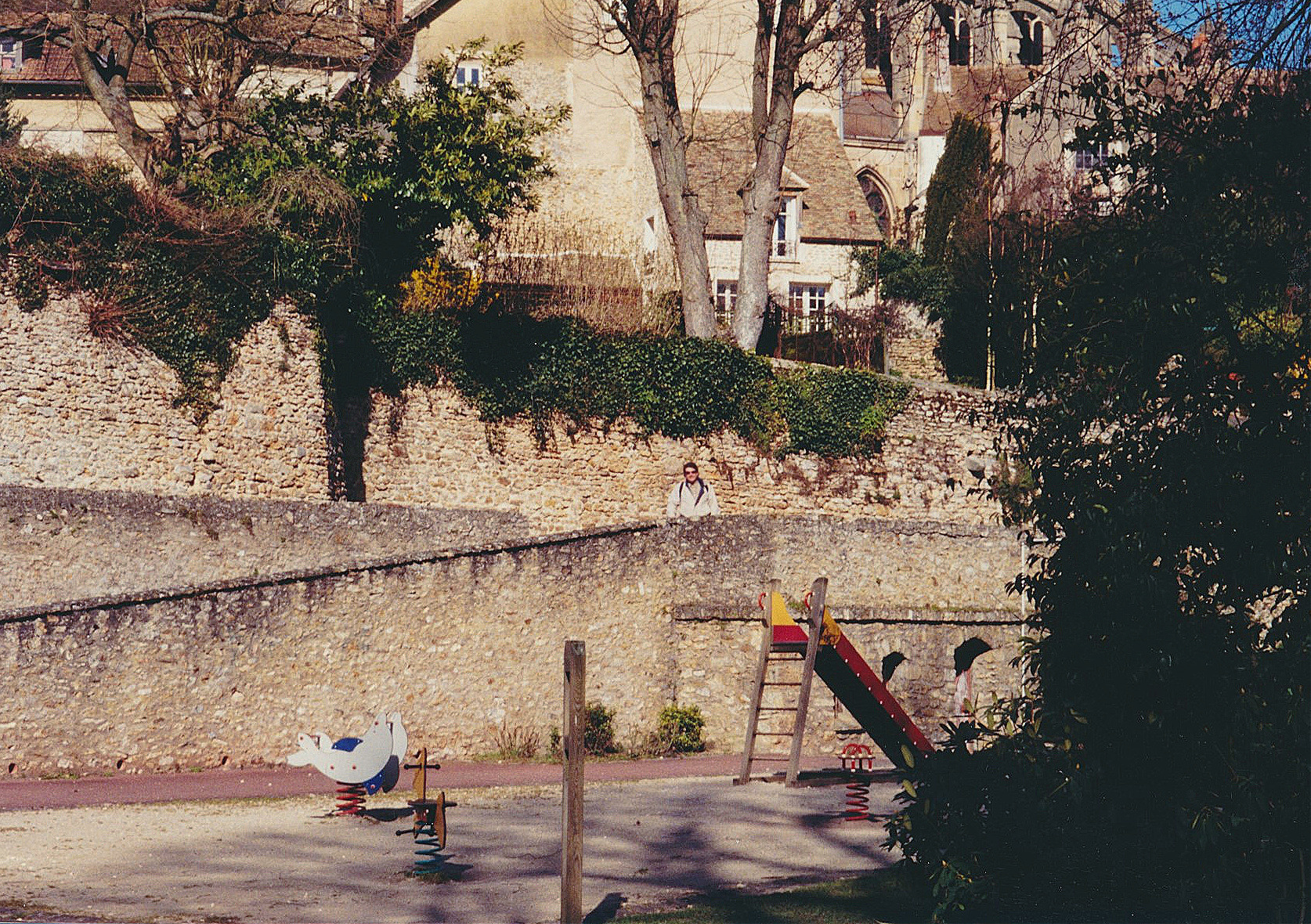
The author at the ramparts. March 2002. Author’s collection.
These fortifications were originally built over 1000 years ago in the early 11th century by Amaury I. The walls run from east to west creating a superficial size of Montfort at about 4 to 5 hectares (one hectare equals about two and a half acres). Portions of the wall were dismantled during the 100 Years War but rebuilt during the Wars of Religion (1562-1598) as well as Montfort’s reception of a royal charter by Charles IX in the mid16th century. The rebuilt wall had to expand to meet the development of Montfort under Anne de Bretagne a half a century before, though substantial portions of the original 11th century wall were incorporated into the construction.
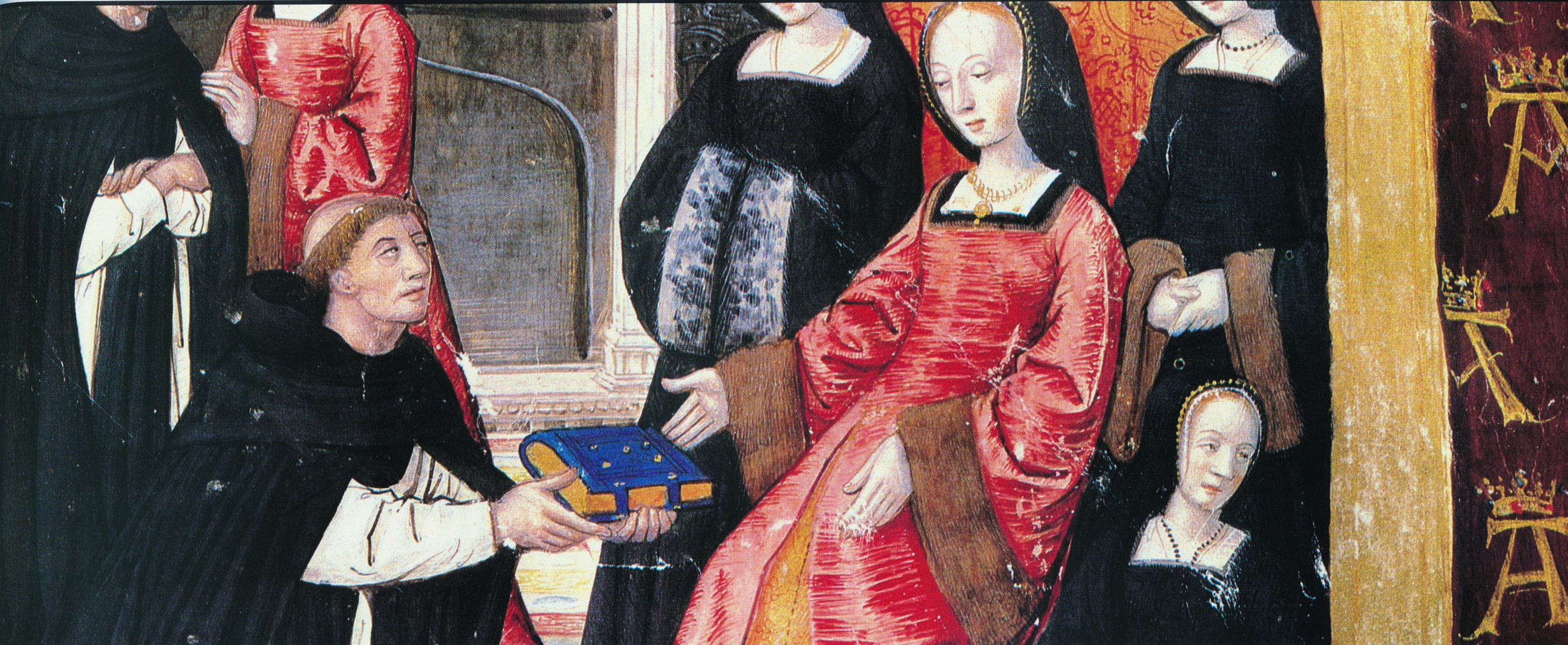
Manuscript 16th century (detail): Queen consort Anne of Brittany (1477-1514) receiving a Book of Hours from her Dominican confessor, Antoine Dufour (d.1509). Montfort L’Amaury returned to the crown of France after Anne of Brittany married Charles VIII “the Affable” (1470-1498) in 1491.
From Montfort L’Amaury, the lords continued to assist the French kings in the crusades. After John I, only a daughter allowed the continuity of the Montfort family. Beatrice d’Albidon married Robert, Count of Dreux. The Comté de Montfort was related to the Duchy of Brittany following the marriage of Yolande de Dreux-Montfort (1263-1330) with Arthur II of Brittany (1261-1312) in 1294. With their marriage in February 1492, Anne of Brittany became the first Queen of France crowned in St. Denis basilica. The marriage contract of Anne to Charles VIII “the Affable” stipulated a union of France and Brittany though the ruthless Charles forbade her to reign with her title, “Duchess of Brittany.” The contract also stated that if the queen were to die first and was childless, the king would inherit all her property. In this pre-nuptial agreement, it further stipulated that if Charles VIII died first Anne must marry his successor. This would be his cousin and brother-in-law, the handsome and seductive Louis II of Orléans, later, Louis XII (1462-1515). Though Charles and Anne often lived apart, she was pregnant for most of her married life with a child on average every fourteen months that produced two sons who died and two daughters who lived. After the accidental death of warring Charles in April 1498 (he hit his head on a door lintel), there was no male heir and 22-year-old Anne duly married Louis. Before she married French kings, Anne was engaged 8 times and briefly was married in 1490 to the Holy Roman Emperor, Maximilian, which the French did not like. Anne was still a married woman when she and Charles the Affable exchanged vows in December 1491. To prevent scandal the marriage had to be regularized by the pope who annulled Anne’s marriage to Maximilian in February 1492 and granted the royal couple a dispensation for each marrying their relative. Before new king Louis XII could marry Anne he had his 22-year marriage to Joan of France – a marriage of longer duration than Anne was then alive – annulled. In 1476 Louis believed he had had Joan forced on him by Louis XI (“The Universal Spider”) and never really cared for her. In what has been described as one of the seamiest lawsuits of the Middle Ages, Joan went on childless from her disappeared marriage to die in a nunnery. In 1499 it was the king’s second marriage and Anne’s third. Anne was quite aware that she was no longer a child but a 33-year-old woman, divorced and widowed with two children. She proceeded to actively insist at court on her rights and prerogatives. Though King Louis XII ruled Brittany, he officially recognized Anne’s title Charles had forbade and Louis promulgated decisions in her name. Their contract stipulated that Anne’s second child with Louis XII would rule Brittany. But with Anne’s death at 36 years old in 1514 this was not honored. Anne was coronated again in St. Denis basilica in 1504. She lived mostly at Blois and was an important patron of the Italian and French fine arts. Louis XII died the next year without a legitimate heir and his cousin and son-in-law Francis I mounted the throne. The couple were buried in St. Denis basilica. During the French Revolution in the wake of the frenzy of having decapitated the king in January 1793, revolutionaries made their way to St. Denis basilica and desecrated the graves of Anne of Brittany and Louis XII and threw their remains into a mass grave. This 15-16th century union of Brittany and France brought increased benefits to Montfort L’ Amaury compared to a union with Brittany alone. The new period saw the town’s castle ruins restored and there was new construction everywhere. The cemetery was relocated outside city walls. Churches were rebuilt and enhanced with that day’s art. While reaping these material improvements from its royal benefactors, Montfort maintained a semi-autonomy from the crown of France that would not be changed until 1550 when Brittany and the French Crown finally united under a single sovereign, Henry II (1519-1559).

Jean Perréal (1455-1529), Portrait Louis XII, c. 1514, Windsor collections de S.M. la Reine d’Angleterre. Jean Perréal’s most important attribution is this portrait of Louis XII who was King of France from 1498 to 1515. Louis XII was married three times – the first annulled; the second leaving the king a widower, and, in his last three months of life, to Mary Tudor (1496-1533), the favorite sister of King Henry VIII of England. Despite these wives, the king had no living sons. The Salic Law prohibited his line to continue on the French throne through his daughters. When Louis died in 1515, his throne eventually passed to his cousin, Francis I.
Under the Valois the Yvelines region of which Montfort is a central part received royal favor. Catherine de Medici (1519-1589) was named the Lady of Montfort in 1561. When the Wars of Religion broke out (1562-1598), the king, Charles IX (1550-1574), offered to the city home-rule in exchange for the reconstruction of its medieval ramparts at his expense. At the end of these wars, the passage of the future king, Henry IV (1553-1610) on the road that led him to Paris to take power, allowed Montfort L’Amaury to prove its loyalty to the new king. Montfort provided Henry Navarre with weapons and later obtained special rights in exchange. During the reigns of the first two Bourbon kings of France, Henry IV and Louis XIII (1601-1643), there are frequent royal visits to Montfort L’Amaury.
A canonized Catholic saint: Joan of Valois (1464 – 1505), sister of Charles VIII, and betrothed of Louis XII.

Portrait of Joan of Valois as abbess by Jean Perréal (1455-1530).
The second daughter of Louis XI (1423-1483) and Charlotte of Savoy (1411-1483), Joan of Valois was a fleeting Queen of France as the wife of King Louis XII following the death of her brother, King Charles VIII. Her marriage was soon annulled so that Louis could, as pre-arranged by contract, marry Charles VIII’s widow, Anne of Brittany.
Joan’s demeanor was characterized by an accepting and placid countenance. When she retired from court politics to become Duchess of Berry, the former Queen of France remarked: “If so it is to be, praised be the Lord.”
In Bourges, Joan of Valois founded a monastic order of sisters and served them as their abbess. In terms of her personality, Joan could be autocratic as an administrator of her nuns, which may have been a vestige of her former high-born role. Joan was canonized in May 1950, almost 450 years after her death.
Anne of Brittany, Catherine de’ Medici, and other royal figures helped shape the town’s development during the Renaissance.

Workshop of François Clouet. Catherine de’ Medici wears the black cap and veil of widow, after 1559. Upon seeing Catherine in the flesh, an Italian diplomat noted that “her mouth is too large and her eyes too prominent and colorless for beauty. But she is very distinguished-looking, has beautiful skin, a shapely figure, and exquisitely made hands.”

Portrait de Henri IV, roi de France et de Navarre (1553-1610) 1600 / 1700 (XVIIe siècle), Atelelier de Frans Pourbus II Louvre. Hung in Versailles chateau. https://collections.louvre.fr/en/ark:/53355/cl010057776

Marie de’ Medici, 1616, Frans Pourbus the Younger (Flemish, 1569-1622), oil on canvas, The Art Institute of Chicago. Marie de Medici (1575-1642) married Henry IV of France in 1600. After the king was assassinated in Paris in 1610, Marie de Medici served as the regent for their young son, Louis XIII. Marie de Medici brought Frans Pourbus to the French court to make regal portraits of the royal family.
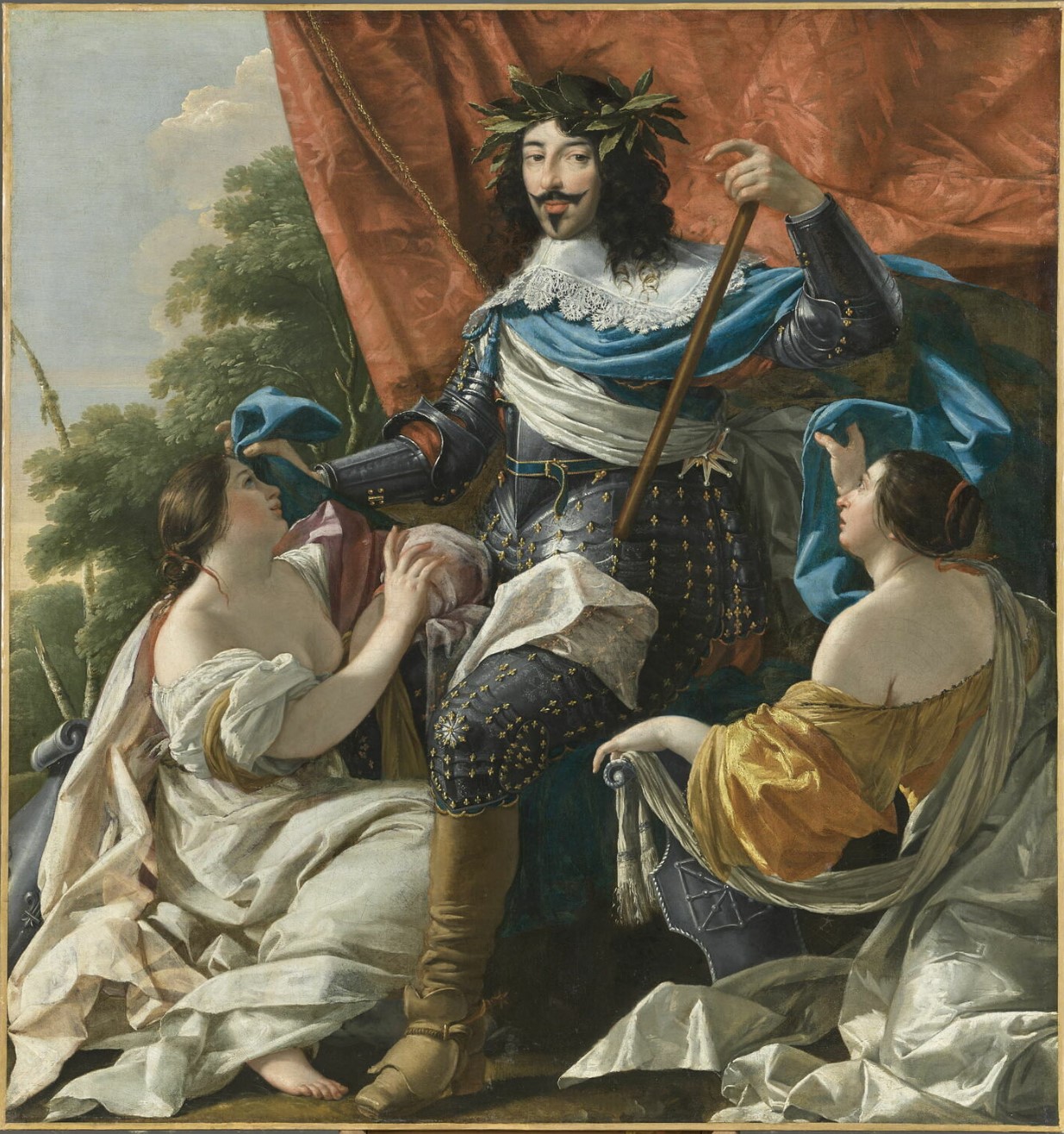
Louis XIII between the figures of two young women symbolizing France and Navarre. 1636/38, School of Simon Vouet (1590-1649). Louvre, Paris. https://collections.louvre.fr/en/ark:/53355/cl010062003
Le Belvédère at Montfort L’Amaury: the House of Maurice Ravel from 1921 to his death in 1937. The coexistence of castle ruins, Gothic architecture, Renaissance art, historic houses, and literary and musical associations makes the town an unusually rich historical destination.

The author in front of Le Belvédère, the house of Maurice Ravel, and ready to go inside for a visit. March 2002. Author’s collection.

Inside Le Belvédère. The salon. March 2002. Author’s photograph.

Pianist Jacques Février with Maurice Ravel in 1925 in Le Belvédère, the house of the composer in Montfort-l’Amaury. Public Domain.

Ravel’s house sits on an ascent from the centre ville where Ravel could look out his garden-side window to back towards town and south and east to the green countryside between Montfort and Paris. March 2002. Author’s photograph.

Classic theater paperback anthology titled Jean Anouilh: Five Plays published as part of the celebrated Mermaid Dramabook series by Hill and Wang in 1958. He lived in Montfort-l’Amaury for roughly a decade, from 1951 to the early 1960s. PHOTO: “George Maas” by Crossett Library Bennington College is licensed under CC BY-NC-SA 2.0.
A master stylist, Jean Anouilh lived in Montfort-L’Amaury as he rejected the conventional realism that dominated much of contemporary theater, instead treating the stage as an elaborate and self-conscious game, an approach reflected in the categories and cycles into which he organized his plays. His dramas became powerful psychological mirrors of the moral and political trauma left by the German occupation of France. Drawing on classical mythology, Anouilh explored themes of moral purity, compromised integrity, and the devastating cost of saying “no” to corrupt authority. He possessed a rare gift for transforming ancient Greek myths into modern drama, replacing epic poetry with sharp, colloquial, and psychologically charged dialogue that resonated deeply with twentieth-century audiences.
Anouilh’s 1944 play, Antigone, was an adaptation play of Sophocles’ play of the same name. The 34-year-old Anouilh’s work was seen as an attack on the Vichy government of Marshal Pétain (1856-1951) in World War II.
This anthology is particularly important to theater history because it gathers the landmark works that introduced Anouilh’s genius to English-speaking audiences, foremost among them Antigone, his crowning achievement. For many French spectators, the defiant Antigone embodied the spirit of the French Resistance, while the pragmatic and authoritarian Creon evoked the collaborationist Vichy regime. By recasting an ancient conflict as a modern moral dilemma, Anouilh created one of the most enduring and controversial dramas of the twentieth century, a work that continues to challenge audiences with its unsettling questions about conscience, obedience, and resistance.
Anouiih also wrote Becket. The original French play is titled Becket ou l‘Honneur de Dieu. It was staged in Paris at the Théâtre Montparnasse-Gaston Baty in October 1959 and directed by Anouilh. The play dramatizes historical martyr and Catholic saint Thomas Becket (1120-1170), the Archbishop of Canterbury In England.
Anouilh’s Becket became an international sensation. Successive productions in English translation were mounted in London (starring Christopher Plummer and Eric Porter) and in New York City (starring Laurence Olivier and Anthony Quinn). In 1964 Becket became a major motion picture starring Richard Burton and Peter O’Toole which won the Academy Award for Best Screenplay.
SOURCES:
Comité d’organisation des fêtes. 1972. Montfort-L’Amaury. Montfort-l’Amaury: Le Syndicat d’Initiative des Fêtes et des Arts de Montfort-L’Amaury et ses Environs.
Coulson, John, dir. 1957. The Saints: A Concise Biographical Dictionary. New York: Guild Press.
De Finance, Laurence, et Marie-Huguette Hadrot. 1994. Montfort-L’Amaury : Les verrières de l’église paroissiale Saint-Pierre (Yvelines). Paris: Centre de Documentation du Patrimoine.
France Bleu. 2018. « Du monde à Montfort l’Amaury pour se recueillir sur la tombe de Charles Aznavour. » ICI (France Bleu Paris Île-de-France), 3 novembre 2018. https://www.francebleu.fr/infos/medias-people/du-monde-a-montfort-l-amaury-pour-se-recueillir-sur-la-tombe-de-charles-aznavour-1541236036.
Hadrot, Marie-Huguette. 2002. Montfort L’Amaury : De l’an mil à nos jours. Paris: Somogy Éditions d’Art.
Kuzmina, Maria. 2007. « L’histoire de la ville. » Montfort-l’Amaury : Un millénaire d’histoire, 17 juin 2007. http://www.montfortlamaury.free.fr/fr/index.php/Montfort-l-amaury-un-millenaire-d-histoire.
Montjoye. 2026. « Château de Montfort-l’Amaury. » Montjoye.net. https://montjoye.net/chateau-de-montfort-lamaury.
Wikipédia. 2026. « Anne de Bretagne. » Dernière modification le 2 octobre 2026. https://fr.wikipedia.org/wiki/Anne_de_Bretagne.