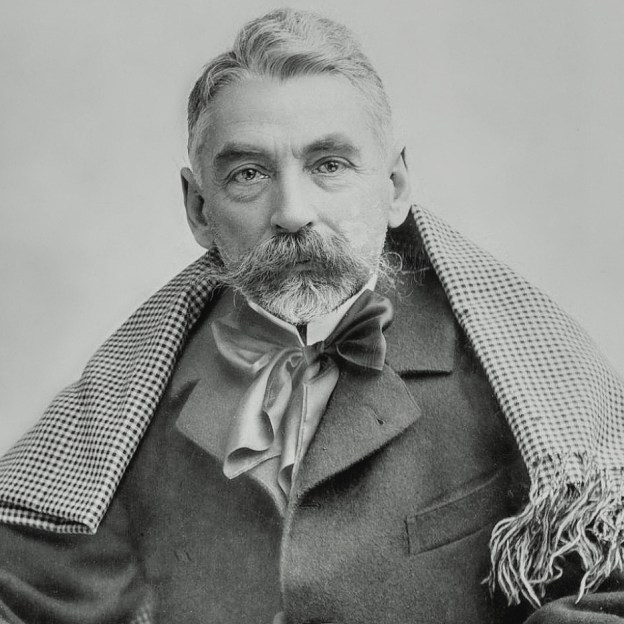
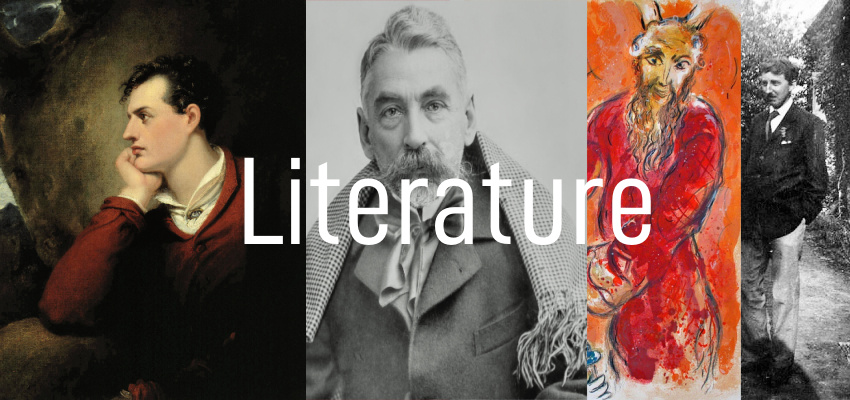
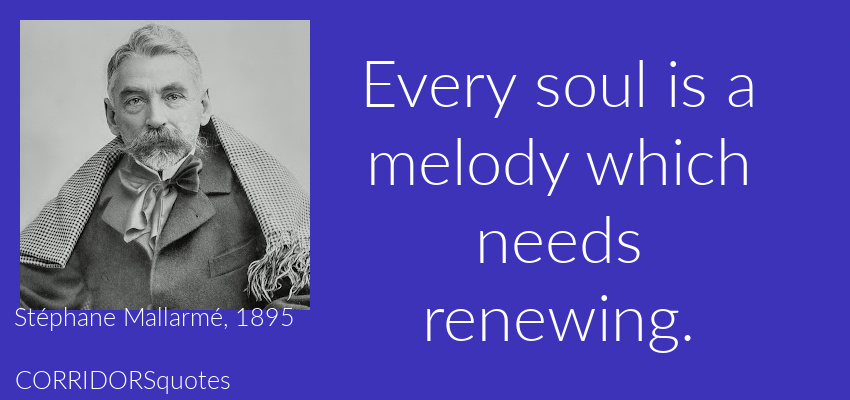
FEATURE Image: This famous 1896 portrait of Stéphane Mallarmé—captured wearing his signature houndstooth-checkered shawl and silk lavallière bow tie—was taken by Paul Nadar (the son of the pioneering photographer Félix Nadar) at Atelier Nadar in Paris. The Bibliothèque nationale de France (BnF) preserves roughly ten distinct negatives and prints of Mallarmé from the Atelier Nadar archives.
By 1896, following the death of Paul Verlaine in January of that year, Mallarmé had been elected the unofficial “Prince des Poètes” (Prince of Poets) by France’s younger generation of writers. Sitting for the Nadar studio—the premier portraitist of Paris’s intellectual and artistic elite—was an essential rite of literary prominence.
Nadar isolates Mallarmé against a neutral, luminous light-gray ground. The minimalist framing directs complete attention to the poet’s expressive, slightly melancholy eyes, silvering hair, and thoughtful, inward gaze. Visually, the shawl draped casually over his shoulders—a garment Mallarmé famously wore to ward off drafts in his modest apartment on the rue de Rome—transforms a formal studio sitting into a warm, unpretentious character study. Today, it stands as the definitive late-life visual icon of Mallarmé who died suddenly in 1898, establishing a public persona as the sage-like master of French Symbolism. Public domain
Stéphane Mallarmé was a central figure of French Symbolism whose complex, evocative poetry helped shift late 19th-century literature and art away from realism and toward suggestion, mystery, dreams, and imagination, influencing an entire generation of modern artists, writers, and intellectuals.
By John P. Walsh
Symbolism and the Paris Salons
Stéphane Mallarmé (1842-1898) is an important Symbolist poet of the last half of the 19th century in France. Throughout his writing career, Mallarmé helped formulate and express the rising anti-naturalism in contemporary art. This movement’s inclinations mainly took the form of Symbolism – that is, the fascination with many types of literature and the inclination to draw upon these sources for inspiration in dreams and visions. Although Mallarmé’s poetry is verbally dense and difficult with fleeting imagery, the poet was influential in modern art circles. The poet hosted a weekly salon in Paris known as “les jeudis” which provided a social network for many leading modern thinkers and practitioners, such as Édouard Manet, Edgar Degas, Odilon Redon, Paul Gauguin and Edvard Munch.
Major Symbolist Poet: Mallarmé was one of the most important voices of French Symbolism and a leading advocate of anti-naturalist artistic ideas.
Early Life and Literary Beginnings
Mallarmé was born in Paris in 1842 into a family of civil servants. His mother died when he was 5 years old and his younger sister when he was 15. It was around the time of his sister’s death that Mallarmé wrote his first poetic essays, influenced by Romantics and early Symbolist writers and poets Victor Hugo, Théophile Gautier, Charles Baudelaire and Edgar Allan Poe. His first poems were published in 1862. Mallarmé earned a teaching certificate in the English language, studied in London and married a young German woman he met in France. Mallarmé began a teaching career in 1863 in Tournon in the Ardèche, where his daughter was born in 1864. He also was teaching in Besançon and Avignon. Outside of Paris, Mallarmé did not prosper as a teacher and viewed his assignments with disdain as necessary modes of employment. The young man turned to poetry as a means of escape. It was between 1863 and 1866 that Mallarmé wrote some of his renown poems: Brise marine, L’Azur, Les Fleurs, a version of L’Après-midi d’un faune. His collection of poems published in Le Parnasse contemporain in 1866 led to Mallarmé’s first notoriety.
Poetry of Suggestion: His verse is known for its density, symbolism, fleeting imagery, and emphasis on mystery rather than direct statement.
Paris, Manet, and Artistic Recognition
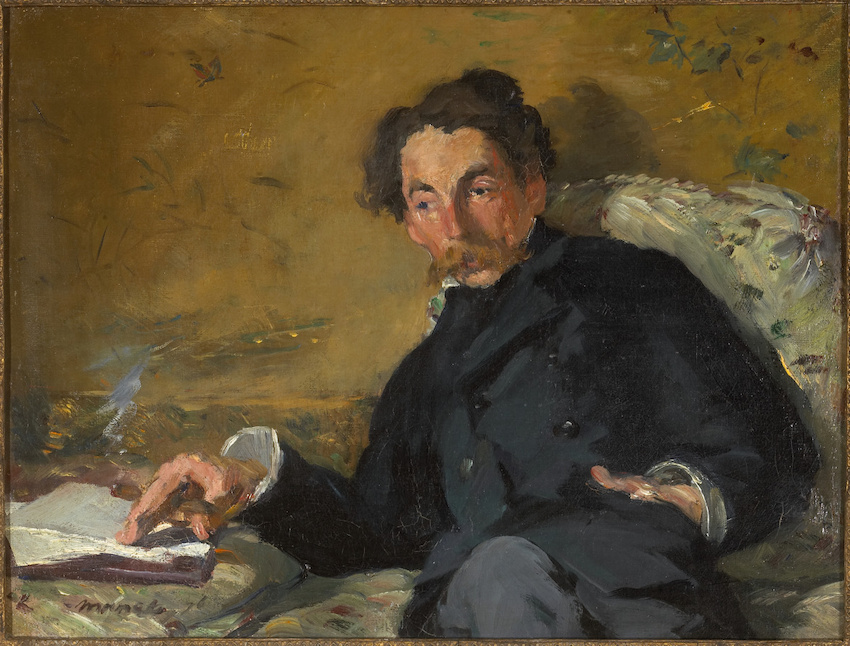
In 1871, Mallarmé, now a father of a family with two children, was assigned to teach in Paris and settled near the new Saint-Lazare train station. His social network of artists and writers blossomed in this period. In 1873 Mallarmé met Édouard Manet who soon illustrated Mallarmé’s translation of American writer Edgar Allan Poe’s Raven, published in 1875. In 1876 Manet painted his portrait that is now in the Musée d’Orsay.
Loss, Friendship, and the Avant-Garde
Mallarmé’s 8-year-old son died prematurely at the end of the 1870s and Manet died a few short years later in 1883. Mallarmé formed new friendships with Berthe Morisot and her daughter Julie Manet, whose guardian Mallarmé became at the death of his parents. Mallarmé also became friends with other leading avant-garde artists and poets such as Claude Monet and Pierre-Auguste Renoir. To the general reader, Mallarmé was criticized as a crazy poet who used unintelligible verse. Yet to avant-garde literati such as Paul Verlaine and Joris-Karl Huysmans, Mallarmé’s demanding poetry they publicly admired.
Later Works and the Nabis Circle
In 1892 appeared Vers et Prose, a major collection of Mallarmé’s poems. The frontispiece was a lithographed portrait by James Abbott McNeill Whistler, with whom Mallarmé was a close friend. In the early 1890s Mallarmé came into contact with the “Nabis,” young Post-Impressionists such as Pierre Bonnard, Maurice Denis and particularly Édouard Vuillard. In the 1890’s Mallarmé’s Paris salon was frequented by the young Paul Valéry.
Final Years and Lasting Legacy
At 51 years old, in 1893, Mallarmé retired from teaching and stayed in his small house of Valvins. He died there on September 9, 1898, at the age of 56. In these final years, Mallarmé’s recognition and fame remained high. It was part of the vivacity and dynamism of literary and artistic circles for which Mallarmé had been one of its inspirations since the 1870s. In 1896 Mallarmé’s influence included his being elected as Prince des poètes and inheriting the seat occupied by the recently deceased Paul Verlaine.
Influence Beyond Literature: His work inspired painters, poets, and avant-garde thinkers, making him a bridge between literature and modern art.
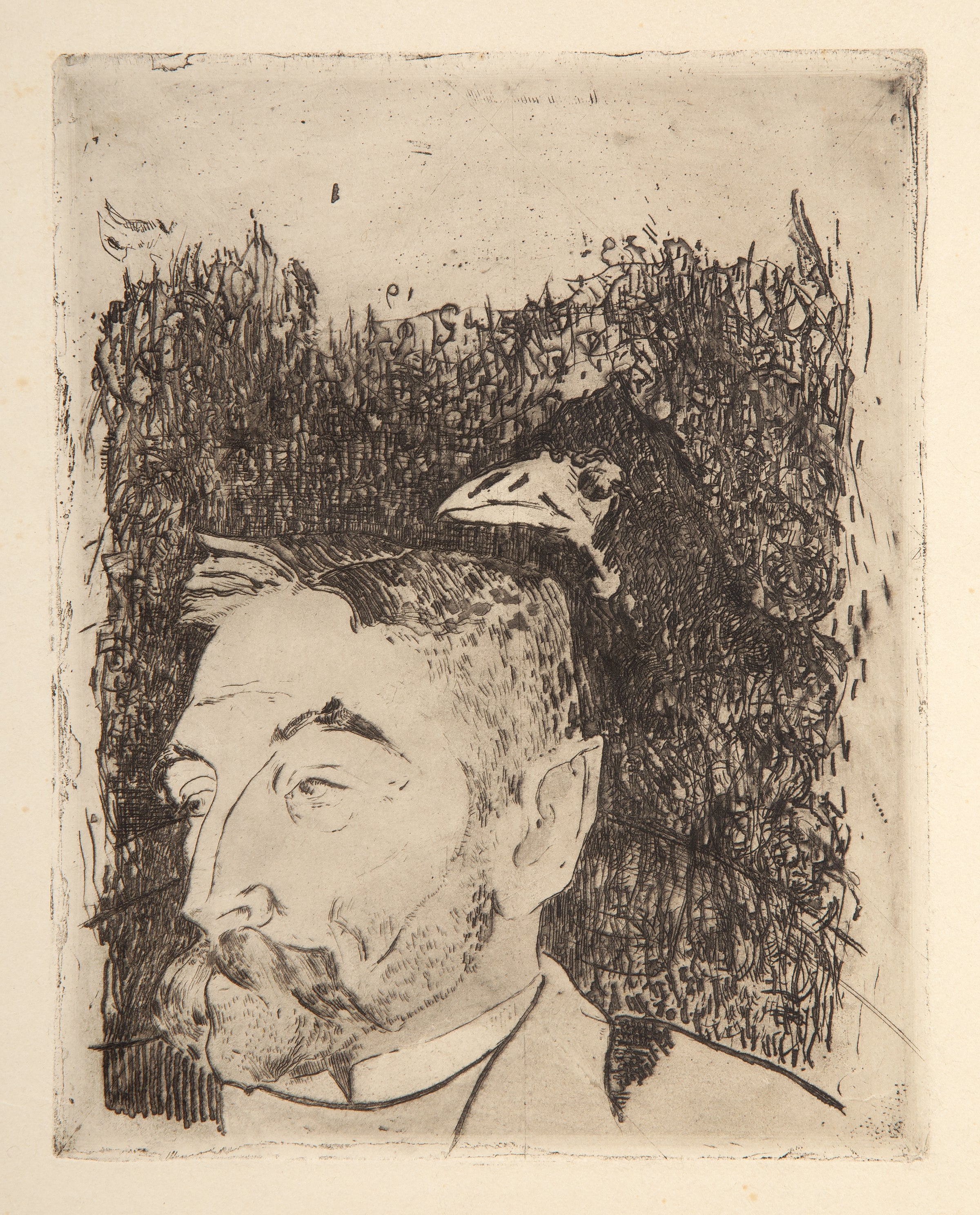
Paul Gauguin (1848-1903), Portrait of Stéphane Mallarmé, 1891. https://www.metmuseum.org/art/collection/search/337818 – retrieved August 27, 2025.
Portrait of Stéphane Mallarmé: A Symbolist Tribute
Portrait of Stéphane Mallarmé, made in Paris in 1891, is an intaglio print by Paul Gauguin that serves as an intimate Symbolist homage to the poet who championed his work shortly before the artist’s first voyage to Tahiti.
Gauguin’s Experiment in Printmaking
Working under the guidance of master printer Eugène Delâtre, Gauguin scratched the copper plate directly with drypoint and burin, creating an image of striking immediacy. The poet’s face is rendered with spare, economical lines, while a dense thicket of cross-hatched marks swirls behind him. Gauguin deliberately left the textured plate tone and ragged margins visible, embracing the physical character of the print as part of its expressive power.
Symbolism and Literary References
Mallarmé appears in three-quarter profile with heavy, lowered eyelids that suggest inward contemplation. A slightly pointed, faun-like ear alludes to his celebrated poem L’Après-midi d’un faune (The Afternoon of a Faun), one of the defining works of Symbolist literature.
Hovering above the poet’s shoulder is an ominous raven, a direct reference to Mallarmé’s landmark 1875 French prose translation of Edgar Allan Poe’s The Raven (Le Corbeau), famously illustrated by Édouard Manet. The bird visually links Mallarmé to Poe’s world of mystery, suggestion, and psychological depth.
Gauguin and Mallarmé
During the winter of 1890-1891, Gauguin became a regular participant in Mallarmé’s renowned Tuesday evening salons, known as les Mardis, held on the Rue de Rome in Paris. Mallarmé regarded Gauguin as the leading painter of the Symbolist movement, an artist who sought to evoke unseen realities and emotional states rather than simply reproduce the visible world.
Recognizing Gauguin’s importance, Mallarmé organized a benefit auction of his paintings at the Hôtel Drouot in February 1891 to help finance the artist’s planned journey to Polynesia. He also wrote an influential essay praising Gauguin’s work and its Symbolist aspirations.
A Farewell Gift Before Tahiti
Gauguin created this small, deeply personal portrait as a gesture of gratitude before departing for Tahiti in the spring of 1891. Few impressions were printed during his lifetime, making early states exceptionally rare.
Today, impressions in the collections of the Metropolitan Museum of Art and the Art Institute of Chicago stand as remarkable survivors of a brief but important alliance between Post-Impressionist painting and Symbolist literature, capturing the friendship between two figures who helped redefine the artistic imagination at the end of the nineteenth century.
Literary and Artistic Connections: He maintained friendships with leading cultural figures including Manet, Monet, Renoir, Whistler, Gauguin, Degas and Paul Valéry.


Impressionist painter Auguste Renoir and Symbolist poet Stéphane Mallarmé in the salon de Julie Manet in a photograph by Impressionists pianter Edgar Degas from Décembre 1895. “Auguste Renoir et Stéphane Mallarmé, dans le salon de Julie Manet, par Edgar Degas, décembre 1895” by Quentin Verwaerde is licensed under CC BY-ND 2.0.
A Photographic Gathering at Rue de Villejust
This remarkable photograph by Edgar Degas depicts his friends Pierre-Auguste Renoir (seated) and Stéphane Mallarmé (standing), while Degas himself appears as a spectral reflection beside his camera in the mirror behind them. Taken on December 16, 1895, after a dinner gathering at 40 rue de Villejust (today rue Paul-Valéry) in Paris, the image captures a moment within the intimate artistic circles of fin-de-siècle France. The apartment had belonged to Berthe Morisot, who had died earlier that year in March 1895, leaving her seventeen-year-old daughter, Julie Manet, under Mallarmé’s legal guardianship.
According to poet Paul Valéry, to whom Degas later gave a print, the photographer arranged nine oil lamps and required Renoir and Mallarmé to remain almost perfectly still during an exposure that may have lasted as long as fifteen minutes. In the large mirror at left, the brilliant flare of a lamp partially conceals Degas and his tripod-mounted camera, while the shadowy figures of Mallarmé’s wife, Marie, and daughter, Geneviève, can be glimpsed watching from across the room.
Degas and Mallarmé: A Shared Artistic Vision
Degas and Mallarmé belonged to the same close-knit Parisian avant-garde milieu that had developed around Édouard Manet and Berthe Morisot. Although Degas was famously difficult, private, and often combative, he maintained a lasting intellectual friendship with Mallarmé. Indeed, the poet was among the very few individuals welcomed into Degas’s intensely private studio.
Their connection extended beyond friendship. Both men valued discipline, artifice, and suggestion, rejecting straightforward representation in favor of carefully crafted artistic effects. In different mediums, the painter and the Symbolist poet pursued similar aesthetic goals: the evocation of mood, mystery, and meaning through indirect means rather than literal description.
A Symbolist Masterpiece in Photography
Within the history of photography and modern art, the image stands as a masterpiece of Symbolist and pictorialist sensibility. Rather than using the camera as a purely mechanical instrument of documentation, Degas bent its technical limitations to serve a distinctly painterly vision.
The deep chiaroscuro, velvety shadows, and luminous halation produced by the oil lamps transform an ordinary bourgeois drawing room into a haunting study of atmosphere and light. Its nocturnal mood reflects Degas’s own belief that daylight was “too easy” compared with the far richer visual possibilities offered by lamplight and moonlight.

Henri Matisse (1869-1954), Fée au chapeau de clarté, Souvenir du Mallarmé (Fairy in a Luminous Hat, Souvenir of Mallarmé), 1933, 14 3/8 × 12 9/16 in. (36.6 × 32.0 cm). Photo: Henri Matisse, Fée au chapeau de clarté, Souvenir du Mallarmé (Fairy in a Luminous Hat, Souvenir of Mallarmé), 1933 · SFMOMA – retrieved October 27, 2025.
From Poésies de Stéphane Mallarmé
The print grew out of Matisse’s landmark 1932 livre d’artista (artist’s book), Poésies de Stéphane Mallarmé, commissioned by Swiss publisher Albert Skira. As Matisse’s first illustrated book, the project marked a pivotal shift in his career toward greater neoclassical clarity, restraint, and graphic purity.
Matisse, Mallarmé, and the Art of Suggestion
This independent 1933 drypoint etching on chine appliqué (thin, luminous paper bonded onto a heavier backing sheet) exemplifies Henri Matisse’s mastery of the distilled, continuous line. Reduced to its essentials, the composition demonstrates the artist’s ability to evoke form, presence, and emotion through the simplest of means.
A Visual Equivalent to Symbolist Poetry
Matisse deliberately avoided literal or narrative illustration, seeking instead a visual counterpart to Mallarmé’s Symbolist poetics. Just as Mallarmé employed a sparse vocabulary and expansive white space to evoke fleeting impressions rather than declare literal meanings, Matisse stripped his drawing down to pure contour, allowing the white page to “sing” alongside the text. He described his goal for the Mallarmé project as balancing the dark typography of the poem on the left page with the airy openness of the etching on the right, creating a visual dialogue between word and image. That artistic principle finds particularly clear expression in this independent drypoint. The title Fée au chapeau de clarté is quoted directly from the eighth line of Mallarmé’s early, dreamlike poem “Apparition” (written around 1863).
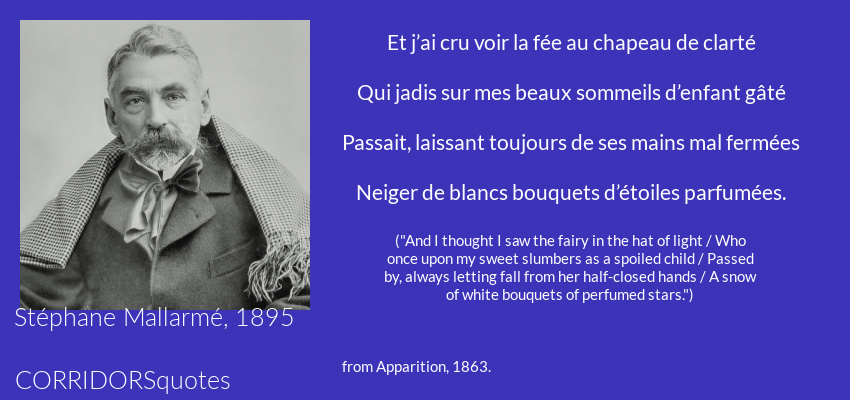
Et j’ai cru voir la fée au chapeau de clarté /Qui jadis sur mes beaux sommeils d’enfant gâté /Passait, laissant toujours de ses mains mal fermées /Neiger de blancs bouquets d’étoiles parfumées. (“And I thought I saw the fairy in the hat of light / Who once upon my sweet slumbers as a spoiled child / Passed by, always letting fall from her half-closed hands / A snow of white bouquets of perfumed stars.”) from Apparition, 1963.
Reimagining “Apparition”
In the published 1932 volume, Matisse paired Mallarmé’s poem Apparition with a different illustration depicting a woman in a wide-brimmed sunhat. Returning to the theme in 1933, he chose not to repeat the original design. Instead, he reinterpreted the fairy’s chapeau de clarté (“hat of clarity” or “brightness”) as a luminous celestial crown formed by radiant spheres. The transformation moved the imagery further away from literal description and closer to the dreamlike, suggestive qualities that define Mallarmé’s poetry.
A Tribute Beyond the Book
By adding the subtitle Souvenir du Mallarmé (“Memory” or “Keepsake of Mallarmé”), Matisse signaled that the print was no longer merely an illustration tied to a published volume. It became an autonomous work of art and a personal homage to the poet whose vision had inspired him. The result is both a reflection on Mallarmé’s enduring imaginative power and a testament to Matisse’s belief that line, space, and suggestion could communicate as profoundly as words themselves.

Champion of Modernism: Though often criticized in his lifetime as difficult and obscure, Mallarmé became a major influence on modern literature and artistic experimentation.
SOURCE:
https://www.musee-mallarme.fr/fr – retrieved July 4, 2022.