FEATURE Image: Three adult periodical cicadas (Magicicada) clinging to the purple petals of a clematis flower, with the possible legs of a fourth cicada tucked beneath a wilting bloom. During mass emergences, cicadas instinctively climb upward onto whatever plants, fences, or garden flowers are nearby. Climbing higher helps them warm up in the sunlight, stay off the ground away from crawling predators, and launch into flight toward nearby trees to find mates. June 8, 2024 6.87mb 8154
Through photography and historical context, this post documents one of the rarest natural events in North American history: the simultaneous emergence of 17-year Brood XIII and 13-year Brood XIX cicadas in 2024, a biological phenomenon not witnessed since 1803, revealing the extraordinary rhythms of nature that unfold across centuries rather than seasons.
Photographs and text by John P. Walsh.
A Once-in-221-Year Awakening
Since late May 2024, Illinois has been the epicenter of one of the most extraordinary natural events in American history: the emergence of trillions of cicadas whose relentless chorus is expected to continue into July.
The Return of Brood XIII
On cue after seventeen years underground, the Northern Illinois Brood, Brood XIII, erupted from the soil across much of the state. Having spent nearly two decades hidden beneath the earth, these red-eyed insects emerged to mate, lay eggs, and continue one of nature’s most remarkable life cycles.
The Great Southern Brood XIX Emerges
At the same time, another giant brood surfaced across the central United States. Known as Brood XIX, or the Great Southern Brood, these cicadas completed their own lengthy underground development before emerging in vast numbers across a broad swath of the country.
A Historic Convergence
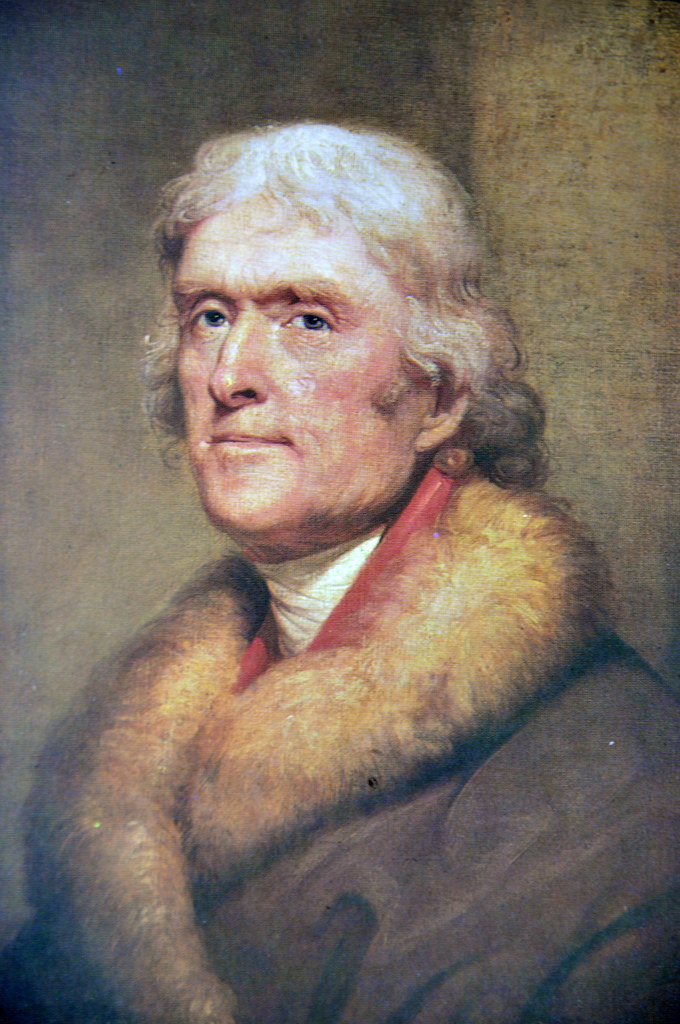
What makes 2024 truly historic is that Broods XIII and XIX are emerging simultaneously. This rare overlap has not occurred since 1803, when Thomas Jefferson was serving as the third President of the United States. More than two centuries later, the descendants of those same broods have returned together, creating a once-in-a-lifetime spectacle for naturalists, photographers, and anyone fortunate enough to witness nature’s ancient timetable in action.
Illinois is the epicenter of 2024’s historic cicada invasion
According to a 2024 publication by the Ohio Biological Survey of “The 2024 Emergence of Periodical Cicada Broods XIII and XIX” by renowned cicada expert Dr. Gene Kritsky, Professor Emeritus of Biology and former Dean of the School of Behavioral and Natural Sciences at Mount St. Joseph University, the Brood XIII emergence extends from the center of the state of Illinois around Springfield and spreads as far north as southern Wisconsin. Brood XIX also extends from around Springfield, Illinois, to points south past Cairo, Illinois. “This is not just a cicada year,” Dr. Kritsky observed, “it’s an historic convergence of Broods XIII and XIX, making it a once-in-a-lifetime experience for enthusiasts and researchers alike.” See- https://www.msj.edu/news/2024/01/dr-gene-kritsky-releases-book-cicada-emergence.html – retrieved June 15, 2024.
The Next Emergence
As trillions of cicadas mate and lay their eggs this year, the buzzing activity will gradually fade and 2024’s broods of adult cicadas die. Their offspring of 2024 will emerge, in the case of Brood XIII, during its next 17 year cycle in 2041.
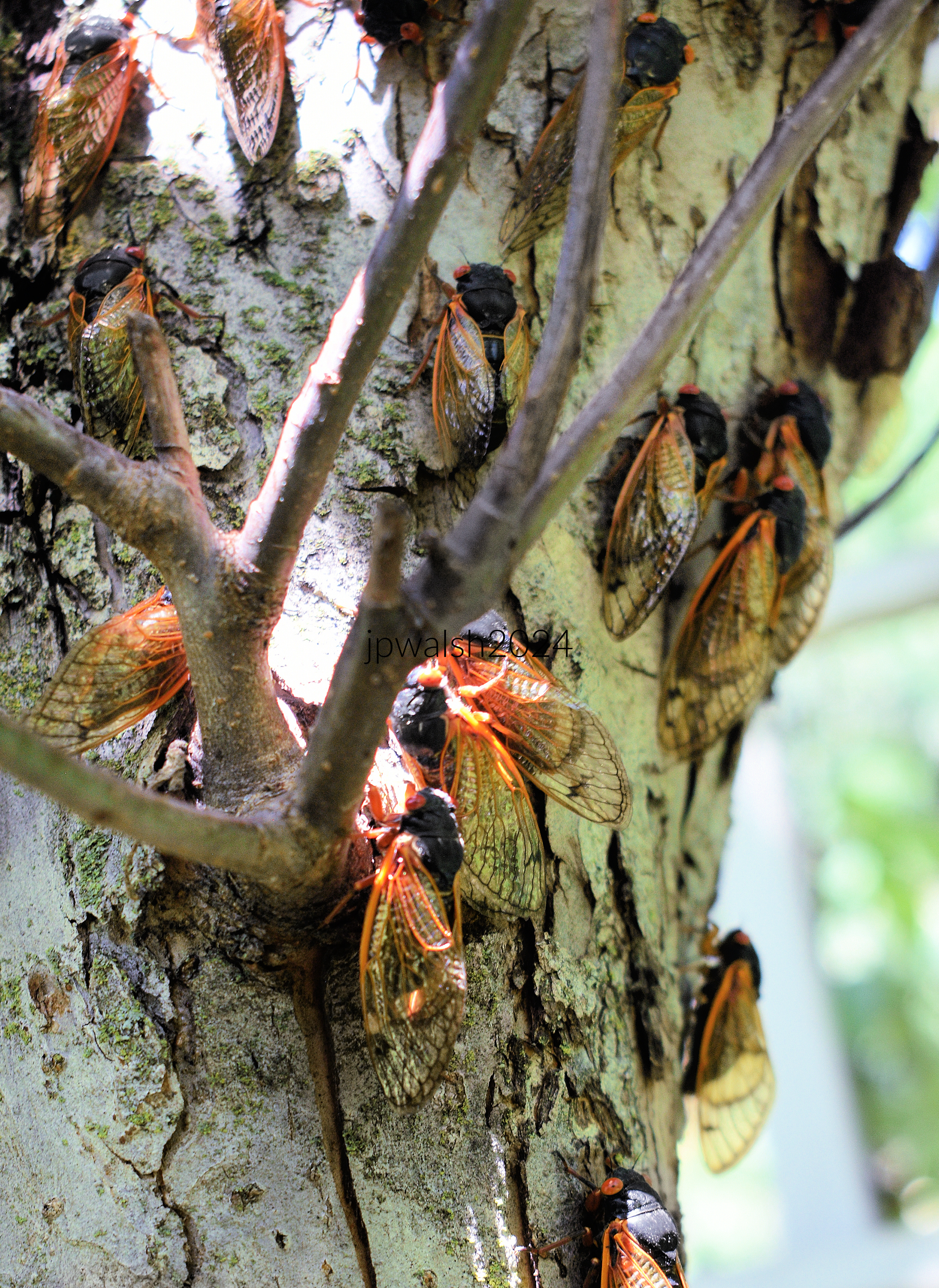
While the cicada’s life is mostly spent under the soil, they use their legs to emerge from the soil where they molt and mate. Cicadas emerge after the soil temperature is higher than 64 degrees Fahrenheit. Their emergence from the ground turns over large amounts of soil, and after they die their decaying bodies contribute a massive amount of nutrients to the soil. June 15, 2024 79% 7.89 mb 8563
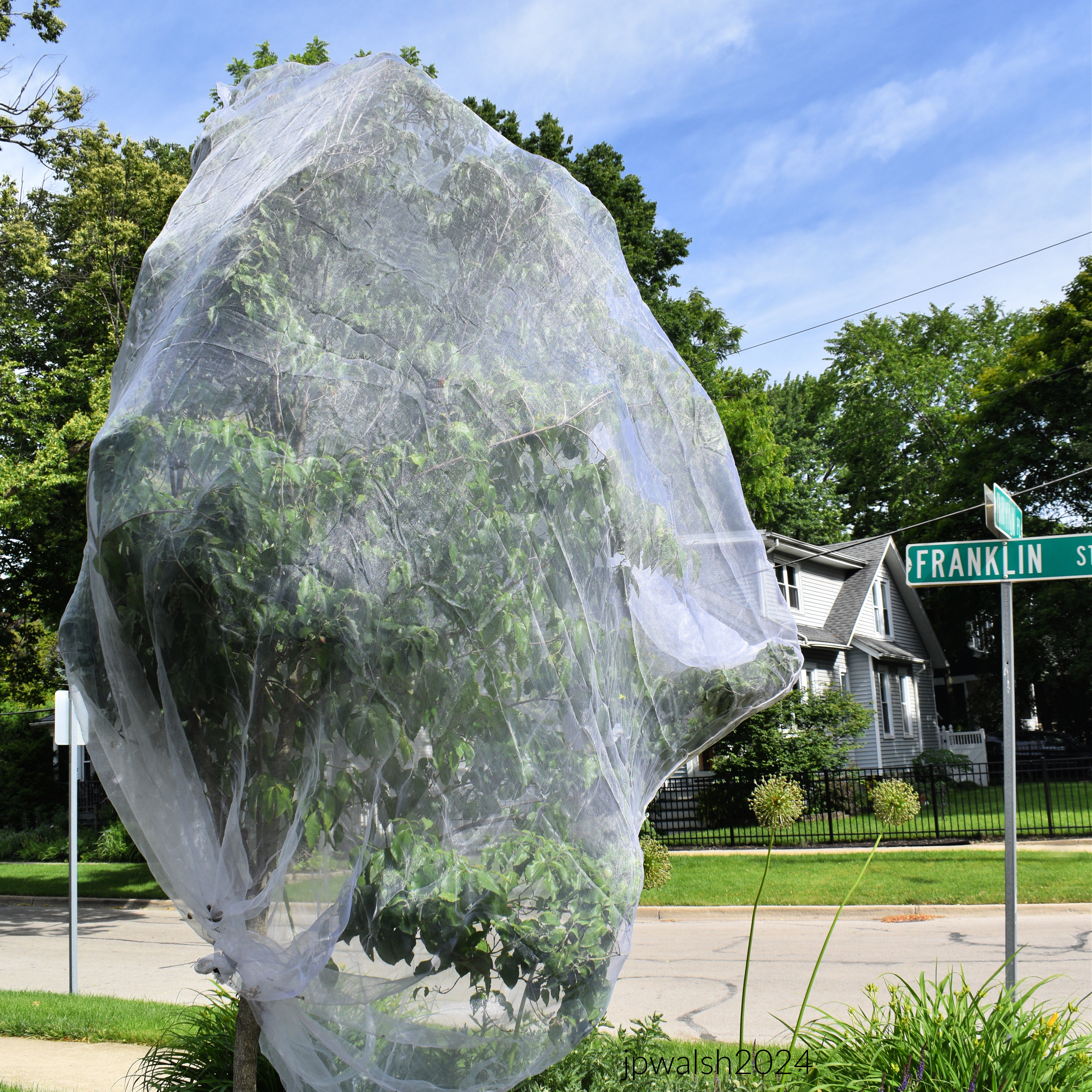
GHOST TREES.Homeowners in Chicago have wrapped their small trees with mesh netting in preperation of the arrival of trillions of molting mating cicadas. The wrapped mesh is to prevent cicadas from damaging young trees. Once cicadas molt and mate, female cicadas lay their fertilized eggs in the bark of trees. April 2024 7.46 mb
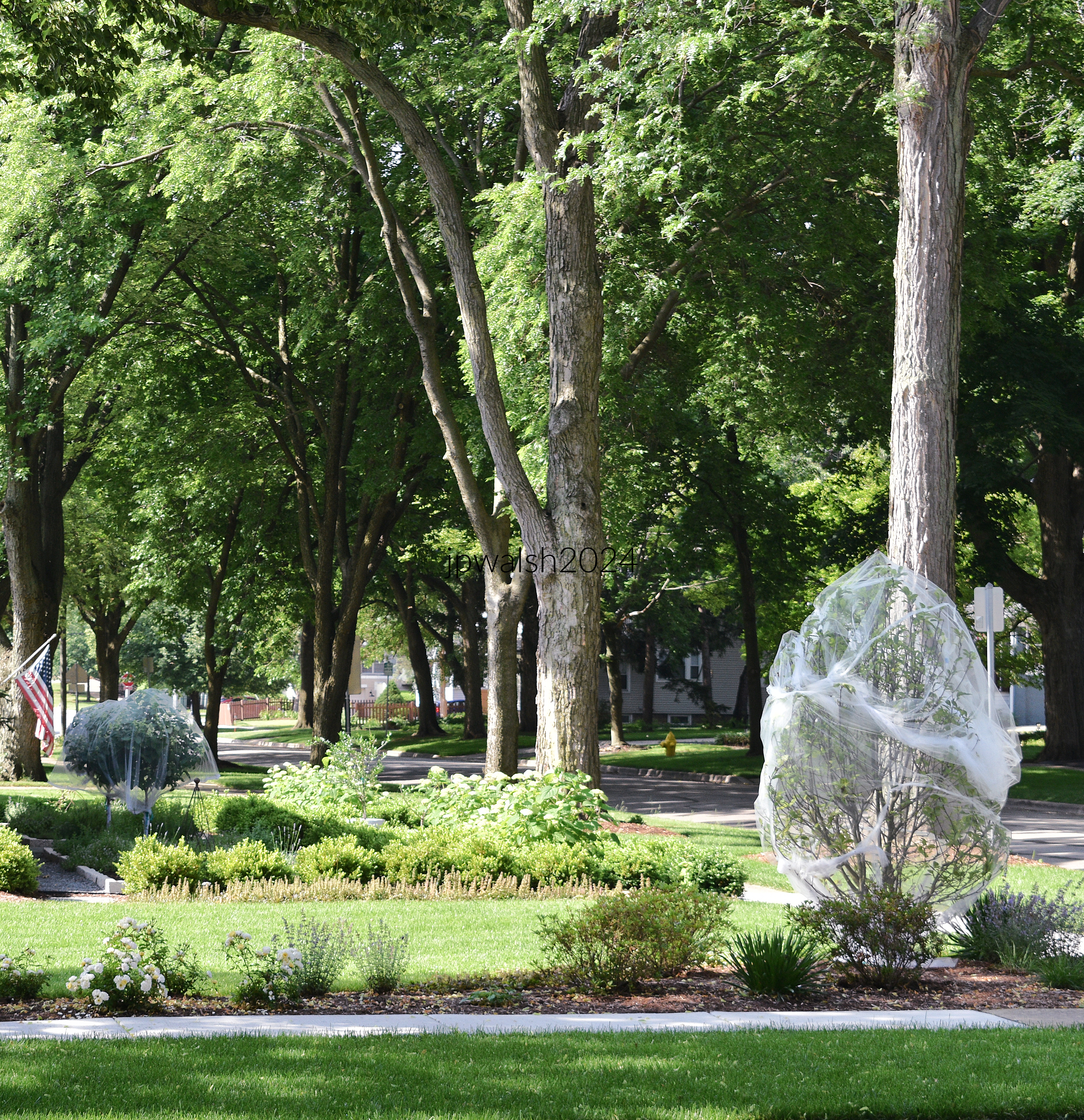
GHOST TREES.Periodical cicada years are quite beneficial to the ecology of the region. Their egg-laying in trees is a natural pruning that results in increased numbers of flowers and fruits in the succeeding years. May 31, 2024 99% 6.92 mb 7779
GHOST TREES.June 15, 2024 95% 7.66 mb 8565 (2)
GHOST TREES. June 3, 2024 89% 7.80 mb 7917
GHOST TREES. May 28, 2024 90% 7.69 mb 7588
During May and June 2024, the 17-year Northern Illinois Brood XIII emerged in and around Chicago, across northern Illinois and in portions of northwest Indiana, southern Wisconsin and eastern Iowa.
Cicadas converge on a backyard playset. May 28 2024 95% 7.69 mb 7557
Cicadas do not sting or bite, and do not carry diseases.
Waiting Beneath the Surface
Called molting, cicadas emerge from their shell. These broods spend either 13 or 17 years living approximately two feet underground before emerging as wingless nymphs rather than true larvae. As they tunnel upward toward the surface, they wait for the soil temperature at a depth of 8 inches to reach about 64°F (18°C) before emerging, usually at dusk.
The Molting Process
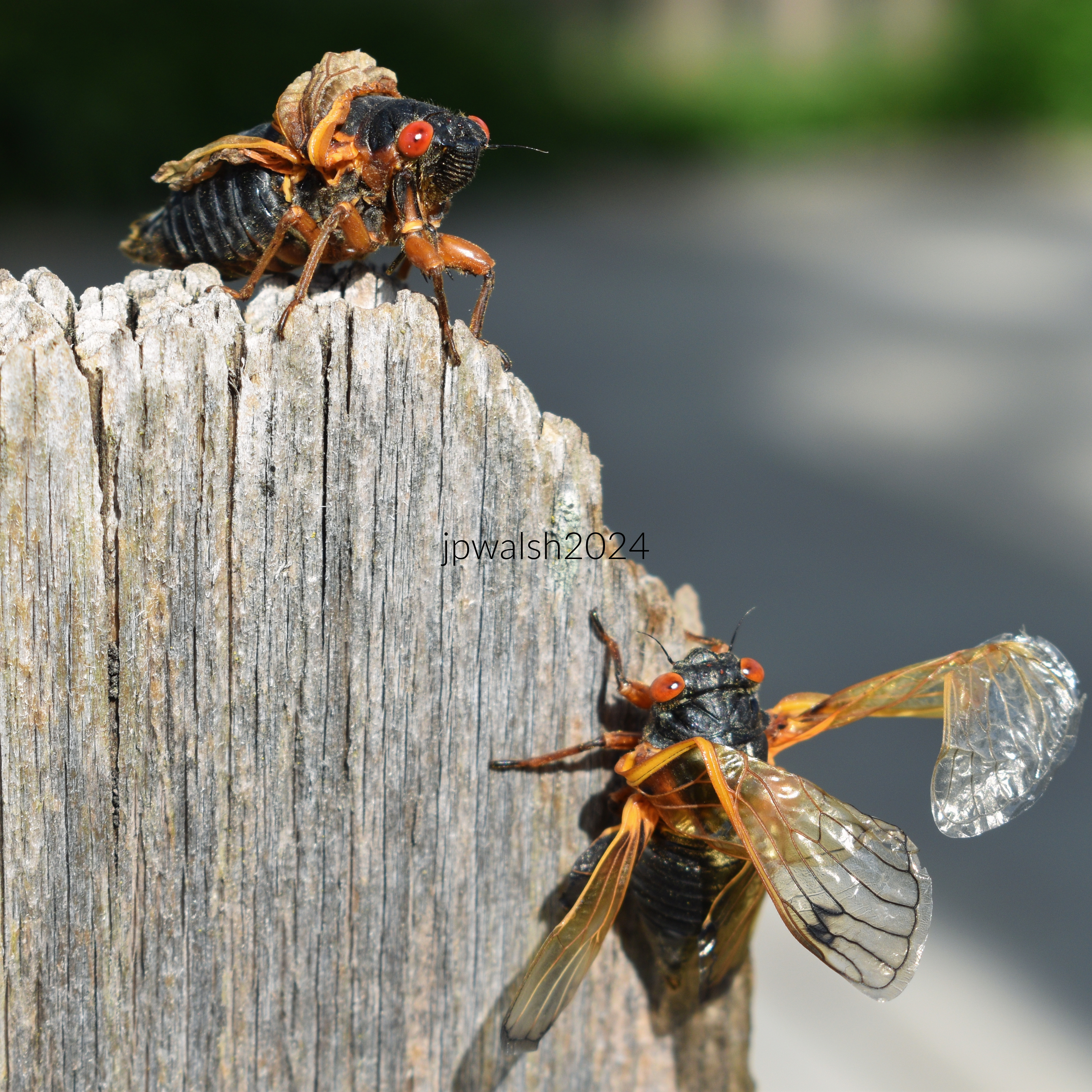
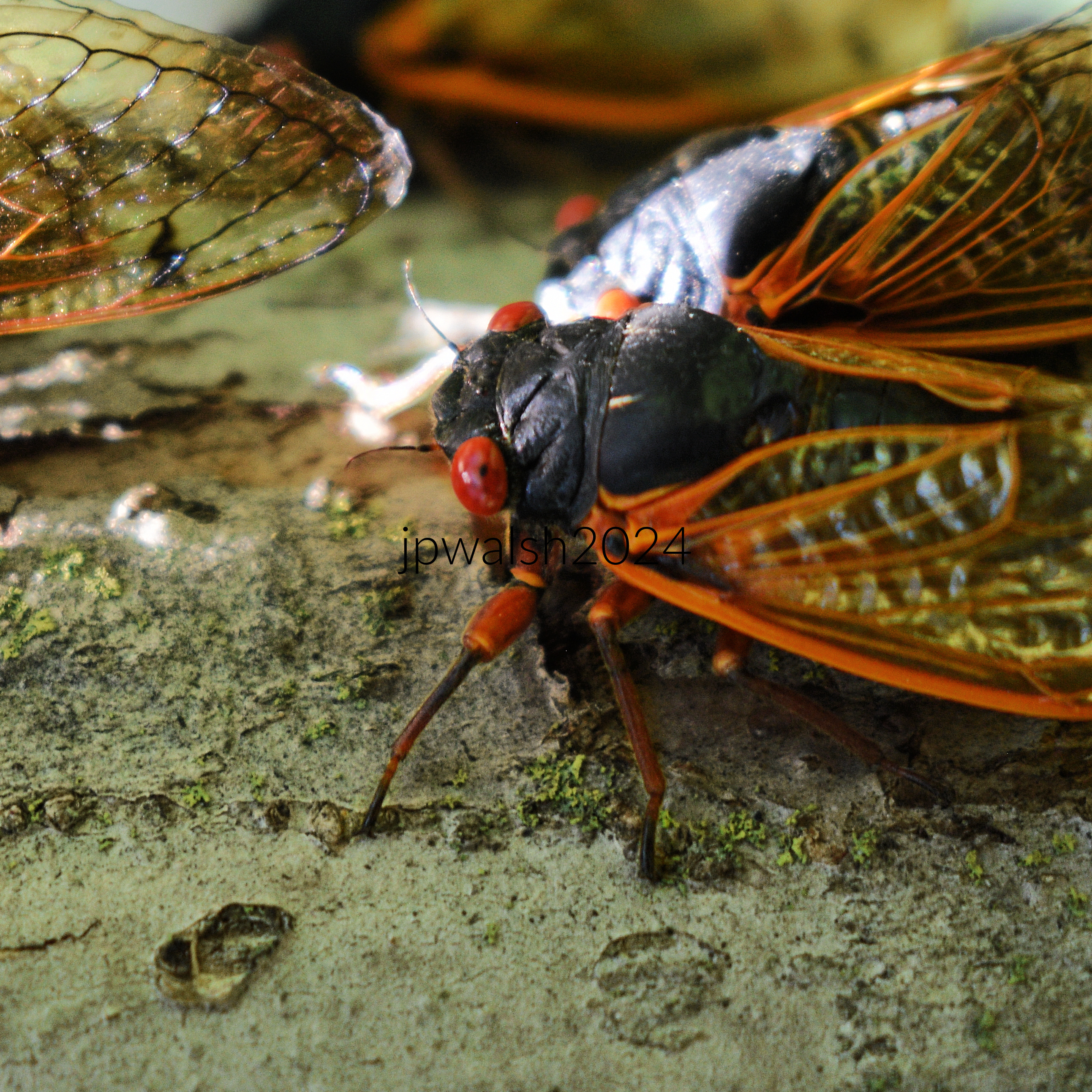
Once above ground, the transformation begins quickly. Most nymphs start molting within an hour of reaching the surface. The empty brown shell, known as an exuvia, preserves the exact shape of the underground nymph that left it behind. The newly emerged adult cicada is still carrying part of its discarded husk, caught in the brief transition between life stages.
Preparing for Flight
Although free of its shell, the insect is not yet fully mature. It takes another four to six days for the cicada’s exoskeleton and delicate wings to darken, harden, and strengthen before it is ready to take flight and join the deafening chorus of millions of other cicadas in the treetops.
May 28 2024 95% 7.67 mb 7667
Cicadas are more closely related to aphids (i.e., black flys) than grasshoppers.
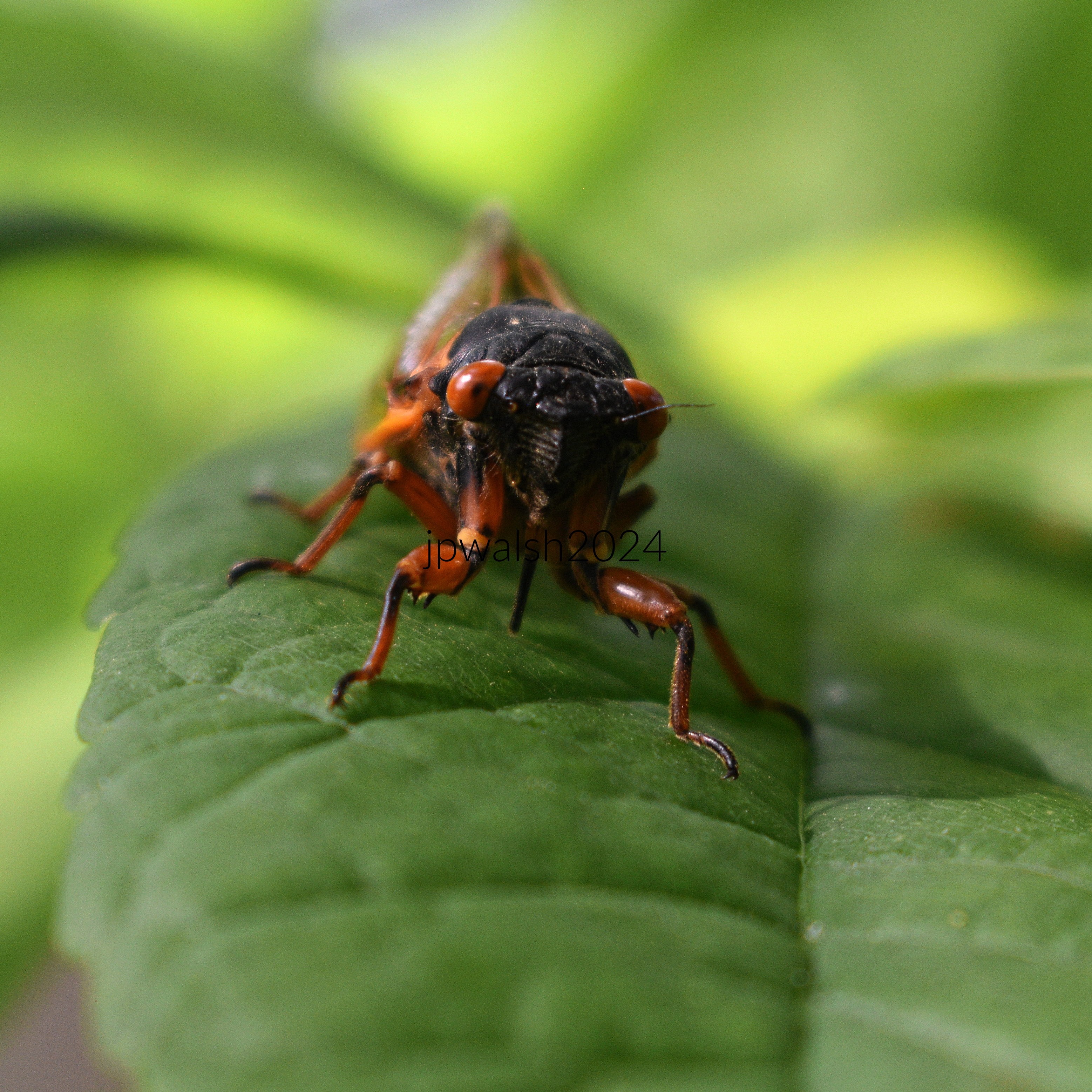
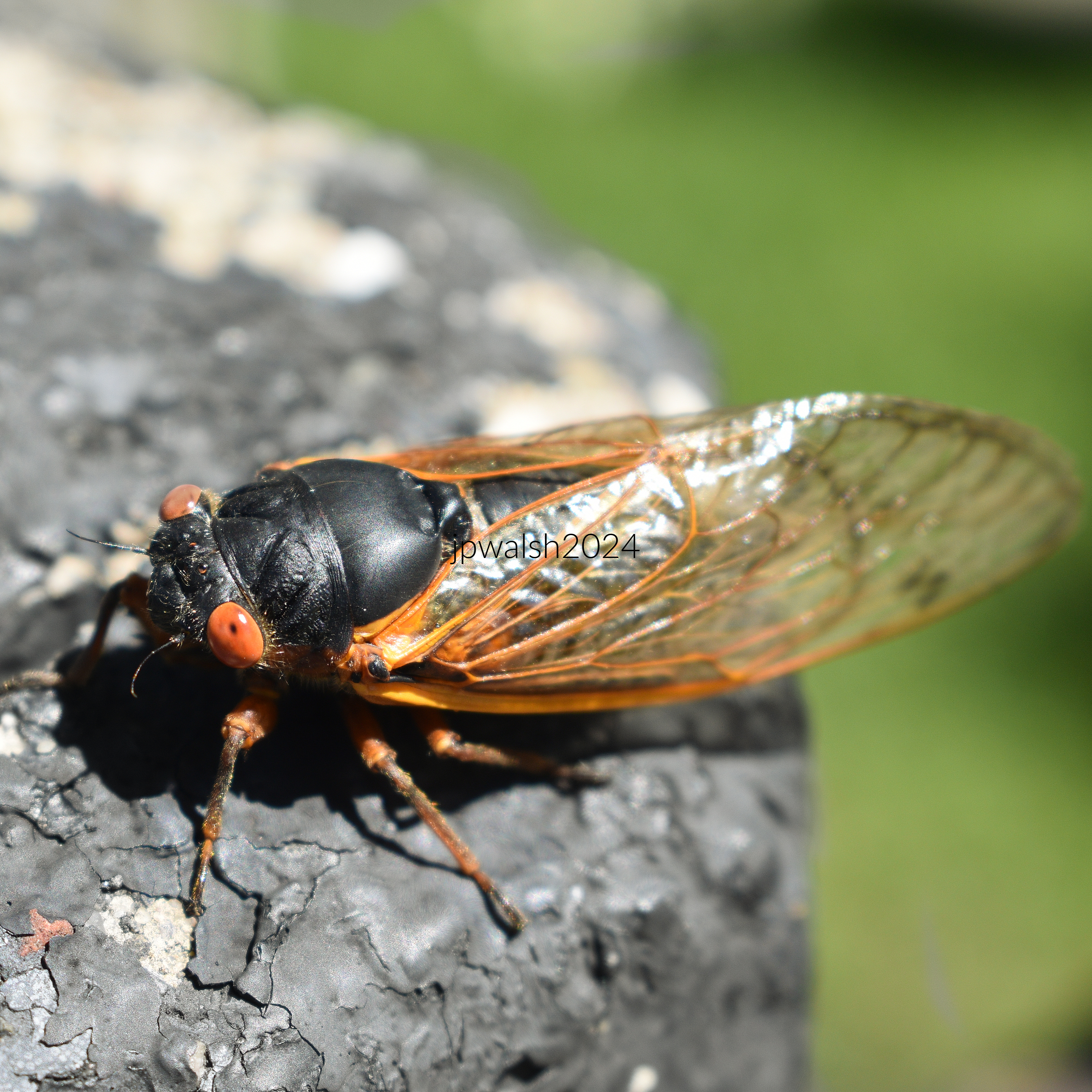
A cicada resting motionless on a weatheredpainted surface, with its five eyes clearly visible. Because their compound eyes bulge outward on the sides of their head, cicadas have nearly a 360-degree field of view. While their vision is blurry and low-resolution—like a grainy mosaic—they are built to detect sudden movement and approaching predators instantly.
Trillions of male cicadas sing through sound-producing structures called tymbals on either side of the abdomen under the wings. Their singing is a mating call to the female.
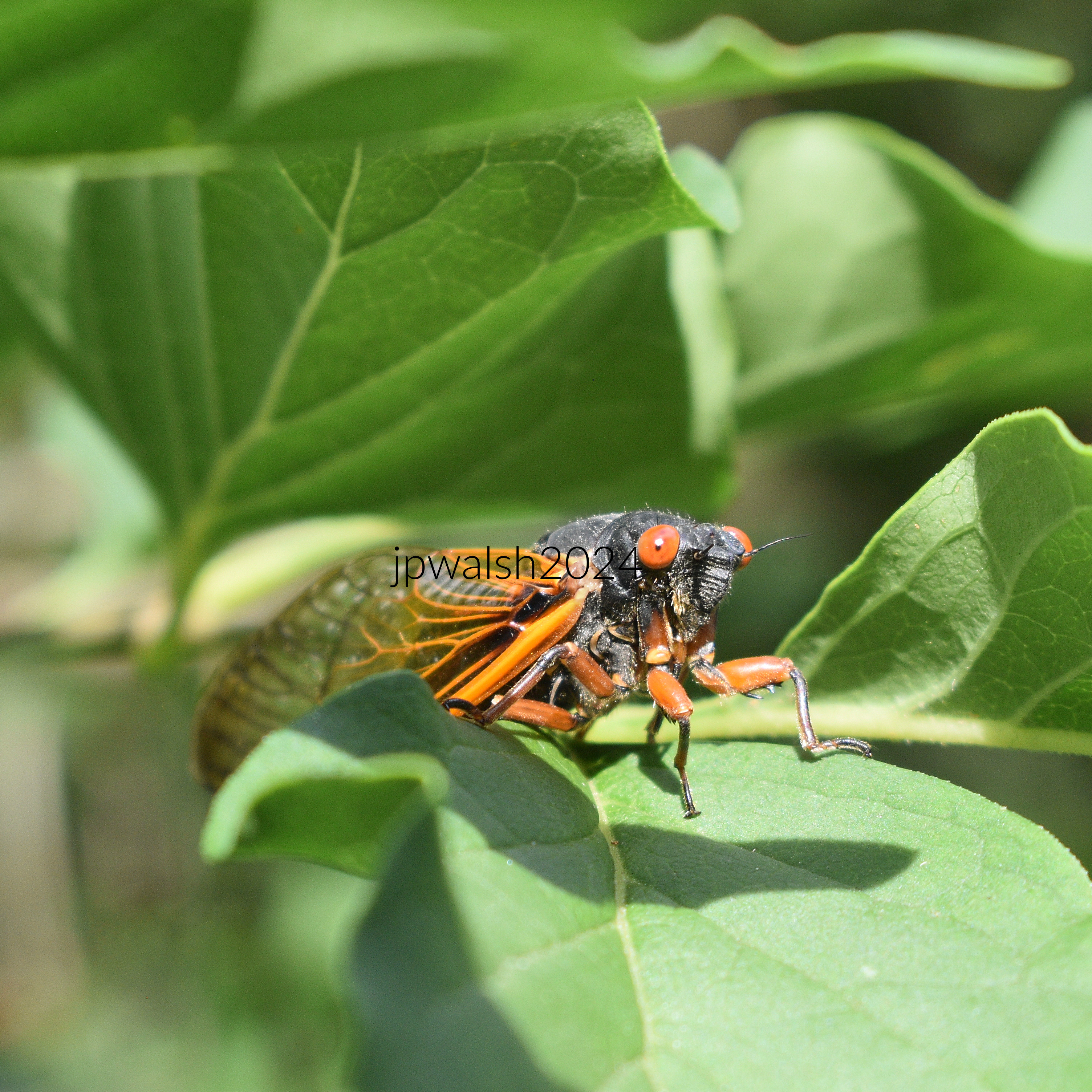
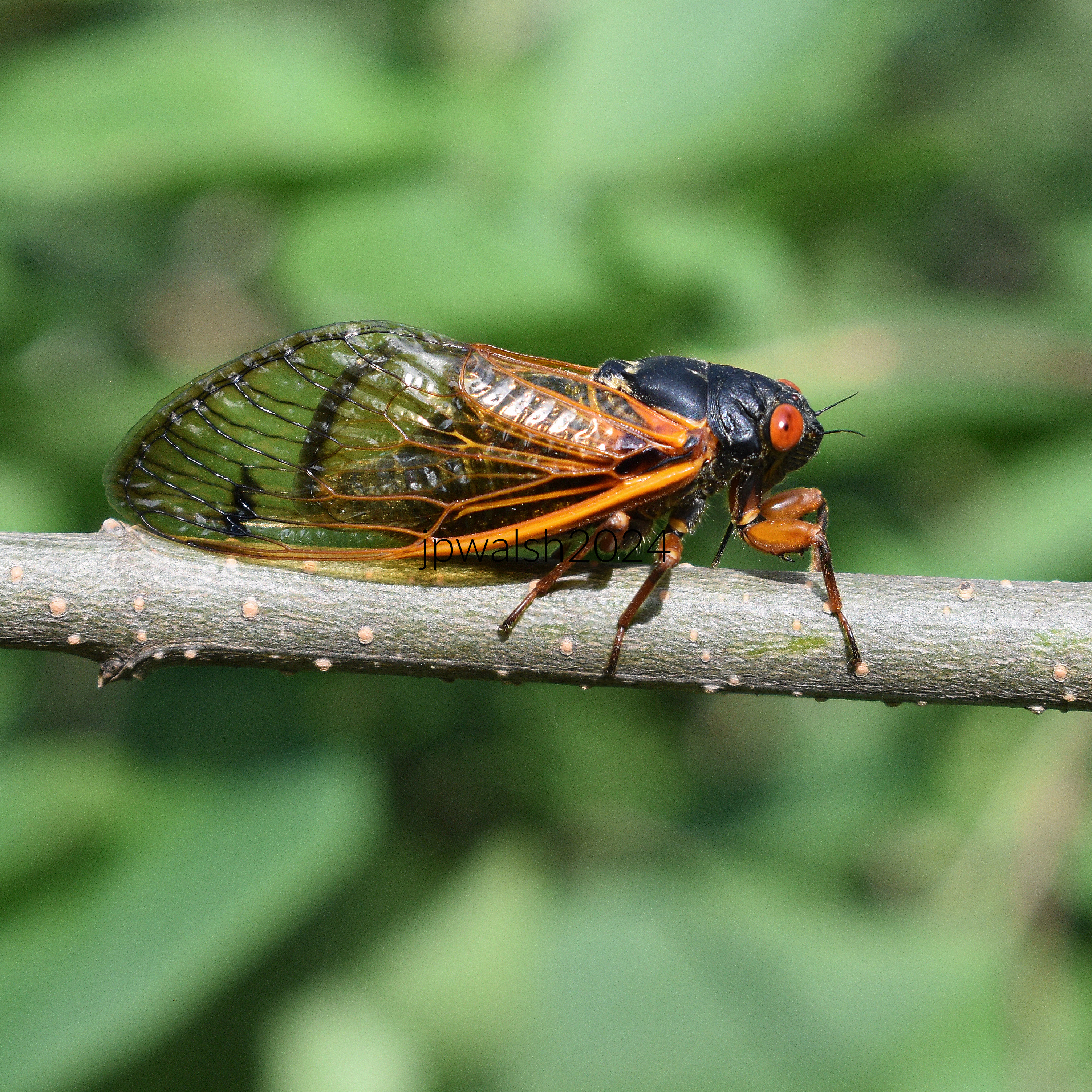
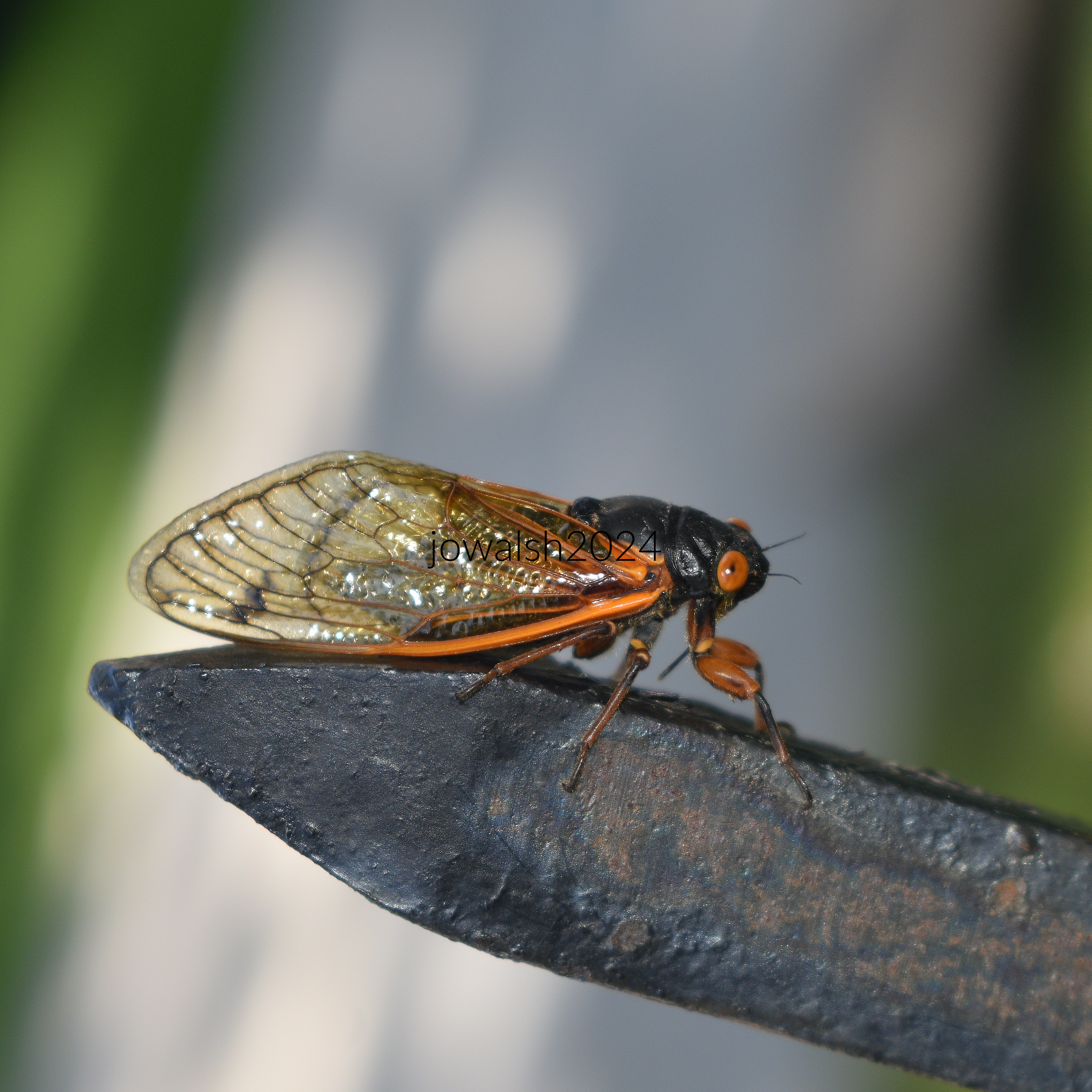
The cicada has bright red-orange compound eyes and orange-banded legs. Its translucent, glassy wings are folded neatly back over its body, displaying prominent amber and orange veins near the base and leading edges. June 7, 2024 4.20mb 8117
May 31, 2024 5.47mb 7700
May 31, 2024 5.03mb 7719
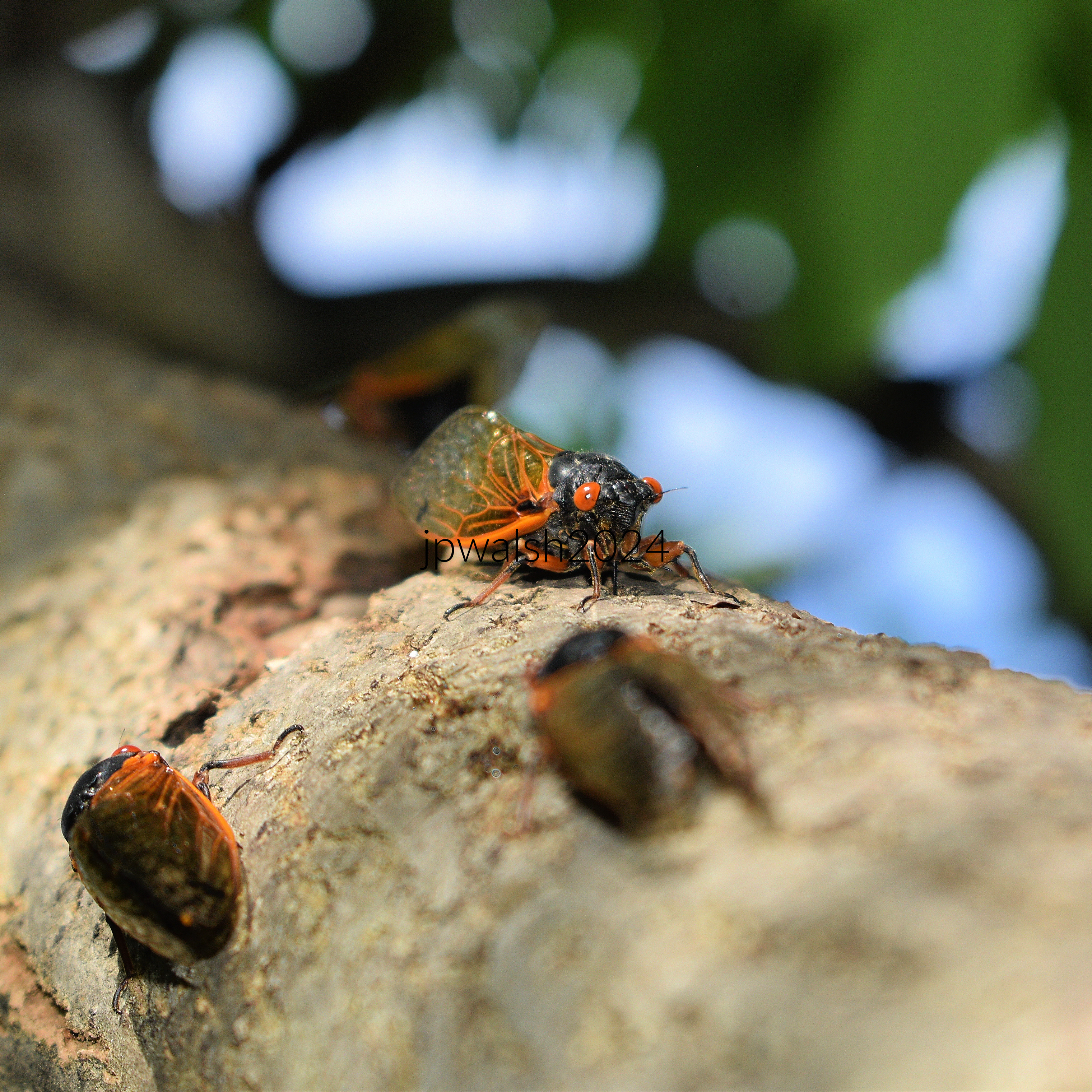
The cicada is perched quietly in direct sunlight on a flat wooden surface, gripping the texture with its clawed, orange-segmented legs. Because insects are cold-blooded, basking in the sun helps raise its body temperature so its wing muscles are warm enough for flight. May 31, 2024 5.80mb 7801
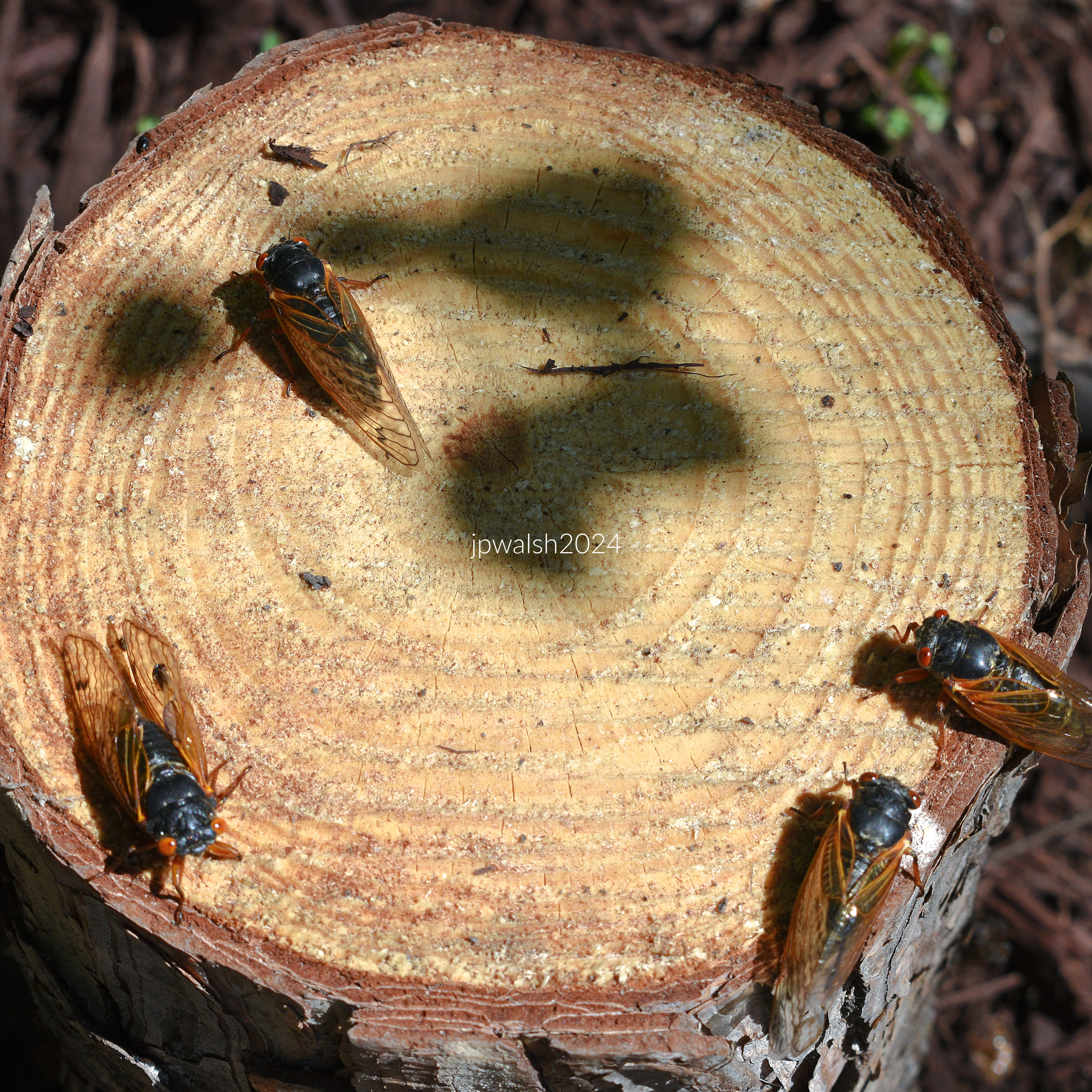
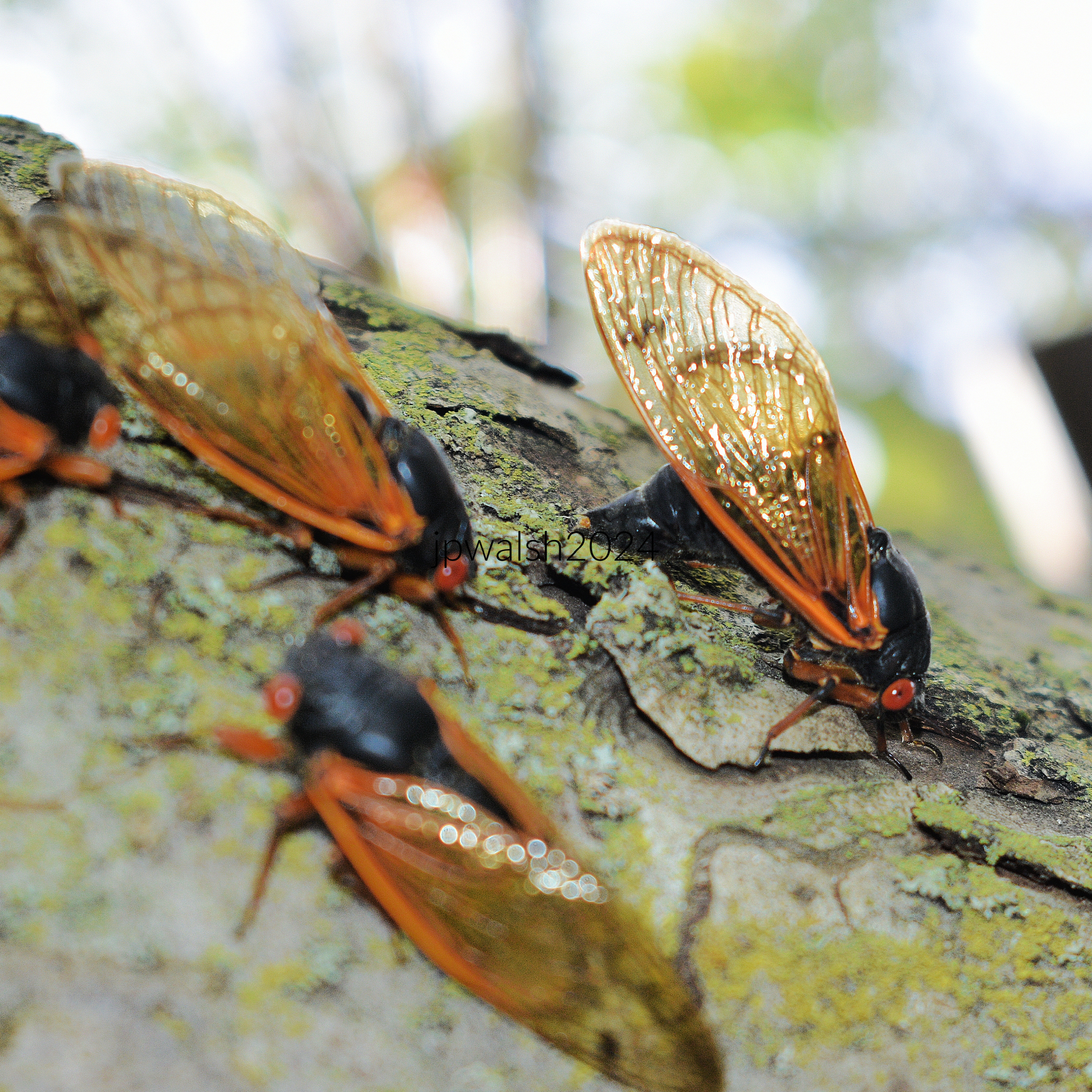
Cicadas resting on dead wood simply to warm up and gather. Adult cicadas lack chewing jaws and feed only by drinking watery plant fluids through a needle-like straw. June 3, 2024 99% 6.40mb 7911
Cicadas do not eat solid food, but do drink fluids to avoid dehydration. They cannot chew leaves, bark, or dead wood. May 28, 2024 2.73mb 7563
Cicadas have a piercing-sucking mouthpart called a rostrum (similar to a hypodermic needle) to drinking sap and watery plant fluids. They do not sleep. Instead, they enter at night a state of torpor at night and during cool, cloudy weather. Because they are cold-blooded, dropping temperatures slow their metabolism, causing them to cling motionless to branches and bark until the morning sun warms their wing muscles back up enough to fly. June 7, 2024 4.84mb 8111
June 10, 2024 7.02mb 8473
An Unexpected Delicacy
Cicadas are edible and have been eaten by people around the world for centuries. Rich in protein, low in fat, and naturally gluten-free, they are often described by foragers as having a mild, nutty flavor reminiscent of shrimp, asparagus, or toasted nuts. After being briefly blanched in boiling water, they can be sautéed with butter and garlic, air-fried with seasonings, added to stir-fries and tacos, or even dipped in chocolate.
A Warning for Shellfish Allergy Sufferers
Not everyone, however, should sample this unusual food. The FDA advises that anyone with allergies to shrimp, crab, lobster, or other shellfish avoid eating cicadas. As arthropods, cicadas contain the same allergenic muscle proteins, including tropomyosin and arginine kinase, that are found in crustaceans and can trigger similar allergic reactions.
What Foragers Should Avoid
There are other reasons to be selective. Because periodical cicadas spend 13 or 17 years underground feeding on fluids from tree roots, they can accumulate traces of lawn chemicals, fertilizers, and other contaminants from the soil. Foragers are also advised to avoid any adult cicada displaying a chalky white or yellowish plug where the back of the abdomen should be. Such insects are infected with the parasitic fungus Massospora, one of the most unusual and disturbing pathogens in the insect world.
Egg-Laying in trees
Cicadas egg-laying in trees. June 7, 2024 99% 6.62 mb 8104
After mating in late May or June, the female uses a sharp, saw-like organ called an ovipositor to slice tiny grooves into slender tree twigs and deposit up to 400 to 600 eggs. About 6 to 10 weeks later—typically in mid-to-late summer—the eggs hatch and the tiny nymphs immediately drop to the ground and burrow into the soil. They survive underground for 13 or 17 years by sucking watery sap from tree roots and living inside protective earthen feeding cells. Newly hatched nymphs are tiny—about the size of a grain of rice or a small ant—and do almost all of their growing underground over the course of 13 or 17 years. June 7, 2024 4.03mb 8094
June 7, 2024 6.12mb 8112
Males gather in large “singing centers” in the treetops to amplify their mating calls, creating a massive acoustic beacon that attracts females from across the neighborhood. June 7, 2024 90% 7.92mb 8088
From George Washington to the modern era, the American presidency emerges as a uniquely human institution in which power, personality, character, and words, actions, triumphs, and failures have continually shaped the office and the course of the United States at home and in the world.
The Roosevelts (32):
“The advent of the new president changed everything. The Roosevelts transformed the White House as completely as the swift march of public thoughts and events had changed the country. No longer did the Executive Mansion resemble a medieval castle besieged by the forces of progress. The drawbridges were figuratively let down, and the moats drained of their timeworn prejudices. The archers of reaction withdrew from their turrets, and the victorious New Deal army took over the battlements.” George Abell and Evelyn Gordon, Let Them Eat Caviar, Dodge Publishing Co., New York, 1937.
The Roosevelts. Taken on January 20, 1941, President Franklin D. Roosevelt and First Lady Eleanor Roosevelt riding in an open-top car as they return to the White House following FDR’s unprecedented third presidential inauguration. PHOTO; “Franklin and Eleanor (FDR Bio, part 1)” by Tony Fischer Photography is licensed under CC BY 2.0.
“As Senate majority leader, I participated in many private conferences with President Franklin D. Roosevelt….Usually we would talk in his bedroom at the White House, and the President, wrapped in his cherished gray bathrobe, which he clung to year after year….would interrupt work on a pile of papers and puff at a cigarette through his long ivory holder as we exchanged views.” Alben W. Barkley (1877-1956), That Reminds Me, 1954.
Senator Barkley (later Vice President Barkley under President Harry S. Truman) describes an almost iconic FDR- one can almost imagine a bespectacled 32nd president smoking a cigarette from a long cigarette (in this instance, ivory) holder and jauntily thrusting his chin forward.
Alben W. Barkley, Democrat of Kentucky, was one of the most prominent American politicians of the first half of the 20th Century. Barkley hoped expectantly to someday be the U.S. President–or at least his party’s sometime presidential nominee, particularly in 1952. The longtime majority leader of the U.S. Senate had to settle, however, for being a one-term vice-president in the executive branch. After Truman chose Barkley to be his running mate in 1948 and that ticket triumphed in one of American history’s most astounding upsets, Alben Barkley became a popular national figure known everywhere as “The Veep.” Like his Kentucky forebear Abraham Lincoln, Vice President Barkley was a noted story-teller and often started his sentence with, “And that reminds me…”
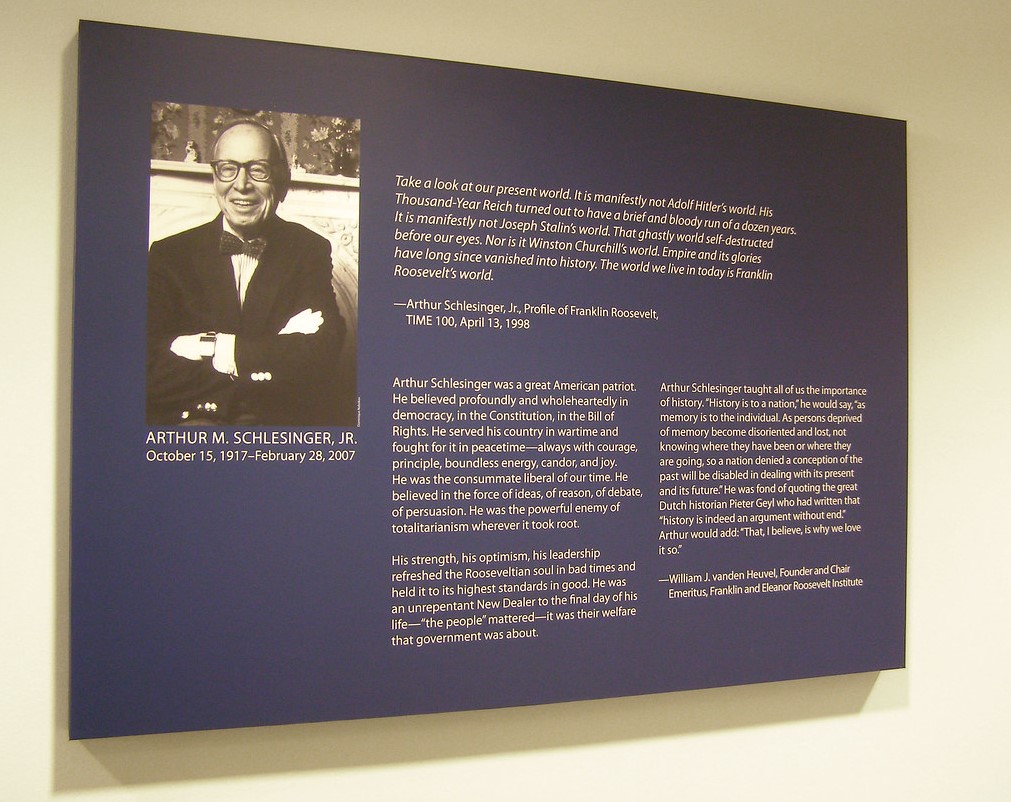
ARTHUR M. SCHLESINGER, JR. October 15, 1917 – February 28, 2007
Take a look at our present world. It is manifestly not Adolf Hitler’s world. His Thousand-Year Reich turned out to have a brief and bloody run of a dozen years. It is manifestly not Joseph Stalin’s world. That ghastly world self-destructed before our eyes. Nor is it Winston Churchill’s world. Empire and its glories have long since vanished into history. The world we live in today is Franklin Roosevelt’s world.
—Arthur Schlesinger, Jr., Profile of Franklin Roosevelt, TIME 100, April 13, 1998
Arthur Schlesinger was a great American patriot. He believed profoundly and wholeheartedly in democracy, in the Constitution, in the Bill of Rights. He served his country in wartime and fought for it in peacetime—always with courage, principle, boundless energy, candor, and joy. He was the consummate liberal of our time. He believed in the force of ideas, of reason, of debate, of persuasion. He was the powerful enemy of totalitarianism wherever it took root.
The tribute concludes by highlighting how Schlesinger’s optimism and leadership sustained the Rooseveltian spirit through difficult times, remaining a dedicated New Dealer who believed that the welfare of “the people” was the primary purpose of government.
Warren J. Harding (29)
Warren G. Harding in 1920 by Harris & Ewing. June 21, 1920, just days after he secured the Republican nomination for the presidency on the tenth ballot at the Republican National Convention on June 12 in Chicago. Public Domain.
“Even that son of a bitch looks impressive in that getup!” Alice Roosevelt Longworth (1884-1980), at the White House after visiting President Warren Harding in the Oval Office. Quoted in Katherine Graham’s Washington, Knopf, 2002.
Alice Roosevelt was President Teddy Roosevelt’s oldest child and the only child of Roosevelt and his first wife, Alice Hathaway Lee, who died in childbirth. Alice grew up to be an independent, unconventional and outspoken “first daughter” and was an important figure in the women’s movement in the first half of the 20th century.
Alice Longworth was perfectly realistic about Harding—and didn’t like the Republican president very much. Sen. Brandegee of Connecticut, a member of Harding’s own inner circle, called the former newspaper owner of The Marion Star, Senator from Ohio, and 29th U.S. President, “no world-beater, but he’s the best of the second-raters.”
June 2001. Visiting Harding Tomb in Marion, Ohio. The final resting place of Warren G. Harding (1865-1923), 29th President of the United States (1921-1923) and First Lady Florence Kling Harding (1860-1924) is located in Marion Cemetery. Following President Harding’s death on Aug. 2, 1923, and funeral, his body was placed in the Receiving Vault in Marion Cemetery until a memorial was built. Florence died in 1924, and her body was also placed in the vault. The Hardings were moved to the memorial in December 1927. In 1931 President Herbert Hoover officially dedicated the memorial.60% see – https://hardingpresidentialsites.org/harding-memorial/ – retrieved August 10, 2025.
Shortest presidents
(50 seconds). While Abraham Lincoln, LBJ and Donald Trump are the three tallest U.S. presidents –and Trump at $7.3 billion, says Forbes in 2025, and Kennedy at $150 million in 1960 ($1.6 billion today) are the richest – though newer wealth rankings jiggle that richest list somewhat – this clip happens to include several of the shortest presidents – the two Adamses (5’7”), “Little Van” Martin Van Buren (5’6”) and the shortest of all chief executives, James Madison (5’4”). https://youtube.com/shorts/h1q_lxjoGog?si=Nj7fkFM8iejI4lX7 – January 30, 2026.
George Washington (1)
“Of all the dispositions and habits which lead to political prosperity, religion and morality are indispensable supports. In vain would that man claim the tribute of patriotism, who should labor to subvert these great pillars of human happiness, these firmest props of the duties of men and citizens. The mere politician, equally with the pious man, ought to respect and to cherish them. A volume could not trace all their connections with private and public felicity.” President George Washington, Farewell Address, first published in Claypoole’s American Daily Advertiser on September 19, 1796.
“Let it simply be asked: Where is the security for property, for reputation, for life, if the sense of religious obligation desert the oaths which are the instruments of investigation in courts of justice? And let us with caution indulge the supposition that morality can be maintained without religion. Whatever may be conceded to the influence of refined education on minds of peculiar structure, reason and experience both forbid us to expect that national morality can prevail in exclusion of religious principle.” President George Washington, Farewell Address, first published in Claypoole’s American Daily Advertiser on September 19, 1796.
“[George Washington’s] mind was great and powerful, without being of the very first order; his penetration strong, though not so acute as that of a Newton, Bacon, or Locke; and as far as he saw, no judgment was ever sounder. It was slow in operation, being little aided by invention or imagination, but sure in conclusion.” Thomas Jefferson (1743-1826), U.S. president, Letter, January 1814.
After returning from France where he served as Minister Plenipotentiary with John Adams and Benjamin Franklin in Paris in the mid-to-late 1780’s, Thomas Jefferson accepted President George Washington’s invitation to serve as the nation’s first Secretary of State in the early 1790’s. Jefferson eventually left Washington’s cabinet over his opposition to Treasury Secretary Alexander Hamilton’s promotion of a national debt and national bank in contrast to Jefferson’s vision of a minimalist federal government (see Joseph J. Ellis, American Sphinx: The Character of Thomas Jefferson, Random House, 1998, pp. 221-222). Thomas Jefferson was elected the third president of the United States in 1800 and served two terms as president. In 1803 Jefferson transacted the Louisiana Purchase that doubled the size of the United States and in the process acquired the most fertile tract of land of its size on Earth.
“In a way the criticism of Washington is extremely healthy. Because the idea of Thomas Jefferson was that to make the system work, Americans always had to be in a state of semi-revolution against the government. He would have been terrified to think that in 2001 Americans might be uncritical of Washington and let it steal their liberties.” Michael Beschloss, U.S. historian, quoted in “Why Do They Hate Washington?” by Sally Quinn, The Washington Post, April 12, 2001.
Woodrow Wilson (28)
“[The Wilsons] finally settled on a house in the 2300 block of S Street, Northwest, and purchased it…[W]e rode by everyday, and the President was eager as a bridegroom about getting back to private life. He seemed to gain new strength as he shed the idea of responsibility and assumed the freedom of a civilian. But he did not forget his dreams.” Colonel Edmund W. Starling, Starling of the White House…as told to Thomas Sugrue…, Simon & Schuster.
Colonel Edmund William Starling (1875-1944) was chief of the Secret Service detail in the White House from 1914 to 1943. In his thirty years of service at the White House he was responsible for the personal safety of five President of the United States—Woodrow Wilson, Warren G. Harding, Calvin Coolidge, Herbert Hoover and Franklin D. Roosevelt. Starling idolized Woodrow Wilson. His first exposure to Wilson left him “in a daze.” Born in Hopkinsville, Kentucky, the posthumous book is based on over 11,000 personal letters Starling wrote over the decades, mostly to his mother back home. Starling’s ashes are buried at Arlington National Cemetery.
“I have been searching for the fundamental fact that converted Europe to believe in us. Before this war, Europe did not believe in us as she does now. She did not believe in us throughout the first three years of the war. She seems really to have believed that we were holding off because we thought we could make more by staying out than by going in. And, all of a sudden, in a short eighteen months, the whole verdict is reversed. There can be but one explanation for it. They saw what we did—that, without making a single claim, we put all our men and all our means at the disposal of those who were fighting for their homes, in the first instance, but also for a cause, the cause of human rights and justice, and that we went in, not to support their national claims, but to support the great cause which they held in common. And when they saw that America not only held ideals, but acted ideals, they were converted to America and became firm partisans of those ideals.” Woodrow Wilson, February 24, 1919. Address Following Arrival from the Paris Peace Conference in Boston, Massachusetts. For more, see – https://www.presidency.ucsb.edu/documents/address-following-arrival-from-the-paris-peace-conference-boston-massachusetts – retrieved January 26, 2025.
Presidents 11-20: All U.S. Veterans
(55 seconds) 4 Republicans, 4 Democrats, 2 Whigs. Every single one of these U.S. presidents were U.S. veterans (according to the US Department of Veteran Affairs).https://youtube.com/shorts/jW_UPuIB2HI?si=uEHgHEQEPPXG6efc – retrieved Jan. 31, 2026.
John F. Kennedy (35)
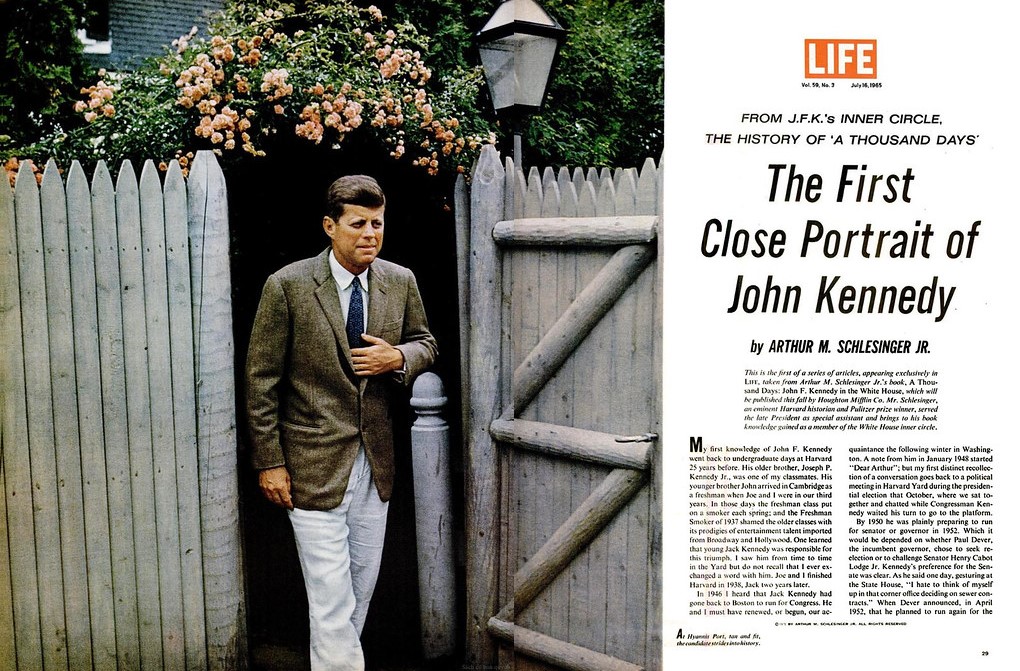
“It was all gone now-the life-affirming, life-enhancing zest, the brilliance, the wit, the cool commitment, the steady purpose….[President Kennedy] had so little time: it was as if Jackson had died before the nullification controversy and the Bank War, as if Lincoln had been killed six months after Gettysburg or Franklin Roosevelt at the end of 1935 or Truman before the Marshall Plan.” Arthur M. Schlesinger, Jr. (1917-2007) on the death of JFK. From A Thousand Days: John F. Kennedy in the White House, Houghton Mifflin, 1965.
Arthur M. Schlesinger, Jr. was an American historian who resigned from Harvard and was appointed Special Assistant to the President in the Kennedy Administration in January 1961. Per Kennedy’s desire, Schlesinger served as a sort of ad hoc roving reporter and troubleshooter on behalf of the president. In February 1961, Schlesinger was told of the plans for what developed into the disastrous Bay of Pigs invasion in April 1961 and wrote a memorandum to the president telling him that he opposed the action. During the Cuban Missile Crisis in October 1962 Schlesinger aided United Nations ambassador Adlai Stevenson on his presentation to the world body on behalf of the Kennedy Administration’s ultimately successful efforts to peacefully remove Soviet nuclear missiles in Cuba. On November 22, 1963, Schlesinger had flown to New York for a luncheon with Washington Post owner Katharine Graham and the editors of her magazine, Newsweek. As they still sipped pre-luncheon libations and amiably talked about upcoming college football games that weekend, a young man in shirtsleeves suddenly entered the gathering. He tentatively announced to the group that, as Schlesinger relates in A Thousand Days, “the President has been shot in the head in Texas.”
21-30: Gilded Age Presidents
The Gilded Age following the Civil War up through the Roaring 20s saw just two Democratic presidents (Cleveland and Wilson) among 7 Republicans. Four presidents in this period were born in Ohio — Harrison, McKinley, Taft, and Harding. Two presidents from Ohio were assassinated – and New Yorkers succeeded them both – Arthur after Garfield and Roosevelt after McKinley. In both cases the Republican base was in a tizzy as both New Yorkers were unlike the elected presidents – Arthur dismissed as an unelected, elite, and corrupt politician and TR as young, impetuous, and overly imperialistic. Wilson won in 1912 because the Republicans were split by TR and Taft – though Wilson’s Electoral College tally was impressive. Harrison’s great grandfather was a signer of the Declaration of Independence, his grandfather the 9th U.S. president and Benjamin Harrison himself a Civil War veteran and lawyer. Like his grandfather, Harrison defeated an incumbent president (Cleveland) though he lost the popular vote. People called Harrison the “ice box” because, at 5’6”, he was short and stocky, a cold fish personally, and insignificant politically. When he ran for re-election against Cleveland (and lost) it was the only time in U.S. history that both major party candidates had been president. Two weeks before the election Harrison’s wife Caroline died of tuberculosis in the White House. Wilson’s wife Ellen also died in the White House of Bright’s Disease on August 6, 1914. Harding died in office and Calvin Coolidge, who succeeded him, saw his younger son, 16-year-old Calvin, Jr. tragically die from a freak accident while playing tennis at the White House. Calvin, Jr.’sbrother John Coolidge, who died in 2000, said the 30th president never forgave himself for his son’s death. https://youtube.com/shorts/xFOCM_LrgF4?si=Wkj_G6GBK1jfiDt2 – retrieved February 1, 2026
George Bush (41)
“During the inaugural parade [President George H.W.] Bush kept darting in and out of his limousine…These pop-outs were much better received than the Jimmy Carter business of walking the whole parade route. We Americans like our populists in small doses and preferably from an elitist.” P.J. O’Rourke, PARLIAMENT OF WHORES, Atlantic Monthly Press, 1991.
The Bushes were a big family and family oriented. O’Rourke reported in his best-selling book that on the first night of Bush’s presidency 28 members of the Bush family spent it at the White House.
John Adams (2)
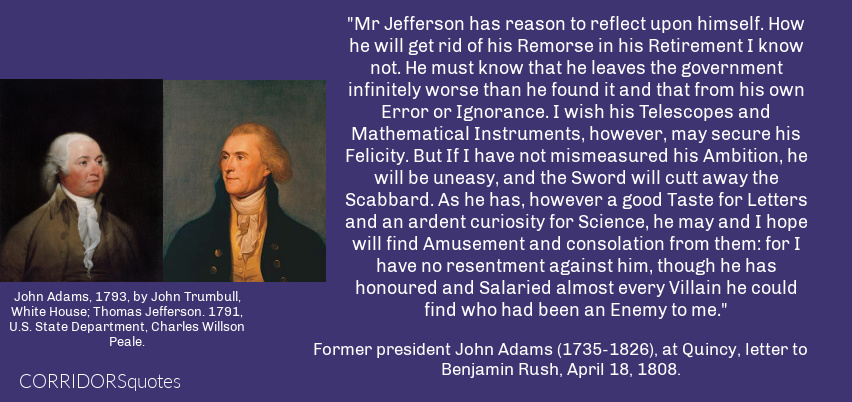
“Mr Jefferson has reason to reflect upon himself. How he will get rid of his Remorse in his Retirement I know not. He must know that he leaves the government infinitely worse than he found it and that from his own Error or Ignorance. I wish his Telescopes and Mathematical Instruments, however, may secure his Felicity. But If I have not mismeasured his Ambition, he will be uneasy, and the Sword will cutt away the Scabbard. As he has, however a good Taste for Letters and an ardent curiosity for Science, he may and I hope will find Amusement and consolation from them: for I have no resentment against him, though he has honoured and Salaried almost every Villain he could find who had been an Enemy to me.” Former president John Adams (1735-1826), at Quincy, letter to Benjamin Rush, April 18, 1808.
John Adams (1735-1826), the second president of the United States, a Federalist, and Thomas Jefferson (1743-1826), a Democratic-Republican, were fierce political rivals. Both lawyers—Adams from Massachusetts and Jefferson from Virginia—each were enlightened political liberals who served in the Continental Congress in Philadelphia as well as headed the committee that drafted the Declaration of Independence. Adams and Jefferson also served together as ministers to France in the 1780’s. Into the 1790’s, as president (Adams) and vying to be (Jefferson), each served opposing visions for the direction of the new nation. At their extreme, the Federalists advocated to establish a strong Federal government that could alienate the individual rights of large groups. Jefferson’s vision of limited government included his advocacy in certain instances for state government to have the right to resist those federal laws that were injurious to local interest.
Jefferson’s narrow victory in the presidential election of 1800 made John Adams the nation’s first one-term president and sent the New England patriarch into early retirement at Peacefield in Quincy, Massachusetts. For the next decade, during Jefferson’s two terms as president, John Adams harbored a barely hidden resentment of his political rival, if not enemy when measured by some of their florid rhetoric towards one another. Though these two sparring giants of the early republic eventually resumed civil correspondence – Adams writing a New Year’s Day greeting to Jefferson in 1812 that Jefferson responded to three weeks later – it became these once friends and political collaborators’ first contact since 1801 – Adams had been especially upset by the relentless propaganda campaign of Jefferson’s Republican party against him during the second president’s first term. Jefferson’s years-long accusations against President Adams inscluded descriptions of the second president as narcissistic, incompetent, dangerous to democracy, unbalanced, and corrupt. All these public proclamations were approved and personally paid for by Jefferson, a profligate spender, and which led to the premature and hasty departure by Adams as chief executive from Washington, D.C. on March 4, 1801, not attending Jefferson’s inauguration. At least two remarkable outcomes resulted in this renewed friendship of political rivals in these resumed letters – one, that Adams and Jefferson stayed in close contact until the day they died and, two, that that was on the same day – July 4, 1826. Which of these conspicuous marvels s most noteworthy among fierce rivals and Founding fathers may be debated. see – https://founders.archives.gov/documents/Jefferson/03-04-02-0296-0002; https://openendedsocialstudies.org/2018/09/25/adams-jefferson-and-two-visions-for-the-united-states/; Joseph J. Ellis, American Sphnix: The Character of Thomas Jefferson, Random House, 1998, pp. 281-82).
Calvin Coolidge (30)
“Isn’t it nice that Calvin is President? You know we never really had room before for a dog.” Grace Coolidge (1879-1957), First Lady of the U.S. (1923-1929), in 1927.
Grace Coolidge was the wife of the 30th President of the U.S., Calvin Coolidge. Throughout her husband’s career, whether as Governor of Massachusetts, Vice-President, or President, Grace Coolidge avoided politics. Though the young Grace broke off a marriage engagement to marry Coolidge, her mother advised against marrying this young man. Calvin Coolidge and Grace Coolidge married on October 4, 1905—and Calvin Coolidge never settled his differences with his mother-in-law who felt her daughter was completely responsible for his rising political fortunes. The Coolidges had two sons, John (1906–2000) and Calvin (1908–1924). After Calvin Coolidge, Jr. died of blood poisoning in July 1924, the Coolidges were inconsolable. The story is well-known: while playing lawn tennis with his brother, John, at the White House, the teenager developed a blister on one of his toes. Within the week, the 16-year-old was dead of a blood infection despite being admitted to Walter Reed Army Medical Center. (see- https://www.coolidgefoundation.org/blog/the-medical-context-of-calvin-jr-s-untimely-death/)
By 1921, the wife of Vice-President Coolidge entered Washington society and quickly became the most popular woman in the capital. In 1927 when Mrs. Coolidge made these remarks, the world that her husband was facing was in flux. In 1927, as France called to outlaw war, which was endorsed by the U.S, a Great Depression already began in Germany with its economic collapse on “Black Friday.” After President Coolidge called for a Naval Disarmament Conference, only a couple of global powers showed up.
The world seemed to be getting smaller in 1927. In May 1927 American Charles Lindbergh flew solo, nonstop, from New York to Paris and started the era of transatlantic air travel. Regular transatlantic telephone service also began in 1927. In the U.S., as the stock market boomed, much of it on shaky credit, lawyers and doctors earned around 3½ times more than a teacher or factory worker. Baltimore-born “Babe” Ruth hit a record 60 home runs in New York.
The first full-length sound motion picture, The Jazz Singer, opened in 1927. In Chicago there was an important art exhibition of Chinese Buddhist art of the Wei Dynasty. In 1927, Hemingway published Men without Women; Willa Cather published Death Comes for the Archbishop; and Thomas Mann published The Magic Mountain. That year’s Pulitzer Prize went to Thornton Wilder’s second novel, The Bridge of the San Luis Rey. It told the story of people who unexpectedly die together in a rope bridge collapse in Peru and the friar who witnessed the accident looking to figure out the possibly cosmic answers as to why.
Lyndon B. Johnson (36)
“The days of transition from Kennedy to Johnson were as hard on me as they were on anyone else–harder. I was losing a dog and gaining a President I didn’t know. Not only didn’t I know him, I didn’t think I wanted to know him. He wasn’t boyish or good-natured or quick-witted like Kennedy and I heard him cussing out the help when things weren’t done fast enough.” Traphes Bryant, Dog Days at the White House, 1975.
In 1951, Traphes Bryant started out at the White House working as an electrician in the afternoons. Bryant moved on to respond to general maintenance calls including a broken White House elevator. In the 1950’s Bryant was already looking after the First Family’s pets, both for the Trumans and, later, the Eisenhowers. The line of work became official for Traphes Bryant in 1961 when John Kennedy became president.
Kennedy asked Bryant to become the new presidential kennel keeper. The president liked how Bryant trained the dogs to meet the presidential helicopter that would often be seen in photographs and films.
Though Kennedy himself was allergic to some animals, First Lady Jackie Kennedy adored all sorts of animals. During the next 1000 days while in office, the Kennedys kept several pets. At one point the first family, which included children Caroline and John, Jr., had nine dogs. The Kennedys also kept hamsters, horses, birds, a rabbit, and a cat. Some of the animals were gifts from foreign heads of state.
In 1961 Soviet Premier Nikita Khrushchev sent the Kennedys a mixed breed dog named Pushinka. The dog’s mother had been sent into orbit in 1960 on Korabl-Sputnik 2. While a surprise, the Kennedy’s welcomed the Russian’s canine gift. In fact, Kennedy’s Welsh terrier, Charlie, not only had a new companion but a new mate: Pushinka gave birth to four puppies fathered by Charlie. Kennedy called the litter, “the pupniks.”
Bryant was officially in charge of Pushinka’s and Charlie’s grooming, exercise, and diet—and all the rest though those responsibilities ended abruptly for Kennedy in November 1963.
“Nancy Dickerson wrote that ‘The LBJ social style was something of a shock to the capital. Starting right at the White House, the Johnson way was different…It’s difficult to comprehend the LBJ style because even by Texas standards he had large impulses. When the Johnsons said, ‘You all come,’ they meant it. Their lack of inhibition was new in Washington, a Southern city in the East. LBJ was a cowboy, and though that mythic figure is in the best American tradition, the Washington establishment, the press and the country were unaccustomed to a cowboy in the White House. The city shook its collective head.’ …However, the Johnsons gradually began to put their own mark on the city.” Katharine Graham, Katharine Graham’s Washington, Knopf, 2002, p. 458.
“What convinces is conviction. You simply have to believe in the argument you are advancing. If you don’t you are as good as dead. The other person will sense something isn’t there, and no chain of reasoning, no matter how logical or elegant or brilliant, will win your case for you.” Lyndon B. Johnson, quoted in Doris Kearns Goodwin, Lyndon Johnson and the American Dream, St. Martin’s Press, 1991, p. 130.
Jimmy Carter (39)
I always thought [President Jimmy] Carter was great…That kind of brain power made him the smartest president we’ve had in my time. His failing was as a politician. He did not know how to organize the White House and how to get along with Congress. Carter promised he was not going to work with the bureaucracy in Washington. He would be the people’s president.. He did it — and it doesn’t work. [Carter] proved that.Conversations with Cronkite: Walter Cronkite and Don Carleton, University of Texas at Austin, 2010, p.320.
The helicopter crash in the Iranian desert unfolded in the dead of night during Operation Eagle Claw on April 24–25, 1980—a mission meant to pull 52 American hostages out of Tehran. What began as a daring rescue quickly unraveled as sandstorms, mechanical failures, and miscommunication converged at a remote staging site known as Desert One. When a helicopter collided with a transport aircraft during an attempted refuel, a fireball lit up the desert floor, killing eight U.S. servicemen and forcing the mission to be abandoned. The tragedy exposed deep flaws in planning and coordination and became a defining moment for how the United States approached special operations for decades to come and an episode for continued diminishment of the Carter presidency in an election year by the Iran crisis. President Carter delivered this televised address from the Oval Office regarding the failed mission (Operation Eagle Claw) on April 25, 1980. .https://www.youtube.com/watch?v=F4D5_F6hz3I – retrieved March 2, 2026.
The Iranian Revolution was already gathering momentum more than a year before the seizure of 52 American hostages on November 4, 1979. As nationwide protests escalated in 1978, the Shah increasingly relied on Washington for guidance. In January 1979, facing mass demonstrations and a collapsing political order, he asked the Carter administration whether he should authorize a forceful crackdown. Washington declined to give a clear answer. According to historical accounts, U.S. officials were reluctant to endorse or appear complicit in violent repression, especially amid domestic political sensitivities in the United States during an upcoming election year.
The Shah, already politically weakened and personally hesitant to use large scale force, departed Iran shortly thereafter. President Carter later told the American public that he avoided direct intervention in Iran’s internal affairs, but archival material shows that his administration was divided. Secretary of State Cyrus Vance opposed supporting harsh measures, while National Security Advisor Zbigniew Brzezinski argued that the stakes for U.S. interests required difficult decisions and potentially firm action.
After the Shah’s departure, the United States dealt with a fragile interim government that lacked both authority and direction. Carter dispatched a senior military officer to Tehran, but U.S. guidance remained ambiguous. Iranian officials sought clarity on whether Washington supported efforts to halt the revolutionary movement; no definitive policy emerged. With no coherent strategy from either Tehran or Washington, the moderate government proved unable to contain events. In February 1979, Ayatollah Khomeini returned to Iran and rapidly consolidated power, sweeping aside moderate factions and establishing a revolutionary regime.
Carter’s broader approach combined pressure on the Shah to liberalize politically with sympathy for resisting Khomeini’s movement. Yet he struggled to enforce a consistent foreign policy. Internal disagreements, bureaucratic friction, and the president’s own reluctance to authorize forceful measures contributed to a policy vacuum at a critical moment. The resulting instability culminated in the November 1979 embassy takeover, when Iranian students seized the U.S. mission in Tehran and held American diplomats hostage for 444 days.
The hostage crisis dominated U.S. politics and overshadowed Carter’s presidency. The prolonged standoff, combined with economic challenges at home, contributed to his decisive loss to Ronald Reagan in the November 1980 election. – JPW March 2, 2026.
Harry S Truman (33)
“Just the day before, I’d joked about being the vice president when I addressed a group of newspapermen covering the Senate. One of them called me Mr. Vice President and I said, “Smile when you say that,” and I told them that the Senate was the greatest place in the world and that I wish I was still a senator. “I was getting along fine,” I said, “until I stuck out my neck too far and got too famous. And then they made me VP and now I can’t do anything.” But now I wasn’t the vice president any longer, and there was plenty to do.” Harry S. Truman, 33rd U.S. President, Where the Buck Stops: The Personal and Private Writings of Harry S. Truman, ed. Margaret Truman, 1989.
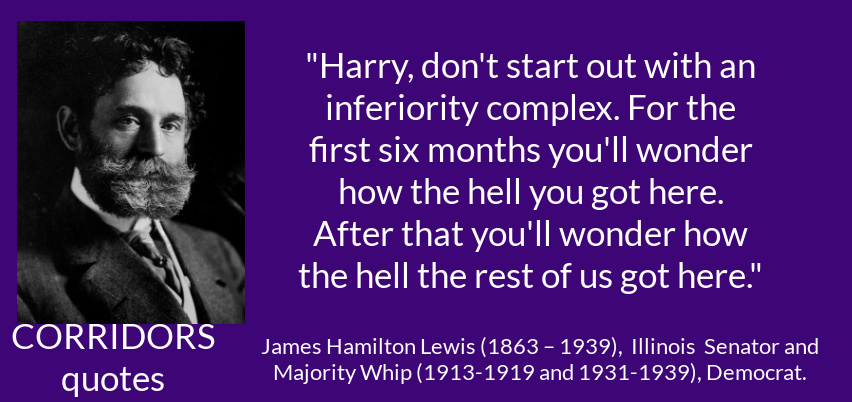
“Harry, don’t start out with an inferiority complex. For the first six months you’ll wonder how the hell you got here. After that you’ll wonder how the hell the rest of us got here.” James Hamilton Lewis (1863 – 1939), Illinois Senator and Majority Whip (1913-1919 and 1931-1939), Democrat.This famous piece of advice (below) was given by Democratic Senator J. Hamilton Lewis to a newly elected Harry S Truman upon his arrival in the Senate in 1935.
Ronald Reagan (40)
“Do you know who the patient is in the emergency room?” “Yes.” “Would you give me his name, please?” I said, “It’s Reagan. R-E-A-G-A-N.” I waited for a reaction. “First name?” “Ron.” “Address?” I said, “1600 Pennsylvania.” His pencil stopped in mid-scratch. He finally looked up. “You mean…?” I said, “Yes. You have the president of the United States in there.” Michael K. Deaver at George Washington University Hospital in Washington, D.C. after the assassination attempt on President Reagan on March 30, 1981. From his Behind the Scenes, 1987.
On Monday afternoon, March 30, 1981, after giving a speech at the Washington Hilton Hotel at 1919 Connecticut Avenue, N.W., in Washington, D.C., President Reagan was shot by 25-year-old would-be assassin, John Hinckley, Jr. The president was slammed to the floor of the presidential limousine by a Secret Service agent during the first split seconds of the shooting in a bid to save his life. Later Reagan expressed his anger for being treated very roughly by the agent though the agent knew he was just doing his job. Under a pile of agents, the 70-year-old president was raced in the limousine to George Washington University Hospital about a mile away.
At first it was believed that the president was unhurt, but within minutes, still on the way to the emergency room, Reagan coughed up blood from his lungs.
At the hospital, the president walked on his own power about 15 yards into the emergency room. Once inside the hospital, Reagan slumped and was helped by Secret Service agents into a private room off the lobby.
As the hospital’s trauma team assembled, it was still not clear whether Reagan had been hit or not in the hail of 6 bullets shot in quick succession by the would-be assassin’s .22 caliber gun. Bullets struck James Brady, Reagan’s Press Secretary, in the head above his left eye; Secret Service agent Timothy McCarthy in the chest; and D.C. police officer Thomas Delahanty in the back of his neck ricocheting off his spine. All of them would receive medical attention and survive.
The doctors were just starting their examination of the president when a green smocked-hospital orderly with a clipboard approached Michael K. Deaver, White House Deputy Chief of Staff and Reagan confidante, looking for information on the new patient. It soon became clear that Reagan had, indeed, been hit in the assassination attempt. A fragment of a bullet had ricocheted off the limousine’s armored car door and entered the new president below the armpit, traveled down his left side, bounced off a rib, punctured his lung, and stopped just inches from his heart.
By exploring personal recollections, memoirs, letters, speeches, and eyewitness accounts, the truly eclectic nature of the presidency over nearly 250 years is revealed. Digging into character studies, historical episodes, poignant quotations, and presidential sites deemphasizes myth for leaders who are real, complex individuals. The definitive thread running through presidential history is how unique personalities must confront the crushing burdens of leadership, and how their legacies continuously evolve over time.