
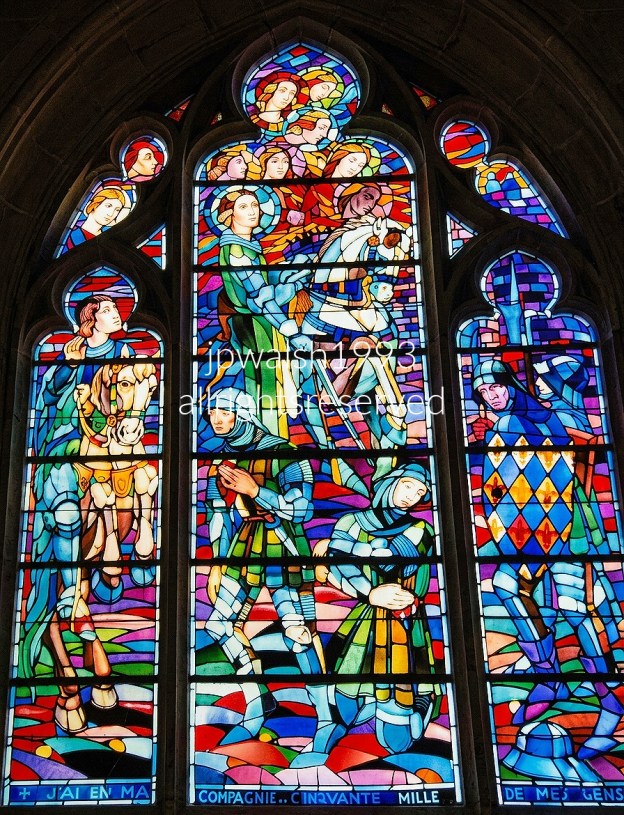

FEATURE Image: St. Joan of Arc’s capture of Saint-Pierre-le-Moûtier from Anglo-Burgundian forces on November 4, 1429, during the Hundred Years War in L’église Saint-Pierre at Saint-Pierre-le-Moûtier, France. Seotember 1993. Author’s photograph.
The stained-glass window at Saint-Pierre-le-Moûtier commemorates a pivotal moment in Joan of Arc’s military career, illustrating how her unwavering faith, personal courage, and conviction in divine assistance transformed a near-defeat into a decisive French victory during the Hundred Years’ War.
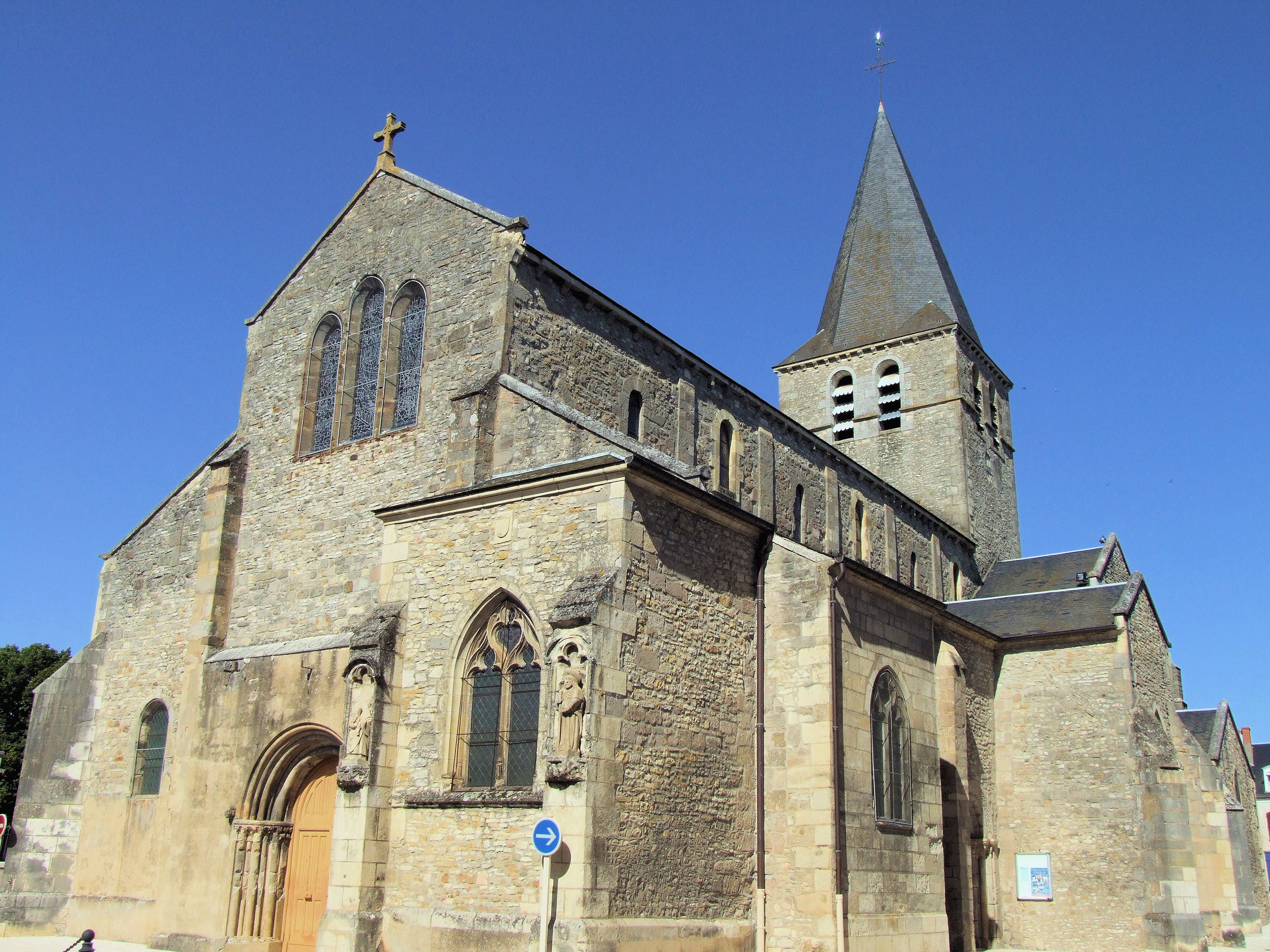
The Saint Peter Church of Saint-Pierre-le-Moûtier (Nièvre) is a 12th-century Roman Catholic building, a former Benedictine priory, classified as a historical monument since 1886. Photo by MOSSOT / Wikimedia Commons / CC BY 3.0
The Window and Its Setting
This stained‑glass window captures one of the most electrifying moments in the epic of Joan of Arc. It is part of a modern cycle in the town church of Saint‑Pierre de Saint‑Pierre‑le‑Moûtier, crafted in the mid‑20th century by the Mauméjean brothers. The artwork commemorates an event that unfolded in this very town — and inside this very church — during the Hundred Years’ War.
On November 4, 1429, Joan led a French royal force to seize Saint‑Pierre‑le‑Moûtier, a fortified stronghold held by Anglo‑Burgundian troops. The attack stalled under fierce resistance. French soldiers broke formation and began to fall back. Amid the chaos, Joan’s officer Jean d’Aulon — wounded during the fighting — suddenly realized she had been left almost alone near the moat with only a handful of men.

Author’s photograph. All rights reserved.
Joan’s Defiance and Her “Fifty Thousand”
D’Aulon mounted a horse, rode to her, and urged her to retreat before she was killed or captured. Joan removed her helmet and shouted that she was not alone. The window preserves her words across its lower banners: “+ J’AI EN MA / COMPAGNIE . . CINQVANTE MILLE / DE MES GENS.” She claimed she had fifty thousand of her people with her — the heavenly host of angels she believed fought at her side. D’Aulon saw only four or five soldiers, but Joan’s unshakable resolve reignited the army.
The Turning of the Battle
Joan ordered her men to gather wood and brush to build a makeshift bridge across the moat. The retreating French troops saw The Maid standing her ground, turned back, and launched a sudden, overwhelming assault that broke the defenses and captured the town. The upper portion of the window shows Joan on her white horse in the heat of battle, while the faces gathered in the arc above represent the “fifty thousand” she invoked — angels, Saint Michael, and the voices she believed guided her.
Aftermath and Joan’s Devotion
Following the victory, Joan prevented her troops from sacking the town. She then spent several days praying inside this church before marching on to her next campaign, leaving behind both a military triumph and a moment of mystic conviction that the Mauméjean window preserves with vivid force.

The nave of Saint-Pierre Church at Saint-Pierre-le-Moûtier, where Joan of Arc spent several days in prayer following her remarkable victory against overwhelming odds at the Battle of Saint-Pierre-le-Moûtier in November 1429. Photo by MOSSOT / Wikimedia Commons / CC BY-SA 3.0
More than a scene of battlefield heroism, the Saint-Pierre-le-Moûtier window presents Joan of Arc’s conviction that military success flowed from divine providence, portraying the inseparable relationship between faith, vision, and leadership that defined her extraordinary career.
This explanatory article is periodically updated.

