Tag Archives: #CorridorsTravelHistory

John F. Kennedy and the Responsibilities of Power: Leadership in an Age of Crisis.

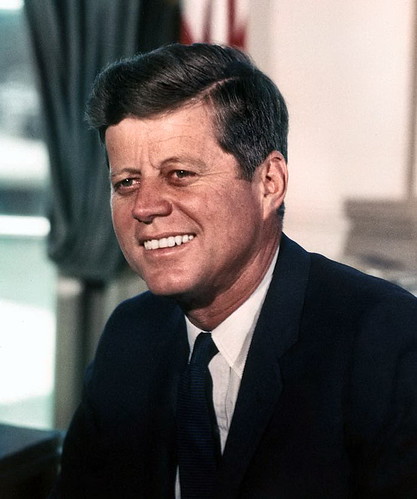
FEATURE image: Portrait of President John F. Kennedy (May 29, 1917–November 22, 1963), 35th U.S. Chief Executive. “President John F. Kennedy” by U.S. Embassy New Delhi is licensed under CC BY-ND 2.0.

Through his words, leadership during moments of crisis, commitment to democratic ideals, and enduring public legacy, John F. Kennedy emerges as a defining figure of mid-20th century America whose influence continues to shape debates about freedom, civil rights, public service, and presidential leadership.

January 3, 1960 — Kennedy Confronts Charges of “Divided Loyalties” on Meet the Press:

(20) Looking back at JFK discussing his faith 60 years after his assassination – YouTube – retrieved June 2, 2026.

January 3, 1960 — Announcement: One day after launching his campaign for the Democratic nomination, Kennedy immediately confronted a revived national anxiety: whether a Roman Catholic could serve as president without divided loyalties. As the first Catholic with a viable path to the White House, he faced sharp questioning over whether allegiance to the Pope might compromise his constitutional duties.

Religious Controversy: Kennedy moved quickly to defuse the issue. Kennedy, who happened to be Catholic, argued that religion should neither qualify nor disqualify a candidate. His position was deliberately universal. Though he made no excuses for his Catholic faith, he insisted that the presidency belongs to individuals, not categories. The controversy did not end there. In September 1960, before the Greater Houston Ministerial Association, he faced it down again, declaring that he was not the Catholic candidate for president, but the Democratic Party’s candidate who happened to be Catholic. The speech became the campaign’s clearest statement that personal identity must not become a political litmus test. He pledged to carry out the responsibilities of the presidency independent of any outside religious authority, rejecting both criticism and instruction. He argued for an uncompromising separation of church and state, stating that he would oppose a national church even if “99 percent” of Americans shared his faith.

Electoral Strategy: Beyond addressing religion, Kennedy used the NBC broadcast to outline his broader campaign logic. He rejected identity‑based ticket balancing, insisting that a major party’s presidential ticket should be shaped by geography and political experience rather than religious background.

Vice‑Presidential Speculation: He also dismissed rumors that he might accept the vice‑presidential slot, stating bluntly that he had no interest in “waiting for the president to die.” The unusually candid remark signaled his determination to run on his own terms and set the tone for the rest of his campaign.

September 13, 1962 — News conference:
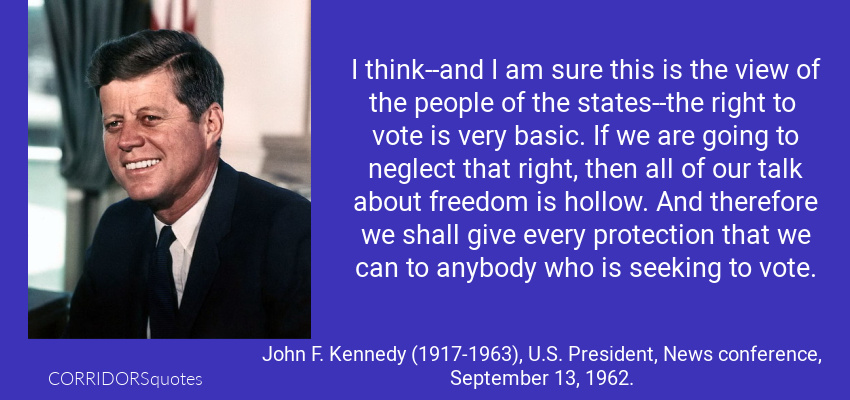
I think – and I am sure this is the view of the people and the states- the right to vote is very basic. If we are going to neglect that right, then all of our talk about freedom is hollow. And therefore we shall give every protection that we can to anybody who is seeking the vote.

September 13, 1960 — Kennedy-Johnson Joint Campaign Appearance, Grand Prairie, Texas:

(starts @ 28 seconds) Grand Prairie, Texas, in September 1960. https://youtu.be/iJHrgw8-QEc?si=NMUyZjDxJZXTy1bi – retrieved November 2, 2025.

Above: One of the rare joint appearances of Senators John F. Kennedy and Lyndon B. Johnson—the Democratic presidential ticket—in the 1960 campaign, which ultimately defeated the Republican ticket of Nixon–Lodge. During the second day of their Texas tour, the two men spoke to nearly 6,000 people in the parking lot of the Chance Vought Aircraft factory. It was at this stop that Kennedy was famously presented with a western cowboy hat, joking that he “didn’t have the guts to wear it” immediately. They also rode in a motorcade through the intersection of Main and Center streets in downtown Grand Prairie. Neither man was a natural campaigner: Kennedy’s hands often shook beneath a table or podium as he spoke, his voice growing hoarse, while Johnson, uneasy in crowds, frequently pushed himself into sick exhaustion on the trail.

Campaign Dynamics: Although both candidates wanted more joint appearances, their aides agreed such events mostly hurt the ticket’s image—especially Kennedy’s. Johnson was only nine years older, and both were the first U.S. presidents born in the 20th century, yet aides felt that when they stood together Kennedy looked almost like LBJ’s son. Still, the press and Johnson complained for weeks that the two men should campaign together more often, given the offices they sought.

Press Pressure: When reporters began hinting at a rift between the candidates as the reason for their limited joint schedule, the campaign arranged another appearance in November 1960, five days before Election Day. For that final joint even at the Biltmore in Los Angeles, Johnson flew out specifically to join Kennedy. The appearance received strong national print and television coverage, and on that Thursday before Americans went to the polls, both campaigns regarded it as a major success.

February 18, 1958 — Speech at Loyola College Alumni Banquet, Baltimore, Maryland:
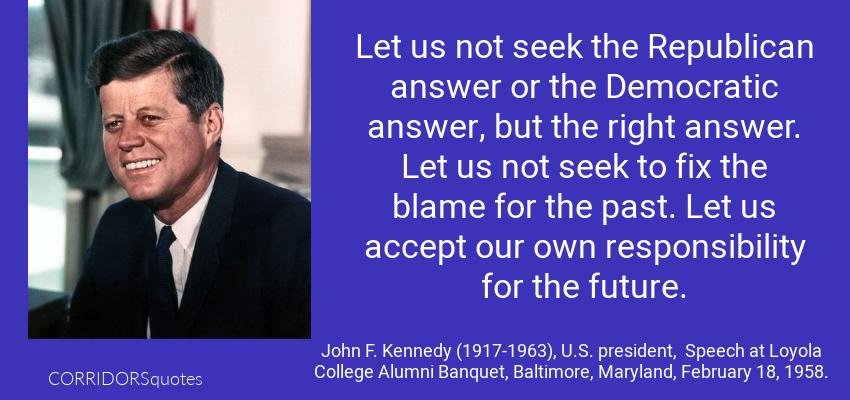
Let us not seek the Republican answer or the Democratic answer, but the right answer. Let us not seek to fix the blame for the past. Let us accept our own responsibility for the future.

The Cuban Missile Crisis lasted from October 16 to October 28, 1962. Critical Milestones:

October 16: Kennedy was first shown U‑2 photographs revealing Soviet nuclear missile installations in Cuba.

October 22: Kennedy announced a naval “quarantine” of Cuba in a televised address to the nation.

October 24: Soviet ships approached the blockade line but stopped or turned back to avoid confrontation.

October 27 — “Black Saturday”: A U‑2 was shot down over Cuba, and a Soviet submarine was forced to surface by U.S. Navy signaling, marking the peak of the crisis.

October 28: Premier Nikita Khrushchev announced that the Soviet Union would dismantle and remove the missiles, ending the 13‑day standoff.

FROM 13 DAYS (2000). JFK: BOB, IS THERE ANY WAY TO AVOID STOPPING THE SUBMARINE FIRST? MCNAMARA: I’M AFRAID NOT MR. PRESIDENT. https://www.youtube.com/watch?v=gol-iCLcroY – retrieved April 20, 2026

In response to the rapid buildup of Soviet nuclear missiles in Cuba, President John F. Kennedy announced that the United States would impose a naval blockade—officially termed a “quarantine”—around the island. It went into effect on the morning of October 24, 1962, when American warships and aircraft tightened a ring around Cuba with orders to intercept any vessel suspected of carrying offensive military equipment.

Tension spiked almost immediately. Roughly 25 Soviet ships, some believed to be transporting nuclear missile components, continued steaming toward the quarantine line. U.S. commanders had standing instructions: any vessel refusing inspection could be stopped, diverted, and, if necessary, sunk. At 10:00 a.m., as the quarantine became active, Kennedy convened ExComm to assess the situation when new intelligence came in that made the situation immediately more precarious. Reports were that the approaching Soviet ships were joined by a Soviet sub armed with nuclear weapons, raising the risk of an existential, catastrophic confrontation. At the same time, aerial reconnaissance showed Soviet crews working feverishly in western Cuba to complete missile sites armed with nuclear warheads pointed at the U.S.—further evidence that the threat to U.S. national security, already considered imminent by the Kennedy Administration, was growing by the minute.

On the diplomatic front, the crisis was unresolved as it was debated by delegates at the U.N. whether Kennedy’s blockade was even legal under international law. Soviet leaders accused the United States of issuing an ultimatum and warned that force would be met with force. Meanwhile protests were organized on each side across the globe as political maneuvering accelerated.

By the end of October 24, 1962, the first signs of restraint appeared: several Soviet ships slowed or halted before reaching the quarantine line, suggesting Moscow might be reconsidering its next move. Even so, the world understood, some for the first time, that it stood on the precipice of nuclear war. The day ended with both superpowers locked in the most dangerous equilibrium of the crisis so far – both armed, alert, and waiting for the next move – with no one knowing whether diplomacy or confrontation would ultimately prevail.

October 31, 1962 — Three Days After the Cuban Missile Crisis, JFK Meets the Archbishop of Canterbury at the White House:

Above: Rev. Dr. Michael Ramsey (1904–1988), Archbishop of Canterbury, meets with President John F. Kennedy on Halloween, 1962—just three days after the Cuban Missile Crisis ended. The world was still exhaling in relief: armed confrontation between the superpowers had been narrowly avoided, and October 27 had been the crisis’s most perilous day. A U‑2 reconnaissance plane was shot down by Soviet‑supplied SAM missiles, killing the USAF pilot. Kennedy’s ExComm urged immediate military retaliation, but he resisted. That same night, Robert Kennedy met secretly with Soviet Ambassador Anatoly Dobrynin in Washington, where they reached a tentative understanding pending Moscow’s approval. By the next morning, October 28, Radio Moscow announced acceptance of Kennedy’s proposal, ending the 13‑day standoff.

Michael Ramsey had been appointed Archbishop of Canterbury on May 31, 1961, and installed the following month, serving until 1974. In 1962 he was also president of the World Council of Churches (1961–1968). During his archbishopric, the first woman Anglican priest—Chicago‑born high‑altitude balloonist Jeannette Piccard—was ordained in the United States in 1974.

Massachusetts: John F. Kennedy Library, Columbia Point, Boston (June 1989):
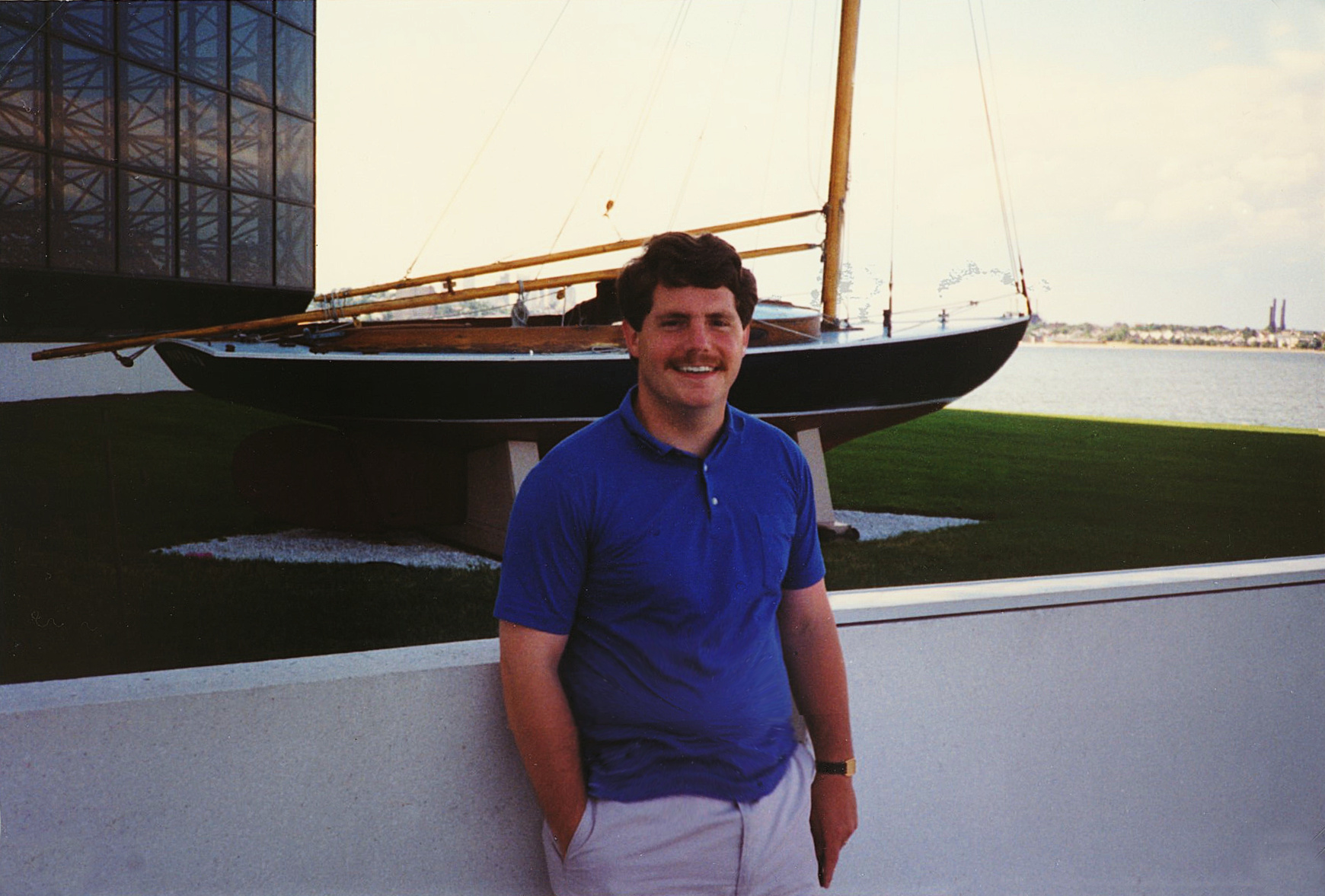
July 1989 — The author at the John F. Kennedy Library, Columbia Point, Boston.

Standing near JFK’s iconic sailboat, 1989 marked the Library’s tenth anniversary, a moment when the institution shifted from a young presidential repository into a fully established center of civic education, political legacy, and architectural study. Its most enduring milestone of 1989 was the formal creation of the Profile in Courage Award by members of the Kennedy family. Just five weeks before this photograph, Columbia Point hosted a major family gathering on May 25, 1989, attended by Jacqueline Kennedy Onassis, Senator Ted Kennedy, Caroline Kennedy, and John F. Kennedy Jr., underscoring the Library’s growing national prominence a decade after its opening

John F. Kennedy Family House (1957), 3307 N Street, Georgetown, Washington, D.C. (October 2003):
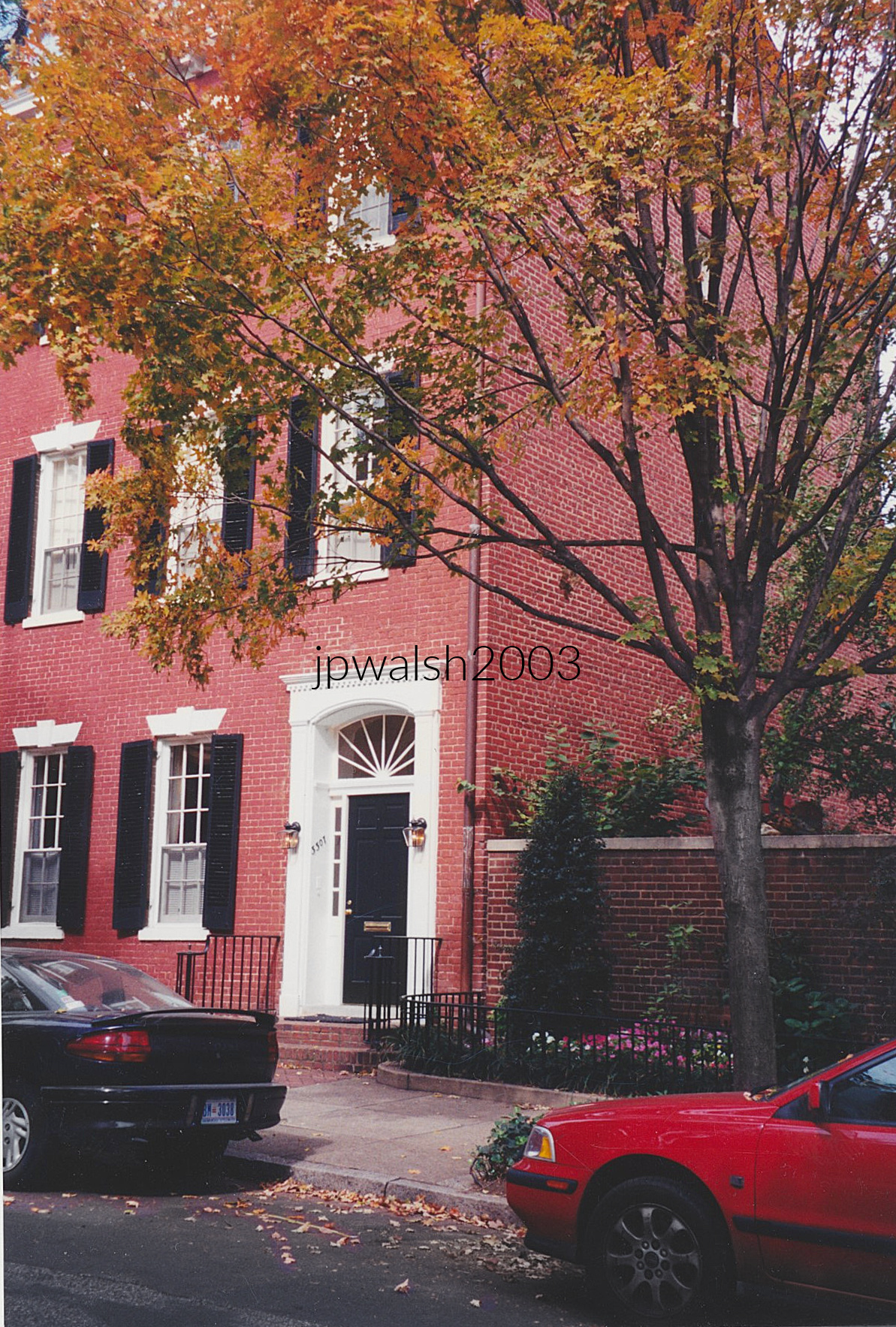
Author’s photograph.

June 1957 — A Georgetown Purchase In June 1957, Massachusetts Senator John F. Kennedy bought this three‑story Federal‑style house as a gift for his wife, Jacqueline Kennedy after the birth of their daughter, Caroline. Their son, John Jr., was also born while the family lived here.

Campaign Life at 3307 N Street During JFK’s 1958 Senate re‑election and the 1960 presidential campaign, Jackie hosted teas in the home’s double living room. The front entrance became nationally recognizable when President‑elect Kennedy stepped outside to announce major appointments — including naming his younger brother and campaign manager, Robert F. Kennedy as U.S. Attorney General.

President-Elect John F. Kennedy and Chester Bowles emerge from a breakfast conference at Kennedy’s Georgetown home in Washington, on Nov. 29, 1960. Bowles was appointed Under Secretary of State and later was Kennedy and Johnson’s ambassador to India.

January 20, 1961 — Departure for History On the morning of January 20, 1961, Kennedy famously left from this doorstep to travel to the U.S. Capitol for his swearing‑in as the 35th President of the United States. The house was sold later that year when the family moved into the White House.

Early 19th‑Century Origins Beyond its presidential associations, the home was originally built in 1811–12 for William Marbury (1762–1835), the financier and plaintiff in the landmark 1803 Supreme Court case Marbury v. Madison — the decision that established the foundational principle of judicial review.

The Garden Refuge The Kennedys used the brick‑walled garden at 3307 N Street as a quiet refuge, especially during the 1960 campaign. With JFK traveling constantly, he rarely found time for his painting hobby, though he did spend occasional Sunday afternoons in the garden with Jackie and Caroline, away from the public spotlight.

Aesthetic Balance Inside the home, Jackie’s classical European taste was balanced with historical maritime art and paintings of naval vessels — a nod to Kennedy’s U.S. Navy service and lifelong passion for the sea.

Massachusetts: The John Fitzgerald Kennedy National Historic Site (Birthplace, 1917), Brookline, Massachusetts (July 1989) (August 2005):
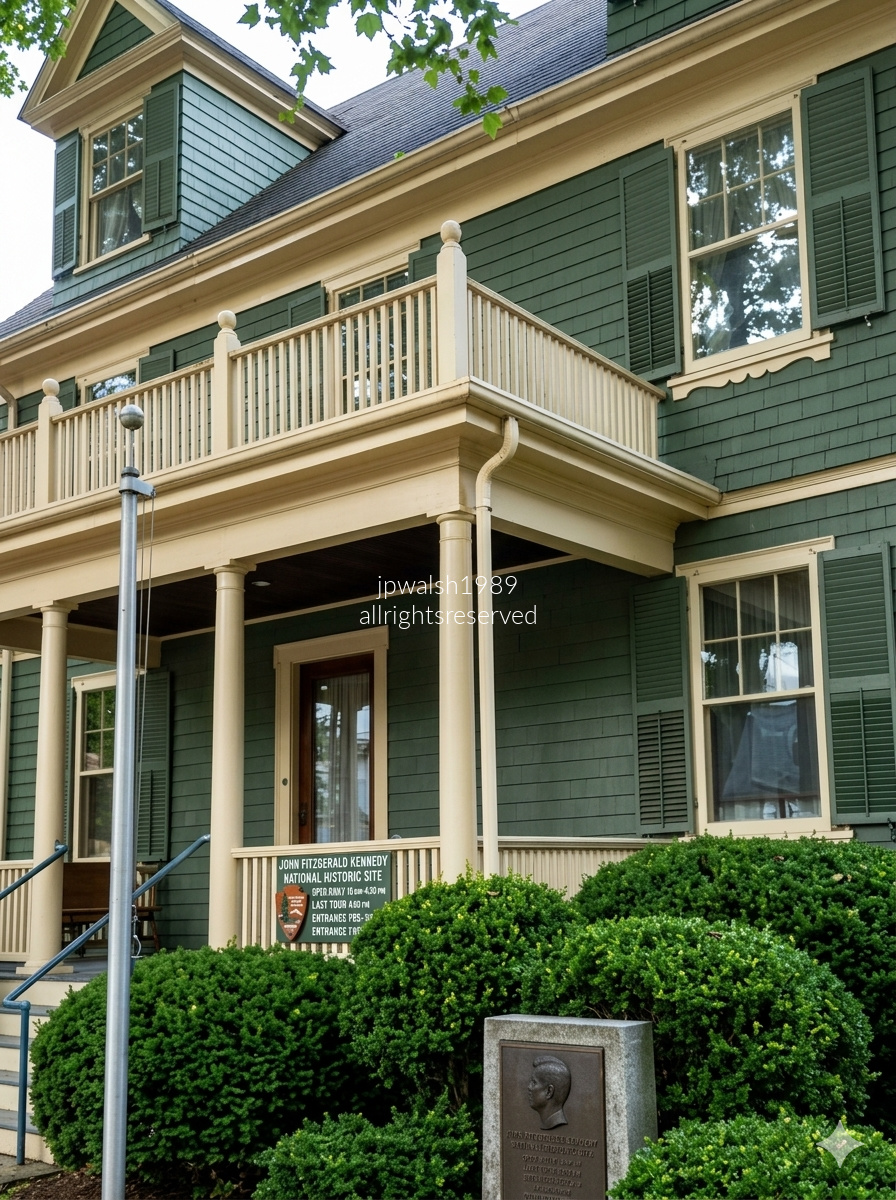
July 1989 — The John Fitzgerald Kennedy National Historic Site at 83 Beals Street preserves the birthplace and early childhood home of the 35th president. The house, built in 1909 by local architect‑builder Robert M. Goode, is a two‑and‑a‑half‑story Colonial Revival structure with a green‑shingled exterior, an asymmetric cross‑gabled roof, prominent dormers, and a front porch topped by an upper balustrade deck. It stands in Brookline’s Coolidge Corner neighborhood, a dense early‑20th‑century streetcar suburb of tree‑lined residential blocks bordering Boston.

Three Kennedy children were born in the second‑floor master bedroom: John F. Kennedy on May 29, 1917; Rosemary Kennedy on September 13, 1918; and Kathleen Kennedy on February 20, 1920. Their older brother, Joseph P. Kennedy Jr., was born in Hull, and the later five siblings — including Bobby and Ted — were born around the corner in the larger family home on Abbottsford Road.

August 2005 — The John Fitzgerald Kennedy National Historic Site in Brookline, Massachusetts. Author’s photograph.

JFK’s birthplace and childhood home—stands on Beals Street in the Boston suburbs. Joseph Patrick Kennedy purchased the house in August 1914, just ahead of his October marriage to Rose Elizabeth Fitzgerald. A driven, opportunistic young bank president and businessman, he began building his fortune during World War I through shipbuilding contracts in the Quincy yards. In Brookline, Joe Kennedy was an affectionate father who fostered a spirited sense of competition among the Kennedy children, shaping the family ethos that would define their later public lives.
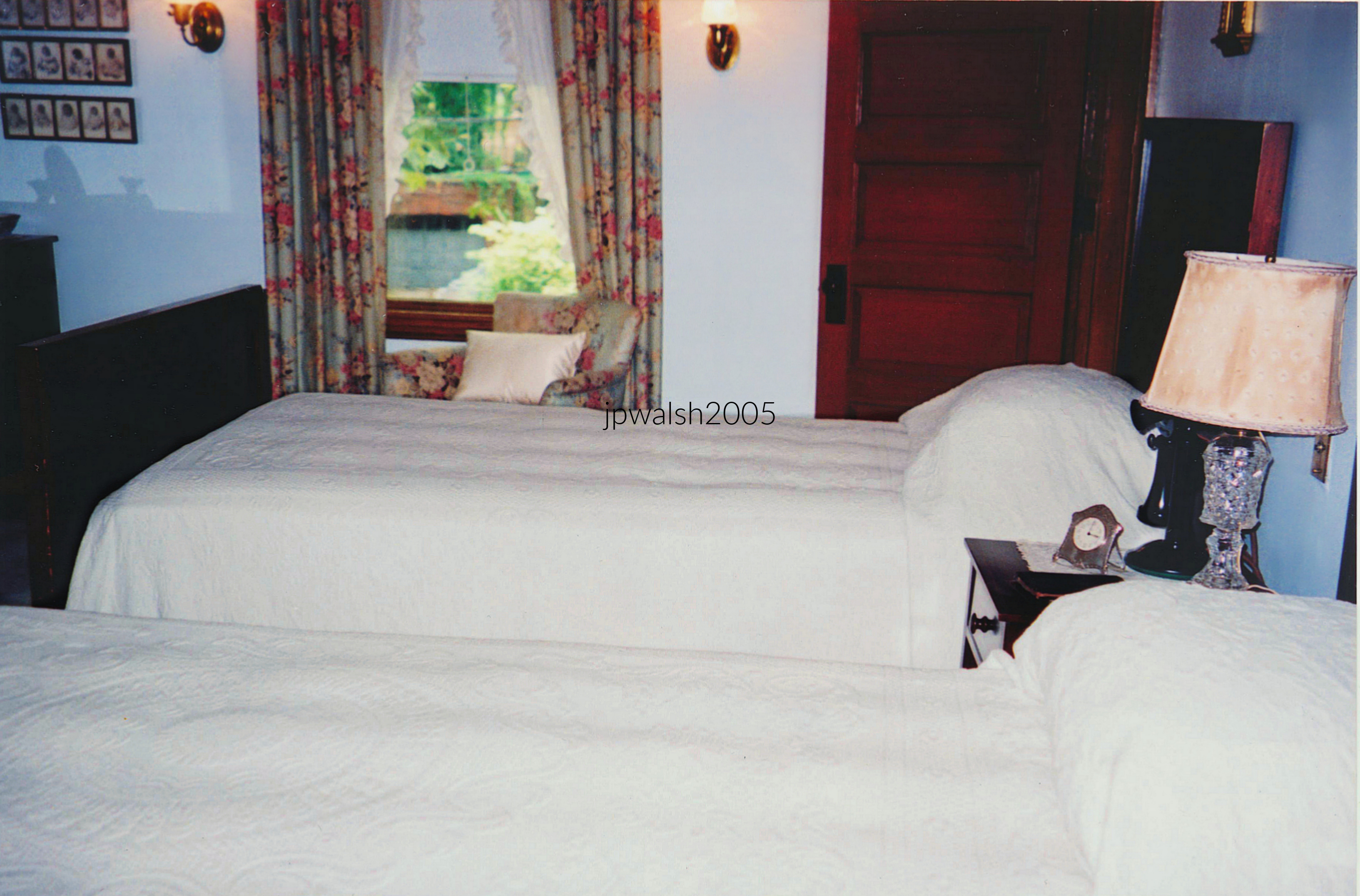
August 2005 — The John Fitzgerald Kennedy National Historic Site in Brookline, Massachusetts. Author’s photograph.

John F. Kennedy was born in this upstairs master bedroom of this Beals Street home in the mid-afternoon (3 p.m.) on Tuesday, May 29, 1917, an unseasonably cold (44 degrees), overcast, and rainy day. The family lived on Beals Street until 1920, then moved a short walk away to a larger house on Abbottsford Road, where they remained until 1927 before relocating to New York. Rose Fitzgerald—daughter of Boston’s first American‑born Irish mayor—had seven of her nine children in Brookline and was reluctant to leave. John F. Kennedy was her second child and son.

In Brookline, Joe Kennedy, son of a local pol and saloonkeeper, instilled a competitive spirit in his children, while Rose, who had studied in Europe, taught them an appreciation for the arts and history. A devout Catholic, Rose took her children on weekday walks to market and then to church, reinforcing their faith as part of daily life, not just Sundays.

After Joseph P. Kennedy sold the Beals Street house to family friend Edward Moore, the property passed through several owners over the next four decades. Following JFK’s assassination in 1963, thousands of mourners visited the home, turning it into an impromptu pilgrimage site. In 1966, the current owners agreed to sell the house back to the Kennedy family so it could be preserved as a permanent memorial.

Rose Fitzgerald Kennedy then led a full restoration of the interior, working from her own memories and period décor to recreate the exact appearance of the home as it looked on the day John F. Kennedy was born in 1917. When the project was complete, the Kennedy family donated the property to the National Park Service in 1969, establishing what is now the John Fitzgerald Kennedy National Historic Site. Rose Kennedy said she gave the house to the American people so that “future generations will be able to visit it and see how people lived in 1917 and thus get a better appreciation of the history of this wonderful country.” see – https://www.nps.gov/jofi/index.htm – retrieved May 29, 2025.

February 26, 1962 — Voice of America speech:

(56 seconds). “We are not afraid to entrust the American people with unpleasant facts, foreign ideas, alien philosophies, and competitive values. For a nation that is afraid to let its people judge the truth and falsehood in an open market is a nation that is afraid of its people.” -John F. Kennedy, Voice of America speech, February 26, 1962.

In a 1962 address to the Voice of America, President John F. Kennedy defined the organization’s mission as a duty to champion truth, transparency, and the free flow of information, even when revealing internal “blemishes and warts.” He emphasized that a free nation must not fear truth and that the “burden of truth” serves the cause of freedom.

SPEAKING OF FREEDOM OF INFORMATION IN A FREE COUNTRY TO THE ENTIRE WORLD: “The Voice of America speaks. Today America has been at war for 79 days. Daily at this time we shall speak to you about America and the war, and the news may be good or bad. We shall tell you the truth”…
…We seek a free flow of information across national boundaries and oceans, across iron curtains and stone walls. We are not afraid to entrust the American people with unpleasant facts, foreign ideas, alien philosophies, and competitive values. For a nation that is afraid to let its people judge the truth and falsehood in an open market is a nation that is afraid of its people.
The Voice of America thus carries a heavy responsibility. Its burden of truth is not easy to bear. …And as you tell it, it spreads. And as it spreads, not only is the security of the United States assisted, but the cause of freedom.”
See – https://www.presidency.ucsb.edu/documents/remarks-the-20th-anniversary-the-voice-america – retrieved May 29, 2025.

November 22, 1963 — Fort Worth Remarks Before the Texas Hotel:

November 22, 1963 – President John F. Kennedy’s remarks in front of the Texas Hotel, Fort Worth, TX. – retrieved November 23, 2025. (3.18 minutes).

On a rainy morning in front of the Texas Hotel in Fort Worth, President John F. Kennedy delivered brief remarks at a citizen’s rally. He outlined three pillars of national security: military strength, economic prosperity, and superiority in space exploration, noting that Fort Worth would again “play its proper part.”

KENNEDY: “What we are trying to do in this country and what we are trying to do around the world, I believe, is quite simple: and that is to build a military structure which will defend the vital interests of the United States. And in that great cause, Fort Worth, as it did in World War II, as it did in developing the best bomber system in the world, the B‑58, and as it will now do in developing the best fighter system in the world, the TFX, Fort Worth will play its proper part. And that is why we have placed so much emphasis in the last 3 years in building a defense system second to none, until now the United States is stronger than it has ever been in its history. And secondly, we believe that the new environment, space, the new sea, is also an area where the United States should be second to none.”
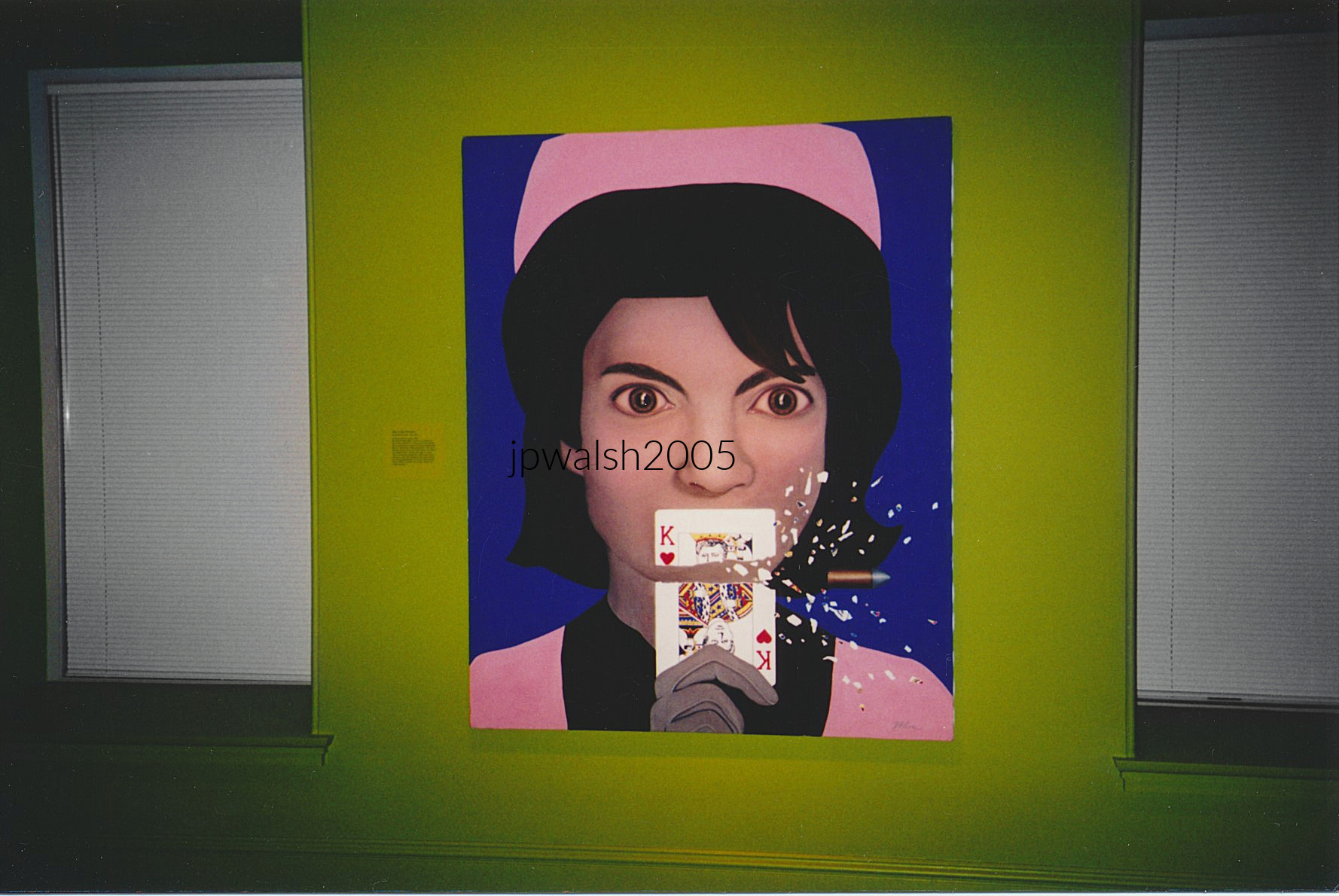
August 2005. National Portrait Gallery, Washington, D.C. Jacqueline Kennedy, the King of Hearts – Stop Action Reaction, 1997, by Tian Mion (b. 1960). see – https://www.si.edu/object/jacqueline-kennedy-king-hearts-stop-action-reaction:npg_S_NPG.2007.6 – retrieved May 29, 2025.

November 22, 1963 — The Johnsons Telephone Condolences to Rose Kennedy in the Aftermath of the Assassination:

November 22, 1963 — Rose and Joe Kennedy at Hyannis Port

On a clear “bluebird” morning at the Hyannis Port compound, Rose Kennedy followed her usual routine, attending morning Mass before returning home for lunch with Joe, who remained severely impaired from his 1961 stroke. After a short drive together, Rose received a call from her son, Attorney General Robert Kennedy: the President—her son Jack—had been shot in Dallas. A second call soon followed, confirming he was dead.

Rose withdrew to grieve in solitude, walking the beach and sitting quietly in her room, later reflecting that she asked God how decades of preparing her children for service could be undone in seconds. At approximately 4:15 p.m., she took a call from the new president, Lyndon Johnson, speaking from Air Force One shortly after being sworn in and as he returned to Washington with President Kennedy’s body. Composed, Rose addressed him as “Mr. President.”

June 11, 1963 — Oval Office Report to the American People on Civil Rights:
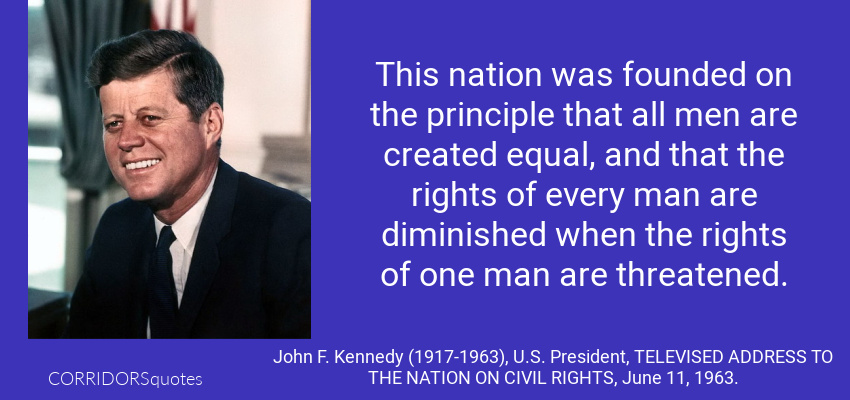
This nation was founded on the principle that all men are created equal, and that the rights of every man are diminished when the rights of one man are threatened.

May 27, 1963 — Supreme Court Signals an End to Evasion of Brown v. Board

On May 27, 1963, the Supreme Court declared that it would no longer tolerate evasions of its 1954 Brown v. Board of Education ruling. The statement came in another desegregation case involving public parks. When the Court issued Brown in 1954, it could not have foreseen the years of delay and resistance that followed.

June 5–10, 1963 — Federal Orders and Kennedy’s Warning to Wallace

On June 5, a federal court enjoined Alabama Governor George Wallace from obstructing the admission of two qualified Black students to the University of Alabama. President John F. Kennedy reinforced the order on June 10, writing to Wallace and urging him not to interfere.

June 11, 1963 — Wallace “Stands in the Schoolhouse Door”

On June 11, Wallace carried out his pledge to “stand in the schoolhouse door,” physically blocking the students from enrolling. When he refused to yield to federal marshals, Kennedy nationalized the Alabama National Guard. Guard troops arrived, Wallace stepped aside, and the students entered and registered for classes.

https://www.youtube.com/watch?v=PTHowggASwY

June 11, 1963 — Kennedy’s Civil Rights Address from the Oval Office

That evening, Kennedy delivered his “Report to the American People on Civil Rights” from the Oval Office. In a 13‑minute address, he set out the moral and legal issues surrounding civil rights and previewed legislation that would become the Civil Rights Act of 1964. After two cautious years, the speech marked a decisive shift: Kennedy gave a full‑throated endorsement of civil rights and federal action to secure them.

June 12–13, 1963 — The Murder of Medgar Evers and Local Repression

In the early hours of June 12, civil rights leader Medgar Evers, who had listened to Kennedy’s remarks, was assassinated outside his home in Jackson, Mississippi. On June 13, Jackson police arrested 82 Black marchers protesting Evers’s murder. Within a week, a white suspect was arrested and charged.

June 19, 1963 — Kennedy Sends His Civil Rights Bill to Congress

On June 19, Kennedy asked Congress to introduce his civil rights bill, seeking desegregation of public facilities, federal action to end job discrimination, and authority for the Attorney General to initiate desegregation suits.

Summer 1963 — Civil Rights Leaders Reject a Pause in Demonstrations

As Congressional debate and filibuster began, Kennedy asked civil rights leaders to suspend protests and marches. They refused. Instead, they announced a March for Jobs and Freedom in Washington, D.C., to take place in August 1963.

See- Kennedy and the Press, edit. Harold W. Chase and Allen H. Lerman, introduction by Pierre Salinger, Thomas Y. Crowell Company, New York, 1965, p. 452.

June 26, 1963 — Berlin speech at Rudolph Wilde Platz
November 21, 1963 —Texas motorcade & remarks at the dedication of the Aerospace Medical Health Center, San Antonio
August 1, 1963—color recording of remarks for “Seas Around Us”
September 12, 1962— Moon speech, Rice University, Houston, Texas

(27 seconds).

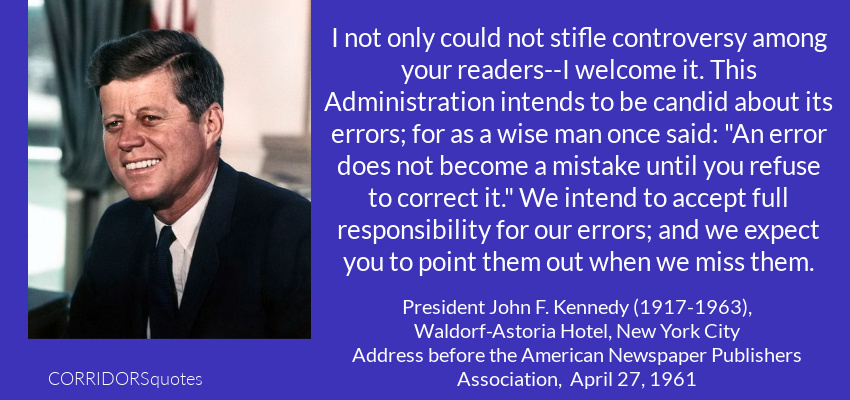
April 27, 1961 — Address before the American Newspaper Publishers Association, Waldorf-Astoria Hotel, New York City:

https://youtu.be/cgHGg8PiAqo?si=aSZpzJKa_NEeHsP4 – retrieved November 1, 2025. For transcript of speech SEE – The President and the Press: Address before the American Newspaper Publishers Association, April 27, 1961 | JFK Library

On April 27, 1961, President John F. Kennedy delivered his 2400-word+ major speech known as “President and the Press” before the American Newspaper Publishers Association at the Waldorf-Astoria Hotel in New York City. In the speech delivered just days after the failed Bay of Pigs Invasion the new president made a plea for responsible journalism in the face of Cold War threats. The remarks remain relevant today on the topics of press freedom, misinformation, and national security.
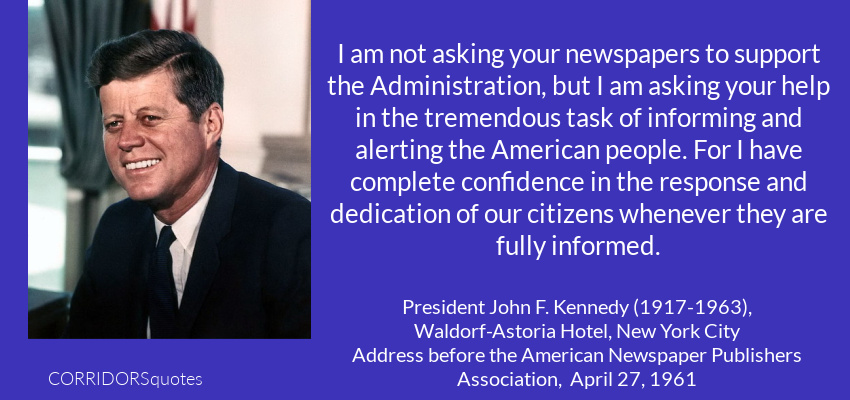
I am not asking your newspapers to support the Administration, but I am asking your help in the tremendous task of informing and alerting the American people. For I have complete confidence in the response and dedication of our citizens whenever they are fully informed. see – https://www.jfklibrary.org/archives/other-resources/john-f-kennedy-speeches/american-newspaper-publishers-association-19610427#:~:text=This%20Administration%20intends%20to%20be,out%20when%20we%20miss%20them. – retrieved March 25, 2025.
It was early in the 17th century that Francis Bacon [1561-1626] remarked on three recent inventions already transforming the world: the compass, gunpowder and the printing press. Now the links between the nations, first forged by THE COMPASS have made us all citizens of the world, the hopes and threats of one becoming the hopes and threats of us all. In that one world’s efforts to live together, the evolution of GUNPOWDER to its ultimate limit has warned mankind of the terrible consequences of failure. And, so, it is to the PRINTING PRESS–to the recorder of man’s deeds, the keeper of his conscience, the courier of his news–that we look for strength and assistance, confident that with your help man will be what he was born to be: free and independent.
I not only could not stifle controversy among your readers–I welcome it. This Administration intends to be candid about its errors; for as a wise man once said: “An error does not become a mistake until you refuse to correct it.” We intend to accept full responsibility for our errors; and we expect you to point them out when we miss them.

John F. Kennedy 1960 Campaign Ad For Social Security:

JOHN F. KENNEDY: we do not rely merely on the past we look forward in this country we fight the same battle that he fought we find it easier because he fought it but it is now our battle. so that this country moves ahead. (6) John F. Kennedy [Democratic] 1960 Campaign Ad “Hyde Park – Social Security” – YouTube – retrieved August 14, 2025. (4.41 minutes).

The Origins of Social Security

When Franklin D. Roosevelt signed the Social Security Act on August 14, 1935, he called the new federal retirement program a “cornerstone.” It became one of the central pillars of the New Deal and a defining feature of modern American social policy.

A Personal Reflection from 1998

In 1998, at a Chicago book signing for The Virtues of Aging, I met former President Jimmy Carter and asked whether he believed Social Security was destined to disappear. Carter replied that he did not think so, a view reflecting the long‑standing bipartisan commitment to the program’s survival.

Social Security Under Strain in 2026

By 2026, Social Security faces unprecedented pressure. The aging population has surged: 75 million seniors now receive benefits—three times the number in 1975. Meanwhile, a smaller workforce contributes payroll taxes to support a rapidly growing pool of beneficiaries. Trust‑fund reserves are being depleted, and insolvency is projected for the mid‑2030s.

Kennedy’s 1960 Visit to Hyde Park

During the 1960 presidential campaign, Democratic nominee John F. Kennedy visited Hyde Park, New York, the national shrine home of Franklin D. Roosevelt. The occasion marked the 25th anniversary of the Social Security Act. Kennedy addressed 2,000 senior citizens gathered to honor Roosevelt and hear the young senator outline his vision for strengthening the program.

Kennedy’s Proposals for America’s Aging Population

In his remarks, Kennedy advanced a series of proposals aimed at improving the lives of older Americans and modernizing Social Security. Among them:

  • Federal medical care — a precursor to Medicare, which would be enacted in 1965.
  • Cost‑of‑living adjustments — automatic increases to keep pace with inflation, implemented in 1975.
  • Incentives for continued work — allowing older Americans to earn more without losing benefits.
  • Vocational guidance — support for retirees seeking new roles or training.
  • Adequate housing — expanding federal efforts to provide safe, affordable homes for seniors.
  • Medical research — increased study of diseases associated with aging.
  • Higher survivor benefits — expanded support for spouses caring for under‑age children.

A Continuity of Purpose

Kennedy’s 1960 message echoed Roosevelt’s original vision: Social Security was not merely a retirement program but a national commitment to dignity, security, and opportunity in old age. His proposals anticipated many reforms that would shape the program in the decades to come.

March 29, 1962—News Conference 29:

The Tax Cut Bill Advances in Congress

The press conference occurred the same week the House Ways and Means Committee approved President Kennedy’s tax cut bill. At the same time, Kennedy emphasized the need to close tax loopholes that permitted and encouraged American industries to invest overseas.

(6) John F. Kennedy’s HILARIOUS response to a woman’s question. – YouTube – retrieved July 21, 2025.

Revenue Neutrality as a Central Congressional Concern

Congress was focused on balancing the revenue lost from tax cuts with revenue gained through tax reforms, aiming to produce a revenue‑neutral bill. The effort was conceived as a targeted economic stimulus—not the broad‑brush solution tax cuts later became in national economic debates, nor the inverse approach of sweeping tax hikes.

Balancing Cuts and Reforms in the 1962 Legislation

The 1962 tax bill was modified and passed with this balancing principle in mind. Kennedy proposed significant reductions in tax rates for individuals and corporations, acknowledging that such cuts would initially reduce federal revenue. Broadly pro‑growth, the plan was not a modern‑style tax giveaway; policymakers believed the country could not afford such an approach. Instead, the goal was to offset revenue losses through reforms that generated compensating gains.

Sources of Revenue Gains

Revenue increases for the government came from several reforms, including:

  • Eliminating the dividend credit and exclusion
  • Introducing withholding taxes on dividends and interest
  • Restricting business expense deductions, particularly for entertainment and meals
  • Adjusting tax treatment for cooperatives and financial institutions
  • Revising taxation of gains from the sale of depreciable property

Short‑Term Losses and Long‑Term Contrast

Although the final Revenue Act of 1962 resulted in a short‑term net revenue loss, it still reflected Kennedy’s intent to pair tax cuts with offsetting reforms. Later economic approaches—particularly those associated with Reagan‑era tax policy—introduced large tax cuts skewed toward higher‑income earners without corresponding revenue‑generating reforms, relying exclusively on growth‑driven revenue effects to offset massive revenue losses. Combined with increased federal spending, this produced persistent deficit financing that Kennedy could not have imagined.

Kennedy’s Fiscal Aim in 1962

In 1962, Kennedy sought both a tax cut and a balanced budget, a pairing that underscores how different his fiscal strategy was from later eras of tax policy.

March 7, 1962—News Conference 26:

On February 22, 1962, Soviet Premier Khrushchev proposed that at the upcoming U.N.-sponsored Geneva Disarmament Conference on March 14 that the heads of government meet.

Kennedy rejected the offer, though he was afterwards pressured by European allies to reconsider and probed by the U.S. press if he would possibly attend and so backtrack on his statements. He maintained his firm position against attending the opening of the Geneva Disarmament Conference on March 14, 1962. Instead of traveling to Switzerland himself, Kennedy appointed Arthur H. Dean as the Chairman of the U.S. Delegation and sent Secretary of State Dean Rusk to handle the initial high-level negotiations.

Kennedy later outlined the manner of his going to any sort of summit conference in the near future— 1. to ratify an agreement 2. if there was a serious international crisis or the U.S. was on the brink of war 3. To aid the national interest.

The outcome to that spring’s lengthy Geneva talks was announced by Kennedy about 5 weeks after its opening: that negotiators had reached a broad outline for the objectives and principles, basic provisions and timings of a general treaty on nuclear disarmament.

Six months later the Cuban Missile Crisis took place.

April 30, 1963 — April 30, 1963 — Kennedy’s Remarks to Choate Alumni:

On May 4, 1963, President Kennedy broadcast taped remarks to the alumni of his alma mater, The Choate School, commemorating the unveiling of his official portrait on the campus in Wallingford, Connecticut.

 https://www.youtube.com/watch?v=Zp4alOCiqCo – retrieved February 27, 2026.

A Line That Defined an Inauguration

The phrase most associated with John F. Kennedy’s 1961 Inaugural Address—“Ask not what your country can do for you; ask what you can do for your country”—endured as a defining call to civic action. Delivered by the nation’s first Catholic president, it urged Americans to see national progress as a shared personal duty rather than a service provided by government.

Echoes in Years of Lightning, Day of Drums (1965)

Its resonance appears again in the 1965 documentary Years of Lightning, Day of Drums, one of the earliest films to chronicle Kennedy’s presidency and assassination. Near the conclusion, narrator Gregory Peck reflects, “All this took place in the early 1960s, and someday the early 1960s will be a long time ago.” Hearing that line as a child, I felt its existential reminder: even the most vivid present moments eventually recede into memory and become history.

Possible Origins at Choate

Some historians have suggested that Kennedy’s inaugural exhortation may trace back to his years at Choate, the Connecticut boarding school he entered in 1931 as a ninth‑grade student. In his chapel addresses, headmaster George St. John frequently reminded students: “The youth who loves his alma mater will always ask not ‘what can she do for me?’ but ‘what can I do for her?’” Kennedy would have heard this refrain repeatedly during his formative years.

A Frail Student with a Mischievous Streak

Kennedy arrived at Choate following his older brother, Joe Jr., a standout athlete two years ahead of him. By contrast, Kennedy was frail, thin, and saddled with the nickname “rat face” among classmates. His early years were marked less by distinction than by mischief. He gathered around him a circle of friends he called “The Muckers Club,” a tongue‑in‑cheek embrace of St. John’s term for troublemakers. Their antics were largely harmless—witty pranks and playful irreverence—and the group included Kennedy’s roommate and lifelong friend, Lem Billings.

A Shift in Trajectory

Despite his unremarkable start, Kennedy’s trajectory at Choate changed. By the time he graduated in 1935, he was not valedictorian, but his peers voted him “Most Likely to Succeed,” a judgment that reflected what followed.

JFK, May 4, 1963: First, it is to make sure that our private schools are increasingly representative of the diversity of American life. These schools will not survive if they become the exclusive possession of a single class or creed or color. They will enlarge their influence only as they incorporate within themselves the variety which accounts for so much of the drive and the creativity of the American tradition. The second is to make sure that our private schools prepare young men and women for service to the community and to the Nation. The inheritance of wealth creates responsibilities; so does privilege in education.

May 19, 1962 — Birthday Party for President Kennedy at Madison Square Garden:

Marilyn Monroe Sings Happy Birthday Mr. President to JFK | Netflix https://www.youtube.com/watch?v=mqsikkkyy_s – retrieved May 29, 2024.

On May 19, 1962—ten days before President Kennedy turned 45—more than 15,000 people packed Madison Square Garden for his birthday celebration, a star‑studded night of politicians, entertainers, and Hollywood royalty. The evening became legendary when Marilyn Monroe stepped onto the main stage in a sheer, flesh‑colored gown studded with 2,500 rhinestones and delivered her breathy rendition of “Happy Birthday, Mr. President” as a giant cake was brought out.

Kennedy followed her to the microphone and quipped, “I can now retire from politics after having had Happy Birthday sung to me in such a sweet, wholesome way,” a wink at Monroe’s sultry delivery and famously skintight dress.

Monroe had flown to New York with jazz pianist Hank Jones, leaving the troubled production of Something’s Got to Give to make the cross‑country appearance. The decision cost her: 20th Century‑Fox fired her in June 1962 for violating her contract. Kennedy attended the event alone; Jackie Kennedy skipped the celebration entirely, spending the day at the Loudoun Benefit Horse Show in Virginia with Caroline and John Jr.

The Madison Square Garden performance would become one of Monroe’s final public appearances before her death that August.

February 26, 1962 — President John F. Kennedy presented astronaut John Glenn with the NASA Distinguished Service Medal at the White House:

(26) John F. Kennedy presents a medal to Colonel John Herschel Glenn Jr at the White …HD Stock Footage – YouTube – retrieved July 18, 2026.

Astronaut John Glenn, born July 18, 1921, was part of NASA’s first astronaut group and became the first American to orbit Earth three times on February 20, 1962. Six days later, on February 26, 1962, President John F. Kennedy presented him with the NASA Distinguished Service Medal at the White House—a ceremony meant both to honor Glenn and to bolster national confidence during the Space Race.

The color footage (no sound) shows Kennedy awarding the medal with Glenn’s wife, Annie, and their children, John David (16) and Carolyn “Lyn” Glenn (14), standing beside him.

Glenn visited the Kennedy White House at least four times. He returned on May 3, 1962, as JFK welcomed Glenn and Soviet cosmonaut Gherman Titov to the Oval Office to discuss their historic flights and encourage international space cooperation. About six weeks before Dallas, on October 10, 1963, Kennedy presented Glenn, joined by the rest of the Mercury Seven astronauts, with the National Aeronautic Association’s 1962 Robert J. Collier Trophy for pioneering American manned spaceflight.

Glenn retired from NASA in 1964 and became A US Senator from Ohio for a quarter of a century (1974-1999). As a sitting senator, 77-year-old Glenn returned to space in 1999 on shuttle Discovery. John Glenn died on December 8, 2016, at the age of 95

June 23-July 2, 1963 — President Kennedy’s 1963 European Tour:

In June and July 1963, President John F. Kennedy embarked on a historic ten-day European tour, beginning with a four-day visit to West Germany and West Berlin. During a stop in Hanau on June 25, Kennedy stepped out of his motorcade to personally shake hands with the German police motorcycle escort that had guided him through streets lined with dense cheering crowds. The following day, June 26, he traveled to Berlin to deliver his celebrated “Ich bin ein Berliner” address on the steps of Rathbone Schöneberg that was attended by a crowd of 500,000. The trip continued as a triumphal circuit through Western Europe. In Ireland, Kennedy visited his ancestral homestead in Wexford and addressed the Irish Parliament. Moving on to the United Kingdom, he attended Sunday Mass at a small parish church in East Sussex (“Our Lady, Help of Christians”) before meeting with Prime Minister Harold Macmillan. Finally, Kennedy concluded his journey in Italy on July 2 with a private audience with Pope Paul VI—securing a vital diplomatic meeting while carefully avoiding the new Pope’s formal installation ceremony just days prior.

October 26, 1963 — Remarks at Amherst College:

The men who create power make an indispensible contribution to the nation’s greatness. But the men who question power make a contribution just as indispensible for they determine whether we use power or power uses us.

October 26, 1963: Remarks at Amherst College on the Arts.

Robert Frost was 88 years old when he participated in the star-studded fundraiser An American Pageant of the Arts on November 29, 1962. The closed-circuit television broadcast served as a major fundraising engine for the National Cultural Center (the future Kennedy Center in Washington, D.C.)—a project initiated by President Eisenhower in 1958 and enthusiastically championed by the Kennedy administration. Though President Kennedy watched from the D.C. National Guard Armory and former President Eisenhower joined via video link from Augusta, Georgia, the event put the growing national momentum for public arts funding on full display.

While Frost recited his poem “Away!” during that specific broadcast, Kennedy was already deeply familiar with Frost’s wider catalog—most notably his poem “Choose Something Like a Star.” JFK had quoted its concluding lines on February 26, 1961, during a televised CBS tribute titled Accent: Robert Frost: An American Poet: “So when at times the mob is swayed / To carry praise or blame too far, / We may choose something like a star / To stay our minds on and be staid.”

The poem deeply mirrored Kennedy’s core philosophy toward governance. He believed that modern democratic leaders required “something like a star”—an unyielding moral anchor or a higher ideal—to ground their focus so their decisions would not be swept away by the fluctuating impulses of public opinion or even themselves.

On October 26, 1963, President Kennedy traveled to Amherst College in Massachusetts for the groundbreaking of the Robert Frost Library. Frost had passed away earlier that January, leaving behind a rich legacy at Amherst, where he taught on and off for 22 years. Reflecting on their personal relationship, Kennedy fondly recalled to the crowd that Frost was unusually “hard-boiled” for a poet, noting that Frost “felt very strongly that the United States should be a country of power and of force.” Frost had once playfully warned the president not to let the “Harvard” in him become too important—a piece of advice Kennedy dryly quipped, “We’ve followed.” Recalling Frost’s devotion to teaching, Kennedy shared how the poet once said he liked to “put [his] students on the operating table and proceed to take ideas they didn’t know they had out of them,” and that the true test of a student’s potential was “the sort of work for which he will neglect his studies.”

The October 26 visit began with an indoor convocation ceremony inside the campus gymnasium, where Kennedy delivered a fifteen-minute address that is now widely regarded as one of the most profound speeches of his presidency. Speaking in honor of the late poet, Kennedy reflected deeply on the relationship between art, poetry, education, and political power. He praised Frost as a figure who understood that a nation’s true strength rests not merely in its wealth or military might, but in the spirit and culture that guide it. Kennedy also reminded the Amherst student body that intellectual privilege carries a strict responsibility to serve the public good, arguing that universities must pursue a “great national purpose” beyond personal advancement.

The speech is most famous for its enduring meditation on how creative expression acts as a vital check on state authority: “When power leads man towards arrogance, poetry reminds him of his limitations. When power narrows the areas of man’s concern, poetry reminds him of the richness and diversity of his existence. When power corrupts, poetry cleanses.”

Kennedy argued that artists and writers serve as essential guardians of truth, preserving individual conscience and challenging society to live up to its highest ideals. He insisted that true art is never propaganda, and that a free society must allow its creators the liberty to follow their vision wherever it may lead.

After receiving an honorary Doctor of Laws degree, Kennedy rode by motorcade the short distance to the campus field for the physical groundbreaking ceremony. Speaking informally and entirely without a text, he reflected on Frost’s long association with the college and quoted Harvard professor George Lyman Kittredge’s famous observation that a university could see all its physical buildings torn down, yet it would still exist so long as it kept its library. The seamless transition from the grand philosophical reflections of the morning convocation to the literal turning of the soil for the new library provided a fitting conclusion to a day that celebrated the vital, enduring importance of literature and learning in American public life.
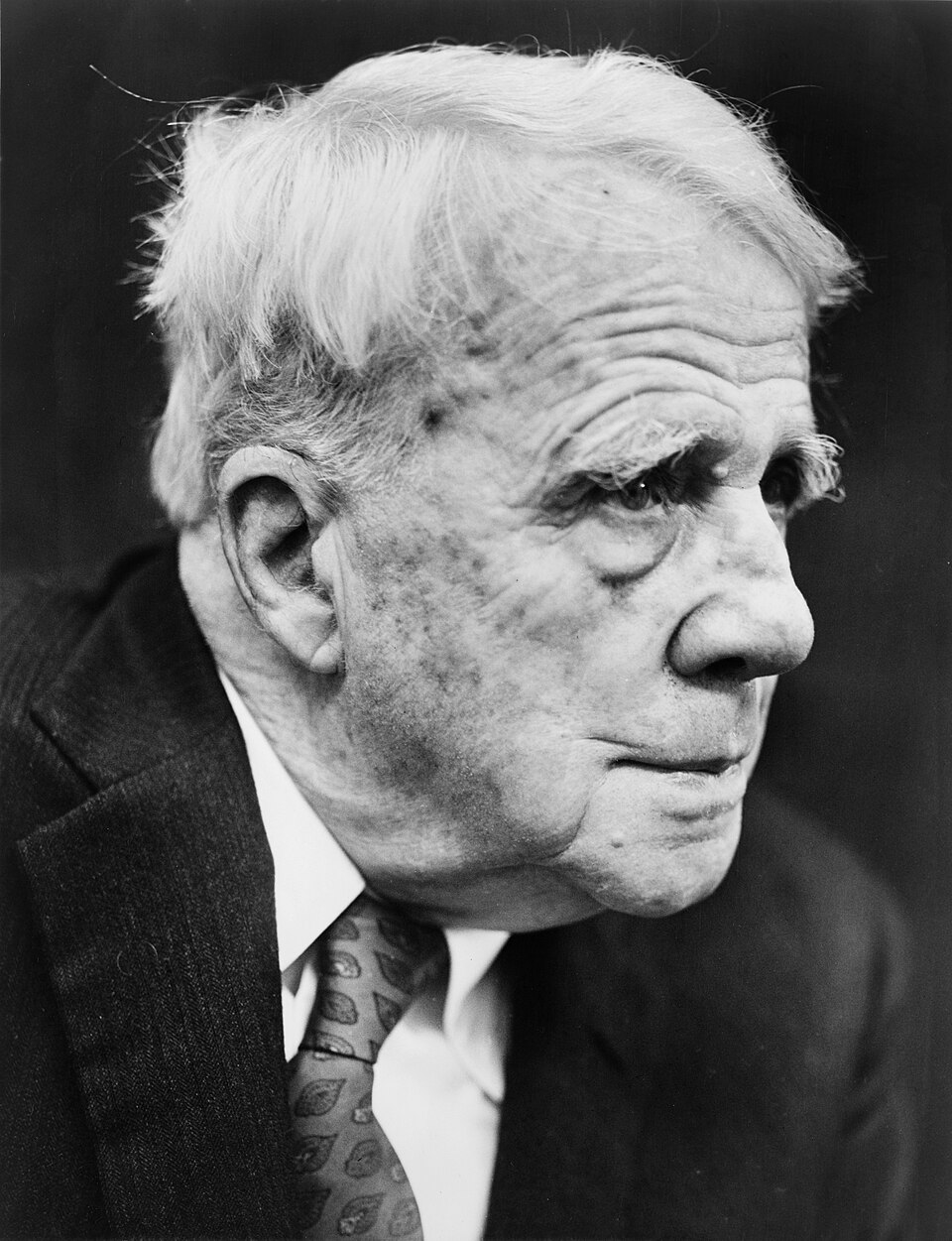
American poet Robert Frost in 1959 when he was 85 years old. Photo: Walter Albertin / New York World-Telegram and the Sun / Library of Congress. Public Domain.

September 26, 1960. Kennedy vs. Nixon: The first 1960 presidential debate:

During the first televised presidential debate, held in Chicago on September 26, 1960, and devoted entirely to domestic policy, John F. Kennedy and Richard Nixon clashed over three major questions of affordability: healthcare for the elderly (the future Medicare), federal aid to education, and the broader issues of inflation, government spending, and balancing the federal budget. [Starts 34:00 minutes}

As might be expected, the debate revealed two fundamentally different views of what the nation and its citizens could, and should, be able to afford.

On healthcare, Kennedy argued that it was unrealistic to expect most elderly Americans to pay medical costs out of pocket. He advocated tying health insurance directly to Social Security, allowing it to be financed automatically through the existing tax system. Nixon opposed a mandatory federal program financed by payroll taxes, instead proposing a voluntary health insurance program subsidized by federal and state governments while preserving individual choice and private administration.

On education, Kennedy supported substantial federal aid to the states, including assistance for public schools and higher teacher salaries. Nixon favored a more limited federal role, supporting funding for school construction while warning that broader aid could lead to federal influence over local curricula.

The sharpest exchange concerned government spending and the federal budget. Nixon argued forcefully that the United States could not afford the scale of Kennedy’s proposed programs, estimating they would cost an additional $18 billion annually (more than $200 billion in today’s dollars). He warned that such expenditures would increase deficits, unbalance the budget, fuel inflation, and raise the cost of living for ordinary Americans. Kennedy responded that his proposals were fiscally responsible and that a growing economy would generate the revenues necessary to fund these investments without jeopardizing budgetary stability.

see – CPD: September 26, 1960 Debate Transcript – retrieved November 4, 2026.

February 7, 1963 – The 11th Annual Presidential Prayer Breakfast at the Mayflower Hotel in Washington, D.C.
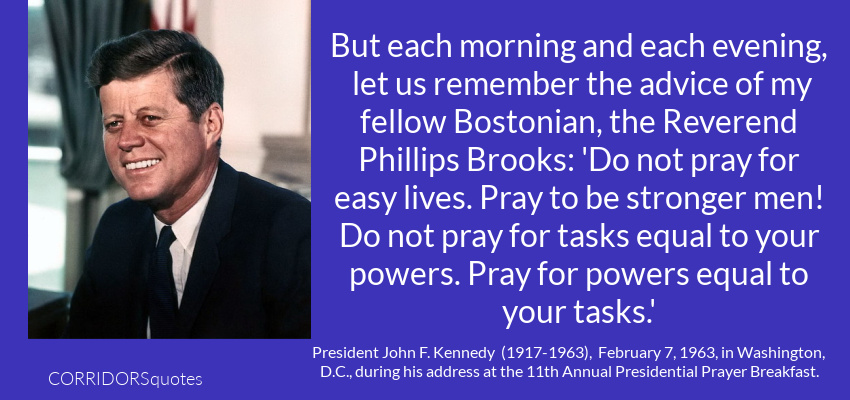
But each morning and each evening, let us remember the advice of my fellow Bostonian, the Reverend Phillips Brooks: ‘Do not pray for easy lives. Pray to be stronger men! Do not pray for tasks equal to your powers. Pray for powers equal to your tasks.’ President John F. Kennedy (1917-1963), February 7, 1963, in Washington, D.C., during his address at the 11th Annual Presidential Prayer Breakfast.

While Truman signed the bill creating the annual National Day of Prayer in April 1952, the inaugural Presidential Prayer Breakfast did not take place until February 5, 1953. Newly elected President Dwight D. Eisenhower was the first president to attend the event, which was organized by Methodist minister Abraham Vereide and evangelist Billy Graham. Every sitting U.S. president since Eisenhower has attended and spoken at the annual gathering.

November 24, 1963 – Mrs. Nellie Connally, Parkland Hospital Press Conference, Dallas, Texas:

(8) November 24, 1963 – Mrs. Nellie Connally speaking at a Parkland Memorial Hospital press conference – YouTube https://www.youtube.com/watch?v=SLMfzeYh-oM

On Sunday, November 24, 1963—just moments after Lee Harvey Oswald was shot in the basement of Dallas Police Headquarters at 11:21 a.m.—Nellie Connally stepped before television cameras in the press room at Parkland Memorial Hospital. It was her first public appearance since the assassination two days earlier. Speaking on behalf of all Texans, in addition to her comments here she offered her deep sorrow to Jacqueline Kennedy and the Kennedy family, noting that her son, John Jr., would represent them at the President’s funeral in Washington the following day.

Meanwhile, upstairs at Parkland, her husband was beginning a lengthy recovery. Sitting in the jump seat ahead of President Kennedy during the motorcade, Texas Governor John Connally had been struck by a bullet that shattered his fifth rib, collapsed his right lung, shattered his right wrist, and lodged in his left thigh. He survived only after four hours of emergency surgery performed by three surgeons to repair his chest and lung, set his wrist, and clean his thigh wound. By the time Nellie addressed the press on November 24, Connally had recovered enough to get out of bed and sit in a nearby chair. He remained hospitalized for 19 days in total—discharged from Parkland on December 6 and transferred to an Austin hospital for five more days of care—before returning to his full duties as governor by the spring of 1964.

Connally’s road to the Texas governor’s mansion had run directly through the Kennedy White House. After helping deliver Texas for the Kennedy-Johnson ticket in 1960, Connally was appointed U.S. Secretary of the Navy in 1961. Although he brought genuine credentials as a decorated World War II naval officer, the role was largely a political stepping stone. His 11-month tenure in the New Frontier was uneventful, and he resigned in December 1961—succeeded by fellow Fort Worth Texan and former Assistant Secretary of the Army Fred Korth—to launch his successful 1962 gubernatorial campaign. By June 1963, it had been Kennedy himself who pressed Connally and Vice President Lyndon Johnson to arrange the pivotal Texas trip that would take place that November.


Taking office in January 1963, Connally served three consecutive two-year terms, finally stepping down on January 21, 1969, the day after Richard Nixon’s presidential inauguration. Returning to a lucrative private law practice in Houston, Connally remained a registered Democrat while becoming one of Nixon’s most trusted outside advisors. That influence led Nixon to appoint him U.S. Secretary of the Treasury in February 1971.

Like his stint at the Pentagon, Connally’s time at the Treasury was brief. He resigned in June 1972 to organize and lead “Democrats for Nixon,” a nationwide effort to rally conservative Democrats behind Nixon’s re-election. By May 1973—nearly a decade after the tragedy in Dallas—Connally formally switched his party registration to Republican. Five months later, when Vice President Spiro Agnew resigned in October 1973, Nixon strongly considered Connally as a replacement before ultimately selecting House Minority Leader Gerald Ford.

As the Watergate scandal reached its climax ahead of Nixon’s resignation in August 1974, Connally faced legal peril of his own. In July 1974, a Watergate grand jury indicted him on charges of perjury, conspiracy, and accepting a $10,000 bribe from Associated Milk Producers, Inc. in exchange for recommending higher federal milk price supports in 1971. He stood trial in April 1975 and was acquitted of all charges by a federal jury.

Cleared of wrongdoing, Connally returned to his Houston law practice and worked to rebuild his political standing, campaigning heavily for President Ford in 1976 and Republican candidates in the 1978 midterms. In 1979, he declared his candidacy for the 1980 Republican presidential nomination. Despite raising and spending more money than any other candidate in the race, his campaign went nowhere against Ronald Reagan, who defeated him in the primaries and later passed him over for the vice-presidential slot.

Turning his focus back to the private sector during the booming 1980s, Connally built a massive Texas real estate empire. However, when the state’s oil and property markets collapsed in the mid-1980s, his heavily leveraged ventures crumbled, forcing him into bankruptcy in 1987. To satisfy his creditors, Connally was forced to sell off his ranch properties, horses, and personal possessions—culminating in a highly publicized four-day auction in Houston in early 1988 that liquidated everything Connolly acquired from his fine art, antiques, and silverware down to his cowboy boots.
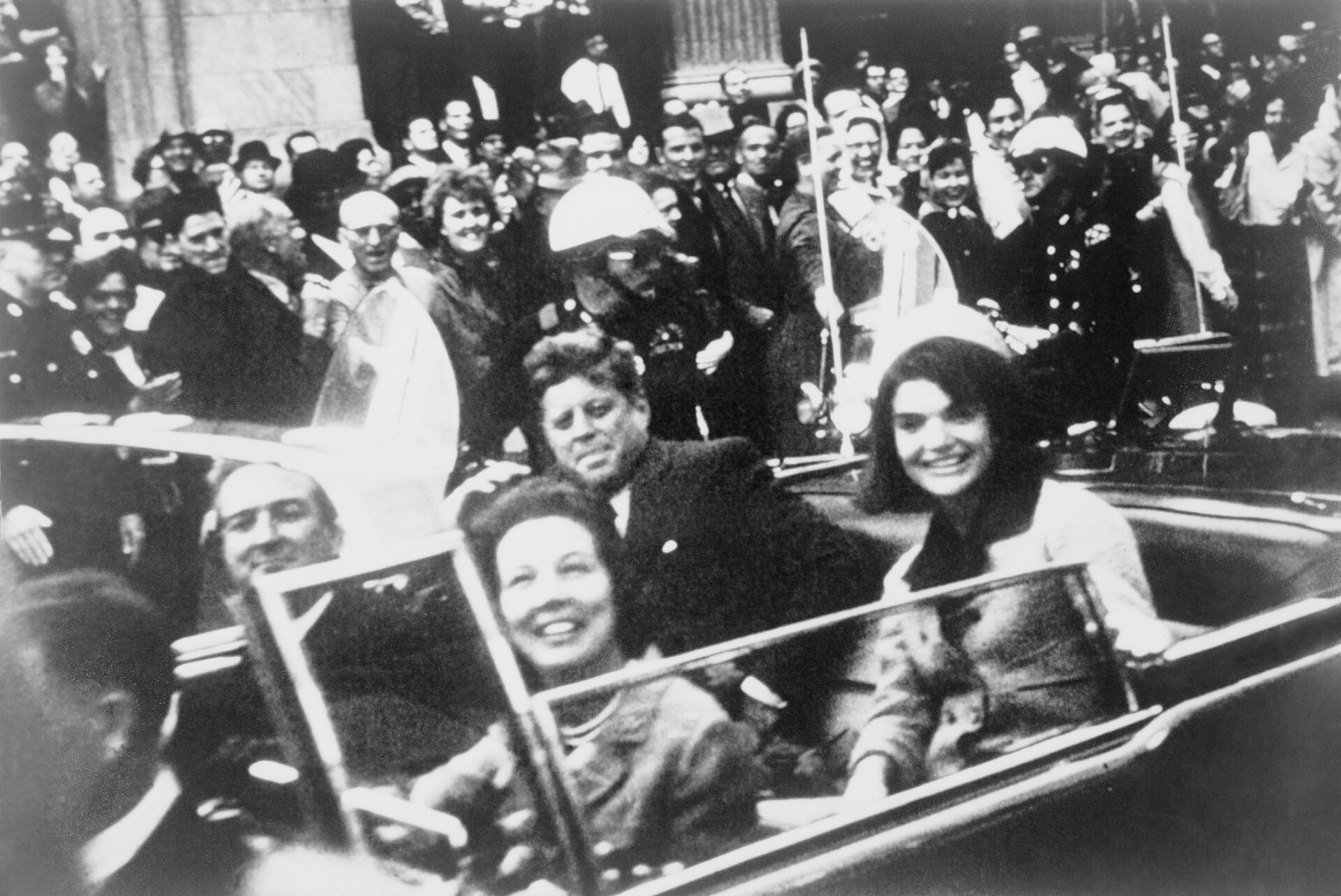
Taken in downtown Dallas, Texas, on November 22, 1963, just minutes before President John F. Kennedy was assassinated. Captured by photographer Victor Hugo King, the occupants of the car include President John F. Kennedy and First Lady Jacqueline Kennedy (back seat), and Texas Governor John Connally and his wife Nellie Connally (middle jump seats). Photo: Victor Hugo King / Library of Congress. Public Domain.

November 22, 1963 — Fort Worth Parade Route:

John F. Kennedy had a lifelong passion for automobiles—especially open-top convertibles—and was widely known among friends and aides as a fast, aggressive, and sometimes reckless driver. He was notorious for speeding while reading newspapers, jotting notes, or talking intensely with passengers, often paying minimal attention to the road. Kennedy’s love affair with top-down driving began in his youth and never faded, regardless of weather or security warnings. In 1937, after his freshman year at Harvard, he shipped a Ford convertible to Europe to tour the continent with his friend, Lem Billings. In 1940, while auditing classes at Stanford, he turned heads across Palo Alto in a cactus-green Buick convertible with red leather seats. As a Congressman and Senator in Washington, he commuted daily between Capitol Hill and Georgetown in a convertible—and loved to keep the top down, even in the cold or rain. Tan and youthful, JFK famously disliked the heavy, enclosed “bubble-top” limousine favored by his older predecessors, Harry Truman and Dwight Eisenhower. Even after winning the 1960 presidential nomination, Kennedy occasionally slipped away to drive himself alone with the top down—such as famously pulling up solo in his convertible to Washington Post publisher Katharine Graham’s driveway—much to the frustration of his Secret Service detail.

On the morning of November 22, 1963, after speaking at an outdoor rally outside the Hotel Texas and attending a Chamber of Commerce breakfast in the ballroom, President John F. Kennedy and First Lady Jacqueline Kennedy rode through Fort Worth in an open, ermine-white, four-door convertible with a red interior—a locally loaned vehicle outside the White House fleet. As the motorcade made its way toward Carswell Air Force Base, cheering crowds, including schoolchildren, lined the route, and the Kennedys paused briefly to shake hands with well-wishers before taking off aboard Air Force One at 11:24 a.m. for the 13-minute flight to Dallas Love Field. Waiting on the tarmac in Dallas was the customized, midnight-blue 1961 Lincoln Continental, SS-100-X, which had already been flown ahead and would carry the president into Dealey Plaza less than an hour later. The white Fort Worth convertible, meanwhile, earned its place in history not only as the last automobile in which President Kennedy ever rode safely, but as the exact kind of car he had loved his whole life.

This explanatory article is periodically updated.

Master of Darkness: Caravaggio and the Baroque Imagination.

FEATURE Image: Caravaggio (Michelangelo Merisi), Judith Beheading Holofernes, c. 1598, oil on canvas, 56 ¾ x 76 ¾” 145 x 195cm Galleria Nazionale d’Arte Antica, Rome. https://barberinicorsini.org/opera/giuditta-e-oloferne/ – retrieved October 12, 2024.

Viewed chronologically, Caravaggio’s career reveals the emergence of a radically new artistic vision in which light, shadow, emotion, and everyday reality transformed both religious and secular painting, altering the course of European art around 1600.

Ottavio Leoni (1578-1630), Portrait of Caravaggio, c. 1621/25, red and white chalk on blue paper, 23.4 x 16.3 cm, Biblioteca Marucelliana, Florence.

INTRODUCTION.

The chalk portrait above is probably the most faithful likeness of Caravaggio. Born Michelangelo Merisi in 1571, Caravaggio became an influential figure in Italian and European art in and well after his lifetime. He revolutionized painting by his theatrical use of light, dramatic narrative, and the naturalistic physical depiction of everyday people. His depiction of figures in historical narrative using dramatic interplay of light and shadow called chiaroscuro along with its naturalistic composition was further modernized in its scenes’ inclusion of the emotional and psychological human state. These artistic qualities were admired and emulated by many young European artists going forward into the balance of the seventeenth century.

Caravaggio came to Rome around 1592 from Lombardy, where he was influenced by the works of Giovanni Girolamo Savoldo (c.1480-1548), Lorenzo Lotto (c. 1480-1557), Romanino (c.1484-1566) and Moretto (c. 1498-1554?). For a while he worked in the workshop of the leading late mannerist Giuseppe Cesari (1568-1640), but soon broke away from the established course in Roman-Florentine artistic mannerism. His completely new approach of intense realism and chiaroscuro — that is, dramatic use of light and darkness to situate a scene – made him the “master of darkness” and completely revolutionized art in Rome around 1600. Along with Annibale Carracci (1560-1609), Adam Elsheimer (1578-1610) and Peter Paul Rubens (1577-1640), Michelangelo Merisi, called Caravaggio, was one of the progenitors of 17th century painting.

Artworks.

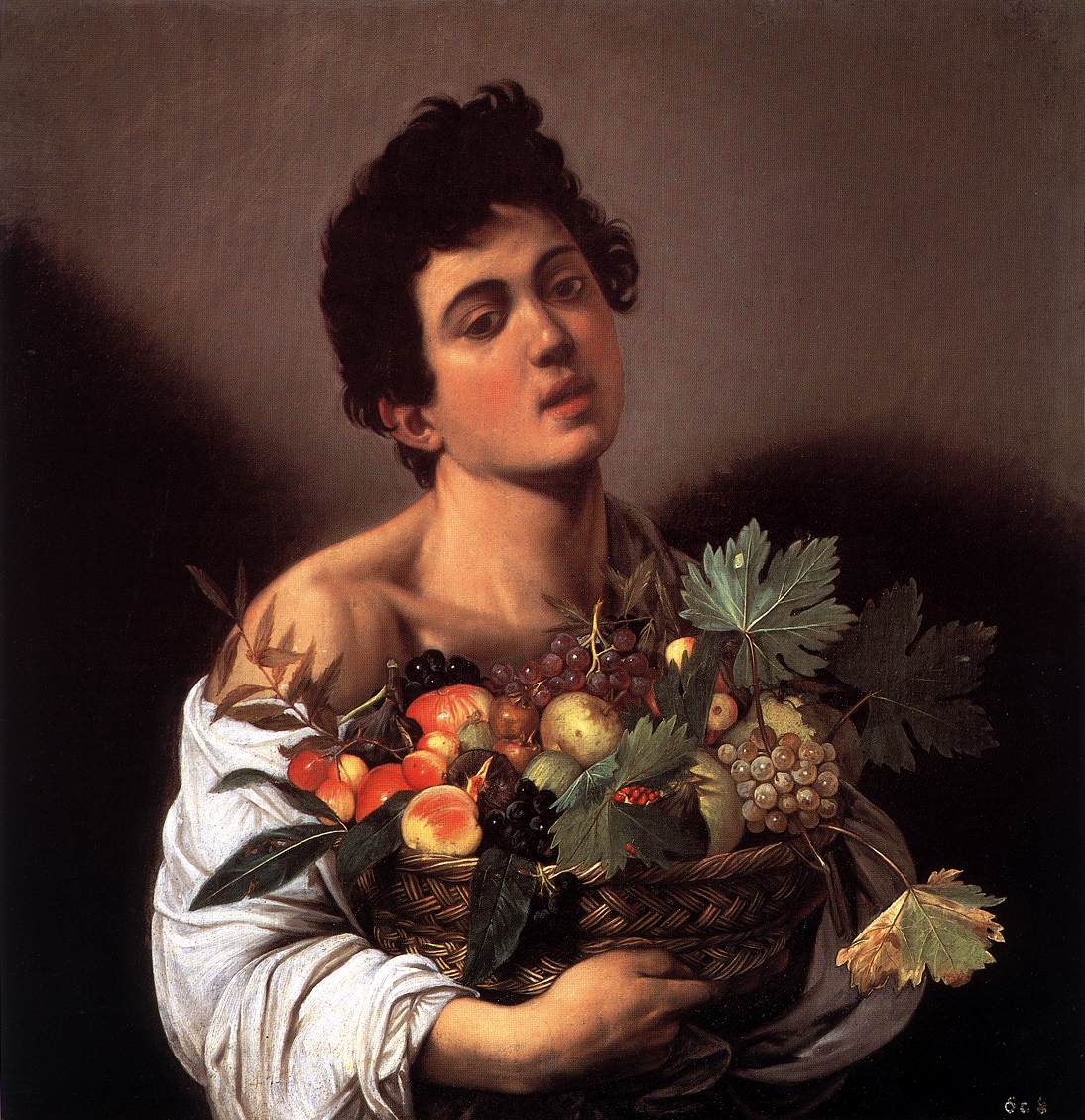
Caravaggio (Michelangelo Merisi), Boy With a Basket of Fruit (“Il Fruttaiuolo”), c. 1593/94, oil on canvas, 27 ½ x 26 3/8” 70 x 67 cm, Galleria Borghese, Rome. https://borghese.gallery/collection/paintings/boy-with-a-basket-of-fruit.html – retrieved October 10, 2024.

Caravaggio’s Il Fruttaiuolo (“Boy with a Basket of Fruit”) presents a remarkable contrast of the detailed, colorful, and sensuous depiction of fruits of the season and the refined and delicate innocence of an adolescent boy holding its basket. The placid scene of typical everyday life is enhanced by an expressive and careful execution. The model was Caravaggio’s friend, Sicilian painter Mario Minniti, at about 16 years old. According to Giovanni Pietro Bellori (1613-1696) who included Caravaggio in his Lives of the Artists, the artist learned “to paint flowers and fruit so well imitated that everybody came to learn from him how to create the beauty that is so popular today.”

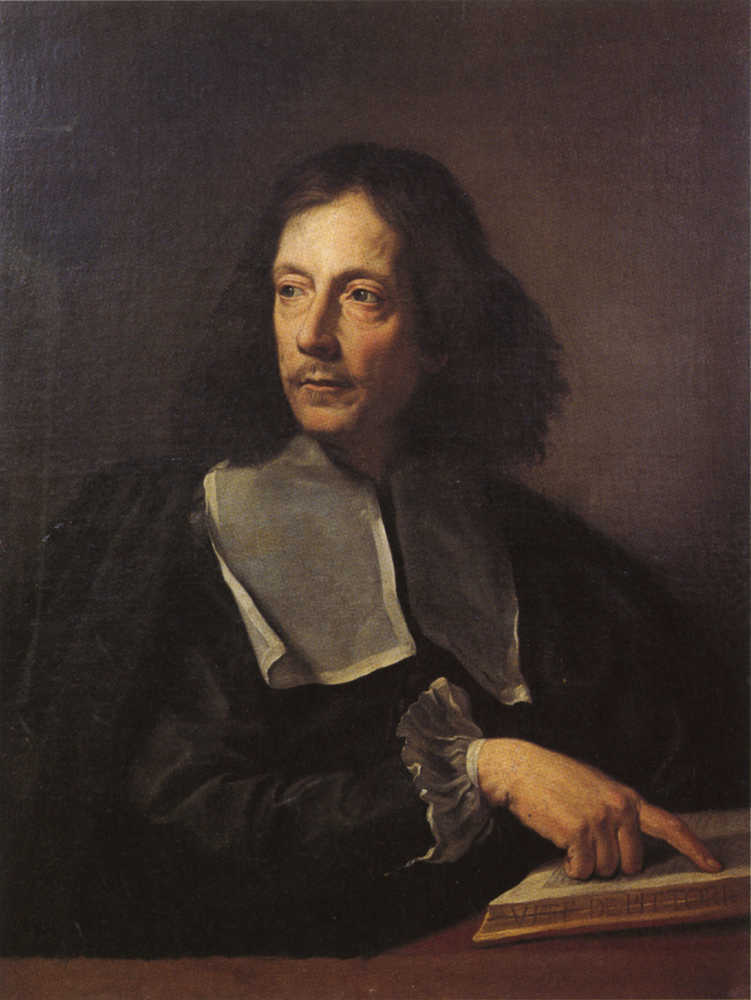
Carlo Maratta (1625-1713), Portrait of Gian Pietro Bellori who was Caravaggio’s most important biographer. Other early biographies of Caravaggio’s life were written by his doctor, Giulio Mancini (1559-1630) and by Giovanni Baglione (1566-1643), a rival artist.

Caravaggio (Michelangelo Merisi), The Young Sick Bacchus (Bacchino Malato), c. 1593/94, oil on canvas, 67 x 53 cm, Galleria Borghese, Rome. https://borghese.gallery/collection/paintings/young-sick-bacchus.html – Retrieved October 10, 2024.
https://www.collezionegalleriaborghese.it/en/opere/self-portrait-as-bacchus-known-as-sick-bacchus – retrieved October 10, 2024.

Caravaggio’s Il Bacchino Malato (“The Young Sick Bacchus”), also known as Bacchino malato (“The Sick Bacchus”) or Autoritratto in veste di Bacco (“The Self-Portrait as Bacchus”), is an early self-portrait by Michelangelo Merisi da Caravaggio, dated between 1593 and 1594. The artwork dates from Caravaggio’s first years in Rome when he moved to the Eternal City from his native Milan in 1592. The painting was in the collection of Giuseppe Cesari (1568-1640), Caravaggio’s early employer. In 1607 it was confiscated from Cesari by the Pope in exchange for the Italian mannerist’s freedom following an illegal firearms charge. The pope gifted it to his nephew, Cardinal Scipione Borghese (1577-1633), together with the Boy Peeling Fruit and Boy with a Basket of Fruit (“Il Fruttaiuolo“).

The painting is a realist portrait of a young man displaying the typical attributes of Bacchus, the god of drunkenness. The sitter is turned to the viewer in a three-quarter pose, holding in his hands a bunch green grapes held next to his ailing greenish complexion. The sitter has been identified as the artist since it is documented that he was in the Ospedale della Consolazione in Rome around this time for undefined reasons. This interpretation provides the origin for the artwork’s title.

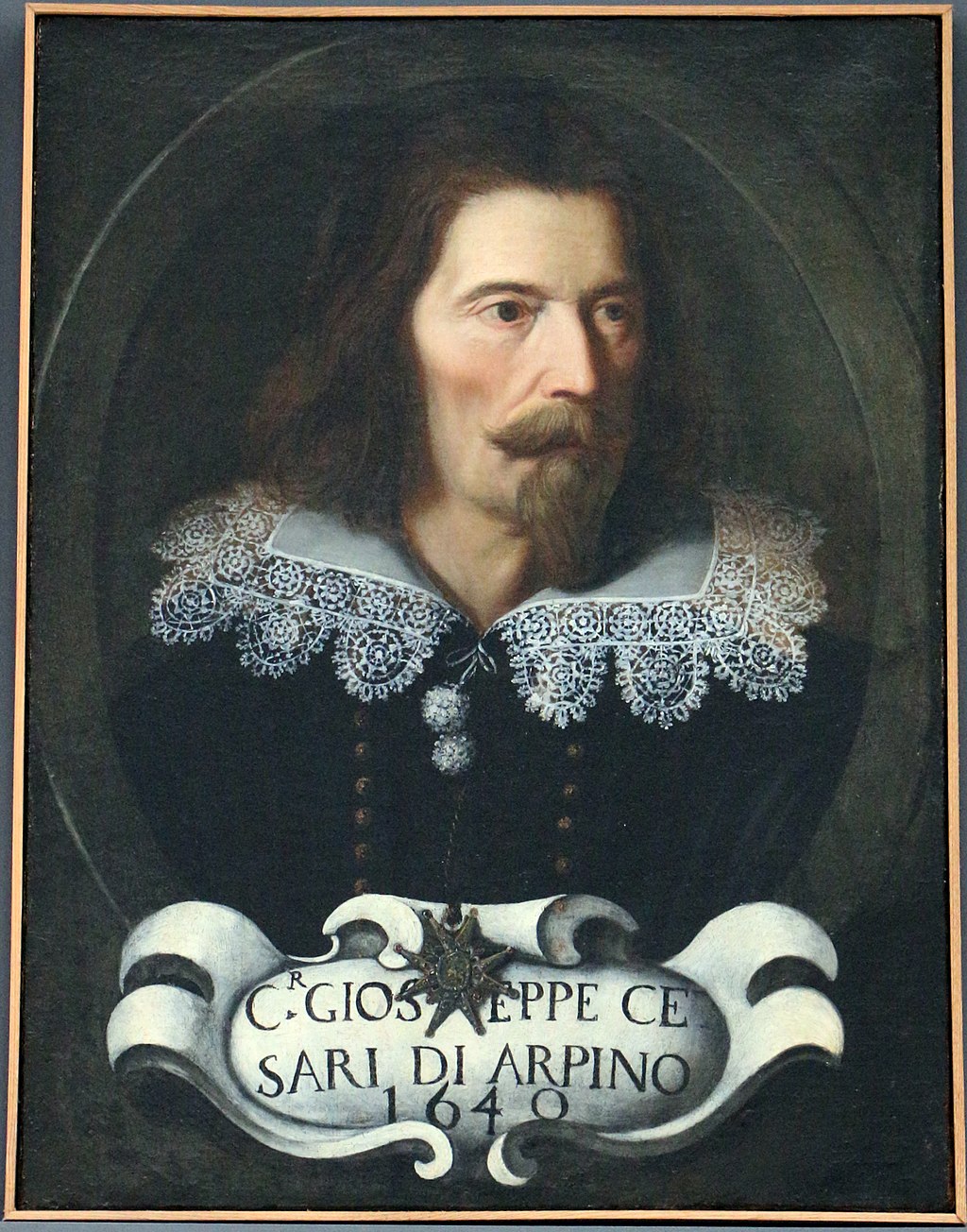
Giuseppe Cesari, Self-portrait, 1640, Accademia di San Luca. Cesari was Caravaggio’s first employer and in possession of The Young Sick Bacchus that was confiscated by the pope.

Ottavio Leoni, Portrait of Cardinal Scipione Borghese. The sitter was not only the pope’s nephew and a Cardinal in the Catholic Church but the recipient of early Caravaggio paintings by gift. Such a gift was not at random: the cardinal’s growing art collection, including Caravaggio and Bernini, formed the basis of the Villa Borghese in Rome.

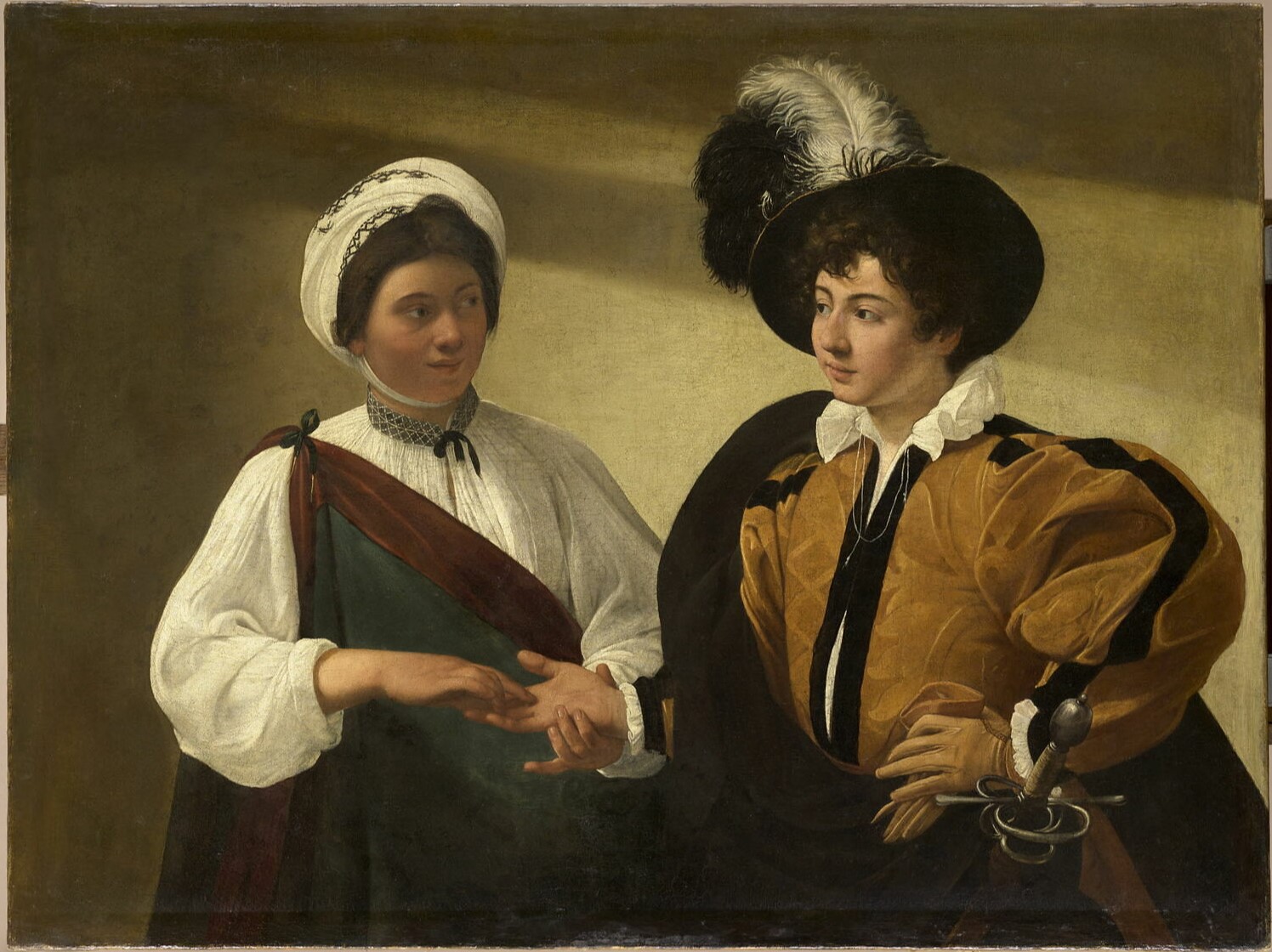
Caravaggio (Michelangelo Merisi), The Fortune-Teller (“La Buona Ventura”), c. 1594, oil on canvas, 39 x 52 3/8”, Louvre, Paris. https://collections.louvre.fr/en/ark:/53355/cl010062329 – retrieved October 10, 2024

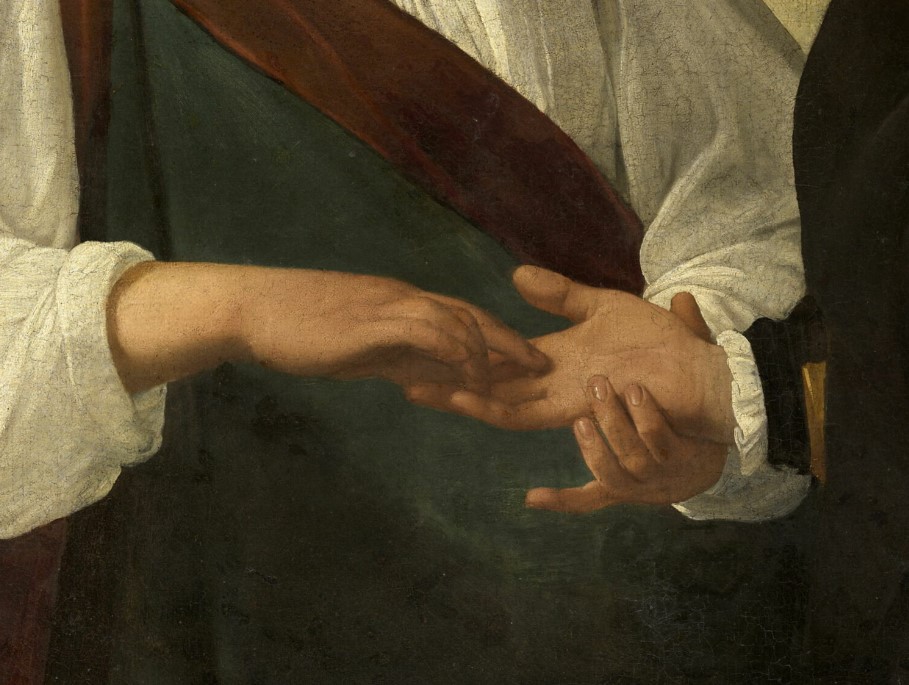
Detail of above.

According to Giulio Mancini, Caravaggio painted The Fortune-Teller for a proverbial song while staying with Archbishop Fantino Petrignani (1577-1601). By 1620 when Mancini was writing, the painting was owned by Roman art collector and Catholic prelate Alessandro Vittrici (d. 1650). Later (1657) it was in the collection of Catholic Cardinal Camillo Francesco Maria Pamphili (1622-1666) who sent it with Bernini (1598-1680) to Paris as a gift to Louis XIV.

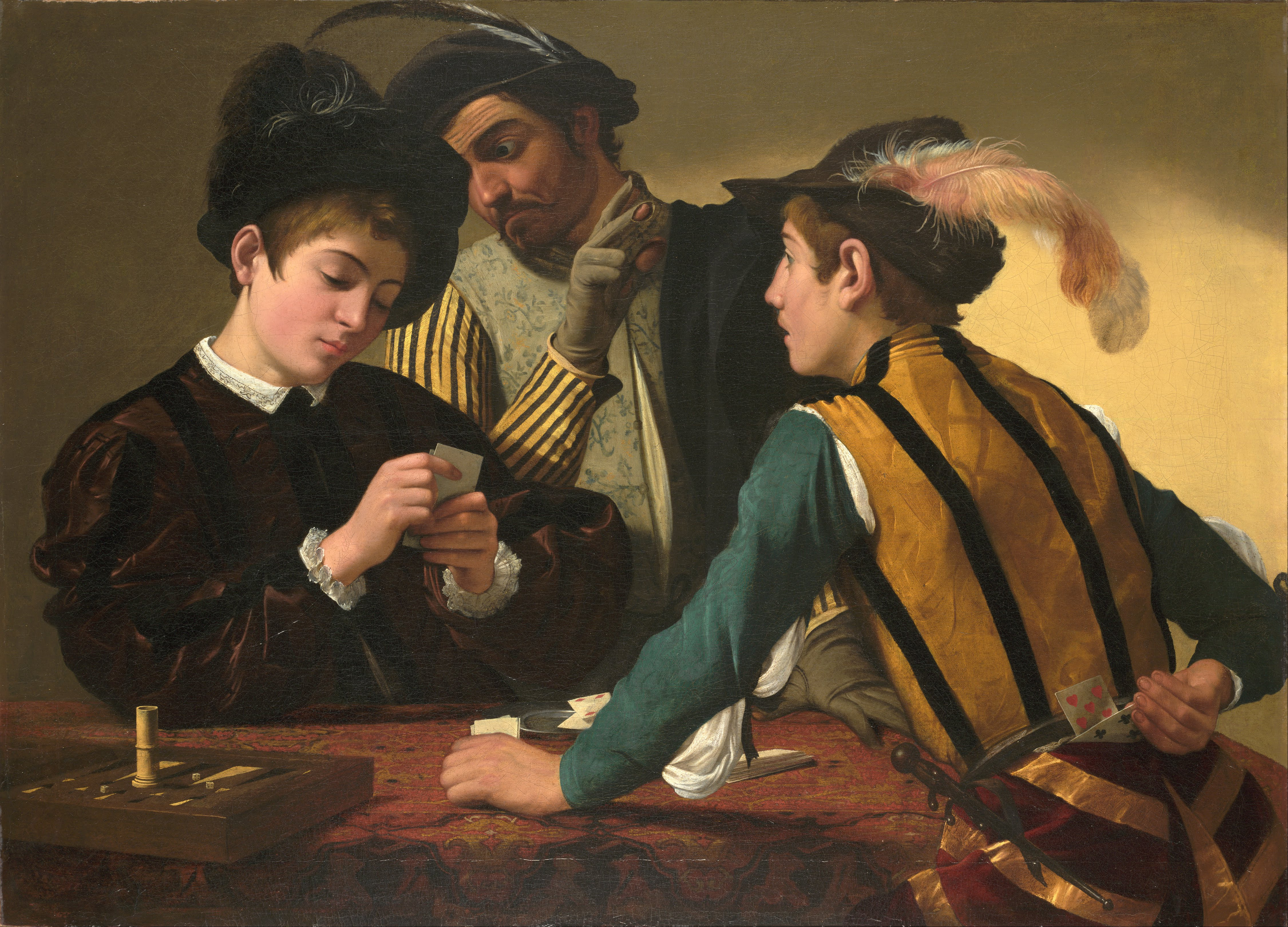
Caravaggio (Michelangelo Merisi), cardsharps,1594/95, oil on canvas, 37 1/16 x 51 9/16 in. (94.2 x 130.9 cm), Fort Worth, Kimbell Art Museum, Fort Worth, Texas. https://kimbellart.org/collection/ap-198706 – retrieved October 18, 2024.

Playing the game of primero the player at left is oblivious to a bearded cardsharp who uses his gloved fingers to signal to the other player the content of the cards. The other cheater is reaching for a hidden card from his pants behind his back. Caravaggio’s composition is novel with a naturalistic treatment of the figures whose distinct expressions and gestures convey a realistic and hard drama of being cheated and cheating. This painting was owned and stamped by Cardinal del Monte and in his inventory of 1627 following his death. It had been lost for almost a century when it was discovered in a European private collection and purchased by the Kimbell in 1987.

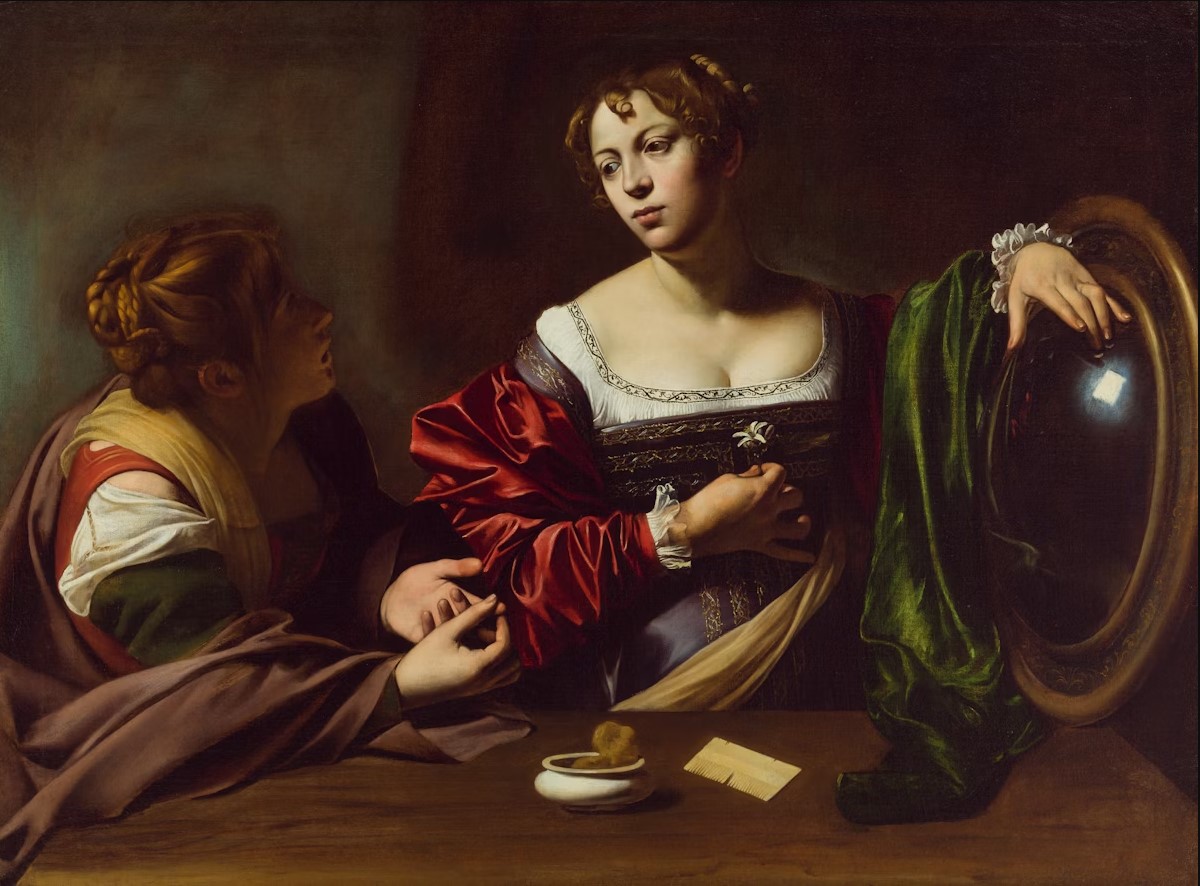
Caravaggio (Michelangelo Merisi), Martha and Mary Magdalene, c. 1598 Detroit Institute of Arts. 

“Caravaggio helped to popularize half-length religious paintings like this, made for private collectors rather than for public church settings. His greatest innovation was in depicting biblical characters as if they belonged to contemporary Roman society, basing them on studio models and dressing them in 17th-century attire, as he does here.” https://www.artic.edu/articles/1071/caravaggio-s-dramatic-life-and-paintings – retrieved October 15, 2024.

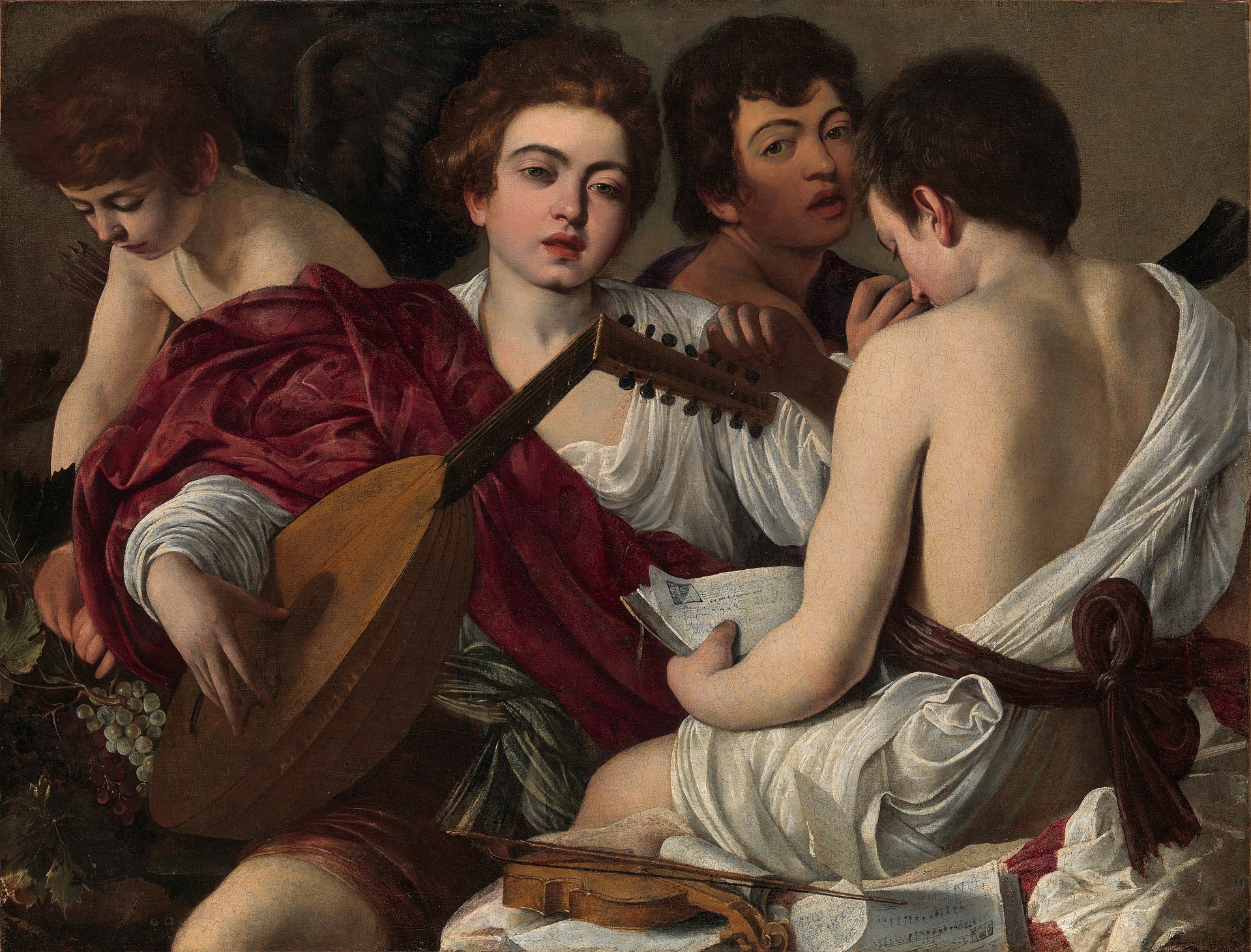
Caravaggio (Michelangelo Merisi), The Musicians, 1595/96, oil on canvas, 36 ¼ x 46 5/8” (92.1 x 118.4 cm), The Metropolitan Museum of Art, New York. https://www.metmuseum.org/art/collection/search/435844 – retrieved October 10, 2024.

The Musicians, painted by Caravaggio and now in The Metropolitan Museum of Art, was commissioned by Cardinal Francesco Maria del Monte (1549–1627), one of Rome’s most influential patrons of the arts. Conceived as an allegory of music—signaled by the presence of Cupid in the background—it is equally a portrait of contemporary musical practice, featuring individualized sitters. Among them is Caravaggio himself, second from the right, offering one of his rare youthful self-portraits.

During the Counter‑Reformation, the Catholic Church actively promoted a revival of music, and Cardinal del Monte was at the center of this cultural movement. At his residence, the Palazzo Madama, he hosted composers, rehearsals, and experiments in progressive musical forms, especially the emerging solo vocal style that departed from older polyphonic traditions. The Musicians was designed specifically for the Cardinal’s music room, its subject and atmosphere echoing the live performances that took place there.

In keeping with Caravaggio’s modernizing approach, the figures are not idealized classical types but real young men posed in quasi‑antique white robes. The self‑portrait—directly engaging the viewer—shows the artist holding a cornetto, a popular wind instrument of the period. Caravaggio also employs a spatial device familiar in later eighteenth‑century art: the prominently placed violin and open music manuscript in the immediate foreground. These objects project into the viewer’s space, drawing the spectator into the scene as an implied participant.

Ottavio Leoni, Francesco Maria del Monte, 1616.

Born in Venice of a Tuscan aristocratic family, Cardinal del Monte was an important connoisseur of the arts.  Four centuries later his fame rests on his early patronage of Caravaggio and an art collection which provides detailed provenance for many important works of the period. Del Monte was the single most influential force in Caravaggio’s life. Between 1595 and 1601, the Catholic cardinal became not only the painter’s primary patron but his intellectual mentor, legal shield, and diplomatic strategist—an alliance that lifted the volatile outsider into the ranks of Rome’s most sought‑after, and most controversial, artistic prodigies. Their bond was complicated by each’s share of eccentricities, intense legal vulnerabilities, and the uneasy overlap between church politics and the city’s street‑level underworld.

As mentioned, the relationship began when Del Monte purchased The Cardsharps from a local dealer and immediately recognized the raw, disruptive talent behind it. He brought Caravaggio into his official residence, the Palazzo Madama, granting him a stipend, room and board, and a dedicated studio. Within those walls, Caravaggio entered a rarefied world. Del Monte—an intimate friend and protector of Galileo —surrounded himself with mathematicians, natural philosophers, and experimenters in optics. Immersed in this court of scientific inquiry, Caravaggio refined the radical, directional lighting that would become his signature, transforming observation into revelation.

Del Monte also understood that private cabinet pictures could only carry an artist so far. Leveraging his position as a Vatican insider, he secured Caravaggio’s first major public commission: the Contarelli Chapel cycle in San Luigi dei Francesi. It was a turning point—Caravaggio’s explosive debut on the public stage and the moment his reputation as a revolutionary painter crystallized.

But the Cardinal’s protection had limits. Caravaggio’s temperament grew increasingly erratic, his nights spent among gamblers, swordsmen, and fugitives. By 1606, after the fatal brawl with Ranuccio Tomassoni, even Del Monte could no longer shield him. Caravaggio fled Rome under threat of execution, bringing to an abrupt end one of the most fertile and consequential artistic partnerships of the Baroque age.

Caravaggio (Michelangelo Merisi), The Lute Player, 1595/96, oil on canvas, 37 x 46 7/8” The Hermitage Leningrad.

The Lute Player was owned by Cardinal del Monte. It was sold to Vincenzo Giustiniani (1564-1637), an aristocrat Italian banker, art collector and intellectual, and appeared in his inventory in 1638. Caravaggio’s model for the painting is the same as for The Musicians.

Nicolas Régnier/Niccolò Renieri (1591-1667), Portrait of Vincenzo Giustiniani, c. 1630.

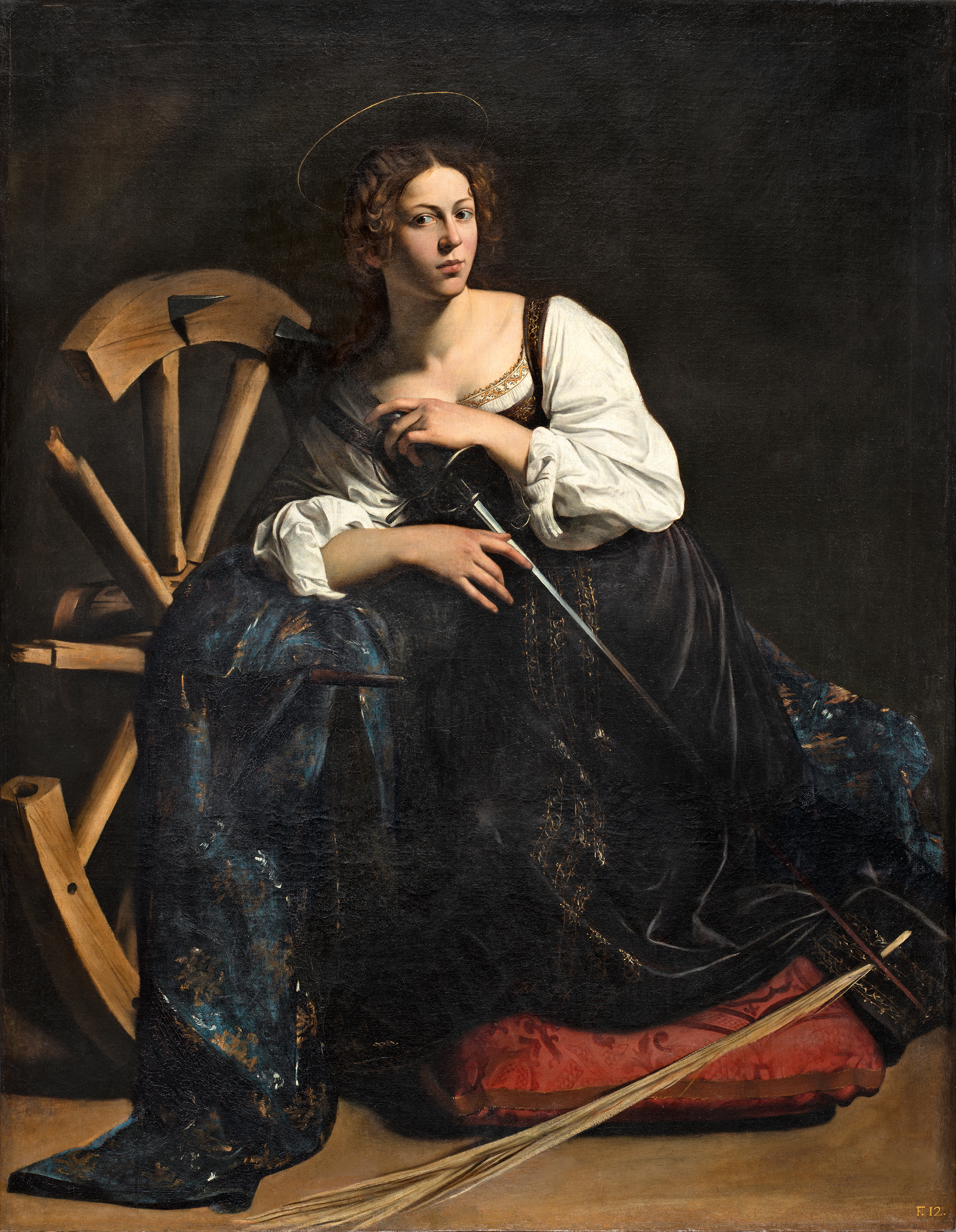
CARAVAGGIO (Michelangelo Merisi), Santa Catalina de Alejandría (St. Catherine of Alexandria), c. 1598-1599, oil on canvas, oil on canvas, 173 x 133 cm, Museo Nacional Thyssen-Bornemisza, Madrid. https://www.museothyssen.org/en/collection/artists/caravaggio-michelangelo-merisi/saint-catherine-alexandria – retrieved October 15, 2024.

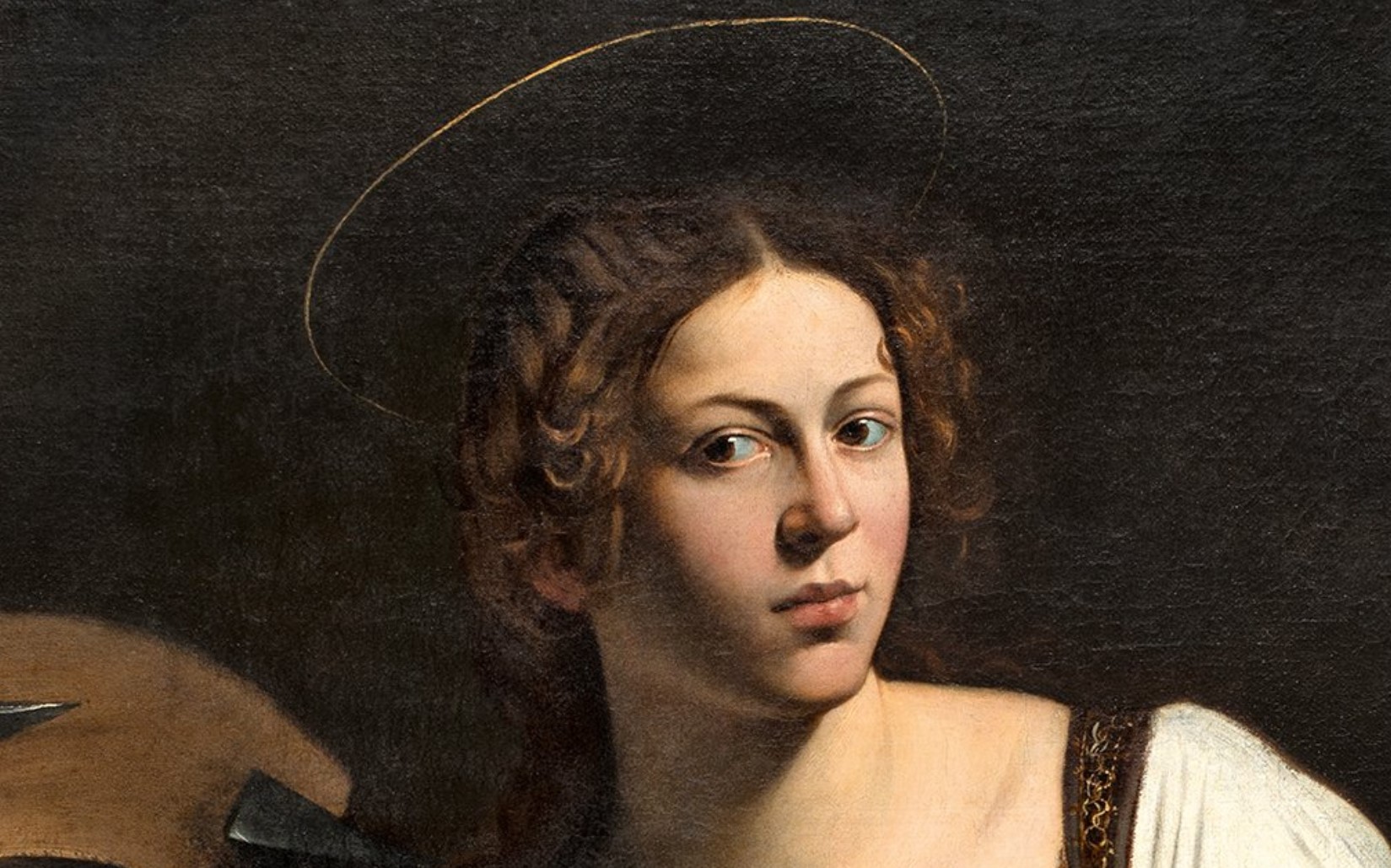
Commissioned by Cardinal Francesco Maria del Monte, Caravaggio’s St. Catherine of Alexandria presents the saint in the unmistakable likeness of Fillide Melandroni, a well‑known Roman courtesan who played a decisive role in the painter’s artistic and personal life. Young artists routinely turned to women like Fillide for models—respectable women were simply unavailable for such work—and Caravaggio, more than most, transformed these marginalized figures into icons of startling dignity and psychological depth.

Richly robed and kneeling on a cushion, Catherine occupies the canvas with commanding stillness. She rests one hand on the spiked breaking wheel and gently cradles the sword—emblems of her martyrdom—while the dramatic fall of light isolates her against the darkness in Caravaggio’s signature chiaroscuro. The effect is intimate yet monumental: a saint rendered not as an ethereal ideal but as a living woman whose presence feels immediate, almost breathing qualities which would have an immense impact on European art in the 17th century.

Caravaggio heightens this immediacy with a device that would also echo through seventeenth‑century European painting: the saint’s body and attributes press toward the viewer’s space, collapsing the distance between sacred history and the spectator. It is precisely this fusion of realism, theatrical light, and emotional proximity that made works like St. Catherine so influential across the Baroque world.

Detail of above: the face of St. Catherine of Alexandria (Fillide Melandroni).

Caravaggio (Michelangelo Merisi), Saint Francis of Assisi in Ecstasy, c. 1595-96, Oil on canvas, 36 3/8 x 50 5/8” 94 x 129.5 cm Wadsworth Atheneum, Hartford, CT. https://5058.sydneyplus.com/argus/final/Portal/Public.aspx?lang=en-US&p_AAEE=tab4&p_AABB=tab8 – retrieved October 11, 2024.

Caravaggio’s Saint Francis of Assisi in Ecstasy stands as his earliest known religious composition, and already the hallmarks of his mature style—intimacy, theatrical light, and emotional immediacy—are unmistakable. The subject, Saint Francis of Assisi (1182–1226), the Umbrian mystic famed for his radical poverty and fierce asceticism, often withdrew into solitude for forty‑day fasts, seeking to imitate Christ as literally as Scripture allowed. Medieval tradition holds that, like Christ in the wilderness, Francis was ministered by angels during these periods of spiritual extremity.

Caravaggio seizes on one such moment. In September 1224, on Mount La Verna in central Italy, Francis received the stigmata, the wounds of the crucified Christ—an experience granted to only a handful of saints. Caravaggio renders the episode with striking restraint: the saint collapses into the arms of an angel, his body slack with awe, while shepherds linger in the obscured background, half‑witnesses to a mystery they cannot fully comprehend. A faint trace of the wound appears beneath the rough folds of Francis’s tunic, a subtle but potent sign of the miracle.

The entire scene is carved out of darkness by Caravaggio’s directional light, a technique shaped by the scientific culture surrounding his patrons. Here, the light does not merely illuminate; it consecrates. It isolates Francis and the angel in a suspended moment of revelation, while the world around them recedes into shadow.

Caravaggio painted the work in Rome for Ottavio Costa (1554–1639), a Genoese banker and discerning collector who became one of his most loyal supporters. Centuries later, in 1943, Saint Francis of Assisi in Ecstasy became the first Caravaggio to enter a public collection in the United States, marking a milestone in the American reception of the Baroque master.

Caravaggio (Michelangelo Merisi), Rest on the Flight to Egypt, c, 1595/98, oil on canvas, 51 ¼ x 63” Galleria Doria- Pamphili, Rome.

La fête champêtre is a musical picnic whose tradition originated in Italy. Caravaggio’s composition is lyrical and complicated. As it is in the setting of the Holy Family’s flight to Egypt in Matthew’s Gospel, the characters are dressed humbly accompanied by the presence of an angel.

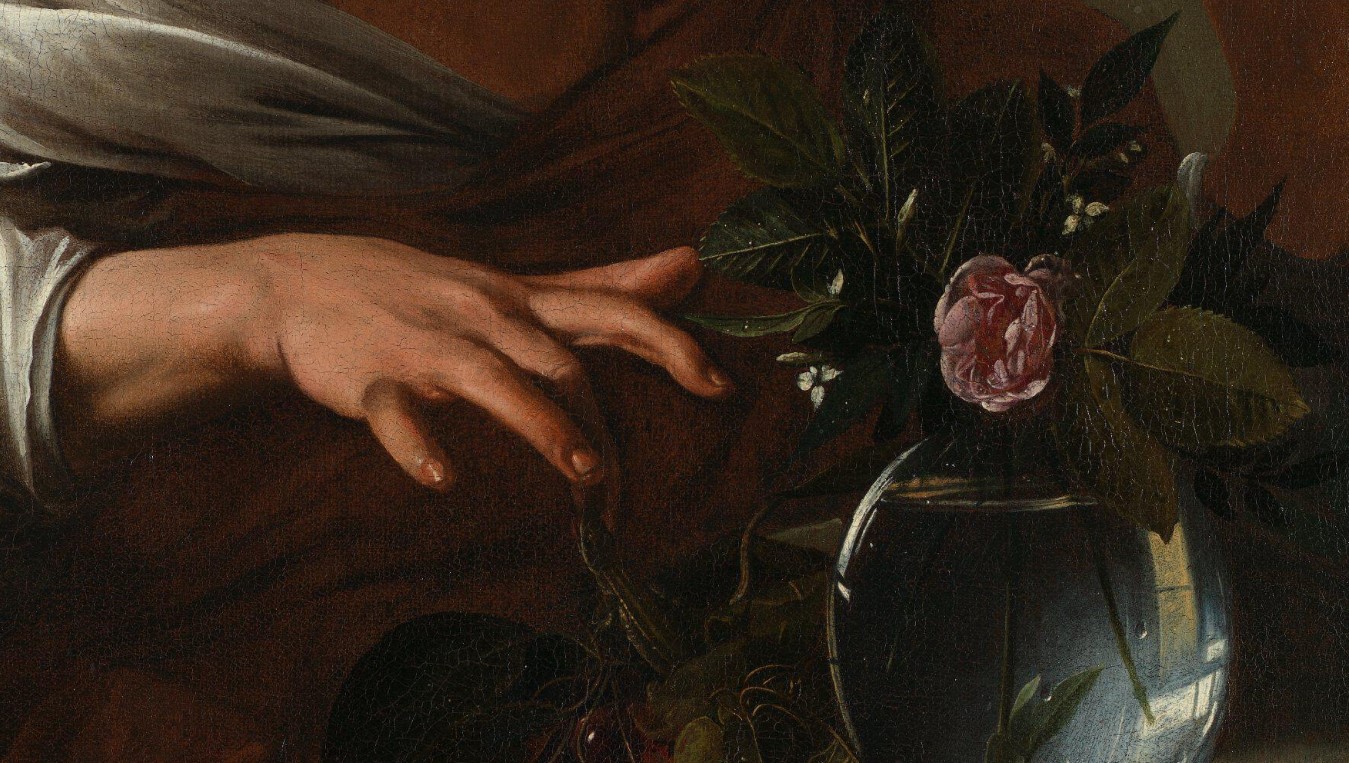
Caravaggio (Michelangelo Merisi), Boy Bitten By A Lizard, 1596/97, oil on cavas, 27 ½ 2 22 3/8”, The National Gallery, London.

Detail of above.

Mancini relates that Caravaggio painted the subject when staying with an old Catholic prelate named Pandolfo Pucci. By the end of his residence Caravaggio nicknamed his temporary benefactor Monsignor Insalata, or “Mister Salad,” for the pittance of solid food he served his artist boarder. The mock heroic painting may be allegorical with the lizard conveying its traditional meaning of lust or death joined to cherries symbolic of love and roses that of sexually transmitted disease — and warning of all three. see – https://www.britannica.com/biography/Caravaggio/First-apprenticeships-in-Rome-Pucci-Cesari-and-Petrigiani – retrieved October 15, 2024.

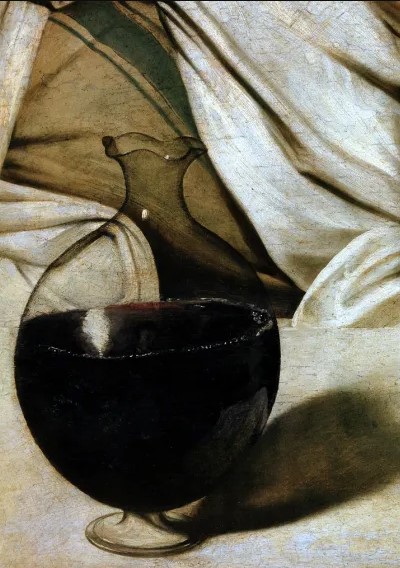
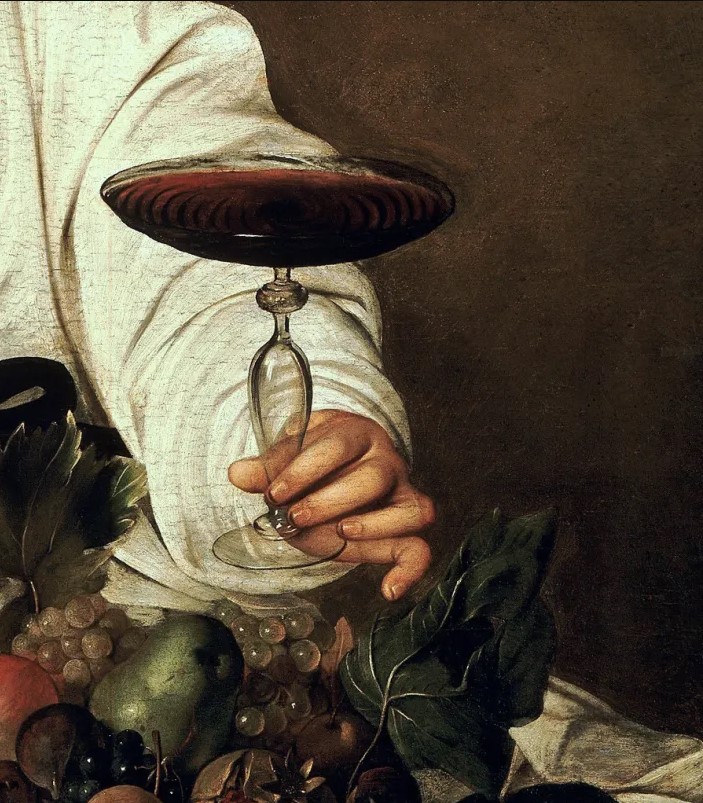
Caravaggio (Michelangelo Merisi), Bacchus, c. 1597, oil on canvas, 37 3/8 x 33 ½”, Uffizi, Florence.

Detail of above.
Cardinal del Monte commissioned it from Caravaggio for a Medici.
Detail of above.

Commissioned by his principal patron, Cardinal Francesco Maria del Monte, Caravaggio’s Bacchus was presented as a diplomatic gift to Grand Duke Ferdinando I de’ Medici to mark his son’s wedding—a gesture that secured the painting’s place in the Medici collections for centuries. Today it stands as a cornerstone of early Baroque art, celebrated for its audacious rejection of idealized Renaissance classicism in favor of a startlingly earthbound realism.

Instead of a radiant, godlike deity, Caravaggio gives us a working‑class Roman youth—almost certainly his friend and frequent model Mario Minniti—costumed as the god of wine. Any pretense of antiquity is deliberately dismantled. Bacchus reclines not on a marble couch but on a striped mattress folded to imitate a Roman triclinium. His white “toga” is nothing more than a contemporary bedsheet, loosely draped over his body. The effect is both intimate and unsettling: a classical god rendered as a boy you might meet in the streets of Rome, invited into myth by costume alone.

The lower half of the canvas deepens the painting’s moral tension. Caravaggio arranges a sumptuous still life—apples, grapes, figs, a carafe of wine—but it is also a vanitas. The apples are bruised and worm‑eaten, the grapes overripe, the leaves already curling toward decay. This quiet rot serves as a memento mori, a reminder that youth, beauty, and sensual pleasure are as fleeting as the fruit that embodies them. Caravaggio’s realism becomes a form of philosophy.

Despite its current fame, Bacchus nearly vanished from history. After the fall of the Medici dynasty, the painting was relegated to a dark storage room in the Uffizi reserves—unframed, uncatalogued, and obscured beneath yellowed varnish. It remained forgotten until 1913, when art historians rediscovered and authenticated it as an irreplaceable treasure of the Baroque.

Caravaggio (Michelangelo Merisi), Jupiter, Neptune, and Pluto, 1597, oil on stucco, about 9/9”” x 5’11” Villa Ludovisi, Rome. https://villaludovisi.org/ – retrieved October 12, 2024.

The building and grounds of Villa Ludovisi in Rome, and their rich artwork, includes masterpiece frescoes by Guercino (1591-1666) and other leading lights of the 17th century Bolognese school. Caravaggio’s Jupiter, Neptune and Pluto is his only known oil painting on plaster. Cardinal de Monte purchased the villa and took up residence there in 1596. The cardinal sold it to the Ludovisi in 1621. Bellori relates that the subject matter for the fresco of these gods was to express the cardinal’s interest in medicinal chemistry (today’s pharmaceuticals).

Caravaggio (Michelangelo Merisi), Judith Beheading Holofernes, c. 1598, oil on canvas, 56 ¾ x 76 ¾” 145 x 195cm Galleria Nazionale d’Arte Antica, Rome.  https://barberinicorsini.org/opera/giuditta-e-oloferne/ – retrieved October 12, 2024.

Commissioned by Ottavio Costa, one of Caravaggio’s most loyal Roman patrons, the painting passed through several prominent Roman families before entering the Galleria Nazionale d’Arte Antica in 1970. Its subject is the famous episode from the Book of Judith, a Biblical tale of courage, seduction, and divine deliverance that had long captured the Christian imagination.

Judith—beautiful, eloquent, and revered in her community—is a widow living in the besieged city of Bethulia, threatened with destruction by the Assyrian general Holofernes. Because he is captivated by her beauty, Judith is granted unusual freedom within the enemy camp. She joins Holofernes at a banquet in his tent, where he drinks himself into oblivion. As the text puts it, “Holofernes, charmed by her, drank a great quantity of wine, more than he had ever drunk on any day since he was born” (Judith 12:20).

Once the attendants withdraw, Judith seizes her moment. The biblical account describes the scene with stark intensity: she stands beside the general’s bed and prays silently for strength, saying: “O Lord, God of all might, in this hour look graciously on the work of my hands for the exaltation of Jerusalem. Now is the time for aiding your heritage and for carrying out my design to shatter the enemies who have risen against us” (Judith 13:4–5). Taking Holofernes’ own sword from the bedpost, she grasps his hair, invokes the God of Israel, and strikes twice, severing his head. She then rolls his body aside and hands the severed head to her maid, who conceals it in a food bag before the two women slip back into the night (Judith 13:4–10).

Caravaggio chooses the exact instant when violence erupts—his first painting to depict action with such visceral, kinetic force. The scene unfolds like a frieze suspended in time: Judith leaning forward with grim resolve, her maid assisting with practiced efficiency, and Holofernes recoiling in shock as the blade bites into his neck. The theatrical light isolates the figures against darkness, heightening the sense of immediacy and moral gravity.

This painting marks a turning point in Caravaggio’s career. With Judith Beheading Holofernes, he demonstrates not only his mastery of chiaroscuro but also his ability to transform a biblical narrative into a moment of raw human drama—one that reverberated across the Baroque world.

Caravaggio (Michelangelo Merisi), Portrait of Monsignor Maffeo Barberini, c. 1603, Private Collection, Firenze. Maffeo Vincenzo Barberini (1568-1644) became the future Pope Urban VIII whose reign began in 1623.

Caravaggio’s First Public Commission | Beyond Caravaggio | National Gallery

The words of Christ, who is there, have been spoken. But now time is suspended. How will Matthew reply? Christ is calling him. Do I go or not? Do I follow him or not? These paintings are completely dramatic. Caravaggio uses natural light but turns it into an astonishing symbol of divine illumination.

Caravaggio (Michelangelo Merisi), The Calling of Saint Matthew, 1599-1600, oil on canvas, 10’7 1/2 “ x 11’ 2” Contarelli Chapel, Church of Luigi dei Francesi, Rome.

Caravaggio’s The Calling of Saint Matthew (1599–1600), a monumental oil on canvas measuring 10’7½” × 11’2” (322 × 340 cm), occupies the left wall of the Contarelli Chapel in San Luigi dei Francesi, Rome. Commissioned as his first major public work when the artist was 28 years old, it quickly became a defining masterpiece of the Baroque—an image that rewired the expectations of religious art for an entire generation.

Caravaggio stages the biblical moment described in Matthew 9:9—Christ summoning the tax collector Levi (Matthew) to discipleship—not in a distant, idealized past but in a dark, contemporary Roman tavern, thick with shadow. The sacred enters the profane unexpectedly.

The composition unfolds in two distinct worlds. Around the counting table sit Matthew and his companions, absorbed in their unseemly gains, dressed in sumptuous late‑16th‑century velvet doublets, feathered hats, and sidearms—figures of worldly wealth and casual corruption. Into this scene step Christ and Saint Peter, barefoot and clothed in rough robes. Their presence feels out of sorts, yet the room shifts around them.

A single, razor‑sharp beam of light—Caravaggio’s signature tenebrism —enters from the upper right, cutting diagonally across the darkness. It travels in parallel to Christ’s extended hand, making the light itself a metaphor for divine grace and spiritual awakening penetrating a den of exploitation and greed. As the light strikes the faces at the table—some oblivious, others looking up startled— it settles fully on Matthew, who points to himself in shock.

In Counter‑Reformation Rome, the message was unmistakable. Caravaggio’s painting declared that the divine could break into the most ordinary, compromised corners of daily life—that salvation could arrive unannounced, even in a backroom thick with schemes of greed. It was a psychological jolt to the city’s viewers, a reminder that grace was not confined to altars or idealized visions but could happen anywhere to anyone, at any moment.

Caravaggio (Michelangelo Merisi), The Inspiration of Saint Matthew, 1602, oil on canvas, 9’8 1/2 “ x 6’ 2 ½” Contarelli Chapel, Church of Luigi dei Francesi, Rome.

This first version of The Inspiration of St. Matthew by Caravaggio was rejected because the evangelist was considered too crude and the angel too familiar. The painting was destroyed during the Fall of Berlin in 1945 and known by photographs.

Caravaggio (Michelangelo Merisi), The Martyrdom of Saint Matthew, 1599-1600, oil on canvas, 10’7 1/2 “ x 11’ 3” Contarelli Chapel, Church of Luigi dei Francesi, Rome.

Permanently installed on the right wall of the Contarelli Chapel in San Luigi dei Francesi, Caravaggio’s The Martyrdom of Saint Matthew erupts across the canvas in a chaotic, centrifugal burst of bodies and motion. The composition radiates outward from a single, horrifying fulcrum—the moment of the apostle’s death—captured with explosive, almost cinematic intensity. With this work, Caravaggio established himself as the unrivaled master of psychological violence in early Baroque art.

The narrative follows the traditional account in the Golden Legend. Saint Matthew, having publicly condemned King Hirticus of Ethiopia for lusting after his own niece, the consecrated virgin Iphigenia, is murdered in retaliation. Caravaggio distills the entire hagiography into one blinding instant: the assassin, a half‑nude royal soldier, lunges forward to strike the fatal blow as Matthew collapses, bleeding, onto the altar steps.

Caravaggio pushes tenebrism to its outer limit. The saint lies sprawled on the ground, his arms flung open in a gesture that hovers between defense and surrender. The executioner grips Matthew’s wrist, towering above him with a drawn sword, his face twisted in a scream of fury. Around them, witnesses recoil in terror, their bodies spiraling outward as if blasted by the force of the violence.

Yet amid the earthly chaos, the supernatural breaks through. A cloud gathers above the altar, and an angel descends—not to rescue Matthew, but to complete the drama of martyrdom. Leaning down from heaven, the angel extends the palm of victory, placing it into the saint’s wounded hand at the very moment the assassin’s sword arcs downward.

The intersection of these three elements—the angel’s arm, the soldier’s blade, and Matthew’s reaching hand—forms a powerful diagonal axis, a visual declaration that divine salvation overrides mortal execution. In this collision of heaven and earth, Caravaggio transforms a brutal killing into a moment of transcendent destiny.

Caravaggio (Michelangelo Merisi), Medusa (detail), 1600/01, oil on canvas mounted on a convex poplar-wood shield, Uffizi, Florence.

Caravaggio’s Medusa is painted on an actual parade shield.

Caravaggio’s Medusa (1600/01), now in the Uffizi Gallery, is one of the most astonishing feats of early Baroque engineering and psychological terror. Painted in oil on canvas and mounted onto a convex poplar shield, the work fuses myth, optics, and raw anatomy into a single, unnervingly lifelike apparition. Commissioned by Cardinal Francesco Maria del Monte and presented as a diplomatic gift to Grand Duke Ferdinando I de’ Medici, it was proudly displayed in the Medici Armory as both a marvel of craftsmanship and a symbol of dynastic power.

Because the surface curves outward, Caravaggio had to deploy advanced foreshortening and perspectival distortion to counteract the shield’s bulge. He subtly elongates Medusa’s cheeks and distorts her jawline so that, when viewed head‑on, the surface appears flat—or even concave—a technical sleight of hand that would have impressed both artists and scientists in Del Monte’s Roman circle.

Caravaggio captures the exact, electric instant between life and death. Perseus has already struck, yet Medusa’s nervous system still fires. Her face becomes a study in catastrophic realization: eyes bulging with shock and fury, brow knotted in disbelief, mouth wrenched open in a silent, blood‑freezing scream. True to his radical naturalism, Caravaggio did not invent stylized serpents; he studied real vipers, painting them mid‑coil, mid‑strike, writhing in panic as their host dies beneath them. From the severed neck, bright arterial blood spurts outward in jagged, hyper‑realistic streams.

To deepen the mythic resonance, Caravaggio anchors the work in the classical story as told by Ovid. According to the Metamorphoses, Perseus could only approach Medusa safely by looking at her reflection in the polished bronze shield given to him by Athena. By painting Medusa’s head directly onto a shield, Caravaggio transforms the viewer into Perseus himself—the one who sees the monster only through a mediated surface. The painting becomes a weapon, a mirror, and a mythic reenactment all at once.

For modern viewers, the shield reads as pure horror: a severed head frozen in the moment of its final scream. But for the Medici, it carried a very different charge. Medusa—whose gaze could immobilize armies—became a potent emblem of political dominion, a symbol of a ruler whose power could paralyze enemies before they even approached.

Caravaggio (Michelangelo Merisi), Basket of fruit (canestra di frutta), c. 1600/01, oil on canvas, 18 1/8 x 25 3/8, Biblioteca Ambrosiana, Milan. https://www.ambrosiana.it/opere/canestra-di-frutta/ – retrieved October 13, 2024.

Caravaggio’s Basket of Fruit is the only autonomous still life by the artist known to survive, though his figure paintings are filled with exquisitely rendered fruit that function as symbolic subtexts. Across his oeuvre, these arrangements vary widely in species, ripeness, and composition, yet they share a distinctive naturalism—blemishes, curling leaves, and the quiet drama of decay rendered with almost scientific precision.

The painting belonged to Cardinal Federico Borromeo (1564–1631), cousin of Saint Charles Borromeo and, like him, Archbishop of Milan. A towering figure of the Counter‑Reformation, Federico championed religious art as a tool of pastoral instruction, yet he was also an unusually passionate collector of still life, a genre often dismissed as minor. Whether he commissioned Caravaggio’s painting or received it as a gift remains uncertain, but he valued it enough to bequeath it in his will to the Ambrosiana in Milan, the scholarly gallery and library he co‑founded in 1618.

The basket itself is instantly recognizable to anyone familiar with Caravaggio’s work. A nearly identical arrangement appears in the Supper at Emmaus in London’s National Gallery, painted around the same time. In both works, the fruit leans precariously over the edge, as if about to tumble into the viewer’s space—a hallmark of Caravaggio’s desire to collapse the boundary between the painting and the viewer.

Cardinal Borromeo lived in Rome from 1586 to 1601, precisely the years when Caravaggio’s reputation was rising with meteoric speed. During this period, he became deeply familiar with the painter’s radical naturalism. For a prelate devoted to both doctrinal clarity and the beauty of the created world, Caravaggio’s still life—so attentive to the fragile, transient nature of living things—would have held profound appeal.

Giulio Cesare Procaccini ((1574–1625), Cardinal-Archbishop Federico Borromeo, 1610, Museo diocesano di Milano.

Caravaggio (Michelangelo Merisi), Supper at Emmaus, c. 1600/01, oil on canvas, 54 ¾ x  76 ¾” The National Gallery, London.

Caravaggio’s Roman career accelerated rapidly after the triumph of the Contarelli Chapel commissions. Almost immediately he was engaged for another prestigious project in Santa Maria del Popolo, decorating the Cerasi Chapel. Although these were technically private commissions, their placement in major Roman churches ensured that Caravaggio’s work circulated before a broad public. By 1600 he had become one of the most sought‑after painters in the city, attracting both established patrons and ambitious newcomers such as the wealthy Mattei brothers, prominent Roman bankers. For one of them, in the family palazzo, Caravaggio produced The Supper at Emmaus (1601), a work executed at the apex of his early fame and artistic maturity.

What distinguishes this painting is not only Caravaggio’s reliance on live models and his anatomically precise naturalism, but his increasingly sophisticated deployment of light as a bearer of meaning rather than mere aesthetic embellishment. Instead of depicting the journey to Emmaus, Caravaggio selects the climactic instant at the supper table when the risen Christ blesses and breaks the bread and the disciples suddenly recognize him—just before he vanishes from their sight. Light becomes the visual analogue of recognition itself: a revelatory force that cuts through the scene with theological and psychological clarity.

Caravaggio dramatizes this moment with unprecedented immediacy. One disciple thrusts himself forward, his elbow projecting into the viewer’s space; the other flings his arms wide in astonished realization. Meanwhile the innkeeper, who has not grasped the miracle unfolding before him, remains enveloped in the darker register of Caravaggio’s chiaroscuro, his face still in shadow. The contrast is not incidental: it marks the divide between those who have entered the “light” of recognition and those who remain outside it.

The composition’s theatricality intensifies this effect. Caravaggio’s half‑length, tightly cropped figures press against the picture plane, collapsing the distance between sacred narrative and beholder. Everyday objects—fruit basket, tablecloth, the disciples’ garments—jut outward with near sculptural immediacy, creating a sensuous, almost tactile realism that anchors the miracle in the viewer’s own world. The result is a painting that is simultaneously grounded in contemporary Roman life and elevated by a supratemporal luminosity that signals divine presence.

Yet the work was not universally admired. Critics objected that Caravaggio’s Christ looked too youthful and unbearded—“a man posing as Christ who certainly was not Christ,” as Bellori complained in 1672. Caravaggio got the criticism though Michaelangelo Buonarroti did the same thing in the pope’s Sistine Chapel. Others scoffed that the fruit on the table could not have been in season during the post‑Easter episode. Such criticisms, however, reveal the very innovation of Caravaggio’s method: his commitment to inventing a world that is believable precisely because it is rooted in the observable, even when that realism unsettles traditional expectations. Unlike earlier artists who idealized sacred history, Caravaggio insisted on painting from life, even in a religious history painting intended for private devotion.

The Supper at Emmaus thus exemplifies Caravaggio’s distinctive achievement: a fusion of radical naturalism and spiritual intensity that collapses historical distance, bringing the sacred into the viewer’s present while simultaneously lifting the everyday into a realm of revelation.

Caravaggio (Michelangelo Merisi), The Conversion of Saint Paul, 100/01, oil on canvas, 90 ½ x 70” Cerasi Chapel, Santa Maria de Popolo, Rome.

Caravaggio (Michelangelo Merisi), The Crucifixion of St. Peter, 1600/01, oil on canvas, 90 ½ x70” Cerasi Chapel, Santa Maria de Popolo, Rome.

The chapel was purchased by Tiberio Cerasi (1544-1601) in 1600 who worked as Treasurer-General for Pope Clement VIII. Cerasi had the chapel redone by Carlo Maderno (1556-1629). In 1601 Cerasi hired Caravaggio to paint The Conversion of St. Paul and The Crucifixion of St. Paul. Notably, his paintings’ first versions were rejected. The final paintings were installed in 1605 and the chapel consecrated in 1506. The Assumption of Mary over the altar was painted at the same time by Annibale Caracci. See – https://en.wikipedia.org/wiki/Cerasi_Chapel– retrieved October 14, 2024.

Caravaggio (Michelangelo Merisi), The Incredulity of Saint Thomas, 1601/02, oil on canvas, 42 1/8 x 57 ½” 118 × 156.5 cm Neues Palais, Potsdam.

Caravaggio’s The Incredulity of Saint Thomas presents the New Testament encounter (John 20:27–31) with uncompromising naturalism and the stark drama of chiaroscuro. The painting’s later history is as turbulent as its subject. Originally owned by the powerful Giustiniani family, it was sold under financial duress and purchased in 1815 from a Paris dealer by King Frederick William III of Prussia (1770–1840). The king intended to assemble a public art museum for Berlin, yet this work—astonishingly—was initially judged “lower quality,” perhaps because Caravaggio offers no visible markers of Christ’s divinity. Instead, he renders the risen Christ with the same corporeal immediacy as the apostles, a choice that unsettled early nineteenth‑century connoisseurs.

Of the five Caravaggios acquired by the Prussian monarch, only three ultimately entered the museum collection, including Cupid as Victorious at the Gemäldegalerie. The Incredulity of Saint Thomas was instead hung in the Berlin Palace, and later, in 1856, installed in the picture gallery at Sanssouci, where its psychological intensity found a more appreciative audience.

Caravaggio’s interpretation of the biblical scene is uncompromisingly direct. Christ guides Thomas’s hand into the wound in his side, the gesture rendered with surgical clarity. The apostles crowd around, their faces lit by a single, directional beam that isolates the moment of recognition. There is no halo, no ethereal glow—only flesh, shadow, and the shock of belief forced into being. Caravaggio transforms a theological lesson into a moment of tactile revelation, collapsing the distance between viewer and miracle. https://brandenburg.museum-digital.de/object/11898 – retrieved October 11, 2024.

Frederick William III ruled Prussia during the Napoleonic Wars and, while shy and quiet by nature, reluctantly participated in the coalition against Napoleon in the German campaign of 1813. After Napoleon’s defeat in 1815, he took part in the Congress of Vienna and helped established the new postwar order in Europe. For the remainder of his reign, Frederick William III set about reforming Prussian institutions and centralizing royal control.

Caravaggio (Michelangelo Merisi), Victorious Amor, c. 1601/02, oil on canvas, 60 5/8 x 43 ¼”, Gemäldegalerie, Staatliche Museen, Berlin-Dahlem. https://recherche.smb.museum/detail/862322/amor-als-sieger?language=de&question=caravaggio&limit=15&sort=relevance&controls=none&collectionKey=GG*&objIdx=0 – retrieved October 11, 2024.

Caravaggio shows Eros prevailing over other human endeavors: war, music, science, government.

Caravaggio (Michelangelo Merisi), Youth With a Ram, 1602/03, oil on canvas, 52 x 38 ¼” Capitoline Gallery, Rome. https://www.museicapitolini.org/en/percorsi/percorsi_per_sale/pinacoteca_capitolina/sala_di_santa_petronilla_la_grande_pittura_del_seicento_a_roma/san_giovanni_battista – retrieved October 12, 2024.
 

Youth With A Ram was painted for Ciriaco Mattei (d.1614), one of the foremost art collectors of his time, and given to Cardinal del Monte by his son before his death. Mattei also commissioned Caravaggio’s Supper at Emmaus and The Taking of Christ.

Caravaggio (Michelangelo Merisi), The Taking of Christ, 1602, oil on canvas, 133.5 cm × 169.5 cm (52.6 in × 66.7 in) National Gallery of Ireland. On loan from the Society of Jesus, Leeson Street., Dublin.
The painting includes a self portrait of Caravaggio.
Caravaggio (Michelangelo Merisi), The Sacrifice of Isaac, 1603, oil on canvas, 41 x 53 1/8” Uffizi, Florence. https://www.uffizi.it/en/artworks/sacrifice-of-isaac – retrieved October 12, 2024.

The painting illustrates the Old Testament story in which God subjected Abraham to an extraordinary test of obedience by ordering him to sacrifice his only son Isaac (Genesis 22: 1-19). Caravaggio faithfully depicts the crucial moment of this dramatic story, when old Abraham, at the very moment he is about to immolate a screaming Isaac, is blocked by an angel sent by the Lord.

Michelangelo Merisi, called the Caravaggio, Deposition, circa1600-1604, Oil on canvas, 300 x 203 cm, Pinacoteca, Vatican, Rome. https://www.museivaticani.va/content/museivaticani/en/collezioni/musei/la-pinacoteca/sala-xii—secolo-xvii/caravaggio–deposizione-dalla-croce.html – retrieved October 12, 2024.

The Deposition, considered one of Caravaggio’s greatest masterpieces, was commissioned by Girolamo Vittrice for his family chapel in Santa Maria in Vallicella (Chiesa Nuova) in Rome. In 1797 it was included in the group of works transferred to Paris in execution of the Treaty of Tolentino. After its return in 1817 it became part of Pius VII’s Pinacoteca.

Michelangelo Merisi, called the Caravaggio, DETAIL The Madonna of Loreto (The Madonna of the Pilgrims), circa1603-1604, Oil on canvas, 8’ 8 ½ x 4’ 11”, Cavalletti Chapel, Church of Sant’ Agostino, Rome.
Michelangelo Merisi, called the Caravaggio, The Madonna of Loreto (The Madonna of the Pilgrims), circa1603-1604, Oil on canvas, 8’ 8 ½ x 4’ 11”, Cavalletti Chapel, Church of Sant’ Agostino, Rome.

The painting has been in the Cavalletti chapel in Rome since it was installed at the end of 1604.

Michelangelo Merisi, called the Caravaggio, Ecce Homo, c. 1604-05, oil on canvas, 50 ½ x 40 ½” Civic Collection, Palazzo Rosso, Genoa.

The painting was made for a competition with Domenico Passignano (1559-1638) and Lodovico Cardi (“Il Cigoli”) (1559-1613) soon after Il Cigoli first arrived in Rome. Il Cigoli won the compettion and the whereabouts of Caravaggio’s painting until it arrived to Genoa is uncertain. It may be that Caravaggio himself took it to Genoa when he visited there in 1605.

Michelangelo Merisi, called the Caravaggio, Saint John the Baptist, c. 1605, oil on canvas, 68 1/4 x 52” Nelson-Atkins Museum of Art, Kansas City, Missouri.

The painting was made for Ottavio Costa who then had a copy made for his chapel in Liguria while the original was lost. It resurfaced in the mid 19th century in England and was acquired by the Nelson-Atkins Museum of Art in the 1950s. Caravaggio reveals the qualities of the saint by his expression and pose. He is sober and downcast with a tense energy as his pose manifests the monumentality of the prophets on the Sistine Chapel ceiling. With his staff he quietly and contemplatively conveys zeal, passion and vitality. There is a sense of his singleness of purpose, joined even to a little madness, as a man driven by making straight the paths of the Lord.

Michelangelo Merisi, called the Caravaggio, Call of Andrew and Simon,1602-1604, oil on canvas,140.1 x 176 cm, Royal Collection Trust, Hampton Court Palace, London, England. https://www.rct.uk/collection/402824/the-calling-of-saints-peter-and-andrew – retrieved November 15, 2024.

The painting was bought by King Charles I of England (1600-1649) in 1637. After the monarch’s defeat in the English Civil War (1642-1645), he was imprisoned and executed for high treason in 1649. During the Commonwealth (1649-1660), the painting was sold in 1651 and recovered at the Restoration. Caravaggio’s painting depicts the call of the very first disciples in the very first New Testament Gospel by Mark: “As he passed by the Sea of Galilee, he saw Simon and his brother Andrew casting their nets into the sea; they were fishermen. Jesus said to them, “Come after me, and I will make you fishers of men.” Then they abandoned their nets and followed him” (Mk 1:16-18). Caravaggio depicts Jesus without a beard as he turns back to invite them to follow him as he moves ahead. Fishermen, Simon Peter holds skewered fish on a stick while Andrew points to himself identifying the object of Jesus’s invitation.

As recently as 1987 this painting came to be attributed to Caravaggio and as the original of this painting’s subject matter. In varying copies of the work the furrow in Christ’s brow is painted faithfully though in this original it is not a painted feature but a canvas fold. There are other design features that, after recent cleaning and conservation, point to a later work of Caravaggio. Many small incisions are present in the artwork’s lower layers of paint that is an uncanny method used by the artist to lay out important points on the canvas for his design. Although the attribution can be argued to the contrary – such as the unusual use of the color blue which Caravaggio saw, according to Bellori, as the “poison of colors” – he did use the color and mostly softened as it is here. Blue, for instance, occurs in the Baptism of Christ (National Gallery of Ireland, c. 1603) and the Annunciation (Nancy, c. 1604). At the Supper at Emmaus (Brera, 1605-6) Christ also wears a robe of softened blue. In its telling broad brushwork, restrained colors, and minimal detail the painting was understood to be a Road to Emmaus painting as discussed by Giulio Mancini and Giovanni Baglione. But these early biographers’ references are likely to the Supper at Emmaus (National Gallery London, 1601). Dated stylistically by its economical, shadowed, and expressive manner, The Calling of Saints Peter and Andrew appears to be from the period of 1603-1606. This would be before Caravaggio killed Ranuccio Tomassoni (c. 1580-1606) in a brawl and fled Rome in May 1606. During the first years of the 17th century, the sensuous surface detail of Caravaggio’s art had become spare, dark and expressive. Further, The Calling of Saints Peter and Andrew places half-length figures interacting against a stark background, similar to such paintings as Doubting Thomas (Sanssouci, Potsdam) and the Betrayal of Christ (National Gallery of Ireland, Dublin), both of 1603. Before this painting reached England, there was a broadly interpreted copy of it that is today in a private collection by Bernardo Strozzi (1582-1644). Strozzi lived and worked in Rome, Genoa and Venice where he may have seen this painting by Caravaggio. When Charles I’s buying agent was later in Italy, he visited the same places as Strozzi had been, except Genoa.

Michelangelo Merisi, called the Caravaggio, Saint Jerome penitent, 1605, oil on canvas,145,5 x 101,5 cm, Museum of Monserrat, Spain. https://www.museudemontserrat.com/ca/coleccions/pinturaantiga/95/caravaggio/490 – October 13, 2024.
Michelangelo Merisi, called the Caravaggio, The Madonna Of the Snake (Palafrenieri), 1605/06, Borghese Gallery, Rome.  https://www.collezionegalleriaborghese.it/opere/la-madonna-dei-palafrenieri – retrieved October 13, 2024.

The painting was commissioned in 1605 by members of the powerful archconfraternity of the Palafrenieri who, following the renovation of St. Peter’s Basilica, asked the painter for a new work intended to replace an old painting that decorated the altar of their chapel dedicated to St. Anne. Painted within a few months, in April 1606 the work was exhibited and shortly afterwards moved to the nearby church of Sant’Anna dei Palafrenieri where, seen by Scipione Borghese, it was bought by him. For whatever reason the painting was controversial – perhaps the cleavage of the Madonna or the rendering of the nudity of the child – but Scipione Borghese proudly hung it in his own picture gallery. The painting depicts Mary as she crushes a snake – a symbol of sin – at her feet with the help of Jesus and witnessed by Anna, mother of the Virgin.

Michelangelo Merisi, called the Caravaggio, Saint Jerome writing, 1605/06, oil on canvas, 116 cm x 153 cm, Borghese Gallery, Rome.

According to Bellori, the painting was made by Caravaggio for Cardinal Scipione Borghese. The cardinal was not only an avid and refined art collector but one of young Caravaggio’s earliest and greatest admirers recognizing the Lombard’s talent despite personality flaws or lack of connections in Rome. The painting depicts Saint Jerome (c. 340s-420), Doctor of the Church, best known for his translation of the Bible from Greek into Latin as well as his commentaries on the Bible. Caravaggio depicts the priest and confessor writing and studying the Holy Scriptures as a scholar, now in old age, who has dedicated his life as a humanist engaged in the complex translation and exegesis of the Church’s sacred text. The composition is divided into large fields of color in warm tones (the saint’s complexion and reddish mantle) and cold tones (the skull and shroud-like white cloth) with Jerome’s arm outstretched with writing instrument in hand across the picture to symbolically portray the unity of the scholar-saint’s dialogue with these opposites of nature including life and death, past and present. As there are many unfinished details in the painting, the artist’s style points to his rapid execution of the work. https://www.collezionegalleriaborghese.it/opere/san-girolamo – retrieved October 13, 2024.

DETAIL Caravaggio (Michelangelo Merisi), The Death of The Virgin, c. 1605-1606, oil on canvas, 12’1 ½” x8’, Louvre, Paris.
Caravaggio (Michelangelo Merisi), The Death of The Virgin, c. 1605-1606, oil on canvas, 12’1 ½” x8’, Louvre, Paris.
Caravaggio (Michelangelo Merisi), The Madonna of the Rosary, c. 1605-1607, oil on canvas, 11’11 ½” x8’ 4”, Kunsthistorisches Museum, Vienna.

The Madonna of the Rosary (1605-1607) is a monumental work of the Italian Baroque and one of the few large-scale, traditional altarpieces Caravaggio ever completed. Although its original patron remains unknown, the commission may have come from the powerful Colonna family, who sheltered the artist after he fled to Naples in 1606. Whoever commissioned it ultimately rejected the painting. It was taken to Naples and sold to Flemish art dealers, who transported it to Antwerp. There, a committee of artists, including Peter Paul Rubens and Jan Brueghel the Elder, purchased it for St. Paul’s Dominican Church.

The painting unfolds as both visual drama and Catholic Counter-Reformation theology, collapsing heaven and earth into a single charged moment. High above, the Madonna sits enthroned with the Christ Child as she presents the rosary to Saint Dominic, clad in the black-and-white habit of his order. The rosary serves as heaven’s answer to Dominic’s prayers in the struggle against the thirteenth-century Albigensian heresy. At right stands Saint Peter Martyr, the first canonized martyr of the Dominican Order, elevated to sainthood by Pope Innocent IV only eleven months after his death and even before the canonization of the order’s founder, Saint Dominic. To this day, Peter Martyr, the fiery preacher who fought heresy throughout Northern Italy and was murdered by an axe blow to the head in 1252, remains the fastest canonization in Catholic Church history. Gazing directly at the viewer, he points toward the Christ Child, identifying Jesus as the ultimate source of divine grace.

Below, Caravaggio brings sacred history to the world’s barefoot and struggling poor. Kneeling in the dirt, their grimy feet and outstretched hands reach for the rosaries being distributed through Saint Dominic. In the left foreground, a wealthy donor in a black coat and crisp white ruff kneels while looking directly outward, drawing viewers into the drama.

In 1781, the painting was confiscated from St. Paul’s Dominican Church when Emperor Joseph II pressured the Dominicans to surrender, or “donate,” the masterpiece to his imperial collection. Today, it remains one of Caravaggio’s essential late works and a centerpiece of the Kunsthistorisches Museum in Vienna, where its powerful blend of realism, devotion, and theatrical display continues to command attention.

Caravaggio (Michelangelo Merisi), The Seven Acts of Mercy, 1606, Oil in canvas, 12’ 9 ½” x 8’ 6 ½” Pio Monte della Misericordia, Naples.

The Seven Acts of Mercy altarpiece was painted between September 23, 1606 and January 9, 1607 for which Caravaggio was paid 400 ducats. The commission required that the artist include the figure of the Madonna of the Misericordia and all the acts of mercy in one vertical canvas and whose overall achievement was a first in Italian art.

Caravaggio (Michelangelo Merisi), Salome, 1609/10, oil on canvas, 35 5/8 x 65 ¾” The National Gallery London.
Caravaggio (Michelangelo Merisi), The Flagellation, 1607, oil on canvas, 9’ 4 ½” x 6’2” Capodimonte Museum, Naples.
Caravaggio (Michelangelo Merisi), David With the Head of Goliath, 1607 or 1609/10, oil on canvas, 49 ¼ x 39 3/8”, Borghese Gallery, Rome. https://borghese.gallery/collection/paintings/david-with-the-head-of-goliath.html – retrieved October 14, 2024.

The dramatic play of light and shadow throws into relief the melancholic expression on David’s face and the hauntingly lifelike head of Goliath, creating a palpable sense of guilt and redemption that resonates deeply with the viewer.

The head of Goliath is Caravaggio’s self portrait.

In addition to developing a considerable name as an artist, Caravaggio was a reputably volatile, bad-tempered and violent man. On May 29, 1606 Caravaggio killed Ranuccio Tomassoni in a fight, the cause of which is disputed, though it may have been over a Roman prostitute, Fillide Melandroni who had posed for Caravaggio several times. The capital crime forced Caravaggio to flee to Naples. A report written by the local coroner declared that the male victim died by Caravaggio’s attempt to castrate him, the code on the Roman street meriting it for a man who insulting another man’s woman. Caravaggio became a fugitive from the law though he continued to paint (Supper at Emmaus) and fled to Naples by the end of 1606. In Naples he painted Flagellation and Seven Works of Mercy, among others. He fled further to Malta and then to Sicily where Caravaggio moved from town to town across the island fearing some unnamed retribution. It was presumed that 38-year-old Caravaggio died from syphilis or perhaps malaria or the Malta Fever though there is current speculation the artist may have been murdered in revenge for his crimes by perhaps members of the Tomassoni family or the Royal Knights. see – https://www.italianartsociety.org/2018/05/on-29-may-1606-the-great-italian-baroque-painter-caravaggio-killed-ranuccio-tommasoni-in-rome/ ; https://thecinemaholic.com/ranuccio-tomassoni-caravaggio/– retrieved October 15, 2024.

Caravaggio (Michelangelo Merisi), Portrait of a Courtesan (Fillide Melandroni), c, 1599. Destroyed Berlin 1945.
Caravaggio (Michelangelo Merisi), Supper at Emmaus,1606, oil on canvas, 141 x 175 cm, Pinacoteca di Brera, Milan.

Caravaggio’s later Supper at Emmaus in Milan’s Brera Gallery intensifies the drama and imposes greater stylistic discipline compared to the earlier London version painted five years prior. The gestures are more restrained and the palette more muted, allowing the dramatic accents to emerge with heightened clarity despite the overall reduction of detail. Objects are rendered with deliberate precision—the urn angled toward the viewer, the plates catching narrow rims of reflected light—each contributing to the painting’s controlled visual rhetoric.

The composition organizes itself in a semicircular sweep of gestures around the table, rising diagonally from Christ’s head to the sharply profiled disciple and then to the standing figures beyond. The entire scene is suffused with a concentrated, directional illumination that culminates on the face of the risen Christ, reinforcing the painting’s theological and dramatic center.

SOURCE: Brera Milan: Great Museums of the World (Great Museums of the World, volume 14), Newsweek, Inc. & Arnoldo Monadori Editore, 1970, pp. 68-69.

Caravaggio (Michelangelo Merisi), The Beheading of St John, 1608, St John’s Co-Cathedral, Valetta, Malta.
Caravaggio (Michelangelo Merisi), St. Francis of Assisi in Meditation, 1606/07, oil on canvas, Pinacoteca Civica Museo ala Ponzone Cremona.
Caravaggio (Michelangelo Merisi), Portrait of Alof de Wignacourt with his Page, 1606/07, oil on canvas, 195 x 134 cm, Louvre.

The subject was the Grand Master of the Knights of Malta. In exchange for this grand portrait, according to Bellori and Baglione, Caravaggio became a Knight of Malta on an accelerated timetable though soon after the artist fled the island in disgrace.

Caravaggio (Michelangelo Merisi), The Burial of Saint Lucy, 1608/9, oil on canvas, 13′ 4 1/2″ x 9′ 10″ 408 x 300 cm, Church of Santa Lucia,Syracuse in deposit at the Galleria Regionale, Palazzo Bellomo, Syracuse, Sicily.

The famous Caravaggio painting depicting the burial of Santa Lucia once hung in the Church of Santa Lucia al Sepolcro, but today is in Siracusa’s Palazzo Bellomo museum. The original church, built as early as the 6th century, was on the site of Saint Lucy’s martyrdom in the early 4th century. Beneath the sanctuary is a vast labyrinth of dark catacombs dating from the 3rd century which have never been completely explored and are closed to the public. Once containing the tomb of the decapitated saint, her remains were relocated to Venice during the Crusades and where they can be found today. This painting was made by Caravaggio between October 1608 in Malta and early 1609 in Sicily in a commission arranged by his old friend painter Mario Minniti. Caravaggio was on the run in Sicily starting in late 1608 when he arrived into Siracusa, and then onto Messina followed by Palermo. In Sicily, the exile Caravaggio painted Resurrection of Lazarus, The Adoration of the Shepherds (Adorazione dei pastori) and Ecce Homo. In late 1609 he returned to Naples and continued painting, including another St. John the Baptist and, his final artwork, The Martyrdom of St. Ursula. In Naples the artist was attacked in the street by four armed men shortly after his arrival where Caravaggio was seriously injured. see – https://www.frommers.com/destinations/syracuse-and-ortygia-island/attractions/santa-lucia-al-sepolcro; https://www.great-sicily.com/post/the-byzantine-era-in-sicily – retrieved October 15, 2024.

Caravaggio (Michelangelo Merisi), Adorazione dei pastori (The Adoration of the The Shepherds), 1609, oil on canvas, 10′ 3 1/2 ” x 6′ 11″, Messina, Sicily, Museo regionale interdisciplinare.

The work was painted for the Church of Santa Maria della Concezione in Messina. Francesco Susinno (1670-1739) states that the commision was a civic not religious one, though apparently the Archbishop of Messina, Franciscan Bonaventura Secusio (d. 1618), supported the project. see – https://federica90.wixsite.com/emozionearte/post/caravaggio-in-sicilia-l-adorazione-dei-pastori-di-messina – retrieved October 15, 2024.

Caravaggio (Michelangelo Merisi), La Resurrezione di Lazzaro (The Resurrection of Lazarus), 1609, oil on canvas, 10′ 3 1/2 ” x 6′ 11″, Messina, Sicily, Museo regionale interdisciplinare.

In Malta Caravaggio became a Knight of Malta but got into another violent group brawl where a knight was badly injured. With a warrant put out for his arrest Caravaggio managed to flee to Sicily in October 1608. By December 1608 Caravaggio was found guilty in abstentia and removed from the Maltese order. The commission for this painting came from Giovanni Battista de’ Lazzari, a merchant of Genoese origin who had obtained permission to be buried in the choir chapel of the church of Saints Peter and Paul de’ Pisani (demolished in 1880) in Messina where Camillo de’ Lellis’ religious order, founded in 1591 and dedicated to the care of the sick, had a house. De’Lazzari’s signed contract on December 6, 1608, declared that his new altarpiece would have the Madonna and St. John with saints as its subject. But that was changed to the resurrection of Lazarus (Gospel of John, chapter 11). It is very likely the change was made by De’Lazzari in agreement with the Camillians. According to Susinno, the artwork’s 13 figures were staff members of the hospital where Caravaggio did the painting. see – https://federica90.wixsite.com/emozionearte/post/caravaggio-in-sicilia-la-resurrezione-di-lazzaro – retrieved October 15, 2024.

Caravaggio (Michelangelo Merisi), The Denial of St. Peter,1609/10, oil on canvas, 94 x 125.4 cm, The Metropolitan Museum of Art, New York.

The Denial of Saint Peter is generally thought to be one of the last pair of artworks by Caravaggio, the other being The Martyrdom of Saint Ursula. It was probably finished at Naples in the summer of 1610.

Caravaggio (Michelangelo Merisi), St. John the Baptist, 1610, oil on canvas, 159 x 124.5 cm, Galleria Borghese, Rome.

Caravaggio carried this painting and others sailing from Naples to Rome hoping for a pardon from the pope. Instead, when the desperate artist landed he was arrested and the boat was sent back to Naples with the paintings. Caravaggio died on July 18, 1610 in Porto Ercole. The papal nuncio secured this painting for Cardinal Scipione Borghese. see – https://www.dailyartmagazine.com/caravaggios-martyrdom-of-saintt-ursula/ – retrieved October 15, 2024.

LAST PAINTING.

Caravaggio (Michelangelo Merisi), The Martyrdom of Saint Ursula, 1610, oil on canvas, 142 x180 cm,
Naples, Galleria di Palazzo Zevallos Stigliano.

Caravaggio’s The Martyrdom of Saint Ursula was painted in the last month of his life. It contains his characteristic and revolutionary chiaroscuro, naturalism, and depiction of psychological and physical emotion. The Martyrdom of Saint Ursula was commissioned by Genoese art patron Marcantonio Doria. The painting was finished in May and arrived in Genoa in mid-June 1610. Ursula was a venerated but almost completely legendary figure. In typical fashion Caravaggio dispels traditional religious iconography associated with Ursula — a crown, halo, palm branch, the 11,000 virgin martyr companions — for the painful moment in her story when the Barbarian king shoots the arrow into Ursula’s chest that kills her.

Caravaggio’s The Martyrdom of Saint Ursula marked a watershed in European art. His revolutionary style inspired subsequent generations of painters, such as Artemisia Gentileschi (1593—1651), Giovanni Baglione (1566-1643), and Orazio Gentileschi (1563–1639), that became known as the Caravaggisti. He also influenced international Baroque artists including Spaniard Diego Velázquez (1599-1660) and Dutchman Rembrandt van Rijn (1606-1669). see – https://www.widewalls.ch/magazine/the-martyrdom-of-saint-ursula-caravaggio – retrieved October 15, 2024.

Detail of above.

SOURCES –

Caravaggio, Gilles Lambert, Taschen, Cologne, 2007.

Caravaggio, Alfred Moir, Harry N. Abrams, Inc., New York, 1989.

Caravaggio: The Complete Works, Sebastian Schütze, Taschen, Cologne, 2021.

Caravaggio, Timothy Wilson-Smith, Phaidon, London, 1998.

Caravaggio, Howard Hibbard, Harper & Row Publishers, New York, 1983.

Caravaggio The Artist and His Work, Sybille Ebert-Schifferer, Getty, 2012.

Caravaggio: Detail of The Pentitent Magdalene, c. 1597. Galleria Doria- Pamphili, Rome.

This explanatory article may be periodically updated.

The Cobden (1892) in Lincoln Park: Richardsonian Romanesque and the Early Career of Charles S. Frost.

FEATURE Image: The Cobden (1892). 418-424 W. Belden Avenue, Chicago, Illinois. June 2014. Author’s photograph.

Built in 1892 at the corner of Clark Street and Belden Avenue in Lincoln Park, The Cobden demonstrates how Richardsonian Romanesque architecture was adapted to a growing middle-class Chicago neighborhood, while revealing the early architectural maturity of Charles S. Frost, one of the city’s most significant architects of the late nineteenth and early twentieth centuries.

A Romanesque Landmark in Lincoln Park

The Cobden is a Richardsonian-Romanesque flats-above-storefront building that has anchored the northwest corner of busy Clark Street and residential Belden Avenue since 1892. It was designed by architect Charles Sumner Frost (1856 –1931) of the firm of Henry Ives Cobb (1859-1931) and Frost.

Charles S. Frost Comes to Chicago

Born in Maine and trained as an architect in Boston, Frost moved to Chicago in 1882. When The Cobden was built, Frost was 36 years old and at the beginning of a new stage in his early mid-career. Cobb and Frost designed and began construction of the Potter Palmer mansion (1882-1885) at 1350 N. Lake Shore Drive (demolished in 1951). The Cobden, two miles to the north in Lincoln Park by Lake Michigan, was built in a burgeoning residential area at 418-424 Belden Avenue.

The Cobden, in its bays and a prominent central gable that breaks above the roofline, presented an attractive architectural variety on Belden Avenue. Its architectural features include round-headed arches, rusticated masonry, recessed entrances, clustered columns, towers, and strong picturesque massing.

Richardsonian Romanesque on a Neighborhood Corner

The Cobden is greatly influenced by the Richardsonian-Romanesque style which was prevalent among young architects in the 1880’s and 1890’s before the onset of the Beaux-Arts revival. Adapted to a residential-commercial street in a middle class neighborhood outside Downtown Chicago, The Cobden shows the characteristics associated with the Richardsonian Romanesque style. These include clear, strong picturesque massing, round-headed arches, clusters of short squat columns, recessed entrances, richly varied rustication, blank stretches of walling contrasting with bands of windows, and cylindrical towers with conical caps embedded in the walling.

From Cobb & Frost to Frost & Granger

In 1897 Charles S. Frost married Mary Hughitt, the daughter of New York railroad tycoon Marvin Hughitt (1837-1928), the president of the Chicago and North Western Railroad. When the partnership of Cobb and Frost ended in 1898, Frost partnered with Mary’s sister’s husband, Alfred Hoyt Granger (1867-1939). Granger came to Chicago also from Boston (he was born in Ohio) and designed The Art Institute Building on Michigan Avenue in 1893. Frost and Granger were known for their designs of train stations and terminals such as the LaSalle Street Station in 1903. In the first decade of the 20th century, Frost and Granger designed over 100 buildings for the Chicago and North Western Railroad, including the massive Renaissance-Revival style Chicago and North Western Terminal which opened in 1912 (and demolished in 1984 to make way for the Ogilvie Transportation Center in Downtown Chicago).

An Independent Practice and Lasting Legacy

When the Frost and Granger partnership ended by 1912, Frost began to work independently and designed in 1916 the Navy Pier Auditorium. Following his father-in-law’s death in 1928, Frost retired from his architectural practice at the end of the same year. After designing hundreds of public, commercial, and residential buildings, mainly in Chicago, Charles S. Frost died in 1931 at 75 years old.

Charles S. Frost in 1920.

SOURCES:

Alice Sinkevitch, AIA Guide to Chicago, 2nd Edition, Harcourt, Inc., Orlando, 2004, p. 196.

The National Cyclopaedia of American Biography, Volume XVII, 1920, pp. 336–337.

Power, Personality, and the Presidency: Watching America’s Presidents Across Two and a Half Centuries of History.

FEATURE Image: “White House” by Diego Cambiaso is licensed under CC BY-SA 2.0.

From George Washington to the modern era, the American presidency emerges as a uniquely human institution in which power, personality, character, and words, actions, triumphs, and failures have continually shaped the office and the course of the United States at home and in the world.

The Roosevelts (32):

“The advent of the new president changed everything. The Roosevelts transformed the White House as completely as the swift march of public thoughts and events had changed the country. No longer did the Executive Mansion resemble a medieval castle besieged by the forces of progress. The drawbridges were figuratively let down, and the moats drained of their timeworn prejudices. The archers of reaction withdrew from their turrets, and the victorious New Deal army took over the battlements.” George Abell and Evelyn Gordon, Let Them Eat Caviar, Dodge Publishing Co., New York, 1937.

The Roosevelts. Taken on January 20, 1941, President Franklin D. Roosevelt and First Lady Eleanor Roosevelt riding in an open-top car as they return to the White House following FDR’s unprecedented third presidential inauguration. PHOTO; “Franklin and Eleanor (FDR Bio, part 1)” by Tony Fischer Photography is licensed under CC BY 2.0.

“As Senate majority leader, I participated in many private conferences with President Franklin D. Roosevelt….Usually we would talk in his bedroom at the White House, and the President, wrapped in his cherished gray bathrobe, which he clung to year after year….would interrupt work on a pile of papers and puff at a cigarette through his long ivory holder as we exchanged views.” Alben W. Barkley (1877-1956), That Reminds Me, 1954.

Senator Barkley (later Vice President Barkley under President Harry S. Truman) describes an almost iconic FDR- one can almost imagine a bespectacled 32nd president smoking a cigarette from a long cigarette (in this instance, ivory) holder and jauntily thrusting his chin forward.

Alben W. Barkley, Democrat of Kentucky, was one of the most prominent American politicians of the first half of the 20th Century. Barkley hoped expectantly to someday be the U.S. President–or at least his party’s sometime presidential nominee, particularly in 1952. The longtime majority leader of the U.S. Senate had to settle, however, for being a one-term vice-president in the executive branch. After Truman chose Barkley to be his running mate in 1948 and that ticket triumphed in one of American history’s most astounding upsets, Alben Barkley became a popular national figure known everywhere as “The Veep.” Like his Kentucky forebear Abraham Lincoln, Vice President Barkley was a noted story-teller and often started his sentence with, “And that reminds me…” 


Arthur M. Schlesinger Research Room a the FDR Presidential Library & Museum in Hyde Park, NY. “Arthur M. Schlesinger Research Room” by FDR Presidential Library & Museum is licensed under CC BY 2.0.

ARTHUR M. SCHLESINGER, JR.
October 15, 1917 – February 28, 2007

Take a look at our present world. It is manifestly not Adolf Hitler’s world. His Thousand-Year Reich turned out to have a brief and bloody run of a dozen years. It is manifestly not Joseph Stalin’s world. That ghastly world self-destructed before our eyes. Nor is it Winston Churchill’s world. Empire and its glories have long since vanished into history. The world we live in today is Franklin Roosevelt’s world.

—Arthur Schlesinger, Jr., Profile of Franklin Roosevelt, TIME 100, April 13, 1998


Arthur Schlesinger was a great American patriot. He believed profoundly and wholeheartedly in democracy, in the Constitution, in the Bill of Rights. He served his country in wartime and fought for it in peacetime—always with courage, principle, boundless energy, candor, and joy. He was the consummate liberal of our time. He believed in the force of ideas, of reason, of debate, of persuasion. He was the powerful enemy of totalitarianism wherever it took root.

The tribute concludes by highlighting how Schlesinger’s optimism and leadership sustained the Rooseveltian spirit through difficult times, remaining a dedicated New Dealer who believed that the welfare of “the people” was the primary purpose of government.

Warren J. Harding (29)

Warren G. Harding in 1920 by Harris & Ewing. June 21, 1920, just days after he secured the Republican nomination for the presidency on the tenth ballot at the Republican National Convention on June 12 in Chicago. Public Domain. 

“Even that son of a bitch looks impressive in that getup!” Alice Roosevelt Longworth (1884-1980), at the White House after visiting President Warren Harding in the Oval Office. Quoted in Katherine Graham’s Washington, Knopf, 2002.

Alice Roosevelt was President Teddy Roosevelt’s oldest child and the only child of Roosevelt and his first wife, Alice Hathaway Lee, who died in childbirth. Alice grew up to be an independent, unconventional and outspoken “first daughter” and was an important figure in the women’s movement in the first half of the 20th century.

Alice Longworth was perfectly realistic about Harding—and didn’t like the Republican president very much. Sen. Brandegee of Connecticut, a member of Harding’s own inner circle, called the former newspaper owner of The Marion Star, Senator from Ohio, and 29th U.S. President, “no world-beater, but he’s the best of the second-raters.”

June 2001. Visiting Harding Tomb in Marion, Ohio. The final resting place of Warren G. Harding (1865-1923), 29th President of the United States (1921-1923) and First Lady Florence Kling Harding (1860-1924) is located in Marion Cemetery. Following President Harding’s death on Aug. 2, 1923, and funeral, his body was placed in the Receiving Vault in Marion Cemetery until a memorial was built. Florence died in 1924, and her body was also placed in the vault. The Hardings were moved to the memorial in December 1927. In 1931 President Herbert Hoover officially dedicated the memorial. 60% see – https://hardingpresidentialsites.org/harding-memorial/ – retrieved August 10, 2025.

Shortest presidents

(50 seconds). While Abraham Lincoln, LBJ and Donald Trump are the three tallest U.S. presidents –and Trump at $7.3 billion, says Forbes in 2025, and Kennedy at $150 million in 1960 ($1.6 billion today) are the richest – though newer wealth rankings jiggle that richest list somewhat – this clip happens to include several of the shortest presidents – the two Adamses (5’7”), “Little Van” Martin Van Buren (5’6”) and the shortest of all chief executives, James Madison (5’4”). https://youtube.com/shorts/h1q_lxjoGog?si=Nj7fkFM8iejI4lX7 – January 30, 2026.

George Washington (1)

“Of all the dispositions and habits which lead to political prosperity, religion and morality are indispensable supports. In vain would that man claim the tribute of patriotism, who should labor to subvert these great pillars of human happiness, these firmest props of the duties of men and citizens. The mere politician, equally with the pious man, ought to respect and to cherish them. A volume could not trace all their connections with private and public felicity.” President George Washington, Farewell Address, first published in Claypoole’s American Daily Advertiser on September 19, 1796.

“Let it simply be asked: Where is the security for property, for reputation, for life, if the sense of religious obligation desert the oaths which are the instruments of investigation in courts of justice? And let us with caution indulge the supposition that morality can be maintained without religion. Whatever may be conceded to the influence of refined education on minds of peculiar structure, reason and experience both forbid us to expect that national morality can prevail in exclusion of religious principle.” President George Washington, Farewell Address, first published in Claypoole’s American Daily Advertiser on September 19, 1796. 

“[George Washington’s] mind was great and powerful, without being of the very first order; his penetration strong, though not so acute as that of a Newton, Bacon, or Locke; and as far as he saw, no judgment was ever sounder. It was slow in operation, being little aided by invention or imagination, but sure in conclusion.” Thomas Jefferson (1743-1826), U.S. president, Letter, January 1814.

After returning from France where he served as Minister Plenipotentiary with John Adams and Benjamin Franklin in Paris in the mid-to-late 1780’s, Thomas Jefferson accepted President George Washington’s invitation to serve as the nation’s first Secretary of State in the early 1790’s. Jefferson eventually left Washington’s cabinet over his opposition to Treasury Secretary Alexander Hamilton’s promotion of a national debt and national bank in contrast to Jefferson’s vision of a minimalist federal government (see Joseph J. Ellis, American Sphinx: The Character of Thomas Jefferson, Random House, 1998, pp. 221-222). Thomas Jefferson was elected the third president of the United States in 1800 and served two terms as president. In 1803 Jefferson transacted the Louisiana Purchase that doubled the size of the United States and in the process acquired the most fertile tract of land of its size on Earth.

“In a way the criticism of Washington is extremely healthy. Because the idea of Thomas Jefferson was that to make the system work, Americans always had to be in a state of semi-revolution against the government. He would have been terrified to think that in 2001 Americans might be uncritical of Washington and let it steal their liberties.” Michael Beschloss, U.S. historian, quoted in “Why Do They Hate Washington?” by Sally Quinn, The Washington Post, April 12, 2001.

Woodrow Wilson (28)

“[The Wilsons] finally settled on a house in the 2300 block of S Street, Northwest, and purchased it…[W]e rode by everyday, and the President was eager as a bridegroom about getting back to private life. He seemed to gain new strength as he shed the idea of responsibility and assumed the freedom of a civilian. But he did not forget his dreams.” Colonel Edmund W. Starling, Starling of the White House…as told to Thomas Sugrue…, Simon & Schuster.

Colonel Edmund William Starling (1875-1944) was chief of the Secret Service detail in the White House from 1914 to 1943. In his thirty years of service at the White House he was responsible for the personal safety of five President of the United States—Woodrow Wilson, Warren G. Harding, Calvin Coolidge, Herbert Hoover and Franklin D. Roosevelt. Starling idolized Woodrow Wilson. His first exposure to Wilson left him “in a daze.” Born in Hopkinsville, Kentucky, the posthumous book is based on over 11,000 personal letters Starling wrote over the decades, mostly to his mother back home. Starling’s ashes are buried at Arlington National Cemetery.

SOURCES: http://www.arlingtoncemetery.net/ewstarling.htm; https://hoptownchronicle.org/hopkinsville-native-edmund-w-starling-protected-five-presidents-as-a-secret-service-agent/

“I have been searching for the fundamental fact that converted Europe to believe in us. Before this war, Europe did not believe in us as she does now. She did not believe in us throughout the first three years of the war. She seems really to have believed that we were holding off because we thought we could make more by staying out than by going in. And, all of a sudden, in a short eighteen months, the whole verdict is reversed. There can be but one explanation for it. They saw what we did—that, without making a single claim, we put all our men and all our means at the disposal of those who were fighting for their homes, in the first instance, but also for a cause, the cause of human rights and justice, and that we went in, not to support their national claims, but to support the great cause which they held in common. And when they saw that America not only held ideals, but acted ideals, they were converted to America and became firm partisans of those ideals.” Woodrow Wilson, February 24, 1919. Address Following Arrival from the Paris Peace Conference in Boston, Massachusetts. For more, see – https://www.presidency.ucsb.edu/documents/address-following-arrival-from-the-paris-peace-conference-boston-massachusetts – retrieved January 26, 2025.

Presidents 11-20: All U.S. Veterans

(55 seconds) 4 Republicans, 4 Democrats, 2 Whigs. Every single one of these U.S. presidents were U.S. veterans (according to the US Department of Veteran Affairs). https://youtube.com/shorts/jW_UPuIB2HI?si=uEHgHEQEPPXG6efc – retrieved Jan. 31, 2026.

John F. Kennedy (35)

“It was all gone now-the life-affirming, life-enhancing zest, the brilliance, the wit, the cool commitment, the steady purpose….[President Kennedy] had so little time: it was as if Jackson had died before the nullification controversy and the Bank War, as if Lincoln had been killed six months after Gettysburg or Franklin Roosevelt at the end of 1935 or Truman before the Marshall Plan.” Arthur M. Schlesinger, Jr. (1917-2007) on the death of JFK. From A Thousand Days: John F. Kennedy in the White House, Houghton Mifflin, 1965.

LIFE Magazine JULY 16, 1965 (3) – The First Close Portrait of John Kennedy – by Arthur M. Schlesinger Jr. “LIFE Magazine JULY 16, 1965 (3) – The First Close Portrait of John Kennedy – by Arthur M. Schlesinger Jr.” by manhhai is licensed under CC BY 2.0.

Arthur M. Schlesinger, Jr. was an American historian who resigned from Harvard and was appointed Special Assistant to the President in the Kennedy Administration in January 1961. Per Kennedy’s desire, Schlesinger served as a sort of ad hoc roving reporter and troubleshooter on behalf of the president. In February 1961, Schlesinger was told of the plans for what developed into the disastrous Bay of Pigs invasion in April 1961 and wrote a memorandum to the president telling him that he opposed the action. During the Cuban Missile Crisis in October 1962 Schlesinger aided United Nations ambassador Adlai Stevenson on his presentation to the world body on behalf of the Kennedy Administration’s ultimately successful efforts to peacefully remove Soviet nuclear missiles in Cuba. On November 22, 1963, Schlesinger had flown to New York for a luncheon with Washington Post owner Katharine Graham and the editors of her magazine, Newsweek. As they still sipped pre-luncheon libations and amiably talked about upcoming college football games that weekend, a young man in shirtsleeves suddenly entered the gathering. He tentatively announced to the group that, as Schlesinger relates in A Thousand Days, “the President has been shot in the head in Texas.”

21-30: Gilded Age Presidents


The Gilded Age following the Civil War up through the Roaring 20s saw just two Democratic presidents (Cleveland and Wilson) among 7 Republicans. Four presidents in this period were born in Ohio — Harrison, McKinley, Taft, and Harding. Two presidents from Ohio were assassinated – and New Yorkers succeeded them both – Arthur after Garfield and Roosevelt after McKinley. In both cases the Republican base was in a tizzy as both New Yorkers were unlike the elected presidents – Arthur dismissed as an unelected, elite, and corrupt politician and TR as young, impetuous, and overly imperialistic. Wilson won in 1912 because the Republicans were split by TR and Taft – though Wilson’s Electoral College tally was impressive. Harrison’s great grandfather was a signer of the Declaration of Independence, his grandfather the 9th U.S. president and Benjamin Harrison himself a Civil War veteran and lawyer. Like his grandfather, Harrison defeated an incumbent president (Cleveland) though he lost the popular vote. People called Harrison the “ice box” because, at 5’6”, he was short and stocky, a cold fish personally, and insignificant politically. When he ran for re-election against Cleveland (and lost) it was the only time in U.S. history that both major party candidates had been president. Two weeks before the election Harrison’s wife Caroline died of tuberculosis in the White House. Wilson’s wife Ellen also died in the White House of Bright’s Disease on August 6, 1914. Harding died in office and Calvin Coolidge, who succeeded him, saw his younger son, 16-year-old Calvin, Jr. tragically die from a freak accident while playing tennis at the White House. Calvin, Jr.’s brother John Coolidge, who died in 2000, said the 30th president never forgave himself for his son’s death. https://youtube.com/shorts/xFOCM_LrgF4?si=Wkj_G6GBK1jfiDt2 – retrieved February 1, 2026

George Bush (41)

“During the inaugural parade [President George H.W.] Bush kept darting in and out of his limousine…These pop-outs were much better received than the Jimmy Carter business of walking the whole parade route. We Americans like our populists in small doses and preferably from an elitist.” P.J. O’Rourke, PARLIAMENT OF WHORES, Atlantic Monthly Press, 1991.

George H.W. Bush, President 1989 – 1993. Vice President George H.W. Bush attending a campaign rally in Omaha, Nebraska, on October 28, 1988. PHOTO: “George H.W. Bush, President 1989 – 1993” by US Department of State is licensed under CC BY-NC 2.0.

The Bushes were a big family and family oriented. O’Rourke reported in his best-selling book that on the first night of Bush’s presidency 28 members of the Bush family spent it at the White House.

John Adams (2)

“Mr Jefferson has reason to reflect upon himself. How he will get rid of his Remorse in his Retirement I know not. He must know that he leaves the government infinitely worse than he found it and that from his own Error or Ignorance. I wish his Telescopes and Mathematical Instruments, however, may secure his Felicity. But If I have not mismeasured his Ambition, he will be uneasy, and the Sword will cutt away the Scabbard. As he has, however a good Taste for Letters and an ardent curiosity for Science, he may and I hope will find Amusement and consolation from them: for I have no resentment against him, though he has honoured and Salaried almost every Villain he could find who had been an Enemy to me.” Former president John Adams (1735-1826), at Quincy, letter to Benjamin Rush, April 18, 1808.

The punctuation and capitalization are Adams’ original. see– https://founders.archives.gov/documents/Adams/99-02-02-5238

John Adams (1735-1826), the second president of the United States, a Federalist, and Thomas Jefferson (1743-1826), a Democratic-Republican, were fierce political rivals. Both lawyers—Adams from Massachusetts and Jefferson from Virginia—each were enlightened political liberals who served in the Continental Congress in Philadelphia as well as headed the committee that drafted the Declaration of Independence. Adams and Jefferson also served together as ministers to France in the 1780’s. Into the 1790’s, as president (Adams) and vying to be (Jefferson), each served opposing visions for the direction of the new nation. At their extreme, the Federalists advocated to establish a strong Federal government that could alienate the individual rights of large groups. Jefferson’s vision of limited government included his advocacy in certain instances for state government to have the right to resist those federal laws that were injurious to local interest.

Jefferson’s narrow victory in the presidential election of 1800 made John Adams the nation’s first one-term president and sent the New England patriarch into early retirement at Peacefield in Quincy, Massachusetts. For the next decade, during Jefferson’s two terms as president, John Adams harbored a barely hidden resentment of his political rival, if not enemy when measured by some of their florid rhetoric towards one another. Though these two sparring giants of the early republic eventually resumed civil correspondence – Adams writing a New Year’s Day greeting to Jefferson in 1812 that Jefferson responded to three weeks later – it became these once friends and political collaborators’ first contact since 1801 – Adams had been especially upset by the relentless propaganda campaign of Jefferson’s Republican party against him during the second president’s first term. Jefferson’s years-long accusations against President Adams inscluded descriptions of the second president as narcissistic, incompetent, dangerous to democracy, unbalanced, and corrupt. All these public proclamations were approved and personally paid for by Jefferson, a profligate spender, and which led to the premature and hasty departure by Adams as chief executive from Washington, D.C. on March 4, 1801, not attending Jefferson’s inauguration. At least two remarkable outcomes resulted in this renewed friendship of political rivals in these resumed letters – one, that Adams and Jefferson stayed in close contact until the day they died and, two, that that was on the same day – July 4, 1826. Which of these conspicuous marvels s most noteworthy among fierce rivals and Founding fathers may be debated. see – https://founders.archives.gov/documents/Jefferson/03-04-02-0296-0002; https://openendedsocialstudies.org/2018/09/25/adams-jefferson-and-two-visions-for-the-united-states/; Joseph J. Ellis, American Sphnix: The Character of Thomas Jefferson, Random House, 1998, pp. 281-82).
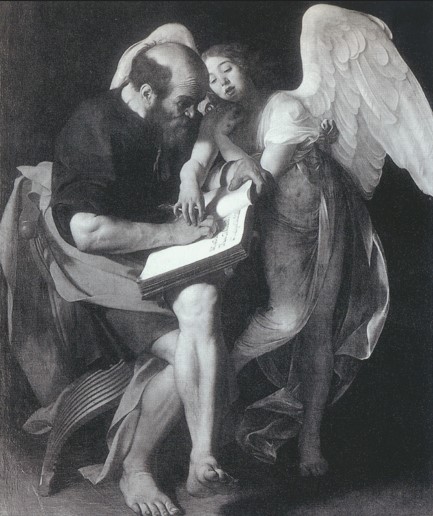
Calvin Coolidge (30)

“Isn’t it nice that Calvin is President? You know we never really had room before for a dog.” Grace Coolidge (1879-1957), First Lady of the U.S. (1923-1929), in 1927.

Grace Coolidge was the wife of the 30th President of the U.S., Calvin Coolidge. Throughout her husband’s career, whether as Governor of Massachusetts, Vice-President, or President, Grace Coolidge avoided politics. Though the young Grace broke off a marriage engagement to marry Coolidge, her mother advised against marrying this young man. Calvin Coolidge and Grace Coolidge married on October 4, 1905—and Calvin Coolidge never settled his differences with his mother-in-law who felt her daughter was completely responsible for his rising political fortunes. The Coolidges had two sons, John (1906–2000) and Calvin (1908–1924). After Calvin Coolidge, Jr. died of blood poisoning in July 1924, the Coolidges were inconsolable. The story is well-known: while playing lawn tennis with his brother, John, at the White House, the teenager developed a blister on one of his toes. Within the week, the 16-year-old was dead of a blood infection despite being admitted to Walter Reed Army Medical Center. (see- https://www.coolidgefoundation.org/blog/the-medical-context-of-calvin-jr-s-untimely-death/)

“Calvin Coolidge, President 1923 – 1929” by US Department of State is licensed under CC BY-NC 2.0.

By 1921, the wife of Vice-President Coolidge entered Washington society and quickly became the most popular woman in the capital. In 1927 when Mrs. Coolidge made these remarks, the world that her husband was facing was in flux. In 1927, as France called to outlaw war, which was endorsed by the U.S, a Great Depression already began in Germany with its economic collapse on “Black Friday.” After President Coolidge called for a Naval Disarmament Conference, only a couple of global powers showed up.

The world seemed to be getting smaller in 1927. In May 1927 American Charles Lindbergh flew solo, nonstop, from New York to Paris and started the era of transatlantic air travel. Regular transatlantic telephone service also began in 1927. In the U.S., as the stock market boomed, much of it on shaky credit, lawyers and doctors earned around 3½ times more than a teacher or factory worker. Baltimore-born “Babe” Ruth hit a record 60 home runs in New York.

The first full-length sound motion picture, The Jazz Singer, opened in 1927. In Chicago there was an important art exhibition of Chinese Buddhist art of the Wei Dynasty. In 1927, Hemingway published Men without Women; Willa Cather published Death Comes for the Archbishop; and Thomas Mann published The Magic Mountain. That year’s Pulitzer Prize went to Thornton Wilder’s second novel, The Bridge of the San Luis Rey. It told the story of people who unexpectedly die together in a rope bridge collapse in Peru and the friar who witnessed the accident looking to figure out the possibly cosmic answers as to why.

Lyndon B. Johnson (36)

“The days of transition from Kennedy to Johnson were as hard on me as they were on anyone else–harder. I was losing a dog and gaining a President I didn’t know. Not only didn’t I know him, I didn’t think I wanted to know him. He wasn’t boyish or good-natured or quick-witted like Kennedy and I heard him cussing out the help when things weren’t done fast enough.” Traphes Bryant, Dog Days at the White House, 1975.

In 1951, Traphes Bryant started out at the White House working as an electrician in the afternoons. Bryant moved on to respond to general maintenance calls including a broken White House elevator. In the 1950’s Bryant was already looking after the First Family’s pets, both for the Trumans and, later, the Eisenhowers. The line of work became official for Traphes Bryant in 1961 when John Kennedy became president.

Kennedy asked Bryant to become the new presidential kennel keeper. The president liked how Bryant trained the dogs to meet the presidential helicopter that would often be seen in photographs and films.

Though Kennedy himself was allergic to some animals, First Lady Jackie Kennedy adored all sorts of animals. During the next 1000 days while in office, the Kennedys kept several pets. At one point the first family, which included children Caroline and John, Jr., had nine dogs. The Kennedys also kept hamsters, horses, birds, a rabbit, and a cat. Some of the animals were gifts from foreign heads of state.

In 1961 Soviet Premier Nikita Khrushchev sent the Kennedys a mixed breed dog named Pushinka. The dog’s mother had been sent into orbit in 1960 on Korabl-Sputnik 2. While a surprise, the Kennedy’s welcomed the Russian’s canine gift. In fact, Kennedy’s Welsh terrier, Charlie, not only had a new companion but a new mate: Pushinka gave birth to four puppies fathered by Charlie. Kennedy called the litter, “the pupniks.”

Bryant was officially in charge of Pushinka’s and Charlie’s grooming, exercise, and diet—and all the rest though those responsibilities ended abruptly for Kennedy in November 1963.

see BRYANT, TRAPHES L.: ORAL HISTORY INTERVIEW – JFK #1, 5/13/1964; Traphes Bryant, Dog Days at the White House, 1975; Katherine Graham’s Washington, Knopf, 2002, pp. 542-43; https://www.facebook.com/WhiteHouseHistory/posts/traphes-bryant-pictured-here-had-been-a-white-house-electrician-since-1948-worki/3374666809225225/

“Nancy Dickerson wrote that ‘The LBJ social style was something of a shock to the capital. Starting right at the White House, the Johnson way was different…It’s difficult to comprehend the LBJ style because even by Texas standards he had large impulses. When the Johnsons said, ‘You all come,’ they meant it. Their lack of inhibition was new in Washington, a Southern city in the East. LBJ was a cowboy, and though that mythic figure is in the best American tradition, the Washington establishment, the press and the country were unaccustomed to a cowboy in the White House. The city shook its collective head.’ …However, the Johnsons gradually began to put their own mark on the city.” Katharine Graham, Katharine Graham’s Washington, Knopf, 2002, p. 458.

“What convinces is conviction. You simply have to believe in the argument you are advancing. If you don’t you are as good as dead. The other person will sense something isn’t there, and no chain of reasoning, no matter how logical or elegant or brilliant, will win your case for you.” Lyndon B. Johnson, quoted in Doris Kearns Goodwin, Lyndon Johnson and the American Dream, St. Martin’s Press, 1991, p. 130.

Jimmy Carter (39)

I always thought [President Jimmy] Carter was great…That kind of brain power made him the smartest president we’ve had in my time. His failing was as a politician. He did not know how to organize the White House and how to get along with Congress. Carter promised he was not going to work with the bureaucracy in Washington. He would be the people’s president.. He did it — and it doesn’t work. [Carter] proved that. Conversations with Cronkite: Walter Cronkite and Don Carleton, University of Texas at Austin, 2010, p.320.

The helicopter crash in the Iranian desert unfolded in the dead of night during Operation Eagle Claw on April 24–25, 1980—a mission meant to pull 52 American hostages out of Tehran. What began as a daring rescue quickly unraveled as sandstorms, mechanical failures, and miscommunication converged at a remote staging site known as Desert One. When a helicopter collided with a transport aircraft during an attempted refuel, a fireball lit up the desert floor, killing eight U.S. servicemen and forcing the mission to be abandoned. The tragedy exposed deep flaws in planning and coordination and became a defining moment for how the United States approached special operations for decades to come and an episode for continued diminishment of the Carter presidency in an election year by the Iran crisis. President Carter delivered this televised address from the Oval Office regarding the failed mission (Operation Eagle Claw) on April 25, 1980. .https://www.youtube.com/watch?v=F4D5_F6hz3I – retrieved March 2, 2026.
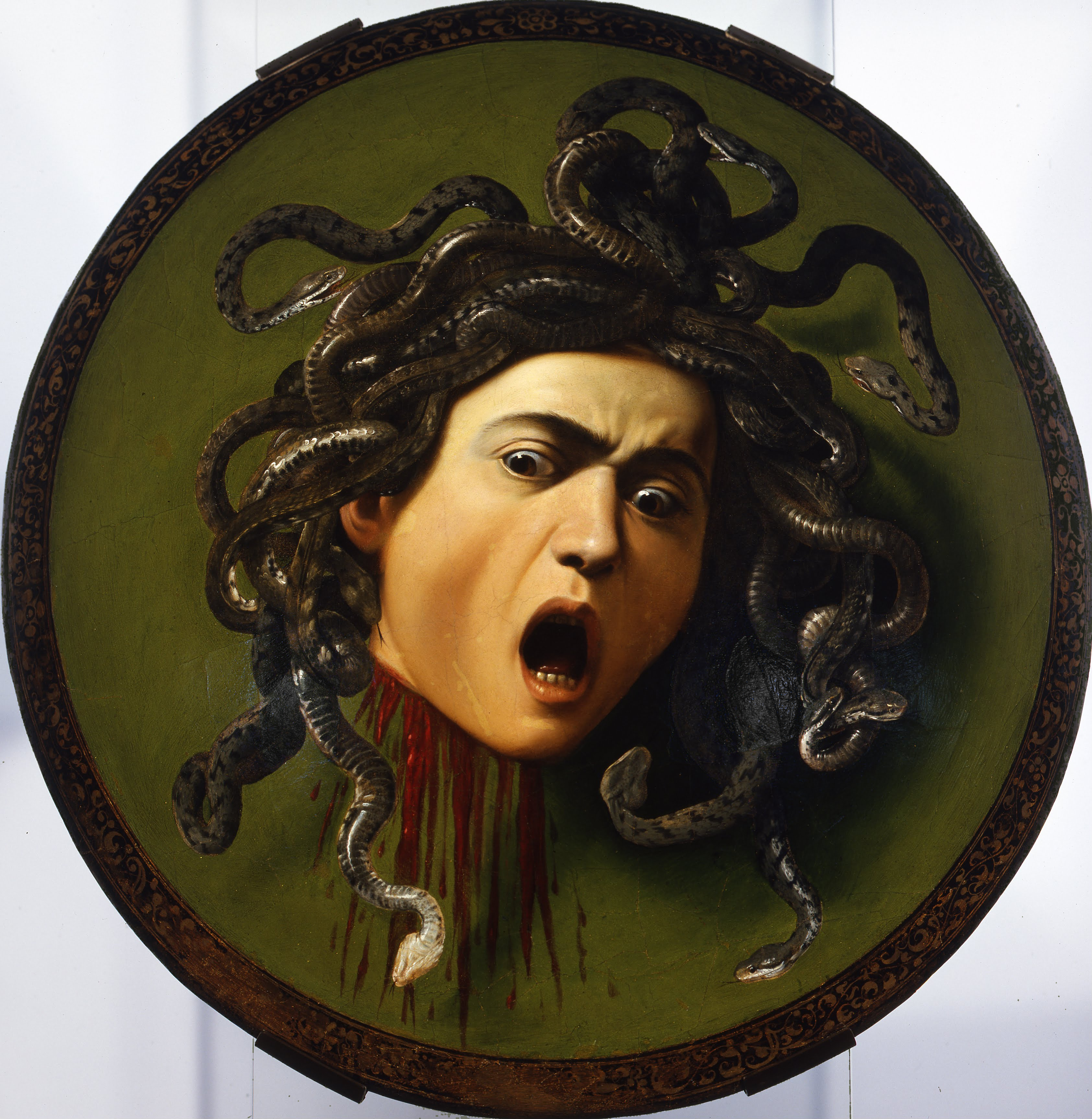
The Iranian Revolution was already gathering momentum more than a year before the seizure of 52 American hostages on November 4, 1979. As nationwide protests escalated in 1978, the Shah increasingly relied on Washington for guidance. In January 1979, facing mass demonstrations and a collapsing political order, he asked the Carter administration whether he should authorize a forceful crackdown. Washington declined to give a clear answer. According to historical accounts, U.S. officials were reluctant to endorse or appear complicit in violent repression, especially amid domestic political sensitivities in the United States during an upcoming election year.

The Shah, already politically weakened and personally hesitant to use large scale force, departed Iran shortly thereafter. President Carter later told the American public that he avoided direct intervention in Iran’s internal affairs, but archival material shows that his administration was divided. Secretary of State Cyrus Vance opposed supporting harsh measures, while National Security Advisor Zbigniew Brzezinski argued that the stakes for U.S. interests required difficult decisions and potentially firm action.

After the Shah’s departure, the United States dealt with a fragile interim government that lacked both authority and direction. Carter dispatched a senior military officer to Tehran, but U.S. guidance remained ambiguous. Iranian officials sought clarity on whether Washington supported efforts to halt the revolutionary movement; no definitive policy emerged. With no coherent strategy from either Tehran or Washington, the moderate government proved unable to contain events. In February 1979, Ayatollah Khomeini returned to Iran and rapidly consolidated power, sweeping aside moderate factions and establishing a revolutionary regime.

Carter’s broader approach combined pressure on the Shah to liberalize politically with sympathy for resisting Khomeini’s movement. Yet he struggled to enforce a consistent foreign policy. Internal disagreements, bureaucratic friction, and the president’s own reluctance to authorize forceful measures contributed to a policy vacuum at a critical moment. The resulting instability culminated in the November 1979 embassy takeover, when Iranian students seized the U.S. mission in Tehran and held American diplomats hostage for 444 days.

The hostage crisis dominated U.S. politics and overshadowed Carter’s presidency. The prolonged standoff, combined with economic challenges at home, contributed to his decisive loss to Ronald Reagan in the November 1980 election. – JPW March 2, 2026.

Harry S Truman (33)

“Just the day before, I’d joked about being the vice president when I addressed a group of newspapermen covering the Senate. One of them called me Mr. Vice President and I said, “Smile when you say that,” and I told them that the Senate was the greatest place in the world and that I wish I was still a senator. “I was getting along fine,” I said, “until I stuck out my neck too far and got too famous. And then they made me VP and now I can’t do anything.” But now I wasn’t the vice president any longer, and there was plenty to do.” Harry S. Truman, 33rd U.S. President, Where the Buck Stops: The Personal and Private Writings of Harry S. Truman, ed. Margaret Truman, 1989.

“Harry, don’t start out with an inferiority complex. For the first six months you’ll wonder how the hell you got here. After that you’ll wonder how the hell the rest of us got here.” James Hamilton Lewis (1863 – 1939), Illinois Senator and Majority Whip (1913-1919 and 1931-1939), Democrat. This famous piece of advice (below) was given by Democratic Senator J. Hamilton Lewis to a newly elected Harry S Truman upon his arrival in the Senate in 1935. 

Ronald Reagan (40)

“Do you know who the patient is in the emergency room?” “Yes.” “Would you give me his name, please?” I said, “It’s Reagan. R-E-A-G-A-N.” I waited for a reaction. “First name?” “Ron.” “Address?” I said, “1600 Pennsylvania.” His pencil stopped in mid-scratch. He finally looked up. “You mean…?” I said, “Yes. You have the president of the United States in there.” Michael K. Deaver at George Washington University Hospital in Washington, D.C. after the assassination attempt on President Reagan on March 30, 1981. From his Behind the Scenes, 1987.

On Monday afternoon, March 30, 1981, after giving a speech at the Washington Hilton Hotel at 1919 Connecticut Avenue, N.W., in Washington, D.C., President Reagan was shot by 25-year-old would-be assassin, John Hinckley, Jr. The president was slammed to the floor of the presidential limousine by a Secret Service agent during the first split seconds of the shooting in a bid to save his life. Later Reagan expressed his anger for being treated very roughly by the agent though the agent knew he was just doing his job. Under a pile of agents, the 70-year-old president was raced in the limousine to George Washington University Hospital about a mile away.

At first it was believed that the president was unhurt, but within minutes, still on the way to the emergency room, Reagan coughed up blood from his lungs.

At the hospital, the president walked on his own power about 15 yards into the emergency room. Once inside the hospital, Reagan slumped and was helped by Secret Service agents into a private room off the lobby.

As the hospital’s trauma team assembled, it was still not clear whether Reagan had been hit or not in the hail of 6 bullets shot in quick succession by the would-be assassin’s .22 caliber gun. Bullets struck James Brady, Reagan’s Press Secretary, in the head above his left eye; Secret Service agent Timothy McCarthy in the chest; and D.C. police officer Thomas Delahanty in the back of his neck ricocheting off his spine. All of them would receive medical attention and survive.

The doctors were just starting their examination of the president when a green smocked-hospital orderly with a clipboard approached Michael K. Deaver, White House Deputy Chief of Staff and Reagan confidante, looking for information on the new patient. It soon became clear that Reagan had, indeed, been hit in the assassination attempt. A fragment of a bullet had ricocheted off the limousine’s armored car door and entered the new president below the armpit, traveled down his left side, bounced off a rib, punctured his lung, and stopped just inches from his heart.

By exploring personal recollections, memoirs, letters, speeches, and eyewitness accounts, the truly eclectic nature of the presidency over nearly 250 years is revealed. Digging into character studies, historical episodes, poignant quotations, and presidential sites deemphasizes myth for leaders who are real, complex individuals. The definitive thread running through presidential history is how unique personalities must confront the crushing burdens of leadership, and how their legacies continuously evolve over time.