


FEATURE IMAGE: A classic publicity still from the 1940 The Three Stooges short film, A Plumbing We Will Go. In this celebrated short, the Stooges pose as professional plumbers to evade the police, only to completely destroy the infrastructure of an upscale mansion. While working on the upstairs bathroom, Curly proceeds to build a labyrinth of pipes that completely traps him inside the bathtub area. In this specific behind-the-scenes promotional shot, the trio leans heavily into their vaudeville roots, playfully treating their disastrous plumbing gear like show business equipment with Curly Howard using a shower attachment as a mock microphone; Moe Howard holding piping, mimicking an old-style broadcaster or telephone operator; and Larry leaning in to listen in. PHOTO: Jerry (Curley) Howard, Moe Howard and Larry Fine are The Three Stooges. “The Three Stooges” by twm1340 is licensed under CC BY-SA 2.0.
A century after their founding in 1922, The Three Stooges remain among the most enduring acts in American popular entertainment, their unique blend of slapstick comedy, physical performance, and anarchic humor transcending generations and demonstrating the lasting appeal of vaudeville traditions in film and television.
A Plumbing We Will Go (1940) is widely considered by film historians and fans to be one of the absolute best entries in the Stooges’ library. Curly Howard himself regularly cited it as his personal favorite out of the 190 shorts they filmed for Columbia Pictures.
Complete Filmography: Every Title Card in The Three Stooges (1934-1959)
Moe and Larry appeared in all of them. Curly in 19; Shemp in 6; and Joe in 1.
The Stooges began in 1922 as part of a vaudeville act called “Ted Healy and his Stooges.” It started with two stooges originally – brothers Moe and Shemp Howard. Larry Fine joined the act in 1925 or shortly thereafter. Their first Hollywood feature (with Ted Healy) was called Soup to Nuts in 1930. The Stooges worked with Healy until 1934. In that time Shemp broke off on his own to work for Warner Bros. Vitaphone and Jerry Howard, Moe’s younger brother, joined the act as Curly.
Between 1934 and 1958 The Three Stooges made over 90 two-reel shorts featuring their ribald comedy. Starting in 1934 and until the end of the 1950s, The Three Stooges had 26 different opening credits.

This title card is from The Big Idea (1934), the fifth and final short film that Ted Healy and his Stooges made to fulfill their studio contract with Metro-Goldwyn-Mayer (MGM). Though often confused with their 1930 Fox feature Soup to Nuts, this specific short marks the exact turning point where the iconic trio finally split from Healy to establish their own legacy.
MGM used this series of comedy shorts primarily to repurpose deleted musical numbers and stock footage from big-budget feature films like Dancing Lady (1933) and Going Hollywood (1933). By the time The Big Idea was released in May 1934, the Stooges had already finished shooting their scenes and were physically walking out the door to start their independent careers.
Shemp Howard was the original third member of the act and the star of their 1930 film Soup to Nuts. He walked out much earlier, in August 1932, because he completely ran out of patience for Healy. His departure opened the door for his younger brother, Jerry, to shave his head and step in as “Curly.” PHOTO: “The Big Idea (1934)” by twm1340 is licensed under CC BY-SA 2.0
In chronological order, all The Stooges’ opening credits from 1934 to 1958.
All opening credits and major brand updates IN BOLD:
1934 1 2 3 4
1935 5 6 7 8 9 10
1936 11
1937 12
1939 13
1940 14 15
1943 16
1945 17 18
1946 19 (Last Curly) 20 (Shemp)
1947 21
1950 22
1952 23
1953 24 25
1958 26 (Joe Besser)
In 1934 there were 4 updates; 6 in 1935; 1 each in 1936, 1937, and 1939; 2 in 1940; 1 in 1943; and 2 in 1945. The 9th (1935), 12th (1937), and 13th (1939) versions were significant brand updates for the Stooges’ opening credits. In 1946 there were 2 updates – Curly’s last and Shemp’s first. In the postwar years there were less updates – one each in 1947, 1950, 1952, and 1953.
Moe’s brother, Curly, died in 1952 after a long illness. Shemp died suddenly from a heart attack in 1955. Though Curly and Shemp’s comedy styles are very different from one another, they are both equally very funny. Though similar in body type to Curly, Joe Besser brought his own unique comic personality to the act from 1956 to 1958. Joe Besser passed away in 1988.

Shemp in the 1949 The Three Stooges short film, Who Done It? The Stooges play private investigators for the “Alert Detective Agency” who are hired to find a missing millionaire. While searching a spooky mansion, Shemp tries to look through a large vintage bellows camera to check for fingerprints. looking through the lens, Moe steps directly in front of it. Terrified by the extreme close-up of Moe’s face, Shemp screams: “Moe! Larry! Help! There was an ugly-looking thing staring right at me, it was horrible!”.
In August 1932, when Shemp left Ted Healy and his Stooges, was it a good move? Free from Healy’s control, Shemp immediately landed a lucrative solo contract at Vitaphone Studios in 1933. He spent the next 14 years becoming a highly successful, stable, and well-paid Hollywood character actor, appearing in major comedies alongside stars like Abbott and Costello and W.C. Fields. He only rejoined the Stooges much later in 1946 out of deep family loyalty to help his brother Moe after Curly suffered a career-ending stroke. PHOTO: The Official Stooges Flickr Photographer In Action” by Larry He’s So Fine is licensed under CC BY-NC 2.0.
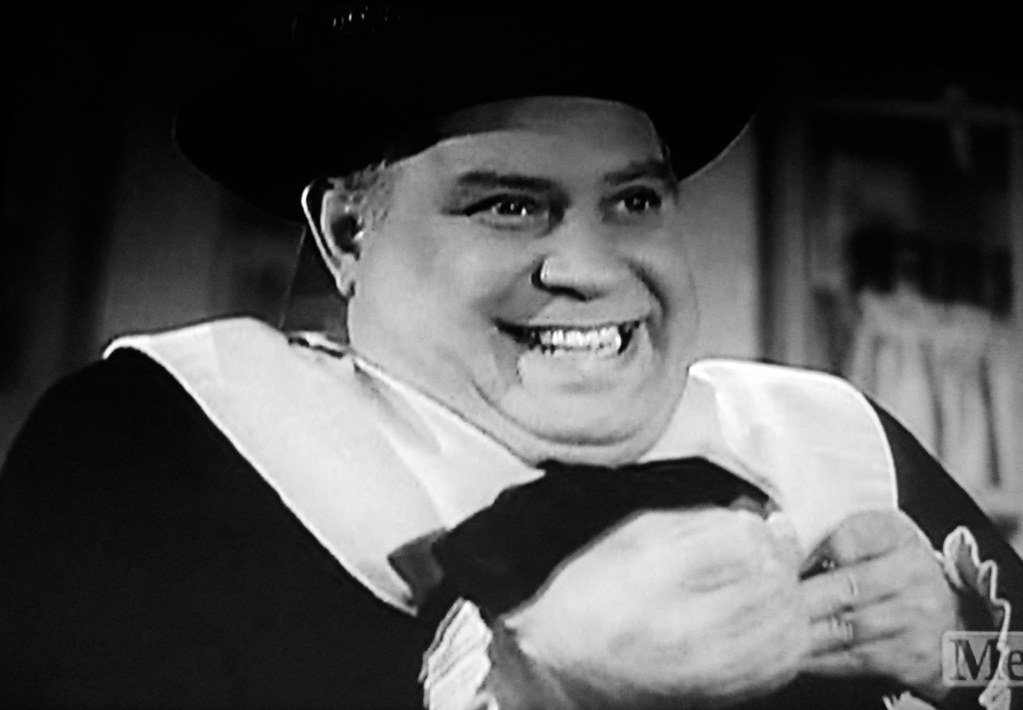
While audiences recognize Besser for his short-lived, late-career stint as the third member of The Three Stooges (from 1957 to 1959 replacing Shemp Howard who replaced Curly Howard), classic television enthusiasts frequently cite Joe Besser in his signature role as Oswald “Stinky” Davis on The Abbott and Costello Show as his finest comedic hour. PHOTO: “Joe Besser as Stinky Davis – Abbott and Costello TV show 9367” by Brechtbug is licensed under CC BY-NC-ND 2.0.
In 1959 Columbia Pictures released Three Stooges shorts for the first time on television. TV broadcasts in the 1960’s brought a new generation of fans to The Stooges. In 1970 The Stooges were scheduled for a new TV sitcom series but Larry Fine had a paralyzing stroke in January of that year..

Columbia Pictures’ “Torch Lady” logo is inextricably linked to The Three Stooges, serving as the visual gateway to over 190 classic short films produced for exclusively for Columbia Pictures between 1934 and 1957. The emblem represents the era that spanned across the careers of all the primary Stooges—Moe, Larry, Curly, Shemp, and Joe Besser—as they built their timeless legacy under the Columbia banner. This particular bronze casting is located embedded in the granite paving of Leicester Square in London, England. Leicester Square is widely celebrated as the historic heart of the United Kingdom’s cinema scene and the primary home for star-studded film premieres. PHOTO: “Hand prints in Leicester Square, London – Columbia Pictures – Torch Lady” by ell brown is licensed under CC BY 2.0.
Both Larry and Moe died in 1975. Eight years later, in 1983, The Three Stooges were inducted onto the Hollywood Walk of Fame.
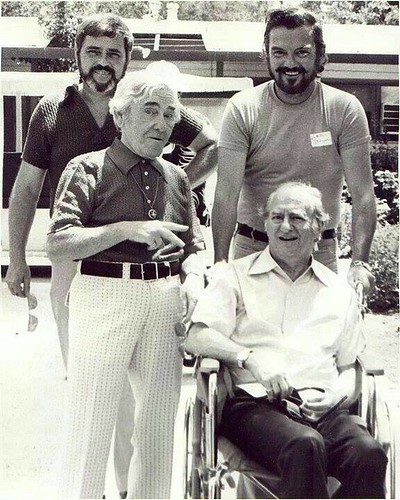
In 1973, at the Motion Picture & Television Country House and Hospital in Woodland Hills, Los Angeles, California, Moe is jokingly preparing his iconic two-finger eye poke gesture toward Larry’s face, showing that their classic humor was alive and well. In January 1970, Larry Fine suffered a paralyzing stroke that ended the Three Stooges as a performing act. He moved into the Motion Picture Country House for long-term care. Moe Howard remained a deeply loyal friend and visited Larry constantly at the facility. With The Stooges are members of the Star Trek TV series, “Scotty” Scott (James Doohan) and Klingon Captain Koloth (William Campbell). PHOTO: “Star Trek James Doohan, William Campbell squire of gothos, stooges Moe Howard Larry Fine” by Sal Ami is licensed under CC BY 2.0.


