


FEATURE Image: Raphael, Portraits of Agnolo Doni and Maddalena Doni, c. 1506, oil on panel, 24 ¾ x 17 ¾” Pitti Gallery, Florence.

INTRODUCTION.
Urbino, Florence, and Artistic Formation Born in Urbino in 1483, an environment rich in the arts and humanist learning, Raphael had a remarkable capacity for personal growth and branded new incarnations of his artistic style regularly. He moved to Florence toward the end of 1504. Giorgio Vasari in his chapter on Raphael describes an episode where the artist of Urbino, already in his thirties with a reputation as a master, went back to study the nude (male) form with Michelangelo as his guide. Vasari’s admiration in telling this story goes beyond Raphael’s humility in assuming the role of student again (he studied constantly anyway) but that his learning always improved his artistic output.
Learning from Perugino, Leonardo, and Michelangelo In the study of nudes, however, artistic growth came perhaps not as the artist expected or intended. Whether Raphael entered the workshop of Perugino at that time or, as seems more likely, many years later when he was already an acknowledged artist, he quickly mastered Perugino’s delicate, ornamental style, with its open landscapes and gentle figures. It was said that contemporaries had trouble distinguishing Perugino’s work from Raphael’s, but Raphael’s compositions were more sophisticated even when he was a young artist. While Raphael mastered Michelangelo’s (and Leonardo’s) art forms convincingly, he also realized he was no match for the creator of the Sistine Chapel and other chiseled works insofar as the nude male forms.1
Testing Limits and Discovering Strengths Yet Raphael consolidated his strengths by testing his limits. A major strength, Vasari believed, was Raphael’s ability to draw and compose a wide range of subjects, such as landscape, architecture, draperies, and the human figure. Up to that time that had been what the artist was doing and would now unflinchingly continue to do on a grander scale, for example, in the Stanzae.
Rome and the High Renaissance Ideal In 1508 the pope called Raphael to Rome. Influenced by the idealized, classical art of the city’s ancient past, Raphael’s work took on a new grandeur. He also responded to the more energetic and physical style of Michelangelo, whose works he had already begun to study in Florence. Vasari believed Raphael had the gift to congeal the “poetic moment” by depicting in his painting the most significant gesture and force of action. With the possible exception of Leonardo, he is probably the unparalleled master of excellent design.2
Raphael and the Popes The precocious Raphael Sanzio also benefited from early opportunities given to him by his father to cultivate his talent. The artist’s own determination to succeed in his métier paid off when he was summoned to work at the Vatican by the Pope in 1509, arguably the greatest art patron in an age of art patrons. 3 The early sixteenth century was an age where patrons were as luminous as their artists and the coming together of Raphael and Julius II, and later Leo X, made for a celebrity team.
Vasari’s Judgment of Raphael While Vasari meticulously tells the reader of the artist’s “judicious” character – and that Raphael was extremely “amatory” and implying it aided in his death – the chronicler describes, often from memory, his preferences in Raphael’s art work. His collective response, for example, to all four frescos in the Camera d’Eliodoro is that he is most impressed by Raphael’s interesting decorative details, beautiful movements and gestures, the sheer number of figures portrayed, and his ability to express complex ideas and stories on a two-dimensional surface.4
Raphael’s Enduring Legacy With Leonardo da Vinci (1452-1519) and Michelangelo (1475-1564) Raphael is one of the great masters of the High Renaissance. Raphael and his large team of assistants left behind a large body of influential work, especially in the Vatican where the artist spent the last 12 years of his life, although Raphael died at 37 years old. For most of the history of Western art, the easy grace and harmonious balance of Raphael’s style has represented an ideal of perfection. His work became widely influential through the dissemination of prints. Raphael was also the city’s leading portraitist, creating penetrating psychological images that engaged viewer and sitter with a new intensity.
FROM URBINO TO FLORENCE: THE FORMATION OF A MASTER
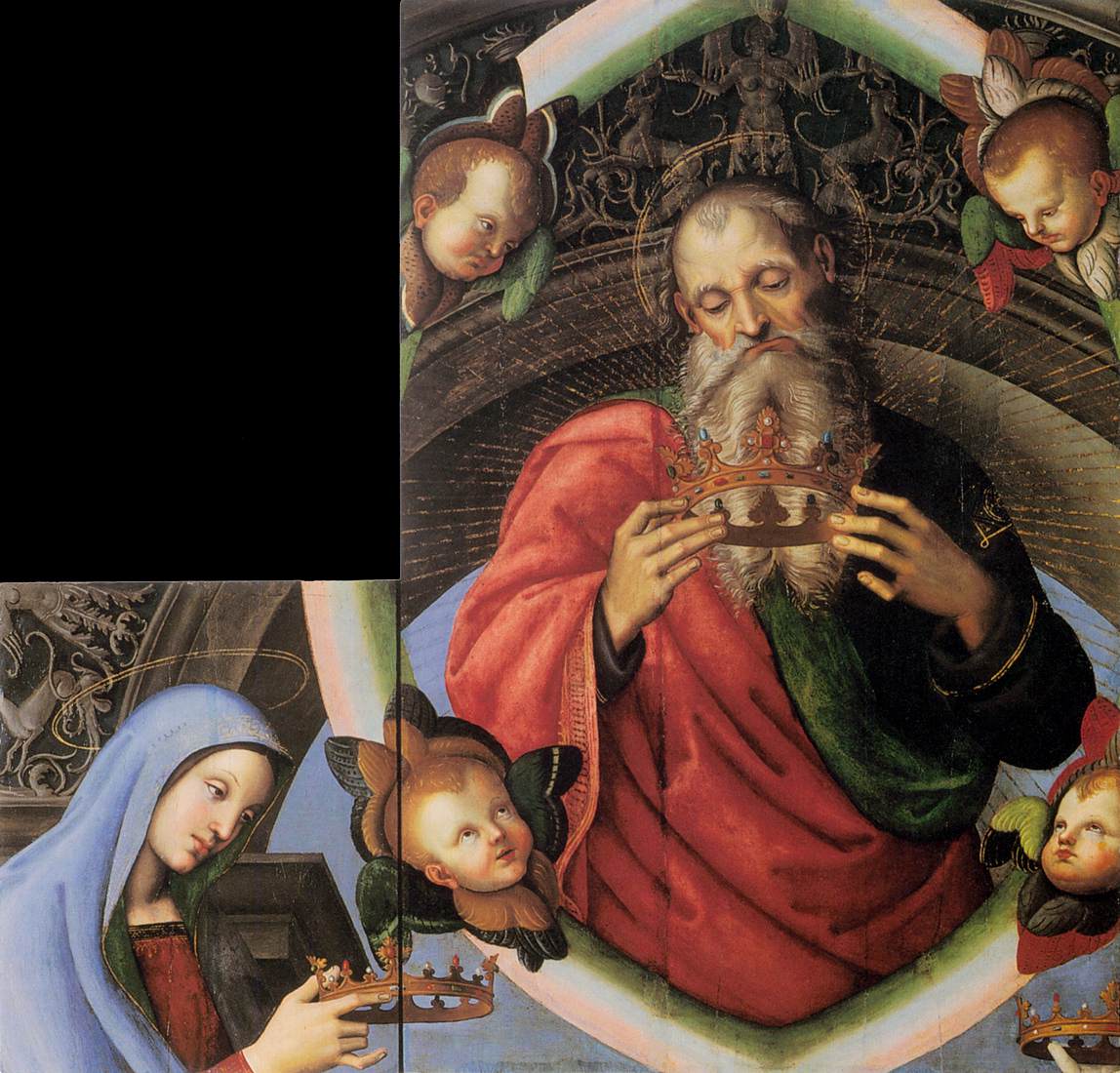
The Baronci Altarpiece is Raphael’s first recorded commission. It was made for the patron’s chapel in the church of Sant’Agostino in Città di Castello, a commune between Arezzo and Urbino, north of Perugia. In 1789 the artwork was badly damaged in an earthquake and surviving fragments were acquired by the Vatican until they mysteriously dispersed in the mid-19th century and found their way into different collections. Raphael’s commission of 1501 was to paint a large altarpiece dedicated to the Augustinian saint Nicholas of Tolentino (c. 1246– September 10, 1305). Nicholas was canonized by Augustinian Pope Eugene IV in 1446. While today’s saints require 1-2 miracles, St. Nicolas Tolentino was credited at his canonization with 300 miracles – including 3 resurrections. (see – Encyclopedia of the Middle Ages, Volume 2, André Vauchez, Richard Barrie Dobson, Michael Lapidge. Chicago: Fitzroy, Dearborn, 2000).
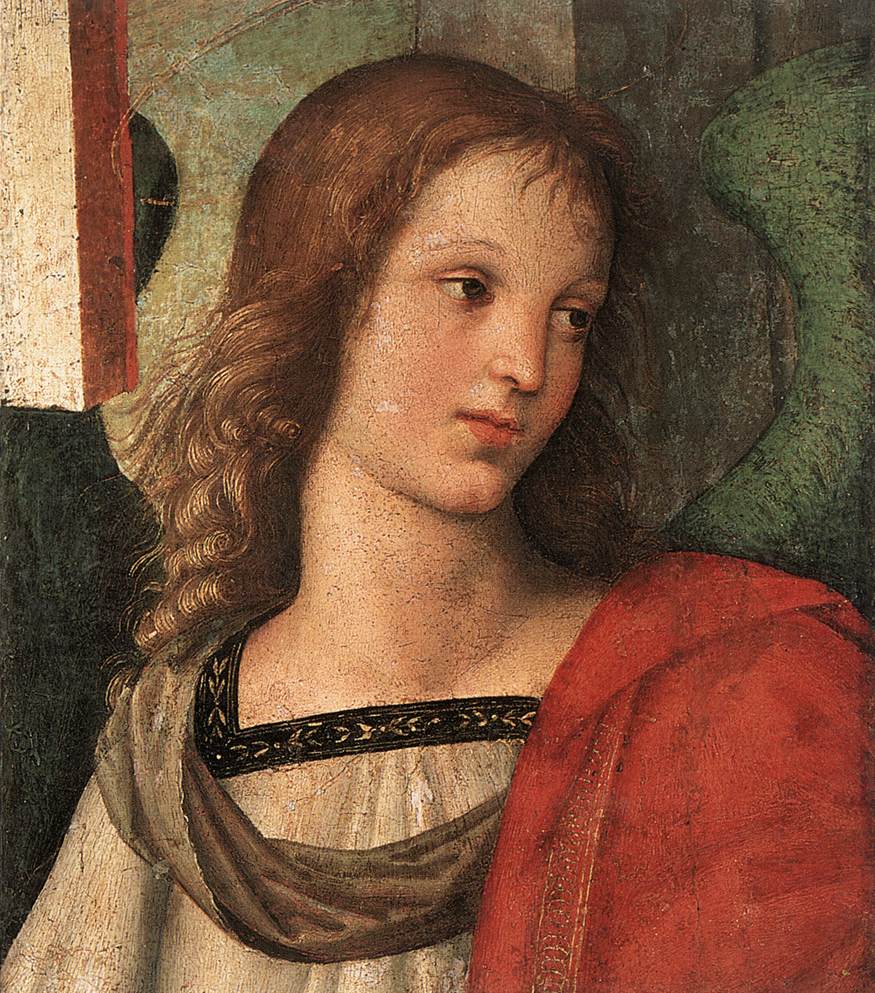
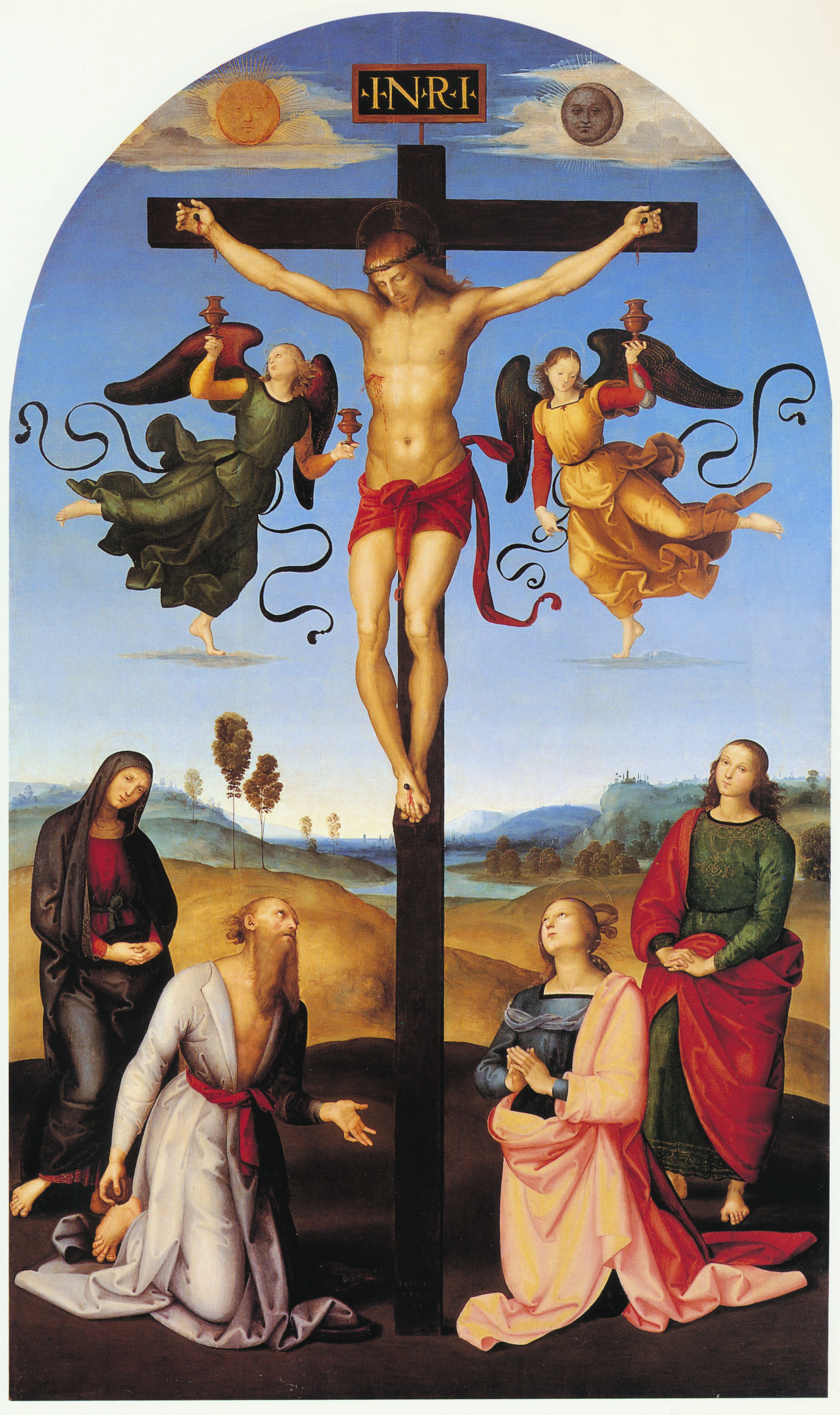
The Crucifixion was done in 1503 for Domenico Gavari for his S. Domenico chapel in Città di Castello. Angels are poised on toes on a cloud as their cups catch Christ’s dripping blood. Mary Magdelene and St. Jerome (holding a rock) are on their knees while the Virgin Mary and St. John stand. The sun and moon in the sky was characteristic of Crucifixion paintings in Umbria (p. 13, Jones & Penny). It was bequeathed to the National Gallery in 1924. Gavari was a close friend of Andrea Baronci, for whom Raphael painted the Saint Nicholas of Tolentino Altarpiece for the church of S. Agostino, also in Città di Castello. Saint Jerome, of course, was not present at the Crucifixion but is included in this scene because the chapel was dedicated to him. The overall design is based on several versions of the crucified Christ in a landscape painted by Perugino in the late 1480s and 1490s, and is especially similar to his altarpiece of the Crucifixion for the convent of S. Francesco al Monte in Perugia, commissioned in 1502 and completed 1506. https://www.nationalgallery.org.uk/paintings/raphael-the-mond-crucifixion – retrieved September 5, 2024.

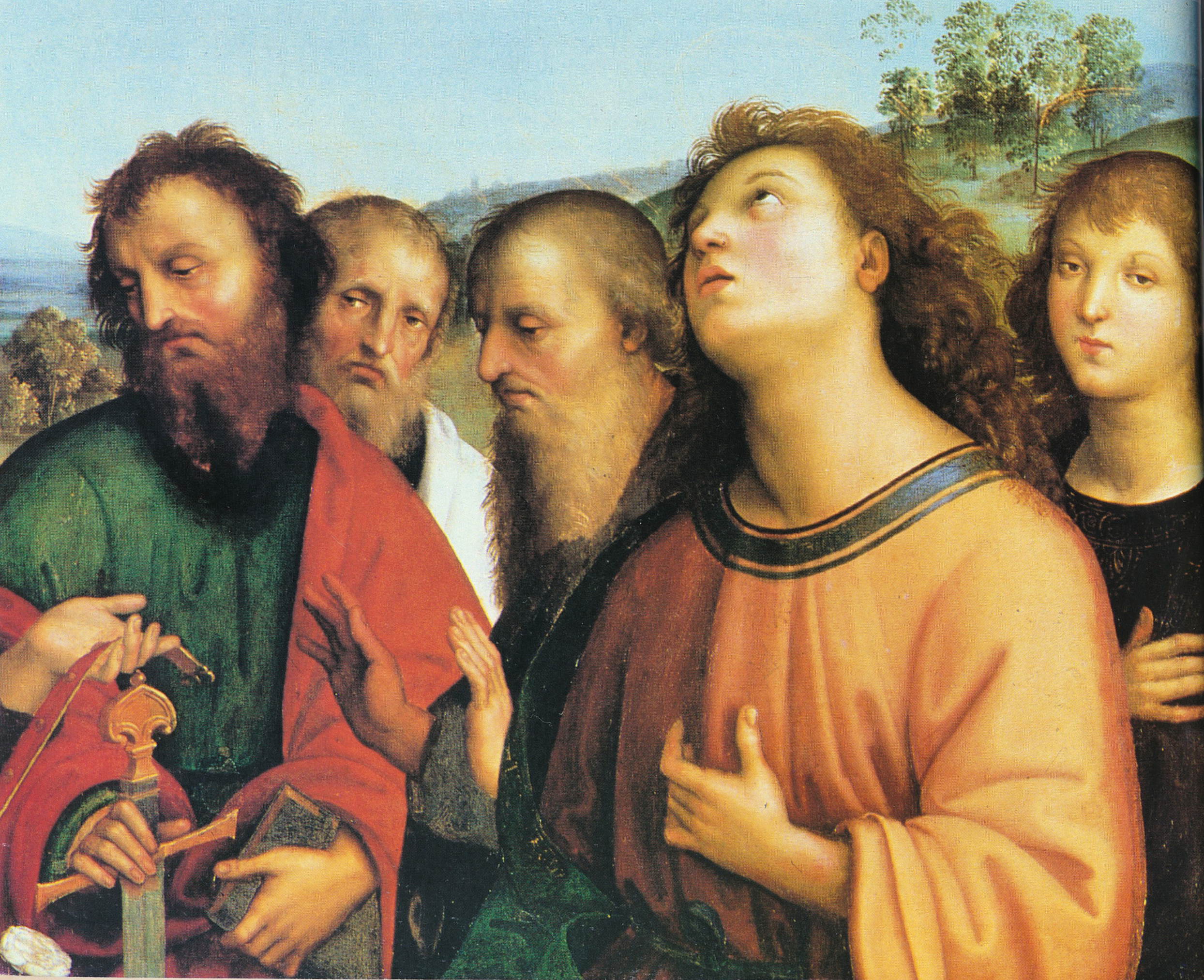
Raphael painted altarpieces for the Augustinians and Dominicans and the Oddi Altarpiece (above and below) was done for the Franciscans. It was commissioned by the Oddi family chapel in S. Francesco al Prato. The Oddi were in exile from Perugia since 1495 because of battles between families and returned in 1503. The altarpiece was part of honoring their family members. The painting is divided into an upper part depicting the coronation of the Virgin and, in the lower part, the Apostles at the time of the Assumption. In the center, the apostle Thomas holds the Virgin’s girdle that the Virgin lowered to him as a token of these supernatural events. This display of theology was precious to the Franciscans at the time who were promoting the Virgin Mary. They were likely very involved in directing the artist in its composition. (Roger & Jones, pp. 15-16).
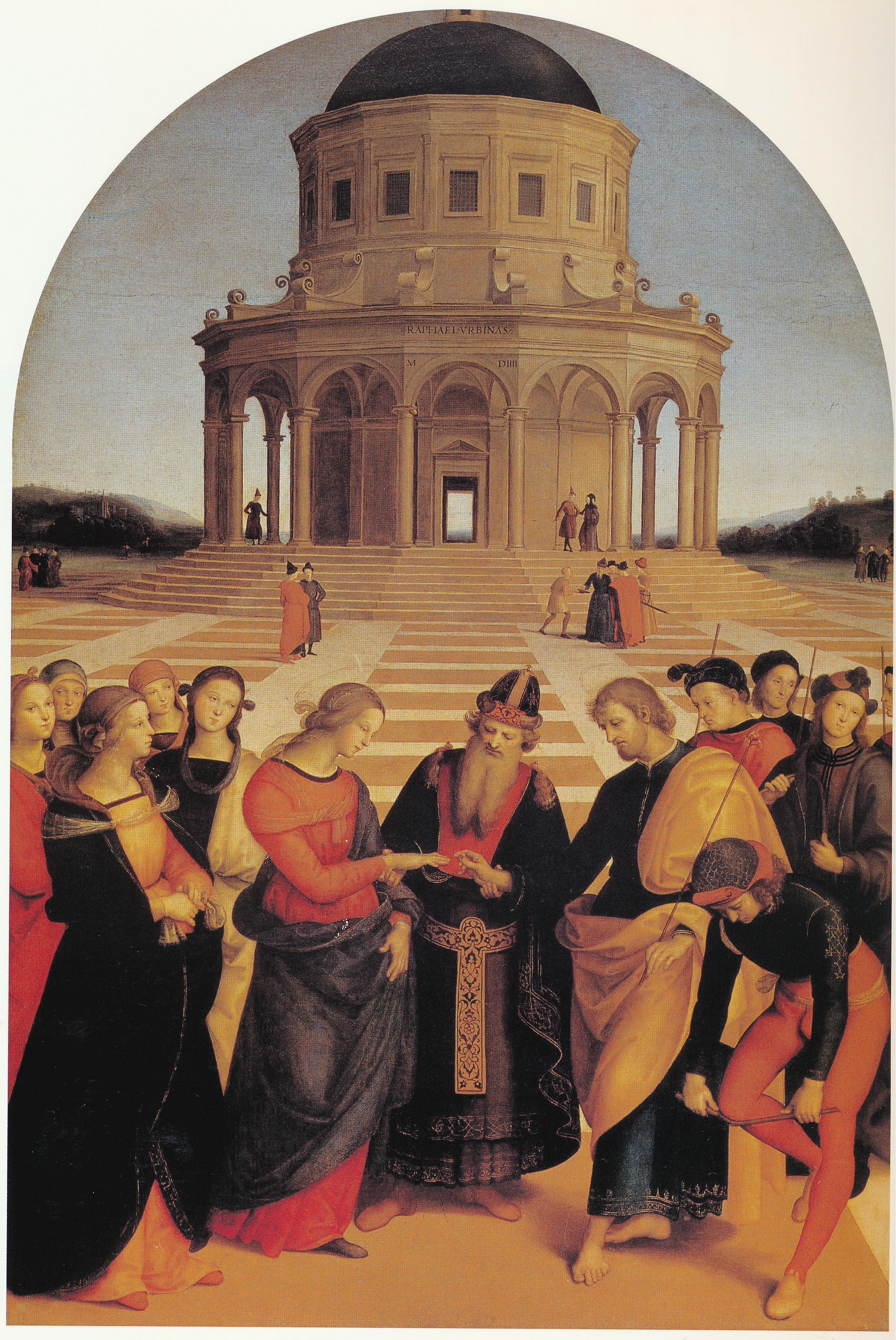
The composition of the Spozalizio reflects the influence of Perugino, specifically the fresco done by him in the Sistine Chapel in 1484. In terms of its architectural setting, Raphael was influenced by Piero della Francesca (c.1416-1492) and Bramante (1444-1514). The painting’s architectural structure shares centrality in the painting with the foreground figures done in a perspectival arrangement. Within the figures are members of the party positioned in depth. Joseph places a ring on Mary’s finger whose positioning bisects the artwork. A tawny gold tone pervades the painting. It was commissioned by the Alberini family for a chapel in S. Francesco of the Friars Minor at Città di Castello in Perugia. (Brera Milan, p 34)

Raphael painted the Colonna Altarpiece for the Franciscan convent of Sant’Antonio in Perugia. It hung in a part of the church reserved for the nuns. The pair of voluminous saints straddling each side of the throne reflect the progressive style of Leonardo da Vinci and Fra Bartolomeo (1472-1517) that Raphael was studying in Florence. The lunette above the main panel depicts God the Father holding a globe and raising his right hand in blessing situated between two angels and two seraphim. https://www.metmuseum.org/art/collection/search/437372 – retrieved September 5, 2024.

The Small Cowper Madonna includes an agreeable background landscape. In a vertical painting, a haloed woman and nude child sit before an expansive grass field extending behind them to a group of trees and buildings on a hill in the distance among hazy blue hills beneath a blue sky. https://www.nga.gov/collection/art-object-page.1196.html – retrieved September 8, 2024.
St. Michael the Archangel vanquishing Satan and Saint George slaying the Dragon.
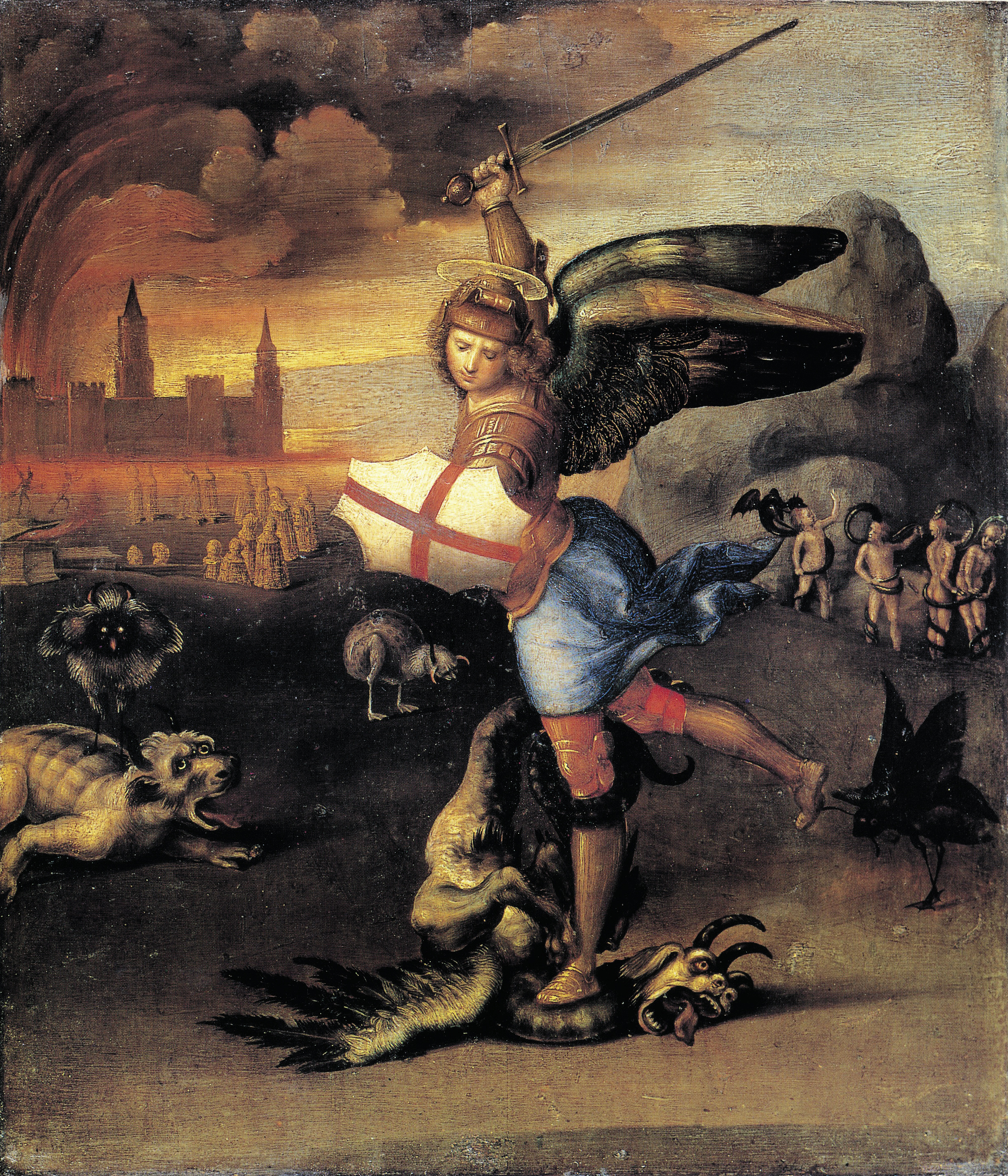
These early works by the artist depict the popular subjects of St. Michael the Archangel vanquishing Satan and Saint George slaying the Dragon, each showing the martial subject of good combatting evil. These were early private commissions for the court of Urbino. Saint George was a Christian Roman soldier who, pious legend informs, subdued a dragon and, with the daughter of a pagan king, brought it to the city, where St. George killed it with his sword. These heroic actions witnessed by the king and his subjects led to their conversion to Christianity. The historic figure of Saint George was martyred around the year 290. https://www.nga.gov/collection/art-object-page.28.html – retrieved September 4, 2024.


The panel of The Three Graces was recorded in the Borghese collection in 1650. It accompanied the Dream of Scipio, an oil on panel, today in the National Gallery of London. The figures were derived from ancient classical sculpture and depict, likely, Chastity, Beauty and Love. Chastity’s lower torso is veiled and an arm covers her breasts from view. Amor’s breasts, by contrast, are revealed. Chastity also wears no adornment as do Beauty and Amor. While the figures are modeled similarly, the space between them is disparate and Beauty blocks Chastity’s leg. (Jones & Penny, p. 8; Beck, pp. 62-63).

Agnolo Doni (above) is the only Florentine portrait in these first years mentioned by Vasari though paired with its companion portrait of Maddalena Doni (below). Doni was an art collector who married the daughter of Giovanni Strozzi in 1503. Agnolo was 10 years older than his wife who was in her teens. The portraits are painted on identically sized panel and are intended to hang next to one another. Raphael took great care in depicting the corporeal reality of his subjects, particularly appreciated in their faces and hands (though Agnolo Doni’s portrait is more detailed than his wife’s.) In both Doni portraits the sitters show-off their jewelry – such as rings and, in Maddalena’s portrait, a large pearl hanging around her neck. (Roger & Penny, p. 29-30)


Raphael’s Madonna del Granduca (The Madonna of the Grand Duke), a quintessential masterpiece of the High Renaissance painted around 1505–1506. The figures emerge from a stark, dark background that was added in the 17th century. Originally, Raphael painted a window opening to a landscape behind the Madonna. Raphael utilizes Leonardo’s sfumato technique—the subtle, smoky blending of colors and tones—visible in the gentle shadows defining Mary’s eyelids, chin, and the soft flesh of the infant. The painting gets its name from Ferdinand III, Grand Duke of Tuscany, who purchased it in 1799.
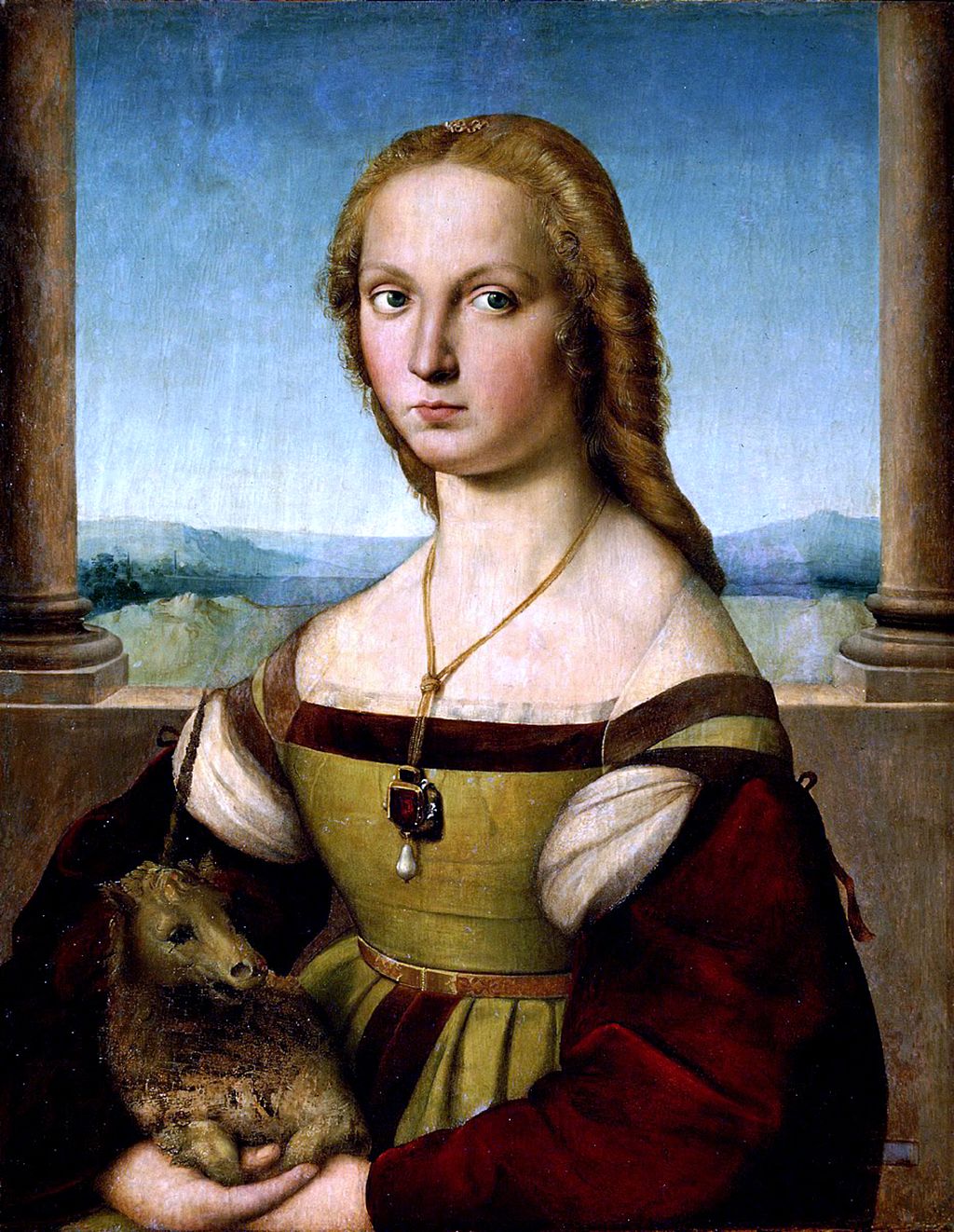
Lady with a Unicorn was of uncertain attribution until recent times. In the 1760 inventory of the Gallery, the subject of the painting was identified as Saint Catherine of Alexandria and attributed to Perugino. A restoration of the painting in 1934 revealed a unicorn, the medieval symbol for chastity, and led to the painting’s attribution to Raphael. In 1959 an x-ray revealed a small dog under the unicorn which symbolized conjugal fidelity. https://en.wikipedia.org/wiki/Young_Woman_with_Unicorn – retrieved September 7, 2024.

Visible on The Canigiani Holy Family on the hem of the Madonna’s scarf is inscribed, “Raphael Urbanas.” The fresco and easel painter was active mainly in Umbria, in Florence after 1504, and in Rome in 1509 until his death. It was painted for Domenico Canigiani where Vasari saw it later. It entered the Medici collection and when a Medici daughter married an Elector Palatine it accompanied her over the Alps to Germany. (Pinakothek Munich Great Museums of the World, Roberto Salvini, et. al., Newsweek NY 1969 pp. 126). In Raphael’s Florentine period, his work marks A transition away from the rigid, flat style of his master Perugino toward a more humanized, emotionally complex, and three-dimensional portrayal of sacred figures.
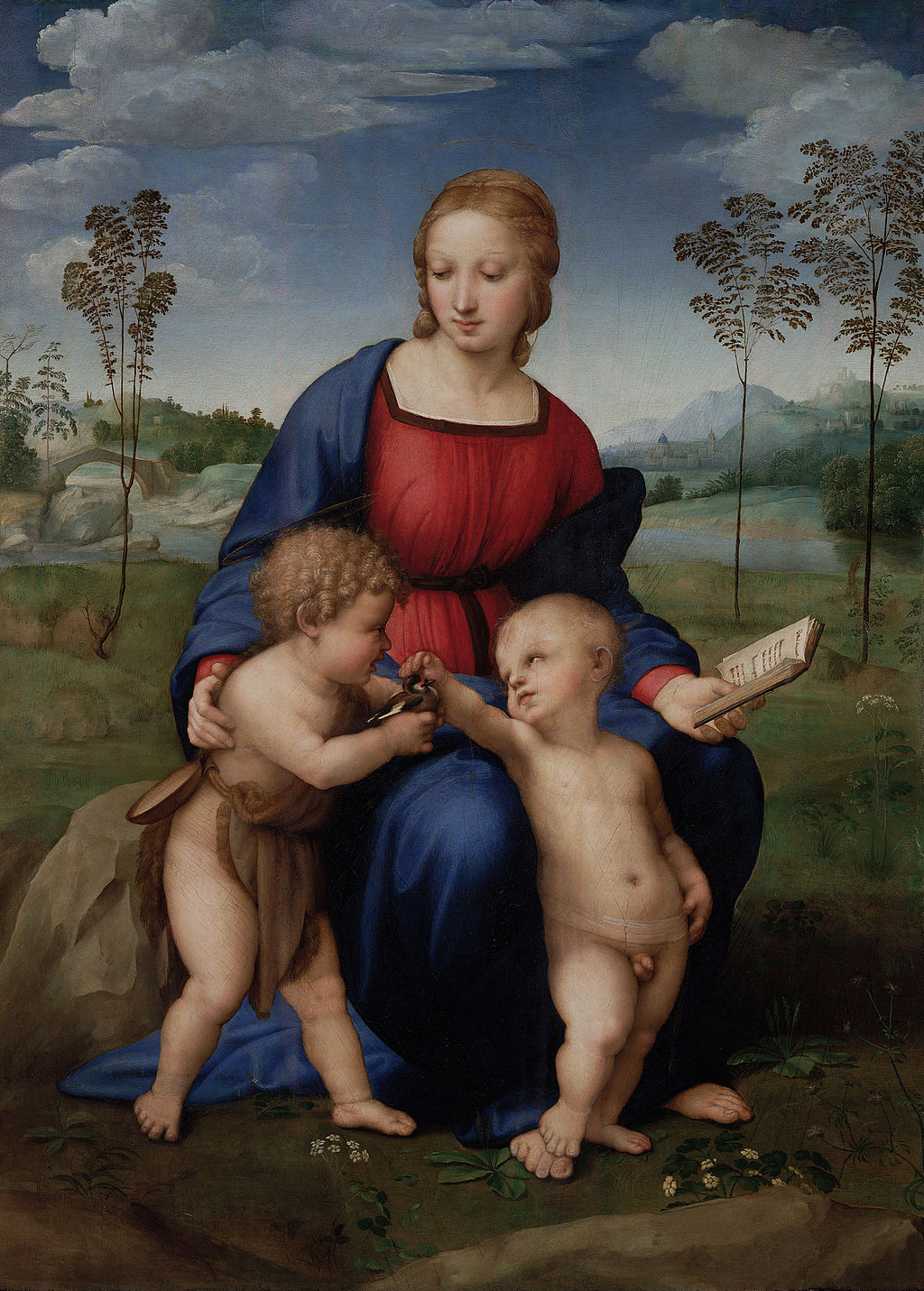
The three figures in Madonna del Cardellino are closely integrated and display a greater sense of volume. The painting is dated 1507 on the hem of the Virgin’s garment. In the painting Saint John the Baptist presents a goldfinch (cardellino) to the Christ child which is a symbol of the Passion. (Roger & Penny, p. 33)

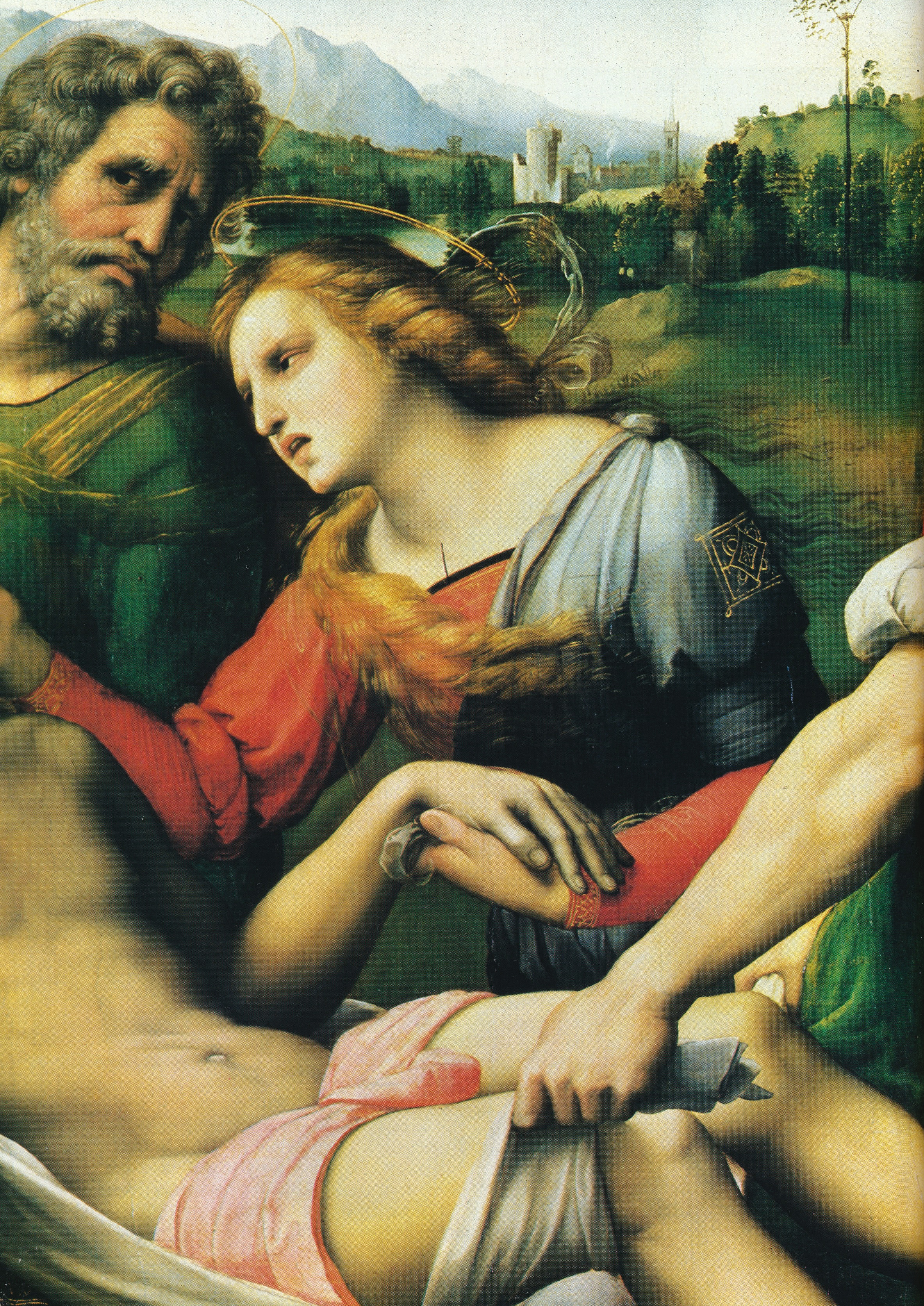
After seeing Leonardo’s Battle of Anghiari and Michelangelo’s Battle of Cascia in Florence Raphael’s style immediately applied their innovative principles changing the trajectory of his artwork. Leonardo da Vinci and Michelangelo were in a pitched battle for the future of art during their fabled competition to decorate the Great Council Hall in Florence. Raphael studied closely these complex drawings of heroic violence. Though Raphael was familiar with violent combat in Perugia and elsewhere, it was its depiction in these artworks in Florence that such dynamic convolutions began to appear in his own work such as The Deposition (above and below) although he may have had in mind Perugino’s Lamentation over the Dead Christ from 1495. In the finished painting the action takes place from right to left: a group of women attending to a swooning Virgin to the Magdalene grasping Christ’s hand to look into his face. (Roger & Penny, pp. 37-44).

In La Belle Jardinière the arch-topped Madonna painting features Saint John the Baptist kneeling before the Christ child. It was Leonardo da Vinci who formulated the pyramidal structure for the Holy Family and half-length portrait, and it seems Raphael looked to explore his idea for his narrative. (Roger & Penny, p. 33)
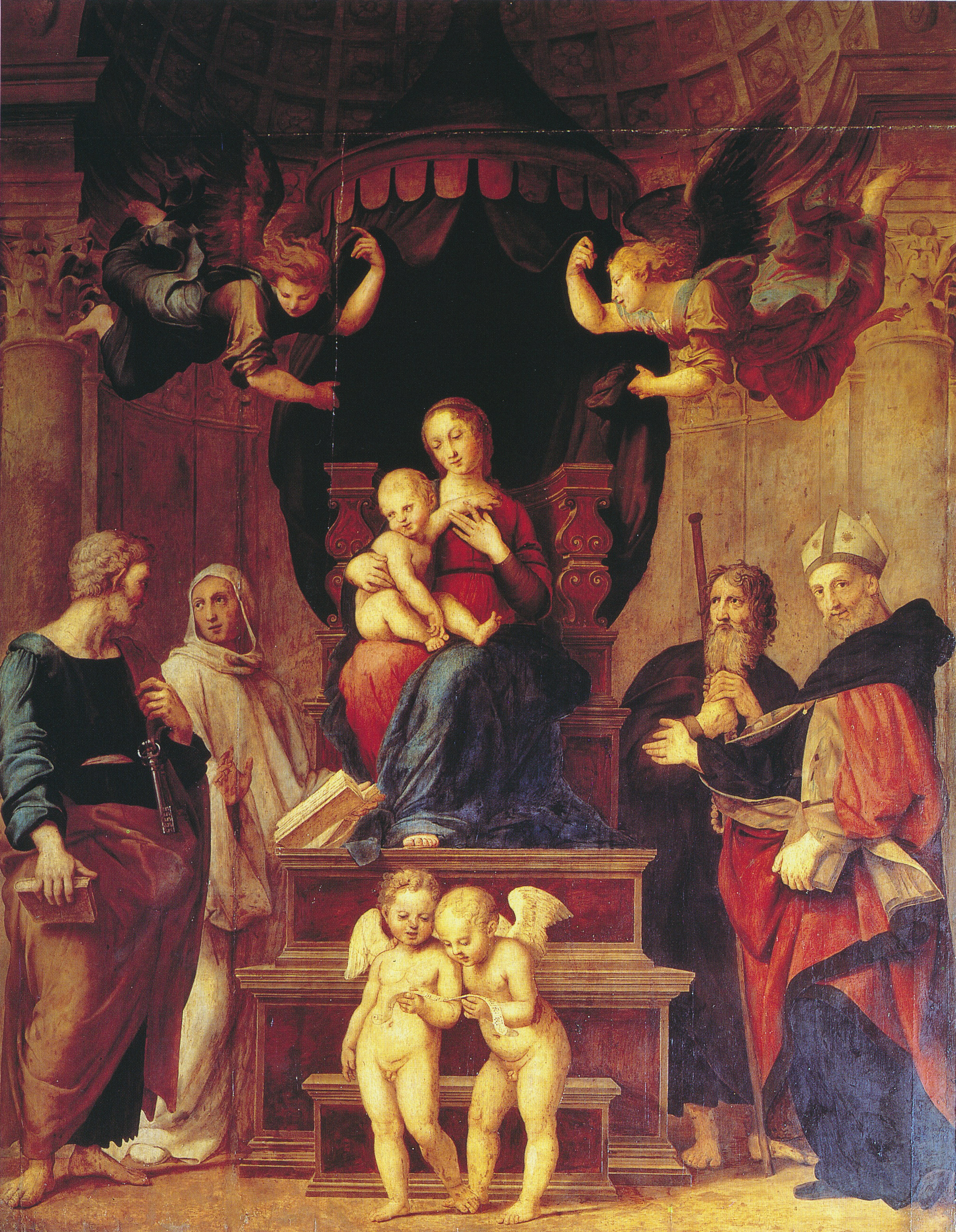
The Madonna of the Baldacchino was started by Raphael and finished after his death (Roger & Penny, p. 44). It was Raphael’s first major commission in Florence for the Dei family chapel in the Santo Spirito basilica (1487) and remained unfinished when the 25-year-old artist was summoned to Rome by Pope Julius II, nicknamed the Fearsome, who reigned on Peter’s chair from 1503 to 1513. Pope Julius, born Giuliano della Rovere in 1443, took his name specifically from Julius Caesar (d. 44 BCE). In 1508, this “Battle Pope” as he was known, commissioned the Raphael Rooms and Michelangelo’s paintings in the Sistine Chapel at the Vatican. Raphael’s enthroned Madonna and Child is with, from left, Sts. Peter, Bernard of Clairvaux, James the Greater and St. Augustine of Hippo. The group is joined by two putti at the foot of the throne’s high pedestal steps. It is a large format painting whose size was increased when it was restored and “completed” at the end of the 17th century to meet the tastes of a Medici prince. Raphael is cited for being an imitator more than originator and this is exampled in the Christ Child playing with his toes whose pudgy type derives from the workshop of Florentine sculptor Luca Della Robbia (c. 1400-1482). The painting can be read right to left as St. Augustine, looking at the viewer, gestures, with St. James gazing in a similar direction, towards the throne and its occupants and then crosses to St. Bernard whose backward glance ends in conversation with St. Peter holding a book and large key. Once in Rome, Raphael continued these simple straight forward readings of his artworks’ often complex network of figures beginning in his famous frescoes in the Stanza della Segnatura (1508-1511) yet by then with greater refinement and heroism. In 1799 The Madonna of the Baldacchino was confiscated by French forces and taken to Paris only to be returned to Florence in 1813. (Beck, pp. 78-79).
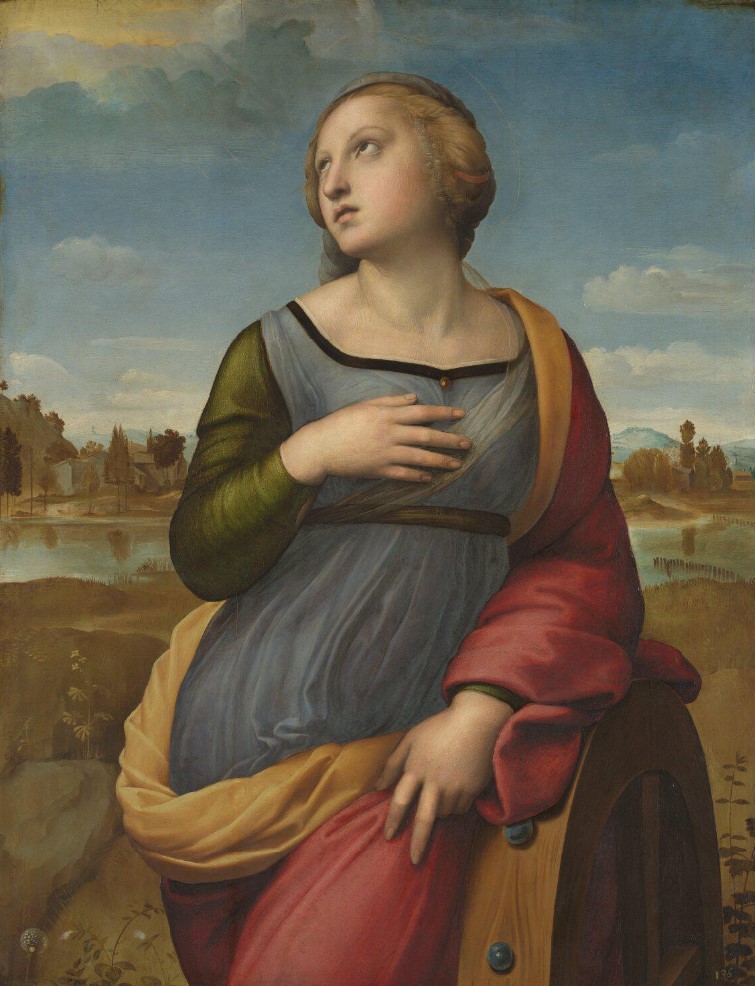
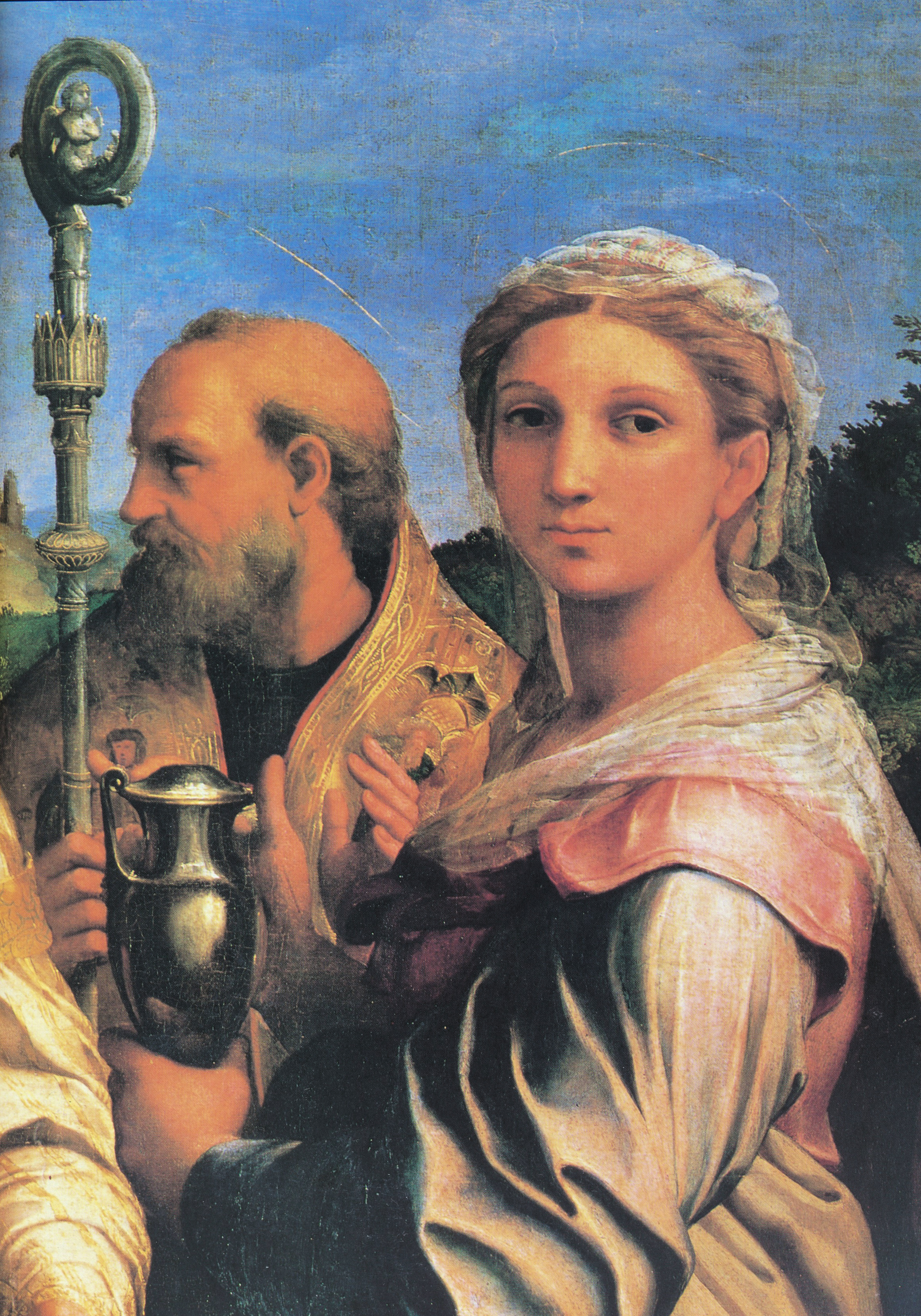
Raphael’s St. Catherine of Alexandria, a Fourth Century mystic and martyr, is not an object for devotion but dramatizes an example of devotion. The turned figure derives from Leonardo da Vinci and expresses an emotional animation that is one of the strongest depictions in Raphael’s oeuvre. (Roger & Penny, p. 44). The portrait is joined to a landscape as the saint leans on a spiked wheel which is her symbol as it was the manner of her death as a martyr. Raphael looks to capture the mystical or visionary aspect of the saint as she places her hand over her heart and gazes upwards to a golden break in the sky. The figure is very dynamic moving beyond Perugino’s influence of angelic air and distant landscapes and towards Michelangelo and Leonardo da Vinci whose monumentality and detailed arrangements Raphael studied in Florence. It is unknown who commissioned the artwork and for exactly what purpose it was intended. https://www.nationalgallery.org.uk/paintings/raphael-saint-catherine-of-alexandria – retrieved September 6, 2024.
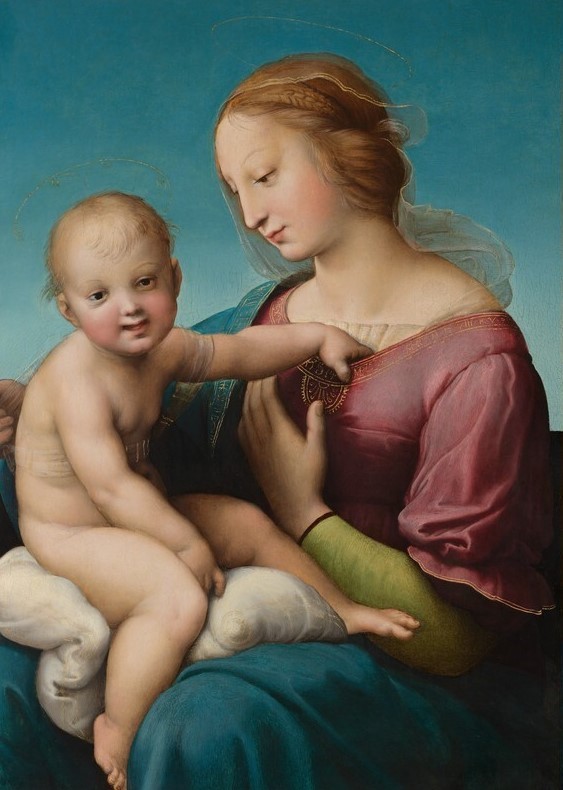
The Niccolini-Cowper Madonna (also known as the Large Cowper Madonna) was painted in 1508 near the end of Raphael’s celebrated Florentine period. The infant Jesus reaches out to clutch the bodice of Mary’s dress which introduces a deeply human element, transforming a sacred, holy icon into an intimate moment shared between a mother and her playful toddler. Raphael utilizes Leonardo’s signature sfumato technique to build physical volume and three-dimensional realism. The painting belonged to the aristocratic Niccolini family in Florence. In 1780, it was purchased by George Clavering-Cowper, the 3rd Earl Cowper who also owned a smaller earlier version of the Madonna by Raphael.
RAPHAEL IN ROME: THE VATICAN COMMISSIONS
Commissioned by Pope Julius II in 1508 for his private apartments in the Apostolic Palace, The Raphael Rooms (Stanze di Raffaello) are a suite of four grand reception chambers that are now part of the Vatican Museums. These rooms include:
The Sala di Costantino. With its theme of the triumph of Christianity over paganism, it contains The Vision of the Cross, The Battle of the Milvian Bridge, The Baptism of Constantine, and The Donation of Constantine.
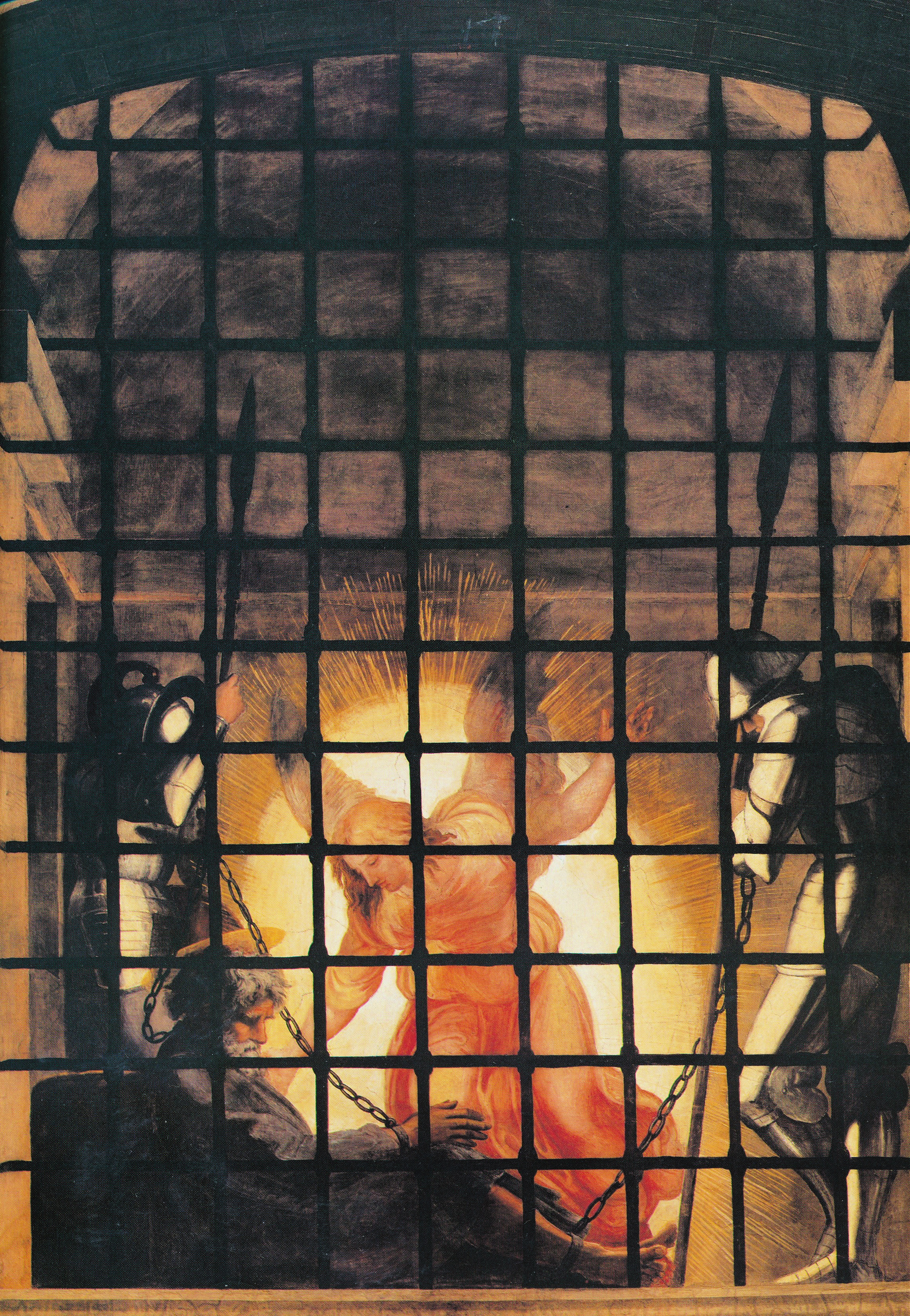
With its theme of Divine protection of the Church during political crises, the Stanza di Eliodoro contains The Expulsion of Heliodorus from the Temple, The Mass at Bolsena, The Liberation of Saint Peter and The Meeting of Leo the Great and Attila.
The Stanza della Segnatura (Julius II’s library/study), with its theme of harmony of human knowledge across Theology, Philosophy, Poetry, and Justice, includes The School of Athens, La Disputa, and The Parnassus.
With its theme of Glorifying Pope Leo X, Stanza dell’Incendio del Borgo (papal dining room) contains The Fire in the Borgo (L’Incendio del Borgo); The Battle of Ostia; Coronation of Charlemagne; and Oath of Leo III.
The Frescoes as Immersive Theater
Raphael’s artwork in these rooms has the effect of cinema in presenting nearly life-sized figures in space that, hoisted onto the wall like a massive theatre screen, fills the room’s field of vision. Further, as a modern-day film dispels incredulity to its medium and any message it conveys, absorbing the viewer, Raphael’s fresco makes intensely real the Catholic faith.
Artistic Borrowing and Reinvention
Raphael frequently adapted individual figures and entire figural groupings from one fresco to another, refining successful visual ideas and integrating them into new compositions. This creative process enabled him to establish thematic and stylistic continuity across the Vatican rooms while continually enriching their complexity.
Michelangelo’s Influence
Raphael was also deeply influenced by Michelangelo’s newly unveiled Sistine Chapel ceiling. He studied its monumental prophets and sibyls closely, incorporating their sculptural power, dynamic poses, and psychological intensity into his own work. Rather than merely imitating Michelangelo, Raphael absorbed these innovations and transformed them within his own more harmonious and balanced visual language.
Perspective and Spatial Mastery
Beyond Michelangelo’s influence, Raphael was intensely interested in the challenges of foreshortening and the organization of large groups of figures within mathematically constructed perspectival settings. His ability to arrange complex assemblies of people within coherent architectural spaces contributed significantly to the intellectual clarity, visual grandeur, and persuasive realism that distinguish the frescoes of the High Renaissance.
Stanza della Segnatura
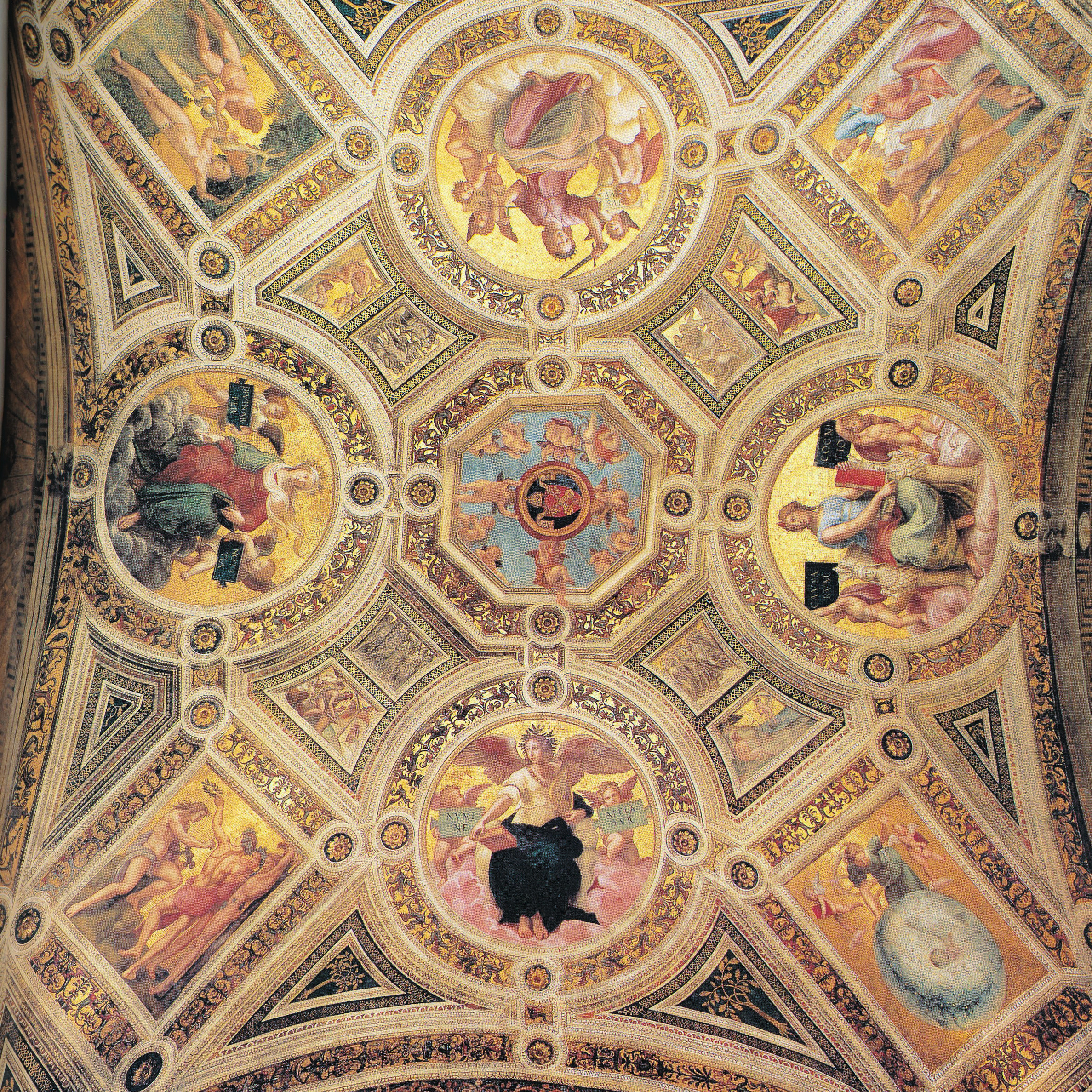
At the time of the papal commission Raphael had little experience painting large frescos but revolutionized the tradition. The basic scheme of the decoration presents four tondi of abstract ideas of Theology, Poetry, Philosophy and Law. The Fall or Adam and Eve on the Brink of Disobedience, along with the Judgment of Solomon on the ceiling relates to themes of Theology and Law as the ceiling’s admixture of pagan scenes including Urania, and Apollo and Marsyas relate to Poetry and Philosophy. (Roger & Penny – pp 50-52).

Theology and the Catholic Faith
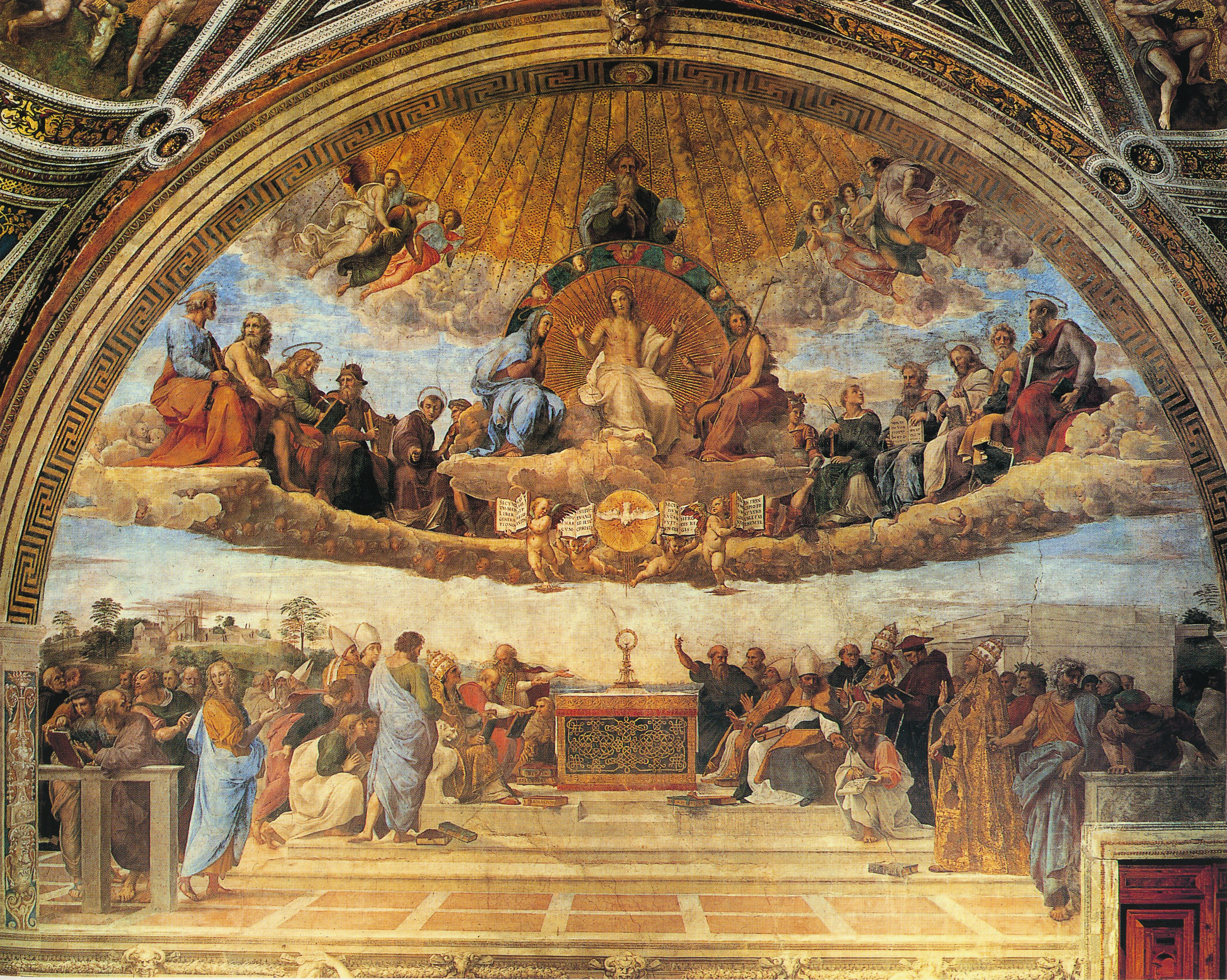
In The Disputation angels in the vault accompany God the Father as a white-robed God the Son sits enthroned before a golden disc displaying his sacrificial wounds of the Cross. On each side of Christ sit the Virgin Mary and St. John the Baptist while on the raised tier sits figures from the Bible. The Holy Spirit descends in the form of a dove on the monstrance holding the Eucharist. Many preparatory drawings survive for this fresco. (Roger & Penny, pp.57-58)
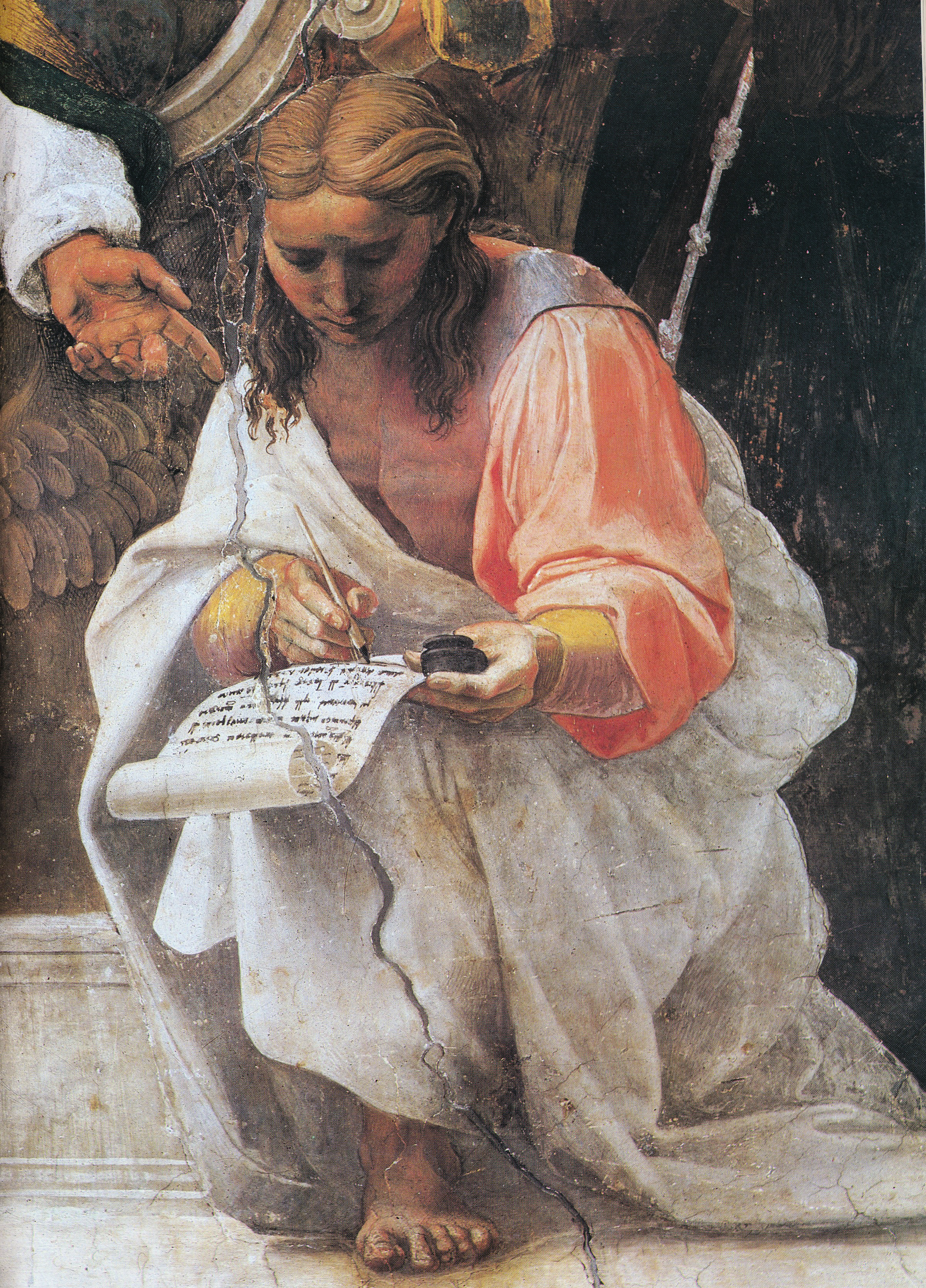
Detail of the young scribe (or amanuensis) at the feet of Saint Augustine from the earthly zone of Raphael’s celebrated fresco, The Disputation of the Holy Sacrament (La Disputa), located in the Stanza della Segnatura in the Vatican Palace. Raphael painted these characters using pseudo-script.
Philosophy and Classical Learning

Compared to the architecture in his Spozalizio from 1504, Raphael’s architecture in The School of Athens is more massive and yet whose angular lines are softened by the contours of colossal statues in niches. One statue is Minerva above Jurisprudence while Apollo is on the left (and closest to the Parnassus fresco). The central figures below the arches, open sky behind them, are Plato with his Timaeus and Aristotle with his Ethics. Other recognizable figures include Socrates to the left of Plato and Pythagoras to the right of the door. (Roger & Penny p 74-78).

Euclid bends down to use one of his compasses surrounded by students and disciples.
Poetry and the Imagination
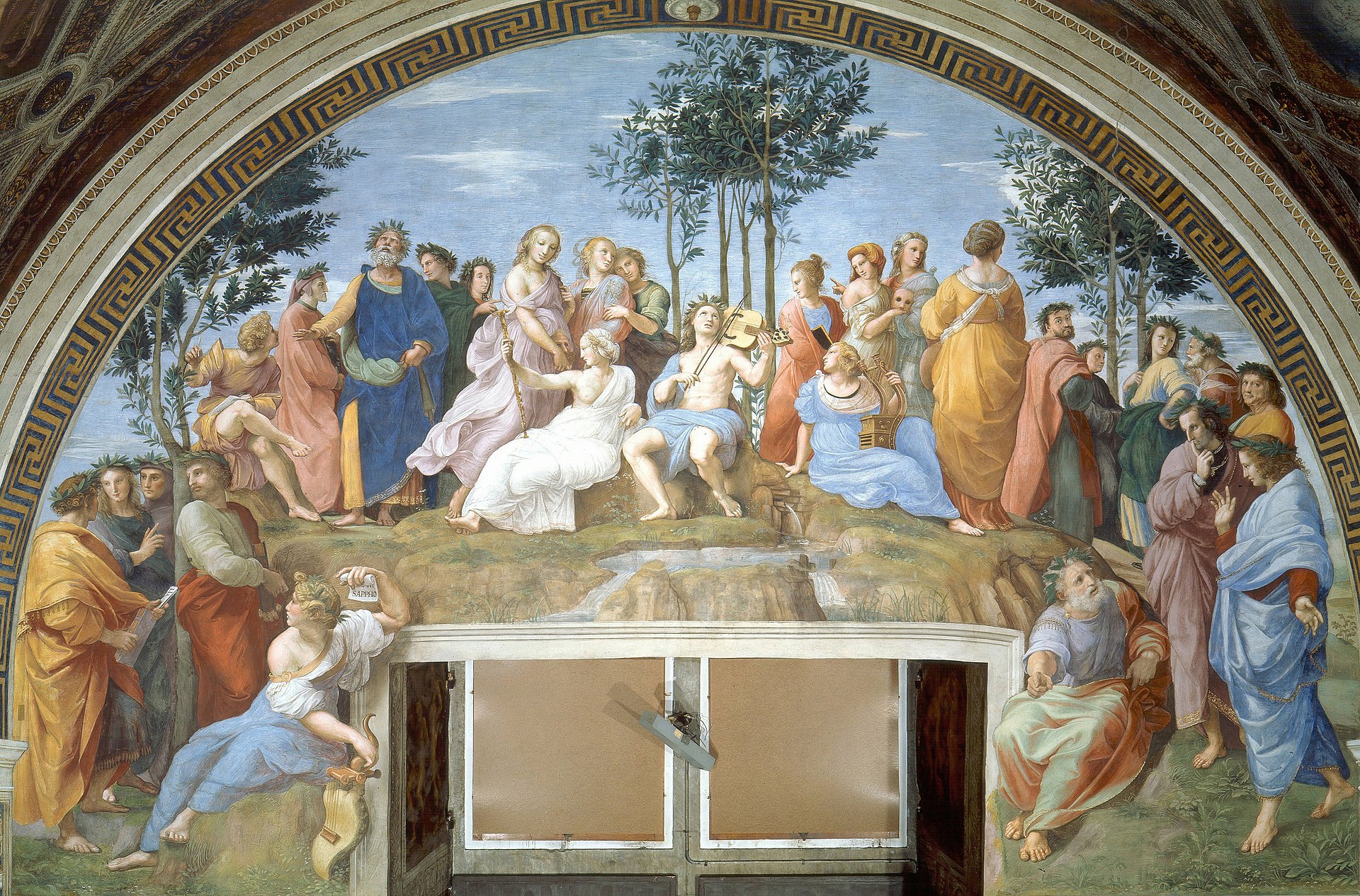
Raphael painted a poet’s paradise in Parnassus where Apollo has the central place. The window which interrupts the base of the artwork looked out onto a hill in Rome called Mons Vaticanus that was known since classical times as sacred to Apollo. This fact with the fresco’s other siting challenges (window glare) Raphael was well aware of. Apollo plays the fiddle surrounded by poets and gorgeous muses with a background of laurel trees. Mortals are below on either side of the window. (Roger & Penny, pp. 68-69)
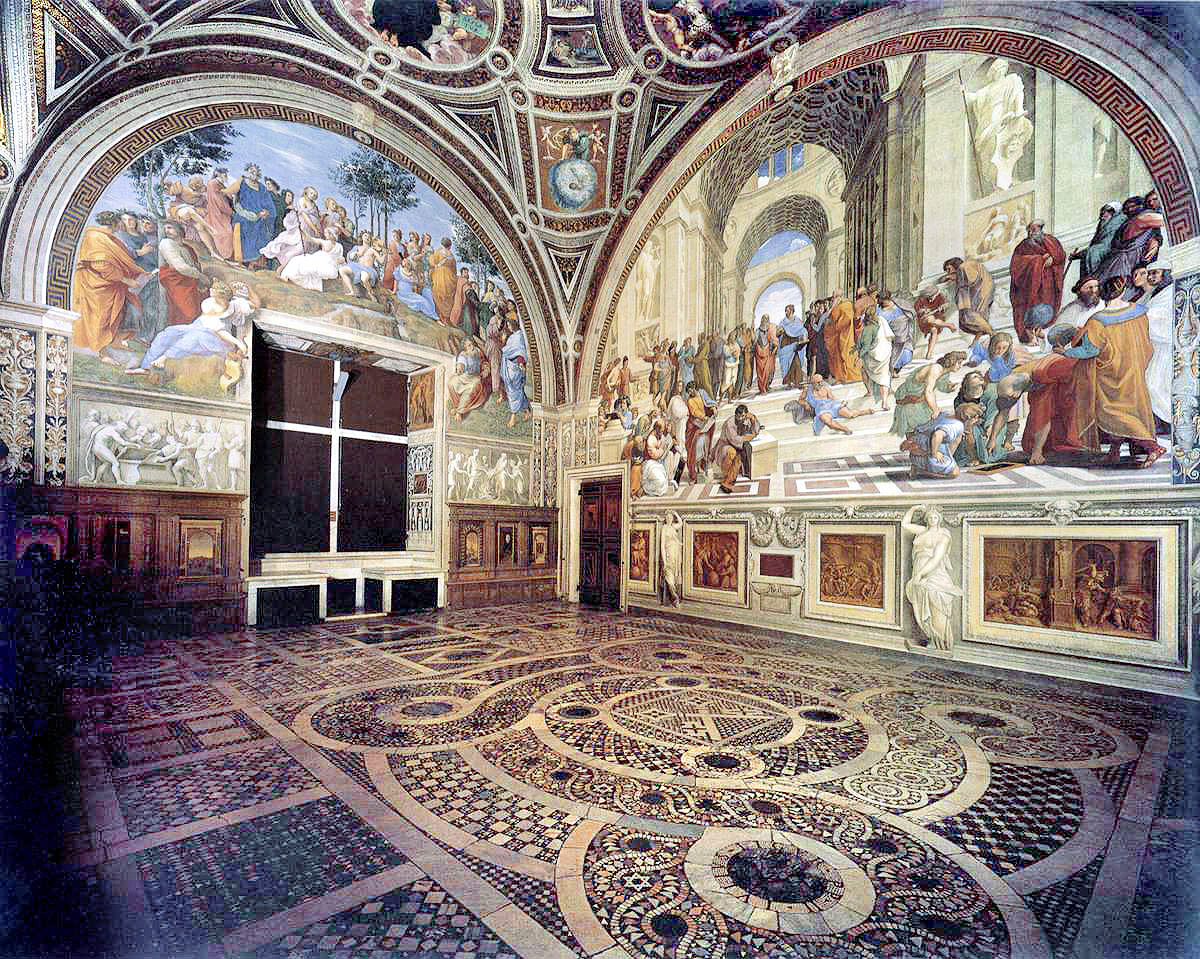
Stanza della Segnatura. The tile floors were designed by the Della Robbia brothers. Public Domain.
PAPAL POWER AND DIVINE INTERVENTION
Stanza di Eliodoro
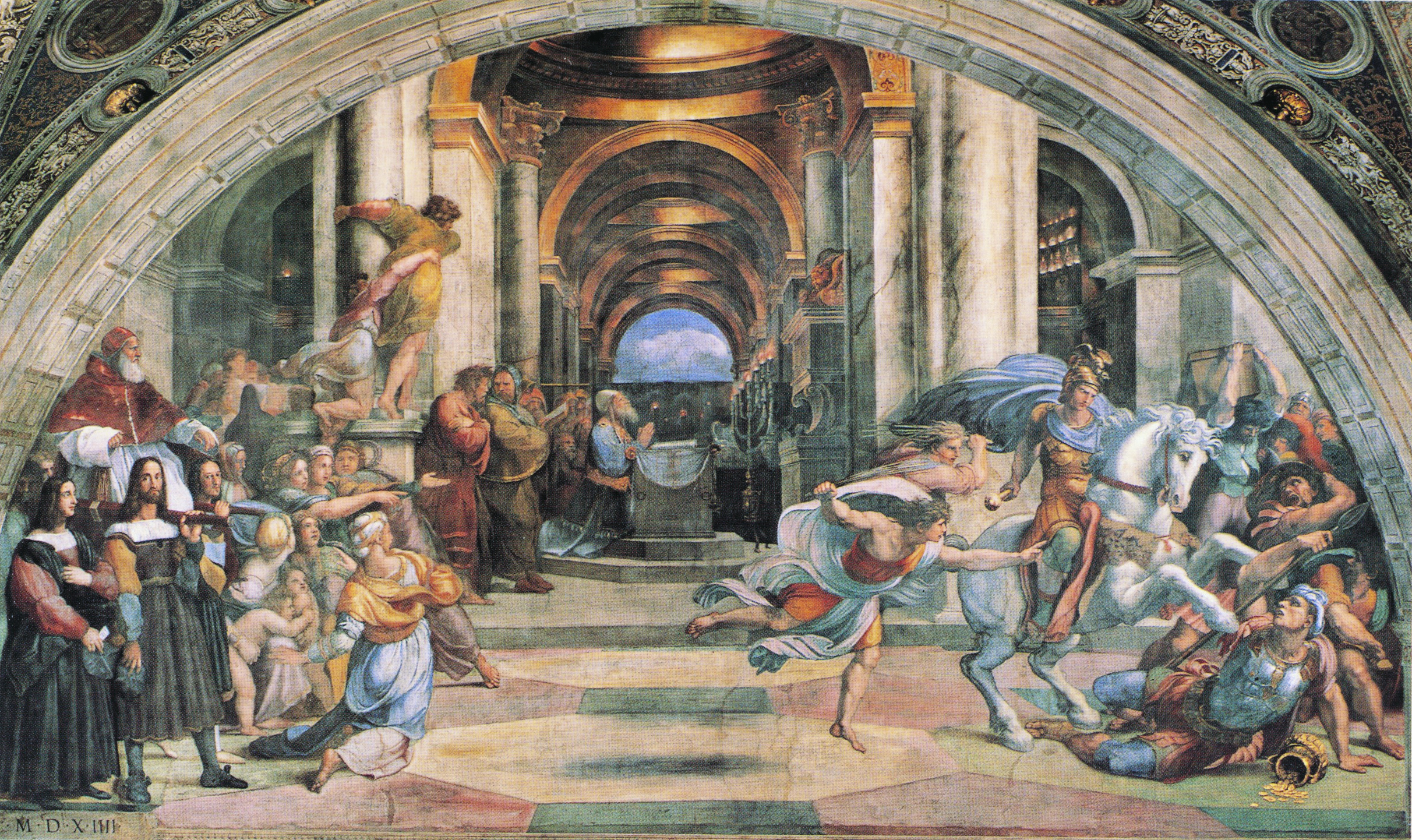
The Stanza D’Eliodoro served as a Vatican audience chamber for the Pope. Each fresco depicts a story of divine intervention and the Pope felt impelled to record them like a civic authority would record an important battle scene in the town hall. The Pope had control over the message and even had himself inserted into these works and one of the best portraits of the pope by Raphael.5 Vasari believed that in the Expulsion of Heliodorus the message was clear: it was the Pope chasing avarice out of the church. Still others, more realistic perhaps, believed the theme to be the defense of the Church’s right to worldly possessions.6 While Julius II kept the treasury full and spent lavishly on public works, he also formally condemned his predecessor’s self-enrichment as well as the Church practice of buying and selling its offices. Others impute Pope Julius II making a parallel between Heliodorus’ expulsion and the Pope’s battle to expel rebellious cardinals who supported the French king against Rome.7 The first fresco painted in the Stanza D’Eliodoro and the one the room is named for is also, in my opinion, the finest: The Expulsion of Heliodorus. Heinrich Wölfflin in his book Classic Art provides the most satisfying brief account of this fresco, although there are other observers who offer insight and detail. The painting is based on an account found in 2 Maccabees, a book that treats of the events in Jewish history from the time of the high priest Onias III and King Seleucus IV to the defeat of Nicanor’s army (around 170 B.C). The biblical account of Heliodorus’ attempt to profane the Temple is a rich one and, in terms of the painting’s iconography, can be synopsized as such:
“There was great distress throughout the city. Priests prostrated themselves in their priestly robes before the altar, and loudly begged him in heaven…to keep the deposits safe for those who had made them…(T)he changed color of the (high priest’s) face manifested the anguish of his soul. The terror and bodily trembling that had come over the man clearly showed…People rushed out…in crowds to make public supplication because the Place was in danger of being profaned…Women, girded…filled the streets…While they were imploring the almighty Lord to keep the deposits safe and secure… Heliodorus went on with his plan. But just as he was approaching the treasury with his bodyguards, the Lord of spirits… (struck). There appeared to them a richly caparisoned horse, mounted by a dreadful rider. Charging furiously the horse attacked Heliodorus with his front hoofs…Then two other young men, remarkably strong…beautiful…splendidly attired, appeared…they flogged (Heliodorus) unceasingly…Suddenly, he fell to the ground enveloped in a great darkness…The man who a moment ago had entered that treasury with a great retinue and his whole bodyguard was carried away helpless…” (2 Maccabees, Chapter 3:14-28)
Raphael followed the biblical text closely. He depicts the three major parties in the religious story: the divine rider, two youths and Heliodorus; the figure of the anguished priest; and the “girded” women. As he does in The Deliverance of Saint Peter, the Pope identifies with one of the major priestly characters in the art work if one detects, as some scholars do, the features of Julius II in the High Priest Onias III.8 The Stanza D’Eliodoro and its first fresco The Explusion of Heliodorus is a milestone for its scale, its composition, its form, its treatment of subject, its color, its narrative power, and its graceful draughtmanship.
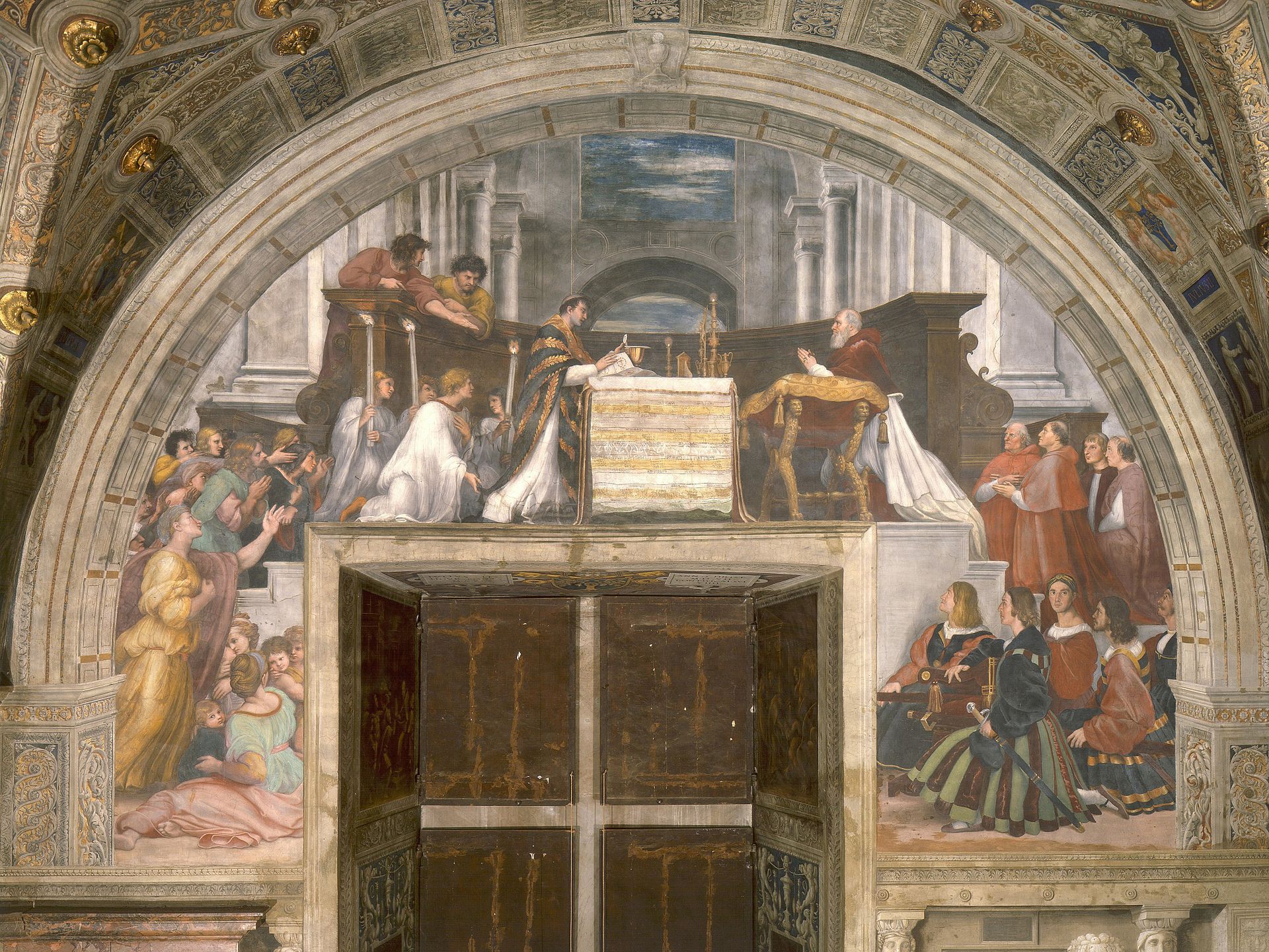
The fresco of The Mass of Bolsena depicts a 13th century miracle connected to the Eucharist when a traveling priest, doubting the Real Presence of Jesus in the consecrated host, is given proof of its reality when the altar cloth he uses for Mass becomes stained with blood from the Host. The cloth relic was revered by Julius II and housed in Orvieto Cathedral where it is today. From its inception, the five handsome youths in the bottom right section of the fresco have been admired for their sturdy monumentality perhaps influenced by Michelangelo as well as its colors and costumes showing Venetian influence. (Beck, pp. 100-101).


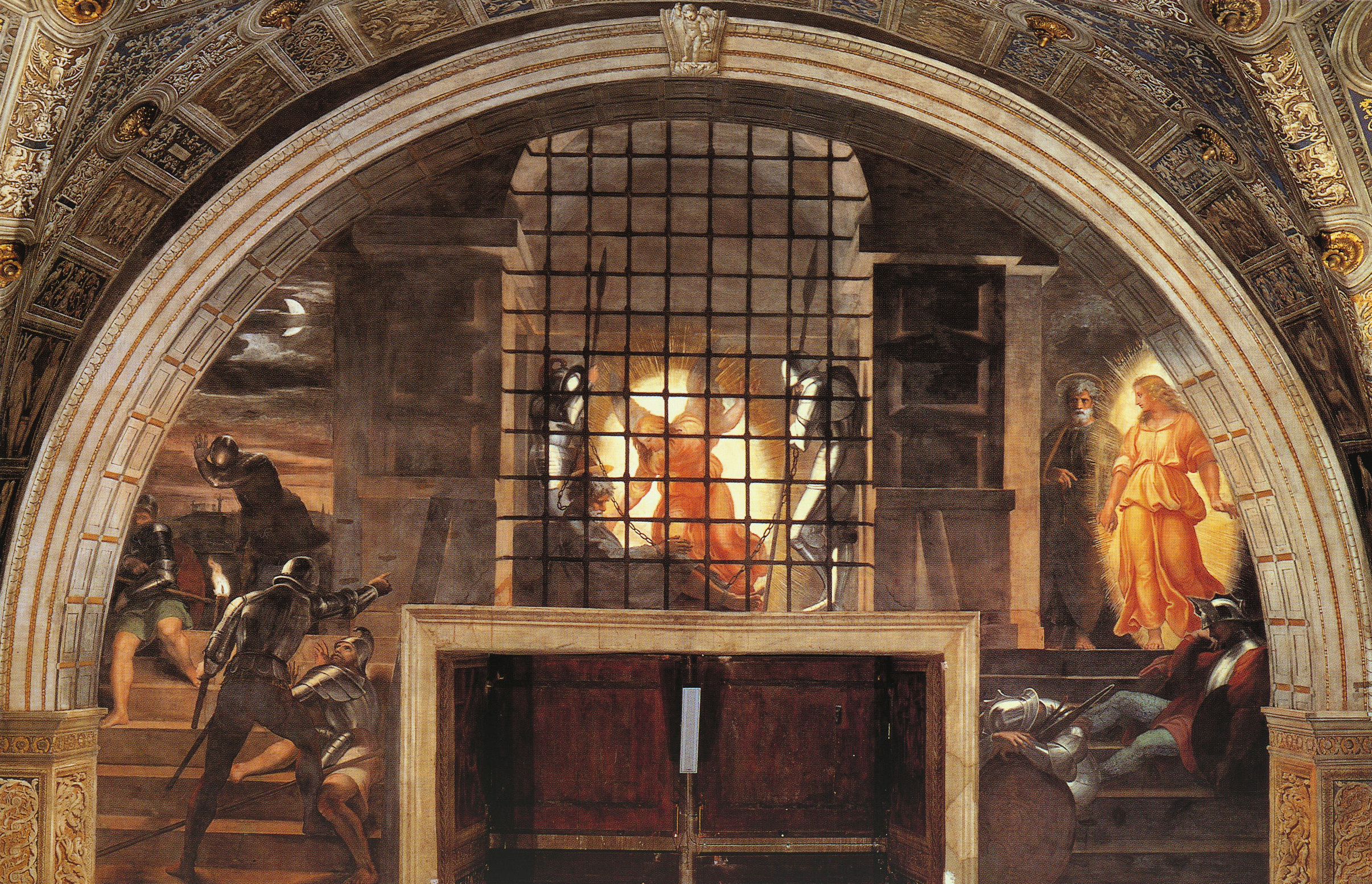
San Pietro in Vincoli in Rome (“St. Peter in Chains”) was Julius II’s titular church when he was a cardinal before becoming pope. It was also his uncle’s church before him, pope Sixtus IV (1471-1484). Pope Julius II made pilgrimage to the church in 1512 after the French evacuated from Italy. The liberation in the title of Raphael’s fresco probably refers to that of the Papal States with St. Peter taking on the physical characteristics of Julius II. The fresco was being painted during a year when the pope was dying which occurred in February 1513. Raphael’s use of light in the fresco is probably the boldest in art taking place at night in the whole of Renaissance art. (Beck, pp. 102-3).
Stanza dell’Incendio del Borgo
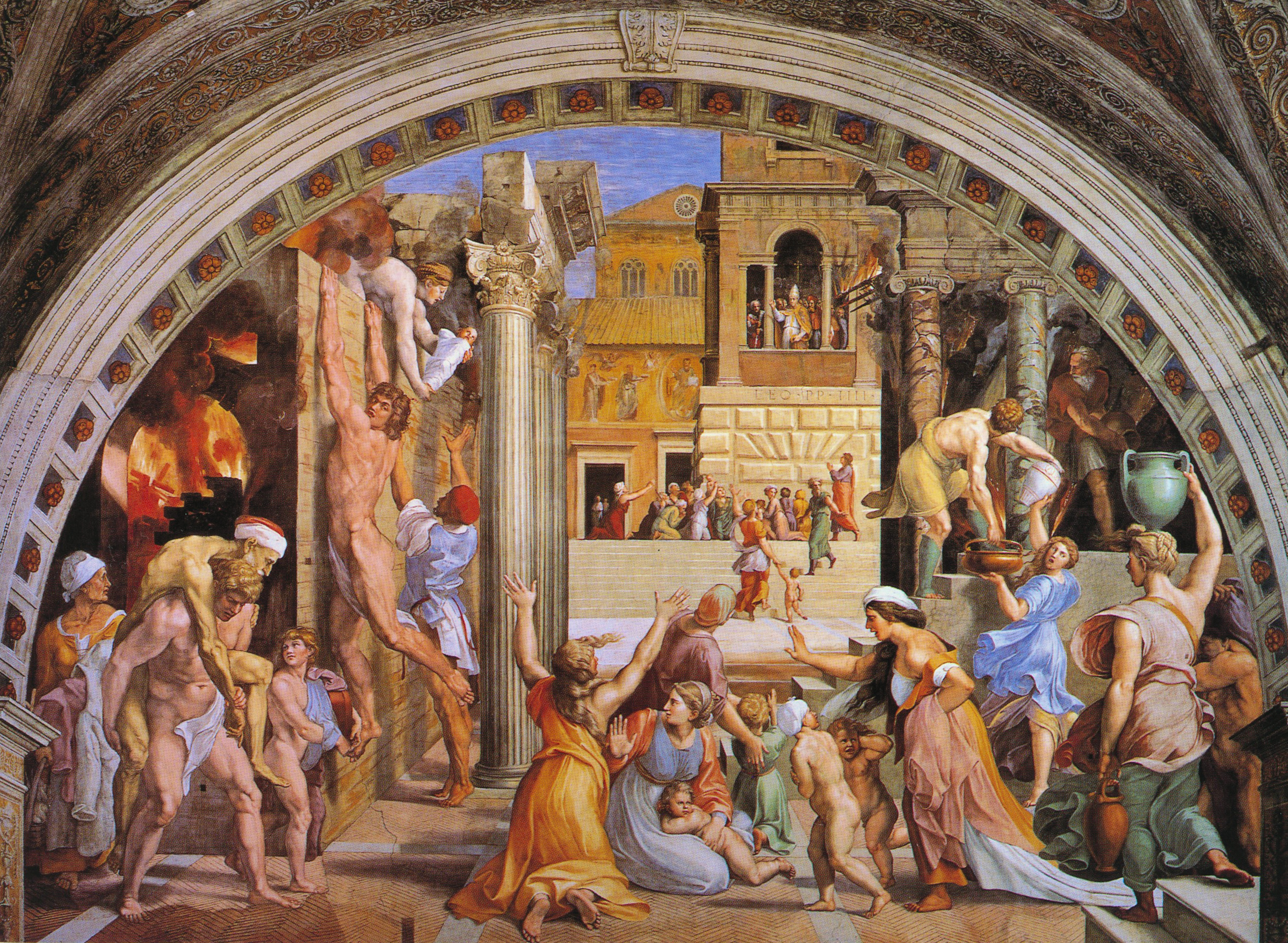
The name of the room comes from this fresco which Raphael began work on in the summer of 1514. It depicts a newly imagined historical event from the mid-9th century when a fire broke out in Rome. The pope (Leo IV) is seen giving a blessing from the balcony of Old St. Peter’s which, the story goes, tamped down the flames. In the meantime, Raphael depicted the event’s panic and drama among its foreground figures in its throes. Once more Raphael is re-inventing his art from only a couple of years earlier. As Raphael continued the practice of borrowing certain figures and themes from previous frescos, the overall classical style of the Segnatura and Eliodoro frescos are remarkably more spatially complex and intriguing in The Fire in the Borgo. Raphael absorbed what Rome offered: from Michelangelo’s latest art to the city’s ancient and contemporary architecture. The Ionic columns of Old St. Peter’s are accurately rendered as are the building fragment of Corinthian columns. (Beck, p. 110).

RAPHAEL THE PORTRAITIST
Four Rooms; Four Popes.
The popes responsible for commissioning, funding, and overseeing the completion of the Raphael Rooms amounted to three out of four consecutive reigns: Pope Julius II (r. 1503–1513) originated the commission. Under Julius, Raphael painted the Stanza della Segnatura and began the Stanza di Eliodoro. Julius II is buried in St. Peter’s Basilica.
Pope Leo X (r. 1513–1521) continued the project, keeping Raphael on as the chief Vatican artist. He oversaw the completion of the Stanza di Eliodoro, the Stanza dell’Incendio del Borgo, and the planning for the Sala di Costantino.
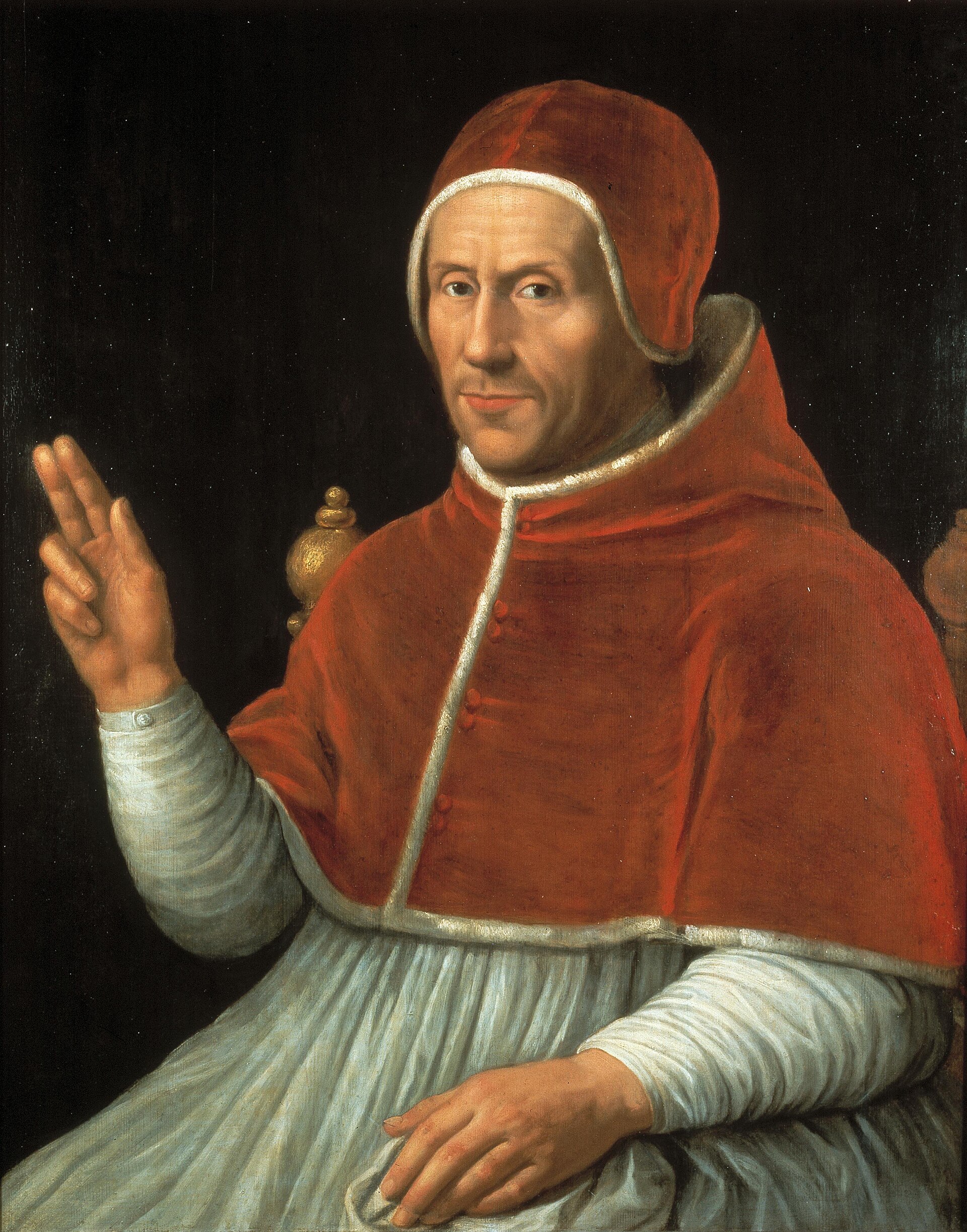
Pope Adrian VI, a Dutchman, then reigned after Leo X for a little over one year and eight months but halted work on the project. Adrian VI is buried in Santa Maria dell’Anima in Rome.
Finally Pope Clement VII (r. 1523–1534), Like Leo X, another Medici pope, finished the Sala di Costantino funded the late Raphael’s workshop assistants led by Giulio Romanoin 1524. Both Pope Leo X and Pope Clement VII are buried directly across from one another inside the choir of the Basilica of Santa Maria sopra Minerva in Rome.

Giuliano della Rovere (1443-1513) was described by Machiavelli in his works as an ideal prince. Becoming pope in 1503, he took the name Julius II in honor of Julius Caesar and was nicknamed the Warrior Pope. In 1506 Julius II organized the famous Swiss Guard for his personal protection and established the Vatican Museums. He was also the pope who instigated the rebuilding of St. Peter’s Basilica that exists today. The pope increased the power of the Papal States and, in 1508, he commissioned the Raphael Rooms and Michelangelo’s paintings in the Sistine Chapel. It was Julius II who also established the first bishoprics in the New World. Although the Tomb of Pope Julius II with its famous sculpture of Moses by Michelangelo is in San Pietro in Vincoli in Rome, the ensemble, extensively abbreviated than originally planned, was not finished until 1545, long after Julius II’s death in 1520. In fact, Julius II is buried in St. Peter’s Basilica.

This was an important group portrait commission for Raphael: the current Pope Leo X Medici (1513-1521) seated by his cousins, Cardinals Giulio de’ Medici on the left and Luigi de’ Rossi on the right. Giulio de’ Medici was soon to become the future pope Clement VII (1523-1534). Though highly individualized, Raphael captures a family resemblance between these Medici who were then the most powerful family in Italy and all about the same age. In 1517 Cardinal Giulio was an important art patron and had commissioned Raphael to do The Transfiguration, his last painting. Raphael demonstrates a wide range of artistic experience and skills so to pull any tool he needs for a successful outcome of any commission. In Urbino Raphael had been exposed to Flemish art and deploys its detailed technique in the bell and manuscript which 42-year-old Leo X uses a magnifier to see. The setting of the monumental portrait, in a room in the Vatican, is subtly captured by way of Flemish art ingenuity. The doorknob in front of cardinal Luigi de’ Rossi shows the reflection of an open window while the cape and biretta of the pope are highly detailed by the artist in its natural light. The Portrait of Leo X and Two Cardinals is considered the greatest group portrait of the 16th century. (Beck, pp. 120-121)

Raphael’s Garvagh Madonna (also known as the Aldobrandini Madonna) was painted in Rome between 1509–1511.Though its commsiion is lost to history it was a cabinet painting for private devotion and likely commissioned by a Roman aristocrat or paper courtier. The focal point is the pink carnation (dianthus) that the infant John the Baptist is handing to the Christ Child. The flower signifies Divine Love and the Passion of Christ. By the late 16th century, it entered the collection of the aristocratic Aldobrandini family in Rome and displayed in their apartments and at the Villa Borghese. During Napoleon’s invasion of Italy in 1799, an art dealer named Alexander Day acquired the painting and smuggled it to London.The painting was purchased in 1818 by the English nobleman George Canning, 1st Lord Garvagh and hidden for the next almost 50 years. In 1865 it was purchased by the National Gallery in London.

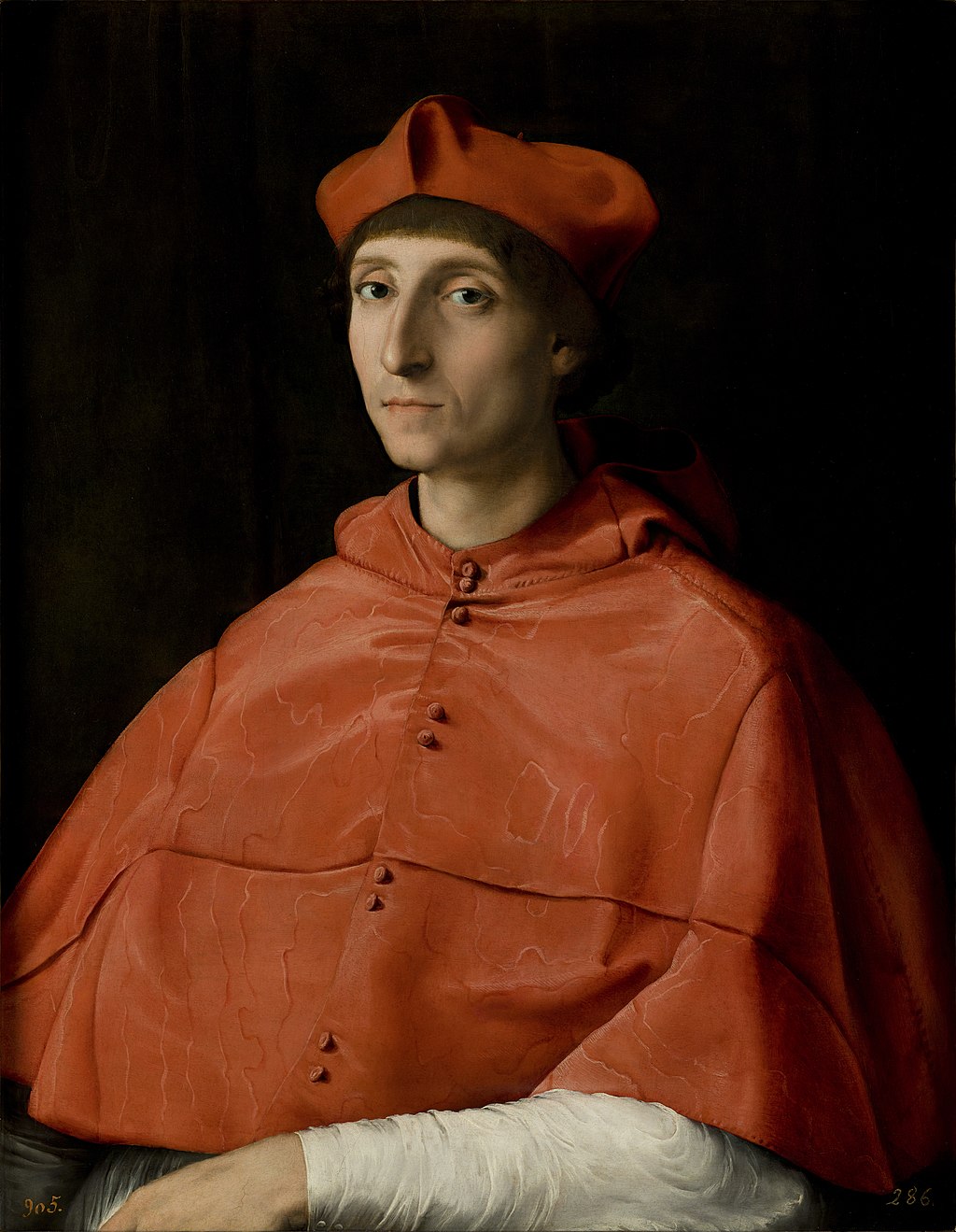
Raphael was working on the frescos in the Vatican Palace when he painted this oil on panel portrait of a “Young Cardinal.” The sitter is not known though it likely is Cardinal Francesco Alidosi (1455-1511). Cdl. Alidosi was an influential diplomat and military leader and a favorite of Julius II (1503-1513). The sitter’s expression and pose of a resting arm on the edge of the painting’s base and the slight turn of the body seems to owe much to Leonardo da Vinci. The body is monumental compared to a placid and yet almost inscrutable slightly smaller head whose depiction, while directly observed, is somewhat idealized. When Della Rovere was elected as Pope Julius II in 1503, Alidosi became his secretary and primary collaborator. He was appointed papal chamberlain and then treasurer. Though labeled “unholy” by Venetian cardinal Pietro Bembo (1470-1547), Cld. Alidosi helped guide the vocation of Bl. Elena Duglioli dall’ Olio (1472-1520), an Italian aristocrat, who wanted to be a Poor Clare nun but was forced to marry by her family and for whose endowed chapel in Bologna Raphael painted an altarpiece. In 1504 Alidosi became a bishop whose sees ranged up and down all of Italy from Mileto in 1504 and Pavia in 1505. He occupied the seat of Pavia until he was murdered in broad daylight in 1511. There were accusations traded back and forth that Cdl. Alidosi was a traitor at a time when the French occupied parts of Italy among its warring Italian families. The independently powerful pope acted to protect his favorite as long as possible. About Alidosi one historian noted: ”A favorite has no friends.” There were many unconcerned witnesses to the brutal crime whose attack included blows that split his head in two. (Beck, pp. 92-93; Herbert M. Vaughan, B.A., The Medici Popes (Leo X and Clement VII), Methuen & Co., London, 1910, p. 64-65; “Alidosi, Francesco, detto il Cardinal di Pavia”. Dizionario Biografico degli Italiani – Volume 2 (in Italian). Treccani. 1960.)
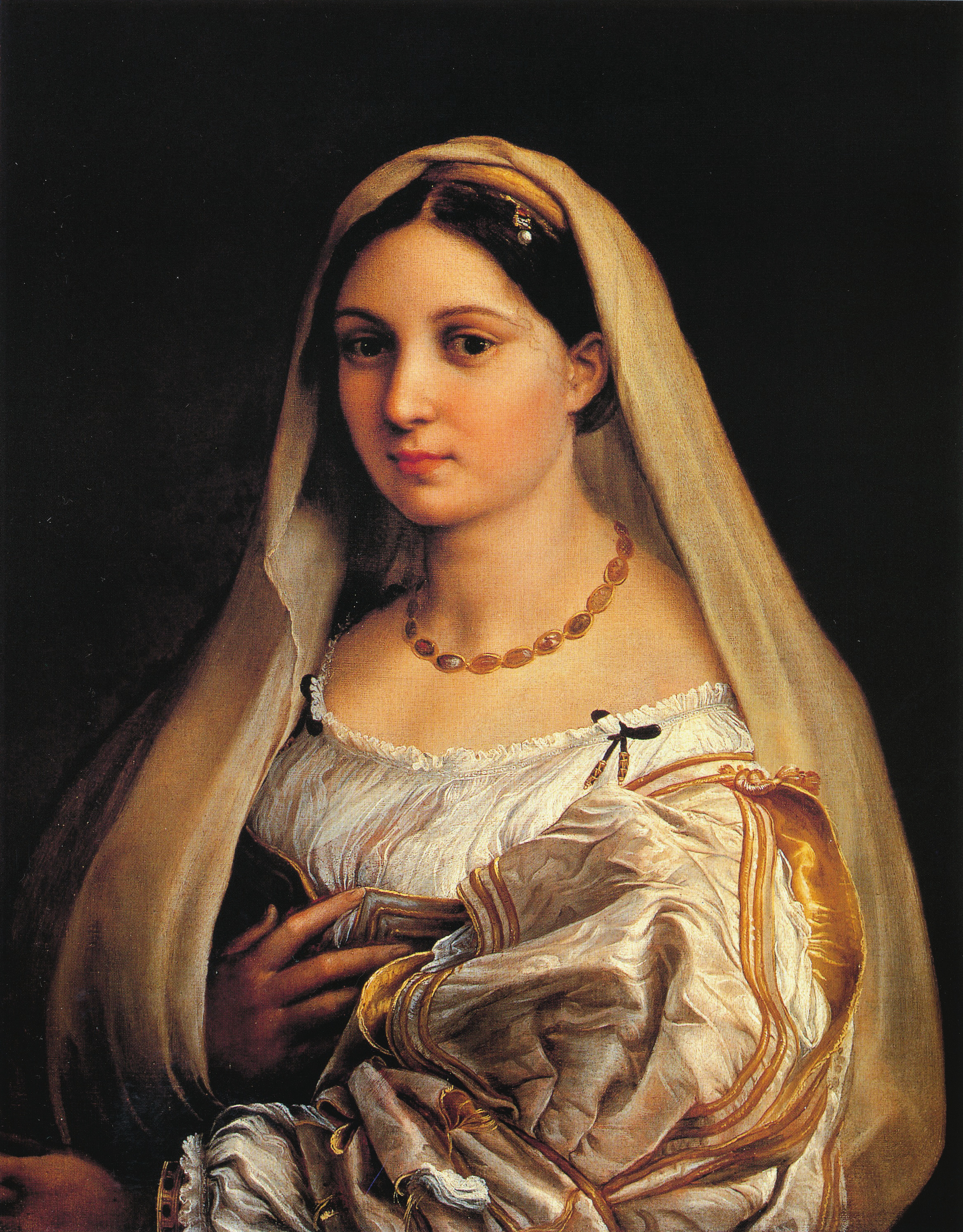
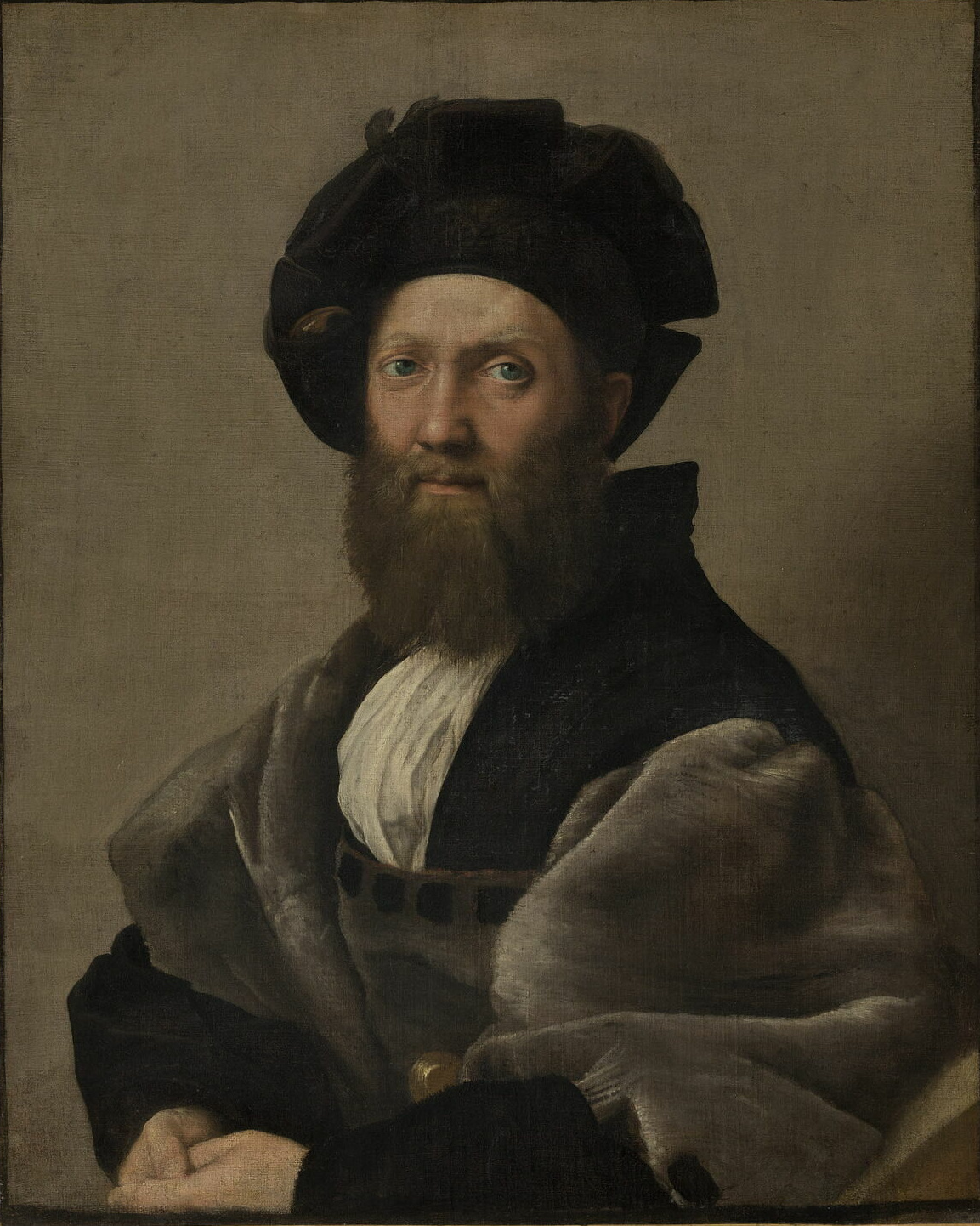
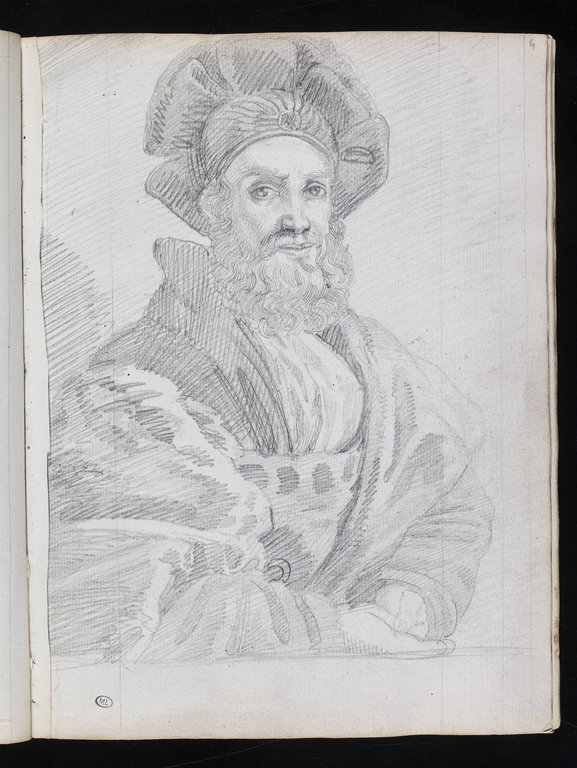
In La Donna Velata and Portrait of Baldassare Castiglione, Raphael, the master portraitist, present near ideal depictions. Both portraits are of almost identical dimensions. The model Raphael used for La Donna Velata he used in other artworks of this period, including The Sistine Madonna. By the mid 1510s these portraits have become gentler in their modeling than the tight, detailed study of corporeal features done before. Raphael begins a display of a mastery of forms and colors that had great influence on future artists such as Rubens and Rembrandt. However, Raphael’s painting does not forgo his mastery of drawing exampled in the female sitter’s sleeve or the overall nobility of the male sitter. (Beck, pp. 108-09; 116-17).
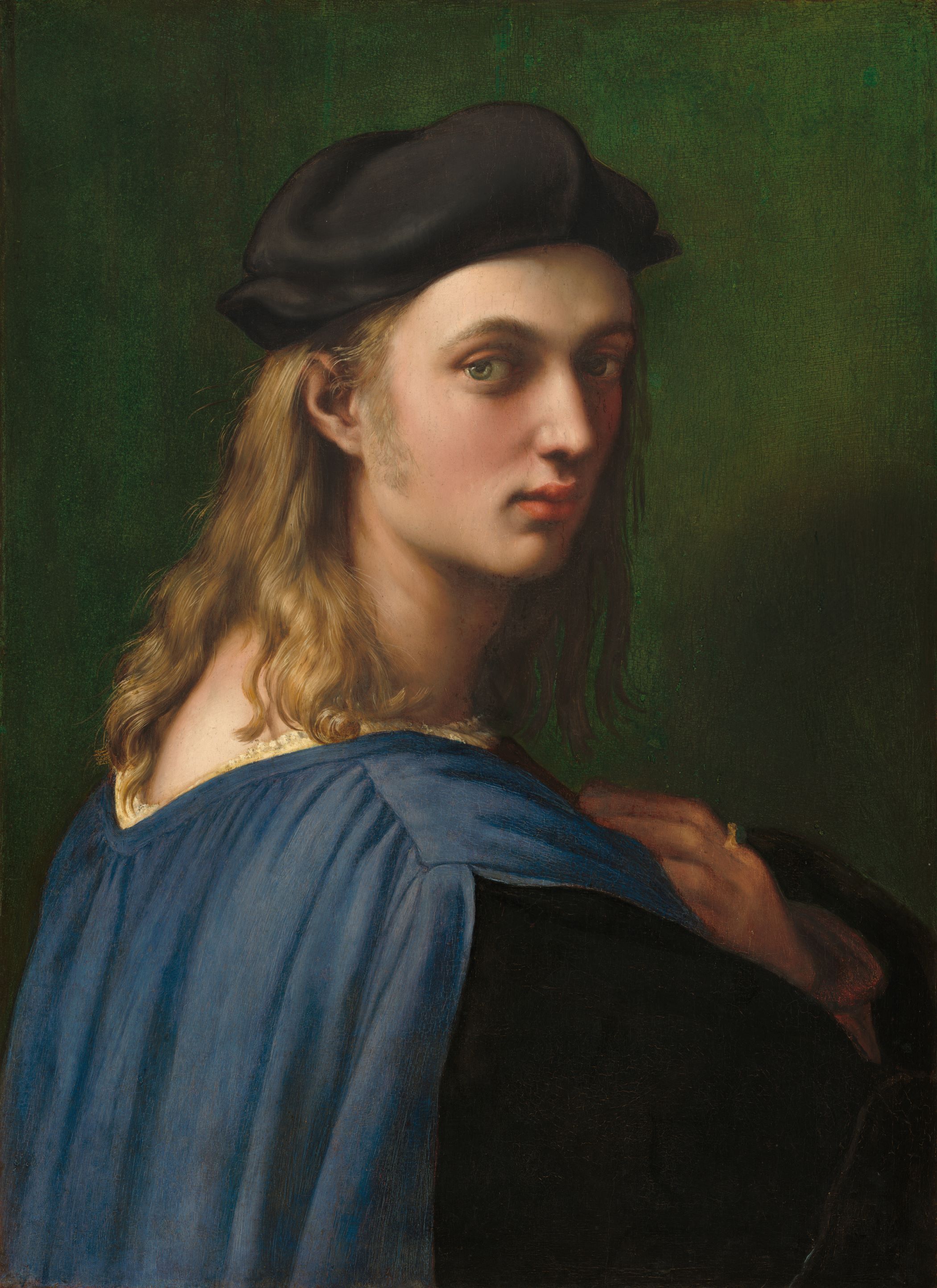
Portrait of Bindo Altoviti, painted circa 1515, presents its subject in a dramatic and highly original pose: a three-quarter back view with his head turned sharply over his shoulder to meet the viewer’s gaze. Bindo Altoviti (1491-1557) was a young, immensely wealthy and politically influential Florentine banker based in Rome. Among the most important patrons of the High Renaissance, he maintained close relationships with Raphael, Michelangelo, and Benvenuto Cellini. A passionate supporter of the arts, he was also a determined political opponent of the Medici family.
The striking twist of Altoviti’s body imbues the portrait with an unusual sense of movement and psychological immediacy. Raphael employs sfumato, particularly around the jawline, eyes, and flowing golden-brown curls, to create subtle transitions of light and shadow that enhance the figure’s sculptural presence. Soft illumination highlights the sitter’s youthful features against a rich dark-green background, while his hand rests lightly against his chest, drawing attention to the prominent gold ring on his finger. His attire, a sumptuous blue mantle draped over a dark tunic, conveys exceptional wealth and social standing while avoiding overt ostentation.

Raphael’s Christ Falling on the Way to Calvary (famously known in Italian as Lo Spasimo di Sicilia) was painted around 1516-1517, originally on panel before later being transferred to canvas. The painting captures the dramatic moment when Christ falls beneath the Cross and turns to look directly at his mother, who swoons in grief (the spasimo). She is supported by a group of weeping women, including Mary Magdalene, who kneels in the lower right foreground. Raphael fills the composition with intense movement and emotional tension. On the left, Roman soldiers and executioners tug brutally at ropes and force Christ onward, while Simon of Cyrene struggles to lift the heavy wooden cross. In the distance, a winding road leads toward Calvary, where other crosses are already being prepared beneath a turbulent sky.
The painting was commissioned by Jacopo Basilio for the new church of Santa Maria dello Spasimo in Palermo, Sicily. Although the church itself was never completed, Raphael’s masterpiece embarked on a remarkable journey. En route to Sicily, the ship carrying the work was wrecked at sea, yet the carefully packed painting somehow washed ashore near Genoa unharmed. It took the direct intervention of Pope Leo X to compel the Genoese authorities to surrender the masterpiece to its rightful owners in Palermo.
In 1661, the painting was acquired by the Spanish Viceroy of Sicily on behalf of King Philip IV of Spain, an avid collector of Raphael’s works. Transported to Madrid, it was installed in the royal chapel. During the Napoleonic Wars, French troops seized the painting and carried it to Paris, where restorers transferred it from panel to canvas. Following Napoleon’s defeat, the work was returned to Spain, where it eventually entered the collection of the Museo del Prado, its home today. The painting reflects Raphael´s interest in the depiction of extreme physical and psychological states. https://www.museodelprado.es/en/the-collection/art-work/christ-falls-on-the-way-to-calvary/870c8293-1691-4a90-88ff-b554a2bc3fe8?searchid=d42d76c7-eb9f-501b-f628-d03605a6ca9c – retrieved September 4, 2024.

Raphael’s major commissions for papal and aristocratic patrons did not interrupt his sustained engagement with the Madonna theme, a subject he had refined since his years in Umbria and Florence. The Alba Madonna exemplifies this continuity. The Virgin is presented as a Virgin of Humility, seated directly on the ground, her pose reinforcing the theological emphasis on Christ’s lowly Incarnation. She wears a rose‑pink gown beneath a topaz‑blue mantle, her hair drawn back from her face, and one finger marking a page in the book resting on her lap.
The Virgin occupies the dominant share of the tondo’s surface, receiving the young John the Baptist as he approaches with flowers gathered in the fold of his garment — a visual shorthand for his role as the forerunner who prepares and presents Christ to the world. All three figures direct their attention toward the small cross held by the Christ Child, a sign of his identity as the Lamb of God and of the sacrificial destiny that defines his mission.
Raphael integrates figure and format with characteristic finesse: the Madonna’s rounded features and gently curving posture echo the circular panel on which the scene is painted. The background opens onto an expansive plain leading to a turquoise body of water, with distant mountains rendered in deeper blue beneath a luminous sky, establishing a serene atmospheric recession typical of Raphael’s mature style. (Roger & Penny, p. 88.) https://www.nga.gov/collection/art-object-page.26.html – retrieved September 4, 2024.

Raphael took a poem by Florentine poet Poliziano (1454-1494) for inspiration for this fresco. The poet gives a detailed description of the Palace of Venus. Galatea is described as riding on the sea in a chariot pulled by a pair of dolphins whose reins she holds. Around her is her entourage playing amorously in the sea. In 2007, the bodies of Poliziano and philosopher Giovanni Pico della Mirandola (1463-1464) were exhumed from Florence’s Church of San Marco to determine the causes of their deaths. Forensic tests showed that both men of letters likely were poisoned but it is only speculation as to why or by whom. (see – http://news.bbc.co.uk/2/hi/europe/6920443.stm – retrieved September 7, 2024). (Roger & Penny, p. 93).
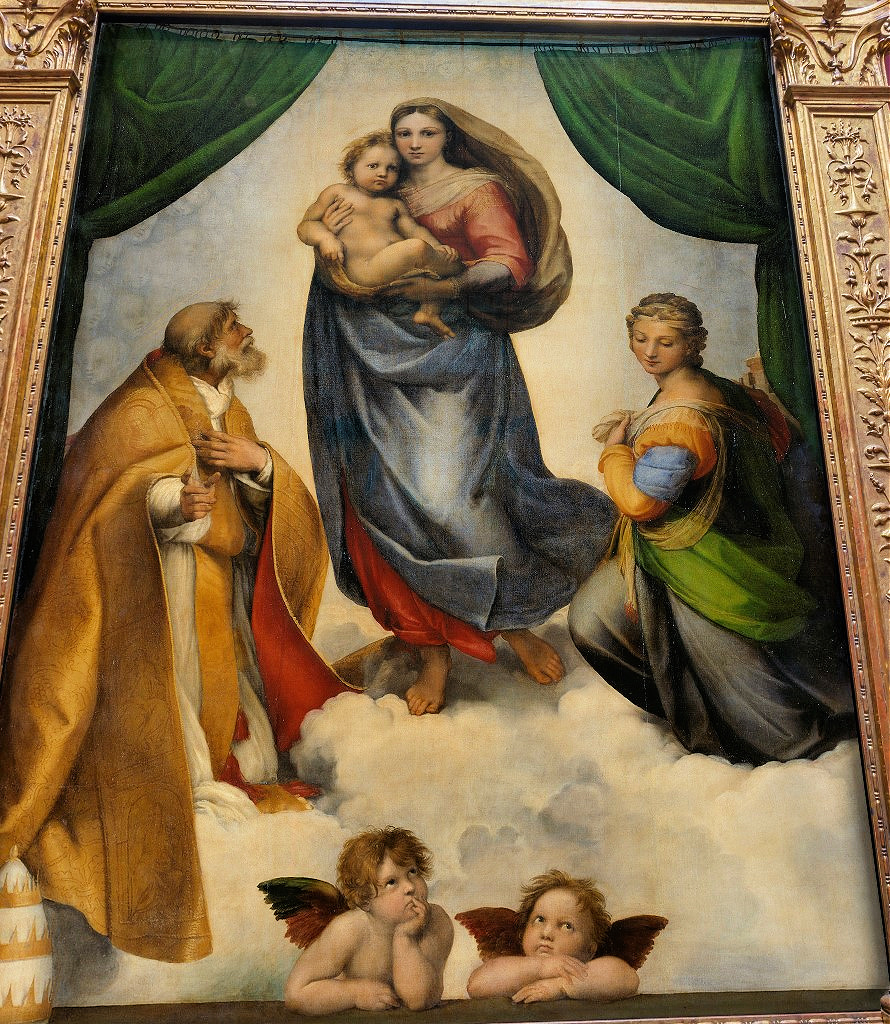
Raphael’s The Sistine Madonna was made for the high altar of a newly rebuilt church of Pope St. Sixtus (d. 257) in Piacenza, Italy. St. Sixtus kneels on a cloud before the Virgin and Christ Child with a hand over his chest. The saint is interceding for the worshippers of Piacenza to whom he gestures outward with his other hand. Opposite is St. Barbara, patron of soldiers, with the symbol of a tower behind her. (Roger & Penny p. 128)

In The S. Cecilia Altarpiece Raphael depicts St. Cecilia with an organetto slipping from her hands as she looks skyward to the preferred sound of heavenly music. Also included are Sts. Paul, John the Evangelist, Augustine and Mary Magdalene. It was an altarpiece for a chapel in S. Giovanni in Monte in Bologna founded by Elena Duglioli dall’ Olio (1472-1520). The Italian aristocrat wanted to become a Poor Clare nun. Though forced to marry by her family, she persuaded her husband not to consummate the marriage. This act of chastity was attributed to her devotion to St. John the Evangelist, patron of virginity, and St. Cecilia. Elena’s benefactor in the enterprise of her religious vocation was influential Cardinal Alidosi. Elena died on September 23, 1520, and her remains are incorrupt in the church of San Giovanni in Monte. In 1828 she was beatified by Pope Leo XII (1760-1829). Her feast day is September 23. (Roger & Penny, pp. 144-146).
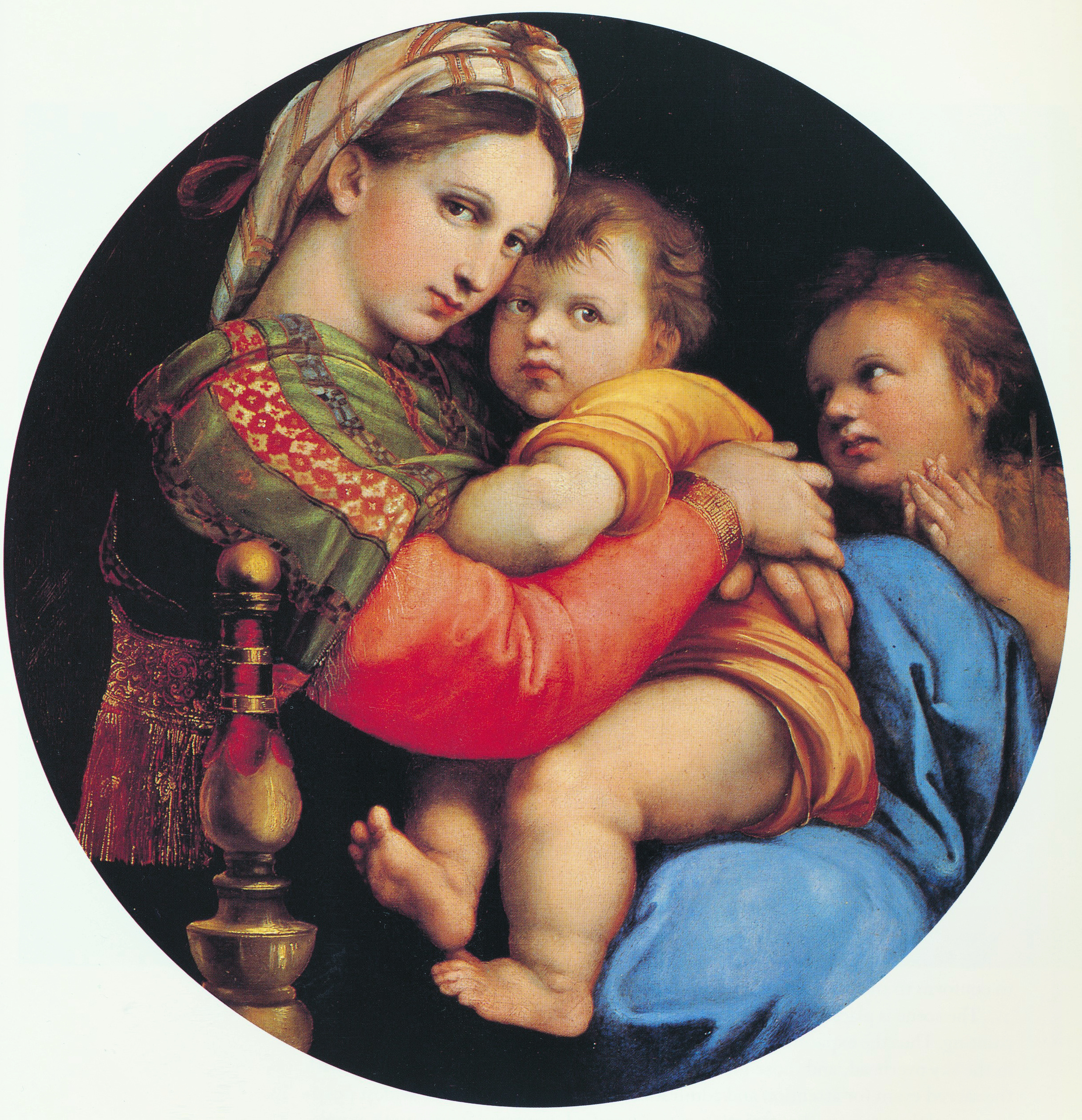
Raphael’s tondo Madonna della Seggiola (Madonna della Sedia or Madonna of the Chair) was painted in Rome around 1513-1514. Its title derives from the ornate gilded chair (seggiola) on which the Virgin sits, a detail that reflects the courtly refinement of Raphael’s Roman years under Pope Leo X. The painting is celebrated for its profound tenderness and maternal warmth: Mary draws the Christ Child closely to her while the young Saint John the Baptist gazes upward in adoration, his hands clasped in prayer and a delicate reed cross foreshadowing the Crucifixion. Unusually, Mary looks directly out at the viewer with an intense and knowing expression, inviting us into what might otherwise seem a private family moment. During the Napoleonic Wars, the painting was seized by French forces in 1799 and taken to Paris, where it was admired as one of the finest treasures in Napoleon’s collection. Following Napoleon’s defeat, it was returned safely to Florence in 1815.

Raphael’s Secret Muse: La Fornarina and the Artist’s Great Love
Raphael’s famously intimate and sensual masterpiece, La Fornarina (The Baker’s Daughter), was painted around 1518-1520, during the final years of the artist’s life. The half-nude sitter is widely identified as Margarita Luti, believed to have been Raphael’s secret longtime mistress and the great love of his life.
A Forbidden Romance
Although Raphael was officially engaged to Maria Bibbiena, the niece of a powerful Vatican cardinal, the artist repeatedly postponed the marriage. Contemporary accounts suggest that his devotion to Margarita overshadowed all other personal and sometimes professional commitments. The Renaissance biographer Giorgio Vasari wrote that Raphael’s passion for Margarita was so consuming that it distracted him from some of his most important artistic commissions, including work for the Vatican.
Margarita as Venus
Margarita’s pose, with one hand resting lightly on her breast and the other across her lap, deliberately echoes the ancient Venus Pudica (“Modest Venus”) type of classical Greco-Roman sculpture. Through this visual reference, Raphael transformed his working-class lover into Venus, the goddess of love, elevating her from earthly companion to idealized beauty.
Her appearance is rich with symbolic details. She wears an exotic striped silk turban adorned with a delicate pearl ornament. The pearl, margherita in Italian, serves as a playful visual pun on her first name. Such references suggest that the painting was not merely a portrait but an intensely personal tribute.
A Private Declaration of Love
Unlike Raphael’s public commissions, La Fornarina appears to have been a private work, likely kept within the artist’s workshop rather than displayed for patrons. One of the painting’s most striking details is the dark blue and gold band encircling Margarita’s upper left arm. Inscribed with the words “RAPHAEL URBINAS” (“Raphael of Urbino”), the band functions almost like a signature worn on the body of the beloved. Rather than simply identifying the artist, it creates a profound connection between painter and sitter, suggesting a mutual bond that transcends the conventions of portraiture.
The Hidden Wedding Ring
Modern scientific analysis and X-ray examinations of the painting have revealed a remarkable hidden history. Beneath the visible paint layers, conservators discovered that Margarita originally wore a large gold wedding ring on the third finger of her left hand. The surrounding landscape also once contained myrtle and laurel, traditional Renaissance symbols associated with marriage, fidelity, and enduring love.
These discoveries have fueled longstanding speculation that Raphael and Margarita may have entered into a secret union, or at the very least that Raphael wished to portray her as his wife rather than merely his mistress.
The Cover-Up After Raphael’s Death
After Raphael’s sudden death in 1520, his workshop assistants, most notably Giulio Romano and Gianfrancesco Penni, altered the painting. The wedding ring was painted over, and portions of the symbolic background were modified or removed.
Many scholars believe these changes were intended to protect Raphael’s posthumous reputation and avoid a potentially damaging scandal. Publicly, the artist was known as the unmarried fiancé of a powerful cardinal’s niece. Evidence of a secret marriage or romantic attachment to a baker’s daughter would have embarrassed both elite Vatican families and Raphael’s estate during a sensitive period following his death.
As a result, La Fornarina survives not only as one of the Renaissance’s most beautiful portraits but also as one of its most intriguing love stories, a work in which a Renaissance artist’s passion, symbolism, and secrecy are woven beneath the surface of the paint itself.
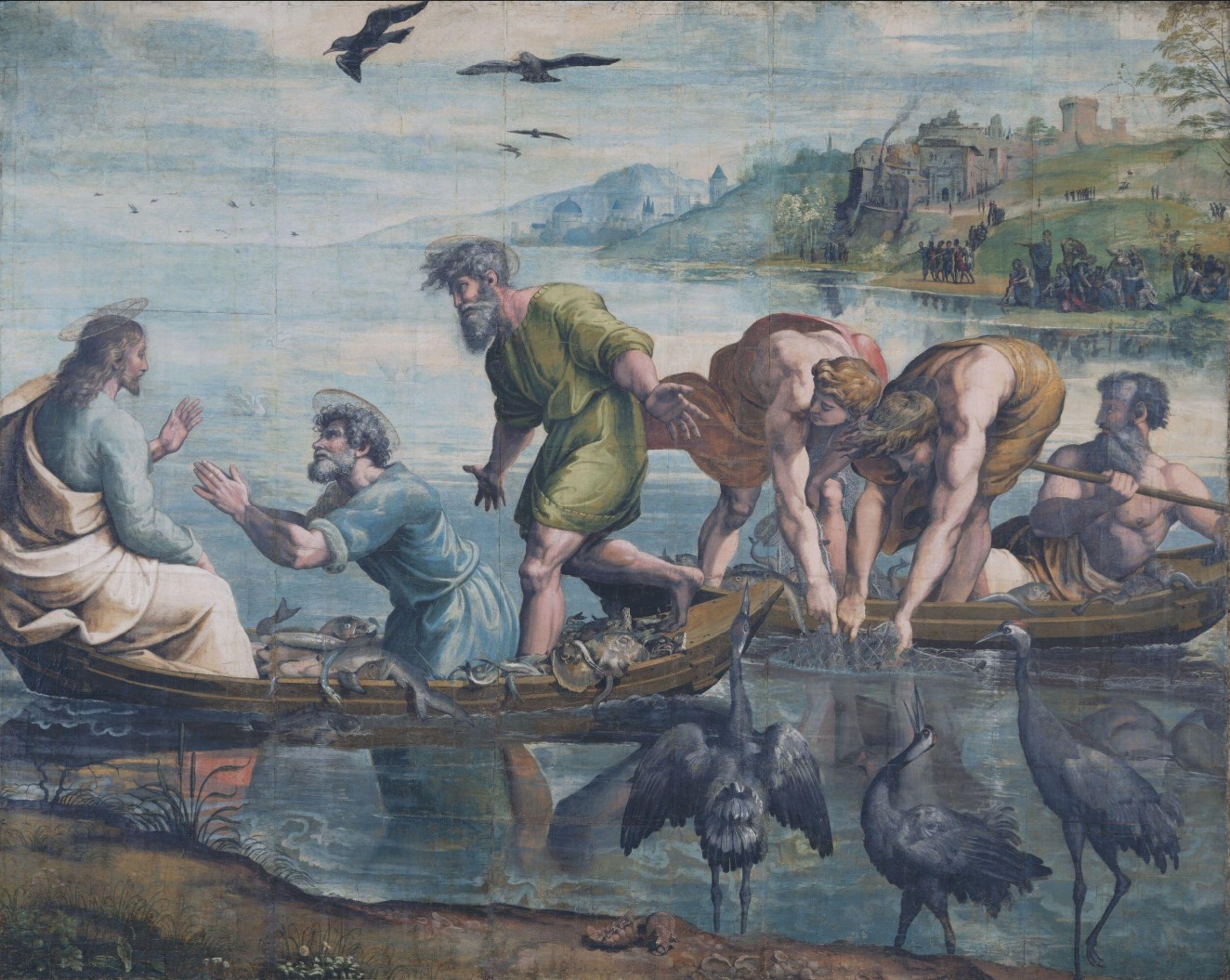
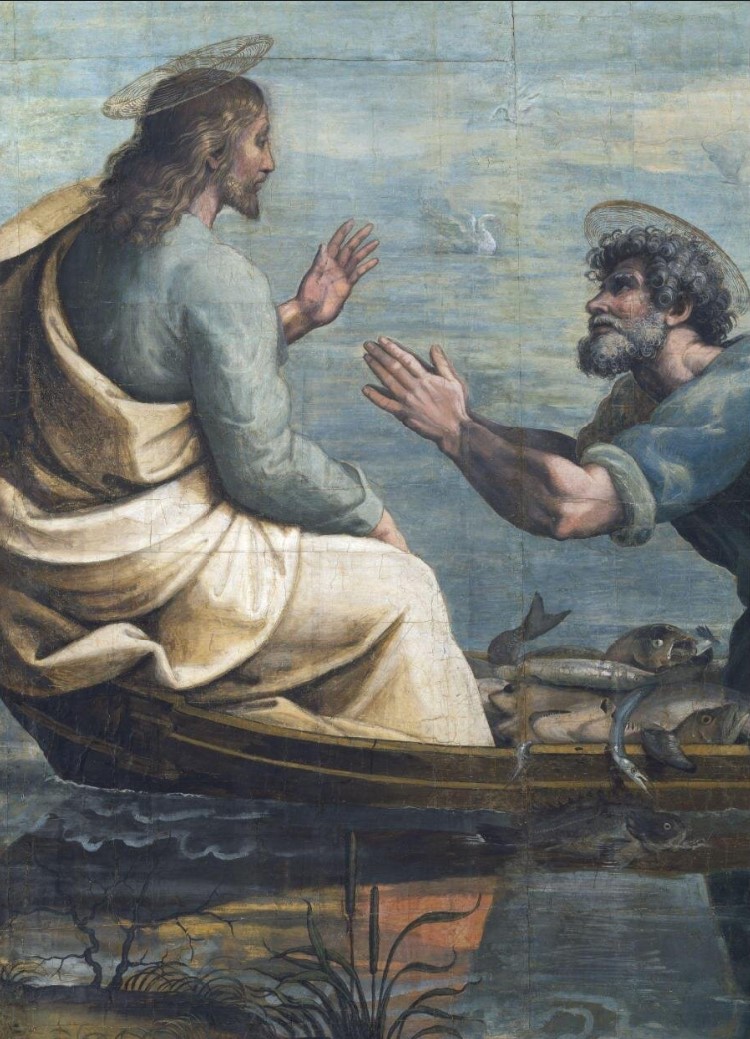
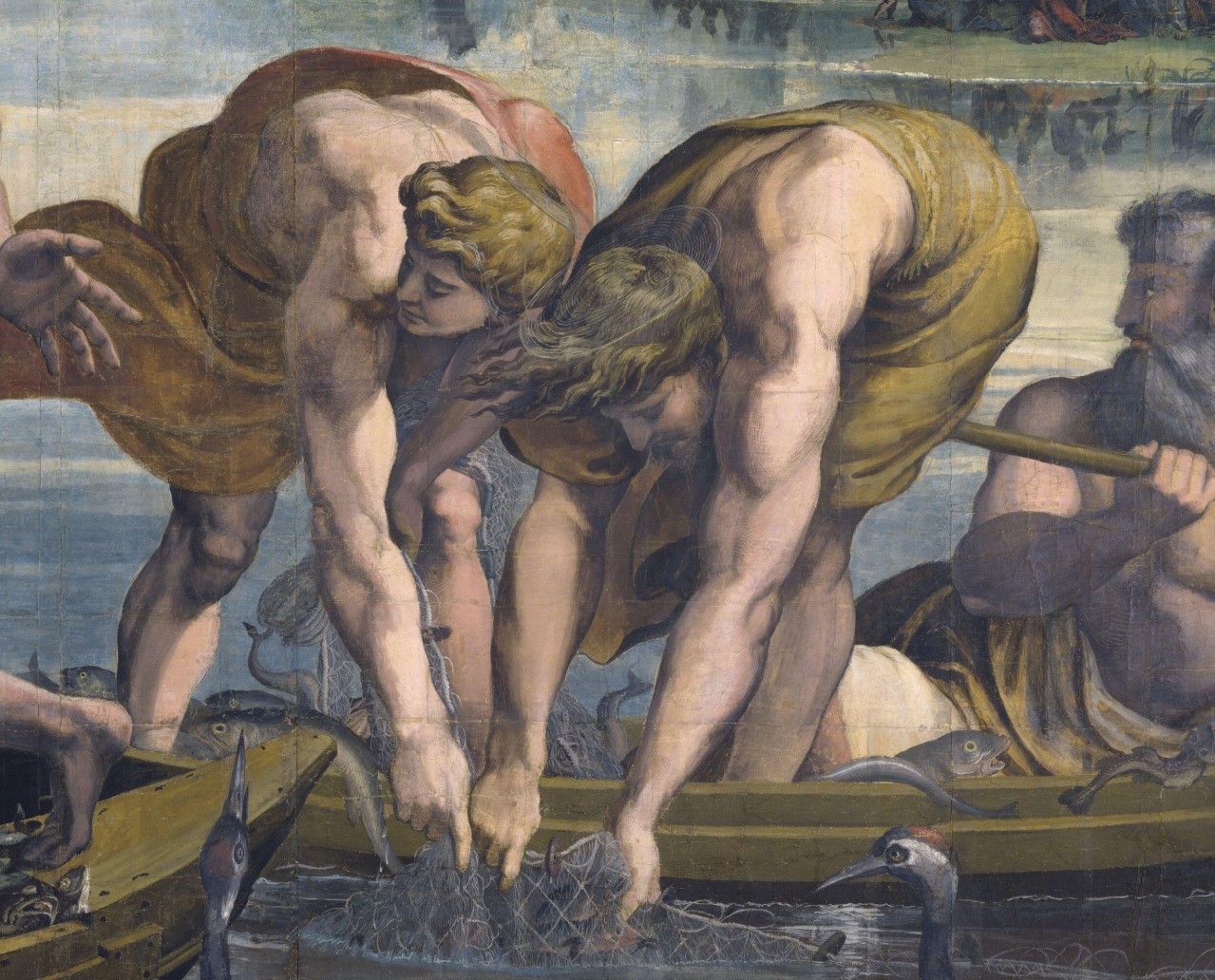
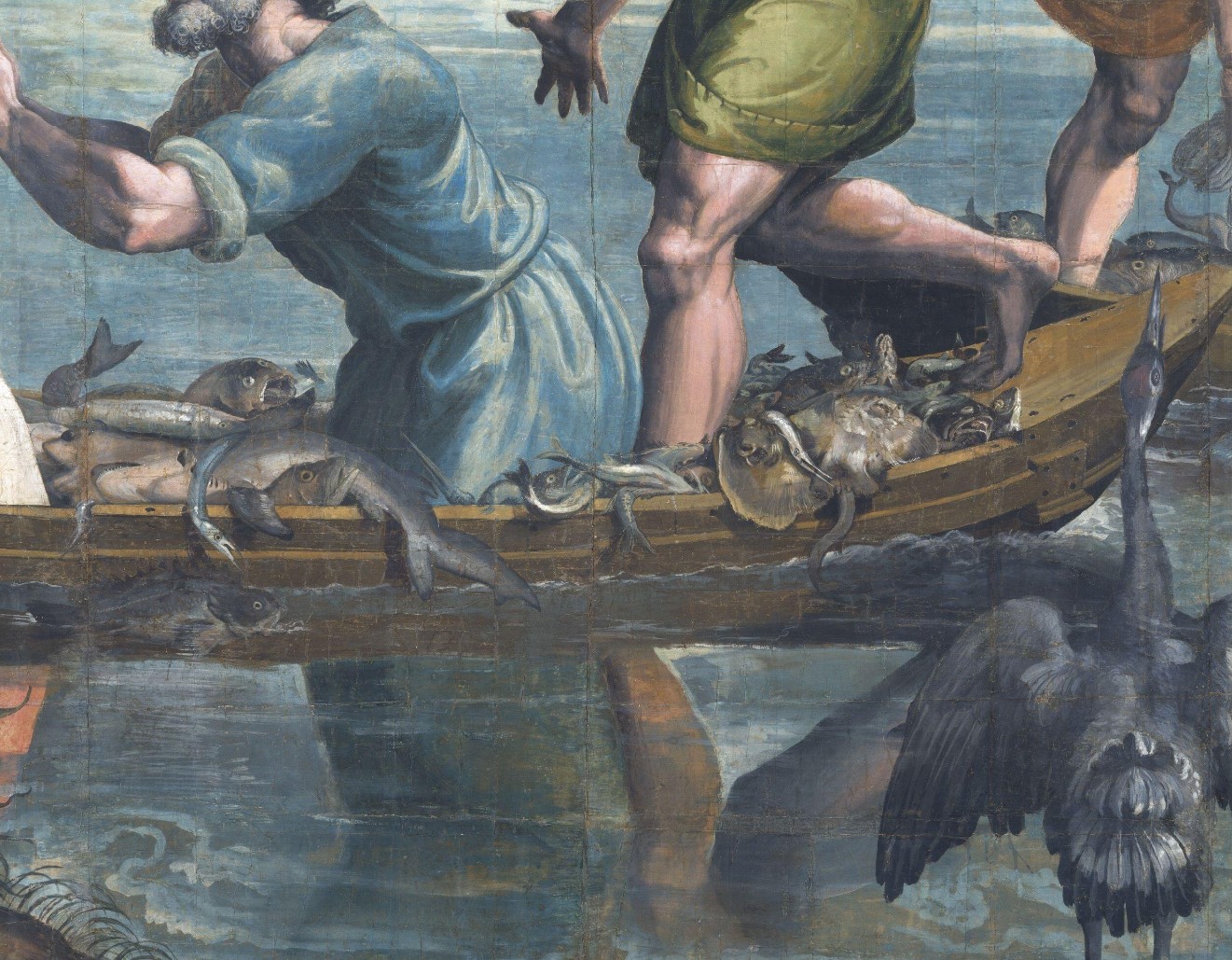
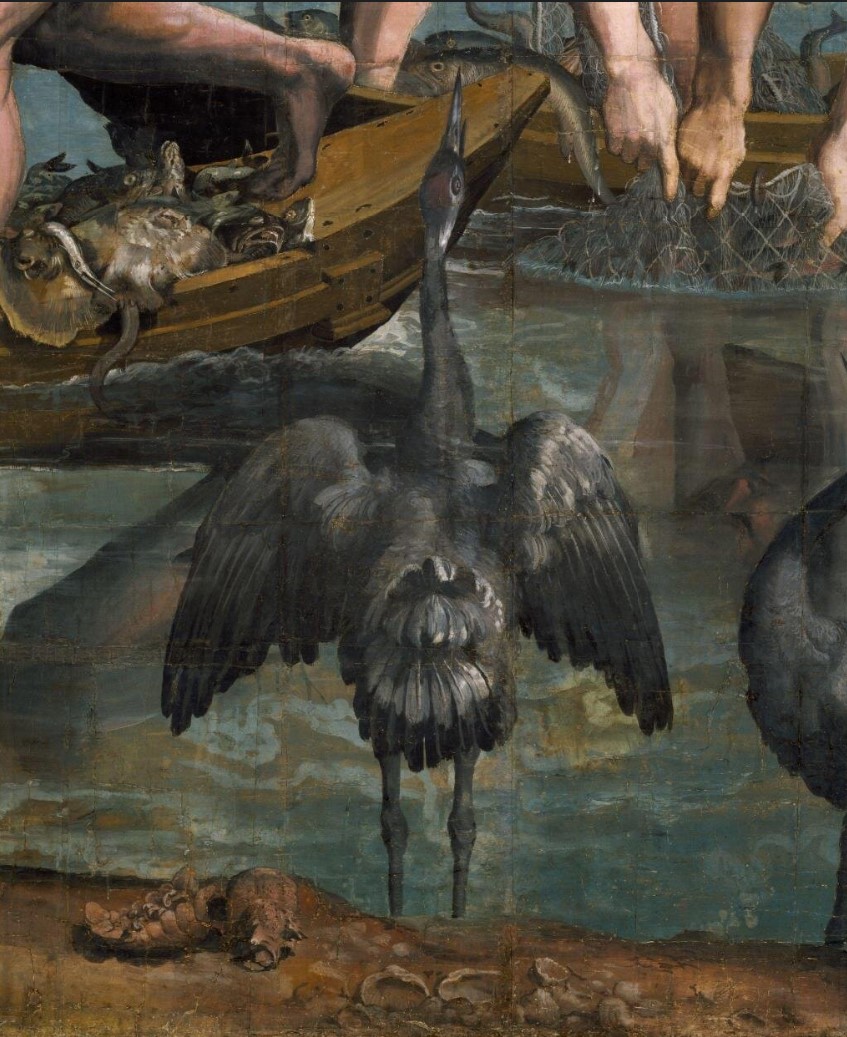
The Raphael Cartoons are designs for tapestries and were commissioned by Pope Leo X (1513-21) shortly after his election in 1513. The tapestries were intended to hang in the Sistine Chapel in Rome, built by Pope Sixtus IV (1471-84). The decoration of the chapel under Sixtus addressed the lives of Moses and Christ. The tapestries continued this theme, illustrating scenes from the lives of St. Peter and St. Paul.

The Visitation was commissioned by Giovanni Branconio, the Apostolic Protonotary, at the behest of his father, Marino Branconio, for the family chapel at the church of San Silvestre de Aquila. Marino´s choice of subject matter was undoubtedly guided by the fact that his wife was named Elizabeth and his son, John. In 1655, this work was acquired by Felipe IV (1605-1665), who deposited it at El Escorial. It entered the Prado Museum in 1837.

Raphael’s grand late masterpiece, The Holy Family of Francis I (also known as The Great Holy Family), was painted in 1518 during his Roman period. At the center of the composition, the infant Christ springs from his cradle into the embrace of his mother, the Virgin Mary. Beside her, Saint Elizabeth supports her young son, Saint John the Baptist, whose hands are clasped in prayer as his gaze points to Jesus. Two angels join the scene, one holding a crown of flowers above Mary’s head, symbolizing her role as the Queen of Heaven. A pensive, heavy-lidded Saint Joseph leans on his hand, quietly contemplating the gathering and awaiting the Holy Family’s next move.
More saccharine than Raphael’s other work, the painting reflects his growing attraction to the monumental, proto-Mannerist tendencies inspired by Michelangelo’s Sistine Chapel ceiling. It also bears the mark of Raphael’s increasingly busy workshop, with most of it executed by his assistant Giulio Romano. Commissioned by Pope Leo X as a diplomatic gift for King Francis I of France and Queen Claude, the painting was sent to the French royal court at Fontainebleau in 1518. The gift formed part of the Vatican’s broader effort to cultivate French goodwill and maintain a political counterweight to the growing power of the Holy Roman Emperor.

Raphael died in April 1520 while working on The Transfiguration. Although most of the painting was already complete, his sudden passing marked the abrupt end of a brilliant but short career—Raphael was only 37 years old. Cardinal Giulio de’ Medici, the future Pope Clement VII, had commissioned the work for the Cathedral of Narbonne in France, but following the artist’s untimely death, it was instead displayed at his funeral in the Pantheon.
During its creation, the project was fueled by intense artistic rivalry. Sebastiano del Piombo, who was mentored by Michelangelo in Florence, was simultaneously producing The Raising of Lazarus for the exact same cathedral, creating a direct competition for Raphael’s work. Today, Sebastiano’s anxious letters to Michelangelo serve as our primary historical record for the progress and development of Raphael’s painting.
Initially, Raphael planned to depict only the mountaintop Transfiguration. This episode is detailed in the Synoptic Gospels but completely omitted from the Gospel of John. This omission is particularly notable because Matthew, Mark, and Luke all record that John was personally present for the magnificent event, alongside Peter and James the Greater. Ultimately, John’s omission makes thematic sense: while the Synoptic writers use the Transfiguration as a dramatic, mid-narrative revelation of Jesus’s heavenly nature, John’s entire Gospel establishes that exact divine premise right from its opening verses.
Raphael’s depiction ultimately became the definitive template for how the event on Mount Tabor has been popularly imagined ever since. He captured Christ rising majestically into the air, His face and clothes turned a dazzling white, elevated above Moses and Elijah, whom the Gospels describe Jesus as being in conversation with. Below them, the three chosen Apostles careen in various prostrations of overwhelming wonderment, shielding themselves from the brilliant light.
Raphael famously expanded the traditional scene to include the scriptural episode that immediately follows: the story of a demoniac boy whom the remaining Apostles fail to heal. In the biblical account, Christ descends the mountain after His transfiguration and cures the child, who appears here frantically gesturing in the lower right corner. In the composition, the divine peace of the Transfiguration sits elevated and farther back from this earthly, chaotic turmoil below. On the left side of the canvas, two figures—identified as the patron saints of Narbonne—can be seen making their way up the mountain to pay homage.
This inclusion was a nod to the patrons, if not a guarantee of Raphael’s full fee. As the Renaissance biographer Giorgio Vasari famously noted, Raphael lived more like a prince than a painter. His lifestyle was expensive, and Giulio Romano, one of Raphael’s chief artistic and financial heirs, eventually had to sue the benefactors in 1522 to secure the final payment for the masterpiece.
Debate continues among art historians over exactly how much of Raphael’s studio executed the final canvas, particularly in the wake of his sudden death. Even so, it is clear the workshop assisted extensively during Raphael’s lifetime, as his highly productive working method required. Nevertheless, the core invention, the preparatory drawings, and the vast majority of the brushwork were distinctly Raphael’s own. Art historians Roger Jones and Nicholas Penny note that for this final painting, Raphael looked back to the very beginning of his career, modeling many of the expressive heads in The Transfiguration after Leonardo da Vinci’s unfinished 1481 masterpiece, The Adoration of the Magi.
Just as in the Gospel narrative, light drives the artistic coloration, invention, and emotion of the painting. A blinding, heavenly radiance engulfs Peter, James, and John at the top, while a second, much sharper earthly light isolates the expressive faces, hands, and frantic gestures from deep shadows below. This complex illumination and intense contrast became an essential touchstone for later, highly influential Baroque painters, most notably Caravaggio. Vasari remarkably notes that when Raphael passed away, the loss plunged the entire papal court into deep, unmitigated grief, so much so that the Pope quite openly and bitterly wept at the tragic passing of this noble craftsman.
Conclusion
With Leonardo da Vinci and Michelangelo, Raphael became one of the defining figures of the High Renaissance. His achievement lay not only in individual masterpieces but in his ability to unite classical ideals, Christian theology, portraiture, architecture, and human emotion into a harmonious artistic vision that shaped the course of Western art for centuries.
FOOTNOTES:
1. Giorgio Vasari, Lives of the Artists, translated by George Bull (Penguin Books, Harmondsworth, Middlesex, England, 1965) pages 316-18.
2. Ibid., page 318 and Edizioni Musei Vaticani, Michelangelo and Raphael in the Vatican, (Tipografia Vaticana, Città del Vaticano, 1995) page 169.
3. Vasari, Lives, pages 285 and 291.
4. Ibid., pages 299-302.
5. Roger Jones and Nicholas Penny, Raphael, Yale University Press, New Haven and London, 1983, page 113 and 17. Carlo Ludivico, Vatican Museums Rome, page 119
6. Roger Jones and Nicholas Penny, Raphael, Yale University Press, New Haven and London, 1983, page 117 and Vasari, Lives, page 301.
7. Frederick Hartt, History of Italian Renaissance Art: Painting, Sculpture, Architecture, Harry N. Abrams, Inc. New York, Third Edition, 1987, page 513.
8. New American Bible, (Catholic Book Publishing Company, New York) page 546 and 550; Beck, Raphael, page 98.
BIBLIOGRAPHY:
Brera Milan Great Museums of the World, Carlo Ludovico Ragghianti, Newsweek NY 1970 pp. 34
Pinakothek Munich Great Museums of the World, Roberto Salvini, et. al., Newsweek NY 1969 pp. 126
Lives of the Artists, Giorgio Vasari, translated by George Bull, Penguin Books, Harmondsworth, Middlesex, England, 1965, pages 316-18
Michelangelo and Raphael in the Vatican, Edizioni Musei Vaticani, Tipografia Vaticana, Città del Vaticano, 1995 p. 169
Raffaello. Franzese, Paolo (2008). Milano: Mondadori Arte.
Raphael, James H. Beck, harry N. Abrams, Inc., Publishers, New York, 1994.
Raphael, Roger Jones and Nicholas Penny, Yale University Press, New Haven and London, 1983.
Encyclopedia of the Middle Ages, Volume 2, André Vauchez, Richard Barrie Dobson, Michael Lapidge, Chicago: Fitzroy, Dearborn, 2000.
History of Italian Renaissance Art: Painting, Sculpture, Architecture, Frederick Hartt, Harry N. Abrams, Inc. New York, Third Edition, 1987.
Raphael, Beck, James H., Harry N. Abrams, Inc. Publishers, New York, 1994.
The Medici Popes (Leo X and Clement VII), Herbert M. Vaughan, B.A., Methuen & Co., London, 1908.
“Alidosi, Francesco, detto il Cardinal di Pavia”. Dizionario Biografico degli Italiani – Volume 2. Treccani. 1960.
This explanatory article may be periodically updated.



