
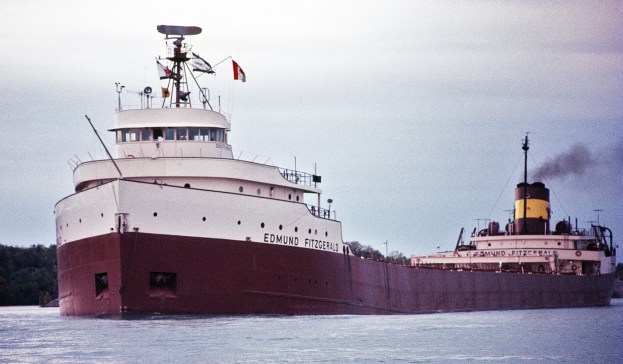

FEATURE image: Edmund Fitzgerald in 1971. This was the final year that the SS Edmund Fitzgerald held the title of the largest ship on the Great Lakes. Following her launch in June 1958, the 729-foot bulk ore carrier reigned as the largest vessel operating on the lakes for 13 consecutive years. That milestone era ended in 1971 when a new generation of even larger, 1,000-foot “superfreighters” (beginning with the Stewart J. Cort) entered service on the Great Lakes and surpassed her dimensions. “Edmund Fitzgerald, 1971, 3 of 4 (restored; cropped)” by Greenmars is licensed under CC BY-SA 3.0.

Canadian folk-rock singer-songwriter Gordon Lightfoot performing live in concert. On stage he is playing an acoustic guitar and singing. Known for his rich storytelling and iconic baritone voice, he famously wrote and recorded timeless classics such as “The Wreck of the Edmund Fitzgerald” and “If You Could Read My Mind.” PHOTO: “Gordon Lightfoot” by Original uploader was Piedmontstyle at en.wikipedia is licensed under CC BY 3.0.
Canadian singer-songwriter Gordon Lightfoot began releasing solo albums in 1966. His first six albums, issued on the United Artists label, achieved moderate success, with sales reaching as high as 200,000 copies. After moving to Reprise Records in 1969, Lightfoot’s commercial fortunes rose dramatically. His first album for the label, Sit Down Young Stranger, coincided with his breakthrough U.S. hit, If You Could Read My Mind, in 1970 and became his first Gold-certified album.
Lightfoot built on that success with Sundown in 1974, which produced both his first No. 1 single and his second Gold-certified album (since certified Platinum). His next major hit was The Wreck of the Edmund Fitzgerald, inspired by the true story of the ore carrier named for Milwaukee civic leader Edmund Fitzgerald that sank during a violent Lake Superior storm on November 10, 1975. The song appeared on Summertime Dream (1976), an album that went Platinum and remains one of Lightfoot’s most enduring releases.1
On November 10, 1975, as two powerful storm systems collided over Lake Superior, the largest of the Great Lakes, the SS Edmund Fitzgerald disappeared beneath its deep, frigid waters. In service since 1958, the Fitzgerald had been the largest vessel on the Great Lakes when launched, stretching more than 700 feet in length. For a relatively modern cargo ship expected to remain in service for decades, its sudden loss was both unexpected and devastating.
At approximately 7:00 p.m. on November 10, the Fitzgerald radioed the nearby freighter Arthur M. Anderson, reporting that despite having lost its radar, the crew was “holding their own.” Those would become the ship’s last known words. Shortly thereafter, the Edmund Fitzgerald vanished from radar and was lost with all 29 crew members aboard.
The location of the SS Edmund Fitzgerald wreck in Lake Superior approximately 17 miles (27 kilometers) north-northwest of Whitefish Point, Michigan. The ship now rests beneath about 535 feet (165 meters) of water and is considered a protected gravesite.2

This map shows the exact location of the SS Edmund Fitzgerald wreck site in southeastern Lake Superior. The red pin marks where the vessel rests beneath approximately 535 feet of water, located about 17 miles north-northwest of Whitefish Point, Michigan (the prominent northward-pointing peninsula directly south of the pin). The purple line indicates the standard shipping route heading toward the locks at Sault Ste. Marie to the southeast, illustrating how close the ship was to reaching safety before sinking during the historic November 10, 1975 storm. PHOTO: “File:SS Edmund Fitzgerald wreck.png” by Oaktree b is licensed under CC BY-SA 3.0.
Recovery Efforts involved the U.S. Navy and U.S. Coast Guard.
On a personal note, I have had the opportunity to visit the Great Lakes Shipwreck Museum in Whitefish Point, Michigan that contains the bell from the SS Edmund Fitzgerald recovered in 1995.
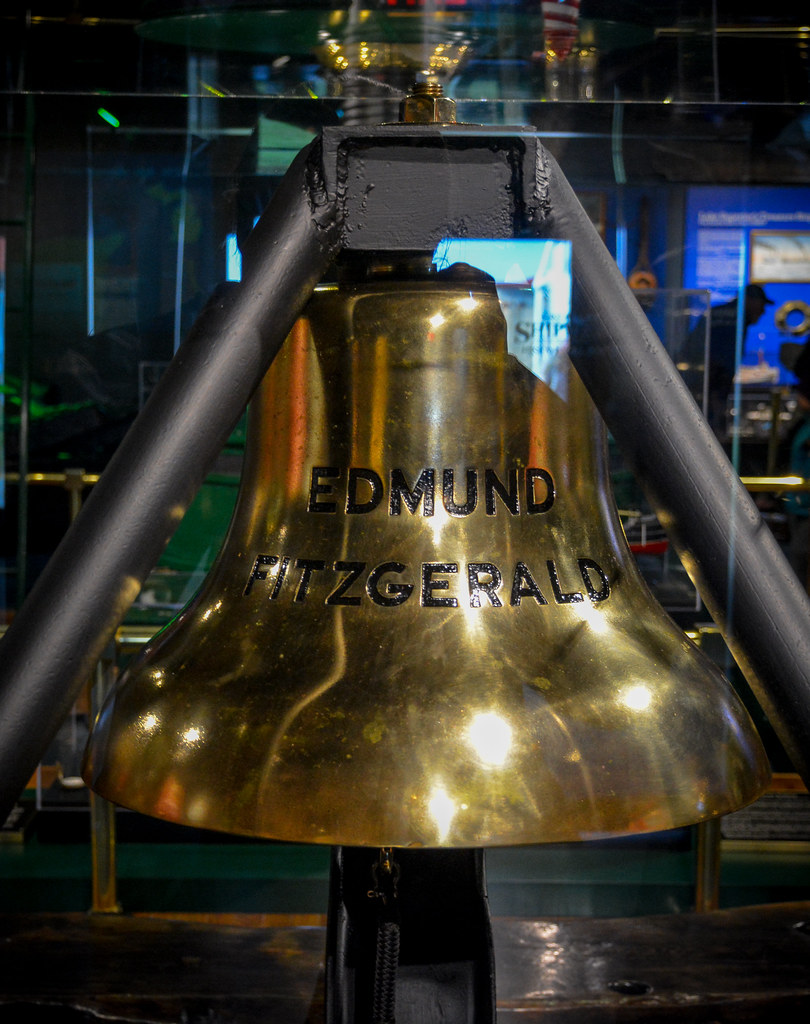
This is the original 200-pound bronze bell of the SS Edmund Fitzgerald. It was recovered from the underwater wreck site on July 4, 1995, by a joint U.S. and Canadian diving team operating 530 feet below the surface of Lake Superior. The salvage operation was conducted at the specific request of the crew members’ surviving families to serve as a tangible memorial. A replica bell engraved with the names of all 29 lost sailors was placed on the shipwreck in its place. Today, the meticulously restored original bell is on permanent display at the Great Lakes Shipwreck Museum located at Whitefish Point, Michigan. Each year on November 10th, the glass case is removed so the bell can be ceremonially tolled 30 times—once for each of the 29 crewmen lost, and a final time to honor all mariners who have perished on the Great Lakes. PHOTO: “The Bell of the Edmund Fitzgerald” by TheGreenHeron is licensed under CC BY-NC 2.0.
Whitefish Point, located on the southeastern shore of Lake Superior in Michigan, houses the Great Lakes Shipwreck Museum, which holds memorial events for the SS Edmund Fitzgerald each November. The wreck’s location, being 17 miles north-northwest of the point, places it beyond safe navigation lines, illustrating why the ship never reached shelter that fateful night.3

The ultimate cause and circumstances of the wreck of the SS Edmund Fitzgerald in Lake Superior remain a mystery, weather conditions surrounding the sinking are well known – extraordinarily severe storm conditions, including 60 m.p.h. winds, towering waves of 25-30 feet, and heavy thick ice, which impacted possible structural vulnerabilities of the large, nearly 20-year-old cargo ship. The exact sequence of the events leading to the sinking are also unknown, as no distress signal detailing mechanical failure was received, so that the wreck has been attributed to adverse weather and lake conditions that impacted the vessel suddenly.4
The disaster, unlike the other hundreds of shipwrecks that have taken place on the Great Lakes, has entered into American mythology with Gordon Lightfoot’s ballad The Wreck of the Edmund Fitzgerald, written within a couple weeks after the disaster that same November 1975. Though the song by a bestselling recording artist about a recent shipwreck carried some risk where it was too early to know every fact, the verses are meticulously based on news stories of the basics that were known. By Lightfoot’s 7th studio album, Don Quixote, released in 1972, the Canadian singer-songwriter had begun in earnest to explore nautical themes. The Wreck of the Edmund Fitzgerald, released in June 1976 on Lightfoot’s 11th studio album, Summertime Dream, stayed on the same course.

Summertime Dream was released in June 1976 and peaked at no. 12 on the Billboard 200 (no. 1 on Canada Top Albums). The Wreck of the Edmund Fitzgerald was the album’s second track and, in August 1976, became its second single peaking at no. 2 in the U.S. and no. 1 in Canada.
The song was getting local airplay from the album in Minnesota, Wisconsin, and Michigan. Its popularity led to its release as a single in August 1976 and became Lightfoot’s biggest and most unlikely hit record commemorating the sinking of a transport cargo ship with its lives lost from less than a year before. The six-and-one-half minute folk rock song reached no. 1 in Canada and no. 2 in the U.S. where it was kept out of the top spot by Rod Stewart’s Tonight’s the Night. After the song’s release, Lightfoot never lost contact with the surviving family members of that shipwreck. Gordon Lightfoot, who was born in a town on Lake Simcoe in Ontario, Canada, died less than 90 miles away on Lake Ontario in Toronto in May 2023 at 84 years old.
The legend lives on from the Chippewa on down
Of the big lake, they called Gitche Gumee
The lake, it is said, never gives up her dead
When the skies of November turn gloomy
With a load of iron ore, twenty-six thousand tons more
Than the Edmund Fitzgerald weighed empty
That good ship and true was a bone to be chewed
When the gales of November came early
The ship was the pride of the American side
Coming back from some mill in Wisconsin
As the big freighters go, it was bigger than most
With a crew and good captain well seasoned
Concluding some terms with a couple of steel firms
When they left fully loaded for Cleveland
And later that night when the ship’s bell rang
Could it be the north wind they’d been feeling?
The wind in the wires made a tattle-tale sound
And a wave broke over the railing
And every man knew, as the captain did too
‘Twas the witch of November come stealing
The dawn came late, and the breakfast had to wait
When the gales of November came slashin’
When afternoon came, it was freezin’ rain
In the face of a hurricane west wind
When suppertime came, the old cook came on deck sayin’
“Fellas, it’s too rough to feed ya”
At seven p.m., a main hatchway caved in, he said
“Fellas, it’s been good to know ya”
The captain wired in he had water comin’ in
And the good ship and crew was in peril
And later that night when his lights went outta sight
Came the wreck of the Edmund Fitzgerald
Does anyone know where the love of God goes
When the waves turn the minutes to hours?
The searchers all say they’d have made Whitefish Bay
If they’d put 15 more miles behind her
They might have split up or they might have capsized
They may have broke deep and took water
And all that remains is the faces and the names
Of the wives and the sons and the daughters
Lake Huron rolls, Superior sings
In the rooms of her ice-water mansion
Old Michigan steams like a young man’s dreams
The islands and bays are for sportsmen
And farther below Lake Ontario
Takes in what Lake Erie can send her
And the iron boats go as the mariners all know
With the gales of November remembered
In a musty old hall in Detroit, they prayed
In the Maritime Sailors’ Cathedral
The church bell chimed ’til it rang twenty-nine times
For each man on the Edmund Fitzgerald
The legend lives on from the Chippewa on down
Of the big lake, they call Gitche Gumee
Superior, they said, never gives up her dead
When the gales of November come early

SS Edmund Fitzgerald in MacArthur Lock, Sault Ste. Marie, Michigan.
NOTES:
- The Rolling Stone Encyclopedia of Rock & Roll, Third Edition (2001), p. 566.
- https://spectrumlocalnews.com/mi/michigan/news/2025/11/10/retired-ap-reporter-helped-cement-the-legend-of-the-wreck-of-the-edmund-fitzgerald – retrieved November 10, 2025.
- https://fieldethos.com/wreck-of-the-edmund-fitzgerald/ – retrieved November 10, 2025.
- https://www.history.com/articles/edmund-fitzgerald-sinking-lake-superior – retrieved November 10, 2025.
PHOTO CREDITS:
Edmund Fitzgerald in 1971 – “Edmund Fitzgerald, 1971, 3 of 4 (restored; cropped)” by Greenmars is licensed under CC BY-SA 3.0.
Gordon Lightfoot guitar – “Gordon Lightfoot” by Original uploader was Piedmontstyle at en.wikipedia is licensed under CC BY 3.0.
map – “File:SS Edmund Fitzgerald wreck.png” by Oaktree b is licensed under CC BY-SA 3.0.
bell – “The Bell of the Edmund Fitzgerald” by TheGreenHeron is licensed under CC BY-NC 2.0.
mystery – “Edmund Fitzgerald” by jpellgen (@1179_jp) is licensed under CC BY-NC-ND 2.0.
Summertime Dream album cover – 2025 01 06 Record – Gordon Lightfoot 7” by Blake Handley is licensed under CC BY 2.0.
at MacArthur Lock – “Edmund Fitzgerald in MacArthur Lock” by Detroit District is licensed under CC BY-SA 2.0.
lighthouse – PHOTO: “DSC_6472” by Jim Sorbie is licensed under CC BY 2.0.


