FEATURE image: Eugène Atget, Place Saint-Médard, 1889-99. Located in Paris’s historic Latin Quarter, Place Saint-Médard lies at the foot of Rue Mouffetard, one of the city’s oldest streets, following the route of an ancient Roman road. Rising behind the crowd is a building covered with large painted advertisements for local businesses, including the Grand Bazar Universel on Avenue des Gobelins and a ground-floor wine merchant. A chapel dedicated to Saint Médard, the patron saint of farmers and good weather, stood on this site as early as the 9th century. The present Église Saint-Médard, built in stages between the 15th and 18th centuries, combines a Flamboyant Gothic nave with a Classical choir and remains an active Roman Catholic parish at 141 Rue Mouffetard. Its former cemetery has since been transformed into a leafy public park. The block of buildings visible near the center of the photograph was later demolished as part of a street-widening project at the busy junction of Rue Mouffetard, Rue Censier, and Avenue des Gobelins.
Eugène Atget transformed photography into an act of historical preservation, creating an unparalleled visual record of Vieux (Old) Paris at the very moment modernization threatened to erase much of its architectural and social character. Through thousands of photographs of streets, courtyards, shopfronts, monuments, and ordinary neighborhoods, Atget documented not simply a city, but an entire urban civilization in transition.
Text by John P. Walsh.

Eugène Atget in an anonymously-taken photograph.
More than a photographer, Eugène Atget became the visual historian of Paris, preserving the city’s disappearing streets, architecture, and everyday life in one of the most important documentary projects in the history of photography.

Eugène Atget, Photographer’s Studio, c. 1910.
Atget was born in 1857 near Bordeaux (Libourne) and after his parents died in 1862, the 5-year-old boy was brought up by his grandparents in Bordeaux. Atget received a solid education and, similar to Paul Gauguin, eventually went to sea in the merchant navy and later, in 1878, settled in Paris where he aspired to be a dramatic actor. For the next decade, Atget was a traveling thespian in the Paris theaters. Even after he left Paris and the theater profession in 1888 to become a fine arts painter in the provinces, Atget always considered himself to be an actor. By 1890, his brief painting career over, Atget was back in Paris where he decided to become a documentary photographer.
There is a portrait of Eugène Atget (1857-1927) by Berenice Abbott created in 1927 that can be found here: https://www.icp.org/browse/archive/constituents/eug%C3%A8ne-atget?all/all/all/all/0. The portrait was taken in Berenice Abbott’s studio after Atget had recently taken up photography again. In August 1927, he died. It was at Man Ray’s suggestion that Berenice Abbott introduced herself to Atget in 1925 and began taking photographs of him. Of her subject she observed: “[Atget] will be remembered as an urbanist historian, a genuine romanticist, a lover of Paris, a Balzac of the camera, from whose work we can weave a large tapestry of French civilization.” (quoted in Paris Eugène Atget 1857-1927, Taschen, 2000, p. 22).

Eugène Atget, Children Playing, Luxembourg Gardens, c.1898.
Atget created many photographs with people in them, including this straightforward portrayal of Parisian life that also serves as a document of historical interest.

Eugène Atget, The Old School of Medicine, Rue de la Bûcherie, 1898.
Near the cathedral Notre Dame de Paris and the Place Maubert, between La Seine and Boulevard Saint-Germain, Rue de la Bûcherie is one of the oldest Left Bank streets. In the Middle Ages discarded meats were prepared here to feed the poor. The dome of this sixteenth-century building built for the University of Paris housed an auditorium in which classes were held. In Atget’s time it was a hotel that housed a street-level wine shop. After 1910 it became a school dormitory and then a library. Today, the Old School of Medicine has been restored to original appearance.

Eugène Atget, Façade, St-Julien-le-Pauvre, 1898.
A chapel on this site since the 6th century was destroyed in the 9th century by the Normans. Remnants of a 12th century church that was sacked by students in 1524 remain after the church was reconstructed in 1651. During the French Revolution the church was used to store and sell various stock. It rededicated as a church in 1826. When Atget photographed it, St Julien-le-Pauvre was already the Melkite Catholic Church which it is today. The arch at the top of Atget’s photograph is a camera effect from the glass plate not being covered by the lens. The church guard is seated to one side of the main door. The buildings to the side of the passageway in the photograph are largely gone today.

Eugène Atget, Hôtel de Brinvilliers, Rue Charles V, 1900.
Built in 1630, the main staircase is inside the Hôtel de Brinvilliers (also known as the Hôtel d’Aubray) at 12 Rue Charles V in Paris’s 4th arrondissement. The mansion is named after its most notorious inhabitant, Marie-Madeleine-Marguerite d’Aubray, Marquise de Brinvilliers. In the 1660s and 1670s, she poisoned her father and two brothers to inherit the family fortune, sparking France’s famous “Affair of the Poisons” scandal before her execution in 1676. By the time Atget photographed the interior in 1900, the once-luxurious mansion had fallen into disrepair. The building still stands today

Eugène Atget, Au Bon Puits, rue Michel-Le-Comte, 1901.
The 17th-century wrought-iron shop sign above the entrance of Au Bon Puits (“At the Good Well”), a historic wine shop and tavern located at 36 Rue Michel-le-Comte in Paris’s 3rd arrondissement. Ornate scrollwork frames a pulley, rope, and shallow bucket—a literal visual translation of the shop’s name, Au Bon Puits. The building was demolished by 1906.

Eugène Atget, Lampshade Seller, rue Lepic, 1901.

Eugène Atget, Ragpicker, avenue des Gobelins, 1901.

Eugène Atget, Fountains at Juvisy, 1902.
The Pont des Belles Fontaines (“Bridge of the Beautiful Fountains”) in Juvisy-sur-Orge is located about 12 miles south of Paris along the historic royal road to Fontainebleau and Lyon (today’s Route Nationale 7). Constructed between 1724 and 1728 by royal architect-engineer Jacques de La Guépière under King Louis XV the entrance marks the level road that replaced a steep incline. The sculpted allegorical river-god groups atop the two roadside pedestals were created by sculptor Guillaume Coustou.

Eugène Atget, Petit Bacchus, rue-St-Louis-en-l’Ile, 1901-02.
The storefront of Au Petit Bacchus at 61 Rue Saint-Louis-en-l’Île on the Île Saint-Louis in Paris. It is considered one of Atget’s signature works because it blends historical documentation with subtle, poetic storytelling. The glass door creates a complex visual interplay—combining the interior glimpse of the woman and a set dining table with faint reflections of the Paris street outside. Above the doorway’s “E. CANET” nameplate sits a finely sculpted figure of a baby Bacchus (the Roman god of wine) straddling a wine barrel amidst wrought-iron grapevines. While most of the historic storefronts Atget photographed were demolished during Paris’s modernization, this 17th-century doorway and its Petit Bacchus sign still survive in their original location today in Paris at 61 Rue Saint-Louis-en-l’Île in the 4th arrondissement.

Eugène Atget, The Temple of Love, the Petit Trianon, 1902.
The Temple of Love (Temple de l’Amour) at the Palace of Versailles was designed and erected by royal architect Richard Mique in 1777–1778 for Queen Marie Antoinette. The neoclassical pavilion was built as a decorative garden “folly” on an artificial island in the English Garden of the Petit Trianon. The circular pavilion—supported by 12 Corinthian columns—was designed to contain a marble statue of Cupid. During Marie Antoinette’s time, the island and temple served as a theatrical backdrop for her evening garden parties, music, and illuminated celebrations.

Eugène Atget, Paris Antique Store, Rue du Faubourg-Saint-Honoré, 1902.
Today, the ground floor of 21 Rue du Faubourg Saint-Honoré is occupied by a sleek, minimalist Chanel boutique. Although the building’s upper stone stories survive, no trace remains at street level of the ornate Antiquités storefront captured by Eugène Atget. A closer look at the center glass panel of the doorway reveals Atget himself reflected in profile, standing beside his large-format wooden tripod camera. The vanished facade was a striking example of early 19th-century Empire design, dominated by a large semicircular arched transom crowned with radiating sunburst ironwork. Above the arch, sculpted winged female figures flanked the word ANTIQUITÉS, rendered in distinctive Gothic lettering, creating a richly decorative streetscape that has long since disappeared from Paris.

Eugène Atget, Façade du no 2 , Place du Caire, 1903.
This view shows 2 Place du Caire in Paris’s 2nd arrondissement, the principal entrance to the historic Passage du Caire. Firmly rooted in Old Paris (le Vieux Paris), the building predates Baron Haussmann’s sweeping 19th-century redesign of the city by more than half a century. The square, street, and arcade were created at the end of the 18th century and named in honor of Napoleon Bonaparte’s capture of Cairo during his Egyptian campaign. Built on the former site of the medieval Convent of the Filles-Dieu, the complex leads into the Passage du Caire, the oldest, longest, and narrowest surviving glass-roofed shopping arcade in Paris.
Designed by architect Philippe-Laurent Pétrel with sculptural decoration by Jules-Gabriel Garraud, the facade is one of the city’s most striking examples of Egyptian Revival architecture. Three monumental heads of the cow-eared goddess Hathor dominate the third-floor windows, while a carved frieze above depicts ancient Egyptian chariots, warriors, and imitation hieroglyphics. Reflecting the eclectic experimentation of pre-Haussmann Paris, the building combines these Egyptian motifs with pointed Gothic arches along the upper story. More than a century after Eugène Atget photographed it in 1903, the facade and its watchful Hathor heads still overlook Place du Caire, appearing remarkably unchanged.

Eugène Atget, Courtyard of Farewells, Fontainebleau, 1903.

Eugène Atget, Ancienne Barrière (tollgate) du Trône, Paris, 1903-04.

Eugène Atget, France Triumphant, Versailles, 1904.

Eugène Atget, Palais-Royal, Paris, 1904-05.

Eugène Atget, Tree Roots, Saint Cloud Park, 1906.
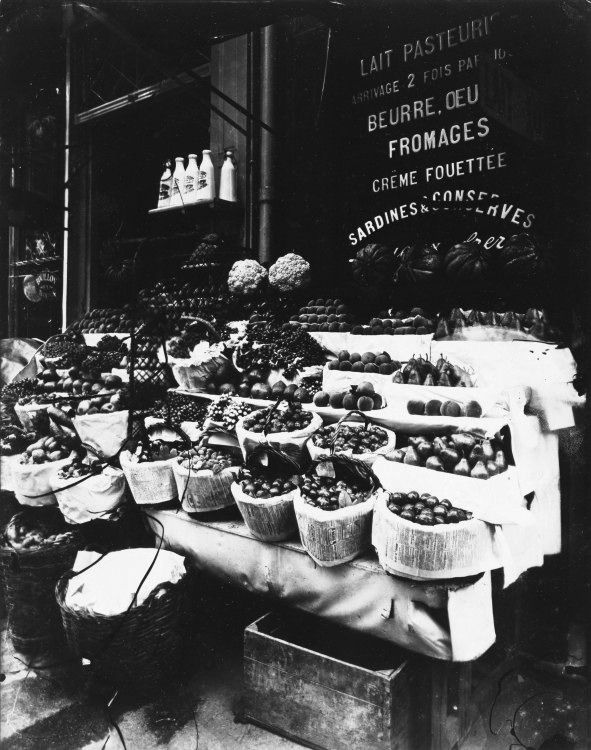
Eugène Atget, Rue Sainte Opportune, Paris, 1908 (or 1912).

Eugène Atget, Water Lilies, before 1911.

Eugène Atget, Old Courtyard, rue Quincampoix, 1908 or 1912.

Eugène Atget, Entrée du passage de la Réunion, 1 et 3 Rue du Maure, 3° arrondissement, 1911.

Eugène Atget, Tinsmith’s Shop, rue de la Reynie, 1912.

Eugène Atget, Dress shop, rue de la Corderie, 1920.

Eugène Atget, Hairdresser’s shop, boulevard de Strasbourg, 1912.

Eugène Atget, Ragpicker’s Hut, 1912.

Eugène Atget, Old Mill, Charenton, 1915.

Eugène Atget, Reflecting Pool, Saint-Cloud, 1915-19.

Eugène Atget, Rue de l’Hôtel de Ville, 1921.

Eugène Atget, Cour de Rouen, 1915.
Tucked off the Cour du Commerce-Saint-André in Paris’s 6th arrondissement, the Cour de Rohan lies just inside the late-12th-century city wall of King Philip Augustus, which once marked the southern boundary of medieval Paris. In this 1915 photograph, Eugène Atget looks through an 18th-century stone gateway fitted with wheel-guards toward a curved 16th-century Renaissance residential wing rising above a ground-floor photogravure workshop. Although the medieval rampart runs directly through the property, the buildings framed here stand inside the old fortification line rather than exposing the stonework itself.
Once part of an estate linked to Diane de Poitiers, the influential mistress of King Henry II, the courtyard retains its 16th-century stone dormers and shuttered casement windows. Like the neighboring Cour du Commerce-Saint-André—famous for its Revolutionary-era printers and early guillotine trials—the Cour de Rohan became an enclave for specialized printing trades. Remarkably, its three interconnected courtyards survive largely intact, preserving their cobblestones, stone wheel-guards, an 18th-century wrought-iron wellhead, and a tripod mounting step (pas-de-mule). Today, while the adjacent Cour du Commerce-Saint-André bustles with boutiques and cafés like Le Procope, a security gate restricts public access to the Cour de Rohan’s private apartments, leaving visitors to glimpse this hidden corner of Old Paris through the entrance or during occasional guided tours.

Eugène Atget, Hôtel Richelieu, 18 quai de Béthune, (4th arr.), 1900.

Eugène Atget, Ancienne maison de la maîtrise, 1902.
This explanatory article may be periodically updated.