


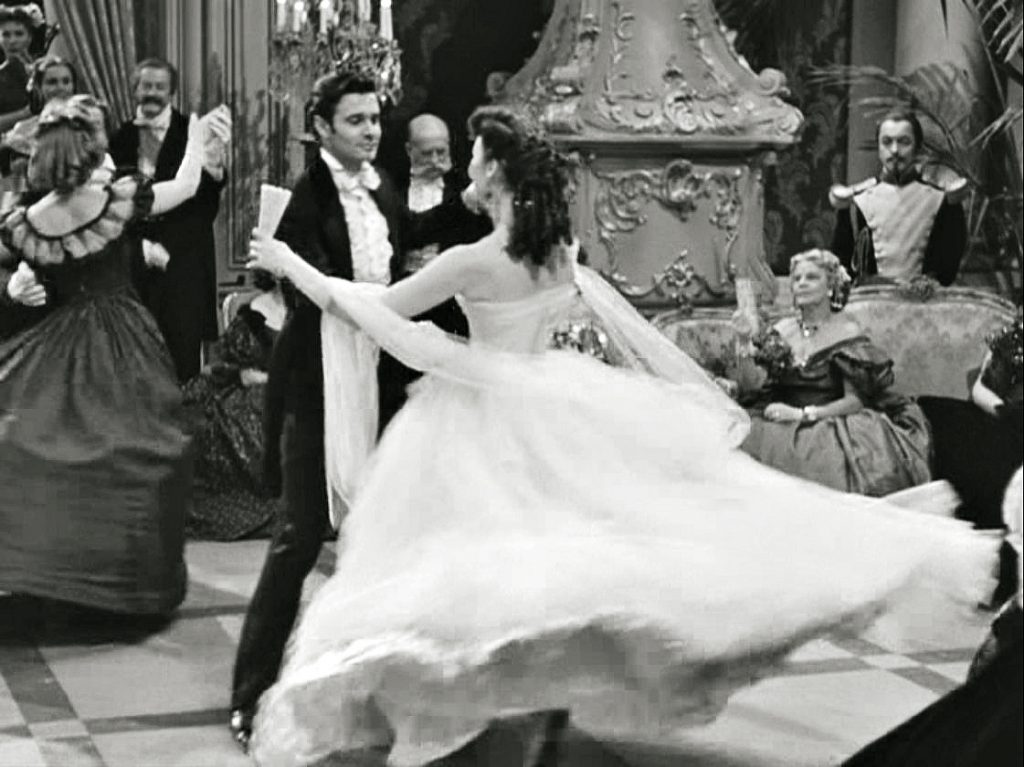
FEATURE image: Madame Bovary (Jennifer Jones) and Rodolphe Boulanger (Louis Jourdan) waltz at the ball in a still from Metro-Goldwyn-Mayer’s 1949 film Madame Bovary directed by Vincente Minnelli. Fair Use.
In Vincente Minnelli’s Madame Bovary (1949), the ballroom waltz transforms Gustave Flaubert’s critique of romantic illusion into a cinematic experience of desire, disorientation, and psychological collapse. Through synchronized choreography, Miklós Rózsa’s expressive score, fluid camera movements, and the extraordinary breaking of the ballroom windows, Minnelli reveals the widening gulf between Emma Bovary’s fantasies of passion and the painful realities of her life. The scene’s visual splendor ultimately becomes an expression of the destructive power of romantic idealism.
In the 1949 film Madame Bovary directed by Vincente Minnelli, a beautiful and charming Madame Bovary (Jennifer Jones) meets wealthy Rodolphe Boulanger (Louis Jourdan) at a ball where he literally sweeps her off her feet. Selfishly aggravated by her husband Charles Bovary (Van Heflin) for not fitting into high society, Madame Bovary begins a love affair with Rodolphe. Though the pair scheme to elope to Italy, Rodolphe does not love Madame Bovary.
Filming began at M-G-M’s Culver City studios in mid-December 1948. Although producers favored Lana Turner for the role of Emma Bovary, director Vincente Minnelli championed Jennifer Jones instead. Fresh from her Academy Award-winning success in The Song of Bernadette, Jones brought the glamour and emotional intensity needed to portray Flaubert’s restless heroine, a woman whose romantic longings and dissatisfaction propel the story. At the same time, her casting may have helped ease concerns from the Production Code Office, which was already preparing to scrutinize the film’s controversial themes of adultery, desire, and moral transgression.
Minnelli initially presents the waltz as a vision of glamour, sensuality, and romantic fulfillment. Yet the swirling camera, increasingly disoriented movement, and shattered windows gradually undermine that beauty. What appears to be Emma’s moment of romantic triumph becomes a visual premonition of emotional collapse.
The Waltz Scene was Filmed to the Music
One of the film’s most carefully wrought and delightful scenes is this ballroom sequence. It was one of the last segments to be shot. The film footage was tailored to Miklós Rózsa’s music. Minnelli explained to the composer in advance the camera movements so he could write the music in an arrangement for two pianos. The scene was then filmed to match it. Their artistic collaboration produced one of cinema’s most original scenes uniting robust music with weaving and gliding images on film.

Madame Bovary (Jennifer Jones) and Rodolphe Boulanger (Louis Jourdan) waltz at the ball. It is one of the film’s most delightful scenes and one of the last to be shot. Director Vincente Minnelli made certain its choreography carefully matched the music of Miklós Rózsa. Madame Bovary was nominated for an Oscar for Best Art Direction-Set Decoration, Black-and-White.

Minnelli has the audience experience the seduction of Emma’s fantasy while simultaneously revealing its destructive nature. The waltz is both an expression of her longing for an ideal life and a cinematic enactment of the illusions that will ultimately destroy her.
Beautiful and charming Emma Bovary (Jennifer Jones) is repulsed by her uncouth husband, Charles Bovary (Van Heflin), an undistinguished medical doctor, and begins an affair with Rodolphe Boulanger (Louis Jourdan). Their plans to elope, however, do not materialize as Emma hoped.

“Break the Windows” dramatizes a heroine’s transition into madness
As Rodolphe swirls her, Emma Bovary’s head spins until she becomes dizzy. The viewer sees her disorientation as the camera takes her viewpoint. She keeps dancing but asks for fresh air. Her request leads to an extraordinary and incredible reaction by the stewards. They start to smash the ballroom’s windows with chairs to help her cool down. This fantastically destructive action of broken glass aligns with the destruction of Emma’s romantic illusions throughout the film.

In reaction to Madame Bovary becoming dizzy while waltzing with a new lover, the stewards smash the ballroom windows to give her air. The extraordinary action ultimately becomes symbolic of the destruction of Madame Bovary’s romantic illusions with handsome, wealthy Rodolphe and her own descent into madness.
Emma imagines that wealth, passion, and an ideal lover will deliver her from the disappointment of her marriage and provincial life.
Night of Repressed Passion
Along with her husband’s boorish behavior at the ball and everywhere else, Madame Bovary’s romantic disappointment leaves her feeling publicly humiliated. Instead of love and excitement, Madame Bovary runs out of the ball in shame. Though she yearns for happiness and excitement, her pursuit of selfish pleasures ends in scandal and ruin.

Jennifer Jones as Madame Bovary offers a performance that is elegant and beautiful. It is equally insightful to the selfish and nervous personality of Flaubert’s fictional character.

A film poster for Vincente Minnelli’s Madame Bovary. Several different versions of the film poster were produced for the marketing of the 1949 film.

This publicity photo for Madame Bovary showed the love triangle of Madame Bovary (Jennifer Jones), her handsome lover Rodolphe Boulanger (Louis Jourdan), and her cuckolded husband Charles Bovary, a medical doctor (Van Heflin).
Miklós Rózsa’s brilliant score for Vincente Minnelli’s 1949 adaptation of Madame Bovary stands as a landmark in film music history, serving as a deeply psychological portrait of Emma Bovary’s tragic descent.
Beyond this technical triumph of the waltz scene, Rózsa approached the entire soundtrack as a symphonic poem directly tied to the literary essence of Gustave Flaubert’s source material. Instead of relying on passive atmospheric cues, he crafted eight interwoven motifs that map directly onto Emma’s fracturing psyche, tracking her spiral from romantic disillusionment to desperate lust, and finally to her agonizing physical end. Rózsa further deepened this musical architecture by assigning singular melodic themes to the three central men in her life: her husband Charles and her two contrasting lovers, Léon and Rodolphe.
In the role of Madame Bovary Jennifer Jones gives a performance beyond the superficiality of display or machination of melodrama and enters into the inner psychology of the character whose anxious egomania manifesting joy and elation is driven by disillusionment to deterioration and self-destruction. Director Vincente Minnelli worked closely with composer Miklós Rózsa to integrate the image, plot and characters with the musical score which the composer admired for its artistic cinematic outcome.

Thirty-year-old Jennifer Jones plays Gustave Flaubert’s doomed title character, Madame Bovary, from his 1856 serial novel.
Vincente Minnelli’s film of the same name offered two costume and wardrobe managers: Walter Plunkett for women and Valles for men.
Walter Plunkett (1902-1982) was a prolific costume designer who worked on more than 150 projects in his Hollywood career, including Gone With The Wind. In 1951, Plunkett shared an Oscar with Orry-Kelly and Irene Sharaff for An American in Paris.
Valles (1886-1970) specialized in men’s costumes at M-G-M. Valles received two Academy Award nominations, including Spartacus in 1960.

Van Heflin is Charles Bovary, the kind and devoted country physician, whom Emma (Jennifer Jones) marries with hopes he would bring her happiness. But she becomes deeply disillusioned with the ordinariness and lack of ambition he represents.

Production photograph of Louis Jourdan and Jennifer Jones. The scene showcases a unique example of the Valles’ costume design for Louis Jourdan and Walter Plunkett’s costume design for Jennifer Jones for the 1949 film Madame Bovary. The next year, in 1950, both Valles and Walter Plunkett were nominated for the Academy Award for Compton Bennett’s That Forsyte Woman.

Madame Bovary danced wildly with Rodolphe at the ball and loves him. The illicit couple plan to elope to Italy. But Rodolphe leaves for Italy without her and shatters Madame Bovary’s spirit and dreams.
Played by Louis Jourdan, Rodolphe represents the wealthy, sophisticated lover Emma imagines can transform her life, although his desires and intentions do not match her romantic expectations.

Featuring Jennifer Jones as Emma Bovary and Louis Jourdan as her aristocratic lover, Rodolphe Boulanger, this scene captures one of the most revealing moments in Emma’s tragic pursuit of romance and social advancement. Emma wears an extravagant wide-brimmed straw hat draped with delicate lace, paired with a dark, tightly corseted jacket over a voluminous white ruffled gown and a high lace collar tied with a black ribbon. Standing in profile at right, Rodolphe urgently places his hands on her waist while gazing up into her conflicted, downward-cast eyes.

Madame Bovary (Jennifer Jones) is indulged by an unscrupulous shopkeeper as she lives beyond her means in the pursuit of happiness. She takes on a heavy debt that is impossible to pay back. Emma’s costume represents the absolute zenith of her superficial triumph and her complete detachment from financial reality. The massive, structurally complex and heavily layered gown scream aristocratic luxury, yet she has completely abandoned provincial practicality for a wardrobe funded entirely on predatory merchant credit. Her clothing is no longer just an expression of romance; it is a heavy, suffocating visual shroud of debt.
Walter Plunkett’s costume designs are more than period attire; they exemplify how attire functions as a visual chronicle of Emma’s psychological descent and eventual financial ruin. What begins as youthful simplicity evolves into increasing luxury, ornamentation, and display as she falls deeper into a world of desire, status, and debt. Yet the splendor proves fragile and its effects, deadly. After Rodolphe abandons her and creditors close in, the glamour evaporates. The elaborate layers, ruffles, lace, and grand hats disappear, replaced by dark, simplified, and increasingly disheveled garments. Through costume alone, Plunkett traces Emma’s journey from romantic dreamer to a woman stripped of illusion, her vulnerability laid bare as her hopes collapse beneath the weight of betrayal and ruin.

Charles, who never stopped loving his wife, begs her to wait for a doctor to arrive. Madame Bovary sighs, “Oh, Charles, why are you always trying to save me?”
The film plot is told from the point of view of the author, Gustave Flaubert (James Mason). A legal proceedings takes place where Flaubert is accused of corrupting morals by writing Madame Bovary. It is an historical fact that, in 1858, Flaubert and his publisher had faced government charges of immorality for Madame Bovary. But the outcome of the trial was that Flaubert was completely acquitted.
From the waltz scene through to her death scene Jennifer Jones as Madame Bovary offers a performance that is elegant and beautiful. It also provides insight into the contradictions offered by a selfish and nervous personality.
In the end Madame Bovary finds that her own death is more attractive to her than living with her shattered dreams.
The larger tragedy: Emma’s pursuit of idealized love and social prestige leaves her increasingly estranged from reality, contributing to the disillusionment and ruin that define her story.

A 1949 film poster for Madame Bovary that includes a publicity head shot of James Mason as Gustave Flaubert, the novel’s French author.
Minnelli’s film is told in flashback through the character of Flaubert who is on trial for charges of immorality for writing the novel. After Flaubert’s work was serialized in the Revue de Paris in 1856, the government charged and tried the author and his publisher for immorality. Both were acquitted in 1859. After Madame Bovary appeared in book form in France, it became an instant classic.

Vincente Minnelli directs Jennifer Jones and Louis Jourdan in a scene from Madame Bovary. This behind-the-scenes photograph captures a fascinating moment on the set of the 1949 film, showing director Vincente Minnelli (standing) actively coaching his lead actors, Louis Jourdan (Rodolphe) and Jennifer Jones (Emma), right before filming an intimate scene. Minnelli’s presence alongside the script highlights just how meticulously calculated every single “spontaneous” moment of romantic desperation was planned to ensure the film’s psychological themes hit perfectly.
Despite the immense talent involved, Vincente Minnelli’s 1949 adaptation of Madame Bovary failed to connect at the box office, ultimately losing $910,000 for MGM. While it was an artistic triumph in terms of music and costume design, the film’s financial failure and mixed critical legacy remain a fascinating case study in classic Hollywood cinema.
Critical Reception in 1949
When Madame Bovary was released in August 1949, critical reaction was sharply divided. At the heart of the debate was a question that had long shadowed the production: could Gustave Flaubert’s sprawling literary masterpiece successfully be transformed into a glossy Hollywood motion picture? Many reviewers praised the film’s technical accomplishments, including its lush score, lavish costumes, polished performances, and Vincente Minnelli’s assured direction. Others, however, argued that the novel’s biting social satire and moral ambiguity had been softened to satisfy the demands of American censorship.
Critics were also divided over the film’s framing device, which opens with Flaubert, portrayed by James Mason, standing trial and defending his novel against charges of obscenity. For some, the prologue provided valuable historical context; for others, it interrupted the narrative and weakened the emotional impact of Emma’s story.
More fundamentally, the film’s bleak outlook proved challenging for many contemporary viewers. Audiences expecting a conventional Hollywood romance instead encountered a devastating portrait of marital boredom, financial ruin, frustrated desire, and self-destruction. Emma Bovary was not presented as a traditionally sympathetic heroine, nor did her story offer the reassurance of redemption. In an era when postwar cinema often emphasized optimism and emotional uplift, a drama in which virtually no one emerges victorious was a particularly difficult sell.
Modern Reassessment
Today, film historians view Madame Bovary far differently than many critics did in 1949. Rather than judging it primarily as a literary adaptation, modern scholarship tends to regard the film as a significant milestone in Vincente Minnelli’s artistic development and one of Hollywood’s earliest and most visually sophisticated explorations of psychological expressionism.
Minnelli’s use of camera movement, lighting, set design, and costume now receives particular admiration for translating Emma’s inner emotional life into visual form. What some contemporary reviewers dismissed as excessive stylization is today recognized as one of the film’s greatest strengths. Modern critics also continue to praise the production’s technical virtuosity, especially Cedric Gibbons’s art direction, Walter Plunkett’s costumes, and the film’s ambitious visual design, which transformed Flaubert’s nineteenth-century tragedy into one of the most striking prestige productions of the late studio era.
Legacy
While Madame Bovary never achieved the immediate acclaim enjoyed by some of M-G-M’s other prestige productions, its reputation has steadily grown over time. Today it stands as both an ambitious literary adaptation and a fascinating example of how Hollywood filmmakers navigated artistic ambition, censorship, and audience expectations during the classical studio era. What was once criticized as an uneasy compromise between literature and cinema is now better appreciated as a bold and visually compelling interpretation of one of the nineteenth century’s most influential novels.


*The photograph copyright may be believed to belong to the distributor of the film, Metro-Goldwyn-Mayer, the publisher of the film or the graphic artist. The copy is of sufficient resolution for commentary and identification but lower resolution than the original photograph. Copies made from it will be of inferior quality, unsuitable as counterfeit artwork, pirate versions or for uses that would compete with the commercial purpose of the original artwork. The image is used for identification in the context of critical commentary of the work, product or service for which it serves as poster art. It makes a significant contribution to the user’s understanding of the article, which could not practically be conveyed by words alone. As this is a publicity photo (star headshot) taken to promote an actress, these have traditionally not been copyrighted. Since they are disseminated to the public, they are generally considered public domain, and therefore clearance by the studio that produced them is not necessary. (See- Eve Light Honthaner, film production expert, in The Complete Film Production Handbook, Focal Press, 2001 p. 211.) Gerald Mast, further, film industry author, in Film Study and the Copyright Law (1989) p. 87, writes: “According to the old copyright act, such production stills were not automatically copyrighted as part of the film and required separate copyrights as photographic stills. The new copyright act similarly excludes the production still from automatic copyright but gives the film’s copyright owner a five-year period in which to copyright the stills. Most studios have never bothered to copyright these stills because they were happy to see them pass into the public domain, to be used by as many people in as many publications as possible.” Kristin Thompson, committee chairperson of the Society for Cinema and Media Studies writes in the conclusion of a 1993 conference with cinema scholars and editors, that they “expressed the opinion that it is not necessary for authors to request permission to reproduce frame enlargements … [and] some trade presses that publish educational and scholarly film books also take the position that permission is not necessary for reproducing frame enlargements and publicity photographs.”(“Fair Usage Publication of Film Stills,” Kristin Thompson, Society for Cinema and Media Studies.)
