
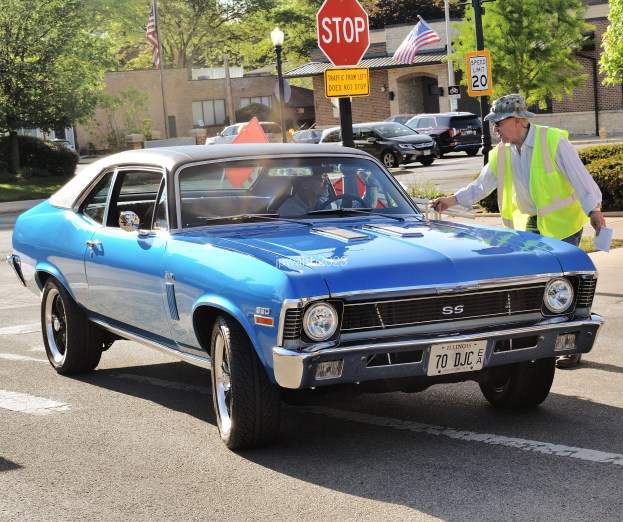
Feature Image: 1972 Chevrolet Nova SS. The third-generation Chevrolet Nova body style peaked in 1972 as a quintessential semi-fastback muscle coupe, representing a dramatic evolution from its humble 1960s economy-car origins and foreshadowing a total shift toward boxier, downsized front-wheel-drive designs by 1982.
The Nova initially launched in 1962 as the “Chevy II,” a strictly utilitarian, boxy compact car designed to compete with the Ford Falcon. Everything changed with the introduction of the third generation in 1968. Designers abandoned the boxy look for a longer, lower, and wider stance built on a 111-inch wheelbase. By 1972, the body style was highly refined.
The muscular, long-hood, short-deck proportions of the 1972 model would completely vanish over the next decade due to changing federal crash safety mandates, fuel emission laws, and shifting consumer tastes. Author’s photograph. May 2023. 7.82mb 80%.
The Chevrolet Nova (1962-1979; 1985-1988) was one of General Motors’ most enduring compact automobiles, evolving from an economical family car into a versatile platform that reflected changing American tastes in transportation, styling, and performance. Produced across multiple generations and remembered for both economy and performance, surviving Novas become moving artifacts of American automotive history, documenting how an ordinary compact car earned an extraordinary place in the nation’s roads, garages, and collective memory.
Building a better way to see the U.S.A. was Chevy’s 1972 advertising tag line. Nova’s ad tag line in 1972: How to see less of you mechanic and more of America.
Production Challenges and a Strong Sales Year
In 1972 there were labor strikes in GM assembly plants that severely impacted production of popular brands (Camaro; Pontiac Firebird) and delayed other model redesigns and rollout plans into 1973. New government regulations on car manufacturers also adversely impacted production schedules. The Chevrolet Nova was assembled in the same plant as Camaro that sat idle for six months. Both cars were saved that year because of enterprising Chevrolet executives who moved their production to other plants. Despite these challenges, Chevrolet became America’s best-selling car brand again in 1972 and Nova sales in particular were excellent.
From Chevy II to Nova
The Chevrolet Nova was produced in four generations from 1962 to 1979 and in a fifth generation from 1985 to 1988. It was the top trim level for the new Chevy II compact whose inception was to counter the popular 1960 Ford Falcon. The SS package was introduced by Chevrolet for 1963. By 1969 Chevy dropped the Chevy II nameplate and Nova become the nameplate throughout the 1970’s.
Simple engineering, affordability, and practicality made the Nova one of Chevrolet’s most successful models.
The Nova as a Compact Performance Car
The car’s growing engine capacities in the mid 1960’s was cut off by Chevrolet for what would be their premier muscle car, the Chevy Camaro, in 1967. With the Chevy II/Nova third generation beginning in 1968 Chevrolet introduced an all-new compact with contemporary semi-fastback styling that continued to 1974. It was with this generation that the car was simply called “Nova.” As a muscle car, Nova’s history ended in 1973 when the SS package was limited to appearance options and a jacked-up heavy-duty suspension although the car could be combined with a 175-horsepower 350.
Standard Equipment for 1972
In 1972 major standard equipment for the Nova included cloth and vinyl bench seat, deluxe steering wheel. hub caps, front-door vent windows, bright moldings on the windshield and rear window, manual drum brakes, vinyl-coated rubber floor tires and E78-14 wide whitewall tires.
The Rally Nova Option
Starting in mid-1971 the Rally Nova option was introduced that was basically an appearance option though it included heavy duty front and rear suspension (RPO-F40) which could be mono-leaf or multi-leaf in the rear.
Pricing the 1972 Chevrolet Nova
The Base MRSP on the 2-Door Coupe was $2,351 ($18,169.52 in 2025 dollars). The 4-Door Sedan was $2,379 ($18,385.91 in 2025 dollars).
Performance versions, particularly V8-powered models and SS variants, expanded the Nova’s appeal beyond economy-minded buyers.

1972 Chevy Nova SS 350. Restored Third Generation (1968–1972) 2-door Chevrolet Nova SS (Super Sport) coupe styled as a classic American muscle car. Its sloping, continuous roofline that glides smoothly down toward the rear deck lid is the definition of a semi-fastback body style. It also features a bold chrome front bumper and the distinctive “SS” performance badging centered on the blacked-out grille. The electric metallic blue paint finish paired with a clean white vinyl roof top, complemented by classic chrome trim accents along the grille, bumpers, and windows.
The hood is propped open to showcase a detailed, clean engine bay featuring a 350 cubic-inch (5.7L) small-block V8 engine. The engine setup includes an aftermarket chrome open-element air cleaner, upgraded performance components, and a custom polished radiator shroud. A “350” numerical emblem is also visible on the front fender just above the marker light.
The vehicle sits on classic five-spoke mag-style wheels wrapped in wide performance tires and displays a vintage Illinois license plate on the front bumper. Author’s photograph. July 2022. 5.53mb DSC_6546.
SOURCE:
https://cokertire.com/tires/e78-14-coker-classic-2-3-8-whitewall-tire.html?srsltid=AfmBOopDvzpu_2cdKTJYosN-5STf4twvFZE5PXmIzNGnWjXnK5P8ZXM2 – retrieved Aug. 30, 2025.
https://en.wikipedia.org/wiki/Chevrolet_Chevy_II_/_Nova – retrieved August 8, 2022.
J. “Kelly” Flory, Jr., American Cars, 1966 to 1972, McFarland & Company, Inc. pp. 485-486; 490.
This explanatory article may be periodically updated.

