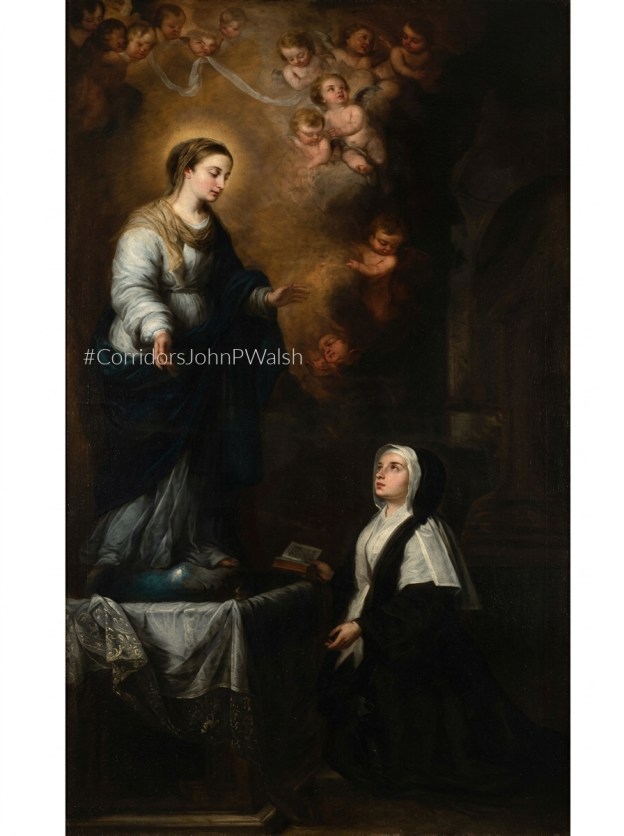
Feature IMAGE: Apparition of the Virgin to Catherine Labouré (1854), painted in Seville by Spanish Romantic artist José María Romero López (1816–1894) the same year Pope Pius IX defined the dogma of the Immaculate Conception. Because Catherine’s identity remained secret until 1876, the artist depicted her as an idealized young Daughter of Charity rather than a portrait. The canvas was originally commissioned in 1854 for the Hospital de la Casa Cuna (the foundling hospital) in Seville, which was staffed by the Daughters of Charity—making a contemporary depiction of their sister’s 1830 Parisian vision a natural focal point for the institution. PHOTO: Conjunto Monumental de San Luis de los Franceses, Seville / Public Domain.
The Feast of Our Lady of the Miraculous Medal commemorates the 1830 apparitions to Saint Catherine Labouré, an event that not only inspired one of the most widespread Marian devotions in Catholic history but also helped shape a distinctive tradition of French sacred music, while Catherine’s own life became a remarkable witness to humility, obedience, anonymity, and enduring faith.
By John P. Walsh.
The Apparitions at Rue du Bac
Today is the feast of Our Lady of the Miraculous Medal. It commemorates the Virgin Mary’s apparition to Saint Catherine Labouré on November 27, 1830, at the Rue du Bac chapel in Paris. To the 24-year-old Daughters of Charity nun (St. Vincent de Paul’s order), Mary requested a medal bearing her image and the prayer, “O Mary, conceived without sin, pray for us who have recourse to thee.” This devotion helped inspire a flourishing of French sacred classical music. Before 1830, plainchant and traditional Marian hymns were the primary musical forms on which French church music relied, rather than grand concert repertoire. However, the 1830 apparition’s central prayer (“O Mary, conceived without sin…”) sparked a wave of Marian fervor in Paris that culminated in 1854 with Pope Pius IX defining the Immaculate Conception as dogma.
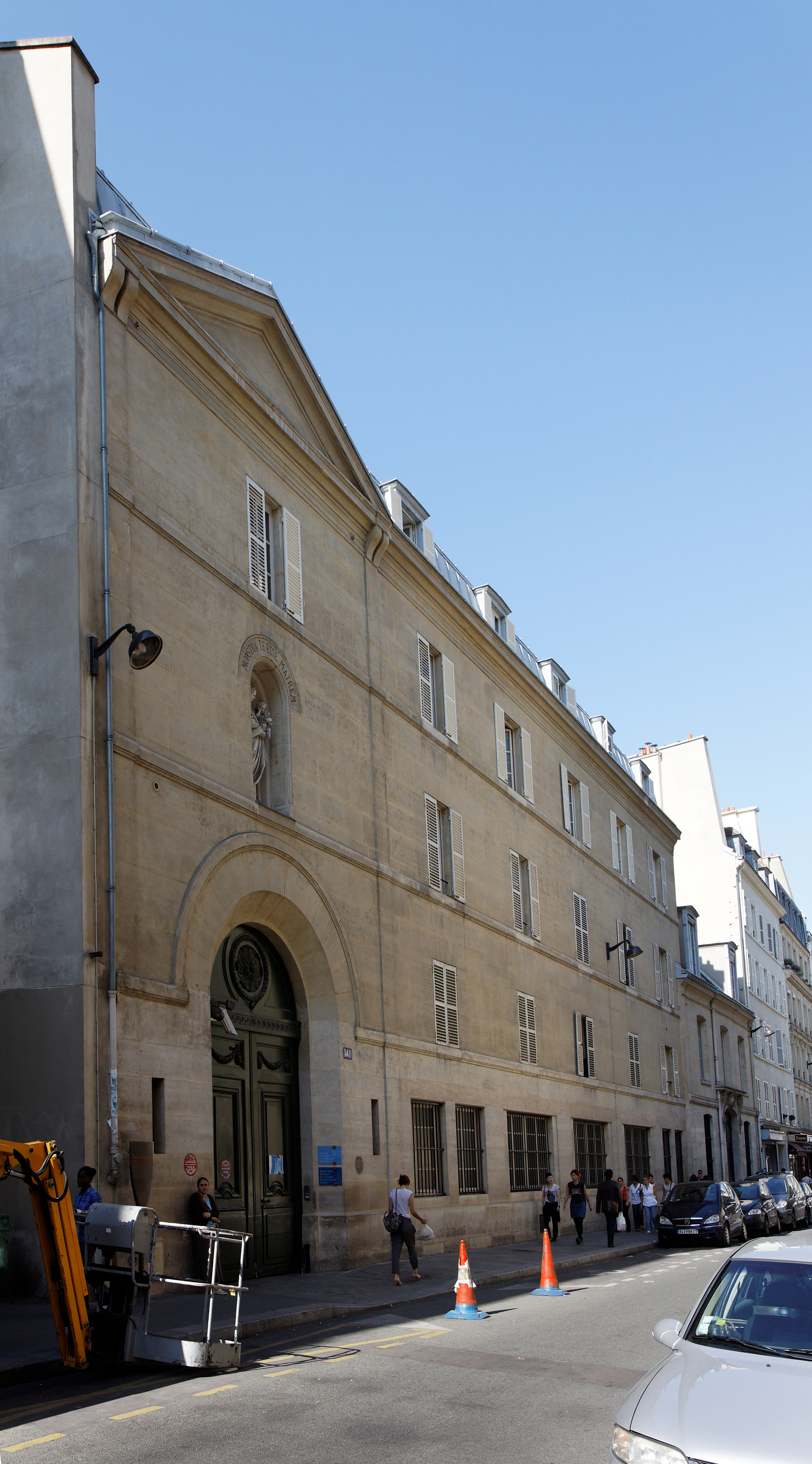
The street-facing facade of the Motherhouse of the Daughters of Charity at 136–140 Rue du Bac in Paris. Originally built as a 17th-century Hôtel de Châtillon, an aristocratic mansion, the complex became the order’s headquarters in 1813 and houses the sanctuary where the Virgin Mary appeared to Saint Catherine Labouré in 1830. Following the 1830 apparitions and the surge of pilgrims, the chapel was significantly enlarged in 1849 and underwent a major renovation completed in 1930 to accommodate growing crowds. Still the international motherhouse (Maison Mère) of the order and an active convent for the Daughters of Charity of Saint Vincent de Paul, this classified French Monument Historique welcomes roughly two million visitors a year for daily Mass and prayer, and houses the incorrupt body of Saint Catherine Labouré, the remains of co-founder Saint Louise de Marillac, and the heart of Saint Vincent de Paul. (Photo by Thesupermat / Wikimedia Commons / CC BY-SA 3.0)
Marian Devotion and the Rise of French Sacred Music
Parisian church composers of that era wrote luminous, intimate sacred works well suited to the spirit of today’s event commemorated on the Rue du Bac, such as Charles Gounod’s Ave Maria (1853/1859); César Franck’s Ave Maria (FWV 57 & 62) and Panis Angelicus (1872), both composed just blocks away from the Rue du Bac at the Basilica of Sainte-Clotilde in Paris’s 7th arrondissement; and later, Gabriel Fauré’s Maria, Mater gratiae, Op. 47, No. 2 (1888). Camille Saint-Saëns also held prestigious organ posts in Paris (including Saint-Merry and La Madeleine) during the height of Miraculous Medal devotion; his Ave Maria settings and his duet Sub tuum praesidium (“We fly to thy patronage,” echoing the medal’s plea for recourse) capture the refined, serene piety of 19th-century Parisian churches. There are several 20th- and 21st-century works too numerous to list, though among the most recent are compositions by Naji Hakim (Olivier Messiaen’s successor at La Trinité in Paris and former organist at Sacré-Cœur), who has made Marian-themed works a centerpiece of his output, such as Mariales (1993) and Fiorella (2024).
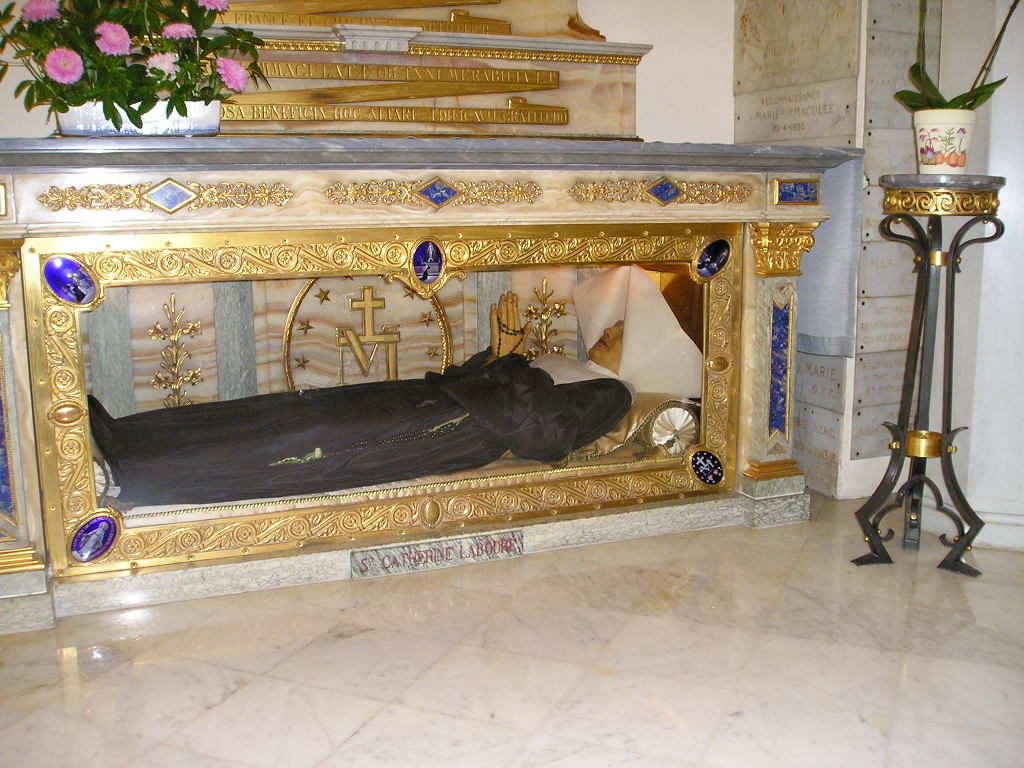
The bronze-and-glass reliquary containing the incorrupt body of Saint Catherine Labouré in the Rue du Bac chapel beneath the side altar of Virgo Potens, marking the exact spot of the November 27, 1830 apparition. Installed after her 1933 beatification, the reliquary preserves her remains beneath a protective wax mask and hands. Catherine is dressed in the traditional blue-grey habit and white cornette headdress of the Daughters of Charity. (Photo by André Leroux / Wikimedia Commons / Public Domain)
Faith, Skepticism, and Father Aladel
There is no doubt that there was a wave of Marian visionaries in mid-19th-century France—nearly a fever of them. That said, the Church investigates such claims and does not mandate belief, though it permits devotion based on its findings. Like all things spiritual, there is a moment of faith based on credible witness, including one’s own experience. Like Bernadette Soubirous in 1858, Saint Catherine Labouré was a peasant girl whose life was unremarkable save for her chapel visitations. She did not broadcast them to anyone except her spiritual director, Vincentian Father Jean-Marie Aladel, C.M. (1800–1865), who became convinced of her truthfulness. When Catherine first approached him in 1830 to describe her visions—beginning with apparitions of St. Vincent de Paul’s heart and followed by the July and November apparitions of the Virgin Mary—Father Aladel was deeply skeptical. He initially dismissed her accounts as illusions or imagination and forbade her to dwell on them. For nearly two years, Father Aladel quietly observed Catherine’s daily conduct, noting her humility, obedience, and sound mental balance. Convinced of her sincerity, he presented the request for the medal to the Archbishop of Paris, Hyacinthe-Louis de Quélen, in January 1832 without revealing Catherine’s name. The Archbishop granted approval, and the first medals were struck in June 1832.
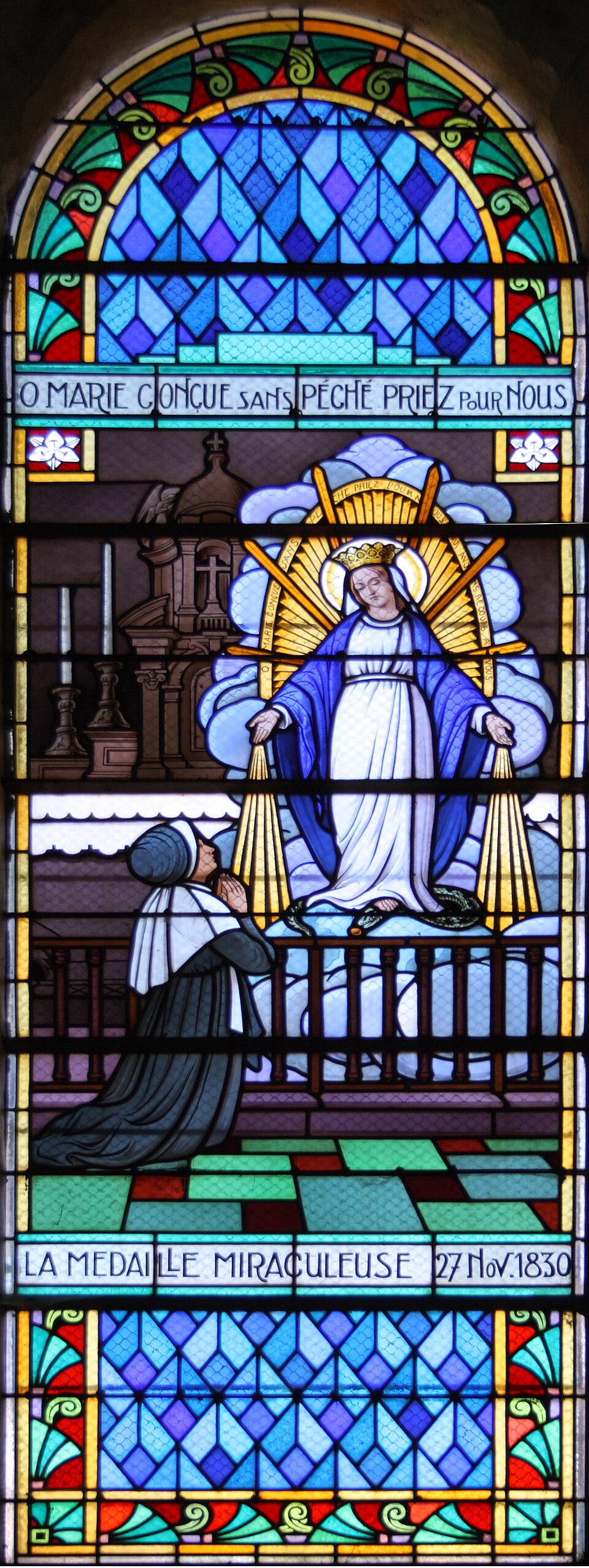
A late-19th-century stained-glass window in the Church of Saint-Martin in Nangis, France, about 40 miles southeast of Paris, depicting the November 27, 1830 apparition of Our Lady of the Miraculous Medal to Saint Catherine Labouré at the Rue du Bac chapel, framed by the medal’s invocation “O Mary, conceived without sin, pray for us.” The window is part of program of French Marian apparition windows in the church produced by Champigneulle, the renowned Parisian stained-glass maker. (Photo by GFreihalter / Wikimedia Commons / CC BY-SA 3.0)
A Life Hidden in Service
Father Aladel strictly protected Catherine’s identity for the rest of his life—she was the one who enjoined the silence of the confessional on him—ensuring she could live out her vocation in obscurity after she was transferred out of the busy Rue du Bac convent to the Hospice d’Enghien in Reuilly, where she cared for the elderly, served as porter, and tended the convent’s chickens. Before Father Aladel’s death in 1865, he wrote an historical account of the devotion titled The Miraculous Medal: Its Origin, History, Circulation, Results, while still keeping the visionary’s name completely hidden.
Catherine died at Reuilly in December 1876, though not before her identity was revealed after she quietly confided it to her religious superior, the brisk, intelligent, and highly organized administrator Sister Jeanne Dufès. The superior admitted that “she already knew,” explaining that the Superior General of the Vincentians and Daughters of Charity, Father Jean-Baptiste Étienne, had previously told her in confidence about the nun under her charge. She had respected this hidden fact—despite a natural inclination toward transparency—out of an inexplicable interior impulse to leave Catherine undisturbed in her humble duties rather than question her or press her to reveal her identity on someone else’s terms.
A Dream and a Promise
When Catherine Labouré was just nineteen years old, she experienced a vivid dream while still living in her native Burgundy. In the dream, she found herself in her parish church at Fain-lès-Moutiers, where an elderly priest was celebrating Mass. After the service ended, the priest beckoned her to approach him.
Instead of moving toward him, Catherine felt an unexpected sense of fear. Unable to explain her reaction, she turned and fled the church.
The dream continued. Catherine next found herself beside the bed of a sick person. Standing nearby was the same elderly priest. This time he spoke directly to her, assuring her that caring for the sick was a noble calling and predicting that, although she ran from him now, she would one day be glad to come to him. He concluded with a striking message: God had plans for her life and she must never forget it.
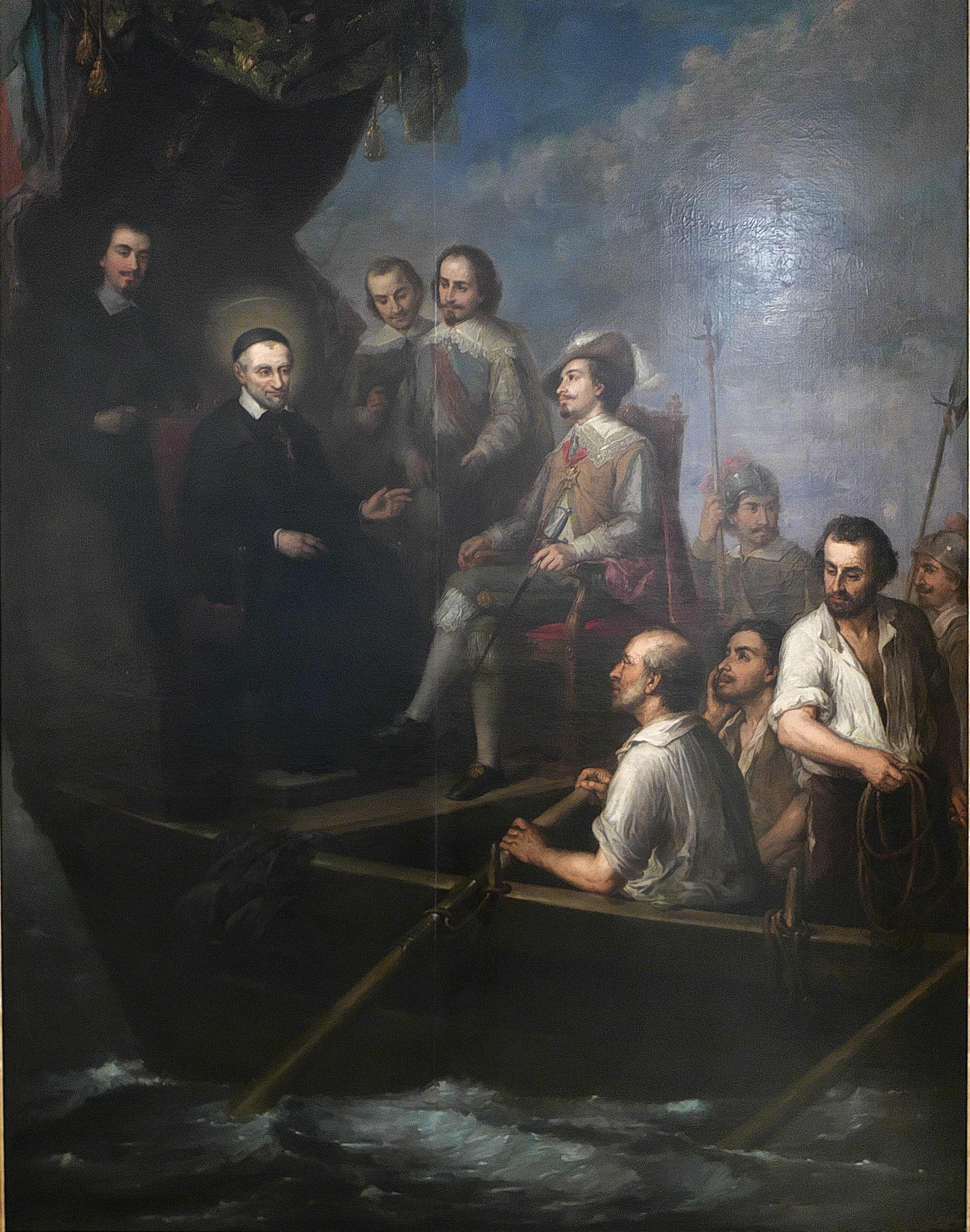
San Vicente de Paúl con los galeotes (Saint Vincent de Paul with the Galley Slaves), José María Romero López (1816–1894), 1854, oil on canvas, 2.91 × 2.29 meters. Location: Conjunto Monumental de San Luis de los Franceses (Sala VII-A), Seville, Spain. Operating squarely within the 19th-century Sevillian Romantic school, Romero López blends historical rigor with the Baroque chiaroscuro tradition of Bartolomé Esteban Murillo, whose work he frequently studied and copied. This monumental canvas depicts Saint Vincent de Paul during his ministry as Chaplain General of the Royal Galleys of France, a post to which he was appointed by King Louis XIII in 1619. The saint took on the near-impossible task of improving the lives and conditions of enslaved oarsmen (galeotes) in ports such as Paris and Marseille. Public Domain.
A Long Road to Paris
For years, Catherine’s desire to enter religious life was frustrated by her father’s opposition. Reluctant to see his daughter become a nun, he hoped that life in the French capital would turn her attention elsewhere. Eventually, Catherine was allowed to travel to Paris, where she stayed with relatives and began exploring the possibility of joining the Daughters of Charity.
While visiting her aunt in nearby Châtillon-sur-Seine, Catherine stopped at a convent operated by the order. As she entered the parlor, she suddenly came to a halt.
The Face From the Dream
Hanging on the wall was a portrait of an elderly priest. Catherine stared in amazement. The figure in the painting was the very same priest she had seen in her dream years earlier, the man who had called her to care for the sick and hinted at God’s designs for her future.
She soon learned his identity: Saint Vincent de Paul, founder of the Vincentian community and spiritual inspiration of the Daughters of Charity. What had seemed an inexplicable dream now appeared to Catherine as something far more significant, linking her vocation to a saint she had never seen in life but somehow recognized immediately.
For Catherine Labouré, the encounter was not merely a coincidence. It was the first sign that the path leading to her future mission had been unfolding long before she understood where it would lead.
The Apparitions of 1830: From the Sanctuary Chair to Virgo Potens
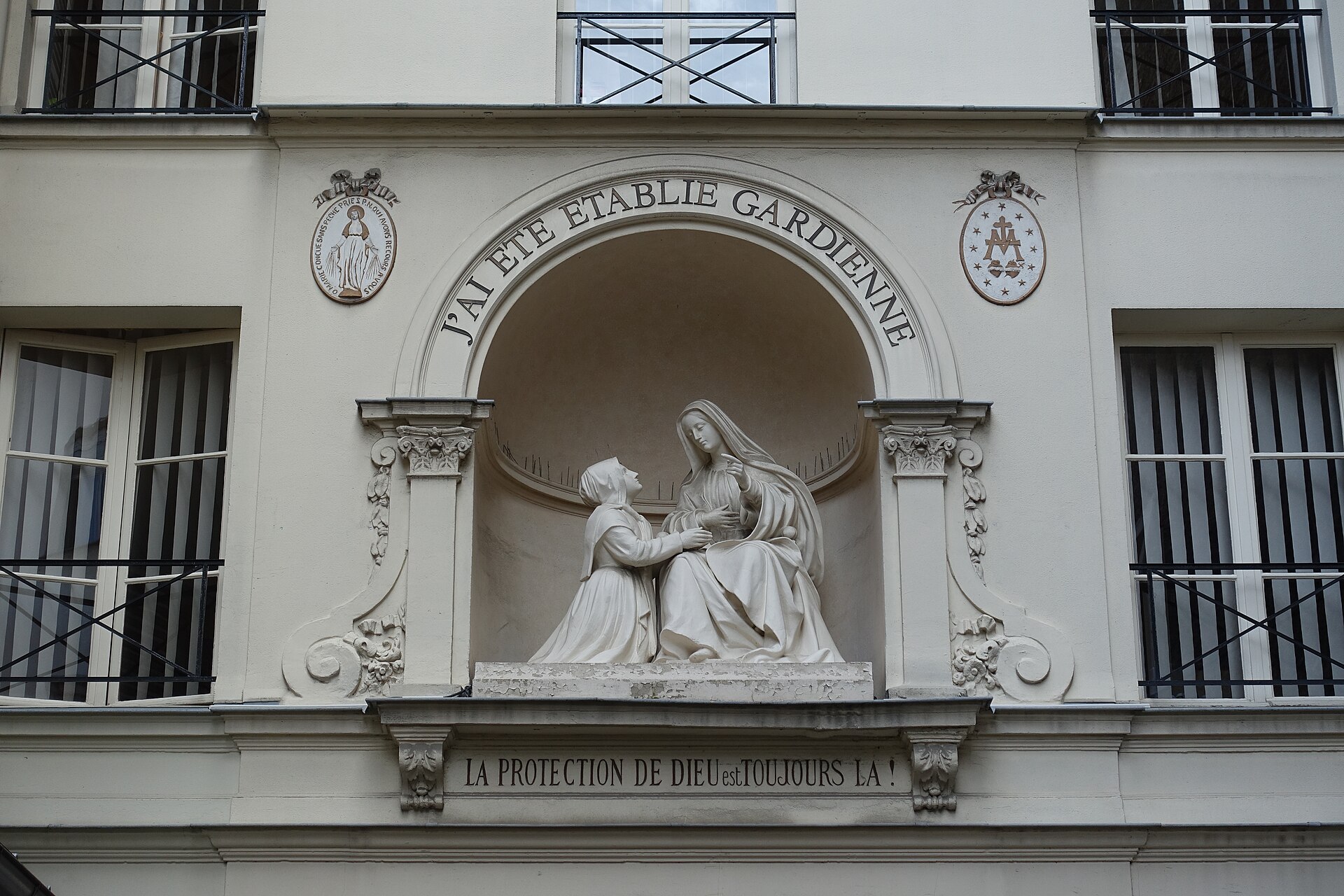
Sculpture above the courtyard entrance at the Chapel of Our Lady of the Miraculous Medal, 140 Rue du Bac, Paris. (Photo by Guilhem Vellut / Wikimedia Commons / CC BY 2.0)
Above the inner courtyard entrance to the Chapel of Our Lady of the Miraculous Medal, this marble sculpture depicts Catherine Labouré kneeling at the Virgin Mary’s knees during her first Marian apparition on July 18, 1830, flanked by reliefs of the front and reverse of the medal.
This niche depicts the first apparition of the Virgin Mary to novice Sister Catherine Labouré on the night of July 18–19, 1830, as recorded by her confessor, Father Jean-Marie Aladel. Awakened at 11:30 p.m. by a luminous child she believed to be her guardian angel, Catherine was led into the darkened chapel, which miraculously lit up as if for midnight Mass. When the Virgin Mary appeared by the sanctuary chair, Catherine knelt at the altar steps and rested her hands on Mary’s knees—what she called the greatest moments of her life. During this two-hour encounter, Mary foretold great trials and bloodshed for France and the clergy, promised abundant graces to all who prayed at the foot of the altar, and prepared Catherine for a sacred mission.
That mission was revealed four months later during the second apparition on November 27, 1830. Appearing during evening meditation, Mary stood upon a globe crushing a serpent while holding a radiant golden sphere—a “ball of fire” surmounted by a cross—which she offered up to God. Explaining that the globe represented the entire world, France, and each individual soul, Mary shed dazzling rays of grace from the jeweled rings on her fingers before stretching her arms outward in the classic pose of the Miraculous Medal. This specific vision of Mary lifting the fiery globe of the world to heaven became revered as Virgo Potens (“Virgin Most Powerful”), a title immortalized in the Carrara marble statue inside the chapel alongside the devotional medal struck at her command.
The Virgo Potens and Catherine’s Final Mission
In May 1876, seven months before her death, Catherine felt an interior prompting to finally speak, partly because the order’s leadership had still taken no action to create the statue of Our Lady Holding the Globe (Virgo Potens) requested during the 1830 apparitions nearly 50 years earlier. Sister Dufès immediately set aside their differences in temperament, background, and role within the community, and listened reverently to Catherine’s detailed instructions for the Virgo Potens statue. Sister Dufès took prompt action to have the statue commissioned for the Reuilly chapel before Catherine died on December 31, 1876. However, Catherine expressed disappointment with the artist’s preliminary rendering, noting that it had not captured the beauty and exact posture of the Virgin as she had seen her, and the finished first statue was not placed in the Reuilly chapel until shortly after her death. In 1880, Vincentian Superior General Father Antoine Fiat commissioned a larger, corrected version of the Virgo Potens statue. It was placed in the chapel on the Rue du Bac on the exact spot where Mary had appeared with the globe to Saint Catherine Labouré in November 1830, where it remains venerated by pilgrims who visit Paris today.
Death, Recognition, and Sainthood
The Vatican officially introduced her cause in 1907 and declared her Venerable on July 19, 1931. Cardinal Jean Verdier, Archbishop of Paris, oversaw the canonical exhumation of Catherine’s body in March 1933—57 years after her burial. Church officials and physicians examining the remains found her body remarkably preserved and supple, with her blue eyes intact. After authenticating two miracles attributed to her intercession, Pope Pius XI beatified her on May 28, 1933, at St. Peter’s Basilica, and her incorrupt body was transferred to a glass reliquary beneath the side altar in the Chapel of Our Lady of the Miraculous Medal on the Rue du Bac.
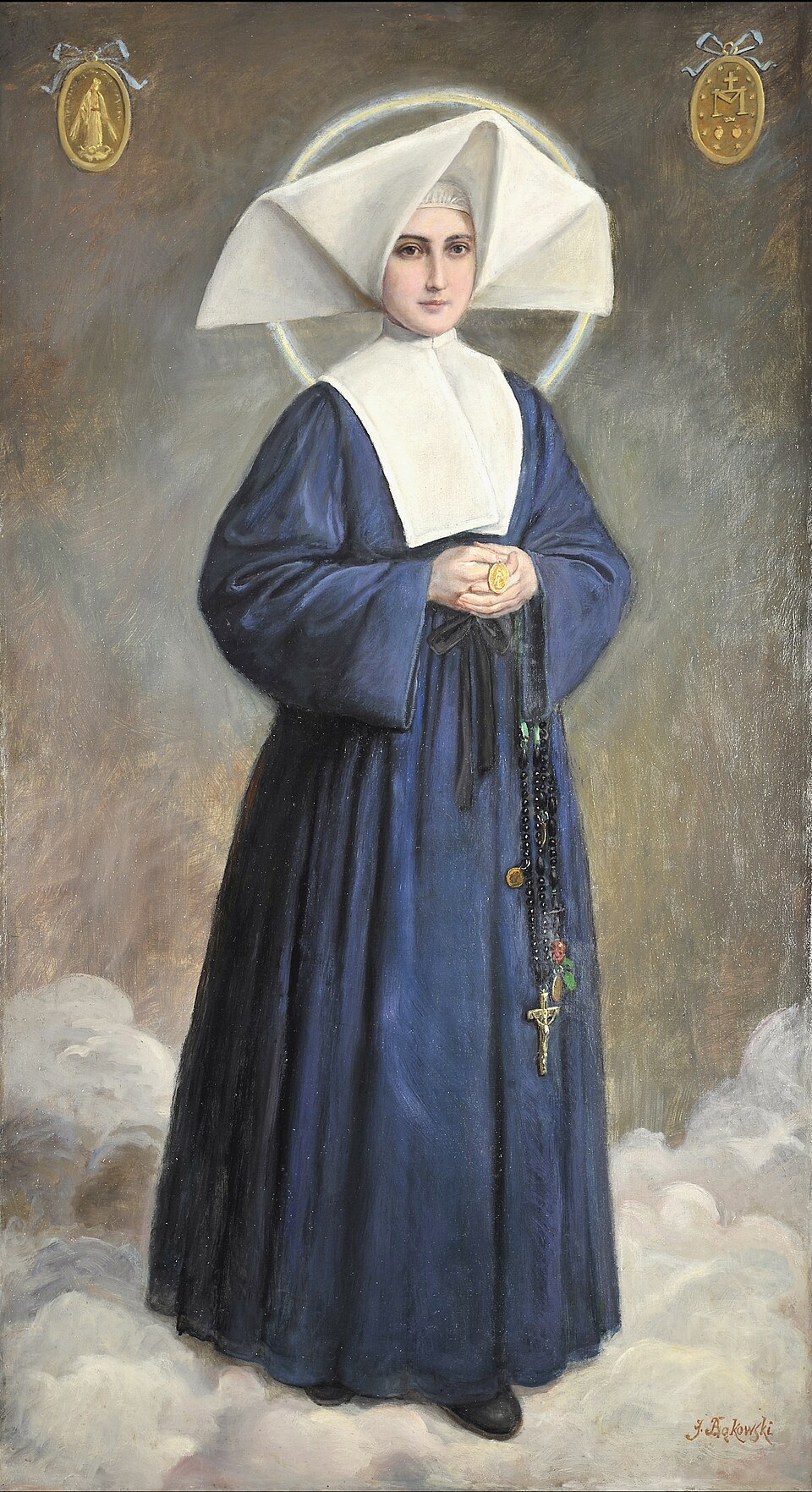
Saint Catherine Labouré by Jan Bąkowski (c. 1933–1934). A full-length oil portrait of Saint Catherine Labouré by Polish portraitist Jan Bąkowski (1872–1934), painted shortly after her 1933 beatification. Dressed in the blue-grey habit and winged white cornette of the Daughters of Charity, she holds a Miraculous Medal in her hands beneath the front and reverse emblems of the medal. (Wikimedia Commons / Public Domain)
Amare Nesciri: To Love to Be Unknown
Pope Pius XII canonized Saint Catherine Labouré on July 27, 1947, in Vatican City. In his homily, Pius XII emphasized that her sanctity lay not simply in seeing the Virgin Mary, but in her radical obedience to silence—summarizing her life with the Latin motto amare nesciri (“to love to be unknown”). Her feast day is celebrated on November 28 by the Vincentian Family and the Archdiocese of Paris (the day after the Miraculous Medal feast), and on December 31 in the universal Roman Martyrology.
This explanatory article may be periodically updated.