FEATURE Image: Lord Byron in Albanian Dress, 1813, Thomas Phillips (1770-1856). Public Domain.
Few writers fused life and art as completely as Lord Byron, whose celebrated poetry, restless travels, scandalous romances, and revolutionary political activism made him the defining figure of the Romantic age. By uniting intense personal emotion, defiance of convention, and a self-created persona, Byron left behind an enduring body of work and wisdom that continues to shape modern notions of individuality, beauty, and creative freedom.
By John P. Walsh.
Introduction.
From Impoverished Heir to Literary Prodigy
Few writers embodied the Romantic ideal as completely as George Gordon, Lord Byron (1788–1824). Born in London on January 22, 1788, to Catherine Gordon, a Scottish heiress, and the erratic Captain John Byron, he spent much of his early childhood amid financial uncertainty, which grew more acute after his father’s possible suicide in 1791. Yet fate dramatically altered his circumstances when, in 1794, he became the heir to the Baron Byron of Rochdale title; four years later, in 1798, he inherited the peerage as Lord Byron and moved to the family seat of Newstead Abbey (a former Augustinian priory) in Nottinghamshire. In 1803, while attending Harrow School, he fell in love with Mary Chaworth, his neighbor at Newstead, though she rejected him. In 1805, Byron entered Trinity College, Cambridge, where he was popular and formed several devoted friendships. At Cambridge, he demonstrated his literary ambitions with his first poetry collection, Fugitive Pieces (1806), which was withdrawn after objections, followed by an expurgated version called Poems on Various Occasions (1807)—both privately printed. A public volume, Hours of Idleness (1807), soon appeared and was harshly criticized. These reviews only sharpened Byron’s pen, prompting his satirical response English Bards and Scotch Reviewers (1809), a work that announced the arrival of a confident and combative young poet. In 1808, he earned the equivalent of a Master’s degree from Cambridge, and in March 1809, upon reaching adulthood, he officially took his seat in the House of Lords.
Fame, Scandal, and the Byronic Hero
Between 1809 and 1811, Byron traveled through Portugal, Spain, Malta, Albania, Greece, and Turkey, experiences that inspired Childe Harold’s Pilgrimage. When the first two cantos appeared in 1812, Byron became an international sensation almost overnight. During the years that followed—shortly after his mother’s death in 1811—he published a remarkable series of popular works, including The Giaour (1813), The Bride of Abydos (1813), The Corsair (1814), Lara (1814), and Hebrew Melodies (1815). At the same time, his private life became the subject of endless public fascination. His numerous affairs—with Lady Caroline Lamb, Lady Oxford, Lady Webster, Claire Clairmont, Marianna Segati, Margarita Cogni, and Teresa Guiccioli—helped embellish his legend as the archetypal Romantic rebel. Rumors also surrounded his close relationship with his half-sister, Augusta Leigh, whose daughter, Elizabeth Medora Leigh (born 1814), was widely believed to be one of Byron’s three daughters by three different women.
Exile, Masterpieces, and Revolutionary Commitment
Byron married Annabella Milbanke in 1815, and their daughter, Augusta Ada Byron (later Ada Lovelace), was born later that year. The marriage quickly collapsed, and in 1816 Byron left England forever. Exile proved creatively transformative. During his years in Geneva, Switzerland, and across Rome, Venice, and Ravenna in Italy—having sold Newstead Abbey in 1817—he produced The Siege of Corinth and Parisina (1816), Childe Harold’s Pilgrimage Canto III (1816), The Prisoner of Chillon (1816), and Manfred (1817). That same year, his daughter Allegra Byron was born to Claire Clairmont. Byron reached the height of his artistic powers with Childe Harold Canto IV (1818), the satire Beppo (1818), Mazeppa (1819), and especially Don Juan, begun in 1819 and expanded through sixteen cantos until his death. While in Italy, he joined the revolutionary Carbonari movement, living in Ravenna alongside Teresa Guiccioli—initially under the roof of her husband before Teresa’s separation—and later moving with her family to Pisa after Allegra was placed in a convent, where the young girl tragically died in 1822. In 1823, Byron sailed to Greece to aid in the struggle for Greek independence from the Ottoman Empire. There, at Missolonghi, the celebrated poet, notorious lover, and political idealist caught a severe fever and died on April 19, 1824, at the age of thirty-six. His remains were returned to England and laid to rest inside St. Mary Magdalene Church in Hucknall Torkard, near Newstead Abbey. Though his friends burned his personal memoirs after his death, preventing them from ever seeing the light of day, Byron’s poetry, personality, and legend secured his place among the most influential figures of the Romantic age.
1812:
Are we aware of our obligations to a mob? It is the mob that labour in your fields and serve in your houses–that man your navy, and recruit your army–that have enabled you to defy the world, and can also defy you when neglect and calamity have driven them to despair. You may call the people a mob; but do not forget that a mob too often speaks the sentiments of the people. Lord Byron (George Gordon), 1788-1824, First speech to the House of Lords, February 27, 1812 on the topic of Luddite machine-wreckers.
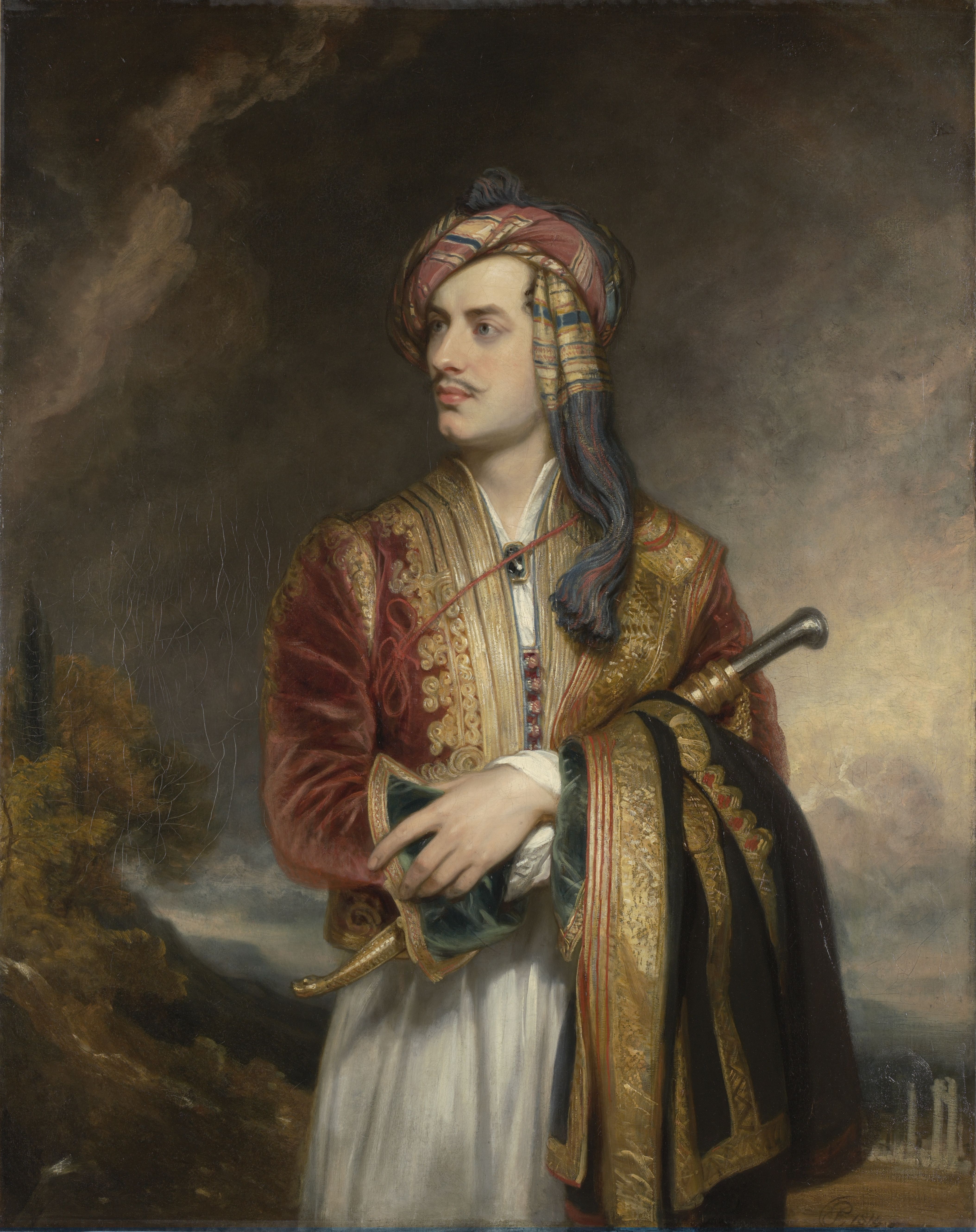
George Gordon Byron (1788–1824), 6th Baron Byron, Poet (commonly known as Lord Byron in Albanian Dress) by Thomas Phillips, 1813. PHOTO: UK Government Art Collection (British Embassy, Athens). Public domain.
Lord Byron in Albanian Dress (1813)
A Portrait of Romantic Self-Invention
Thomas Phillips’s celebrated Lord Byron in Albanian Dress (1813), also known as Byron in Arnaout Dress, is among the most iconic images of the Romantic era. Painted when Byron was twenty-five years old and at the height of his Regency-era literary fame, the portrait captures not merely the poet’s appearance but the carefully crafted public persona that made him one of the most recognizable figures in Europe.
The original full-length version (to the knees), now housed at the British Embassy in Athens, depicts Byron standing confidently in elaborate traditional Albanian attire. Rather than appearing as a conventional poet surrounded by scholarly or aristocratic symbols or settings, he presents himself as a “man of action,” cosmopolitan outsider, and world traveler and adventurer: an image aligned with the Romantic movement’s celebration of individuality, freedom, and exotic experience.
The Albanian Costume and the Grand Tour
The striking costume dates to Byron’s travels through the eastern Mediterranean during his Grand Tour of 1809-1811. In the autumn of 1809, while visiting Ali Pasha of Tepelena in Epirus, a region spanning parts of present-day southern Albania and northern Greece, Byron purchased the outfit that would later become the centerpiece of the portrait.
Commissioned by Byron’s publisher, John Murray, the painting functioned as part of a literary promotion. Exhibited at the Royal Academy in 1814, it appeared during the peak of a phenomenon known as “Byronmania,” when the young poet’s writings, travels, romances, and scandals captivated the public imagination.
Byron is shown wearing an embroidered crimson velvet jacket and waistcoat adorned with golden thread, a striped silk turban, a jewel-fastened white camesa, and a traditional fustanella, the pleated white kilt associated with Albanian and Greek dress. The costume became a visual marker for Byron’s fascination with cultures and landscapes he encountered abroad and became a moniker for his world travels.
Byronmania and Literary Celebrity
Phillips painted the portrait in London shortly after the astonishing success of Childe Harold’s Pilgrimage (1812), the poem that transformed Byron into a literary sensation almost overnight. The image also complemented the exotic settings and themes of his popular “Eastern Tales,” including The Giaour (1813), helping to reinforce the connection between the poet’s adventurous life and his works.
A Portrait Hidden from View
Soon after its exhibition, the painting was purchased by Lady Judith Noel, mother of Byron’s future wife, Annabella Milbanke. Following the scandals that would eventually engulf Byron’s failed marriage and reputation, Lady Noel hid the portrait from view. It remained unaccounted for until after Byron’s death in 1824.
Today, Lord Byron in Albanian Dress endures as more than a portrait. It is a visual manifesto of the Byronic age: poet, adventurer, lover, traveler, celebrity, rebel, and Romantic hero, presented at the very moment when Byron stood at the center of European cultural life, three years before he would leave England forever.
1813:

I do detest everything that is not perfectly mutual. Lord Byron (George Gordon), 1788-1824, Letter, October 21, 1813. Byron’s Letters and Journals, vol. 3 (1973-81; edited by Leslie A. Marchand).

I only go out to get me a fresh appetite for being alone. Lord Byron (George Gordon), 1788-1824, Journal, December 12, 1813. Byron’s Letters and Journals, vol. 3 (1973-81; edited by Leslie A. Marchand).
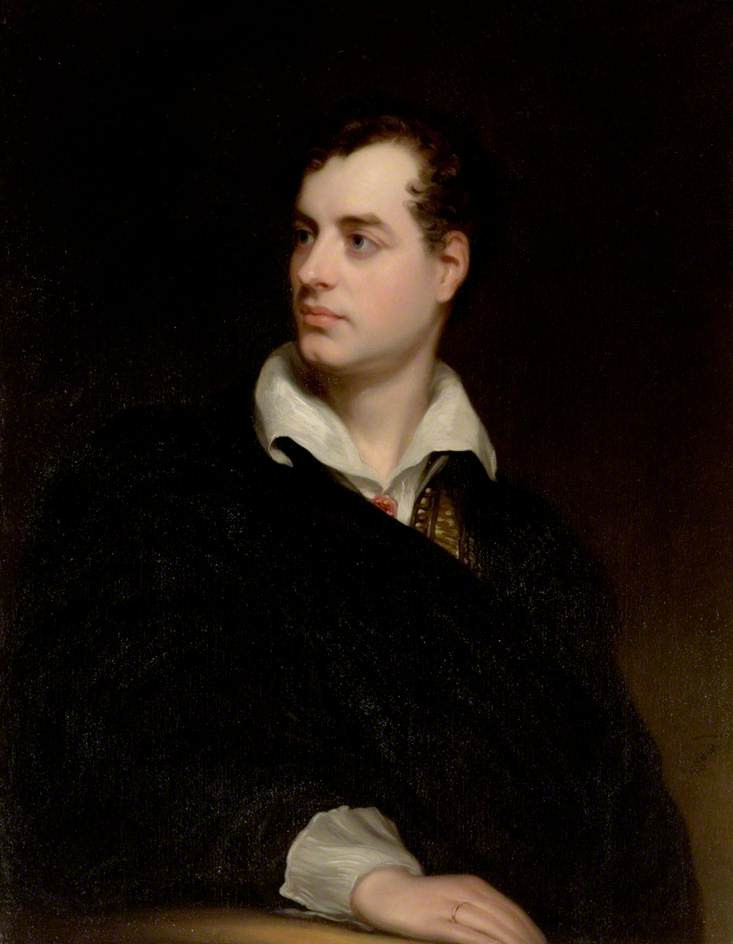
Portrait of Lord Byron by Thomas Phillips, c. 1813–1814. PHOTO: Courtesy of Newstead Abbey / Nottingham City Museums and Galleries. (Public domain via Wikimedia Commons).
The “Cloak” Portrait and the Making of a Romantic Icon
Painted by Thomas Phillips between 1813 and 1814, the celebrated “Cloak” portrait presents Lord Byron in a pose that became inseparable from the Romantic movement itself. Rather than conforming to the stiff formal dress expected of a Regency aristocrat, Byron is shown wrapped in a loose fitting dark blue-black boat cloak, his white shirt open at the collar and secured with a small reddish brooch. The image projects artistic freedom, introspection, emotional depth, and offers visual counterpoint to the Lord Byron in Albanian Dress painted by the same artist around the same time.
Fashioning the Byronic Ideal
As it captured Byron’s likeness, the portrait worked to create the enduring image of the Romantic poet. His open collar quickly became known as the “Byronic collar,” a fashion statement that suggested poetic sensitivity, a touch of melancholy, and independence from aristocratic convention. Phillips’s painting transformed Byron from a literary celebrity into a cultural archetype, establishing a look that artists, writers, and intellectuals would seek to imitate and embellish throughout the rest of the nineteenth century.
Byronmania and Literary Celebrity
Phillips painted the portrait in London between June and July 1813, at the height of “Byronmania.” The phenomenon followed the sensational success of Childe Harold’s Pilgrimage, which had turned Byron into one of Britain’s most famous literary figures almost overnight. Alongside Phillips’s equally famous Albanian portrait, the “Cloak” portrait presented complementary versions of Byron’s public identity: the exotic traveler and the reflective poet. Here, Byron is deliberately advertised as the brooding, contemplative genius that readers could imagine they encountered in his verse.
From Studio to Public Sensation
Recognizing the portrait’s promotional value, Byron urged Phillips in September 1813 to complete the work quickly so that his publisher, John Murray, could have it engraved for use in connection with his publications. When exhibited at the Royal Academy in 1814 beside the Albanian portrait, the pairing proved immensely successful. Together, the two images reinforced Byron’s status as the embodiment of Romanticism: pale, thoughtful, slightly disheveled, and seemingly lost in profound reflection. Reproduced in thousands of prints, engravings, and cameos across Europe, the portrait helped define how generations of artists and writers would choose to present themselves to the public.
Multiple Versions for an Enthralled Public
Demand for the image was so great that Phillips painted four versions of the same composition. The principal version was commissioned for Byron’s half-sister, Augusta Leigh, while another was acquired by John Murray, who prominently displayed it in the drawing room of his publishing house at 50 Albemarle Street, an important literary gathering place in London. Additional versions entered major British collections, ensuring the portrait’s continued visibility and influence.
Byron in London, 1813–1815
Although Byron still owned Newstead Abbey in this period, his daily life during the years surrounding the portrait was centered in London. He lived at 4 Bennet Street from February 1813 until March 1814, then moved to 2 Albany. After he married in January 1815, he relocated to 13 Piccadilly Terrace, where he lived with his new bride. These addresses formed the backdrop to a period when Byron’s literary fame, social notoriety, and artistic mythmaking converged.
Legacy
Today, the principal canvas commissioned for Augusta Leigh continues to be one of the most famous images associated with Byron and remains at Newstead Abbey in Nottinghamshire. John Murray’s version survives in the historic John Murray Collection, while other versions are preserved in major British institutions. More than two centuries after its creation, Phillips’s “Cloak” portrait remains one of the defining images of Romanticism, helping to create not merely the image of Byron, but the very idea of the Romantic poet.
1814:

Lord Byron (George Gordon), 1788-1824, Journal, March 22, 1814. Byron’s Letters and Journals, vol. 3 (1973-81; edited by Leslie A. Marchand).
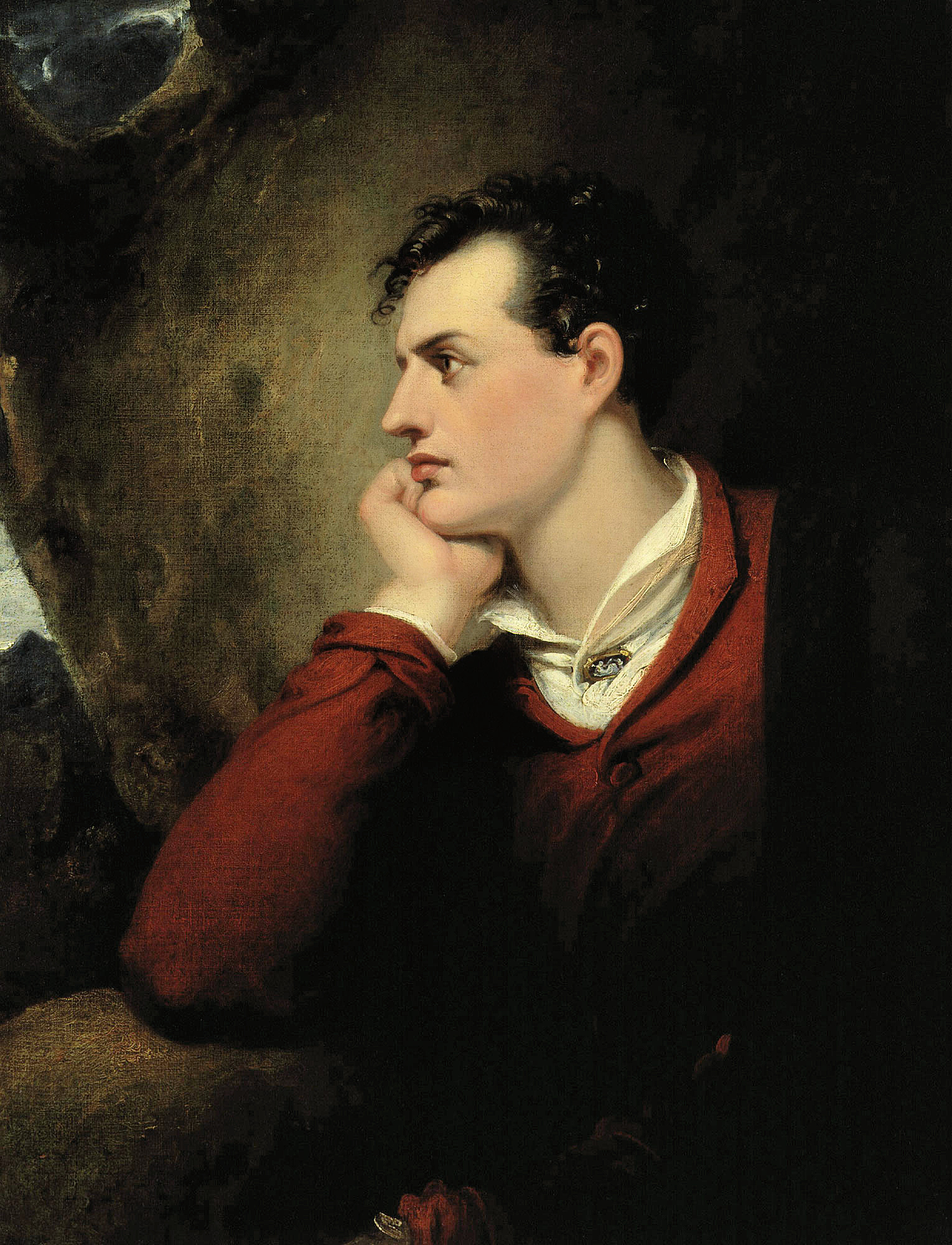
George Gordon (Lord Byron) by Richard Westall (1765-1836). National Portrait Gallery, London. see – NPG 4243; Lord Byron – Portrait – National Portrait Gallery
The Portrait and Its Creation
Painted in the spring of 1813, Richard Westall’s portrait of George Gordon, Lord Byron, was commissioned at the request of a friend, likely the radical politician Sir Francis Burdett or Byron’s then-lover, Lady Oxford. Westall had recently been engaged by Byron’s publisher, John Murray, to illustrate Childe Harold’s Pilgrimage, making him particularly well suited to present the poet in the image of his own brooding literary creation. Byron appears half-length in left profile, seated before a dramatic landscape of boulders, mountains, and storm-darkened skies. Resting his chin on his right hand, with his elbow supported on a rock, he wears a crimson velvet coat, dark cloak, and open-collared white shirt fastened with a cameo brooch. Westall accentuates the features that had already become synonymous with the poet’s public image: his dark, tousled curls and intense, furrowed brow, though here rendered with a healthy, pink complexion rather than his usual literary pallor.
The Byronic Hero in Paint
Conceived as a private commission rather than a commercial frontispiece, the painting serves as a psychological study of the emerging “Byronic hero”—an image echoed in Byron’s December 1813 journal remark about another, likely lost likeness by Westall, which he described as “not a flatterer, but dark and stern.”
Provenance and Legacy
Unclaimed in the artist’s studio after Byron’s affair ended with Lady Oxford, this portrait was eventually purchased by Sir Francis Burdett in 1825, a year after the poet’s death. Later inherited by Burdett’s daughter, the philanthropist Baroness Burdett-Coutts, the painting eventually entered the collection of the National Portrait Gallery, London, in 1961.
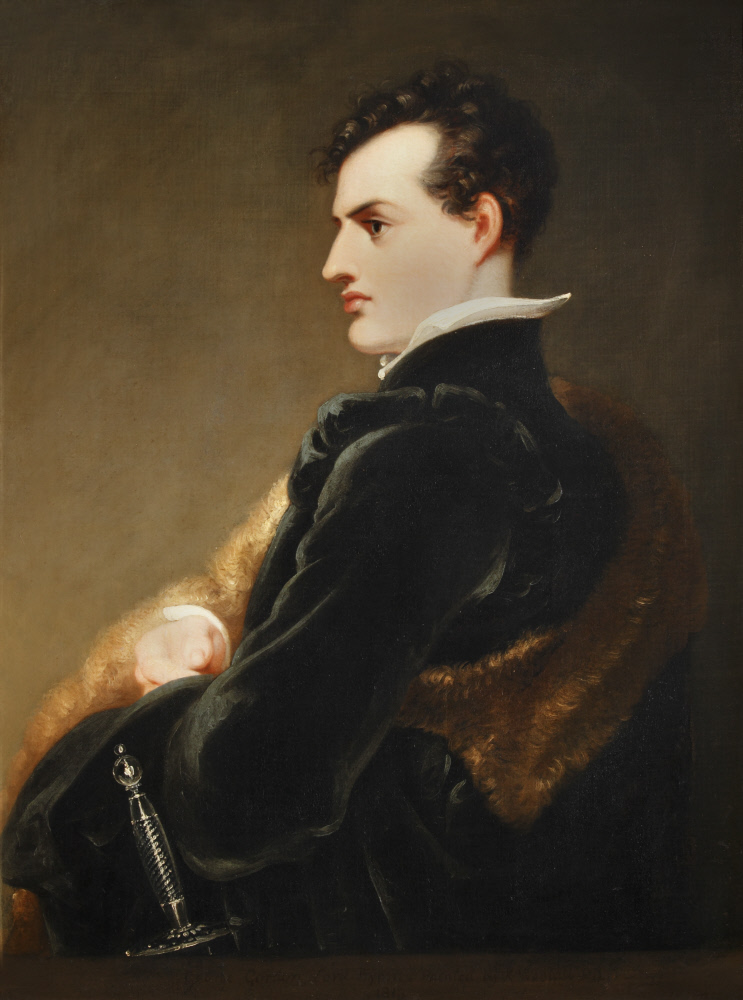
George Gordon, Lord Byron, oil on canvas, by Richard Westall, RA (Hertford 1765 – London 1836), 1813.
Byronmania and a Second Portrait
Richard Westall’s George Gordon, Lord Byron, painted in 1813, is the fur-cloaked and sword-hilt profile portrait at Hughenden Manor in Buckinghamshire, the historic country home of later Prime Minister Benjamin Disraeli, who deeply admired Byron. A closely related version is held in the Parliamentary Art Collection at the House of Lords. Produced as a variant pose from the same 1813 sittings, the portrait helped satisfy the surging demand among Byron’s admirers and collectors for his likeness during the height of “Byronmania.”
A Noble and Theatrical Image
Westall depicts Byron seated in strict left profile, turned slightly further away from the viewer than in the better-known outdoor portrait. Set against a plain studio backdrop, the poet wears a dark blue velvet coat with puffed Elizabethan-style shoulder detailing and a crisp upturned white collar. Draped over his chair and shoulders is a heavy cloak trimmed with broad brown fur, while his left hand rests near the prominent silver-mounted hilt of a sword. The combination blends historical and Renaissance-inspired pageantry with aristocratic confidence and martial pride.
Fashioning the Romantic Hero
Unlike the rocky outdoor portrait with its air of introspection and psychological drama, this version was designed to emphasize Byron’s noble lineage, theatrical glamour, and chivalric authority. It presents a more flattering and dignified image of the poet, transforming the literary celebrity into a romantic aristocratic icon, perfectly suited for display in the entrance hall of a grand country house.
1815:

Lord Byron (George Gordon), 1788-1824, Letter to poet Thomas Moore, October 28, 1815. Byron’s Letters and Journals, vol. 4 (1973-81; edited by Leslie A. Marchand).
1816:

In solitude, where we are LEAST alone. Lord Byron (George Gordon), 1788-1824, Childe Harold, canto 3, stanza 90.
1818:

The thorns which I have reap’d are of the tree
I planted; they have torn me, and I bleed.
I should have known what fruit would spring from such a seed. Lord Byron (George Gordon), 1788-1824, Childe Harold’s Pilgrimage, Canto IV, Stanza 10 (1818).
1820:

If we must have a tyrant, let him at least be a gentleman who has been bred to the business, and let us fall by the axe and not by the butcher’s cleaver. Lord Byron (George Gordon), 1788-1824, Letter, February 21, 1820 to John Murray, publisher. Byron’s Letters and Journals, volume 7, edited by Leslie A. Marchand, 1973-1981.
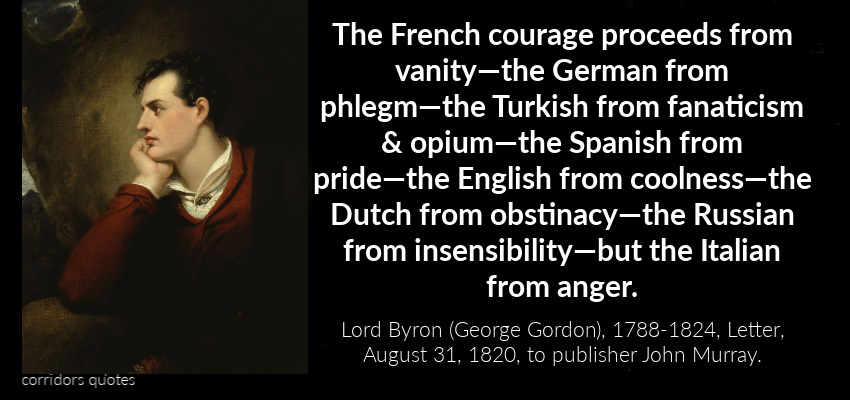
The French courage proceeds from vanity—the German from phlegm—the Turkish from fanaticism & opium—the Spanish from pride—the English from coolness—the Dutch from obstinacy—the Russian from insensibility—but the Italian from anger. Lord Byron (George Gordon), 1788-1824, Letter, August 31, 1820, to publisher John Murray. Published in Byron’s Letters and Journals, volume 7, ed. Leslie A. Marchand , 1973-1981.
1821:

Lord Byron (George Gordon), 1788-1824, Byron’s Letters and Journals, vol. 8 (1973-81; edited by Leslie A. Marchand).

Out of chaos God made a world, and out of high passions comes a people. Lord Byron (George Gordon), 1788-1824, Byron was describing the early nationalist fervor in Italy for which the poet played an active role. Byron’s Letters and Journals, vol. 8 (1973-81; edited by Leslie A. Marchand).
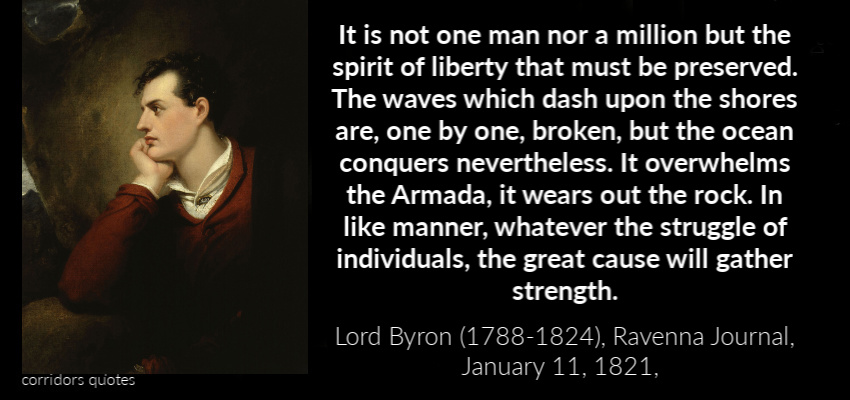
Lord Byron (George Gordon), 1788-1824, Byron’s Letters and Journals, vol. 8 (1973-81; edited by Leslie A. Marchand).

It is useless to tell one not to reason but to believe — you might as well tell a man not to wake but sleep. Lord Byron (George Gordon), 1788-1824, Detached Thoughts, no. 96, 1821-22.
1822:

It is by far the most elegant worship, hardly excepting the Greek mythology. What with incense, pictures, statues, altars, shrines, relics, and the real presence, confession, absolution, –there is something sensible to grasp at. Besides, it leaves no possibility of doubt; for those who swallow their Deity, really and truly, in transubstantiation, can hardly find any thing else otherwise than easy of digestion. Lord Byron (George Gordon), 1788-1824, Letter, March 8, 1822 to poet Thomas Moore. Byron explained that he was bringing up one of his own daughters, Allegra, a Catholic.

I would rather…have a nod from an American, than a snuff box from an emperor. Lord Byron (George Gordon), 1788-1824, letter, June 8, 1822, to poet Thomas Moore.
1823:

Lord Byron (George Gordon), 1788-1824, Byron’s Letters and Journals, volume 9, edited by Leslie A. Marchand, 1979. The journal entry was written on Byron’s final journey to aid the Greek revolt.