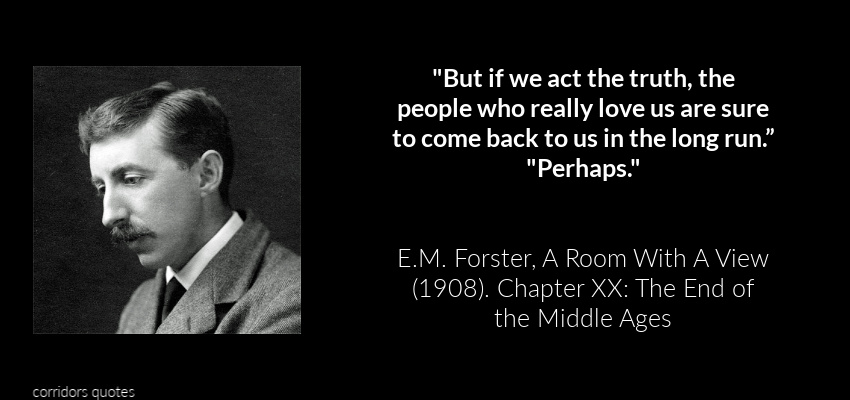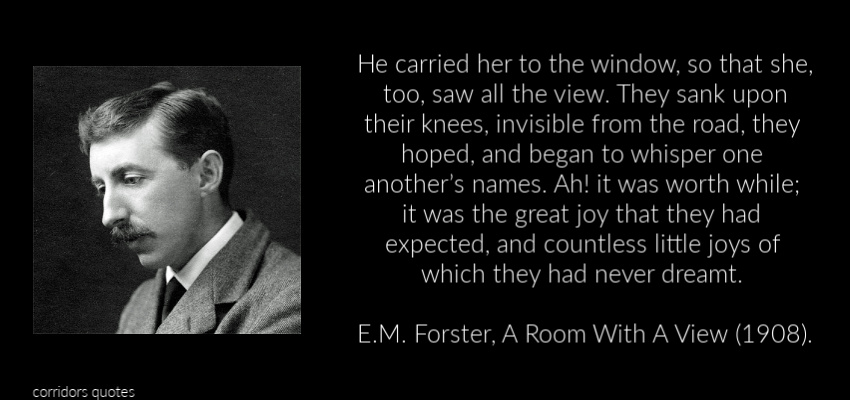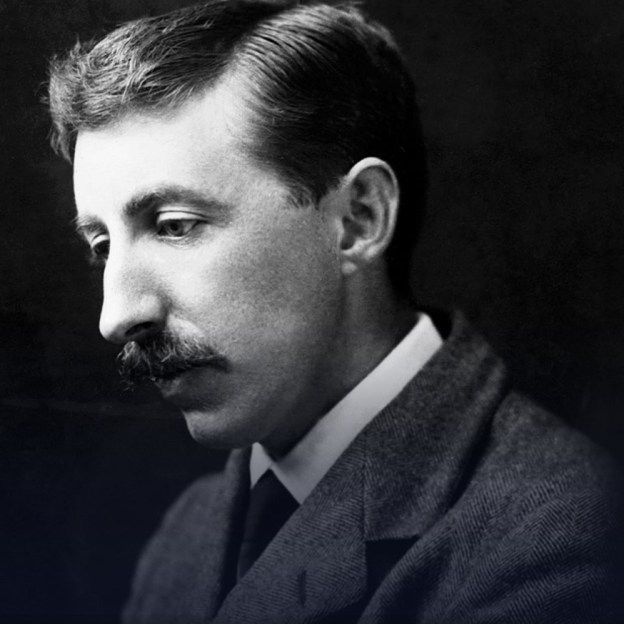
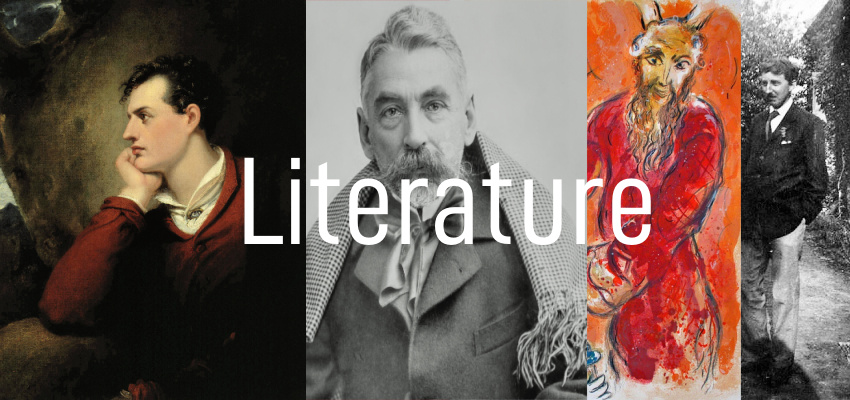
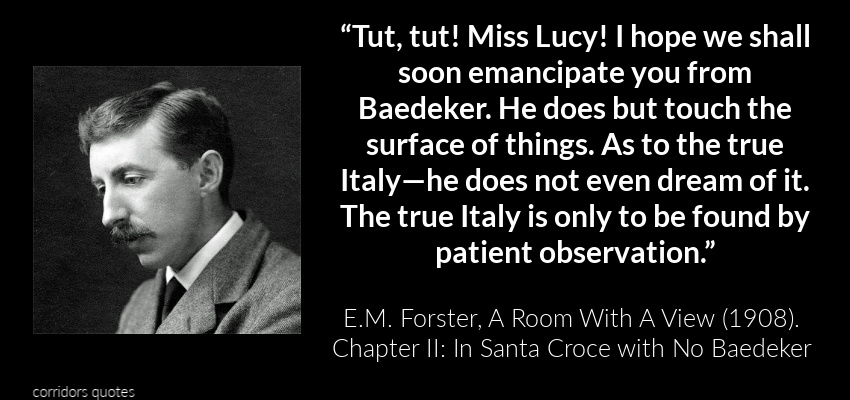
FEATURE image: Edward Morgan ( E.M. ) Forster was born in London in 1879. He wrote numerous short stories, essays, biographies and plays, although he is best known for his novels, particularly A Room With A View (1908), Howards End (1910), and A Passage to India (1924), all of which have been made into award-winning feature films. Forster was nominated for a score of Nobel Prizes for Literature. He died in 1970. This studio portrait photograph of E. M. Forster was taken in England—almost certainly in London—around 1910 (with some archive records dating it between 1910 and 1920), though the individual photographer’s name is unrecorded. Public Domain.
E.M. Forster’s A Room with a View is a coming-of-age novel that contrasts social convention with personal freedom, arguing that genuine human connection and emotional honesty are achieved only when individuals reject artificial restraints and embrace the fuller possibilities of life, love, and self-discovery.

E. M. Forster by Dora Carrington (1893-1932), oil on canvas, 1920. Public Domain.
A Bloomsbury Portrait of E. M. Forster
This oil-on-canvas portrait of E. M. Forster by Dora Carrington is housed in the National Portrait Gallery, London (NPG 4698). Donated in 1969 by the writer Frances Partridge, it stands as one of the most personal visual records of Forster created within the Bloomsbury circle.
Carrington, Forster, and Tidmarsh Mill
Carrington painted the portrait in 1920, although some sources have dated it to 1924-1925, around the time of the publication of A Passage to India. The work was almost certainly painted at Tidmarsh Mill in Berkshire, the country home Carrington shared with the biographer Lytton Strachey and her husband Ralph Partridge. Significantly, the portrait was not painted from life, making it less a formal likeness than the artist’s deeply personal interpretation shaped by friendship, memory, and shared intellectual culture.
An Echo of A Room with a View
Although Forster’s A Room with a View appeared in 1908, twelve years before Carrington painted him, the portrait resonates strikingly with the novel’s imagery and themes. Carrington places Forster indoors, seated beside a window that opens toward daylight, an arrangement that recalls one of the novel’s governing metaphors. In A Room with a View, windows symbolize openness to experience, emotional freedom, and a broader human sympathy, standing in contrast to the restrictions and conventions of late Victorian society.
The Bloomsbury Spirit on Canvas
The portrait also reflects values shared by both Forster and the Bloomsbury Group. Carrington’s informal presentation and direct brushwork reject academic stiffness in favor of psychological presence and human authenticity. In much the same way, A Room with a View champions honesty, emotional self-discovery, and resistance to social pretension. As a result, Carrington’s portrait functions not only as an image of Forster but as a visual expression of the same ideals that animate his fiction: truthfulness, individuality, and a willingness to look beyond convention toward a fuller engagement with life.
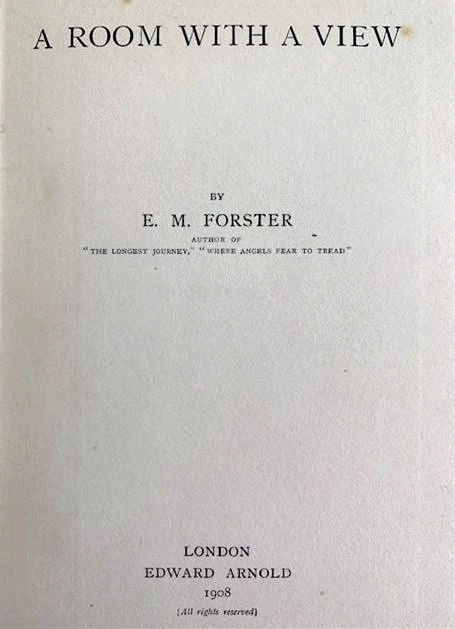

This is the first edition, first printing of E. M. Forster’s A Room with a View, published in London on October 14, 1908 by Edward Arnold in a small initial print run of just 2,000 copies. It was followed by an equally small American edition by G. P. Putnam’s Sons in 1911. Edward Arnold—the same London house that published Forster’s The Longest Journey (1907), would go on to publish Howards End (1910) and A Passage to India (1924). Public Domain.
“Passion does not blind. No. Passion is sanity, and the woman you love, she is the only person you will ever really understand.” – Synopsis of A Room with a View:
Edward Morgan Forster (1879–1970) is an English novelist, short story writer, and essayist. The heart of Forster’s literary work is humanist in nature as his characters depict—whether in Where Angels Fear to Tread (1905), A Room with a View (1908), his masterpiece Howards End (1910), his most successful work A Passage to India (1924), Maurice (1971), and others — the honest pursuit of personal tracks and connections in the face of first looking to impress or please the inevitable and constantly mutating restrictions of contemporary society.
In A Room with a View, set in the Edwardian era, a young Englishwoman named Lucy Honeychurch—”a young lady with a quantity of dark hair and a very pretty, pale, undeveloped face”—is staying at an Italian pension with her older cousin and chaperone, Miss Charlotte Bartlett, while on holiday in Florence.
At dinner in the pension, they meet several fellow English guests: the two elderly Miss Alans, the eccentric novelist Miss Lavish, and an outspoken freethinker, Mr. Emerson, along with his brooding, handsome adult son, George. When Lucy and Charlotte complain that their rooms look out onto a courtyard rather than the Arno, the Emersons shock everyone’s sense of propriety by generously offering to swap rooms so the ladies can have a view.
The next day while touring the city Lucy faints in the Piazza della Signoria having witnessed a stabbing and is rescued by handsome George. After they establish this connection George and Lucy are together again to join a group carriage tour in the nearby hills of Fiesole,. Eventually finding themselves alone, George embraces Lucy and on a terrace of violets, they kiss. This is witnessed by Miss Bartlett who cuts short her and Lucy’s visit to Florence.
After visiting the Vyses in Rome, Lucy and Miss Bartlett return to Windy Corner, the Honeychurch family home in Surrey. There, Lucy accepts one of many marriage proposals from the pretentious, aesthetic snob Cecil Vyse—a purely “drawing-room” match. By pure coincidence, Cecil runs into the Emersons at the National Gallery in London and, as a petty joke against his snobby local landlord, arranges for them to rent a villa right next door to Lucy’s family. Renewed proximity to George unsettles Lucy, who tries to deny her attraction while growing increasingly suffocated by Cecil—whom the local clergyman, Mr. Beebe, aptly dubs a “fiasco.”
After George kisses her a second time in the garden, Lucy angrily rebuffs him, though she soon realizes she cannot marry Cecil and breaks off their engagement. To escape the emotional muddle, she plans a trip to Greece with the Miss Alans, while George moves back to London. Just before she departs, however, a chance encounter with old Mr. Emerson in Mr. Beebe’s study strips away her self-deception and forces her to admit she loves George. Lucy cancels her trip, elopes with George to Florence, and returns with him to their original pension—taking “a room with a view” as Mr. Emerson’s words ring true: “Passion does not blind. No. Passion is sanity, and the woman you love, she is the only person you will ever really understand.”

This candid snapshot of E. M. Forster was taken in 1920 by the celebrated literary hostess and arts patron Lady Ottoline Morrell at her country estate, Garsington Manor, in Oxfordshire, England. Measuring barely three inches tall (3 1/8 in. x 2 1/8 in.), the vintage print is part of the Lady Ottoline Morrell Album Collection at the National Portrait Gallery in London (NPG Ax140742).
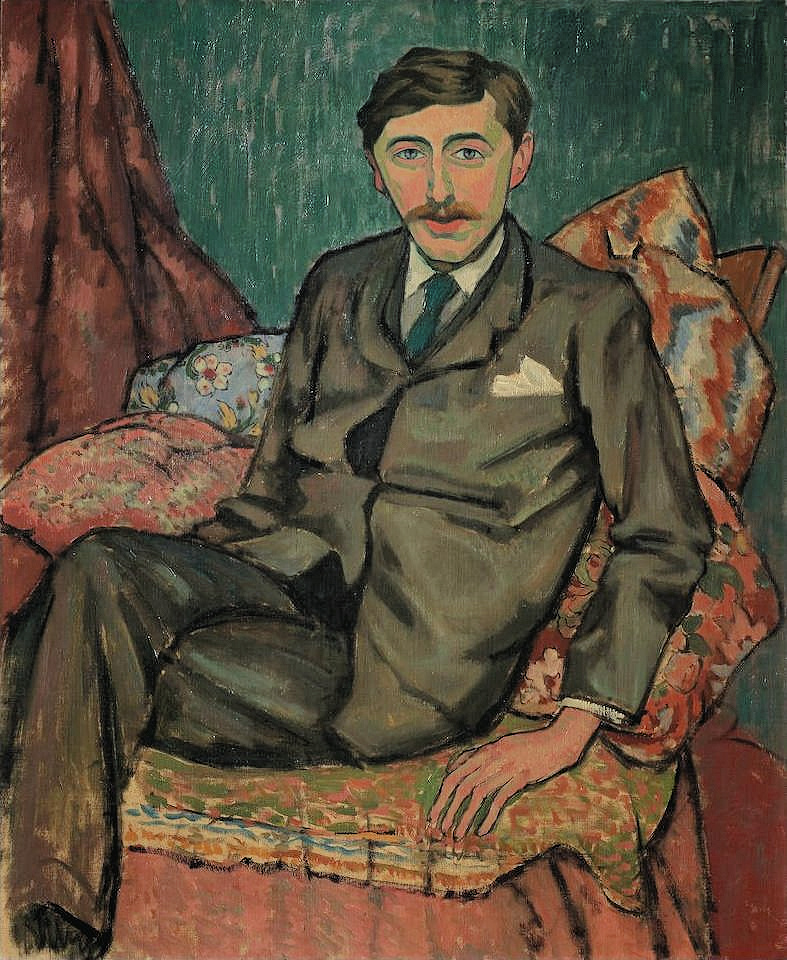
Portrait of E.M. Forster by Roger Fry, 1911, 73 x 60 cm. (28 1/4 x 23 5/8 in.).
Roger Fry Paints E. M. Forster, 1911
This oil-on-canvas portrait captures E. M. Forster painted from life by Roger Fry in late 1911 at Durbins, Fry’s newly built Arts-and-Crafts home in Guildford, Surrey. Created just one year after Fry startled the British art establishment with his landmark exhibition Manet and the Post-Impressionists, the portrait reflects the revolutionary visual language he was championing: bold contours, flattened spatial planes, and expressive, non-naturalistic color. Rather than pursuing photographic likeness, Fry sought to reveal character through form and design, placing Forster firmly within the emerging world of British modernism.
A Friendship Rooted in Cambridge
Although Fry was thirteen years older than Forster, the two men shared important intellectual roots at King’s College, Cambridge. Fry became both a friend and an influential artistic mentor, introducing Forster to many of the aesthetic ideas that would circulate through the Bloomsbury milieu. Their friendship endured for more than two decades until Fry’s death in 1934. Forster later honored him in Roger Fry: An Obituary Note, acknowledging the profound influence Fry’s artistic vision had exercised on his life and work. Elements of Fry’s aesthetic philosophy would also find their way into several of Forster’s fictional characters and themes.
Forster at the Height of Early Success
The portrait was painted during one of the most successful periods of Forster’s early career. At thirty-two, he was enjoying the acclaim generated by Howards End, published in October 1910 and widely recognized as a major achievement in English fiction. In 1911 he also published his first collection of short fiction, The Celestial Omnibus and Other Stories, for which Fry designed the innovative, non-figurative cover and endpapers. The collaboration demonstrated how closely their literary and artistic interests had become intertwined.
Modernism Meets A Room with a View
Although A Room with a View had appeared three years earlier, in 1908, Fry’s portrait seems almost a visual counterpart to the novel’s central ideas. Both artist and novelist rejected the constraints of late Victorian convention in favor of greater emotional honesty, individual freedom, and openness to experience. The painting’s departure from traditional realism mirrors the novel’s call to embrace life’s vitality and complexity rather than retreat into rigid social expectations. The connection was strengthened by another shared passion: Italy. Both men drew deep inspiration from Italian art, culture, and landscapes, influences that helped shape Fry’s modernist aesthetic and Forster’s literary imagination.
Forster’s Amused Reaction
Forster himself responded to the portrait with characteristic wit. In a letter to his friend Florence Barger dated December 24, 1911, he joked that Fry had made him look like “a bright healthy young man, without one hand, it is true, and very queer legs, perhaps the result of an aeroplane accident, as he seems to have fallen from an immense height on to a sofa.” The remark captures both Forster’s humor and his recognition that Fry’s goal was never strict realism. What mattered was not exact appearance, but the modernist attempt to capture personality, energy, and intellectual presence through paint.
A Portrait of a Changing Age
Seen today, Fry’s portrait stands as more than an image of a celebrated novelist. It records a pivotal moment when British literature and modern art were moving in parallel directions. Painted at the moment Forster emerged as one of England’s leading writers, the work also preserves the friendship between two central figures of early twentieth-century culture, united by a belief that art should challenge convention and awaken new ways of seeing the world.
PART 1.
Chapter I: The Bertolini (7 quotes).

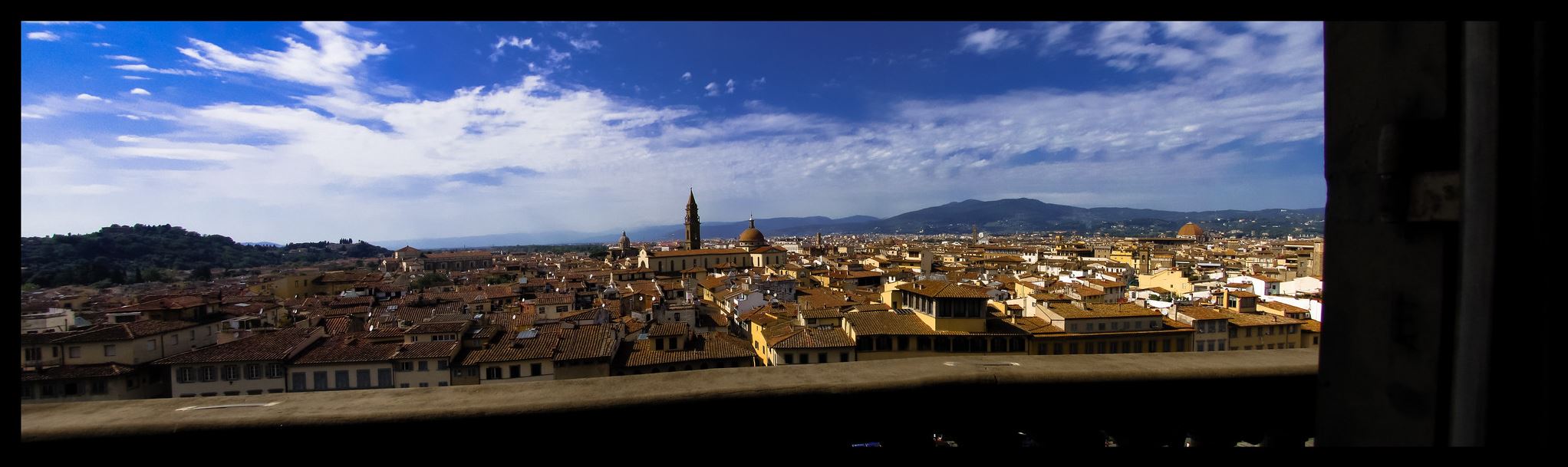
by Flavio~This image was marked with a CC BY 2.0 license.


Chapter II: In Santa Croce with No Baedeker (17 quotes).




by *Jezza. This image was marked with a CC BY-NC-ND 2.0 license.





by Francesco CescoP Pradella. This image was marked with a CC BY-ND 2.0 license.
Chapter III: Music, Violets, and the Letter “S” (15 quotes).


Chapter IV: Fourth Chapter (5 quotes).



by Belpaese.nl. This image was marked with a CC BY-NC-ND 2.0 license.
Chapter V: Possibilities of a Pleasant Outing (10 quotes).




by giorgiorodano46. This image was marked with a CC BY-NC 2.0 license.
Chapter VI: The Reverend Arthur Beebe, the Reverend Cuthbert Eager, Mr. Emerson, Mr. George Emerson, Miss Eleanor Lavish, Miss Charlotte Bartlett, and Miss Lucy Honeychurch Drive Out in Carriages to See a View; Italians Drive Them (6 quotes).

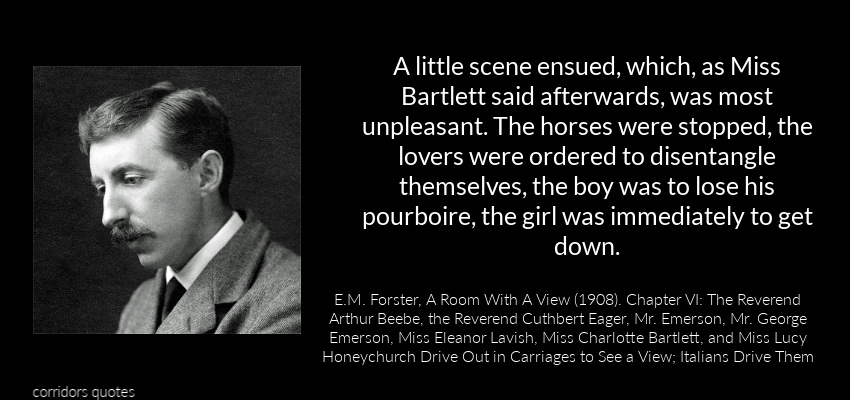


Chapter VII: They Return (10 quotes).


by giorgiorodano46. This image was marked with a CC BY-NC 2.0 license.
PART 2.
Chapter VIII: Medieval (14 quotes).


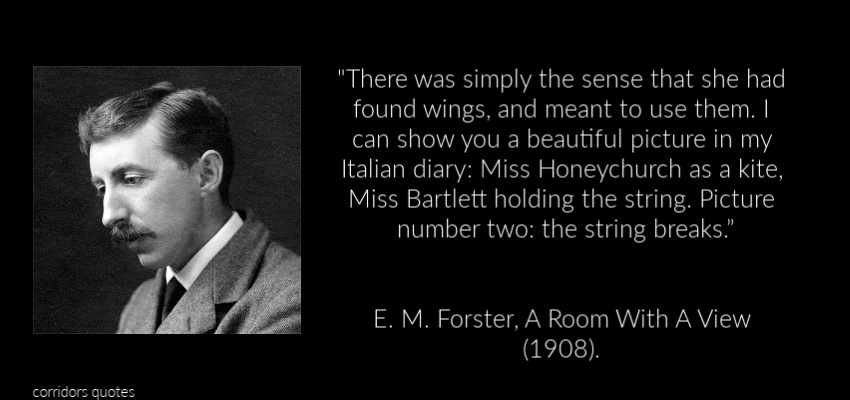


Chapter IX: Lucy As a Work of Art (11 quotes).


by Maia C. This image was marked with a CC BY-NC-ND 2.0 license.
Chapter X: Cecil as a Humourist (11 quotes).


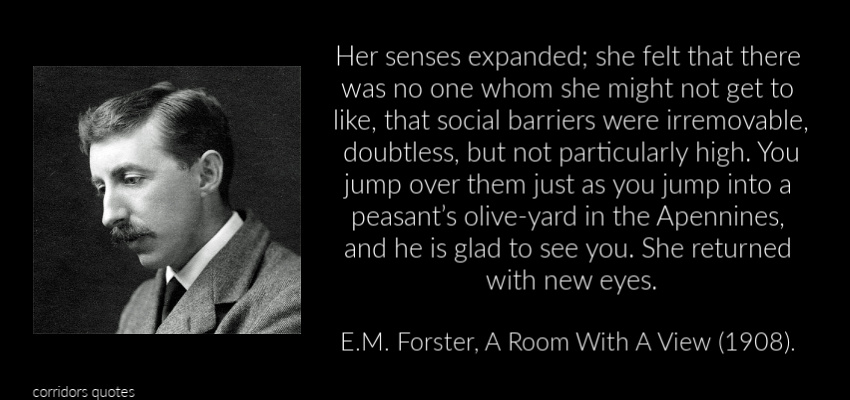


by Anguskirk. This image was marked with a CC BY-NC-ND 2.0 license.

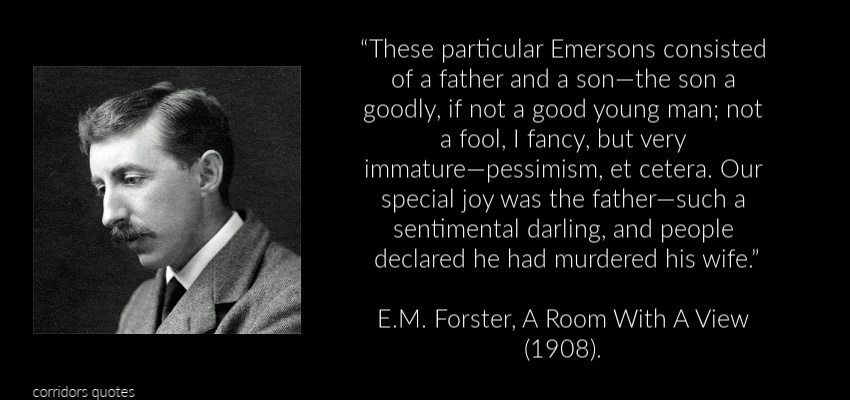


Chapter XI: In Mrs. Vyse’s Well-Appointed Flat (9 quotes).


Chapter XII: Twelfth Chapter (9 quotes)


Chapter XIII: How Miss Bartlett’s Boiler Was So Tiresome (13 quotes)


Chapter XIV: How Lucy Faced the External Situation Bravely (9 quotes)


Chapter XV: The Disaster Within (20 quotes)




Chapter XVI: Lying to George (11 quotes)


Chapter XVII: Lying to Cecil (14 quotes)




Chapter XVIII: Lying to Mr. Beebe, Mrs. Honeychurch, Freddy, and The Servants (18 quotes)








Chapter XIX: Lying to Mr. Emerson (25 quotes)






Chapter XX: The End of the Middle Ages (11 quotes)