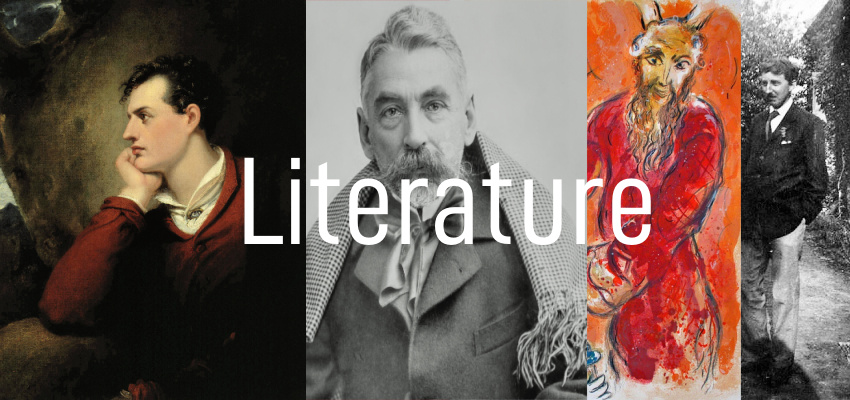
FEATURE image: John Keats, c. 1822, by William Hilton after Joseph Severn (1819), oil on canvas, 30 in. x 25 in., National Portrait Gallery, London. Painted posthumously, this portrait by the English history and portrait painter William Hilton was based heavily on Joseph Severn’s 1819 miniature (see below). Measuring 30 x 25 inches, the full-scale work is housed in London’s National Portrait Gallery (NPG 194) but is often displayed on long-term loan at Keats House in Hampstead. By the time Hilton painted it, John Keats had been dead for roughly a year, having succumbed to tuberculosis in Rome in February 1821 at the age of twenty-five. By January 1823, members of Keats’s literary circle were discussing this completed canvas in their letters. The portrait was created for John Taylor, Keats’s devoted friend and publisher of the firm Taylor and Hessey. Taylor had helped raise funds to send the ailing poet to Italy in 1820 and acquired the painting as a lasting, life-sized memorial to the young writer whose career he had championed. Because Severn’s original portrait was a tiny miniature barely four inches high, Keats’s inner circle wanted a large gallery-scale artwork worthy of Keats’s growing stature in English literature. Taylor’s publishing partner, James Hessey, observed that Hilton had combined Severn’s composition with the artist’s own impressions, giving the poet a more idealized, Romantic appearance than in Severn’s more intense miniature. According to Hessey, Hilton also drew upon a chalk sketch the artist had made from life of Keats before the poet left England. He aslo drew inspiration from Keats’s life mask created by the sculptor Benjamin Robert Haydon in 1816. Public Domain.
John Keats’s letters and poetry reveal the core of his Romantic vision: beauty, suffering, imagination, love, and mortality are inseparable forces that shape the human soul. Written amid personal loss, illness, artistic struggle, and intense love, his words transform private experience into universal reflections on life’s fleeting yet profound meaning.
Early Life and Literary Awakening
John Keats’s first book of poems was published in 1817 when the English poet was 22 years old. From an early age, Keats, studying under the literary Rev. John Clarke, became a passionate reader of poetry and was introduced to the theater and music which he loved. Though both of his parents had died by the time Keats was in his early teens, their respectable estate never reached him in his short lifetime. His guardian sent the minor Keats to work in the medical field. But in 1813, the young Keats abandoned that apprenticeship for another — and began to write poetry.
Mentors, Friends, and First Successes
Keats’ early poetic mentor was Leigh Hunt (1784-1859), editor of the Examiner, who introduced Keats to great established poets such as William Hazlitt (1778-1830), Charles Lamb (1775-1834), and Percy Bysshe Shelley (1792-1822). Keats also made the acquaintance of painter Benjamin Robert Haydon (1786-1846) and made other intimate lifelong friends. In 1816 Keats wrote his first major sonnet (On First Looking into Chapman’s Homer) in which he laid out an ambitious plan for his poetry.
Finding His Own Voice
In 1817 Keats wrote the 4,000-line Endymion though, ever a perfectionist, Keats considered it merely a poetic exercise. Keats soon isolated himself consciously from others to benefit his art. His over-riding quest was to seek his artistic individuality and poetic voice.
Adversity, Travel, and Love
In 1818 external personal and professional events circumscribed Keats’ precious independence. First, his poetry for political rather than artistic reasons was ridiculed in the press. But more problematic for the brave Keats was that some of his immediate family members had become suddenly destitute or died. Keats’ spring and summer walking tour in 1818 of England, Scotland, and Ireland resulted in Keats’s personal inspiration but a chronically weakened state of physical health. In those same months, the 23-year-old poet had fallen in love with the vivacious, pretty and thoroughly nonliterary 18-year-old Fanny Brawne (1800-1865). They soon became engaged, but Keats’ inferior health and his strained to nonexistent finances impeded their getting married which frustrated Keats.
The Great Year: 1819
In the rapidly reached final period of his life and poetic career, Keats wrote several of his masterpieces. In 1819 Keats wrote, one after another, The Eve of St. Agnes, La Belle Dame Sans Merci, his Odes (including Ode To a Grecian Urn), Lamia, and several major sonnets. These poems possess the characteristics of Keats’ mature work—that of grace, sensuality, and sympathetic objectivity. It sets before the reader the conflicting and contradictory nature of existence, signaling a “both-and” experience of living in the world, including grappling with the problem of good and evil. Keats writes plainly in a letter in that period about life’s suffering—it is a “world…full of misery and heartbreak, pain, sickness and oppression.”
Illness, Rome, and Death
Weakened by tuberculosis, Keats’ health took a bad turn in February 1820 so much so that the poet realized he was dying. By that fall he traveled to Italy seeking a milder climate for his health. He stayed in Rome until the end came. On February 23, 1821 —like his mother and brother before him— Keats died of tuberculosis. The 25-year-old poet was buried in the Protestant Cemetery in Rome.
An Unfulfilled Promise
Despite his gallant reluctance to yield to bitterness or despair for his life’s wasteful circumstances, with death died Keats’ ambitious plans of renewed poetic achievement and an ongoing passionate love for Fanny Brawne. Although today’s reader can continue to savor John Keats’ poems and letters prior to his having stopped writing at 24 years old, what might have been in terms of the English Romantic poet’s fully realized potential is to offer a conjecture about one of the English language’s greatest poets.
SOURCES: The Norton Anthology of English Literature, Third Edition, Volume 2, W.W. Norton & company, Inc. New York, 1974.
John Keats, Walter Jackson Bate, The Belknap Press of Harvard University Press, Cambridge, Massachusetts, 1964.
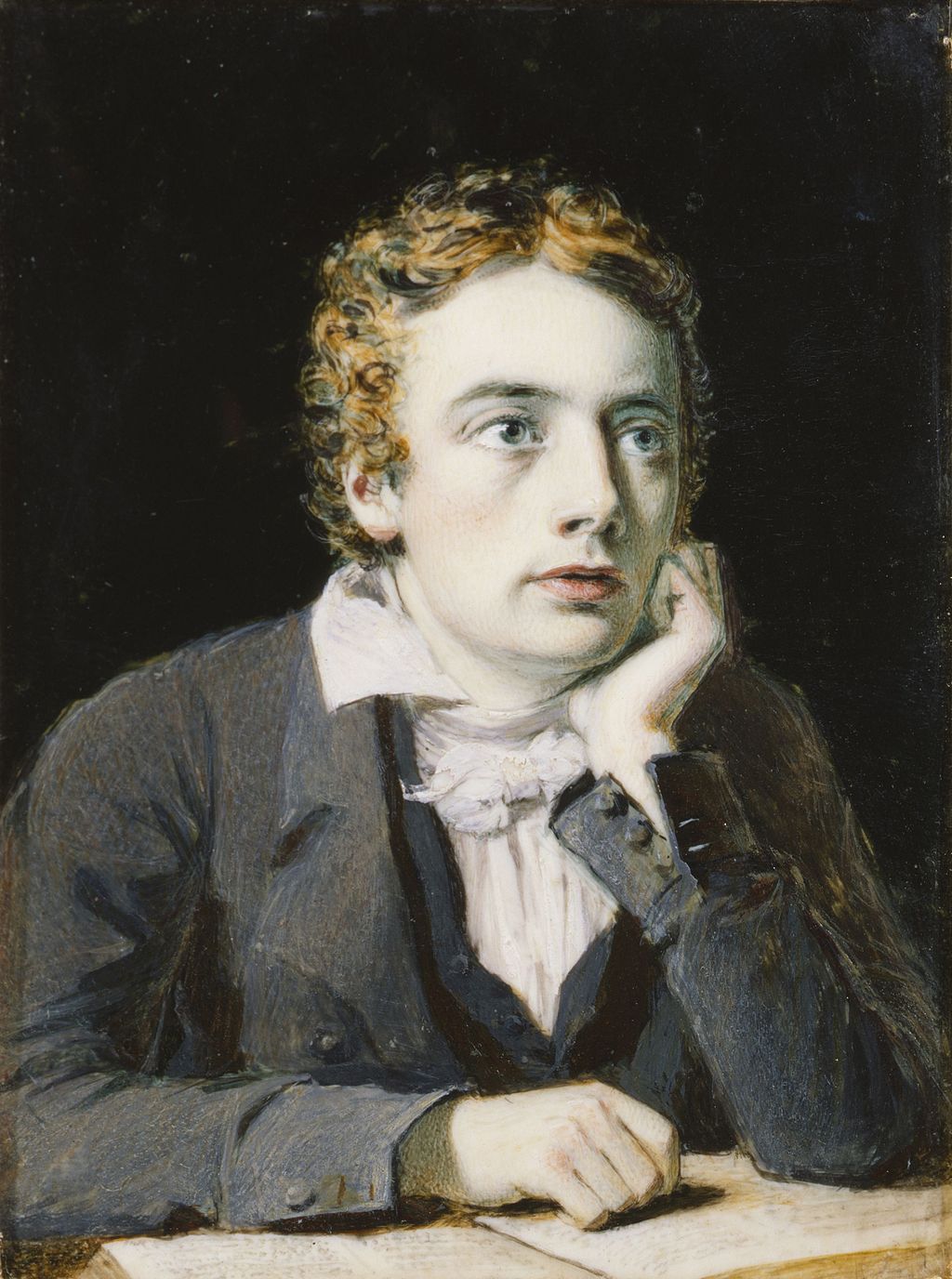
John Keats by Joseph Severn (1793-1879), 1819.
A Portrait of Keats at His Creative Peak
The miniature portrait of John Keats, painted in oil and watercolor on ivory by Joseph Severn in the opening months of 1819, captures the poet at one of the most extraordinary moments of his brief life. Now housed in London’s National Portrait Gallery (NPG 1605), the work measures just over four inches in height and dates from the same remarkable year in which Keats composed his six great odes, including Ode to a Nightingale, Ode on a Grecian Urn, and To Autumn. Severn exhibited the portrait at the Royal Academy in May 1819, when the poet was only twenty-three years old and still months away from the first appearance of the tuberculosis that would take his life in Rome in 1821.
Joseph Severn’s Friend and Subject
Severn was more than a fellow artist. A close friend of Keats and an aspiring painter seeking recognition, he created the miniature partly as a professional showcase for the Royal Academy exhibition, where portrait miniatures offered young artists a valuable means of attracting patrons. Yet the portrait also held deep personal significance. Severn later gave a watercolor version to Fanny Brawne, Keats’s fiancée, while the original oil-on-ivory miniature remained in his possession before passing through the hands of Keats’s close friend Charles Wentworth Dilke and eventually entering the museum collection.
Painted Directly from Life
Unlike many later images of Keats, this portrait was painted directly from life. During the winter and spring of 1819, Keats sat for Severn in London while the artist carefully recorded his appearance. Severn posed him with his left cheek resting against his hand and his right hand laid across an open book. The portrait preserves the poet’s reddish-gold curls, pale complexion, and intensely reflective gaze, conveying both youthful vitality and inward concentration.
Because Severn knew Keats personally and worked from direct sittings,those who knew Keats best considered Severn’s miniature the most authentic image ever made of the poet. Both Fanny Brawne and Keats’s sister, Fanny Keats, reportedly viewed it as the truest and most lifelike representation of him. The portrait’s intimacy and naturalness distinguish it from the more idealized images that would follow after Keats’s death.
Creating the Public Image of Keats
The miniature’s influence extended far beyond Keats’s circle of family and friends. It became the basis for several reproductions, most notably Henry Meyer’s steel and stipple engraving published in 1828 for Leigh Hunt’s Lord Byron and Some of His Contemporaries. Through these widely circulated versions, Severn’s likeness helped shape the enduring public image of Keats as a sensitive, contemplative poetic genius. More than two centuries later, the small portrait remains one of the most important visual records of the young poet, preserving the face of a writer whose greatest works were still fresh from the pen and whose literary immortality was only beginning to emerge.
1818:

Letter to his brothers, George and Thomas Keats, January 13-19, 1818. Letters of John Keats, no. 37, edited by Frederick Page, 1954. There is nothing stable in the world; uproar’s your only music.
Opening his letter to his brothers, Keats wrote: “I am quite perplexed in a world of doubts and fancies—there is nothing stable in the world; uproar’s your only music.” Keats was struck by the contrast between his friends’ artistic brilliance and their childish egos.

Endymion, Preface (1818). The complete line is: “This may be speaking too presumptuously, and may deserve a punishment: but no feeling man will be forward to inflict it: he will leave me alone, with the conviction that there is not a fiercer hell than the failure in a great object.”
1819:

John Keats, letter to his brother and sister, Spring 1819. While we are laughing, the seed of trouble is put into the wide arable land of events. While we are laughing it sprouts, it grows and suddenly bears a poison fruit which we must pluck.

Letter to his brother George Keats (1797-1841) and sister-in-law Georgiana Augusta Wylie Keats (1798-1879). Married in England in May 1818, the Keats departed for America going to Kentucky and southeastern Illinois by way of Philadelphia and Pittsburgh. The Keats are buried in Cave Hill Cemetery in Louisville, Kentucky. Mrs. Keats re-married after the poet’s brother died during experiences of serious financial setbacks. Do you not see how necessary a world of pains and troubles is to school an intelligence and make it a soul?

The Fall of Hyperion – A Dream. Canto 1, first lines (1819). Fanatics have their dreams, wherewith they weave A paradise for a sect.
Fanatics have their dreams, wherewith they weave
A paradise for a sect; the savage too
From forth the loftiest fashion of his sleep
Guesses at Heaven; pity these have not
Trac’d upon vellum or wild Indian leaf
The shadows of melodious utterance.
…
Whether the dream now purpos’d to rehearse
Be poet’s or fanatic’s will be known
When this warm scribe my hand is in the grave.

Letter, August 23, 1819, Letters of John Keats, no. 144, ed. Frederick Page, 1954. I will give you the definition of a proud man: he is a man who has neither vanity nor wisdom—one filled with hatreds cannot be vain, neither can he be wise.

Letter to George Keats, February 19, 1819. A Man’s life of any worth is a continual allegory–and very few eyes can see the Mystery of his life–a life like the scriptures, figurative–which such people can no more make out than they can the Hebrew Bible…Shakespeare led a life of Allegory; his works are the comments on it.
1820:

The poet suffered from– and died of– tuberculosis at the age of 25 years. Letter to his fiancée, Fanny Brawne, March 1, 1820. Health is my expected Heaven.